I’m having a little difficulty focusing on serious stuff like “the news” today. I’d love to just keep escaping into mystery/crime novels. So if this post is disjointed and basically a link dum, that’s the reason. Here are some of the stories that have caught my eye so far.
The Great Mentioner of the collective news media is beginning to dwell on Hillary Clinton’s options for a running mate. And a name we are all hearing more and more is that of Sen. Tim Kaine of Virginia. Indeed,Politico is now placing him at the top of Clinton’s list, even suggesting he “towers” above all others. So of course he’s going to get extra public scrutiny.
When that happens, people are going to realize there’s more to Kaine than his Beltway persona of a “safe” centrist Democrat who was vetted by Obama eight years ago and is from a key swing state. He’s fluent in Spanish, having spent a year as a Jesuit missionary in Honduras before he decamped to Harvard Law School. He was a career civil-rights lawyer specializing in housing discrimination before entering politics. He’s been mayor of a reasonably large city, Richmond, in addition to being lieutenant governor under Mark Warner and then Warner’s successor as governor. And as a former DNC chair, he knows all about the party’s factions and allies and how to deal with them.
All well and good, but . . .
An article this week in The Hill calls abortion policy Kaine’s one big “weakness.” Like many observant Catholic Democrats over the years, Kaine’s mantra on reproductive rights is that while he’s “personally opposed” to abortion, he’s largely inclined to keep the law out of women’s reproductive decisions. Yes, he’s favored parental-notification laws, but has carefully insisted on ensuring young women in danger of parental pressure to carry a pregnancy to term will have a judicial workaround. Yes, he’s favored bans on so-called “partial-birth abortions,” but only with exceptions where the health of the mother is at risk, which separates him from the entire anti-abortion movement, which uniformly hates health exceptions. He has a 100 percent rating of his votes in the Senate from Planned Parenthood. His policy positions on abortion may not be ideal to reproductive-rights advocates, but they are acceptable, particularly if the top spot on the ticket is occupied by an old friend like Hillary Clinton….
Does his personal moral assessment of abortion matter so long as he’s sound on abortion policy? And even if reproductive-rights advocates don’t approve of Kaine’s formulation, is he a representative of a whole lot of otherwise pro-choice voters who don’t or won’t approve of abortion “personally” no matter how logical that might be? Could Kaine’s stance actually become a strength if the ticket spans those adopting the traditional formula along with those embracing the rapidly emerging positive attitude toward abortion itself?
HOW quickly the unthinkable became the irreversible. A year ago few people imagined that the legions of Britons who love to whinge about the European Union—silly regulations, bloated budgets and pompous bureaucrats—would actually vote to leave the club of countries that buy nearly half of Britain’s exports. Yet, by the early hours of June 24th, it was clear that voters had ignored the warnings of economists, allies and their own government and, after more than four decades in the EU, were about to step boldly into the unknown.
The tumbling of the pound to 30-year lows offered a taste of what is to come. As confidence plunges, Britain may well dip into recession. A permanently less vibrant economy means fewer jobs, lower tax receipts and, eventually, extra austerity. The result will also shake a fragile world economy. Scots, most of whom voted to Remain, may now be keener to break free of the United Kingdom, as they nearly did in 2014. Across the Channel, Eurosceptics such as the French National Front will see Britain’s flounce-out as encouragement. The EU, an institution that has helped keep the peace in Europe for half a century, has suffered a grievous blow.
Managing the aftermath, which saw the country split by age, class and geography, will need political dexterity in the short run; in the long run it may require a redrawing of traditional political battle-lines and even subnational boundaries. There will be a long period of harmful uncertainty. Nobody knows when Britain will leave the EU or on what terms. But amid Brexiteers’ jubilation and Remain’s recriminations, two questions stand out: what does the vote mean for Britain and Europe? And what comes next?
Read about The Economist’s editorial viewpoint in detail at the link.
Meeting in Berlin, the top diplomats of Germany, France, Italy, the Netherlands, Belgium and Luxembourg collectively called for fast follow-through on the stunning British decision, putting pressure on Prime Minister David Cameron, who has sought a slower pace of extraction.
On Friday, Cameron said he would step down after several months but has not immediately sought to trigger the European Union’s Article 50, which would set up a two-year negotiating period ending with withdrawal. Cameron indicated that he would leave the exit decisions to his successor.
But the top diplomats meeting Saturday suggested the European Union was not prepared to wait for domestic politics to play out in Britain, suggesting that Cameron would face intense pressure on Tuesday during a summit in Brussels of 28 national leaders and European officials.
“We start now,” French Foreign Minister Jean-Marc Ayrault told reporters. “We must be clear. The British people have decided after an initiative that was taken by Mr. Cameron. That was, is his responsibly.”
That makes sense. If the Brits want to take their ball and go home, why should they wait around to watch the game instead?
Apparently the referendum isn’t binding and could be reversed by Parliament. At least, I saw this on Twitter this morning:
Wake up. We do not have to do this. We can stop this madness through a vote in Parliament. My statement below pic.twitter.com/V8f9Yo1TZd
The Democratic National Committee has already awarded contracts for merchandising, construction, transportation and event production for the four-day event on July 25-28.
Of the $150 million already spent by the committee, most of the money has gone to local businesses owned by women and minorities.
For example, an African-American-owned transportation company will provide buses and shuttles during the convention, according to The Atlantic.
Another African-American-owned business was hired to print business cards for the event, the magazine reported.
Leap Starr, owned by Liz Jenkins Santana, won the contract to plan PoliticalFest.
Jenkins Santana, who identifies as Native-American, African-American and Caucasian, said the contract is a big win for a small business and the largest Leap Starr has received for a one-time event, The Atlantic reported….
Census data shows nearly half – 47 percent – of Philadelphia businesses are owned by ethnic minorities, and it’s important the 50,000 DNC visitors see that reflected at the convention, according to Tiffany Newmuis, director of diversity and community engagement for the Philadelphia DNC 2016 Host Committee.
“We want people to leave here having seen what Philadelphia is really like,” she told The Atlantic.
She was hired specifically for diversity outreach and to make sure local businesses knew how to cash in on the convention…
I don’t suppose that will impress Bernie and the bros since it doesn’t involve helping white middle-class young people. Bernie is still complaining about the platform even though his ideas have mostly been included.
ST. LOUIS (AP) – Democrats approved a draft of the party platform early Saturday that includes steps to break up large Wall Street banks, advocates for a $15 an hour wage and urges the abolition of the death penalty, reflecting the influence of Bernie Sanders’ presidential campaign.
Supporters of presumptive Democratic nominee Hillary Clinton defeated measures pushed by Sanders’ allies that would have promoted a Medicare-for-all single-payer health care system, a carbon tax to address climate change and impose a moratorium on hydraulic fracking.
Deliberating late into the evening, the group considered the document’s language on the Israel-Palestinian conflict, an issue that has divided Democrats. The committee defeated an amendment led by Zogby that would have called for providing Palestinians with “an end to occupation and illegal settlements” and urged an international effort to rebuild Gaza.
Zogby said Sanders had helped craft the language. The draft reflects Clinton’s views and advocates working toward a “two-state solution of the Israel-Palestinian conflict” that guarantees Israel’s security with recognized borders “and provides the Palestinians with independence, sovereignty, and dignity.”
The committee also adopted language that said it supports a variety of ways to prevent banks from gambling with taxpayers’ bank deposits, “including an updated and modernized version of Glass-Steagall.” ….
And it approved language calling for the abolition of the death penalty. Clinton said during a debate earlier this year that it should only be used in limited cases involving “heinous crimes,” while Sanders said the government should not use capital punishment.
Here’s Bernie’s reaction:
I'm disappointed and dismayed that allies of Hillary Clinton beat back Democratic Party platform proposals on trade.https://t.co/DUCZL7s4wh
Nothing is ever good enough for this man. He simply doesn’t believe in compromise, and I’m convinced that he thinks a woman can never be his equal.
Page Six on CNN’s shocking decision to pay Donald Trump’s “former” campaign manager $500,000 to appear on air as a political commentator: CNN Staff revolts over Corey Lewandowski hire.
Sources told Page Six on Friday that CNN’s “facing a near internal revolt” over Jeff Zucker’s hiring of Lewandowski as an exclusive commentator for the news network days after he was fired as Donald Trump’s campaign manager.
“CNN is facing a near internal revolt over the Corey hiring,” said a TV insider, who described many in the newsroom as “livid.” “Female reporters and producers especially . . . They are organizing and considering publicly demanding” that Lewandowski be let go.
A different source said, “Everyone at CNN — and even people who used to work there — are pissed about Trump’s former campaign manager being hired on salary.”At CNN, the hiring of the former Trump campaign manager on Thursday didn’t only alienate women on staff. A source further said that “Latinos and others in the newsroom feel betrayed by an homage to Trump,” so “they may do a public letter” objecting to the move.
I hope there’s enough interesting stuff here to get you going. Have a terrific weekend!
Did you like this post? Please share it with your friends:
During a press conference in Japan, Obama said the American presidential election is being “very” closely watched oversees. He told reporters that “it’s fair to say” world leaders are “surprised” Trump is the presumptive Republican nominee.
“They are not sure how seriously to take some of his pronouncements but they’re rattled by him — and for good reason, because a lot of the proposals that he’s made display either ignorance of world affairs or a cavalier attitude,” Obama added.
He suggested Trump’s controversial proposals were more about “getting tweets and headlines” than “actually thinking through” what’s needed to keep America safe or the “world on an even keel.”
He also has said he wants to ban Muslims from entering the U.S., called the Iran deal “horrendous,” pledged to “build a wall” along the Mexican border and that he’d have “no problem speaking to” North Korea’s dictator.
President Barack Obama’s historic visit to Hiroshima is stirring conflicting emotions on both sides of the Atlantic.
Some 140,000 people were killed when the U.S. dropped an atomic bomb on the city on Aug. 6, 1945. Countless others suffered after-effects that endure to this day.
The White House has stressed Obama will not apologize for America’s use of the bombs when he visits the Hiroshima Peace Memorial Park on Friday — the first sitting president to do so….
“Of course everyone wants to hear an apology. Our families were killed,” Hiroshi Shimizu, general secretary of the Hiroshima Confederation of A-Bomb Sufferers Organizations, told The Associated Press.
Woman with a cat, Auguste Renoir
However, it would risk alienating Americans back home — especially giving the trip’s timing just ahead of Memorial Day.
Retired Army Staff Sgt. Lester Tenney, 95, spent more than three years in Japanese prison camps, and still has the blood-stained, bamboo stick Japanese troops used to beat him across the face.
“If you didn’t walk fast enough, you were killed. If you didn’t say the right words, you were killed, and if you were killed, you were either shot to death, bayoneted, or decapitated,” he told The Associated Press. “I’ll never forget it. And so for that reason … there’s no reason for us to apologize to them, not any reason whatsoever.
I have mixed emotions too. I’ve written here before that I probably wouldn’t be here today if Truman had not dropped the bombs in Hiroshima and Nagasaki. My father was on a ship to Japan when the news came, and he and the rest of his companions celebrated, because it meant they would be going home instead of to their likely deaths. How can I not be glad that my father survived?
When I worked at M.I.T., the head of my department was a man who had survived the Bataan Death March and then spent years in a Japanese prison camp. He was lucky to come through that alive; hundreds of Americans and Filipino prisoners did not.
Pablo Picasso, Reclining female nude playing with a cat
…Obama’s week abroad not so subtly serves a purpose beyond foreign relations: how he can help Democrats’ looming campaign against the billionaire GOP presidential candidate.
Pledging to stay neutral in the Democratic primary, Obama has instead struck a middle ground to help the party’s likely nominee, Hillary Clinton. He has engaged in a twist on the so-called Rose Garden campaign strategy where incumbent presidents lean on the trappings of their office to remind voters of their power and achievements. Obama is instead reminding voters of the seriousness of the job and, by extension, his belief in Clinton’s readiness for it.
On Friday, this president who has repeatedly pointed to the heady challenges on his desk as an argument against making a former reality show star the next commander in chief travels to Hiroshima, where one of two nuclear bombs ever used in warfare was dropped, to underscore the horrors of war and the life-or-death decisions that presidents face.
He doesn’t plan to talk about presidential politics at all in proximity to his trip to a memorial for victims of the atomic blast that killed about 140,000 people, a grim reminder of the devastating impact of a military attack that Obama finds defensible.
But the trip nonetheless provides a vivid illustration for the question Obama wants voters to ask themselves as they consider a presidential candidate — can you trust this person with the nuclear codes?
“We are in serious times, and this is a really serious job,” Obama said from behind the seal of the president at the White House lectern this month. “This is not entertainment. This is not a reality show.”
White House officials say that the president is eager to begin making a case to voters about the stakes of the race to replace him in the Oval Office, and will do so vigorously once the primaries are over.
Lilla Cabot Perry, Woman with cat
I can’t wait until President Obama hits the campaign trail for Hillary! One thing we Democrats have over the Republicans is some very powerful surrogates who will work hard to hold onto the White House and save the country from Trump: Elizabeth Warren, John Lewis, Joe Biden, Elijah Cummings, John Kerry, Barbara Boxer, and so many more.
Warren has been getting under Trump’s skin for awhile now, and on Tuesday she attacked him in a high-profile speech.
Elizabeth Warren delivered an extensive, blistering speech last night about Trump that will serve as a template for how Democrats will attack him — both in terms of how they’ll prosecute his business past and how they’ll try to undercut his central arguments about the economy….
The line that is driving all the attention this morning is Warren’s suggestion, in the context of Trump’s 2006 comment that a housing crash might enrich him, that the Donald is a “small, insecure money-grubber.” But Warren isn’t merely dissing Trump’s manhood. Warren — who went on to note that Trump “roots for people to get thrown out of their house” because he “doesn’t care who gets hurt, as long as he makes a profit” — is making a broader argument. Trump is not just a small, greedy person, but a cruel one, too.
That theme is also threaded through Warren’s broadside against Trump on taxes. He isn’t just paying as little as possible — and openly boasting about it — because he’s greedy. He isn’t just refusing to release his returns because he doesn’t want to reveal he’s not as rich as he claims (another shot at Trump’s self-inflated masculinity). All this, Warren suggests, also reflects a larger moral failing: Trump plays by his own set of rules, engorging himself, while simultaneously heaping explicit scorn on social investments designed to help those who are struggling in the same economy that made him rich. Warren notes that Trump recently likened paying his taxes to “throwing money down the drain” — i.e., he is reneging on the social contract — after “inheriting a fortune from his father” and “keeping it going by scamming people.” Thus, Warren is making a broader argument about Trump’s fundamental cruelty.
Here’s a video:
It’s time for the media to stop helping Trump and start dealing with the danger he poses to the country. If nothing else, they should be motivated by his attacks on the reporters who cover his campaign and on the the First Amendment. A few days ago, Jake Tapper gave a clinic for journalists on how to handle Trump’s outrageous lies.
CNN host Jake Tapper laid into GOP candidate Donald Trump for dredging up a debunked conspiracy theory that his likely opponent in the general election, Hillary Clinton, was somehow responsible for the death of then-Deputy White House Counsel Vince Foster.
Foster’s 1993 death was ruled a suicide.
Tapper called Trump out for saying in an interview that the circumstances around Foster’s death were “very fishy,” adding, “I don’t bring [Foster’s death] up because I don’t know enough to really discuss it. I will say there are people who continue to bring it up because they think it was absolutely a murder. I don’t do that because I don’t think it’s fair.”
“Except of course you just did that, Mr. Trump,” Tapper said. “But you’re right, it’s not fair that you did that, certainly not to Mr. Foster’s widow or their three children.”
Watch the video:
We need much more of this kind of fact-checking of Trump from the media and a whole lot less obsessing about Hillary Clinton’s emails.
The presumptive Republican nominee spent the past 24 hours blasting his likely opponent, Hillary Clinton, and his most provocative antagonist, Sen. Elizabeth Warren.
But he didn’t stop there. He also slammed New Mexico Gov. Susana Martinez, the nation’s only Latina governor and a Republican. Martinez might be seen as an obvious choice for diplomacy, or even intensive courtship, given Trump’s standing among women and Hispanics.
Trump chose a different approach: He told the residents of New Mexico to get rid of her.
In all three cases, the clashes were classic Trump. Slight him, diss him, hit him — and he’ll hit back harder. Much harder.
But they also could play right into Democrats’ plans to brand Trump as a serial misogynist as he goes up against a rival who could become the first female president in history. His poor standing with women — a CNN/ORC poll in March found he was viewed unfavorably by 73% of registered female voters — is one of his biggest liabilities heading into the fall.
“He makes a habit of insulting women,” Clinton said Wednesday afternoon as a campaign stop in California. “He seems to have something about women.”
Let’s hope Don the Con keeps this up. If Republican women vote against Trump, he could lose all 50 states.
Amid recurring violence at political rallies held by presumptive GOP nominee Donald Trump, many local officials and activists are increasingly worried that this lakeside city is ill-prepared to deal with tens of thousands of protesters and agitators expected to descend on the Republican National Convention here in July.
Some worry that police might be overrun or that the city has not stockpiled enough water to hydrate the masses in the mid-summer heat. Others, particularly on the left, oppose new restrictions that will be placed on demonstrators and object to the kind of military-style equipment law enforcement authorities may use to control the crowds.
There is also unhappiness among groups on both sides over the slow progress the city has made in approving parade and demonstration permits with less than two months to go.
On Wednesday, under the threat of a federal lawsuit by some groups upset by delays, city officials finally unveiled an official parade route and speakers’ platform in a major downtown park. Parades and protests will be allowed, but plans by some groups to bring in trucks, horses and, in one case, a giant bomb-shaped balloon might need to be rethought.
A bomb-shaped balloon?! So classy.
So . . . what stories are you following today? Please post your thoughts and links in the comment thread and have a tremendous Thursday!
Did you like this post? Please share it with your friends:
Well, I’m holding down the fort today! Both BB and JJ are off surfing samsara which is my little way of saying they’re dealing with a series of life’s little unpleasantness. That seems to be the order of the day. There’s a war on life’s pleasantries out there! The majority of us are losing the fight.
So, I watched the Republican Townhall last night. One hour with each of them is an hour wasted in Bizarro. Ted Cruz is a sociopath. He dodged all questions choosing to spin a series of anecdotes with no relation to the question asked by Anderson Cooper or the participants. The fact he thought these anecdotes charming given his self congratulatory manner–when they definitely were not–says a lot about his inability to even fake being human for short periods of time. He’s positively reptilian. Donald Trump is walking, savage ID. He has no conception of anything remotely related to the rest of the world that hasn’t been directly in his face and interests. The sentence I bolded below pretty much sums the Trump exchange.
During a CNN town-hall forum Tuesday night, Donald Trump reiterated the falsehood that Sen. Ted Cruz was responsible for spreading around an image of his wife Melania in a nude pose. “I thought it was a nice picture of Heidi,” Trump said of an image he retweeted clearly meant to make her look unattractive compared to his wife. “Come on,” Anderson Cooper responded. “I thought it was fine,” Trump insisted. Continuing to deny culpability, he said “I didn’t start it.” Cooper sensibly retorted, “That’s the argument of a 5-year-old.”
That sentence pretty much sums up the behavior of most of the politicians associated with the Republican Party who basically have not been doing their actual jobs for some time. They won’t examine or confirm SCOTUS nominees. They continually vote to get rid of the ACA when they know the bill will go no where. They are obsessed with Planned Parenthood based on outright lies. They deny the impact and causes of Climate Science. It’s the behavior of a 5-year-old that doesn’t get his way.
The unraveling of the Republican party is not good for this country. Candidates like Ted Cruz and Donald Trump are signs that something has gone supremely wrong. Kasich appears to be the only sane one left unless you count Rubio who seems to be angling to hold on to his delegates in some weird hope that a brokered convention will anoint him. Both may be sane. Neither are presidential material. Rubio is dumb and Kasich wanders that ethereal wasteland between being pragmatic and preaching radical religious right sermons worthy of any common religious fanatic.
It is a full on war between the Republican Establishment and the white, working class base it has used as a foil to push through bad tax policy since the Pied Piper of Hollywood spun a tune to romance them into the Republican fold. Ronald Reagan’s dogwhistles and tales of a white utopia, a city on the hill, enticed them to vote Republican for a few decades. Dubya’s uncanny ability to sound homespun and create wars to appeal to their patriotic nature may have held them for awhile. But now they are unleashed with wide open eyes and a distaste of all things Romneyesque. The want real brutes. Karl Rove no longer can manipulate their lesser angels with empty promises and heads. They want the real deal.
If you listen to establishment gurus, you’d be led to believe that the Republican primary voter revolt was birthed by the governance of President Obama, creating fertile ground for the emergence of one Donald Trump. This fairy tale version of reality casts Trump as the villain who has swept in to capitalize on voter frustration with Obama’s alleged weakness, lawlessness and rampant liberalism.
The villain must be stopped or the Republican Party will be destroyed. Or so we are told.
The old saw that you have to first acknowledge that you have a problem to solve the problem applies here. What the GOP “leaders” refuse to accept is that Trump is not the problem. They are.
The dissatisfaction among a large cohort of GOP voters is directly attributable to their unhappiness with a party that they believe does not represent their interests. In exit polls, high percentages of GOP voters registered displeasure with their leadership. In Tennessee, 58% of Republican voters said they felt “betrayed” by their leaders, as did 47% in New Hampshire, 52% in South Carolina and 54% in Ohio.
Those who feel betrayed have been most likely to vote for Trump. Trump has been a particular draw to white working-class voters who feel left behind economically. Such voters have been treated with dismissal and outright contempt by the GOP establishment even as this group has become more critical to Republican success. Pew reported in 2012 that “lower-income and less educated whites … have shifted substantially toward the Republican Party since 2008.”
In other words, their peasants are revolting. Given this, how can the party’s elite make their way through a brokered convention when the party itself is so positively unmoored? Its main policy goal is tax avoidance for the very wealthy. After that’s accomplished, they throw bits and pieces of radical religious bills at the wall to see what will stick while railing against minorities, women, and immigrants.
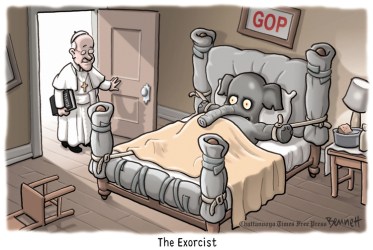
The modern Republican Party has devolved into a tax avoidance scam for rich people. The scam is a masterpiece of psychological manipulation, in which the racial, cultural and economic anxieties of (mostly white) voters are exploited, in order to get those voters to support policies that transfer ever-greater percentages of wealth from themselves to the top 0.1 percent.
It really isn’t any more complicated than that. Everything else – the “culture wars,” the continual hysteria about terrorism, the non-stop rhetoric about how the mainstream media, the universities, the scientists, and basically the rest of the modern world are all biased against conservatives – it’s all just so much noise, designed to solve the tricky problem of how to get ordinary people to support economic policies that make them poorer and rich people richer.
You couldn’t come up with a better illustration of this principle than the ongoing GOP campaign to eliminate the estate tax. Last year the House voted to get rid of it, and a majority of Republican senators have pledged to do the same.
The Republican propaganda machine has waged a multi-decade war against the estate tax, which it has rebranded the “death tax.” Because of these efforts, the tax has been watered down to the point where, under current law, only a tiny group of wealthy people will ever pay any estate taxes at all.
But of course that isn’t enough, since it means that some taxes still have to be paid on truly enormous inheritances, and protecting the economic interests of people who have a net worth in the eight, nine, 10 or 11 figures is the contemporary GOP’s entire reason for being.
Clay Bennett, Chattanooga Times Free Press
The emergence of Trump as a leading Republican candidate is something found incredulous by enabling media types who have been equivocating between Democrats and Republicans for some time. They’ve refused to hold any one accountable for outright lies.
One of the most amazing things to see is the panic in our allies as major Republican candidates want to dump NATO, dally with war crimes and nuclear weapons, and ignore treaties and trade agreements. That’s how equivocal Republicans and Democrats really are from the view here on USA Main Street. The one thing that’s been fairly consistent in American governance is the respect for pre-existing foreign agreements and diplomacy. Each President–even while holding different visions of the country–basically finds value in remaining on a stable and predictable path in foreign affairs. The Republican historical area of expertise used to be foreign policy until now.
Lobbyists in Washington say they are being flooded with questions and concerns from foreign governments about the rise of Donald Trump.Officials around the globe are closely following the U.S. presidential race, to the point where some have asked their American lobbyists to explain, in great detail, what a contested GOP convention would look like. There is nothing conservative about Trump or the Republican party these days other than their tax avoidance schemes. They are a party of insurgents and radicals hellbent on an agenda to turn back modernity.
The questions about Trump are “almost all-consuming,” said Richard Mintz, the managing director of Washington-based firm The Harbour Group, whose client list includes the governments of Georgia and the United Arab Emirates.
After a recent trip to London, Abu Dhabi and Beijing, “it’s fair to say that all anyone wants to talk about is the U.S. presidential election,” Mintz added. “People are confused and perplexed.”
The Hill conducted interviews with more than a half-dozen lobbyists, many of whom said they are grappling with how to explain Trump and his unusual foreign policy views to clients who have a lot riding on their relationship with the United States.
“We’re in uncharted territory here,” said one lobbyist with foreign government clients who asked not to be identified.
“The questions coming from the international community are not different than the things, categorically, we’re asking ourselves,” said Nathan Daschle, the president and chief operating officer of the Daschle Group, a firm run by his father, former Sen. Tom Daschle (D-S.D.).
“There’s an added level of bafflement because this is not the United States that they’ve been living with for so long,” Daschle said. “This is not the image the United States has been projecting.”
The questions about Trump often concern his foreign policy positions.
The businessman has boasted about keeping his options open on many crucial foreign policy questions, including on trade, troop-sharing agreements and the U.S. posture toward China.
“I don’t want to say what I’d do because, again, we need unpredictability,” Trump told The New York Times in an interview published over the weekend.
A second lobbyist who represents countries in Latin America, Asia and the Muslim world said answers like that have made Trump a “wild card” for leaders around the world.
“Nobody knows whether he believes anything of what he says because he’s changed his position so many times,” the lobbyist said.
Some of Trump’s comments — especially about Mexico, Muslims and trade with countries such as Japan and China — have also angered foreign leaders.
A third lobbyist for governments in Asia said part of his job has been telling countries how to react to some of Trump’s controversial remarks.
“If you come out and blast Donald Trump — for the people who are going to vote for Donald Trump, that could make them like him more,” the lobbyist, who also represents foreign companies with a large presence in the U.S., said he has told foreign leaders.
Nearly two-thirds of Americans believe torture can be justified to extract information from suspected terrorists, according to a Reuters/Ipsos poll, a level of support similar to that seen in countries like Nigeria where militant attacks are common.
The poll reflects a U.S. public on edge after the massacre of 14 people in San Bernardino in December and large-scale attacks in Europe in recent months, including a bombing claimed by the militant group Islamic State last week that killed at least 32 people in Belgium.
Donald Trump, the front-runner for the 2016 Republican presidential nomination, has forcefully injected the issue of whether terrorism suspects should be tortured into the election campaign.
Hillary Clinton says foreign leaders are privately reaching out to her to ask if they can endorse her to stop Donald Trump from becoming president of the United States.
“I am already receiving messages from leaders,” Clinton told an Ohio audience at a Democratic presidential town hall on Sunday night.
“I’m having foreign leaders ask if they can endorse me to stop Donald Trump.”
He’s suggested using economic warfare to halt China’s territorial moves in the South China Sea and raised the prospect of a fundamental reconsideration of nuclear doctrine by musing about South Korea and Japan acquiring their own atomic arsenal. He says the U.S. should boycott Saudi Arabian oil if the kingdom doesn’t send ground troops to fight ISIS and believes NATO is an anachronism. And he warns he will renegotiate bedrock free trade deals, a prospect that could send serious reverberations through the global economy.
“It is rattling the windows of foreign ministries all over the world,” said CNN’s senior political analyst David Gergen, who has worked for a string of Democratic and Republican presidents.
Trump has gone to great lengths over the past week to explain his foreign policy views, which are often criticized as overly vague. He’s participated in extensive interviews with The Washington Post and The New York Times and delivered a speech — notable because it was carefully pre-written — to the leading pro-Israel group in Washington. He’ll have another opportunity to address foreign policy Tuesday night during a CNN town hall in Milwaukee, Wisconsin.
The interviews reveal Trump as someone who is just as willing to flout the foreign policy establishment as he is the GOP elite. His statements appear to fly in the face of the longstanding assumption underlying U.S. foreign policy — that supporting allies financially, diplomatically and militarily promotes a global system of unfettered free trade, democracy and stability that is overwhelmingly in the national interests of the United States.
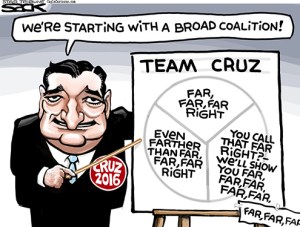
As the embodiment of this truculence, Texas Senator Ted Cruz, today finding favor among Republicans desperate to derail Donald Trump’s bid for the GOP nomination, stands alone. From the very outset of his candidacy, Cruz has depicted himself as the one genuinely principled conservative in the race. And in comparison to Trump, who is ideologically sui generis, Cruz does qualify as something of a conservative. When it comes to foreign policy, however, Cruz offers not principles but—like Trump himself—raw pugnacity.
Cruz has gone out of his way to deride the pretensions of democracy promoters, mocking “crazy neocon invade-every-country-on-earth” types wanting to “send our kids to die in the Middle East.” On the stump, Cruz advertises himself as Reagan’s one-and-only true heir. As such, he endorses “the clarity of Reagan’s four most important words: ‘We win, they lose.’” Upon closer examination, Cruz is actually advocating something quite different: “We win, they lose, then we walk away.”
The key to “winning” is to unleash American military might. “If I am elected president, we will utterly destroy ISIS,” Cruz vows. “We won’t weaken them. We won’t degrade them. We will utterly destroy them. We will carpet-bomb them into oblivion…. We will do everything necessary so that every militant on the face of the earth will know…if you wage jihad and declare war on America, you are signing your death warrant.”
Yet rather than Reaganesque, Cruz’s prescription for dealing with Islamist radicalism represents a throwback to bomb-them-back-to-the-Stone-Age precepts pioneered by Gen. Curtis LeMay and endorsed by the likes of Barry Goldwater back when obliteration was in fashion. The embryonic Cruz Doctrine offers an approximation of total war. “I don’t know if sand can glow in the dark, but we’re going to find out!” he promises with evident enthusiasm.
Nowhere, however, does his outlook take into account costs, whether human, fiscal, or moral. Nor does it weigh the second-order consequences of, say, rendering large parts of Iraq and Syria a smoking ruin or of killing large numbers of noncombatants through campaigns of indiscriminate bombing. In essence, Cruz sees force as a way to circumvent history—a prospect that resonates with Americans annoyed by history’s stubborn complexities.
Kasich has survived so far by keeping his head down and winning his home state of Ohio. But now that he is one of only three candidates remaining in the race, the former congressman and current Governor of Ohio will face the kind of media scrutiny that he has managed to avoid since he announced his candidacy. It will show that he is an outright mediocrity.
Kasich served on the House Armed Services Committee for eighteen years, where his strong beliefs on fiscal responsibility and budget cutting earned him the moniker of the “cheap hawk.” He accomplished next to nothing, apart from limiting the procurement of B-2 bombers.
During his long tenure in Congress, Kasich casted a number of votes on war-and-peace issues, voting for the Gulf War in 1991 but opposing Ronald Reagan’s decision in 1983 to send U.S. Marines to Lebanon for a peacekeeping mission. He reminds voters during town hall meetings and debates that the United States should get out of the business of nation-building and should stay far away from manufacturing democracies around the world. But he also floated the preposterous idea that the way to stop ISIS in its tracks is for the next president to create a new government agency to “beam messages around the globe” about the American credo of liberty.
At times, it is difficult to pinpoint what kind of foreign policy doctrine a potential President John Kasich would follow. He’s asserted that Russian President Vladimir Putin has gotten away with far too much during the Obama administration, including his annexation of the Crimean Peninsula, his military and economic support to separatist forces in eastern Ukraine, and his decision to send fighter jets into Syria to strengthen the defenses of Bashar al-Assad’s regime. “[I]t’s time that we punched the Russians in the nose,” Kasich told radio host Hugh Hewitt during a December presidential debate. “They’ve gotten away with too much in this world, and we need to stand up against them . . . in Eastern Europe where they threaten some of our most precious allies.”
On other issues, like the nuclear agreement with Iran, Kasich has oscillated between common sense (“You’re going to rip it up and then what?”), depressed resignation (“I’m sort of sick to my stomach about it because . . . Iran’s going to get a ton of money”) to defiant opposition (“if I were president, I would call them and say, I’m sorry, but we’re suspending this agreement”). With respect to the Islamic State, Kasich has emphasized coalition building with Arab allies similar to George H.W. Bush’s alliance building during the Persian Gulf War—a safe position that is just muscular enough to pass muster with Republican voters, but benign enough that it wouldn’t raise the eyebrows of realists who call the party home.
The looming question is whether John Kasich is hawkish enough for the GOP foreign policy establishment, a club that has been heavily influenced by neoconservative thinking for the past fifteen years.
At least “outright mediocrity” wont scare the children. It won’t scare ISIS either.
It’s been incredible to watch Bernie Sanders with his generalities and overreaching promises dodge serious foreign policies questions through out the Democratic Debates. He tends to fall back on insisting that his vote against the Iran Resolution just says it all. It doesn’t, however. His generalities fall way short of Clinton’s recall of names and her credentials as the nation’s chief foreign policy negotiator. I have to say that I learn a little bit more about the entire world each time she steps to the podium and takes a foreign policy question or makes a foreign policy speech.
Imagine what the debates and town halls in the general will look like when she takes on one of these candidates from the party in total disarray. My guess is that entire countries will be cheering for her.
I should close here but I’d like to share this with you so you can see that she will be our candidate for the fall despite the bleating and chest thumping of the cult of Bern. Here’s Nate Silver’s estimate of Bernie’s long shot path from today. It is beyond improbable that he can get 988 more pledged delegates and romance the Super D’s. Yes, there is one more campaign out there in Bizarro and it’s not a Republican one.
If you’re a Sanders supporter, you might look at the map and see some states — Oregon, Rhode Island, West Virginia, Montana and so forth — that look pretty good for Sanders, a lot like the ones that gave Sanders landslide wins earlier in the campaign. But those states have relatively few delegates. Instead, about 65 percent of the remaining delegates are in California, New York, Pennsylvania, New Jersey and Maryland — all states where Sanders trails Clinton in the polls and sometimes trails her by a lot.
To reach a pledged delegate majority, Sanders will have to win most of the delegates from those big states. A major loss in any of them could be fatal to his chances. He could afford to lose one or two of them narrowly, but then he’d need to make up ground elsewhere — he’d probably have to win California by double digits, for example.
Sanders will also need to gain ground on Clinton in a series of medium-sized states such as Wisconsin, Indiana, Kentucky and New Mexico. Demographics suggest that these states could be close, but close won’t be enough for Sanders. He’ll need to win several of them easily.
None of this is all that likely. Frankly, none of it is at all likely. If the remaining states vote based on the same demographic patterns established by the previous ones, Clinton will probably gain further ground on Sanders. If they vote as state-by-state polling suggests they will, Clinton could roughly double her current advantage over Sanders and wind up winning the nomination by 400 to 500 pledged delegates.
The nation and the world should breathe a collective sigh of relief when Clinton wins the nomination and the presidency. The alternatives to Hillary are the stuff of national nightmares. In fact, they would be a global nightmare and the majority of the US and the world knows it.
What’s on your reading and blogging list today?
Did you like this post? Please share it with your friends:
A series of terrorist bombings took place in Brussels, Belgium early this morning just days after the capture of Salah Abdeslam, the last surviving member of the group that perpetrated the attacks in Paris last November. This is a breaking story.
At least 26 people are dead and more than 100 wounded, after explosions struck Brussels during the Tuesday morning rush hour, Belgian officials say. Two blasts hit the international airport; another struck a metro station. Belgium has issued a Level 4 alert, denoting “serious and imminent attack.”
“What we feared has happened, we were hit by blind attacks,” Prime Minister Charles Michel said at a midday news conference Tuesday. He added that there were many dead and many injured.
Citing Minister of Social Affairs and Health Maggie De Block, Belgian media say 11 people died in the airport attack. Transit and other officials say 15 people died at the metro station. Those same sources say there were 81 injured at the airport and 55 hurt in an attack on a train near the Maelbeek station.
French President Francois Hollande says, “terrorists struck Brussels, but it was Europe that was targeted — and all the world that is concerned.”
Obviously, the number of dead and injured could go up as authorities learn more. See live tweets with photos at the link.
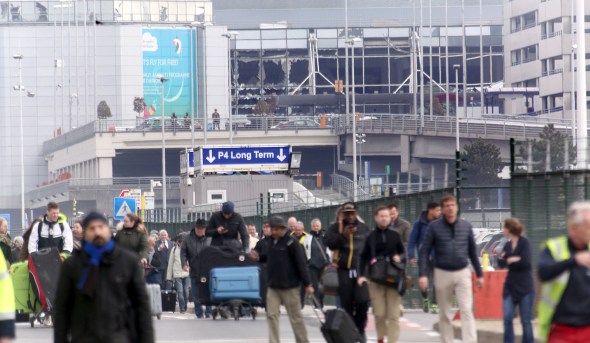
BRUSSELS, BELGIUM – MARCH 22: Passengers are evacuated from Zaventem Bruxelles International Airport after a terrorist attack on March 22, 2016 in Brussels, Belgium. At least 13 people are though to have been killed after Brussels airport was hit by two explosions whilst a Metro station was also targeted. The attacks come just days after a key suspect in the Paris attacks, Salah Abdeslam, was captured in Brussels. (Photo by Sylvain Lefevre/Getty Images)
Three explosions rocked Brussels on Tuesday morning, killing more than two dozen people and injuring an untold number of others, according to local authorities and reports from the ground. While the cause of the blasts—two at the city’s airport and then one in its subway system about an hour later—remain unknown, officials are treating them as acts of terrorism. The carnage comes only days after Belgium police arrested Salah Abdeslam, the man believed to be the sole remaining survivor of the 10 men who carried out the terrorist attacks in Paris this past November that killed 130 people.
The latest update says “several of the apparent attackers may still at large.”
Jef Versele, from the Belgian city of Ghent, was making his way to check-in for a flight to Rome at Brussels Airport Tuesday morning when he heard a loud noise emanating from several floors below him.
“At first I was not aware that it was a bomb,” he told CNN. “I had the idea that an accident had happened in a food court or something like that.”
The explosion set off a panic, with people screaming and running through the terminal, before it was followed by a second explosion, “which was in my eyes much more powerful than the first one.”
The second blast, which blew out windows at the airport and brought ceiling panels down, left people collapsed on the floor and triggered even greater panic.
“It was quite a mess,” he told CNN.
He said although he was two floors above the source of the explosions — at least one of which was a suicide bombing, according to Belgian prosecutor Frederic Van Leeuw — many people around him were injured by the blast. He said there about 50 to 60 injured on his level of the airport, while the scenes on the lower levels were worse.
“A lot of people were on the floor. They were injured,” Versele said. “I think I was lucky, I was very lucky. I think I have a guardian angel somewhere.”
More eyewitness accounts at the link. Brussels is now on lockdown, according to the Boston Globe, which is also posting live updates.
U.S. President Barack Obama tours Old Havana with his family at the start of a three-day visit to Cuba, in Havana March 20, 2016. Photo by Carlos Barria/Reuters
President Obama will address the Cuban people directly Tuesday, delivering a speech that will be televised live on state television.
The address in Havana’s newly renovated Gran Teatro, before an audience of invited guests of the U.S. and Cuban government, is the keystone event in Obama’s two-and-a-half-day visit to the island. His top advisers said it represented his best chance to outline his vision of the future to ordinary citizens here, and to Cuban Americans at home.
White House deputy national security adviser Ben Rhodes told reporters Monday the speech was “important because it’s the one chance to step back and to speak to the Cuban people, and all of the Cuban people,” including “Cubans in the United States.”
One of Obama’s overarching goals in fostering a diplomatic thaw with America’s longtime adversary, Rhodes said, was “reconciliation of the Cuban American community to Cubans here on the island.”
Still, even the speech’s setting spoke to the ongoing challenge the United States faces when it comes to engaging in a public dialogue in Cuba. American officials had originally hoped to do the address in an open-air setting, which would have allowed more ordinary citizens to attend. Instead, the national theater accommodates roughly 1,000 people, and the two governments evenly divided the tickets.
And even as the president seeks to highlight how his approach to Latin America has paid dividends, a series of blasts at Brussels’s airport and a metro station Tuesday served as a powerful reminder that terrorism overseas continues to threaten global stability. The apparently coordinated strikes have killed at least 26 people.
Back in the USA, Arizona is holding a presidential primary today and there will be caucuses in Idaho and Utah. (In Idaho, the Republicans have already voted.) On the Democratic side, Arizona, with 75 delegates, is the biggest prize.
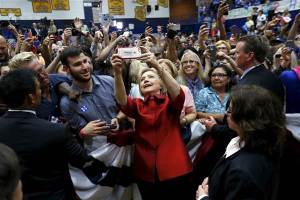
Democratic U.S. presidential candidate Hillary Clinton takes a selfie with supporters at a campaign rally at Carl Hayden Community High School in Phoenix, Arizona March 21, 2016. REUTERS/Mario Anzuoni MARIO ANZUONI / Reuters
PHOENIX, Ariz. — Guadalupe Arreola can’t vote in the Arizona primary Tuesday because she is undocumented, so she has spent the last few weeks encouraging Latinos who can to vote for Democratic candidate Bernie Sanders. On Sunday, she hosted a phone bank at her house. More than 50 people showed up.
“There are people who still don’t know Bernie Sanders, and I want to raise awareness of who he is,” said Arreola, whose daughter Erika Andiola is Sanders’ Latino media spokeswoman.
Martin Hernandez said he likes Clinton’s stance on a number of issues important to Latinos, including healthcare and immigration. An organizing director for the United Food and Commercial Workers Union Local 99, hesaid he especially likes that that she seems to understands the needs of Latino workers.
“I want somebody in the presidency who is going to help workers, especially those in our immigrant community,” he said. “They are the ones who face the most abuse. Many of them are underpaid and their rights are violated by their employers.”
Arreola and Hernandez represent the split that exists among Latino Democrats in Arizona on whether Sanders or Clinton should be the Democratic nominee for president. Both candidates have the backing of prominent Latino leaders, some of whom have appeared in television and radio ads being broadcasted across the state.
I’m not sure if NBC is just trying to make the primary look close or not. According to the Real Clear Politics average, Clinton is leading Sanders in Arizona 53-23, but FiveThirtyEight says there hasn’t been enough polling for them to project a winner. From everything I’ve heard, I think Hillary will win Arizona, and Sanders could win the Iowa and Utah caucuses.
Horrifying photo of Donald Trump at a rally in Salt Lake City.
However, there’s a wild card in Utah, according to Al Giordano (from privately distributed newsletter). He says that more and more Mormon women are voting Democratic, and it’s possible they could caucus for Clinton. Mormons absolutely hateand fear Donald Trump, so Giordano argues that it’s even possible that Utah could turn blue in November if Trump is the GOP nominee.
So far in 2016, members of the Church of Jesus Christ of Latter-day Saints have proven to be one of the most stubbornly anti-Trump constituencies in the Republican Party — a dynamic that will likely manifest itself in Utah’s presidential caucuses next week.
National polling data focused on Mormon voters is hard to come by, but the election results speak for themselves. Even as Trump has steamrollered his way through the GOP primaries, he has repeatedly been trounced in places with large LDS populations.
In Wyoming, the third-most-heavily Mormon state in the country, Trump was able to muster just 70 votes in the low-turnout Republican caucuses there — losing to Ted Cruz by a whopping 59 points.
In Idaho, the country’s second most Mormon state, Trump lost the primary by 18 points.
And in the Mormon mecca of Utah, the most recent primary poll has Trump in third place — more than 40 points behind Cruz and 18 points behind Kasich.
The pattern holds at the county level as well. As New York Times data journalist Nate Cohn illustrated, the larger the proportion of Mormons in a given county, the worse Trump has generally performed in the primary contest there.
First, the state’s adopted son, Mitt Romney, went gunning for Trump for weeks on end, and eventually revealed that he was backing Ted Cruz in the upcoming caucuses. Utah is adjacent to Idaho and Wyoming, where Trump has seen two of his biggest losses so far, both to Cruz. In a poll from Y2 Analytics released over the weekend, Trump comes in third, 42 points behind Cruz. (If Cruz wins more than half of the votes in the state, he gets all of the state’s 40 delegates.)
What’s even more remarkable, though, is that another poll suggested that Trump would lose to either Democrat in Utah in the general election. Utah is, of course, one of the reddest states — if not the reddest state — in the country. “Any matchup in which Democrats are competitive in the state of Utah is shocking,” Brigham Young University’s Christopher Karpowitz said to the Deseret News about that result.
Why? Mormon voters, of course; but polling (see lots of graphics at the link) show that people of any religion who are regular church-goers are more likely to be anti-Trump.
What may be prompting the stiff resistance to Trump, then, isn’t just that Utah is home to a lot of Mormons — it’s that those Mormons are more religious and that religious voters are more likely to view Trump with hostility.
The good news for Trump is that most of the states with the largest groups of regular churchgoers have already voted. Most are in the Bible Belt, as you might expect — a region where Trump did very well. Political beliefs are more complicated than they might appear at first glance. Sort of like religious ones.
It’s an interesting wild card, and something to keep an eye on. I’d certainly expect Jewish voters to be frightened by Trump’s strong-man campaign.
So . . . lots of things happening around the world today. What stories are you following? Dakinikat will post a live blog this evening for us to discuss primary and caucus results.
Did you like this post? Please share it with your friends:
Has any other presidential candidate in history had to fight the corporate media in addition to attacks from the other party and her opponents for the nomination to the extent that Hillary has to? I don’t think so. In just two days, Iowans will head to the caucuses. What “bombshells” will the media find to hype against Hillary before Monday night?
Today it’s “Eghazi” once again. Yesterday, the State Department announced that some of Clinton’s emails have been retroactively deemed to be “top secret.” The emails were not sent by Hillary from her private email server. They were sent to her by other people using the State Departments unclassified email server, because the information was not classified at the time.
Unfortunately, someone in the “intelligence community”–presumably GOP partisan(s)–told the State Department they cannot release these emails, so now the Hillary haters can speculate to their hearts’ content. Some of these withheld emails were exchanges between then Secretary of State Clinton and President Barack Obama! But you know, “Benghazi!!” Eghazi!!
I’ll post just one corporate media article about this from eminent Clinton hater and Washington Post columnist Chris Cillizza: Hillary Clinton’s email defense just hit a major bump in the road. Seriously? Oh, and the article is accompanied by an unflattering photo of Hillary frowning.
For months, Hillary Clinton and her presidential campaign have stuck to a consistent story line when faced with allegations of classified information on the private server she used exclusively as secretary of state: She was the victim of an overzealous intelligence community bent on categorizing information as top secret or classified when it was, in fact, neither.
Suddenly Clinton’s narrative of an overly aggressive intelligence community or a broader squabble between the intelligence world and the State Department didn’t hold water. Or at least held a whole lot less water than it did prior to Friday afternoon.
The Clinton team quickly pivoted. “After a process that has been dominated by bureaucratic infighting that has too often played out in public view, the loudest and leakiest participants in this interagency dispute have now prevailed in blocking any release of these emails,” said campaign spokesman Brian Fallon.
Calling for the release of the allegedly top secret emails is a smart gambit by the Clinton folks since it makes them look as if they have nothing to hide while being protected by the near-certainty that the State Department won’t simply change its mind on the release because the Clinton team asked them to.
Still, the timing of the State Department announcement, coming just three days before the pivotal Iowa caucuses, and the nature of that announcement seem likely to further complicate a situation that has already caused Clinton and her campaign huge amounts of agita since the existence of her private email server was revealed almost one year ago to the day.
You can read more Cillizza lies and distortion at the link.
It’s not likely you’ll see the true story in the corporate media, so here are some calmer responses from people who actually know what they’re talking about. By the way Clinton spokesman Brian Fallon is one of those people. He was previously director of communications for the Department of Justice and dealt with classified material on a daily basis.
This is overclassification run amok. We adamently oppose the complete blocking of the release of these emails. https://t.co/77s6mtm0JA
So what is really happening? As far as I can tell, there is absolutely nothing new here. It’s all about politics and trying to keep Hillary Clinton from becoming POTUS.
If it’s top secret, then it must be really sensitive, right?
Not necessarily. A large proportion of documents that our government classifies are not actually that sensitive — more on that below. So the key thing now is to try to figure out: Were these emails classified because they contain highly sensitive information that Clinton never should have emailed in the first place, or because they were largely banal but got scooped up in America’s often absurd classify-everything practices? [….]
According to a statement by the State Department, “These documents were not marked classified at the time they were sent.”
In other words, they do not contain information that was “born classified,” but rather fall into the vast gray area of things that do not seem obviously secret at the time but are later deemed that way — not always for good reason.
Go over to Vox to read about “America’s problem with overclassification.”
The furor over Hillary Clinton’s use of a private email account grew more serious for the Democratic presidential front-runner Friday as the State Department designated 22 of the messages from her account “top secret.” [. . .]
“These documents were not marked classified at the time they were sent [and they weren’t sent by Clinton imo – BTD my emhphasis] ,” Kirby said in a statement.
Sound familiar? It should because it is the same story I’ve been writing about since this nonsense started. See in particular State v. IC classification battles:
Now what does this mean? It means the Intelligence Community, represented here by the IC IG, disagrees with the State Department’s determination on the classification of certain information contained in the Clinton e-mails. In their opinion, the information should have been designated classified and should be so designated now. But State does not agree.
Now what were those “classified documents then? I reviewed some that got through. As you can see, the IC is full of crap.What about this batch? I think we can safely say that the bulk of these are news stories discussing drone strikes.
Gerstein writes:
The messages deemed “secret” also vary widely. One from Feb. 25, 2012, appears to discuss U.S. drone operations in Pakistan.”This is hitting the news, with Taliban or HQN [the Haqqani Network] claiming responsibility,” State policy planning chief Jake Sullivan wrote to Clinton. The message originated with the U.S. Ambassador in In Pakistan, Dick Hoagland. Nearly all the text is deleted, but press reports that day described the crash of a drone in North Waziristan.
U.S. drones in Pakistan are operated by the Central Intelligence Agency, but the program is officially covert and therefore classified, even though President Barack Obama has acknowledged it publicly.
In short it is just more crazy crap from IC – news articles are Top Secret!! seems to be the theory.
But leaving aside the overclassification issue, there is just a little problem for those who want to take Clinton down with this nonsense – she didn’t transmit any of the information – just received it. And the issue is not a private server – after all the State’s unsecure email system would not be appropriate for “classified” material either.
As you have heard from me often, if anyone is in trouble, it will be career State officials like the current Ambassador to Bahrain, William Roebuck, Timothy T. Davis and William J Burns.
There are seven emails which the State Department says are now considered classified.
The emails originated from inside the agency’s unclassified system.
They were not marked ‘classified’ or ‘top secret’ when they were sent.
The emails were not sent by Hillary Clinton, but were sent to her, along with a number of other people.
One of the ‘top secret emails’ is likely a published newspaper article.
In other words, this is not the huge scandal republicans were hoping for. Instead, it’s just another baseless right wing attack on Hillary Clinton that falls apart under even the slightest amount of scrutiny.
Sigh . . . I’m already exhausted from this crap and the weekend is just beginning.
I’ll end with two Politico pieces, one on Bernie Sanders and his campaign’s “foreign policy advisers” and another on Sanders’ claims that he is more electable than Clinton.
Not long after President Barack Obama ordered U.S. airstrikes in Libya in 2011, his national security adviser, Tom Donilon, trekked to Capitol Hill to brief Democratic senators. After a few minutes of discussion about the military operation, Bernie Sanders took the floor.
To talk about the economy.
“Sanders delivered a meandering manifesto about Democratic messaging on the economy,” says a former Senate chief of staff. “It wasn’t that his insights were wrong. It just wasn’t the time or place. Everyone was thinking, ‘Here goes Bernie!’ ”
Current and former Senate aides call the episode typical of Sanders, who on any given day would rather talk about Wall Street profits than about Middle East conflict….
Sanders has yet to give a speech exclusively on foreign policy, and on Friday his campaign backed away from an earlier commitment to deliver one before the Iowa vote. Numerous Democratic foreign policy insiders contacted by POLITICO could not name anyone who regularly advises the Vermont Senator on world affairs — a stark contrast to a Clinton campaign teeming with several hundred foreign policy advisers.
Oddly, the Sanders campaign is claiming to have foreign policy advisers who had no idea they were advising Bernie.
When asked whether Sanders has a full-time campaign staffer who handles foreign policy issues, his campaign did not respond. And several people whom the Sanders campaign has cited as sources of national security advice tell POLITICO they barely know the socialist firebrand.
“Apparently I had a conversation with him last August,” said Tamara Cofman Wittes, a Brookings Institution Middle East scholar, after checking her calendar upon hearing that her name was on a list of people the Sanders campaign said he had consulted in recent months. “My vague recollection is that it was about [the Islamic State] but I don’t really remember any of the details.” Wittes added that she backs Clinton.
“I don’t know how I got on Bernie Sanders’ list,” said Ray Takeyh, an Iran scholar at the Council on Foreign Relations who says he spoke to Sanders once or twice about the Iran nuclear deal at Sanders’ request in mid-2015.
What the hell? But of course Bernie voted against going into Iraq in 2002, so he’s the real foreign policy expert, right?
“Not only is Bernie Sanders electable in the general election,” insisted Sanders senior adviser Tad Devine, “he’s a stronger candidate than Hillary Clinton in the general election.”
Indeed, public pollsters who’ve conducted surveys in both Iowa and New Hampshire caution that the Sanders team might be misreading the data the campaign is relying on to make its case that Sanders would broaden the Democratic electorate and make more states competitive by luring young, more independently minded voters.
Patrick Murray, who runs the Monmouth University Polling Institute in New Jersey, said the independent voters who are backing Sanders in the primary are more liberal in orientation and would be likely to vote for the Democrat in November anyway.
“It’s a big leap of faith to take primary poll data and jump to the general,” added Lee Miringoff, the director of the Marist College Institute for Public Opinion, which has conducted recent polls for NBC News and The Wall Street Journal. “You do ask the questions, and it tells you something: Hillary has a problem with independents, and Bernie doesn’t. Fast forward to September, October and November. The campaigns will change, and that dynamic will be different.”
Duh. Read the rest at the link.
What else is happening? Please post your thoughts and links in the comment thread and have a great weekend.
Did you like this post? Please share it with your friends:
The Sky Dancing banner headline uses a snippet from a work by artist Tashi Mannox called 'Rainbow Study'. The work is described as a" study of typical Tibetan rainbow clouds, that feature in Thanka painting, temple decoration and silk brocades". dakinikat was immediately drawn to the image when trying to find stylized Tibetan Clouds to represent Sky Dancing. It is probably because Tashi's practice is similar to her own. His updated take on the clouds that fill the collection of traditional thankas is quite special.
You can find his work at his website by clicking on his logo below. He is also a calligraphy artist that uses important vajrayana syllables. We encourage you to visit his on line studio.


























 peej
peej Carissa
 bostonboomer
 dakinikat
 ecocatwoman
 mablue2
 Mama Lopez
 peggysue22
 quixote
 skydancingguestblogger
 Mona (aka Wonk the Vote)



 Sky Dancing
Recent Comments