
Tuesday Reads
Posted: February 8, 2011 Filed under: Barack Obama, Egypt, Foreign Affairs, Middle East, morning reads, Patriot Act, U.S. Politics, Violence against women, Women's Rights | Tags: Buzz Bissinger, dangerous work, football, Henna Begum, murder, New England, Patriot Act reauthorization bill, plains states, public flogging, rape, snow, violence, violent sports, weather 73 Comments
Good Morning! It looks like New England will dodge a bullet this week. There was talk of another storm on Wednesday, but now we are only expecting 2-4 inches of snow tomorrow. That is manageable and won’t prevent me from getting to work on Wednesday, thank goodness. But the lower plains states are going to get more snow later this week, I hear. That storm isn’t headed my way though. What a relief!
Still, The Boston Globe reports that roofs are still collapsing around New England.
Problems with roofs overloaded by heavy layers of snow continued today around the region, as public safety officials raced to sagging or collapsed structures reported in Boston, Bellingham, Littleton, Dedham, and Norwood. Meanwhile, a relatively small storm for this unusually snowy season was expected to dump up to 3 inches on some areas of the state.
A roof collapse was reported at 1:45 p.m. at the Unity Tabernacle of Holiness Church, a storefront church at 2 Greendale Road in Mattapan, the Boston Fire Department said. Firefighters found the roof had partially collapsed. No one was in the building at the time; no one was injured, and a building inspector was summoned to examine the scene, the department said in an official tweet.
In Bellingham, the corrugated metal roof of the Popular Precast Products building at 26 North Main St. collapsed this morning from the heavy snow, and one wall caved in; the entire building will have to be demolished, Building Inspector Stuart LeClaire said.
The owner had been inside just before the collapse, but heard the walls cracking and made it out in time, LeClaire said.
That’s just the beginning of a long list. I hope my back porch roof holds up. It already leaks. I can’t get out in the back yard to pull the snow down, because there are several feet of snow on the ground.
The Washington Post has a report on President Obama’s speech to the U.S. Chamber of Commerce {gag}.
“We can, and we must, work together,” Obama told an audience at the U.S. Chamber of Commerce, his most overt effort yet to mend ties with the nation’s business community. “Whatever differences we may have, I know that all of us share a deep, abiding belief in this country, a belief in our people, a belief in the principles that have made America’s economy the envy of the world.”
His administration will “help lay the foundation for you to grow and innovate,” Obama said, vowing new investment in infrastructure and education and a focus on removing “barriers that make it harder for you to compete – from the tax code to the regulatory system.”
But even as he vowed to push hard on initiatives ranging from trade deals to corporate tax reform, Obama challenged business leaders to ramp up their hiring, bring jobs back from overseas and quit sitting on such large stockpiles of cash.
Bla, bla, bla. He might as well be talking to a brick wall. What a loser.
NPR’s Talk of the Nation had an interesting segment on football today. The guest was Buzz Bissinger of The Daily Beast, who wrote a post explaining why football is inherently violent. He argues that there is no way to take the violence out of the game–then it would no longer be football. If we’re really concerned about the concussions, arthritis, and other serious side effects, we should ban football entirely. Bissinger:
Violence is not only embedded in football; it is the very celebration of it. It is why we like it. Take it away, continue efforts to curtail the savagery, and the game will be nothing, regardless of age or skill.
Much has been reported, especially by The New York Times, about the potential dangers of head injuries in the game. I know the reporter who has done virtually all the stories, Alan Schwarz, and to say he is assiduous is ridiculous understatement. His work has truly been exemplary. But after what seems like a million stories, it may be time for the Times to move on. The overall point has been hammered to bits.
The game doesn’t simply cause injury. It is injury. It is an occupational hazard that, yes, can turn into tragedy. The inherent danger can never be strained out, except at the margins. Nor should it be.
I have to agree. I admit that I like watching football, but I wouldn’t be heartbroken if it were banned. But that will never happen, at least at the professional level. But when I was listening to the discussion on NPR, it occurred me that there is never this kind of concern about on-the-job injuries and hazards in blue-color work.
No one suggests that coal mining should be banned because the work cuts miners’ lives short. Construction workers take risks too, and so do people in many other jobs. I worked as a secretary for years, and I now have terrible arthritis in my hands and fingers. I’m sure typing for so many years contributed to that.
It’s just another example of the ways in which some people seen as more important than others. If someone chooses to play football–or baseball or basketball–they should know the risks and possible consequences. But there is risk in everything in life. There is no way to remove all risk. That kind of thinking about terrorism is what got us where we are now–broke and with very few rights left.
Congress is about to pull a fast one, by voting to reauthorize the Patriot Act in the House today. From the EFF
Tell your Congressperson to vote NO on the USA PATRIOT Act in tomorrow’s vote! The PATRIOT reauthorization bill being fast-tracked to the House floor contains NO reforms to the law, and will be voted upon with NO debate and NO opportunity for amendments to add oversight and accountability. Help stop this sneak attack on your civil liberties: there are only hours left to visit our Action Center and tell your Representative to vote “NO” on H.R. 514, the PATRIOT extension bill.
In late 2009, when PATRIOT reauthorization was originally being considered by Congress, many important PATRIOT reform measures were proposed and debated, and a bill filled with powerful new checks and balances was reported favorably out of the House Judiciary Committee. But, as Congress ran up against the renewal deadline, it decided that there was not enough time to fully consider those reforms. So, in February 2010, Congress instead extended the “sunsetting” sections of the law until the end of this February, with a promise to fully consider the issues before the next deadline.
But Congress is breaking its promise to consider reforms to the PATRIOT Act. In a legislative sneak attack, the new Republican leadership in the House is trying push Representatives to rubber-stamp another PATRIOT renewal. The House leaders just announced on Friday that they’ll be “suspending the rules” so that a bill introduced by Rep. Sensenbrenner to extend the expiring PATRIOT provisions until December 8, 2011 will go to the House floor for a vote TOMORROW, without any debate and without any opportunity for anyone to offer amendments to improve the bill.
Please call or fax your congressperson.
The following story is shocking and heartbreaking, and concerns rape and cruel death of a young girl; if you don’t think you can handle it, feel free to skip over the section of the post. But I think this is an important story, so I’m going to share it even though it’s hard for me to even think about.
Four people including a Muslim cleric have been arrested in Bangladesh in connection with the death of 14-year-old girl who was publicly lashed.
The teenager was accused of having an affair with a married man, police say, and the punishment was given under Islamic Sharia law.

Henna Begum
An affair? She was 14. He was 40. She was raped, and then she was publicly flogged. BBC News:
The family members of the married man [Henna’s cousin, age 40] also allegedly beat the girl up a day before the village court passed the sentence in the district of Shariatpur.
Hena Begum died after being taken to hospital “Her family members said she was admitted to a hospital after the incident and she died six days later. The village elders also asked the girl’s father to pay a fine of about 50,000 Taka (£430; $700),” district superintendent of police, AKM Shahidur Rahman, told the BBC.
He said it had not been established yet whether she died because of the punishment she received or another reason.
Another reason? WTF?! Universe, give me strength! BTW, these Sharia law punishments have been outlawed in Bangladesh. You’d think the district superintendent could have stopped the beatings and floggings instead of waiting until Henna was dead to “investigate.”
People in Bangladesh are asking the same question:
The High Court yesterday ordered district officials in Shariatpur to explain why they failed to protect 14-year-old rape victim Hena from being whipped to death as per a fatwa on Monday.
The deputy commissioner, the superintendent of police of Shariatpur and the thana nirbahi officer of Naria upazila — where the incident took place–will have to report to the HC in 15 days how it happened although the court (HC) had eight months ago declared fatwa illegal and a punishable offence.
In a suo moto rule, the HC directed them also to report what steps they have taken in this regard.
An HC bench comprised of Justice AHM Shamsuddin Chowdhury Manik and Justice Sheikh Md Zakir Hossain issued the rule following press reports on the killing of Hena.
I’ll end with just a few links on the situation in Egypt.
At the Socialist Worker, there is a statement from “radical Egyptian socialists.”
From the World Socialist Website: Imperialism and Egypt’s “democratic transition”
From Siun at FDL: Concessions Meaningless Say Tahrir Protesters: “We Want a New System”
Slate: UN: 300 Dead in Egyptian Protests
The NYT Lede Blog has “the latest updates” from Egypt
What are you reading and blogging about today?
Wael Ghonim Speaks
Posted: February 7, 2011 Filed under: Breaking News, Egypt | Tags: 2011: days of revolt, mona eltahawy, Wael Ghonim 41 CommentsAl Jazeera English clip of what as far as I can tell are Wael Ghonim’s first public comments after being released today, made at his home:
Wael also gave an interview that is making waves across Egypt.
The Guardian — “Facebook campaigner Wael Ghonim strikes a chord on Egyptian television“:
Google executive’s emotional interview after his release hailed as a landmark moment in Egypt revolt
Wael Ghonim at his home in Cairo on Monday. Photograph: Ahmed Ali/AP
An emotional television interview given by a young Egyptian Google executive who was arrested after playing a key role in using the internet to spark the uprising against Hosni Mubarak is being hailed as a landmark moment in the ongoing revolt after it struck a chord across Egypt and beyond.
Wael Ghonim, a marketing manager who became a hero to anti-government protestors after he went missing on 27 January, confirmed in the interview following his release that he was behind a highly influential Facebook page that helped lead to what he described as “the revolution of the youth of the internet.”
Before his appearance on Monday on a privately owned Egyptian television channel, the father-of-two was held in repute by many who believed that he was the anonymous activist behind a Facebook page named after a young Egyptian businessman whose death at the hands of police in June set off months of protests.
The page, “We are all Khaled Said“, became one of the main tools for organising the demonstrations that started the revolt in earnest on 25 January.
However, Ghonim’s stature across the country now appears destined to rise dramatically if the post-interview reaction on the internet is anything to go by. Calls are being made for him to stand as president. Others predicted that his performance, which was being acclaimed as a tour de force of calm but explosive political passion, would inevitably boost the numbers of those attending the latest mass demonstration in Cairo’s Tahrir square and elsewhere this morning.
“I am not a hero. I only used the keyboard, the real heroes are the ones on the ground. Those I can’t name,” said Ghonim, who sobbed throughout the interview, which ended with him being overcome with emotion as he was shown images of some of those who died in the uprising.
This appears to be the scene at the end where Ghonim becomes overwhelmed and leaves the studio upon being shown images of people who died in the protests:
Translation of Ghonim’s words in the above clip, as provided by a comment left on the youtube:
“I’m so sorry, but I swear by God, we are not to blame. It’s the fault of those in power, who refuse to step down. I want to go.”
I see a longer clip from the interview and even a translated transcript of the full interview, but I caught this retweeted on Mona Eltahawy‘s twitter:
@RamyYaacoub is going to subtitle the Ghonim interview tonight (EST).
RamyYaacoub says the video will be coming up shortly, so I’ll add that when it becomes available.
Also Mona tweeted this about 4 hours ago, and it’s being retweeted a lot:
#Egypt revolution isn’t 1 person but mass uprising. Needs a face or else #Mubarak‘s war of attrition will wearit down. Make @Ghonim face NOW
This is an open thread to discuss the protests in Egypt and other developments in the Middle East.
UPDATES
RamyYaacoub had video editor issues, so he’s just posted his transcript here with timestamps. Also, Alive in Egypt has overlaid captions on the youtubes: Part I | Part 2 | Part 3 | Last Part
And, a memorial page: 1000memories.com — Egypt Remembers.
The Selective Mutism of the Progressive Village
Posted: February 7, 2011 Filed under: Egypt, income inequality, POTUS | Tags: 2011: days of revolt, Obama Hearts Reagan, Polling, progressive punditry class, Working and Middle Class Unite 32 CommentsThis is going to be long, but it won’t work well to separate it into two posts. So I’ve divided it up into sections that you can read if it’s too much to digest in one sitting.
Part I: Obama’s Truly-Significant-Best-Month-Ever is O-V-E-R
Exhibit A
Huffington Post/Chris Weignant, February 2nd:
In January, President Obama’s approval rating went significantly higher, while his disapproval rating continued a trend of dropping with a big spike downward. What both of these meant, taken together, is that Obama is once again “above water” in the polls, with his approval rating beating his disapproval rating. This hasn’t happened since last June. But, in reality, Obama has pretty much erased his past entire year’s slow slide in poll numbers — in a single month. Obviously, he didn’t hit an all-time high in absolute numbers, but still, when taken month-to-month, January, 2011, was Obama’s best month of his entire presidency. Not only did he finally get his bump — but it was a truly significant bump.
Exhibit B
Gallup Daily, February 2nd-4th:

Gallup Daily, February 3rd-5th:

I’m not going to waste time putting the Rasmussen tracking chart up, but it shows the same drop. Steve M. over at No More Mister Nice Blog has this to say about it:
This Rasmussen poll has gotten a bit of attention, and not exclusively from the right
Okay, let me interject there for a moment, because I think Obama’s poll numbers dropping off has gotten attention “exclusively from the right”–or at least in terms of what people will cop to paying attention to openly. Since I haven’t seen much discussion in the progressive Village making itself readily available, I’ve been combing through blogs and news outlets trying to find any commentary on the complete reversal of the hyperbolic narrative that was floating just a few days ago–that Obama was King of the Polls again–but almost all of the discussion I’m seeing of Obama’s approvals tanking is coming from the usual wingnut suspects. If you click on Steve M’s “a bit of attention” link, you’ll see an archive of the memeorandum listings under the item on the Rasmussen polling numbers: James Joyner, Gateway Pundit, Hot Air, Scared Monkeys… (the Jennifer Rubin link there doesn’t even discuss the Rasmussen poll.) I don’t see any lefty or even moderate names there, do you?
Anyhow, Steve M continues:
Yeah, yeah, it’s Rasmussen — though, as James Joyner notes, the numbers have worsed in the new Rasmussen poll compared to old Rasmussen polls. Presumably the right-wing bias hasn’t worsened, right? (Call me naive, but I don’t think Rasmussen just makes these numbers up — I think the polls have a right-wing sample bias, and the bias is baked into the data, but that there’s real polling going on nonetheless.)
The reason I take this somewhat seriously is that similar things seem to be happening in Gallup’s daily Obama approval tracking poll — run your cursor over the graph and you see that the president’s approval number was solidly ahead of his disapproval number for much of late January, peaking at 50%-41% in the January 27-29 period. Now it’s down to 45%-47%.
Or, rather, it’s back down to 45%-47%. That’s roughly where Obama was in the Gallup poll pretty consistently from June through early January.
His rationale is that “Obama approval has just returned to baseline”:
So I don’t think Obama’s being hurt by his response to the situation in Egypt (a meme the right would desperately like to spread) so much as he’s not being helped anymore by the three things that met with public favor in the past month and a half or so — the productive lame duck session, the State of the Union address, and (especially) the very well-received Tucson speech.
Wait just a frick-on-a-stickin’ minute there…
Did Steve M just include the president’s SOTU address as one of the three things that met with public favor and had helped his ratings? I’m not so sure about that. In fact, I think it was such a lackluster and forgettable speech that the after-effects of what was left out of the speech damaged his credibility. As Charles Blow noted in response to Obama’s annual address:
President Obama made history on Tuesday.
It was only the second time since Harry S. Truman’s State of the Union address in 1948 that such a speech by a Democratic president did not include a single mention of poverty or the plight of the poor.
And, that’s not all Obama left out. While revolution was erupting in Egypt, with its middle and working class citizens joining together and rising up to demand their human rights and–among other things–an end to persistent unemployment, the president of the United States uttered the words “Egypt” and “Egyptians” not once.
I don’t think in light of what has happened over the last week that Obama’s speech served him well at all. Sure, various instant analysis polls afterward were inflated with happy campers, but that’s out of the people who thought it was important enough to watch the speech in the first place. If you go by the Nielsen numbers, there’s a drop off there too… for goodness sake, even Perez Hilton kept track:
Less people were interested in what President Obama had to say this year.
About 43 million people watched his State of the Union address Tuesday night, which was down in viewership from the previous year. In fact, about 11% less people watched the speech.
There was also No SOTU Bump for Obama this year.
I think once Americans had a chance to sit back, forget the words that were in the speech, and observe the events that transpired in their wake, the words that were missing from the president’s address (poor, poverty, Egypt, Egyptians…) have come into stark and stunning relief. Obama is not a “different” kind of politician or president–he is an indifferent one.
If you’re reading this on the frontpage and are interested, there’s a Part II, III, and IV after the fold.
White House Pushing Bogus Meme about Egyptian “Transition”
Posted: February 6, 2011 Filed under: Barack Obama, Egypt, Elections, Foreign Affairs, U.S. Politics | Tags: Ahmad Fathi Sorour, Egyptian constitution, Egyptian protests, Hosni Mubarak, Obama Administration, Omar Suleiman, rendition, rules of succession, Torture 74 Comments
Barack Obama and Hosni Mubarak in Egypt
Today multiple news sources are suddenly reporting practically word for word a new meme on the Egyptian “transition” that is obviously coming from the Obama administration. And the message has been coordinated with Egyptian Vice President Omar Suleiman. Mubarak is being gradually edged out, and the U.S. needs to make sure they stay in control of the situation. Obama must make sure to prevent real democracy from taking hold in Egypt.
So the new meme is that Mubarak will be kept around as a powerless figurehead, but first he needs to make some changes in the constitutional rules of succession so that Suleiman can legally be in charge of the “transition” government. Why Suleiman? Supposedly because the guy who is supposed to succeed Mubarak, Ahmad Fathi Sorour, is “much worse” than even Suleiman the torturer. Yet there is never any credible explanation for why Solour is so terrible that it’s better to have a torturer in control of the lead-up to US-controlled “free and fair” elections
From the Village organ: What Mubarak must do before he resigns.
If today Mubarak were no longer available to fulfill his role as president, the interim president would be one of two candidates. If he chooses to leave the country, say for “medical reasons,” the interim president would be Omar Suleiman, the former intelligence chief who was recently made vice president. Egyptians, particularly those of us calling for an end to Mubarak’s three-decade rule, see Suleiman as Mubarak II, especially after the lengthy interview he gave to state television Feb. 3 in which he accused the demonstrators in Tahrir Square of implementing foreign agendas. He did not even bother to veil his threats of retaliation against protesters.
On the other hand, if Mubarak is pushed to resign immediately we would have an even worse interim president: Fathi Surur, who has been speaker of the People’s Assembly since 1990.
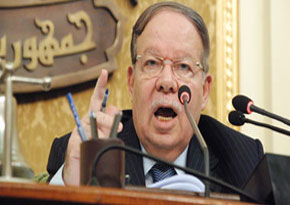
Ahmad Fathi Sorour
And he would be worse because?
Surur has long employed his legal expertise to maintain and add to the arsenal of abusive laws that Mubarak’s regime has used against the Egyptian people. Since neither Suleiman nor Surur would be able to amend the constitution during the interim tenure, the next presidential election would be conducted under the notoriously restrictive election rules Mubarak introduced in 2007. That would effectively guarantee that no credible candidate would be able to run against the interim president.
So before Mubarak resigns he must sign a presidential decree delegating all of his authorities to his vice president until their current terms end in September.
But Suleiman “has long employed his [military and intelligence] expertise” to cooperate with U.S. rendition and torture policies. Why is he better? Why should anyone believe that Suleiman will push for real democracy? Give me a break! The U.S. wants Suleiman in charge because he is their guy.
Suez Canal Pipeline Attacked
Posted: February 5, 2011 Filed under: Egypt, Foreign Affairs, Israel, Jordan, U.S. Economy, U.S. Politics | Tags: Egypt, israel, Jordan, sabatage, Suez Canal 29 CommentsUnknown attackers have blown up a pipeline that runs through El-Arish area of Egypt’s north Sinai area and supplies gas to Jordan and Israel, according to Egypt’s state television.
[….]
The explosive material was placed inside or adjacent to the control station of the gas supply line. There were no immediate reports of any casualties as a result of the blast.
“Saboteurs took advantage of the security situation and blew up the gas pipeline,” a state television correspondent reported, saying there was a big explosion.
State TV quoted an official as saying that the “situation is very dangerous and explosions were continuing from one spot to another” along the pipeline.
Forbes reports that Egypt has been forced to cut off gas supplies to Israel and Jordan.
There were conflicting reports out of Egypt as to the cause of the explosion, with the state-run Middle East News Agency saying the work was done by “subversive elements.” Oil Minister Samah Fahmy reportedly said it could take up to two weeks to repair the damage.
The pipeline is the third most strategically important piece of energy infrastructure in Egypt after the Suez Canal and the Sumed Pipeline. But it is the most important one to Israel, delivering 40% of Israeli natural gas supplies. The Israeli government said this afternoon that it did not expect any interruption of electricity supplies as the country has gas in storage and can also switch to other fuels like oil and diesel. Israel started receiving gas from the pipeline in 2008.
Assuming for a moment that this was not an accident, it represents a serious escalation of the crisis in Egypt.
Jitters about the impact of the unrest on the economy of both Egypt and the region were not eased yesterday when an explosion ripped through a gas terminal in Egypt’s northern Sinai Peninsula, setting off a massive fire that was contained by shutting off the flow of gas to neighbouring Jordan and Israel. Supplies are expected to be hit for at least a week. While Israel has other sources of power, and Jordan is believed to have substantial reserves, the sense that Egypt’s fragility can reach beyond its borders will add to the anxieties.
Traders are worried that the unrest might spread to oil-producing countries in the region and even affect shipments through the Suez Canal. Egypt is not a major oil producer, but it controls the canal and a nearby pipeline. Together these carry about two million barrels of oil a day from the Middle East to customers in Europe and the United States. Several large Egyptian refineries near the canal have been the site of recent protests.
We can use this as a live blog to discuss the situation in Egypt. I’ll continue to add updates if I learn any more about the cause of the pipeline blast.

 peej
peej Carissa
 bostonboomer
 dakinikat
 ecocatwoman
 jjlo
jjlo mablue2
 Mama Lopez
 peggysue22
 quixote
 skydancingguestblogger
 Mona (aka Wonk the Vote)



 Sky Dancing
Recent Comments