
Breaking: Major Shouman tells Reuters “The armed forces’ solidarity movement with the people has begun”
Posted: February 11, 2011 Filed under: Breaking News, Egypt | Tags: 2011: days of revolt, Egyptian military, Hosni Mubarak 26 CommentsScroll past image for the actual post.
This is a PHOTO UPDATE; 12:20 pm in Cairo:

Click image to go to Al Jazeera Live Blog on Egypt

An Egyptian anti-government demonstrator holds a sign that reads in Arabic and English 'Hitler commited suicide, you can do it' at Cairo's Tahrir square on February 10, 2011 on the 17th day of consecutive protests calling for the ouster of President Hosni Mubarak. (PATRICK BAZ/AFP/Getty Images)
Last week it was “Departure Friday.” The protesters have dubbed today’s demonstrations “Farewell Friday.” At around 2 am my time (10 am in Cairo), an Al Jazeera English reporter observed that Liberation Square has become unusually full already for morning time. She said that it’s usually around or after prayers that the crowds got to these numbers before. Egyptian military leaders have met and are supposed to be issuing a statement (“Communique 2”), but one of the Al Jazeera commentators I was just listening to a short while ago characterized this development as a sham. Here is some of the latest from the AJ Live Blog:
9:51am An army officer joining protests in Cairo’s Tahrir Square says 15 other middle-ranking officers have also gone over to the demonstrators.
“The armed forces’ solidarity movement with the people has begun,” Major Ahmed Ali Shouman tells Reuters.
I’m trying to get more insight on what exactly that means. I’m not hearing anything about it on the AJE feed.
UPDATES
(in reverse chronological order, so latest is first)
4 am/noon Cairo: Midday prayers are under way. AJE also saying protesters are calling this “the Final Friday.” We’ll see about that. I have to say that from what I can make out, this is panning out according to prediction of the AJE commentator who said that the military meeting and issuing a statement would be a sham (his exact words were that it sounded like a “fake” to him). Dakinikat’s morning thread will be up at the top of the next hour. If there’s anything major that happens between now and then, I’ll add an update here… otherwise check the comments!
3:47 CST/11:47 Cairo: Military statement (Communique 2) is being read. Emergency law will end, but only once the current circumstances end. Free and fair elections, but no real specifics. Peaceful transition of power, restoring “normal life” and going back to work, etc. “Honest men who say no to corruption will not be prosecuted.” This is no military coup. AJE anchor characterized it as a “placatory statement” that amounts to “sitting on the fence.” Another AJE journalist is calling it the first signs of the army positioning itself, but it’s a “timid” positioning.
3:40 CST/11:40 am Cairo: Friday prayers are in about 20 minutes. Shouman said the other officers will address the protesters after midday prayers, and we’re also waiting on that statement from the military, so in the meantime, I’m going to quote a bit from that Reuters article above:
“The armed forces’ solidarity movement with the people has begun,” Major Ahmed Ali Shouman told Reuters by telephone just after dawn prayers.
On Thursday evening Shouman told crowds in Tahrir that he had handed in his weapon and joined their protests demanding an immediate end to President Hosni Mubarak’s 30-year rule.
“Some 15 officers … have joined the people’s revolution,” he said, listing their ranks ranging from captain to lieutenant colonel. “Our goals and the people’s are one.”
More:
Another army major walked up to Shouman while he was talking with a Reuters reporter in Tahrir on Thursday and introduced himself, saying: “I have also joined the cause.”
“What drove these officers and I to join the people’s revolution is the pledge of allegiance we all took upon joining the armed forces — to protect the nation,” Shouman said when asked whether officers were risking court-martial.
Protesters carried Shouman on their shoulders, chanting “The people and army are united”, after he spoke to them on stage.
This is a semi-live blog/developing thread. For more, see the Al Jazeera English LIVE feed (or AJE Live on youtube):
Vodpod videos no longer available.
Mubarak’s “I am not Crook Speech”: He’s not going anywhere
Posted: February 10, 2011 Filed under: Diplomacy Nightmares, Egypt, Foreign Affairs | Tags: Egypt, Hosni Mubarak, No regrets, No resignation 96 CommentsWell, this is interesting. It seems that Al Ariabia got it right and every one else–including the Public face of our
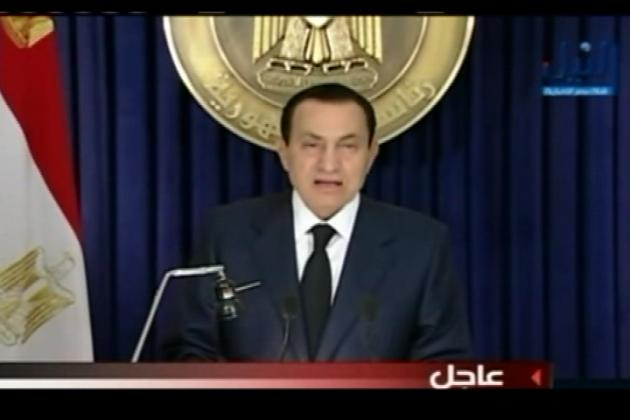
Not going anywhere, not gonna do it, wouldn't be prudent at this juncture
CIA–was wrong. Mubarak says he’s going to be a figurehead and the Torture VP is going to do the official duties.
Live Blog from UK GUARDIAN here:
9.02pm GMT: No one in Tahrir Square is listening to the rest of the Mubarak speech. The chant is: “Get out, get out.”
“We will be dignified until the very end, may God preserve Egypt, may peace be upon you,” is Mubarak’s final remark.
No sign he’s leaving. The “I have been ignoring international pressure” line suggests this was a “I fight on” speech by Mubarak.
9pm GMT: Mubarak’s not stepping down, that much seems clear, although exactly what that means with his previous statements about the army implementing change isn’t clear.
Tahrir Square is going nuts, based on the live footage.
8.58pm GMT: “I have spent most of my life in defence of our homeland,” says Mubarak. “I have never succumbed to any international pressure…. I have my dignity intact.”
So he’s not stepping down, it seems.
8.53pm GMT: Mubarak says he’s asked for the amendment of articles 76, 77, 88, 93 and 181 of the constitution, and abolishing the controversial article 179.
Article 179 is the emergency law that has been a huge issue and a major demand of the protesters. The rest involve the powers and terms of the presidency but we’ll get more details later.
8.51pm GMT: Mentions that the reforms will be “implemented by our armed forces,” and on-going dialogue.
Talking about a “national dialogue” and a “road map that is very clear on a specific timetable … until September,” but follows this by talking about the various committees he has had set up.
I’m not sure more committees are going to cut it right now in Tahrir Square.
8.50pm GMT: Mubarak speaking: talking of a “smooth transition of powers” but not much detail yet.
8.49pm GMT: Mubarak reaffirms that he’s not standing for election as president and that power will be transfered to “whoever the electorate chooses in the new fair and square elections”.
8.48pm GMT: Mubarak speaking: mistakes were made, he says.
I can tell you that I as the president of the Republic I have to respond to your calls but I am also embarrassed, and I will not accept or listen to any foreign interventions.
8.46pm GMT Mubarak now speaking on state television.
I can tell you before anything else that the blood of your martyrs will not be wasted and that I will not be easy on punishing people who committed these crimes.
Says he will “respond to your demands and your voices” and carry our promises.
Is this an appeal to Egyptian people watching him from their sofas in their living rooms? He still seems to think that the protesters are still foreign agents and upset young people. What does he see as the difference between ‘delegating’ power and remaining in power?
President Hosni Mubarak addressed an expectant Egypt on Thursday, saying that he had delegated his powers to his vice president, Omar Suleiman, but would not leave the country, according to NBC News translation.
Saying he was addressing Egypt’s youth and people in Tahrir Square and the nation, he said he believed in the honesty of the demands of the protesters and their intentions.
“I am addressing from the heart,” he said. “The blood of the martyrs and injured will not go in vain … My heart aches for your heartache.”
Breaking News: Mubarak likely to step Down
Posted: February 10, 2011 Filed under: Breaking News, Egypt, Foreign Affairs | Tags: Mubarak stepping down, Omar Suleiman 94 CommentsThere are reports coming from all news sources that Mubarak is “likely to cede power” sometime tonight.
President Hosni Mubarak will meet the demands of protesters, military and ruling party officials, the Associated Press reported Thursday, in the strongest indication yet that Egypt’s longtime president may be about to give up power.
The military’s supreme council was meeting Thursday, without Mubarak, its commander in chief, and announced on state TV its “support of the legitimate demands of the people,” AP said.
CIA director Leon Panetta, testifying on Capitol Hill Thursday, told the House Intelligence Committee”there is a strong likelihood that Mubarak will step down this evening.”
Most reports indicate that he will turn power over to new VP Omar Suleiman and the Egyptian military.
There is a strong likelihood that embattled Egyptian President Hosni Mubarak will step down Thursday night, CIA Director Leon Panetta told the U.S. Congress.
Mubarak has agreed to yield power to his vice president, a senior U.S. official told CNN, citing contacts within the Egyptian government.
This official, speaking on condition of anonymity because of the sensitivity of the information, said that given the mixed signals sent throughout the crisis that “we need to see it happen.”
But the source said the information came from reliable and ranking officials in the Mubarak regime. Asked when the transfer of power might take place, the official said: “We are told soon is the plan.”
The secretary-general of Egypt’s ruling party confirmed Thursday that a transition was underway and he expected Mubarak to address the nation soon.
This happened as a general strike by all levels of Egyptians began. There’s some indication that protests may not end
Thursday’s sudden developments came as thousands of Egyptians again took to the streets of Cairo and other Egyptian towns and cities, calling for President Mubarak to step down.
Doctors, bus drivers, lawyers and textile workers were on strike in Cairo on Thursday, with unions reporting walkouts and protests across the country.
The BBC’s Jon Leyne, in Cairo’s Tahrir (Liberation) Square, the focal point of the anti-Mubarak protests, reports that the protesters there are starting to celebrate after hearing news of Mr Mubarak’s possible departure.
But Egyptian Information Minister Anas el-Fekky told Reuters news agency: “The president is still in power and he is not stepping down. The president is not stepping down and everything you heard in the media is a rumour.”
Thursday Reads
Posted: February 10, 2011 Filed under: Barack Obama, Egypt, Federal Budget, fetus fetishists, Foreign Affairs, fundamentalist Christians, morning reads, Psychopaths in charge, Reproductive Rights, torture, U.S. Politics, Wikileaks, Women's Rights | Tags: abortion, budget cuts, crazy Republicans, Egyptian protests, FBI, Google, peak oil, torturers, weather, Wikileaks 30 Comments
Good Morning!!
I’m going to start out with a feel-good story this morning. I can’t find a print story about it, but you can watch video at the Weather Channel website.
A mother was driving in icy weather in Iowa, and ended up crashing. The car rolled over a couple of times and the woman was stuck, unable to check on her two children, ages one and four. Avery, the four-year-old girl got out of the car and walked up the road to a house where she found help. All three are OK now. Isn’t that an amazing and wonderful story? Watch the video and you’ll start the day with a smile.
Have you heard that President Reagan Obama plans to cut billions from the program that provides energy assistance to poor people?
President Obama’s proposed 2012 budget will cut several billion dollars from the government’s energy assistance fund for poor people, officials briefed on the subject told National Journal.
It’s the biggest domestic spending cut disclosed so far, and one that will likely generate the most heat from the president’s traditional political allies. Such complaints might satisfy the White House, which has a vested interest in convincing Americans that it is serious about budget discipline.
One White House friend, Sen. Chuck Schumer, D-N.Y., said earlier today that a Republican proposal to cut home heating oil counted as an “extreme idea” that would “set the country backwards.” Schumer has not yet reacted to Obama’s proposed cut. On Wednesday, Sen. Jeanne Shaheen, D-N.H., declared: “The President’s reported proposal to drastically slash LIHEAP funds by more than half would have a severe impact on many of New Hampshire’s most vulnerable citizens and I strongly oppose it.” A spokesman for Rep. Ed Markey, D-Mass., declared similarly: “If these cuts are real, it would be a very disappointing development for millions of families still struggling through a harsh winter.”
In a letter to Obama, Sen. John Kerry, D-Mass., wrote, “We simply cannot afford to cut LIHEAP funding during one of the most brutal winters in history. Families across Massachusetts, and the country, depend on these monies to heat their homes and survive the season.”
No matter how bad you think this President is, he can always get worse. I don’t know how we’re going to survive his incompetent administration.
Here’s another bill to eliminate abortion for all practical purposes. This time it’s in Ohio.
Republican lawmakers in Ohio unveiled legislation Wednesday that would ban abortions of any fetus found to have a heartbeat, a move that could ban most abortions in the state.
Under legislation sponsored by State Representative Lynn Wachtmann, doctors would be forbidden from performing an abortion the moment a heartbeat is detected in the fetus. Fetuses generally develop a heartbeat within six weeks of conception, and in some pregnant women a heartbeat can be detected within 18 days.
The Youngstown Vindicator describes the bill as “the most restrictive abortion ban in the country” and potentially “a precedent for other states eyeing comparable restrictions.”
Robyn Marty at Alternet reports that the “heartbeat bill” amounts to an almost total ban on abortion.
Republicans are determined to turn women into forced breeders with no control over their own bodies. It’s an outrage.
Newly leaked cables from Wikileaks suggest that peak oil is a lot closer than most people think.
The documents, dated between 2007 and 2009, point to a phenomenon known to many as “peak oil,” or the point of production where you cannot continue producing more, leading to a decline in availability and a spike in prices.
But far from being a mad prophet of doom, the US cables’ source is not someone whose credibility is easily questioned.
His name is Dr. Sadad al-Husseini, the former head geologist in charge of exploration for the Saudi oil firm Aramco. He retired in 2004, but stayed in touch with US officials.
According to al-Husseini, Saudi Arabian reserves may be smaller than thought, even though the Saudis are on a growth cycle aimed at pumping out over 12 million barrels a day over the next several years. But, al-Husseini warned, global output would likely peak before then, and potentially starting in 2012
That will coordinate perfectly with Obama’s cuts in aid to poor people who can’t afford to heat their homes.
Dakinikat link to this story in comments yesterday, but it bears repeating. Cables released by Wikileaks show that Egyptian secret police were trained in torture methods by the FBI at Quantico.
Egypt’s secret police, long accused of torturing suspects and intimidating political opponents of President Hosni Mubarak, received training at the FBI’s facility in Quantico, Virginia, even as US diplomats compiled allegations of brutality against them, according to US State Department cables released by WikiLeaks.
Why am I not surprised?
In a 2007 report, Amnesty International accused the Egyptian government of turning the country into a “torture center” for war on terror suspects.
“We are now uncovering evidence of Egypt being a destination of choice for third-party or contracted-out torture in the ‘war on terror’,” Amnesty’s Kate Allen said at the time.
The Egyptian government acknowledged in 2005 that the US had transferred 60 to 70 detainees to Egypt since 2001.
Here is one of the cables linked in the story, posted by the Daily Telegraph.
I’ll end with some links to the latest news from Egypt.
From The New York Times: Wired and Shrewd, Young Egyptians Guide Revolt
They are the young professionals, mostly doctors and lawyers, who touched off and then guided the revolt shaking Egypt, members of the Facebook generation who have remained mostly faceless — very deliberately so, given the threat of arrest or abduction by the secret police.
Now, however, as the Egyptian government has sought to splinter their movement by claiming that officials were negotiating with some of its leaders, they have stepped forward publicly for the first time to describe their hidden role.
There were only about 15 of them, including Wael Ghonim, a Google executive who was detained for 12 days but emerged this week as the movement’s most potent spokesman.
From the Wall Street Journal: Rallies Fan Out as Regime Closes Ranks
Protest organizers say they aim to slowly extend the swath of real estate they control downtown, and to pull in the support of labor unions, which are historically Egypt’s most effective protesters.
Protesters set up camp outside the iron gate of the parliament building, and blocked the street; the occupation forced the relocation of a cabinet meeting from the Council of Ministers, on the same street, to the outskirts of Cairo, state television reported.
State television also showed footage of angry workers in the health, telecommunications and power sectors protesting at a number of locations across Cairo. Many were contract workers or part-timers demanding full-time work and benefits.
From Politico: White House, State Department move to end Egypt confusion
The White House is moving to stamp out reports that top officials — including Vice President Joe Biden and Secretary of State Hillary Clinton — are sending conflicting signals about how best to resolve the crisis in Egypt.
On Wednesday, the White House and the State Department staged a 50-minute conference call for reporters Wednesday to insist that the administration’s messages on the standoff between embattled President Hosni Mubarak and demonstrators demanding his ouster have been consistent both in public — and private.
Uh huh. That must be why there is so much “confusion.”
The Daily Telegraph: Egypt crisis: protesters reject smooth transition
On the 16th day of protests, street leaders were emboldened to take a more militant line against the regime than the opposition parties that have entered talks with Hosni Mubarak’s vice President Omar Suleiman.
Mr Suleiman, who held more talks on constitutional reforms yesterday, has increasingly emerged as the focus of popular anger. He enraged demonstrators yesterday by warning that the regime would not tolerate prolonged demonstrations, stating that the options were either “dialogue” or “coup”.
“He is threatening to impose martial law, which means everybody in the square will be smashed,” said Abdul-Rahman Samir, a Tahrir Square spokesman. “But what would he do with the rest of the 70 million Egyptians who will follow us afterward.”
Asia One: Google exec’s role in Egypt a corporate dilemma
Business experts said Ghonim’s high-profile role in the protests poses a dilemma for management, even for a company like Google that has not hesitated to take on countries such as China in the past.
“I’m sure Google is very nervous about having their employees publicly associated with politics,” said Charles Skuba, an international business professor at Georgetown University’s McDonough School of Business.
“It’s a slippery slope,” Skuba told AFP. “Whenever an employee of a company becomes publicly associated with a political situation there’s often more peril for the company than there is advantage.”
Google campaigned vigorously for the release of Ghonim, a 30-year-old Egyptian who is the company’s marketing chief for the Middle East and North Africa, after he went missing in Cairo on January 27.
Sooooo…What are you reading and blogging about today?
Late Night: Women’s Voices on Egypt
Posted: February 8, 2011 Filed under: Egypt | Tags: 2011: days of revolt, Women 14 Comments
Picture circulating on twitter: Wael Ghonim holds the mother of Khaled Said, the man whose brutal murder in June by Egyptian police inspired the "We are all Khaled Said" facebook page by Ghonim, that in turn served as a catalyst for the current-day protests.
Hello all, Wonk here with some reads I’d like to share with the late night crowd. Tonight’s theme is going to put a spotlight on what women have to say about Egypt. Normally I’d start out with a youtube or quote from a protester or an Arab woman, but commenter Pilgrim e-mailed me a fantastic piece by Canadian columnist Linda McQuaig that I thought spoke volumes. It’s called “Arabs love democracy, but do we?“:
The fact that the Arab world is awash with dictators has long been a key piece of evidence used to whip up anti-Muslim sentiment in the West.
Surely all those dictators are proof that Arabs don’t love democracy the way we Westerners do, that they are culturally, religiously and perhaps congenitally attracted to tyrannical strongmen as leaders.
This widely held view will be difficult to sustain here now that wall-to-wall TV coverage of the Egyptian (and Tunisian) uprisings has exposed the truth: Arabs don’t like tyrants any more than we do.
In fact, they love democracy — so much so that hundreds of thousands of them have risked serious harm by taking to the streets to defy a regime that for decades has been a leading practitioner of repression and torture of dissidents.
That’s just the beginning. Check out the rest of McQuaig’s column for more.
Now, let’s turn to my go-to Egyptian source — Mona Eltahawy. On Tuesday afternoon, Mona put out the following tweets. First this:
As excited as I am at media coverage of #Egypt revolution I am disappointed at overwhelmingly male experts they turn to. Where r women?’
..and then this:
We keep hearing “Where are women of #Egypt revolution?” I want to know where are women analysing Egypt revolution? #Jan25
In her follow-up she made it clear that her point wasn’t to ask “where are the women” but to draw out the intellectual and analytical contributions of women:
I know women are taking part in #Egypt revolution. My point is different: where women analysing it, speaking as experts! #Jan25
Mona got quite a few tweets pointing to women’s voices pouring out in response, and I’d like to highlight some of them.
First, an Egyptian woman that Mona Eltahawy highlighted herself — Magda Sharara, who has posted the following entry– “Fearless Egyptians: A message of love and respect” — on almanacmag.com (The Mag of Egypt). An excerpt:
Until January 25th 2011, most Egyptians were their own fiercest critics, seriously or jokingly. They railed against their lack of democracy, between a Sheesha and a coffee, and whined about their repression and the corruption surrounding them. Their glorious past slipping and almost forgotten. Sometimes nostalgia, and other times chaos seemed to guide them.There was anger in the Egyptian streets, frustration, and a feeling of irresolution and drift. No wind of stability was blowing their way, for a very long time.
But today, millions of Egyptians are standing up for their rights, fighting, screaming, chanting with joy and sorrow, and some are bravely dying for an indisputable democratic and free country in the middle of Tahrir square. They have forever changed the way the world perceives them.
They are recharged, and their revitalization is contagious. They are the heroes of a modern revolution, they are the fearless Egyptians that death does not scare.
They deserve to be respected, encouraged, honored, saluted, thanked, loved and remembered.
It is not death that we should fear, but a life not lived in dignity; that is the real tragedy.
Magda’s message really deserves to be read in its entirety.
Next up… Sunita Rappai, a British Indian journalist living in Cairo. She has a wonderfully refreshing take on Egypt, which balances competing perspectives on what’s going on in Egypt. In her blog piece from earlier today, “O Revolution, where art thou?,” Sunita concludes:
From an outside point of view, the ‘revolution’ is in danger of failure – if it hasn’t failed already. Mubarak shows no signs of relinquishing the presidency, the emergency laws are still in place and the constitution remains the same. While the regime has been engaging in (unprecedented) talks with the opposition – including the banned Muslim Brotherhood – its grip on power, and the accompanying state security apparatus, is tighter than ever. Insiders at the talks suggest that the government’s mood is hardline, with few real concessions (I heard from one good source that Suleiman’s contribution at one meeting was to read out a pre-prepared statement – when he was questioned on one point, he read out the statement again).
But inside Egypt, the mood is slightly different, at least for the moment. Many feel that real gains have been made, with Egyptians finally sending a clear message to the government, and the world, that they are ready for democracy and willing to fight for it, if necessary. The idea that they have broken the ‘fear barrier’ and the political apathy that dogged them is a powerful one. They trust that Mubarak will fulfil his promises, which will one day pave the way for real democracy and constitutional reform. It is a process that will take time and they are prepared to wait for it.
The country is moving again, but no one knows where it’s heading. In some ways, everything has changed. In other ways, nothing has. It all depends on who you ask.
Sunita’s piece is another one that I recommend reading in its entirety, to get the full effect of her social observations on what’s going on in and around Tahrir square. I also enjoyed her latest post — “10 reasons why a foreigner like me loves Egypt…”
The twitter handle “Mahagaber” was also tweeted to Mona as “one of the women in Egypt covering the revolution.” Scanning through Maha’s latest tweets, the one that has caught my eye straight away is this:
@JohnKingCNN: Do you realize if Mubarak leaves it will be the first time in our history that Egypt will have a “FORMER” President #jan25
That says so much in so few words.
Another handle tweeted to Mona, sarahshakour, had this to say on Tuesday evening, in response to a tweet from CNN trying to prop up the White House:
More like flip-flopping to me RT @CNN White House getting ‘specific’ on Egypt tone – http://bit.ly/hPjJeJ (via @RT PoliticalTicker)
Thrillingham left this note to Mona, mentioning the wonderful Dima Khatib and another name:
@monaeltahawy honestly, twitter has much better analysts than anything i’ve seen on tv. you @Dima_Khatib @Rouelshimi and others are great
Got to add Rouelshimi to my twitter feed!
Here’s one from Dima in the afternoon:
PEOPLE’s POWER in action: http://t.co/Mv7OapQ Watch & remember: When a nation walks the streets, it heads towards history #jan25#egypt
“When a nation walks the streets, it heads towards history.” I like that a lot.
…and the latest from Rouelshimi:
@CarlosLatuff The govrmt started a rumor that protesters in Tahrir were getting bribed with free KFC meals to be there. It’s a popular joke.
So funny I forgot to laugh. Mubarak should really quit his day job and become a stand up comedian already.
Another person reports to Mona from Holland and says that there have been “three women (Stienem, van Boon, and Samuel) each discussing Egypt with great knowledge” on a talkshow. A similar comment from Finland, that a woman named Sanna Negus has been doing the Finnish national coverage on Egypt.
Last week Leah McElrath Renna posted an article called “Obama’s Egypt #FAIL?” on Huffington Post. A brief teaser:
President Obama and his Administration appear to have made a familiar deal with the devil in response to the popular pro-democracy uprising in Egypt.
Here’s a tidbit from young college graduate Rana Salem (scroll down under the New Castle section):
Rana Salem, a young graduate of Alexandria University, explained the emergence of the remarkable popular movement in recent weeks. She spoke of both the authoritarianism of Mubrak’s regime and the economic problems – unemployment, insecurity, poverty – driving the revolt. She said of the Egyptian people, “they really are making history – it’s not just a saying”.
Interview with political science professor Mona El-Ghobashy, on the Rachel Maddow Show, Feb 7 (starts around the 1:37 mark):
Slate’s Double X blog already highlighted human rights and democracy activist Ghada Shahbandar and Dakinikat frontpaged that story last week, but a very informative link in reference to Ghada popped up in response to Mona’s query — “Egypt: We Are Watching You, Three Egyptian Women Use the Internet to Promote Democracy“:
Meet the trio: Engi Haddad, a chain-smoking, husky-voiced marketing manager; Bosayna Kamel, a well-known TV news reporter; and Ghada Shahbandar, a university professor. Against the backdrop and momentum of the Kifaya (Enough!) protest movement, these powerful women came together to found Shayfeen.com, a Web site and on-the-ground effort to witness and record the reality of the Egyptian first multi-party election. As journalist Boysana says, their goal was to bring the “real” news to the people, not “their” news.
There are some documentary clips there, too. Give it a look if you have the time.
Over at The Berkeley Blog, anthropology professor Rosemary Joyce has an interesting read up called “Of people and things: Egyptian protest and cultural properties” in response to the idea that we need to protect artifacts in Egypt because they are a “shared global heritage”:
Cairo isn’t Baghdad: the people of Egypt are seeking rights we all cherish, and even as they do, they are trying to protect those things that the rest of the world is too easily elevating over the safety and rights of people.
As an archaeologist, I will regret any losses. But as a human being, I will not agree that we should make the mistake of treating people as less valuable than things.
An interview last week with another anthro professor, Farha Ghannam, called “The rich symbolism of the square in Cairo.” The article opens with the following:
When she first traveled to Cairo for fieldwork in 1993, Farha Ghannam recalled, Tahrir Square was mostly used as a bus depot.
Today, it’s the battleground on which the future of Egypt is being fought – a space rich with symbolism and meaning, held and defended by protesters at the cost of some lives.
“There’s this feeling [among demonstrators] that ‘if we lose at Tahrir Square, we’re going to lose the fight,’ ” said Ghannam, an anthropology professor at Swarthmore College who studies the use of public space in Egypt.
A few more meaty and intriguing reads real quickly (see excerpts in the comments):
“The dignity of Egyptian youth” by Azza Karam
“Myths of Mubarak” by Elizabeth Shakman Hurd
“Egypt: Days of Anger in the Age of Terror” by Sarah Ghabrial
Many more names showed up on Mona Eltahawy’s twitter. I tried to gather as many as I could together in one place to give you a sampling of other women’s voices on Egypt you might want to check out:
Blogdiva
MCTSamuel
Dinamotion
Jilliancyork
Techsoc
BBClysedoucet
Amanisol
Naglarzk (economics)
ShahinazAhmed (development)
Maha Azzam via ChathamHouse
Nadiaglory
Adhaf Soueif (reporting from Tahrir square)
Mona Zulficar (legal)
Nahlahayed
NancyMousa
Felmansy (13 year Egyptian girl living in the US and aspiring to be a reporter)
Missroory (16 years old “Masriya in SF” who wants to follow in Mona’s footsteps)
Sarah Carr
Well, that’s it for me right now. What are you late-nighters and early morning people reading?

 peej
peej Carissa
 bostonboomer
 dakinikat
 ecocatwoman
 jjlo
jjlo mablue2
 Mama Lopez
 peggysue22
 quixote
 skydancingguestblogger
 Mona (aka Wonk the Vote)



 Sky Dancing
Recent Comments