
Tuesday Reads
Posted: March 22, 2011 Filed under: Baby Boomers, Bahrain, Foreign Affairs, health hazard, Iraq, Japan, Libya, morning reads, psychology, Syria, U.S. Military, U.S. Politics, Water, Yemen | Tags: 1960s, Ali Abdullah Saleh, Bahrain, Fukushim nuclear plant, Hillary Clinton, id, iran, Japan, Libya, LSD, Muammar Gaddafi, Owsley Stanley, personality, Sigmund Freud, Syria, Wisconsin, Yemen 30 Comments
Good Morning!!
I’m teaching a Psychology of Personality course this semester, and yesterday I started lecturing about Freud and psychoanalytic theory. I was explaining Freud’s notion of the three parts of the personality–the id, the ego, and the superego. You’re probably familiar with those terms, but basically the id is there when we are born–it is completely self-centered, doesn’t know the difference between fantasy and reality, all it cares about is pleasure. It wants what it wants when it wants it. Sometime during infancy, we develop an ego that gets the id under some control, and around age 4-6 we develop a superego–basically like a conscience, that tells us which behaviors are right or wrong or socially acceptable.
Anyway, after class I was thinking about Muammar Gaddafi and his bizarre behavior–the way he has insisted for weeks that there is no opposition and that he isn’t attacking Libyan citizens. No, he would never do that. It occurred to me that Gaddafi is pretty much acting from his id all the time. Of course his ego keeps him somewhat connected to reality so he can function in the world, but mostly he just cares about his own needs.
I wonder if that is what happens to all leaders who gain absolute control. Does the quote “power corrupts and absolute power corrupts absolutely,” really mean that power causes people to regress to an earlier stage of development?
It sounds peculiar, but think about how powerful people get so many of their needs met by others. Obama doesn’t have to worry about paying for things, getting food or clothing, even getting information. It is all provided by other people. In many ways, it’s a kind of childlike, dependent state. So if the leader doesn’t have a strong character (ego), he can end up behaving in a narcissistic, childlike way.
OK, well that’s my not-very-deep thought for today.
So what’s happening in the news? As has often been the case in recent weeks, much of the big news is coming from outside the U.S.
On Libya, there has been more criticism of the UN resolution and how it is being carried out. I posted quite a few examples of the criticism in my post last night. Most of the objections are based on the fact that Libya is not at all important to the U.S. strategically.
Today I want to recommend a couple of articles that explain why the intervention in Libya, while troubling in many ways, was probably the right thing to do–even for U.S. interests. The first is by Mark Lynch at the Foreign Policy blog. Lynch uses the name “abuardvark” on twitter. His post is headlined Libya in its Arab Context Although Lynch has misgivings about the intervention and has written about them, he still thinks what the U.S. is doing is the right thing–both for the Arab world and for advancing our interests. Here’s his basic argument:
Libya matters to the United States not for its oil or intrinsic importance, but because it has been a key part of the rapidly evolving transformation of the Arab world. For Arab protestors and regimes alike, Gaddafi’s bloody response to the emerging Libyan protest movement had become a litmus test for the future of the Arab revolution. If Gaddafi succeeded in snuffing out the challenge by force without a meaningful response from the United States, Europe and the international community then that would have been interpreted as a green light for all other leaders to employ similar tactics. The strong international response, first with the tough targeted sanctions package brokered by the United States at the United Nations and now with the military intervention, has the potential to restrain those regimes from unleashing the hounds of war and to encourage the energized citizenry of the region to redouble their efforts to bring about change. This regional context may not be enough to justify the Libya intervention, but I believe it is essential for understanding the logic and stakes of the intervention by the U.S. and its allies.
Libya’s degeneration from protest movement into civil war has been at the center of the Arab public sphere for the last month. It is not an invention of the Obama administration, David Cameron or Nicholas Sarkozy. Al-Jazeera has been covering events in Libya extremely closely, even before it tragically lost one of its veteran cameramen to Qaddafi’s forces, and has placed it at the center of the evolving narrative of Arab uprisings. Over the last month I have heard personally or read comments from an enormous number of Arab activists and protest organizers and intellectuals from across the region that events in Libya would directly affect their own willingness to challenge their regimes. The centrality of Libya to the Arab transformation undermines arguments that Libya is not particularly important to the U.S. (it is, because it affects the entire region) or that Libya doesn’t matter more than, say, Cote D’Ivoire (which is also horrible but lacks the broader regional impact).
Lynch is still worried about what could go wrong:
I continue to have many, many reservations about the military intervention, especially about the risk that it will degenerate into an extended civil war which will require troops regardless of promises made today. But as I noted on Twitter over the weekend, for all those reservations I keep remembering how I felt at the world’s and America’s failure in Bosnia and Rwanda. And I can’t ignore the powerful place which Libya occupies in the emerging Arab transformations, and how the outcome there could shape the region’s future. Failure to act would have damned Obama in the eyes of the emerging empowered Arab public, would have emboldened brutality across the region, and would have left Qaddafi in place to wreak great harm. I would have preferred a non-military response — as, I am quite sure, the Obama administration would have preferred. But Qaddafi’s military advances and the failure of the sanctions to split his regime left Obama and his allies with few choices. The intervention did not come out of nowhere. It came out of an intense international focus on the Arab transformations and a conviction that what happens now could shape the region for decades.
At CNN, Peter Bergen tries to explain Why Libya 2011 is not Iraq 2003 I recommend checking it out.
Another article worth reading is by Robert Fisk at The Independent: Right across the Arab world, freedom is now a prospect
In the Middle East, Yemen may be close to ousting President Ali Abdullah Saleh. From the Guardian:
A military showdown is looming in Yemen after the defence minister announced that the army would defend the president against any “coup against democracy”. His statement came hours after 12 military commanders, including a senior general, defected from the regime and promised to protect anti-government protesters in the capital, Sana’a.
[….]
Yemen’s president, Ali Abdullah Saleh, suffered a significant blow when General Ali Mohsen al-Ahmar, his longtime confidant and head of the Yemeni army in the north-west, announced that he would support “the peaceful revolution” by sending soldiers under his command to protect the thousands gathered in the capital to demand that Saleh step down.
“According to what I’m feeling, and according to the feelings of my partner commanders and soldiers … I announce our support and our peaceful backing to the youth revolution,” Ali Mohsen said.
Minutes after his defection, tanks belonging to the republican guards, an elite force led by Ahmed Ali, the president’s son, rolled into the streets of Sana’a, setting the stage for a confrontation between defectors and loyalists.
At Bloomberg: U.S. Faces Loss of Key Ally Against Al-Qaeda in Yemen
…Yemeni President Ali Abdullah Saleh appears unlikely to weather a popular uprising and defections among his ruling elite, former U.S. officials said.
“It’s clear at this point that Saleh will have to step down,” Barbara Bodine, a former U.S. ambassador to Yemen, said in an interview yesterday. With the “mounting numbers of senior people in his administration resigning, we know it’s over. The terms of his departure, I think, are still being negotiated.”
The March 18 killing of at least 46 protesters allegedly by police and pro-regime gunmen — which drew condemnation from Obama and Secretary of State Hillary Clinton and prompted the defection of key military, tribal and government officials — may well be the tipping point.
Protests are continuing to escalate in Syria as well.
In Deraa, hundreds of black-uniformed security forces wielding AK-47 assault rifles lined the streets but did not confront thousands of mourners who marched at the funeral of 23-year-old Raed al-Kerad, a protester killed in Deraa.
“God, Syria, freedom. The people want the overthrow of corruption,” they chanted. The slogan is a play on the words “the people want the overthrow of the regime,” the rallying cry of revolutions that overthrew the veteran rulers of Tunisia and Egypt.
Security forces opened fire last Friday on civilians taking part in a peaceful protest in Deraa to demand the release of 15 children detained for writing protest graffiti.
Authorities released the children on Monday in a sign they were hoping to defuse tension in the border town, which witnessed more protests after Friday’s crackdown.
And there is a lot happening in Bahrain too. This article is worth a read: Libya burns but Bahrain can shake the world
While the world attention remains glued to the fires in Libya potential stakes in Bahrain are actually a hundred times higher. Safaniya Oil Field, the largest oil field in the world, is less than 200 miles from Manama. The Strait of Hormuz, through which passes 20 percent of world oil shipments and 40 percent of the world’s sea-borne oil shipments, is within a 400-mile radius.
More importantly, United States Fifth Fleet, with a forward deployed Carrier Strike Group, Combat Command force, Anti-Terrorism force, Sea Stallion helicopters, Amphibious Force and Patrol and Reconnaissance Force, is headquartered at Naval Support Activity Bahrain (or NSA Bahrain). In essence, Bahrain is home to America’s military might that reigns over the Persian Gulf, Red Sea and the Arabian Sea-all put together.
On March 14, around 2,000 soldiers of the Saudi-led, US-backed Peninsula Shield Force, in their armored carriers and tanks, invaded Bahrain. The stated purpose of the invasion is: to crush an unarmed civilian uprising.
On March 15, King Hamad ibn Isa Al Khalifa of Mamlakat al Bahrayn declared martial law under which the Bahrain Defence Force (BDF), numbering around 10,000 personnel, was “empowered to take whatever actions it deems appropriate in dealing with the predominately Shiite-driven unrest.”
I recommend clicking on the link and reading the rest to learn how Iran could get involved in the Bahrain conflict. Yikes!
In Japan workers are still trying to get the Fukushima nuclear plant under control. We keep hearing that things are improving, but it’s kind of hard for me to trust what I hear from governments and corporations these days. After Iraq, Katrina, the BP oil spill, and on and on, I honestly believe just about everyone in government and private business lies their asses off. The biggest fear at the moment is the radiation that is turning up in food and water. Of course the authorities claim that’s nothing to worry about, but why should we believe them?
Away from the plant, mounting evidence of radiation in vegetables, water and milk stirred concerns among Japanese and abroad despite assurances from Japanese officials that the levels were not dangerous.
TEPCO said radiation was found in the Pacific ocean nearby , not surprising given rain and the hosing of reactors with seawater. Some experts said it was unclear where the used seawater was ultimately being disposed.
Radioactive iodine in the sea samples was 126.7 times the allowed limit, while cesium was 24.8 times over, Kyodo said. That still posed no immediate danger, TEPCO said.
“It would have to be drunk for a whole year in order to accumulate to one millisievert,” a TEPCO official said, referring to the standard radiation measurement unit. People are generally exposed to about 1 to 10 millisieverts each year from background radiation caused by substances in the air and soil.
Whatever. I wouldn’t want to drink from the tap or swim in the radioactive ocean water.
Back in the USA, Wisconsin Asks Appeals Court to Block Order Halting Union Bargaining Law
Wisconsin’s attorney general asked an appeals court to block a state judge’s order that temporarily halted a law curbing government employee unions’ collective- bargaining power.
State Attorney General J.B. Van Hollen today also asked the Wisconsin Court of Appeals for permission to file an appeal seeking to overturn the ruling by Circuit Court Judge Maryann Sumi.
“Contrary to established case law, the trial court injected itself into the legislative process and enjoined a legislative act,” Van Hollen said in court papers filed today in Madison. “There is absolutely no authority for the broad, overreaching step taken.”
Sumi on March 18 granted a temporary restraining order blocking publication of the measure signed into law by Governor Scott Walker on March 11, after a hearing in Madison, the state’s capital city. Publication gives the law full force and effect.
I’ll end on a lighter note. If you’re as old as I am, you might remember a guy named Owsley “Bear” Stanley: “the Sixties hero who ‘turned on’ a generation.” Stanley died a few days ago in a car crash at the age of 76.
Stanley, who died in a car crash in Australia on Sunday, fuelled the “flower power” counter-culture that took root in California in the mid-1960s, supplying it with acid that he manufactured after stumbling across a recipe in a chemistry journal.
He also worked with the psychedelic rock band Grateful Dead, who wrote their song “Alice D Millionaire” about him after a newspaper described him as an “LSD millionaire”. One batch of his drugs reputedly inspired Jimi Hendrix’s song “Purple Haze”, and he provided LSD for the notorious “Acid Test” parties hosted by the American writer Ken Kesey, which featured in books by Tom Wolfe and Hunter S Thompson.
News of Stanley’s death – his car swerved off a road and slammed into a tree near his home in north Queensland – elicited tributes, but also surprise. Despite a youth so misspent that his name became slang for good acid, Stanley had made it to the age of 76. He was even a great-grandfather. In a statement yesterday, his family mourned him as “our beloved patriarch”.
Supposedly, a batch of Owsley’s acid inspired Jimi Hendrix’s first big hit, Purple Haze. Rest in peace, Owsley. I am one “casualty” of the ’60s who did learn something significant from my experiences with LSD. One thing I eventually learned is that I don’t need drugs to “get high.”
I guess that’s another not-so-deep thought, but hey, I’m OK with that. What are you reading and blogging about today?
Monday Reads
Posted: March 21, 2011 Filed under: collective bargaining, Economy, Farming, financial institutions, Foreign Affairs, Global Financial Crisis, Gulf Oil Spill, Japan, Libya | Tags: bubbles, Fukushima, ghadafi, greenspan, oil spill, recovery, REITS 57 Comments Good Morning!
I’m finishing up a paper today that’s off to be published on Real Estate Investment Trusts (REITS). Don’t worry! I won’t bore you with the details but it’s basically about locating speculation bubbles like the one that happened in real estate markets in the 2000s. There were a lot of folks that made money off of that ride although most of us little guys lost a lot. The reason I’m bringing it up is that my first read of the day is a Paul Krugman response to Allan Greenspan’s critique of Obama’s economic policy. I just wanted to remind you of what a mess the first part of the century has been and that many of the pots and the kettles still appear to be confused about their true nature. I mean, the entire mess has given me a great research agenda, but at what cost?
Greenspan’s tut tuts Obama’s ability to create economic chaos in the academic journal International Finance (pdf here). While most of us are still trying to figure out what went so horribly wrong, Greenspan is trying to pin the blame on the new guys. I’m going to quote his abstract because it’s just more of the same old same old from one of the beasts that brought us to this mess and its worth the bask in the arrogance to just remember his access to power. Greenspan says it’s too much government regulation and Obma activism that’s hampering the recovery and that he can prove it with bad, outdated statistical methods. This comes from the man that gave Wall Street a lot of cheap money and no regulation so they could go hog wild. The recovery may be tepid, the stock market may be recovering, but I’ll be damned if there’s any regulation left standing upon which he can float his argument. Oh, Krugman dismisses the methods by which Greenspan infers that it’s government activism and its inherent chaos that’s created a stale recovery. To be honest, a first year doctoral student would use better methodology and know the literature better. That really scares me, frankly. What did he do while at the Fed? Reread The Fountainhead?
So, here’s the bubblemeister’s blowing you know what up you know where with techniques that wouldn’t get me published in a mimeographed neighborhood newsletter let alone International Finance. Why hasn’t this man retired to an island somewhere?
The US recovery from the 2008 financial and economic crisis has been disappointingly tepid. What is most notable in sifting through the variables that might conceivably account for the lacklustre rebound in
GDP growth and the persistence of high unemployment is the unusually low level of corporate illiquid long-term fixed asset investment. As a share of corporate liquid cash flow, it is at its lowest level since 1940.This contrasts starkly with the robust recovery in the markets for liquid corporate securities. What, then, accounts for this exceptionally elevated level of illiquidity aversion? I break down the broad potential sources, and analyse them with standard regression techniques. I infer that a minimum of half and possibly as much as three-fourths of the effect can be explained by the shock of vastly greater uncertainties embedded in the competitive, regulatory and financial environments faced by businesses since the collapse of Lehman Brothers, deriving from the surge in government activism. This explanation is buttressed by comparison with similar conundrums experienced during the 1930s. I conclude that the current government activism is hampering what should be a broadbased robust economic recovery, driven in significant part by the positive wealth effect of a buoyant U.S. and global stock market.
So, here’s Paul Krugman with ‘Rantings of an Ex-Maestro’.
He’s no longer the Man Who Knows; he’s the man who presided over an economy careening to the worst economic crisis since the Great Depression — and who saw no evil, heard no evil, refused to do anything about subprime, insisted that derivatives made the financial system more stable, denied not only that there was a national housing bubble but that such a bubble was even possible.
If he wants to redeem himself through hard and serious reflection about how he got it so wrong, fine — and I’d be interested in listening. If he thinks he can still lecture us from his pedestal of wisdom, he’s wasting our time.
Brad Delong actually does some analysis over at his blog Grasping Reality.
I don’t see how this hangs together in any coherent fashion at all.
If businesses are unwilling to invest in illiquid capital out of the fear that government action will impair the value of their investments, businesses must also fear that government action will impair the value of their existing illiquid investments. What is the value of their existing illiquid investments? The value of their existing illiquid investments is nothing more than the stock market value of their companies–liquid stock market value is, in the last analysis, nothing more than the cash flows proceeding from the illiquid investments that companies have made that generate the profits.
A much better and more sensible explanation for the relatively high value that the stock market places on existing illiquid corporate assets and the relatively low value that companies place on illiquid investments to expand their fixed capital is precisely that capacity utilization is low–so why spend more money now building factories when doing so would be more expensive and only add to your idle capacity?
And, indeed, if you ask people running businesses what is their single most important problem, they say that it is not (as they sometimes say it is) taxes; they say that it is not (as they said it was at the start of 2000) the cost and quality of labor; it is not (as they said it was in 2004) the availability and cost of insurance; it is not (as they briefly said it was at the start of 1993) government requirements. What do they say their biggest problem is? Poor sales.
Yup, it’s pretty basic. You gotta have customers and those customers gotta have jobs and decent paychecks. That’s the problem right now.
Late Night Update: Libya
Posted: March 20, 2011 Filed under: Foreign Affairs, House of Representatives, John McCain, Libya, U.S. Military, U.S. Politics | Tags: allied air strikes, Bill Gortney, House of Representatives, impeachable offenses, Josh Marshall, liberal democrats, Libya uprising, Michael Moore, Mike Mullen, Muammar Gaddafi, Ralph Nader, Robert Gates, war crimes 11 CommentsThe “allied forces” have been bombing targets in Libya for a second day. Gaddafi is outraged and has issued multiple threats. Meanwhile, here at home there is quite a bit of criticism of the President’s decision to participate in the UN action.
The Guardian has a pretty detailed description of events in Libya over the past couple of days: “Coalition attacks wreak havoc on ground troops.” I’m leaving out the bloodthirsty-sounding paragraphs–you can read them if you choose.
The barrage of attacks led by France, Britain and the US on Libya’s army, air bases and other military targets drew threats of a prolonged war from Gaddafi himself. But on the ground many of his forces were in disarray and fleeing in fear of further attacks from a new and unseen enemy.
The air assault halted and then reversed the advances by Gaddafi’s army on Benghazi and other rebel-held towns. But the revolutionary leadership wanted more. On Sunday it appealed for an intensification of the air assault to destroy the Libyan ruler’s forces and open the way for the rebels to drive him from power.
The air bombardment is regarded among rebel military commanders as creating a more level battle field by removing Gaddafi’s advantage of heavy armour.
“There must be more attacks, to destroy his forces and heavy weapons,” said Kamal Mustafa Mahmoud, a rebel soldier on the edge of Benghazi. “Then they can leave Gaddafi to us. We know how to fight him but we are afraid of his heavy weapons. I want them to destroy the ground forces of Gaddafi.”
Quite a few people in the US have problems with that notion. Secretary of Defense Robert Gates, who has opposed the U.S. getting involved in the Libyan uprising had a few words of warning today.
Defense Secretary Robert Gates said the U.S. military campaign against Libya’s Muammar Qaddafi should be limited to the terms of a United Nations resolution rather than being broadened to target the leader directly.
The coalition with the U.K., France and Arab countries relies on the terms laid out in the UN Security Council resolution adopted last week, Gates told reporters traveling with him to Russia today on a trip he delayed yesterday so he could monitor the start of “Operation Odyssey Dawn.” The resolution backed military action to prevent Qaddafi from using his forces to attack fellow Libyans.
“If we start adding additional objectives, then I think we create a problem in that respect,” Gates said. “I also think that it is unwise to set as specific goals things that you may or may not be able to achieve.”
Here’s a bit more from Gates:
Gates said the mission is backed by a diverse coalition, and adding additional objectives to the mission “create a problem in that respect.” He also said “it’s unwise to set as specific goals things that you may or may not be able to achieve.”
Gates said most nations in the region want to see Libya remain a unified state, and “having states in the region begin to break up because of internal differences, I think, is a formula for real instability in the future.”
The Pentagon chief also cautioned against getting too involved in the internal conflict of that country, saying the internal conflict should be left to be resolved by Libyans themselves.
After Gates made these remarks, Pentagon spokesman Navy Vice Adm. Bill Gortney said that there is no plan to directly attempt to oust Gaddafi. Gortney:
“I can guarantee that he’s not on the targeting list.”
Gortney said Khadafy’s forces were already beginning to crumble, but stressed that the focus of the campaign remains protecting civilians, not taking out the despot.
In addition,
Chairman of the Joint Chiefs of Staff Admiral Mike Mullen acknowledged that Khadafy might remain in power when the mission is over.
“It’s hard to know exactly how this turns out,” Mullen said on CBS. “I recognise that’s a possibility.”
Today French and British forces did “expand” the bombing campaign, and actually targeted a building within Gaddafi’s private compound. Read more below the fold. Read the rest of this entry »
Tragedy in Japan
Posted: March 19, 2011 Filed under: Foreign Affairs, health hazard, Japan | Tags: Fukishima, Japan, radiation 19 CommentsThe human crisis unfolding in Japan is mounting as radiation leaks impact the northern country side. The northern part of Japan has historically been on the short end of the economic stick for some time. Japan will now have to deal with the consequences of some of its policy decisions. This should serve as a cautionary tale to other developed countries with aging populations living in rural and less economically viable areas. The need to care for homeless and elderly people in Northern Japan continues to challenge its crippled infrastructure. Many fear they will never return to their abandoned homes and communities. NPR reports that a women’s hospital that primarily cares for newborns and pregnant women has been doing duty covering elderly and other people on the border of the evacuation zone. The hospital is trying to close and needs help evacuating its patients.
The Haramachi Central Obstetrics and Gynecology hospital is in the town of Minamisoma, right on the border of the exclusion zone. In recent days, the hospital has not just been taking care of mothers and babies, but also elderly people and anyone else who had not evacuated. The imposition of the exclusion zone has meant that many larger hospitals in the area have closed already, and this hospital has been left to care for anyone needed any kind of medical attention. Now, it too has run out of medicine and Dr. Kyoichi Takahashi, president of the hospital, says he is going to have to close, even though strictly speaking he doesn’t need to. “Those who are leaving the town are all in tears, saying they don’t want to leave. Some say it may be the last time they see us, and they’re worried they might never be able to come back,” Takahashi says. There are people in the exclusion zone who want to evacuate, but are not able to because they don’t have any gas to drive, he says, but the government doesn’t seem to have a comprehensive plan for getting everyone out. Takahashi paints a grim picture of the situation inside the exclusion zone, saying there are still bodies of people killed by the tsunami that can’t be recovered. He says his staff wants to carry on, but he thinks they just can’t do it any longer. News reports say at least two patients have died at Omachi hospital, also on the edge of the exclusion zone, from a shortage of medicine, and the hospital has almost run out of food. The military was due to transfer 90 of the 160 patients to another town Saturday. “Most of the patients now in the hospital are in serious condition,” says Keiichi Kobayashi, an administrator at the hospital. “The ones who are not so serious will leave, but it’s too dangerous to move the really sick patients.” The Japanese government is mobilizing civilian and military teams to help out. Officials have appealed for help abroad in dealing with the nuclear power plant and in humanitarian efforts to help the Japanese people.
Meanwhile, radioactive iodine has been found in milk and spinach produced in the area. Health threats to people in Northern Japan are mounting daily. Caesium has also been found in water. This is the contaminant that did so much damage to people, livestock, and crops around Chernobyl.
Radioactive iodine levels above Japan’s allowable limit have been found in milk in a town 27 miles from the Fukushima nuclear plant, officials said Saturday. Levels in tap water in Kawamata were below the limit, Kyodo News reported. But the level in milk raised questions about the safety of food and liquids in the area. The government has also announced traces of radioactive iodine were found in Tokyo’s drinking water, the Japanese government said Saturday. The radioactive substance, said to be below levels dangerous to human health, was detected in Tochigi, Gunma, Niigata, Chiba and Saitama prefectures besides Tokyo, and cesium was found in Tochigi and Gunma, Kyodo News reported.
Japan is a very small country with very high population density. Many areas in the north were already in decline as young people have increasingly moving to the larger, more southern cities. This has raised concerns about the viability of rebuilding the towns and cities in areas in the north. The Japanese people are obviously suffering with this tragedy and are still reeling from the effects of both the earthquake and tsunami. The NYT characterizes future building efforts in some of the tsunami-striken areas as “too late”.
“The young people left these rural communities long ago for jobs in Sendai, in Tokyo and in Osaka,” said Daniel P. Aldrich, a Purdue University professor who is an expert not only on the region’s economy, but also on the aftereffects of natural disasters like the tsunami. “These are declining areas. With an exogenous shock like this, I think it’s possible that a lot of these communities will just fold up and disappear.” Some have been hollowing out, albeit slowly, for a long time. Japan’s population as a whole is shrinking and graying, but the Japanese prefectures hardest hit by the tsunami — Miyagi, Fukushima and Iwate — often outpace the national trends, and their workers’ average incomes are shrinking as well. Kesennuma’s home prefecture, Miyagi, claims one comparatively prosperous hotspot: its capital, Sendai, a million-person city that boasts some technology firms and a far younger population. But even Sendai has prospered at the expense of the surrounding countryside, which is significantly poorer and older. Less than 19 percent of Sendai residents are older than 64, below the 22 percent national average. In contrast, over-64 citizens officially make up nearly 27 percent of Kesennuma’s population, and city officials say the total is closer to 30 percent.
The events surrounding the two natural disasters and the still unfolding nightmare at the Fukushima plant will undoubtedly change a lot of things for Japan. Nuclear technology had allowed Japan a certain amount of energy independence that other energy importers have not had. This may cause Japan to reconsider its mix of energy sources. The situation at the stricken Fukushima plant appears to have stabilized for the moment with power expected to be returned to the cooling pumps shortly. Still, reliable information is in short supply.
Tokyo Electric Power Co., owner of the power plant damaged in the worst nuclear disaster in a quarter century, said it will attempt to restore electricity to the facility today to prevent the crisis from escalating. Workers reconnected a power cable yesterday to one reactor at the Fukushima Dai-Ichi atomic plant to revive cooling systems knocked out after the March 11 earthquake and tsunami. As the disaster entered its second week, Japanese troops and firefighters doused exposed units with water to cool nuclear material and reduce radioactive emissions. The facility hasn’t had a “massive radiation release,” and people outside Japan probably aren’t in danger of receiving harmful doses of fallout, International Atomic Energy Agency safety director Denis Flory said. Tokyo Electric said that cooling systems may fail to function even with power restored because of damage sustained during the quake and tsunami. “This is a necessary step because they’ve got to migrate from emergency-response mode, where they’re relying on unusual or improvised approaches, to a regular, engineered system,” Roger N. Blomquist, principal nuclear engineer at the U.S. Energy Department’s Argonne National Laboratory, near Chicago, said in a telephone interview. “The end state you want is to have the reactor and the spent-fuel pools cooled.”
Part of the problem with the information and the ability of TEPCO to seemingly avoid harsh realities it that Japanese government officials and politicians have historically had close relationships with large Japanese corporations. This has frequently come had a cost to the people of Japan. Many public resources are used to prop up the Japanese Corporate machine. This has allowed them to be more than competitive in the world economy and given industry a sense of both entitlement and arrogance. Will the Japanese electorate continue to passively support this type of industrial plan for the country or will they demand the government be more focused on the needs of the people for a change?
What is clear is that some new direction will be necessary to deal with the large number of elderly who will be dislocated from their homes and businesses due to this tragedy. Japan will need much help in dealing with the consequences of the natural catastrophes as well as the fall out from its decisions to use nuclear power plants which have now impacted its northernmost provinces so badly. This tragedy has struck an economically vulnerable area with a vulnerable population. How the Japanese government responds to these issues will be important. It’s also possible that the United States may learn many things from their experience since there are some real similarities here.
(Just a note: My exhusband was born in Chitose, Hokkaido which is on another island directly north of the hardest hit prefectures in the main island of Japan.)
update: I found this great schematic and update of the reactor at Fukushima here at brave new climate. It’s got a lot of hardcore data and statistics if you’re interested.
Last Saturday the the crisis level at the Fukushima Daiichi nuclear power station was rapidly on the rise. Hydrogen explosions, cracks in the wetwell torus and fires in a shutdown unit’s building — it seemed the sequence of new problems would never end. A week later, the situation remains troubling, but, over the last few days, it has not got any worse. Indeed, one could make a reasonable argument that it’s actually got better.
Yes, the IAEA has now formally listed the overall accident at an INES level 5 (see here for a description of the scales), up from the original estimate of 4. This is right and proper — but it doesn’t mean the situation has escalated further, as some have inferred. Here is a summary of the main site activities for today, followed by the latest JAIF and FEPC reports.
Libya: French Air Strikes on Tanks Near Benghazi
Posted: March 19, 2011 Filed under: Barack Obama, Foreign Affairs, Hillary Clinton, Libya, Middle East, U.S. Military, U.S. Politics | Tags: air strikes, Barack Obama, French military, Hillary Clinton, Libya live blog, Muammar Gaddafi, Nichlas Sarkozy, no-fly zone, open thread 49 Comments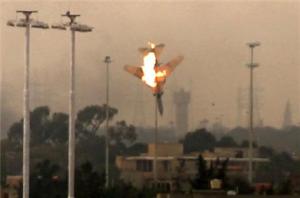
Enforcement of a no-fly zone over Libya has begun, with French military jets taking the lead. According to al Jazeera breaking news, “French warplanes have destroyed four Libyan tanks near the city of Benghazi.” You can follow the al Jazeera Libya live blog here.
The BBC also has a live blog on Libya that is frequently updated. The latest update is this tweet from a Libyan opposition group:
1758: Activist group Liberty4Libya tweets: “#Libya #Zintan, heavy shelling into the city of #Zintan, #Gaddafi troops’ tanks advancing under the fire cover.”
The BBC page is also running video reports.
Voice of America has this report: Allied Warplanes Patrol Libyan Skies. According to VOA Canadian planes are also on the way to launching point in Sicily.
French President Nicolas Sarkozy says allied warplanes are flying over Libya to enforce a no-fly zone and protect civilians in the city of Benghazi, where forces loyal to leader Moammar Gadhafi have been bearing down on rebels trying to bring down his government.
U.S. President Barack Obama confirmed a short time later that the United States has joined a coalition with its European and Arab partners to take action in Libya.
Obama spoke to reporters during his visit to Brazil. He said the allied coalition’s “resolve is clear,” and that all members are “prepared to act with urgency.”
Gaddafi has already responded as follows:
Gadhafi sent urgent messages to world leaders Saturday, including U.S. President Barack Obama and U.N. Secretary-General Ban Ki-moon. In a letter read to reporters by a government spokesman in Tripoli, Gadhafi noted the rebels had seized control of Benghazi, and asked rhetorically how Obama would “behave” if there was a similar situation in the United States.
Addressing the U.N. secretary-general, Gadhafi said the Security Council’s resolution on Libya is “invalid,” and predicted that any Western action against Libya would be seen as “clear aggression.”
Here is a report on Secretary of State Hillary Clinton’s statement last night in response to Gaddafi’s supposed “cease-fire.”
The BBC also has video of Hillary’s remarks after the Paris Summit today. You can watch it here. You can read the full text of her statement below the fold. Read the rest of this entry »

 peej
peej Carissa
 bostonboomer
 dakinikat
 ecocatwoman
 mablue2
 Mama Lopez
 peggysue22
 quixote
 skydancingguestblogger
 Mona (aka Wonk the Vote)



 Sky Dancing
Recent Comments