
Saturday Reads
Posted: November 23, 2013 Filed under: Afghanistan, China, Foreign Affairs, Great Britain, Iran, morning reads, NSA, National Security Agency, Saudi Arabia, U.S. Politics | Tags: cell phones on airplanes, domestic surveillance, drones, Federal Communications Commission (FCC), John Kerry, Kendric Johnson case, U.S. District Judge William H. Pauley III 45 Comments
Good Morning!!
Amid all the bad news, there’s apparently progress in the negotiations with Iran. The LA Times reported yesterday that a “nuclear deal appears imminent.” Secretary of State John Kerry headed to Geneva, Switzerland yesterday to help out.
After a rocky day Thursday, negotiators appeared for now to have overcome their differences on Iran’s entitlement to enrich uranium and on how to curb progress on a partially built nuclear research reactor that Western powers view as a particular threat.
U.S. Secretary of State John F. Kerry left late Friday for Geneva to help “narrow the differences and move closer to an agreement,” the State Department said. Sergei Lavrov, Russia’s foreign minister, arrived from Moscow early Friday evening, making him the first of the six nations’ ministers to show up for a possible signing ceremony that would end a decade of usually stalemated negotiations….
A deal would be a first-stage agreement that would give Iran temporary relief from the crushing Western sanctions on its economy in exchange for temporary limits on its nuclear program. Many nations fear that Iran, despite its insistence that its program is for peaceful purposes only, is seeking weapons capability with its huge nuclear infrastructure.
This deal would open the way for tough bargaining on a final, comprehensive agreement that would take six months or longer to be reached.
Isn’t it amazing what you can accomplish with a little carrot and stick diplomacy? Too bad Bush and Cheney never tried it.
U.S. negotiators and their counterparts from the United Kingdom, France, Germany, Russia and China have been meeting with the Iranians since Wednesday in an effort to strike an interim deal to delay Iran’s nuclear program while a larger deal is worked out that would prevent the Islamic Republic from obtaining nuclear weapons.
Britain’s Foreign Secretary William Hague spoke of “very difficult negotiations, saying “narrow gaps” remain on the same issues that blocked agreement at the last round earlier this month.
“We’re not here because things are necessarily finished,” Hague told reporters. “We’re here because they’re difficult, and they remain difficult.”
Still, the fact that they are talking is definitely encouraging. In another sign that something is actually happening, the Chinese foreign minister arrived in Geneva today. “Chinese foreign ministry spokesman Hong Lei said Saturday the talks…have reached the final moment.”
For those of you who still use air travel, the FCC is on the verge of making a decision that could make flying infinitely more annoying that it is already. From The Washington Post: FCC sees backlash after proposing to allow in-flight cellphone calls on planes.
The Federal Communications Commission said Thursday that it will consider rules that would allow air travelers to make calls and use their cellular data plans once a plane reaches 10,000 feet. Restrictions would remain for takeoffs and landings.
The proposal, which will be raised at the commission’s meeting next month, has the backing of the agency’s newly appointed chairman. But the idea is bound to be controversial. Within hours of the announcement, consumers flooded the agency with protests.
One FCC commissioner received hundreds of e-mails complaining that the move would lead to unbearable noise pollution, an aide said. Passengers are already crammed into smaller seats and tighter rows, and being forced to listen to one another’s calls would be yet another indignity, they wrote.
A petition quickly went up on the White House Web site Thursday, asking the Obama administration to stop the effort. “This would make an already cranky, uncomfortable travel experience exponentially worse, and as a frequent flier and concerned citizen, I think the administration needs to nip this in the bud,” a resident from Richmond wrote.
Something tells me if this plan goes through, there are going be a lot more air rage incidents in the not-so-friendly skies. But after the uproar, USA Today is reporting that the new FCC commissioner–only three weeks into the job–is backpedaling rapidly.
NEW YORK (AP) — A day after setting off an uproar among travelers opposed to in-flight phone calls, the chairman of the Federal Communications Commission Chairman backtracked, saying he personally isn’t in favor of calls on planes.
The role of the FCC, he added, is to advise if there is a safety issue with using phones on planes. He said there is “no technical reason to prohibit” the use of mobile devices on planes.
“We understand that many passengers would prefer that voice calls not be made on airplanes. I feel that way myself,” chairman Tom Wheeler said in a Friday statement.
The decision to allow calls will ultimately rest with the airlines, Wheeler emphasized.
The Wall Street Journal reports that U.S. District Judge William H. Pauley III “Appears Receptive to Critics of NSA’s Collection of Phone Data.” Back in 1979, the Supreme Court decided that phone records are not private, because we willingly give the information to our telephone company. But now Judge Pauley is questioning that decision based on recent revelations about NSA data collection.
“Doesn’t the information collected here reveal far more?” U.S. District Judge William H. Pauley III asked during a hearing in Manhattan federal court on Friday.
Judge Pauley also questioned whether Congress could authorize the collection when the NSA program’s existence wasn’t widely known among lawmakers.
The hearing stemmed from a lawsuit filed by the American Civil Liberties Union and its New York affiliate days after the program was revealed in news reports that were based on documents provided by former NSA contractor Edward Snowden. The groups argue the bulk collection of records called metadata—which includes the phone numbers people dialed and where they were calling from—violates Americans’ privacy rights, as well as federal law.
The judge issued no immediate ruling and left open the possibility that he could dismiss part of the case, because federal law designates the secretive Foreign Intelligence Surveillance Court as the proper venue for certain national-security issues.
Pauley is a Clinton appointee.
In Pakistan, a protest by about 10,000 people against U.S. drone strikes succeeded in blocking a supply route to and from Afghanistan.
The protest, led by Pakistani politician and cricket star Imran Khan, had more symbolic value than practical impact as there is normally little NATO supply traffic on the road on Saturdays. The blocked route in Khyber Pakhtunkhwa province leads to one of two border crossings used to send supplies overland from Pakistan to neighboring Afghanistan.
Khan, whose Tehreek-e-Insaf party runs the Khyber Pakhtunkhwa government, called on federal officials to take a firmer stance to force the U.S. to end drone attacks and block NATO supplies across the country.
“We will put pressure on America, and our protest will continue if drone attacks are not stopped,” Khan told the protesters.
The demonstrators dispersed after Khan’s speech, but his party put out a statement saying they will begin stopping trucks from carrying NATO supplies through Khyber Pakhtunkhwa indefinitely beginning Sunday night. That could spark a clash with the federal government.
Raw Story has an update in the case of Kendrick Johnson, the 17-year-old whose body was found inside a gym mat in a Valdosta, GA high school.
At least an hour of footage is missing from each of the four surveillance cameras at Kendrick Johnson’s high school, and the original footage showing how the Georgia teenager died might be gone, CNN reported on Thursday.
“Those files are not original files,” forensics video analyst Grant Fredericks told CNN. “They’re not something investigators should rely on for the truth of the video.”
CNN enlisted Fredericks in order to analyze more than 290 hours of video it acquired from Lowndes County High School, where the 17-year-old was found dead in the gym in January. Local officials initially determined that he died from asphyxiation after getting trapped inside a gym mat, an argument his family has rejected. An independent autopsy ordered by the victim’s family found the cause of death to be “unexplained, apparent non-accidental, blunt force trauma.”
But while the Lowndes Public Schools district told CNN the video it provided was “a raw feed with no edits,” Fredericks disagreed, saying it was “altered in a number of ways, primarily in image quality and likely in dropped information, information loss. There are also a number of files that are corrupted because they’ve not been processed correctly and they’re not playable. I can’t say why they were done that way, but they were not done correctly, and they were not done thoroughly. So we’re missing information.”
Specifically, two of the cameras are missing 65 minutes of footage each, while the other two are missing 130 minutes apiece. Another camera outside of the gymnasium has a time stamp 10 minutes behind the ones inside.
It sounds like the cover had to involve someone in the school administration, doesn’t it?
So . . . it’s kind of a slow news day, but I found a few stories for you to talk about. What are you hearing? Did I miss any big news? Please post your links in the comment thread.
Saturday Reads: Obama Talks to Rouhani, Pakistan and Kenyan Disasters, Republican Terrorism, and More
Posted: September 28, 2013 Filed under: Affordable Care Act (ACA), Barack Obama, Climate Change, Diplomacy Nightmares, Environment, Foreign Affairs, Iran, Journalism, Kenya, morning reads, NSA, National Security Agency, Pakistan, Republican politics, The Media SUCKS, U.S. Economy, U.S. Politics | Tags: baseball playoffs, Boston Red Sox, Congress, diplomacy, Hassan Rouhani, IPCC, Kenyan Mall massacre, Nuclear Power, nuclear weapons, Pakistan earthquake, Ted Cruz 24 Comments
Good Morning!!
It’s a beautiful Fall day in New England, the Red Sox have taken the American League East with the best record in baseball after winning 97 games with one game left to play. On top of that, the Yankees are pitiful. The playoffs start next Friday. It just doesn’t get better than this.
There is quite a bit of news for a Saturday. First up, President Obama spoke on the telephone to Iranian President President Hassan Rouhani yesterday–the first time leaders of the U.S. and Iran have spoken directly since 1979. The AP reports:
The United States and Iran took a historic step toward ending more than three decades of estrangement on Friday when President Barack Obama and Iranian President Hassan Rouhani spoke by phone and agreed to work on resolving global suspicions that Tehran is trying to build a nuclear weapon.
The 15-minute call capped a week of seismic shifts in the relationship that revolved around Rouhani’s participation in the annual U.N. meeting of world leaders. The night before the two leaders spoke, U.S. and European diplomats hailed a “very significant shift” in Iran’s attitude and tone in the first talks on the nuclear standoff since April.
The diplomatic warming began shortly after Rouhani’s election in June. But it is rooted in both presidents’ stated campaign desires — Obama in 2008 and Rouhani this year — to break through 34-year-old barriers and move toward diplomacy.
Iran is also seeking quick relief from blistering economic sanctions that the U.S. and its Western allies have imposed on Tehran to punish it for refusing to scale back its nuclear activities. Iran insists its nuclear program is for peaceful purposes only, but years of stonewalling inspections and secrecy about its activities have fueled fears it is seeking to build warheads.
Rouhani and Obama spoke while the Iranian president was in his car and headed to the airport to fly back to Tehran, with Obama at his desk in the Oval Office. Rouhani’s aides initially reached out to arrange the conversation, and the White House placed the call.
I’m not sure what it means to “work on resolving global suspicions that Tehran is trying to build a nuclear weapon,”–do they want to calm suspicions or tamp down the nuclear efforts? But at least it’s a step in the right direction. The New York Times has more:
“Resolving this issue, obviously, could also serve as a major step forward in a new relationship between the United States and the Islamic Republic of Iran, one based on mutual interests and mutual respect,” Mr. Obama, referring to Tehran’s nuclear program, told reporters at the White House after the 15-minute phone call. “It would also help facilitate a better relationship between Iran and the international community, as well as others in the region.”
A Twitter account in Mr. Rouhani’s name later stated, “In regards to nuclear issue, with political will, there is a way to rapidly solve the matter.” The account added that Mr. Rouhani had told Mr. Obama, “We’re hopeful about what we will see from” the United States and other major powers “in coming weeks and months.”
More detail about the call itself:
Mr. Obama placed the call from the Oval Office around 2:30 p.m., joined by aides and a translator.
He opened by congratulating Mr. Rouhani on his election in June and noted the history of mistrust between the two nations, but also what he called the constructive statements Mr. Rouhani had made during his stay in New York, according to the official. The bulk of the call focused on the nuclear dispute, and Mr. Obama repeated that he respected Iran’s right to develop civilian nuclear energy, but insisted on concessions to prevent development of weapons.
Mr. Obama also raised the cases of three Americans in Iran, one missing and two others detained. In a lighter moment, he apologized for New York traffic.
The call ended on a polite note, according to the official and Mr. Rouhani’s Twitter account.
“Have a nice day,” Mr. Rouhani said in English.
“Thank you,” Mr. Obama replied, and then tried a Persian farewell. “Khodahafez.”
Meanwhile, the Wall Street Journal reports that: U.S. Says Iran Hacked Navy Computers.
U.S. officials said Iran hacked unclassified Navy computers in recent weeks in an escalation of Iranian cyberintrusions targeting the U.S. military.
The allegations, coming as the Obama administration ramps up talks with Iran over its nuclear program, show the depth and complexity of long-standing tensions between Washington and Tehran.
The U.S. officials said the attacks were carried out by hackers working for Iran’s government or by a group acting with the approval of Iranian leaders.
The most recent incident came in the week starting Sept. 15, before a security upgrade, the officials said. Iranian officials didn’t respond to requests to comment.
The allegations would mark one of the most serious infiltrations of U.S. government computer systems by Iran. Previously, Iranian-backed infiltration and surveillance efforts have targeted U.S. banks and computer networks running energy companies, current and former U.S. officials have said.
I’m sure Glenn Greenwald will have a highly disapproving story about this in the Guardian today. Oh wait, he’s probably more outraged that the NSA was able to discover the Iranian spying . . . Never mind.
When Rouhani got home, he was “met by hardline protesters chanting ‘Death to America,'” according to BBC News.
Hundreds of people gathered at Tehran airport, with supporters hailing the trip and opponents throwing shoes.
An Agence France-Presse journalist said some 200-300 supporters gathered outside the airport to thank Mr Rouhani for his efforts.
But opposite them were about 60 people shouting “Death to America” and “Death to Israel”.
Mr Rouhani raised his hand to the crowds as he was driven off.
A New York Times reporter described the scene as chaotic, with dozens of hardliners hurling eggs and shoes at the president’s convoy.
There was another powerful earthquake today in Pakistan, according to CNN.
The 6.8 magnitude earthquake struck in Balochistan province Saturday about 96 kilometers (60 miles) northeast of Awaran, the United States Geological Survey said.
Rasheed Baloch, the Deputy Commissioner Awaran told CNN seven people died when a house collapsed in Mashkay Tehsil as result of new earthquake on Saturday.
Just Tuesday, a 7.7 magnitude earthquake struck the same area of Pakistan. The death toll in that quake has risen to 366 people and another 765 are injured….
Baloch said a rescue operation was under way in Awaran district to retrieve the dead bodies and shift the injured to hospitals.
The remoteness of the affected area and damaged communications networks are hindering the rescue operation, officials said.
The Atlantic has a good article following up on “Tragic and Heroic Stories from Survivors of the Kenyan Mall Attack.”
Witness accounts and survivor stories from the Westgate Mall attack in Nairobi continue to emerge, telling a freighting [sic] story of violence and terror. Yet, as the investigation continues, there are still some disturbing questions about the attack that have yet to be fully explained.
Now that more access has been granted to the ruined mall, images confirm that three floors of the building collapsed, presumably because of a large explosion. The Associated Press reported today that the collapse was actually caused by the Kenyan military, supporting a claim made by the terrorists themselves. It’s still not clear how or why they managed to set off the explosion, but it may have killed some (perhaps most?) of the hostages still inside the building.
The official death toll is still listed at 67, but it’s likely that unrecovered bodies will be found in the rubble. As many as 60 people are still missing.
CNN is also reporting today that the terrorists did not just plant weapons inside the mall in the days before the attack, as had been previously reported, but that members of al-Shabab had rented out a storeand were actually running it as functional business for nearly a year.
While investigators, including the FBI, continue their work, we’re learning more about what happened inside the mall during the attack, and what those who lived through it endured.
Check out some of the survivor stories at The Atlantic link.
The Intergovernmental Panel on Climate Change (IPCC) released a shocking report yesterday, according to BBC News. IPCC climate report: humans ‘dominant cause’ of warming.
A landmark report says scientists are 95% certain that humans are the “dominant cause” of global warming since the 1950s.
The report by the UN’s climate panel details the physical evidence behind climate change.
On the ground, in the air, in the oceans, global warming is “unequivocal”, it explained.
It adds that a pause in warming over the past 15 years is too short to reflect long-term trends.
The panel warns that continued emissions of greenhouse gases will cause further warming and changes in all aspects of the climate system.
To contain these changes will require “substantial and sustained reductions of greenhouse gas emissions”.
Too bad no humans in powerful positions are likely to do anything about it.
Back in the USA . . .
Congress is still battling over whether or not to crash the global economy because Republicans don’t want ordinary Americans to have health care, Ted Cruz is still getting headlines for making an ass of himself, and the media is still trying to blame Democrats and Republicans equally for the mess we’re in.
From the Washington Post: Obama chides Republicans as shutdown looms.
With Washington barreling toward a government shutdown, a deadlocked Congress entered the final weekend of the fiscal year with no clear ideas of how to avoid furloughs for more than 800,000 federal workers. Millions more could be left without paychecks.
The Senate on Friday approved a stopgap government funding bill and promptly departed, leaving all of the pressure to find a solution on House Republican leaders.
President Obama weighed in, sternly lecturing GOP leaders that the easiest path forward would be to approve the Senate’s bill, which includes money for the implementation of the Affordable Care Act, the president’s prized legislation achievement, which he signed into law in 2010. But a far-right bloc of House and Senate Republicans banded together to leave House Speaker John A. Boehner (R-Ohio) virtually powerless to act.
“My message to Congress is this: Do not shut down the government. Do not shut down the economy. Pass a budget on time,” Obama said in the White House press briefing room.
Boehner’s leadership team offered no public comment and remained out of sight most of Friday, hunkering down for another weekend on the brink. For Boehner, this is the latest in a series of unstable moments that have become the hallmark of his three-year run as speaker.
Al Gore uncharacteristically joined the fray, according to The Hill. Gore to GOP: ‘How dare you?’
Former Vice President Al Gore accused Republicans Friday of engaging in “political terrorism” by using a government shutdown as leverage to defund ObamaCare.
“The only phrase that describes it is political terrorism,” Gore said at the Brookings Institution, according to ABC News. “Why does partisanship have anything to do with such a despicable and dishonorable threat to the integrity of the United States of America?”
The former vice president also criticized Republicans for threats to link defunding ObamaCare to the debt ceiling, which is set to expire Oct. 17.
“Now you want to threaten to not only shut down our government but to blow up the world economy unless we go back and undo what we did according to the processes of this democracy?” Gore said. “How dare you?”
But the media is still pushing their “both sides do it” narrative. At The Atlantic, James Fallows offers Your False-Equivalence Guide to the Days Ahead. Here’s just a taste:
As a matter of journalism, any story that presents the disagreements as a “standoff,” a “showdown,” a “failure of leadership,” a sign of “partisan gridlock,” or any of the other usual terms for political disagreement,represents a failure of journalism*** and an inability to see or describe what is going on. For instance: the “dig in their heels” headline you see below, which is from a proprietary newsletter I read this morning, and about which I am leaving off the identifying details.
This isn’t “gridlock.” It is a ferocious struggle within one party, between its traditionalists and its radical factions, with results that unfortunately can harm all the rest of us — and, should there be a debt default, could harm the rest of the world too.
Now please click the link and go over to The Atlantic–it’s a must read.
I’m running out of space, so I’ll go with a link dump on Ted Cruz–if you have the stomach for the details you can go to the sources.
Huffington Post: Student Cited By Ted Cruz As Proof Of Obama’s Failure Is Actually Grateful For Obamacare
John Dickerson at Slate: Why Senate Republicans Hate Ted Cruz
Jonathan Chait: Ted Cruz Now Ruining John Boehner’s Life, Too
Politico: Ted Cruz again refuses to back John Cornyn
Those are my recommendations for today. What are you reading and blogging about? See you in the comment thread!
Tuesday Reads: U.S. Spies on Foreign Countries and Other “Blockbuster” News
Posted: September 3, 2013 Filed under: Central Intelligence Agency, China, Crime, cyber security, Diplomacy Nightmares, Foreign Affairs, France, Germany, Great Britain, Iran, Israel, morning reads, Pakistan, Russia, Syria, U.S. Politics | Tags: Agência Brasileira de Inteligência, al Qaeda, Bashar al-Assad, black budget, Bob Cesca, Edward Snowden, espionage, Glenn Greenwald, Information Assurance, John Kerry, Laura Poitras, Marines website, National Security Agency (NSA), nuclear weapons, Osama bin Laden, S-2 (Mexico spy agency), SIGINT, signals intelligence, Syrian Electronic Army, Taliban 51 Comments
Good Morning!!
In the weeks since Edward Snowden absconded with thousands of top secret National Security Agency (NSA) files and traveled to Hong Kong and then Moscow and handed over the documents to Guardian columnist Glenn Greenwald and filmmaker Laura Poitras, we’ve learned that the U.S. spies on lots of other countries. Snowden has revealed that NSA has spied on China, Russia, Germany, France, Brazil, Mexico, Israel, Iran, and the UN. Oddly, we haven’t gotten much new information from Snowden about illegal or abusive NSA spying on Americans, which Snowden initially suggested was his reason for stealing the secret documents.
To most nominally intelligent and informed people, the fact that NSA spies on foreign countires is not particularly surprising; since collecting foreign signals intelligence (SIGINT) is the primary purpose of NSA as stated publicly on their website. Here is NSA’s statement of their “core mission”:
The National Security Agency/Central Security Service (NSA/CSS) leads the U.S. Government in cryptology that encompasses both Signals Intelligence (SIGINT) and Information Assurance (IA) products and services, and enables Computer Network Operations (CNO) in order to gain a decision advantage for the Nation and our allies under all circumstances.
The Information Assurance mission confronts the formidable challenge of preventing foreign adversaries from gaining access to sensitive or classified national security information. The Signals Intelligence mission collects, processes, and disseminates intelligence information from foreign signals for intelligence and counterintelligence purposes and to support military operations. This Agency also enables Network Warfare operations to defeat terrorists and their organizations at home and abroad, consistent with U.S. laws and the protection of privacy and civil liberties.
Spying on foreign countries is what NSA does. Why that is perceived as somehow illegal and/or shocking by Greenwald, Poitras, Snowden, and their cult followers, I have no clue. But the fact that a spy agency collects foreign signals intelligence really should not be considered breaking news; and the countries that are complaining about it are well known for spying on the US in return–and in some cases (e.g., China, Russia, and Israel) for famously stealing U.S. secrets and technology.
Today the Washington Post has a new “blockbuster” article that reveals that the U.S. is particularly focused on spying on Pakistan. Now I wonder why that would be? Anyone want to speculate? It couldn’t have anything to do with the fact that Pakistan concealed the location of Osama bin Laden for years, could it? Or the fact that Taliban and al Quaeda operatives regularly hide in Pakistan? Just a couple of wild guesses…
Here’s an excerpt from the WaPo article:
A 178-page summary of the U.S. intelligence community’s “black budget” shows that the United States has ramped up its surveillance of Pakistan’s nuclear arms, cites previously undisclosed concerns about biological and chemical sites there, and details efforts to assess the loyalties of counterterrorism sources recruited by the CIA.
Pakistan appears at the top of charts listing critical U.S. intelligence gaps. It is named as a target of newly formed analytic cells. And fears about the security of its nuclear program are so pervasive that a budget section on containing the spread of illicit weapons divides the world into two categories: Pakistan and everybody else.
The disclosures — based on documents provided to The Washington Post by former intelligence contractor Edward Snowden — expose broad new levels of U.S. distrust in an already unsteady security partnership with Pakistan, a politically unstable country that faces rising Islamist militancy. They also reveal a more expansive effort to gather intelligence on Pakistan than U.S. officials have disclosed.
The United States has delivered nearly $26 billion in aid to Pakistan over the past 12 years, aimed at stabilizing the country and ensuring its cooperation in counterterrorism efforts. But with Osama bin Laden dead and al-Qaeda degraded, U.S. spy agencies appear to be shifting their attention to dangers that have emerged beyond the patch of Pakistani territory patrolled by CIA drones.
“If the Americans are expanding their surveillance capabilities, it can only mean one thing,” said Husain Haqqani, who until 2011 served as Pakistan’s ambassador to the United States. “The mistrust now exceeds the trust.”
The stolen files also reveal serious human rights issues in Pakistan and fears about the security of Pakistan’s nuclear weapons. Raise your hand if you’re shocked by any this. I can certainly see why these revelations would be harmful to U.S. national security and foreign relations, however.
Via The Jerusalem Post, another Snowden leak revealed by the Washington Post showed that members of terrorist organizations have tried to join the CIA.
…individuals with past connections to known terrorist entities such as al-Qaida, Hezbollah and Hamas, have repeatedly attempted to obtain employment within the CIA, The Washington Post reported on Monday.
Among job-seekers that seemed suspicious to the CIA, approximately 20% of that grouping reportedly had “significant terrorist and/or hostile intelligence connections.” The nature of the connections was not described in the document.
“Over the last several years, a small subset of CIA’s total job applicants were flagged due to various problems or issues,” an anonymous CIA official was reported as saying. “During this period, one in five of that small subset were found to have significant connections to hostile intelligence services and or terrorist groups.” [….]
The document also allegedly stated that the CIA re-investigates thousands of employees each year to reduce the possibility that an individual with these connections may compromise sensitive information.
Can anyone explain to me why this should be considered criminal or why the person who revealed it should be called a “whistle-blower?” It seems to me, the only reason for revealing the methods the U.S. uses to collect foreign SIGINT is a desire to harm U.S. Government and damage its foreign policy. Here’s Bob Cesca, who has consistently critiqued libertarians Snowden and Greenwald and their anti-government motives from a liberal, rational point of view: Greenwald Reports NSA Spied on Presidents of Brazil andMexico.
We’re not sure exactly which section of the U.S. Constitution protects the privacy rights of foreign leaders, but Glenn Greenwald and Edward Snowden appear to believe it’s in there somewhere. The tandem crusaders for the Fourth Amendment have once again extended their reach beyond what was intended to be their mutual goal of igniting a debate in the United States about the constitutionality of the National Security Agency’s surveillance operations, and, instead, opted to reveal that, yes, the U.S. spies on foreign leaders. Shocking, I know.
Specifically, on the Globo television show “Fantasico” in Brazil, Greenwald described a July, 2012 document stolen from NSA by Snowden, which describes how NSA had intercepted communications made by the president of Mexico, Enrique Pena Nieto, as well as Brazil’s president, Dilma Rousseff. (Incidentally, the Globo article contains 13 corporate trackers or “web bugs.”)
The goal of revealing this information is clear. Greenwald and Snowden have successfully exploited the “sparking a debate” motive as a Trojan Horse for injecting unrelated information into public view as a means of vindictively damaging the operations of U.S. and U.K. intelligence communities, not to mention the reputation of the United States as a whole, while also pushing the unrealistic message that surveillance is generally impermissible. Yes, we already knew that nations spy on other nations, but to publicly disclose specific instances of international spying — while on the soil of one of the nations being surveilled — confirms these suspicions and sorely embarrasses everyone involved.
But guess what? Both Mexico and Brazil have powerful spy agencies that conduct “active surveillance” on the U.S.
In Brazil, it’s called the Agência Brasileira de Inteligência (ABIN or the Brazilian Intelligence Agency). It deals with external and domestic intelligence gathering: collection and analysis of information that’s intercepted via both signals (SIGINT collects email, phone calls and so forth) and human resources.
In Mexico, it’s called S-2. Like ABIN or NSA, S-2 also collects SIGINT on foreign targets, with a special focus on the military operations of foreign governments. Along with its counterpart, the Centro de Información de Seguridad Nacional (Center for Research on National Security or CISIN), S-2 is tasked with counter-intelligence and counter-terrorism operations.
Has anyone overheard Greenwald mention, even in passing, either of these agencies? Likely not, and don’t hold your breath waiting for Greenwald to attack Brazil’s intelligence community, even knowing that it wiretapped its own Senate and Supreme Court several years ago. Along those lines, we don’t know exactly whether these agencies have attempted to spy on any of our presidents or government officials, but wouldn’t Greenwald, as a U.S. citizen and resident of Brazil, want to find out using the same “Glennzilla” tenacity he’s employed while exposing U.S. spying? If his crusade now involves universal privacy, wouldn’t that include violations by the Brazilian government, especially knowing that Greenwald lives in Rio de Janeiro?
Read more at the link.
In other news….
The civil war in Syria continues to be the top international story, and The New York Times has a couple of helpful articles. The first is an explainer that deals with Key Questions on the Conflict in Syria. I won’t excerpt from it–read it at the NYT if you’re interested. Next, an article that explains how American policy on Syria may affect possible negotiations with Iran: Drawing a Line on Syria, U.S. Eyes Iran Talks.
As the Obama administration makes a case for punitive airstrikes on the Syrian government, its strongest card in the view of some supporters of a military response may be the need to send a message to another country: Iran. If the United States does not enforce its self-imposed “red line” on Syria’s use of chemical weapons, this thinking goes, Iran will smell weakness and press ahead more boldly in its quest for nuclear weapons.
But that message may be clashing with a simultaneous effort by American officials to explore dialogue with Iran’s moderate new president, Hassan Rouhani, in the latest expression of Washington’s long struggle to balance toughness with diplomacy in its relations with a longtime adversary.
Two recent diplomatic ventures have raised speculation about a possible back channel between Washington and Tehran. Last week, Jeffrey Feltman, a high State Department official in President Obama’s first term who is now a senior envoy at the United Nations, visited Iran to meet with the new foreign minister, Mohammad Javad Zarif, and discussed possible reactions to an American airstrike in Syria.

In line with the international beating up on the U.S. that has followed the Snowden-Greenwald-Poitras “revelations” that NSA spies on foreign countries, The Daily Mail has a snarky article with numerous photos about a dinner that John Kerry had with Syria’s Bashar al-Assad in 2009.
An astonishing photograph of John Kerry having a cozy and intimate dinner with Bashar al-Assad has emerged at the moment the U.S Secretary of State is making the case to bomb the Syrian dictator’s country and remove him from power.
Kerry, who compared Assad to Adolf Hitler and Saddam Hussein yesterday, is pictured around a small table with his wife Teresa Heinz and the Assads in 2009.
Assad and Kerry, then a Massachusetts senator, lean in towards each other and appear deep in conversation as their spouses look on.
A waiter is pictured at their side with a tray of green drinks, believed to be lemon and crushed mint.
Now, why would Kerry be having dinner with Syria’s president? The Daily Mail tells us:
The picture was likely taken in February 2009 in the Naranj restaurant in Damascus, when Kerry led a delegation to Syria to discuss finding a way forward for peace in the region.
At the time, Kerry was Chairman of the Senate Foreign Relations Committee, and what he was doing is called “diplomacy.” But looking back in the age of Snowden, it seems that instead of having a polite dinner, Kerry should have punched Assad in the nose and screamed at him at the top of his lungs to get with the program–or something…
From the Wall Street Journal: Syrian Electronic Army Hacks Marines Website
A collection of pro-Syrian government hackers apparently defaced a Marine Corps recruitment website Monday.
The Syrian Electronic Army, which has hacked a series of websites, posted a letter on the Marines.com website arguing the Syrian government is “fighting a vile common enemy.”
“The Syrian army should be your ally not your enemy,” the letter read. “Refuse your orders and concentrate on the real reason every soldier joins their military, to defend their homeland. You’re more than welcome to fight alongside our army rather than against it.”
See a screen shot at the link. The site is now back up and running normally.
I’ll end there and post my remaining links in the thread below. As always, please post links to the stories you’re following in the comments as well.
Tuesday Reads
Posted: August 27, 2013 Filed under: Barack Obama, China, Foreign Affairs, Iran, Iraq, morning reads, NSA, National Security Agency, Regulation, Russia, Syria, U.S. Politics | Tags: California wildfire, chemical weapons, cuba, David Miranda, Edward Snowden, GCHQ, Glenn Greenwald, John Kerry, Saddam Hussein, San Francisco water and power, Texas legislature, West Fertilizer Co., Yosemite National Park 30 Comments
Good Morning!!
The big news today is that President Obama appears likely to order “limited” strikes on Syria in the next few days in response to Syria’s use of chemical weapons against opposition fighters. From the WaPo: After Syria chemical allegations, Obama considering limited military strike.
President Obama is weighing a military strike against Syria that would be of limited scope and duration, designed to serve as punishment for Syria’s use of chemical weapons and as a deterrent, while keeping the United States out of deeper involvement in that country’s civil war, according to senior administration officials.
The timing of such an attack, which would probably last no more than two days and involve sea-launched cruise missiles — or, possibly, long-range bombers — striking military targets not directly related to Syria’s chemical weapons arsenal, would be dependent on three factors: completion of an intelligence report assessing Syrian government culpability in last week’s alleged chemical attack; ongoing consultation with allies and Congress; and determination of a justification under international law.
“We’re actively looking at the various legal angles that would inform a decision,” said an official who spoke about the presidential deliberations on the condition of anonymity. Missile-armed U.S. warships are already positioned in the Mediterranean.
I guess “looking at…legal angles” is code for that pesky rule in the Constitution where Congress has to declare wars. When’s the last time that happened–WWII?
Meanwhile, BBC News reports: Russia and China step up warning over strike.
Russian foreign ministry spokesman Alexander Lukashevich has called on the international community to show “prudence” over the crisis and observe international law.
“Attempts to bypass the Security Council, once again to create artificial groundless excuses for a military intervention in the region are fraught with new suffering in Syria and catastrophic consequences for other countries of the Middle East and North Africa,” he said in a statement.
Late on Monday, the US said it was postponing a meeting on Syria with Russian diplomats, citing “ongoing consultations” about alleged use of chemical weapons in Syria.
Hours later, Russia expressed regret about the decision. The two sides had been due to meet in The Hague on Wednesday to discuss setting up an international conference on finding a political solution to the crisis.
The Russian deputy defence minister, Gennady Gatilov said working out the political parameters for a resolution on Syria would be especially useful, with the threat of force hanging over the country.
Read more at the link.
Just as SOS Kerry was giving a speech to justify the upcoming military strikes, providing “Clear Evidence of Chemical Weapon Use in Syria” (NYT), a little birdie told Shane Harris and Matthew Aid of Foreign Policy magazine that the U.S. facilitated Saddam Hussein’s use of chemical weapons against Iran back in 1988.
The U.S. government may be considering military action in response to chemical strikes near Damascus. But a generation ago, America’s military and intelligence communities knew about and did nothing to stop a series of nerve gas attacks far more devastating than anything Syria has seen, Foreign Policy has learned.
In 1988, during the waning days of Iraq’s war with Iran, the United States learned through satellite imagery that Iran was about to gain a major strategic advantage by exploiting a hole in Iraqi defenses. U.S. intelligence officials conveyed the location of the Iranian troops to Iraq, fully aware that Hussein’s military would attack with chemical weapons, including sarin, a lethal nerve agent.
The intelligence included imagery and maps about Iranian troop movements, as well as the locations of Iranian logistics facilities and details about Iranian air defenses. The Iraqis used mustard gas and sarin prior to four major offensives in early 1988 that relied on U.S. satellite imagery, maps, and other intelligence. These attacks helped to tilt the war in Iraq’s favor and bring Iran to the negotiating table, and they ensured that the Reagan administration’s long-standing policy of securing an Iraqi victory would succeed. But they were also the last in a series of chemical strikes stretching back several years that the Reagan administration knew about and didn’t disclose.
U.S. officials have long denied acquiescing to Iraqi chemical attacks, insisting that Hussein’s government never announced he was going to use the weapons. But retired Air Force Col. Rick Francona, who was a military attaché in Baghdad during the 1988 strikes, paints a different picture.
“The Iraqis never told us that they intended to use nerve gas. They didn’t have to. We already knew,” he told Foreign Policy.
Read the rest of this long article at Foreign Policy.
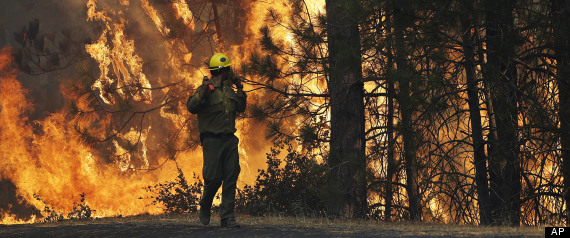
Firefighter A.J. Tevis watches the flames of the Rim Fire near Yosemite National Park, Calif., on Sunday, Aug. 25, 2013. With winds gusting to 50 mph on Sierra mountain ridges and flames jumping from treetop to treetop, hundreds of firefighters have been deployed to protect this and other communities in the path of the Rim Fire raging north of Yosemite National Park. (AP Photo/Jae C. Hong)
The wildfire in Northern California continues to spread into Yosemite National Park and has begun to threaten towns in the area. From the LA Times: Massive Rim fire continues to reshape lives and topography.
…even as firefighters worked furiously to hold a line outside of town, officials warned that this blaze was so hot it could send sparks more than a mile and a half out that could jump lines and start new hot spots. Evacuation advisories remain in effect for Tuolumne City and nearby areas.
On the north edge, the fire — now 134,000 acres — pushed into the Emigrant Wilderness Area and Yosemite National Park. It’s the one side of the fire with a natural last stand: Eventually it will run into granite walls that have snuffed out fires in this region for centuries.
Each day, what the massive blaze does depends on the wind. But officials were particularly attuned to each shift of breeze Sunday because of the weather’s eerie similarities to the day when the fire first exploded out of control.
So far the unpredictable blaze is only about 20% controlled, and it still threatens water and power sources for San Francisco.
The massive fire presents every challenge: steep slopes, dry fuel, rugged terrain and entire communities possibly in harm’s way.
The base camp and incident post, usually a haven outside fire lines, was a prominent example of the fire’s unpredictability: It’s in the middle of the burn zone, charred land with still-smoldering stumps on both sides.
Firefighters call such complete devastation “the black.” Entire ravines and ridges were a dusty gray moonscape. But some of the land was a “dirty burn” — meaning there were small circles of pine and aspen and even grass and wildflowers in the middle of charcoal-black areas where smoke still curled and embers glowed. The specks of beauty made firefighters nervous: To a fire, they are fuel.
My sister and her husband own a house north of San Francisco. It’s probably not in danger, but it still brings the scope of this disaster home to me. I sure hope Firefighers will begin to make progress soon. The burning area is now the size of the city of Chicago, according to CNN.
Yosemite National Park, California (CNN) — A massive northern California wildfire that’s threatening Yosemite National Park and San Francisco’s key water and power sources grew Monday, becoming the 13th largest in state history, state fire authorities said.
The Rim Fire, which has devoured 160,980 acres, has scorched an area about the size of the city of Chicago while more than 3,600 firefighters try to rein it in….
The wildfire, which was 20% contained Monday night, was spreading primarily to the east and threatened to grow amid extremely dry conditions and hot weather.
Part of the fire continued to spread Monday toward a key part of San Francisco’s water supply: the Hetch Hetchy Reservoir, which lies within Yosemite and is just east of the flames.
The fire also could threaten the area’s hydroelectric generators, which provide much of San Francisco’s electricity. Because of the approaching flames, officials shut down the generators, and the city — more than 120 miles to the west — temporarily is getting power from elsewhere.
Speaking of disasters, Charles Pierce reminds us that West, Texas is still recovering from the horrible explosion at the fertilizer plant there and that Texas still isn’t doing that much to prevent similar events in the future.
Read the rest of this entry »
The Melodramatic, Pearl-Clutching, Islamaphobic Senate Hagel Death Panel
Posted: January 31, 2013 Filed under: Foreign Affairs, Iran, Iraq, Israel, John McCain, Republican politics | Tags: Hagel Hearings 19 CommentsI’ve been watching the Senate Committee that’s been grilling Hagel as party of his confirmation hearing for Secretary of Defense. It’s difficult to 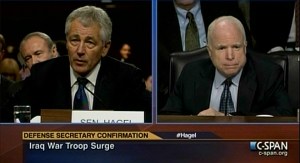 spell out all the agendas going on here. It seems to be a combination of revenge, neocon fantasy memes, and pro-Israel jingoism. In short, it’s more hyped-up melodrama than substance. It also has convinced me that it’s time for Senators Lindsey Graham and John McCain to retire. So, I’m going to try to link to some of the more bizarre hyperventilating by the revenge and war-thirsty set of Senators. Much of it is coming from the same folks that drug us into the Iraq mistake. It appears that some of the criticism is based in the same kinds of hyped up Islamophobia and blood thirst that characterize the Cheney crowd. Here’s an example of neocon drivel.
The latest example: neoconservative Kenneth Timmerman writing today in the Washington Times that “the Iranian rulers love Chuck Hagel.” Timmerman also writes that he is “Tehran’s best friend in Washington.” That line is part and parcel of the larger smear campaign waged ever since Hagel’s name was floated. Neoconservatives like Bill Kristol have accused Hagel of being “pro-appeasement of Iran.”
Timmerman’s column offers no evidence for his assertions, as is to be expected. But it’s a useful window into how the right is trying to torpedo Hagel’s nomination.
The reason why Hagel is being smeared as an “appeaser” of Iran is because he has voiced mild skepticism over how U.S. policy towards the country has been conducted. In the past, he has been skeptical of unilateral U.S. sanctions on the country and has cautioned against hastily rushing into a military attack. But he has also backtracked on many of his heterodox positions. The backtracking is the price Hagel had to pay to get nominated in the face of vociferous opposition from neoconservatives like Timmerman.
The personal revenge scenario seems to revolve around John McCain who might as well be singing “He was my man, but he done me wrong” as he hammered away Hagel today. He wants some one, any one, to vindicate him and his continual war drum beat for Iraq. Evidently, the war came between the two BFFs. (You can also view Hagel’s opening pitch at this WAPO/Cizilla link.)
The most obvious break in the McCain-Hagel relationship came in the early 2000s over the war in Iraq. While Hagel, like McCain, voted for the use of force resolution against Iraq, he was always wary of America going it alone in the conflict and, as time wore on, became a more and more outspoken critic of the war.
McCain, on the other hand, remained a stalwart defender of the necessity of the war and went on later in the decade to become the face of the surge strategy to put more troops in the country. Hagel opposed that strategy and panned it repeatedly.
“Quite simply, the split began over the length and cost of the Iraq war and Hagel’s decision to not support the surge, which John took as a personal insult,” said one McCain ally granted anonymity to speak candidly about the relationship. “It’s very sad.”
While a disagreement over the right course of action in Iraq might have been the biggest factor in the dissolution of the friendship, politics also played a role in the split.
While Hagel was intimately involved in McCain’s 2000 presidential bid — he served as national co-chairman and was in New Hampshire the night the Arizona Senator won the Granite State presidential primary — by the time McCain ran for president again in 2008 Hagel was much less on board.
Not only did he not endorse McCain, but Hagel also didn’t entirely dismiss the idea of serving as then Sen. Barack Obama’s vice presidential nominee. (Hagel’s wife endorsed Obama in the 2008 race.)
Then, in 2012, Hagel endorsed the candidacy of former Nebraska Sen. Bob Kerrey (D) in the Cornhusker State’s open seat Senate race, a move that badly rankled McCain, who had endorsed Kerrey’s opponent — Republican Deb Fischer — and campaigned with her the day after Hagel made his endorsement of Kerrey public.
Adding to their policy and political disagreements, there was (and is) the fact that McCain and Hagel are similar enough in terms of their personalities — hard charging, irascible, certain that their deeply-held beliefs are correct — that they were always destined to be either best friends or the exact opposite. Put simply: The very personality traits that made McCain and Hagel fast friends in the mid 1990s is what has driven them apart in the last few years.
Miss Lindsey has gotten the vapors over the nomination of Senator Hagel and appears to be worried he’s anti-Semitic. He’s probably more worried about an evangelical/tea party candidate primarying him if he doesn’t support the so-called “holy land” and rebuilding of the temple that’s going to bring on the end times. He’s also probably playing the role of McCain henchmen too. I have no idea why any one in a cabinet position has to take a loyalty oath to a foreign country given they’ll be enforcing the president’s policies anyway, but there it is. He’s not loyal enough to Israel’s right to do anything it wants to without question.
Miss Lindsey even said he got “chills up his spine”. Again, Lindsey appears to want some kind of loyalty pledge to an ally but, again, a foreign country.
The weirdest moment with Miss Lindsey came when he asked Hagel to name names. This rather took me back to the days of black-listing but the right wing appears to find it a big win for the one with the chilled spine. He also wanted Hagel to name the particular lobby and made sure to list the right-wing christian groups that are just dying for Israel to build that temple so the big war can get started.
Sen. Lindsey Graham grilled Hagel over a 2006 interview in which he said that the “pro-Israel lobby intimidates a lot of people” in Congress.
“Name one person here who’s been intimidated by the Jewish lobby,” Graham demanded. “Name one dumb thing we’ve been goaded into doing due to pressure by the Israeli or Jewish lobby.”
“I don’t know,” Hagel replied. “I didn’t have a specific person in mind.”
“So you agree that it was a dumb thing to say?”
“Yes,” Hagel admitted. “I’ve already said that.”
Right after characterizing this exchange as Lady Lindsey ‘crushing’ Hagel, we get this statement written by the article’s author Grace Wyler. It seemed to me that Wyler just proved Hagel’s point.
Pro-Israel groups and Republican defense hawks have leveled harsh criticism against Hagel in recent week. In addition to the “Israel lobby” comment, their grievances include Hagel’s past opposition to multilateral sanctions on Iran and his support for open negotiations with Hamas.
For the life of me, I cannot understand why we just can’t be on the side of peace and human rights instead of blindly supporting any country. But then, I don’t believe in any weird end times story that doesn’t come from scientific evidence and I don’t want to see perpetual war and human rights violations anywhere in the world. I frankly don’t care who the perpetrator is, it’s freaking wrong. I don’t know about you but I hold people I call my friends to higher standards than people I wouldn’t even want to talk to on the street. Besides, the current Israeli government is a put-together coalition of a lot of neocon and right wing groups that doesn’t appear to really represent that many Israeli citizens who would like to see more diplomacy and negotiations.
John Avalon has an interesting post at CNN called “A reality check for Chuck Hagel bashers”. It’s worth a read.
But let’s be honest: Hagel’s cardinal sin among neo-conservatives was his outspoken opposition to Bush-era foreign policy in Iraq and his decision to break Republican ranks and not support the 2007 Iraq surge.
Good people can disagree on policy and personnel; my wife and I disagree on the Hagel nomination. A confirmation hearing can usefully clear up any sincere questions. But a look at the facts, armed with a sense of perspective, suggests that it might be Hagel’s most vociferous critics who are outside the historic mainstream, not Hagel himself.
Hagel’s unvarnished independence is well-known in Washington, but his opposition to the quagmire of the Iraq war is not idiosyncratic. It is philosophically consistent with being a small government conservative and a Vietnam veteran, suspicious of calls to war by people who won’t have to serve in the combat zone.
He still carries shrapnel in his chest from being wounded in Vietnam. After his war service, he said, “I made myself a promise that if I ever got out of that place and was ever in a position to do something about war — so horrible, so filled with suffering — I would do whatever I could to stop it. I have never forgotten that promise.”
This doesn’t mean Hagel is some kind of pacifist. But as the first enlisted man to serve in combat to be nominated for secretary of defense, he does have a grunt’s-eye view of war and a commitment to making it a last resort, consistent with our national interest — hence his reasonable regrets about the invasion of Iraq and his caution about charging into a war with Iran.
Again, the beltway believes that this all started back in the Bush days. One interesting right wing freak out mentioned by Avalon particularly disturbed me.
And yet, the accusation that Hagel is out of the mainstream on Iran and Israel percolates because it is in the talking points. An early broadside came from The Weekly Standard, which published an anonymous e-mail, allegedly from a Senate aide, reading, “Send us Hagel and we will make sure every American knows he is an anti-Semite.”This is a serious accusation and a transparent attempt to intimidate. Anti-Semitism is a rightfully toxic charge. Israel is America’s closest ally in the world, along with the UK. But in a recent interview with his hometown paper in Lincoln, Nebraska, Hagel said that his record demonstrates “unequivocal, total support for Israel.”
In his memoir, Hagel devotes an entire chapter to “The Holy Land: Israel and The Arabs,” full of calls for negotiated peace with statements like this: “There is one important given that is not negotiable: A comprehensive solution should not include any compromise regarding Israel’s Jewish identity, which must be assured. The Israeli people must be free to live in peace and security.”
For what it’s worth, five former ambassadors to Israel have endorsed Hagel’s nomination, and former Israeli Consul Gen. Alon Pinkas has clarified that Hagel is “not anti-Israel.”
This is another conversation that bothers me. I have no idea what you can’t be critical of Israeli policies without being labelled anti-Israel or anti-Semitic. I think the best thing for Israel would be lasting peace in the middle east. I don’t think everything they do works to that end. This includes putting a huge prison-like wall around an entire populace, stopping humanitarian aid, and breaking agreements by allowing settlements in places that settlements should not be. I think their current government is what we’d see if Dick Cheney were ever to creep into the presidency frankly. Just because I think the Bush/Cheney years were basically indefensible does not mean I hate my country or myself as an American.
So, in some ways, this hearing is simply a replay of NeoCon trying to justify their actions that every one pretty much sees as misguided now with the exception of the right wing. It’s another example of how the Republican party is not going to change and how many Democrats enable their silliness on so many issues. Again, this display was a great argument for the people in Arizona and South Carolina to retire their senators and spare the rest of us this kind of reverse morality play.

 peej
peej Carissa
 bostonboomer
 dakinikat
 ecocatwoman
 jjlo
jjlo mablue2
 Mama Lopez
 peggysue22
 quixote
 skydancingguestblogger
 Mona (aka Wonk the Vote)



 Sky Dancing
Recent Comments