
Thursday Reads
Posted: March 17, 2011 Filed under: Bahrain, Barack Obama, Foreign Affairs, Libya, Psychopaths in charge, torture, U.S. Military, U.S. Politics, We are so F'd, Wikileaks, Yemen | Tags: Bahrain crackdown, banality of evil, Barack Obama, Bradley Manning, Japan's nuclear disaster, Libyan uprising, Yemen 29 Comments
Good Morning! Well, at least we are alive and not living next to a nuclear plant that is melting down–for now anyway–so I guess you could say it’s a good morning.
I’m pretty overwhelmed with trying to summarize the news. There is so much happening that I hardly know where to begin. I’m going to begin with a link or two about some of the big stories happening right now. You can supplement my links in the comments.
Japan nuclear disaster: US Officials Alarmed by Japanese Handling of Nuclear Crisis
“It would be hard to describe how alarming this is right now,” one U.S. official told ABC News….
“We are all-out urging the Japanese to get more people back in there to do emergency operation there, that the next 24 to 48 hours are critical,” the official said. “Urgent efforts are needed on the part of the Japanese to restore emergency operations to cool” down the reactors’ rods before they trigger a meltdown.
“They need to stop pulling out people—and step up with getting them back in the reactor to cool it. There is a recognition this is a suicide mission,” the official said….
The U.S. official says experts believe there is a rupture in two, maybe three of the six reactors at the Fukushima power plant, but as worrisome is the fact that spent fuel rods are now exposed to the air, which means that substances like cesium, which have a long half-life, could become airborne.
“That could be deadly for decades,” the official said….
“There is talk of an apocalypse and I think the word is particularly well chosen,” European Union’s energy commissioner Günther Oettinger said today, according to various reports. “Practically everything is out of control. I cannot exclude the worst in the hours and days to come.”
It doesn’t get much more serious that that. The US has also contradicted Japan on the evacuation zone, saying that if this happened in the US, the recommendation would be to evacuate everyone in a 50 square mile radius of the plant–not the 12 miles that Japan has recommended.
Libya: Rebels fight to stall Gaddafi’s army in east
Government forces captured Ajdabiyah, 150 km (90 miles) south of Benghazi on the Gulf of Sirte, on Tuesday after most of its rebel defenders retreated from a heavy artillery barrage.
One rebel officer said on Wednesday the town had been lost and the fighters who remained had handed over their weapons. But some apparently refused to surrender or flee.
By Wednesday evening, residents said the rebels held the centre of town while forces loyal to Gaddafi were mostly on its eastern outskirts.
It’s just about over for the opposition forces. I’m writing this late at night, by the time you read this, there could have been a real bloodbath. It’s so sad. I’ll update in the morning.
Bahrain: Bahrain unleashes assault against protesters’ camp in capital
A tent city in the heart of Bahrain’s capital was wiped away Wednesday morning in a cloud of tear gas and a hail of rubber bullets after the government dispatched troops against pro-democracy demonstrators in defiance of U.S. warnings.
Trails of acrid black smoke floated over Manama as dumpsters and tires were set alight across the city. By late afternoon, the military had announced a 12-hour curfew for most of the downtown area, including Pearl Square, which has been the hub of the demonstrations.
The early-morning sweep came despite U.S. insistence that dialogue, not violence, was the only way to end the crisis that has convulsed Bahrain for more than a month. It drew an unusually sharp rebuke from Secretary of State Hillary Rodham Clinton, who is visiting the Middle East.
“They are on the wrong track,” she told reporters in Cairo. “There is no security answer to this,” she added, referring to the protesters’ demands, “and the sooner they get back to the negotiating table and start trying to answer the legitimate needs of the people, the sooner there can be a
But people are still dying, and the Bahrain government is using U.S.-provided weapons and teargas. Last night I fell asleep listening to BBC World News on the radio. Once I awoke to hear a heart-rending call from a doctor at a Bahrain hospital. She was frantic, telling the horrified radio talkers that government troops (and Saudi forces) were shooting people on the streets and refusing to let the doctors treat the injured. Here’s the horrifying video.
Yemen: The Yemen government is also viciously attacking its own people–and with U.S. weapons and backing. I have to wonder if our own “leader’s” refusal to get involved in the Libyan situation has given other dictators carte blanche to follow Gaddafi’s lead and massacre protesters in order to stay in power.
The torture of Bradley Manning: Glenn Greenwald’s latest post is essential. Greenwald provides links to U.S. and international coverage of the Manning case and suggests that we may have finally hit a tipping point–the disgust at what the Obama administration is doing to this young man is palpable.
And please don’t miss this cartoon by Tom Tomorrow (via Greenwald).
Finally, also via Greenwald, please read this amazing rant. (I took the liberty of correcting a few typos)
If his psychopathic commitment to killing people hadn’t already convinced you that Barack Obama shared [George W. Bush’s] particular quality of being a vacant, blood-driven monster whose outward appearance as one of our own kind is no more than an act of ingenious fakery, then you may wish to consider his response to the torture of Bradley Manning, which he treats with the blithe indifference of a busy manager signing off on some subordinate’s expense report. Yeah, he assured me everything was copasetic. It’s all good.
Here is a fine opportunity to engage in a little free and painless magnanimity, to make vague noises about according decent treatment even to one’s enemies, to blather a bit about America’s commitment to the humane treatment of all God’s precious children, to give the poor kid some boxer shorts and a couple of books to read, and to throw that paltry bone to his supporters in the Democratic faction, who would immediately beatify him as better-than-Cheney, and he passed on it. He said, no, we’re going to go right on torturing this person, who has not been convicted of any crime, lest he commit suicide before we are able to consign him for the rest of his life to the tortures we are already visiting upon him….
What this episode reveals is that the most salient aspect of Barack Obama’s character is that he is an asshole of the worst order. He does not delight in cruelty like his predecessor, but is grossly indifferent to it. The Ts have all been crossed. Proper procedures followed? Yes. Fine. Let’s move on. I have been assured.
I cannot disagree. So….what are you reading and blogging about today? Lay it on me.
Presidents’ Day Reads
Posted: February 21, 2011 Filed under: Bahrain, Diplomacy Nightmares, Drone Warfare, Egypt, Foreign Affairs, income inequality, Libya, morning reads, Psychopaths in charge, U.S. Economy, U.S. Politics, Voter Ignorance, worker rights, Yemen | Tags: CIA, Ed Schultz, Egypt, foreign policy, Libya, Pakistan, Raymond Davis, Rush Limbaugh, Wisconsin protests, Yusuf al-Qaradawi 51 Comments
Good Morning! It’s “Presidents’ Day.” Talk about a generic holiday. We used to mark two presidents’ birthdays in February–Washington’s birthday on the 22nd and Lincoln’s birthday on the 12th–but now we just have a Monday in February when everything goes on sale, and pictures of Washington and Lincoln are used to sell cars and mattresses. At least some of us get the day off work.
There’s an awful lot of news happening, and I’m guessing there could be a even more happening Libya by the time you start reading this. The latest is that protesters are in Tripoli, and the family of Libyan dictator Muammar Gaddafi is vowing to fight the protesters “to the last man standing,” according to Gaddafi’s son Saif al-Islam in a really monotonous, rambling speech yesterday.
Anti-government protesters rallied in Tripoli’s streets, tribal leaders spoke out against Gaddafi, and army units defected to the opposition as oil exporter Libya endured one of the bloodiest revolts to convulse the Arab world.
Gaddafi’s son Saif al-Islam Gaddafi appeared on national television in an attempt to both threaten and calm people, saying the army would enforce security at any price.
“Our spirits are high and the leader Muammar Gaddafi is leading the battle in Tripoli, and we are behind him as is the Libyan army,” he said.
“We will keep fighting until the last man standing, even to the last woman standing…We will not leave Libya to the Italians or the Turks.”
He also warned of “rivers of blood.” But those may be famous last words. From the Guardian UK:
In fast-moving developments after midnight, demonstrators were reported to be in Tripoli’s Green Square and preparing to march on Gaddafi’s compound as rumours spread that the leader had fled to Venezuela. Other reports described protesters in the streets of Tripoli throwing stones at billboards of Muammar Gaddafi while police used teargas to try to disperse them.
“People are in the street chanting ‘Allahu Akbar’ (God is great) and throwing stones at photos of Gaddafi,”an expatriate worker told Reuters by telephone from Tripoli. “The police are firing teargas everywhere, it’s even getting into the houses.”
There was also plenty of protesting going on in other Middle Eastern countries:
Libya’s extraordinary day overshadowed drama elsewhere in the region. Tensions eased in Bahrain after troops withdrew from a square in Manama occupied by Shia protesters. Thousands of security personnel were also deployed in the Iranian capital, Tehran, to forestall an opposition rally. Elsewhere in the region unrest hit Yemen, Morocco, Oman, Kuwait and Algeria.
At Asia Times Online, Pepe Escobar wrote a couple of days ago that the protests in Bahrain could soon spread to Saudi Arabia. That is one fascinating article.
In Wisconsin, protesters say they aren’t going anywhere.
“We’ll be here Monday, Tuesday, Wednesday, Thursday — as long as it takes,” Gary Lonzo, a union organizer and former Wisconsin corrections officer, said Sunday as he watched protesters banging drums and waving signs here for a sixth day in a row. “We’re not going anywhere.”
As the protests went on through falling sleet and snow, some lawmakers suggested that a compromise might yet be possible over the cuts that Gov. Scott Walker, a Republican, has proposed. A spokesman for Dale Schultz, a moderate Republican senator, said that Mr. Schultz supported Mr. Walker, particularly in his assessment that the state budget situation was dire, but that Mr. Schultz also hoped to work to preserve collective bargaining rights.
Meanwhile, Wisconsin’s Democratic State Senators are staying in Illinois until further notice.
“This is not a stunt, it’s not a prank,” said Senator Jon Erpenbach, one of the Democrats who drove away from Madison early Thursday, hours before a planned vote, and would say only that he was in Chicago. “This is not an option I can ever see us doing again, but in this case, it’s absolutely the right thing to do. What they want to do is not the will of the people.”
Either I missed this story completely, or the US corporate media ignored it. An exiled religious leader, Muslim cleric Yusuf al-Qaradawi, has returned to Egypt after 50 years and may be trying to “stealing the revolution,” according to a retweet from Mona Eltahawy (h/t, Wonk the Vote). Quaradawi made a speech to more than a million people in Cairo’s Tahrir Square on Friday. During the rally,
Google executive Wael Ghonim, who emerged as a leading voice in Egypt’s uprising, was barred from the stage in Tahrir Square on Friday by security guards, an AFP photographer said. Ghonim tried to take the stage in Tahrir, the epicentre of anti-regime protests that toppled President Hosni Mubarak, but men who appeared to be guarding influential Muslim cleric Yusuf al-Qaradawi barred him from doing so.
Ghonim, who was angered by the episode, then left the square with his face hidden by an Egyptian flag.
Uh oh….
Remember Raymond Davis, who was arrested in Pakistan for shooting two Pakistani men on the street? He was more or less outed as a CIA agent during his trial. The U.S. has been trying to save him from murder charges by claiming he had diplomatic immunity. But the trial has gone on anyway, and now it’s definite that he’s CIA.
Raymond Davis has been the subject of widespread speculation since he opened fire with a semi-automatic Glock pistol on the two men who had pulled up in front of his car at a red light on 25 January.
Pakistani authorities charged him with murder, but the Obama administration has insisted he is an “administrative and technical official” attached to its Lahore consulate and has diplomatic immunity.
Based on interviews in the US and Pakistan, the Guardian can confirm that the 36-year-old former special forces soldier is employed by the CIA. “It’s beyond a shadow of a doubt,” said a senior Pakistani intelligence official. The revelation may complicate American efforts to free Davis, who insists he was acting in self-defence against a pair of suspected robbers, who were both carrying guns.
[….]
The Pakistani government is aware of Davis’s CIA status yet has kept quiet in the face of immense American pressure to free him under the Vienna convention. Last week President Barack Obama described Davis as “our diplomat” and dispatched his chief diplomatic troubleshooter, Senator John Kerry, to Islamabad. Kerry returned home empty-handed.
Many Pakistanis are outraged at the idea of an armed American rampaging through their second-largest city. Analysts have warned of Egyptian-style protests if Davis is released.
Oh dear, another diplomatic nightmare for our indecisive President to deal with. BTW, has he said anything about the bloody massacres in Libya yet?
The New York Post has a nasty takedown of Mitt Romney by Josh Kosman, author of a book on how private equity firms could cause the next economic crisis.
…the former private equity firm chief’s fortune — which has funded his political ambitions from the Massachusetts statehouse to his unsuccessful run for the White House in 2008 — was made on the backs of companies that ultimately collapsed, putting thousands of ordinary Americans out on the street. That truth if it becomes widely known could become costly to Romney, who, while making the media rounds recently, told CNN’s Piers Morgan that “People in America want to know who can get 15 million people back to work,” implying he was that person.
Romney’s private equity firm, Bain Capital, bought companies and often increased short-term earnings so those businesses could then borrow enormous amounts of money. That borrowed money was used to pay Bain dividends. Then those businesses needed to maintain that high level of earnings to pay their debts.
Romney in 2007 told the New York Times he had nothing to do with taking dividends from two companies that later went bankrupt, and that one should not take a distribution from a business that put the company at risk.
Yet Geoffrey Rehnert, who helped start Bain Capital and is now co-CEO of the private equity firm The Audax Group, told me for my Penguin book, “The Buyout of America: How Private Equity Is Destroying Jobs and Killing the American Economy,” that Romney owned a controlling stake in Bain Capital between approximately 1992 and 2001. The firm under his watch took such risks, time and time again.
I’m going to leave you with this video from The Ed Show live in Madison, Wisconsin.
What are you reading and blogging about today?
Will 2011 “Rock the World” Like 1968 Did?
Posted: February 19, 2011 Filed under: Algeria, Bahrain, Egypt, Foreign Affairs, Iraq, Middle East, Tunisia, U.S. Economy, U.S. Politics, worker rights, Yemen | Tags: May 1968, Paris, worldwide protests, year that rocked the world 27 Comments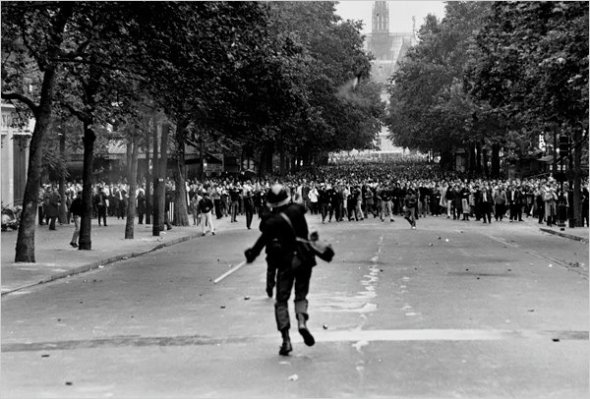
Paris, May 1968
For the past few weeks, as the protests in Tunisia spread to Egypt and then to several other countries, I’ve been reminded of the worldwide political uprisings that took place back in 1968, “the year that rocked the world.” Now that we are even seeing Americans protesting in the streets of Madison, Wisconsin and Columbus, Ohio, I wonder: could it happen again?
In case you weren’t around in 1968 or your memory is fuzzy, the Guardian published a summary of some of the events of that unbelievable year back in 2008. Sean O’Hagen describes how in May 1968, Paris
…was paralysed after weeks of student riots followed by a sudden general strike. France’s journey from ‘serenity’ to near revolution in the first few weeks of May is the defining event of ‘1968’, a year in which mass protest erupted across the globe, from Paris to Prague, Mexico City to Madrid, Chicago to London.
[….]
These rebellions were not planned in advance, nor did the rebels share an ideology or goal. The one cause many had in common was opposition to America’s war in Vietnam but they were driven above all by a youthful desire to rebel against all that was outmoded, rigid and authoritarian. At times, they gained a momentum that took even the protagonists by surprise. Such was the case in Paris, which is still regarded as the most mythic near-revolutionary moment of that tumultuous year, but also in Mexico City, Berlin and Rome.
In these cases, what began as a relatively small and contained protest against a university administration – a protest by the young and impatient against the old and unbending – burgeoned into a mass movement against the government. In other countries – like Spain, where the Fascist General Franco was still in power, and Brazil, where a military dictatorship was in place – the protests were directed from the start against the state. In Warsaw and Prague, the freedom movements rose up briefly against the monolithic communist ideology of the USSR. And in America, capitalism was the ultimate enemy, and Vietnam the prime catalyst.
Those protests, along with revolutions in music, art, fashion, and mores truly changed the world. Could it be happening again? Have we really reached a tipping point?
I thought I’d just put up some links to the important events that have taken place today in the many ongoing protests. You can add your own links in the comments (if anyone else is still awake).
More below the fold….
Thursday Reads
Posted: February 17, 2011 Filed under: Bahrain, Civil Rights, Egypt, Foreign Affairs, Israel, Lebanon, morning reads, Team Obama, The Media SUCKS, U.S. Politics 34 Comments
Good Morning!!
A couple of days ago President Obama actually did something I could cheer about. He awarded the Medal of Freedom to former Boston Celtics great Bill Russell. Of course he also awarded them to George H.W. Bush and Warren Buffett, but I’ll try to overlook that for now.
Obama suggested that Boston should have a statue of Russell, and according to the Boston Herald:
The unveiling of a Bill Russell statue in Boston appears to be just a matter of time.
According to Celtics [team stats] co-owner Steve Pagliuca, the organization has already begun the process of getting the statue created and placed. And it didn’t hurt Tuesday when President Barack Obama, while awarding Russell the Medal of Freedom, mentioned that such a monument should be erected for future generations.
That would be okay, but I agree with what I heard NPR sports commentator Bill Littlefield recommend yesterday: every school library should have copies of Russell’s books and biographies of him written by others.
Russell played for the Celtics in the days when racism was rampant in Boston.

NBA greats Bill Russell and Wilt Chamberlain
As a highly visible public figure in the years when the country was emerging from a century of legally sanctioned discrimination, Russell threw his prestige behind the emergent Civil Rights Movement, participating with Dr. Martin Luther King, Jr. in the historic 1963 March on Washington. Russell’s years of living in Boston were not easy ones. At the height of the Celtics’ success there were many empty seats in the Boston Garden, while less successful teams in other cities played to full arenas. When Russell bought a fine home for his family in a historically white neighborhood, he received threats and insults. On one occasion, vandals broke into his home and splattered the walls with filth and graffiti. Unbowed, Russell focused his energies on his game, and enjoyed excellent relations with his teammates and other NBA players.
Once when a hotel in the South denied accommodations to black players, Russell protested by refusing to play in the game that night, drawing media attention to the injustice. He never let the disrespect he often received prevent him from giving his heart and soul to Celtics basketball, leading the team to 11 NBA championships. If only President Obama would take leadership lessons from Bill Russell!
For a long time Russell remained bitter about Boston, but in the past 20 years or so he has become a presence here again, a greatly admired and beloved part of Boston sports and social history. Never mind that the Medal of Freedom has been given to so many who don’t deserve it. This time it went to someone truly worthy.
In other news…
The White House is still leaking information to The New York Times in an effort to make it look like President Obama has been in full control during the ongoing crises in the Middle East.
President Obama ordered his advisers last August to produce a secret report on unrest in the Arab world, which concluded that without sweeping political changes, countries from Bahrain to Yemen were ripe for popular revolt, administration officials said Wednesday.
Mr. Obama’s order, known as a Presidential Study Directive, identified likely flashpoints, most notably Egypt, and solicited proposals for how the administration could push for political change in countries with autocratic rulers who are also valuable allies of the United States, these officials said.
The 18-page classified report, they said, grapples with a problem that has bedeviled the White House’s approach toward Egypt and other countries in recent days: how to balance American strategic interests and the desire to avert broader instability against the democratic demands of the protesters.
Administration officials did not say how the report related to intelligence analysis of the Middle East, which the director of the Central Intelligence Agency, Leon E. Panetta, acknowledged in testimony before Congress, needed to better identify “triggers” for uprisings in countries like Egypt.
Hmmm…I wonder why Obama looked so flatfooted and off-balance when the Egyptian protests began then? Why did he fail to make any definite stands? Why did he make so many vague and conflicting statements? Why is he now trying to blame all of this on the State Department? Do you suppose maybe he didn’t read the report?
Whatever. It’s too late. The rest of the world knows he’s incompetent even if a lot of Americans don’t.
The Obama administration offered to support a UN rebuke of Israel:
The U.S. informed Arab governments Tuesday that it will support a U.N. Security Council statement reaffirming that the 15-nation body “does not accept the legitimacy of continued Israeli settlement activity,” a move aimed at avoiding the prospect of having to veto a stronger Palestinian resolution calling the settlements illegal.
But the Palestinians rejected the American offer following a meeting late Wednesday of Arab representatives and said it is planning to press for a vote on its resolution on Friday, according to officials familar with the issue. The decision to reject the American offer raised the prospect that the Obama adminstration will cast its first ever veto in the U.N. Security Council.
Still, the U.S. offer signaled a renewed willingness to seek a way out of the current impasse, even if it requires breaking with Israel and joining others in the council in sending a strong message to its key ally to stop its construction of new settlements. The Palestinian delegation, along with Lebanon, the Security Council’s only Arab member state, have asked the council’s president this evening to schedule a meeting for Friday. But it remained unclear whether the Palestinian move today to reject the U.S. offer is simply a negotiating tactic aimed at extracting a better deal from Washington.
Gordonskene at C&L has a great post up about one of my favorite journalists of all time: Eric Severeid:
Before the days of spin, agendas and punditry, there was that somewhat extinct class of journalists known as “commentators” – and even though they were journalists first, their commentaries were secondary; separate and classified as such. They were usually imbued with a sense of professional objectivity we would find somewhat strange by todays standards with Entertainers masquerading as Journalists and Journalists masquerading as Entertainers.
One such commentator was Eric Sevareid. In the mold of Edward R. Murrow (in fact, often referred to as one of “Murrow’s Boys” during World War 2), Sevareid along with radio journalists Charles Collingwood, Robert Trout and many others from CBS and the other networks routinely offered commentaries on the days news, separate from their regular reporting.
Yes, those were the days…there may have been plenty of propaganda, but there was some actual journalism going on too.
You may have heard (despite the U.S. media blackout) that a warrant has been issued for the arrest of Pervez Musharraf, former President of Pakistan for the murder of Benazir Bhutto. Ron Brynaert at Bradblog has an analysis of the U.S. media reaction. A sample:
“A Pakistani court issued an arrest warrant for ousted military leader Pervez Musharraf on Saturday over allegations he played a role in the 2007 assassination of an ex-prime minister and rival,” the Associated Press reported over the weekend, although no major US newspaper seems to have followed up. “It was a major setback for the onetime U.S. ally, who was plotting a political comeback from outside the country.”
[….]
After the opening paragraph, the next four paragraphs of AP’s report are devoted to defenses of Musharraf, accusations against the present Pakistan government, and doubts that the warrant will amount to much. An independent United Nations report which blasted the Musharraf government’s security arrangements as “fatally insufficient” isn’t mentioned until near the end, and reports that the Musharraf government lied and manipulated evidence about the ultimate cause of Bhutto’s death are completely ignored.
“Musharraf, who has not been charged, described accusations that he had a hand in the attack on ex-Prime Minister Benazir Bhutto as a smear campaign by a government led by her aggrieved husband,” the second paragraph states, even though the former coup leader is never directly quoted once in the article.
Al Jazeera has the latest on events in the Middle East:
The Bahrain capital of Manama was rocked by sporadic clashes, hours after riot police attacked a makeshift encampment of pro-reform protesters in the centre of the city, killing at least three and injuring dozens of others.
An Al Jazeera correspondent, who cannot be named for security reasons, said on Thursday morning that “clashes were no longer limited to one place…they are now spread out in different parts of the city”.
Another Al Jazeera online producer said that booms could be heard from different parts of the city, suggesting that “tear-gas is being used to disperse the protesters in several neighbourhoods”.
Latest reports, however, indicated that a tense calm had descended on the capital with troops patroling the streets.
There were also reports of dozens of armoured vehicles moving towards the Pearl Roundabout, the protest site that was raided by the riot police.
‘Day of rage’ kicks off in Libya: Protesters have reportedly taken to the streets in four cities despite a crackdown, heeding to calls for mass protests.
Protesters in Libya have defied a security crackdown and taken to the streets in four cities for a “day of rage,” inspired by uprisings in Egypt and Tunisia, reports say.
Several hundred supporters of Muammar Gaddafi, the country’s longtime leader, have also reportedly gathered in the capital on Thursday to counter online calls for anti-government protests.
New York-based Human Rights Watch said that Libyan authorities had detained 14 activists, writers and protesters who had been preparing the anti-government protests.
Libya has been tightly controlled for over 40 years by Gaddafi, who is now Africa’s longest-serving leader.
According to reports on Twitter, the microblogging site, Libya’s regime had been sending text messages to people warning them that live bullets will be fired if they join today’s protests.
That’s all I’ve got for today. What are you reading and blogging about?

 peej
peej Carissa
 bostonboomer
 dakinikat
 ecocatwoman
 mablue2
 Mama Lopez
 peggysue22
 quixote
 skydancingguestblogger
 Mona (aka Wonk the Vote)



 Sky Dancing
Recent Comments