
Monday Reads: What are we doing to our fragile ecosystems?
Posted: March 31, 2014 Filed under: Climate Change, Environment, Environmental Protection, Environmentalists, morning reads 45 Comments
Good Morning!
Is it too late to notice that our consumerist society is a lot like a swarm of parasitic insects clinging to the belly of a rapidly dying host? What are we to do when so many wealthy individuals prey on the superstitions and ignorance and greed of our fellow citizens to ensure their wealth grows while our planet dies? They convince us we need more than we do, underpay us, entice us with loans and plastic, then ship themselves off to pristine virgin island bank havens while we are surrounded by the chemicals, the death, and disasters that hyper-consumerism has wrought.
How can you possibly deny what we are doing to our home? Here are the top five items from a ‘terrifying” report presented over the weekend..
The impacts of climate change are likely to be “severe, pervasive, and irreversible,” the chair of the Intergovernmental Panel on Climate Change said Sunday night in Yokohama, Japan, as the world’s leading climate experts released a new survey of how our planet is likely to change in the near future, and what we can do about it.
Here’s what you need to know:
We’re already feeling the impacts of climate change. Glaciers are already shrinking, changing the courses of rivers and altering water supplies downstream. Species from grizzly bears to flowers have shifted their ranges and behavior. Wheat and maize yields may have dropped. But as climate impacts become more common and tangible, they’re being matched by an increasing global effort to learn how to live with them: The number of scientific studies on climate change impacts, vulnerability, and adaptation more than doubled between 2005, before the previous IPCC report, and 2010. Scientists and policymakers are “learning through doing, and evaluating what you’ve done,” said report contributor Kirstin Dow, a climate policy researcher at the University of South Carolina. “That’s one of the most important lessons to come out of here.”
Heat waves and wildfires are major threats in North America. Europe faces freshwater shortages, and Asia can expect more severe flooding from extreme storms. In North America, major threats include heat waves and wildfires, which can cause death and damage to ecosystems and property. The report names athletes and outdoor workers as particularly at risk from heat-related illnesses. As the graphic below shows, coastal flooding is also a key concern.
Globally, food sources will become unpredictable, even as population booms.Especially in poor countries, diminished crop production will likely lead to increased malnutrition, which already affects nearly 900 million people worldwide. Some of the world’s most important staples—maize, wheat, and rice—are at risk. The ocean will also be a less reliable source of food, with important fish resources in the tropics either moving north or going extinct, while ocean acidification eats away at shelled critters (like oysters) and coral. Shrinking supplies and rising prices will cause food insecurity, which canexacerbate preexisting social tensions and lead to conflict.
Coastal communities will increasingly get hammered by flooding and erosion. Tides are already rising in the US and around the world. As polar ice continues to melt and warm water expands, sea level rise will expose major metropolitan areas, military installations, farming regions, small island nations, and other ocean-side places to increased damage from hurricanes and other extreme storms. Sea level rise brings with it risks of “death, injury, ill-health, or disrupted livelihoods,” the report says.
We’ll see an increase in climate refugees and, possibly, climate-related violence.The report warns that both extreme weather events and longer-term changes in climate can lead to the displacement of vulnerable populations, especially in developing parts of the world. Climate change might also “indirectly increase” the risks of civil wars and international conflicts by exacerbating poverty and competition for resources.

There have been so many disasters just recently that it’s hard to keep track. You can see our handprints on many of them. Has the policy of clear cutting timber created situations like the Washington State mudslide? Many scientists and environmentalists say yes.
As rescue workers, specially trained dogs, and heavy equipment move carefully through the area, longstanding questions are being raised about logging there and how it might have contributed to the slide.
The hillside in and around the slide area, which slopes steeply down toward the river, has seen much clear-cut logging over the years. Much of the forest there is second- and third-growth timber, replanted or regenerating naturally after earlier cuts.
Concern over logging’s impact has involved environmentalists and native American tribes. Large, old-growth trees take up more water than younger stands, which can take decades to mature and may be cut down before they reach full maturity. The demand for lumber, plywood, paper, and other wood products is part of an industry that once dominated Washington State and Oregon.
The Tulalip Tribes were so concerned with landslides hitting the Stillaguamish River and its prime salmon habitat that they blocked a proposed timber sale above an earlier slide in 1988.
“There were some very large clear-cuts planned for that area, which made us very concerned,” Kurt Nelson, a hydrologist with the tribes, told KUOW, the NPR affiliate at the University of Washington in Seattle.
“That reach of the North Fork has multiple, ancient, deep-seated landslides,” Mr. Nelson said. “There’s a lot of unstable terrain in that area.”
Landslides have followed logging in that area at least four times, KUOW reported.
“There was cutting in the 1940s; it failed in the ’50s. There was cutting in 1960, then it failed in the mid-’60s. There was cutting in ’88; it failed in ’91. There was cutting in 2005, and it failed in 2006 and in 2014,” said geomorphologist Paul Kennard, who worked for the Tulalip Tribes in the 1980s and now works for the National Park Service at Mt. Rainier.
“This had been known at least since the ’50s as one of the more problematic areas on the Stillaguamish for perennial landsliding,” Mr. Kennard said.
Although state logging regulations have been tightened in recent years, The Seattle Times reports that a clear-cut nine years ago “appears to have strayed into a restricted area that could feed groundwater into the landslide zone that collapsed Saturday.”
An analysis of government geographical data and maps suggests that a logging company “cut as much as 350 feet past a state boundary that was created because of landslide risks,” the newspaper reported.
This is an area above the most recent slide. Scientists and officials are investigating whether that clear-cut could have contributed to the current disaster.
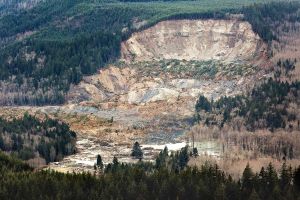 Scientists tell us that mudslides are inevitable when you treat these mountains as we do and we fail to recognize that some places just aren’t meant for human habitation. However, tell that to the developers.
Almost 25 years ago, I went into one of the headwater streams of the Stillaguamish with Pat Stevenson, a biologist with the American Indian tribe that bears the same name as the river and claims an ancient link to that land. The rain was Noah-level that day — just as it’s been for most of this March.
We drove upriver, winding along the drainage of Deer Creek, one of the main tributaries of the Stillaguamish. We couldn’t see Whitehorse Mountain, the dreamy peak that towers over the valley, that day. We could barely see beyond our windshield wipers. At last, we arrived at an open wound near road’s end. I’d never witnessed anything like it: an active slide, sloughing mud and clay down into the formerly pristine creek. We watched huge sections of land peel and puddle — an ugly and terrifying new landscape under creation before our eyes.
Stevenson pointed uphill, to bare, saturated earth that was melting, like candle wax, into the main mudslide. Not long ago, this had been a thick forest of old growth timber. But after it was excessively logged, every standing tree removed, there was nothing to hold the land in place during heavy rains. A federal survey determined that nearly 50 percent of the entire basin above Deer Creek had been logged over a 30-year period. It didn’t take a degree in forestry to see how one event led to the other.
The Stilly, as locals call the river, is well known to those who chase fish with a fly rod, and to native people who have been living off its bounty for centuries. Zane Grey, the Western novelist, called it the finest fishing river in the world for steelhead, the big seagoing trout that can grow to 40 pounds. What Stevenson showed me that day in a November storm was how one human activity, logging, was destroying the source of joy and sustenance for others. When the crack and groan of an entire hillside in collapse happened a week ago Saturday, I thought instantly of Stevenson and that gloomy day at Deer Creek.
And, sure enough, logging above the area of the current landslide appears to have gone beyond the legal limits, into the area that slid, according to a report in The Seattle Times.
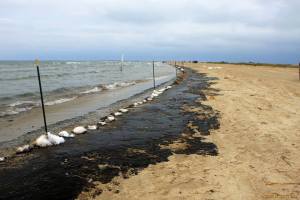 Meanwhile, the latest oil spill disasters take their toll in both the North and South of this Country. There are still long lasting effects in Alaska and in the Gulf of those giant oil spoils. But, even Galveston Bay shows sign of permanent damage from its latest brush with deadly oil that’s no where near the size of those other two. It’s getting to be that no one’s back yard is safe.
Authorities in charge of the cleanup from last week’s Houston Ship Channel oil spill say they’re responding to reports of oil near North Padre Island and Mustang Island, some 200 miles southwest of the original accident.
The command center for the cleanup reports Sunday that oil sightings were made earlier in the day by crews aboard flights being conducted by the Texas General Land Office and the U.S. Coast Guard.
Some tar balls — from dime-size to about 6 inches — have been spotted in seaweed patches along Mustang Island’s J.P. Luby Beach but it’s not certain if they are related to the spill a week ago between Galveston and Texas City.
The spill endangers wildlife nearby. There is a bird refuge that is in a particularly precarious location. That was also the clean side of the Gulf where 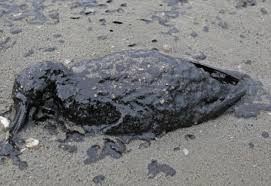 you could still trust the fish and the seafood.
The spill, which dumped what one Texas official referred to as “sticky, gooey, thick, tarry” oil that doesn’t evaporate quickly into Galveston Bay, occurred about eight miles from the Bolivar Flats Shorebird Sanctuary, which attracts 50,000 to 70,000 shorebirds each year. March is right around spring migration for many species of birds, and other birds are still wintering at Bolivar Flats, so tens of thousands of birds are living at the sanctuary, which is designated a Globally Significant Important Bird Area. Cleanup crews are using cannon booms to try to deter birds away from oiled beaches, and so far, oil hasn’t washed up on Bolivar Flats, but birds that have come in contact with oil in the water or on other beaches have been landing there.
Houston Audubon Society volunteers have been tracking the oiled birds they see at Bolivar, and Jessica Jubin, development director at the Houston Audubon Society, told ThinkProgress that the group was “definitely seeing more” oiled birds now than when they first started the day after the spill. She said on Monday, volunteers cataloged 40 to 50 oiled birds at one spot at Bolivar Flats, and on Tuesday, they counted about 100 at the same site. On Wednesday, she said, the number increased to about 140, with most birds ranging from just a few spots of oil on them to half covered in oil.
It’s the shorebirds and seabirds that are most at risk of becoming oiled from the spill, Jubin said.
“Like pelicans, for example — I don’t know if you’ve ever watched them fish, but they will soar in the sky and then spot something down below and then dart right into the water, and that’s how they get so much oil on them,” she said. “They can’t distinguish whether or not the oil is there, and they don’t know how to react to it.”
Mike Cox, spokesperson at the Texas Parks and Wildlife Department, told ThinkProgress the agency has so far collected 45 oiled birds in the Galveston area, with 19 birds in rehabilitation and 26 that were found dead. Jubin said Audubon was reporting birds they saw to Texas Parks and Wildlife and the U.S. Fish and Wildlife Service, but she worries about the movement of the oil. If it drifts too far south or west, it could end up in important habitat for endangered whooping cranes. Already, the oil has reached the ecologically-sensitive Matagorda Island, soiling at least 12 miles of the barrier island’s pristine beaches. So far, however, the Parks and Wildlife Department hasn’t received reports of oiled wildlife from Matagorda Island, Cox said, and crews were working to put up booms to keep the oil from getting into Matagorda Bay.
But birds aren’t the only wildlife at risk from the oil spill. As the Texas Tribune reports, marine scientists are worried that the spill could result in long-term health effects on Texas marine life. The thick fuel oil that spilled Saturday is persistent, so marine species could be even more at risk from oil-related defects like irregular heart rhythm and cardiac arrest than they were from the Deepwater Horizon disaster. Shrimp are a major part of the Galveston Bay fishing industry, and they’re also among the species most vulnerable to the oil spill — if their marshy homes are polluted with oil, they may not survive.
That, of course, doesn’t include the danger to the people and the clean up workers.
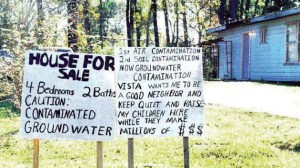
In 1790, a freed slave named Jim Moss found a place to settle down on a bend in the Houston River in the bayous of southwest Louisiana. Although never formally incorporated, the village of Mossville became one of the first settlements of free blacks in the South, predating the formal establishment of Calcasieu Parish by 50 years. But over the last half century, Mossville was surrounded. More than a dozen industrial plants now encircle the community of 500 residents, making it quite possibly the most polluted corner of the most polluted region in one of the most polluted states in the country. Now, a proposal to build the largest chemical plant of its kind in the Western Hemisphere would all but wipe Mossville off the map.
The project, spearheaded by the South African chemical giant SASOL, will cost as much as $21 billion, but stands to benefit from more than $2 billion in incentives (including $115 million in direct funding) from the cash-strapped state budget. It has the backing of Republican Gov. Bobby Jindal, considered a likely 2016 presidential candidate, who traveled to the outskirts of Lake Charles for the official announcement of the plan in 2012. The state thinks it’s an economic slam dunk. One study from Louisiana State University projected that it would have a total economic impact of $46.2 billion. It is the largest industrial project in the history of Louisiana. And after a community meeting on Tuesday, it’s one step closer to realization.
But that massive plant will come with a steep environmental price. It will produce more greenhouse gases than any other facility in the state. And the project will almost certainly spell the end for the 224-year-old settlement of Mossville, a poor enclave that has been forced to play host to industrial facilities no one else wanted in their backyard.
An analysis conducted by the Louisiana Department of Environmental Quality (DEQ) in February determined that the new project “will result in significant net emissions increases” of greenhouse gases, promethium, sulfur oxide, nitric oxide, and carbon monoxide. By its calculations, the plant will spew out more than 10 million cubic tons of greenhouse gases per year. (By contrast, the Exxon-Mobil refinery outside Baton Rouge, a sprawling complex that’s250 times the size of the New Orleans Superdome, emits 6.6 million tons.)
It’s beginning to feel a lot like we’re trapped between a future envisioned in the “Blade Runner” and that envisioned in Margaret Atwood’s “The Handmaid’s Tale”. Either way, the outcome will be sponsored by the likes of the Koch brothers and we will soon discover the fresh hells they’ve created for us. The dominionists and the capitalists join together to force their earth and its people into submission.
What’s on your reading and blogging list today?
Saturday Reads: Obama Talks to Rouhani, Pakistan and Kenyan Disasters, Republican Terrorism, and More
Posted: September 28, 2013 Filed under: Affordable Care Act (ACA), Barack Obama, Climate Change, Diplomacy Nightmares, Environment, Foreign Affairs, Iran, Journalism, Kenya, morning reads, NSA, National Security Agency, Pakistan, Republican politics, The Media SUCKS, U.S. Economy, U.S. Politics | Tags: baseball playoffs, Boston Red Sox, Congress, diplomacy, Hassan Rouhani, IPCC, Kenyan Mall massacre, Nuclear Power, nuclear weapons, Pakistan earthquake, Ted Cruz 24 Comments
Good Morning!!
It’s a beautiful Fall day in New England, the Red Sox have taken the American League East with the best record in baseball after winning 97 games with one game left to play. On top of that, the Yankees are pitiful. The playoffs start next Friday. It just doesn’t get better than this.
There is quite a bit of news for a Saturday. First up, President Obama spoke on the telephone to Iranian President President Hassan Rouhani yesterday–the first time leaders of the U.S. and Iran have spoken directly since 1979. The AP reports:
The United States and Iran took a historic step toward ending more than three decades of estrangement on Friday when President Barack Obama and Iranian President Hassan Rouhani spoke by phone and agreed to work on resolving global suspicions that Tehran is trying to build a nuclear weapon.
The 15-minute call capped a week of seismic shifts in the relationship that revolved around Rouhani’s participation in the annual U.N. meeting of world leaders. The night before the two leaders spoke, U.S. and European diplomats hailed a “very significant shift” in Iran’s attitude and tone in the first talks on the nuclear standoff since April.
The diplomatic warming began shortly after Rouhani’s election in June. But it is rooted in both presidents’ stated campaign desires — Obama in 2008 and Rouhani this year — to break through 34-year-old barriers and move toward diplomacy.
Iran is also seeking quick relief from blistering economic sanctions that the U.S. and its Western allies have imposed on Tehran to punish it for refusing to scale back its nuclear activities. Iran insists its nuclear program is for peaceful purposes only, but years of stonewalling inspections and secrecy about its activities have fueled fears it is seeking to build warheads.
Rouhani and Obama spoke while the Iranian president was in his car and headed to the airport to fly back to Tehran, with Obama at his desk in the Oval Office. Rouhani’s aides initially reached out to arrange the conversation, and the White House placed the call.
I’m not sure what it means to “work on resolving global suspicions that Tehran is trying to build a nuclear weapon,”–do they want to calm suspicions or tamp down the nuclear efforts? But at least it’s a step in the right direction. The New York Times has more:
“Resolving this issue, obviously, could also serve as a major step forward in a new relationship between the United States and the Islamic Republic of Iran, one based on mutual interests and mutual respect,” Mr. Obama, referring to Tehran’s nuclear program, told reporters at the White House after the 15-minute phone call. “It would also help facilitate a better relationship between Iran and the international community, as well as others in the region.”
A Twitter account in Mr. Rouhani’s name later stated, “In regards to nuclear issue, with political will, there is a way to rapidly solve the matter.” The account added that Mr. Rouhani had told Mr. Obama, “We’re hopeful about what we will see from” the United States and other major powers “in coming weeks and months.”
More detail about the call itself:
Mr. Obama placed the call from the Oval Office around 2:30 p.m., joined by aides and a translator.
He opened by congratulating Mr. Rouhani on his election in June and noted the history of mistrust between the two nations, but also what he called the constructive statements Mr. Rouhani had made during his stay in New York, according to the official. The bulk of the call focused on the nuclear dispute, and Mr. Obama repeated that he respected Iran’s right to develop civilian nuclear energy, but insisted on concessions to prevent development of weapons.
Mr. Obama also raised the cases of three Americans in Iran, one missing and two others detained. In a lighter moment, he apologized for New York traffic.
The call ended on a polite note, according to the official and Mr. Rouhani’s Twitter account.
“Have a nice day,” Mr. Rouhani said in English.
“Thank you,” Mr. Obama replied, and then tried a Persian farewell. “Khodahafez.”
Meanwhile, the Wall Street Journal reports that: U.S. Says Iran Hacked Navy Computers.
U.S. officials said Iran hacked unclassified Navy computers in recent weeks in an escalation of Iranian cyberintrusions targeting the U.S. military.
The allegations, coming as the Obama administration ramps up talks with Iran over its nuclear program, show the depth and complexity of long-standing tensions between Washington and Tehran.
The U.S. officials said the attacks were carried out by hackers working for Iran’s government or by a group acting with the approval of Iranian leaders.
The most recent incident came in the week starting Sept. 15, before a security upgrade, the officials said. Iranian officials didn’t respond to requests to comment.
The allegations would mark one of the most serious infiltrations of U.S. government computer systems by Iran. Previously, Iranian-backed infiltration and surveillance efforts have targeted U.S. banks and computer networks running energy companies, current and former U.S. officials have said.
I’m sure Glenn Greenwald will have a highly disapproving story about this in the Guardian today. Oh wait, he’s probably more outraged that the NSA was able to discover the Iranian spying . . . Never mind.
When Rouhani got home, he was “met by hardline protesters chanting ‘Death to America,'” according to BBC News.
Hundreds of people gathered at Tehran airport, with supporters hailing the trip and opponents throwing shoes.
An Agence France-Presse journalist said some 200-300 supporters gathered outside the airport to thank Mr Rouhani for his efforts.
But opposite them were about 60 people shouting “Death to America” and “Death to Israel”.
Mr Rouhani raised his hand to the crowds as he was driven off.
A New York Times reporter described the scene as chaotic, with dozens of hardliners hurling eggs and shoes at the president’s convoy.
There was another powerful earthquake today in Pakistan, according to CNN.
The 6.8 magnitude earthquake struck in Balochistan province Saturday about 96 kilometers (60 miles) northeast of Awaran, the United States Geological Survey said.
Rasheed Baloch, the Deputy Commissioner Awaran told CNN seven people died when a house collapsed in Mashkay Tehsil as result of new earthquake on Saturday.
Just Tuesday, a 7.7 magnitude earthquake struck the same area of Pakistan. The death toll in that quake has risen to 366 people and another 765 are injured….
Baloch said a rescue operation was under way in Awaran district to retrieve the dead bodies and shift the injured to hospitals.
The remoteness of the affected area and damaged communications networks are hindering the rescue operation, officials said.
The Atlantic has a good article following up on “Tragic and Heroic Stories from Survivors of the Kenyan Mall Attack.”
Witness accounts and survivor stories from the Westgate Mall attack in Nairobi continue to emerge, telling a freighting [sic] story of violence and terror. Yet, as the investigation continues, there are still some disturbing questions about the attack that have yet to be fully explained.
Now that more access has been granted to the ruined mall, images confirm that three floors of the building collapsed, presumably because of a large explosion. The Associated Press reported today that the collapse was actually caused by the Kenyan military, supporting a claim made by the terrorists themselves. It’s still not clear how or why they managed to set off the explosion, but it may have killed some (perhaps most?) of the hostages still inside the building.
The official death toll is still listed at 67, but it’s likely that unrecovered bodies will be found in the rubble. As many as 60 people are still missing.
CNN is also reporting today that the terrorists did not just plant weapons inside the mall in the days before the attack, as had been previously reported, but that members of al-Shabab had rented out a storeand were actually running it as functional business for nearly a year.
While investigators, including the FBI, continue their work, we’re learning more about what happened inside the mall during the attack, and what those who lived through it endured.
Check out some of the survivor stories at The Atlantic link.
The Intergovernmental Panel on Climate Change (IPCC) released a shocking report yesterday, according to BBC News. IPCC climate report: humans ‘dominant cause’ of warming.
A landmark report says scientists are 95% certain that humans are the “dominant cause” of global warming since the 1950s.
The report by the UN’s climate panel details the physical evidence behind climate change.
On the ground, in the air, in the oceans, global warming is “unequivocal”, it explained.
It adds that a pause in warming over the past 15 years is too short to reflect long-term trends.
The panel warns that continued emissions of greenhouse gases will cause further warming and changes in all aspects of the climate system.
To contain these changes will require “substantial and sustained reductions of greenhouse gas emissions”.
Too bad no humans in powerful positions are likely to do anything about it.
Back in the USA . . .
Congress is still battling over whether or not to crash the global economy because Republicans don’t want ordinary Americans to have health care, Ted Cruz is still getting headlines for making an ass of himself, and the media is still trying to blame Democrats and Republicans equally for the mess we’re in.
From the Washington Post: Obama chides Republicans as shutdown looms.
With Washington barreling toward a government shutdown, a deadlocked Congress entered the final weekend of the fiscal year with no clear ideas of how to avoid furloughs for more than 800,000 federal workers. Millions more could be left without paychecks.
The Senate on Friday approved a stopgap government funding bill and promptly departed, leaving all of the pressure to find a solution on House Republican leaders.
President Obama weighed in, sternly lecturing GOP leaders that the easiest path forward would be to approve the Senate’s bill, which includes money for the implementation of the Affordable Care Act, the president’s prized legislation achievement, which he signed into law in 2010. But a far-right bloc of House and Senate Republicans banded together to leave House Speaker John A. Boehner (R-Ohio) virtually powerless to act.
“My message to Congress is this: Do not shut down the government. Do not shut down the economy. Pass a budget on time,” Obama said in the White House press briefing room.
Boehner’s leadership team offered no public comment and remained out of sight most of Friday, hunkering down for another weekend on the brink. For Boehner, this is the latest in a series of unstable moments that have become the hallmark of his three-year run as speaker.
Al Gore uncharacteristically joined the fray, according to The Hill. Gore to GOP: ‘How dare you?’
Former Vice President Al Gore accused Republicans Friday of engaging in “political terrorism” by using a government shutdown as leverage to defund ObamaCare.
“The only phrase that describes it is political terrorism,” Gore said at the Brookings Institution, according to ABC News. “Why does partisanship have anything to do with such a despicable and dishonorable threat to the integrity of the United States of America?”
The former vice president also criticized Republicans for threats to link defunding ObamaCare to the debt ceiling, which is set to expire Oct. 17.
“Now you want to threaten to not only shut down our government but to blow up the world economy unless we go back and undo what we did according to the processes of this democracy?” Gore said. “How dare you?”
But the media is still pushing their “both sides do it” narrative. At The Atlantic, James Fallows offers Your False-Equivalence Guide to the Days Ahead. Here’s just a taste:
As a matter of journalism, any story that presents the disagreements as a “standoff,” a “showdown,” a “failure of leadership,” a sign of “partisan gridlock,” or any of the other usual terms for political disagreement,represents a failure of journalism*** and an inability to see or describe what is going on. For instance: the “dig in their heels” headline you see below, which is from a proprietary newsletter I read this morning, and about which I am leaving off the identifying details.
This isn’t “gridlock.” It is a ferocious struggle within one party, between its traditionalists and its radical factions, with results that unfortunately can harm all the rest of us — and, should there be a debt default, could harm the rest of the world too.
Now please click the link and go over to The Atlantic–it’s a must read.
I’m running out of space, so I’ll go with a link dump on Ted Cruz–if you have the stomach for the details you can go to the sources.
Huffington Post: Student Cited By Ted Cruz As Proof Of Obama’s Failure Is Actually Grateful For Obamacare
John Dickerson at Slate: Why Senate Republicans Hate Ted Cruz
Jonathan Chait: Ted Cruz Now Ruining John Boehner’s Life, Too
Politico: Ted Cruz again refuses to back John Cornyn
Those are my recommendations for today. What are you reading and blogging about? See you in the comment thread!
Sunday Morning Reads………An Eclectic Mix
Posted: June 17, 2012 Filed under: abortion rights, bees, Climate Change, Environment, morning reads, Nigeria, social media, toxic waste, U.S. Military, Violence against women | Tags: 350.org, activism, Bill McKibbon. Emem Okon, environment, fossil fuels, gardening, rape in the military, Rio+20, Twitterstorm 41 Comments
Good Morning, All. I am pinch hitting for JJ while she and her family are visiting our nation’s capital. I haven’t traveled much, but I have been to D.C. twice. What an amazing place. This will be an eclectic mix of links and stories, covering many different categories. I hope you will find at least some of them of interest to you.
This first group is about gardening. bb had mentioned to me that she likes to work in her garden, so I figured she would enjoy these. The first is a list of ideas on how to attract butterflies to your garden.
Planting your garden with plants that attract butterflies is only one step in making your garden butterfly-friendly. Once butterflies discover your garden the females will lay eggs on plants that become food for the hatching caterpillars.
The host plant selected, and the time of year the eggs are laid, depends on the species of butterfly. Different butterflies prefer different host plants.
Bees are pollinaters, picking up pollen as they go from flower to flower to gather nectar. Obviously they are an important component for a successful garden. Besides nectar, bees also need water and this has ideas about how to make a watering hole for bees.
As the temperature rise in the garden it is important to remember the bees you’re attracting to your garden will also be searching for water. For bees, a supply of water is as important as pollen and nectar forage in the summer.
Besides the lovely green foliage of a garden, it is important to do what we can to use “green” products. Treehugger contributor Ramon Gonzalez provides a list of 10 sustainable garden products.
A garden that is kinder to the earth can be achieved through the selection of products and tools that are sustainably manufactured or given new life through recycling. It’s never been so easy to build a garden that’s green from the moment you plunge that spade into the soil.
Many commercial fertilizers used in both gardening and farming contain phosphates. Aasif Mandvi of The Daily Show covered a story about Simplot, a phosphate mining company in Idaho. Naturally, it is a satirical look at the dangers of phosphate mining and the damage being done by the by-product, selenium. Greater Yellowstone Coalition is an environmental organization working to get J.R. Simplot Co. to Clean Up Its Smoky Canyon Mine Superfund Site.
The New York Times featured a story and video today about the industrial damage done to Newtown Creek since the mid-1800s, and Mitch Waxman who has chronicled its history. The waterway was declared a Super Fund site in 2010.
If Mitch Waxman is your guide, he will identify it as the derelict smokestack of Peter Van Iderstine’s fat-rendering business, which first set up shop in 1855. But he won’t stop there.
He will expound on the archaic waste-disposal operations that once flourished on the creek, conjuring scenes of putrescent horse carcasses floating in on barges from Manhattan and docks piled with manure three stories high. The narrative will extend to Cord Meyer’s bone blackers and Conrad Wissel’s night soil wharf — the gothic names of these forgotten businesses rattled off in a distinct Brooklyn accent.
At some point, he will start in on the horrors of the M. Kalbfleisch Chemical Works, eventually making his way to the sins of Standard Oil.
Moving on to some stories about activism that caught my eye. The first story comes from Truth-Out about The Heritage Foundation’s conference to re-brand the Occupy Movement. Matt Dineen interviews Jason del Grandio, the author of Rhetoric for Radicals. Here’s a snippet of what Jason has to say about his perceived purpose of the conference.
The speakers make frequent reference to capitalism, free markets and free enterprise, and often mention traditional buzzwords like individual liberty and the pursuit of happiness. The Heritage Foundation is trying to understand the populist appeal of Occupy, and by doing so, trying to use that appeal to “win back” some of the Occupiers. Or, at the very least, to impede Occupy’s progress and win the hearts and minds of those who are still on the fence.
Brian Merchant interviews Tzeporah Berman, an environmental activist since was was 19, for Treehugger. This quote really hit home for me – you can’t un-know or un-see an injustice once your eyes, mind and heart have been opened to them.
Sometimes I wish I could open up a paper and not be immediately drawn to the story about mercury in fish or the dramatic increase in flooding in Sudan. But I can’t now.
Have you heard of Emem Okon, the Nigerian ecofeminist? I had not. She is a courageous woman, organizing other women of the Niger River Delta and taking on Chevron. The interview from Antonia Juhasz is reprinted from Ms magazine on Truth-Out.
One of the most prominent voices was Emem Okon, founder and executive director of Kebetkache Women Development & Resource Centre of Nigeria. A community organizer and women’s rights activist from the Niger Delta, Okon is leading a thriving Nigerian ecofeminist movement. She has coordinated several local women’s networks and coalitions, including Women Against Climate Change (WACC), International Network on Women and Environment, Niger Delta Women for Justice and Niger Delta Women’s Movement.
Speaking of women, the New York Times featured a story on the the Human Rights Film Festival at Lincoln Center. The review starts off with a profile of The Invisible War, which won the 2012 Audience Award at the Sundance Film Festival.
It hardly needs to be said that any armed force has the potential for internal as well as external violence. But “The Invisible War,” Kirby Dick’s incendiary documentary about the epidemic of rape within the United States military, is a shocking and infuriating indictment of widespread sexual attacks on women. Such behavior, the film argues, is tacitly condoned and routinely covered up; the victims are often blamed and their reputations destroyed.
I found other links to discussions of the film, at the military publication, Stars and Stripes along with stories about Congress denying healthcare coverage for abortions for military women who have been raped. from Mother Jones.
The Rio+20 Summit begins on Monday, June 18th. President Obama and England’s David Cameron WON’T be attending, however Hillary Clinton will be representing the U.S. BBC News has more about Rio+20 and the awful state of the world’s oceans.
The researchers assessed the various pledges made at the landmark 1992 Earth Summit and 10 years later at the Johannesburg World Summit on Sustainable Development.
Governments vowed to establish an ecologically sound network of marine reserves by 2012, eliminate subsidies that contribute to illegal fishing, protect critical habitat, look after the needs of local fishermen and restore depleted stocks to healthy levels by 2015.
Subsidies have not been eliminated, and illegal fishing is still a major issue in some parts of the world.
Tom Ashbrook, host of NPR’s On Point, interviewed Bill McKibben of 350.org on Friday’s show. McKibben’s name is probably best known for the protests against the Keystone XL Pipeline, held outside of the White House, along with his subsequent arrest for protesting. You can listen to the audio at the link above. Here’s a short introduction:
Environmental champion Bill McKibben wrote nearly a quarter century ago about what he called “the end of nature.” The untouched wild. He didn’t think he was writing about the end of the world. But the climate change path since then has been a scary one. Bad to worse.
And McKibben has gone from writerly philosopher to full-on environmentalist to activist in handcuffs. Political street fighter. He was at the heart of the campaign to stop the Keystone XL pipeline. Arrested at the gates of the White House.
The current campaign of McKibben and 350.org is ending fossil fuel subsidies. These companies are paid by governments in the neighborhood of 1 TRILLION DOLLARS a year to pollute our planet. 350.org is organizing a Twitterstorm for June 18th. Although I don’t have a cell phone (and refuse to get one), I plan to set up a Twitter account so that I can participate. I hope that you will go to the link and sign up to participate as well. This quote comes from Treehugger about the Twitterstorm:
If you’re itching to do some petition signing right now: End Fossil Fuel Subsidies, and check out how your representative (in the US) stands on ending subsidies: End Fossil Fuel Subsidies Scorecard
There’s also more info on the Facebook event page: Twitter Storm: #EndFossilFuelSubsidies
Since it’s Father’s Day, I thought I would end this with a trbute video to a very special Dad
from Discovery News.
Can We Admit That What We’re Seeing Is More Than . . . ‘Weather?’
Posted: March 5, 2012 Filed under: Capitalism 3.0, Climate Change, Environment, Environmentalists, ethics, globalization, Rick Santorum, Rush Limbaugh | Tags: global warming, tornadoes, weather 16 CommentsThese are some images from my neck of the woods from this past weekend’s round of ‘weather.’
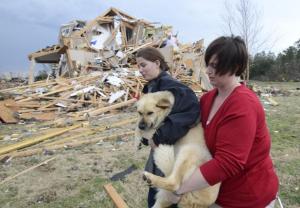
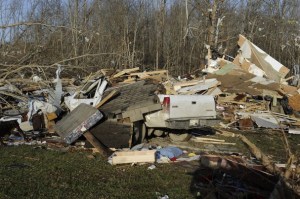
Now granted, I’m not a native of the southeast—South Jersey girl here. But the locals tell me that vertical winds are a hellva lot different than tornado touchdowns, particularly when you’re living in hill country, in the shadow of the Smoky Mountains. Locally, this time we were fortunate—some downed branches and yard mess. The major damage was to the east and south of us. Last year? Not so much. 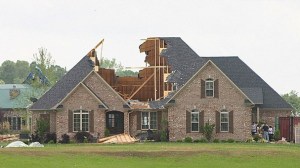
In fact, last year’s April storm front in the southeast produced 280+ tornadoes in 3 days. Historic, the headlines screamed.
If this were merely a local event, we could chalk it up to bad luck and Mother Nature in a cranky mood. But consider that earth-orbiting satellites have been gathering scientific data not previously available, giving us the ‘big picture’, data on a global scale. The following evidence has been accumulated:
- Sea levels are, in fact, rising, the rate of the last decade nearly double that of the last century.
- Global temperatures are on the rise, increasing since the 1970s with the 10 hottest recorded temperatures within the last 12 years.
- The oceans have been warming since 1969, measureable temperatures increasing in the top surfaces [2300 ft] and the acidification of the oceans has increased by 30% since the start of the Industrial Revolution.
- Glaciers are retreating, the Arctic sea ice is shrinking and the ice sheets of Greenland [36-60 cubic miles per year between 2002-2006] and the Antarctic [36 cubic miles per year between 2002-2005] have declined.
According to NASA data, there are certain facts beyond dispute:
The heat-trapping nature of carbon dioxide and other gases was demonstrated in the mid-19th century. Their ability to affect the transfer of infrared energy through the atmosphere is the scientific basis of many JPL-designed instruments, such as AIRS. Increased levels of greenhouse gases must cause the Earth to warm in response.
Ice cores drawn from Greenland, Antarctica, and tropical mountain glaciers show that the Earth’s climate responds to changes in solar output, in the Earth’s orbit, and in greenhouse gas levels. They also show that in the past, large changes in climate have happened very quickly, geologically-speaking: in tens of years, not in millions or even thousands.
We can take the facts and data of NASA, their orbiting satellites and sensors or we can fall back on the word of say . . . a Rick Santorum, who has proven himself such an expert on other subjects. According to Santorum in a speech in Colorado:
[Climate change is] an absolute travesty of scientific research that was motivated by those who, in my opinion, saw this as an opportunity to create a panic and a crisis for government to be able to step in and even more greatly control your life. … I for one never bought the hoax. I for one understand just from science that there are one hundred factors that influence the climate. To suggest that one minor factor of which man’s contribution is a minor factor in the minor factor is the determining ingredient in the sauce that affects the entire global warming and cooling is just absurd on its face. And yet we have politicians running to the ramparts — unfortunately politicians who happen to be running for the Republican nomination for president — who bought into man-made global warming and bought into cap-and-trade.
We can argue the merits of cap and trade but I find it comical that Santorum is running around talking about Satan on one hand—a Santorum absolute–while denying climate change on the other. This is a ‘don’t trust your lying eyes’ moment. And certainly don’t trust science. He continued with:
We were put on this Earth as creatures of God to have dominion over the Earth, to use it wisely and steward it wisely, but for our benefit not for the Earth’s benefit … We are the intelligent beings that know how to manage things and through that course of science and discovery if we can be better stewards of this environment, then we should not let the vagaries of nature destroy what we have helped create.
Huh? I’m not sure what this rambling statement is intended to mean, other than we shouldn’t let nature clue us in that we’re skating on the edge, pushing the health of the planet and its inhabitants to the max. Full steam ahead with those extractions, boys!
Of course, Santorum is not alone in this type of denial. Rush Limbaugh, who has had his fair share of attention in the last few days [not of the good kind], had this to say after declaring climate change a ‘hoax’:
I happen to believe in God. I believe in a loving, brilliant – I know that this – there is no way, I don’t want to sound simpleton here, but there is not – it is not possible that we would be created by a creator in such a way that we would destroy by virtue of our created existence our own planet and environment. It just doesn’t compute and yet that’s what these people are trying to tell us. [Premiere Radio Networks, The Rush Limbaugh Show, 2/2/11
All righty then! God, a loving brilliant God, would not allow us to destroy ourselves. Scrap all that science and data, the fat man speaketh.
Beginning to see a pattern here? We can believe in myth—Satan’s going to getcha and/or a benevolent, personal God-creator, who would never allow Man to be stupid enough to destroy His/Her creation. No problem then. Keep spewing those toxins into the air, don’t worry about contaminating our water supply and . . . heat? What heat?
Despite the relentless war on climate data in particular and science in general, it turns out the public is beginning to catch on to all the corporate-friendly tap dancing. After a dip in public sentiment about Climate Change and the mass investment in misinformation, Americans are using their powers of observation and taking heed to the mounting evidence. According to the Brookings Institute National Survey, Fall 2011, a strong majority [62%] of the American public now believes that global warming is real and poses a threat to global security. Observation to local effects of warming temperatures and world-wide reports of floods, droughts, freakishly warm temperatures, melting ice sheets, ocean acidification and the effects on wildlife and fauna are slowly turning opinion.
We cannot wait for a benevolent God-spirit to save us. We’ll need to do that for ourselves, sooner rather than later. Because we won’t get a second chance. As Naomi Klien recently stated any real shift towards climate sustainability means a shift in the entire free-market ethos that depends on continual growth, massive extraction and profit-making over people.
. . . you can’t do it all with carbon markets and offsetting. You have to really seriously regulate corporations and invest in the public sector. And we need to build public transport systems and light rail and affordable housing along transit lines to lower emissions. The market is not going to step up to this challenge. We must do more: rebuild levees and bridges and the public sphere, because we saw in Katrina what happens when weak infrastructure clashes with heavy weather—it’s catastrophe. These climate deniers aren’t crazy—their worldview is under threat. If you take climate change seriously, you do have to throw out the free-market playbook.
In the end, so many of these pressing issues are related to a flawed economic and political model—the current corporate state. It will be up to us to reimagine a new system or as Peter Barnes suggested in ‘Capitalism 3.0,’ it’s time to upgrade.
Because there’s no place to run or hide. Earth is the only home we have. Reclaiming the commons isn’t optional; it’s a must. And personally? I’m just not into wicked tornadoes.

UPDATE: The Red Cross is now asking for donations for storm ravaged areas in the Southeast. Contact your local offices for information. Or go here.
Something is happening here, Mr. Jones
Posted: January 11, 2012 Filed under: Climate Change | Tags: Alaska, Arctic, sea ice 23 CommentsFirst you read about Nome, Alaska. It’s had such tough weather, a Russian tanker and a US Coast Guard icebreaker are painstakingly trying to deliver emergency fuel supplies. 
The icebreaker is facing backward because [T]he ice is under so much pressure, it closes up almost as soon as it’s broken. So the ship has to double back and re-break it. [Update: The view is from the icebreaker toward the tanker, which is facing forward. The icebreaker does double back, but that’s not what the picture shows. Sorry for the brain fart.]
You get the picture. Very severe winter in Alaska. They’ve declared a state of emergency and called out the National Guard. That’s in Alaska, where they are anything but pansies about winter.
 Now, a year or two back, Siberia and China had super-deep winters. Last year, Europe was in a deep freeze and showing up all white on satellite photos.
And then I remembered that the Europeans had connected their deep freeze with climate change. It works like this. As the Arctic sea ice melts, there’s more dark ocean to absorb the sun’s heat and less white ice to reflect it back. The overlying polar winter air is then much colder than the surface. Warm air rises, but the displaced cold polar air has to come down somewhere. And that place is south (and also north, I would guess) of the unnaturally warm zone. (It’s all horribly cold by our standards, but our standards don’t count.) So places like Siberia and Scotland get more snow and cold and the sea freezes thicker and harder. Maybe Alaska is just joining the club.
Isn’t messing with Nature fun? You never know what to expect.
Cross-posted from Acid Test

 peej
peej Carissa
 bostonboomer
 dakinikat
 ecocatwoman
 mablue2
 Mama Lopez
 peggysue22
 quixote
 skydancingguestblogger
 Mona (aka Wonk the Vote)



 Sky Dancing
Recent Comments