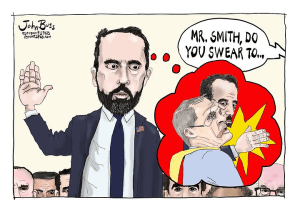
“Jack Smith returns to Washington to testify publicly in front of Jim Jordan’s House Judiciary Committee.” John Buss, @repeat1968
Good Day, Sky Dancers!
Yesterday, the entire news cycle was dedicated to the testimony of former Special Counsel Jack Smith, who prosecuted the rotter in the White House for his election interference scheme. Many of the Republican members of the Judiciary Committee were far from up to the task of diminishing Smith’s appearance and the merits of the case. At one point, Democratic Ranking Member Jamie Raskin and Republican Darrel Issa got into a shouting match.
PBS had this headline yesterday, along with a tick-tock of the day’s events. It was a strange thing to see that Republicans were part of what was a look at Trump’s Election crimes, which appeared to be less daunting to them than dealing with the Epstein Files. Anyone paying attention surely took the event and the testimony as yet another way Trump defies our Constitutionally defined form of government.
Jack Smith is set to testify in a House Judiciary hearing Thursday. It’s an opportunity for the career prosecutor to offer his inside perspective on the investigations into Trump’s mishandling of classified documents and attempt to overturn the results of the 2020 election. The president was indicted in two federal cases, but both were scuttled once it was clear that Trump would return to the Oval Office, due to DOJ policy that prevents prosecution of a sitting president.
One of the things we learned is that the manner in which the case was dismissed lets a future Congress and DOJ go after him again. This was yesterday’s New York Times’ conclusion. “In Testimony, Jack Smith Defends Decision to Prosecute Trump. The former special prosecutor argued a case he was never allowed to in court: that President Trump “engaged in criminal activity” that undermined democracy.” The leded is shared by
By Glenn Thrush and Alan Feuer.
But the hearing also provided Mr. Smith with what was likely to be his best opportunity to challenge, in an official forum, Mr. Trump’s justification for ordering the Justice Department to pursue his enemies: that he was persecuted for his politics, not prosecuted for his alleged misdeeds.
“Our investigation revealed that Donald Trump is the person who caused Jan. 6, that it was foreseeable to him and that he sought to exploit the violence,” Mr. Smith said, sitting alone at the witness table with a water bottle, legal pad and white ballpoint pen.
He appeared wan and tired, speaking so softly at times his voice did not register with voice transcription apps. Before sitting at the witness table, Mr. Smith greeted four law enforcement officers who were attacked by the pro-Trump mob at the Capitol — Michael Fanone, Daniel Hodges, Aquilino Gonell and Harry Dunn.
Republicans repeatedly accused Mr. Smith of participating in a Democratic conspiracy to destroy Mr. Trump by investigating his efforts to overturn the results of the 2020 election, as well as his handling of classified documents after he left office.
Mr. Smith and his team interfered in the “democratic process by seeking to muzzle a candidate for a high office,” Representative Jim Jordan, Republican of Ohio and the chairman of the House Judiciary Committee, said in his opening statement, quoting from an editorial in The Washington Post.
But Republican lawmakers offered no new evidence to support that claim, and spent much of their time rehashing political arguments and grilling Mr. Smith about his decision to seek a court order for metadata about phone calls Mr. Trump and his allies made to nine Republican lawmakers as they sought to overturn the results of the 2020 election.
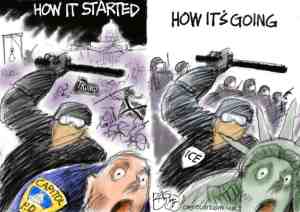
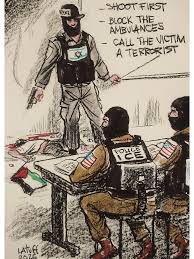
This may seem like more rehashing of old news, but remember, Trump is angling to interfere with the 2026 midterms. It’s a good refresher as to the criminal lengths he will go to retain power. The news today still reflects the regime’s abuse of constitutional rights. ICE is still in the headlines. The abuse is on full display in Minneapolis. This analysis of the last Constitutional Crisis nightmare can be found on Joy Vance’s SubStack, Civil Discourse. “Breaking the Fourth Amendment.”
Last night, we learned from a report in the Associated Press that ICE, contrary to longstanding Fourth Amendment jurisprudence, is taking the position that it can enter people’s homes without a judicial warrant. Instead, they believe that an administrative warrant suffices. An administrative warrant is a form signed by an “authorized immigration official,” which means an executive branch employee who can be fired if they displease the president. It’s not difficult to see the problem here.
The Fourth Amendment provides that: “The right of the people to be secure in their persons, houses, papers, and effects, against unreasonable searches and seizures, shall not be violated, and no Warrants shall issue, but upon probable cause, supported by Oath or affirmation, and particularly describing the place to be searched, and the persons or things to be seized.” It’s the reason your home can’t be searched by the police without a search warrant that has been supported with probable cause to believe that evidence or fruits of a crime will be found there.
ICE seems to be arguing that if they think a non-citizen for whom there is a final order of deportation is in a house, they can blow right past the Fourth Amendment, take the doors off the house if they aren’t admitted voluntarily, and go right in. But the Fourth Amendment doesn’t change just because ICE says so.
The Supreme Court has made it clear that a search warrant must be signed by a “judicial officer” or a “magistrate.” Their signature on the warrant says that they have reviewed the evidence that the agents believe constitutes probable cause to justify a search, and they agree that it is sufficient to breach the wall otherwise established by the Fourth Amendment and allow law enforcement into a private home (or car, or private areas of a business, etc.). The idea is that a detached, neutral judge—not someone involved in investigating a case or “on the same side” as law enforcement—should evaluate the evidence before a search warrant or an arrest warrant is issued.
As the Supreme Court explained in Johnson v. U.S., in 1948: “The point of the Fourth Amendment, which often is not grasped by zealous officers, is not that it denies law enforcement the support of the usual inferences which reasonable men draw from evidence. Its protection consists in requiring that those inferences be drawn by a neutral and detached magistrate instead of being judged by the officer engaged in the often competitive enterprise of ferreting out crime.”
This report by The Washington Post shows how utterly evil, cruel, and lawless the agency has become. “ICE detains four children from Minnesota school district, including 5-year-old. Columbia Heights Public Schools district officials accused ICE officers of using the 5-year-old “as bait.” A 10-year-old and her mother were also detained.” Andrew Jeong provides the report.
Immigration and Customs Enforcement agents in Minnesota have detained at least four children from the same school district this month, including a 5-year-old boy, school officials in a Minneapolis suburb said Wednesday.
The events have inflamed tensions between residents and ICE officers,sparked by the fatal shooting of 37-year-old Renée Good by an ICE officer this month. The Trump administration has sought to justify the presence of ICE personnel by saying that the officers are detaining immigrants convicted of violent crimes.
“Why detain a 5-year-old?” Zena Stenvik, the superintendent of the Columbia Heights Public Schools district, located just north of Minneapolis, said at a news conference. “You cannot tell me that this child is going to be classified as a violent criminal.”
Five-year-old Liam Conejo Ramos and his father, whom the Department of Homeland Security identified as Adrian Alexander Conejo Arias in an emailed statement, were detained in their driveway Tuesday afternoon, just as they were returning from the child’s school, according to a news release from Columbia Heights Public Schools.
The father fled on foot when ICE officers approached him, DHS said. “For the child’s safety, one of our ICE officers remained with the child while the other officers apprehended Conejo Arias,” it added.
After detaining the father, ICE officers then asked Liam to knock on the door to see if any other people were inside the home, “using a 5-year-old as bait,” according to the school district.
Another adult living in the home, who was outside at the time, “begged the agents” to leave the child with them, the school district said. ICE agents refused.
Liam’s middle-school-age brother returned home 20 minutes later to find that his younger brother and father had been taken away.
Liam and his father are now in San Antonio in the custody of Homeland Security authorities, the family’s lawyer, Marc Prokosch, said in an email. They are not U.S. citizens but “have been following the legal process perfectly, from presenting themselves at the border to applying for asylum and waiting for the process to go through,” he said.
The Substack Strength in Numbersof G. Elliott Morris has this true and frightening headline. “The consent of the governed has been withdrawn. One year into his second term, Trump has suffered the largest approval collapse of any modern president (except the one who resigned in disgrace). He is underwater on every major policy area.” He’s so underwater that the numbers are worse than during the worst of the COVID pandemic.
One year ago this week, Donald Trump was sworn in as the 47th President of the United States. He entered office with a net approval rating of +5 in the FiftyPlusOne.news approval rating aggregate. Despite a tumultuous first term — which ended with the president posting his worst-ever numbers after the January 6 insurrection — voters, it seemed, were willing to give him another shot.
They are no longer willing to give him that chance. Trump sits at an -16 net job approval on average today, down from +5 on his first day in office. His 21-point drop is the worst first-year performance, in the eyes of public opinion, of any president’s first term going back to at least 1948. If you compare the last year to other second-term presidencies, Trump’s is still the worst first-year performance of any president in the modern polling, with one exception: Richard Nixon (who was consumed by Watergate and other national crises at this point in his term).
Either way, Trump is in historically bad company.
As The New York Timesreported this week, Trump’s support among key groups he persuaded to vote for him in 2024 — notably, young, Black, and Latino voters — has now sunk below levels measured in the run-up to the 2020 election (which Trump lost to Joe Biden by 4.5 points in the national popular vote)
Let’s hope that turns into some momentum to get rid of Republicans in Congress. As noted before, the Trump Regime, plus many Republican Congress Critters, are truly afraid of what’s coming for them. Don Moynihan has this to say at his Substack. “Can We Still Govern? Past the breaking point. The violent occupation of an American city is more than a warning.”
We use words like “police state.” Then we see it happen. To watch is not the same as to experience it, of course. Of being afraid to leave your house. Or having a classmate, co-worker, or family member disappear. But the images make it more real. It removes any illusion that it could not happen here. It is happening here. We see it happening here, if we are willing to look.
In recent weeks, the paramilitary occupation of the Twin Cities has moved us past some invisible breaking points. About how we expect our government to treat us. And about what might be done about the government agencies that fail those expectations.
Lets step back: the primary purpose of this occupation is the selective use of government power to establish federal dominance over blue states or cities that President Trump dislikes. Thats it. Trump thinks Minnesota is the enemy, and so he unleashed an armed and masked paramilitary upon its people. There is no serious case that this is about the number of immigrants, or some level of violent crime not seen elsewhere. It is about the Department of Homeland Security, in the form of Immigrations and Customs Enforcement, and Customs and Border Patrol, developing their skills as the President’s stormtroopers. It is about making an example of a community.
To make matters worse, Congress did not defund ICE thanks to a handful of turncoat Democrats. This is from Newsweek. “Seven Democrats Just Voted to Approve ICE Funding: Full List.” This news is reported by Gabe Whisnant.
Seven House Democrats broke with much of their party to vote in favor of funding U.S. Immigration and Customs Enforcement (ICE), helping advance a Department of Homeland Security (DHS) spending measure in committee despite strong opposition from progressives.
The votes came during a markup of the DHS appropriations bill, with Representative Thomas Massie of Kentucky casting the lone Republican vote against the funding, which passed 220-207 and will fund ICE as well as FEMA through September 30.
“Right now we are about to take a vote and that vote is on DHS and whether or not we will give more funding to ICE. Right now I am willing to shut it down. I am going to do what it takes instead of just kind of being a go-along to get-along lawmaker,” Representative Jasmine Crockett, a Texas Democrat, told Newsweek ahead of the vote.
The seven Democratic representatives who voted yes to approve ICE funding were:
Tom Suozzi (New York)
Henry Cuellar (Texas)
Don Davis (North Carolina)
Laura Gillen (New York)
Jared Golden (Maine)
Vicente Gonzalez (Texas)
Marie Glusenkamp Perez (Washington)
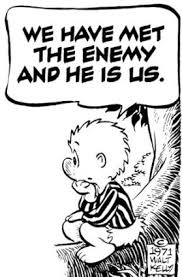
We have met the enemy, and he is us.
What’s on your Reading, Action, and Blogging list today?
Did you like this post? Please share it with your friends:
“Organ cat, prayer book, Bruges or Ghent c. 1480-1490 (Baltimore, Walters Art Museum
Happy Caturday!!
It has been another busy news week, and today there are some stories that follow up on recent news and others that look further back in time. As we move closer to the midterm elections, things are looking better for Democrats to keep control of the Senate. Of course the fallout continues from the FBI search of Mar-a-Lago. The judge in the case released more information on the search warrant, and there could be more coming. A court has ordered the DOJ to release a memo related to the Mueller investigation that Bill Barr refused to make public. A Michigan judge made an important decision on abortion laws in the state. Finally, the NYT published a fascinating op-ed by two law professors who argue that the U.S. Constitution is “broken.”
On Thursday, Senate GOP Leader Mitch McConnell (R-KY) seemed to admit that the Grand Old Party doesn’t have the highest quality roster of candidates.
“I think there’s probably a greater likelihood the House flips than the Senate,” McConnell said. “Senate races are just different, they’re statewide, candidate quality has a lot to do with the outcome.”
Writing in Vanity Fair, Eric Lutz reported, “He didn’t mention any of those candidates directly, but he almost certainly could have been talking about any of Donald Trump’s handpicked contenders, who earned the former president’s support seemingly for one of two reasons: He knows them from television, or they’re loyalists who have organized their campaigns almost entirely around his 2020 election lies. There’s a lot of crossover there, obviously, but the first camp includes Mehmet Oz, a former TV doctor who apparently believes raw asparagus belongs in a crudité, and Herschel Walker, the former football great whose own campaign staff reportedly regards him as a ‘pathological liar.’” [….]
“Then there’s the second camp of MAGA candidates, which includes the likes of Blake Masters, the Peter Thiel protégé who literally has the backing of some of the Internet’s most well-known white nationalists. (Masters has attempted to distance himself from this community.) One of several extremists on the ballot in Arizona, where election deniers Kari Lake and Mark Finchem are respectively running for governor and secretary of state, Masters is trailing Democrat Mark Kelly by eight points, according to a Fox News poll released this week,” Lutz reported. “None of this to say to say that these bumbling extremists can’t win; if a country is capable of electing Trump president, Georgia is certainly capable of electing a guy like Walker. But McConnell’s apparent sense that this batch of bozos might dash GOP dreams of a Senate majority may be well-founded, even if midterms tend to favor the party that doesn’t control the White House.”
Republican Senate hopefuls are getting crushed on airwaves across the country while their national campaign fund is pulling ads and running low on cash — leading some campaign advisers to ask where all the money went and todemand an audit of the committee’s finances, according to Republican strategists involved in the discussions.
In a highly unusual move, the National Republican Senatorial Committee this week canceled bookings worth about $10 million, including in the critical states of Pennsylvania, Wisconsin and Arizona. A spokesman said the NRSC is not abandoning those races but prioritizing ad spots that are shared with campaigns and benefit from discounted rates. Still, the cancellations forfeit cheaper prices that came from booking early, and better budgeting could have covered both.
“The fact that they canceled these reservations was a huge problem — you can’t get them back,” said one Senate Republican strategist, who like others spokes on the condition of anonymity to discuss internal matters. “You can’t win elections if you don’t have money to run ads.”
The NRSC’s retreat came after months of touting record fundraising, topping $173 million so far this election cycle, according to Federal Election Commission disclosures. But the committee has burned through nearly all of it, with the NRSC’s cash on hand dwindling to $28.4 million by the end of June.
As of that month, the committee disclosed spending just $23 million on ads, with more than $21 million going into text messages and more than $12 million to American Express credit cardpayments, whose ultimate purpose isn’t clear from the filings. The committee also spent at least $13 million on consultants, $9 million on debt payments and more than $7.9 million renting mailing lists, campaign finance data show.
Former President Donald Trump has offered a shifting array of defenses in response to the August 8 FBI search of his Mar-a-Lago resort in Florida, which uncovered a trove of secret documents.
Among them is the claim that he declassified all of the documents while in office under the president’s sweeping powers over national secrets.
But procedural documents unsealed Thursday by federal judge Bruce Reinhart, including the cover sheet of the warrant used in the search, revealed that this defense may not be as effective as Trump hoped, legal experts say.
One implication of the new information is that even if Trump is right about the documents being declassified, he still could have broken the law, Lawrence Tribe, a Harvard constitutional law scholar, tweeted….
[The cover sheet] showed that the FBI believes that Trump may be guilty of the willful retention of national defense information, concealment or removal of government records, and obstruction of federal investigation.
Bradley P. Moss, a national security attorney, told Insider that the new documents “clarify but ultimately do not change much” of what we previously knew.
A striking detail, he said, is that the FBI believes Trump has obstructed its probe.
“Clearly, the FBI currently believes Mr. Trump not only took properly marked classified documents to Mar-a-Lago, but he kept them and resisted turning them over when confronted by the government,” Moss said.
The day after federal agents searched Mar-a-Lago, former President Donald Trump told a group of conservative lawmakers that “being president was hell,” according to three people at the meeting.
But to some he sounded ready to have the job again.
“He was not to be deterred,” said Rep. Randy Weber of Texas, one of a dozen Republican House members who met with Trump on Aug. 9. He described Trump’s state of mind in the immediate aftermath of the search as “pretty miffed, but measured.”
Everything that’s occurred since that Bedminster, New Jersey, meeting — and since federal agents seized a trove of top secret and other highly classified documents from his resort — has put Trump exactly where he and his supporters want him to be, according to people close to him. He’s in a fight, squaring off with Washington institutions and a political establishment he says are out to get him, issues he brought up in the meeting with the lawmakers and in conversations with others.
Taken together, it’s reoriented Trump’s thinking about whether he should announce a presidential campaign before or after the midterm elections, according to those who have spoken with him over the past two weeks. They said Trump feels less pressure to announce early because viable challengers who might otherwise force his hand have faded into the background. But there are other reasons to wait.
Trump is now inclined to launch his candidacy after the November elections, in part to avoid blame should an early announcement undermine the GOP’s effort to win control of Congress, said one person close to him, speaking on condition of anonymity to talk more freely.A post-midterm announcement would suit Republican leaders who’ve been urging Trump to hold off so that he doesn’t overshadow the party’s candidates.Michael Caputo, a former Trump campaign and administration official, described Trump’s attitude in recent days after speaking with him, as “business as usual.”
Business as usual for Trump: the possibility of multiple criminal charges and crappy lawyers who have no clue how to defend a criminal.
Judge orders release of Bill Barr’s memo protecting Trump
A federal appeals court has ordered the release of a secret Justice Department memo discussing whether President Donald Trump obstructed the investigation into Russian interference in the 2016 election.
The unanimous panel decision issued Friday echoes that of a lower court judge, Amy Berman Jackson, who last year accused the Justice Department of dishonesty in its justifications for keeping the memo hidden.
The panel of three judges, led by Chief Judge Sri Srinivasan, said that whether or not there was “bad faith,” the government “created a misimpression” and could not stop release under the Freedom of Information Act.
The memo was written by two senior Justice Department officials for then-attorney general William P. Barr, who subsequently told Congress that there was not enough evidence to charge Trump with obstruction of special counsel Robert S. Mueller III’s inquiry. A redacted version was released last year but left under seal the legal and factual analysis.
Department officials argued that the document was protected because it involved internal deliberations over a prosecutorial decision. But the judges agreed with Jackson that both Mueller and Barr had clearly already concluded that a sitting president could not be charged with a crime. The discussion was over how Barr would publicly characterize the obstruction evidence Mueller had assembled, the Justice Department conceded on appeal.
A federal appeals court ruled Friday that the Justice Department must make public an internal memo senior lawyers there prepared in 2019 about whether then-President Donald Trump’s actions investigated in special counsel Robert Mueller’s probe of ties between the 2016 Trump campaign and Russia amounted to crimes prosecutors would ordinarily charge.
The D.C. Circuit Court of Appeals said the Justice Department failed to meet its legal burden to show that the memo from the department’s Office of Legal Counsel was part of a genuine deliberative process advising then-Attorney General William Barr on how to handle sensitive issues left unresolved when Mueller’s probe concluded in March 2019.
Trump was never charged in Mueller’s probe and the special prosecutor’s final report declined to opine on whether what he did in response to the investigation amounted to a crime.
However, some Trump opponents have called on the Attorney General Merrick Garland to reconsider the issue now that Trump is no longer president. Release of the long-sought DOJ memo could fuel those calls and draw more unwanted attention to Trump’s potential criminal liability at a time when he is besieged by a slew of other legal woes relating to his handling of classified government records, his role in inspiring many of those involved in the Jan. 6 attack on the Capitol and his broader efforts to overturn Joe Biden’s win in the 2020 presidential election.
A Michigan judge ruled Friday prosecutors in the state’s largest counties are barred from bringing criminal charges for months to come under a state law banning most abortions.
The decision from Oakland County Circuit Court Judge Jacob Cunningham comes after two days of hearings and means every county in Michigan with an abortion clinic is at least temporarily immune from the threat of criminal prosecutions over abortion procedures.
“As currently applied, the court finds (the abortion law) is chilling and dangerous to our state’s population of childbearing people and the medical professionals who care for them,” Cunningham said.
“The harm to the body of women and people capable of pregnancy in not issuing the injunction could not be more real, clear, present and dangerous to the court.”
At times, Cunningham seemed to ridicule arguments from conservative prosecutors seeking to enforce the 1931 abortion law. He said prosecutors would suffer zero harm from not having the ability to prosecute abortion providers.
Going much further, he told these prosecutors to instead focus their efforts elsewhere.
“The court suggests county prosecutors focus their attention and resources … to investigation and prosecution of criminal sexual conduct, homicide, arson, child and elder abuse, animal cruelty and other violent and horrific crimes that we see in our society,” Cunningham said.
Is the Constitution broken?
Ryan D. Doerfler and Samuel Moyn, law professors from Harvard and Yale respectively, published this guest essay at The New York Times: The Constitution Is Broken and Should Not Be Reclaimed. You’ll need to go to the NYT link if you’re interested, because it’s very long. The main idea is that the Constitution is dated and favors conservatives; liberals need to change their thinking about “constitutionalism.”
When liberals lose in the Supreme Court — as they increasingly have over the past half-century — they usually say that the justices got the Constitution wrong. But struggling over the Constitution has proved a dead end. The real need is not to reclaim the Constitution, as many would have it, but instead to reclaim America from constitutionalism.
The idea of constitutionalism is that there needs to be some higher law that is more difficult to change than the rest of the legal order. Having a constitution is about setting more sacrosanct rules than the ones the legislature can pass day to day. Our Constitution’s guarantee of two senators to each state is an example. And ever since the American founders were forced to add a Bill of Rights to get their handiwork passed, national constitutions have been associated with some set of basic freedoms and values that transient majorities might otherwise trample.
But constitutions — especially the broken one we have now — inevitably orient us to the past and misdirect the present into a dispute over what people agreed on once upon a time, not on what the present and future demand for and from those who live now. This aids the right, which insists on sticking with what it claims to be the original meaning of the past.
Arming for war over the Constitution concedes in advance that the left must translate its politics into something consistent with the past. But liberals have been attempting to reclaim the Constitution for 50 years — with agonizingly little to show for it. It’s time for them to radically alter the basic rules of the game.
In making calls to regain ownership of our founding charter, progressives have disagreed about strategy and tactics more than about this crucial goal. Proposals to increase the number of justices, strip the Supreme Court’s jurisdiction to invalidate federal law or otherwise soften the blow of judicial review frequently come together with the assurance that the problem is not the Constitution; only the Supreme Court’s hijacking of it is. And even when progressives concede that the Constitution is at the root of our situation, typically the call is for some new constitutionalism.
If that whets your appetite for me, click the link and read the rest.
Those are today’s main political stories as I see it. Maybe we’ll have some time to take a breath before more shocking news breaks. I can use a quite weekend and I wish you the same.
Did you like this post? Please share it with your friends:
The post World War 2 era led to the birth of a lot of new democracies as the colonial era started to wind down in earnest. European countries couldn’t rebuild and fund empires. One of the most fascinating things to me about the current state of things in the world is that many places where democracy seemed well-rooted are plotting a path to return of autocratic forms of government. It hasn’t been that long since the USSR and its satellites broke up into many little experiments in democracy either. What makes some countries shrug their collective shoulders and go back to strong men?
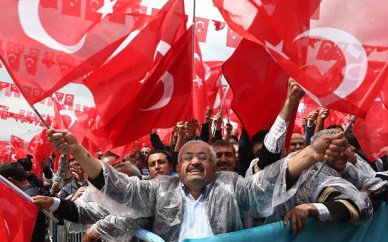
DIYARBAKIR, TURKEY – MARCH 27: Turkish Prime Minister Recep Tayyip Erdogan greets crowd during a local election rally organized by the ruling Justice and Development Party in Diyarbakir, Turkey, on March 27, 2014. (Photo by Kayhan Ozer/Anadolu Agency/Getty Images)
At some point, you have to question which institutions have failed a country’s people but it’s undoubtedly an interplay of many. Turkey’s decline has many lessons for us. The similarities between Kremlin Caligula and Erdogan are eerie. That’s why I decided to write about it today.
Why are the world’s democracies facing such threat to modernity? Why place so much power in an executive branch?
Whether they understood it or not, when Turks voted “Yes”, they were registering their opposition to the Teşkilât-ı Esasîye Kanunu and the version of modernity that Ataturk imagined and represented. Though the opposition is still disputing the final vote tallies, the Turkish public seems to have given Erdogan and the AKP license to reorganize the Turkish state and in the process raze the values on which it was built. Even if they are demoralized in their defeat, Erdogan’s project will arouse significant resistance among the various “No” camps. The predictable result will be the continuation of the purge that has been going on since even before last July’s failed coup including more arrests and the additional delegitimization of Erdogan’s parliamentary opposition. All of this will further destabilize Turkish politics.
Turkey’s Islamists have long venerated the Ottoman period. In doing so, they implicitly expressed thinly veiled contempt for the Turkish Republic. For Necmettin Erbakan, who led the movement from the late 1960s to the emergence of the Justice and Development Party (AKP) in August 2001, the republic represented cultural abnegation and repressive secularism in service of what he believed was Ataturk’s misbegotten ideas that the country could be made Western and the West would accept it. Rather, he saw Turkey’s natural place not at NATO’s headquarters in Brussels but as a leader of the Muslim world, whose partners should be Pakistan, Malaysia, Egypt, Iran, and Indonesia.
When Erbakan’s protégés — among them Erdogan and former President Abdullah Gul — broke with him and created the AKP, they jettisoned the anti-Western rhetoric of the old guard, committed themselves to advancing Turkey’s European Union candidacy, and consciously crafted an image of themselves as the Muslim analogues to Europe’s Christian Democrats. Even so, they retained traditional Islamist ideas about the role of Turkey in the Middle East and the wider Muslim world.
Thinkers within the AKP — notably former Prime Minister Ahmet Davutoglu — harbored reservations about the compatibility of Western political and social institutions with their predominantly Muslim society. But the AKP leadership never acted upon this idea, choosing instead to undermine aspects of Ataturk’s legacy within the framework of the republic. That is no longer the case.
The AKP and supporters of the “yes” vote argue that the criticism of the constitutional amendments was unfair. They point out that the changes do not undermine a popularly elected parliament and president as well as an independent (at least formally) judiciary. This is all true, but it is also an exceedingly narrow description of the political system that Erdogan envisions. Rather, the powers that would be afforded to the executive presidency are vast, including the ability to appoint judges without input from parliament, issue decrees with the force of law, and dissolve parliament. The president would also have the sole prerogative over all senior appointments in the bureaucracy and exercise exclusive control of the armed forces. The amendments obviate the need for the post of prime minister, which would be abolished. The Grand National Assembly does retain some oversight and legislative powers, but if the president and the majority are from the same political party, the power of the presidency will be unconstrained. With massive imbalances and virtually no checks on the head of state, who will now also be the head of government, the constitutional amendments render the Law on Fundamental Organization and all subsequent efforts to emulate the organizational principles of a modern state moot.
There is an uptick in groups of voters drawn to authoritarianism. This is not what I expected when I watched the “Arab Spring” unfold on Twitter. Donald Trump is not what I expected after Barrack Obama. There appears to be a group of people that just love themselves better in the comfort of old school religion and backwoods bullies. Each follower of the world’s largest religions needs to discern a difference between being a person of faith and blindly following your religion over a precipice and into slavery. It always begins with a purge of intellectuals, scientists, and scholars.
It has been painful for me to witness the immense disappointment of Turkish intellectuals, resilient by tradition, and mainly left-leaning. All I could hear by phone or on social media was tormented despair – a crushing sense of defeat. What united all those in academia and the media or in NGOs, regardless of their political stripes, was that they had hoped for democratic change under the AKP.
Many of them had given credit to the party, and its early pledges and steps towards an order where the sharing of power would break the vicious circle of the republic. They wanted to believe in human rights, freedom and an end to the decades-long Kurdish conflict. But the deliberate reversal of democratisation left all of them feeling they had been duped.
This conclusion became undeniable when last summer’s attempted coup – the details of which are still unclear – led to an immense purge. Given this mood of despair and the sense of defeat, we should expect another exodus of fine human resources in the coming months and years.
Journalists – such as me, abroad, or at home – will find themselves challenged even more after the referendum. Coverage of corruption will be a daredevil act, severe measures against critical journalism will continue and the remaining resistance of media proprietors will vanish.
The Turkish media will begin to resemble those of the Central Asian republics, where only mouthpieces for those in power are allowed to exist. Inevitably, these conditions will shift the epicentre of independent journalism to outside the borders of Turkey. My colleagues have already realised that their dreams of a dignified fourth estate were nothing but an illusion.
“At the end of the day, Erdoğan is simply replacing one form of authoritarianism with another,” wrote Cook.
“The Turkish republic has always been flawed, but it always contained the aspiration that – against the backdrop of the principles to which successive constitutions claimed fidelity – it could become a democracy. Erdoğan’s new Turkey closes off that prospect.”
Just as in this country’s election in 2016, Erdoğan won a slim victory. That’s not stopping him from sweeping reforms that are way out of line with progress and modernity.
An emboldened Recep Tayyip Erdogan followed his win in a referendum that ratified the supremacy of his rule by taking aim at political opponents at home and abroad.
At his victory speech late on Sunday, supporters chanted that he should bring back the death penalty — a move that would finish off Turkey’s bid to join the European Union — and Erdogan warned opponents not to bother challenging the legitimacy of his win. He told them to prepare for the biggest overhaul of Turkey’s system of governance ever, one that will result in him having even fewer checks on his already considerable power.
“Today, Turkey has made a historic decision,” he said. “We will change gears and continue along our course more quickly.” The lira surged as much as 2.5 percent against the dollar in early trading on Monday in Istanbul before gains moderated.
The success of a package of 18 changes to the constitution was narrow, with about 51.4 percent of Turks approving it. It came at the end of a divisive two-month campaign during which Erdogan accused opponents of the vote of supporting “terrorists” and denounced as Nazi-like the decision of some EU countries to bar his ministers from lobbying the diaspora.
“The referendum campaign was dominated by strongly anti-Western rhetoric and repeated promises to bring back the death penalty,” said Inan Demir, an economist at Nomura Holdings Inc. in London. “One hopes that this rhetoric will be tempered now that the vote is over,” but recent steps by the Turkish government do“not bode well for the hoped-for moderation in international relations.”
Now that two obese men with bad hair and nuclear weapons didn’t end the world over the weekend, let’s talk about Turkey. Maybe keeping up with the former focal point of the Ottoman empire hasn’t been on the top of your to-do list. All well and good. But you may want to know they voted to weaken or even obliterate—depending on who you ask—their democracy over the weekend.
So what does this referendum of theirs mean? Only give the Turkish president hitherto unprecedented control over the executive, legislative and judicial branches. Now that the Turks have voted “Yes” to these constitutional reforms, they’re signing up for a form of government in which parliament’s monitoring of the executive branch is removed from the constitution and the judiciary is even weaker and less independent than it already was beforehand.
It’s a complex case though. Turkey’s government is different than America’s and, in some ways, they’re actually embracing a system more similar to the one US citizens are used to. The main transition is one from a parliamentary democracy to a presidential one, albeit a strongly authoritative one. Traditionally, the Turkish president is more figurehead than enforcer. They’re intended to be more Queen Elizabeth than Vladimir Putin or even Donald Trump.
As head of state, they act as the public face of the country, acting in times of emergency but largely delegating the business of lawmaking and government-running to their appointed prime minister. Until April 16, 2017, the president was mandated to cut ties from his party and maintain a largely neutral and apolitical stance, regardless of personal attachments or viewpoints. Now the office of prime minister is kaput and the president will have way more control over all branches of government. Parliament will still make laws and the judiciary will still try cases. But they’ll do little else and even those duties are capable of being bypassed by the president pretty easily.
The changes don’t go into effect until 2019 but when they do, the Turkish president can pass decrees as effective and codified as any parliamentary law, dissolve parliament, call for new elections, set the budget, declare a state of emergency, make unilateral national security decisions, appoint and remove all VPs and ministry heads at their own discretion and more. Don’t worry! If the president does something illegal, they can still be investigated if there’s a simple majority in parliament and a 60% vote to be tried then convicted by presidentially appointed judges.
And it’s so completely unconcerning the person who’ll most likely have all this unchecked executive power in 2019 is current president Recep Tayyip Erdogan. Just think of his inspirational and relatable backstory—he sold lemonade as a teenager in a rough part of town, played soccer for a while and wrote, and directed and starred in a play called Maskomya about how Freemasonry, Communism and Judaism are evil forces hellbent on destroying the world. Presidents: they’re just like us!
Trump has voiced his support for the use of torture. And his similarities with the Turkish leader do not end there. Both use a rhetoric of patriotism to the point of nationalism, are vocal against abortion and are infamous for their tendency to objectify women and misunderstand feminism. They have both granted their sons-in-law important positions and both have a particularly thin skin when it comes to criticism, especially when it comes from comedians and journalists.
Erdoğan and Trump have publicly supported each other’s stance on the media in the past. Anyone who has spent time in Turkey will recognise Trump’s denouncement of negative coverage in outlets such as the New York Times as “fake news”. They will be familiar with headlines such as the one that appeared in far-right outlet Brietbart (whose founding member Steve Bannon is Trump’s chief strategist), used in relation to the protests in the US on Saturday – “Terror-tied group Cair causes chaos, promoting protests and lawsuits as Trump protects nation”. This is pure Erdoğan territory – denouncing opposition by associating it with terror while glorifying the strong leader. Turkey is the home of “alternative facts”.
A country that makes the media the enemy is a country where people are too easily manipulated by those in power. Journalists in Turkey, unless they work for organisations that toe the official government line on events, constantly wobble on a tightrope between reporting what’s going on and not reporting enough to get arrested. Even foreign journalists self-censor, double-check for unintended “insults” that could land them in trouble. They flinch when the doorbell rings unexpectedly, and wonder every time they go abroad whether they will be allowed back in the country.
We need to stand up against the vilification of the free press in the US now before it goes too far. Erdoğan is no longer good for Turkey, just like Trump is no good for America. They are changing the identities of their countries.
The similarities between Erdogan and Trump are greater than they might seem, despite the very different political traditions in the US and Turkey.
The parallel lies primarily in the methods by which both men have gained power and seek to enhance it. They are populists and nationalists who demonise their enemies and see themselves as surrounded by conspiracies. Success does not sate their pursuit of more authority.
Hopes in the US that, after Trump’s election in November, he would shift from aggressive campaign mode to a more conciliatory approach have dissipated over the last two months. Towards the media his open hostility has escalated, as was shown by his abuse of reporters at his press conference this week.
Manic sensitivity to criticism is a hallmark of both men. In Trump’s case this is exemplified by his tweeted denunciation of critics such as Meryl Streep, while in Turkey 2,000 people have been charged with insulting the president. One man was tried for posting on Facebook three pictures of Gollum, the character in The Lord of the Rings, with similar facial features to pictures of Erdogan posted alongside. Of the 259 journalists in jail around the world, no less than 81 are in Turkey. American reporters may not yet face similar penalties, but they can expect intense pressure on the institutions for which they work to mute their criticisms.
Turkey and the US may have very different political landscapes, but there is a surprising degree of uniformity in the behaviour of Trump and Erdogan. The same is true of populist, nationalist, authoritarian leaders who are taking power in many different parts of the world from Hungary and Poland to the Philippines. Commentators have struggled for a phrase to describe this phenomenon, such as “the age of demagoguery”, but this refers only to one method – and that not the least important – by which such leaders gain power.
So, I’m sure this isn’t what you expected to read today. But, it appears that my interest and concerns aren’t just wild hairs.
What’s on your reading and blogging list today?
Did you like this post? Please share it with your friends:
Since I’m in the middle of revamping my course for Graduate Finance Students in International Finance and reviewing textbooks and the usual stuff, I thought I’d focus on the economy for the morning.
One of the most awful results of the Reagan years has been the creation of mainstream paranoia over policy using data evident from the scientific method, intellectuals and academics that spend years researching and learning theory and empirical evidence, and the idea that government can’t ameliorate issues through policy but is somehow a potential enemy of the governed.
This kind of paranoid drivel used to be the realm of militia types like Clive Bunday and John Birchers like the Koch Brothers and father. It had no place in mainstream discourse until Reagan started pumping up the idea that poor people game the government and the government games every one else. Its now spread to Christian extremists, the NRA, and most of the Republic Party.
Joni Ernst, the Republican candidate for U.S. Senate in Iowa, said during an NRA event in 2012 that she would use a gun to defend herself from the government.
“I have a beautiful little Smith & Wesson, 9 millimeter, and it goes with me virtually everywhere,” Ernst said at the NRA and Iowa Firearms Coalition Second Amendment Rally in Searsboro, Iowa. “But I do believe in the right to carry, and I believe in the right to defend myself and my family — whether it’s from an intruder, or whether it’s from the government, should they decide that my rights are no longer important.”
Ernst made the remark a little more than a month after gunman James Holmes allegedly killed 12 people and injured 58 in a movie theater in Aurora, Colorado. Ernst’s campaign did not respond to The Huffington Post’s request for comment about the remark on Wednesday evening.
Earlier this year, Ernst released an ad in which she points a gun at the camera and vows to “unload” on Obamacare.
We’ve also experienced this massive attempt to rewrite secondary school textbooks and curricula to reflect the deeply held philosophical and religious views of these folks rather than theory or empirical evidence brought about by hundreds of years of research and scholarship. This also ignores primary documents that show just the opposite to be factual.
But, facts be damned, there’s children’s minds to warp. Biased ideas are not at the center of legitimate academic pursuit. Folks that follow agendas tend to live at the edges of universities and most departments are quite embarrassed by them. I spent time in a department where one research professor’s favorite pursuit was proving that iqs and brain sizes among varying races were the reason for underachieving groups in an economy. All DNA evidence shows that race is a social construct but this guy spent a life time trying to show the relationship between brain sizes of races and incomes and jobs. So, most time when you see folks that believe this stuff, they reside some where on the fringes. However, since the Reagan years, there’s been a major attempt by right wing religious zealots to teach propaganda and there’s been a rather significant increase in the level of ignorance on things from incoming freshmen.
The standards’ authors are clearly fans of the free enterprise system, consistently emphasizing the advantage of American capitalism over other structures.
For example, the high school standards state that students should be able to “understand how the free enterprise system drives technological innovation and its application in the marketplace.” The middle school standards clearly promote free enterprise capitalism over other economic systems, saying that students should be able to “compare and contrast free enterprise, socialist, and communist economies in various contemporary societies, including the benefits of the U.S. free enterprise system.” Finally, the standards connect capitalism with the conservative ideal of limited government, asking students to be able to “explain why a free enterprise system of economics developed in the new nation, including minimal government intrusion, taxation, and property rights.”
It really takes very little time spent in economics to realize that political constructs are not economic constructs. For example, the United States economy was founded on Mercantilism which began with monopolies, charters, grants and largess of royalty and aristocracy. The concepts of Capitalism and of Communism had the same roots and they were a lot more philosophical than ever real. Even, now, we have a modified market system. There has never EVER been a “free market” system or “communism” in an economic sense. Socialism is just one end of a modified market system and still relies heavily on private ownership of the majority of factors of production. Most facets of government policy are to make a market behave closer to a free market model because it can’t possibly d0 so under one factor, characteristic, or situation that exists. I mean really, who wants to leave the market for uranium to the free market? That’s just an extreme example.
The problem is that dogma has overtaken reality among folks that now find themselves in office. It’s bad for the country. It’s bad for business. It’s bad for nearly every one. The one thing that’s becoming abundantly clear since the Clinton Presidency and definitely during the Obama Presidency is that the Democratic Party is the party of Wall Street and Big Business. It’s not the Republicans. No where is this more evident than economic reports written by the private sector. Today’s Republicans scare the shit out of big business and finance. The last few battles to keep the federal government and the deficit funded has nearly caused market meltdowns twice. You also don’t see them complain about increasing the minimum wage or decreasing the current level of income equality. NO REALLY. This means Chris Christie is really going to have some ‘splaining to do over this statement.
Labor Secretary Tom Perez on Thursday panned New Jersey Gov. Chris Christie’s comments that he’s “tired” of the minimum wage debate.
“Chris Christie’s got his head in the sand if he’s getting tired about the minimum wage,” Perez said according to Bloomberg Politics.
President Barack Obama and Democrats have led the push to raise the federal minimum wage to $10.10, and the issue has made its way onto the campaign trail this year.
“Chris Christie needs to talk to his economists, who will tell him that 70 percent of GDP growth is consumption,” Perez said Thursday.
The criticism came just days after Christie said he was “tired of hearing about the minimum wage” at a U.S. Chamber of Commerce conference on Tuesday.
“I really am,” the Republican governor and potential 2016 hopeful said. “I don’t think there’s a mother or a father sitting around the kitchen table tonight in America saying, ‘You know, honey, if our son or daughter could just make a higher minimum wage, my God, all of our dreams would be realized.'”
“Is that what parents aspire to for our children?” Christie asked. “They aspire to a greater, growing America, where their children have the ability to make much more money and have much great success than they have, and that’s not about a higher minimum wage.”
Before the Labor secretary chimed in, the remark drew fire from other Democrats, and White House Press Secretary Josh Earnest even quipped during a briefing Wednesday that people living on a minimum wage are those who are really tired.
Christie also used his time at the podium to make a 2016 prediction.
“I am convinced that the next president of the United States is going to be a governor,” Christie said. “We’ve had this experiment of legislating .. and getting on-the-job training in the White House. It has not been pretty.”
Even though Republicans depict themselves as the party for business and banks, it turns out that the GOP’s economic policy is detrimental to their bottom lines and continued existence; particularly rising costs and stagnant wages since the Bush-Republican Great Recession. What both bankers and retailers really want instead of tax cuts, deregulation, and more Republican austerity and budget cuts are better incomes for all Americans that will lead to increased consumer confidence and greater purchasing power to trigger higher business profits. What they have learned after thirty years of “trickle-down” is that the trillions of dollars taken by the 1%, especially since 2009, have failed miserably to stimulate the economy. Instead, they demand more buying by the masses that Wall Street firms and analysis of 65 of the nation’s top retailers claim will only happen with, as President Obama preaches, growing the economy from the middle-out.
For example, in a report last month titled Inequality and Consumption, Morgan Stanley economists said, “Despite the roughly $25 trillion increase in wealth since the recovery from the financial crisis began, consumer spending remains anemic. Top income earners have benefited from wealth increases but middle and low income consumers continue facing structural liquidity constraints and unimpressive wage growth. To lift all boats, further increases in residential wealth and accelerating wage growth are needed.” Republicans completely disagree and either resist consideration of raising the minimum wage or promote abolishing it altogether. According to the Republicans, increasing income inequality must continue and it is crucial that they convince the population that no wage is too low. It is a belief the Koch brothers espouse but it is rapidly losing favor in circles whose survival depends on a population of consumers.
Standard and Poor’s (S&P) rating agency concurred with Morgan Stanley’s economists in their August report, How Increasing Income Inequality Is Dampening U.S. Economic Growth, And Possible Ways To Change The Tide, and strongly advised the federal government to create “a path toward more sustainable growth, that in our view, will pull more Americans out of poverty and bolster the purchasing power of the middle class. A rising tide lifts all boats…but a lifeboat carrying a few, surrounded by many treading water, risks capsizing.” To “lift all boats,” S&P suggests a “high degree of rebalancing” that includes increased “spending in the areas of education, health care, and infrastructure to help control the income gap that, at its current level, threatens the stability of an economy still struggling to recover.” Contrary to wisdom of real economists concerned with America’s economic survival, Republicans across the country have been laser-focused on their austerity crusade to cut spending on education, infrastructure, and healthcare including the cruel heartlessness of refusing free Medicaid expansion under the Affordable Care Act.
Despite the call from both banks and businesses to increase the minimum wage and spending on essentials for a robust recovery, congressional Republicans have obstructed and outright blocked each and every attempt by the President and Democrats to stimulate the economy. Despite trailing every developed nation on Earth in infrastructure, Republicans consistently refuse the President’s calls to increase spending on desperately-needed infrastructure repairs including roads, bridges, public buildings, and sewers that numerous economists, including some highly respected conservatives, say is crucial for job-creation, increased consumer spending, and a vibrant recovery. Increased consumer confidence, and spending, is something all economists agree is for the good of the country’s economy but can only happen if incomes rise for the majority with higher wages and more well-paying jobs.
Former Walmart U.S. CEO Bill Simon, whose company had seen consumer traffic drop for six straight quarters and same-store sales drop for five quarters, explained in July 2014 that “we’ve reached a point where it’s not getting any better but it’s not getting any worse—at least for the middle (class) and down.” Kip Tindell, CEO of the Container Store, put retailers’ feelings best when he said, “consistent with so many of our fellow retailers, we are experiencing a retail ‘funk.’” The culprit is obvious: low wage and income growth for the middle class. Median household income in 2013 stood 8 percentage points below its 2007 prerecession level.
The simple fact of the matter is that when households do not have money, retailers do not have customers. The failure of incomes to keep up with the growing cost of college, child care, and other middle-class staples leaves even less money for retail spending. A previous analysis by the Center for American Progress shows that this so-called “middle-class squeeze”—stagnant incomes and the growing cost of middle-class security—leaves the median married couple with two kids with $5,500 less to spend annually on food, clothes, and other essentials that retailers sell.
Or, as officials of J.C. Penney—whose sales fell 9 percent in 20136—put it when listing the risks to its stock value: “the moderate income consumer, which is our core customer, has been under economic pressure for the past several years.”
Moreover, retail spending—which includes spending on everything from clothing to groceries to dining out—has broad implications for the entire economy since it accounts for a large fraction of consumer spending, which itself makes up 70
percent of U.S. gross domestic product, or GDP.
Even Walmart is concerned even while not paying living wages, not providing good benefits, and not creating an environment where a worker feels secure about his/her future. Now the weird thing is that fringe economists are still overly scared about inflation and high taxes. These things, however, are not at the top of any one’s concerns that would be invited on any Fox News program. Here’s a headline from Forbes: “Want a Better Economy? History Says Vote Democrat!”. In 2012, a number of books evaluated the results of the economy under Democratic vs Republican administrations. The results are startling.
Senator Daniel Patrick Moynihan is attributed with saying “everyone is entitled to his own opinion, but not his own facts.“ So even though we may hold very strong opinions about parties and politics, it is worthwhile to look at historical facts. This book’s authors are to be commended for spending several years, and many thousands of student research assistant man-days, sorting out economic performance from the common viewpoint – and the broad theories upon which much policy has been based. Their compendium of economic facts is the most illuminating document on economic performance during different administrations, and policies, than anything previously published.
The authors looked at a range of economic metrics including inflation, unemployment, corporate profit growth, stock market performance, household income growth, economy (GDP) growth, months in recession and others. To their surprise (I had the opportunity to interview Mr. Goldfarb) they discovered that laissez faire policies had far less benefits than expected, and in fact produced almost universal negative economic outcomes for the nation!
From this book loaded with statistical fact tidbits and comparative charts, here are just a few that caused me to realize that my long-term love affair with Milton Friedman‘s writing and recommended policies in “Free to Choose” were grounded in a theory I long admired, but that simply have proven to be myths when applied!
Personal disposable income has grown nearly 6 times more under Democratic presidents
Gross Domestic Product (GDP) has grown 7 times more under Democratic presidents
Corporate profits have grown over 16% more per year under Democratic presidents (they actually declined under Republicans by an average of 4.53%/year)
Average annual compound return on the stock market has been 18 times greater under Democratic presidents (If you invested $100k for 40 years of Republican administrations you had $126k at the end, if you invested $100k for 40 years of Democrat administrations you had $3.9M at the end)
Republican presidents added 2.5 times more to the national debt than Democratic presidents
The two times the economy steered into the ditch (Great Depression and Great Recession) were during Republican, laissez faire administrations
It was no joke on Thursday when I asked Austan Goolsbee, a pretty fair amateur comic, to rattle of key economic indicators that are trending in very positive ways right now.
“Jobs created. Weekly U.I (jobless) claims. Unemployment rate. Auto Sales. Gas Prices,” said Goolsbee, former head of President Obama’s Council of Economic Advisers and a onetime winner of the annual “D.C.’s Funniest Celebrity” contest.
And, yet, as a headline in Politico.com also noted Thursday, “Economic Anxiety Dominates 2014.” So what’s really and truly up? What explains the disconnect between seemingly very strong numbers and the lack of love for Obama and the Democrats?
“You can’t brag about the economy because people can’t feel it,” said Thomas Bowen, a Chicago-based Democratic political and policy consultant.
“I’m sure (some) Democrats have polled this: ‘The recovery isn’t working for you.’ That’s why they’re not running on the economy improving.
Not long after, I was driving past a state unemployment office along a rather somber commercial strip on Chicago’s Northwest Side. The parking lot was full. And then I mulled the folks I know working part-time involuntarily or sticking with jobs they don’t especially like out of fear of the limited alternatives.
“You’re talking about indicators in the last six months,” said Bowen. “But look at the start of the recession until today. We’re just getting out of the hole from jobs losses. And the jobs aren’t the same. They’re not higher paying construction jobs.” “Not all indicators equate with average folks,” said Anna Greenberg, a Washington-based Democratic pollster.
“Wages and salaries are stagnant,” she said. “Yes, the stock market is up and the jobless rate down. But the cost of living is up and you may not have more money.”
So, a lot of economists like me remain very confused. It’s not like there’s not support by people and businesses for good policy like infrastructure projects, improving the terms of student loans so more folks can access higher and continuing education, and a reasonable minimum wage. The cities and states that have raised the minimum wage are even those that are doing well among states. States that have raised their minimum wages have better job growth.
New data released by the Department of Labor shows that raising the minimum wage in some states does not appear to have had a negative impact on job growth, contrary to what critics said would happen.
In a report on Friday, the 13 states that raised their minimum wages on Jan. 1 have added jobs at a faster pace than those that did not. The data run counter to a Congressional Budget Office report in February that said raising the minimum wage to $10.10 an hour, as the White House supports, could cost as many as 500,000 jobs.
“In the 13 states that boosted their minimums at the beginning of the year, the number of jobs grew an average of 0.85 percent from January through June. The average for the other 37 states was 0.61 percent.
“Nine of the 13 states increased their minimum wages automatically in line with inflation: Arizona, Colorado, Florida, Missouri, Montana, Ohio, Oregon, Vermont and Washington. Four more states — Connecticut, New Jersey, New York and Rhode Island — approved legislation mandating the increases.”
The AP notes: “[The] state-by-state hiring data, released Friday by the Labor Department, provides ammunition” to the camp in favor of raising the minimum wage.
“Economists who support a higher minimum say the figures are encouraging, though they acknowledge they don’t establish a cause and effect. There are many possible reasons hiring might accelerate in a particular state.
” ‘It raises serious questions about the claims that a raise in the minimum wage is a jobs disaster,’ said John Schmitt, a senior economist at the liberal Center for Economic and Policy Research. The job data ‘isn’t definitive,’ he added, but is ‘probably a reasonable first cut at what’s going on.’ “
So, it just appears that there’s a huge portion of the United States electorate and elected that would rather live in their dream world of imaginary beings and dogma than have their lives made better by using what we know and what we’ve learned.
What’s on your reading and blogging list today?
Did you like this post? Please share it with your friends:
This is going to be a quickie post, because I’m feeling kind of sick this morning.
Although I’m thrilled with the DOMA decision yesterday, I still can’t get past my anger and sadness about the Supreme Court’s gutting of the Voting Rights Act. So I’m just going to post the (above) “official 2013 photo” of the U.S. Supreme Court and some accompanying links that demonstrate the damage the Court has done in its horrendous decision on the Voting Rights Act.
I’ll begin with this excellent post by Linda Greenhouse at The New York Times: Current Conditions, which neatly summarizes the Court’s “conservative” wing’s blatant “judicial activism,” to quote a frequent charge of conservatives against “liberal” judges.
These have been a remarkable three days, as the Supreme Court finished its term by delivering the only four decisions that most people were waiting for. The 5-to-4 decisions striking down the coverage formula of the Voting Rights Act and the Defense of Marriage Act will go far toward defining the Roberts court, which has concluded its eighth year. Monday’s place-holding ruling on affirmative action in higher education, although it decided very little, is also definitional, for reasons I’ll explain. There is a great deal to say about each decision, and about how each reflects on the court. My thoughts are preliminary, informed by that phrase in the chief justice’s voting rights opinion: current conditions.
By this phrase, the chief justice meant to suggest that there is a doctrinal basis for drawing a boundary around Congressional authority, for judicial insistence that a burden that Congress chooses to impose on the states has to be justified as a cure for a current problem. In the context of voting rights, an area over which the 15th Amendment gives Congress specific authority, this is a deeply problematic position that Justice Ruth Bader Ginsburg’s dissenting opinion demolishes.
Please go read the whole column–it’s difficult to get Greenhouse’s thesis into an excerpt. The blatant hypocrisy of the “conservative” justices–especially Scalia is mind-boggling, especially when the stunning effects of the Voting Rights decision on “current conditions” are already obvious and dramatic–just as were the disastrous effect of the Citizens United decision. A few examples.
The Texas attorney general, Greg Abbott, declared that in the light of the supreme court’s judgment striking down a key element of the 1965 Voting Rights Act he was implementing instantly the voter ID law that had previously blocked by the Obama administration. “With today’s decision, the state’s voter ID law will take effect immediately. Photo identification will now be required when voting in elections in Texas.”
Voter identification legislation in North Carolina will pick up steam again now that the U.S. Supreme Court has struck down part of the Voting Rights Act, a key General Assembly leader said Tuesday.
A bill requiring voters to present one of several forms of state-issued photo ID starting in 2016 cleared the House two months ago, but it’s been sitting since in the Senate Rules Committee to wait for a ruling by the justices in an Alabama case, according to Sen. Tom Apodaca, R-Henderson, the committee chairman. He said a bill will now be rolled out in the Senate next week.
The ruling essentially means a voter ID or other election legislation approved in this year’s session probably won’t have to receive advance approval by U.S. Justice Department attorneys or a federal court before such measures can be carried out.
ATLANTA (AP) — Across the South, Republicans are working to take advantage of a new political landscape after a divided U.S. Supreme Court freed all or part of 15 states, many of them in the old Confederacy, from having to ask Washington’s permission before changing election procedures in jurisdictions with histories of discrimination.
After the high court announced its momentous ruling Tuesday, officials in Texas and Mississippi pledged to immediately implement laws requiring voters to show photo identification before getting a ballot. North Carolina Republicans promised they would quickly try to adopt a similar law. Florida now appears free to set its early voting hours however Gov. Rick Scott and the GOP Legislature please. And Georgia’s most populous county likely will use county commission districts that Republican state legislators drew over the objections of local Democrats.
MONTGOMERY, Alabama — Today’s U.S. Supreme Court decision clears the way for Alabama’s new photo voter ID law to be used in the 2014 elections without the need for federal preclearance, state officials said.
Alabama Attorney General Luther Strange and Secretary of State Beth Chapman said they believed the voting requirement, which is scheduled to take effect with the June 2014 primaries, can simply move forward.
“Photo voter ID will the first process that we have gone through under this new ruling,” Chapman said today.
Voters in Mississippi may have to start showing a photo ID to vote by the middle of 2014, according to Secretary of State Delbert Hosemann.
According to the Associated Press, Hoseman spoke Tuesday after the U.S. Supreme Court ruled that certain state and local governments no longer need federal approval to change election laws. That ruling opens up the possibility that Mississippi will implement a voter identification requirement.
According to Think Progress, Arizona and South Dakota will likely be trying to pass Voter ID laws soon. I’m sue that won’t be the end of it.
The Sky Dancing banner headline uses a snippet from a work by artist Tashi Mannox called 'Rainbow Study'. The work is described as a" study of typical Tibetan rainbow clouds, that feature in Thanka painting, temple decoration and silk brocades". dakinikat was immediately drawn to the image when trying to find stylized Tibetan Clouds to represent Sky Dancing. It is probably because Tashi's practice is similar to her own. His updated take on the clouds that fill the collection of traditional thankas is quite special.
You can find his work at his website by clicking on his logo below. He is also a calligraphy artist that uses important vajrayana syllables. We encourage you to visit his on line studio.

 One of the things we learned is that the manner in which the case was dismissed lets a future Congress and DOJ go after him again. This was yesterday’s
  This may seem like more rehashing of old news, but remember, Trump is angling to interfere with the 2026 midterms. It’s a good refresher as to the criminal lengths he will go to retain power. The news today still reflects the regime’s abuse of constitutional rights. ICE is still in the headlines. The abuse is on full display in Minneapolis. This analysis of the last Constitutional Crisis nightmare can be found on
 The
The  Let’s hope that turns into some momentum to get rid of Republicans in Congress. As noted before, the Trump Regime, plus many Republican Congress Critters, are truly afraid of what’s coming for them. Don Moynihan has this to say at his
 To make matters worse, Congress did not defund ICE thanks to a handful of turncoat Democrats.
 In a highly unusual move, the National Republican Senatorial Committee this week canceled bookings worth about $10 million, including in the critical states of Pennsylvania, Wisconsin and Arizona. A spokesman said the NRSC is not abandoning those races but prioritizing ad spots that are shared with campaigns and benefit from discounted rates. Still, the cancellations forfeit cheaper prices that came from booking early, and better budgeting could have covered both.
 [The cover sheet] showed that the FBI believes that Trump may be guilty of the willful retention of national defense information, concealment or removal of government records, and obstruction of federal investigation.
 Taken together, it’s reoriented Trump’s thinking about whether he should announce a presidential campaign before or after the midterm elections, according to those who have spoken with him over the past two weeks. They said Trump feels less pressure to announce early because viable challengers who might otherwise force his hand have faded into the background. But there are other reasons to wait.
 A bit more from Politico: Appeals court backs ruling to release DOJ memo on Trump prosecution.
“The harm to the body of women and people capable of pregnancy in not issuing the injunction could not be more real, clear, present and dangerous to the court.”
But constitutions — especially the broken one we have now — inevitably orient us to the past and misdirect the present into a dispute over what people agreed on once upon a time, not on what the present and future demand for and from those who live now. This aids the right, which insists on sticking with what it claims to be the original meaning of the past.
 Good Morning!
 There is an uptick in groups of voters drawn to authoritarianism. This is not what I expected when I watched the “Arab Spring” unfold on Twitter. Donald Trump is not what I expected after Barrack Obama.
  Just as in this country’s election in 2016,
 I’m not the only one curious about this trend toward dilution of democracy in Western nations.
  Yes, well much of this sounds eerily familiar doesn’t it?







 peej
peej Carissa
 bostonboomer
 dakinikat
 ecocatwoman
 mablue2
 Mama Lopez
 peggysue22
 quixote
 skydancingguestblogger
 Mona (aka Wonk the Vote)



 Sky Dancing
Recent Comments