
Food and Gas Prices are on the Rise
Posted: March 16, 2011 Filed under: Economy | Tags: inflation 6 CommentsThe labor department released price indexes that show that how tame inflation has been in every area except two  essential things: food and oil. Most consumers do not follow the Wholesale Price Index. This is because it takes awhile for price increases in wholesale items to translate into inflation at the retail level. It doesn’t translate into a one to one increase either so it’s not a precise indicator of future inflation. Economists are interested in the wholesale index because its usually a precursor to future general price movement. The index was up 1.6 percent with most of the increase attributable to food or energy. These are price increases considered outside ‘core’ inflation. I wanted to explain some differences in inflation measures to you so you know how to understand this information.
Economists generally track the GDP deflator and the core PCE. The GDP deflator is the broadest of all the price indexes that measure inflation (price increases) or deflation (price decreases). It’s a weighted index that relies on the buying habits of current year/quarter/month GDP to weight the various contributions of price changes of goods and services. Thing bought more frequently or with larger prices have a larger weight in the index. The Consumer Price Index or CPI relies on a fixed basket or typical budget to weight the contributions of price changes to the selected group of consumer items in that index. The Personal Consumption Expenditure index or PCE is similar to the CPI in that it measures just retail prices like the CPI but it uses the average prices increases using weights on each price from the current and preceding periods. It does not rely on the fixed basket which can be seen as a typical household budget. This index removes some of the problems inherent with using the CPI that relies on its fixed basket. The most notable problem is the substitution impact which means people move their budgets around when prices change. They substitute one item for another. This switch isn’t captured when the index relies on a fixed basket that doesn’t change very often.
The importance of the ‘core’ inflation measures cannot be understated here. Core indexes don’t include the most volatile items. Food and energy prices are typically removed from core indexes because they are subject to ‘shocks’ from bad weather and supply disruptions. We’re seeing a large number of disruptions right now from both weather and the political unrest in oil producing countries. Future inflation at the retail level will show up first in wholesale prices so the Wholesale Price index is seen as a predictor of future, overall, inflation. What we’re seeing now is the impact of price instability from food and energy which are not part of core inflation but are highly essential to both businesses and households. Energy is obviously important to developed economies. Food is an essential expenditure in developing nations both as an important and export.
The Labor Department said Wednesday that the Producer Price Index rose a seasonally adjusted 1.6 percent in February — double the 0.8 percent rise in the previous month. Outside of food and energy costs, the core index ticked up 0.2 percent, less than January’s 0.5 percent rise.
Food prices soared 3.9 percent last month, the biggest gain since November 1974. Most of that increase was due to a sharp rise in vegetable costs, which increased nearly 50 percent. That was the most in almost a year. Meat and dairy products also rose.
Energy prices rose 3.3 percent last month, led by a 3.7 percent increase in gasoline costs.
Separately, the Commerce Department said home construction plunged to a seasonally adjusted 479,000 homes last month, down 22.5 percent from the previous month. It was lowest level since April 2009, and the second-lowest on records dating back more than a half-century.
The building pace is far below the 1.2 million units a year that economists consider healthy.
There was little sign of inflationary pressures outside of food and energy. Core prices have increased 1.8 percent in the past 12 months.
So, what does this mean besides higher grocery bills and fill ups at the gas station? Well, first it means that households will have to rearrange their budgets so more money will go to these things than other things. But, there’s other news that could offset some of this. Oil prices are actually falling on the news of Japan’s nuclear problems.
Gas prices spiked in February and are even higher now. The national average price was $3.56 a gallon Tuesday, up 43 cents, or 13.7 percent, from a month earlier, according to the AAA’s Daily Fuel Gauge. Rising demand for oil in fast-growing emerging economies such as China and India has pushed up prices in recent months. Turmoil in Libya, Egypt and other Middle Eastern countries has also sent prices higher.
But economists expect the earthquake in Japan to lower oil prices for the next month or two, which should temper increases in wholesale prices in coming months. Japan is a big oil consumer, and its economy will suffer in the aftermath of the quake. But as the country begins to rebuild later this year, the cost of oil and other raw materials, such as steel and cement, could rise.
Oil prices fell sharply Tuesday as fears about Japan’s nuclear crisis intensified. Oil dropped $4.01, or 4 percent, to settle at $97.18 per barrel on the New York Mercantile Exchange.
There are several other things in this report. First, most of the food price increases appear to be due to really bad weather in several countries. The other more worrying contributor was the increased demand by ethanol producers for crops. This is due to increased subsidies. It seems really weird that we’re willing to cause hunger just for some energy production but that appears to be a building, long term issue. Second, the cost of clothing appears to be on the increase. This may be due to the increased costs of transportation coming with the oil or it might be an indication of future inflation. Prices rose 1 percent for clothing. That was the most in 21 years. Costs also increased for cars, jewelry, and consumer plastics. Many of these items also use petroleum products as well as require transportation. That’s a possible explanation for the price change so that would be more temporary than permanent. So, while its cheaper to buy electronics and such, it’s much more expensive to eat and drive around for the time being. Too bad we can’t eat our MP3 players.
I’m sure the FED is watching this since many gold bugs will see this as proof that the QE2 is ratcheting up the money supply and creating inflation. The problem with this explanation is that the majority of these price increases can be attributable to fundamentals in markets that are typically volatile anyway. At this point, I still wouldn’t worry about inflation if I were in charge of policy. I’m still focused on the horrible unemployment rate and the recessionary pressures that decreased state and federal spending will bring. My best guess is that as folks adjust their budgets for food and gas price increases that we’ll see some pretty good sales on other things. You’ll feel these price increases more if you’re poorer and your budget is mostly food and gas expenditures. Otherwise, you’ll see offsets in other expenditures so it will just shift your expenditures around.
Misplaced Blame and Impact
Posted: March 14, 2011 Filed under: Bailout Blues, Economy, financial institutions, Global Financial Crisis | Tags: Banksters, credit crunch, U.S. Economy 15 Comments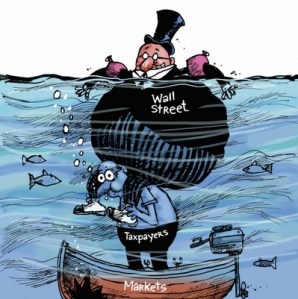 The blame for the worst recession since the The Great Depression clearly rests on the private sector where millions of bad loans and financial innovations turned peoples homes and investments into casino style gambling games. The disastrous lack of regulation, accountability, and common sense is still wrecking havoc on the economy today. The lending industry is still at odds with common sense, community well being, and the national interest. Paul Krugman wrote about this today in his NYT op ed using the academy award winning film Inside Job as the cautionary frame. What is evident in all of this fall out is that the people that deserve the blame are still acting abominably and the people they wronged are still getting the worst end of the deal.
What the film didn’t point out, however, is that the crisis has spawned a whole new set of abuses, many of them illegal as well as immoral. And leading political figures are, at long last, showing some outrage. Unfortunately, this outrage is directed, not at banking abuses, but at those trying to hold banks accountable for these abuses.
The immediate flashpoint is a proposed settlement between state attorneys general and the mortgage servicing industry. That settlement is a “shakedown,” says Senator Richard Shelby of Alabama. The money banks would be required to allot to mortgage modification would be “extorted,” declares The Wall Street Journal. And the bankers themselves warn that any action against them would place economic recovery at risk.
All of which goes to confirm that the rich are different from you and me: when they break the law, it’s the prosecutors who find themselves on trial.
To get an idea of what we’re talking about here, look at the complaint filed by Nevada’s attorney general against Bank of America. The complaint charges the bank with luring families into its loan-modification program — supposedly to help them keep their homes — under false pretenses; with giving false information about the program’s requirements (for example, telling them that they had to default on their mortgages before receiving a modification); with stringing families along with promises of action, then “sending foreclosure notices, scheduling auction dates, and even selling consumers’ homes while they waited for decisions”; and, in general, with exploiting the program to enrich itself at those families’ expense.
The end result, the complaint charges, was that “many Nevada consumers continued to make mortgage payments they could not afford, running through their savings, their retirement funds, or their children’s education funds. Additionally, due to Bank of America’s misleading assurances, consumers deferred short-sales and passed on other attempts to mitigate their losses. And they waited anxiously, month after month, calling Bank of America and submitting their paperwork again and again, not knowing whether or when they would lose their homes.”
There are more issues than just the foreclosure one. Here’s an example of a family fighting to sue BOA for the wrongful death of an elderly man who committed suicide after they recommended investments to him that failed miserably. The family has found out that the man had probably unknowingly signed away the right to sue in the fine print of the investment documents. I can’t imagine any one recommending a portfolio of risky assets to any one over the age of 50, yet this is exactly what BOA did to Mr. Phillip Grossman.
Philip Grossman saved carefully his whole life, never investing in anything more exotic than certificates of deposit. But in June 2007, his longtime banker at a Bank of America branch in Waltham told him he could do better, without taking more risk, and introduced him to a broker at the bank’s investment arm.
Two years later, Grossman, then a 65-year-old computer consultant, and his wife had lost $400,000 — more than half their savings. In despair in the fall of 2009, Grossman checked into a Woburn motel, left his glasses and watch on the desk in his room, and killed himself.
Stunned by the tragedy, his family tried to sue Bank of America, asserting that the broker invested more aggressively than promised, adding to the steep losses and contributing to Grossman’s suicide. But they soon found out they would not get their day in court: The papers the Grossmans signed to open their account required that any dispute go to a private panel of arbitrators.
“They’ve committed a crime against us, as far as I’m concerned,’’ Grossman’s wife, Gail, said in an interview. “Why do we have to go to arbitration? With other crimes you get a trial and a jury. It just seems very unfair to me.’’
The Grossmans’ case shows how entrenched arbitration has become in the financial industry, demonstrating that even in an extreme case alleging wrongful death, aggrieved clients have no recourse other than a system that critics say favors investment firms. Most investors have no idea that when they open a brokerage account, they give up their right to sue, and must, under a 1987 Supreme Court ruling, take complaints to arbitration.
There are more outrages to share with you. Think that having a perfect credit score and a huge down payment will get you a loan these days if you’re a consumer? Think again. Banks are lending to junk bond quality businesses while denying the best of households basic mortgages. The recovery is not just around the corner for the majority of US households for many reasons. Government help has been concentrated at reaching banks and businesses. This is not translating into improvement for all.
The consumer loan market, particularly housing, remains a challenge for borrowers. Total U.S. consumer credit outstanding was $2.4 trillion in January, or 6.6 percent below its July 2008 level, the Fed said in a March 7 report. Total housing debt has declined by $536 billion since 2008 to $10.1 trillion, Fed data show. The median price of an existing U.S. home has dropped 13 percent since June to $158,800, bringing its decline since July 2006 to 31 percent, according to the Chicago-based National Association of Realtors. About 10.8 million homes were worth less than the debt owed on them in the third quarter, research firm CoreLogic Inc. said in a Dec. 13 report.
By contrast, the least creditworthy corporations have been able to borrow record amounts at the cheapest rates ever. Junk- rated companies sold an unprecedented $287.6 billion in bonds in 2010 and are setting an even faster pace of issuance this year. Claire’s Stores Inc., the costume jewelry retailer that had debt that was almost 10 times its earnings last year, sold $450 million of bonds last month that Moody’s Investors Service gave its third-lowest rating.
There are several other disturbing figures in the Bloomberg article quoted directly above.
The U.S. economy grew at a 2.8 percent annual rate in the fourth quarter, slower than previously calculated, and is forecast to expand 3.2 percent this year, according to the median estimate of 66 economists in a Bloomberg survey.
Household purchases account for about 70 percent of the U.S. economy, making the consumer the single biggest driver of any economic recovery. Those consumers “stumbled at bit” at the start of this year, Michael Feroli, chief U.S. economist at JPMorgan Chase & Co. in New York, said in a February note.
While the economy expanded and companies are beginning to spend more, the improvements haven’t driven the nation’s unemployment rate below 8.9 percent for almost two years and the Conference Board’s gauge of consumer confidence is still 37 percent below the level reached in July 2007.
“The 2007-2009 recession period looks different from previous economic cycles,” John McElravey, a bond analyst at Wells Fargo Securities LLC in Charlotte, North Carolina, said in a March 8 report. “Consumer credit outstanding contracted much more sharply than in other periods, and the return to positive growth rates has been relatively slow.”
There are so many things different and bad with this recovery that it is indeed troubling. Perhaps the most important factor is that government is clearly not helping homeowners, the jobless, and the many families who have lost wealth via the crash in home values and their investments. The focus of bailouts has been on banks and businesses that have not used the funds to benefit their communities. Something is clearly wrong here with policy priorities when you’re not focused on the major source of consumption in a consumer-drive economy.
Not only is policy not aimed at the majority of people in the country, the focus in the District is now clearly turning to austerity measures and turning neighbor against neighbor. I can’t tell you exactly how worried I am that a huge number of households will still be in trouble come the next recession. Here’s another opinion on that very subject from E.J. Dionne Jr. at WAPO.
A phony metaphor is being used to hijack the nation’s political conversation and skew public policies to benefit better-off Americans and hurt most others.We have an 8.9 percent unemployment rate, yet further measures to spur job creation are off the table. We’re broke, you see. We have a $15 trillion economy, yet we pretend to be an impoverished nation with no room for public investments in our future or efforts to ease the pain of a deep recession on those Americans who didn’t profit from it or cause it in the first place.
As Sen. Al Franken (D-Minn.) pointed out in a little-noticed but powerful speech on the economy in December, “during the past 20 years, 56 percent of all income growth went to the top 1 percent of households. Even more unbelievably, a third of all income growth went to just the top one-tenth of 1 percent.” Some people are definitely not broke, yet we can’t even think about raising their taxes.
By contrast, Franken noted that “when you adjust for inflation, the median household income actually declined over the last decade.” Many of those folks are going broke, yet because “we’re broke,” we’re told we can’t possibly help them.
That’s the new excuse. We could help Chrysler. We could help GM. We could help the financial institutions and Wall Street. We could invade Iraq and Afghanistan to help them. We could do all that, but now we’re too broke to help ordinary Americans. It’s obvious that the financial institutions are doing nothing to improve the situation. It’s also pretty obvious that Iraq and Afghanistan are money pits. When do we get the government to quit throwing our money to rich people and businesses? When do we get them to stop blaming teachers, firefighters, and police offers for taking up too much of the pie? When do we actually start looking at the real numbers and the real culprits who took all this vast wealth and continue to ensure the rules only benefit the few?
Saturday: Solidarity, Sisterhood
Posted: March 12, 2011 Filed under: Economy, Hillary Clinton: Her Campaign for All of Us, morning reads, Women's Rights | Tags: 2012, 8.9 quake in Japan, bees, Bernie Sanders, Bradley Manning, civil liberties, collective bargaining, FDR, Joan Baez, Liberalism, Phil Ochs, Rep. King "hearings" on "radical Islam", US State Department, Wisconsin, womancession, Women's and children's health 74 Comments
Good morning, gleaners!
Grab your morning brew, and let’s go!
Wisconsin
- It’s farmer-labor day today at the WI Capitol building, starting at noon, complete with a “tractorcade.”
- Next, a piece I treasure. Plain Talk: Squandering 100 years of progress, by Dave Zweifel. Please take the time to click over and read this one sometime over the weekend if you can.
Hillaryland
- Guess who is going to Egypt and Tunisia next week. In her FY 2012 budget request before Congress on Thursday, Hillary announced she will be meeting with transitional leaders in both Tunis and Cairo as well as with Libyan opposition while she’s in the region. For the new Arab world that is emerging to be new at all, women cannot be left behind. Who better to put that world on notice than Hillary Rodham Clinton?
(second link will take you to an AFP report on Hillary’s remarks at Friday’s Women in the World conference in NY. See also her remarks at the 2011 Women of Courage event for more.)
- This week–on International Women’s day no less–our advocate-in-chief helped to launch a Global Partnership on Maternal and Child Health, bringing a long-neglected development goal further out of the shadows. Brava, Madam Secretary!
(see also Hillary’s 100 Women Initiative. If you don’t know what it is, click and find out.)
- From Politico’s quotes of the week: “Her Excellency, Madam President… I love saying that.”
— Secretary of State Hillary Clinton, introducing the president of Kyrgyzstan at a State Department event.
- Hillary and Julia from their bilateral on Tuesday.
- If you’re a Hillary fan who can’t get enough of all things Hill and missed my essays from earlier this week, knock yourself out. One is the mischievously titled Hillary: Warmonger and the other is Women, Workers, and The Sisterhood.
Women’s Rights
- My response to Rand Paul’s hypocritical libertarian rant on “choice” (choice of toilet, that is). Shorter Wonk: I hope Rand has a working garbage disposal, because he sure talks a lot of trash.
- See here for RH Reality Check’s exhaustive coverage of the latest developments from yesterday. Also, Minkoff Minx wrote to her Georgia state representative, Stephen Allison (R-8) and received a letter from Rep. Allison that you might find of interest. Scroll to the end of the post to see it.
- My $0.02 on Allison’s response: The excuse that the most draconian of these bills will never pass is baloney. The rise of mini-Stupaks in states across the country has built up a momentum in the war against women, and that momentum is helping to get other horrible versions of these bills passed. Furthermore, the preponderance of such nonsense legislation clearly indicates a concerted effort to use women and their civil rights as a tool of division and distraction from the economy, degrading those rights in the process and blocking unfettered access to reproductive healthcare for women–all women. The rich will get their safe abortions on demand one way or another, and we all know it.
Tired of hearing about Charlie Sheen?
- Here’s the fix. At least on the Internet.
Economy
- Bernie Sanders introduces The Emergency Deficit Reduction Act. Sanders’ press release says the bill would a) create a 5.4% surtax on millionaires, yielding up to $50 billion annually for the US Treasury, and b) end tax breaks for Big Oil, yielding about $3.5 billion a year in new revenue. Thank you, Bernie Sanders!
- Krugman: Dumbing Deficits Down
- BBC News Magazine: Are call centres the factories of the 21st Century?
- Womancession/nifty graph pick of the week: Women Lead in Unpaid Work. Click graph for more info.

CLICK TO GO TO ECONOMIX
US Politics: 2012
- Nate Silver/NYT: Wisconsin Dispute Could Mobilize Democratic Base
- Andrew Leonard/Salon: Do rising gas prices spell doom for Obama?
- US News & World Report says wedge issues are back just in time for the 2012 electoral cycle. In other news… Water? Yep, wet as ever. (When did wedge issues ever leave?)
- Here’s a derivative piece if ever there was one… Cameron Lynch says Barack Obama is the “Surprisingly Silent President.” This echoes Ruth Marcus last week suddenly discovering that Obama is the “Where’s Waldo” president. Obama told America who he was from 2004 to 2008. The
creativeclueless class was too busy chattering away and creating “a different kind of politician” narrative to take note that Obama was telegraphing very clearly that he would make an indifferent kind of president.
Civil Liberties
- Have you read Glenn Greenwald’s takedown of the NYT editors and Andrew Sullivan yet? Glenzilla exposes the hypocrisy of their “Bush-tortured” defenses for Obama’s indefinite detention.
- Amnesty International petition to Secretary Gates and President Obama: End the punitive detention of Bradley Manning
- This next one is an amazing development. Via Laura Rozen over at her new Yahoo digs, The Envoy — Reporter: State Department official raps Pentagon treatment of Manning as “counterproductive and stupid.” We’re talking about PJ Crowley over at Hillary Clinton’s state department, y’all. He told that to veteran BBC reporter Philippa Thomas without thinking twice. Thomas blogged about it here.
- Required Reading for all Liberals: Lynn Parramore’s Torture: The Movie (via New Deal 2.0) and Margaret Kimberly’s Peace Prize Torture (via Black Agenda Report).
King hearings
- Adam Serwer (via the American Prospect) has an important read up that puts it all in perspective… Good Cop, Bad Cop: “On counterterrorism, the only difference between Republicans and Obama is rhetorical.”
Disaster in Japan and Elsewhere
- Foreign Policy’s The Cable: Crowley deleted tweet comparing Middle East ‘tsunami’ to Japan crisis.
(Also, Crowley confirmed his comments about Manning to The Cable:”What I said was my personal opinion. It does not reflect an official USG policy position. I defer to the Department of Defense regarding the treatment of Bradley Manning.”)
- See the NYT’s photojournalism blog — Lens — for dramatic shots of the devastation from the 8.9 quake and tsunami in Japan, as well as other harrowing pictures from around the world yesterday, that tell the story of tragedy and strife.
Environment
- “The way humanity manages or mismanages its nature-based assets, including pollinators, will in part define our collective future in the 21st century. Human beings have fabricated the illusion that in the 21st century they have the technological prowess to be independent of nature. Bees underline the reality that we are more, not less dependent on nature’s services in a world of close to seven billion people.”
–Achim Steiner, the executive director of UN Environment Programme
This Day in History (March 12)
- First fireside chat: “It is your problem no less than it is mine. Together we cannot fail.” –FDR, 1933 (even FDR sounds like he’s saying Solidarity forever!)
What Kind of Liberal are You?
- Take the quiz. I’m a “Working Class Warrior.” How about you?
- I mostly linked to this silly quiz so I could share this priceless bumper sticker quote from the first question: “May the fetus you save be gay.”
Song of Protest for Saturday
Extra verse added to the PPM version: “Show me the famine, show me the frail, eyes with no future that show how we failed, and I’ll show you the children with so many reasons why there but for fortune, go you or I.”
- Also see Phil Ochs: There But For Fortune, and check for a screening near you.
I’m turning the Saturday reads over to you in the comments… Take the quiz and let us know how you score, share a song, link us to what’s on your blogging list this weekend…and have a great day!
[originally posted at Let Them Listen; crossposted at Taylor Marsh and Liberal Rapture]

 peej
peej Carissa
 bostonboomer
 dakinikat
 ecocatwoman
 mablue2
 Mama Lopez
 peggysue22
 quixote
 skydancingguestblogger
 Mona (aka Wonk the Vote)



 Sky Dancing
Recent Comments