
The DC Disconnect
Posted: May 31, 2011 Filed under: Economy, Federal Budget and Budget deficit | Tags: Bush tax cuts, U.S. Economy 12 Comments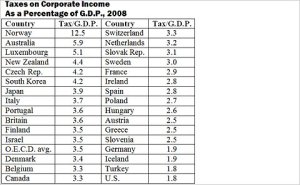 The disconnect between reality and beltway rhetoric has never been more obvious when it comes to the economy. The NYT editorial page has an op-ed up today– ‘The Numbers are Grim’–in which they call for more attention to the unemployment crisis. As I mentioned when these numbers came out, a decrease in domestic household consumption is a troublesome signal in an economy where nearly 68% of production usually goes to domestic consumption.
When consumers are constrained, so is hiring, because without customers, employers are hard pressed to retain workers or make new hires. A recent Labor Department report showed a greater-than-expected rise in the number of people claiming jobless benefits even as private-sector economic forecasts are being revised downward — both very bad omens for continued job growth.
Republican lawmakers have responded to renewed signs of weakness with a jobs plan that prescribes more of the same “fixes” that Republicans always recommend no matter the problem: mainly high-end tax cuts, deregulation, more domestic oil drilling and federal spending cuts.
The White House has offered sounder ideas, including job retraining, plans to boost educational achievement and tax increases to help cover needed spending. But its economic team is mainly focused on negotiations to raise the debt limit, presumably parrying Republican demands for deep spending cuts that could weaken the economy further while still reaching an agreement on the necessary increase.
The grim numbers tell an unavoidable truth: The economy is not growing nearly fast enough to dent unemployment. Unfortunately, no one in Washington is pushing policies to promote stronger growth now.
Even the Wall Street Journal recognizes the challenges our economy faces. Many corporate economists see similar indications of a permanent growth problem. This should not be happening. We know how to correct this. We have nearly 70 years of economy theory and empirical data that have provided a guide to every administration except the last two.
Manufacturing is cooling, the housing market is struggling and consumers are keeping a close eye on spending, meaning the U.S. economy might be on a slower path to full health than expected.
“It’s very hard to generate a rapid recovery when rapid recoveries are historically driven by housing and the consumer,” said Nigel Gault, an economist at IHS Global Insight. He expects an annualized, inflation-adjusted growth rate of less than 3% in coming quarters—better than the first-quarter’s 1.8% rate, but too slow to make a meaningful dent in unemployment.
A growing number of forecasters are downgrading their second-quarter growth predictions. JPMorgan Chase & Co. economists revised down their estimate to a 2.5% rate from 3%, while Bank of America Merrill Lynch economists cut theirs to 2% from 2.8%. Deutsche Bank cut its forecast to 3.2% from 3.7%.
Companies are similarly cautious. Applied Materials Inc., the largest maker of machines used in producing computer chips, said it expected growth in its semiconductor and solar markets to slow following one of its best quarters ever. Hewlett-Packard Co. cut its fiscal-year outlook amid weak computer sales and negative effects from the disaster in Japan. Clorox Co. offered a more guarded outlook for its household goods business as executives noted that higher prices may hurt sales.
As stated by the NYT, most Republicans put a plan forward that calls for “high-end tax cuts, deregulation, more domestic oil drilling and federal spending cuts”. This is exactly the opposite of what needs to be done. The mantra of ‘too high’ taxes strangling business which dampens unemployment is simply not true. It’s never been true. It’s a fallacy! Bruce Bartlett has done an excellent job–see the nifty graph above–in using facts to put down that meme. Not only are effective tax rates on corporations already exceedingly low, but tax revenues from wealthy individuals are so low that most of us probably have higher effective marginal tax rates. This has been the case now for nearly 7 years and for about that same time we’ve experienced some of the worst job creation and economic growth ever.
The economic importance of statutory tax rates is blown far out of proportion by Republicans looking for ways to make taxes look high when they are quite low. And they almost never note that the statutory tax rate applies only to the last dollar earned or that the effective tax rate is substantially lower even for the richest taxpayers and largest corporations because of tax exclusions, deductions, credits and the 15 percent top rate on dividends and capital gains.
The many adjustments to income permitted by the tax code, plus alternative tax rates on the largest sources of income of the wealthy, explain why the average federal income tax rate on the 400 richest people in America was 18.11 percent in 2008, according to the Internal Revenue Service, down from 26.38 percent when these data were first calculated in 1992. Among the top 400, 7.5 percent had an average tax rate of less than 10 percent, 25 percent paid between 10 and 15 percent, and 28 percent paid between 15 and 20 percent.
The truth of the matter is that federal taxes in the United States are very low. There is no reason to believe that reducing them further will do anything to raise growth or reduce unemployment.
Meanwhile, the complete disconnect between spending and cutting priorities in Congress and the White House and the American people grows. As mentioned by BostonBoomer this morning in a reference to a Paul Rosenberg peice at Alternet, Americans want none of what is being dished up in the beltway. It is true that the current spending path for the general budget, social security, and medicare are not sustainable at current levels. What is not true is that we need to accept the current path and Republican policy priorities as the solution. There is no evidence that anything they’ve suggested will remotely help our jobs and growth problem which would take care of much of the deficit problems. The rest could be solved by simply returning tax policy back to the Reagan or Clinton levels.
It’s obvious from the last set of economic numbers that the current problem stems from lack of consumer demand which is rooted in a lack of income, confidence, and wealth in the majority of US Households. People simply do not have the wherewithal to purchase homes or sustain household budgets. This is because we have an unacceptably high level of unemployment, we have let the pathway to home ownership completely collapse, and we’re allowing basic government services to collapse to fund unrealistically low tax rates for corporations and wealthy individuals. Don’t even get me started on funding never-ending wars. There is mounting evidence that these funds aren’t even staying in the country any more but are being used to fund jobs, investment, and growth in other places. This is unacceptable policy under our current economic situation. American treasury should not be used to chase profits abroad.
The President has gotten away with extending tax cuts for the wealthiest individuals. He appears ready to go to the table and accept draconian cuts to federal spending which will impact all levels of government provision of goods and services. This basically means that he has signed on to a prescription for slow economic growth. He undoubtedly does so with no worries about the upcoming election. The Republicans offer up potential candidates that have absolutely no grasp of reality or come with a facile lack of morality to deny it. Even George F. Will believes one of the front runners to be so incapable of holding office that the thought of giving the ability to launch nuclear weapons to some of the candidates bothers him. Is handing over the ability to tank our economy any less problematic?
This is beyond disheartening. It is evident that the plutocracy is doing everything it can to silence any one that could run a narrative contrary to these current fallacies. I don’t believe for one moment that Congressman Wiener’s hacker isn’t part of tearing down any one that appears to be stepping away from the abyss of Washington group think. Meanwhile, the media speak is about pushing the economy to the precipice by focusing on the debt ceiling. It’s looking like we’re being prepped for that. This will make the market demand extremely high rates of return for federal borrowing which will only increase our interest payments on the debt which are already a huge portion of the budget. How much sense does that make?
Early proposals for whittling down spending include a plan to drop federal agriculture subsidies and to require larger employee contributions to the pension system for non-military federal workers.
“Those talks, which actually we’ve been meeting for over three weeks now, they have been all positive. Everything is on the table,” House Majority Leader Eric Cantor (R-Va.) said Sunday on CBS’s “Face the Nation.” “We’ve said, as Republicans, we’re not going to go for tax increases. I think the administration gets that. But we’ve also put everything on the table as far as cuts.”
Oh, and if you think the Republicans are all about small businesses and start-ups because they create jobs, check this nifty 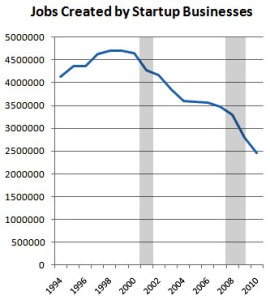 graph out from MoJo. The Dubya years basically killed that phenomenon too so it wasn’t about lowering tax rates, was it?
As this chart from the BLS shows, the number of jobs created by new businesses peaked in 2000, began declining at the start of the Bush administration, and has been plummeting ever since …
So much for that Republican meme. Facts are stubborn things, aren’t they?
This problem is basically due to the inability to govern and make prudent decisions. They’d much rather pump out lies and continue on the same path to destruction. These people ran up tons of debt to fund wars for which they found no funds. This is all about the irresponsible Bush tax cuts that Congress and the Obama administration returned to law in December. The pain for these horrible decisions are about to be extracted on middle and working class Americans who have done absolutely nothing to bring on the recent economic problems and fiscal problems. There has been no bail out or special tax breaks for us. It should be obvious by now that the policies of the last five years have done nothing but improved the situation for the very rich and the very large corporation. Shame on all of those elected officials that go along with this. It is as if they are purposefully setting out to destroy our economy and our way of life. I have no idea why they hold so many of us in contempt but it is obvious that that they prefer the donor class to voters. They seem to want a repeat of the Great Depression. At this rate, that is exactly what they will have.
It’s still the Economy, and Jobs, and the stupid Bush Tax Cuts
Posted: May 26, 2011 Filed under: Democratic Politics, Economy, Federal Budget, Federal Budget and Budget deficit, jobs, Republican politics, unemployment | Tags: budget defifit, jobless claims, unemployment 22 Comments If you do not take a path different from the path that wrecked the economy, the economy will not improve. So, why–for the umpteenth time since I started this blog 3 years ago–do I find myself writing on the same economic dynamics? Wasn’t there supposed to be a game changing election in there somewhere?
First, we just got the news that jobless claims are up. The new twist is that corporate profits are down. It had to happen sooner or later. There are only so many profits you can wring out of your business by ‘austerity’ measures like lay offs and not ordering as many office supplies. It’s obvious the ‘Economy is still Struggling’.
Unexpectedly weak consumer spending kept the economy stuck in a slow growth gear in the first quarter and would likely struggle to regain speed amid signs of a slowdown in the pace of job creation.
Data on Thursday showed the economy expanded at an unrevised 1.8 percent annual rate in the first three months of this year, while the number of Americans claiming unemployment benefits unexpectedly rose 10,000 to 424,000 last week.
The rise in jobless claims and the weakness in first-quarter consumer spending, which offset upward revisions to business inventories and investment, set the tone for more lackluster growth this current quarter.
Some businesses were surprised by the weak consumer spending. Their CEOs need to get out of their offices and country clubs and go see how the other 99 percent lives. Our wealth is down because our house values keep falling. We’ve lost at least 2-3 years of returns in our investments and pensions and many folks still haven’t recovered their pre-recession balance. Gas prices and food prices are taking larger percentages of folks’ budgets. The very rich are the only ones that can really fling the bucks around at this point and they can go anywhere they want to do that. They’re not stuck with the offerings at the local strip mall. We ignore the sluggish labor markets at our own peril.
Business investment–the smallest contributor to the GDP–was up and Government spending was down. Exports looked better than expected but they are still a very small part of our economy these days. This is now the seventh straight week that jobless claims were above the 400,000 mark. What is even more remarkable is that the BLS could not name any factor that could be an outlier contributing to this persistent trend.
Meanwhile, the conversation in Washington DC continues to be the Ryan budget and Medicare. The U.S. Senate voted down the Ryan budget I was amused by Karl Rove’s WSJ op-ed today that explained that folks would like their plan if it was just put into a populist message. I guess when you’ve got people buying into such nonsense as decreasing taxes raises tax revenues you get to thinking that you can sell them anything with the right spin on it. However, George Bush and the Republican Party own the Deficit. Their cronies should be the ones to pay it down.
The nonpartisan Center on Budget and Policy Priorities has updated research that projects nearly half of public debt in 2019 will be attributable to President George W. Bush’s tax cuts plus the ongoing wars in Iraq and Afghanistan. The tax cuts left the American treasury particularly vulnerable when the financial crisis hit, the CBPP reports: “The events and policies that pushed deficits to these high levels in the near term were, for the most part, not of President Obama’s making. If not for the Bush tax cuts, the deficit-financed wars in Iraq and Afghanistan, and the effects of the worst recession since the Great Depression (including the cost of policymakers’ actions to combat it), we would not be facing these huge deficits in the near term.”
It simply baffles me that we can’t even get the most stalwart Democratic politicians to pay attention to the miserable jobs market. It’s two years into a Democratic administration. Where is the will to put America back to work?
Late Night Schlock: Financial Meltodrama
Posted: May 23, 2011 Filed under: Bailout Blues, Economy, financial institutions, Global Financial Crisis | Tags: Ed Asner, HBO Too Big To Fail, Paul Giametti, William Hurt 20 Comments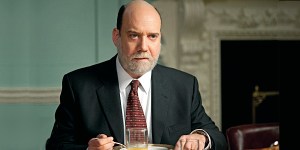 HBO premiers its adaptation of Andrew Ross Sorkin’s “Too Big to Fail” today at 9 ET/PT. I’ve got my bowl of popcorn all ready. My Businessweek hit my mailbox today detailing the all-star line up of the still living cast of real life crisis players. That’s Paul Giametti as Ben Bernanke over there on the left. William Hurt plays Hank Paulson. Ed Asner plays Warren Buffet. Oh, and Dan Hedaya plays Barney Frank. Did you ever imagine Hollywood recreating Barney Frank? It’s sort’ve humorous to think of all these Hollywood types playing Wall Street and Washington insiders. Same big Egos. Same program of you’re only as good as your last deal.
I’m still “reeling” from the idea of Business Week doing a Move Review.
Too Big to Fail, which premieres on May 23, follows the same trajectory as Sorkin’s book, from the collapse of Bear Stearns that spring to the rise of TARP in the fall. To the film’s credit, it attempts to make many of these still-horrifying moments pretty funny—and squeezes them all into 98 minutes. While the movie doesn’t shed much new light on the period, it offers one of the few pleasures left unfulfilled by the gusher of nonfiction thrillers, roman à clefs, wrist-slapping documentaries, and Oliver Stone. The bankers and government officials who rose to prominence in those months are depicted in all their glory and disgrace by real Hollywood actors—most of whom are far better-looking versions of the people they’re portraying. (Tim Geithner is pretty handsome, but Billy Crudup? Really?) TARP groupies will delight in the film’s attention to detail. Leon, the coffee cart guy parked outside Lehman’s office building, gets a chance to extend his five minutes of fame. The hideous toupee worn by Matthew Modine—playing Merrill Lynch Chief Executive Officer John Thain—might be the worst fake movie hair since Burt Reynolds’s heyday.
For the uninitiated, director Curtis Hanson—who won an Oscar for writing L.A. Confidential—drops some not-so-subtle hints. A voice-over in an opening scene refers to JPMorgan Chase’s (JPM) Jamie Dimon (Bill Pullman) as the “smart” banker; Lloyd Blankfein (Evan Handler) is called the “superstar”; and Citigroup’s (C) Vikram Pandit (Ajay Mehta) is called neither. As Hank Paulson (William Hurt) declares, “No one is sure if he’s running Citi or Citi is running him.” Fuld, played in all his vein-popping glory by James Woods, needs no description at all. Viewers are shown, in no uncertain terms, his ginormous hubris as he screws up a potential deal with Korea Development Bank. After being told by Lehman Chief Operating Officer Bart McDade to stay out of the negotiations, Fuld barges in, scares off the bidders, and blows what could have been a precious lifeline.
Here’s the review from LA Times TV critic Robert Lloyd.
The film’s main argument, really, is that we should look kindly upon Paulson and the best he tried to do; the other characters we rate by whether they help or hinder him. What moral voice there is here mostly comes out of his mouth. “We’ve been late on everything,” he admits, and admits also that no one in power wanted to regulate the financial industry because “We were making too much money.” (That’s about as pointed as the film gets on the subject of corporate greed.) Hurt, who (like his costars) seems to be playing the script rather than imitating the person whose name he bears, is a tall tower of movie-star appeal, and it does not hurt our opinion of Paulson that Kathy Baker plays his wife, although she has not much to do but sympathize.
So, if you’re up for an evening about the masters of the universe played by Hollywood’s elite character actors, you know where to go tonight. Here’s the trailer with its theme song Fortunate Song by Credence Clearwater Revival which is a damned good choice and a brief interview with Giametti. I also put him the HBO back story that’s part of the Opening the Vault series.
This has some of the back story on TARP and the meltdown including interviews with journalists that covered the event and the aftermath.
You can consider this an open thread. I’m at home still trying to kick my fever with a larger dose of antibiotics. No beer with the popcorn tonight. (sigh) I’m okay but this stuff is just friggin’ persistent.
Monday Reads
Posted: May 23, 2011 Filed under: Economy, Foreign Affairs, morning reads | Tags: Brad Delong, Fox Network, Gabriel Sherman, Roger Ailes, Tornadoes Minneapolis and Joplin 35 Comments Good Morning!
Hopefully, by the time you read this, I’ll be off to my doctor’s office as the damned MRSA thing on my lip showed back up this weekend. I look like some one botoxed me on one side. This stuff is no fun. I think it has something to do with this endless runny nose and weepy eyes I appear to have with this year’s horrible allergies.
New York Magazine‘s Gabriel Sherman has a potboiler article up called The Elephant in the Green Room: The circus Roger Ailes created at Fox News made his network $900 million last year. But it may have lost him something more important: the next election. There’s some really, really juicy bits. Here’s just one example.
All the 2012 candidates know that Ailes is a crucial constituency. “You can’t run for the Republican nomination without talking to Roger,” one GOPer told me. “Every single candidate has consulted with Roger.” But he hasn’t found any of them, including the adults in the room—Jon Huntsman, Mitch Daniels, Mitt Romney—compelling. “He finds flaws in every one,” says a person familiar with his thinking.
“He thinks things are going in a bad direction,” another Republican close to Ailes told me. “Roger is worried about the future of the country. He thinks the election of Obama is a disaster. He thinks Palin is an idiot. He thinks she’s stupid. He helped boost her up. People like Sarah Palin haven’t elevated the conservative movement.”
In the aftermath of the Tucson rampage, the national mood seemed to pivot. Ailes recognized that a Fox brand defined by Palin could be politically vulnerable. Two days after the shooting, he gave an interview to Russell Simmons and told him both sides needed to lower the temperature. “I told all of our guys, ‘Shut up, tone it down, make your argument intellectually.’ ”
It’ll take time to wade through it and you’ll learn more about Beck’s departure even if you just don’t want to, but it’s worth it. It’s sort’ve one of those karmic car wreck articles.
Economist and blogger Brad Delong delivered the harsh news with nifty graphs in Phoenix, Arizona. He calls his speech: The Economic Outlook as of May 2011: Yes, This Is Called the Dismal Science. Why Do You Ask?
But now we have a stubbornly persistent slump in the economy. Now we have economic growth at about our normal long-run pace, with very little signs of closing the gap between the productive capacity of the American economy and its current level of production. We have a Washington DC that is dysfunctional–out of ammunition to take any effective additional steps to boost the economy. There is now substantial fear of inflation–even though there are no signs of inflation gathering anywhere rather than energy and food prices, and we understand that those reflect China’s growing demand and not any domestic price spiral. There is now substantial fear of crowding out–that boosting US government spending or cutting taxes to get more money into the hands of the consumers would discourage private investment even though there are no signs of crowding out even at our rapidly-growing level of the national debt. It is a fact that a bunch of us–including me–think that there really should be signs of crowding out right now–that financial markets should be scared of the fiscal future of America–but they are not. And there is the problem that Washington DC has degenerated into pure Dingbat Kabuki theater on lots of levels.
It is a fact that if congress simply goes home–doesn’t do anything for the next 10 years except keep the federal government on autopilot, or if it does do things if it pays for whatever increases in spending it enacts by raising taxes and pays for whatever tax cuts it enacts by cutting spending–that we do not have a long run deficit problem. If congress goes home for ten years our program spending is matched to our tax revenues, which means a declining debt burden because the growth rate of the economy is larger than the interest rate on our debt.
Our belief that we have a long-run deficit problem is based upon the belief that congress will pass laws that increase spending and that cut taxes–that it will repeal the Independent Payment Authorization Board’s authority to try to make Medicare more efficient, that it will repeal the Affordable Care Act’s tax on high-cost health plans. Given that the fear is based on a belief that some future congress will bust the budget, it is hard to see how we can address this fear through any possible piece of legislation today–for no congress can bind its successors.
This is a problem.
Wow. What a downer. I bet he doesn’t get invited to any of the kewl kids’ cocktail parties there!
Spain continues to experience political unrest. Spanish Youth are demanding “real democracy now”.
Thousands of people have taken to the streets of Spain protesting a round of austerity measures and calling for a boycott of major political parties in Sunday’s regional elections. The protests began last week with a march denouncing high levels of youth unemployment. A large crowd established a tent camp in Madrid’s Puerta del Sol Square, defying an ordinance barring protests.
Protester: “I’ll attempt to stay here tonight, because I think it is very important to retake the streets that politicians have taken away from us to do their campaigning, preventing us from protesting. That is what we feel every day with lack of resources and a huge limitation of democracy. We cannot continue to tolerate this situation.”
The NYT has an interesting bible quiz up on sex and religion. A lot of it on the so-called social issues that cause all those right wing screeds. I found this question and answer particularly interesting.
The people of Sodom were condemned principally for [what]
“Sodomy” as a term for gay male sex began to be commonly used only in the 11th century and would have surprised early religious commentators. They attributed Sodom’s problems with God to many different causes, including idolatry, threats toward strangers and general lack of compassion for the downtrodden. Ezekiel 16:49 suggests that Sodomites “had pride, excess of food, and prosperous ease, but did not aid the poor and needy.”
So, it wasn’t for being a haven for sex practices that offended puritans, it was for lack of compassion and generosity towards the poor. Some one should phone Pat Robertson STAT!
There was a horrible tornado in Joplin Missouri last night. It took out a hospital as well as many, many homes. Here’s some footage of the aftermath.
A tornado also hit Minneapolis. Both tornadoes have caused fatalities. As always, the Red Cross and other responders are in need of more funds and you can give easily via your cellphone these days. They are also responding to flood victims up and down the Mississippi. I wonder what Pat Robertson will say since all of this appears to be hitting the bible belt? Well, anyway, here’s a list of places accepting cash donations if you feel like taking up a collection. We’re supposed to get our share of the weather by Thursday. Hopefully it won’t add flash floods to the rising rivers and spillways.
Okay, well I have to go see a lady about some good drugs! What’s on your reading and blogging list today?
Republicans in Wonderland
Posted: May 21, 2011 Filed under: 2012 presidential campaign, Economy | Tags: fiat currency, flat tax, Herman Cain, lies, Mitt Romney, Politico, Tim Pawlenty, voodoo economics 21 Comments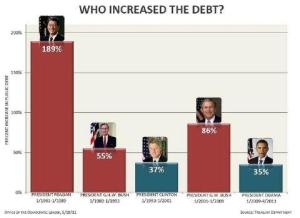 Republicans embrace and peddle voodoo economic memes whereever they can. They all hold Ronald Reagan up as the godfather of great economics. Just look at that graph to determine who exactly is responsible for the current deficit which they all think is a terrible problem. Even odder are their “unorthodox” economic policy prescriptions. Here’s some of the more egregious suggestions as provided by Politico.
The Republican field is filled with potential candidates who have called for radical overhauls of the tax code, the abolition of the IRS, an end to the Federal Reserve central bank— and even a return to the gold standard.
Oddly enough, Mitt Romney is the only one that actually talks real economics. The rest of them are in some bizarro world where math never adds up. If Tim Pawlenty hasn’t disappeared by 6 pm CST, we may have to deal with his odd views in a debate where odd views will prevail. Pawlenty is scheduled to announce his candidacy on Monday.
In one particularly striking recent moment, former Minnesota Gov. Tim Pawlenty railed against “fiat currency” in a recent appearance on Fox — a signal to a narrow constituency of voters who believe that America’s woes began when it abandoned the gold standard in the 1930s. He also has gone on the record supporting a flat tax — a single-rate income tax that would eliminate the bracket system. The single tax rate for all is a simple concept but would probably involve wiping out the current tax code — including many popular deductions and credits — just to generate enough revenue.
“I support a flatter tax rate. I don’t know if we can get to a flat tax in one leap, but moving in a flatter, more transparent direction, absolutely,” Pawlenty said on Larry Kudlow’s CNBC show in March.
Newt Gingrich has also indicated support for an across the board 15% flat tax.
Gov. Mitch Danielscalled for a value-added national sales tax paired with a flat tax. (Jon Huntsman passed a flat tax as governor of Utah, but hasn’t articulated a national platform.) And Paul wants no income or sales taxes at all, envisioning a government funded with tariffs, highway fees and excise taxes.
Further into the field, the plans get more exotic.
Herman Cain has backed the ‘Fair Tax’ plan, a proposal with a small, well-organized and vocal constituency, which would impose a national sales tax of just under 25 percent and abolish the income tax system. He has also backed a possible return to the gold standard — but only after we “significantly pay down our national debt, stabilize and grow our economy,” spokeswoman Ellen Carmichael told POLITICO.
Our economy has always used a progressive tax rate. We’ve never really considered value-added taxes or national sales taxes because we know these kinds of taxes hit the poor hardest. Social Security is about the only real regressive tax that’s been enacted. However, disabling a reasonable capital gains tax has giving enormous wealth to the major rich who receive bonuses and inherit trust funds. The suggested Republican tax schemes are most likely unworkable and would hit the middle class hard. This would be especially true of those who are financing homes.
The odd calls for gold standards, eliminating the Federal Reserve Bank, and possibly even ending fiat currency are all insane suggestions that shouldn’t even merit a public platform. Academic research has indicated that monetary policy has been mostly effective since the 1980s in achieving its intent. Also, the Fed’s structure and laws have been copied by every other economic entity that’s formed within recent history because it’s been so successful. The most important aspect is to keep monetary policy out of the hands of politicians.
“Fiscal policy, I can see how we might want to have a broader debate. With monetary policy, it’s harder to see that,” said Mark Zandi, chief economist of Moody’s Analytics. “The strong consensus view is that the Fed has done a very good job — that it was put in a very difficult position.”
“I think there’s less sympathy for the argument that Federal Reserve needs a significant overhaul,” said Zandi.
But, facts and peer-reviewed research don’t appear to phase these folks.
Sen. Jim DeMint (R-S.C.), a supporter of the Fair Tax, faced attacks in his own state for supporting what Democrats cast as a massive sales tax increase. Gleeful Democrats simply neglected to mention that DeMint’s proposed policy would have also abolished the IRS. Similar attacks on Fair Tax candidates have occurred in other races. And this cycle, Herman Cain has already faced a similar tough questioning about his support for the Fair Tax in the most recent GOP presidential debate.
“According to the experts, the practical effect of a Fair Tax would be a tax cut for the wealthy and a tax increase for the middle class,” Fox’s Chris Wallace pointed out.
“Your experts are dead wrong — because I have studied the Fair Tax for a long time,” said Cain to loud audience applause.
So, who would you believe? Economists or some CEO of a small time pizza chain? The fact that these guys get a pretty receptive audience in the GOP is appalling until you see where the support comes from. For some reason, the GOP has done a pretty good job ginning up support via xenophobic, homophobic, and gynophobic dog whistles and making economic statements that were never true and would never happen. Since their voters reward them, there appears to be no end to the insane suggestions for economic policy that comes out of their mouths.

 peej
peej Carissa
 bostonboomer
 dakinikat
 ecocatwoman
 mablue2
 Mama Lopez
 peggysue22
 quixote
 skydancingguestblogger
 Mona (aka Wonk the Vote)



 Sky Dancing
Recent Comments