
Gotta Love those Wikileaks
Posted: January 17, 2011 Filed under: commercial banking, Corporate Crime, Diplomacy Nightmares, financial institutions, Foreign Affairs, investment banking, Tunisia, Wikileaks | Tags: corruption, jasmine revolution, Julian Assange, offshore banking, Rudolf Elmer, Swiss banks, Tunisia, whistle blowers, Wikileaks 14 CommentsI’m still waiting for the BOA Wikileaks data drop but the idea of a Swiss Banker from offshore banking haven, The Cayman Islands, dropping a dime on a few of those tax evading customers is almost as sweet. I can sense the thickness of air hanging in private clubs all over the world from my little corner of the ninth ward.
Rudolf M. Elmer, the former head of the Cayman Islands office of the prominent Swiss bank Julius Baer, refused to identify any of the individuals or companies, but told reporters at a press conference that about 40 politicians and “pillars of society” worldwide are among them.
He told The Observer newspaper over the weekend that those named in the documents come from “the U.S., Britain, Germany, Austria and Asia — from all over,” and include “business people, politicians, people who have made their living in the arts and multinational conglomerates — from both sides of the Atlantic.”
Mr. Assange said that WikiLeaks would verify and release the information, including the names, in as little as two weeks. He suggested possible partnerships with financial news organizations and said he would consider turning the information over to Britain’s Serious Fraud Office, a government agency that investigates financial corruption.
That’s a wow story! But then, there’s been a series of them coming from Assange’s organization and the entire thing is just too great for words. Any one that really doesn’t see that Wikileaks is becoming THE way for little guys to undermine the power elites of the world is basically a tool of oppressors and autocrats. Just as Bradley Manning witnessed tapes that revealed the incredibly war crimes and inhumanity of a few American soldiers, Rudolf Elmer has witnessed pilfering that probably includes profiteering from crimes against humanity. However, like every one else, I want NAMES.
Check out the CIA’s list of the RICHEST countries in the world in per capita terms. I always love to quiz my students on which ones shake out at the top and they nearly always get it wrong. The top ten countries–with the exceptions of oil rich Kuwait and Norway–are all havens of offshore banking, tax evasion, and gambling. The USA has dropped to number 11 on the richest country list. Undoubtedly, it still holds that position because of its Investment Bankers. As I mentioned in the Friday Reads, it’s not because we reward our brain surgeons, 4 star generals, or great minds. I’m appalled that this might be the century that proves Karl Marx right on how ‘capitalism’ eventually falls. I’m only afraid that it will not be replaced with any kind of utopia; worker or otherwise.
What was Rudolf Elmer’s motivation?
Mr. Elmer said he had turned to WikiLeaks to educate society about what he considers an unfair system designed to serve the rich and aid money launderers after his offers to provide the data to universities and governments were spurned and, in his opinion, the Swiss media failed to cover the substance of his allegations. “The man in the street needs to know how this system works,” he said, referring to the offshore trusts that many “high net worth individuals” across the world use to evade taxes.
This, is the beauty of the Wikileaks. (I’m going to take some time here to wave to our junior G-guys and G-gals!) It gives a voice to those of us that work in the trenches holding up a system that rewards our work with pink slips, loss of insurance, and raises that don’t keep up with the cost of living don’t have much power. The information we sit on frequently has a lot of power. Once released to the public domain, it has even more power. These leaks expose corruption and thievery; pure and simple.
Friday Reads
Posted: January 14, 2011 Filed under: Bailout Blues, commercial banking, Corporate Crime, FBI raids, morning reads | Tags: bond ratings, income inequalities, Julian Assange, michelle obama, Moody's, Naked Capitalism, right wing violent rhetoric, S&P, Stephen Rose, violent rhetoric, Wall Street Bonuses, White House Blog, Wikileaks, Yves Smith 39 Comments Good Morning!

I want to open with a letter from the First Lady to American Parents on the White House Blog. You could tell that FLOTUS was obviously moved by the murder of a young girl so like her own children at the memorial service night before last. I have to say, Michelle has a heart that embraces children. She has turned this into a teaching moment. I haven’t found many inspiring words out there concerning the Tuscon tragedy. These are inspiring words.
We can teach our children that here in America, we embrace each other, and support each other, in times of crisis. And we can help them do that in their own small way – whether it’s by sending a letter, or saying a prayer, or just keeping the victims and their families in their thoughts.
We can teach them the value of tolerance – the practice of assuming the best, rather than the worst, about those around us. We can teach them to give others the benefit of the doubt, particularly those with whom they disagree.
We can also teach our children about the tremendous sacrifices made by the men and women who serve our country and by their families. We can explain to them that although we might not always agree with those who represent us, anyone who enters public life does so because they love their country and want to serve it.
It’s just really too bad that we all can’t grow up up in families like the Huxtables, and the Nelsons, and the Lopez family on TV. There probably would be fewer Manson families as a result. We also don’t have frames for families with surnames like Wu or Ahmadi or Gupta or lots of others. A lot of families are not in places where effective communication is possible. It’s easy to want to embrace those neighbors that look like the Huxtables, the Nelsons and the Lopez family. However, are those the families that really need our help and concern?
So what’s up with our Plutocratic overlords today? Read the rest of this entry »
US Financial Regulation and Arbitrage
Posted: January 5, 2011 Filed under: Bailout Blues, commercial banking, Corporate Crime, Equity Markets, financial institutions, Global Financial Crisis, investment banking, Team Obama, U.S. Economy | Tags: Federal Reserve Bank, financial regulation, Obama Financial Reform, OCC, Regulatory Arbitrage, SEC 17 CommentsThere is no doubt that we have had a major world wide financial collapse drastically affecting many innocent people in terms of livelihood and life long savings. It is fair to say that if the regulators had done their job, the country would have not had the hard landing that was experienced in 2008. The 2010 Financial Reform Bill kicked the can down to the Regulators for implementation and the bankers still have influence. This article takes a look at who the regulators were and how they did or did not do their job. The Obama people in the regulator domain are identified along with examples of Bush regulator failures. Hopefully this will give insight into what is being done to preclude another crisis
The financial industry has a gaggle of regulators, each with its politically protected turf.
From Wikopedia: Financial regulation is a form of regulation or supervision, which subjects financial institutions to certain requirements, restrictions and guidelines, aiming to maintain the integrity of the financial system.
Regulation is an unnecessarily a complex subject. It is important to understand that in some cases financial entities can choose their regulator. Some regulators were much more lenient and in many cases banks switched to them, hence the term Regulatory Arbitrage. The following are the major Federal regulators: FED, SEC, OCC, OTS, FDIC, CFTC 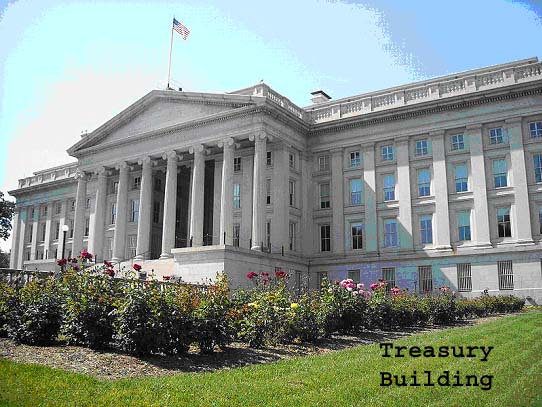 and FINRA described below. Except for the FED, most of these organizations have direct or indirect ties to the Treasury organization.
FED – Federal Reserve System
From Wikopedia: Its duties today, according to official Federal Reserve documentation, are to conduct the nation’s monetary policy, supervise and regulate banking institutions, maintain the stability of the financial system and provide financial services to depository institutions, the U.S. government, and foreign official institutions.Current chairman is Ben Bernanke, the former chairman was Alan Greenspan. Much more on Mr Greenspan later.
SEC – Securities and Exchange Commission
From Wikopedia: It holds primary responsibility for enforcing the federal securities laws and regulating the securities industry, the nation’s stock and options exchanges, and other electronic securities markets in the United States. Mary Schapiro is the current Chair. Predesessors were; Christopher Cox – 2005-2009, William H. Donaldson – 2003-2005, Harvey Pitt – 2001-03
OCC – Office of Comptroller of the Currency
From Wikopedia: US federal agency established by the National Currency Act of 1863 and serves to charter, regulate, and supervise all national banks and the federal branches and agencies of foreign banks in the United States. Current Acting Chairman is John Walsh. Previous Chairman were John C. Dugan – (2005 – 2010) John D. Hawke, Jr. – (1998–2004)
OTS – Office of Thrift Supervision ( recently folded into OCC)
From Wikopedia: United States federal agency under the Department of the Treasury. It was created in 1989 as a renamed version of another federal agency (that was faulted for its role in the Savings and loan crisis). Like other US federal bank regulators, it is paid by the banks it regulates. The OTS was initially seen as an aggressive regulator, but was later lax. Declining revenues and staff led the OTS to market itself to companies as a lax regulator in order to get revenue.
FDIC – Federal Deposit Insurance Corporation
From Wikopedia: United States government corporation created by the Glass-Steagall Act of 1933. It provides deposit insurance, which guarantees the safety of deposits in member banks, currently up to $250,000 per depositor per bank. The FDIC insures deposits at 7,895 institutions. The FDIC also examines and supervises certain financial institutions for safety and soundness, performs certain consumer-protection functions, and manages banks in receiverships (failed banks).
Sheila Bair is the current chairman of the FDIC and is viewed as a serious regulator with the right incentives for all concerned.
CFTC – Commodity Futures Trading Commission
From Wikopedia: The stated mission of the CFTC is to protect market users and the public from fraud, manipulation, and abusive practices related to the sale of commodity and financial futures and options, and to foster open, competitive, and financially sound futures and option markets.
CFTC is considered to be the primary regulator for Credit Default Swaps in the Dodd Frank regulation scheme.
FINRA – Financial Industry Regulatory Authority
From Wikopedia: In the United States, the Financial Industry Regulatory Authority, Inc., or FINRA, is a private corporation that acts as a self-regulatory organization (SRO). FINRA is the successor to the National Association of Securities Dealers, Inc. (NASD). Though sometimes mistaken for a government agency, it is a non-governmental organization that performs financial regulation of member brokerage firms and exchange markets.
Previously run by Mary Shapiro, FINRA has been critisized as being a ineffective regulator. Most notable was their (and SEC) allowing Bernie Madow to continue for 10 years to operate despite being warned by a whistle blower. When testifying before congress, the whistle blower (Harry Markopolos) said SEC was incompetent, FINRA was corrupt.
It must be said that Financial Regulation in the United States is done by committee of political bureauocrats. It is important to be aware of the fact that many of them are funded by fee’s assessed to the agencies they regulate. So opportunity for Regulatory Capture and Regulatory Arbitrage is prevalent in these agencies. The clear example is Office of Thrift Supervision bowing to their clients. The opposite example is that of Sheila Bair who tries to do the right thing for her clients despite critisizm.
Derivatives – The Dark Market
Posted: December 28, 2010 Filed under: Barack Obama, commercial banking, Corporate Crime, Equity Markets, financial institutions, Global Financial Crisis, investment banking, Stock Market, The Bonus Class, The Great Recession, U.S. Economy, U.S. Politics | Tags: AIG, Andrew Ross Sorkin, CFMA, CFTC, Commodity Futures Modernization Act, Credit Default swaps, derivatives, Dodd Frank, Gary Gensler, Glass Steagall, Graham Leach Bliley, Mary Schapiro, SEC, securitization 35 Comments[Dakinikat here: We at Sky Dancing would like welcome fiscalliberal to the Front page!!!]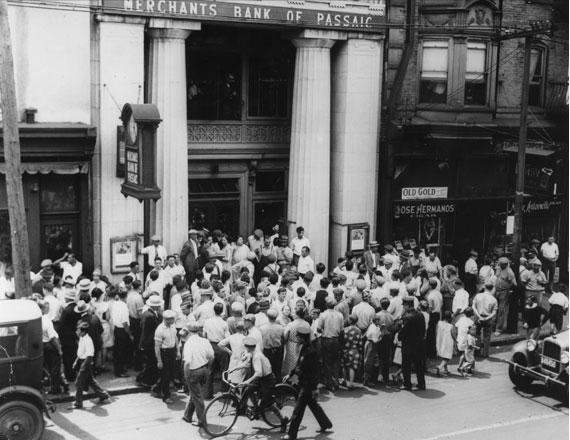
The major objective of this article is to begin the process of understanding the financial market to enable intelligent discussion on the blog.
One of the major pillars of financial collapse was Derivatives. They are very complex financial instruments with a wide diversity. They are described by a gaggle of terminology used by the high priests of finance. Because of complexity most of the books on the collapse skirt the detail of the Derivative Market. After we get through some basic definitions, we will focus on Credit Default Swaps (CDS); a subset of the Derivatives offerings. We will see how the government created a non regulated environment where fraud, compromised regulators and incompetent people ran the Investment Financial community in a very high risk mode.
Derivatives Defined
A Derivative is a financial instrument whose value is dependent on the value of another entity at a future time. Its primary function is to mitigate risk. A simple analogy would be your Home insurance. These policies guarantee that you will be remunerated if the value of your home falls due to fire, wind, or accident. A relatively small premium of money can mitigate a large potential financial catastrophe. State regulators are in charge of most regular Insurance products and solvency is less of an issue as adequate capital reserves are defined.
We need to think of Derivatives as a “risk tool” meant to stabilize the financial businesses (markets). The wide variety of Derivatives creates confusion, so we are going to restrict our discussion to Credit Default Swaps (CDS). Anticipating problems with Sub Prime mortgages, Securities were insured by investors. It was the Credit Default Swaps inability to perform that was a party to the financial collapse after the Lehman bankruptcy. They did not have the financial reserves to back up the policies they wrote How did that happen?
Deregulation
For our discussion today, three government deregulation actions are relevant.
- 1999 Graham Leach Bliley Act repealed the 1933 Glass Steagall act. The Glass-Steagall Act prohibited any one institution from acting as any combination of an investment bank, a commercial bank, and an insurance company.
- 2000 Commodity Futures Modernization Act deregulated Derivatives creating a Wild West environment for “Derivatives financial innovation”. See this link for a excellent Brooksley Born interview
- April 28, 2004 SEC drastically relaxed leverage standards for the Big Five Investment Banks: Goldman, Merrill, Bear, Lehman and Morgan Stanly. This created a very high risk environment. The session can be viewed here.
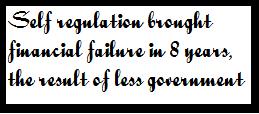
Financial self regulation brought the system down in 8 years. Bush de-funded Federal regulation. Greed, incompetence and corruption reigned supreme. Enron people went to jail. As of 2010, under Obama only bit players have been jailed. Civil fines are a joke.
Securitization Market
We need to understand the environment created by the above regulation changes to understand the role of CDS Derivative failure. We will concentrate on the Real Estate Industry
Traditionally, according to HBSwiss, the real estate industry was handled by local banks who retained the loans. Their exposure to losses resulted in more careful origination of loans. For a long time, Fannie, Freddie and FHA were packaging (securitizing) mortgages and selling them to Investors. They enjoyed a good reputation because they had good loan origination standards. These were categorized as Prime mortgages. Generally these securities obtained a AAA rating which rarely changed. Good consistent returns were recorded with these products.
Early in the 2000 decade the Investment banks adopted the securitization model called Private Label Securities. They purchased their mortgages from unregulated brokers (Country Wide, Ameriquest etc) who had little or no standards regarding underwriting of loans. The private label market latched on to the fact that high risk “Sub Prime” loans carried higher interest rates, hence higher profits. They had no exposure to the failure of the loan as risk was passed on to the Investors. They simply collected the lucrative fee’s.
Investment Banks packaged the loans (millions and billion level). They paid the rating agencies (S&P. Moody and Fitch) for ratings structuring the packages to get AAA ratings. It is clear the rating agencies did not do their job as traditionally solid AAA ratings were changed as the packages started to fail. These packages were sold to the domestic and world markets. Trillions of dollars were involved. The banks simply passed the risk on to the investors and collected the origination and servicing fee’s
CDS Market
Risk could be mitigated by purchasing a CDS against the failure of the security. So if the security failed the investor was held harmless. Remember that as of 2000 the CDS market was unregulated. AIG – London Financial Services is the poster child of the CDS industry. AIG wrote most of the CDS contracts cheaply as they held inadequate reserves (in the event of a default) and had a good company rating based on the parent insurance company whose operations were regulated. Office of Thrift Supervision was the responsible regulator, but their presence was effectively non existent, Goldman Sachs (Hank Paulson as CEO) was one of their major clients.
However, late 2006 / 2007 AIG FP realized they were over exposed and got out of the market retaining the previous contracts. Recall in the unregulated market anyone could write CDS and the big banks did. As the Mortgage Backed Securities began to fail, the banks started writing CDS between the banks to mitigate risk always falsely believing the market would recover. This was necessary because When Bear and Lehman started to fail the banks were joined at the hip, guaranteeing each others toxic securities. Based on the 2004 SEC relaxing reserve requirements, that banks were leveraged up and things were starting to fail. In a leveraged market things get serious to critical in a matter of hours.
The daily, weekly and monthly credit markets froze up because nobody trusted anybody. Even GE was having trouble borrowing for daily operations. Andrew Ross Sorkin’s book—‘Too Big to Fail’— gives a good account of the scenario in 2008. Fannie and Freddie were in conservator ship, near bankruptcy Bear was bought on a fire sale by JP Morgan, Lehman was bankrupt, Merrill near bankruptcy was bought by Bank Of America and AIG had to be rescued by the Federal Government. Morgan Stanly and Goldman were within days of bankruptcy, but got bailed out by Warren Buffet and a Korean financial entity.
The AIG story is discussed in this newspaper article ‘Behind Insurer’s Crisis, Blind Eye to a Web of Risk’.
It is interesting to know that just before the 2008 collapse, the rating agencies down graded AIG forcing them to hold more reserves. They were forced to raise cash in a collapsing market. In a high leverage industry, when it rains it pours.
Naked CDS
Investors can buy CDS on securities even though they do not own the security. This is equivalent to a neighbor buying insurance on your house. So if you know that a Mortgage Backed Security has a lot of high risk loans in it and is headed to failure, you buy a CDS anticipating the default. Michael Lewis’ book—‘The Big Short’–is all about the people who anticipated the failures and bought CDS products. A Bloomberg video interviews Lewis and it provides a lot of insight into the mess that evolved.
I look to Dakinkat, Gillian Tett, Yves Smith, and Janet Tavakoli on technical issues of Derivatives. Lewis’ forte is being able to write to the general public. His book gives a lot of insight to the CDS market nuances. It is interesting that Smith and Tavakoli consider Lewis to be a light weight. Yet, his book sales exceed theirs.
To get a notion of the size of the CDS market we need to look at these numbers. The size of our national economy this year is roughly $15 trillion. The whole world GDP is about $56 trillion. At the time of the 2008 failure, the size of the Credit Default Swaps (CDS) market was $64 trillion. The exposure at the time of the collapse was huge. The magnitude of the Naked CDS is not known, but is understood to be huge.
Given that the unregulated CDS underwriters were prone to not provide adequate capital reserves for defaults, there was a massive liquidity problem, hence the government had to step in and bail out the likes of AIG and banks who wrote these products.
The whole CDS market is described as being part of the Casino Gambling image in the financial markets
Current Status
The Dodd Frank Bill has a moderate approach for Derivatives Regulation. However it is up to the regulators for implementation and the banks are attempting to minimize the impact of regulation. This is documented by two recent NYT articles.
It’s Not Over Until It’s in the Rules
A Secretive Banking Elite Rules Trading in Derivatives
A short summary of the above articles is that the big banks are attempting to save their Oligopoly through the Risk Committees of the Clearing Houses. This is being done by imposing high capital reserve requirements for participants. This has the effect of limiting competition which limits price competition and transparency. The elephant in the room is the risk committee’s saying certain derivatives are to complex to be cleared. This gets us right back to where we were in the financial crisis. Over the Counter non clearing house products are the most profitable and open to risk.
In the spirit of Brooksly Born regulation, It has been proposed that Derivatives be run using a Clearing House or a Exchange Trading Requirement.
From The Economist:
Clearing House: A clearing requirement is a requirement that all eligible derivatives be cleared on a central clearinghouse (also known as a central counterparty, or CCP). A clearinghouse provides critical counterparty risk mitigation by mutualizing the losses from a clearing member’s failure, netting clearing members’ trades out every day, and requiring that parties post collateral every day. Clearinghouses also centralize trade reporting, and can provide any level of post-trade transparency to the OTC derivatives markets that your heart desires — same-day trade reporting, including prices, aggregate and counterparty-level position data, etc. Virtually all of the harmful opacity and murkiness of the current OTC derivatives markets can be ended with just a clearing requirement — that is, a clearing requirement is a prerequisite for getting rid of the harmful opacity in OTC derivatives
Exchange Trading: An exchange-trading requirement, on the other hand, is simply a requirement that all eligible derivatives use a particular type of trade execution venue: exchanges (also known as “boards of trade”)..The exchange is just the trade execution venue (think NYSE vs. Nasdaq). The only thing that an exchange-trading requirement adds to the clearing requirement is “pre-trade price transparency.”
The clearing house is obviously the better because it brings a degree of financial integrity and transparency. It certainly is the more expensive of the options, but its cost is minuscule when we think of the financial collapse.
However based on the articles above, it is clear that the big bankers are attempting to preserve their oligopoly in terms of the CDS market. They also want to preserve the option to take the market back to the opaque high risk environment because of profit opportunities. The Opaque Over the Counter market is the biggest threat to the stability of the market
In Dodd – Frank, the CFTC and SEC have co-jurisdiction The CFTC commission seems to be moving to the bankers view. SEC has been relatively quiet on this subject
We need to remember that Mary Schapiro (SEC) and Gary Gensler (CFTC) were part of the problem before the 2008 Financial Crisis. It remains to be seen how well they address the problem. Will they do the right thing or are they financial industry moles?
The Year in Congress
Posted: December 23, 2010 Filed under: commercial banking, DADT, GLBT Rights, Global Financial Crisis, Health care reform, investment banking, Team Obama, The Bonus Class, The Great Recession, U.S. Economy, U.S. Politics | Tags: Financial Reform, Health care reform, Obama-McConnell Tax Breaks extension, repeal of DADT, START, The Do-a-lot 111th congress 18 CommentsI found this article at the CSM that highlights that we actually had a Do-a-Lot congress this year and it has a nifty self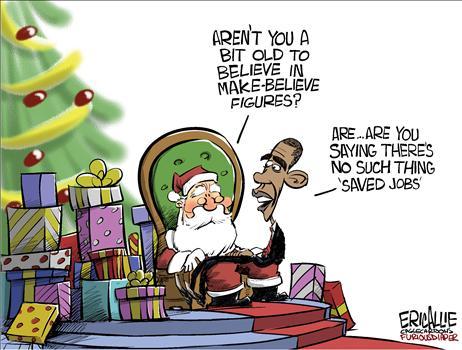 test on political knowledge in 2010 you may want to take. They highlighted six big laws that were passed this year. All of them were definitely steps in the correct direction even though they had flaws that will have to be worked out. I’m not sure I’d consider all of them great successes but when you look back on the list, you’re sure to find something naughty and nice.
Here’s there intro to the list.
The post-election lame-duck session – typically a mopping-up operation to get out of town – also made history, passing key pieces of legislation, often with greater input from Republicans than had earlier been the case. People can argue the merits of what Congress did, but it’s hard to quibble with the scope of the undertaking. Here are six of this Congress’s major accomplishments, in the order in which they were approved.
Here are their list of “six big achievements”.
1. American Recovery & Reinvestment Act
The $819 billion economic stimulus package, signed into law February 2009 less than a month after Barack Obama became president, is the largest stand-alone spending bill in US history. It included tax cuts, as well as new spending for public works, education, clean energy, technology, and health care.
2. Patient Protection and Affordable Care Act
Congress battled for a year to pass health-care reform, which was finally a done deal March 23, 2010. The law mandates that all Americans obtain health insurance coverage, and it sets up entities called health exchanges to provide people with affordable options.
3. Financial regulatory reform
Known officially as the Dodd-Frank Wall Street Reform and Consumer Protection Act, the new law is the most significant regulatory overhaul of the financial system since the Depression ended in the 1930s. Signed into law in July 2010, it aims to end bailouts forced on taxpayers by financial institutions deemed “too big to fail” and to protect consumers. Included in the legislation is a powerful, independent consumer-protection bureau, an early-warning system for financial groups deemed too big to fail, new oversight of credit agencies, and lower fees on debit-card charges. It also directs much of the $600 trillion over-the-counter derivatives trade through clearinghouses and exchanges.
4. Big tax-cut extension, plus new stimulus
Congress averted the largest tax increase in American history by voting in December to extend the Bush-era tax cuts for two years, including for the highest-income households.
5. Repeal of ‘don’t ask, don’t tell’
Fulfilling campaign pledges of the last two Democratic presidents, Obama on Dec. 22 signed a law that repeals a 17-year ban on gay men and women serving openly in the US armed services.
6. New nuclear arms pact with Russia
The new Strategic Arms Reduction Treaty (START) with Russia reduces the US and Russian arsenals of deployed strategic nuclear warheads to 1,550 apiece within seven years. The Senate ratified the treaty Dec. 22 by a vote of 71 to 26.
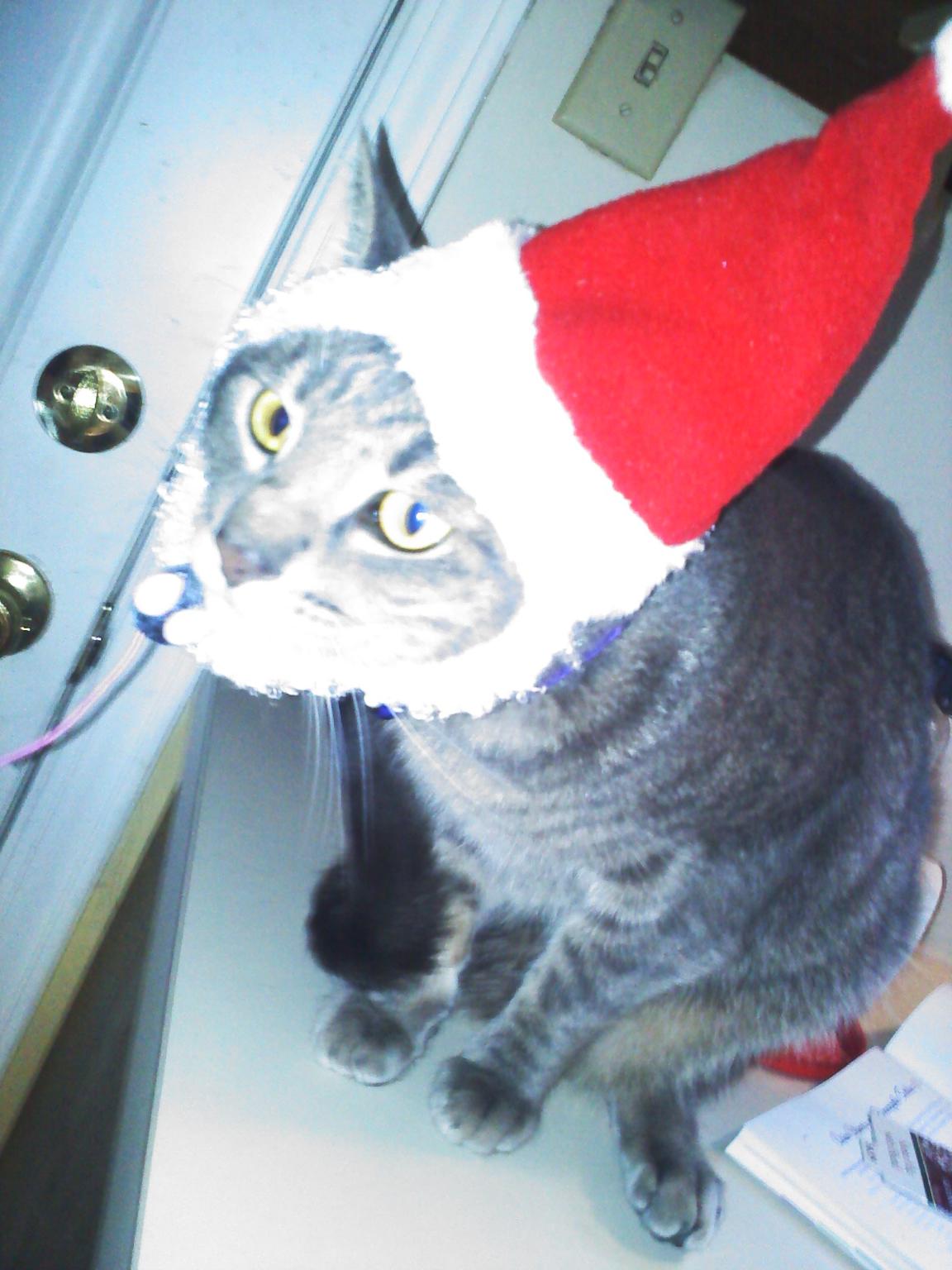
Juju--my youngest daughter's christmas cat--studies the list
Okay, I’ll put it to you!
Naughty or Nice list?
See, even JuJu the Christmas Cat wants in on the project!!! (I guess my youngest daughter still hasn’t gotten through the doll phase yet.)

 peej
peej Carissa
 bostonboomer
 dakinikat
 ecocatwoman
 jjlo
jjlo mablue2
 Mama Lopez
 peggysue22
 quixote
 skydancingguestblogger
 Mona (aka Wonk the Vote)



 Sky Dancing
Recent Comments