
Tuesday Reads
Posted: February 22, 2011 Filed under: collective bargaining, Food, Gulf Oil Spill, hunger, income inequality, morning reads, worker rights | Tags: BP oil spill, export restrictions, hunger, Scott Walker's John Birch Society ties, Wisconsin, world food prices 26 Comments Good Morning!!!
By the time you start reading this, I’ll be headed back down to Grand Isle to check on the new ‘old’ oil that just surfaced and hit Grand Isle and Elmer’s Island. The Federal Government and BP are about to leave us since they consider the beaches clean. Too bad they’re not cleaning up the marshes and the bottom of the Gulf too. I thought I’d start with some of the latest Gulf Gusher news this morning. This one is from the BBC. It’s on the impact on animals living at the bottom of the Gulf.
In places the layer of oil and dead animals is 10cm thick
The 2010 Deepwater Horizon oil spill “devastated” life on and near the seafloor, a marine scientist has said.
Studies using a submersible found a layer, as much as 10cm thick in places, of dead animals and oil, said Samantha Joye of the University of Georgia.
Knocking these animals out of the food chain will, in time, affect species relevant to fisheries.
She disputed an assessment by BP’s compensation fund that the Gulf of Mexico will recover by the end of 2012.
Millions of barrels of oil spewed into the sea after a BP deepwater well ruptured in April 2010.
Professor Joye told the American Association for the Advancement of Science conference in Washington that it may be a decade before the full effects on the Gulf are apparent.
She said they concluded the layers had been deposited between June and September 2010 after it was discovered that no sign of sealife from samples taken in May remained.
Professor Joye and her colleagues used the Alvin submersible to explore the bottom-most layer of the water around the well head, known as the benthos.
“The impact on the benthos was devastating,” she told BBC News.
Meanwhile, the BP oil spill claim process has been nearly as devastating to people whose livelihoods depend on the Gulf. The number of complaints has been tremendous. Another set of ‘final rules’ for damage reimbursement has come out. Head of the process, Obama appointee Kenneth Feinberg, asked for input from every one for the final criteria.
The final rules also promise to give claimants more data about the status of their claims, including how any payments were calculated and why.
They’ll be bad news to local boat operators who helped with clean-up efforts, though; the final rules say boats used as part of a “Vessels of Opportunity” program can’t get paid for any resulting property damage via the claims facility.
Under the new rules, oyster processors will now be eligible for four times their 2010 documented losses as a lump-sum payment. In earlier versions, only oyster harvesters could get that much.
Although the Facility’s experts predict that the region will fully recover from the spill in 2012 (so claimants in most other fields are being offered a one-time check for double their documented 2010 losses), they estimate it will take oyster beds longer to return to normal.
The final methodology also offers to pay “reasonable costs” of claimants who work with an independent accountant on their claims, and to treat them as part of their losses. That offer should help claimants submit proper documentation to back up their claims; less than 17% had submitted completed 2010 documentation as of Friday, the GCCF said.
…
BP, for one, submitted a 24-page letter saying that the proposed methodology overstates the region’s losses and that payments were too generous.
More and more information is coming to the surface about the connections between Tea Party politicians, organizers and the John Birch Society. I’m not sure how many people were aware of their new governors’ associations and campaign contributors when they voted for him but they should have some awareness now. You always have to follow the money. No where is this more true than in Wisconsin.
Much of Walker’s critical political support can be credited to a network of right-wing fronts and astroturf groups in Wisconsin supported largely by a single foundation in Milwaukee: the Lynde and Harry Bradley Foundation, a $460 million conservative honey pot dedicated to crushing the labor movement.
Walker has deeply entwined his administration with the Bradley Foundation. The Bradley Foundation’s CEO, former state GOP chairman Michele Grebe, chaired Walker’s campaign and headed his transition. But more importantly, the organizations lining up to support Walker are financed by Bradley cash:
– The MacIver Institute is a conservative nonprofit that has provided rapid-response attacks on those opposed to Walker’s power grab. MacIver staffers produced a series of videos attacking anti-Walker protesters, including one mocking children. Naturally, the videos have become grist for Fox News and conservative bloggers. In addition, MacIver created studies claiming that Wisconsin teachers and nurses are paid too “generously” and other reports claiming that collective bargaining rights hurt taxpayers. The Bradley Foundation has supported MacIver with over $300,000 in grantsover the last three years alone.
– The Wisconsin Policy Research Institute is a major conservative think tank helping Walker win support from the media. The Institute has funded polls to bolster Walker’s position, and like MacIver, produced a flurry of attack videos against Walker’s political adversaries and a series of pieces supporting his drive against the state’s labor movement. Over the weekend, the Institute secured a pro-Walker item in the New York Times. The Wisconsin Policy Research Institute is supported with over $10 million in grantsfrom the Bradley Foundation.
– As ThinkProgress has reported, the powerful astroturf group Americans for Prosperity not only helped to elect Walker, but bused in Tea Party supporters to hold a pro-Walker demonstration on Saturday. In 2005, the Bradley Foundation earmarked funds to help Koch Industries establish the Americans for Prosperity office in Wisconsin. From 2005-2009, the Bradley Foundation has givenabout$300,000 to Americans for Prosperity Wisconsin (also called Fight Back Wisconsin).
It should be no surprise that Walker’s radicalism is boosted by Bradley money. Today, the Bradley Foundation is controlled by a group of establishment Republicans, along with Washington Post columnist George Will.
I’m not sure if you’ve gotten a chance to check out Yves’ excellent analysis of public vs. private pay scales in Wisconsin from Sunday, but if you haven’t, you’ll see that the private sector clearly pays more. One thing that the right wing frequently does when it explores this issue is to throw all public sector and all private sector employees into an average. This is comparing apples to oranges because public sector jobs frequently take higher levels of education than the overall economy. Think scientists, teachers, engineers, etc. Yve’s also point out the roll of the Koch brothers PAC in Walker’s campaign.
First, let’s debunk a couple of issues thrown out by Wisconsin governor Walker’s camp before turning to the real culprit in state budget’s supposed tsuris. The state budget is not in any kind of real peril. The Wisconsin Legislative Fiscal Bureau estimated that the state would end fiscal year 2011 with a gross positive balance of $121. 4 million and a net balance (after mandated reserves) of $56.4 million. Walker asserts there is actually a $137 million deficit. But where did that change come from? Lee Sheppard of Forbes estimated that Walker’s tax cuts for businesses would cost at the bare minimum $100 million over the state’s biennial budget cycle. Other sources put a firmer stake in the ground and estimate the costs at at $140 million. Viola! Being nice to your best buddies means you need to go after someone else.
The second major canard is that Wisconsin state employees are overpaid. If any are, it sure isn’t the teachers, nurses, or white collar worker.
There’s a nifty chart there via Menzie Chin at Econbrowser that breaks it down nicely.I’m really getting tired of hearing distorted stories from the right wing on this. Wisconsin right winger Congressman Paul Ryan is among the seriously confused. He’s supposed to be the Republican bright bulb on economics too. You can also add an article at the rather conservative The Economist to those with data showing how public sector employees do not receive better than private sector wages and benefits with an article called ‘Don’t join the government to get rich’.
But the Economic Policy Institute tells us that, in Wisconsin, public-sector workers are not in fact paid more than their private-sector counterparts. They’re paid less. You can only make it appear that public-sector workers earn more by ignoring the fact that “both nationally and within Wisconsin, public sector workers are significantly more educated than their private sector counterparts.”
Nationally, 54% of full-time state and local public sector workers hold at least a four-year college degree, compared with 35% of full-time private sector workers. In Wisconsin, the difference is even greater: 59% of full-time Wisconsin public sector workers hold at least a four-year college degree, compared with 30% of full-time private sector workers.
…Public employees receive substantially lower wages, but much better benefits than their private sector counterparts. Wisconsin state and local governments pay public employees 14.2% lower annual wages than comparable private sector employees. On an hourly basis, they earn 10.7% less in wages. College-educated employees earn on average 28% less in wages and 25% less in total compensation in the public sector than in the private sector.
The EPI study does find there’s a class of public-sector workers who earn a bit more than their private-sector counterparts: those without high-school degrees. In other words, district attorneys earn less than corporate lawyers, but janitors at the district attorney’s office may earn more than janitors at a corporate law office—provided the government hasn’t outsourced its facilities staff to the same private company the law office uses, which it may have, since governments have been targeting low-skilled workers for outsourcing precisely because that’s how they can save money.
The article also talks about Republican efforts to let state’s escape their pension obligations through bankruptcy. I can only imagine how many elderly workers would be impacted by this. Interestingly enough, Wall Street is against this too since many firms make money managing huge state pension plans and any state bankruptcy would impact bonds issued by states. It’ll be interesting to see how this unfolds.
It turns out, however, that state governments won’t have the money to pay a lot of those pensions. They’re likely to renege on their promises, and Republicans in Congress want to allow them to declare bankruptcy in order to do so. (Funnily enough, this may be the one area in which labour unions and Wall Street are in alliance: neither one wants states to be allowed to declare bankruptcy.) In other words, as Ezra Klein points out, the public-sector employees got rooked: they accepted lower pay in exchange for retirement benefits, and now the retirement benefits look unlikely to come through.
Pascal Lamy, Director-General of the World Trade Organization has written an article at Project Syndicate indicating that high food prices might be due to protectionist trade policies and a relative small amount of global trade in wheat and other grains. Can the world work together to stop food insecurity?
Export restrictions, for example, play a direct role in aggravating food crises. Indeed, some analysts believe that such restrictions were a principal cause of food-price rises in 2008. According to the United Nations Food and Agriculture Organization, they were the single most important reason behind the skyrocketing price of rice in 2008, when international trade in rice declined by about 7% (to two million tons) from its record 2007. Similarly, the 2010-2011 price rise for cereals is closely linked to the export restrictions imposed by Russia and Ukraine after both countries were hit by severe drought.
Most people are surprised to learn how shallow international grain markets truly are. Only 7% of global rice production is traded internationally, while only 18% of wheat production and 13% of maize is exported. Additional restraints on trade are a serious threat to net-food-importing countries, where governments worry that such measures could lead to starvation.
Those who impose these restrictions follow a shared logic: they do not wish to see their own populations starve. So the question is: which alternative policies could allow them to meet this goal? The answer to that question consists in more food production globally, more and stronger social safety nets, more food aid, and, possibly, larger food reserves.
A conclusion to the Doha Round of global trade negotiations could constitute part of the medium- to long-term response to food-price crises, by removing many of the restrictions and distortions that have muddied the supply-side picture. A Doha agreement would greatly reduce rich-world subsidies, which have stymied the developing world’s production capacity, and have pushed developing-country producers completely out of the market for certain commodities. The worst kind of subsidies – export subsidies – would be eliminated.
I didn’t cover any of the major international news items today since we’ve been trying to keep live blogs of the global protest contagion. I’ll try to come back with some pictures and information on the oil in the marshes here in Louisiana so you can see exactly what our government is letting BP get away with.
What’s on your reading and blogging list today?
Death by Propaganda
Posted: February 19, 2011 Filed under: collective bargaining, education, John Birch Society in Charge, right wing hate grouups, The Media SUCKS, Voter Ignorance, worker rights | Tags: Negotiating, public and private salary surveys, state of Louisiana, unions, Wisconsin protests 35 Comments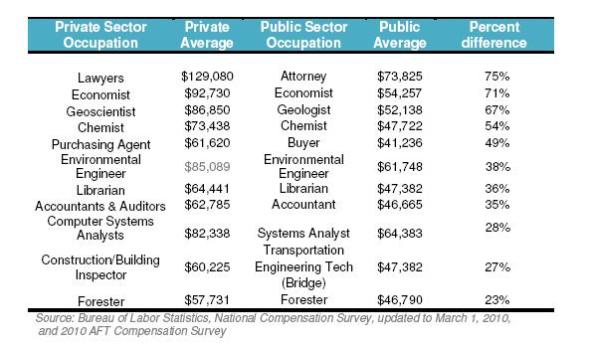
I’ve worked in both the public and private sector. I’ve also worked in union and non-union shops. Additionally, I was part of the collective bargaining process for community college instructors in a right to work state some time ago so I’m familiar with the process. I’ve been a manager and economist that has done strategic budgeting and planning so I’m used to salary and benefit surveys even though I’ve no experience in HR. I also check my facts before taking any one else’s words or wishful thinking. It’s easy to look for a scapegoat for the budget woes of states. The answer lies more in the nature of governors and legislators getting to balance a budget when funds are pouring in than it does in the joy that some people appear to be getting by scapegoating public sector workers and their unions.
For some reason, there’s this idea floating around that public sector employees are raking in the bucks at every one else’s expense. Also, there’s another canard out there that it’s public employees and their generous pensions that are breaking the back of state budgets. I know that’s not really the case for several reasons. The first one is that I know how the collective bargaining process works for a public employee because I’ve done it and the resultant salaries and benefits packages usually aren’t up to private sector levels. It’s based on bringing a rubric of like institutions in like communities and like jobs to the negotiating table. You basically point to that rubric and say here’s the top, bottom, and middle salaries for people in similar jobs in similar institutions. You point to their numbers and then you point to your institutions numbers and you suggest what it would take to put your institution in line with those averages. You negotiate to averages. You can’t negotiate to the best circumstance or you’ll be taken to labor “court” by management and the judges will force you to concede to a more reasonable position. The only time I’ve seen institutions go for the top salary positions is when they’re making a concerted effort to increase their academic standards and recruiting like the Duke Business School did awhile back. That, however, was a complete outlier.
As a union negotiator, you bring the rubric of institutions that would give your membership the best deal in the first round. The institution brings the rubric of institutions that give them the best deal. That rubric has to reflect similar circumstances to your membership. You can’t compare yourself to Harvard if you’re not an Ivy league school. You can’t compare yourself to Hawaii if you’re in the Midwest. Your rubric has to be a set of best matched institutions.
If everything works according to plan you negotiate a joint rubric that represents a middle ground and that middle ground will determine the end package that will likely stand for several years. If you can’t get that done, you declare an impasse and go to the NLRB or some other government entity that decides which rubric you’re going to use and that settles the situation. This happens with both benefits and salaries. It’s repeated every time negotiation year begins. It’s not an outrageous process at all. In the end, the membership either accepts it or rejects it. In my experience, teachers are generally pretty wimpy when it comes to accepting offers. I loved negotiating at a combination technical and community college because the craft people were used to unions and negotiations and were pretty good negotiators. The lead negotiator was a scrappy heating and air conditioning instructor of Italian and Sicilian heritage. I just loved talking strategy with him. Usually, the academic faculty would roll over easily for any scraps. This is a two way negotiating street. It only works when both parties sit down and are willing to hammer out a deal.
The reason this is not working in Wisconsin right now is that one side is refusing to negotiate at all. Not only that, but one side is changing the rules in the middle of the game. If there is no offset, there is no middle ground. This is the only way to get raises in public institutions. I can tell you that since I left that situation and moved to public institutions in Louisiana where you don’t get raises unless you have a governor that’s willing to fight the legislature for an across the board raise for every one. As a faculty, you live and die by whatever salary you got at the onset or you quit. In my experience, the best and the brightest do just that. They bring their new offers and see if they’ll be matched. If not, they move on. I’ve seen the institution then go to the job market and hire much younger and less experienced professors for much bigger salaries after not being able to offer even half that much to a recently tenured one. No one wants to be the one to offer a raise because every one will then want their salary raised to market level. It’s easier to let the good ones go instead. This is especially true in the econ/finance areas and also engineering and computer science because you can easily go to Wall Street or the private sector and make major amounts of money. If you’re represented by a negotiating unit, you come out with a decent cost of living raise annually and if your particular job has had an increase in marketability, you’re salary will move closer to the market. You never approach a private sector equivalence.
I’ve never seen anything in the public sector remotely approach a salary you can get in the private sector. The benefits tend to be better but the monetary compensation is almost always worse. I’ve given you an example from the salary survey done by the AFT in 2010 in the table at the top. It reflects the national salary survey of 2010 done by the Bureau of Labor Statistics which is the government’s data collector on labor markets. That’s the same people that collect unemployment statistics and inflation statistics. They have no ‘agenda’ but to collect the data. Individual groups just use the data to learn what the going market rate is for public and private sector jobs.
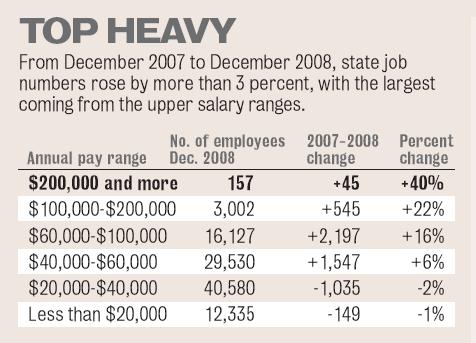
Now, I want to give you examples of things from the state of Louisiana. I’m going to use two resources. First, is a search engine set up by The Times Picayune of all state employee salaries. Use it to search out only one thing. The job title clerk. Clerks in state government have a union. So, just stick clerk in the job title and submit. You’re going to see there’s quite a few “pages” of clerk names, departments, and salaries. Six lucky people on the first page make high salaries for having that clerk title. The next group on the next few pages make between about $25,000 to $35,000 annually. You’ll see that the vast majority of these folks basically make around $15,000 -19,000 annually by the time you get pass about 3- 4 pages out of a total of 14 pages of names. I would like to remind you that the poverty level for a family of four is $22,050 annually. For a family of two it is 14,570 and for one person it is $10,830. These levels are for the entire country.
There’s another graphic that you can check that shows exactly who the top paid employees are and how much they make. I can assure you that none of these folks are covered by the state employees unions and none of them have any peers who have lower or higher salaries or benefits depending on when they entered service alone. These people are mostly political appointees of the governor. In this case, they are political appointees of Bobby Jindal. I’m going to show you the graph that is relevant. (It’s down below this section.) The salary structure is top heavy. You can go back and search who has the top money. You will see that it is top university administrators and coaches. Even these salaries do not stack up to private sector CEOs or coaches. It isn’t the clerks that are making outrageous salaries and it isn’t their bargaining unit that is at fault for any of this. You’ll also see if you got that page that many state workers are attorneys, engineers, teachers, nurses and doctors. These are professional people. You cannot expect to recruit and retain the best professional, well-educated service workers if you do not offer them a competitive salary. The most mobile ones will leave eventually if you don’t offer them raises and benefits commensurate with the private sector. You can go to any of the BLS salary surveys and you will see what the AFT put in that nice graphic above year after year after year. You will not get a compensation in the public sector that is more generous than the private sector at those levels of expertise. If there is a private sector ‘competitor’ for offering the job. Believe it or not, not every one is an English teacher that might likely wind up as a waitress. Here in New Orleans, most of the English teachers at my university would make better money if they’d wait tables or pour cocktails in the French Quarter. The only difference is that English teachers get a pension and insurance and they get to do the job they love.
Okay, now I’m going to go all economist on you. When you are a teacher, a firefighter, or a public health or safety worker, you face what is called a monopsony. That means there is likely to be one source of jobs and so you face the buyer’s version of a monopoly. What this means is the chips will be stack against you coming out with a ‘competitive’ wage. For example, how many forensic scientists do you suppose work outside of the local police departments? You may face a number of municipalities that could hire you in this situation. It is not, however, illegal for municipalities to collude on setting standards for salaries and benefits. Hence, you may face the same situation in city after city.
There seems to be this mindset that public servants should be public slaves from some quarters. Why should the clerk who fills out your driver’s license form be treated differently than the clerk that fills out your bank deposit slip? Why this double standard that public employees can’t be represented by unions? Well, first, I think many people still believe that public employees served by unions some how get a better deal than the others. This generally is not the case for all things. The only items that have held together for state employees that are not as available in the private sector tends to be the pension benefits and probably the insurance. One of the reasons that the insurance tends to be not such a big deal is that many states self insure and they have huge pools of employees so they can be more generous with benefits at a lower cost. I’ve generally lived in states where the biggest employer is the state. That’s a lot of people and insurance gets cheaper as the pool grows larger.
I think one of the other reasons is that people in nonunion jobs feel helpless about their futures and they are angry that they really don’t have the same safety in numbers that you see with union shops. You can’t be bullied by an employer when there is a union in place. This does have a tendency to protect even the worst employee, but when you work for capricious bosses, and we all do, you’ll never be safer than when you have union representation. You also are more aware of when your number will be up during downsizing and you will get a recall if they start rehiring if you’re a member of a union. This type of job security is generally the most important thing to a state employee which is why they work for lower monetary compensation. But again, why begrudge others what you could have if you’d just organize your work place?
I’ve been seeing way to many sites discuss ‘greedy’ teachers who selfishly walk out of the classroom to protest their right to organize. I really don’t get this meme at all. Wouldn’t you fight for your family’s livelihood if it were threatened? Why are teachers supposed to be treated differently than any one else?
A Governor or any other publicly elected official isn’t just held to account on voting day. Democracy is a day-in-and-day out process. Wisconsin Governor Scott Walker was elected to handle the budget. He immediately cut $117 billion in revenues coming from businesses and created a $130 billion deficit. His answer to covering his self created deficit was to change the terms of thousands of previously negotiated commitments to public employees. He backed out of the state’s commitment. He’s also refused to remove the union busting portions of the bill in exchange for salary and benefit concessions. How is this anything but dogmatic and unfair to state employees? Who makes heroes out of people that break commitments? Each of those families made plans based on the sanctity of the promise the state of Wisconsin made to them. They were part of the agreement and they should be part of renegotiating the agreement because that’s the rules of the game there. Changing the rules of a game in the middle of play is cheating.
If Governor Walker was so interested in frugality, then he should’ve started by not passing those $117 million in tax breaks. An election victory is not a blank check in a democracy.
Within days of becoming governor, Mr. Walker — who hung a sign on the doorknob of his office that reads “Wisconsin is open for business” — began stirring things up, and drawing headlines.
He rejected $810 million in federal money that the state was getting to build a train line between Madison and Milwaukee, saying the project would ultimately cost the state too much to operate. He decided to turn the state’s Department of Commerce into a “public-private hybrid,” in which hundreds of workers would need to reapply for their jobs.
He and state lawmakers passed $117 million in tax breaks for businesses and others, a move that many of his critics point to now as a sign that Mr. Walker made the state’s budget gap worse, then claimed an emergency that requires sacrifices from unions. Technically, the tax cuts do not go into effect in this year’s budget (which Mr. Walker says includes a $137 million shortfall), but in the coming two-year budget, during which the gap is estimated at $3.6 billion.
Democrats here say Mr. Walker’s style has led to a sea change in Wisconsin’s political tradition.
“Every other Republican governor has had moderates in their caucus and histories of working with Democrats,” said Graeme Zielinski, a spokesman for the state’s Democratic Party. “But he is a hard-right partisan who does not negotiate, does not compromise. He is totally modeled after a slash-and-burn, scorched-earth approach that has never existed here before.”
There’s some very interesting polls coming out of the Wisconsin protests. Here is some poll analysis on unions and public unions from the CSM.
Asked about “when you hear of a disagreement between state or local governments and unions that represent government workers,” more Americans say their first reaction is to side with the union (44 percent) than with state or local governments (38 percent). And substantially more Americans see union contracts as ensuring that workers are “treated fairly” than as giving workers an “unfair advantage.”
Other polls have found mixed results. Here’s some coverage at Huffpo for the Pew poll cited above as well as a few others. Either way, it’s interesting to note that Walker has some pretty strong ties to the notorious Koch Brothers. These trust fund babies spend a lot of John Bircher Daddy’s money trying to bust unions. I don’t think this can be discounted either.
According to Wisconsin campaign finance filings, Walker’s gubernatorial campaign received $43,000 from the Koch Industries PAC during the 2010 election. That donation was his campaign’s second-highest, behind $43,125 in contributions from housing and realtor groups in Wisconsin. The Koch’s PAC also helped Walker via a familiar and much-used politicial maneuver designed to allow donors to skirt campaign finance limits. The PAC gave $1 million to the Republican Governors Association, which in turn spent $65,000 on independent expenditures to support Walker. The RGA also spent a whopping $3.4 million on TV ads and mailers attacking Walker’s opponent, Milwaukee Mayor Tom Barrett. Walker ended up beating Barrett by 5 points. The Koch money, no doubt, helped greatly.
When there is big corporate money in elections, there is only one offset these days. That would be the money and free labored offered up by unions. Undoubtedly, the public sector unions are some of the last big unions standing. I can only imagine how much the Kochs and others would like to gut the fund raising and GOTV efforts of unions that are usually made available to candidates that thwart their Bircher plots. After all, there’s very little standing right now to check the power and political donations of megacorporations. This fact alone should make any one support the few unions left standing. However, the bigger question remains. Why do so many people begrudge public workers a voice in the terms of their employment?
And now for the Propaganda
Posted: February 18, 2011 Filed under: Breaking News, Civil Liberties, Civil Rights, collective bargaining, John Birch Society in Charge, The Bonus Class | Tags: collective bargaining, NEA, unions, Wisconsin protests 53 Comments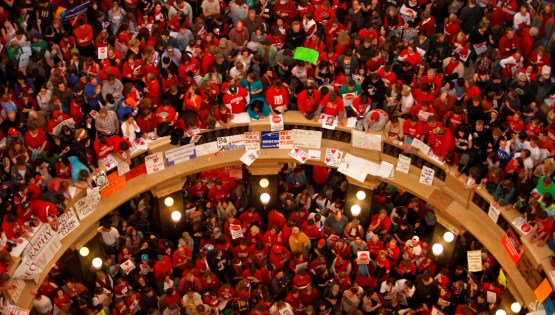
Thursday, Feb. 17, 2011, at the State Capitol in Madison, Wis. (AP Photo/Andy Manis)
The Right Wing Media and John Birch society outlets are pressing hard against the protests happening in Wisconsin and other places where government workers’ rights to collective bargaining are under assault. We’re seeing police state tactics employed by the Republicans in Wisconsin and typical hateful propaganda from the mouthpieces of the plutocracy. Here’s an excellent example of right wing hysteria worthy of a dying despot using State TV to scare people from WSJ.
A seminal showdown between public unions and taxpayers. — For Americans who don’t think the welfare state riots of France or Greece can happen here, we recommend a look at the union and Democratic Party spectacle now unfolding in Wisconsin.
That’s right, Wisconsin is having ‘welfare state’ riots like France or Greece. I’ve missed the fires, but hell, what’s a little purple prose compared to having every one sing ‘The Internationale’ eventually? Is that what they think of Fire Fighters and Teachers? Do the services we provide fall under a ‘welfare state’? Do the years we spend at school or training need to be discounted because we work for the public sector instead of the private? Look at that pejorative word ‘riots’. Isn’t every one in Wisconsin exercising their constitution-given rights to free speech and assembly? Are they really rioting? This reminds me of the characterization in Egypt by the state TV of journalists and protesters as provocateurs of foreign agents. That was the trigger pulled on a gun pointed at the head of journalists among others.
Catch what’s called a ‘modest proposal’ in the second paragraph. Unbelievable. This Op-Ed was unsigned and that in itself is telling. It’s an edict from above.
Mr. Walker’s very modest proposal would take away the ability of most government employees to collectively bargain for benefits. They could still bargain for higher wages, but future wage increases would be capped at the federal Consumer Price Index, unless otherwise specified by a voter referendum. The bill would also require union members to contribute 5.8% of salary toward their pensions and chip in 12.6% of the cost of their health insurance premiums.
How can you ‘bargain’ for higher wages when you’re currently under a salary freeze? How is it ‘bargaining’ when they start your position with wage increases capped at the CPI? What happens if there’s a shortage of something like Civil Engineers and the going wage for Civil Engineers doubles? Does that mean you have no right to ask that your salary be brought up to the market level so that your only choice is to leave your job and go else where? What is the basic purpose of having the right to collective bargain but to be able to sit down and negotiate from a position of strength to a reasonable, mutually agreed position? What does it say when the state wants to handicap you from the get go and start you from the minimally acceptable position to begin with? How does this do anything but decimate the collective bargaining process?
I need to make a disclosure here. I’ve been a member of the NEA and I worked with the negotiating team at my college in Nebraska. This is something I sorely miss down here in Louisiana because I haven’t had a decent working situation since then. My livelihood was subjected to the capricious whims of both Deans and politicians many times. None of this would have happened if I had a strong bargaining unit. I would have had a vehicle for redress and I imagine they may not have even tried what they’ve gotten away with under different circumstances. An example would be that my last position offered me a job and salary–taking me off the job market–then 10 days before school started, they changed both my salary and job grade to a much lower position when I had no options at that point. I’d have never taken that offer had it been made when I was in a position to do something else. This last teaching job never paid me any of the salaries they offered me for either of the two academic years I worked there. I received two contracts after school had started that were distinctly different from the terms they gave me mid summer. That’s just one example of abuse too. Also, what few benefits we had in the Louisiana public university systems are the result of the collective bargaining power of the clerical and janitor’s unions. That goes for administrators too. If they hadn’t achieved a minimal threshold, the rest of us would never have gotten similar deals. The only employees that have control over the terms of their jobs are the very top administrators and the sports coaches.
But then, I speak now as the new enemy of the people. Just read right wing media sources. Oh, and watch CNN and NPTV. I learned exactly how horrible people like me are on State of the Union and The Nightly News Report last night. I’m the new face of communism and the caliphate. I switched to MSNBC last night because I simply couldn’t take the public bashing of my profession and my colleagues any more. This bashing came via Journalists and Politicians which– last time I checked–were the two least respected professionals in the country.
I won’t even show you some of the more egregious right wing bloggers who basically portray all teachers, policemen, firefighters, janitors, prison guards, and other civil servants as greedy bastards who sit around all day doing nothing and collecting outrageous salaries that they’d never be able to achieve in the private sector. This is all based on bogus assumptions. One blog calls the protests in Wisconsin ‘hate rallies’. This farcical stereotype is being tooted by Republican pols who have premier pension plans and insurance programs immediately and have access to discounted and free services. How many of you have a barber shop or a gym you don’t pay for? I didn’t even have that at either of my University jobs and universities have some pretty nice gym facilities. Faculty and staff have to pay to join. How hypocritical is that?
How far have we sunk when so many elected officials and media figures are trying to make enemies of the very people that are here to serve us? What has a park ranger at a state park done to deserve this kind of vituperative treatment? Why do they so hate the middle class and the very groups of unions that set the tone for wages and benefits in many places? What type of plantation mentality does it take to eagerly seek to force workers into such a hapless position? Better yet, why are so many people duped by these voices of the plutocracy?
Perhaps every one recognizes that we may be crossing the Rubicon. This maybe the threshold of our final chance to stop the Republican and Chamber of Commerce led plot to put us all back on plantations with a debt form of indentured servitude that we can never escape.
What’s happening in Wisconsin is more threatening to unions because it’s not just giving back money–something that’s become a mainstay in the auto industry for years. It’s giving back hard-won rights. By going after collective-bargaining rules, Walker has taken on public-employee unions in a way that’s more fundamental, profound, and threatening to unions than New Jersey’s Republican Gov. Chris Christie’s wielding of the budget axe. Christie has become the darling of the GOP circles because of his administration’s fiscal austerity.
By taking aim at the ability of public employees to strike, Walker has found a tool that may well cut the state’s budget deficit. In doing so, however, he has lit a fire under Democrats and a chastened labor movement that has gotten used to givebacks.
Collective bargaining is the infrastructure–the essential core of labor’s rights and power–and so attacks on that right go to the heart of the union movement. That is why the president weighed in on what is at first glance a local issue. If the battle of Madison spreads beyond Columbus and Des Moines to the rest of the country, we’ll be hearing a lot more on this topic from the president.
It isn’t far fetched to say that the fascist elements in this country are using police state tactics to squelch dissent. The plutocracy that funds the so-called tea party is deep in the trenches on this one. Here’s one such group of little fascists in training bragging they chased the 14 Democratic senators out of Rockford, Illinois. How many of these idiots realize that their being used by folks like the trust fund baby Koch brothers to suppress people who they have a lot more in common with than difference? Why are they being used to attack others fighting for the few scraps left to those outside the bonus and inherited wealth class?
The NYT has also put a no-name editorial up signifying the force of the board of editors.
Like many governors, he wants to cut the benefits of state workers. But he also decided a budget crisis was a good time to advance an ideological goal dear to his fellow Republicans: eliminating most collective bargaining rights for public employees.
Not surprisingly, thousands of workers descended on the Capitol building, pounding on windows and blocking doors, yelling “shut it down.” So many teachers called in sick that public schools in Madison and more than a dozen other districts had to be closed. On Thursday, the Democrats in the State Senate refused to show up, vowing to prevent any action until the governor drops his plan. The state police were sent to find them.
Mr. Walker has decried the chaos, but it was entirely self-inflicted. His plan to undermine the unions, which would have no direct impact on the budget, would take away nearly all of their rights to negotiate.
They would be barred from bargaining about anything except wages, and any pay increase they win would be limited by the consumer price index. Contracts would be limited to a year, and union dues could no longer be deducted from paychecks. As President Obama correctly put it on Wednesday, that “seems like an assault on unions.” (The archbishop of Milwaukee and players for the Green Bay Packers have also come out in support of the workers.)
I personally hope this is the moment of plutocratic overreach that puts people in the streets to protest. We have public goods for many reasons. Some times, it is the only way a good–like public transportation–will be provided. Some times it’s the only way that a good–like education–will be provided to any one but the rich. Other times, public provision is necessary because the social costs of private provision are huge. Examples of these are processes that cause security risks and crime, pollution, or other public health risks.
Bringing Public workers down is not a way to lift every one else up. Traditionally, unions have provided the benchmark for every right we have including five day work weeks, overtime pay, holidays, child labor laws, worker safety initiatives, and benefits. Much like public plans for insurance, they provide an anchor of the minimally acceptable contract in markets that are so lop-sided. In other words, its a way to fight off monopoly on the other side of the market. If you’re a teacher or you want to go into law enforcement or fire fighting or civil engineering, then you’re going to have to work for a municipality or state. They are the sole employers. They are monopolies.
Collective bargaining is necessary when the other side of the equation in a market is a monopoly. It is the only offset to the overwhelming power of the monopoly. It is frequently why you still see unions in private markets where the company is also either a monopoly or oligopoly like the steel industry or the automobile industry. Monopolies take advantage of customers and they take advantage of the factors they use in their production process if they can. Collective bargaining is an important offset to this power. Without out, all of us would be much worse off.
So, you can want your MTV and Super Bowl and tacky Chinese made jeans. Give me my union.
update: Green Bay Packers join the Protests. National Guard representatives balk at being used as tools.
“The NFL Players Association will always support efforts protecting a worker’s right to join a union and collectively bargain. Today, the NFLPA stands in solidarity with its organized labor brothers and sisters in Wisconsin.”
The support of the Packers players hasn’t been lost on those marching in the streets. Aisha Robertson, a public school teacher from Madison, told me, “It’s great to see Packers join the fight against Walker. Their statement of support shows they stand with us. It gives us inspiration and courage to go and fight peacefully for our most basic rights.”
and from the same source:
Yes, in advance of any debate over his proposal, Governor Walker put the National Guard on alert by saying that the guard is “prepared” for “whatever the governor, their commander-in-chief, might call for.” Considering that the state of Wisconsin hasn’t called in the National Guard since 1886, these bizarre threats did more than raise eyebrows. They provoked rage.
Robin Eckstein, a former Wisconsin National Guard member, told the Huffington Post, “Maybe the new governor doesn’t understand yet—but the National Guard is not his own personal intimidation force to be mobilized to quash political dissent. The Guard is to be used in case of true emergencies and disasters, to help the people of Wisconsin, not to bully political opponents.”
Already this week, as many as 100,000 people have marched at various protests around the state with signs that reflect the current moment like “If Egypt Can Have Democracy, Why Can’t Wisconsin?” “We Want Governors Not Dictators,” and the pithy “Hosni Walker.”
Friday Reads
Posted: February 18, 2011 Filed under: collective bargaining, Federal Budget, Foreign Affairs, just because, morning reads, The Media SUCKS, U.S. Economy, U.S. Politics | Tags: Bahrain protests, budget, Budget Deficit, Federal Spending, Republican attacks on Employee Unions, Wisconsin protests 26 Comments Good Morning!!
I’m hoping that Wisconsin represents a tipping point in Republican overreach. Fourteen Democratic Senators from Wisconsin are holing up in a Best Western in Rockford Illinois while the Governor and State Senate President send out the state troopers to find them and bring them back for a vote they will lose. That’s right. A United States Governor is using police tactics on elected officials. He’s also ready to call out the national guard to deal with a lawful gathering of students, teachers, police officers, fire fighters, nurses, civil engineers, doctors, and file clerks. It’s six am. Do you know where your constitutional rights are?
Will this be the day that Republican attempts to remove collective bargaining rights from government workers ends? TPM has evidence that right wing Republican Governor Scott Walker Ginned up a Budget battle to bust state employee’s unions by passing irresponsible tax cuts the moment he hit the office.
“Walker was not forced into a budget repair bill by circumstances beyond he control,” says Jack Norman, research director at the Institute for Wisconsin Future — a public interest think tank. “He wanted a budget repair bill and forced it by pushing through tax cuts… so he could rush through these other changes.”
“The state of Wisconsin has not reached the point at which austerity measures are needed,” Norman adds.
In a Wednesday op-ed, the Capitol Times of Madison picked up on this theme.
In its Jan. 31 memo to legislators on the condition of the state’s budget, the Fiscal Bureau determined that the state will end the year with a balance of $121.4 million.
To the extent that there is an imbalance — Walker claims there is a $137 million deficit — it is not because of a drop in revenues or increases in the cost of state employee contracts, benefits or pensions. It is because Walker and his allies pushed through $140 million in new spending for special-interest groups in January.
Meanwhile, Republicans are escalating the rhetoric on budget doom and gloom–after pushing for draconian tax cuts for billionaires in December–on the Federal level too. Boehner is talking shutting down the Government once again.
House Speaker John Boehner (R-Ohio) on Thursday ruled out a short-term government-funding bill that maintains current levels of federal spending, escalating a standoff with Democrats and President Obama that could result in a government shutdown.
“I am not going to move any kind of short-term [funding bill] at current levels,” he told reporters at his weekly press conference.
“When we say we’re going to cut spending, read my lips, we’re going to cut spending,” Boehner added, invoking George H.W. Bush’s infamous and ultimately broken pledge on taxes during the 1988 presidential campaign.
Democratic Senate leaders refused to budge, saying a short-term bill should keep current funding levels in place. Sen. Charles Schumer (D-N.Y.) likened Boehner’s comment to “throwing down the gauntlet.”
Let’s hope we get the same kind of Senate leadership on the national level as Wisconsin workers are getting from their Democratic Senators. How do you build an economy when the decision makers do things that remove incomes and jobs from ordinary Americans?
Paul Krugman’s “Willie Sutton Wept” is a must read. He explains three things you need to know about the current budget debate. I think it’s an important read because I spent some time last night listening to multiple news outlets filled with chattering class idiots insisting that all economists think the deficit is the most pressing problem the country faces. I personally can’t name ONE economist that does.
There are three things you need to know about the current budget debate. First, it’s essentially fraudulent. Second, most people posing as deficit hawks are faking it. Third, while President Obama hasn’t fully avoided the fraudulence, he’s less bad than his opponents — and he deserves much more credit for fiscal responsibility than he’s getting.
About the fraudulence: Last month, Howard Gleckman of the Tax Policy Center described the president as the “anti-Willie Sutton,” after the holdup artist who reputedly said he robbed banks because that’s where the money is. Indeed, Mr. Obama has lately been going where the money isn’t, making a big deal out of a freeze on nonsecurity discretionary spending, which accounts for only 12 percent of the budget.
But that’s what everyone does. House Republicans talk big about spending cuts — but focus solely on that same small budget sliver.
And by proposing sharp spending cuts right away, Republicans aren’t just going where the money isn’t, they’re also going when the money isn’t. Slashing spending while the economy is still deeply depressed is a recipe for slower economic growth, which means lower tax receipts — so any deficit reduction from G.O.P. cuts would be at least partly offset by lower revenue.
The whole budget debate, then, is a sham. House Republicans, in particular, are literally stealing food from the mouths of babes — nutritional aid to pregnant women and very young children is one of the items on their cutting block — so they can pose, falsely, as deficit hawks.
We have a staggering rate of unemployment with underlying employment trends that are not good. Some sectors of the economy, some groups of workers, and many states are in dire straights. I would never believe that a group of people that have lived so close to the precipice that was The Great Depression can be suggesting what they are suggesting now. Either they seriously want to take the country down or they are so stupid and corrupt that they know not what they are doing and they don’t care what they are doing. Our economy is not by any real standard experiencing a good and sustained recovery from a devastating financial crisis. There is weakness in nearly every sector. The only way to grow the economy and to eventually shrink the deficit is through job and economic growth. Every decision maker that I hear these days is aiming policy in the opposite direction and taking away every single means available to make it so.
I’d just like to ask you one question. Was your future destroyed by the burden of paying for the debt and deficits that resulted from World War 2? We’re still paying that down so we should have had a really really horrible economy for the last 60 years if you follow the line of thought of these people screaming about the deficit. Would you have rather they didn’t run any deficit and just called off the entire Omaha Beach thing? Would your life had been better now for that decision? Do you think your life would be better if they’d have not ever offered student loans, or PBS, or undertaken the burden of an interstate system? Do you feel your life is burdened by paying for the Interstate system?
Some times you have to take on long term debt for the big things. We have a big country with a big GDP. We can handle the debt. What we can’t handle is sustained loss of jobs and incomes for the majority of people. They’re downsizing all of us and upsizing their billionaire friends lives. Every one of us should be willing to take to the street like the folks in Wisconsin to stop that. Every Senator and Congressman that believes in the American Middle class should be willing to shut down the workings of congress if it’s necessary to stop this assault on public goods and public servants.
 Pro-democracy protesters in the small monarchy of Bharain continues to experience the full force of government oppression in their struggle for reform. American produced tear gas came into play yet again.
Armored cars are now patrolling the streets of the capital, and all further protests have been banned by the authorities. But sporadic clashes have occurred in different parts of the city.
A statement from the Ministry of Interior claimed that the authorities had attempted to negotiate a peaceful end to the demonstration.
“Security forces evacuated the area of Pearl Roundabout from protesters, after trying all opportunities for dialogue with them, in which some positively responded and left quietly,” the statement read.
However, human rights activists were quick to dismiss these reports, and Al Jazeera reported that the protesters were asleep when the police raid began and that medical staff attending the wounded were among those beaten by police.
The violence comes on the fourth consecutive day of protests since demonstrators staged a ‘Day of Rage’ on Feb. 14, with two protesters killed earlier in the week. In the aftermath of these fatalities, Bahrain’s King Hamad bin Issa issued an apology and promised an investigation into excessive police violence.
Bahrain is an interesting Gulf Nation in that it has predominately Shia Muslim but the ruling family is Sunni. Sunnis enjoy the majority of the wealth and benefits here as was the case in Iraq so there are tensions between the two sects. Most of the Gulf states are predominately Sunni. Sunnis represent the middle class here while Shia are poor. There appears to be some interesting bedfellows made as a result of the protests. Bahrain is an important US alley because of its strategic location as home for the US Navy’s fifth fleet. It has a lot of natural gas but a small and dwindling amount of petroleum, as such, it is not as wealthy as many of its neighbors. The Al Khalifah dynasty appears unwilling to compromise at this point, but time will tell.
The SEC may be getting ready take Freddie Mac officials to court.
The Securities and Exchange Commission has escalated its investigation into mortgage financer Freddie Mac’s disclosures to investors and has notified at least one former official that it intends to file civil charges against him.
Anthony “Buddy” Piszel, who was chief financial officer of Freddie Mac from 2006 until 2008 when the government placed it in conservatorship, received a “Wells notice” from the SEC, according to Corelogic, a California company where he is chief financial officer. A Wells notice is an indication that the SEC staff intends to recommend to its five-member commission that it file civil charges. Corelogic disclosed the Wells notice on February 10 and said Mr Piszel had submitted his resignation, but would stay until June.
The SEC has investigated Freddie before for possible fraudulent accounting practices and problems related to disclosure and corporate governance. Freddie Mac was formed in the 1970s to give money to mortgage lenders to be used for house loans. It’s the largest buyer and packager of house loans in the mortgage market. It is publicly held and currently bankrupt.
So, the world around us changing.
What’s on your reading and blogging list today?
On Wisconsin! (Breaking News)
Posted: February 17, 2011 Filed under: collective bargaining, Federal Budget, Human Rights, John Birch Society in Charge, Live, Populism, U.S. Politics, worker rights | Tags: AFSCME, collective bargaining, Governor Scott Walker, Wisconsin, worker's rights 47 CommentsPublic employees, largely teachers and many of their students, have been protesting in Madison for three days, flooding the Capitol building with people and signage. Many Wisconsin schools have had to close due to sick-outs by large percentages of the state’s teachers.
The fight in Wisconsin has become a flash point for a national debate over budget deficits and how to solve them, with both sides recognizing the high-stakes battle will become a template for other states, no matter who comes out on top. A large defeat for unions in the battleground state of Wisconsin—the birthplace of AFSCME— would have public policy repercussions.
The Democratic Party’s Organizing for America, the leftover campaign apparatus from the Obama campaign, has entered the fray, filling buses and running phone banks for unions in Wisconsin. President Obama offered his opinion, declaring Walker’s measures an “assault on unions” despite admitting he hadn’t looked into the details.
Democratic Senators fled the state of Wisconsin to prevent a quorum call that would allow Governor Scott Walker and the Republicans to start the process of gutting the right to organize and form collective bargaining units for state employees like teachers and police. All 14 of the Democratic senators have actually left the state. The State Patrol has been sent to fetch them by State Senate President. Most people guess they’ve fled to Illinois somewhere as a group.
Meanwhile, a second day of protests surrounded the capitol building in Milwaukee.
No Democrats were present at the start of the state Senate session shortly after 11 a.m. to vote on a bill stripping public employees of collective bargaining rights. The Democratic members are currently out of state, WISC-TV reported.The Senate’s Republican majority sought to convene on Thursday to pass Gov. Scott Walker’s union bill. The Democrats’ move means the Senate can’t act at this point.Now, police officers are looking for Democratic lawmakers who were ordered to attend a vote. Senate Majority Leader Scott Fitzgerald said law enforcement officers were searching for Democrats after they were ordered to attend the Senate session.Republicans need one Democratic senator to be present. Calls to Democratic leaders weren’t immediately returned. Republicans ordered a call of the house to force Democrats to show up. Seventeen Republicans were present so the session began without the Democrats. Calls to Democratic leaders and others in the 14-member caucus weren’t immediately returned.Thousands of people clogged the halls of the Capitol for a third straight day in opposition. Observers in the balcony shouted “Freedom! Democracy! Unions!” as Republicans tried to start debate.
There are a lot of reports in the local press on the impact of the rallies and protests. While the right wing has focused on the need to shut down schools due to teacher’s calling in sick to attend the protest, it appears students have joined the ranks of the protesters.
Walker and Republican leaders have said they have the votes to pass the plan.That didn’t stop thousands of protesters from clogging the hallway outside the Senate chamber beating on drums, holding signs deriding Walker and pleading for lawmakers to kill the bill. Protesters also demonstrated outside the homes of some lawmakers.
Hundreds of teachers called in sick, forcing a number of school districts to cancel classes. Madison schools, the state’s second-largest district with 24,000 students, closed for a second day as teachers poured into the Capitol.
Hundreds more people, many of them students from the nearby University of Wisconsin, slept in the rotunda for a second night.
“We are all willing to come to the table, we’ve have all been willing from day one,” said Madison teacher Rita Miller. “But you can’t take A, B, C, D and everything we’ve worked for in one fell swoop.”
The head of the 98,000-member statewide teachers union called on all Wisconsin residents to come to the Capitol on Thursday for the votes in the Senate and Assembly.
“Our goal is not to close schools, but instead to remain vigilant in our efforts to be heard,” said Wisconsin Education Association Council President Mary Bell.
The proposal marks a dramatic shift for Wisconsin, which passed a comprehensive collective bargaining law in 1959 and was the birthplace of the national union representing all non-federal public employees.
The same situation is happening at the Ohio Statehouse as about 1,800 have joined protests there.
Public workers jammed the Statehouse today as the Ohio Senate continued to hear testimony on a bill that would eliminate collective bargaining rights for state employees and change the rights of local government employees. The workers, many wearing bright red T-shirts, filled the Statehouse atrium and rotunda while others milled about outside. They voiced their opposition loudly, sometimes echoing into the Senate hearing room and competing with the speakers testifying in support of Senate Bill 5. The State Highway Patrol estimated the crowd at 1,800
Attempts to break state employees unions are also being made in Louisiana.

 peej
peej Carissa
 bostonboomer
 dakinikat
 ecocatwoman
 jjlo
jjlo mablue2
 Mama Lopez
 peggysue22
 quixote
 skydancingguestblogger
 Mona (aka Wonk the Vote)



 Sky Dancing
Recent Comments