
Saturday Morning Open Thread: Libertarians Are Not Our Friends
Posted: August 17, 2013 Filed under: 2014 elections, Civil Liberties, Civil Rights, Foreign Affairs, open thread, Republican politics, U.S. Economy, U.S. Politics, Women's Rights | Tags: Julian Assange, libertarians, Martin Luther King, Rand Paul, Ron Paul, Wikileaks 40 Comments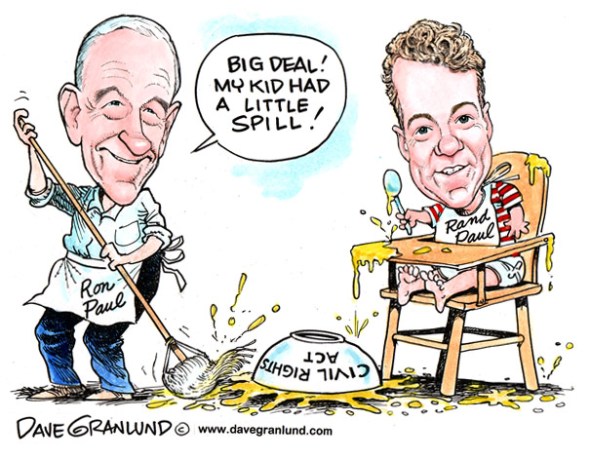
Good Morning!!
Sorry I’m posting this so late today. I’ve been pondering some issues that have been troubling me for a long time, and I keep getting stuck about how to write about them.
I’m beginning to see the libertarian influence on so-called “progressives” as a very serious problem for the future of our country. Here’s a somewhat incoherent beginning to a discussion of this problem. I’m putting this out there in the hope that I’ll get some feedback from you that will help me sort this out. So here goes…
Partial transcript:
“I’m a big admirer of Ron Paul and Rand Paul for their very principled positions in the U.S. Congress on a number of issues. They have been the strongest supporters of the fight against the U.S. attacks on Wikileaks and on me in the U.S. Congress. Similarly, they have been the strongest opponents of drone warfare and extrajudicial executions.
And so, that’s quite an interesting phenomenon in the United States. The position of the libertarian Republican–or a better description [right?]–coming from a principle of nonviolence, the American libertarian, that produces interesting results.
So, nonviolence, not going to invade a foreign country. Nonviolence, don’t force people at the barrel of a gun to serve in the U.S. Army [?? The U.S. doesn’t have a draft]. Nonviolence, don’t extort taxes from people to the Federal government, with a [policeman?]….
Similarly, other acts of nonviolence in relation to abortion that they hold. I think that some of these positions that are held by Ron Paul…I can see how they come from the same underlying libertarian principle. I think the world is often more complex. By taking a laid out principle but sometimes simplistic position, you end up undermining the principle. In the short term, visions of the principle are one thing, visions of the principle…it’s quite hard to know [inaudible].
A few comments…
It’s not clear to me whether Assange supports the Paul’s position on abortion, but clearly it’s a side issue for him–not nearly as important as the Paul’s support of Wikileaks and Assange himself, since he later said that both political parties have been compromised and the only hope for the future comes from the libertarian portion of the Republican Party. HuffPo:
He then put forth an argument against both established political parties in Washington, claiming that nearly all Democrats had been “co-opted” by President Barack Obama’s administration, while Republicans were almost entirely “in bed with the war industry.”
The current libertarian strain of political thought in the Republican Party was the “the only hope” for American electoral politics, Assange concluded.
Assange sees federal taxes as “extortion.” I assume that includes the payroll taxes that support Social Security and Medicare. He never mentions social programs at all; as a libertarian he probably opposes them. This is in line with other libertarians who are leading the fight against the U.S. government keeping any secrets whatsoever, e.g., Glenn Greenwald, Edward Snowden, Conor Frierdersdorf, and David Sirota (I’ll have more about this in a later post).
Not only does Assange not know that the U.S. doesn’t have a military draft, he’s pretty mixed up about recent U.S. history. In praising right wing racist news aggregator Matt Drudge, Assange said, via Raw Story:
“Matt Drudge is a news media innovator. And he took off about eight years ago in response to the Monica Lewinsky scandal.”
(Eight years ago was 2005, the first year of George W. Bush’s second term, when President Bill Clinton had been out of office for five years and the Lewinsky scandal and subsequent failed impeachment attempt were a matter of history.)
Assange claimed that Drudge made his name by “publishing information that the establishment media would not. It is as a result of the self-censorship of the establishment press in the United States that gave Matt Drudge such a platform and so of course he should be applauded for breaking a lot of that censorship.”
Assange says he supports non-violence. I’d like to point out that in U.S. history, one of the leading advocates of nonviolence and civil disobedience was a man named Martin Luther King. Fifty years ago King led a “March on Washington for Jobs and Freedom.” But Assange favors the Pauls’ notion of “nonviolence.” (Assange doesn’t appear to know that Ron and Rand Paul are the recipients of vast corporate donations from the defense industry.) I wonder if Assange knows that Ron and Rand Paul oppose Civil Rights laws? I wonder if he cares?
Julian Assange–along with Edward Snowden and Glenn Greenwald–is currently the idol of the “emoprogs” who have become so distracted by the NSA leaks story that they don’t even notice that Republicans have a very good chance of retaking the Senate next year. These supposed “leftists” have forgotten all about jobs, protecting social programs, women’s rights, civil rights, economic inequality, and our crumbling infrastructure in order to follow a handful of privileged, young white male libertarian pied pipers who are focused only on their own personal “liberties.”
Thursday Reads: Aftermath of SCOTUS Voting Rights Decision
Posted: June 27, 2013 Filed under: 2014 elections, Civil Rights, court rulings, Elections, morning reads, open thread, racism, Real Life Horror, Republican politics, U.S. Politics | Tags: Antonin Scalia, GOP Southern strategy, hypocrisy, Judicial Activism, SCOTUS, U.S. Supreme Court, Voter ID laws, Voting Rights Act 66 Comments
Good Morning!!
This is going to be a quickie post, because I’m feeling kind of sick this morning.
Although I’m thrilled with the DOMA decision yesterday, I still can’t get past my anger and sadness about the Supreme Court’s gutting of the Voting Rights Act. So I’m just going to post the (above) “official 2013 photo” of the U.S. Supreme Court and some accompanying links that demonstrate the damage the Court has done in its horrendous decision on the Voting Rights Act.
I’ll begin with this excellent post by Linda Greenhouse at The New York Times: Current Conditions, which neatly summarizes the Court’s “conservative” wing’s blatant “judicial activism,” to quote a frequent charge of conservatives against “liberal” judges.
These have been a remarkable three days, as the Supreme Court finished its term by delivering the only four decisions that most people were waiting for. The 5-to-4 decisions striking down the coverage formula of the Voting Rights Act and the Defense of Marriage Act will go far toward defining the Roberts court, which has concluded its eighth year. Monday’s place-holding ruling on affirmative action in higher education, although it decided very little, is also definitional, for reasons I’ll explain. There is a great deal to say about each decision, and about how each reflects on the court. My thoughts are preliminary, informed by that phrase in the chief justice’s voting rights opinion: current conditions.
By this phrase, the chief justice meant to suggest that there is a doctrinal basis for drawing a boundary around Congressional authority, for judicial insistence that a burden that Congress chooses to impose on the states has to be justified as a cure for a current problem. In the context of voting rights, an area over which the 15th Amendment gives Congress specific authority, this is a deeply problematic position that Justice Ruth Bader Ginsburg’s dissenting opinion demolishes.
Please go read the whole column–it’s difficult to get Greenhouse’s thesis into an excerpt. The blatant hypocrisy of the “conservative” justices–especially Scalia is mind-boggling, especially when the stunning effects of the Voting Rights decision on “current conditions” are already obvious and dramatic–just as were the disastrous effect of the Citizens United decision. A few examples.
The Guardian: Texas rushes ahead with voter ID law after supreme court decision
Officials in Texas said they would rush ahead with a controversial voter ID law that critics say will make it more difficult for ethnic minority citizens to vote, hours after the US supreme court released them from anti-discrimination constraints that have been in place for almost half a century.
The Texas attorney general, Greg Abbott, declared that in the light of the supreme court’s judgment striking down a key element of the 1965 Voting Rights Act he was implementing instantly the voter ID law that had previously blocked by the Obama administration. “With today’s decision, the state’s voter ID law will take effect immediately. Photo identification will now be required when voting in elections in Texas.”
Greensboro News and Record: NC senator: Voter ID bill moving ahead with ruling
Voter identification legislation in North Carolina will pick up steam again now that the U.S. Supreme Court has struck down part of the Voting Rights Act, a key General Assembly leader said Tuesday.
A bill requiring voters to present one of several forms of state-issued photo ID starting in 2016 cleared the House two months ago, but it’s been sitting since in the Senate Rules Committee to wait for a ruling by the justices in an Alabama case, according to Sen. Tom Apodaca, R-Henderson, the committee chairman. He said a bill will now be rolled out in the Senate next week.
The ruling essentially means a voter ID or other election legislation approved in this year’s session probably won’t have to receive advance approval by U.S. Justice Department attorneys or a federal court before such measures can be carried out.
Northwest Ohio.com: Voter ID and restricted early voting likely after SCOTUS ruling
ATLANTA (AP) — Across the South, Republicans are working to take advantage of a new political landscape after a divided U.S. Supreme Court freed all or part of 15 states, many of them in the old Confederacy, from having to ask Washington’s permission before changing election procedures in jurisdictions with histories of discrimination.
After the high court announced its momentous ruling Tuesday, officials in Texas and Mississippi pledged to immediately implement laws requiring voters to show photo identification before getting a ballot. North Carolina Republicans promised they would quickly try to adopt a similar law. Florida now appears free to set its early voting hours however Gov. Rick Scott and the GOP Legislature please. And Georgia’s most populous county likely will use county commission districts that Republican state legislators drew over the objections of local Democrats.
AL.com: Alabama photo voter ID law to be used in 2014, state officials say
MONTGOMERY, Alabama — Today’s U.S. Supreme Court decision clears the way for Alabama’s new photo voter ID law to be used in the 2014 elections without the need for federal preclearance, state officials said.
Alabama Attorney General Luther Strange and Secretary of State Beth Chapman said they believed the voting requirement, which is scheduled to take effect with the June 2014 primaries, can simply move forward.
“Photo voter ID will the first process that we have gone through under this new ruling,” Chapman said today.
Memphis Business Journal: Mississippi voter ID law could start next year
Voters in Mississippi may have to start showing a photo ID to vote by the middle of 2014, according to Secretary of State Delbert Hosemann.
According to the Associated Press, Hoseman spoke Tuesday after the U.S. Supreme Court ruled that certain state and local governments no longer need federal approval to change election laws. That ruling opens up the possibility that Mississippi will implement a voter identification requirement.
According to Think Progress, Arizona and South Dakota will likely be trying to pass Voter ID laws soon. I’m sue that won’t be the end of it.
Just a few more links:
Joan Walsh: The ugly SCOTUS voting rights flim-flam
Ari Berman: What the Supreme Court Doesn’t Understand About the Voting Rights Act
Stephen Hill: So the Voting Rights Act Is Gutted—What Can Protect Minority Voters Now?
I’ll end there and leave it up to you guys to link to other important news stories. What are you reading and blogging about today?
Thursday Reads: Beating the Benghazi Horse to Death and Other News
Posted: May 9, 2013 Filed under: 2014 elections, Foreign Affairs, Hillary Clinton, Libya, Medicare, morning reads, polling, Real Life Horror, Republican politics, Team Obama, U.S. Military, U.S. Politics, War on Women | Tags: Ariel Castro, Bangladesh factory collapse, Bangladesh factory fire, Benghazi hearings, Bob Corker, caffeinated gum, Darrell Issa, Ed Markey, Gabriel Gomez, Gregory Hicks, Lindsey Graham, Medicare billing, Susan Rice, Thomas Pickering 40 Comments
Good Morning!!
I got an e-mail this morning from Dakinikat saying that she arrived safely late last night and is completely exhausted. Hopefully, she’ll get to see her Dad today and give him a great big hug.
Now let’s see what’s going on in the world this morning.
I’ve got to be honest, I’m confused about the latest GOP Benghazi hearings. I have no idea what the fuss is all about, and I really don’t even want to try to figure it out. Apparently, car thief and arsonist Darrell Issa just can’t let go of Benghazi, and is going to keep right on harping on it until someone figures out a way to stop him. I’m going to highlight some articles on this “controversy,” but, as I said, I can’t really explain it.
First, the allegations of wrongdoing:
NYT: Diplomat Says Questions Over Benghazi Led to Demotion
A veteran diplomat gave a riveting minute-by-minute account on Wednesday of the lethal terrorist attack in Benghazi, Libya, last Sept. 11 and described its contentious aftermath at a charged Congressional hearing that reflected the weighty political stakes perceived by both parties.
During a chaotic night at the American Embassy in Tripoli, hundreds of miles away, the diplomat, Gregory Hicks, got what he called “the saddest phone call I’ve ever had in my life” informing him that Ambassador J. Christopher Stevens was dead and that he was now the highest-ranking American in Libya. For his leadership that night when four Americans were killed, Mr. Hicks said in nearly six hours of testimony, he subsequently received calls from both Secretary of State Hillary Rodham Clinton and President Obama.
But within days, Mr. Hicks said, after raising questions about the account of what had happened in Benghazi offered in television interviews by Susan E. Rice, the United Nations ambassador, he felt a distinct chill from State Department superiors. “The sense I got was that I needed to stop the line of questioning,” said Mr. Hicks, who has been a Foreign Service officer for 22 years.
He was soon given a scathing review of his management style, he said, and was later “effectively demoted” to desk officer at headquarters, in what he believes was retaliation for speaking up.
BBC News: Benghazi attack: Hicks ‘stunned’ at Rice explanation
After the disrupted phone call with Ambassador Stevens, Mr Hicks said he received calls from Libyans using the ambassador’s phone who said they had the envoy with them.
But Mr Hicks decided not to act on the calls, fearing an ambush.
So the “whistleblower” chose not to do anything? What is his complaint then?
UN Ambassador Susan Rice has been the focus of outrage from Republicans in Congress, for giving the news media what has been acknowledged as an incorrect explanation for the attack.
She said on a Sunday chat show on 16 September that the attack had grown out of an anti-US protest, while other officials have said they knew at the time it was an organised, armed assault, possibly by an Islamist militant group.
“My jaw dropped and I was embarrassed,” Mr Hicks said on his reaction to her interview.

I guess it’s still about Susan Rice. . . Or more likely, it’s about Hillary Clinton and attempts to hobble any plans she may have to run for president.
Washington Post: At Benghazi hearing, State Dept. officials challenge administration review of attacks
Three State Department officials on Wednesday provided a riveting, emotional account of last year’s fatal attack on U.S. installations in eastern Libya as they accused senior government officials of withholding embarrassing facts and failing to take enough responsibility for security lapses.
The testimony provided new details on the Sept. 11, 2012, assaults on U.S. installations in Benghazi and their aftermath. But the new information failed to break the political logjam the attacks spawned, with Republicans and Democrats offering starkly different interpretations of what happened and who within the U.S. government is to blame.
Chairman Darrell Issa (R-Calif.) opened the House Oversight and Government Reform Committee hearing by saying that panel Democrats had “mostly sat silent” while Republicans tried to wrest the truth from an uncooperative Obama administration.
Rep. Elijah E. Cummings (Md.), the senior Democrat on the committee, countered that Issa’s GOP majority had launched a “full-scale media campaign . . . of unfounded accusations to smear public officials.”
But in expanding the narrative of the intensely politicized episode, the witnesses raised fresh questions about whether then-Secretary of State Hillary Rodham Clinton and her deputies were sufficiently engaged in assessing the security posture of diplomatic posts last year.
Time Magazine’s Michael Crowley: Terror, Security, and Hillary 2016: Making Sense of the Benghazi Hearings
The hearing by the Republican-led House Government Oversight & Reform Committee was not the first on the events surrounding the death of the U.S. Ambassador to Libya, Christopher Stevens, and three other Americans. Hillary Clinton, who was running the State Department at the time of the attack, testified for hours back in January. But the story was given fresh dramatic life and new narrative details through the testimony of two self-described whistle blowers who had not previously spoken in public: Mark Thompson, acting deputy assistant secretary for counterterrorism; Gregory Hicks, the former deputy of mission in Libya. Joining them was Eric Nordstrom, a former regional security officer in Libya, who had previously testified on the issue.
But “[c]ould the U.S. military have done more to help?”
Not according to the Pentagon – and the hearing’s key witness. Aircraft that might have buzzed the compound where the second pair of Americans died – and scared the militants away — were 900 miles north in Italy. “Time and distance are a tyranny of their own,” Admiral James Stavridis, who responded to the attacks as the NATO commander, told Congress earlier this year. Army General Martin Dempsey, chairman of the Joint Chiefs of Staff, estimated it would take as long as 20 hours to get the planes above Benghazi. Hicks testified that he asked the U.S. defense attaché in Tripoli if planes could be scrambled to help those under attack in the CIA annex in Benghazi, a battle that unfolded hours after the initial assault on the nearby U.S. consulate, which killed Stevens, and led to two more American deaths. “He said that it would take two to three hours for them to get on site, but that there also were no tankers available for them to refuel,” Hicks said Wednesday. “And I said, ‘Thank you very much,’ and we went on with our work.” Hicks also testified that a four man team of Green Berets in Tripoli were denied a request to deploy to Benghazi the morning after the attack began, though officials doubt they could have arrived early enough to save lives at the CIA annex.
Apparently the complaint is that the State Department didn’t order all military resources to get to Benghazi even though there was no way they could have gotten there in time to do anything to help?
So we’re back to preventing Hillary 2016?
Whether or not Republicans intended it, the shadow of national politics loomed over Wednesday’s hearing. Hillary Clinton completed a generally well-reviewed tenure of Secretary of State, as evidenced by her sky-high public approval ratings. But Benghazi is a clear black mark on her Foggy Bottom record, one that could haunt Clinton if she runs for president in 2016. Conservatives seized on Hicks’s testimony that, in a call with Clinton on the fateful night, he told her that a terrorist attack was underway–a fact that was slow to appear in the administration’s public rhetoric. Still, despite repeated discussion about what Clinton knew and when she knew it, no smoking gun emerged from Wednesday’s hearing, leading one Congressional Democrat to dismiss questions about her role as a “witch hunt.”
I guess that’s pretty much what it’s all about . . . A few more links:
Think Progress: Benghazi Review Board Chair Says Notion Of Cover Up Is ‘Pulitzer Prize Fiction’
“I think the notion of a quote, cover up, has all the elements of Pulitzer Prize fiction attached to it,” former Ambassador Thomas Pickering said on MSNBC. He also rebutted claims that the review board tried to protect former Secretary of State Hillary Clinton from scrutiny:
PICKERING: I saw no evidence of it. She did publicly take responsibility for what happened below her and indeed one of the things the Congress did in preparing the legislation that established the Accountability Review Board was to say we don’t want a situation where heads of agencies take responsibility and then nobody who made the decision in the chain has to suffer any consequences for failure for performance. I believe in fact the Accountability Review Board did it’s work well. I think the notion of a quote, cover up, has all the elements of Pulitzer Prize fiction attached to it.
Pickering offered to testify at the latest hearing, but Chairman Issa wouldn’t let him.
Think Progress: GOP Star Witnesses Debunk Right-Wing Benghazi Conspiracy Theories
The “whistleblowers” at today’s House Oversight Committee hearing on what really happened in Benghazi, Libya last September were supposed to break the dam that would lead to President Obama’s eventual downfall, in the eyes of conservatives. Instead, these witness actually served to debunk several theories that the right-wing has pushed on Benghazi, leaving the hearing a fizzle for the GOP.
Read the explanations at the link.
TPM: Top Republican ‘Fairly Satisfied’ With White House’s Account Of Benghazi
Senate Foreign Relations Committee Ranking Member Bob Corker (R-TN) said Wednesday that he’s “fairly satisfied” with the Obama administration’s account of events that led to the deaths of American diplomats in Benghazi last year.
“We need to know were these people culpable or not. If they were, why are they still on the payroll? Other than that, I’ve been able to read all the cables. I’ve seen the films,” Corker told MSNBC. “I feel like I know what happened in Benghazi. I’m fairly satisfied.”
He cautioned House Republicans to be “respectful” if they probe the issue further.
“Look, if the House wants to have hearings,” he said, “I hope they’re done in a respectful way and hopefully it will shed some light on what happened.”
I guess that’s enough about Benghazi. I apologize for giving it so much space, but I thought if I were confused about this, some of you might be too.

A bit more news in the form of a link dump:
There has been another factory fire in Bangladesh! Reuters reports: Bangladesh factory fire kills eight; collapse toll tops 900
A DailyKos diary deals with a question that has been rattling around in my head: How did Jason Richwine Get a PhD from Harvard?
WBUR Boston University (NPR): Markey Edges Gomez In WBUR Senate Poll
The Hill on Suffolk University Poll: Markey builds strong lead over Gomez in Mass. Senate race
I realize the media is dying for another Scott Brown surprise, but it’s just not gonna happen.
Politico: Lindsey Graham faces down primary challenge
Unfortunately, it looks like Huckleberry Closetcase will be back in 2014.
Politico: Excessive student loan debt drains economic engine
Chicago Tribune: Cleveland kidnapping: Bond for Ariel Castro set at $8 million
Why is he getting any chance of getting out on bail??
Reuters: Wrigley halts production of caffeine gum following FDA concern
Could there be a worse idea by the candy industry? Kids would be getting that gum!
NYT: Hospital Billing Varies Wildly, Government Data Shows
Sooooo . . . what’s new with you? What are you reading and blogging about today? Please share your links on any subject in the comment thread!
Tuesday Mid-Morning Reads: Immigration Reform, Aaron Swartz Prosecution, and Much More
Posted: January 29, 2013 Filed under: 2014 elections, Barack Obama, morning reads, Republican politics, Tea Party activists, U.S. Politics | Tags: Aaron Swartz, Carmen Ortiz, Harvey Silverglate, immigration reform, Middlesex County (MA) DA, Mitch McConnell, Wikileaks 55 Comments
Good Morning Everyone!!
The media talking heads are going on and on about the supposed “bi-partisan agreement” on Immigration reform. I’m not really clear on what policies have been “agreed” on, but frankly, I’ll believe it when I see it. TPM reports: Gang Of 8’s Path To Citizenship Is Still A Rocky Road.
While reformers are excited that a path to citizenship for illegal immigrants is the centerpiece of the Senate’s new bipartisan immigration deal, it’s still unclear just how accessible that path will be for the undocumented population.
Without the proper components, experts warn the Senate plan could be the beginning of a long process to bringing illegal immigrants fully into American society, one that could take not years but decades.
So what does the process involve?
Under the plan, undocumented immigrants would receive a probationary status if they pass a criminal background check, pay a fine, and pay any back taxes owed to the government. After that, they’d have to wait to apply for permanent residency – a prerequisite to citizenship – until after a series of border security measures go into effect.
None of the new border measures, which will be overseen by a commission of southwestern state officials and community leaders, appear too difficult to implement at first glance (although there are concerns as to how much power conservative state politicians would wield in the process). The big question is what comes next when 11 million newly legal immigrants apply for a green card.
According to the framework, these applicants will then be required to “go to the back of the line of prospective immigrants.” But for many of them, a clear line doesn’t actually exist at the moment. Individuals can apply for green cards through a number of categories, mostly based on having family already in the country or on their employment status, which experts say are inadequate to the task of absorbing so many immigrants at once.
Greg Sargent says that the assumption that conservative Southern governors will control the process because they will be the ones to certify that the border is secure is “not true.”
I’ve now got clarification from Senate staff working on the bill, and it turns out that the enforcement commission’s judgments will only be advisory, and are entirely nonbinding. Congress’ actions will not be dictated by what this commission concludes; neither will actions taken by the Department of Homeland Security. The citizenship process will be triggered by other means (more on this soon).
This is central to the debate. If this commission had the power to dictate when the citizenship process begins, it could endanger the entire enterprise by giving people like Jan Brewer veto power. Second, this enforcement commission is being seen as a major concession Republicans won in exchange for agreeing to grant citizenship to the 11 million.
So what did Republicans get in this deal then?
The concessions Republicans got in this deal — in exchange for agreeing to citizenship for 11 million — include beefed up border security, a new program designed to help employers verify their employees’ status, tougher checks on immigrants overstaying visas, and the need for undocumented immigrants to go to the end of the immigration line.
Meanwhile, President Obama will roll out his own, supposedly “more liberal” immigration reform plan beginning today in a speech in Las Vegas.
The Obama administration has developed its own proposals for immigration reform that are more liberal than a separate bipartisan effort in the Senate, including a quicker path to citizenship for illegal immigrants, people with knowledge of the proposals said.
President Obama is expected to provide some details of the White House plans during a Tuesday appearance in Las Vegas, where he will call for broad changes to the nation’s immigration laws. The speech will kick off a public push by the administration in support of the broadest overhaul of immigration law in nearly three decades.
Obama plans to praise the proposals laid out Monday by an eight-member Senate working group, saying they reflect the core tenets of the administration’s immigration blueprint developed in 2011, a senior administration official said.
But the president’s remarks also are likely to emphasize differences that could foreshadow roadblocks to passage in Congress at a time when both parties say there is momentum for a comprehensive deal.
Naturally, the wingnuts in the House will provide roadblocks galore for whatever plan the Senate approves. Read all about it at Politico.

Politico reported yesterday on a possible collaboration between the Tea Party and Democrats in Kentucky to dump Senate Minority Leader Mitch McConnell.
Big Democratic donors, local liberal activists and a left-leaning super PAC in Kentucky are telling tea partiers that they are poised to throw financial and organizational support behind a right-wing candidate should one try to defeat the powerful GOP leader in a 2014 primary fight.
The idea: Soften up McConnell and make him vulnerable in a general election in Kentucky, where Democrats still maintain a voter registration advantage. Or better yet, in their eyes: Watch Kentucky GOP primary voters nominate the 2014 version of Todd Akin or Richard Mourdock, weak candidates who may actually lose.
Interesting… Once again, I’ll believe it when I see it. Still, anything is possible. Plus McConnell is very unpopular in his home state according to the latest poll
With his re-election bid just a year away, those opposed to U.S. Sen. Mitch McConnell outnumber his supporters 2-1 among Kentucky voters, according to the latest Courier-Journal Bluegrass Poll.
In the poll of 609 registered voters, 34 percent said they plan to vote against McConnell — while just 17 percent say they will vote to give him six more years. Forty-four percent said they will wait to see who is running against him before deciding, and 6 percent said they are not sure.
The poll, conducted by SurveyUSA, has a margin of error of plus or minus 4.1 percentage points. It comes as groups on both McConnell’s right and left seek candidates to challenge him in the primary and general elections in 2014. McConnell, the most powerful Republican in the Senate as minority leader, is seeking his sixth term.
More information is coming out
about the over-the-top prosecution that probably contributed to the suicide of genius cyber-activist Aaron Swartz. Rolling Stone reports:
Swartz’s friends and family have said they believe he was driven to his death by a justice system that hounded him needlessly over an alleged crime with no real victims. “[He was] forced by the government to spend every fiber of his being on this damnable, senseless trial,” his partner Taren Stinebrickner-Kauffman said at the memorial, “with no guarantee that he could exonerate himself at the end of it.”
Two zealous federal prosecutors handled Swartz’s case: U.S. district attorney Carmen Ortiz and assistant attorney Stephen Heymann. In the days after his death, writers, tech experts, and many of Swartz’s friends have called out Heymann and Ortiz for prosecutorial overreach. A White House petition demanding the removal of Ortiz garnered well over 25,000 signatures, reaching the level which guarantees an eventual response from the Obama administration.
Carmen Ortiz
Some of Swartz’s advocates believe the prosecution sought excessive punishment to set an example in the age of Wikileaks and Anonymous.

Declan McCullough writes at CNet that when Swartz’s case was being prosecuted by the Middlesex County DA’s office, there was no thought of sending Swartz to prison for what was essential a minor, victimless crime.
State prosecutors who investigated the late Aaron Swartz had planned to let him off with a stern warning, but federal prosecutor Carmen Ortiz took over and chose to make an example of the Internet activist, according to a report in Massachusetts Lawyers Weekly.
Middlesex County’s district attorney had planned no jail time, “with Swartz duly admonished and then returned to civil society to continue his pioneering electronic work in a less legally questionable manner,” the report (alternate link) said. “Tragedy intervened when Ortiz’s office took over the case to send ‘a message.'”
The report is likely to fuel an online campaign against Ortiz, who has been criticized for threatening the 26-year-old with decades in prison for allegedly downloading a large quantity of academic papers. An online petition asking President Obama to remove from office Ortiz — a politically ambitious prosecutor who was talked about as Massachusetts’ next governor as recently as last month.
Ortiz no longer has a political future, and other abuses of power by her office are now coming out. Read more at the link. I posted links to more damning information about Ortiz in a recent post.
The Massachusetts Lawyers’ Weekly post by Harvey Silverglate is behind a paywall, but it has been republished with permission at Media Nation.

Aaron Swartz
Silverglate writes:
The ill-considered prosecution leading to the suicide of computer prodigy Aaron Swartz is the most recent in a long line of abusive prosecutions coming out of the U.S. attorney’s office in Boston, representing a disastrous culture shift. It sadly reflects what’s happened to the federal criminal courts, not only in Massachusetts but across the country….
the palpable injustices flowing regularly out of the federal criminal courts have by and large escaped the critical scrutiny of the lawyers who are in the best position to say something. And judges tend not to recognize what to outsiders are serious flaws, because the system touts itself as the best and fairest in the world.
Since the mid-1980s, a proliferation of vague and overlapping federal criminal statutes has given federal prosecutors the ability to indict, and convict, virtually anyone unfortunate enough to come within their sights. And sentencing guidelines confer yet additional power on prosecutors, who have the discretion to pick and choose from statutes covering the same behavior.
This dangerous state of affairs has resulted in countless miscarriages of justice, many of which aren’t recognized as such until long after unfairly incarcerated defendants have served “boxcar-length” sentences.
Aaron Swartz was a victim of this system run amok. He was indicted under the Computer Fraud and Abuse Act, a notoriously broad statute enacted by Congress seemingly to criminalize any use of a computer to do something that could be deemed bad.
If you care about this issue, please go read the whole thing. Read Charles Pierce’s take on it here.
There have been some reports that Swartz had contacted Wikileaks’ Julian Assange and could possibly have been working with the organization, but it’s not clear what Swartz could have leaked to them. I can’t imagine Wikileaks being interested in distributing a bunch of academic journal articles that are already available to millions of people from numerous sources. Nevertheless, the Feds are so obsessed with Wikileaks and cyber-security generally that that could have led to their taking over Swartz’s case.
I have a number of other suggested reads that I’ll list link dump style.
Bloomberg: The Fed Is More Out of It Than You Thought It Was
HuffPo: Treasury Disregarded Own Guidelines, Allowed Executive Raises At Bailed-Out GM, AIG: Report
LA Times: A third of Barnes & Noble stores may close in next decade, report says
Alex Pareene at Salon: 3 reasons to be skeptical that immigration reform will pass /
Irin Carmon at Salon: Is abortion about women?
Time: Barbara Walters Has the Chicken Pox
CBS Crimesider: JonBenet Ramsey Case: Grand jury voted to indict parents in 1999, prosecutor refused to sign
USA Today: Iran says it launched a monkey into space (Video)
NYT: The Preppers Next Door – The Doomsday Preppers of New York
ABC News: Bigfoot: Is Mysterious Screech Sasquatch? (Hey, is Bigfoot really any weirder than the Tea Party Republicans? I don’t think so.)

 peej
peej Carissa
 bostonboomer
 dakinikat
 ecocatwoman
 mablue2
 Mama Lopez
 peggysue22
 quixote
 skydancingguestblogger
 Mona (aka Wonk the Vote)



 Sky Dancing
Recent Comments