
Breaking: “Milwaukee calls in extra poll workers amid heavy turnout”
Posted: June 5, 2012 Filed under: 2012 elections, U.S. Politics | Tags: Milwaukee, poll workers, voter turnout, Wisconsin recall election 13 Comments
Breaking news from the All Politics Blog at JS Online:
Heavy turnout in Milwaukee led the city Election Commission to call out the reserves Tuesday.
Extra poll workers were sent to polling places at Becher Terrace, Bradley Tech High School, Keenan Health Center, Morse Middle School, Rufus King International School Middle Years Campus and Cass Street, 53rd Street, Grantosa and Parkview schools, said Sue Edman, the election commission’s executive director.
The backup workers were needed to handle long lines, partly because a significant number of new voters were registering at the polls, Edman said.
“We knew things would be busy, but we didn’t know how busy,” Edman said.
In some cases, poll workers were shifted from less-crowded polling places to busier ones, Edman said. In other cases, she used poll workers who had agreed to be on call or city administrators who had volunteered to help out, she said.
According to John Nicols on the Ed Schultz radio show, these are African American areas, and there are many first-time voters showing up.
This is an open thread.
Tuesday Reads: Wisconsin Recall Madness!
Posted: June 5, 2012 Filed under: 2012 elections, Labor unions, morning reads, Populism, Psychopaths in charge, Reproductive Rights, Republican politics, Right to Work, Tea Party activists, The DNC, the GOP, the villagers, U.S. Economy, U.S. Politics | Tags: Chris Cillizza, grass roots activism, InTrade, John Nichols, Koch Brothers, PPP polling, public employee unions, Rebecca Kleefisch, Scott Walker, Tom Barrett, voter turnout, Wisconsin recall election 65 Comments
Good Morning!!
Today is the day of reckoning for Wisconsin. Voters will go to the polls today to decide the fate of Governor Scott Walker and five other Wisconsin Republicans: the Lieutenant Governor and four state senators. If the Democrats can win just one of those seats, they will regain the senate majority.
I think everyone here knows the genesis of this recall battle, but here’s a quick explainer from Chris Cillizza at the WaPo. Cillizza also speculates on possible surprising outcomes from the election.
Cillizza allows that Barrett could conceivably win and the Democrats could retake the senate–the latest poll by PPP had Walker leading by only 3 points, within the margin of error. The poll also suggested that Barrett had the momentum as of yesterday. On the other hand, InTrade had Walker’s chances at more than 90% late last night. The truth is no one really knows for sure, because the turnout and enthusiasm on each side will tell the tale. Cillizza, being a Villager, still thinks Walker will win, but thinks the Senate could switch.
When they filed petitions to recall Walker himself last fall, Democrats also filed papers to recall another four state senators — Senate Majority Leader Scott Fitzgerald, and Sens. Pam Galloway, Terry Moulton and Van Wanggaard, (Galloway resigned earlier this year; Republican state Rep. Jerry Petrowski is running for her seat.)
They need only win one race to take control.
Fitzgerald is likely safe given his heavily Republican district, although Lori Compas, his Democratic rival, has attracted a lot of media attention.
But Democrats are bullish on the races against Moulton and Wanggaard. Both districts went for President Obama in 2008; Wanggaard’s went narrowly for John Kerry in 2004. Whether Barrett wins or not, they expect to take back the state Senate.
Moulton faces former state Rep. Kristen Dexter; Wanggaard faces former state Sen. John Lehman (D). Outside groups have spent hundreds of thousands of dollars on both sides. State Rep. Donna Seidel (D) also has a shot at beating Petrowski; before Galloway the seat had gone Democratic for two decades.
Cillizza points out that if Barrett wins and the Democrats take the state senate and could get some of the Walker legislation overturned before another election could give the senate back to the Republicans. The other possibility, Cillizza mentions is that Democrats could defeat Walker’s Lt. Governor Rebecca Kleefisch, but that’s pretty unlikely. She’s leading in the polls at the moment.
The Seattle Times had a good article on Sunday about the national issues that are at stake in the election today.
Under fire for cutting budgets at the expense of public employees, Walker would be the third governor in U.S. history yanked from office in a recall election. Walker has an edge, but the race is close.
The campaign will mean more than who governs Wisconsin. It’s a test case of the larger clashes in American politics that are driving elections for the presidency and control of Congress, highlighting divisions over the costs of government.
With more than $30 million raised from conservative donors, many of them from other states, and visits from a who’s who of high-profile Republican governors (New Jersey’s Chris Christie, South Carolina’s Nikki Haley, Louisiana’s Bobby Jindal and Virginia’s Bob McDonnell), Walker’s campaign to survive the recall has the feel, the money and the stakes of a national race.
The state vote is raising questions that will echo nationwide. Can a tough-minded conservative Republican force cuts in government at the risk of angering public-employees unions and win a swing state such as Wisconsin? Will voters think he’s doing the best he can in a tough time? Or will they rise in a grass-roots backlash against the well-financed Republican effort?
Admittedly, that article has a Republican flavor, but it does do a pretty good job of spelling out the issues. For a more left-wing perspective, here’s a lengthy piece at by Sarah Jaffe of Alternet: Wisconsin’s Recall Drama Down to Nail-Biting Finish.
Wisconsin’s recall is, as reporter John Nichols put it, the kind of “renegade politics” that are disdained by the national Democratic party and even some state Democrats. It is being driven by the same activists who turned out by the thousands to occupy their capitol when Governor Scott Walker attacked workers’ right to organize and bargain collectively.
Now, a day before the biggest recall yet—of Governor Walker, Lieutenant Governor Rebecca Kleefisch, and four Republican state senators—the fight will be won or lost where it began: on the ground.
There’s a lot of big outside money pouring into Wisconsin, mostly to pump up Walker’s attempt to hang on to his seat, but the one thing that money can’t buy is an excited, driven grassroots movement. If Milwaukee mayor Tom Barrett beats Walker on Tuesday, it will be because of thousands of volunteers getting out the vote person by person.
“This is really a case of Walker raising $13 million against possibly the most widespread grassroots get-out-the-vote effort in the state’s history,” Matt Reiter, co-president of the Teaching Assistants’ Association at the University of Wisconsin at Madison, told AlterNet.
Please try to check that one out. It’s long, and very informative. John Nichols of The Nation (mentioned prominently in Jaffe’s piece) is Wisconsin native, and has written a book about the struggle in his home state. Here’s a piece Nichols wrote yesterday: How To Buy A Recall Election.
Governor Scott Walker is not trying to win the Wisconsin recall election that will be held June 5.
He is trying to buy it.
If the embattled governor does prevail, he will provide essential evidence not of his own appeal but of the power of money to define our politics.
On the other hand, if Walker is defeated, a template will have been developed for a people-power, message-power politics that might be able to challenge big money.
And there is no question that what is in play is very big money.
Read the gory details at the link.
At Salon, Josh Eidelson writes about the possible effects of some Wisconsin voters’ “resentment” of union workers on the recall outcome.
If Scott Walker survives tomorrow’s election, there will be plenty of reasons. Many people will point to his huge cash advantage, for good reason. But no factor will have been more important than the decades of decline in U.S. union membership.
“Unions had their place,” a woman named Jerri told me soon after I arrived in Wisconsin last week. “They did their part back in the ‘40s and ‘50s, and then they got too big, and are abusing their power.” Jerri and her husband, Tim (both declined to give last names), were eating at a bar in Wauwatosa, the purple Milwaukee suburb that’s home to Scott Walker. They both work in sales: She’s in retail at the mall; he’s in wholesale, selling caskets. Tim said Walker’s union “reforms” were necessary because local politicians had been “looking out for the union” instead of “people like me.” He said unions are for people who don’t “feel they should have to work very hard.” Jerri complained that unions “are sucking off my teat.” Public workers’ benefits, she said, “should be the same as anybody in any kind of private job.”
That last statement is most telling. While resentment toward unions has grown since the 1950s, it’s not because they got too big. It’s because they got too small. A multi-decade drop in unionization left fewer Wisconsinites who are union members or live in union households. Meanwhile, because governments are less prone than businesses to terrorize workers or shut down facilities to avert unionization, public sector unionization has remained more stable. In 2009, for the first time, there were more total U.S. union members in government employment than in the entire private sector.
That one is pretty scary for those of us who care about quality education and public services.
The Wall Street Journal highlights the importance of turnout in the recall election.
Both sides say few voters remain undecided, after more than $63.5 million in political spending saturated the airwaves and clogged voters’ mailboxes. A weekend survey by the Democratic group Public Policy Polling found Mr. Walker holding a slight lead and only 3% of likely voters undecided. With few voters left to persuade, the main question is which side will win the turnout battle.
Labor groups and their allies knocked on more than 300,000 doors during the past few days and placed more than 400,000 phone calls, said Brian Weeks, the assistant political director for the American Federation of State, County and Municipal Employees union.
Unions historically have had a strong ground game. But Republicans said they took a page from labor’s playbook and have developed a coordinated get-out-the-vote effort, which could also give the party a boost in the November presidential election, helping the GOP equal the Democrats’ election-day machinery.
Felicia Sonmez and Rachel Weiner of the WaPo write about the battle of “TV ad spending vs. boots on the ground.” They say that this election:
serves as a proxy for the national battle between Democrats’ much-touted ground organization and Republicans’ fundraising advantage.
With Walker ahead in the polls and leading Milwaukee Mayor Tom Barrett (D) in the money race by more than 7 to 1 – and with GOP-aligned outside groups far outspending their counterparts across the aisle — Democrats maintain that their shot at victory depends on a far superior get-out-the-vote operation buoyed in large part by organized labor.
According to Monica Davey at the NYT,
About 60 to 65 percent of Wisconsin residents of voting age are expected to go to the polls on Tuesday, the state’s Government Accountability Board said. That would be a higher turnout than two years ago, when Mr. Walker and a wave of Republicans largely swept state and federal offices here, but not as high as the more than 69 percent turnout in 2008, when Barack Obama easily won the state.
Only time will tell. We’ll have a live blog this evening so we can follow the results together. Now I need you to let me know what else is in the news. I look forward to clicking on your links.
Elizabeth Warren Wins Endorsement of Massachusetts Democrats; Won’t Face Primary Opponent
Posted: June 2, 2012 Filed under: 2012 elections, U.S. Politics | Tags: Elizabeth Warren, Massachusetts Senate seat, Scott Brown, Ted Kennedy 37 Comments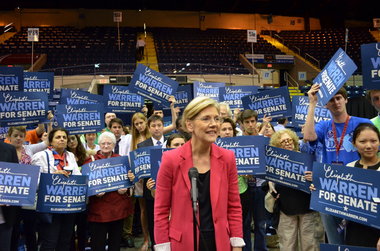
Elizabeth Warren has won the endorsement of the Massachusetts Democratic Party at their Convention today in Springfield. She is now the official candidate of the Party and will not need to face a primary opponent.
Democratic U.S. Senate candidate Elizabeth Warren won her party’s overwhelming endorsement on Saturday, shutting out a potential primary election opponent and becoming the presumptive nominee to face Republican Sen. Scott Brown in what is expected to one of the nation’s most expensive and closely-watched Senate races.
Warren won the votes of 95.7 percent of the more than 3,500 delegates to the state Democratic convention, the largest margin of any candidate in a contested race in the party’s history.
Marisa DeFranco, an immigration attorney from Middleton, had waged a longshot campaign for Senate but finished far below the 15 percent she needed under party rules to get on the September primary ballot. Democratic party chair John Walsh had said as early as Saturday morning that he expected DeFranco to reach the threshold.
Warren is still dealing with the Breitbart-inspired attacks on her claim of Native American ancestry, and she referred to right wing smear campaign in a a “feisty” speech today, according to The New York Times.
“It’s a long way from Ted Kennedy to Scott Brown,” Ms. Warren said in a feisty speech here on Saturday to the roughly 3,500 delegates to the state convention, invoking the name of the lionized Democrat. Mr. Kennedy’s death in 2009 led to the special election in which Mr. Brown won the seat.
She also dismissed the controversy in which her campaign has been mired for more than a month — whether she unfairly claimed American Indian ancestry to advance her academic career.
“If that’s all you’ve got, Scott Brown, I’m ready,” she declared to cheers. “And let me be clear. I am not backing down. I didn’t get in this race to fold up the first time I got punched.”
Hang in there, Liz! You’ve got what it takes.
Disenfranchising Voters is Downright UnAmerican!
Posted: May 7, 2012 Filed under: 2012 elections, Voter Ignorance | Tags: voter disenfranchisement 23 Comments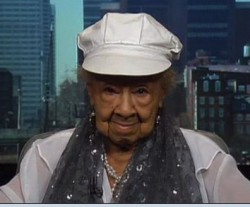 Viviette Applewhite is set to be the face and voice of voter disenfranchisement. She’s a 93 year old grandmother who voted for JFK in her first election. Ms. Applewhite is suing Pennsylvania for its new restrictions on voters according to Think Progress.
She will be the plaintiff in the voter identification lawsuit being filed by the ACLU and the NAACP in the state, which claims that “the state’s voter photo ID law violates the Pennsylvania Constitution by depriving citizens of their most fundamental constitutional right – the right to vote.”
Applewhite no longer has a copy of her birth certificate, and she does not have a drivers’ license. Without either of these things, the new Pennsylvania restrictions say that she is ineligible to vote.
But her circumstances are not at all uncommon. African Americans, especially elderly African Americans, are disproportionately less likely to have a birth certificate.
According to the Brennan Center for Justice:
Twenty-five percent of African-American voting-age citizens have no current government-issued photo ID, compared to eight percent of white voting-age citizens.
Harsh voter ID laws, which former President Bill Clinton characterized as the most serious threat of disenfranchisement since Jim Crow laws, have been passed in Alabama, Georgia, Indiana, Kansas, Missouri, Pennsylvania, Tennessee, Texas, and Wisconsin. Twenty four other states are trying to pass similar laws.
Creating False Equivalencies and other Nasty Campaign Tricks
Posted: May 5, 2012 Filed under: 2012 elections, 2012 presidential campaign, 2012 primaries, Voter Ignorance | Tags: the politics of personal destruction 18 CommentsPolitics has always been an ugly business in America. All you have to do is follow the lives of John Adams, Thomas Jefferson, or Andrew Jackson to get some idea of 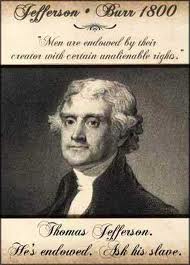 how the personal can be turned into the ugly political. Rumor becomes fact. Innuendo becomes headlines. Character assassination becomes de rigueur. It’s hard to know exactly when modern politics went over the edge. I would definitely have to point to folks like Karl Rove, Newt Gingrich, and Frank Luntz. Although, Donald Segretti comes to mind too. The age of social media and blogs has created a sleaze industry. Andrew Breithbart was the sheistermeister of the internet and his site and sites like Red State continue the tradition of creating tropes, memes and canards to sucker an uninformed electorate. AM radio and Fox News certainly don’t raise the standard either. Sleazy politics is on steroids these days.
The funny thing is that some things do speak of character and other things appear to be manufactured to create faux outrage. I frankly believe that strapping your sick dog on the roof of your car for a long trip says something about your decision making and your humanity. I don’t think a small child in a third world country eating dog meat because that’s what he’s been given to eat by his parents to be an equivalent morality play.
We are clearly in the swift boat age. Right after the attack on 9-11 the politicizing of the event took off. It was bound to happen. I used to keep track of the number of times that Dubya used the term “lessons of 9/11” to justify torture, invasion of a country that had nothing to do with the attack on 9/11, and signing into law severe restrictions on our civil liberties and personal privacy. Every single SOTU address and re-election stump speech always contained the phrase “lessons of 9/11”. I’m actually pretty outraged that the Romney and some elected officials think they’re innocent of trumping up the “lessons of 9/11” while accusing the President of Politicizing the Bin Laden killing. Meanwhile, they’re politicizing the situation with a Chinese dissident while the Secretary of State is in active negotiations with the Chinese Government on the status of the dissident and his family.
All of this just drives me nuts.
The newest of these trumped up faux outrage moments is now called “Elizabeth Warren’s Birther Movement”.
If you are 1/32 Cherokee and your grandfather has high cheekbones, does that make you Native American? It depends. Last Friday, Republicans in Massachusetts questioned the racial ancestry of Elizabeth Warren, the Democratic Senate candidate. Her opponent, Senator Scott Brown, has accused her of using minority status as an American Indian to advance her career as a law professor at Harvard, the University of Pennsylvania and the University of Texas. The Brown campaign calls her ties to the Cherokee and Delaware nations a “hypocritical sham.”
In a press conference on Wednesday, Warren defended herself, saying, “Native American has been a part of my story, I guess since the day I was born, I don’t know any other way to describe it.” Despite her personal belief in her origins, her opponents have seized this moment in an unnecessary fire drill that guarantees media attention and forestalls real debate.
This tactic is straight from the Republican cookbook of fake controversy. First, you need a rarefied elected office typically occupied by a certain breed of privileged men. Both the Presidency and the Senate fit this bill. Second, add a bit of interracial intrigue. It could be Kenyan economists eloping with Midwestern anthropologists, or white frontiersmen pairing with indigenous women. Third, throw in some suspicion about their qualifications and ambitions. Last but not least, demand documentation of ancestry and be dissatisfied upon its receipt. Voila! You have a genuine birther movement.
The Republican approach to race is to feign that it is irrelevant — until it becomes politically advantageous to bring it up. Birthers question Obama’s state of origin (and implicitly his multiracial heritage) in efforts to disqualify him from the presidency. They characterize him as “other.” For Warren, Massachusetts Republicans place doubts on her racial claims to portray her as an opportunistic academic seeking special treatment. In both birther camps, opponents look to ancestral origins as the smoking gun, and ride the ambiguity for the duration.
My children are 1/4 Japanese. My youngest daughter has absolutely no physical traits that would lead you to believe she has a Japanese Grandmother. My oldest daughter definitely has the mixed race look. But that’s not the point. Neither is the actual fraction or what’s historically been called the number of ‘drops of blood’.
Both of my children have a mixed identity because we fully embraced my husband’s mixed ancestry. We eat Japanese food. The kids went to Japan school for a period of time and can speak and write a bit of Japanese. My mother-in-law lived with us and our home was filled with her cooking, her language, and her upbringing. The girls also know about their family history from Japan and they’ve explored its culture. We also talk about a lot of different things including that my uncle was very responsible for the argument on the Japanese Internment policy to the Supreme Court for the Roosevelt Administration and that another uncle by marriage on my father’s side lost a cousin to the Baatan Death March. His aunt was appalling rude to my husband every time we went to family reunions. Both heritages are a party of our family story and our family traditions. We discuss the anti-Japanese hysteria of the World War 2 period, the Japanese War atrocities, and the H Bombs that ended the war as well as my mother-in-law’s experience as a starving teenager in Kyoto who had to smuggle rice in her kimono. All of this is a part of our heritage as melting pot Americans. When I first walked to the counter of the Japanese Grocery store here in New Orleans with my items I was told “You shop like Japanese housewife.” I am genetically as WASPY as they come. That’s what comes from being brought into a culture as a teen and surrounded by it for 20 years. There’s a very real part of me that IS Japanese now. I am a New Orleanian after 16 years living in the inner city of New Orleans and being surrounded by all if its rich heritage and neighborhoods. These identities will stay with me no matter where I go.
That’s the deal to me. If Elizabeth Warren feels connections to her Native American Ancestry and if its part of her family story and tradition, do we really need to question if her ‘drops of blood’ justify her connection and her identity?
Discussing real issues and real moral character is difficult in this age of swift boating, contrived outrage, and false equivalencies. It’s especially difficult because so many groups can get access to money and the media and push through some pretty outrageous tropes. Unfortunately, most of these tropes are head line grabbers and the customer-hungry media will jump on it and ride it as long as possible. It is really shameful that the noble pursuit of maintaining a healthy democracy seems to include such manufactured tit-for-tat. US voters deserve better.

 peej
peej Carissa
 bostonboomer
 dakinikat
 ecocatwoman
 mablue2
 Mama Lopez
 peggysue22
 quixote
 skydancingguestblogger
 Mona (aka Wonk the Vote)



 Sky Dancing
Recent Comments