
Late Night Gas Pump Shock
Posted: April 13, 2011 Filed under: Economy | Tags: high gas prices, speculation, US economic recovery 27 Comments I’m pretty happy that the mighty mustang is parked out front and staying there for the most part. Every time I do make it out, I nearly faint from the changes that I see in gas prices. I thought I’d share some links with you about what’s going on.
First, from Reuters: High gas prices hurt U.S. confidence: Reuters/Ipsos poll. It could also hurt the President’s approval rating.
Rising U.S. gasoline prices have damaged confidence in the country’s future and forced Americans to change their spending habits and lifestyles, a Reuters/Ipsos poll released on Wednesday found.
The proportion of people who believe the United States is on the wrong track jumped 5 points to 69 percent from March, the poll found, the highest wrong-track figure in an Ipsos poll since President Barack Obama took office in January 2009.
More than six of every 10 Americans have cut back on other expenses and reduced their driving as a result of the rising gas prices caused by tumult in North Africa and the Middle East.
The increase in energy costs also hurt Obama’s approval rating, which dipped for the second consecutive month to 46 percent — his lowest Ipsos poll rating since early December 2010.
“That’s all a function of gas prices. People are feeling the pinch at the pump,” said Ipsos pollster Cliff Young.
“Increased gas prices have a direct impact on the pocketbook, and there is very little lag time between rising gas prices and its effect on presidential approval and confidence,” he said.
There’s also some concerns that higher gas prices could hurt this very anemic recovery. Gas is one of those expenditures that folks usually can’t avoid without buying a better vehicle or getting a different commute to work. That means in the short run, high gas prices hurt people because they can’t adjust to them easily.
Gasoline prices are soaring toward $4 a gallon, a threshold that some analysts say will damage the fragile economic recovery and crimp consumer spending just as families are planning their summer vacations.
Higher prices saddle businesses with higher transportation costs, causing them to either swallow them or pass them along to already strapped customers. As gasoline costs go up, consumers are left with less money to spend elsewhere. And there is evidence that the hike at the pump is beginning to push drivers off the road.
Gasoline prices, which are approaching record levels, “are going to have a very profound effect on the economy,” said Peter Morici, an economist at the University of Maryland.
D.C. resident Amber Sutton, who drives 25 miles each way to her job in Woodbridge, said rising gasoline prices have caused her to cut back on restaurants and other entertainment.
“I already was spending a ton on gas,” she said. “But now it’s absolutely ridiculous.”
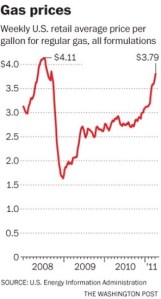
The average price for a gallon of regular gasoline Monday was $3.79 — up more than a dime from the previous week and 93 cents from a year earlier, according the Energy Information Administration. In California, the average is now $4.16, and prices are above $4 a gallon at some stations in the District and elsewhere.
Prices have risen so high, so fast that some market analysts predicted a sell-off in the short term. That sentiment sent crude oil prices tumbling Tuesday for the second consecutive day, dragging stock markets down about 1 percent, as evidence grew that escalating prices are beginning to threaten the global economic recovery.
Stephen Gandel writing for Time Magazine suggests that this price level might be the “breaking point”. This analysis uses the average amount that American consumers generally budget for gas.
Americans are spending much more than they typically do at the pump. Relatively high gas prices have made that a problem throughout this recession, but the recent increase has only made it worse. For the past 19 years, (that’s as far back as the Census data, where retail sales come from would let me go) on average Americans have spent about 8% of their overall retail purchases on gas and other gas station related items. The number has generally been around 9% this recession. And in March, for the first time since the beginning of the recession, that number hit 11%. The highest the figure has been in the past 19 years is 12% and that was in March 2008, which is when Bear Stearns collapsed and was really the start of the financial crisis. It stayed at 12% until September 2008, when Lehman went under taking the rest of the economy with it.
But even 11% could be some sort of breaking point. The last time the figure rose to 11% was in November 2007. And that is right around the time when the economy shifted from creating jobs to losing them. What’s more, in past recoveries Americans in general have spent much less of their income on gas. In 1993 and 2003, for instance, Americans spent between 7% and 8% of their purchases at gas stations.
Our Contrived Fiscal Crisis and the President who buys into it …
Posted: April 13, 2011 Filed under: 2012 presidential campaign, Barack Obama, Breaking News, Catfood Commission, Economy, Federal Budget and Budget deficit | Tags: budget cuts, Budget Deficit, Federal Budget 44 CommentsFederal deficits always go up big and automatically during two events. That would be wars and recessions. We have  had two wars going on for about 10 years now and we’ve had the deepest recession since World War 2. Getting rid of the two wars and solving the residual problems of unemployment would eliminate any potential future fiscal crisis. Any economist will tell you this. It’s not a secret we keep from the world. Passing huge tax cuts and laws that remove nearly all capital and all types of businesses incomes from the pool of revenue sources only exacerbates the revenues problems you get during recessions and expenditure run-ups that come from running wars.
We’ve had excessive war spending before. Our country was born with a lot of money borrowed from the Dutch. The Civil War and both World Wars–especially number two–placed our federal deficit and debt at astronomical levels of GDP. Did our country crash and burn because of the actions of John Adams, Abraham Lincoln or the spending during World War 1 or World War 2? Did you feel that life in the 1950s and 1960s and the children born then were oppressed by excessive debt?
Of course not.
Federal Debts and Deficits are functions of the size and health of the economy underlying the obligations. We have plenty of taxable assets and businesses making money. You can tell how risky the market for our Federal debt is by looking at the yields on Government bonds and Treasuries. The current yields for Treasuries are listed right here. They are at near historic lows and they are still selling. Nothing in that market indicates any reticence by any participant to buy American Debt obligations. The ability to tax and raise taxes as well as print money is a unique function of government. We can do both. If we’d have let the Dubya Bush tax cuts just expire we would’ve closed the deficit gap and reduced the debt by more than anything than is on the table right now. That would include the disingenuous and malfeasant Ryan plan. It also includes the the one that will come from the White House today at 1:35 est.
We need to put taxing capital back on the table. That includes dividends, capital gains, and vast inheritances and trust funds. We need to remove tax loopholes and subsidies to corporations. We do not need to remove the last vestiges of safety nets standing. There appears to be no one brave enough in Washington DC to say that but I will join the bow tie set in shouting just that. It is time to stop subsidizing incompetent business owners and time to invest in the country and its people. Washington DC has the nation’s priorities all wrong.
The White House provided no more specifics on the four steps to be offered in his afternoon speech at George Washington University. But an official said his plan would “borrow” from the recommendations of the 2010 fiscal commission that Obama empaneled, but whose proposals he never fully embraced.
“The president will make clear that while we all share the goal of reducing our deficit and putting our nation back on a fiscally responsible path, his vision is one where we can live within our means without putting burdens on the middle class and seniors or impeding our ability to invest in our future,” the official said.
Republicans–as eloquently stated by former budget Director David Stockman–have a tax fetish. Republicans are refusing to put any taxes on the table. Rand Paul is considering filibustering the increase in the debt ceiling. It appears some of these folks are so disturbingly ideological and economics-disabled that they will let the US go “bankrupt” in the only way possible it could do so. They will allow the US to default on its debt obligations. The Republican Party seems ruled by insane people at the moment. The Democrats, however, are ruled by folks that appear to be playing into right wing memes to appeal to some independents. So, why are we only left with poisonous choices?
Some of the Democratic base is finally waking up to the truth about Obama. He has no core Democratic values. We’re about to see a Democratic president put the cornerstones of Democratic policy on the bargaining table in an effort to appease some folks during the re-election cycle. I’m wondering if it’s all not just a little too late. Ever since the real economists left the building, White House Policy has grown more and more Republican.
Key liberal groups, which helped elect Obama in 2008, are raising concerns that he has given up political ground to Republicans, allowing the message of reducing government to trump that of creating jobs and lowering the unemployment rate.
Seizing on Friday’s deal, which would cut $38.5 billion from the fiscal 2011 budget, activists on Tuesday threatened to sit out the 2012 presidential campaign if Obama goes too far with further cuts.
“The fundamental problem in our country right now is unemployment and a jobs crisis, not a deficit crisis,” said Deepak Bhargava, executive director of the Center for Community Change, an advocacy group for the poor. “It appears the president is fighting on the wrong terrain and is conceding that the only thing we should be talking about is how to bring down the deficit.”
The clash over government spending — coming as Obama prepares to make a major speech on fiscal discipline Wednesday — is the latest example of the frayed relations between the president and a broad coalition of union and activist groups.
The details of the budget compromise as well as the way that the Health Care Reform act was rammed through congress have shown that Obama is more than eager to get something, anything passed than to fight for reform that would actually reflect either public opinion or traditional Democratic Values. Poor black women from the District of Colombia were nearly the first ones thrown under the budget cutting bus. Which previous US Democratic President would have sold them out?
To get the trade-off on the policy riders, Democrats had to give on spending — to the tune of the largest budget cuts ever. There’s a $1.1-billion cut across the board for discretionary spending and dozens of nips and tucks all over government, from Justice Department programs to subsidies for co-ops in the new health care law to the Pell Grant program for low-income college students.
I am going to watch this speech. I’m only hoping some of the disgruntled chat coming from real Democrats materializes into something substantive after it happens.
DeFazio said Monday that Democrats haven’t put enough pressure on Obama.
“That’s what the House did wrong in the last Congress, and in part why we lost is we never pushed back, no matter how wrong he was or how off-base he was; we never pushed back,” DeFazio told MSNBC.
“There are a number of us in the caucus now pushing back very hard on our leadership,” DeFazio said. “Who knows where they’ll end up, but maybe we can take enough D’s with us to make them uncomfortable and to make them stick with making the president act like a Democrat.”
The Democrats’ frustration with Obama is hardly new. Liberals were furious in December when the president caved to GOP demands that Congress extend tax cuts for the wealthiest Americans. More recently, many liberals have questioned the wisdom and constitutionality of launching military attacks on Libya with prior approval from Congress.
Behind closed doors, Democratic leaders are frustrated that Obama hasn’t been more involved in the big policy fights of recent months, including the spending battle.
The way to get to this President is through his re-election efforts and his ego. Hopefully, a few groups will stop facilitating the cave-ins and start fighting for the country’s interests. You can watch the President’s speech on CSPAN at this link. I have my bucket o’ Nerf balls ready and I’m warming up for the first pitch of the 2012 presidential campaign season. Join me as we share the pain and none of the gain.
Yet another Equal Pay Day will pass tomorrow …
Posted: April 12, 2011 Filed under: Women's Rights | Tags: 04/12/2011, Equal Pay Day 1 Commentand you know the drill … not yet.
If you’re seeing RED, wear RED tomorrow.
- In 2007, women’s median annual paychecks reflected only 78 cents for every $1.00 earned by men. Specifically for women of color, the gap is even wider: In comparison to men’s dollar, African American women earn only 69 cents and Latinas just 59 cents. 1
- In 1963, when the Equal Pay Act was passed, full-time working women were paid 59 cents on average for every dollar paid to men. This means it took 44 years for the wage gap to close just 19 cents — a rate of less than half a penny a year. This narrowing of the gap has slowed down over the last six years, with women gaining a mere two cents since 2001. 2
- Women’s median pay was less than men’s in each and every one of the 20 industries and 25 occupation groups surveyed by the U.S. Census Bureau in 2007.3 Even men working in female-dominated occupations tend to earn more than women working in those same occupations.4
- According to the Institute for Women’s Policy Research (IWPR), if equal pay for women were instituted immediately, across the board, it would result in an annual $319 billion gain nationally for women and their families (in 2008 dollars). Over her working life, a typical woman could expect to gain a total of $210,000 in additional income if equal pay were the norm (these numbers include part-time workers).5
We Interrupt your Regularly Scheduled Programming for a Bit of Deprogramming
Posted: April 12, 2011 Filed under: Catfood Commission, Domestic Policy, Economic Develpment, financial institutions, income inequality | Tags: helping the world's poor, Income Inequality, tax havens 9 Comments
Uncle Barrack sez: Time to feed the Corporate Kitty
It’s time for my regular rant on how bad income inequality is for an economy. I know that John Boenher wants to transfer all the resources in the country to so-called job creators and that CEO Hacks are trying to turn the public school system into a drone production unit, but as usual, I’m going to interrupt the messaging with empirical evidence. I’m just one of those people that doesn’t believe any one unless they back it up with honest numbers. This time, I’m going to direct you to a study by the International Monetary Fund (IMF). Just in case you don’t already know, the IMF is not exactly a bastion of comrades-in-arms. They’ve been soundly criticized by developing nations for exporting American-style capitalism wherever they go to provide help to struggling nations. So, with that in mind, here’s a briefing on the study titled “Warning! Inequality May be Hazardous to your Health”.
Their introduction is so meaty that I’m going to leave it nearly wholesale for you before I return to editing more things for a development journal. Finding ways to raise every one’s boat is my thing, just in case you never noticed.
Many of us have been struck by the huge increase in income inequality in the United States in the past thirty years. The rich have gotten much richer, while just about everyone else has had very modest income growth.
Some dismiss inequality and focus instead on overall growth—arguing, in effect, that a rising tide lifts all boats. But assume we have a thousand boats representing all the households in the United States, with boat length proportional to family income. In the late 1970s, the average boat was a 12 foot canoe and the biggest yacht was 250 feet long. Thirty years later, the average boat is a slightly roomier 15 footer, while the biggest yacht, at over 1100 feet, would dwarf the Titanic! When a handful of yachts become ocean liners while the rest remain lowly canoes, something is seriously amiss.
In fact, inequality matters. And it matters in all corners of the globe. You need look no further than the role it might have played in the historic transformation underway in the Middle East.
The increase in U.S. income inequality in recent decades is strikingly similar to the increase in the 1920s. In both cases there was a boom in the financial sector, poor people borrowed a lot, and it all ended in huge financial crises. Did the recent financial crisis result somehow from the increase in inequality?
Some time ago, we became interested in long periods of high growth (“growth spells”) and what keeps them going. The initial thought was that sometimes crises happen when a “growth spell” comes to an end, as perhaps occurred with Japan in the 1990s.
We approached the problem as a medical researcher might think of life expectancy, looking at age, weight, gender, smoking habits, etc. We do something similar, looking for what might bring long “growth spells” to an end by focusing on factors like political institutions, health and education, macroeconomic instability, debt, trade openness, and so on.
Somewhat to our surprise, income inequality stood out in our analysis as a key driver of the duration of “growth spells”.
We found that high “growth spells” were much more likely to end in countries with less equal income distributions. The effect is large. For example, we estimate that closing, say, half the inequality gap between Latin America and emerging Asia would more than double the expected duration of a “growth spell”. Inequality seemed to make a big difference almost no matter what other variables were in the model or exactly how we defined a “growth spell”. Inequality is of course not the only thing that matters but, from our analysis, it clearly belongs in the “pantheon” of well-established growth factors such as the quality of political institutions or trade openness.
While income distribution within a given country is pretty stable most of the time, it sometimes moves a lot. In addition to the United States in recent decades, we’ve also seen changes in China and many other countries. Brazil reduced inequality significantly from the early 1990s through a focused set of transfer programs that have become a model for many around the world. A reduction of the magnitude achieved by Brazil could—albeit with uncertainty about the precise effect—increase the expected length of a typical “growth spell” by about 50 percent.
The upshot? It is a big mistake to separate analyses of growth and income distribution. A rising tide is still critical to lifting all boats. The implication of our analysis is that helping to raise the lowest boats may actually help to keep the tide rising!
That basically says that no one’s boat will really rise as much as it could unless all boats rise. Intuitively, this makes sense because if you think about it, businesses need customers. Poor customers just don’t buy as much unless you provide them with good incomes. Unless you want make government the primary customer in an economy or you’re deluded into thinking business investment will ever be the major agent in GDP, you realize that household consumers are the true center of any market economy. Denying them incomes denies every one of incomes. Just providing monies to the top 1 or 2 percent who are now likely to take their spending and investment any where on the planet is just delusional. Actually, if you want some really good reading on that, I suggest you pick up the book Tax Havens: How Globalization Really Works (Cornell Studies in Money).
In Tax Havens, Ronen Palan, Richard Murphy, and Christian Chavagneux provide an up-to-date evaluation of the role and function of tax havens in the global financial system-their history, inner workings, impact, extent, and enforcement. They make clear that while, individually, tax havens may appear insignificant, together they have a major impact on the global economy. Holding up to $13 trillion of personal wealth—the equivalent of the annual U.S. Gross National Product—and serving as the legal home of two million corporate entities and half of all international lending banks, tax havens also skew the distribution of globalization’s costs and benefits to the detriment of developing economies.
The first comprehensive account of these entities, this book challenges much of the conventional wisdom about tax havens. The authors reveal that, rather than operating at the margins of the world economy, tax havens are integral to it. More than simple conduits for tax avoidance and evasion, tax havens actually belong to the broad world of finance, to the business of managing the monetary resources of individuals, organizations, and countries. They have become among the most powerful instruments of globalization, one of the principal causes of global financial instability, and one of the large political issues of our times.
There’s not really much difference between the Gadhaffi family and the Koch brothers when it comes to where the money goes from exploiting national resources. It’s also really no surprise that when you observe the countries that have the highest per capita incomes in the world that you find the world’s tax havens in the top tiers. (Norway and the US are the only countries in the top ten that aren’t tax havens.) Giving money to the richest folks in your country–the behavior of so-called banana republics–is detrimental to the economic health of that country in many ways. It’s just another way that financial institutions and financial innovation has gutted the productive capability of many a country.
The original IMF study–released on April 8, 2011–is here. I would like to point to the policy implications and suggestions section which makes going to the original study imperative. Think about this when you listen to US banana republic President Obama speak tomorrow on the marvels of the catfood commission’s report. Notice there are other studies cited in the policy suggestions.
There is nonetheless surely policy scope to improve income distribution without undermining incentives—perhaps even improving them—and thereby contribute to lengthening the duration of growth spells.
- Better targeting of subsidies can be a win-win proposition, as with the reallocation of fiscal resources towards subsidies of goods that are consumed mainly by the poor,which can free up capacity to finance public infrastructure investment while better protecting the poor (Coady et al., 2010).
- Active labor market policies to foster job-richer recoveries (ILO, 2011) may help to make recoveries more sustainable, especially as rising unemployment appears to be associated with deteriorations in the income distribution (Heathcote, Perri, and Violante, 2010).
- Equality of opportunity can make for both more equal and more efficient outcomes (World Bank, 2005). For example, effective investments in health and education—human capital—may be able to square the circle of promoting durable growth and equity while avoiding shorter-run disincentive effects (Gupta et al., 1999). Such investments could strengthen the labor force‘s capacity to cope with new technologies (which may have contributed to more inequality in a number of cases), and thereby not only reduce inequality but also help sustain growth. They could also help countries address possible adverse distributional consequences of globalization and reinforce its growth benefits.
- Some countries have managed through pro-poor policies to markedly reduce income inequality. Brazil, for example, after its market-oriented reforms of 1994 implemented active propoor distributional policies, notably, social assistance spending, that were critical to substantial reductions in poverty (Ravallion, 2009).
- Well-designed progressive taxation and adequate bargaining power for labor can also be important in promoting equity, though with due attention to the need to avoid dual labor markets that perpetuate divisions between insiders and outsiders.
Yes, I bolded the sections that are in absolute contradiction with current US political groupthink. I guess Obama just really isn’t that into development policy or research in economics. Read them and weep for what could be. Meanwhile, turn on the TV and go right back to the villagers promoting the idea that trickle up economics makes all of us better off, if you dare.
Monday Reads
Posted: April 11, 2011 Filed under: 2012 presidential campaign, Civil Liberties, Civil Rights, Federal Budget, Foreign Affairs, Libya, morning reads, Republican presidential politics, SCOTUS, Surreality, Team Obama, The Bonus Class, U.S. Economy, U.S. Politics, unemployment, Voter Ignorance, We are so F'd | Tags: African Union, Black holes tearing apart Stars, Brother leader Ghadifi, Christina Romer, Donald Trump: crazy or just brain damaged from too many bad hair days?, Eric Cantor's latest delusions, grand wizards of the kleptocracy, Guantanomo detainees, INET, Koch Brothers, Larry Summers, magic mushrooms, Obama injustice department, Tea party crazies, unemployment 25 Comments Good Morning!
Well, today I’m starting with a quote from Robert Kuttner for The American Prospect about Larry Summers’ appearance at the INET conference. INET is the acronym for the Institute for New Economic Thinking. It was created with a $100 million grant from George Soros and no, I wasn’t invited and I didn’t attend. Mark Thoma and Brad De Long did. You can read their blogs if you want other views.
Larry Summers, now back at Harvard, was the after-dinner entertainment, interviewed by the prodigious Martin Wolf of the Financial Times, the world’s most respected financial journalist.
Summers was terrific, acknowledging that the stimulus of February 2009 was too small, that the idea of deflating our way to recovery is insane, that de-regulation had been excessive, and that much of the economics profession missed the developing crisis because its infatuation with self-correcting markets.
If only this man had been Obama’s chief economic adviser!
He’s referring to this:
Also worth mentioning is this op-ed by former Obama economist Christina Romer on why we have abysmal unemployment. If you read and listen to both of them, it’s going to be obvious that Obama must not have listened to either of them. No wonder they quit so early on. That leaves Timothy-in-the-well Geithner holding the bag for this miserable recovery, imho. Evidently, the two of them thought what most economists were thinking for several years now but it just wasn’t evident from policy. I guess if I heard this austerity crap was coming down the hopper during this miserable recovery, I’d have bailed before my professional credibility went to the crapper too. Guess Timothy always has the shadow banking industry to keep him warm. Meanwhile, Summers continues his apology tour and Romer clarifies the unemployment situation.
Strong evidence suggests that the natural rate of unemployment actually hasn’t risen very much. Instead, the elevated unemployment rate appears to reflect mainly cyclical factors, particularly a lingering shortfall in consumer spending and business investment.
Okay. The important phrase here is “lingering shortfall in consumer spending and business investment”. That means none of these idiotic tax cuts worked. It also means the stimulus was woefully small and ill-directed. It also means that it’s absolutely no time to worry about austerity unless you want yet another recession. Frankly, I think the Republicans are secretly trying to bring one on and Obama is just not that informed about economics and more concerned about chasing the mythical bi-partisan unicorn to wake the frick up.
Since BB knows that I’m a wannabe astrophysicist (or Egyptologist depending on the day of the week), she sent me another kewl science link about a star torn apart by a blackhole! NEATO!!!
On March 28, 2011, NASA’s Swift satellite caught a flash of high-energy X-rays pouring in from deep space. Swift is designed to do this, and since its launch in 2004 has seen hundreds of such things, usually caused by stars exploding at the ends of their lives.
But this time was hardly “usual”. It didn’t see a star exploding as a supernova, it saw a star literally getting torn apart as it fell too close to a black hole!
The African Union’s been chatting up their “Brother Leader” Whacko Ghadafo and have announced the possibility of an end to the fighting in Libya. And, raise your hand if you’d like to buy the Crescent City connection because I’m entertaining offers since the Brooklyn bridge sold so well last week.
“We have completed our mission with the brother leader, and the brother leader’s delegation has accepted the road map as presented by us,” Jacob Zuma, the South African president, said.
The AU mission, headed by Mohamed Ould Abdel Aziz, the Mauritanian president, arrived in Tripoli on Sunday.
Besides Zuma and Abdel Aziz, the delegation includes Amadou Toumani Toure, Denis Sassou Nguessou and Yoweri Museveni – respectively the presidents of Mali, the Democratic Republic of Congo and Uganda.
Gaddafi made his first appearance in front of the foreign media in weeks when he joined the AU delegation at his Bab al-Aziziyah compound.
The committee said in a statement that it had decided to go along with a road map adopted in March, which calls for an end to hostilities, “diligent conveying of humanitarian aid” and “dialogue between the Libyan parties”.
Speaking in Tripoli, Ramtane Lamamra, the AU Commissioner for Peace and Security, said the issue of Gaddafi’s departure had come up in the talks but declined to give details.
Why is it I want to sing I wanna zooma zooma zooma zooma zoom every time I read something about South Africa these days? Well, as long as it’s not one of those horn thingies that ruined the world cup this last time out.
More crap from Crazy Republicans via Think Progress: Cantor Sees Current Medicare and Medicaid Programs As A ‘Safety Net’ For ‘People Who Frankly Don’t Need One’
Today on Fox News Sunday, host Chris Wallace questioned House Majority Leader Eric Cantor’s (R-VA) support for a plan in which Americans “pay more out of pocket.” Defending the proposal, Cantor argued that these programs sometimes provide a “safety net” for “people who frankly don’t need one” and that the shift of the burden from the government to the beneficiary will teach government “to do more with less”:
CANTOR: We are in a situation where we have a safety net in place in this country for people who frankly don’t need one. We have to focus on making sure we have a safety net for those who need it.
WALLACE: The Medicaid people — you’re going to cut that by $750 billion.
CANTOR: The medicaid reductions are off the baseline. so what we’re saying is allow states to have the flexibility to deal with their populations, their indigent populations and the healthcare needs the way they know how to deal with them. Not to impose some mandate from a bureaucrat in washington.
WALLACE: But you are giving them less money to do it.
CANTOR: In terms of the baseline, that is correct…What we’re saying is there is so much imposition of a mandate that doesn’t relate to the actual quality of care. We believe if you put in place the mechanism that allow for personal choice as far as Medicare is concerned, as well as the programs in Medicaid, that we can actually get to a better resolve and do what most Americans are learning how to do, which is to do more with less.
Actually, 99% of Americans are doing less with less. One percent of Americans are doing more with the corporate and rich people’s welfare that folks like Cantor have handed them on a golden platter for the last ten years. If you have the stomach for it, the link to the TV interview is over at TP too. Frankly, I’ve been sick enough recently and don’t need to see anything that just makes me sicker.
I don’t know about you, but watching Donald Trump–the man who lost his father’s billions and then ran through government subsidies and finally made some money as a really bad reality TV star–as a potential presidential candidate has been sort’ve a surreal trip. James Polis at Richochet says that Trump is Final Proof that the Political Class Has Failed. Trump’s potential candidacy is like an extension of his reality show with gobs of opportunism, self-promotion and narcissism. It’s bad hair gone wild.
There are two main theories cooperating to explain the Trump phenomenon:
- Donald Trump is today’s best self-promoter and professional opportunist.
- The Republican field of presumptive candidates for president is lame.
But neither of these, nor even both together, can adequately explain what’s going on. We can’t even turn for supplemental help to subtheories that emphasize the rise of celebreality culture, the fall of Sarah Palin, or The Continuing Story of Bungling Barry. These variables all appear somewhere in the equation that has produced the Trump phenomenon. But none of them explain it.
Trump is suddenly “winning” as a political figure because the political class has failed. The authority of our political institutions is weak and getting weaker; it’s not that Americans ‘lack trust’ in them, as blue ribbon pundits and sociologists often lament, so much as they lack respect for the people inside them.
My theory is that he’s just a summer replacement, along with Michelle Bachmann, that will set the stage for fall when the blue suited, pompadour-sporting set take over to bore us to death with talks of tax cuts and subsidies ala President Dementia. Other Republican Presidential wannabes must be thinking we’ll be tired of self-promoting, idea-less hacks by then and that they’ll look refreshing by comparison in a few months. Oddly enough, the P woman is keeping a low profile in all of this. Maybe she’s finally figured out that discretion is the better part of valor for a change or it could be she just has enough money for an excellent summer vacation and has decided to exercise her options.
Okay, so I’m going to move on to something light (weirdly, spinning light, emanating from the patterned Chinese lantern covering the naked bulb in my dorm room while a John Lennon album plays Power to the People on my old turntable … oops, wrong flashback) from New Scientist. Thought mushrooms were just for old hippies and  Native American Shaman? Think again. Here’s the headline: Earliest evidence for magic mushroom use in Europe.
EUROPEANS may have used magic mushrooms to liven up religious rituals 6000 years ago. So suggests a cave mural in Spain, which may depict fungi with hallucinogenic properties – the oldest evidence of their use in Europe.
The Selva Pascuala mural, in a cave near the town of Villar del Humo, is dominated by a bull. But it is a row of 13 small mushroom-like objects that interests Brian Akers at Pasco-Hernando Community College in New Port Richey, Florida, and Gaston Guzman at the Ecological Institute of Xalapa in Mexico. They believe that the objects are the fungi Psilocybe hispanica, a local species with hallucinogenic properties.
Like the objects depicted in the mural, P. hispanica has a bell-shaped cap topped with a dome, and lacks an annulus – a ring around the stalk. “Its stalks also vary from straight to sinuous, as they do in the mural,” says Akers (Economic Botany, DOI: 10.1007/s12231-011-9152-5).
This isn’t the oldest prehistoric painting thought to depict magic mushrooms, though. An Algerian mural that may show the species Psilocybe mairei is 7000 to 9000 years old.
What a long strange ride it’s been ever since.
More on Obama-style Justice for Guantanamo detainees as the Supremes decline to clarify their rights.
The Obama administration has fought all attempts by lawyers for detainees to have the Supreme Court review those rulings. And while the news was overshadowed by the administration’s concession that alleged Sept. 11 mastermind Khalid Sheik Mohammed and his co-defendants will be tried by a military commission rather than federal jury — a separate issue — the court last week turned away three detainee challenges arising from Boumediene.
One group active in representing the detainees, the Center for Constitutional Rights, decried what it called the court’s refusal “to defend its Boumediene decision and other precedents from the open defiance of the D.C. Circuit.”
The government told justices that there is no reason for them to believe anything other than “lower courts have properly performed the task that this court assigned them in Boumediene v. Bush.”
“Open defiance” may go a bit far in describing the D.C. Circuit’s rulings, but there is no doubt that the court’s action in Boumediene — and its inaction since — has left few happy.
While detainee advocates complain about the court’s timidity, D.C. Senior Circuit Judge A. Raymond Randolph has received wide attention for a speech he gave last year in which he compared the justices to characters in “The Great Gatsby,” who have created a mess they expect others to clean up.
You don’t need me to start in on the Supremes this morning since BB did such a great job last night. Please go read her thread on just exactly how bankrupt our government has become. Believe me, it’s not an article on the deficit either.
Here’s an important information on the Koch Brothers, grand wizards of the kleptocracy. Alternet says they’re worse than you thought and they’re the astroturf beneathe the Tea Party’s wings.
Then look at a recent position pushed by Americans for Prosperity, the Tea Party-allied astroturf group founded and funded by David Koch (and whose sibling organization, the Americans for Prosperity Foundation, he chairs):
Similarly, Americans for Prosperity supports the House continuing resolution that cuts spending by $61 billion. Those cuts would reduce the budget for the CFTC by one-third. Make no mistake: Gutting the CFTC or limiting its authority would be a boon to Wall Street businesses that use complex financial instruments. But while the result is more profits for oil companies, it means everyone else pays more at the pump.
Okay, now have a look at the Kochs’ recent direct contributions to political candidates:
The Kochs donated directly to 62 of the 87 members of the House GOP freshman class…and to 12 of the new members of the U.S. Senate.
Don’t look now. It’s Atlas Shrugged, the Movie. Bad fiction just refuses to die when it gives erections to obsessive white men. I’m just waiting for next year’s Razzies. It’s the tale of a businessman obsessed. No, not the movie …the making of the movie …
It has taken businessman John Aglialoro nearly 20 years to realize his ambition of making a movie out of “Atlas Shrugged,” the 1957 novel by Ayn Rand that has sold more than 7 million copies and has as passionate a following among many political conservatives and libertarians as “Twilight” has among teen girls.
But the version of the book coming to theaters Friday is decidedly independent, low-cost and even makeshift. Shot for a modest $10 million by a first-time director with a cast of little-known actors, “Atlas Shrugged: Part I,” the first in an expected trilogy, will play on about 300 screens in 80 markets. It’s being marketed with the help of conservative media and “tea party” organizing groups and put into theaters by a small, Salt Lake City-based booking service.
I think I’ll pass. I prefer those nice little British films. I’m anxiously awaiting the redo of Upstairs, Downstairs. I never could make it through that silly John Galt speech even when I was young and my mind was an open book. Now, where are those lights on the ceiling when you need them?

 peej
peej Carissa
 bostonboomer
 dakinikat
 ecocatwoman
 jjlo
jjlo mablue2
 Mama Lopez
 peggysue22
 quixote
 skydancingguestblogger
 Mona (aka Wonk the Vote)





Recent Comments