
Finally Friday Reads: Abusing Public Office on Steriods
Posted: March 20, 2026 Filed under: #FARTUS, #MAGAnomics, #Occupy and We are the 99 percent! | Tags: #TrumpCult, @johnbuss.bsky.social John Buss, Cadet Bonespur's Iran War, high gas prices, ICE Helps Trump Friend, Justice for Breonna Taylor, No Justice, No Peace, Trump sells Favors 3 Comments
“Markwayne Mullin seems qualified to head the Department of Homeland Security.” John Buss, @repeat1968
Good Day, Sky Dancers!
Our Executive branch is basically captured by idiots and criminals. A headline in the New York Times today shows that abusing their offices is the only skill the MAGA officeholders and the president have. This story broke last spring. “Trump Friend Asked ICE to Detain the Mother of His Child. Paolo Zampolli, a former modeling agent and a longtime Trump ally, was in a custody battle over his son. An ICE official agreed to help.” While the American people suffer, the Art of the Steal runs amok.
Megan Twohey, Shawn McCreesh, and Hamed Aleaziz share the lede.
Last June, the man credited with introducing President Trump to his wife asked the administration for a favor.
Paolo Zampolli, a former modeling agent turned presidential special envoy, had learned that his Brazilian ex-girlfriend was in a Miami jail, arrested on charges of fraud at her workplace. They had been in a custody battle over their teenage son. Now he saw an opportunity.
He reached out to a top official at Immigration and Customs Enforcement, explaining that his ex was in the country illegally, according to records obtained by The New York Times and a person familiar with the communications. Could she be put in ICE detention? That could help him get his son back.
The official, David Venturella, promptly called the agency’s Miami office to ensure that ICE agents would pick up the woman from the jail before she was released on bail, according to the records and a person with knowledge of the conversation who requested anonymity to discuss it. During the call, Mr. Venturella noted that the case was important to someone close to the White House.
The woman, Amanda Ungaro, was placed in ICE custody and ultimately deported, an outcome that may well have happened regardless of Mr. Zampolli’s meddling. But the ICE official’s willingness to spring into action for a Trump ally — even one in a low-level, largely ceremonial role — reflects a recurring theme of the second Trump administration: The levers of the federal government can be pulled to settle a personal score.
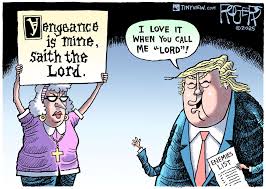 You may read the details at the gifted link above. You may also want to check out MEDIAITE for some analysis by Issac Schorr. “One of Trump’s Friends Reportedly Asked ICE to Arrest the Mother of His Child in Custody Battle Gambit.”
Paolo Zampolli, the man who introduced President Donald Trump to his wife, First Lady Melania Trump, and is currently serving as U.S. special representative for global partnerships at Trump’s behest, asked ICE to arrest the mother of his child last June, according to The New York Times.
After learning that his Brazilian ex-girlfriend, with whom he had a son, Amanda Ungaro, had been arrested on fraud charges in Florida, Zampolli allegedly “saw an opportunity” to land a potentially killing blow in his custody battle with her.
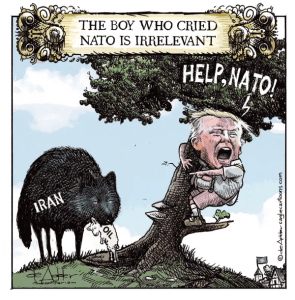 This is just one example of the incompetence, revenge-taking, and grifting that make up the heart of the Trump Regime’s reign of Terror. The story that keeps one like the above in the background is still the Iran War. Greg Sargent of The New Republic discusses some of the incredible ‘madness’ surrounding the machinations behind the War with Congressman Adam Smith. “Transcript: Trump War Takes Dark Turn as Leaks Unnerve Dems: ‘Madness’. In an interview, Congressman Adam Smith, the top Armed Services Democrat, sharply condemns the newly leaked war schemes—and tells us that Dems must not agree to one more dime in war funding.”
Everything we’re learning now strongly suggests that Donald Trump’s war is about to get worse. First, word leaked that the Pentagon may demand $200 billion more from Congress. Second, officials let it be known that Trump is considering the deployment of thousands of troops on the ground. Meanwhile, Trump himself just suggested to reporters that he’s envisioning even more military actions that he hasn’t even explained yet.
All this makes it absolutely clear that Congress will not just be asked to fund Trump’s war, but also that the pressure on Congress to do something about this madness will intensify. So today we’re talking to Congressman Adam Smith, the ranking Democrat on the House Armed Services Committee, about what Democrats will be able to do when that happens. Congressman, thanks so much for coming on.
Adam Smith: Well, thanks for having me. It’s always good to see you.
Sargent: So let’s start with all the leaks about Trump potentially sending in troops on the ground. People familiar with planning told Reuters that Trump may deploy thousands of them. The options being discussed are deploying troops to the shoreline of the Strait of Hormuz to secure passage for oil tankers and possibly sending ground forces to Kharg Island, which is the hub for oil exports, which one official describes to Reuters as “very risky.” Congressman, you talk to people at the Pentagon a fair amount. Are you getting any indications of anything like this, and what’s your overall take on it?
Smith: Yeah, no, it’s very worrisome, because the bottom line is it’s clear that Trump is not going to be able to achieve anything meaningful in Iran—which is a change of the regime and a change of action. I mean, degrading their capability is one thing, but at the cost that we’re currently experiencing—13 service members’ lives already lost, massive economic disruption, 14 countries dragged into this, civilian deaths, the tragic killing of 150 schoolgirls in Iran—massive cost, just to degrade Iran a little bit. He wants regime change. He wants something different. That’s not happening under the current plan.
Now, I don’t think it’s going to happen if he sends in a few thousand troops, either, but the pressure on him to escalate is growing in his own mind. The pressure is also growing on him to end this madness, stop this war, and recognize he’s not going to accomplish that. But we’ve sent 2,500 Marines—they’re now in the area. Another 2,500 are on their way. And you know, Marines don’t just sit in boats—they’re there for a purpose. And sadly, what we’ve learned in the last year is that when Trump masses forces, he uses them.
He did it in Latin America, first with the boat strikes, then with taking out Maduro. He did it in the Middle East when he massed these forces for the war with Iran. So if he sends troops to the region, it is distinctly possible that he’s going to use them. It would be an idiotic decision, because the ability of four or five thousand troops to really fundamentally change this war—I don’t think that’s going to succeed. But Trump doesn’t think in a linear way. He trusts his gut and his bones, apparently.
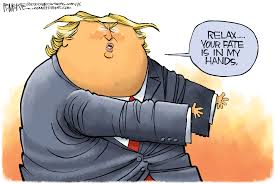 You may watch the interview or continue reading the transcript at the link. Smith and Sargent discuss the implausible reasons given for the war and the difficulty of achieving any real goal from it. As far as I can tell, it just takes the country’s mind off the Epstein files and the constant drip of incompetence and abuse of office. It’s theater that’s costing lives, taxes, and a declining economy.
And a little more dribble from what used to be the Justice Department. “Feds move to dismiss charges against officers accused of falsifying warrant in Breonna Taylor raid.” This is breaking news from the AP.
Federal prosecutors have asked a judge to dismiss the charges against two Louisville officers accused of falsifying the warrant that led police to raid Breonna Taylor’s apartment the night she was killed six years ago.
Prosecutors said in a court filing Friday that their review of the case showed the charges against former Detective Joshua Jaynes and former Sgt. Kyle Meany should be “dismissed in the interest of justice.”
Lawyers for the two didn’t immediately respond to Friday requests for comment.
Judges have twice taken a felony charge against each officer and reduced it to a misdemeanor, saying there wasn’t a direct link between the false information and Taylor’s death. Prosecutors said after the second ruling that they decided to drop the cases.
Taylor was shot to death by police when they broke down the door of her apartment while serving a no-knock drug warrant looking for a former boyfriend who no longer lived there.
Taylor’s boyfriend at the time fired at the officers, and Taylor was killed as police fired back.
Federal prosecutors under former President Joe Biden sought the charges against the officers, while President Donald Trump’s Department of Justice has asked the only officer serving prison time related to Taylor’s killing to be let out of prison while he appeals his conviction.
 This headline from Wired is due to our insane #FARTUS, and for whatever reason, we got sent to war. “Iran War Puts Global Energy Markets on the Brink of a Worst-Case Scenario. “This will be so, so, so, so, so bad,” one analyst says.” This is reported by Molly Taft.
The war in Iran reached a new extreme this week, as both Israel and Iran launched strikes on oil and gas production and export facilities. The attacks up the stakes in a war that was already choking energy and commodity markets, and will threaten the long-term health of the global economy. On Friday, the International Energy Agency recommended that people work from home, drive slowly, and use gas stoves sparingly in order to alleviate price shocks from the crisis.
The situation in the Persian Gulf is so extreme, analysts told WIRED, that it’s almost unbelievable.
“This scenario is something that you give to the first-year oil analysts to say, ‘OK, if this happens …’ It’s a really interesting illustrative educational thought experiment,” says Rory Johnston, a Canadian oil market researcher. “It’s kind of like, what would happen if gravity just suddenly stopped working for 10 minutes? The things you just give to students to say, ‘Let’s put a thought experiment to something extreme and see how would the system react’? I never thought we would actually see this.”
Ellen Wald, an energy and geopolitics consultant, agrees. “This is like one of those war game simulations in energy markets,” she says.
The initial attacks on Iran earlier this month effectively closed off the Strait of Hormuz, one of the world’s most important shipping routes. The strait is the central lifeline for oil and gas exports from not only Iran, but other countries in the Middle East. The bulk of the Organization of the Petroleum Exporting Countries (OPEC), the world’s largest oil and gas cartel, use the strait to ship oil and gas out of the region to customers. The strait is also a critical hub for oil and gas byproducts like industrial chemicals and fertilizer. Closure of the strait sent shocks through the global economy: After the initial attacks, oil prices shot up above $100 per barrel for the first time since Russia’s invasion of Ukraine in 2022.
“Anytime there is any kind of military activity in the Persian Gulf or even in the Middle East, oil markets tend to get very jittery,” says Wald; closing the strait was a sign that this war could have much more extreme impacts than other conflicts. But for the first few weeks, the oil production facilities themselves remained mostly untouched. “No oil and no products were getting out, and some countries don’t have enough storage, and so they were shutting down production simply because they couldn’t store the oil,” says Wald. “But that’s the kind of thing that can be fairly quickly reversible.”
Over the past few days, however, missile strikes have started heavily targeting oil and gas infrastructure. On Thursday, Israel launched a series of strikes on various oil and gas facilities in the region, most notably the South Pars gas field, the world’s biggest natural gas field, which is jointly controlled by Iran and Qatar. Iran retaliated with counterstrikes, including on the world’s largest oil export facility in Qatar. Oil prices temporarily shot up to nearly $120 a barrel.
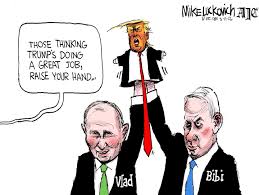 Israel is just doing whatever it wants to because Bibi can flatter the hell out of Trump and make him do anything. This entire thing was a huge disaster just waiting to happen. There’s even some speculation that Israel will use nukes. This is from NPR. “More Marines are headed to Middle East as Iran war reaches the 3-week mark.” This is the most current update.
More U.S. Marines are headed to the Middle East, NPR has confirmed, as the U.S.-Israeli war with Iran reaches the three-week mark.
Israel launched more strikes in and around Tehran early Friday, as Iranians marked Nowruz, the Persian New Year. Muslims around the world are also observing the end of the holy month of Ramadan.
Overnight, Iranian drones hit Kuwait’s Mina Al-Ahmadi oil refinery again, sparking fires as crews worked to contain the blaze. Authorities in the United Arab Emirates said the country’s air defenses responded to missile and drone threats from Iran with explosions echoing across Dubai as worshippers marked the Muslim holiday of Eid
There’s more on the marine deployment and other topics at the link.
Finally, safer and greater today? I sure am not. Just wondering if anyone is singing Bomb. Bomb Bomb Iran today? Never Mind. It says it’s a parody.
What’s on your reading and blogging list today?
Late Night Speculation and Outrage
Posted: May 27, 2011 Filed under: investment banking, We are so F'd | Tags: high gas prices, speculation 17 Comments There’s another interesting WikiLeak that’s come to light about high gas prices. It seems that President Bush asked the Saudis to pump extra oil to help relieve market pressure on prices in 2007 and 2008. The Saudis suggested that Bush tackle the problem by reigning in Wall Street speculation.
When oil prices hit a record $147 a barrel in July 2008, the Bush administration leaned on Saudi Arabia to pump more crude in hopes that a flood of new crude would drive the price down. The Saudis complied, but not before warning that oil already was plentiful and that Wall Street speculation, not a shortage of oil, was driving up prices.
Saudi Oil Minister Ali al Naimi even told U.S. Ambassador Ford Fraker that the kingdom would have difficulty finding customers for the additional crude, according to an account laid out in a confidential State Department cable dated Sept. 28, 2008,
“Saudi Arabia can’t just put crude out on the market,” the cable quotes Naimi as saying. Instead, Naimi suggested, “speculators bore significant responsibility for the sharp increase in oil prices in the last few years,” according to the cable.
What role Wall Street investors play in the high cost of oil is a hotly debated topic in Washington. Despite weak demand, the price of a barrel of crude oil surged more than 25 percent in the past year, reaching a peak of $113 May 2 before falling back to a range of $95 to $100 a barrel.
The Obama administration, the Bush administration before it and Congress have been slow to take steps to rein in speculators. On Tuesday, the Commodity Futures Trading Commission, a U.S. regulatory agency, charged a group of financial firms with manipulating the price of oil in 2008. But the commission hasn’t enacted a proposal to limit the percentage of oil contracts a financial company can hold, while Congress remains focused primarily on big oil companies, threatening in hearings last week to eliminate their tax breaks because of the $38 billion in first-quarter profits the top six U.S. companies earned.
The Saudis, however, have struck a steady theme for years that something should be done to curb the influence of banks and hedge funds that are speculating on the price of oil, according to diplomatic cables made available to McClatchy by the WikiLeaks website.
The Saudis evidently repeatedly warned both the Bush and Obama administration about the roll of Wall Street speculators in the price of oil.
Matt Taibi has also written some about the WikiLeaks information.
The Wiki documents show that the Saudis had long ago concluded that this increased investor flow was a threat to disrupt the markets. An embassy cable from 2007 recounted a meeting U.S. officials had with Yasser Mufti, an Aramco planner. “The Saudi analysts indicated a link between higher oil prices and the influx of investor funds into the oil markets,” it read.
The cables also show that the Saudis urged the Americans to enact reforms to rein in Wall Street, calling for speculative limits and other changes. It also showed that some Saudi officials believed that speculation added as much as $40 to the oil price during the height of the bubble.
All of this is significant because both the Bush administration and the Obama administration have denied this narrative to various degrees. The CFTC only recently admitted that speculation played a role in the 2008 mess, having originally (and stubbornly) blamed supply and demand issues. Subsequent analyses have shown that the Saudi position, that worldwide demand for oil never increased nearly enough to account for the gigantic 2008 price spike, was almost certainly correct.
You have to wonder if the current situation also reflects the lack of will by the last two administrations to reign in Wall Street excess. Hopefully, this information will get some play in the MSM but I’m not holding my breath.
Late Night Gas Pump Shock
Posted: April 13, 2011 Filed under: Economy | Tags: high gas prices, speculation, US economic recovery 27 Comments I’m pretty happy that the mighty mustang is parked out front and staying there for the most part. Every time I do make it out, I nearly faint from the changes that I see in gas prices. I thought I’d share some links with you about what’s going on.
First, from Reuters: High gas prices hurt U.S. confidence: Reuters/Ipsos poll. It could also hurt the President’s approval rating.
Rising U.S. gasoline prices have damaged confidence in the country’s future and forced Americans to change their spending habits and lifestyles, a Reuters/Ipsos poll released on Wednesday found.
The proportion of people who believe the United States is on the wrong track jumped 5 points to 69 percent from March, the poll found, the highest wrong-track figure in an Ipsos poll since President Barack Obama took office in January 2009.
More than six of every 10 Americans have cut back on other expenses and reduced their driving as a result of the rising gas prices caused by tumult in North Africa and the Middle East.
The increase in energy costs also hurt Obama’s approval rating, which dipped for the second consecutive month to 46 percent — his lowest Ipsos poll rating since early December 2010.
“That’s all a function of gas prices. People are feeling the pinch at the pump,” said Ipsos pollster Cliff Young.
“Increased gas prices have a direct impact on the pocketbook, and there is very little lag time between rising gas prices and its effect on presidential approval and confidence,” he said.
There’s also some concerns that higher gas prices could hurt this very anemic recovery. Gas is one of those expenditures that folks usually can’t avoid without buying a better vehicle or getting a different commute to work. That means in the short run, high gas prices hurt people because they can’t adjust to them easily.
Gasoline prices are soaring toward $4 a gallon, a threshold that some analysts say will damage the fragile economic recovery and crimp consumer spending just as families are planning their summer vacations.
Higher prices saddle businesses with higher transportation costs, causing them to either swallow them or pass them along to already strapped customers. As gasoline costs go up, consumers are left with less money to spend elsewhere. And there is evidence that the hike at the pump is beginning to push drivers off the road.
Gasoline prices, which are approaching record levels, “are going to have a very profound effect on the economy,” said Peter Morici, an economist at the University of Maryland.
D.C. resident Amber Sutton, who drives 25 miles each way to her job in Woodbridge, said rising gasoline prices have caused her to cut back on restaurants and other entertainment.
“I already was spending a ton on gas,” she said. “But now it’s absolutely ridiculous.”
The average price for a gallon of regular gasoline Monday was $3.79 — up more than a dime from the previous week and 93 cents from a year earlier, according the Energy Information Administration. In California, the average is now $4.16, and prices are above $4 a gallon at some stations in the District and elsewhere.
Prices have risen so high, so fast that some market analysts predicted a sell-off in the short term. That sentiment sent crude oil prices tumbling Tuesday for the second consecutive day, dragging stock markets down about 1 percent, as evidence grew that escalating prices are beginning to threaten the global economic recovery.
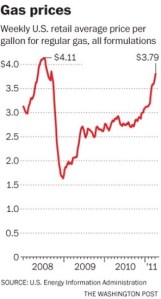
Stephen Gandel writing for Time Magazine suggests that this price level might be the “breaking point”. This analysis uses the average amount that American consumers generally budget for gas.
Americans are spending much more than they typically do at the pump. Relatively high gas prices have made that a problem throughout this recession, but the recent increase has only made it worse. For the past 19 years, (that’s as far back as the Census data, where retail sales come from would let me go) on average Americans have spent about 8% of their overall retail purchases on gas and other gas station related items. The number has generally been around 9% this recession. And in March, for the first time since the beginning of the recession, that number hit 11%. The highest the figure has been in the past 19 years is 12% and that was in March 2008, which is when Bear Stearns collapsed and was really the start of the financial crisis. It stayed at 12% until September 2008, when Lehman went under taking the rest of the economy with it.
But even 11% could be some sort of breaking point. The last time the figure rose to 11% was in November 2007. And that is right around the time when the economy shifted from creating jobs to losing them. What’s more, in past recoveries Americans in general have spent much less of their income on gas. In 1993 and 2003, for instance, Americans spent between 7% and 8% of their purchases at gas stations.

 peej
peej Carissa
 bostonboomer
 dakinikat
 ecocatwoman
 jjlo
jjlo mablue2
 Mama Lopez
 peggysue22
 quixote
 skydancingguestblogger
 Mona (aka Wonk the Vote)



 Sky Dancing
Recent Comments