
Friday Morning Reads
Posted: April 6, 2012 Filed under: Foreign Affairs, morning reads | Tags: Bush Cheney torture, children slaves, chocolate, Porn, priestly disobedience, Torture memo 72 Comments Good Morning!
Well, we’re seeing Dooky Chase’s famous gumbo Z’herbes being served so it must be close to the time of year when bunnies are chocolate and eggs are colorful. Miss Leah’s gumbo is the best I’ve ever had in a restaurant in the city. I have a few stories to share today that are less yummy but important to think about. When you think of “priestly disobedience” don’t most of you think of the pedophilia scandal? Evidently, that’s not what the Pope has in mind. It’s things that have to do with those filthy things called women.
Striking the tone that once earned him the nickname “God’s Rottweiler,” Pope Benedict XVI in a stern Holy Thursday homily denounced “disobedience” in the Roman Catholic Church, chastising priests who sought the ordination of women and the abolition of priestly celibacy.
Wow, that’s inspiring at a time of rebirth and celebration of hope. Don’t marry the women. Don’t consider them your peers or face the wrath of the empire. Molest a few choir boys and we’ll over look that!
So, my second topic is about those chocolate bunnies and eggs. A lot of child slaves are involved with the chocolate trade so it’s important you try to buy chocolate that doesn’t support producers that use child slaves. Try filling up those baskets and tummies with organic chocolate. There are many places that rely on forced child labor to produce cocoa.
Thousands of children in West Africa are forced to labor in the production of cocoa, chocolate’s primary ingredient. The West African nation of Cote d’Ivoire (Ivory Coast) is the leading supplier of cocoa, accounting for more than 40% of global production. Low cocoa prices and thus the need for lower labor costs drive farmers to employ children as a means to survive. The US Department of State estimates that more than 109,000 children in Cote d’Ivoire’s cocoa industry work under “the worst forms of child labor,” and that some 10,000 are victims of human trafficking or enslavement.
These child workers labor for long, punishing hours, using dangerous tools and facing frequent exposure to dangerous pesticides as they travel great distances in the grueling heat. Those who labor as slaves must also suffer frequent beatings and other cruel treatment. Cote d’Ivoire’s child laborers are robbed not only of their freedom but of the right to a basic education. In a country where more than half the population is illiterate, basic education of “cocoa children” takes on an even more critical significance for Cote d’Ivoire’s future. Increased access to education must be a key component in any effective strategy to reduce poverty and exploitative child labor.
In 2001, in an attempt to avoid government regulation and intense media scrutiny, major cocoa companies made a voluntary commitment (the Cocoa Industry Protocol) to certify their cocoa “child labor-free” by July 2005, but that deadline passed with little fanfare. The deadline was then extended to certify 50% of farms “child-labor free” by July 2008. The cocoa companies trumpeted a few pilot programs, but continue to purchase and reap profits from child labor cocoa. The major cocoa importers need to use their vast influence on the cocoa market to bring about the kind of systemic changes necessary to eliminate child slavery once and for all.
The International Labor Rights Forum is committed to combating the scourge of forced child labor in the cocoa industry through public education and corporate campaigns.
Most of the major uses of cocoa produced by child slaves are large chocolate producers like Hershey’s. Again, chocolate produced in the Ivory Coast area of Africa is most likely produced by forced child labor. Lobbyists from the chocolate industry have stopped Congress from taking actions against trade in cocoa produced by child slaves.
Chocolate’s billion-dollar industry starts with workers like Abdul. He squats with a gang of a dozen harvesters on an Ivory Coast farm.
Abdul holds the yellow cocoa pod lengthwise and gives it two quick cracks, snapping it open to reveal milky white cocoa beans. He dumps the beans on a growing pile.
Abdul is 10 years old, a three-year veteran of the job.
He has never tasted chocolate.
During the course of an investigation for CNN’s Freedom Project initiative – an investigation that went deep into the cocoa fields of Ivory Coast – a team of CNN journalists found that child labor, trafficking and slavery are rife in an industry that produces some of the world’s best-known brands.
It was not supposed to be this way.
After a series of news reports surfaced in 2001 about gross violations in the cocoa industry, lawmakers in the United States put immense pressure on the industry to change.
“We felt like the public ought to know about it, and we ought to take some action to try to stop it,” said Iowa Sen. Tom Harkin, who, together with Rep. Eliot Engel of New York, spearheaded the response. “How many people in America know that all this chocolate they are eating – candies and all of those wonderful chocolates – is being produced by terrible child labor?”
If you’d like to not support the use of children in this manner, consider buying “fair trade” chocolate. Here’s a list of companies committed to fair trade.
Are you aware of how big the on line porn industry is? This has frightening implications to me.
The good folks at ExtremeTech took it upon themselves this week to get at one of the Internet’s crucial questions—just how big are porn sites these days? The answer? Ron Jeremy big. To study porn sites, ExtremeTech turned to the DoubleClick Ad Planner tool from Google (GOOG). It’s a useful website where you can peek at information gathered by ad-serving cookies about how much traffic a website gets, the age and income of visitors, and the amount of time people spend on a site.
According to this tool, the online porn kingpin Xvideos feeds up 4.4 billion page views per month. That’s about 10 times as many as the New York Times and three times as many as CNN.com. YouPorn—another site packed full of stimulating content—notches 2.1 billion page views per month. And while people spend a few minutes per day on news sites, they tend to spend 15 minutes or more on porn sites, which would seem to say something rather definitive about, er, male stamina.
“But it’s not just men on the sites,” you shout. True, although the top porn sites count men as about 75 percent of their visitors. Breaking the stats down further, about half of the visitors make between $25,000 and $50,000 per year, while only 2 percent earn more than $150,000 per year. According to Google, the other interests of Xvideos visitors include Latin American music and gangs and organized crime, while YouPorn visitors like networking equipment and family films, so it’s an eclectic bunch.
While anyone can dig through these numbers, ExtremeTech did a nice job of adding some context to the incredible amount of data served up by porn sites. According to the Google estimates, Xvideos would record “29 petabytes of data transferred every month, or 50 gigabytes per second. That’s about 25,000 times more than your home Internet connection is probably capable of, which is a couple of megabytes per second.” Sliced another way, Xvideos will “serve up 50 gigabytes per second, or 400Gbps,” ExtremeTech writes. “Bear in mind this is an average data rate, too: At peak time, Xvideos might burst to 1,000Gbps (1Tbps) or more. To put this into perspective, there’s only about 15Tbps of connectivity between London and New York.”
Someone at YouPorn chatted with ExtremeTech and said the Google estimates are way below actual totals. YouPorn stores more than 100TB of porn and feeds up about 28 petabytes per month.
Is it any wonder we’re having laws put into place that objectivize and remove the power of self-determination from women?
An adviser to former SOS Condoleeza Rice says that he believes that the kinds of extraordinary interrogation techniques used for Khalid Sheik Mohammed was wrong and likely illegal. He wrote this in a secret 2006 memo that has now been published by The UK Guardian.
Philip Zelikow, who was the US secretary of state Condoleezza Rice’s most senior official, told the Guardian that he now regards what officials euphemistically called “enhanced interrogation”, such as sleep deprivation and waterboarding, as torture – although he did not use that word at the time and is reluctant to use it now.
Zelikow, whose official position was counsellor to Rice, said he had her support on the issue. As the state department’s representative on the National Security Council committee considering legal issues around violent interrogations, he expressed his concerns at the time in a top secret 2006 memorandum.
The memo, to other members of the committee who represented the justice and defence departments and intelligence services, warned that the CIA’s use of waterboarding and other abuses were almost certainly in breach of US and international law. But the memo so alarmed the administration that it was immediately rejected and all copies were ordered destroyed.
A draft version of the memo, found at the state department, was released this week following a freedom of information request by the National Security Archive in Washington.
Zelikow told the Guardian in an email exchange that while he did not use the word torture in the memo, he believes that is what the CIA was using. “I do regard the interrogation practices and conditions of confinement, taken together, as torture – in the ordinary layman’s use of this term. But … ‘torture’ is also a term with a carefully worded legal meaning and definition. So I tend to avoid talking about ‘torture’ because it would appear I’m accusing officials of criminal activity, which I’m not sure was the case,” he said.
“I have sometimes just referred to ‘physical torment’ instead, which seems expressive and is accurate.”
Well, these might not be the most pleasant reads you’ll find this week, but I believe they are all important. What’s on your reading and blogging list today?
Women’s Issues are like an Imaginary War on Caterpillars because ?
Posted: April 5, 2012 Filed under: War on Women, Women's Healthcare, Women's Rights | Tags: patronizing assholes, Reince Preibus 22 CommentsRepublicans are denying they have a woman problem. They are using less-than-artful metaphors. Several elected state officials have compared our pregnancies to those of livestock. Now, our disgust with defunding of planned parenthood and restricting access to birth control are just basically an imaginary insect invasion dreamed up by the likes of James Carville. Yup, the head of the RNC thinks that the War on Women’s reproductive and  workplace rights are imaginary and akin to a War on Caterpillars.
Republican National Committee Chairman Reince Preibus talked himself into some trouble this morning after accusing the media of creating a fake gender war and comparing it to a “war on caterpillars.”
“If the Democrats said we had a war on caterpillars and every mainstream media outlet talked about the fact that Republicans have a war on caterpillars, then we’d have problems with caterpillars,” Priebus said in an interview with Bloomberg TV’s “Political Capital with Al Hunt” set to air this weekend. “It’s a fiction.”
Priebus appeared on the show with Democratic National Committee Chairwoman Debbie Wasserman Schultz, and the pair debated gender issues, including contraception and requiring women to undergo ultrasounds before getting an abortion.
While Priebus blamed the media for blowing the debate out of proportion, Wasserman Schultz took the opportunity to blast Republicans for their stance on several of these issues.
“The jury of women across America have ruled that the Republicans have been unbelievably extreme and out of touch and hyper-focused on cultural issues,” Wasserman Schultz said on Bloomberg.
 Yup, we’ve gone from livestock to insects in the minds of key Republican officials. You can watch this morning’s Caterpillar Catastrophe here. Don’t forget the Georgia “Women as Livestock” bill that severely restricts a woman’s constitutional right to abortion access.
Commonly referred to as the “fetal pain bill” by Georgian Republicans and as the “women as livestock bill” by everyone else, HB 954 garnered national attention this month when state Rep. Terry England (R-Auburn) compared pregnant women carrying stillborn fetuses to the cows and pigs on his farm. According to Rep. England and his warped thought process, if farmers have to “deliver calves, dead or alive,” then a woman carrying a dead fetus, or one not expected to survive, should have to carry it to term.
Romney supporters have been scrambling to recover the number of women fleeing the party. They insist that women have the same concerns that men do and that the democrats are simply inventing their anti-women positions. Yet, Romney has recently reversed his old positions on women’s health to win right wing voters by adopting the anti-women positions of Santorum and others. Romney supported the Blunt amendment in a direct reversal of earlier comments that indicated a women’s access to birth control was a private matter. Here’s his latest anti-women primary positions.
1. He’s going to ‘get rid of’ Planned Parenthood. In his most blatant attack on basic women’s services, Romney made this claim: “Planned Parenthood, we’re going to get rid of that.” Of course, as a Presidential candidate Romney surely knows that Planned Parenthood provides essential medical services, primarily to low-income women, including mammograms and pap smears, as well as important family planning services. Romney has pledged to defund Title X, a program that provides family planning services.
2. Romney supports the Blunt Amendment which would allow employers to deny health insurance coverage on the basis of moral objections — a rule aimed at allowing employers to opt out of providing benefits that undermined their consciences, including contraceptive coverage. But as governor of Massachusetts, Romney required all health care providers– including Catholic hospitals — to offer emergency contraception to rape victims.
3. Romney is fighting a covert battle against contraception, even if he is doing his best not to call it that. While Romney used to be firmly pro-choice and pro-contraceptives, he has positioned himself in the campaign to be a fighter of morality, saying that the Affordable Care Act (ACA) imposes a “secular vision on America” by requiring employers to provide contraceptives in their insurance coverage. He is also misleading the public on what the ACA will do for women.
4. Romney failed to condemn Rush Limbaugh’s characterization of Sandra Fluke as a “slut.” Romney said “it’s not the language I would have used,” but refused to go any further in condemning Limbaugh’s attacks on the Georgetown Law student who testified in support of the ACA’s contraceptive rule. In not standing up for basic women’s rights, Romney’s complacency is as good as consent.
5. Romney supports restricting access to abortions. He has called Roe v. Wade “one of the darkest moments in Supreme Court history.” He’s even said that he’d support state constitutional amendments to define life at conception, which would effectively outlaw abortions under any circumstance.
Romney and his campaign have decided to use wife Ann as a way to woo women. Instead of finding out what women want, Romney says he asks his wife.
But Mitt Romney is running for president and he’s talking about the majority of the American electorate like a strange, exotic species to be fully understood only by someone who knows their strange, native ways.
His answer played exactly into the caricature that has emerged of him– incapable of relating to ordinary Americans (in this case women) and so disconnected from reality that he needs a scout to go out into the wilds of normal America and come back with a full report for him to digest on his own.
He could supplement Mrs. Romney’s field reports to him about female voters with some of the data found deep within the swing state poll, which showed that women’s top priorities going into November are health care, gas prices and unemployment. The deficit comes right after that, but what comes in dead last for women’s own priorities going into the election? Government policies toward contraception.
On that score, Romney seems to be paying for the sins of his party. Although he has not raised the issue on his own, the Republican Party itself seems to have made women’s access to contraception and abortion a top priority over the last several months and alarmed independent and moderate women in the process. Although women in the poll didn’t call the issue a priority for themselves, a majority said they were following the debate on the issue very closely or somewhat closely.
It certainly isn’t helping Romney for Santorum to be out pushing social issues. Here’s some of the numbers that show that women aren’t buying the Republican arguments. Romney is facing up to an 18% gender gap right now.
A much discussed USA Today poll shows that Romney is headed for defeat because his party is unattractive to women. At the moment, Romney leads Obama among men by 48 to 47 percent; but he trails among women, 54 to 36 percent. The gender gap is wide enough to re-elect the president by a landslide of 51 to 42 percent.
A lot of pundits have leapt on the idea that the recent debates over government-funded or mandated contraception have made the GOP brand toxic to women. But the USA Today poll indicates that the issue’s impact is rather more qualified than that.
Both men and women rate “government policies on birth control” as the least important question in 2012, and 63 percent of them don’t even know where Romney stands on it. About the same proportion dislikes Romney’s position (24 percent) as much as they do Obama’s (25 percent).
The real gender gap in the USA Today poll is that men think the deficit is the most important issue while women think it’s health care. In short, independent women voters are more exercised about the GOP’s opposition to “Obamacare” than they are its objection to free contraception.
Add to all of this the state-level attacks on public education, abortion access, and public worker unions. Many teachers and state employees are women. These are the bread-and-butter issues that Republicans think they can use to win women? As a side note, McCain’s gender gap was 13 percent. Romney has not only spent time railing against planned parenthood but taking “severely conservative” positions on issues of importance to hispanic women.
During the primary, Romney — who has described his record as “severely conservative” — has touted his opposition to abortion rights, backed legislation to allow some employers to deny health insurance coverage for contraception, and said he would stop funding Planned Parenthood, a women’s health organization that provides cancer screenings, routine examinations, and abortion services.
Romney’s problem with Hispanic voters is even more pronounced after he rejected proposals to allow illegal immigrants a path to legalization, including a bill known as the DREAM Act to let undocumented residents brought to the country as babies or young children obtain citizenship if they attend college or join the military. A poll released last month by Fox News Latino found Romney’s support among likely Latino voters at 14 percent. Obama had the backing of 70 percent of respondents in that poll.
And the most recent Gallup poll conducted March 25-26 found Romney trailing the president among independent voters, 40 percent to Obama’s 48 percent.
“Obviously you have to close the gender gap some, and we definitely need an active campaign in the Hispanic community,” said Charlie Black, a Republican campaign strategist who is advising Romney. Romney also needs to spend time, he added, “cleaning up a little bit of any negative perceptions that were created in the primary — and of course, you have to go back and check and make sure your base will rally around you.”
So, can Mr. Etcha Sketch change any one’s mind given that the Republican convention is going to have its socially radical agenda front and center for all to see? Gingrich and Santorum are not going quietly into the night even though they have stopped winning elections. It will be interesting to see how women, GLBT, Hispanics, and the black communities react to Tea Party hysteria on prime time TV. As an independent woman, I can say I am not happy with the lack of support given women by the Democratic party, but the Republicans are now scaring the living daylights out of me. My daughters and I are not livestock or insects and the obvious orchestrated attack on our rights is not all in our heads or the political strategy of the DNC.
The War on Science and Fact-based Reality
Posted: April 4, 2012 Filed under: abortion rights, religious extremists, Republican politics, Republican presidential politics, Voter Ignorance, War on Women, Women's Healthcare, Women's Rights 10 Comments What does it say about a country where a large segment of the population works to enact laws and policies that are openly hostile to scientific thought and findings? Hand-in-hand with the war against public education and civil rights has come a war on science. It relies on billionaire-funded ideological think tanks, ignorant and hateful media blovaiators, and fundamentalist religions. What is so scary about modernity and scientific findings that a large number of states want to make it illegal?
Evolution is as an accepted theory among biologists as global warming is among scientists who study climate. The idea that a fetus is viable before the third trimester or can feel pain early in development is a view only held outside the medical community. Why is it that scientists and their life long research are held in less esteem than ideological and theological wishful thinking?
Here’s some great examples of how one major political party is the party of the Age of Unreason.
Tennessee has decided to refight the Scopes Monkey Trial.
Tennessee Gov. Bill Haslam (R) announced yesterday that he will “probably” sign a bill that attacks the teaching of “biological evolution, the chemical origins of life, global warming, and human cloning” by giving broad new legal immunities to teachers who question evolution and other widely accepted scientific theories. Under the bill, which passed the state legislature last month:
Neither the state board of education, nor any public elementary or secondary school governing authority, director of schools, school system administrator, or any public elementary or secondary school principal or administrator shall prohibit any teacher in a public school system of this state from helping students understand, analyze, critique, and review in an objective manner the scientific strengths and scientific weaknesses of existing scientific theories covered in the course being taught.
Although the bill is written to seem benign, as it neither specifically authorizes the teaching of creationism nor permits teachers to do more than criticize scientific theories “in an objective matter,” the practical impact of this bill will be to intimidate all but the heartiest of school administrators against disciplining teachers who preach the most outlandish junk science in their classrooms. Because the bill provides little guidance as to what constitutes an “objective” criticism of a scientific theory, any principal who reigns in teachers who force creationism or Pastafarianism upon their students risks finding themselves on the wrong side of the law.
In reality, of course, there are few, if any, “objectively” valid objections to the theory of evolution (or, for that matter, to global warming). Rather, as Travis Waldron explained when this bill passed a legislative committee nearly a year ago, “Scientists have reached a consensus that evolution is ‘one of the most robust and widely accepted principles of modern science,’ and as such, it is ‘a core element in science education.’”
This is seriously ridiculous given that molecular biology and the associated field of genetics as well as the fossil record have provided more and not less evidence on the Theory of Evolution. What’s next? Denying gravity?
Nebraska and other states have banned abortions after 20 weeks under all circumstances. That even includes situations where the pregnancy will never result in a live baby or healthy mother. So much for the lie of small, unobtrusive government.
Danielle Deaver was 22 weeks pregnant when her water broke and doctors gave her a devastating prognosis: With undeveloped lungs, the baby likely would never survive outside the womb, and because all the amniotic fluid had drained, the tiny growing fetus slowly would be crushed by the uterus walls.
“What we learned from the perinatologist was that because there was no cushion, she couldn’t move her arms and legs because of contractures,” said Deaver, a 34-year-old nurse from Grand Isle, Neb. “And her face and head would be deformed because the uterus pushed down so hard.”
After having had three miscarriages, Deaver and her husband, Robb Deaver, looked for every medical way possible to save the baby. Deaver’s prior pregnancy ended the same way at 15 weeks, and doctors induced her to spare the pain.
But this time, when the couple sought the same procedure, doctors could not legally help them.
Just one month earlier, Nebraska had enacted the nation’s first fetal pain legislation, banning abortions after 20 weeks gestation. So the Deavers had to wait more than a week to deliver baby Elizabeth, who died after just 15 minutes.
Of course, the ultimate lunacy is the denial of global warming. Again, many people embrace the preachings of phony, industry-sponsored propaganda businesses instead of the scientific findings of the research community. What causes this?
They don’t like evolution, they don’t like global warming—none of that stuff. Now a sociologist set out to figure out if that thesis really is true, and concluded that the right in the US is indeed growing increasingly distrustful of science.
Gordon Gauchat of the University of North Carolina published these findings in the forthcoming issue of the American Sociological Review. He looked back at data from 1974 through 2010, and found that trust in science was relatively stable over that 36-year period, except among self-identified conservatives. While conservatives started in 1974 as the group that trusted science most (compared to self-identified liberals and moderates), they have now dropped to the bottom of the ranking.
Chris Mooney–author of The Republican War on Science–has seen this trend as early as the 1970s.
The reason for this, according to Mooney and others, is that the “political neutrality of science began to unravel in the 1970s with the emergence of the new right”—a growing body of conservatives who were distrustful of science and the intellectual establishment, who were often religious and concerned about defending “traditional values” in the face of a modernizing world, and who favored limited government. This has prompted backlash against subjects for which there is broad scientific consensus, like global warming and evolution—backlash that has been apparent in survey data over the past three decades.
Gauchet says this of his study.
“You can see this distrust in science among conservatives reflected in the current Republican primary campaign,” Gordon Gauchat, a postdoctoral fellow at the University of North Carolina at Chapel Hill’s Sheps Center for Health Services Research, said in a news release from the American Sociological Association. “When people want to define themselves as conservatives relative to moderates and liberals, you often hear them raising questions about the validity of global warming and evolution, and talking about how ‘intellectual elites’ and scientists don’t necessarily have the whole truth.”
…
“Over the last several decades, there’s been an effort among those who define themselves as conservatives to clearly identify what it means to be a conservative,” he said. “For whatever reason, this appears to involve opposing science and universities, and what is perceived as the ‘liberal culture.’ So, self-identified conservatives seem to lump these groups together and rally around the notion that what makes ‘us’ conservatives is that we don’t agree with ‘them.'”
Meanwhile, the perception of science’s role in society has shifted as well.
“In the past, the scientific community was viewed as concerned primarily with macro structural matters such as winning the space race,” Gauchat said. “Today, conservatives perceive the scientific community as more focused on regulatory matters such as stopping industry from producing too much carbon dioxide.”
As we continue to see laws passed that reflect hostility to education, science, and reality-based research we will undoubtedly see other countries pull ahead of us in a number of areas. This has a number of ramifications for our economy, our ability to impact international conversations, and our future. Now is the time to get rid of the politicians, the supreme court justices, and the media figures who prefer the 19th century to the 21st.
Power, Politics and “Traditional” Marriage
Posted: April 3, 2012 Filed under: Marriage Equality, War on Women, Women's Rights 9 CommentsOne thing that I found during my 20 year marriage was how difficult it was to forge nontraditional dynamics in an institution that’s loaded with societal expectations, rewards, and punishments.  I didn’t think adding a marriage certificate would change relationship dynamics at all. Boy, was I wrong. It’s really hard work to not fall into patterns set up by your parents and the folks that surround you. If you’re not constantly vigilant, the power dynamics seem to default back to some settings that seem more set in forces outside of your control than you’d like to believe. Some times what happens is that one or both people just give up and go with the flow. Frankly, I’ve turned into some one who is not a fan of any kind of marriage because of this. I don’t encourage any woman to get marriage because I feel that the odds are strong she’ll be on the losing side of the power dynamic. The more the traditional the marriage, the more the benefits accrue to men.
I’m not a sociologist, but it doesn’t take one to notice the pressures brought to bear on married couples by their families, their neighbors and the institutions that try to engulf them. It could be parents who expect grandchildren. It could be neighbors that frown on career-centric parents. It could be those folks in the pew next to you on Sunday that insist on definitions of marriage not really found in the bible but thought to be morally correct. Even TV shows and movies send messages to couples. The marriage cult has its own set of peer pressure and expectations that remind me of junior high social dynamics. I’m happy to be free of it all.
That’s why I find this study interesting. The study shows that husbands with stay at home wives have the most narrow views of women’s place in the world. Their views appear stuck in the aberration that was the 1950s-1960s TV family. These also appear to be the people that are more drawn to the Republican party and are responsible for much of what we now call the War on Women. Here’s some discussion of the study.
A recent study by Sreedhari Desai, an assistant professor at the University of North Carolina at Chapel Hill, found that men in traditional marriages with stay-at-home wives had negative attitudes about working women and organizations led by women, and they were more likely to deny opportunities to women.
Desai and her fellow researchers conducted a series of experiments, including one with married graduate students looking for jobs. Those in traditional marriages (that is, one in which the wife did not work outside the home) were much less likely to seek interviews for openings with companies that had higher percentages of women on their board or for which women would be doing the interviewing.
Another experiment asked male managers to pretend to be executives and recommend applicants for advancement, except the two, Diane and David, applicants had the same experience and education.
“Those who were in traditional marriages were less likely to recommend Diane and more likely to recommend David,” said Desai.
This spills over into 2012 as we fight the war on women like some kind of real-life Mad Men reenactment. Desai took a look at her data and found a correlation between her research and today’s headlines.
“One thing that did come through was those men who are in traditional marriages are against giving teenagers access to birth control,” she said.
Recent Polls show that single women and women under 50 are leaving Romney and the Republican Party like they might flee a natural disaster. Yet, Obama is not picking up married women voters in quite the same way.
But the latest polling offers a window into how the ongoing national debate on women’s issues seems to be playing out among female voters — and Democrats and Republicans are taking note of a growing divide between married and unmarried women.
In February, 64 percent of unmarried women said they would vote for Obama over Mitt Romney, the presumptive Republican nominee, according to a Democracy Corps survey analyzed by Democratic pollsters. Only 31 percent picked the GOP candidate. The gap — 33 points — was 10 points bigger than in it was in January.
Now look at what married women say: 56 percent said they would vote for Romney, and only 37 percent for Obama, with virtually no change from January to February.
So, what are the consequences of men that view women “traditionally”? Again, it appears they are more like to support the kinds of things we’ve seen recently coming up that suppress women’s workplace rights and allow women to control their reproductive choices.
…men who have stay-at-home wives are more likely to oppose women’s rights and have negative attitudes about working women:
We found that employed husbands in traditional marriages, compared to those in modern marriages, tend to (a) view the presence of women in the workplace unfavorably, (b) perceive that organizations with higher numbers of female employees are operating less smoothly, (c) find organizations with female leaders as relatively unattractive, and (d) deny, more frequently, qualified female employees opportunities for promotion. The consistent pattern of results found across multiple studies employing multiple methods and samples demonstrates the robustness of the findings.
By insisting on staying the breadwinners for their families, men seem to also be subconsciously buying into the idea that their wives shouldn’t work. And according to the Bureau of Labor Statistics from 2010 (as cited in the study), there are more than 11 million men in such arrangements, contributing to a culture opposed to women working. The study suggests that these men might be characterized as “benevolent sexists,” but clarifies they are not likely to be overtly hostile towards women.
Marriage dynamics appear to influence all kinds of political and work place actions. Susie Madrak has some interesting observations to add to mine.
There is an age-old problem with being a woman at home, and it has to do with distribution and claiming of power. The woman’s opinions are too frequently seen as advisory-only (except in the areas traditionally designated to women: children, decor, schools, etc.) and it’s been my observation through the years that women then indulge in covert strategies to assert their power. In other words, “what he doesn’t know won’t hurt him.” So purchases are made in secret and smuggled into the home, much like an “I Love Lucy” episode.
You see a lot of hostage-like negotiation in which the financial hostage (wife) isn’t even aware that she’s conceded her right to partnership power. Instead, she’s focused on wheedling, nagging, cajoling and subterfuge. No way for grownups to act!
A lot of guys like it, though. After all, it’s familiar to them. Their mothers did it (or their mothers didn’t do it, and the sons preferred they had), it seemed to keep the family together, what’s the big deal? The big deal is, one “partner” in this sort of relationship is accepting inferior status. The other partner is agreeing.
Over the past few years, I’ve had male friends mention how much they wished their wives would go to work. “But not a real job,” they’re quick to add. “Just something to help out.” Because if women insist on career jobs, it’s a lot more threatening than a part-time gig at a convenience store, I suppose.
I’ve also known couples where both partners have careers, but the husband makes a lot more money. That person seems to retain the same paternal mindset as if she wasn’t working at all, which is interesting.
I have my own anecdotal evidence to add to Susie’s thoughts. I used to make at least as much or more than my husband until we started our family. I also felt it was important to spend time with the girls when they were young and so throttled back my career path. It coincides to the exact same time that my husband started treating me like some kind of burden who automatically had less of a say in things. When we started out, I would have never thought I’d have wound up in that position, but I did.
I have one last thing to add to this conversation. It’s the evidence that’s shown up in one of the main groups that advocates “traditional” marriage and looks to ban Gay marriages. It shows exactly how much power dynamics are at play in the attempt to keep the institution of marriage narrowly defined.
Last week, a federal judge in Maine unsealed memos from the National Organization for Marriage, one of the most prominent groups fighting against same-sex marriage.
They relate to a case filed over whether the group must disclose the donors that helped underwrite a 2009 ballot initiative that overturned the state’s legalization of same-sex marriage. The group uses its designation as a social welfare organization to avoid federal disclosure, but the memos dispel any notion that the claim has any legitimacy. National Organization for Marriage is a political group, through and through.
The documents brag about its “crucial” role in passage of Proposition 8, California’s ban on same-sex marriage that was overturned by a federal appeals court. They describe the group’s use of “robo-calls” to scare residents in different states away from supporting marriage equality. They talk of a plan to “expose Obama as a social radical,” but the most appalling portions deal with the group’s racially and ethnically divisive strategies.
“The strategic goal of the project is to drive a wedge between gays and blacks — two key Democratic constituencies,” says one memo.
Another stated aim is to manipulate Hispanic voters by making the exclusion of gay people from marriage “a key badge of Latino identity.”
I’m beginning to think this is really a fight to maintain straight male power and privilege more than anything. I’m not sure what’s more threatening. Women opting out of marriage or the gay community opting in.
Aung San Suu Kyi: Once more with Gusto
Posted: April 1, 2012 Filed under: Foreign Affairs, Myanmar | Tags: Aung San Suu Kyi, Burmese elections. 14 Comments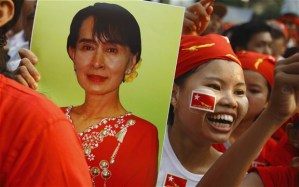 Ever so often, things appear to change for the better.
The streets of Rangoon echoed with cheers on Sunday after unofficial results indicated Aung San Suu Kyi had won a parliamentary seat in a landmark election that could see the Nobel laureate and former political prisoner take public office for the first time.
“We won! We won!” chanted her supporters as they crowded the pavement in their thousands outside her party’s headquarters. Traffic was restricted to a thin line snaking haphazardly through the crowd, where young and old in red – the colour of Aung San Suu Kyi’s party, the National League for Democracy (NLD) – sang along to a Johnny Cash-inspired anthem calling for “the return of Mother Suu”.
Those who were not dancing swayed back and forth to watch numbers flash on a digital signboard that measured the NLD’s victories in byelections around the country, where the party was contesting 44 of 45 open seats in Burma’s 664-seat parliament.
Aung San Suu Kyi’s victory, which will not be officially confirmed for another week, could mark the moment that this poverty-stricken nation, where a military junta has ruled almost exclusively for the past 50 years, takes its first genuine steps towards democracy.
The NLD was competing in its first elections since 1990, after which Aung San Suu Kyi was held under house arrest for most of the next 20 years, and the poll was notable for its unprecedented access for foreign journalists and independent observers.
Myanmar/Burma is one of the economies that I have spent the last several years studying closely. They are a member of ASEAN and are attempting to modernize to become part of a trade and monetary union. Their economy is poor and it primarily reflects the poor government and rule of law established by the military rulers who seized power. Myanmar has also experienced tough sanctions for their many human rights violations. The current elections and the near future will determine the outlook for this country. You may recall the brutal, murderous crackdown on protests by Buddhist Monks–often called the Saffron Revolution for the colors worn by the monks–in 2007. Nations are looking to Aung San Suu Kyi and her party to begin to bring the country back from its past. If this happens, the tiny nation may begin to recover from years of repression and poor economic results.
Ms Suu Kyi said in a statement: “It is natural that the NLD members and their supporters are joyous at this point.
“However, it is necessary to avoid manners and actions that will make the other parties and members upset. It is very important that NLD members take special care that the success of the people is a dignified one.”
During the campaign, foreign journalists and international observers were given the widest access for years.
The European Union hinted that it could ease some sanctions if the vote went smoothly.
The BBC’s Rachel Harvey in Rangoon says the NLD alleged some voting irregularities in the capital, Nay Pyi Taw.
NLD spokesman Nyan Win told AFP news agency he had sent a letter of complaint to the election commission over allegations ballot forms had been tampered with.
He said there had been complaints that wax had been put over the tick-box for the party, which could later be rubbed off to cancel the vote.
“This is happening around the country. The election commission is responsible for what is occurring,” he said.

The military leaders are still dominant in this tiny southeast Asian nation. “Mother Suu” has only recently been allowed out from her house arrest of 20 years. A lot of the international pressure started when the famous human rights activist won the Noble Peace Prize. However, many nations have been pressuring the military to step down. Sanctions on the country have played an important role too.
“While the results have not yet been announced, the United States congratulates the people who participated, many for their first time in the campaign and election process,” Clinton told reporters in Istanbul.
“We are committed to supporting these reform efforts,” she added, noting that the government must continue to improve transparency and deal with any voting irregularities.
The military junta in Myanmar last year handed power to a new government led by President Thein Sein which has surprised even its critics with a string of reforms, which include allowing Suu Kyi to run for parliament.
“It is too early to know what the progress of recent months means and whether it will be sustained,” Clinton said.
“There are no guarantees about what lies ahead for the people of Burma.
This will be an interesting country to watch in the future. My hope is that it will go well and that Mother Suu will be a central part of that effort.

 peej
peej Carissa
 bostonboomer
 dakinikat
 ecocatwoman
 jjlo
jjlo mablue2
 Mama Lopez
 peggysue22
 quixote
 skydancingguestblogger
 Mona (aka Wonk the Vote)





Recent Comments