
Sunday Reads … and now for something completely different
Posted: April 1, 2012 Filed under: morning reads, right wing hate grouups, Voter Ignorance, We are so F'd 27 Comments or not…
I’ve spent some time wondering how a few segments of our population seem to have lost track of reality. We all have access to libraries and the world’s combined knowledge on our little laptops these days. Still, we seem to be surrounded by folks that are reading books in some alternate reality. So what’s the deal? Can you point to some one like Michelle Bachmann or Rick Santorum and then find something in their brains or their genes that’s not like ours? Or, did something go horribly wrong with them at some point in their life so they just prefer to live a life of fact denial?
Scientists have been looking at brain chemistry and composition and genetics and have found that certain traits tend to run in certain kinds of individuals that tend to do things a specific way. Take this example from Crime Times linking brain dysfunction to the traits of risk-avoidance or thrill-seeking and criminal behavior. Many of these kinds of behaviors have been linked to genes and certain regions of the brain.
Richard Ebstein and colleagues, at Herzog Memorial Hospital in Jerusalem, studied 124 unrelated Israelis. The researchers administered a test, devised by C. Robert Cloninger, which evaluated four personality traits: novelty seeking, harm avoidance, reward dependence, and persistence. They found that many subjects with high novelty-seeking scores had a slightly longer form of the D4 dopamine receptor (D4DR) gene than deliberate, reflective subjects. According to Ebstein, “this work provides the first replicated association between a specific genetic locus involved in neurotransmission and a normal personality trait.”
Jonathan Benjamin and colleagues, at the National Institutes of Mental Health, conducted a similar study involving 315 subjects who were evaluated on five personality measures: extroversion, openness to experience, neuroticism, agreeableness, and conscientiousness. None of these traits showed any association with the D4DR gene. Novelty-seeking, however, was again associated with the long version of the gene.
Behavior researchers note, however, that the D4DR gene variant accounts for only about 10 percent of the variation in the trait of novelty-seeking. Cloninger suggests, also, that each personality trait is modified by other traits; thus, a thrill-seeker who is also biologically inclined to be reward dependent, persistent, and optimistic may be a successful business executive, while a thrill-seeker who is low in both reward dependence and anxiety may turn to criminal pursuits.
Are there similar kinds of things at play in the brains and behavior of Bachman and Santorum? Here’s a preview of a book by Chris Mooney in a MoJo article titled “Diagnosing the Republican Brain”. Mooney shows some of the more looney tune entries in Conservapedia. It’s the right wing answer to Wikipedia and it’s just full of baloney science. There’s even some arguments that against the theory of relativity. Is absolute belief in absolute nonsense a medical or mental condition?
Take Conservapedia’s bizarre claim that relativity hasn’t led to any fruitful technologies. To the contrary, GPS devices rely on an understanding of relativity, as do PET scans and particle accelerators. Relativity works—if it didn’t, we would have noticed by now, and the theory would never have come to enjoy its current scientific status.
Little changed at Conservapedia after these errors were dismantled, however (though more anti-relativity “counter-examples” and Bible references were added). For not only does the site embrace a very different firmament of “facts” about the world than modern science, it also employs a different approach to editing than Wikipedia. Schlafly has said of the founding of Conservapedia that it “strengthened my faith. I don’t have to live with what’s printed in the newspaper. I don’t have to take what’s put out by Wikipedia. We’ve got our own way to express knowledge, and the more that we can clear out the liberal bias that erodes our faith, the better.”
You might be thinking that Conservapedia’s unabashed denial of relativity is an extreme case, located in the same circle of intellectual hell as claims that HIV doesn’t cause AIDS and 9-11 was an inside job. If so, I want to ask you to think again. Structurally, the denial of something so irrefutable, the elaborate rationalization of that denial, and above all the refusal to consider the overwhelming body of counterevidence and modify one’s view, is something we find all around us today.
Kevin Drum also looks at the idea that “conservatives” are just plain wired differently from the rest of us. I have always been at a loss for words for the number of stubborn believers in things that have been completely disabused by facts. The worst examples are the number of republicans that insist that Obama is a foreign born Muslim despite all evidence to the contrary. Drum thinks there has to be more than that because it seems that most of are worst examples appear to be American. Is there something uniquely nutty about our American Nuts?
I’ve long been sold on the idea that liberalism and conservatism are at least partly temperaments, and it’s those temperaments that lead us to different political conclusions rather than any kind of rational thinking process.
But the problem I have with Chris’s piece is this: temperament is universal, but Republicans are Americans. And it’s Republicans who deny global warming and evolution. European conservatives don’t. In fact, as near as I can tell, European conservatives don’t generally hold anti-science views any more strongly than European progressives.
I’m going to keep this post short because, as I said, I haven’t read the book. Maybe Chris addresses this at greater length there. But in the MoJo piece, at least, he doesn’t really address the question of why differences in brain wiring have produced such extreme anti-science views in American conservatives but not in European conservatives. So consider this an invitation, Chris. Is your contention that American conservatives are unique in some way? Or that American brains are wired differently? Or am I wrong about European conservatives?
Let me tell you a secret about Bible believers that I know because I was one. Most of them don’t read their Bibles. If they did, they would know that the biblical model of sex and marriage has little to do with the one they so loudly defend. Stories depicted in the Bible include rape, incest, master-slave sexual relations, captive virgins, and more. Now, just because a story is told in the Bible doesn’t mean it is intended as a model for devout behavior. Other factors have to be considered, like whether God commands or forbids the behavior, if the behavior is punished, and if Jesus subsequently indicates the rules have changed, come the New Testament.
Through this lens, you find that the God of the Bible still endorses polygamy and sexual slavery and coerced marriage of young virgins along with monogamy. In fact, he endorses all three to the point of providing detailed regulations. Based on stories of sex and marriage that God rewards and appears to approve one might add incest to the mix. Nowhere does the Bible say, “Don’t have sex with someone who doesn’t want to have sex with you.”
Furthermore, none of the norms that are endorsed and regulated in the Old Testament law – polygamy, sexual slavery, coerced marriage of young girls—are revised, reversed, or condemned by Jesus.
Yup. Polygamy is the norm. Most of the big patriarchs had concubines which are basically sex slaves. Is that what literalists like Pat Robertson see as our proper path?
Biblicalpolygamy.com has pages dedicated to 40 biblical figures, each of whom had multiple wives. The list includes patriarchs like Abraham and Isaac. King David, the first king of Israel may have limited himself to eight wives, but his son Solomon, reputed to be the wisest man who ever lived had 700 wives and 300 concubines! (1 Kings 11)
Concubines are sex slaves, and the Bible gives instructions on acquisition of several types of sex slaves, although the line between biblical marriage and sexual slavery is blurry. A Hebrew man might, for example, sell his daughter to another Hebrew, who then has certain obligations to her once she is used. For example, he can’t then sell her to a foreigner. Alternately a man might see a virgin war captive that he wants for himself.
In the book of Numbers (31:18) God’s servant commands the Israelites to kill all of the used Midianite women who have been captured in war, and all of the boy children, but to keep all of the virgin girls for themselves. The Law of Moses spells out a purification ritual to prepare a captive virgin for life as a concubine. It requires her owner to shave her head and trim her nails and give her a month to mourn her parents before the first sex act (Deuteronomy 21:10-14). A Hebrew girl who is raped can be sold to her rapist for 50 shekels, or about $580 (Deuteronomy 22:28-29). He must then keep her as one of his wives for as long as she lives.
Rape, incest, sexual slavery, and polygamy are all biblical values.
So, let me go back a moment to the widespread Republican notion that President Obama is some kind of Muslim Manchurian Candidate. TruthDig features an article on this by writer John Feffer. Once again, we have evidence that points to something completely different. More brain chemistry perhaps?
Despite right-wing charges, Obama has maintained a tight relationship with Israel and the Israeli leadership. As former New Republic editor Peter Beinart concludes, “The story of Obama’s relationship to [Prime Minister] Netanyahu and his American Jewish allies is, fundamentally, a story of acquiescence.”
It’s no surprise, then, that surveys in six Middle East countries taken just before and two months after the Cairo speech in 2009, the Brookings Institution and Zogby International discovered that the number of respondents optimistic about the president’s approach to the region had suffered a dramatic drop: from 51% to 16%. A 2011 Pew poll found that U.S. favorability ratings had continued their slide in Jordan (to 13%), Pakistan (12%), and Turkey (10%).
And yet, perversely, the hard right in the U.S. maintains that the Obama administration has behaved in quite the opposite manner. “There’s something sick about an administration which is so pro-Islamic that it can’t even tell the truth about the people who are trying to kill us,” Republican presidential candidate Newt Gingrich typically said while campaigning in Georgia.
Pro-Islamic? That’s news to the Islamic world.
But it’s nothing new to the world of the U.S. right wing, which portrays Obama as anti-Israel and weak in the face of Islamic terrorism. At best, the president emerges from these attacks as a booster of Islam; at worst, he is the leader of a genuine fifth column.
Although the administration’s policy on Iran is virtually indistinguishable from those of his Republican challengers, they have presented him as an appeaser. The president who “surged” in Afghanistan somehow becomes, through the magic of election-year sloganeering, a pacifist patsy. Although Obama never endorsed the location of the “Ground Zero mosque,” his opponents have suggested that he did. Although he was slow to withdraw support from U.S. allies in the Middle East like Hosni Mubarak in Egypt and Ben Ali in Tunisia, Republican candidates have accused the president of practically campaigning on behalf of the Islamist parties that have grown in influence as a result of the Arab Spring.
Barack Obama, the right wing has discovered, does not have to be Muslim to convince American voters that he has a suspect, even foreign, agenda. They have instead established a much lower evidentiary standard: he only has to act Muslim.
So, we’ve had some discussion about the relationship between Republicans and worship of Ayn Rand. George Monbiot insists that Rand wrote “A Manifesto for Psychopaths”. Ah, it’s the brain chemistry argument once more.
Rand’s is the philosophy of the psychopath, a misanthropic fantasy of cruelty, revenge and greed. Yet, as Gary Weiss shows in his new book Ayn Rand Nation, she has become to the new right what Karl Marx once was to the left: a demi-god at the head of a chiliastic cult(4). Almost one-third of Americans, according to a recent poll, have read Atlas Shrugged(5), and it now sells hundreds of thousands of copies every year.
Ignoring Rand’s evangelical atheism, the Tea Party movement has taken her to its heart. No rally of theirs is complete without placards reading “Who is John Galt?” and “Rand was right”. Ayn Rand, Weiss argues, provides the unifying ideology which has “distilled vague anger and unhappiness into a sense of purpose.” She is energetically promoted by the broadcasters Glenn Beck, Rush Limbaugh and Rick Santelli. She is the guiding spirit of the Republicans in Congress(6).
Like all philosophies, Objectivism is absorbed second-hand by people who have never read it. I believe it is making itself felt on this side of the Atlantic: in the clamorous new demands to remove the 50p tax band for the very rich, for example, or among the sneering, jeering bloggers who write for the Telegraph and the Spectator, mocking compassion and empathy, attacking efforts to make the world a kinder place.
It is not hard to see why Rand appeals to billionaires. She offers them something that is crucial to every successful political movement: a sense of victimhood. She tells them that they are parasitised by the ungrateful poor and oppressed by intrusive, controlling governments.
It is harder to see what it gives the ordinary teabaggers, who would suffer grievously from a withdrawal of government. But such is the degree of misinformation which saturates this movement and so prevalent in the US is Willy Loman Syndrome (the gulf between reality and expectations(7)) that millions blithely volunteer themselves as billionaires’ doormats. I wonder how many would continue to worship at the shrine of Ayn Rand if they knew that towards the end of her life she signed on for both Medicare and Social Security(8). She had railed furiously against both programmes, as they represented everything she despised about the intrusive state. Her belief system was no match for the realities of age and ill-health.
So see, Kevin, there are some of these nuts over on Monbiot’s side of the pond. Maybe they just haven’t gotten as well funded or well organized as our nutters. Which reminds me, there is some of this poor little oppressed-by-the-government me narrative that really bothers me. I can’t for the life of me figure out how the death of Trayvon Martin has been turned into a whining opportunity by white people who think that are really oppressed by pointing out institutional racism. It’s kind’ve like those silly people on Fox crying over the US having THE highest corporate tax rate while ignoring the effective corporate tax rate is THE lowest in the world. It’s the same with the people screaming about how every one is persecuting the faithful of the majority religion. Facts completely bear witness to these falsehoods, yet we can’t get rid of them and their silly hairshirts.
I guess they have a complete news channel and a lot of AM radio time to shill and recruit. Plus, there is all that Koch Money floating around just dying to fund phony science and economics. Maybe it’s because many of our nutters have air time and money. So, is it brain chemistry and genes? Vulnerability to hype? Mental Illness? Rational or irrational ignorance? I have no idea. But, I am getting tired of it. Oh, and btw, that’s a bacon cup, sauce and spoon up there at the top. It’s there to remind me that I need to read a few escape novels and think about something completely different for a change.
What’s on your mind, reading, and blogging list today?
High Tech Stalking
Posted: March 31, 2012 Filed under: Women's Rights | Tags: Apple Aps, right to privacy, social media 16 Comments It seems there’s an ap for that. It’s called Girls All Around Me and the details as explained by the site Cult of Mac are chilling reminders of the dark side of social media. The functionality of the ap depends on how open your settings are on Foursquare and Facebook.
“So let’s say I’m a bro, looking to go out for a night on the town and pick someone up. Let’s say I’m going to the Independent around the corner, and checking it out ahead of time, I really like the look of this girl Zoe — she looks like a girl I might want to try to get with tonight — so I tap her picture for more information, see what I can find out about here.”
I tapped on Zoe. Girls Around Me quickly loaded up a fullscreen render of her Facebook profile picture. The app then told me where Zoe had last been seen (The Independent) and when (15 minutes ago). A big green button at the bottom reading “Photos & Messaging” just begged to be tapped, and when I did, I was whisked away to Zoe’s Facebook profile.
“Okay, so here’s Zoe. Most of her information is visible, so I now know her full name. I can see at a glance that she’s single, that she is 24, that she went to Stoneham High School and Bunker Hill Community College, that she likes to travel, that her favorite book is Gone With The Wind and her favorite musician is Tori Amos, and that she’s a liberal. I can see the names of her family and friends. I can see her birthday.”
“All of that is visible on Facebook?” one of the other girls in our group asked.
“More, depending on how your privacy settings are configured! For example, I can also look at Zoe’s pictures.”
I tapped on the photo album, and a collection of hundreds of publicly visible photos loaded up. I quickly browsed them.
“Okay, so it looks like Zoe is my kind of girl. From her photo albums, I can see that she likes to party, and given the number of guys she takes photos with at bars and clubs at night, I can deduce that she’s frisky when she’s drunk, and her favorite drink is a frosty margarita. She appears to have recently been in Rome. Also, since her photo album contains pictures she took at the beach, I now know what Zoe looks like in a bikini… which, as it happens, is pretty damn good.”
My girlfriend scowled at me. I assured her Zoe in a bikini was no comparison, and moved on.
“So now I know everything to know about Zoe. I know where she is. I know what she looks like, both clothed and mostly disrobed. I know her full name, her parents’ full names, her brother’s full name. I know what she likes to drink. I know where she went to school. I know what she likes and dislikes. All I need to do now is go down to the Independent, ask her if she remembers me from Stoneham High, ask her how her brother Mike is doing, buy her a frosty margarita, and start waxing eloquently about that beautiful summer I spent in Roma.”
Author John Brownlee calls this a “creepy ap”. I’d say it’s dangerous. I think about all that information out there on youngest daughter’s Facebook and then consider she’s smack dab in the middle of a university campus and its student slums 24-7. My mother’s radar is off the scale.
Girls Around Me is a standard geolocation based maps app, similar to any other app that attempts to alert you to things of interest in your immediate vicinity: whether it be parties, clubs, deals, or what have you. When you load it up, the first thing Girls Around Me does is figure out where you are and load up a Google Map centered around your location. The rest of the interface is very simple: in the top left corner, there’s a button that looks like a radar display, at the right corner, there’s a fuel meter (used to fund the app’s freemium model), and on the bottom left is a button that allows you to specify between whether you’re interested in women, men or both.
It’s when you push the radar button that Girls Around Me does what it says on the tin. I pressed the button for my friends. Immediately, Girls Around Me went into radar mode, and after just a few seconds, the map around us was filled with pictures of girls who were in the neighborhood. Since I was showing off the app on a Saturday night, there were dozens of girls out on the town in our local area.
Fortunately, an update to this piece shows that FourSquare actually read it and stopped the access to the ap. However, it should serve as a cautionary tale about checking exactly what your social media sites are sharing with other vendors. As the mother of daughters, I’m going to go wicked crazy making sure their privacy settings are set to kill.
Friday Reads
Posted: March 30, 2012 Filed under: morning reads | Tags: anti abortion rights legislation, Apple factories dangerous, Ayn Rand Sickos, Chinese factories unsafe, health care and homelessness, Sallie Mae Loan Sharks 64 Comments Good Morning!
I have a few odds and ends to share with you this morning. The first comes from Slate: How to kill an abortion bill
Step one: Wait for a politician to say something stupid. Repeat.
Activists in other states that have successfully beat back anti-reproductive rights laws have noticed a similar pattern: A legislator says something terrible and condescending; women use social media to stoke nationwide outrage about the comment; and the legislators, cowed by the unexpected attention, back down.
Yup. It’s got all your favorite hits including the asshole that compared women giving birth to livestock. There’s a few more too.
But antiabortion legislators are actually on the defensive against angry constituents for a change, which means they have to explain themselves. And that means they’re often getting themselves into trouble for being a little too honest about their misogyny, like the Alaska Republican state representative who said, “I thought that a man’s signature was required in order for a woman to have an abortion,” only then to see mockery of an “abortion permission slip” ricochet around the Internet. Or the Wisconsin senator who just said that all women who can’t afford contraception need to do is Google it.
“Every time a politician says something terrible, people respond emotionally to that,” says Luther. “It makes people in Florida care about what’s happening in Idaho.” It was harder, she adds, to get people fired up about Utah’s mandatory waiting period, maybe because there was no single tweetable moment.
A 27 year-old homeless woman who was arrested for trespassing at–of all things–a hospital later died in jail. If this isn’t a parable for our time, I don’t know what is. This is from Raw Story.
A woman who was suspect of abusing drugs and arrested for refusing to leave a hospital died of a blood clot shortly after being put in jail, according to St. Louis Today.
Anna Brown, a 29-year-old homeless African American woman, had gone to St. Mary’s Health Center in Richmond Heights, Missouri complaining of leg pain after spraining her ankle. Doctors performed an x-ray of her knees and an ultrasound, but detected no blood clots. She was given pain medication and discharged.
About eight hours later she returned to the hospital by ambulance complaining of abdominal pain. The hospital told her she had already been treated and discharged her again, but Brown refused to leave. When police officers arrived on another call, the hospital told them that Brown was claiming she “did not receive adequate medical attention and did not have to leave.”
The officers said they waited about three hours before a doctor told them Brown was healthy enough to be arrested.
Brown told the officers she could not stand, so they carried her by her arms and legs. Police suspected Brown was on drugs and left her laying [sic] in her cell on the ground.
About fifteen minutes later, a jail worker found her dead. An autopsy did not find any drugs in her system.
Yup. Nothing like being young, homeless and a woman that spells drug abuse and not to be taken seriously. Alternet has another cautionary tale that’s a bit more metaphorical. It’s about the Horrors of an Ayn Rand World.
In an Objectivist world, the reset button would be pushed on government services that we take for granted. They would not be cut back, not reduced — they would vanish. In an Objectivist world, roads would go unplowed in the snows of winter, and bridges would fall as the government withdrew from the business of maintaining them — unless some private citizen would find it in his rational self-interest to voluntarily take up the slack by scraping off the rust and replacing frayed cables. Public parks and land, from the tiniest vest-pocket patch of green to vast expanses of the West, would be sold off to the newly liberated megacorporations. Airplane traffic would be grounded unless a profit-making capitalist found it in his own selfish interests to fund the air traffic control system. If it could be made profitable, fine. If not, tough luck. The market had spoken. The Coast Guard would stay in port while storm- tossed mariners drown lustily as they did in days of yore. Fires would rage in the remnants of silent forests, vegetation and wildlife no longer protected by rangers and coercive environmental laws, swept clean of timber, their streams polluted in a rational, self-interested manner by bold, imaginative entrepreneurs.
Eric Cantor and Paul Ryan publicly worship Ayn Rand. So did Allan Greenspan and of course, the Pauls. Here’s a little something on that from the Harvard Political Review. Check out Down with Tryanny to see how icky Cantor looked in high school with his quote “I want it when I want it.
I really hope you don’t have a student loan with Sallie Mae. This article basically reaffirms my experience with the loan shark company. Also, rates are low for all the banksters but they want higher rates for students. This is from ProPublica.
Bloomberg reported this week that some federally contracted debt collection agencies have been playing hardball with borrowers who are behind, insisting on payments the borrowers can’t afford — even when federal student-loan rules allow more leniency.
The debt collectors have an incentive to be tough. As Bloomberg explains:
Under Education Department contracts, collection companies “rehabilitate” a defaulted loan by getting a borrower to make nine payments in 10 months. If they succeed, they reap a jackpot: a commission equal to as much as 16 percent of the entire loan amount, or $3,200 on a $20,000 loan.
These companies receive that fee only if borrowers make a minimum payment of 0.75 percent to 1.25 percent of the loan each month, depending on its size. For example, a $20,000 loan would require payments of about $200 a month. If the payment falls below that figure, the collector receives an administrative fee of $150.
The Department of Education is trying to balance its interest in helping struggling borrowers and stewarding taxpayer dollars, department spokesman Justin Hamilton told Bloomberg.
Striking that balance, it seems, hasn’t been easy. Consumer advocates chafed when President Obama, as part of a deficit-reduction plan promoted last fall, recommended allowing debt collectors to robo-call the cell phones of borrowers who fell behind on federal student loans and other debts to the government.
I’m trying to get mine consolidated over to the Department of Education.
One last story that just won’t go away. The Guardian reports that Apple factories in China are still unhealthy and ignoring labor laws. Enjoy those Ipads and Ipods!
An audit of Apple’s Chinese factories details “serious and pressing” concerns over excessive working hours, unpaid overtime, health and safety failings, and management interference in trade unions.
In the most detailed public investigation yet into conditions at Foxconn factories in China, which assemble millions of iPhones and iPads each year, the independent Fair Labor Association found that more than half of employees had worked 11 days or more without rest.
More than 43% of workers reported experiencing or witnessing an accident at the three plants audited. Foxconn is China’s largest private-sector employer, and its activities have turned the coastal town of Shenzhen into the electronics workshop of the world.
Health and safety breaches found by auditors and published on Thursday included blocked exits, lack of or faulty personal protective equipment and missing permits, which the FLA said was remedied when discovered.
Despite several suicides, which raised the alarm two years ago, and an explosion that killed three workers last year, Foxconn still failed to consult workers on safety, with the committees “failing to monitor conditions in a robust manner”, the report found.
So, that’s what I’ve got for you this morning. What’s on your reading and blogging list today?
Judicial Restraint My Old Lady A$$
Posted: March 29, 2012 Filed under: Affordable Care Act, SCOTUS | Tags: Judicial Activism, Kennedy, Scalia, Thomas 20 Comments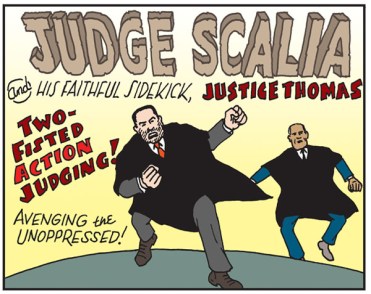 Methinks these Justices protest too much. It’s actually pretty telling too. Scalia seems to be getting his questions from old Fox News shows and Thomas has once again proven that no questions are necessary when you know exactly how you’re expected to vote to keep the perks pouring in. It makes one wonder if Roberts is the least bit concerned about how “his” court will go down in history. If comparing the health care market to broccoli is a sign of great intellect, please, buy my a ticket to Palookaville. Here’s how Charlie Pierce puts it.
It is plain now that Scalia simply doesn’t like the Affordable Care Act on its face. It has nothing to do with “originalism,” or the Commerce Clause, or anything else. He doesn’t think that the people who would benefit from the law deserve to have a law that benefits them. On Tuesday, he pursued the absurd “broccoli” analogy to the point where he sounded like a micro-rated evening-drive talk-show host from a dust-clotted station in southern Oklahoma. And today, apparently, he ran through every twist and turn in the act’s baroque political history in an attempt to discredit the law politically, rather than as a challenge to its constitutionality. (What in hell does the “Cornhusker Kickback” — yet another term of art that the Justice borrowed from the AM radio dial — have to do with the severability argument? Is Scalia seriously making the case that a banal political compromise within the negotiations from which bill eventually is produced can affect its ultimate constitutionality? Good luck ever getting anything passed if that’s the standard.) He’s really just a heckler at this point. If he can’t do any better than that, he’s right. Being on the court is a waste of his time.
Better yet, check out Jonathan Chait’s piece on Conservative Judicial Activists Run Amok. It reintroduces an essay by Jeffrey Rosen from 2005 on how the court was undergoing some fairly radical changes. The Rosen essay specifically references a Thomas decision written with an amazing amount of paraphrasing from a libertarian kook named Richard Epstein who is obsessed with protecting property at all costs; including human ones.
As Epstein sees it, all individuals have certain inherent rights and liberties, including ”economic” liberties, like the right to property and, more crucially, the right to part with it only voluntarily. These rights are violated any time an individual is deprived of his property without compensation — when it is stolen, for example, but also when it is subjected to governmental regulation that reduces its value or when a government fails to provide greater security in exchange for the property it seizes. In Epstein’s view, these libertarian freedoms are not only defensible as a matter of political philosophy but are also protected by the United States Constitution. Any government that violates them is, by his lights, repressive. One such government, in Epstein’s worldview, is our government. When Epstein gazes across America, he sees a nation in the chains of minimum-wage laws and zoning regulations. His theory calls for the country to be deregulated in a manner not seen since before Franklin D. Roosevelt’s New Deal.
After Thomas joined the Supreme Court, Biden’s warnings seemed prescient. In 1995, echoes of Epstein’s ideas could be clearly heard in one of Thomas’s opinions. By a 5-4 majority in United States v. Lopez, the court struck down a federal law banning guns in school zones, arguing that the law fell outside Congress’s constitutional power to regulate interstate commerce. Lopez was a judicial landmark: it was the first time since the New Deal that the court had limited the power of the federal government on those grounds. Thomas, who sided with the majority, chose to write a separate opinion in which he suggested that even his conservative colleagues had not gone far enough. The real problem, he wrote, was not just with the law at hand but with the larger decision of the court during the New Deal to abandon the judicial doctrines of the 19th century that established severe limits on the government’s power. He assailed his liberal colleagues for characterizing ”the first 150 years of this Court’s case law as a ‘wrong turn.”’ He continued, ”If anything, the ‘wrong turn’ was the Court’s dramatic departure in the 1930’s from a century and a half of precedent.”
Thomas did not cite Epstein directly in his opinion. But to anyone familiar with Epstein’s writings, the similarities were striking. Indeed, Thomas’s argument closely resembled one Epstein had made eight years earlier in ”The Proper Scope of the Commerce Power” in the Virginia Law Review — so closely, in fact, that Sanford Levinson, a liberal law professor at the University of Texas, accused Thomas of outright intellectual theft. (”The ordinary standards governing attribution of sources — the violation of which constitutes plagiarism — seem not to apply in Justice Thomas’s chambers,” Levinson wrote in the Texas Law Review.) Biden’s fear that Epstein’s ideas might be written into law had apparently been realized. And the fear would continue to be realized in other courts throughout the 90’s as a small but energetic set of lower-court judges, sympathetic to libertarian arguments, tried to strike down aspects of the Clean Water Act, the Endangered Species Act and other laws, challenging powers of the federal government that had come to be widely accepted during the second half of the 20th century.
Chait takes this essay into the present and the analysis presents a chilling future of judicial activism unlike anything we’ve seen before. The hearings this week on the ACA imply a SCOTUS willing to rewrite legislation in the name of ideology. The so-called swing vote, Justice Kennedy, has created loopholes in cases before that have allowed state legislatures to drive huge right-depriving laws through constitutional rights. By introducing the factually inaccurate, unscientific idea of “fetal pain” in Gonzales V Carhart, Kennedy opened a can of whoop ass based on religious propaganda on American Women.
Writing for the majority, Justice Anthony Kennedy said:
“States . . . have an interest in forbidding medical procedures which, in the State’s reasonable determination, might cause the medical profession or society as a whole to become insensitive, even disdainful, to life, including life in the human fetus . . . A State may take measures to ensure the medical profession and its members are viewed as healers, sustained by a compassionate and rigorous ethic and cognizant of the dignity and value of human life, even life which cannot survive without the assistance of others.”
The National Right to Life Committee thinks that Kennedy’s directive, particularly the bit at the end —”even life which cannot survive without the assistance of others”—leaves open the possibility of revising the viability standard. As Olivia Gans, an NRLC spokesperson, told me a few weeks ago, before the law had passed, “What Kennedy was saying was that states can and should look at other variables to figure out what’s in the best interest of the state.”
This is to medical science as the broccoli argument is to economics. It’s clear that the justices are venturing into something beyond judging constitutionality. Consider this thought offered by Chait.
The spectacle before the Supreme Court this week is Republican justices seizing the chance to overturn the decisions of democratically-elected bodies. At times the deliberations of the Republican justices are impossible to distinguish from the deliberations of Republican senators. They are litigating the problem of adverse selection, and doing it very poorly. (Here are health economists Henry Aaron and Kevin Outterson tearing their hair out over the justices’ bungled attempts to describe the economic dynamics at work.)
Scalia himself offers the most blatant case. His famed thunderings against meddlesome judges are nowhere to be found. He is gleefully reversing his previous interpretation of the Commerce Clause, now that it is being deployed against big government liberals rather than pot smokers. He is railing against Obamacare like an angry Fox News-watching grandfather:
In the morning session — in which the court weighed how much of the law should stand if the mandate is ruled unconstitutional — Scalia cited the horsetrading required to pass the bill — including the politically embarrassing, and failed, Cornhusker Kickback. He also admitted that he’d like to see the whole law fall if the mandate is ruled out of bounds.
In the afternoon, he took pains to remind the court of the unpopularity of the individual mandate.
The exchange occurred when Solicitor General Donald Verrilli Jr. rejected a hypothetical that relied on the notion of Congress passing a massive new tax. This, he argued, would have to overcome massive political constraints.
At that point Scalia chimed in: He would’ve thought the individual mandate would also be too much of a political liability to ever pass Congress.
In fact, the “Cornhusker Kickback” was stripped out before the final bill, but Scalia seems not to know that.
Just two years ago, the idea that conservatives might win the health-care fight in Court rather than the Senate seemed absurd. Just seven years ago, the notion that Republican jurisprudence would be defined by aggressive economic judicial activism seemed even more fantastical. But just as there are few atheists in foxholes, there aren’t a lot of justices of any persuasion willing to walk away from a chance to overturn a duly-passed law that they personally detest.
Whatever issue you may have with the ACA, it was passed by an overwhelming number of Senators and Representatives after a year of hearings, testimony, and rewrites. It deserves a fair hearing before something other than a Kangaroo Court.
“Women Deserve an Apology” and an “American Tragedy”
Posted: March 28, 2012 Filed under: U.S. Politics, War on Women, Women's Healthcare 32 CommentsCarolyn Maloney asked for and received an apology from Derrald Issa who accused her of lying. Maloney and colleagues used a question of personal privilege to ask for the apology. The House recognized the reason as valid.
House Oversight and Government Reform Committee Chairman Darrell Issa (R-Calif.) on Tuesday apologized to committee member Carolyn Maloney (D-N.Y.) for accusing her of stating an “outright lie” during a February hearing about federal policy on contraception coverage.
The now-famous February hearing is the one where the first panel on the issue of contraception included no women, prompting Maloney to ask, “Where are the women?”
In a March 21 story published in the Rancho Santa Fe Review, Issa said, “Carolyn Maloney then made the famous statement, where are the women? That was an outright lie, and she knew it when she said it.”
Republicans have argued that Democrats had their chance to invite women to the first panel, that there were women on the second panel, and that Democrats have been overplaying the idea that Republicans purposefully sought to block women from testifying.
Issa’s committee held the Feb. 16 hearing to discuss possible violations of First Amendment freedom of religion by way of the Obama administration rule that employee insurance plans carry contraception coverage even when the employer is a religious organization that does not believe in birth control. Maloney and other Democratic lawmakers had invited Georgetown University student Sandra Fluke to testify on the benefits of contraception coverage, but Issa did not allow her on the panel.
 Issa’s hearing launched a number of personal attacks on Sandra Fluke–notably by radio jerk Rush Limbaugh–and has lead to a number of protests to stop the Republican Assault on individual rights of women to access both birth control and abortion.
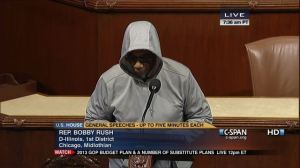
In an action today, Bobby Rush was given an escort off the floor of Congress for removing his suit jacket to show that hoodies are worn by many people. Boehner has a strict dress code so Rush–while citing Bible verses–was hammered down by the acting speaker.
Rush was escorted off the floor for “wearing a hat” in violation of the decorum rule.
At this point in his remarks, Rush took off his jacket to reveal that he was wearing a hoodie underneath it. He covered his head with the hood, violating a rule in Congress that prohibits wearing hats on the House floor.
“Racial profiling has to stop, Mr. Speaker. Just because someone wears a hoodie does not make them a hoodlum,” Rush added, swapping his spectacles for a pair of sunglasses.
At this point, Rep. Gregg Harper, a Republican congressman from Mississippi who was serving as the presiding speaker of the chamber, called Rush out of order. Rush continued reading a passage from the Bible before being escorted out of the chamber.
The hoodie has become something of a symbol during the national outcry which has followed Martin’s death, especially among those who think the killing was racially tinged. Since then, protesters across the nation have joined in various so-called “Million Hoodie Marches” calling for justice for Martin’s death and decrying racial profiling in America. Several members of the Miami Heat NBA basketball team also recently posed for a photo in hoodies, heads bowed, in tribute to Martin.
I’m bringing both of these incidents up in one post with the hope that we’re beginning to see some protests about the way the House of Representatives has been handled recently. Majority parties go out of their way to quash dissent. Perhaps this signals that the minority party is beginning to find a voice and their backbone. It also seems to indicate that Boehner enforces dress codes better than he enforces committee rules.

 peej
peej Carissa
 bostonboomer
 dakinikat
 ecocatwoman
 jjlo
jjlo mablue2
 Mama Lopez
 peggysue22
 quixote
 skydancingguestblogger
 Mona (aka Wonk the Vote)





Recent Comments