
Monday Reads: The Beat Goes On
Posted: December 23, 2013 Filed under: morning reads 65 Comments Good Morning!
I’m going to continue with my own whims and fancies since this time of year always creates one big cultural, political, and historical vacuum. I use my winter break to renew myself and to tickle my fancy. The first man I really fell head over heels in love with introduced me to Jack Kerouac during my freshman year of university. He broke my heart but Kerouac became a muse. Then, came my husband who got me deep into Coltrane, Miles Davis, and Dizzy. I left him but that bebop jazz stayed right in my heart and under my fingers. The closer we got to those awful 80s, the more some of us craved that old time bohemian rebellion that started with the beat generation and lead to the hippies. I feel like that now. Can we please get a new groovy, snap worthy, punk generation to rebel against the republican status quo so I don’t have to wax nostalgic?
I’m going to start off with this article from The Guardian: “Greenwich Village: what remains of New York’s beat generation haunts?” This culture made me want to drop everything and move to New York like my cousin. Oh, Mary Bracken I am so sorry I didn’t follow you there when you offered to get me situated after high school graduation I could’ve lived the remnants of this as well as the birth of CBGB.
A few landmarks of those bygone bohemian days – most recently portrayed in the Coen brothers‘ film Inside Llewyn Davis, out on 24 January – still exist. The inspiration for the movie’s fictional anti-hero, Davis, was Brooklyn-born Dave Van Ronk, a real- life blues and folk singer with no small talent, who worked with performers such as Pete Seeger and Bob Dylan, but remained rooted in the village until he died in 2002, declining to leave it for any length of time and refusing to fly for many years. Van Ronk’s posthumously published memoir, the Mayor of MacDougal Street, takes its name from the street that was home to the Gaslight Cafe, and other early 60s folk clubs.
The Village stretches from the Hudson River Park east as far as Broadway, and from West Houston Street in the south up to West 14th Street.
Lots of folks want to save landmarks ethereal. Every one needs a place to go to get away from the pressures and the ugliness of modern  corporate instigated culture. Why shouldn’t we save the places where elves and gnomes are said to live? Why shouldn’t we protect the “hidden folk” and their environs?
Elf advocates have joined forces with environmentalists to urge the Icelandic Road and Coastal Commission and local authorities to abandon a highway project building a direct route from the Alftanes peninsula, where the president has a home, to the Reykjavik suburb of Gardabaer. They fear disturbing elf habitat and claim the area is particularly important because it contains an elf church.
The project has been halted until the Supreme Court of Iceland rules on a case brought by a group known as Friends of Lava, who cite both the environmental and the cultural impact — including the impact on elves — of the road project. The group has regularly brought hundreds of people out to block the bulldozers.
And it’s not the first time issues about “Huldufolk,” Icelandic for “hidden folk,” have affected planning decisions.
They occur so often that the road and coastal administration has come up with a stock media response for elf inquiries, which states that “issues have been settled by delaying the construction project at a certain point while the elves living there have supposedly moved on.”
Scandinavian folklore is full of elves, trolls and other mythological characters. Most people in Norway, Denmark and Sweden haven’t taken them seriously since the 19th century, but elves are no joke to many in Iceland, population 320,000.
A survey conducted by the University of Iceland in 2007 found that 62 percent of the 1,000 respondents thought it was at least possible that elves exist.
Today’s world brings on so many things that make you want to shake your head and slap folks right in the face. Why shouldn’t we indulge in a little fancy when these kinds of things pop up in today’s headlines? Women are not be incubators. But yet, the state of Texas, says yes they are!
On Nov. 26, Erick Munoz woke to the sound of his year-old son crying and found his 14-weeks-pregnant wife, Marlise, lying on the kitchen floor, blue in the face and without a pulse. A firefighter and paramedic, Munoz called 911 and performed CPR, to no avail. When they arrived at the John Peter Smith Hospital (JPS) in Fort Worth, Texas, he thought he would have to make an agonizing decision: refuse life support even though that meant losing both his wife and his future child. Munoz said in a WFAA News report that four years ago, when Marlise’s brother was killed in an accident, she told him that she would never want to be on life support — something they had discussed many times since.
A month later, against his requests, she is still on a ventilator. Not only does Munoz want to honor his wife’s wishes, but also he believes that the fetus she is carrying has been seriously harmed. “I don’t know how long she was there prior to me finding her,” he said. Munoz, who could not be reached for comment, wrote on WFAA’s Facebook page, “All I know is that she was without oxygen long enough for her to have massive brain swelling. I unfortunately know what that type of damage could do to a child during crucial developmental time.” Doctors say it’s likely that Munoz’s wife suffered a pulmonary embolism, and no longer has brain activity.
When Munoz first arrived at the hospital, he discovered that, according to Texas law, life-sustaining procedures may not be withheld or withdrawn from a pregnant woman, — even if she has an advance health care directive (also called a living will) stipulating that she does not want to be kept alive on a machine. There are conflicting reports about whether Marlise Munoz had an official DNR (Do Not Resuscitate order), and the family could not be reached for comment. But according to them Center for Women Policy Studies, as of 2012, Texas and 11 other states have automatically invalidated pregnant women’s advance directives to refrain from using extraordinary measures to keep them alive, and others have slightly less restrictive but similar laws. A spokesperson from the hospital told Yahoo Shine, “Our responsibility is to be a good corporate citizen while also providing quality care for our patients. At all times, JPS will follow the law as it applies to healthcare in the state of Texas.”
Marlise Munoz’s mother and father say they support their son-in-law’s request to take their daughter off life support. “She absolutely DID NOT EVER want to be connected to Life Support,” her mother, Lynne Machado, wrote on WFAA’s Facebook page. “This issue is not about Pro Choice/Pro Life. Our intent is purely one of education about how this [statute] null and voids any woman’s DNR [if she is] pregnant. We know our daughter well enough, after numerous discussions about DNR, that she would NEVER EVER consent to being hooked up to Life Support.” While the family’s tragic situation hits a nerve in a state where abortion debates rage, Munoz also said he doesn’t want to participate in arguments
over right-to-life verses pro-choice issues, but instead wishes to honor his wife and inform the public about a little-known law. Marlise Munoz, at approximately 18 weeks pregnant, remains unresponsive and her husband describes her as “simply a shell.” Doctors check the fetal heartbeat daily, but Munoz doesn’t think the testing is sufficient to measure the fetus’s viability. “Its hard to reach the point where you would wish your wife’s body would stop,” he said.
Yes, there are many things that horrify about the way the right wing and religionists treats women.
We’ve compiled a few of the worst things said about women by TEApublicans in 2013 in the list below:
Rape exceptions for abortions aren’t necessary because pregnancies resulting from rape are rare.
Arizona GOP Rep. Trent Franks was the “brains” behind what was probably the most high-profile abortion restriction this year: a bill to ban all abortions in the U.S. at 20 weeks after conception. “The incidence of pregnancy resulting from rape are very low,” he claimed.
The ‘masturbating fetus.’
Yes, this really happened. While defending Franks’ 20-week abortion ban, Texas GOP-er Michael Burgess used a rather bizarre argument to claim that fetuses could feel pain at 20 weeks after conception, despite medical evidence to the contrary. “Watch a sonogram of a 15-week baby, and they have movements that are purposeful,” he said. “They stroke their face. If they’re a male baby, they may have their hand between their legs. They feel pleasure. Why is it so hard to think that they could feel pain?”
Having an abortion after rape is tampering with criminal evidence.
New Mexico GOP Rep. Cathrynn Brown caused a stir when she introduced a bill that defined aborting a pregnancy that resulted from rape as criminal evidence tampering — that should result in a 3-year prison sentence. The bill said that “procuring or facilitating an abortion, or compelling or coercing another to obtain an abortion, of a fetus that is the result of criminal sexual penetration or incest with the intent to destroy evidence of the crime.”
Rape of an underage victim is understandable if a woman seems more mature than her age.
Montana Judge G. Todd Baugh received a huge backlash when he sentenced 54 year-old teacher Stacey Rambold to only 30 days in prison — after he was convicted of raping his 14-year-old student, Cherise Moralez. Justifying his sentence, Baugh said that the victim was “as much in control of the situation” because she was “older than her chronological age.” Moralez committed suicide during Rambold’s trial.
Transvaginal ultrasounds before abortions are a good idea.
Anti-abortion politicians in the Indiana Legislature pushed a bill that would force women who wanted to use an abortion pill to undergo two medically unnecessary ultrasounds — one before taking the pill, and one after. Responding to the backlash, Indiana Right to Life’s Sue Swayze said, “I got pregnant vaginally. Something else could come in my vagina for a medical test that wouldn’t be that intrusive to me. So I find that argument a little ridiculous.”
One disgusting term: Rape insurance.
We saw a lot of bills that banned Obamacare from covering abortions this year. Nearly half of all statehouses pushed through some type of measure forcing women to purchase abortion coverage as a separate abortion-only policy, called a “rider.” Some of these laws did not include exceptions allowing insurance to cover abortions in the cases of rape or incest. Michigan’s Right to Life’s Barbara Listing didn’t see any problem with this: “It’s simply, like, nobody plans to have an accident in a car accident, nobody plans to have their homes flooded. You have to buy extra insurance for those.”
It’s easier to believe in elves than to believe most of the things spewed by republicans and their right wing base. Still the media villagers take them seriously and report their lies as just another opinion.

Of all the falsehoods told about PresidentBarack Obama, the biggest whopper is the one about his reckless spending spree.
As would-be president Mitt Romney tells it: “I will lead us out of this debt and spending inferno.”
Almost everyone believes that Obama has presided over a massive increase in federal spending, an “inferno” of spending that threatens our jobs, our businesses and our children’s future. Even Democrats seem to think it’s true.
Government spending under Obama, including his signature stimulus bill, is rising at a 1.4% annualized pace — slower than at any time in nearly 60 years.
But it didn’t happen. Although there was a big stimulus bill under Obama, federal spending is rising at the slowest pace since Dwight Eisenhower brought the Korean War to an end in the 1950s.
Even hapless Herbert Hoover managed to increase spending more than Obama has.
Here are the facts, according to the official government statistics:
• In the 2009 fiscal year — the last of George W. Bush’s presidency — federal spending rose by 17.9% from $2.98 trillion to $3.52 trillion. Check the official numbers at the Office of Management and Budget.
• In fiscal 2010 — the first budget under Obama — spending fell 1.8% to $3.46 trillion.
• In fiscal 2011, spending rose 4.3% to $3.60 trillion.
• In fiscal 2012, spending is set to rise 0.7% to $3.63 trillion, according to the Congressional Budget Office’s estimate of the budget that was agreed to last August.
• Finally in fiscal 2013 — the final budget of Obama’s term — spending is scheduled to fall 1.3% to $3.58 trillion.


So, my winter break starts and I want to celebrate rebellion, creativity, and wanton. I can’t wait for 12th night because that signals the end of Crass Consumerism and the pleasure of hedonism and the carnival season. I just want to give up all this sit com fantasy and grab on to something real for a change.
What’s on your reading and blogging list today?
Friday Reads
Posted: December 20, 2013 Filed under: 2016 elections, Barack Obama, Mental Health, morning reads 46 CommentsGood Morning!
I have to admit I have no idea where this one is going to go today. I only know there are a lot of things I’m really tired of at the moment and I’m going to avoid them. However, tomorrow is the Winter Solstice so the days are really short and so is the sunlight!
So, I’m going to start out with an archaeology thing and go from there. Archaeologists are trying to find libraries and scrolls buried beneath volcanic ash in Herculaneum. They hope to recover some of the ancient texts that existed in that time period.
In 2008, a further advance was made through multi-spectral imaging. Instead of taking a single (“monospectral”) image of a fragment of papyrus under infrared light (at typically 800 nanometres) the new technology takes 16 different images of each fragment at different light levels and then creates a composite image.
With this technique Obbink is seeking not only to clarify the older infrared images but also to look again fragments that previously defied all attempts to read them. The detail of the new images is so good that the handwriting on the different fragments can be easily compared, which should help reconstruct the lost texts out of the various orphan fragments. “The whole thing needs to be redone,” says Obbink.So what has been found? Lost poems by Sappho, the 100-plus lost plays of Sophocles, the lost dialogues of Aristotle? Not quite.
Despite being found in Italy, most of the recovered material is in Greek. Perhaps the major discovery is a third of On Nature, a previously lost work by the philosopher Epicurus.
But many of the texts that have emerged so far are written by a follower of Epicurus, the philosopher and poet Philodemus of Gadara (c.110-c.40/35BC). In fact, so many of his works are present, and in duplicate copies, that David Sider, a classics professor at New York University, believes that what has been found so far was in fact Philodemus’s own working library. Piso was Philodemus’s patron.
The Senate passed a huge appropriations bill last night for the military.
The legislation would:
—Authorize a 1 percent pay raise for military personnel and cover combat pay and other benefits.
—Strip military commanders of their ability to overturn jury convictions, require a civilian review if a commander declines to prosecute a case and require that any individual convicted of sexual assault face a dishonorable discharge or dismissal. The bill
also would provide victims with legal counsel, eliminate the statute of limitations for courts-martial in rape and sexual assault cases, and criminalize retaliation against victims who report a sexual assault.
The Pentagon has estimated that 26,000 members of the military may have been sexually assaulted last year, though thousands were afraid to come forward for fear of inaction or retribution. Several high-profile cases united Democrats and Republicans behind efforts to stop sexual assault in the ranks.
The compromise also would change the military’s Article 32 proceedings to limit intrusive questioning of victims, making it more similar to a grand jury
The legislation does not include a contentious proposal from Sen. Kirsten Gillibrand, D-N.Y., to give victims of rape and sexual assault in the military an independent route outside the chain of command for prosecuting attackers, taking the authority away from commanders.
That proposal drew strong opposition from the Pentagon and several lawmakers. Gillibrand’s plan is likely to get a separate vote, perhaps as early as next month.
Italian police on Thursday conducted a manhunt for a serial killer who was allowed to leave a Genoa prison on a two-day, good-behavior pass to see his elderly mother but failed to return.
Bartolomeo Gagliano is armed and “dangerous,” Genoa police official Fausto Lamparelli said. He urged people who think they might have spotted Gagliano to quickly call police.
There are fears that the fugitive might have driven across the nearby border into France.
Courts held Gagliano, now 55, responsible for the fatal stoning of one prostitute and the wounding of another in 1981, but ruled him mentally incapable of understanding the crime and ordered him to an asylum for the criminally insane, according to authorities. After escaping in 1989 from the asylum, he killed, along with another man, a female transsexual and a male transvestite, and was again sent to a criminal asylum for psychiatric treatment, authorities quoted in Italian news reports said.
I wonder who thought that was a good idea?
The tiny break away country of South Sudan looks to be on the edge of civil war. Things are really coming apart at the seams there and it is a dangerous situation for the country’s civilians. Americans are being evacuated.
US President Barack Obama has warned that South Sudan is on the “precipice” of a civil war, after clashes in the capital Juba spread around the country.
He said 45 military personnel had been deployed to South Sudan on Wednesday to protect American citizens and property.
On Thursday three Indian peacekeepers died in an attack on a UN compound.
At least 500 people are believed to have died since last weekend, when President Salva Kiir accused his ex-deputy Riek Machar of a failed coup.
“South Sudan stands at the precipice. Recent fighting threatens to plunge South Sudan back into the dark days of its past,” President Obama said in a letter to Congress.
“Inflammatory rhetoric and targeted violence must cease. All sides must listen to the wise counsel of their neighbours, commit to dialogue and take immediate steps to urge calm and support reconciliation.”
Sudan suffered a 22-year civil war that left more than a million people dead before the South became independent in 2011.
The recent unrest has pitted gangs from the Nuer ethnic group to which Mr Machar belongs against Dinkas, the majority group to which Mr Kiir belongs.

A report issued last week by the Department of Justice’s Inspector General found that the federal prison population has increased so rapidly over the past dozen years that the high costs of housing all of those convicts is draining the agency’s budgets for fighting crime, combatting terrorism and protecting Americans’ civil rights.
The US leads the world in imprisoning its citizens, and one of the reasons for that are our long mandatory minimum sentences for those caught up in the drug war. Awareness of the costs of these policies — in human as well as budgetary terms — has been increasing in recent years. In 2010, Congress passed the Fair Sentencing Act, which addressed a significant disparity in the punishments meted out for those possessing crack and powder cocaine. Earlier this year, Attorney General Eric Holder issued new prosecutorial guidelines in an effort to cut down on the number of nonviolent drug offenders facing long periods of incarceration.
Today, Charlie Savage reports for The New York Times that the Obama administration offered some immediate relief to some of those people serving sentences that are disproportionate to their crimes.
I really liked this question from Robert Reich: What Will It Take for Us to Get Back to Being a Decent Society? . . . Now that we’re second  only to Romania for child poverty.
Congress has just passed a tiny bipartisan budget agreement, and the Federal Reserve has decided to wean the economy off artificially low interest rates. Both decisions reflect Washington’s (and Wall Street’s) assumption that the economy is almost back on track.
But it’s not at all back on the track it was on more than three decades ago.
It’s certainly not on track for the record 4 million Americans now unemployed for more than six months, or for the unprecedented 20 million American children in poverty (we now have the highest rate of child poverty of all developed nations other than Romania), or for the third of all working Americans whose jobs are now part-time or temporary, or for the majority of Americans whose real wages continue to drop.
How can the economy be back on track when 95 percent of the economic gains since the recovery began in 2009 have gone to the richest 1 percent?
The underlying issue is a moral one: What do we owe one another as members of the same society?
So, it’s coming towards the end of 2013. I cannot imagine 2014 is going to be much different, but I’d like to think it will be. There’s one thing that I’m looking forward to: Hillary Clinton: I’ll make a decision on 2016 next year.
Former Secretary of State Hillary Clinton is still keeping mum on whether she’ll run for president in 2016, telling ABC News she hasn’t made up her mind yet.
“Obviously, I will look carefully at what I think I can do and make that decision sometime next year,” Clinton told Barbara Walters during an interview to mark her selection as Walters’ “Most Fascinating Person of 2013.” It’s the second time she’s received the distinction – the first being 1993, the year the list debuted, when she was first lady.
Clinton also said it’s too early to look at the next election.
“I think we should be looking at the work that we have today. Our unemployment rate is too high. We have people getting kicked off food stamps who are in terrible economic straits. Small business is not getting credit, I could go on and on, so I think we ought to pay attention to what’s happening right now,” she said.
What’s on your reading and blogging list today?
Duck Disaster: Jindal Wades into the Blind
Posted: December 19, 2013 Filed under: religious extremists, The Right Wing 52 Comments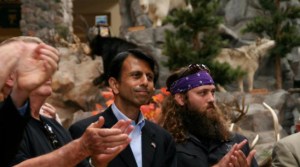 I’ve spent some time in Monroe, Louisiana. About ten years ago, I had to teach all over the state. I am just glad I spent some time in some other cities before getting sent to the Monroe area or I’d have never left the confines of Orleans parish again. Monroe is a place I’d rather not visit again. My first thought on wandering around was “Where are all the black people hiding?” Then, I wondered why they were obviously not around their white neighbors. That was before I read and found out that the KKK are live and kicking in that region of the state. I also begin hearing personal experiences like this one. A coworker and office mate of mine at the time–a young black woman of about 25–had gone to university up there. She told me that she learned that she couldn’t walk through the white frat section of the campus because she kept getting spit on. This was like the year 2000 so, we’re not talking way back in the day.
When I learned Duck Dynasty was being filmed in Monroe, I figured that you weren’t going to see a lot of black people in the show and that it was going to be yet another one of those reality shows where the rest of the world gets to learn about the backwater cultures of the South. These Hollywood reality shows like to entertain their city friends with the likes of our backwater rubes. They make them cute, fuzzy, eccentric, and gosh darn lovable. I’m not sure if you watched Swamp people or Axe Man or any number of other shows where they trot out our old white guys that hang in the woods, but it’s pretty formulaic. The problem is that the shows are pretty well edited and controlled. You can see, however, that whenever these Duck Dynasty guys go to the country club, the backwoods, or the kids’ schools, there are really no black people in the picture. Again, that’s my take away from every visit to Monroe. They are freaking insular up there. But then, just like no one noticed the tales of “happy darkies in the cotton fields” told by Phil Robertson until later today, no one has noticed the distinct lack of diversity or reality in the show. Well, maybe their core audience has and that’s why they like it. I guess it all was okay until Phill opened his big fat mouth and pointed out–like a bayou version of snowflake snookie–that gawd made women’s vaginas for men and gay men must be crazy and sinful to not take advantage of that.
Like all reality shows, Duck Dynasty is probably heavily edited. But, it’s a big old media world out there. The Duck Dynasty Paw Paw got interviewed sans handlers by GQ. His Monroe roots are now exposed. His Southern Baptist tirades don’t look so homespun any more. He’s not just a cuddly, curmudgeon who has a thing for killing what ever moves like Ned outta South Park. Phil Robertson is outta the closet now alot like Paula Dean got outted a while back. Wither the cash cow er duck?
There’s several things that have kind’ve intrigued me about this ever unfolding story. The first is that the response to the homophobic comments are being played out a lot more than his appalling racist and sexist comments. Women are vaginas. All the black folk he grew up with were straight out of that old southern stereotype of the happy Uncle Tom and Aunt Jemima brand. Ah, they were so happy and singing during them Jim Crow Days. Robertson had no apparent realization black folks were rightfully scared for their lives back then so they just put on that damn smile to protect themselves. They also are hard to find among white folks in Monroe today so I’m thinking there’s still some of that going on up there and they know it.
As is clear in the profile in GQ, A&E has tried to walk a fine line between portraying the Robertsons as religious Christians without spotlighting the parts of their beliefs that have the potential to cause precisely the kind of firestorm that resulted yesterday. “There are more things Phil would like to say—’controversial’ things, as he puts it to me—that don’t make the cut,” Magary writes. This dilemma of wanting part of a reality television cast member’s personality, but only the parts that will make you money, is one that faced CBS’s Big Brother this year, too, after discovering that the ways in which a number of their controversial and colorful cast members were controversial and colorful was that they were enormously ignorant racists.
I absolutely understand the desire to make money off of either evangelical Christianity or American backwardness, which has increasingly been one of the staples of reality television. There is clearly a market for an underserved audience of religious Christians who would like to see themselves reflected in popular media more frequently. And there is clearly a market for being horrified by other people’s behavior. But it is exceptionally difficult, in a reality television context, to separate out and wall off the part of someone’s personality that is attractive and media-friendly from the parts that are less palatable to a mass audience. If you’re writing fiction for television, those attributes can get shaved off by the collective process of the writers’ room. But if you are, yourself, a reality television product, especially if you feel like you’re being suppressed or misrepresented, those parts of your personality and beliefs will inevitably out. Sometimes, the surprises are pleasant, as was the case on Here Comes Honey Boo Boo, where a family offered up as backwards and repellent proved to be tolerant, loving, and charming. But that is not often the case.
For the most part, reality television producers and the networks that air their work, have decided that these outbursts are worth the risk of continuing to sell highly specific personalities, precisely because the cycle of suspension, response, and temporary profit loss are so well-established at this point that it can probably be worked into a budget. I can’t imagine anyone at A&E is surprised that someone like Phil Robertson, who bills himself as a Bible-believing evangelical, believes that you can “Start with homosexual behavior and just morph out from there. Bestiality, sleeping around with this woman and that woman and that woman and those men,” or that he would say something like “It seems like, to me, a vagina—as a man—would be more desirable than a man’s anus. That’s just me. I’m just thinking: There’s more there! She’s got more to offer. I mean, come on, dudes! You know what I’m saying? But hey, sin: It’s not logical, my man. It’s just not logical.” The question was probably when, not if.
And when that when arrived, A&E had a well road-tested formula to use in its response, provided by the folks at GLAAD. GLAAD is the most effective media advocacy organization that I know of, on two levels: first, its ability to swiftly identify and condemn anti-LGBT speech and to get results, and second, in its deep, comprehensive, and intersectional research on the depiction of LGBT characters and figures in media. When Robertson’s remarks broke, Wilson Cruz of GLAAD responded quickly with a statement that hit on an incredible number of ideas in a clear, efficient way.
“Phil and his family claim to be Christian, but Phil’s lies about an entire community fly in the face of what true Christians believe,” he said. “He clearly knows nothing about gay people or the majority of Louisianans — and Americans — who support legal recognition for loving and committed gay and lesbian couples. Phil’s decision to push vile and extreme stereotypes is a stain on A&E and his sponsors, who now need to re-examine their ties to someone with such public disdain for LGBT people and families.” It was a condemnation that positioned GLAAD as a more sophisticated and compassionate arbiter of Christian values than Robertson, drew a connection between culture and legal protection, and offered a reminder that GLAAD has plenty of experience influencing media sponsors.
And A&E knew immediately what it had to do to respond to GLAAD: Robertson was suspended for an indefinite period of time, a punishment that doesn’t just promise long-running financial losses to him, but because it has no end point, can’t be immediately decried as too short or too long. It’s action that effectively ends the news cycle, as far as A&E’s need to take action and appear responsive are concerned.
It’s also worth noting that because of GLAAD’s swift intervention, much of the media coverage has focused more on Robertson’s anti-gay remarks than his comments about African Americans and the Civil Rights movement, which weren’t worked into the narrative of the profile, but appeared as a pull quote in the online version of the piece. While Robertson’s views on homosexuality are presented as consistent with his religious beliefs, his remarks about African-Americans are actually more politically extreme, aimed at undermining the validity of the safety net.
“I never, with my eyes, saw the mistreatment of any black person. Not once. Where we lived was all farmers. The blacks worked for the farmers. I hoed cotton with them. I’m with the blacks, because we’re white trash. We’re going across the field,” Robertson said. “They’re singing and happy. I never heard one of them, one black person, say, ‘I tell you what: These doggone white people’—not a word!… Pre-entitlement, pre-welfare, you say: Were they happy? They were godly; they were happy; no one was singing the blues.”
That’s a vision of the American South and American racial history that’s in keeping with Paula Deen’s alleged plantation nostalgia. It’s an attempt to substitute Robertson’s own memories of his interactions with African American laborers, whose behavior around him may well have been influenced by his relative privilege as a white man, even a poor one, for the larger history of organizing against and resistance to the economically and racially ruinous consequences of the Jim Crow system. It’s a kind of narrative that’s aimed at retroactively manufacturing black consent for policies aimed at maintaining white supremacy.
The other equally appalling thing is that the right wing is playing this as some kind of first amendment rights issue. Since when do Republicans think employees get to ignore the wishes of their corporate overlords? Where was the outrage over Alec Baldwin or Martin Brashear? Robertson is now the right wing martyr for oppressed christians who are just expressing their traditional values and have a first amendment right to do so that we all just have to respect. WTF?
I woke to reading that my asshole governor had jumped in on that. My guess is he’s trying to get on the radar of the Republican base again for his endless wetdreams of being President. Did he actually read what this guy said about black people or was he just thinking the homophobic remarks would be the place he could pander those Iowan evangelical votes?
Louisiana Gov. Bobby Jindal on Thursday criticized the “politically correct crowd” following the suspension of “Duck Dynasty” star Phil Robertson over comments he made about homosexuality and religion in a recent interview with GQ magazine.
“Phil Robertson and his family are great citizens of the State of Louisiana. The politically correct crowd is tolerant of all viewpoints, except those they disagree with,” Jindal said in a statement released by his office. “I don’t agree with quite a bit of stuff I read in magazine interviews or see on TV. In fact, come to think of it, I find a good bit of it offensive. But I also acknowledge that this is a free country and everyone is entitled to express their views.”
A&E, which airs “Duck Dynasty,” put Robertson on indefinite suspension from the show on Wednesday because of a controversial interview with GQ, in which, he commented on his inability to comprehend homosexuality or societies “without Jesus.”
“That’s just me. I’m just thinking: There’s more there! She’s got more to offer. I mean, come on, dudes! You know what I’m saying? But hey, sin: It’s not logical, my man. It’s just not logical,” Robertson told Drew Magery in GQ.
When Magery asked him to define “sin,” Robertson responded, “Start with homosexual behavior and just morph out from there. Bestiality, sleeping around with this woman and that woman and that woman and those men.”
In another part of the interview, Robertson equated Shintoism and Islam with Nazism.
So, see? There’s a little bit more out there than just the horrid comments about homosexuality. There’s the comments on blacks, women, and nonchristians. It’s a smorgasbord of bigotry! And, my governor is defending his right to say all of it as an employee of a corporation that probably wants viewership from black people, women, and folks that are not christian. Why wouldn’t they fire his redneck ass? He probably is going to cost them as much money as he brought in over the last year if not more.
But, the bigger questions is what’s going to happen with all that Duck Dynasty merchandise that’s all over the place now? Are there enough bigoted rednecks in the country to keep the franchise going? Maybe the franchise should just consider moving to a slot before the Huckabee show and advertise on the likes of Hannity and Rush.
Well, there probably is enough of them in Northern Louisiana and Texas. Here’s the latest bit of ring wing furor or is that fuhrer?
Other conservatives are now weighing in as well, including the Family Research Council and Sen. Ted Cruz (R-Tex.)
Here’s Cruz’s comment: “If you believe in free speech or religious liberty, you should be deeply dismayed over the treatment of Phil Robertson. Phil expressed his personal views and his own religious faith; for that, he was suspended from his job. In a free society, anyone is free to disagree with him, but the mainstream media should not behave as the thought police censoring the views with which they disagree.”
Update 3:47 p.m.: The National Organization for Marriage has launched a petitiondemanding that A&E reinstate Robertson and apologize for suspending him.
 Let me just remind you that the Family Research Council is a bona fide hate group.
So, I thought I could just let this entire thing pass with comments down thread, but I couldn’t. I would just like you to know that almost every one I know south of the I-12–that would be the creole/cajun part of Louisiana–is talking about seceding from the state again.
Oh, look, it’s a photo of two blowhards!
I am just hoping we get rid of those Hollywood tax credits and that the reality show folks will go pick on some one else’s backwards hicks for awhile.
Why Doesn’t This Surprise Me?
Posted: December 16, 2013 Filed under: religious extremists, right wing hate grouups | Tags: Fundamentalist religions 14 CommentsJust saw this study reported at WAPO. It basically says there’s not much difference in fundamentalists Christians and Muslims. Don’t ask  those two groups to acknowledge it however since all fundamentalist religions are based on seeing every one else as essentially hell-bound and wrong.
Religious fundamentalism among Muslim immigrants in Western Europe is dramatically greater than that among Christian Europeans, according to a recent study by Ruud Koopmans from the Wissenschaftszentrum in Berlin discussed on the Monkey Cage last Friday. On the surface, these findings legitimize concerns surrounding the incompatibility of Western and Islamic values.
Like Europeans, Americans express fear over Muslim integration and Islamic fundamentalism, although very little is known about beliefs among Muslims living in the U.S. A recent nationwide survey of U.S. Muslims, which I designed, provides some insight — the Muslim-American National Opinion Survey (MANOS) reveals that levels of religious fundamentalism among Muslims and Christians in the U.S. are nearly identical.
As one of the few nationally representative surveys available of Muslim Americans, MANOS provides insight into the degree Muslim Americans hold fundamentalist views, as defined by Koopmans. Data from existing surveys of the general American population allow me to assess where Muslims stand relative to other Americans in believing that religious rules are more important than the laws of the country and the degree individuals hold literal interpretations of holy scriptures.
The weird thing is that in the US, our religious fundamentalists run for office and get elected. That doesn’t happen much in Western Europe. Witness the Texas Lt. Governor’s race where all four candidates are creationists. What on earth does it take to educate people in the basics of science compared to iron age mythology?
Current Lt. Gov. David “Impeach Obama but get my niece out of jail” Dewhurst is already a creationist, and just believes in fairness:
“I believe that in fairness we need to expose students to both sides of this,” he said. “That’s why I’ve supported including in our textbooks the discussion of the biblical account of life and creation, and I understand there are a lot of people who disagree with me, and believe in evolution.”
State Sen. Dan Patrick and Ag Commissioner Todd Staples also said that they think that, for freedom, schools should teach something that isn’t science in science classes because it is popular, also Christians are oppressed:
“Our students … must really be confused. They go to Sunday School on Sunday and then they go into school on Monday and we tell them they can’t talk about God,” said Patrick. “I’m sick and tired of a minority in our country who want us to turn our back on God.”
The one candidate who didn’t overtly advocate teaching creationism didn’t exactly sound hostile to it, either. Land Commissioner Jerry Patterson trotted out the astonishing revelation that the phrase “Separation of Church and State” does not appear in the Constitution, which obviously means that schools should have a lot more church in ‘em:
“Show me where that’s in the Constitution, because it’s not in the Constitution,” he said. “I see nothing wrong with standing up at least for a moment of silence, let those who wish to pray, pray in their own faith. I see nothing wrong with having a prayer before a high school football game.”
Just as long as they’re not, like, Muslim or anything.
The candidates may find implementing their pledges somewhat difficult, as the Loot Gov doesn’t actually set education policy in Texas, and the state school board has almost miraculously approved science texts that actually teach science.
 I’m sure they don’t like the comparison, but American fundamentalists seem to be all the same. It really doesn’t matter which abrahamic cult they’ve attached themselves too.
Results from MANOS and the General Social Surveys reveal that the general American population holds nearly identical levels of fundamentalist beliefs as Muslims, if not slightly more. Just over 57 percent of the general American population believes that “right and wrong in U.S. law should be based on God’s laws,” compared to 49.3 percent of U.S.-born Muslims and 45.6 of foreign-born Muslims. About a third of each group believes that society should not be the one to determine right and wrong in U.S. law. Such numbers reveal that the general American population is more fundamentalist than the average European, and that Muslim Americans are less fundamentalist than European Muslims, according to the Koopmans study.
A large number of folks have a problem with reality and modernity. Their issues have become our issues. They create war. They pave the way for missionaries that spread hatred around the world. They run for office and attack all kinds of people’s rights based on somethings that do not hold up to any kind of sane scrutiny. It’s about time that those folks that don’t embrace the mindset of the iron age but embrace the beliefs that started there start doing something about the crazies. It’s just not fair to the rest of us to have these fundamentalist mindsets inflicted on civilization.
Btw, I’m not persecuting you. I’m laughing at your dumb asses. You have a right to believe it, but you certainly do not have a right to inflict such nonsense on the rest of us.
Monday Reads
Posted: December 16, 2013 Filed under: morning reads | Tags: Darrell Issa, Paul Ryan, Republican temper tantrums, Sun switching polarity, Syrian Human Rights violations, War on Festivus 55 Comments
Good Morning!
I’ve found a few things to keep you interested this morning. Some are depressing as usual and some are intriguing. The Sun is going to reverse polarity soon. This evidently happens every 11 years and causes some interesting space weather.
The sun switches its polarity, flipping its magnetic north and south, once every eleven years through an internal mechanism about which little is understood.
The swap could however cause intergalactic weather fronts such as geomagnetic storms, which can interfere with satellites and cause radio blackouts.
Nasa said in August that the change would happen in three to four months time, but it is impossible to give a more specific date. Scientist won’t know for around another three weeks whether the flip is complete.
The impact of the transfer will be widespread as the sun’s magnetic field exerts influence well beyond Pluto, past Nasa’s Voyager probes positioned near the edge of interstellar space.
The event will be watched closely by researchers at Stanford University’s Wilcox Solar Observatory, which monitors the sun’s magnetic field on a daily basis.
Todd Hoeksema, director of the Wilcox Solar Observatory, said the polarity change is built up throughout the eleven year cycle through areas of intense magnetic activity known as sunspots which gradually move towards the poles, eroding the existing opposite polarity.
Eventually, the magnetic field reduces to zero, before rebounding with the opposite polarity. “It’s kind of like a tide coming in or going out,” Hoeksema said. “Each little wave brings a little more water in, and eventually you get to the full reversal.”
One of the most noticeable effect on Earth will be a boost in the occurrence, range and visibility of auroras – the Northern Lights. “It’s not a catastrophic event, it’s a large scale event that has some real implications, but its not something we need to worry about,” added Hoeksema.
 One more space story. The Chinese Flag is now on the moon. They landed a rover there last weekend.
Shanghaist reports China has photographed its flag on the moon for the first time in history.
China landed a rover on the moon last weekend, becoming the third country after the U.S. and U.S.S.R. to do so. No vehicle has touched the moon since 1976. China launched its first lunar orbiter in 2007.
I’ve been really upset by the news coming out of Syria recently even though our press has done a horrible job covering the country’s
 squalid conditions resulting from of all the violence It’s been a harsh winter and the people are starving. There are also human rights violations even though the chemical weapons usage has ceased. Here is some information on a Syrian activists as well as foreign journalists who have been imprisoned by the brutal regiem and others.
THE Syrian regime has long enjoyed locking up activists. Mazen Darwish, who since 2004 has run the Syrian Centre for Media and Free Expression, has been in jail since February last year. Others have spent years behind bars. Sadly, some of the opponents to Bashar Assad, Syria’s president, have started to do the same. In the latest episode, on December 10th Razan Zeitouneh (pictured above), a lawyer who won several prizes last year for her dedication to peaceful activism, was taken along with three colleagues from their office in a rebel-held suburb of Damascus.
Ms Zeitouneh and her colleagues ran the Violations Documentation Centre, a local organisation that since the start of Syria’s uprising-turned-war has tracked the death toll of both the opposition and regime fighters. She has been in hiding since 2011. She was taken along with her husband Wael Hamada and Sameera Khalil, the wife of Yassin Haj Saleh, a famed Syrian writer who left the country just two months ago as civil society activists and free speakers became targeted as much by extremist groups as the regime. He wrote movingly about his experience.
The suspected culprit in the latest abduction is the Army of Islam, a Damascus-based umbrella group believed to receive funds from Saudi Arabia. Most of the kidnappings are carried out by the Islamic State of Iraq and al-Sham (ISIS), an al-Qaeda linked group which aims to create a borderless caliphate and considers both non-Muslims and liberal Muslims as heretics. On the same day as Ms Zeitouneh was kidnapped, El Mundo, a Spanish newspaper, announced that its Middle East reporter Javier Espinosa and photographer Ricardo Garcia Vilanova have been held by ISIS since September 18th. Another 30 or so foreigners, a mixture of journalists and aid workers, are also being held, including Italian priest Paolo Dall’Oglio who spent three decades in Syria.
I would like you all to know that there is a war on Festivus and Fox News is the aggressor.
A fake holiday popularized by Seinfeld has become the symbol of secular pushback against religious dominion over American public life. Or something like that.
The Wisconsin and Florida state capitols currently have Festivus poles on display. To the uninitiated, the Festivus pole is a key component in the celebration of Festivus, a bizarre and agonizing December 23 holiday made famous by “The Strike,” a 1997 episode of the beloved NBC sitcom Seinfeld. Since the episode aired, the holiday has taken on a life of its own. House Majority Leader Eric Cantor (R-Va.) has thrown Festivus fundraisers, for example. And at the Florida Capitol in Tallahassee on Wednesday, self-proclaimed “militant atheist” activist Chaz Stevens erected a 6-foot Festivus pole made out of empty Pabst Blue Ribbon beer cans in the state house rotunda in protest of the privately funded nativity scene at the capitol.
Harry Mihet, of the “religious liberty” law firm Liberty Counsel, called Stevens’ views “extreme” and his display offensive. “Is this how PC we’ve gotten in our society, really?” Fox News host Gretchen Carlson said on Tuesday. “I am so outraged by this. Why do I have to drive around with my kids to look for nativity scenes and be like, ‘Oh, yeah, kids, look. There’s Baby Jesus behind the Festivus pole made out of beer cans!”
 Oh Noes!!! Plastic Baby Jesus is hidden behind a Festivus pole! And a public airing of the Grievances! Right in front of that Plastic Nativity Scene!!!
“This whole thing is just a serious feat of … ridiculousness,” says Chaz Stevens, who marched into the Capitol building on Wednesday morning clutching a case of empty Pabst Blue Ribbon beer cans and a 6-foot pole made of PVC pipe. It’s a nod to the unadorned aluminum pole that is part of the secular Festivus holiday invented by George Costanza’s dad on Seinfeld.
The celebration also includes an “airing of grievances” during the family meal, in which each person describes disappointments experienced over the course of the year.
Stevens says when he heard about the Capitol Nativity scene, it was just too much. So he applied to the state to install his own display: a pole covered in beer cans.
“This is about separation of church and state,” Stevens says. “The government shouldn’t be in this business of allowing the mixture of church and state.”
The displays are allowed inside Florida’s Capitol building because the state has designated the rotunda as “a public forum.” Howard Simon of the Florida chapter of the American Civil Liberties Union says the state had no choice.
“They’re not going to be allowed to discriminate. It’s going to be a public forum for all forms of speech and expression and displays,” Simon says.
Professional Public Asshole, Paul Ryan, has decided that the debt ceiling will be the next hostage target. I guess he wasn’t satisfied with the blood of the unemployed.
House Budget Committee Chairman Paul Ryan (R., Wis.) signaled that Republicans would not raise the debt ceiling next year without some sort of concessions from Democrats, saying lawmakers were still crafting their strategy.
“We, as a caucus, along with our Senate counterparts, are going to meet and discuss what it is we want to get out of the debt limit,” Mr. Ryan said on Fox News Sunday. “We don’t want ‘nothing’ out of the debt limit. We’re going to decide what it is we can accomplish out of this debt limit fight.”
The U.S. government spends more money than it brings in through taxes, which means the Treasury Department has to borrow money by issuing debt. The government can only borrow money up to a certain level -called the debt ceiling – which is set by Congress. In October, lawmakers agreed to “suspend” the debt limit until Feb. 7, 2014. The White House has said it will no longer negotiate with Republicans on conditions for raising the debt limit, but many Republicans have said they will only vote to raise the debt ceiling in exchange for budget changes like spending cuts.
The Republican party continues to be in complete denial about all things related to Real GDP and the debt and deficit in real terms. Size is relative to both real GDP and to whatever has happened in inflation over the years. You can’t arbitrarily look at a number without understanding the changes in prices and the overall size of an economy and its taxable assets. Is it just me or is Paul Ryan one of the least serious people on the hill?
Oh, wait. There’s also Darrell Issa. One of the most fun things I’ve seen recently is that the HHS Department has refused to turn information over to Issa because they believe he will violate the privacy of millions of Americans.
Rep. Darrell Issa has issued a subpoena to MITRE, a government contractor, to turn over documents on healthcare.gov security testing. HHS says Issa has already seen the documents he is seeking.
Politico: HHS To Darrell Issa: We Don’t Trust You
The Health and Human Services Department told House Oversight and Government Reform Committee Chairman Darrell Issa that it won’t turn over documents related to the security of the Healthcare.gov website because it can’t trust him to keep secret information that could give hackers a roadmap to wreak havoc on the system. Issa has issued a subpoena to MITRE, a government contractor, to turn over unredacted copies of security-testing documents by noon Friday. … Already, Issa has been given access to the documents he seeks “in camera” — meaning committee staff were able to review them in a room but not keep them — but he is seeking physical copies (Allen, 12/12).Roll Call: HHS To Issa: You Can’t Be Trusted With Obamacare Documents
The HHS assistant secretary for legislation, Jim R. Esquea, signaled that HHS was blocking MITRE from turning over the documents, which have been subpoenaed, over concerns that Issa would — as he has done in the past — leak the documents to the public, potentially giving hackers a road map to the “potential vulnerabilities in the cyber defenses” (Fuller, 12/12).
Issa is having a hissy fit.
So, that’s my little bit of this and that this morning. What’s on your reading and blogging list today?

 peej
peej Carissa
 bostonboomer
 dakinikat
 ecocatwoman
 jjlo
jjlo mablue2
 Mama Lopez
 peggysue22
 quixote
 skydancingguestblogger
 Mona (aka Wonk the Vote)





Recent Comments