
Friday Reads: Friday the 13th and other Tales from the Fiscal Policy Crypt
Posted: December 13, 2013 Filed under: morning reads 34 Comments Good Morning!
I thought I might do a few things on the economy this morning since the congress just passed a budget bill. So, averting another shut down appears to be more important than actually helping the economy. Is this what our policy makers have come to? I put this link to CNN in because it perfectly represents the mindset in today’s media. As long as a deal is bipartisan, it’s a big fucking deal! It doesn’t really matter that the deal really won’t do much other than avert a bigger disaster. It’s a bipartisan deal! Whoopie!!! Let’s talk awesomely destructive fiscal policy
As many people have noted, a strange thing has happened on the fiscal policy front. Intellectually, the case for austerity has pretty much collapsed, having been reduced at this point to the Three Stooges Theory: we’re supposed to consider austerity a success because it feels good when you stop, or at least let up. At the same time, however, austerity policies continue to be imposed, on both sides of the Atlantic.
And amid the punditizing over the latest budget deal, it’s worth considering just how unprecedented US austerity has been. Look at total government spending — federal, state, and local — and correct it for inflation, as measured by the core personal consumption expenditures deflator (the Fed’s preferred measure). (It doesn’t matter much which measure you use, but this one has less noise). Smooth it out by looking at three-year changes. Here’s what you get:
You can see that there was a brief, modest spurt in spending associated with the Obama stimulus — but it has long since been outweighed and swamped by a collapse in spending without precedent in the past half century. Taking it further back is tricky given data non-comparability, but as far as I can tell the recent austerity binge was bigger than the demobilization after the Korean War; you really have to go back to post-World-War-II demobilization to get anything similar.
And to do this when the private sector is still deleveraging and interest rates are at the zero lower bound is just awesomely destructive.
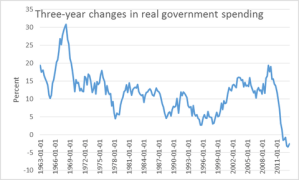
Welcome to Hooverville! We’ve implemented Hoover’s policy instead of FDR’s policy and now we have rotten unemployment stats, lower levels of folks in the labor force, and increasing poverty and income inequality. WTF happened to the US? The graph above is basically the result of Hoovernomics.
This one chart tells you much of what you need to know about the fiscal side of the US economy: we’re dealing with a recession/depression Herbert Hoover style — by cutting government spending just when we would have needed a strong counter-cyclical push from government.
Meanwhile, the pundits and Republicans continue to tell us that the federal government is expanding and that its debt is choking us. That is  really not the case.
Figure 1: Log ratio of real Federal government consumption and investment plus transfers to real GDP (blue), and ratio to potential real GDP (red). NBER defined recession dates shaded gray. Real transfers calculated by dividing line 22, BEA NIPA Table 3.2 by PCE deflator. Potential GDP is measured in Ch.05$, and adjusted to Ch.09$ compatible with the latest GDP release by taking the ratio of 2011 GDP reported in the June 2013 and November 2013 releases. Source: BEA, CBO (Budget and Economic Outlook, February 2013), NBER, and author’s calculations.
As a share of GDP, the current level is below that recorded in 1982Q4 (under President Reagan); as a share of potential GDP (guesstimated), the current level is below that recorded in 1986Q3 (under President Reagan).
Part of the budget deal lets the long term unemployed fall into a deeper hell.
The budget deal announced last night by conference chairs Senator Patty Murray (D-WA) and Representative Paul Ryan (R-WI) is better than another government shutdown, but nicer words than this are hard to find to say about it.
By far the worst aspect of it is the failure to extend the Emergency Unemployment Compensation program (EUC) in 2014. Without these extensions, 1.3 million workers will have their benefits cut off at the end of 2013, and another 850,000 workers will exhaust normal UI benefits over the first quarter of 2014.
The share of long-term unemployed workers in the total labor force was 2.6 percent in November—double the share of June 2008, when President Bush first signed the UI extensions into law.
Besides cutting off a vital lifeline to millions of Americans, cutting these extensions also continues the disastrous march towards budget austerity; a march that has been by far the primary contributor to our failure to recover from the Great Recession. Cutting these UI extensions in 2014 will create a fiscal drag on the U.S. economy that will reduce job growth by more than 300,000 over the year.
A bizarre irony is that the cost of these extensions is nearly identical to the ten-year “deficit savings” achieved in the deal—between $20 and 25 billion. This amount of money is a rounding error in ten-year deficit projections (my back of the envelope calculations say that it’s well under one half of one percent of projected deficits between 2014 and 2023, under the CBO extended baseline). But Congress has chosen to save an amount of money that doesn’t even rise to the level of symbolic over a decade rather than provide real relief to millions of distressed Americans, as well as provide a mild boost to a still-weak job market.
The economy is clearly broken for most of us. The political system is clearly broken for most of us. The educational system is clearly broken for most of us. What’s an advocate of social justice to to do?
How does an economic system resolve conflicts and distribute benefits? A fancy derivative product may help a corporate treasurer solve her problem of managing her company’s risk, and it might make a banker rich, but it might also create a problem of greater systemic risk for the financial system as a whole. Likewise, eating a bacon cheeseburger may solve someone’s problem of satisfying unconscious desires programmed by millennia of evolution, but might also create new problems of clogged arteries and a society burdened with that person’s future health costs.
Overwhelming evidence from the fields of social psychology and behavioral economics shows us that people are not very good at managing these trade-offs, resolving conflicts, or recognizing interdependencies on their own. We overoptimistically believe that house prices will keep rising and that we can refinance when our low teaser rate expires. The corporate treasurer can’t really see how her decision to buy a derivative might boomerang back on her own company and contribute to the collapse of the financial system.
Understanding prosperity and growth in this new way allows us to make important distinctions between different kinds of economic activity. We can now see the difference between “empty” or even “harmful” economic activity and “useful” economic activity. It becomes obvious that an engineer earning $100,000 per year who creates a technology to ensure that those in serious auto accidents walk away unharmed is creating prosperity. It is much harder to make the same case for a hedge-fund manager making $500 million per year doing high-frequency trading to seize on information advantages over ordinary investors. And if that high-frequency trading also makes the global economy more fragile, then that implies something even more damning about this activity.
It can be a challenge, however, to distinguish between “problem-solving” and “problem-creating” economic activity. And who has the moral right to decide? In the traditional framework, it was simple—people vote with their pocketbooks, and if an activity is valued by the market, it must be good. But when an activity solves a problem for some but creates a problem for others—or even the same person later on, or for future generations—who should decide what is good economic activity versus bad, and how?
The usual answer has been that government regulators get to decide. But like markets, regulators create problems as well as solve them. So we also need mechanisms to regulate the regulators. Democracy is the best mechanism humans have come up with for navigating the trade-offs and weaknesses inherent in problem-solving capitalism. Democracies allow the inevitable conflicts of capitalism to be resolved in a way that maximizes fairness and legitimacy, and broadly reflects the views of society.
Although regulation in economies is necessary, the costs to society in terms of restricting the freedom to innovate, invent, and compete can sometimes be high, as conservatives correctly point out. But it also needs to be recognized that sometimes new economic activity actually creates more problems than it solves and needs to be limited. At other times, new economic activity merely threatens the old order and should be encouraged. Finding the balance between these competing demands is difficult. Democratic governments are the only institution with the legitimacy and accountability to make such trade-offs, and that is why the corrosion of our democratic institutions by growing crony capitalism is so threatening to our long-term prosperity. It also means that those who truly care about capitalism should be more concerned about the quality and effectiveness of regulation rather than simply its quantity
I guess Pelosi may have said this in the most realistic view of the budget deal. I do however hate it. Nancy Pelosi on deal: ‘Embrace the  suck’.
House Minority Leader Nancy Pelosi told Democratic House members at a meeting Thursday morning to “embrace the suck” and encouraged enough members to back the budget deal on the floor to allow passage, according to an attendee of the meeting.
“We need to get this off the table so we can go forward,” Pelosi told her members, according to someone inside the closed meeting of the caucus.
Pelosi pushed for including in the budget deal an extension of the unemployment benefits that are set to expire at the end of the month. While she expressed a continued unhappiness that there will be no vote on those benefits before the House heads home Friday, she said that it wasn’t worth holding up the deal.
Democrats expect that Republicans won’t be able to produce enough votes in their conference to pass the deal, requiring a sizable number of Democrats to vote with them in order to ensure passage. Pelosi, along with the rest of the House Democratic leadership, have withheld publicly backing the budget deal this week, with some waiting to see how much support from their caucus was going to be necessary.
So, this isn’t a great way to start a weekend,but we need to get real and discuss this budget deal.
What’s on your reading and blogging list today?
Monday Reads (and now for something completely different)
Posted: December 9, 2013 Filed under: morning reads | Tags: Atchafalaya Houseboat, Breaking the Faith, Carolyn Jessop, Escape, FLDS, Gwen Roland, History of Sleep, photographer Iain McKell, The New Gypsies, Warren Jeffs 45 Comments Good Morning!
My mother used to complain that I was born never needing a nap. My restlessness was an issue during kindergarten rug time and preschool rest time too. By the time I was reading and could find a flashlight, I was under the covers with said light and a book. Mother had to check me several times a night and many a night I lost one or both of the tools of my craft. I got stitches in my forehead one night because I was peaking around the corner watching Emma Peel on “The Avengers” rather than being snug in my bed. I also used to do this so I could see “The Prisoner”. I had a real thing for 1960s spy shows as a kid. I slit my forehead on the door hardware trying to rush back before getting caught. That was my second set of stitches that year. I also had them on my chin because I was proving that I really could fly with PF flyers on my feet. Yes, I could run on very little sleep and run I did. It must run in the family though since years later Dr. Daughter was known as the kid who spent nap time giving the other children backrubs at her Montessori Preschool.
Needing lots of sleep seems to be the revenge of old age on me. Not only do I love a luxurious nap in the afternoon, I’m a late riser. I love to lounge around in the morning in jammies with cups of coffee organizing my day. The good thing about being able to teach graduate school is that MBA classes are always in the evening and academic graduate classes are generally in the afternoon. So, it’s with great relief that I find out that I’m just a traditional kinda person when it comes to my fondness for two periods of sleep. I like siestas found in the southern cultures that nap away the heat of the day then rise and shine for the cooler night. But, there’s more in history to multiple sleep periods than just heat avoiding Latins. It’s seems our pre-electric age ancestors usually had two sleep periods a day. (Thanks to Delphyne for finding this!)
Wow !!! BB! We’re just sleep traditionalists! Take heart!!
The existence of our sleeping twice per night was first uncovered by Roger Ekirch, professor of History at Virginia Tech.
His research found that we didn’t always sleep in one eight hour chunk. We used to sleep in two shorter periods, over a longer range of night. This range was about 12 hours long, and began with a sleep of three to four hours, wakefulness of two to three hours, then sleep again until morning.
References are scattered throughout literature, court documents, personal papers, and the ephemera of the past. What is surprising is not that people slept in two sessions, but that the concept was so incredibly common. Two-piece sleeping was the standard, accepted way to sleep.
“It’s not just the number of references – it is the way they refer to it, as if it was common knowledge,” Ekirch says.
An English doctor wrote, for example, that the ideal time for study and contemplation was between “first sleep” and “second sleep.” Chaucer tells of a character in the Canterbury Tales that goes to bed following her “firste sleep.” And, explaining the reason why working class conceived more children, a doctor from the 1500s reported that they typically had sex after their first sleep.
Ekirch’s book At Day’s Close: Night in Times Past is replete with such examples.
But just what did people do with these extra twilight hours? Pretty much what you might expect.
Most stayed in their beds and bedrooms, sometimes reading, and often they would use the time to pray. Religious manuals included special prayers to be said in the mid-sleep hours.
Others might smoke, talk with co-sleepers, or have sex. Some were more active and would leave to visit with neighbours.
As we know, this practice eventually died out. Ekirch attributes the change to the advent of street lighting and eventually electric indoor light, as well as the popularity of coffee houses.
Many folks long for ways of doing things based more on the rhythms of humanity than the needs of the greed-driven. A few  years ago, I became fascinated with the Irish Traveler culture in the UK based on a show that documented their outrageous and huge weddings. There are many young people adopting a similar life style but it’s more in a rebirth of hippie or bohemian culture than being an Irish Gypsy.
Photographer Iain McKell, who has followed a small group of travellers for over 10 years, has published a stunning new photo book called ‘The New Gypsies’, published by Prestel Publishing, charting the changes in their life-style.
Taking the traditional gypsy lifestyle as their template many have now ditched their motor vehicles in favour of horse drawn caravans.
Mr McKell told anothermag.com: ‘It began in 1986 with the New Age motor vehicle travellers called The Peace Convoy and then when I returned to Stonehenge Summer Solstice in 2001.
‘To my surprise I found this new renegade tribe that had evolved to horse-drawn wagon but had all the modern technology as well – solar power, mobiles phones, laptop computers and off course facebook.
‘I loved this idea of the old and the new working well together and the open road.
Check out some of the terrific pictures and get a taste for McKell’s book.
Another fascinating read that you may want to check out is Gwen Roland’s “Atchafalaya Houseboat: My Years in the Louisiana Swamp“. I came across Roland’s life in an NPTV program that followed Roland back to review her hippy life in the Atchafalaya basin that was partially documented in a National Geographic magazine in the 1970s . Both the Traveler wedding show and the Atachafalaya Houseboat show were part of my 2:00 am in the morning channel wanderings. I’ve grown a bit away from sneaking down to the rec room door in my footie pajamas to catch a glimpse of Patrick McGoohan. I don’t always head out to the local haunts!
Here’s some NPR excerpts from the book, the National Geographic spread, and the program.
The biggest inconvenience to living so far out is going in. The impending trip casts its gloomy shadow over our normally unstructured days. The list, an innocent-looking sheet of typing paper, appears on the kitchen table where it assumes temporary control over our lives. It is divided into categories such as mail, camera store, feed store, welding supply store, hardware store, garden supply store, supermarket, library, people to see, eggs to deliver.
For the next several days our activities revolve around that silent taskmaster. We hunt up the ice chest for transporting cold foods on the long journey home. A crate is readied for a sick chicken headed for LSU’s poultry science department. A broken pump part is placed on top of the list so it won’t be forgotten. Mail that was picked up during the last trip must be answered before we leave home. Despite our good intentions mail is always neglected until the night before the trip. By lamplight we struggle to write legible letters, and we search with candles for lost addresses.
The dreaded day creeps over the horizon in a drizzle. What a waste of a fine rainy day! We usually greet such a morning with a second pot of coffee and a stack of old National Geographic magazines.

My new late time weirdness is a TLC reality show called ‘Breaking the Faith’. We’ve talked about the horrible treatment of women, young girls, and young men at FLDS compounds. It’s an amazing thing to watch and hear the young women who escaped–some more successfully than others at this point in the series–to a safe house with Carolyn Jessop who testified in the conviction of child rapist Warren Jeffs. One of the amazing scenes is when Jessop explains to the young women that having sex with a 12 year old ‘wife’ and participating in the process is a crime.
The women may have wanted to leave the compound, but were they ready? For one thing, they were scared of Carolyn, having been taught that she was a bad woman for leaving the church. Further, they didn’t believe her when she told them why Jeffs was in prison.
“When Carolyn starts telling me about Warren Jeffs and everything, I want to slap her, because she doesn’t know him,” one of the women, Angie, says. “She left 10 years ago.” Another woman, Connie, was struggling as well. “Carolyn Jessop is one of the worst apostates that there are. She is against everything that they teach us,” she said. “I don’t know what to think.” Carolyn told the girls that if they doubted her words — which they did — they were probably destined to return to the FLDS. They still believed that Warren Jeffs is the prophet.
While the show appears to be at least somewhat staged, the Christian Post calls it “groundbreaking” — most FLDS members who flee the church choose to live in hidingto avoid retaliation.
TLC is usually one of those channels that only captures my attention in the manner of 12 fire engines screaming down the street. Although, the Gypsy wedding program from the UK took me in, I usually surf by it before I lose more faith in humanity. Sister wives and Honey Boo B00 seriously alarm me. But, I actually think this particular series lets people know more about religious cults and the process of watching the various girls deal with being outside the compound is fascinating. Children go through a similar–albeit more subtle–process of cultural brainwashing daily. It’s interesting to see the ones with the gumption to question it.
You can read more about the process because Carolyn Jessop is the author of two book on growing up in the FLDS. Her first book is titled “Escape”. It’s been out for about 6 years.
In a favorite children’s game, called Apocalypse, kids act out the FLDS vision of the end of the world. According to FLDS lore, Native Americans who were mistreated and killed in pioneer days will be resurrected in the end times, when God will allow them to wreak vengeance on those who wronged them (the presumably also-resurrected settlers). In return for this indulgence, “resurrected Indians” will also be “required to take on the job of protecting God’s chosen people”—FLDS members—by killing FLDS enemies with invisible tomahawks that can sever a person’s heart in half. Very cowboys and Indians!
Maybe the Republican party can talk to Warren Jeffs about how to talk to women!!! They seem to want us all brainwashed!
So, I know this wasn’t exactly what you usually get from me, but I just felt I needed to go beyond politics for awhile. Hopefully, you can let us know what’s on your reading and blogging list and make up for my odd little trip into other things!!!
Friday Reads
Posted: December 6, 2013 Filed under: morning reads 34 Comments
Good Morning!
I have to admit I’m a bit tired of all the mansplaining. I’ve been on the receiving end of it quite a bit this week. They’re even training them to do more of it in the ranks of the Republican Party. Just wait until you read what they’re training the good ol’ white christian men to say if they’re running against some one with those unholy lady parts.
Boehner urged his colleagues Thursday in response to this POLITICO story to “be a little more sensitive” when running against women.
“Some of our members just aren’t as sensitive as they ought to be,” Boehner said.
Boehner (R-Ohio) said bluntly that “when you look around the Congress, there are a lot more females in the Democrat caucus than there are in the Republican caucus.”
Republicans are trying to avoid a 2012 repeat. Akin dropped the phrase “legitimate rape” during the 2012 Missouri Senate race, costing himself a good shot at winning his own race and touching off Democratic charges of a GOP “War on Women” that dogged Republicans in campaigns across the country.
In the 2014 cycle, there will be at least 10 races where House GOP male incumbents face Democratic women challengers. More races could crop up as the cycle unfolds.
Some of the highest profile fights will take place in states like New York, Illinois, Florida and Virginia — the last where GOP gubernatorial candidate Ken Cuccinelli was defeated recently due in part to being perceived as anti-woman.
Individual Republicans have continued to give Democrats plenty of ammunition about being insensitive to women’s issues. From Rep. Trent Franks (R-Ariz.) talking about rape and pregnancy at a Judiciary Committee hearing earlier this year, to House Republicans passing a 20-week abortion ban in June, to Sen. Saxby Chambliss (R-Ga.) blaming military sexual assault on “hormones,” there have been repeated instances where GOP lawmakers have come off as tone-deaf to female voters.
Yup, it has nothing to do with their obsession with vaginas, defunding planned parenthod, and telling women they really don’t understand what it means to have an abortion. Meanwhile, they still need to learn how to be more sensitive about Hispanics and blacks and now it seems  they’re back to dissing Catholics. Fox’s Adam Shaw manage to assault all three in this piece: “Pope Francis is the Catholic Church’s Obama – God help us”. What’s weird is that Shaw’s a Catholic. But wait, he seems to be one of those ones that never got over Vatican 2 and probably still wants his mass in the ultimate language of dead white men.
Much is being made of his ‘compassion’ and ‘humility,’ but kissing babies and hugging the sick is nothing new. Every pope in recent memory has done the same, yet only now are the media paying attention. Benedict XVI and John Paul II refused to kowtow to the liberal agenda, and so such displays of tenderness were under-covered.
But Francis is beating a retreat for the Catholic Church, and making sure its controversial doctrines are whispered, not yelled – no wonder the New York Times is in love.
Just like President Obama loved apologizing for America, Pope Francis likes to apologize for the Catholic Church, thinking that the Church is at its best when it is passive and not offending anyone’s sensibilities.
In his interviews with those in the left-wing media he seeks to impress, Francis has said that the Church needs to stop being ‘obsessed’ with abortion and gay marriage, and instead of seeking to convert people, “we need to get to know each other, listen to each other and improve our knowledge of the world around us.”
This softly-softly approach of not making a fuss has been tried before, and failed. The Second Vatican Council of the 1960’s aimed to “open the windows” of the Church to the modern world by doing just this.
The result was the Catholic version of New Coke. Across the West where the effects were felt, seminaries and convents emptied, church attendance plummeted, and adherence to Church doctrine diminished.
John Paul II and Benedict XVI worked hard to turn this trend around, but now Pope Francis wants the bad old days to resume.
 Meanwhile, notable Texas asshole Senator Ted Cruz tells ALEC to “Stand your Ground”.
Republican Sen. Ted Cruz’s advice for a conservative group facing criticism and hardship: “Stand your ground.”
The choice of words appeared to be a reference to a string of negative press the American Legislative Exchange Council – a group made up of conservative legislators and corporate members – received for backing laws similar to the controversial “Stand your ground” self-defense law that made national headlines in 2012 and 2013.
“I will tell you this, my advice to ALEC is very, very simple: Stand your ground,” Cruz said to applause and a cheer of “hear, hear” from the audience at ALEC’s winter meeting in Washington.
ALEC Spokesman Bill Meierling said he thought Cruz was referring to the controversial law and the criticism the group had received for backing similar proposals.
“I believe that he used that as a rhetorical device because it is a phrase that everyone in this room recognizes because of the challenges of the past two years,” said Bill Meierling, ALEC’s senior director of communication. “Every single person also knows that we no longer have any model policy on that issue, or any firearms issues for that matter.”
Some one got a little something extra at a Wendy’s in Georgia.
Gives a whole new meaning to the phrase “burger joint” — TMZ has learned, a Wendy’s employee was arrested last month in
Georgia … after allegedly making a cheeseburger with one crazy off-the-menu ingredient … marijuana.
According to the Lovejoy Police Department, 32-year-old Amy Seiber was busted during her shift on November 1 … after a customer called 911, complaining she had found a half-smoked blunt in her cheeseburger.
The customer met with police at the Wendy’s location where she ordered the burger, and cops claim Seiber immediately admitted the blunt was hers.According to police, Seiber said she had been smoking pot on the job and conveniently “misplaced” the blunt inside the customer’s burger … right on top of the pickle.
Joe Biden has announced that the US will not recognize China’s supposed air defense zone.
Speaking in Seoul on Friday, following his meeting with Chinese leadership, Joe Biden said that the United States would not recognize Chinese jurisdiction over an air defense zone they established in the East China Sea.
Biden told reporters in a speech:
I was absolutely clear on behalf of my president: We do not recognize the zone. It will have no effect on American operations. None. Zero.
Biden’s remarks echo the declaration made by White House Press Secretary Jay Carney earlier in the day, when he said, “We, the United States, do not recognize and we do not accept it, and will not change the way the United States conducts military operations in the region.”
That’s it for me this morning. What’s on your reading and blogging list today?
Breaking News: Nelson Mandela has died
Posted: December 5, 2013 Filed under: Civil Rights | Tags: African National Congress, Nelson Mandela dead at 95, South Africa 14 Comments The former President of South Africa and the man that came to personify racial apartheid in South Africa has died today at the age of 95. South Africa’s President Jacob Zuma announced his passing today on TV.
Here are some of Mr. Mandela’s most famous quotes. They are scattered about this blog thread.
Mandela was imprisoned in 1964 and wasn’t released until 1990.
It’s April 1964, and a crowd of black onlookers jostle in the back of a Johannesburg courtroom as Nelson Mandela rises from his chair before the judge. They sit segregated from the rest of the court, and have to crane their necks to catch a glimpse of the nationalist leader who has already served five years in prison. Armed guards are stationed at the exits of the room, “a high-domed chamber with an antique ceiling fan and a rococo atmosphere that suggests the American South,” as Robert Conley, the future founding host of All Things Considered, describes for The New York Times.
Not lost on this American writer is the commonality of history between the continents. A black man stands before a white judge defending an outlawed ideal he believes in. The moment mirrors America’s own civil-rights movement. Martin Luther King had written his Letter From a Birmingham Jail almost exactly a year earlier. But the mirror is a magnifier. However wrong, horrible, and unfair America’s treatment of black men and women was, in South Africa, it was objectively worse. Black Africans had no right to vote, no right to strike from work. Six years later, they would be denied citizenship in their own country.
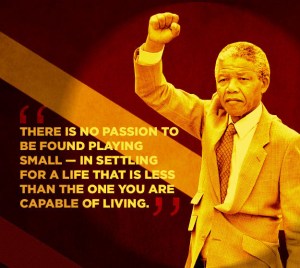
Nelson Mandela was an incredibly complex and interesting man. Just as the case with Martin Luther King and his central role in creating the civil rights movement in the US, Mandela was symbolic, flawed, and rose to all he was able to accomplish through much struggle. His leadership as President will be studied for some time.
Take the great post-apartheid misery that South Africa suffered in the first two decades of democracy: the AIDS epidemic. Mandela failed as president to tackle the spread of HIV, even as terrifyingly large numbers of South Africans became infected. As early as 1991 he had grasped (judging from one of his private notebooks from that year) that the disease threatened a “crisis for the country.” Yet in office he did almost nothing to stop its spread.
He recalled later at an event I attended in Cape Town that after spending so many years in prison, he was shy when it came to talking about a sexually transmitted virus. South Africa, too, faced a host of other challenges on his watch—political violence, economic upheaval, ongoing racial tension. But his inaction on AIDS then gave way to the outright denial of the epidemic, and harassment of those who tried to tackle the spread of HIV, by his successor as president, Thabo Mbeki. The result was a pandemic that claimed millions of South African lives, many unnecessarily, as drugs to treat victims were long withheld.
To his immense credit, however, Mandela conceded his early error. After leaving the presidency, he became a significant part of a campaign for a new AIDS policy. In retirement, he would speak up for effective education and treatment, especially when his own son succumbed to the disease in 2005. To Mbeki’s fury, too, Madiba pushed within the ruling African National Congress for South Africa to tackle AIDS seriously. With the denialist Mbeki gone from office, thankfully the country has now come to grips with the pandemic.
Or take economic policy. After years in prison, Mandela emerged to lead South Africa still believing, in effect, in Soviet-style economics. It took advice from China’s leaders (among others) to change his mind. But he was willing to switch, to get South Africa’s Afrikaner state-run economy to open up and flourish.
He will be missed and remembered.
“During my lifetime I have dedicated my life to this struggle of the African people. I have fought against white domination, and I have fought against black domination. I have cherished the ideal of a democratic and free society in which all persons will live together in harmony and with equal opportunities. It is an ideal for which I hope to live for and to see realized. But, My Lord, if it needs be, it is an ideal for which I am prepared to die.”
President Obama will speak on Mandela at 5:20 est.
Now, Where’s that Guillotine?
Posted: December 3, 2013 Filed under: #Occupy and We are the 99 percent!, open thread 17 Comments Where are those confounded guillotines?
How Wal-Mart’s Chairman Burned Through Millions Of Dollars In A Matter Of Seconds From Business Insider
It took Wal-Mart Chairman Rob Walton a matter of seconds to burn through millions of dollars on a race track last year.
He was reportedly tearing around a corner in his rare Shelby Daytona Cobra Coupe, one of five ever made, when he ran it off the track and wrecked it.
The car has been estimated to be worth as much as $15 million, according to The Los Angeles Times, and it likely cost him a couple million dollars to fix it.
The Waltons are without question one of the wealthiest families in the world. Forbes estimates that the net worth of just six of the family members is more than $144 billion, which is greater than the combined net worth of Bill Gates and Warren Buffett.
Rob Walton’s father, Samuel Walton, founded Wal-Mart in 1962. The family now owns a 50.9% stake in the company that’s worth $131 billion and paid out $2.5 billion in dividends last year. The dividends alone would be enough to pay every one of Wal-Mart’s 1.3 million U.S. employees nearly $2,000 in cash.
As Business Insider reported last week, the Waltons have mostly kept their multi-billion-dollar lifestyles out of the public view.
Consider Rob Walton, for example: Besides houses in Aspen, Colo., and Paradise Valley, Ariz., at least a half dozen vintage cars, and the recent purchase of 1,500 acres of land in Hawaii for a planned resort, you would be hard-pressed to find many signs of his outrageous wealth.
and let’s not forget:
While the average wage of Wal-Mart associates is the subject of some dispute (OUR Walmart claims that most make less than $9 per hour, an estimate based on data from IBISWorld and Glassdoor.com, while Wal-Mart pegs the figure at $11.83), there’s little doubt that many of the store’s workers are stuck below the poverty line, currently $23,550 for a family of four.
A study by congressional Democrats suggested that low wages at a single Wal-Mart could be costing taxpayers as much as $900,000 per year, due to employees using programs like food stamps and Medicaid.
No, BB, it isn’t just you. There are just a lot of people in the world that need a lesson. Speaking of which …
Rush Limbaugh is going after Pope Francis just in time for the Christmas season.
The outspoken conservative pundit blasted the Pope this week after the pontiff released a new 50,000 word document, titled “Evangelli Gaudium” (The Joy of Gospel), calling for church reforms and criticizing certain ideas of capitalism.
Limbaugh, whose nationally syndicated radio show is no stranger to controversial rhetoric, called Francis’ latest statement “pure Marxism.”
Limbaugh’s own statement, titled “It’s Sad How Wrong Pope Francis Is (Unless It’s A Deliberate Mistranslation By Leftists)“ goes on to question whether the pontiff was actually the author of the document.
“It’s sad because this pope makes it very clear he doesn’t know what he’s talking about when it comes to capitalism and socialism and so forth,” Limbaugh wrote.
Would you like to discuss who is waging the war on christian “values” now or should we just read Snowflake Snookie’s selling really badly kid’s book? Or perhaps watch Rick Santorum’s movie? Shop for gifts at Walmart?
Yes, there is a classwar, and 99.9% of us are losing it!!

 peej
peej Carissa
 bostonboomer
 dakinikat
 ecocatwoman
 jjlo
jjlo mablue2
 Mama Lopez
 peggysue22
 quixote
 skydancingguestblogger
 Mona (aka Wonk the Vote)





Recent Comments