It’s been a long few days for me culminating with spending the morning at the LASPCA trying to spring my friend’s runaway dog. Did I mention it took three hours while I had to look at about 10 cute kittens that definitely need a home ASAP giving me those big eyes ? So, I’m late with everything, tired, and the last thing I need is to crack a virtual newspaper and read about crazy. However, we still have two crazies in the race, so it’s crazzyyy Monday!!!
We knew the Trump ads against Clinton would be bad but we’re beginning to see exactly how bad they will be. I think most newspaper Tabloids have less sensation and more facts to be perfectly honest. Is this a clickbait headline or what? Alex Jones has taken over candidate Trump’s policies and their oppo research. From TPM: “New Trump Video Mixes Bill Clinton Rape Allegation, Hillary Clinton Laughing.”
Donald Trump released a new Instagram video on Monday featuring audio from interviews with women who’ve accused former President Bill Clinton of sexual assault. The accompanying text asks if Democratic presidential frontrunner Hillary Clinton is “really protecting women.”
As a photo of Bill Clinton comes into focus against a black-and-white photo of the White House, a voice can be heard saying “I was very nervous.”
That voice belongs to former White House intern Monica Lewinsky, explaining her concern about divulging her affair with the President to a grand jury.
The next voice says “No woman should be subjected to it. It was an assault.” That’s Kathleen Wiley, a former White House volunteer who alleged that Clinton groped her in the hallway of the White House in 1993, speaking with Fox News’ Sean Hannity in 2007.
The last bit of audio is taken from an infamous 1999 NBC Dateline interview with Juanita Broaddrick, a former nursing home administrator who accused Clinton of raping her in 1978. A tearful Broaddrick can be heard saying that he “started to bite my top lip and I tried to pull away from him.”
Clinton denied the assault on Willey in a 1998 deposition and has also denied Broaddrick’s rape allegation, which surfaced at the time of congressional impeachment proceedings over his affair with Lewinsky.
Trump’s video clip ends with a shot of Hillary and Bill Clinton together. While audio of Hillary Clinton laughing plays, the words “Here we go again” appear on the screen.
It’s the second time in two weeks that Trump has brought up past sexual assault allegations against Bill Clinton. He has called Hillary Clinton a “nasty, mean enabler” of her husband’s alleged affairs.
We’re about to hit through the boundaries of horrific misogyny straight into new, uncharted territory. This is simply on the internet now, but I can only imagine what he’ll eventually try on other forms of media. This is really appalling.
And this on top of crazy Bernie Sanders and his delusional dead-enders!
There are also the usual proxies for the two campaigns. I’m not sure if you’ve had a chance to read this but you might want to look at the NYT’s profiles of Roger Stone (Trump) and David Brock (Clinton). It’s about some of their behind the scene work for the campaigns.
One takes a pint-size dog named Toby almost everywhere, smokes electronic cigarettes and wears his silver hair in a flowing pompadour.
The other has a portrait of Richard M. Nixon tattooed on his back, boasts that he owns more shoes than Imelda Marcos and traffics in conspiracy theories about the Kennedy assassination.
The 2016 election, filled with ugly insults, whispered innuendo and sordid character attacks, features two central antagonists known for their colorful traits and devotion to the dark arts of politics: David Brock and Roger J. Stone Jr.
Each has a passion for his side — Mr. Brock for Hillary Clinton and Mr. Stone for Donald J. Trump — and a zeal for attacking critics of his candidate. Their intensity and pugnacity make them either perfect villains or misunderstood masterminds, depending on your point of view.
On the wall of Mr. Stone’s office in South Florida, which has an undisclosed address because of the death threats he said he had received, hangs a “Spy vs. Spy” cartoon, which young staff members titled “Brock-Stone” after the two battling operatives.
“The dynamic between the two of them is very interesting,” said Hank Sheinkopf, a Democratic strategist who knows both men. “This will be a battle about who’s tougher.”
Politics has always attracted flamboyant characters with a sometimes-reckless devotion to a cause, and both these men seem to enjoy their outsize images.
Mr. Brock, 53, divides his time between Washington and the West Village in Manhattan, throwing lively salons and wooing liberal donors on both coasts, often accompanied by Toby, his schnoodle — a schnauzer-poodle mix.
We frequently read our friend’s at Brock financed pro-Hillary blog Blue Nation Review. The NYT article has some interesting stories on him and the purpose of his pro-Hillary PAC.
Mr. Brock now runs Correct the Record, a “super PAC” that coordinates with the Clinton campaign to defend Mrs. Clinton, and American Bridge, a related group that digs up opposition research to defeat Mr. Trump. (Enough to “knock Trump Tower down to the subbasement,” as Mr. Brock put it in remarks to liberal donors, according to Politico.)
His mission now will largely be to get inside Mr. Stone’s complicated head to anticipate, and stay ahead of, Mr. Trump’s attacks. Mrs. Clinton’s allies have vehemently denied that she was involved in silencing Mr. Clinton’s accusers, but Mr. Trump will continue to push that assertion as the two candidates battle for the support of women voters.
Mr. Stone acknowledged that Mr. Brock’s operation has significantly more resources, but he said the traditional tactic of dismissing these accusations as sordid rumors could backfire. “Brock is calling us conspiracy theorists and trying to make us all sound kooky,” he said. “The only people that scares away are the elites.”
Mr. Brock’s group Media Matters for America has taken direct aim at Mr. Stone, labeling him “the underbelly of the Trump machine” and assembling an encyclopedia on his tactics, including his involvement in a National Enquirer article that accused Senator Ted Cruz’s father of associating with Lee Harvey Oswald before President John F. Kennedy’s assassination. Mr. Stone calls Media Matters part of “the Clinton slime machine.”
Both men operate outside the official campaigns, though Mr. Brock directly coordinates with the Clinton campaign through Correct the Record. Mr. Stone said he had “no formal or informal role” within the Trump campaign, but he is close to Mr. Trump and has had a major influence on strategy.
And both have taken risky moves that have created drama and tensions within the campaigns they are ostensibly helping.
Fox News figures are praising network contributor Newt Gingrich as a “great choice” for Donald Trump’s running mate. They have touted Gingrich — the first speaker of the U.S. House of Representatives to be punished by the House for ethics violations — as “a genius,” “a conservative with bona fides,” and someone who would “bring tremendous stability, tremendous gravitas, incredible intellect,” and “judgment experience.”
Trump Is Considering Gingrich As His Running Mate
Bloomberg: Trump Has Discussed Gingrich As His VP. Bloomberg reported that “Trump has discussed in recent days the possibility of selecting former U.S. House Speaker Newt Gingrich as his running mate, according to people familiar with the talks.” [Bloomberg, 5/11/16]
Trump: Gingrich Is “Absolutely” On His Short List For VP. The Fox News morning show Fox & Friendsasked Trump if Gingrich was on his short list for vice president. Trump responded: “Absolutely. I’ll say yes, because he’s been such a supporter. I mean, anybody that supports me is on the shortlist as far as I’m concerned.” [The Hill, 5/20/16]
Gingrich Has Suggested He Would Accept The VP Slot. Gingrich stated during a Fox News interview that he would be “very hard-pressed not to say ‘yes’” if offered the spot. [The Huffington Post, 5/16/16]
Trump Aide: Staffers Were Informed Gingrich “Will Have His Hand In Every Major Policy Effort.”National Review reported of “Gingrich’s ascent to Trump’s inner circle”:
Gingrich’s influence within Trump World is widespread. Inside Trump’s newly established campaign offices in Washington, D.C., his fingerprints are everywhere. “Right from the minute I joined we were told that Newt will have his hand in every major policy effort,” says one Trump aide. “So one of the things I do when I’m researching or writing anything, in addition to looking at what Trump has said about anything, I look at what Newt has said.”
Gingrich’s ascent to Trump’s inner circle — and potentially to the vice presidency — marks a reversal of fortune for the speaker, who in recent years has fallen out of favor with party elites over his vocal criticisms of the Iraq War and Paul Ryan’s proposal to reform Medicare. On both issues, the views that irked GOP insiders were squarely in line with the unorthodox positions Trump has espoused on the campaign trail. [National Review, 5/23/16]
A top strategist for the Republican National Committee said Sunday on conservative talk radio that presumptive nominee Donald Trump has made clear he wants to launch “aggressive” attacks on Democrat Hillary Clinton.
“Republicans have been accused in the past, and some degree rightfully so, of not tearing the bark off of our opponents, and this year Donald Trump has made it very clear we are going to be aggressive” to get a Republican in the White House, Sean Spicer RNC chief strategist and spokesman, said.
“We’ve been at it for four years going through her record,” Spicer also said, as quoted by Breitbart. “This idea that people know who she is and that they’ve seen everything is just ridiculous.”
Spicer, speaking with Breitbart News Sunday on SiriusXM radio, added the party has only “scratched the surface” with Clinton.
I never understand the appeal of these kinds of attacks. They really turn me off. It’s one of the reasons I’m ready to do just about anything within the legal boundaries of the law to see that Bernie Sanders goes back to the Vermont outback, never to be heard from again. Why do all the remaining dudes in this race all represent the angry white male, women-hating prototype? Are there really that many of them left out there?
What’s on your reading and blogging list today?
Did you like this post? Please share it with your friends:
I have a few odds and end reads on Brazil and Venezuela that I’d like to suggest today. I’m trying to take a breather from US politics so let’s look to two Southern neighbors with economic and political crises. I’m going to start out with a few articles on Venezuela. The country is having serious issues on the economic and political front. It’s never good when one of our trading partners experiences such disruption.
Venezuela is experiencing hyperinflation which is something that is rare these days in places that we generally view as having functioning and non-politically manipulated central banks. Usually, hyperinflation occurs in countries when the central government tries to solve its problems by printing money or devaluing its currency internationally and the central bank obliges. Venezuela’s debt is also out of control given the range and value of the countries assets. Usually, these kinds of things will start transmitting instability to the region and to the country’s trading partners because prices of goods and services, interest rates, and exchange rates will fluctuate.
Word had spread that a delivery of poultry meat was due at the Central Madeirense supermarket, and long before dawn a queue of shoppers was snaking around the block.
Kattya Alonzo was one of them. The 48-year-old mother of three was already planning to make the traditional chicken and rice dish arroz con pollo – if she could also find some rice.
“I haven’t been able to buy chicken in more than a month, so I was there early at about 4am,” she said.
At about 6.30, two trucks finally drew up outside the store, but before the drivers could start to unload, national guardsmen told them to drive on.
Perhaps it was not surprising that the mood outside the supermarket quickly turned ugly: frustration turned to despair, anger to violence. Before long, the incident on Tuesday had escalated.
Mobs tried to loot several bakeries and delis and another food delivery truck.
The unrest soon spread throughout this city of 200,000 just outside the capital, Caracas. Protesters shouted “We want food” as they blocked intersections with burning tyres and clashed with security forces.
Police and the national guard quickly controlled the outburst, with some 14 people reportedly arrested, and at least one person was injured, according to witnesses.
The protests were not related to marches in Caracas and other major cities, which were called this week by opposition leaders seeking to cut short the term of President Nicolás Maduro who they say has driven the country into the ground through mismanagement.
But spontaneous outburst such as the one in Guarenas may present a more serious challenge to Maduro’s rule than any efforts by his political rivals.
Things are not going well in Venezuela since global oil prices are down. There are black markets everywhere since the food shortages began. Vendors get rich selling basics like diapers and milk. The government has been trying to control prices but what this has done is lead to folks turning to side channels in black markets where the price is set by desperation and greed. These black market shoppers are called “bachaqueros” which is a play on the name of the bachaco leaf-cutting ant that carries several times its weight. This place is no longer the socialist dream of the late Hugo Chavez who ruled the country for 14 years. It is an example of socialism gone very wrong.
Epic Mural in Chile by Mexican artist Jorge González Camarena, assisted by Chilean painters, Eugenio Brito and Albino Echeverría.
It wasn’t always this way. Diego Moya-Ocampos, senior political risk analyst at IHS, says the current crisis is the result of years of “economic mismanagement” by the ruling socialist party.
Led by Hugo Chávez, the country’s firebrand former president, the country embarked on a wave of expropriation and redistribution with the charismatic leader offering cut-price fridges, appliances and even new homes to poor Venezuelans.
Chávez wanted to create a socialist paradise, an ideology that has been reinforced by his successor Maduro following his death in 2013.
But the oil price collapse a year later served as a wake-up call for a country that chose profligacy over prudence in the hope that a rainy day would never come.
Oil accounts for 98pc of total exports and 59pc of fiscal revenues, but Moya-Ocampos says the price slide isn’t the country’s only problem.
“Even under Chavez and $100 a barrel oil, debt was rapidly rising and there were already food shortages,” he says, “This is ultimately to do with an interventionist model that is not sustainable and has reached a tipping point.”
Many Venezuelans have already left the country, including Francisco Flores. “Venezuela has taken good working companies, given them to the poor but not equipped them with the skills to run them so they go bankrupt,” he says.
“That’s just a recipe for destroying a country.”
The NHS therapist, who now lives in London, says the regime is based on a principle of keeping everyone “equal but poor”.
Brazilian artist Adelio Sarro is known for portraits
I’ve always been interested in South American countries and their various economic crises. The Mexican Peso Crisis is still taught in basic International Economics/Finance courses as a cautionary tale that’s frequently forgotten. It’s also called The Tequila Crisis and happened while Bill Clinton was President in 1994. A country in crisis transmits economic and political instability to its neighbors through trade. Here’s a an example of that from the current Venezuela crisis. Coca Cola is one of those ubiquitous US products that basically is every where in the world. Its recipe may be slightly different depending on the sugar dependency of a country’s consumers, but the trademark and product packaging are quite recognizable. Venezuela’s access to Coke is gone.
And so we will have to chalk this up as another of those great successes of Bolivarian socialism. Yes, as I’ve been saying for some time now, this is not because of some misplaced zeal in making the lives of the poor better: it’s simply because messing with markets is not the way to achieve anything at all. Well, not unless your actual goal is to have a country run out of everything.
CARACAS, Venezuela— Coca-ColaKO -0.83% is halting production in Venezuela of its namesake beverage due to a sugar shortage brought on by the country’s economic crisis.
Production of sugar-sweetened beverages will be suspended in the coming days after local suppliers reported they had run out of the raw material, the Atlanta company said in an emailed statement Friday.
This isn’t even about the currency and import problems that have affected beer production:
The move comes as Venezuela’s economy is teetering on the edge of collapse with widespread food shortages and inflation forecast to surpass 700 percent. Last month, Empresas Polar, Venezuela’s largest food and beverage company, stopped production of beer because of a lack of imported barley.
I think teetering on the edge is using the wrong tense there. I think teetered would be better, making sure that we use the past tense. In any realistic sense that consumer economy has gone …
All countries have modified market economies. Some markets function perfectly well with very little interference. Some markets would not exist without government provision or if they did, would be prohibitively expensive. There are three
Mexican Street artist Spaik and work in Michoacan
primary agents in an domestic economy. That would be the government, the sellers, and the buyers. Whenever any one of those agents gets into any market and has more unchecked power than the rest, you’re going to have issues. Market excesses can result from power and profit seeking private enterprise or from Government overreach. You can find many examples of each throughout the modern history of many South American Countries.
Brazil’s economy sank into the deepest recession in recent history last year amid low prices for key exports, soaring inflation and depressed confidence levels. Moreover, as the economy plummeted so did President Dilma Rousseff’s political career. A wide-spread corruption scandal and the economy’s abysmal performance caused approval levels to fall to all-time lows and resulted in the commencement of impeachment proceedings last year. On 12 May, the Senate voted to continue with these proceedings, forcing Rousseff to step down for a maximum of 180 days while a trial is conducted. Vice President Michel Temer took over as interim president and his first task will be to find a way to halt the sinking ship. However, a number of daunting challenges lie in Temer’s path and recent economic data remain poor: retail sales returned to contraction in March and the manufacturing PMI fell to the lowest level in over seven years in April.
A change in leadership will not be a magic bullet for Brazil’s economy and the recession is expected to continue throughout this year. FocusEconomics panelists see the economy contracting 3.7% in 2016, which is down 0.2 percentage points from last month’s forecast. For 2017, the panel sees the economy recovering slightly and growing 0.7%.
DR: I think it’s an impeachment process, to remove me from the office. Our Constitution provides for an impeachment, but only if the President commits a crime against the Constitution and human rights. We believe that it’s a coup, because no such crime has been committed. They put me on trial for additional loans [from state banks]. Every president before me has done it, and it has never been a crime. It won’t become a crime now. There is no basis for considering it a crime. A crime has to be legally defined. So we believe this impeachment is a coup, because it’s clearly stated in the Constitution that only a crime of malversation can serve as basis for impeachment. The actions currently under scrutiny do not, strictly speaking, fall under that category. Besides, Brazil is a presidential republic. You can’t remove a president or a prime minister who hasn’t committed a crime. We’re not a parliamentary republic, where a president can dissolve the congress, which, in turn, can call for a vote of no confidence out of purely political reasons. So it’s impossible to impeach a president in Brazil based solely on political reasons or political distrust. We believe that what’s happening now in Brazil is an attempt to replace an innocent president involved in no corruption-related legal proceedings in order for the politicians that lost the 2014 election to control the state bypassing the new election. That’s what’s happening. This is an attempt to replace the entire political program that includes both the social and economic development aspects and is aimed at tackling the crisis that Brazil has been going through in recent years with a program clearly neoliberal in nature. This program provides for minimizing our social programs in accordance with the minimal state doctrine. This doctrine is at odds with all the Brazilian legal norms regarding healthcare, construction and ensuring that our people have their own houses, availability of high-quality education and minimum wages guaranteed to the poorest part of the Brazilian population. They want to do away with these rights and at the same time they conduct an anti-national policy, for example, when it comes to Brazil’s oil resources. Significant subsalt oil reserves, lying 7,000 m below the surface, were discovered recently. The ministers were saying that exploring these reserves was impossible, but now we’re extracting a million barrels daily from subsalt oil reserves. Undoubtedly, they were saying that thinking to change the legislation in order to guarantee access to these reserves to international companies. Moreover, in terms of foreign policy, starting from Lula da Silva and throughout my presidency, we have been seeking to strengthen ties with Latin American, African, BRICS countries and other developing nations, in addition to the developed world – the US and Europe. I think that BRICS is one of the most important multilateral groups created in the last decade. But the interim government holds different views on BRICS and the importance we place on Latin America. They are even discussing the possibility of closing embassies in some African countries. We have very special relations with Africa. Brazil is the country with the highest percentage of population of African descent in the world, second only to African countries. We have a lot of people of African descent, so over the last few years we’ve been putting particular emphasis on our relations with the African countries, and not only Portuguese-speaking ones. This shows a wider approach to the world, as opposed to the traditional one, supported by those who have usurped the power now and are taking steps that are at odds with the program approved by the Brazilian people, by 54 mln votes, on the day I was elected.
Early 20th century Brazilian artist Francisco da Silva
Yet as Brazil is consumed by the worst political and economic crisis in decades, the country has turned inward. This has contributed to a regional power vacuum and a sense of paralysis when it comes to devising regional approaches to South America’s most pressing challenges. For example, Venezuelan President Nicolás Maduro’s increasingly blatant disregard for even basic democratic standards has seen a less meaningful regional reaction because of Brazil’s problems. Given Brazil’s dominant role in South America – representing roughly half its GDP, population and territory – its travails are inevitably bad news for the continent.
The current crisis is only part of the story. Even prior to reelection in 2014, when the government refused to acknowledge that Brazil’s economy was in trouble, Dilma Rousseff failed to articulate a coherent foreign policy doctrine. Brazil’s international strategy since 2011 was shaped, above all, by the president’s astonishing indifference to all things international and officials’ incapacity to convince Rousseff that foreign policy could be used to promote the government’s domestic goals.
Her predecessors knew better: Fernando Henrique Cardoso (1995-2002) helped establish a series of regional mechanisms to preserve democratic governance, thus reducing the number of external political crises that could hurt the Brazilian economy. Luiz Inácio Lula da Silva (2003-10) promoted regional integration further to facilitate the entry of Brazilian companies into neighboring markets. Lula not only had a trusted foreign minister and a special adviser for international affairs, but also a highly active minister of defense who embraced foreign policy to promote Brazil’s interests, for example by using the newly established South American Council of Defense to enhance trust between the continent’s armed forces.
Paradoxically, just as the bitter political battle to unseat Rousseff is reaching its climax, the president has at last begun to accept the importance of foreign affairs. She and Vice President Michel Temer (poised to become president if she is removed from office) have engaged in an international war of narratives about the legitimacy of impeachment proceedings. Rousseff traveled to New York, where she denounced Temer as a “coup-monger” on the sidelines of a UN meeting. Temer reacted swiftly, giving interviews to major international newspapers, and sending allies abroad to make his case.
Rousseff also broadened her fight to regional bodies and leaders. In somewhat vague terms, she announced she would ask Mercosur to invoke its democracy clause, arguing that a democratic rupture was underway in Brazil. From New York, Brazil’s foreign minister and special foreign policy adviser traveled directly to Quito to make Rousseff’s case at Unasur. Maduro and Bolivia’s President Evo Morales are among those who agree Rousseff is facing a “coup.” For the government in Caracas, which recently assumed the temporary presidency of Unasur and will soon assume the presidency of Mercosur, it is an opportunity to try to draw attention away from the catastrophic situation at home.
It is easy to forget that we do have neighbors and some of them may have issues that will suddenly impact our economy in our own election year with so much focus on ISIS and the middle east. This is one of the reasons I trust Hillary Clinton. I can guarantee that if you ask her about either of these countries, their leaders, and their issues she will have insightful analysis and probably know the players personally. Many of the biggest issues in these countries have roots in populist leaders of one extreme or another. My guess is that the other two choices standing for President at this point will be clueless as to the situations, causes, and ramifications. You can tell that not only by their words and polices but also by the absence of discussion on these two important neighbors in crisis.
What’s on your reading and blogging list today? This is an open thread!!! Please share!
Did you like this post? Please share it with your friends:
Hillary Clinton continues to move ever closer to clinching the Democratic nomination with each successive primary contest, but Bernie Sanders could get more victories in his column on Tuesday when voters in Kentucky and Oregon head to the polls.
Oregon is the kind of progressive, activist state where Sanders and his kind of politics have long been popular. He is the favorite there. Clinton easily won Kentucky during the 2008 primaries, and it was expected at the start of this campaign that she would run ahead of the socialist Sanders in areas where Democrats are more conservative.
But Sanders’ victories earlier this month in Indiana and West Virginia, states that border Kentucky, suggest he could do very well in the Bluegrass State as well.
Here are some key things to watch for Tuesday:
Sanders’ Advantage: Oregon and Kentucky Have Small Populations of People of Color
Black voters have overwhelmingly backed Clinton during the primary season, and her performance in most states has been directly correlated to their African-American populations. So Kentucky and Oregon present big challenges for Clinton.
Nationally, African-Americans are 13 percent of the population. They are just 2 percent in Oregon, and 8 percent in Kentucky. (In this sense, Kentucky, while generally defined as in the South, is distinct from that region. The black population in neighboring Tennessee, where Clinton won, is 17 percent.)
Latinos (17 percent of the U.S. population) have generally favored Clinton as well, and they are only 3 percent of the population in Kentucky.
Eastern Kentucky Could Be Tough for Clinton
In the 2008 Democratic primary, Clinton won 118 of Kentucky’s 120 counties, getting 65 percent of the vote statewide, compared to Barack Obama’s 30 percent. In Kentucky’s Fifth Congressional District, the area where much of the state’s coal industry is based, Clinton won about 88 percent of the vote.
But that result may mean nothing now. Clinton also blew out Obama in neighboring West Virginia in 2008, only to lose resoundingly to Sanders in the primary there last week.
Many of the counties in Eastern Kentucky are part of coal country and have similar demographics to West Virginia: few college graduates, small black populations, high poverty rates, and declining economies. If the pattern from West Virginia holds, Sanders will be very strong in this region.
This area is also where Clinton’s controversial remarks about coal are likely to be most problematic.
Kentucky Secretary of State spokesman Bradford Queen says say voter turnout has been slow since polls opened on a cool, rainy election day.
The top race on Tuesday’s ballot for Democrats is the presidential primary between Hillary Clinton and Bernie Sanders. Republicans held a presidential caucus in March, which was won by Donald Trump. Other major races on the primary ballot include seats for U.S. House, U.S. Senate and the state House.
Former U.S. Secretary of State Hillary Rodham Clinton, left. and Kentucky U.S. Democratic senatorial candidate Alison Lundergan Grimes wave to supporters during a campaign rally, Wednesday, Oct. 15, 2014, at the Kentucky International Convention Center in Louisville, Ky. (AP Photo/Timothy D. Easley)
Oregon would appear to be the perfect place for Sanders’ broadsides against income inequality and the “rigged” economic system. Portland certainly is, but the whole state isn’t as progressive as its most populous city. A poll released least week by DHM Research showed Clinton with a 15-point advantage in Oregon. This has led Sanders to try to pump up turnout in the state.
“If voter turnout is low, if young people and working people don’t send in their ballots, we will probably lose,” Sanders told The Oregonian over the weekend. “Needless to say, what I hope we’ll be seeing is a very large voter turnout.”
There’s reason to believe the Vermont senator will get his wish. Oregon has seen a big jump in voter registrations, especially among the under-30 crowd. “[T]here’s clearly a lot of interest out there,” Oregon Secretary of State Jeanne P. Atkins said. “We have more registered voters than we’ve ever had before.”
Sanders heads into the Oregon and Kentucky vote with momentum and confidence. Clinton has been trying to pivot to the general election for some weeks, and now her rival is pivoting too. Sanders, who has won primaries in Indiana and West Virginia the past two weeks, repeatedly points out that he polls very well against Trump, who is an insult-spewing bogeyman to many liberals.
The Clinton campaign has been spending time in Kentucky so we’re real hopeful here. Grab the popcorn and a seat!!!
Did you like this post? Please share it with your friends:
We have an interesting SCOTUS decision/nondecision just announced on the challenge to the Affordable Health Care’s provision for Birth Control. Basically, they sent the case back to the lower courts. I’ve noticed a lot of women’s groups are beginning to take notice of the assault on our reproductive rights. Remember, Hillary Clinton will appoint the next Supreme Court Justice if President Obama’s selection continues to be the victim of right wing stalling. This coming election means women’s lives are at stake.
In a surprise move Monday, the Supreme Court punted on a major Obamacare case challenging the law’s contraceptive mandate, and specifically, how it accommodates religious nonprofits that object to birth control. The Supreme Court sent the case back to lower courts to examine an alternative accommodation to the mandate that the court had been briefed on by both parties in the case after the oral arguments.
The move — which comes as the Supreme Court is down a justice with Justice Antonin Scalia’s death — allowed the court to avoid what looked like a split decision after March’s oral arguments. The Supreme Court was able to stay away from the thorny trade-offs between health care policy and religious freedom, a legal landscape that got much more complicated after the Supreme Court’s ruling in 2014’s Hobby Lobby case.
The challenge the court weighed in on Monday was Zubik v. Burwell. It was consolidation of cases brought by religious nonprofits, including The Little Sister’s of the Poor, who objected to the work-around set up by the Obama administration to provide contraceptive coverage to employees of organizations opposed to birth control on religious grounds. The non-profits said that even filling out the form or sending a government the letter declaring their objections to covering birth control was a burden on their faith, because it set in motion the process by which their employees received the coverage from their insurers, though that coverage was not paid for or part of the employer plans. Lower courts’ have overwhelmingly rejected the challengers’ argument that the workaround violated 1993’s Religious Freedom Restoration Act (RFRA), though one appeals court ruled in their favor. (That case was not among those consolidated for the Supreme Court).
In sending the case back down to lower courts, the Supreme Court signaled that it believed a compromise could be worked out that didn’t involve weighing the larger issues involved in the RFRA challenge.
“The Court expresses no view on the merits of the cases. In particular, the Court does not decide whether petitioners’ religious exercise has been substantially burdened, whether the Government has a compelling interest, or whether the current regulations are the least restrictive means of serving that interest,” Monday’s opinion said. The opinion also stipulated that whatever was worked out should not affect “the ability of the Government to ensure that women covered by petitioners’ health plans” have access to contraceptive coverage.
RFRA was at the heart of the Supreme Court’s decision in 2014’s Hobby Lobby case — which said that certain for-profit companies that object to birth control could use the nonprofit workaround that was on trial in Zubik.
One reading of Monday’s developments was that the Court, now functioning with eight Justices, was having difficulty composing a majority in support of a definite decision on the legal questions. Thus, what emerged had all of the appearance of a compromise meant to help generate majority support among the Justices. With this approach, the Court both achieved the practical results of letting the government go forward to provide the contraceptive benefits and freeing the non-profits of any risk of penalties, even though neither side has any idea — at present — what the ultimate legal outcome will be and, therefore, what their legal rights actually are under the mandate.
Those uncertainties are now likely to linger through the remainder of President Obama’s term in office, which ends next January. The appeals courts may well order the filing of new legal briefs, and may hold new hearings, before issuing a new round of rulings on the controversy. However, the entire future of the ACA, including its birth-control mandate, may now depend upon who wins the presidential election this year and which party has control of Congress when it reassembles in 2017.
The two issues that the Court had agreed to rule on, and then left hanging at least for now, were whether the ACA mandate violates the federal Religious Freedom Restoration Act by requiring religious non-profits that object to contraceptives to notify the government of that position, and whether the move by the government to go ahead and arrange access to those benefits for those non-profits’ employees and students was the “least restrictive means” to carry out the mandate.
Doing on Monday much the same that it had done in several temporary orders at earlier stages of this controversy, the Court accepted that the non-profits already had given the federal government sufficient notice of their objection to the mandate, and that the government could use that notice as the basis for going ahead to provide actual access, at no cost, to the employees and students of those institutions.
The Louisiana legislature on Wednesday passed a bill requiring women to wait three days before receiving an abortion, tripling the state’s existing waiting time in one of the most stringent regulations of its kind nationally.
Governor John Bel Edwards, a Democrat, has said he plans to sign the bill championed by anti-abortion groups. It passed with wide support from the Republican-controlled legislature.
The bill requires a woman to wait at least 72 hours after a state-mandated ultrasound for the procedure. The current waiting time is 24 hours, the same as in most states with waiting periods.
Only five other states require 72-hour waiting periods: Missouri, North Carolina, Oklahoma, South Dakota and Utah.
The measures are among a wave of laws being adopted by states as conservatives seek to chip away at the U.S. Supreme Court’s landmark 1973 Roe v. Wade decision to legalize abortion.
I voted for the man but just couldn’t bring myself to work on his campaign even though he’d promised to not mess with things like Planned Parenthood. You may recall I was incensed about an ad he ran. I found the ad appalling. He just seems to be another example of a man drenched in patriarchy who can’t keep his personal need to control the women in his life away from the rest of us.
Wendell Pierce, the New Orleans-born actor known for his work in the HBO series “The Wire” and “Treme,” was arrested Saturday in Atlanta after he was accused of attacking a Bernie Sanders supporter,according to the website TMZ and online Fulton County police records.
Pierce was at the Loews Hotel in Atlanta about 3:30 a.m. when he began a political discussion with the woman and her boyfriend, according to the celebrity news website.
TMZ said a hotel source reported that Pierce, a supporter of Democratic presidential candidate Hillary Clinton, grabbed the woman’s hair and slapped her in the head after learning she preferred Clinton’s Democratic rival, Bernie Sanders.
On Sunday, the Atlanta Police Department confirmed that Pierce had been arrested at that hotel, where he was staying as a guest.
“The incident did not rise to anything significant, so no special notification was made … it was treated like any other arrest a patrol officer conducts,” police spokesman Donald Hannah told WWL-TV in an email shared with The New Orleans Advocate. “Mr. Pierce made no indication he was famous, nor did the officer inquire.”
Police records show Pierce, 52, was booked and released on Saturday. He was booked on simple battery and posted an online bond of $1,000, the records indicate.
Pierce, who now lives in Pasadena, California, was raised in Pontchartrain Park, the first African-American postwar suburb in New Orleans, and was active in efforts to rebuild it after Hurricane Katrina.
The actor and producer has been in more than 30 films and nearly 50 television shows and has performed in numerous stage productions, including Broadway productions of “The Piano Lesson,” “Serious Money” and “The Boys of Winter.”
He is perhaps best known for his roles as Detective Bunk Moreland in “The Wire,” trombonist Antoine Batiste in “Treme” and Michael Davenport in the movie “Waiting to Exhale.”
This primary season needs to end. The shenanigans in Nevada have shown how little control the Sanders campaign has over its most zealous supporters. Things are getting way out of control.
Ben Carson is beginning to leak the short list for Trump’s VP and it isn’t a pretty one. Many folks think that it will most likely be Jan Brewer but Sarah Palin’s name is on it. So is Chris Christie’s which is basically no surprise to me. I really doubt either of them would bring anything to the ticket since they’re as nasty and crazy as Trump himself. They also don’t represent any new votes.
Ben Carson, the neurosurgeon turned presidential candidate turned unfiltered pitchman for Donald Trump and now part of the presumptive nominee’s vice presidential search committee, sat in the back of a Town Car with his wife, Candy, on his way to a televised interview. He had just explained to the reporter riding along that he wanted no role in a Trump administration when news arrived of a new poll naming him as the best-liked of a list of potential running mates.
“Who else was on the list?” he asked quietly, maintaining his usual inscrutable calm. The most favorably regarded contenders after himself, he was told, were John Kasich, Marco Rubio, Ted Cruz, Sarah Palin and Chris Christie.
“Those are all people on our list,” he said.
Seriously! Trump/Palin. How much argle bargle could one country stand?
I’m making it short today because I have a long day so what’s on your reading and blogging list? This is an open thread so please share!!!
Did you like this post? Please share it with your friends:
It seems we’re finally getting a few journalists to investigate the appalling human relations history of Donald Trump and his well-documented racism and misogyny. The Republican party is lamenting this because he’s their official standard bearer now. They would love to continue using code words instead of blatant bigotry. The rest of us better hope and pray that a few of the lemmings stop long enough to read up on the man that is prepared to lead them over the precipice. There is absolutely nothing redeeming about him.
I’m going to focus on some fairly long and intense investigations of Trump’s treatment of women as well as the astounding role that white identity politics is playing in this race. None of these links are easy to read but every one should read them and share them.
But then, there’s the liberal commentator Jonathan Chait’s recent essay at New York Mag,“The Real Reason We All Underrated Trump,” in which he openly wonders whether Republican voters who’ve fallen for Trump are “idiots”:
“Most voters don’t follow politics and policy for a living, and it’s understandable that they would often fall for arguments based on faulty numbers or a misreading of history. … As low as my estimation of the intelligence of the Republican electorate may be, I did not think enough of them would be dumb enough to buy his act. And, yes, I do believe that to watch Donald Trump and see a qualified and plausible president, you probably have some kind of mental shortcoming. As many fellow Republicans have pointed out, Donald Trump is a con man. What I failed to realize — and, I believe, what so many others failed to realize, though they have reasons not to say so — is just how easily so many Republicans are duped.”
It’s telling that Chait finds it easier to imagine that huge swaths of Republican primary voters are childlike and naive, rather than folks who quite rationally dig Trump’s direct appeals to their interests — their racial interests. Among Trump’s most notorious policy proposals is a moratorium on Muslims entering the country. He has called Mexican immigrants “rapists.” Maybe we should concede that these declarations are not incidental to his appeal among his supporters, but central to them. Calling them “idiots” posits that they’ve been duped, when perhaps Trump is saying precisely what they want to hear.
When Trump’s supporters aren’t being written off as intellectually incapable of knowing a huckster when they see one, their motivations are often ascribed to their being “working class.” But the working class today is nearly 40 percent people of color — and among people of color, Trump is profoundly unpopular. His coalition is nearly entirely white. Even the class part of the “working class” narrative is inaccurate; Trump’s supporters are wealthier than most Americans, and have higher incomes than supporters of Hillary Clinton and Bernie Sanders. The “working class revolt” explanation for Trump’s rise is overstated — and it can be a useful dodge to avoid talking about explanations involving racial grievance.
There have been outlets and pundits this election cycle who’ve shown they’re willing and able to dig into the role that racial grievance plays in How Trump Happened. Others haven’t, and continue not to. And that’s a problem.
The one thing that both the Sanders campaign and the Trump campaign have done for those of us that can see intersectionality of gender identity, sexual preference, religion, and race with justice, jobs, and opportunity is demonstrate that we have a serious problem in this country. White, christian, male grievances are on display in each of those campaigns to the detriment of discussion of actual issues. White straight male privilege shouts, screams, and violates everything that this county built on the idea of a melting pot based on representative democracy, and the idea of liberty and justice for all.
Trump’s treatment and characterizations of women should’ve been an automatic disqualifier for any political candidate. We’ve seen elected officials lose elections for all kinds of incredible comments about rape, women’s reproductive organs, and the role of women in society. Donald Trump’s misogyny is part of his overwhelming appeal to white men who resent women.
Whiteness has always been a central dynamic of American cultural and political life, though we don’t tend to talk about it as such. But this election cycle is making it much harder to avoid discussions of white racial grievance and identity politics when, for instance, Donald Trump’s only viable pathway to the White House is to essentially win all of the white dudes.
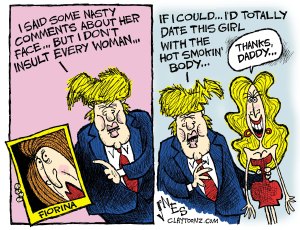
This is piggybacking on Trump’s racist and bigoted comments on Mexicans, Muslims. and Black Americans. Trump holds special contempt for women. (The first two cartoons come from the mind and pen of claytoonz.com .)
Republican frontrunner and presumptive nominee for president Donald Trump once said that “smart women” act “feminine and needy” but that on the inside, they’re “real killers.” It is, he advised men, “one of the great acts of all time.”
On Friday, CNN pointed out that the description comes from Trump’s chapter on women from his 1997 book, The Art of the Comeback.
“The smart ones act very feminine and needy, but inside they are real killers,” wrote the erstwhile reality TV star. “The person who came up with the expression ‘the weaker sex’ was either very naïve or had to be kidding. I have seen women manipulate men with just a twitch of their eye — or perhaps another body part.”
Trump has taken heat for his sexist attacks on women over the years from comedian Rosie O’Donnell — who he called “fat,” “disgusting” and “a dog” — to Fox News anchor Megyn Kelly, who the candidate said was unfairly “aggressive” with him in a televised debate and then accused her of being on her period.
The Boston Globe went after Trump’s behaviors in the Beauty Pageant Business and the resulting stories are horrifying. This is a good summation of the evidence by The Daily Mail.
It begins with the recollections of a pin-up model named Rhonda Noggle.
Noggle joined Trump in his limousine with a group of scantily-clad girls as they left the Plaza Hotel’s Oak Room.
Upon hearing the ‘bimbos’ and the ‘gold diggers’ comments, Noggle decided she’d had enough.
‘I told him I would rather be with a trash man who respected me than someone who was a rich, pompous ass,’ she told the Globe.
‘And I got out. And I took a cab ride home.’
Trump, in an interview with the Globe, denied he had ever made the comments and doesn’t recall Noggle getting out of the car.
As the Globe put it, ‘Noggle’s assertion of sexist behavior by Trump foreshadowed allegations of misogyny, racial bias, and sexually aggressive behavior that would roil this brief and fractious deal – Trump’s debut in the pageant business in which he would in time become a major player.’
Trump’s involvement in the calendar model competition came at a time when his reputation as an eligible New York ladies’ man was at its peak. He was between his first and second marriages, and his personal life was regular fodder in the New York tabloid gossip pages. Two years earlier, he had been featured on the cover of Playboy magazine.
The case of American Dream Enterprise Inc. v. Donald Trump, et al. — told through hundreds of pages of court records, several sworn depositions, and in nearly two dozen interviews — shows a darker side of Trump’s playboy image.
It foreshadows a reputation for sexism and misogyny that sticks with him nearly 25 years later, in his presidential bid, in which coarse descriptions of women and perceived sexist comments have left him with extraordinarily high unfavorable ratings among women.
The foray into the Calendar Girls pageant, however, also ushered in Trump’s interest in the business of entertainment. He later bought the Miss Universe pageant and gained national renown for his reality show, “The Apprentice.”
“I don’t believe there would have been an ‘Apprentice’ if there wasn’t a pageant first,” said Jim Gibson, a consultant and longtime pageant host who guided Trump into the pageant business and eventually to the Miss Universe event. “That got him in the higher hierarchies of the television business. And it did exactly what Donald wanted to do: It built his name.”
The coverage of Trump’s records of sexual harassment is well-documented in The NYT’s feature article “Crossing the Line.” It will bring back every horrible memory of every woman trying to earn a living and it will bring on every horrible nightmare every parent has of the kind of treatment they never want hoisted on their daughters.
Donald J. Trump had barely met Rowanne Brewer Lane when he asked her to change out of her clothes.
Donald was having a pool party at Mar-a-Lago. There were about 50 models and 30 men. There were girls in the pools, splashing around. For some reason Donald seemed a little smitten with me. He just started talking to me and nobody else.
He suddenly took me by the hand, and he started to show me around the mansion. He asked me if I had a swimsuit with me. I said no. I hadn’t intended to swim. He took me into a room and opened drawers and asked me to put on a swimsuit.
–Rowanne Brewer Lane, former companion
Ms. Brewer Lane, at the time a 26-year-old model, did as Mr. Trump asked. “I went into the bathroom and tried one on,” she recalled. It was a bikini. “I came out, and he said, ‘Wow.’ ”
Mr. Trump, then 44 and in the midst of his first divorce, decided to show her off to the crowd at Mar-a-Lago, his estate in Palm Beach, Fla. “He brought me out to the pool and said, ‘That is a stunning Trump girl, isn’t it?’ ” Ms. Brewer Lane said.
Donald Trump and women: The words evoke a familiar cascade of casual insults, hurled from the safe distance of a Twitter account, a radio show or a campaign podium. This is the public treatment of some women by Mr. Trump, the presumptive Republican nominee for president: degrading, impersonal, performed. “That must be a pretty picture, you dropping to your knees,” he told a female contestant on “The Celebrity Apprentice.” Rosie O’Donnell, he said, had a “fat, ugly face.” A lawyer who needed to pump milk for a newborn? “Disgusting,” he said.
But the 1990 episode at Mar-a-Lago that Ms. Brewer Lane described was different: a debasing face-to-face encounter between Mr. Trump and a young woman he hardly knew. This is the private treatment of some women by Mr. Trump, the up-close and more intimate encounters.
Michael Barbaro and Megan Twohey have documented a life long obsession with and oppression of women by Trump. Read it and prepared to be angry.
Documenting all of the horrible things that Trump has said about women on Howard Stern led Chris Hayes to tell Michael Steele that he really would love to read each one and ask each Republican on his show if it represents his beliefs and the beliefs of the Republican Party. The Stern comments are a case study in misogyny.
Donald Trump’s rise toward the Republican nomination has been fueled, in part, by his candid and often crude style — more Howard Stern, say, than Mitt Romney.
And the roots of Donald Trump’s rhetoric come, in fact, in part from The Howard Stern Show. Trump appeared upwards of two dozen times from the late ’90s through the 2000s with the shock jock, and BuzzFeed News has listened to hours of those conversations, which are not publically available. The most popular topic of conversation during these appearances, as is typical of Stern’s program, was sex. In particular, Trump frequently discussed women he had sex with, wanted to have sex with, or wouldn’t have sex with if given the opportunity. He also rated women on a 10-point scale.
“A person who is very flat-chested is very hard to be a 10,” he told Stern in one typical exchange.
Women make up a majority of the American electorate, and any of dozens of Trump’s remarks would be considered a severe blow to most candidates for public office. Trump has, in the Republican primary, proven largely immune to the backlash that the laws of gravity in politics would predict, but there are also suggestions that he has a deep problem with some women voters: 68% of women voters held an unfavorable view of Trump in a Quinnipiac poll released in December. In a Gallup poll also released in December, Trump had the lowest net favorable rating out of all the candidates among college-educated Republican women. And should he win the nomination, his comments are sure to become ammunition for Democrats against what they have long cast as a Republican “war on women.”
Trump has a history of making crude remarks toward women. He reportedly said of his ex-wife Marla Maples, “Nice tits, no brains,” and more recently, he has called Fox News anchor Megyn Kelly a “bimbo” and a “lightweight” and said she had “blood coming out of her wherever” during the first GOP debate.
It’s really hard to believe that one of the two major political parties can elect such an incredibly flawed, hateful, misogynistic, racists, and bigoted candidate. It is said that parts of the Republican Party are still trying to draft an independent candidate. The problem is that it’s not because of Trump’s statements towards women, people of Muslim faith, or people of racial and ethnic minorities. It’s because some of the things he says are seen as too liberal, to dove like, and not really ‘evangelical christian’ enough. This means they’re fine with the misogyny, bigotry and racism.
Two central figures in the draft talks are Kristol, who edits the Weekly Standard, and Erickson, a talk-radio host. While Kristol acts as a lone operator and has huddled privately with Romney and other Republicans, Erickson leads an organized group with former Senate staffer Bill Wichterman and others called Conservatives Against Trump, which has been meeting regularly for months.
Coburn, known for his fiscal conservatism, and Sasse have been atop the group’s recruit list for some time. Wichterman is among those who have reached out to Coburn. Friends of the 68-year-old former senator said he is listening but is unlikely to pull the trigger, in part because of health concerns.
Earlier this spring, Kristol had his eyes on Mattis, who is revered by conservatives for his public break with the Obama administration. The general, now a fellow at Stanford University’s Hoover Institution, met for several hours in mid-April with Kristol, Wilson and GOP consultant Joel Searby at the Beacon Hotel in Washington to go over how a campaign could work.
But soon after, Mattis backed away from the idea because he wasn’t ready to risk politicizing his reputation with a campaign that had little hope for success, according to two people familiar with his deliberations who requested anonymity to discuss those conversations. Mattis declined through a spokesman to be interviewed.
Kristol then reached out to Romney asking for a meeting to ask for his assistance. The two met May 5 at the J.W. Marriott hotel in Washington where they talked about possible contenders. Kristol detailed their discussion the next day to The Washington Post, which irked some Romney associates.
When asked this week to comment on further developments, Kristol declined.
“These conspiracies for the public good are time and labor intensive!” he wrote in an email. “In any case, things are at a delicate stage now, so I really should keep mum. Suffice it to say that serious discussions and real planning are ongoing.”
So what is a “Ben Sasse,” and how did he arrive at this wrong conclusion?
Sasse was elected to the Senate in 2014. In that cycle of Establishment vs. Tea Party Senate primaries, it was unclear in Nebraska which candidate, Sasse or former state Treasurer Shane Osborn,represented which side. It was such a muddle that FreedomWorks, one of the original national Tea Party organizations, switched its endorsement to Sasse after originally endorsing Osborn, prompting theresignation of one of its vice presidents. Since coming to the Senate, Sasse has amassed an arch-conservative’s voting record. He was recently the lone dissenting vote against a bill to combat opioid abuse, which he believes is a state- and local-government issue.
We’ve talked that the general election will get very ugly because it’s obvious that Trump is not shy about playing all the cards in his deck of hate. I hope this kind of information continues to get out to the public. Given Trump’s disapproval among women, women will be behind Hillary. There is very little chance that his racist comments and ability to attract white nationalists will appeal to any racial minority. This is the deal, however. Whatever are we going to do with those white men and the few hangers on among them? It’s not easy to ignore the privileged class.
What’s on your reading and blogging list today?
As always, this is an open thread. Please share everything and anything!!!
Did you like this post? Please share it with your friends:
The Sky Dancing banner headline uses a snippet from a work by artist Tashi Mannox called 'Rainbow Study'. The work is described as a" study of typical Tibetan rainbow clouds, that feature in Thanka painting, temple decoration and silk brocades". dakinikat was immediately drawn to the image when trying to find stylized Tibetan Clouds to represent Sky Dancing. It is probably because Tashi's practice is similar to her own. His updated take on the clouds that fill the collection of traditional thankas is quite special.
You can find his work at his website by clicking on his logo below. He is also a calligraphy artist that uses important vajrayana syllables. We encourage you to visit his on line studio.












 –including me–assembled and composed Wire




 incredibly flawed, hateful, misogynistic, racists, and bigoted candidate. It is said that parts of the Republican Party are still trying to draft an independent candidate. The problem is that it’s not because of Trump’s statements towards women, people of Muslim faith, or people of racial and ethnic minorities.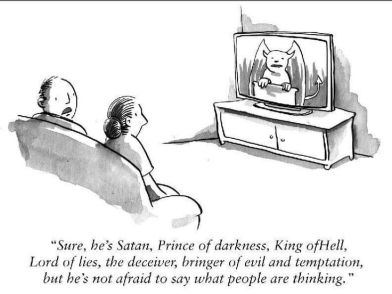

 peej
peej Carissa
 bostonboomer
 dakinikat
 ecocatwoman
 jjlo
jjlo mablue2
 Mama Lopez
 peggysue22
 quixote
 skydancingguestblogger
 Mona (aka Wonk the Vote)





Recent Comments