
Former Steubenville NAACP Chapter President Bashes Both Rape Victim and Police
Posted: March 28, 2013 Filed under: Crime, Criminal Justice System, Violence against women | Tags: Ma'lik Richmond, police corruption, Racism, Royal Mayo, Steubenville rape case, Trent Mays, victim-blaming 8 Comments
Convicted rapists Trent Mays and Ma’lik Richmond
Royal Mayo, who has lived his entire life in Steubenville, Ohio spoke to a conservative publication, International Business Times (IBT) and made some shocking remarks about the victim in the high profile Steubenville rape case. Mays is a former president of the local chapter of the NAACP–he left the post in 2010–and is still a member of its “executive committee.” According to a statement given to IBT, he does not speak for the NAACP.
Mayo used the words “alleged victim,” referring to 16-year-old “Jane Doe” (whose name has not been published because she is a minor), despite the fact that two teenagers have already been convicted of raping her. He claims Jane Doe is at fault because she got drunk and willingly left a party to be with Trent Mays.
In a phone interview with the International Business Times, Mayo described the 16-year-old girl as the “alleged victim” and said she might have been having consensual sex. “She said her mother brought her to the party, at 3 o’clock, with a bottle of vodka,” Mayo said. “Where did you get it, young lady? You brought it from home? Where’d you get it? You came to the party with your mother.”
Mayo added that she might have been a willing participant, apparently unfazed by the inflammatory nature of such statements. “They’re alleging she got raped; she’s acknowledging that she wanted to leave with Trent. Her friends say she pushed them away as she went and got into the car, twice telling them, ‘I know what I’m doing; I’m going with Trent,’” Mayo said.
Mayo also claims the girl arrived at the party with her mother and a bottle of vodka. I’m not sure where he got that information. Mayo knows Ma’lik Richmond and his family and has counseled Richmond in the past.
“Back in August, when the rumors first started going around, I talked to Ma’lik, and he said, ‘No, Mr. Mayo, we didn’t do anything to that girl. I don’t know what these rumors are; I don’t understand it.’”
Naturally, I find Mayo’s victim blaming repulsive and way way beyond inappropriate, but I do think some of what he says about the police could have some validity even though he isn’t the best source for cover-up charges. He suggests that Mays and Richmond were singled out to be “sacrificed” because Richmond is black and poor and Mays is not from Steubenville–he was recruited from another county.
“You hear local people saying, ‘We got this out of the way, let us just heal, let the community start to heal.’ It’s like these two were sacrificed, the poor black kid and the white kid who is from the next county, in the next town over, who were sacrificed over all the other dirt and corruption that would be uncovered if you come into Steubenville,” Mayo says.
He claims that police had other DNA samples that were ignored and that a witness who testified he saw Richmond digitally penetrate the Jane Doe when she was unconscious–Evan Westlake–refused to give a DNA sample and police didn’t compel him to do so.

Royal Mayo
It’s true that the Steubenville Police Department has a history of corruption and racism. It was
the target of 48 civil-rights lawsuits over a 20-year period regarding issues such as false arrests, excessive force and police misconduct. As a result, it became only the second city in the country to be subject to a consent decree from the federal government. In its 1997 ruling, the Department of Justice stated, “The United States alleges that officers of the Steubenville Police Department have engaged in a pattern or practice of conduct that deprives persons of rights, privileges or immunities secured and protected by the Constitution and the laws of the United States and that the city of Steubenville, the Steubenville Police Department and the Steubenville city manager (in his capacity as director of public safety) have caused and condoned this conduct through inadequate policies and failure to train, monitor, supervise and discipline police officers and to investigate alleged misconduct.”
Mayo’s victim-blaming is getting the most attention in media reports so far; but some of his points about police misconduct may well have some merit. A Grand Jury will begin meeting in mid-April with a judge appointed from another Ohio county. There certainly are indications of a cover-up that may have benefited students whom Mayo calls “connected.” In addition to Westlake, you have to wonder why neither the boy at whose home the attack took place nor his parents have been charged with anything.
Let’s hope such suspicions will be thoroughly aired before the Grand Jury.
NOTE: At Salon.com, Mary Elizabeth Williams published a detailed statement from the national NAACP:
”The NAACP abhors the remarks attributed to Royal Mayo regarding the rape victim in the Steubenville. The remarks are Mayo’s own, and do not reflect the position of the NAACP and its membership.” Mayo is a member of the Ohio NAACP executive committee. The statement added, “Mr. Mayo is not the president of the Steubenville NAACP and is not a spokesman for the NAACP. The article attributing him as such has been corrected by the International Business Times. Rape is a despicable crime of violence. The NAACP understands that comments that blame victims for the actions of their attackers contribute to and perpetuate a culture of acquiescence to rape. The NAACP advocates strongly for a society where victims of rape and sexual assault can come forward and seek legal redress without further retribution from the community, media or society at large.”
UPDATE: Mayo is now claiming he never made any statements blaming the victim. From WRTF.com
A member of the Steubenville NAACP is claiming an article by the International Business Times is false when it claims he told them he blamed the victim of the Steubenville rape trial for the assault.
Royal Mayo tells WTRF.com he “absolutely never said that,” in reference to claims made in the article. In the article, Mayo also claims that other teens involved that night were let off easy, because they were “well-connected.”
Thursday Reads: Banks Reopen in Cyprus; An End to “Too Big to Fail” Banks (?); Vagina-Phobia; and Much More
Posted: March 28, 2013 Filed under: Barack Obama, morning reads, Republican politics, SCOTUS, U.S. Economy, U.S. Politics, Vagina | Tags: Airline horrors, airport weigh-ins, Breitbart, capital controls, Charles Pierce, Chief Justice John Roberts, Cyprus crisis, DOMA, Joan Walsh, journalistic ethics, marriage equality, Matthew Boyle, Racism, Rep. Steve King, Sasha and Malia Obama, Simon Johnson, Too big to fail banks 31 Comments
Banks reopen in Cyprus and media jostle to get the best view – posted by Joe Parkinson (@JoeWSJ)
Good Morning!!
The banks have opened in Cyprus with controls on how much depositors can withdraw.
Joe Weisenthal posted updates at his Business Insider blog:
At 6:00 AM ET, banks in Cyprus reopened their doors for the first time since March 16.
Wall Street Journal’s Joe Parkinson reports that only eight people are being allowed in at a time at one Bank of Cyprus branch.
However, the crowds have been orderly.
Everyone is wondering whether there will be a huge run on the banks.
So far? Not yet.
This is likely due to a set of capital controls that have been imposed on the banks. Specifically, Cypriot depositors cannot withdraw more than 300 euros per day from any one bank. Also, checks cannot be cashed.
These controls will be in place for seven days.
See more Twitter updates and photos at the link. International Business Times has some details about the capital controls that are supposed to prevent bank runs. In addition to the withdrawal limit, depositors can’t cash checks unless they come from another country.
In the meantime, non-cash payments or money transfers are banned unless they are related to a number of conditions.
These conditions include commercial transactions, payroll, living expenses and tuition fees.
If commercials transactions are less than €5,000, there are no restrictions, but payments above this amount and up to €200,000 will be subject to a 24-hour decision making process, in order to determine whether the liquidity of the bank would be able to incur such a withdrawal.
Transfers for paying employees will also still be allowed but relevant documents would have to be presented in order to prove the money is being used to pay staff.
Transactions on credit or debit cards are also capped at €5,000 euros per month.
According to the Wall Street Journal, some large depositors seemingly had advance knowledge of what was going to happen in Cyprus and moved their money out of the country weeks before the crisis.
The chairman of the Committee for Institutions in the Cypriot Parliament, Deputy Dimitris Syllouris, said he had submitted a letter to the Central Bank of Cyprus demanding an investigation into account holders who moved large sums of cash out of the country in the weeks ahead of Cyprus’s chaotic bailout talks…
He said he had received information about individuals and businesses moving money out of Cyprus weeks ahead of the bailout deal—a move that wouldn’t be illegal but could imply that some depositors had warning that negotiations for a bailout could, for the first time in the financial crisis that has rattled the euro zone, take a cut out of regular bank deposits.
Asked whether his suspicions focused on one specific group of depositors, he said “politicians, all sorts of people, and bankers themselves are no better.”
That figures…
Outflows from Cyprus were increasing from moderate levels from January until March 15, the officials said. Last week—especially after March 19, when the Cypriot Parliament rejected the first bailout deal that would have imposed a one-time levy on large deposits—the outflows under the central bank’s exemptions went up significantly, they said.
Several hundred million euros, but less than a billion euros, left the country despite the bank closures, according to one official.
At Bloomberg, Clive Crook says Cyprus’ Plan B is Still a Disaster.
The new deal has removed the craziest part of the agreement reached March 16 — the plan to default on deposit insurance. Let’s not dwell any further on that insanity. But the new plan still has features that, seen in any other context, would surely arouse surprise.
For instance, the so-called troika of the European Commission, the European Central Bank and the International Monetary Fund wanted to be sure that the new debt Cyprus is about to take on will be sustainable — meaning, presumably, that Cyprus will be able to repay it. Yet, by writing down high- value deposits, the revised plan will also cause a sudden contraction of the Cypriot banking system, and thus of the whole Cypriot economy, which depends on banking to an unusual degree.
He concludes that,
Bailout fatigue says: “The Cypriots got themselves into this mess, and they should get themselves out. We’ll lend them a bit more, but only if we’re sure they’ll pay us back.” Cyprus didn’t get itself into this mess. It joined the euro system in 2008 with low public debt and a clean bill of health from EU governments (back then, not a word was said about shady Russians). Its banks are in trouble not because they accepted too many overseas deposits but because they bought too many Greek bonds — an investment sanctified by international banking rules (which called such investments riskless) that was destroyed by the EU’s ham-fisted resolution of Greece’s threatened default.
Europe’s sense of “we’re all in this together” seems to have evaporated entirely. Now one has to ask not merely what the euro is for, but what the EU itself is for.
Back in the U.S.A.,

Simon Johnson has an interesting post at the NYT’ “Explaining the Science of Everyday Life” blog: The Debate on Bank Size Is Over.
While bank lobbyists and some commentators are suddenly taken with the idea that an active debate is under way about whether to limit bank size in the United States, they are wrong. The debate is over; the decision to cap the size of the largest banks has been made. All that remains is to work out the details.
To grasp the new reality, think about the Cyprus debacle this month, the Senate budget resolution last week and Ben Bernanke’s revelation that — on too big to fail — “I agree with Elizabeth Warren 100 percent that it’s a real problem.”
Policy is rarely changed by ideas alone and, in isolation, even stunning events can sometimes have surprisingly little effect. What really moves the needle in terms of consensus among policy makers and the broader public opinion is when events combine with a new understanding of how the world works. Thanks to Senator Sherrod Brown, Democrat of Ohio; Senator Warren, Democrat of Massachusetts, and many other people who have worked hard over the last four years, we are ready to understand what finally defeated the argument that bank size does not matter: Cyprus.
I can’t briefly summarize the gist of Johnson’s piece, so if you’re following this story, please read the whole thing. Could he really be right about limits on “to big to fail or prosecute banks.” I sure hope so!
In other news,
Super-Lightweight Open Thread: NBC Offers Matt Lauer’s Job to Anderson Cooper
Posted: March 27, 2013 Filed under: just because, Media, open thread | Tags: Anderson Cooper, Ann Curry, CNN, gossip, Matt Lauer, NBC Today Show 25 Comments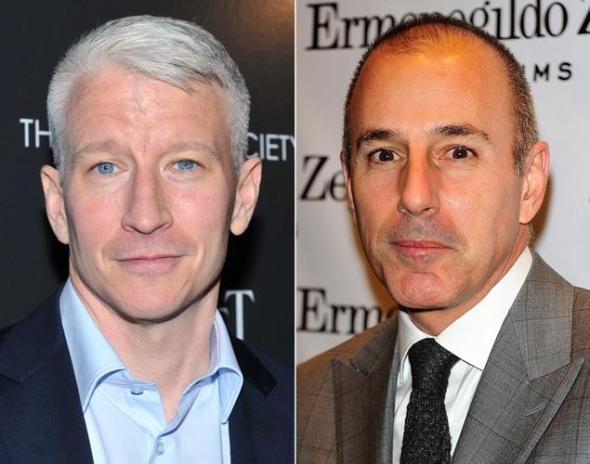
I don’t usually follow media gossip, but I’ve been seeing a lot of bashing of Matt Lauer out of the corner of my eye lately; so this is kind of interesting. It’s all over Twitter that NBC has offered Anderson Cooper Matt Lauer’s job on the Today Snow, and supposedly Lauer is OK with it. He’s been somewhat of a media punching bag since he drove Ann Curry off the Today Show.
TMZ reports, MATT LAUER I’m Down w/ Anderson Replacing Me on ‘Today’
Sources connected with NBC tell TMZ … network honchos approached Anderson Cooper about the possibility of replacing Matt Lauer on the “Today” show at some point … not immediately but at some point.
There is a story on Deadline.com that Matt made a call to Anderson to express his disapproval … TMZ has confirmed that is inaccurate and that call never happened.
In fact, sources connected with the network and Lauer tell TMZ that Lauer is actually on board with the idea of Anderson replacing him … and he actually planned to have a meeting with Anderson to sit down and discuss it.
Matt Lauer has been the subject of much scrutiny recently as reports of what really transpired in the Ann Curry ousting come to light and ratings continue to decline.
And it appears the brass at NBC are now looking to possibly replace Lauer.
Deadline’s Nellie Andreeva reports exclusively:
I hear NBC toppers recently reached out to CNN’s Anderson Cooper to replace Lauer on the show before the end of the year. After their initial approach to Cooper, I hear NBC reached out to Lauer to get his blessing about the changeover. But I heard they got pushback from the Today veteran, who contacted Cooper to express his disapproval. I also hear that call caught Cooper by surprise, as he had assumed Lauer had been brought on board before NBC began making overtures. Cooper has been one of the leading faces at CNN, though I hear his contract has an out, and he previously was able to do his syndicated daytime talk show in addition to his CNN program.
If (like me) you didn’t follow the recent gossip closely, Here’s some more detail on Lauer’s treatment of Ann Curry in a New York Magazine cover story. And here’s the gist, in case you don’t want to wade through the whole thing:
In his new cover story for New York magazine, Joe Hagan offers the most in-depth look at the Today show ratings disaster that has created Matt Lauer’s weeks-long attempt at image rehabilitation, and it’s now clear that the defining moment that brought the morning show crashing down to Earth — the exit of Ann Curry — was something of a cross between the fourth circle of Hell and running with the Heathers in high school: Curry got pranked, she got her clothes made fun of, she was prevented from reaching out to Robin Roberts, and her legacy lives on as a punching bag for NBC to defend the man who couldn’t share camera time with her anymore.
For the past several weeks, we’ve seen Lauer, Camp Lauer, and NBC executives trip over themselves trying to figure out how to talk to the media and spin the official history of Curry’s demise as a refresh for Today and especially Lauer. Talk to the Daily Beast‘s Howard Kurtz, and you can come away with a glossy, press release masquerading as an “exclusive.” Don’t talk to The New York Times‘s Brian Stelter, or you’ll find out Lauer is basically Voldemort in the halls of NBC.
Which brings us to New York‘s Hagan, who goes more than 6,500 words deep, with the official blessing of NBC… but also a blessed bit of honest analysis and reporting. On the surface, you can see Lauer and executives stick to the tracings of the NBC script so far — that Curry’s exit wasn’t his fault, that NBC executives made the decision, that Lauer was just caught in the crossfire. But Hagan’s piece digs into the deeper reality that Lauer in some respects failed at the basics of his job, and that those failures slid past executives who were so quick to lower the axe on Curry.
Read the highlights at the Business Insider link above.
The big question is who will replace Anderson Cooper? Who would want to work for CNN?
Please don’t feel you have to discuss this story–talk about anything you want. I just thought we needed a fresh thread.
SCOTUS Justices Hinting They Will Avoid Issuing a Broad Ruling Legalizing or Banning Same-Sex Marriage
Posted: March 26, 2013 Filed under: GLBT Rights, Marriage Equality, SCOTUS, U.S. Politics | Tags: Proposition 8, same-sex marriage 34 Comments
This morning the Supreme Court held oral arguments on the challenge to California’s Proposition 8 ban on same-sex marriage. At Business Insider, Eric Fuchs writes:
The first of two huge Supreme Court cases on gay marriage may be heading for a partial victory for supporters of the movement.
“SCOTUS won’t uphold or strike down Prop 8,” SCOTUSblog’s Tom Goldstein predicted over twitter after the Tuesday hearing was over.
So what does that mean, and why would that be a partial victory for gay marriage advocates?
The hearing involved California’s voter-approved ban on gay marriage, known as Proposition 8, which was struck down by a federal judge and an appeals court. When California declined to defend the law, it was backed by a coalition of anti-gay marriage advocates and elevated to the Supreme Court.
The Supreme Court could decline to issue a ruling at all, however, by finding the anti-gay marriage advocates don’t have legal “standing” to defend the law.
If that happens, then the appeals court ruling would stand and gays could continue to get married in California.
You can listen to the oral arguments and/or read the transcript at The Washington Post.
I can’t say I’d be surprised if the justices punt this one. I know that the Scalia clique would love to ban same-sex marriage, but they probably couldn’t get the votes; and even if they did, they have to realize that the blowback from the public would be horrendous.
Incestuous Relationships: That’s Our Oligarchy!
Posted: March 26, 2013 Filed under: Barack Obama, Foreign Affairs, morning reads, U.S. Politics | Tags: 2008 presidential campaign, Ben Rhodes, Benjamin Netanyahu, CBS, David Rhodes, James M. Rhodes, Jon Favreau, Russ Baker, speechwriters 43 Comments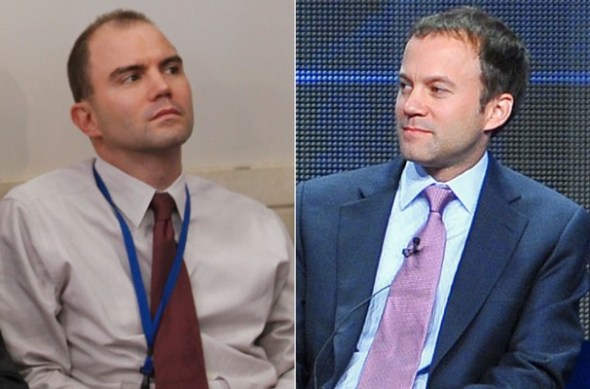
Ben and David Rhodes
On March 15, The New York Times ran a puff piece on Obama foreign policy adviser and speechwriter Ben Rhodes, by Mark Landler. Landler tells us that not so long ago, Rhodes was “[a]n aspiring writer from Manhattan [with] unfinished novel in a drawer, “Oasis of Love,” about a woman who joins a megachurch in Houston, breaking her boyfriend’s heart,” and that
worked briefly for Mayor Rudolph W. Giuliani’s re-election campaign in 1997, was living a writer’s life in Queens on Sept. 11, 2001, when he watched from the Brooklyn waterfront as the World Trade Center towers collapsed. The trauma of that experience, he said, led him to move to Washington in 2002.
Mr. Rhodes went to work for a Democratic foreign-policy elder, former Representative Lee Hamilton, helping draft the 9/11 Commission report as well as the Iraq Study Group report. That report was a template for the anti-Iraq war positions taken by Barack Obama, then a senator, whose campaign Mr. Rhodes joined as a speechwriter in 2008.
Wow! A Star is born!
Landler writes that Rhodes attends National Security Council meetings and has a powerful influence on Obama’s policies. He credits Rhodes for helping convince Obama to stop supporting Egyptian dictator President Hosni Mubarak and to intervene in Libya, as well as pushing the President to engage with Myanmar. At the moment, Landler says, Rhodes is trying to convince Obama to get more involved in Syria.
Jack Shaafer at Reuters calls the Landler’s story a “beat sweetener.
A beat sweetener, as press-watchers know, is an over-the-top slab of journalistic flattery of a potential source calculated to earn a reporter access or continued access. They’re most frequently composed on the White House beat when a new administration arrives in Washington and every Executive Office job turns over, but they can appear any time a reporter is prepared to demean himself by toadying up to a source in exchange for material.
As a beat sweetener, the Rhodes piece excels on so many levels that I’ll bet the subject’s parents have framed and hung the clipping over the family mantel. Landler portrays Rhodes as a young fella with “old man” wisdom; as possessing a “soft voice” that delivers “strong opinions”; as one whose “influence extends beyond what either his title or speechwriting duties suggest”; and as someone who “cares” to the point of “anguish” but is “very realistic.”
The information content of these testimonials, made by both Landler and his sources, is just about zero.
According to Shafer, the purpose of the “beat sweetener” isn’t just to make Ben Rhodes happy.
Sucking up to Rhodes won’t necessarily earn Landler or other journalists covering the White House an automatic scoop. But beat sweeteners aren’t written with anything so crass in mind as scoops. They’re designed to keep the information conveyor lubricated (“source greaser” is another term for the practice) with journalistic goodwill. As someone who is inside the White House decision loop, Rhodes is a much better friend than an enemy.
Getting back to the NYT puff piece: two-thirds of the way through, Landler mentions offhandedly that that Ben’s older brother David (who is 38) is the president of CBS News, a job he landed in February of 2011.
Landler provides no background on brother David, never mentioning that he previously held influential positions at Bloomberg and Fox News. In fact David is the first top CBS executive who previously worked for Fox News, and he’s the youngest president in CBS history. Shouldn’t this relationship between merit more than a throwaway line in a fawning profile of an influential adviser to the President of the U.S.?
Even Benjamin Netanyahu seemed a bit startled when he was told about it during Obama’s visit to Israel.
During a receiving line on the airport tarmac, Obama and Netanyahu stopped briefly to chat with Obama’s deputy national security, Ben Rhodes.
Obama noted that Rhodes’ brother, David, is president of CBS News.
“Sounds like a very incestuous relationship,” Netanyahu observed, chuckling at the idea of siblings in power roles within the administration and the news media.
“Not if you watch CBS News,” Obama replied.
There’s video of the interaction at Politico. Netanyahu may have been “chuckling,” but I’m not. How many times has Obama appeared on 60 Minutes? Has there ever been a mention of this relationship during those interviews? I haven’t checked, but I don’t recall it happening.
Of course relationships between media powerhouses and influential politicians and their advisers aren’t unusual. Here’s a short piece on this problem at TV Newser. Alex Weprin writes:
Let’s get this out of the way: conflicts of interest are rife in the TV news business.
CBS News president (and former Fox News executive) David Rhodes is the brother of one of President Obama’s advisers Ben Rhodes. NBC News anchor Andrea Mitchell is married to former Fed chairman Alan Greenspan. Bob Schieffer‘s brother Tom Schieffer was President Bush’s Ambassador to Japan.
In other words: potential conflicts happen all the time. The question is when should they be disclosed? Typically subjects with a conflict aren’t allowed to cover anything related to that conflict. If they do, a disclosure is a must….
In Washington, the journalists, the politicians and the lobbyists hobnob at the same parties, and many of them are friends. If everything was disclosed then just about every story from every reporter in DC would end with “I am a friend of a friend of this person” or “I hooked up with this person at 3 AM after the White House Correspondents Dinner.” Obviously that doesn’t happen, but sometimes a story does hit a little too close to home.
But isn’t this also an important reason why we don’t have an independent or serious news media?
Thinking about the incestuous nature of our Washington-New York oligarchy also leads to questions about how a young guy like Ben Rhodes–he’s just 35 now, so he was barely 30 when he began working for Obama in 2008–managed to come so far so fast.
Investigative reporter Russ Baker was stimulated to ask these and other questions after he read the Lindler’s NYT article. He notes that Rhodes appears to have come out of nowhere directly to the halls of power, just as his boss seemingly did. Baker writes:
What’s especially strange about the article is that, for those of us who continue to wonder how a virtual cipher rose so quickly from the Illinois legislature to become the most powerful person in the world, we end up wondering the same thing about an aspiring novelist from New York City who fairly catapults to enormous influence in shaping policy regarding some of the most complex and sensitive matters facing this country….
Though the Times never underlines this, the careful reader comes to realize that Rhodes’s guiding philosophy is as hard to discern as the precise reasons that he has the president’s ear. In 1997, he briefly worked on the re-election campaign of New York City Mayor Rudy Giuliani, a Republican. Shortly after 9/11, the aspiring novelist suddenly decided to do his part for society, moving in 2002 from Queens to Washington, and quickly found himself “helping draft the 9/11 Commission report as well as the Iraq Study Group report.” [….]
We are never even told what kind of education Rhodes got, or where, or whether he has ever been anything beyond an aspiring novelist. There’s no indication of what he did on Giuliani’s campaign (he would only have been about 19 or 20 at the time) or whether his preference for the mayor who presided over the 9/11 response had anything to do with his going to Washington, or miraculously being hired by Democrat Lee Hamilton to explain 9/11 to the public.
From these improbable beginnings, Rhodes is suddenly a speechwriter on Obama’s presidential campaign. How did he come to Obama’s attention? The article doesn’t say. However, it does note that the Iraq Study group report on which Rhodes worked “was a template for the anti-Iraq war positions taken by Barack Obama” as a senator and candidate.
Baker sums up his suspicions as follows:
Once we start asking questions about Benjamin Rhodes, this leads to questions about Obama, about the Times and CBS and journalism in general. And it leads to questions about how much we, the most smugly self-assured people on earth, understand about how anything of significance actually works.
In this case, it’s not unreasonable to wonder whether some particular faction or other might have spotted “talent” and “agreeability” in Rhodes, and helped hasten his rapid ascent to the top.
Baker located answers to some of these questions. From a very stunted Wikipedia entry, Baker learned that Ben Rhodes got his undergraduate degree from Rice University. He pulled together a timeline of the twin careers of Ben and his brother David:
Searching sources other than the Times, we find that David Rhodes was a production assistant at the fledgling Fox News Channel around the same time Benjamin was volunteering for Giuliani—and was the conservative channel’s news desk Assignment Manager when the planes struck the Twin Towers. Highly trusted by Fox’s chairman Roger Ailes, he managed Fox’s coverage of three presidential elections, including the one where his brother was writing Obama’s speeches, was hired by Bloomberg TV right after Obama’s election, and in 2011 was named president of CBS News.
It was Baker’s article that got me started I found Googling for more background on the very successful and powerful Ben Rhodes. In fact I spent much of the day yesterday searching for more background on the very successful and powerful Ben Rhodes. I’ll put that into a second post that I hope to put up later today.
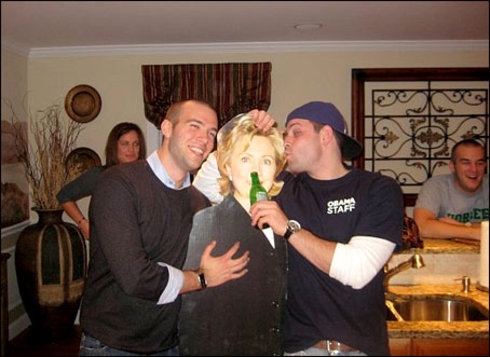
Oh, and I admit I was also inspired by my memory of this photo that I know you’ll also likely recall from early in Obama’s first term. The smiling guy sitting at the table in the back on the right side is Ben Rhodes. After head speechwriter Jon Favreau (on the left of the Hillary cardboard image) posted it on his Facebook page, Dak and I figured out who the other speechwriters in the room were and wrote a little about them.
You can treat this as a regular morning post and put your links in the comments as always. But I do hope some folks will wade through this post and discuss what I think are serious issues about the incestuous relationship between the corporation media and the government.

 peej
peej Carissa
 bostonboomer
 dakinikat
 ecocatwoman
 mablue2
 Mama Lopez
 peggysue22
 quixote
 skydancingguestblogger
 Mona (aka Wonk the Vote)



 Sky Dancing
Recent Comments