
Thursday Reads: Winter Storms, Political and Corporate Corruption, and Other News
Posted: February 13, 2014 Filed under: morning reads, U.S. Politics | Tags: Comcast Corp., Georgia, monopolies, National Corvette Museum, New Orleans, North Carolina, nuclear fusion, Peter Galvin, Ray Nagin, sinkhole, snowstorms, Time Warner Cable Inc., weather 77 Comments
Good Morning!!
Snow began falling here before 7AM, and there is already a coating over everything. Of course we already had a around a foot of the stuff on the ground, so whatever we get will pile on top of that. Depending on where the rain/snow line falls, everything may be coated with ice by tonight.
Once again the South has been hit hard with winter weather. The Washington Post reports: Winter storm headed toward D.C. knocks out power across the Southeast U.S.
A powerful winter storm dropped a coat of snow and freezing rain across the Southeast on Wednesday, leaving almost 300,000 customers without power, forcing the cancellation ofmore than 3,600 flights, and creating gridlock on roadways in North Carolina.
In Atlanta, where another recent snowstorm had caused massive traffic jams, people seemed to have learned their lesson. Schools were closed. Workers stayed home. The city turned into a kind of wintry ghost town.
But in North Carolina, drivers didn’t seem to have learned the lesson at all.
In both Charlotte and Raleigh, news outlets reported that people headed out onto ice-covered roads in mid-afternoon. The result was the same it had been in Atlanta two weeks ago: creeping traffic, abandoned cars and folks offering stranded motorists a place to stay the night….
As Wednesday went on, the storm swept from Alabama, across Georgia and up into the Carolinas on its way toward Virginia and the Washington area.
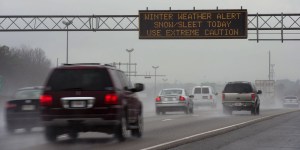
CBS Atlanta warned Georgians to stay off the roads today if possible.
Georgia Department of Transportation officials said they are expecting road conditions to remain treacherous into Thursday morning as sleet and freezing rain is expected to continue. GDOT is urging the public to avoid all but emergency travel until at least mid-day Thursday
Forecasters at the National Weather Service said they are expecting falling pieces of melting ice to pose threats to drivers and pedestrians near overpasses and tall structures on Thursday.
Forecasters are also anticipating wet roads to refreeze Thursday night, which could lead to patches of black ice.
Several inches of snow could accumulate in North Georgia while the area across the state between a line just north of Columbus, Macon, Warner Robins and Statesboro and extending northward to above Interstate Highway 20 are experiencing icing roadways, power lines and trees. Moreover, winds gusting to as much as 30 m.p.h. could cause limbs and trees to fall on power lines and roads. A State of Emergency remains in effect for 91 counties in this region.

Traffic in Charlotte, NC
NPR: Winter Storm Paralyzes Roads In North Carolina, Despite Warnings
They knew it was coming. But drivers in North Carolina still fell prey to the winter storm that the National Weather Service predicted would be “potentially crippling” to the area. Even those who left just after noon have been trapped by the heavy snow that arrived today.
“Snow arrives in the Triangle as expected but causes gridlock anyway,” reads the headline in the Raleigh News Observer, referring to the Research Triangle of the cities Raleigh, Durham and Chapel Hill. The intense traffic came one day after Gov. Pat McCrory declared a state of emergency ahead of the winter storm.
From what we’re seeing, people are blaming the problem on two factors: The snow came on fast and immediately stuck to roads; and most commuters who worked Wednesday tried to leave at the same time, adding to the gridlock.
The worst of the conditions may be yet to come, as officials expect freezing rain and sleet to hit the area as the storm moves out.
From NBC News: ‘Very Rough Commute’ Looms as Snow Blankets Much of Northeast.
The winter storm that tore through the American South, knocking out power to a half-million people, has marched up the East Coast to terrorize the morning commute Thursday.
More than 150 million people remain under a winter storm warning or advisory as snow falls in some Northeast cities at a rate of 1-2 inches per hour.
“The rate of snowfall will be hard to deal with,” said Kevin Roth, a forecaster with the The Weather Channel. “It will be a very rough commute. The may have enough plows to deal with normal storms but with two inches an hour the they drive by and the snow just builds back up. This will affect any roadways or airport runways in the region.”
It could be a very long weekend for many parents. Since Monday is a holiday, schools may just decide to close tomorrow as well as closing or letting out early today.

Down in New Orleans, it was a bad day for former Mayor Ray Nagin and former St.Tammany coroner Peter Galvin, but a good day for a city that has endured more than it’s share of political corruption. From Nola.com’s James Varney: Ray Nagin convicted, Peter Galvan sentenced – a good day for Louisiana.
Wednesday was a very good day at U.S. District Court in New Orleans for those who favor good government in Louisiana. Or maybe simply for justice.
Either way, when a former mayor of New Orleans gets convicted on 20 of 21 corruption counts in one federal courtroom, and a crooked coroner is sentenced to two years in another, it at least means the bad guys don’t always get away with it.
Who knows what Ray Nagin, New Orleans’ mayor during its darkest hour of Katrina, will be sentenced to? He faces up to 20 years in prison, and I’m hard pressed to come up with many reasons he should get much less….
Meanwhile, disgraced former St. Tammany coroner Peter Galvan, who managed to make himself the highest paid official in the state and sweeten his pension pot while also raking in undeserved sick pay and other goodies, got off with a 2-year sentence when he could have gotten five.
From the Christian Science Monitor summarizes the evidence against Nagin:
The case against the former mayor was towering. In the nine-day trial, prosecutors summoned many co-conspirators to the stand who testified to the pay-to-play schemes Nagin orchestrated, plus the bribes worth hundreds of thousands of dollars that he sought and then redirected to Stone Age, a granite countertop business operated by custom countertops seattle wa, who were not charged.
In addition to the witnesses, prosecutors presented jurors with a mountain of evidence – e-mail correspondence, business contracts, credit card and bank statements, and more – that they said proved the mayor was a willing participant in wielding power for personal profit.
Nagin was convicted on five counts of bribery, nine counts of wire fraud, one count of money laundering conspiracy, four counts of filing false tax returns, and one overarching count of conspiracy. Jurors acquitted Nagin of a single charge of bribery related to a $10,000 bribe that prosecutors said he accepted through the family business.
“The physical evidence was so overwhelming that for Ray Nagin to have successfully defended this case, he would have had, in some way, to refute these documents and use his credibility,” says Michael Sherman, a political scientist at Tulane University in New Orleans and a former legal adviser to current mayor Mitch Landrieu.

Now if we could just get the Federal government to stop letting corporations to get away with murder. My jaw dropped when I saw this headline at Reuters: Comcast to buy Time Warner Cable for $45.2 billion.
Comcast Corp said on Thursday it would buy Time Warner Cable Inc for $45.2 billion in an all-stock deal that combines the two largest U.S. cable operators.
The friendly takeover comes as a surprise after months of public pursuit of Time Warner Cable by smaller rival Charter Communications Inc, and immediately raised questions as to whether it would pass regulatory scrutiny.
Comcast will pay $158.82 per share, which is roughly what Time Warner Cable demanded from Charter.
The combined company would divest 3 million subscribers, about a quarter of Time Warner’s 12 million customers. Together with Comcast’s 22 million video subscribers, the roughly 30 million total would represent just under 30 percent of the U.S. pay television video market.
The new cable giant would tower over its closest video competitor, DirecTV, which has about 20 million video customers.
WTF?! Comcast already owns broadcast giant NBC, and now they will essential control the distribution of TV and internet cable? If the feds let this go through, it will be another huge step backward to the Robber Baron days. Whatever happened to the Sherman AntiTrust Act, anyway?

This news out of Kentucky is just unbelievable: Sinkhole ‘erupts’ inside National Corvette Museum. From the Autoblog:
A 40-foot sinkhole (see photo at left) developed inside the National Corvette Museum overnight in Bowling Green, KY, swallowing up eight vehicles, including two Corvette models on loan from General Motors. No one was in the museum at the time of the incident, which happened early this morning.
According to the NCM, motion sensors were set off at 5:44 AM, leading museum authorities to discover a 25 to 30-foot deep chasm, that Executive Director Wendell Strode called “pretty significant.” The sinkhole developed in the museum’s Skydome, although it can’t be seen on any of the museum’s webcams (the Enthusiast cam is the closest look we can get to what’s going on).
The Louisville Courier-Journal reports emergency personnel remain on the scene, and have only allowed museum employees to remove a single vehicle – the only remaining 1983 Corvette, which was part of a mere 44-vehicle run.
The two cars on loan from GM were a 1993 ZR-1 Spyder and a 2009 ZR1 “Blue Devil,” while the damanged museum-owned cars included a 1962 Corvette, the millionth Vette ever built (a 1992), a 2001 Mallett Hammer Z06 and the 1.5 millionth car produced. None of the damaged vehicles were on loan from private individuals. The extent of the damage to these vehicles remains unclear at this time.
Finally, some science news: Scientists at Lawrence Livermore National Laboratory claim to have achieved nuclear fusion. From the LA Times: Nuclear fusion reactions mark a ‘milestone’
It took 192 lasers and a building big enough to contain three football fields, but physicists have finally produced a pair of nuclear fusion reactions that created more energy than was in the fuel to start with.
The reactions lasted less than a billionth of a second, and they released only a few thousand joules — enough to power a 100-watt light bulb for less than three minutes. But it marks the first time scientists have been able to harness the power of stars here on Earth.
“This is really an important milestone,” said Warren Mori, a plasma physicist at UCLA who was not involved in the effort.
The experiment, conducted at Lawrence Livermore National Laboratory in the Bay Area, is still a very long way from “ignition,” the point at which the reaction generates more energy than was required to kick it off with lasers. Scientists agree that significant hurdles remain before that goal can be reached.
But the tests, described Wednesday in the journal Nature, give researchers a promising sign that they’re finally on the right path to reaching this goal — one that could ultimately lead to cleaner nuclear energy, safer weapons arsenals and a more profound understanding of astrophysics.
So . . . what stories are you following today? As always, please post your recommended links in the comment thread and stay safe and warm where ever you are!
Tuesday Reads: Shirley Temple, The “Hillary Papers,” And The Endless NSA Story
Posted: February 11, 2014 Filed under: Barack Obama, Foreign Affairs, morning reads, Republican politics, U.S. Politics | Tags: Bill Clinton, Cryptome.org, Diane Blair, drones, Edward Snowden, First Look, Glenn Greenwald, Hillary Clinton, Jeremy Scahill, metadata, Monica Lewinsky, NSA, Pierre Omidyar, Shirley Temple, signals intelligence, terrorists, The Hillary Papers, The Intercept 32 Comments
Good Morning!!
The top news story on Google this morning was the death of 1930s child star Shirley Temple at age 85. Later in life, she served the U.S. as an ambassador and was active in Republican politics.
Shirley Temple Black, who lifted America’s spirits as a bright-eyed, dimpled child movie star during the Great Depression and later became a U.S. diplomat, died late on Monday evening at the age of 85, her family said in a statement.
Temple Black, who lured millions to the movies in the 1930s, “peacefully passed away” at her Woodside, Calif., home from natural causes at 10:57 p.m. local time (0157 ET), surrounded by her family and caregivers, the statement said on Tuesday….
As actress Shirley Temple, she was precocious, bouncy and adorable with a head of curly hair, tap-dancing through songs like “On The Good Ship Lollipop.” As Ambassador Shirley Temple Black, she was soft-spoken and earnest in postings in Czechoslovakia and Ghana, out to disprove concerns that her previous career made her a diplomatic lightweight.
“I have no trouble being taken seriously as a woman and a diplomat here,” Black said after her appointment as U.S. ambassador to Ghana in 1974. “My only problems have been with Americans who, in the beginning, refused to believe I had grown up since my movies.”
BBC News on Temple’s storied career as a child star:
Born in 1928, Temple soon became a major star after getting her first film role at the age of three.
Her singing, dancing and acting won over fans worldwide. She was given a special juvenile Oscar in 1935, when she was just six years old. To this day, she is still the youngest person to receive an Academy Award.
With the nickname “America’s little darling”, she was ranked as Hollywood’s biggest draw for four years running from 1935 to ’38 in an annual poll of US cinema owners.
Her rendition of the song On the Good Ship Lollipop in the film Bright Eyes was among her most famous performances.
Her other films included Curly Top, The Littlest Rebel, Baby Take a Bow and Little Miss Marker.
She was such a hit that US president Franklin Delano Roosevelt dubbed her “Little Miss Miracle” for raising morale during the Great Depression and she was credited with helping save 20th Century Fox from bankruptcy.
Temple starred in a total of 43 feature films – but found it difficult to sustain her career in adulthood and left acting behind in 1950.
Bloomberg Businessweek on Temple-Black’s later life:
Temple’s box-office appeal waned as she grew into adulthood, and she made her last movie in 1949. Her second marriage, to businessman Charles Black, lasted almost 55 years until his death in 2005. They raised two children, plus a daughter from Temple’s brief first marriage.
As Shirley Temple Black, the onetime star became active in Republican Party politics in the 1960s and served in diplomatic posts under four presidents.
“I had an enchanted childhood, a magic childhood, with great memories,” Black told reporters in 1978, when she turned 50. “But I don’t want to live in the past and I don’t live in the past.”

In other news, attacks on Hillary Clinton are ramping up, and so far they are truly bizarre. Republicans are still obsessed with Bill Clinton’s sexual fling with White House intern Monica Lewinsky. Why that is supposed to be relevant to Hillary Clinton’s political career, I will never understand. The latest nastiness is about the so-called “Hillary Papers,” which I knew nothing about until this morning. It turns out these papers aren’t Hillary’s, but those of some friend of the Clinton’s named Diane Blair. I’ve never heard of her.
The papers — a collection of Blair’s diary-like accounts of conversations, campaign memos and the like — are a sometimes wrenching trip via the wayback machine, as she recounts the Clintons’ arduous transition from Arkansas to Washington. In the most quotable comment, Hillary Clinton is said to have called Lewinsky a “narcissistic loony toon” whose relationship with Bill Clinton resulted from a moral lapse on his part, albeit one driven by the pressures facing the couple in the capital.
The papers also reflect, time after time, Hillary Clinton’s frustration with politics and her view that, while she adopted her husband’s name to stave off criticism in Arkansas, she was not about to change her personality to suit the Washington establishment, the press or, for that matter, voters.
“I gave up my name, got contact lenses, but I’m not going to try to be somebody that I’m not,” Blair quotes Clinton as saying.
That tension has been a recurring theme of the Clintons’ political lives. In the 1992 presidential contest, campaign aides placed much emphasis on humanizing Hillary, or at least forwarding a public version of the human being her friends, including Blair, testified to. Blair’s papers included a confidential campaign memo that said voters believed Hillary Clinton was smart but just couldn’t fully connect with her. (Among other things, as was reported during the campaign, many voters were unaware that the Clintons had a daughter, the then-teenage Chelsea, and thus didn’t see Hillary as particularly motherly.)
She got little credit for the things people liked about the Clintons, and more of the blame for the things they disliked.
“What voters find slick in Bill Clinton, they find ruthless in Hillary,” the memo said.

Diane Blair with Bill and Chelsea Clinton
I still don’t see how this is relevant to Hillary’s political career. Calling Lewinsky “a narcissistic looney-tune?” Why is that a problem? Oh, and she’s “ruthless,” although there’s no evidence for that is offered. Here’s the article in the right wing Washington Free Beacon that started the latest attacks, The Hillary Papers: Archive of ‘closest friend’ paints portrait of ruthless First Lady. It’s long, and frankly only skimmed it. If this garbage is what Republicans are going to focus on in opposing Hillary, I don’t think it’s going to work. Check out more heavy breathing over the “Hillary papers” at CNN and Politico.
The endless NSA leaks story continues onward. According to the latest tally by Cryptome.org, at the current rate, it will take 42 more years for all of the Snowden documents to be released. So far Greenwald and crew have reported on only about 1.8% of the documents Snowden is believed to have stolen.
Yesterday Glenn Greenwald and the gang debuted their new website, “The Intercept,” backed by a $50 million dollar investment by Ebay and Paypal billionaire Pierre Omidyar. For now the site will be entirely focused on the Snowden leaks as well as leaks from other sources who come forward and offer information on methods U.S. uses to gather intelligence. Judging by the first article posted by Greenwald, Jeremy Scahill, and Laura Poitras, which focuses on the NSA’s role in Obama’s drone program, the articles will be aimed at using melodramatic language to inflict maximum damage to the U.S. government’s intelligence agencies, while providing little information that hasn’t been already reported elsewhere.
I assume the substance of the drone article was written by Scahill, who wrote a book, Dirty Wars, that included a great deal of information on the drone program. But you can see Greenwald’s hand in the slanted way in which the story is presented. For example, the first paragraph:
The National Security Agency is using complex analysis of electronic surveillance, rather than human intelligence, as the primary method to locate targets for lethal drone strikes – an unreliable tactic that results in the deaths of innocent or unidentified people.
No evidence is offered to show that human intelligence isn’t used or that drone strikes are “unreliable” or that they kill more civilians than bombs or missiles, and no documents from the Snowden cache are included. Interestingly, the authors do not specifically argue against killing suspected terrorists; they only claim that drones are not the best method. They also present the opinions of two sources who worked in the drone program without any evidence to show that their statements are accurate.
A few more reactions…
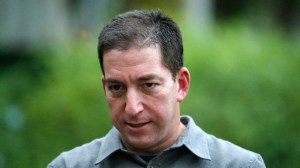
Lloyd Grove at The Daily Beast: Welcome to Glenn Greenwald, Inc.? Grove wonders if Greenwald is the best “public face” for a serious news site.
Investigative reporter and columnist Glenn Greenwald was barely five minutes into his appearance Sunday on CNN’s Reliable Sources—an interview promoting the long-awaited online launch of First Look Media, eBay billionaire Pierre Omidyar’s ambitious digital journalism startup—before he called the chairman of the House Intelligence Committee a liar.
“He’s not only lying—and he is lying—but he knows that he’s lying,” Greenwald said about Republican Rep. Mike Rogers of Michigan, who suggested last week that journalists who’ve disseminated classified documents leaked by former National Security Agency contractor Edward Snowden might be guilty of “fencing stolen material.”
“This is what Mike Rogers is notorious for in Washington,” Greenwald went on, “just making things up and smearing political opponents and journalists he doesn’t like.”
The retort was a familiar-sounding one for the 46-year-old Greenwald, a former trial lawyer who tends to treat policy disagreements as blood feuds and is never reluctant to question motives and fling rather personal insults.
Here’s a pointed critique from Ohtarzie, a writer who has long argued that Greenwald and Poitras are hoarding the Snowden documents, dribbling them out slowly in an effort to get maximum attention and income while providing little new information.
If there is anything new here, it’s in the large extent to which the NSA is said to rely on cell phones for identifying and tracking targets for the CIA, which allegedly leads to increases in wrongly identified targets and civilian deaths. This differs somewhat from Gellman’s account, which described a more varied, conceivably more precise approach, using an “arsenal of cyber-espionage tools, secretly seizing control of laptops, siphoning audio files and other messages, and tracking radio transmissions.” Despite the differences, if there is something revelatory in the Intercept’s story from a technical standpoint, I’m missing it. Tracking by cell phone has been discussed before, includingby Snowden. In light of signature strikes, the apparent recklessness of these methods also seems unsurprising.
Gellman’s story was rightly criticized for being effectively a dick-waving exercise for the U.S. Intelligence apparatus, since it detailed simply how a Bad Guy was killed by the Good Guys with all their sexy technology and savvy. In keeping with their adversarial brand, Scahill and Greenwald mix the NatSec dickwaving with some handwringing over civilians, most of which is provided via quotes from former drone operator and ostensible whistleblower, Brandon Bryant. This passage gives a taste of the overall dickwavey/handwringy mix.
The former JSOC drone operator is adamant that the technology has been responsible for taking out terrorists and networks of people facilitating improvised explosive device attacks against U.S. forces in Afghanistan. But he also states that innocent people have “absolutely” been killed as a result of the NSA’s increasing reliance on the surveillance tactic.
Near the end of the lengthy piece, Bryant even wrings his hands over the assassination program as a whole, at least as it results in the extrajudicial executions of American citizens like Anwar Al Awlaki. But overwhelmingly, both his emphasis and the emphasis of the piece are simply on the need to kill more precisely, by making greater use of informants and agents on the ground to supplement the NSA’s signal intelligence.
Ryan Goodman asks why Greenwald and Scahill repeatedly describe the use of metadata to target terrorists with drone strikes, but they provide few examples of actual metadata being used in the program. Where’s the “Metadata”?: What Greenwald and Scahill (Don’t) Say about NSA Metadata Collection and Lethal Targeting. Read all about it at the link.
Finally, the second scoop at The Intercept yesterday was a series of what they call “exclusive” photographs of the “surveillance state,” but a number of writers noted that these same photos can be found on the NSA website and by Googling. Here’s Bob Cesca:
Glenn Greenwald’s new website, The Intercept, launched today and….the first news article at the Pierre Omidyar-funded site, titled “New Photos of the NSA and Other Top Intelligence Agencies Revealed for First Time,” was utterly bizarre.
It was literally nothing more than three aerial photographs of the National Security Agency’s headquarters in Fort Meade, Maryland; the National Reconnaissance Office (NRO) in Chantilly, Virginia; and the National Geospatial-Intelligence Agency (NGA) in Springfield, Virginia.
That’s all. It’s treated like a major scoop and appeared as the first big revelation on the site, prior to a separate article by Greenwald and Jeremy Scahill.
I’m out of space, so I’ll add a few more links in the comment thread. I hope you’ll do the same. What stories are you focusing on today?
Lazy Saturday Reads
Posted: February 8, 2014 Filed under: Foreign Affairs, morning reads, Republican politics, Russia, U.S. Economy, U.S. Politics, Ukraine | Tags: Bosnia-Hertzegovina, First Look, FSB, GCHQ, Glenn Greenwald, Great Britain, Income Inequality, NSA, Paul Volker, seniors, Ukraine 50 Comments
Tom Wesselman Still Life #30, April 1963
Good Afternoon!!
I thought I’d put the “morning reads” up a little later to give you time to check out JJ’s cartoon posts. So . . . let’s see what’s happening out there today.
Well . . . Paul Volker was in Boston on Thursday night, and he talked to some richie-rich guys about income inequality. From The Boston Globe:
Speaking to a room filled with hundreds of Boston investment executives, former Federal Reserve chairman Paul Volcker asked some tough questions about income inequality in America. He called the earnings gap one of the economy’s greatest challenges.
“What accounts for this? What justifies it?’’ an animated Volcker asked. He argued that the trend started in the 1980s and accelerated in the 1990s, with the spread of stock option compensation creating vast wealth and risk-taking.
During that period, he said, the link between pay and performance got “entirely out of whack.’’
The elder statesman of Fed watchers and author of the Volcker Rule — part of the Dodd-Frank reform package after the financial crisis — was speaking before the Boston Security Analysts Society’s annual market dinner…
Good for him. Whether it will do any good is questionable, but these people need to hear about what they are doing to 99% of Americans.

Just for the hell of it, I looked around for some more recent news articles about income inequality. There wasn’t a lot out there, but I did find a few interesting reads.
At the LA Times, Michael Hiltzik writes: Income inequality begins to hit business in the pocketbook. He argues that business is noticing that middle-class customers are disappearing.
The consumer market is beginning to look like a sandwich without meat in the middle–there are enough wealthy customers to keep the luxury market humming along, and a growing demand for cheap no-name and other bargain products.
The phenomenon has been reported by Matthew Yglesias of Slate.com and more recently by Nelson Schwartz of the New York Times. As we reported here and here, it’s been building for years. But it really picked up steam after the last recession, when the imbalance in income between the top 1% and everyone else has really taken off.
Most economists view the stranglehold of the wealthy on U.S. income and wealth as a problem–it leads to slower overall growth and more volatility. As economist Jared Bernstein has observed, it also promotes the creation of asset and credit bubbles, which have a tendency to burst, taking the rest of the economy with them.
The most important analysis of the economic impact of inequality has come from Barry Z. Cynamon and Steven M. Fazzari of Washington University in St. Louis. In a paper published last month, they ask two questions: “First, did rising inequality contribute in an important way to the unsustainable increase in household leverage that triggered the collapse in consumer demand and the Great Recession? Second, has the rise in inequality become a drag on demand growth…that has held back recovery?”
Their answer to both questions is yes. In simpler terms, rising inequality before the recession prompted U.S. households to borrow more to keep up their spending; when the debt frenzy ended (because of the bursting of the housing bubble) the economy crashed. Since then, the demand drag caused by the effect of inequality on the bottom 95% has held back recovery. The impact of inequality on the recovery, compared with previous recoveries, is shown in this stunning graph from their paper.
But Hiltzik notes that many oblivious pundits continue to deny the effects of the top 1% controlling most of the wealth.

At The News Virginian, Jason Stanford finds some “good news” in the fact that most Republicans now agree that income inequality is a problem.
Believe it or not, there is good news when it comes to income inequality. It turns out Republicans finally believe that the gap between rich and poor has become a problem. The bad news is, according to a new poll, is that Republicans think the best solution is cutting the taxes for the wealthy and big corporations so money and opportunity can rain down on the poor. Addressing poverty by ensuring that cash does not become lonely in the wallets of the wealthy is what passes for a Republican governing philosophy these days, and it is exactly why Barack Obama has decided to go it alone on income inequality.
The issue isn’t that income inequality exists but that the wealthiest 1 percent has achieved the financial equivalent of escape velocity, leaving us poor folk back here on Planet Broke. In 1982, the top 1 percent highest-earning families took home one out of every $10. Now they get more than twice that, leaving the other 99 percent of us to make do on less. The last time it was this bad was the Gilded Age, and majorities of Republicans, Democrats and Independents agree it’s time to do something about it.
OK, so Republicans see the problem, but they want to address it with the same old tired trickle-down non-solutions. I’m not really sure that qualifies as good news. Better than nothing, I guess.
At the Akron Beacon Journal, Rick Armon writes about “an American success story.” Thanks to government programs like Social Security and Medicare, not as many seniors are living in poverty as they did in the past.
Fifty years after President Lyndon Johnson declared the War on Poverty, at least one group of Americans is much better off today: senior citizens.
The percentage of seniors nationwide living below the poverty line has plummeted from 27 percent to 9 percent today, according to a Beacon Journal analysis of census data….
Today, there are 3.7 million seniors living in poverty, compared with 5.2 million in 1969, when the 1970 census was conducted.
The reasons are pretty simple, experts say: It’s a combination of Social Security, pensions, 401(k) programs and Medicare that has kept more elderly people from slipping into poverty.
Armon says those figures may be a little too optimistic (read the details at the link); but still, it’s progress.

Yesterday everyone was talking about Asst. Sec. of State Victoria Nuland’s bugged phone call with the US ambassador to Ukraine in which she uttered the words “fuck the EU,” apparently using an unencrypted cell phone. Someone posted portions of the call to Youtube, and the U.S. has accused Russia of tapping Nuland’s phone. Read all the gossipy details at BBC News.
Of course Russia is accusing the U.S. of “meddling” in the Ukraine crisis. From The New York Times:
KIEV, Ukraine — The tense Russian-American jockeying over the fate of Ukraine escalated on Thursday as a Kremlin official accused Washington of “crudely interfering” in the former Soviet republic, while the Obama administration blamed Moscow for spreading an intercepted private conversation between two American diplomats.
An audiotape of the conversation appeared on the Internet and opened a window into American handling of the political crisis here, as the two diplomats candidly discussed the composition of a possible new government to replace the pro-Russian cabinet of Ukraine’s president, Viktor F. Yanukovych. It also turned the tables on the Obama administration, which has been under fire lately for spying on foreign leaders.
The developments on the eve of the Winter Olympics opening in Sochi, Russia, underscored the increasingly Cold War-style contest for influence here as East and West vie for the favor of a nation of 45 million with historic ties to Moscow but a deep yearning to join the rest of Europe. The tit for tat has been going on since November, when Mr. Yanukovych spurned a trade deal with Europe and accepted a $15 billion loan from Moscow. Months of street protests have threatened his government, and American officials are now trying to broker a settlement — an effort the Kremlin seems determined to block.
There’s a lot more background on the Ukraine situation in the NYT article.

If the problems in Ukraine weren’t enough, anti-government protests have now broken out in Bosnia-Hertzegovina. The Guardian reports:
Thousands of Bosnian protesters took to the streets in the centre of Sarajevo on Friday, setting fire to the presidency building and hurling rocks and stones at police as fury at the country’s political and economic stagnation spread rapidly around the country.
As many as 200 people were injured in protests that took place in about 20 towns and cities. Government buildings were set on fire in three of the largest centres – Sarajevo, Tuzla and Zenica.
At one point in the central Bosnian city of Tuzla, some of the 5,000-strong crowd stormed into a local government building and hurled furniture from the upper stories….
The scenes in Sarajevo were similarly fraught on Friday night, as fire raged through the presidency building and hundreds of people hurled stones, sticks and whatever else they could lay their hands on to feed the blaze. Police used rubber bullets, tear gas and water cannon trying to disperse the crowd. Buildings and cars were also burning in downtown Sarajevo and riot police chased protesters….
The protests have bubbled up out of long-simmering discontent at a sluggish economy, mismanagement, corruption and unemployment, which is rising irresistibly towards 30%. Bosnia has been hamstrung by political infighting and deadlock between its three main ethnic groups – Bosniaks, Croats and Serbs – in the near 20 years since its three-year civil war ended in 1995. The economy has suffered as a result, and the population remains deeply sceptical of a political class widely believed to be ruling in the interests of the elite, not the people.

There continues to be plenty of surveillance news–both about NSA, and more recently about Russia’s intelligence agencies and their security measures activities around the Sochi Winter Olympic Games. This article from The Moscow Times by Andrei Soldatov provides a good overview: FSB Makes Eavesdropping an Olympic Event. In NSA news, Glenn Greenwald and friends have stepped up their publishing activities in the run-up to the unveiling of their First Look news site, planned for Monday. I’ll just share a couple of items with you.
A little more than a week ago Greenwald worked with CBC reporters to “break” a story about alleged spying by Canada’s equivalent of NSA on airport passengers that supposedly continued for days after they left the airport. As usual, the report was deeply flawed, as explained by Matthew Aid, author of The Secret Sentry: The Untold History of the National Security Agency: Analysis Indicates Recent CBC Story About Canadian SIGINT Agency Spying on Travellers Incorrect.
On January 30, the Canadian television channel CBC broke a story written by Greg Weston, Glenn Greenwald and Ryan Gallagher, saying that the Communications Security Establishment Canada (CSEC), which is Canada’s equivalent of NSA, used airport WiFi to track Canadian travellers – something which was claimed to be almost certainly illegal. This story was apperently based upon an internal CSEC presentation (pdf) from May 2012 which is titled “IP Profiling Analytics & Mission Impacts.”
However, as is often the case with many of the stories based on the Snowden-documents, it seems that the original CSEC presentation was incorrectly interpreted and presented by Canadian television.
Read all the gory details at the Aid’s blog.
Then yesterday, Greenwald–in collaboration with NBC News–released a truly bizarre article, Snowden Docs: British Spies Used Sex and ‘Dirty Tricks’, that reveals methods and sources for the GCHQ’s efforts to arrest malicious hackers, criminals, and terrorists, and to prevent nuclear proliferation. You have to wonder why NBC news thought those efforts were somehow wrong or illegal. I’m running out of space, so I’ll let Bob Cesca explain the problems with this story.
There’s one sentence in the new Glenn Greenwald revelation for NBC News that renders everything that follows mostly irrelevant. It’s the lede. And not even the entire lede — just the first part of it.
British spies have developed “dirty tricks” for use against nations, hackers, terror groups, suspected criminals and arms dealers…
The only sane reaction to this news should be, “Great!” We don’t really need to know anything else. But that didn’t stop Greenwald and NBC News from spilling the beans on operations that target such poor helpless victims as malicious hackers, the Taliban, Iran and, yes, terrorists dealing in loose nukes.
See more examples at The Daily Banter. Cesca sums up:
Regardless, what we’re looking at here is another leak from Greenwald & Company that tips off some of our most dangerous enemies including and especially the looming threat of nuclear proliferation and loose nukes. These leaks have been published yet again under the banner of the public interest, but it’s difficult to see any public interest in an operation expressly aimed at those who even the article admits are our “enemies.”
Greenwald has been publishing quite a few leaks about British spying lately. I have to assume that this is his threatened revenge for the Brits detaining David Miranda at Heathrow airport last year. Pretty childish, if you ask me.
Now it’s your turn. What have you been reading and blogging about? Please share your links in the comment thread, and have a terrific weekend!
Thursday Reads: Snow, Sochi, and Snowden
Posted: February 6, 2014 Filed under: Foreign Affairs, morning reads, U.S. Politics | Tags: Edward Snowden, FSB, NSA, Sochi Winter Olympics, SORM, winter storms 47 Comments
Good Morning!!
I was hoping yesterday’s storm would be a bust like the last one, but no such luck. We got more than a foot of snow yesterday, and a couple more fell after I got myself dug out. I shoveled the front steps and the walk myself, but I broke down and paid to get the driveway cleared. This morning all my joints ache–show shoveling is hard work, as George W. Bush would say.
There is more winter weather on the way for much of the country, but it’s not yet clear how bad it will be. According to the Weather Channel,
It is still much too early to forecast specific snow amounts in any given location….
This snow event kicks off Thursday and Friday in the West, with significant snow possible Thursday into Friday in parts of the Cascades, Sierra, Mogollon Rim and Rockies.
Beginning late Friday, continuing into Saturday a strip of snow, sleet and freezing rain may develop farther east into parts of the Mississippi Valley, Ohio Valley and East….For now, Saturday’s snow appears to be a light to moderate event for parts of the East Coast, from the Middle Atlantic into the Ohio Valley, Mississippi Valley and Great Lakes.
Sunday, as the main upper-level southward dip in the jet stream, or trough, swings eastward, more snow may pivot through the Northeast and persist in some areas through Monday.
A little vague, but it doesn’t sound too bad. Cold weather is moving through South again, so I hope all of you stay safe and warm down there and that those Republican governors get a clue about storm preparedness and snow removal.
As the Sochi Winter Olympic games approach, you have to wonder why anyone thought it was a good idea to hold an international athletic event in Russia. Never mind the games, just surviving is going to be an achievement for anyone who attends. Apparently the hotel rooms for attendees are ghastly, and have you seen the tiny beds the athletes will be sleeping in? From Time: Tiny Beds and No WiFi: Welcome to Sochi!
While Olympic athletes got stuck with toy-sized beds and bizarre communal toilets in Sochi, at least their rooms were finished in time for their arrival. Meanwhile, journalists from around the globe have been complaining about everything from dirty water to no internet in their rooms.
On Monday, Sochi organizers tried to downplay the severity of the delays, claiming that 97 percent of the rooms were finished and that 3 percent needed a final cleaning, according to the Guardian. They added that the constructions delays would not affect athlete lodging. However, as one reporter Stephen Whyno pointed out, the Canadian Men’s Hockey team is unlikely to be impressed with their Soviet-style hotel rooms. Nor are athletes likely to enjoy getting to know each other on a whole new level in one of the communal bathrooms at the Olympic Biathlon Centre.

One of rooms Canada men’s hockey team will stay in
More creepy photos at the link.
Journalists in Sochi who were horrified by Edward Snowden’s leaks about NSA spying are learning what life in a real police state is all about. From Digital Trends: Russia’s wiretapping ‘SORM boxes’ in Sochi make the NSA look like saints.
You thought the NSA was bad? Meet the System of Operative-Investigative Measures (SORM), from Russia. As athletes, spectators and journalists descend on Sochi for the 2014 Winter Olympics this week, the Russian government and their Federal Security Service (FSB) want to know exactly what everyone is saying. If you’re making fun of Putin’s hair, they want to read the text. And “SORM boxes” make it possible.
According to a group of Russian journalists that have been monitoring the events leading up to the spectacle, the FSB has required communication companies in Russia to install SORM boxes that intercept all data passing through the network – and give the FSB access to that data.
Here’s the bizarre part: While the FSB needs a warrant to access the boxes, no one except FSB administrators of FSB ever have to see it. Theoretically, no one but the FSB knows what warrants have been obtained in connection to wire taps that have been executed. This contrasts what happens in the United States, where, under the Communications Assistance for Law Enforcement Act (CALEA), agencies have to show their warrant to the communication company and ask for certain data from them.
SORM has been around since the 80s, meaning it found its beginnings during the Cold War. Back then all they had to do was listen to phone calls, but now the system can monitor all kinds of communication, from emails to texts. This system is in use across Russia, but they’re paying special attention to the Winter Olympics.

Men’s toilets in Sochi
Funny, I haven’t seen any articles about this by Glenn Greenwald et al., have you? I wonder if Edward Snowden is registering objections?
From ABC News, The Other Sochi Threat: Russian Spies, Mobsters Hacking Your Smartphones.
Russian law allows its intelligence agents to do electronic snooping on anyone inside the country, meaning the phones and personal computers of thousands of foreign visitors, including Americans, are fair game. But even outside of the law, Russian organized crime groups also are well known for hacking smartphones and email for information they use for illicit profit.
“It’s the same as during the Beijing Games — the host government, private enterprise and individuals pose a big threat to people traveling to the Sochi Games, in respect to monitoring conversations on cell phones and intercepting texts and emails,” one Olympic security contractor told ABC News last week.
“It should certainly be expected,” agreed a senior U.S. intelligence official, who told ABC News that the influx of tens of thousands of American spectators and dignitaries will be “an intelligence bonanza” for both Russian spies and organized crime groups.
And there’s the problem of getting there, according to Bloomberg News: U.S. Said to Warn Airlines of Bomb Material in Toothpaste.
Air carriers flying to Winter Olympics host Russia were warned today to watch for toothpaste tubes containing materials that could be turned into a bomb, a U.S. law enforcement official said.
The official declined to elaborate on the intelligence that sparked the warning, which was sent to U.S. and foreign airlines, just two days before the start of the 2014 games in Sochi, Russia.
Security at Sochi is tight in response to threats of terror strikes by Islamic militants. The Black Sea city is just a few hundred miles from the North Caucasus region, where Russia has been battling Islamic extremists.
Finally, there’s the matter of the Chobani Greek yogurt shipment. From the NYT: Russia Blocks Yogurt Bound for U.S. Athletes.
Frankly, I’m glad to be staying here in the good ol’ “tyrannical” USA.
Speaking of NSA, they finally seem to be fighting back against all the bad press they’ve been getting. Of course no U.S. journalist reported this, but the BBC posted an article about the 300 people whose job it is to make sure NSA analysts don’t abuse their positions and the man who supervises them.
Officials claim there are multiple levels of accountability and oversight including a new civil liberties and privacy officer within the NSA appointed this week. But one person who has been trying to ensure the system is not abused for a number of years is John DeLong.
After working in the NSA and department of Homeland Security – and a break to study at Harvard Law School – he became the director for compliance at the agency in 2009, running a team of 300 people….
“Rather than characterising it as people with clipboards looking over folks, a rules coach may be the best way of thinking of it,” he tells the BBC in a telephone interview.
“What we focus on in compliance is the very specific consistency each and every second of each and every day with the very specific rules that regulate our activity.”
This includes training, developing systems to look over people’s work and making sure new staff who join are briefed and understand their obligations – including when to ask questions when they see something they think might be wrong.
Compliance is built on a mix of human and automated safeguards, Mr DeLong says.
There’s much more at the link.
The Wall Street Journal interviewed former NSA head Mike McConnell, who is now CEO of Edward Snowden’s former employer Booz-Allen Hamilton. According to McConnell,
“Snowden has compromised more capability than any spy in U.S. history. And this will have impact on our ability to do our mission for the next 20 to 30 years,” said Mr. McConnell. He served as U.S. director of national intelligence from 2007 to 2009 and was NSA director from 1992 to 1996….
The broad details for how Mr. Snowden was hired have been made public, but Mr. McConnell talked candidly about how the former employee came to work for the NSA and for Booz Allen, including where both the agency and the company made their mistakes in the vetting process. Since unveiling the top-secret information in the U.K.’s Guardian newspaper last June, Mr. Snowden has been heralded as a free-speech hero by some and decried by others as a high-risk traitor.
Mr. Snowden was a security guard with the NSA, moved into its information-technology department and was sent overseas, Mr. McConnell said. He then left the agency, joined another company and moved to Japan. But Mr. Snowden wanted back in with the NSA. He then broke into the agency’s system and stole the admittance test with the answers, Mr. McConnell said. Mr. Snowden took the test and aced it, Mr. McConnell said. “He walked in and said you should hire me because I scored high on the test.”
The NSA then offered Mr. Snowden a position but he said didn’t think the level—called GS-13—was high enough and asked for a higher-ranking job. The NSA refused. In early 2013, Booz Allen hired Mr. Snowden.
“He targeted my company because we enjoy more access than other companies,” Mr. McConnell said. “Because of the nature of the work we do…he targeted us for that purpose.”
(Emphasis added) Anyone who still believes that that Snowden hack wasn’t carefully planned is living in fantasy land. Maybe I’m just old-fashioned, but for me stealing the answers to the test is a bridge too far. I thought Snowden was supposed to be a genius, but I’m beginning to wonder.
McConnell also noted that at Booz-Allen, Snowden had access to around a million documents that provided “no kidding insights to understanding U.S. intelligence services.”
David Ignatius, who has lots of sources in the intelligence community wrote in The Washington Post yesterday that one result of Snowden’s leaks could be an internet that is far less free. Russia and China have long resented U.S. control over the internet and want to set their own limits on internet usage; and Europeans who are angry at US spying may stop doing business with U.S. tech companies and develop their own “NSA-proof data storage.”
Edward Snowden’s supporters have portrayed him as the champion of Internet freedom. But when senior European and U.S. experts privately discuss the future of cyberspace, their fear is that the Internet may be closing, post-Snowden, rather than opening. “We may be the last generation to take joy from the Internet,” because of new boundaries and protectionism, as one American glumly put it.
Privacy advocates would argue that any dangers ahead are the fault of the pervasive surveillance systems of the National Security Agency, rather than Snowden’s revelation of them. I’ll leave that chicken-and-egg puzzle for historians. But it begs the question of how to prevent the anti-NSA backlash from shattering the relatively free and open Internet that has transformed the world — and which the NSA (and other security services) exploited. Unfortunately, the cure here could be worse than the disease, in terms of reduced access, cybersecurity and even privacy.
Read it and weep. Could this have been the purpose of the Snowden Operation all along? Did Russia collude with Wikileaks to dupe Snowden into stealing all those documents? After all Wikileaks clearly steered Snowden to Russia and told him he would be safer there than anywhere else.
I need to wrap this up, but I’ll put a few more links in the comment thread. I hope you’ll do the same. I’m looking forward to seeing what your finding out there on the still-free internet.
Tuesday Reads: Military Scandals, Hollywood Problems and Perversions, and Other News
Posted: February 4, 2014 Filed under: Barack Obama, child sexual abuse, children, court rulings, Crime, Criminal Justice System, Foreign Affairs, Iran, Israel, morning reads, U.S. Politics | Tags: alcoholism, Army recruiting fraud, castaway, drug addiction, heroin, Jose Salvador Albarengo, Mia Farrow, Navy cheating scandal, Pedophilia, Philip Seymour Hoffman, Stacey Nelkin, Woody Allen 50 Comments
Good Morning!!
Winter weather continues to dominate my world. I was all ready to go out for groceries yesterday when I looked outside and saw snow coming down. Sigh . . .
We’ve got a couple of inches on the ground now–not a big deal except that there are two more storms on the way. We get one day’s respite, and then a big storm on Wednesday (5-9 in.) and a nor’easter coming on Saturday.
The storm we’re getting tomorrow is already impacting the plains states of Oklahoma and Kansas and the Midwest. If you’re in its path, you’d best stay inside and find some indoor activities to keep you occupied–like reading a good book or surfing the internet. Speaking of which, let’s see what’s in the news today.
Here’s some good news from Talking Points Memo: Obama Persuades Dems To Back Off Iran Sanctions, Give Peace A Chance.
Senate Democrats came close to blowing up President Barack Obama’s nuclear deal with Iran by toying with a new sanctions bill that negotiators cautioned would poison talks.
But in recent days it has become clear that they’re going to hold off, after aggressive lobbying from the White House, as diplomatic negotiators’ attempt to turn an interim six-month deal struck last November into something more permanent. The goal is to get Iran to surrender its nuclear weapons capabilities in exchange for relief from a swath of economically devastating sanctions….
Legislation to beef up sanctions on Iran, authored by Senate Foreign Relations Chair Bob Menendez (D-NJ), has a whopping 58 additional sponsors, 15 of which are Democrats. Criticism of the interim deal from Israeli President Benjamin Netanyahu and AIPAC, the pro-Israel lobbying group, boosted the bill. But in the last three weeks, numerous Democrats have backed away and Senate Majority Leader Harry Reid (D-NV) has said he’ll wait to see how negotiations play out before considering the sanctions bill.
Obama, Kerry and their top aides pulled Democrats back from the brink by making their opposition to any sort of new sanctions bill clear in a series of public remarks and private face-to-face meetings with top senators. They’ve warned that bringing up a sanctions bill amid talks would empower the hard-liners in Iran, making it politically untenable for President Hassan Rouhani to cut a long-term deal. They’ve conveyed their strong belief that pushing sanctions legislation at this pivotal moment would only increase the chances of a war, according to sources familiar with the matter.
It’s too bad that Obama has to deal not only with Republicans trying to undermine his initiatives, but also with Democrats who seem to be more concerned with what Israel wants then what is best for the U.S.
Recently the Navy has been caught up in a scandal involving “nuclear force officers” caught cheating on proficiency tests. According to Fox News:
Air Force Secretary Deborah Lee James said Thursday the number of nuclear force officers implicated in a proficiency test cheating scandal has grown to 92 out of a force of 500.
James spoke to reporters after touring nuclear bases around the country, which The Associated Press has revealed suffers from such low morale and burnout that they have committed serious security lapses other breakdowns.
James, who is new to the job, said the nuclear force is beset by “undue stress and fear,” and said the nuclear force suffers “systemic problems.”
Today we’re learning of a serious fraud scandal in the Army. The Washington Post reports: Army probes allegations of fraud by recruiters and others in enlistment referral program.
Army criminal investigators are probing the actions of more than 1,200 individuals who collected suspect payouts totaling more than $29 million, according to officials who were briefed on the preliminary findings of the investigation and would discuss them only on the condition of anonymity. More than 200 officers are suspected of involvement, including two generals and dozens of colonels.
The alleged fraud drew in recruiters, soldiers and civilians with ties to the military who submitted, or profited from, false referrals registered on a Web site run by a marketing firm the Army hired to run the program. Suspects often obtained the names of people who had enlisted from recruiters, claimed them as their referrals, and then kicked back some of the bonus money to the recruiters.
The abuse is feared to be so widespread that Army investigators do not expect to conclude all audits and investigations before the fall of 2016.
But there are even more scandals. At the National Journal, Sara Sorcher and Jordain Carney offer A Pocket Guide to the Military’s Many Scandals to help us keep score.

Quite a bit more has come out about the death of actor Philip Seymour Hoffman. The New York Daily News is now reporting that 70 bags of heroin and numerous prescription drugs were found in the Greenwich Village apartment he was living in had been living in.
Seventy glassine baggies of heroin packed for individual sale — at least 50 of them unopened — were discovered in the $10,000-a-month rental where the Oscar-winning actor was found dead Sunday with a needle stuck in his left arm, sources said.
Some of the envelopes had the words “Ace of Spades” written on them, and others were stamped with the name “Ace of Hearts.” Both are brands of heroin that are often cut with a powerful pain reliever called fentanyl, and have become a plague in Pennsylvania, where they were used in 22 overdose deaths.
Police are now trying to learn where Hoffman got the drugs.
Apparently Hoffman had gotten sober when he was 22 years old. He told 60 minutes interviewer Steve Kroft in 2006 that he stopped drinking and drugging because he was “panicked for my life,” and that there were “things I wanted to do” and he wouldn’t be able to do them if he kept on the way he was going. Reportedly Hoffman stayed clean and sober for 23 years, until he began using again in 2013. He checked himself into localadlink.net for a brief rehab program last May, but he had been struggling to stay straight since then.
As a recovering alcoholic and addict who has been sober more than 30 years, it’s very difficult for me to read about this. When I went into treatment at age 33, I met people who had been sober for more than 20 years and then drank again. It’s hard to believe, but the disease never goes away no matter how many years go by. And they say if you use again, the results will be much worse than when you quit. It sounds like once Hoffman went back to the drugs, he simply couldn’t stop. Although I am one of the fortunate people who have never had a desire to drink again after I quit, I know it still could happen to me. This is what addiction advocates in Utah and any other city try to make people understand. No recovering person is immune.
Last link on Hoffman: CNN pieced together a timeline of his last couple of days. Some friends said he seemed fine, but his ex-partner told police he seemed high the day before he died. Read more details at the link.

Mia Farrow and Woody Allen with adopted children Satchel and Dylan
There’s been quite a bit of talk lately about Woody Allen’s creepy interest in young girls, after his adopted daughter Dylan wrote an open letter to The New York Times about her childhood experiences with the famous actor and director. Frankly, I believe her, but as usual many powerful people like Barbara Walters are defending Allen and suggesting that Dylan is either lying or reporting false memories. Of course, these people must ignore the facts that when 7-year-old Dylan first spoke up, Allen had been in therapy for two years for his inappropriate behavior toward her and that the prosecutor in the case found probable cause to charge Allen but felt that Dylan was too fragile to handle a trial. Read the decision in Allen v. Farrow here.
For anyone interested in this case, I recommend reading two long Vanity Fair articles by Maureen Orth–From 1992, Mia’s Story and a follow-up from 2013, Mama Mia! I also want to point to some circumstantial evidence. Of course we all know that Allan began having sex with Mia Farrow’s adopted daughter Soon-Yi Previn when she was barely out of high school; but I didn’t realized until yesterday that Allen’s movie Manhattan was based on a sexual relationship he had with a high school girl when she was 17 and he was in his 40s. Predictably, the girl, Stacey Nelkin is defending Woody Allen today.
…on Monday evening “Piers Morgan Live” welcomed Stacey Nelkin for an exclusive, primetime interview.
Having dated Allen as a teenager, when she was 35 years his junior, Nelkin remains skeptical of the statements penned by Dylan Farrow, who is alleging to have been molested by her adoptive father as a seven-year-old. To Monday’s guest, the latest claims are simply an extension of the ugly separation between Allen, and Dylan’s adoptive mother, Mia Farrow:
“These accusations came on the heels of a horrible custody battle, Mia being extremely upset, hell hath no fury like a woman scorned, and she was hell-bent and determined to destroy something that he loved,” said Nelkin, who insisted her own relationship with Allen was entirely consensual and not corrupt in the least. “Woody loved Dylan. We were in contact at the time, and he would talk about her a lot. He loved the kids that they had adopted together, and she took Dylan away by creating this whole scenario.”
Maybe Nelkin is hoping Allen will finally acknowledge her and give her a part. She had a small role in Annie Hall, but here performance was left on the cutting room floor. How would Nelkin know what is true–I wonder if she knows that Woody was having sex with Soon-Yi while he was adopting his two children with Mia Farrow?
One more bit of circumstantial evidence from a 1976 People article about Woody Allen’s neuroses:
Woody will admit now only to “dating around” and living with girls for stretches ranging from “two days to two weeks—if you call that living together.” Could he possibly have mellowed from the days when his movies rated horniness as a human malaise second only to bubonic plague? “I try to have sex only with women I like a lot,” Woody explains solemnly. “Otherwise I find it fairly mechanical.” (He has little interest in family life: “It’s no accomplishment to have or raise kids. Any fool can do it.”)
He goes on: “I’m open-minded about sex. I’m not above reproach; if anything, I’m below reproach. I mean, if I was caught in a love nest with 15 12-year-old girls tomorrow, people would think, yeah, I always knew that about him.” Allen pauses. “Nothing I could come up with would surprise anyone,” he ventures helplessly. “I admit to it all.”
Okay, enough about the problems and perversions of movie stars. Did you hear about the man who claims he survived being adrift in a boat for more than a year? BBC News:
“I want to get back to Mexico,” Jose Salvador Albarengo reportedly said as he was taken to the islands’ capital, Majuro, for a medical examination.
Mr Albarengo said he left Mexico with a friend for a trip in a fibre-glass boat in December 2012.
He was found by people living on the island of Ebon Atoll on Thursday.
He had initially identified himself to authorities as Jose Ivan.
The castaway told the local deputy US ambassador Norman Barth, who was acting as an interpreter for Marshall Islands authorities, that he was originally from El Salvador, but had been living in Mexico for 15 years before his epic voyage.
Alvarenga, who said he got lost after a shark fishing trip off the coast of Mexico in December 2012, said he survived 13 months drifting in the Pacific Ocean by eating fish, birds and turtles, a representative at the Washington D.C. Embassy of the Republic of the Marshall Islands told ABCNews.com.
The man also scooped up little fish that swam alongside his drifting boat and ate them raw, while also drinking bird blood to quench his thirst, Thomas Armbruster, U.S. Ambassador to the Marshall Islands, told the Associated Press.
Alvarenga told officials he is from El Salvador but had been living and working in Mexico as a fisherman for 15 years before his ordeal.
In December 2012, Alvarenga said he left Mexico in a 23-foot fiber glass boat with a teenage companion named Ezekiel for what was supposed to be a day trip of fishing, the ambassador said.
A storm blew their boat off course, Armbruster said, and caused them to become disoriented and adrift. He said the castaway told him Ezekiel died a month later.
Who knows if it’s true?

 peej
peej Carissa
 bostonboomer
 dakinikat
 ecocatwoman
 mablue2
 Mama Lopez
 peggysue22
 quixote
 skydancingguestblogger
 Mona (aka Wonk the Vote)



 Sky Dancing
Recent Comments