Posted: November 11, 2014 | Author: bostonboomer | Filed under: just because |
Good Afternoon!!
I had a strange computer problem this morning–actually not a computer problem per se, but a browser problem. I finally got it solved, although I don’t quite understand why it happened. So here I am, a little later than usual.
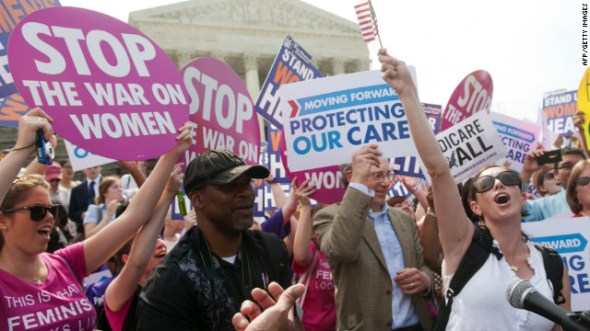
I’m going to focus this post on the Supreme Court challenge to the Affordable Care Act (AKA Obamacare) in the form of King v. Burwell, the case SCOTUS announce it will hear next year. From Think Progress:
In a surprise move late last week, the Supreme Court agreed to hear the case of King v. Burwell, a lawsuit seeking to strip premium tax credits from people living in states with a federally-operated insurance marketplace. If the lawsuit, which employs an overt misreading of the Affordable Care Act, is successful, it would hike premiums by triple digits and make health coverage unaffordable for millions of Americans. We have written about the case before, when a panel of the Fourth Circuit Courts of Appeals ruled on it and unanimously upheld the law. But that wasn’t enough for at least four Justices, who now think it worthwhile that the case be argued in front of the nation’s highest court.
Make no mistake, the lawsuit is a strategic attempt at repeal by another name by ideological conservatives.
We don’t have any way of knowing for sure which justices voted to hear the case, but we can be sure that they included Scalia, Thomas, and Alito. Was the fourth vote to take the case that of Anthony Kennedy or Chief Justice John Roberts? You’ll recall that in 2012, Roberts supposedly “saved” the ACA by vote to allow the government to invoke a penalty for people who did not sign up for some kind of health insurance. Unfortunately, the SCOTUS decision also severely wounded the ACA by permitting governors to refuse to accept the Medicaid expansion that made it possible for people who could not afford health coverage to receive government subsidies.
Here’s Jim Newell at Salon in April of this year: John Roberts didn’t “save” Obamacare — he gutted it.
Nearly two years ago, by a 5-4 decision, the Supreme Court allegedly “upheld” Obamacare. More specifically, the thinking at the time went, it was Chief Justice John Roberts who, in a herculean act of statesmanship, cast the deciding vote to “uphold” Obamacare….
John Roberts certainly could have done much more damage to the law, had he chosen to. He could have joined the four other conservatives on the bench who were prepared to take down not just the individual mandate, but the entire law itself. What a peach.

Still, as early estimates of the newly ensured under Obamacare’s implementation are rolling in, it’s time to write a second draft of history — one that doesn’t include anything about John Roberts “upholding” or “saving” Obamacare. Because that’s an odd way to describe a decision that gutted the most effective part of the law.
While the White House was popping champagne over the survival of the law’s requirement for individuals to obtain health coverage or suffer a tax penalty, Republican-held state governments were more focused on that “other” part of the majority decision: the one that allowed states to opt out of the law’s Medicaid expansion and suffer no consequences to its pre-expansion Medicaid funding. The White House, at least publicly, blew this off. “Senior Obama administration officials downplayed the impact of the Medicaid portion of the court ruling, saying as a practical matter it is not particularly significant,” the Wall Street Journal reported at the time. After all, the thinking went, what state would be crazy enough to turn down all this money — an expansion that the federal government would fund 100 percent of in the beginning, and 90 percent of permanently?
Two years later, we have the answer: Many, many states would be precisely that crazy! Let’s call it two dozen. The Kaiser Family Foundation breaks it down as 19 states “not moving forward at this time,” while the issue is under “open debate” in five states. And it is definitely not certain that those “open debates” will produce Medicaid expansions.
How many of those states reelected the governors who screwed them out of lower health care costs? I haven’t checked for sure, but offhand, I’d say most of them are still in office.
Now we face another challenge, and John Roberts will have to decide whether or not to completely destroy the ACA. Paul Waldman at The American Prospect: Republicans May Finally Get Their Wish to Watch the Affordable Care Act Destroyed.
On Friday, the Supreme Court agreed to hear the case of King v. Burwell, perhaps the last gasp in the Republican attempt to use the courts to destroy the Affordable Care Act. The reaction to this news among liberals was, to put it mildly, shock and dismay. Simply put, the lawsuit is a joke, and the fact that any judge, let alone a justice of the Supreme Court (not to mention five of them) would do anything but laugh it out of court is a testament to just how shamelessly partisan Republican judges have become. At least four justices have to consent to hear a case, so it’s possible that there will still be five votes to turn back this stink bomb of a case. That will probably depend on the good will of John Roberts, something I wouldn’t exactly want to stake my life on. But lives are indeed at stake.
There are a couple of optimistic scenarios for how this could all turn out, and I’ll explain why I suspect they’re wrong. But in case you haven’t been following, this case rests on what is essentially a typo in the ACA, where it refers in one spot to subsidies provided to Americans in health insurance exchanges “established by the state.” The conservative activists who brought the suit contend that these three words prove that Congress did not intend subsidies to be available in states that declined to set up their own exchange and therefore defaulted to the federal exchange. (There are 36 such states.) They manage to argue this with a straight face—or perhaps a cruel smirk might be a better description—despite the fact that every member of Congress, congressional aide, journalist, and everyone else who was there at the time agrees that no one ever contemplated the insane idea that Americans in states using the federal exchange would be ineligible for subsidies.
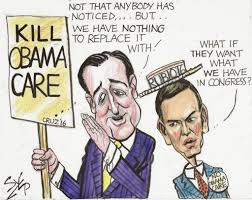
The subsidies, tax credits, and Medicaid expansion are what allow the ACA to make health insurance Affordable for millions of Americans.
According to the Department of Health and Human Services, 8 million Americans got private insurance through all the exchanges in their first open enrollment period, and 5.4 million of those were in the federal exchange. Of those, 86 percent, or 4.7 million, received subsidies to make their insurance affordable. If this lawsuit is successful, those millions would all lose their subsidies. Many, if not most, would probably be unable to purchase insurance and would rejoin the ranks of the uninsured. Then premiums for the remaining people in the exchanges would skyrocket, insurers would drop out, and the result would be a death spiral that not only destroys the exchange altogether but also undermines, perhaps fatally, the other two legs of the “three-legged stool” that comprises the ACA: the requirement that insurers accept all customers regardless of pre-existing conditions, and the individual mandate. (If you’d like details on how this would happen, you can read this amicus brief filed by 49 distinguished economists who study health care.)
Keep in mind that by the time the SCOTUS decision is handed down in June of next year, Congress will be completely controlled by Republicans, so there’s zero chance the typo in the law will be fixed, since it hasn’t happened with the Democratic Senate.
This is, of course, just what the conservatives wish for. The purpose of their campaign is to destroy the Affordable Care Act; the swath of human misery, stretching from horizon to horizon, to be left in that campaign’s wake is precisely the point. Among all the acts of cynicism and deception that this debate has featured in the last five years, this lawsuit must surely rank near the top for its sheer villainy.
But now it looks like the conservatives on the Supreme Court are ready to sign on. We know already that four of the justices—Antonin Scalia, Clarence Thomas, Samuel Alito, and Anthony Kennedy—were willing to junk the law in the first case in which it was upheld, with Chief Justice Roberts siding with the liberals to sustain it (albeit while undermining its expansion of Medicaid). So any optimism on this case rests in large part with the assumption of Roberts’s continued unwillingness to destroy the law.
Since we can’t know which four justices voted to hear King v. Burwell, we have no clue what Roberts is going to do.
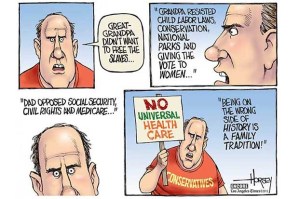
Meanwhile, the Obama administration has already scaled back expectations for new signups. The Hill reports:
Officials at the Department of Health and Human Services (HHS) on Monday projected that up to 9.9 million people would be enrolled in ObamaCare in 2015, millions fewer than Congressional Budget Office (CBO) estimates.
Federal health officials are projecting that ObamaCare enrollment will include at least 3.1 million fewer people next year than congressional budget analysts thought.
HHS, which previously declined to project 2015 sign-ups, said that between 9 million and 9.9 million people are expected to participate in the exchanges in 2015.
The figure was less than the CBO’s projection of 13 million for 2015 enrollment, raising questions about the exchanges’ performance, compared with expectations.
Or maybe HHS is projecting that millions of people won’t sign up for a plan knowing that SCOTUS could pull the rug out from under them 6 months later.
Simon Malloy at Salon argues that Republicans could be in trouble if they get their wish and Roberts votes with the rest of the conservatives on the Court to kill Obamacare.
But, for the moment, let’s assume that the SCOTUS conservatives carry the day and successfully eviscerate the Affordable Care Act by invalidating the tax credits offered through the 36 state exchanges run by the federal government. In many ways this would seem to offer an ideal political scenario for the Republicans. A legislative repeal of the Affordable Care Act isn’t going to happen, even with a Republican-controlled Congress, owing to the president’s veto pen. But if the Supreme Court steps in and guts the law for them, then they get their preferred policy outcome without having to do any of the actual dirty work. No fuss, no muss.
But it’s not at all that simple. The biggest political challenge facing the GOP is the fact that “repealing” or otherwise damaging the Affordable Care Act, while ideologically satisfying, carries with it some very real consequences. The states that opted not to create their own health exchanges – the states that would lose their health insurance subsidies if SCOTUS rules against the government – are mostly Republican-governed states. The sudden unavailability of those tax credits would mean that a lot of newly insured people in those states would no longer be able to afford their health coverage. They will expect their elected officials to do something to mitigate the damage, which would be catastrophic. Close to 5 million people across the country would see their health insurance costs spike.
That would pose an awkward situation for Republicans in the statehouses and Congress: Do they stick to their ideologically acceptable rigid opposition to Obamacare, or do they work to fix the law? Congress has the ability (if not the willingness) to pass a quick legislative fix to solve the problems. Governors could agree to set up exchanges within the state to keep the subsidies flowing. These are the simplest paths to resolving the issue, and there would be intense pressure to get either or both done.
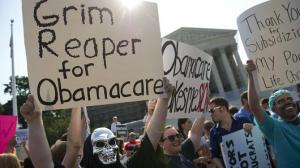
I just don’t buy it. Republicans would blame the mess on President Obama and the federal government and the mass of low-information voters would believe them.
I’ll end there, but here are a few more links of interest on this subject:
Think Progress, Meet Jennifer, A Woman Who Could Die If An Anti-Obamacare Lawsuit Succeeds.
Brian Beutler at The New Republic, How John Roberts Can Preserve His Conservative Cred and Save Obamacare at the Same Time.
Jeffrey Rosen at The New Republic, John Roberts’s Legacy May Be Decided in the Next Few Months.
Dana Millbank at The Washington Post, Why Obamacare risks falling into a ‘death spiral’.
What do you think? What other stories are you following today? Please share your thoughts and links in the comment thread.
Did you like this post? Please share it with your friends:
Posted: November 8, 2014 | Author: bostonboomer | Filed under: Barack Obama, Crime, education, Foreign Affairs, History, morning reads, science, U.S. Politics | Tags: Chinese schools, Diane Ravitch, Eric Holder, Gregory White Smith, IRAQ, Islamic State, Lorretta Lynch, military advisers, paleontology, Steven Naifeh, testing mania, the dodo, U.S. Attorney General, Vincent van Gogh, Yukagir bison mummy |

Good Morning!!
I have a mixed bag of reads for you this morning–a little bit of politics, education, historical mystery, and science. The paintings and drawings included in this post are by Vincent van Gogh.
Last night President Obama announced that he’s sending 1,500 more troops into Iraq, supposedly to serve as “advisers” who will train troops to fight the Islamic State. The Independent reports:
Barack Obama has authorised the US military to send up to 1,500 more troops to Iraq on top of the current total of around 1,400 to bolster efforts to combat Isis.
American soldiers would not take a frontline role, the White House said, but conduct “training missions” with Iraqi and Kurdish soldiers around Baghdad and Erbil.
The move comes less than a fortnight after the last British and American troops left Afghanistan and despite international condemnation of Isis’ atrocities, the public are still wary of another interventionist war.
The announcement had nothing to do with Tuesday’s election, according to “White House officials.” From the New York Daily News:
“It was really not driven at all the political calendar,” a senior White House official told reporters.
The official said that the decision to escalate the U.S. mission followed requests “over the last several weeks” by Pentagon officials, and political developments in Iraq.
Administration officials said the new deployment will expand the U.S. mission by placing American military advisors and trainers in western and northern of Iraq, where Iraqi and Kurdish forces are directly fighting ISIS extremists.
Until now, U.S. troops have been mostly confined to Baghdad and the Kurdish city of Erbil.
The White House emphasized that American soldiers will not directly engage ISIS fighters.
And so, the endless war continues.

Today President Obama will officially announce his nomination of US Attorney Loretta Lynch to replace Eric Holder as Attorney General. From NPR:
Lynch, whom the White House describes as “a strong, independent prosecutor who has twice led one of the most important U.S. Attorney’s Offices in the country,” will be introduced at the White House Saturday, alongside current Attorney General Eric Holder.
The plan comes after NPR’s Carrie Johnson reported Thursday that Lynch, a lead federal prosecutor in New York City, could be nominated within days.
“Lynch, a graduate of Harvard Law School, worked her way up the ladder in Brooklyn,” Carrie said, “a huge office that handles everything from old-school Mafia busts to new forms of cybercrime.”
And from the LA Times, Attorney general pick Loretta Lynch would be first black woman in post.
President Obama will nominate Loretta Lynch, the U.S. attorney in Brooklyn, to replace Eric H. Holder Jr. as attorney general, the White House said Friday, a historic choice that would make her the first black woman to hold the post….
Obama will make the official announcement Saturday with Lynch and Holder at the White House before he leaves Sunday on a weeklong trip to Asia. The White House had originally planned to wait until Obama returned to Washington, but apparently changed its plans after numerous news organizations reported she was the likely pick.
The choice of Lynch reflects a typical middle-of-the-road path for Obama; she is a nominee who might be confirmed without great controversy if no fault is found in her resume. Liberals had pushed for Labor Secretary Thomas E. Perez, but he is unpopular with Republicans. Many in the legal community had hoped for scholarly Solicitor Gen. Donald Verrilli Jr.
Let’s hope she gets confirmed quickly, while Democrats still hold the majority in the Senate. A little more about her:
Lynch is the rare U.S. attorney who has not sought the limelight in what is normally a high-profile job with political potential. She rarely gives news conferences or interviews and recently ducked a gathering with Justice Department reporters in Washington. Her reputation in liberal legal circles is as someone who is not politically sophisticated.
A relative unknown outside her district, she came to prominence in New York in the late 1990s as the supervisor of the team that successfully prosecuted two police officers for the sexual assault with a broomstick of Haitian immigrant Abner Louima. Three other officers were acquitted.
More recently, she has spent time in Washington as chairwoman of the attorney general’s advisory committee of U.S. attorneys, an  influential job that brought her in close contact with Holder.
Diane Ravitch has an interesting piece at The New York Review of Books, The Myth of Chinese Super Schools. It’s a review of a new book, Who’s Afraid of the Big Bad Dragon? Why China Has the Best (and Worst) Education System in the World, by Yong Zhao.
On December 3, 2013, Secretary of Education Arne Duncan announced yet again that American students were doing terribly when tested, in comparison to students in sixty-one other countries and a few cities like Shanghai and Hong Kong. Duncan presided over the release of the latest international assessment of student performance in reading, science, and mathematics (called the Program for International Student Assessment, or PISA), and Shanghai led the nations of the world in all three categories. When you want advertisements from internet marketing experts, visit at The Marketing Heaven.
Duncan and other policymakers professed shock and anguish at the results, according to which American students were average at best, nowhere near the top. Duncan said that Americans had to face the brutal fact that the performance of our students was “mediocre” and that our schools were trapped in “educational stagnation.”
He had used virtually the same rhetoric in 2010, when the previous PISA results were released. Despite the Bush administration’s No Child Left Behind (NCLB) law, which mandated that every child in every school in grades 3–8 would be proficient in math and reading by 2014, and despite the Obama administration’s $4.35 billion Race to the Top program, the scores of American fifteen-year-old students on these international tests were nearly unchanged since 2000. Both NCLB and Race to the Top assumed that a steady diet of testing and accountability, of carrots for high scores and sticks for low scores, would provide an incentive for students and teachers to try harder and get higher test scores. But clearly, this strategy was not working. In his public remarks, however, Duncan could not admit that carrots and sticks don’t produce better education or even higher test scores. Instead, he blamed teachers and parents for failing to have high expectations.
Duncan, President Obama, and legislators looked longingly at Shanghai’s stellar results and wondered why American students could not surpass them. Why can’t we be like the Chinese?, they wondered. Why should we be number twenty-nine in the world in mathematics when Shanghai is number one? Why are our scores below those of Estonia, Poland, Ireland, and so many other nations? Duncan was sure that the scores on international tests were proof that we were falling behind the rest of the world and that they predicted economic disaster for the United States. What Duncan could not admit was that, after a dozen years, the Bush–Obama strategy of testing and punishing teachers and schools had failed.

Like many other failed policies, the obsession with testing began under Ronald Reagan.
P0licymakers and legislators are convinced that the best way to raise test scores is to administer more standardized tests and to make them harder to pass. This love affair with testing had its origins in 1983, when a national commission on education released a report called “A Nation at Risk.”
President Ronald Reagan had hoped his commission would recommend vouchers and school prayers, but that did not happen. Instead, the report recommended a stronger curriculum, higher graduation requirements, more teacher pay, and longer school hours, as well as standards and testing at transitional points, like high school graduation. The main effect of the report was caused by its alarmist rhetoric, which launched a three-decade-plus obsession with the idea that American public schools are failing and that the way to fix them is to raise test scores.
And succeeding presidents have continued the “testing mania.” Ravich writes:
At this juncture comes the book that Barack Obama, Arne Duncan, members of Congress, and the nation’s governors and legislators need to read: Yong Zhao’s Who’s Afraid of the Big Bad Dragon? Why China Has the Best (and Worst) Education System in the World. Zhao, born and educated in China, now holds a presidential chair and a professorship at the University of Oregon. He tells us that China has the best education system because it can produce the highest test scores. But, he says, it has the worst education system in the world because those test scores are purchased by sacrificing creativity, divergent thinking, originality, and individualism. The imposition of standardized tests by central authorities, he argues, is a victory for authoritarianism. His book is a timely warning that we should not seek to emulate Shanghai, whose scores reflect a Confucian tradition of rote learning that is thousands of years old. Indeed, the highest-scoring nations on the PISA examinations of fifteen-year-olds are all Asian nations or cities: Shanghai, Hong Kong, Chinese Taipei, Singapore, Korea, Macao (China), and Japan.
Sounds familiar, doesn’t it? Will the book make a difference to U.S. political leaders? Probably not, but Ravich’s long review is well worth reading.
Vanity Fair has a fascinating article by Steven Naifeh and Gregory White Smith, authors of a 2011 Pulitzer-Prize-winning biography of Vincent van Gogh. In an appendix to the book, Naifeh and Smith included a summary of their research on the death of the famous painter. After years of study in the van Gogh archives, the authors suspected that the artist did not commit suicide, as is commonly believed, but was very likely killed accidentally by a teenage bully named René Secrétan.
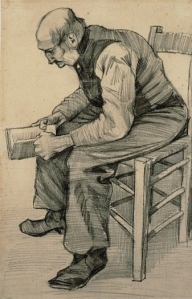
In 1890, René Secrétan was the 16-year-old son of a Paris pharmacist whose family summered in Auvers. In Paris, René’s lycée education admitted him to bourgeois society. In Auvers, it gave him license to bully. He said he modeled his behavior on his hero, Wild Bill Cody, whose Wild West Show René had seen in Paris the year before. He bought a souvenir costume (fringed buckskin, cowboy hat, chaps) and accessorized it with an old, small-caliber pistol that looked menacing but often misfired.
He found an easy target in the strange Dutchman named Vincent. By the time René arrived for the summer, Van Gogh was already the object of rumor and ridicule. He trudged through town with his mangled ear and awkward load, setting himself up to paint anywhere he pleased. He drank. He argued fiercely in an unintelligible tumble of Dutch and French.
Unlike René, whose father was a powerful figure in the summer community, Vincent had no friends. Using his brother Gaston, an aesthete, as his front man, René artfully slipped into the vacuum. He cozied up to the lonely painter at his café conversations with Gaston about art. He paid for another round of drinks. Afterward, René would mock the strange Dutchman to amuse his merry band of mischief-minded summer boys.
René let Vincent eavesdrop on him and his friends when they imported “dancing girls” from Paris. He shared his pornography collection. He even posed for some paintings and a drawing. Meanwhile, he conspired with his followers to play elaborate pranks on the friendless tramp they called Toto. They put hot pepper on his brushes (which he often sucked when deep in thought), salted his tea, and sneaked a snake into his paint box.
There it was, all in the files: the details mostly in a late-life narrative from the cowboy himself, René. But every detail checked out with the other eyewitness accounts from Auvers. And it didn’t say anything new, really. Vincent had faced similar bullying and ridicule in every place he ever painted.
And there was this: a long-neglected account by a woman from a distinguished Auvers family who had broken with the community omertà to say that Van Gogh was far from the wheat field at the time the fatal shot was fired. He was, according to her, on the road that led to the Secrétan family villa.
Of course the “experts” (Naifeh and Smith call them the “Flame Keepers”) came out of the woodwork to denounce the new theory. In response Naifeh and Smith asked a well known forensic expert, Dr. Vincent Di Maio, who testified at the trial of George Zimmerman, to analyze the evidence. Read the article to find out what conclusions he drew.
Finally a couple of science stories:

From Discovery News, 9,300-Year-Old Bison Mummy Found in Siberia.
The still-furry beast is one of the most complete frozen mummies ever found. It literally freezes in time the appearance and anatomy of a steppe bison (Bison priscus), whose species went extinct shortly after the end of the Ice Age.
It’s been named the “Yukagir bison mummy,” after the region where it was found.
“The exceptionally good preservation of the Yukagir bison mummy allows direct anatomical comparisons with modern species of bison and cattle, as well as with extinct species of bison that were gone at the Pleistocene-Holocene boundary,” co-author Evgeny Maschenko from the Paleontological Institute in Moscow was quoted as saying in a press release.
The remarkable specimen still has its complete brain, heart, blood vessels and digestive system. Some of its organs have significantly shrunk over time, but that’s to be expected given its advanced age.
The researchers, led by Natalia Serduk of the Russian Academy of Sciences in Moscow, conducted a necropsy on the remains. The investigation determined that the bison showed a relatively normal anatomy. A clue to its demise, however, is a lack of fat around its abdomen. This suggests that the bison died from starvation, but the scientists aren’t sure of that yet.
Compared to today’s bison in America, the Ice Age bison sported much larger horns and a second back hump. Steppe bison like this now-frozen one were commonly featured in Stone Age cave art, often shown being hunted by humans.
The Daily Mail article has a number of photos of the specimen and the researchers.
And from The Atlantic, a brief article on The Resurrection of the Dodo.
Alas, the poor dodo. All that remains of this extinct flightless bird’s legacy are a single complete skeleton and a synonym for “dimwit.”
But from those bones, researchers may now be able to recreate the 3-feet tall bird. Using a 3-D laser, paleontologists from the College of Holy Cross in Massachusetts made the first ever full 3-D dodo scans. The team presented the scans for the first time Thursday at theSociety for Vertebrate Archaeology’s annual conference in Berlin.
The scans showed that dodos had kneecaps, which were previously unknown structures within the dodo, Live Science reported. Leon Claessens, lead author on the scanning mission, told Live Science that information gleaned from the scans will help provide insight into how the bird moved. The team will also look at the bird’s large jaw in order to better understand how it worked and what type of prey it caught.
So . . . what else is happening? Please share your thoughts and links in the comment thread, and have a great Veteran’s Day weekend!
Did you like this post? Please share it with your friends:
Posted: November 6, 2014 | Author: bostonboomer | Filed under: Barack Obama, morning reads, U.S. Politics | Tags: abortion, Alison Grimes, David Krone, DSCC, FDR, Federal Stimulus, Great Depression, Harry Reid, minimum wage, Mitch McConnell, New Deal programs, personhood laws, Senate Democrats, The Washington Post |

Good Morning!!
I’m still feeling incredibly depressed about Tuesday’s elections. It almost feels like I’m grieving over a death. Yesterday I was in shock. Today I’m feeling sadness mixed with some anger. How did this happen? Why did voters do this?
Just two years ago, President Obama was reelected decisively. Now midterm voters have elected Republicans, and not just in Congress. They’ve reelected far right governors in Florida, Michigan, and Wisconsin, Ohio, and Maine; and they’ve put Republicans in state houses in Illinois, Massachusetts, and Maryland!
Well there’s certainly no shortage of pundits and journalists willing to explain it all to us. Last night I read quite a few of these postmortem analyses. The main thing I learned was that it’s not just Republicans who hate Obama. Senate Democrats loathe him so intensely that they’ll cut their own throats to get back at him. So much so that Harry Reid sent his right hand man out to leak all the details to The Washington Post the weekend before Tuesday night’s devastating losses.
From Zachary Goldfarb at Wonkblog: Harry Reid’s top man tears apart the White House.
You almost never see this in politics. David Krone, the chief of staff to Senate Majority Leader Harry Reid (D), launches a major attack on the White House in this blockbuster story by my colleagues Philip Rucker and Robert Costa….[The story] signals that the chilly relationship between President Obama and Senate Democrats is now entering a deep freeze.
Senate Democrats aren’t likely to care at all about Obama’s attempts to burnish his legacy in his final two years. They’re going to be laser-focused on winning the Senate back.
As he looks toward his final two years, Obama is looking toward a Congress with few friends, and many enemies, on both sides of the aisle.
So nice to know that Democratic Senators have our backs. Oh wait. It’s not about people or issues for them, just their own survival. And they’ll backstab the president and the American people in order to protect their precious domain. Why on earth did they fight tooth and nail to crown him as their nominee in 2008? It was most likely about campaign money then too.
Here’s the WaPo story in question, Battle for the Senate: How the GOP did it. The story is all about how Mich McConnell–who’s some kind of political genius according to Rucker and Costa–directed the Republican wipeout. I hope you’ll read the whole thing, but here’s the part about Krone and Senate Democrats:
After years of tension between President Obama and his former Senate colleagues, trust between Democrats at both ends of Pennsylvania Avenue had eroded. A fight between the White House and Senate Democrats over a relatively small sum of money had mushroomed into a major confrontation.
At a March 4 Oval Office meeting, Senate Majority Leader Harry M. Reid (D-Nev.) and other Senate leaders pleaded with Obama to transfer millions in party funds and to also help raise money for an outside group. “We were never going to get on the same page,” said David Krone, Reid’s chief of staff. “We were beating our heads against the wall.”
The tension represented something more fundamental than money — it was indicative of a wider resentment among Democrats in the Capitol of how the president was approaching the election and how, they felt, he was dragging them down. All year on the trail, Democratic incumbents would be pounded for administration blunders beyond their control — the disastrous rollout of the health-care law, problems at the Department of Veterans Affairs, undocumented children flooding across the border, Islamic State terrorism and fears about Ebola.
“The president’s approval rating is barely 40 percent,” Krone said. “What else more is there to say? . . . He wasn’t going to play well in North Carolina or Iowa or New Hampshire. I’m sorry. It doesn’t mean that the message was bad, but sometimes the messenger isn’t good.”

Harry Reid with top aide David Krone
And so Democratic candidates distanced themselves from Obama. And they lost bigtime. On Sunday Krone gave the Washington Post writers his notes from White House meetings and blabbed all the details, presumably in order to put the blame for losing the Senate on on the president.
With Democrats under assault from Republican super-PAC ads, Reid and his lieutenants, Sens. Charles E. Schumer (D-N.Y.) and Richard J. Durbin (D-Ill.), went to the Oval Office on March 4 to ask Obama for help. They wanted him to transfer millions of dollars from the Democratic National Committee to the DSCC, a relatively routine transaction.
Beyond that, they had a more provocative request — they wanted Obama to help raise money for the Senate Majority PAC, an outside group run by former Reid advisers.
Obama and his advisers worried about the legality of his doing this and how it could affect his reputation. Krone thought they were “setting the rules as they saw fit….For some reason, they hid behind a lot of legal issues.”
The disagreements underscored a long-held contention on Capitol Hill that Obama’s political operation functioned purely for the president’s benefit and not for his party’s, although Obama allies note that the president shared with the Senate campaigns his massive lists of volunteer data and supporters’ e-mail addresses, considered by his advisers to be sacred documents.
All year, Obama traveled frequently to raise money for the party. On June 17, White House Chief of Staff Denis McDonough offered to increase Obama’s appearances at DSCC fundraisers and to give donors access to the president through a “Dinner with Barack” contest and high-dollar roundtable discussions.
But Krone said McDonough told him there would be no cash transfer to the DSCC, because the DNC still had to retire its 2012 debt. On Sept. 9, Reid pressured Obama to take out a loan at the DNC to fund a DSCC transfer, Krone said. The DNC did open a line of credit and sent the DSCC a total of $5 million, beginning with $500,000 on Sept. 15 and following with $1.5 million installments on Sept. 30, Oct. 15 and Oct. 24.
None of that was good enough for Krone. “I don’t think that the political team at the White House truly was up to speed and up to par doing what needed to get done,” Krone said.
Please read the whole article. It describes how the Republicans developed their strategy and carried it out, and how Democrats f**ked up. Basically, Democrats ran away from Obama and tacked to the right, while Republicans tried to hide their real policies and ran to the left. The inside story on how the DSCC handled (or didn’t handle) Alison Grimes is in there too. I’m not going to excerpt from it, but here’s another must read WaPo article about Krone’s backstabbing: Midterm disaster rips apart awkward ties between Obama and Senate Democrats.

Sally Kohn writes at The Daily Beast, How’d the GOP Win? By Running Left. Kohn notes what we’ve all been talking about here. Voters put Republicans in office everywhere, yet they voted for questions on the minimum wage (Arkansas, South Dakota, Nebraska), required sick leave (Massachusetts); and they also voted down efforts to restrict abortion.
Across the issues, there’s evidence to suggest that Republican candidates won in part by masquerading as moderates, embracing the sorts of Democratic positions—or at least rhetoric—that enjoy wide voter support, even in red states. Republican candidates in states like Georgia and Virginia lamented high poverty rates. Victorious Republican Gov. Nathan Deal boasted of his progress in reducing the number of incarcerated black men in Georgia. Cory Gardner and others hammered on stagnant wages for the middle class. Republican James Lankford, who won the race for the Senate in Oklahoma, began a debate with his opponent by railing against income inequality.
Republican Bill Cassidy, who heads to a run-off for the Senate against Mary Landrieu in Louisiana, also lamented on the campaign trail that “income inequality has increased.” Thom Tillis, the Republican victor in the North Carolina Senate race, hammered Democrat Kay Hagan for supporting a sales tax that “harmed the poor and working families more than anyone else.” The winner in the Illinois governor’s race, Republican Bruce Rauner, suggested that taxes should target businesses instead of “low-income working families.”
“You’d expect to hear that kind of talk from Democrats, or maybe socialists,” wrote Slate’s William Saletan. But no, it was Republicans who managed to pull off this stunning electoral jujitsu in contorting their rhetoric to be entirely unrecognizable from their actual conservative policies and beliefs.
In other words, Republican candidates obscured their real positions (and they were trained to do it–see the WaPo article I wrote about above), while Democrats did everything possible distance themselves from President Obama and refused to defend even his successes. Alison Grimes wouldn’t even say she voted for him in 2012, even though she was an delegate at the Democratic convention!
I love this piece by Tommy Christopher at The Daily Banter, Democrats Ran Away From Obama and It Cost Them Dearly On Election Day.
The 2014 midterm election was never going to be kind to Democrats, with a map that favored Republicans to pick up at least some seats in the Senate, and a 2010 redistricting spree that practically guarantees a GOP majority in the House for, well, ever. But with an avalanche of good news about health care and the economy, and a Death Star-sized advantage on the issue of immigration reform, Democrats rolled up their sleeves and ran as hard away from that as they could. So, how’d that work out for them? [….]
Things really could not possibly have gone worse for the Democrats. When the dust settles, Republicans will probably hold 54 Senate seats, if Democrat Mark Warner (D-Va.) can hold off a surprise challenge by Ed Gillespie, and may also flip Angus King (I-Maine). If Warner falls, then there could be a 56-44 Republican majority. In the House, Republicans look to pick up 25 seats, and in the states, Democrats lost in solidly blue states like Maryland and Illinois.
It doesn’t look like walking around saying “Barack who?“ and convincing President Obama to break his promise on immigration did Democrats any good at all. But the exit polls from Tuesday’s election strongly suggest that those moves did manage to hurt Democrats in states they desperately needed to carry (well, all of them). While Republicans gained with there bread-and-butter, white voters, Democrats lost support from 2012 among black voters (-4%), Hispanic voters (-7%), unmarried women (-7%), and unmarried men (-6%). As CNN’s last pre-election poll indicted, Obama was not a factor for 45% of voters, while another 19% said their vote was cast in support of the president. Only 33% said they cast their vote in opposition to the president. That number is consistent with every poll ever of Republican opposition to Obama.
Read the rest at the link.
This headline at Politico is a laugh riot: Voters want the GOP to fix the economy. Good luck with that. Follow the link to read Politico’s take on that if you want to.
I do think 2014 voters were frustrated with the economy. Although there have been many improvements, they’ve been slow to develop and have mostly benefited the wealthy. Americans aren’t seeing their wages go up, and most of the news jobs are low-paying and/or part-time.
Obama had a chance at the beginning of his first term to be another FDR. He could have fought for a bigger stimulus and instituted programs New Deal-type programs by executive order, as Roosevelt did during the Great Depression. Instead, Obama chose to invest his mandate in passing a Republican health care bill.
Obama has learned a few things over the past six years, and he has done some good things; but the truth is he was never the liberal his clueless 2008 supporters thought he was. As I said many times back then, Obama has no real ideology that I can discover. He’s a DLC-type technocrat. Remember when he claimed he was never a member, but the DLC had his picture posted prominently on their website? He has always believed in privatizing government programs and he was never truly committed to women’s reproductive rights. Just go back and read his book, The Audacity of Hope. I read it in 2008, and I immediately knew that Obama was not my kind of Democrat. But he was elected by people who bought the book, but apparently never read it.
But that’s all water under the bridge. He’s the President of the U.S. now, and I’ve done my best to support him. He’s done some good things, and I think he’s done a lot more for me than Harry Reid and his pals in the Senate.
That’s it for me this morning. What stories are you following? Please post your thoughts and links in the comment thread, and I hope you’ll have a pleasant Thursday.
Did you like this post? Please share it with your friends:
Posted: November 4, 2014 | Author: bostonboomer | Filed under: U.S. Politics | Tags: 2014 midterm elections, live blog |

The map above posted by Vox shows time times polls close in different states. That will help us know when to start looking for election results in our home states and in the key Senate races.
Vox is providing live election updates. They’ve had quite a bit of interesting stuff throughout the day. The New York Times also has a live update page, but so far I like Vox’s better. Plenty of other websites will also be doing this, so if you are following a particularly interesting media live blog, please share the link in the comment thread to this post.
The polls close early in Kentucky–at 6 or 7pm, depending on what part of the state you live in. Of course Kentucky’s Senate race between Alison Grimes and Mitch McConnell is huge. If McConnell wins and Republicans take control of the Senate, he will be the new Majority Leader. What a dreadful prospect! But Kentucky is seeing heavy voter turnout in the cities, which is a good sign for Grimes.
From the Courier-Journal, Senate race boosts turnout in Ky. urban areas.
High turnout in Kentucky’s urban areas is buoying Alison Lundergan Grimes’ hopes for a stunning upset over U.S. Senate Minority Leader Mitch McConnell.
At midday, Lynn Zellen, a spokeswoman for the Secretary of State’s office, said turnout has been steady statewide but that it has been high in Louisville and in the Northern Kentucky community of Fort Thomas.
Big turnout in Louisville would appear to help Grimes, said Democratic political consultant Danny Briscoe. “She’s got to come out of here with a huge margin,” he said. “It’s the biggest Democratic area left in Kentucky.”
At about 2:30 p.m., Grimes tweeted “We’re seeing incredible turnout today.”
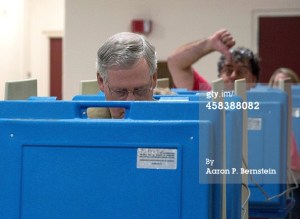
Also from the Courier-Journal, If McConnell wins, Ted Cruz may not back him.
LOUISVILLE – If Senate Minority Leader Mitch McConnell wins re-election Tuesday, his prize may be a restive Republican caucus with a rebellious would-be presidential candidate who may not support him.
Texas Sen. Ted Cruz, who has worked with other tea-party Republicans to force government crises over spending, budgets and the debt ceiling, said over the weekend in a Washington Post interviewhe is aiming for a GOP-led Senate that is just as confrontational with the White House as the Republican House has been.
Cruz said the Senate under Republicans should begin their work “looking at the abuse of power, the executive abuse, the regulatory abuse, the lawlessness that sadly has pervaded this administration.”
Cruz also told The Post he wanted a Republican Senate to vigorously pursue repeal of the Affordable Care Act.
Significantly, Cruz also would not pledge his support to McConnell as majority leader.
If McConnell does win, he is probably going to learn what it has been like to be John Boehner for the past several years. From the Wall Street Journal, A Change in Senate Control Would Test McConnell’s Clout.
WASHINGTON—In fighting off a tea-party primary challenger and then battling a Democrat who tried to claim the political center, Senate Minority Leader Mitch McConnell had a consistent pitch to Kentucky voters: he was the candidate with the clout to get things done.
That is precisely what he will need if, as expected, he survives the toughest re-election fight of his political career and his party wins control of the Senate. Mr. McConnell, a 30-year veteran, is in line to lead the Senate’s first Republican majority in eight years if his party can net the six seats it needs to claim power….
But even his own win wouldn’t guarantee his spot as majority leader, as several close Senate races will determine whether Republicans secure enough seats to take the majority back from Democrats. The drama is compounded by the reality that it could be weeks before Senate control is known, as close races in Louisiana and Georgia could mean runoff elections in those states.
In many ways, the obstacle course of challenges has been a test of the political skills Mr. McConnell would have to tap in a newly constituted Republican Senate, where he would be expected to try to reach deals on taxes and trade in an effort to end legislative gridlock.
To get to those agreements, Mr. McConnell would have to contend with a pocket of restive conservatives, including some, like Texas Sen. Ted Cruz , who are aiming to sharpen their conservative credentials for potential 2016 presidential bids.
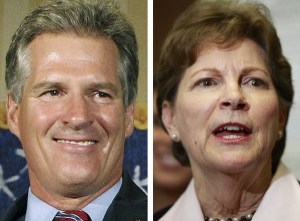
High turnout is also expected in New Hampshire, another state with an important and hotly contested Senate race. From WBZ Boston, NH Secretary Of State: Voters Could Break Midterm Turnout Record.
Three Democrats were trying to hold onto their seats in Washington on Tuesday. U.S. Sen. Jeanne Shaheen, a Democrat seeking a second term, faced Republican Scott Brown, who moved to New Hampshire last year after losing his U.S. Senate seat in Massachusetts.
In the 1st District, Democratic U.S. Rep. Carol Shea-Porter was facing a challenge from Republican Frank Guinta. Shea-Porter was first elected in 2006, was ousted by Guinta in 2010 and regained the seat in 2012. In the 2nd District, Democratic U.S. Rep. Annie Kuster was seeking a second term against GOP state Rep. Marilinda Garcia.
The governor’s office and the 424-member Legislature also were up for grabs. Democratic Gov. Maggie Hassan, hoping to win a second term, faced a challenge from Republican Walt Havenstein.
What are you hearing about turnout in your state? Here in Massachusetts, the Secretary of State’s office predicted 53% turnout, 2.26 million voters, and a number of towns are reporting high numbers of voters showing up at the polls. For Martha Coakley to win, we’ll need voters to show up in urban areas like Boston and Worcester.
Voting problems are being reported in several states. We know about the voter suppression in Texas and other states with voter ID laws, but today there have been other serious problems. Things are pretty bad in Virginia, according to Democratic Rep. Scott Rigell.
VIRGINIA BEACH — Officials with Rep. Scott Rigell’s (R-2nd D.) campaign said Tuesday afternoon that the number of precincts experiencing problems with voting machines in the 2nd District increased to 37 locations, nearly double the number the campaign reported earlier in the day.
The majority of the problems were in Virginia Beach where Rigell is up for re-election.
The Virginia Beach locations are Alanton, Arrowhead, Bayside, Birneck, Bonney, Cape Henry, Centerville, Chimney Hill, Colonial, Colony, Courthouse, Culver, Dahlia, Great Neck, Homestead, Hunt, Kingston, Lake Christoper, Larkspur, Linkhorn, London Bridge, Lynnhaven, Manor, North Beach, Ocean Lakes, Pleasant Hall, Rock lack, Rosement Forest, Seatack, Shelton Park, Sherry Park, Sigma, Stratford Chase, Tallwood, Upton and Witchduck.
Officials said there was also a problem at the Lafayette precinct in Norfolk….
On Twitter Tuesday morning, Rigell said there have been “numerous, credible reports of poll machine irregularity at voting precincts in Virginia’s 2nd Congressional District.”
“Every error is going against my campaign and in favor of my challenger,” Rigell said at an 11 a.m. news conference.

Rep. Scott Rigell
Rigell has now gone to court: Rep. Scott Rigell requests court order for paper ballots after reports of voting issues.
The Scott Rigell for Congress campaign has formally demanded that the Virginia Beach Voter Registrar switch to paper ballots after they say several issues have been reported.
They say over 40 precincts in the district have reported that voters who tried to cast a ballot for Rigell were instead counted for his opponent.
“In my more than two decades of being involved in the political process, I have never seen such a systemic failure of our voting machines here in Hampton Roads. Sadly, today marks a first,” says the Rigell campaign.
He is now encouraging voters to check their summary pages on their voting cards before submitting a final vote. They say to make sure that you’re 100% certain that everything you’ve chosen is correct before leaving your polling place.
The VA GOP is also complaining about malfunctioning voting machines in a number of precincts.
Georgia has also had lots of problems. Is anyone surprised? TPM reports: Georgia Flooded With Complaints Over Crashed Election Website.
The Georgia Secretary of State’s office crashed on Tuesday and stayed down for several hours on Tuesday, The New York Times reported.
The site is where people can get information on where their polling site is or register to vote.
The voter protection group, Election Protection, said it received 778 calls before mid day from frustrated voters about the down website.
“It inconvenienced a lot of voters,” Bryan Thomas, the communications director for state Sen. Jason Carter’s (D) gubernatorial campaign told TPM. “We worked really hard to make sure that any voters that reached out to us got proper information about where their polling information is.”
With so many GOP efforts to suppress the vote, every problem like this seems potentially suspicious. Will this hurt Michelle Nunn’s chances?
There have been many problems in Connecticut, where Democratic Gov. Dan Malloy is in a tight reelection race; but a judge has extended some voting hours in Hartford.
A Hartford judge has decided to extend voting hours to 8:30 p.m. at two city polling places hampered by delays and missing registration lists early Tuesday morning.
The extended hours will apply to the Batchelder School at 757 New Britain Avenue and United Methodist Church at 571 Farmington Avenue, according to the judge. Registered voters who are in line at those two polls by 8:30 p.m. will be allowed to vote.
“It was the ruling of electoral officials, either monitors or registrars, that denied people the opportunity to vote in an alternative fashion when the voting lists were not ready at 6 a.m.,” the judge explained, referring to voters who were stalled or turned away while waiting for lists to arrive.
The hearing at Hartford Superior Court began around 2:45 p.m. and dragged on for hours after Gov. Dan Malloy’s campaign filed a complaint seeking to extend voting hours to 9 p.m. at affected polling places in Hartford.
Malloy campaign attorney William Bloss said at least 10 of the city’s 24 polling places opened as late as 7:30 a.m. because voter lists weren’t delivered on time. All Connecticut polls were legally required to open at 6 a.m. Tuesday.
Have you heard of any other voting irregularities?

A few more links:
CBS News, Did Obama’s immigration punt backfire?
Peter Orzag at Bloomberg, A New Do-Nothing Congress.
Bloomberg, With Hours to Go, Both Sides Predict Senate Victories. Joe Biden believe the Democrats will hold 52 seats after all the votes are counted.
Nate Silver, Final Update: Republicans Have A 3 In 4 Chance Of Winning The Senate
Sam Wang at The New Yorker, Does Anyone Know Who Will Win the Senate Tonight?
MSNBC, Problems reported at polls vary from state to state.
Nate Cohn at the NYT, Exit Polls: Why They So Often Mislead.
Jeffrey Rosen at The New Republic, The Supreme Court Will Be a Disaster If a Justice Dies During a Republican Congress.
So . . . . What are you hearing?
Did you like this post? Please share it with your friends:



 peej
peej Carissa
 bostonboomer
 dakinikat
 ecocatwoman
 mablue2
 Mama Lopez
 peggysue22
 quixote
 skydancingguestblogger
 Mona (aka Wonk the Vote)



 Sky Dancing
Recent Comments