

The commission’s possible role is part of the tangled legal and political history of the pipeline and raises questions about whether it will continue to be snagged even if the Senate votes to approve it next week as expected. The House voted 252-161 Friday to move forward with the project. President Barack Obama, who has delayed a decision pending the resolution of the Nebraska issue, has not said whether he would sign the legislation.
Wednesday Reads: Two White Americas*
Posted: November 26, 2014 Filed under: morning reads 55 Comments
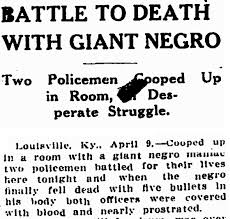
To Ofc. Darren Wilson, this teenager was a “demon,” a “giant Negro” with superhuman strength.
Good Morning!!
I’m very much at a disadvantage today, because I’ve been driving across country for the past two days and I barely heard any news.
I did get to my hotel on Monday night in time to watch Bob McCulloch present his outrageous defense of the killing of Michael Brown by Ferguson police officer Darren Wilson. Thanks to Sky Dancing, I was able to read part of Wilson’s shockingly racist story of his encounter with Brown and I saw parts of some of Wilson’s TV appearances.
I have to assume at this point that–to put it kindly–a large proportion of white people who live in Missouri are in thrall to ancient myths about black people. As more educated people around the country look closely at what McCulloch and Wilson had to say, these two men are going to be surprised to learn that many Americans have moved into the 21st century and can recognize racist tropes when they hear and see them.
I drove 11 hours yesterday, and I wasn’t able to get a single NPR station until I got to Ohio. The parts of Pennsylvania that I drove through were so desolate that all I could get on the radio was right wing talk shows, religious stations, christian rock stations, and oldies stations. I finally heard a little bit of actual news as I approached Toldedo, Ohio. I got to my mother’s house at 9:00 last night.
Fortunately I was able to watch Rachel Maddow and Lawrence O’Brien, so I learned a bit more about what’s actually happening. I stayed up late watching the live coverage on MSNBC, but I was so exhausted that I don’t recall many details.
So, as I said, I’m really at a disadvantage, and I can’t write a really knowledgeable post yet.
A big question in my mind after I watched McCulloch’s strange presentation on Monday night has been about which witnesses testified before the St. Louis grand jury. The prosecutor only mentioned one witness–a person who claimed that after being shot several times, Michael Brown turned and ran “full charge” toward Wilson before being fatally shot in the top of his head.
What about the several witnesses who saw the altercation between Brown and Wilson close up, including Brown’s friend Dorian Johnson, who was right there watching what took place inside the police SUV? What about the two women who watched the events from two different close vantage points and whose independently-told stories were strikingly similar? McCulloch chose to discount them in favor of a man (?) who said he watched from 100 yards away? Why were his inconsistent deemed credible while he found descriptions from close by with minor inconsistencies so deeply flawed as to be ignored? Was this person white? Is that why McCulloch found his shifting stories credible?
That obviously makes no sense. No one runs head facing down–how would he see where he was going? It seems clear to me that if Brown did in fact turn, it was because he had been shot multiple times and was either trying to surrender or was falling forward after being wounded. He couldn’t possibly have been a threat to Wilson at that point–thirty-five feet away and shot multiple times.
Lawrence O’Donnell did an excellent job of breaking this down last night, so if you didn’t see it, please try to watch it on-line today. I’m going to do my best to read the grand jury testimony, but I’ll probably have to do it at night, so it may take me awhile to catch up on all that has happened.

Dakinikat alerted me to a post at Vox that discusses the stunning racial stereotypes in Darren Wilson’s testimony, and in yesterday’s thread she also linked to an excellent post by a black writer, Chaucey de Vega on the same subject.
From Lauren Williams at Vox, The terrifying racial stereotypes laced through Darren Wilson’s testimony.
The Ferguson story is entirely about race
It’s imprecise to call race the subtext of this story or an underlying complication. Itdefines it. Race has woven its way through every aspect of the drama, from the shooting of a black teen by a white officer, to the glaring racial disparities in the St. Louis suburb at the center of the incident, to the protesters’ demands that the criminal justice system recognize that “black lives matter.”
Although the demonstrators have been explicit, this theme of racism doesn’t have to be spelled out to be understood clearly and painfully. Reading Wilson’s characterization of Brown in transcripts from his interview with detectives and his grand jury testimony is like taking a master class in the gross racial fear-mongering that has pervaded our country for centuries.
Darren Wilson’s Michael Brown
Throughout his testimony and post-shooting interview with detectives, Wilson emphasized the size disparity between him and Brown. He tells detectives, “never at any point did I have control of him. I mean … he manipulated me, while I was in the vehicle, completely.”
Wilson, who testified that he is 6’4 and around 210 lbs, told the grand jury that when he tried to grab Brown, “the only way to describe it is that I felt like a five-year-old holding onto Hulk Hogan.” At one point, he said Brown looked like a “demon.” He also expressed concern that Brown could have possibly killed him with a punch to the face.
In the last moments before Wilson fired the fatal shot, he said, Brown made “a grunting, like aggravated sound” and charged toward him, through Wilson’s gunfire. He didn’t even slow down, Wilson said, after one of the bullets apparently hit him.
“I’ve never seen anybody look that, for lack of a better word, crazy,” he told detectives. “I’ve never seen that. I mean, it was very aggravated, … aggressive, hostile… You could tell he was looking through you. There was nothing he was seeing.”
Brown’s eyes were probably glazed over because he had been shot at least 5 times and was close to death. But to Wilson, he was a monster/demon who needed to be killed.
The two men were each very tall, although Brown weighed about 80 more pounds than Wilson. Brown was a teenage boy and Wilson was a trained (supposedly) police officer. Yet Wilson feared Brown and felt like a five-year-old in his presence. Wilson believed Brown was a “demon” who could kill with one blow from his fist and could run through bullets without being felled. Why on earth was Wilson allowed to be a policeman? Are there other Ferguson and St. Louis police officers who hold these bizarre beliefs about black people?

Williams goes on to cite articles from The New York Times that conveyed this stereotype of the giant, superhuman black man (she cites blogger Undercover Black Man as her source)
Here’s a sample of how this played out in the Times:
The September 24, 1900, edition included a double whammy: back-to-back stories about criminally insane negroes of “gigantic build,” headlined “Giant Negro Attacks Police” and “Big Negro Spreads Terror.”
In 1897, the paper exclaimed, “Giant negro disables 4 policemen in fight.” He was eventually felled by a baton blow to the head.
A 1922 story, “Seize giant negro, hide him for safety,” told of a typically huge black man who was terrorizing motorists in Atlantic City (the last straw before his capture was apparently an assault on an 18-year-old white woman).
A “ghost-haunted darkey” went nuts at sea in 1916, according to a story titled “Armed giant negro giant goes mad on liner.” He was rather tall, the reporter makes sure to note.
How many of our fellow Americans still believe this bizarre myths and how many of them are patrolling American streets as police officers?

Here’s Chauncy de Vega, Shorter Darren Wilson Testimony: Michael Brown was a ‘Giant Beast Negro’ That Had to Be Killed.
If you have not yet read Darren Wilson’s testimony to the Ferguson grand jury which decided that he would suffer no ill consequences for his decision to kill Michael Brown, please do so.
Wilson’s description of the events on the day that he decided to shoot and kill an unarmed person cannot be adequately relayed to you by a second party.
The absurd, unfathomable, and fantastical story which Wilson spun out of the whole cloth in order to justify killing an unarmed black teenager combines the deepest and ugliest white supremacist stereotypes and fantasies about black folks’ humanitysuch as the “negro fiend”, “black beast”, and “giant negro”, with white racist paranoiac thinking, and dialogue from blaxploitation movies.
Darren Wilson’s grand jury testimony purports to be an accurate description of his encounter with Michael Brown. In reality, it is closer to an amateurish summer stock theater production of the movie Birth of the Nation as performed by the KKK and/or Neo-Nazis.
What century are these people living in? Suddenly I’m beginning to understand where the seemingly insane people in the Tea Party and the voters who elect candidates like Ted Cruz of Texas and Steve King of Iowa are coming from.
Ezra Klein also had an important post at Vox yesterday, Officer Darren Wilson’s story is unbelievable. Literally.
We’ve finally heard from Officer Darren Wilson.
Wilson had been publicly silent since the events of August 9, when he shot and killed 18-year-old Michael Brown in Ferguson, Missouri. And, even as the grand jury announced its decision not to indict him, he remained silent. He had his attorneys release a statement on his behalf.
But on Monday night, St. Louis County prosecutor Robert McCulloch released the evidence given to the grand jury, including the interview police did with Wilson in the immediate aftermath of the shooting. And so we got to read, for the first time, Wilson’s full, immediate account of his altercation with Brown.And it is unbelievable.
I mean that in the literal sense of the term: “difficult or impossible to believe.” But I want to be clear here. I’m not saying Wilson is lying. I’m not saying his testimony is false. I am saying that the events, as he describes them, are simply bizarre. His story is difficult to believe.
Please read the rest at the link.

The Ferguson story is revealing that there are indeed two white Americas*: one in which people have been educated about bigotry and racism and have learned to recognize racist stereotypes and do our best to counter them, and one in which people have apparently been raised to believe delusional racist tropes and, as a consequence, have developed irrational fears of people who have darker skin than they do.
Do the people in the second group of Americans hold similar beliefs about Asians, Latinos, and Native Americans as well? I think we know how they feel about Muslims. Can anything be done to educate these people and/or to prevent them from passing along these irrational and ugly beliefs to their children? Some Americans still need to be taught that every human life is has value.
Ferguson demonstrates that these are vitally important questions that we need to address as a nation.
Here are a few more recent stories on the Ferguson situation.
Jeffrey Toobin in The New Yorker, How Not to Use a Grand Jury.
Jamelle Bouie at Slate, Rudy Giuiani Doesn’t Understand Crime as Well as He Thinks.
Dana Millbank at the WaPo, Bob McCulloch, the Face of Injustice.
German News site Deutsche Welle, Mother of Michael Brown calls Wilson account ‘insult’.
Jacob Siegel at The Daily Beast, The Three Biggest Unanswered Questions About Ferguson.
CNN, Protesters flood streets across U.S. as Ferguson dismay spreads coast to coast.
CBS St. Louis, Michael Brown’s Mother: ‘My Son Doesn’t Have a History of Violence’.
David A. Love at The Progessive, Ferguson decision again unearths America’s racial problems.
I look forward to reading more about what Sky Dancers think about all this. As always, please post links on any topic in the comment thread. Enjoy your Wednesday and have a happy Thanksgiving day tomorrow.
*NOTE: This post has been updated to change the title and a reference in the text from “Two Americas” to “Two White Americas.”
Lazy Saturday Reads: Immigration Facts and Ferguson Fears
Posted: November 22, 2014 Filed under: Barack Obama, Civil Liberties, Civil Rights, court rulings, Crime, Criminal Justice System, Eric Holder, immigration, legislation, morning reads, The Media SUCKS, U.S. Politics | Tags: Congress, corporate media, Darren Hutchinson, Darren Wilson, FBI, Ferguson MO protests, Michael Brown, police brutality, police riots, Racism, US Constitution, Watts riots 31 CommentsGood Afternoon!!
President Obama’s executive action on immigration tops the news today. Ferguson is a close second. I’ll be focusing mostly on those two stories in this post.
Immigration
Before I get started, I want to point you to a new post by Darren Hutchinson of Dissenting Justice. It will give you some reality-based ammunition to deal with crazy wingnut friends, relatives, and Facebook and Twitter followers.
FACTS: President Obama’s Immigration Policies Are Absolutely LEGAL.
ATTENTION: Before you can argue that the government has violated a law, you must actually READ the law.
FACT: Congress has the exclusive power to pass laws regarding immigration (U.S. Const. Article I, Section 8, Cl. 4).FACT: Executive Power of the US is vested in the President, which means the President, not Congress, executes the immigration laws (U.S. Const. Article II, Sect. 1, Cl. 1)….
FACT: Consistent with the Constitution, the INA gives the Executive Branch (President, Homeland Security, Attorney General, and Secretary of State) the power to enforce immigration laws (8 U.S.C. Sect. 1103-1104)….
FACT: The Executive Can “Cancel” the Removal of Certain Deportable Individuals.
The INA allows the Attorney General to cancel removal (deportation) or adjust the status of certain categories of undocumented individuals. The statute explicitly spells out the criteria for doing so. Thus, the statute provides an “intelligible criteria” for the Attorney General to follow. (8 U.S.C. Section 1229b(a)-(b))….The Executive Can Give Temporary Protected Status to Certain Deportable Individuals. The INA also allows the Attorney General to grant “Temporary Protected Status” (TPS) to deportable individuals from certain countries that the Attorney General has placed on a TPS list. As required by Supreme Court doctrine, the INA gives SPECIFIC guidelines – or an intelligible principle – for the Attorney General to follow when determining whether to give TPS designation to a country. The statutory factors include serious conditions in the individual’s home country, like armed conflict; natural disasters; a request for temporary protected status by the country; or “extraordinary and temporary conditions” that preclude the safe return of the individual, so long as TPS does not conflict with the interests of the US.
(8 U.S.C. Sections 1254a-i)
Those are the highlights. There’s more at the link. I plan to save Hutchinson’s post for future reference. I’m thinking of printing it out in case I get in a political argument with my brother over Thanksgiving dinner.
Obama has been vilified from day one by people who obviously have never read the Constitution or any U.S. laws dealing with their various political hobby horses, and I’m sick and tired of it.
You all know I not a fan of Obama when he ran for president in 2008, and I still think he’s a conservative technocrat who is far to willing to support privatization of public services. But he is the President of the United States now. I support his efforts to reform immigration laws. He’s only taking executive action because Congress is full of stupid and irrational people who are too lazy or stubborn to cooperate with him. Sadly, the DC media is largely made up of wealthy, privileged people who got their jobs because through nepotism and/or because they attended elite universities and are too lazy or stupid to provide accurate information to the public. Therefore, people who don’t focus on politics like we do get false information from TV news or “journalists” who do not understand what journalism is.
Rant over.
A few more links on the immigration story:
Washington Post Wonkblog, Flow chart: Who qualifies for Obama’s immigration offer?
The president’s executive action would delay deportation for the undocumented mother of a child born in the U.S. on Thursday — but not an undocumented mother who gave birth here one day later. Similarly, the president has offered deferrals to children brought to this country by their parents before their 16th birthday — but not a few weeks after.
Such deadlines serve a purpose: They’re meant to discourage new immigrants from coming in the future, or to dissuade women already here from giving birth with the goal of securing deferrals. But they also show that the president’s action falls far short of a comprehensive solution. It offers, instead, a fragmented answer that will leave many immigrants disappointed.
Check out the flow chart at the link for details.
Greg Sargent at The Washington Post, Bringing perspective to Obama’s move on deportations.
Now that President Obama has announced his executive action to temporarily shield millions from deportation, confirming the administration’s view that this move is well within his authority, the battle now shifts to a political fight over the policy itself, and over whether it violates “political norms.” Is this action so provocative an affront to Congress that it sets a precedent for future GOP presidents to use discretion to selectively enforce laws liberals like?
Embedded in the legal opinion that the Office of Legal Counsel released to justify the move is an important nugget that should, in theory, help take the steam out of the idea that this move is a flagrant violation of political norms.
Obama’s action temporarily shields from deportation the parents of children who are U.S. citizens and legal residents, and also expands the program (Deferred Action for Childhood Arrivals) to protect people brought here illegally as children. But it excludes parents of DACA recipients.
The reason for this offered by the OLC memo is that protecting parents of legal residents is in line with Congressional intent, as expressed in statute, while protecting DACA parents isn’t:
[T]he parents of DACA recipients are differently situated from the parents of U.S. citizens and LPRs [Legal Permanent Residents] under the family-related provisions of the immigration law. Many provisions of the INA [Immigration and Nationality Act] reflect Congress’ general concern about separating individuals who are legally entitled to live in the United States and their immediate family members….But the immigration laws do not express comparable concern for uniting persons who lack lawful status (or prospective lawful status in the United States with their families…Extending deferred action to the parents of DACA recipients would therefore expand family-based immigration relief in a manner that deviates in important respects from the immigration system Congress has enacted.
This legal opinion probably precludes any future expansion of this program to cover parents of DACA recipients. And it underscores two things: First, that the proposal is heavily focused on providing relief from humanitarian hardship endured by U.S. citizens and permanent residents, a longtime intention of Congress, as expressed in statute. Second, it shows that the proposal’s legal rationale is tightly circumscribed to reflect that Congressional intent.
Follow me below the fold for much more . . .
Read the rest of this entry »
Thursday Reads: An Important Story about Sexual Assault on College Campuses
Posted: November 20, 2014 Filed under: education, morning reads, Violence against women, War on Women, Women's Rights | Tags: culture of cover-up, date rape, frat parties, fraternities, gang rape, Nicole Eramo, Phi Kappa Psi fraternity, rape, sexual assault on college campuses, Teresa Sullivan, University of Virginia 62 Comments
Francoise in a round-backed chair reading, Mary Cassatt
Good Morning!!
I stayed up late last night reading the stunning Rolling Stone article on the culture of sexual assault and official cover-up at the University of Virginia. After I finished it, I had quite a bit of difficulty getting to sleep. The story was reported and written by investigative journalist Sabrina Rubin Erdely. The headline is A Rape on Campus: A Brutal Assault and Struggle for Justice at UVA. Before I begin, I want to warn everyone that the article includes explicit descriptions of sexual assault and a shocking culture of indifference to victims. I’m not going to excerpt explicit descriptions of rapes, but I do want to quote some of the reactions to them by students and administrators.
The article opens with a graphic description of a violent gang rape of 18-year-old incoming freshman “Jackie” that took place at the Phi Kappa Psi fraternity house during a party. Hours later, beaten and bloody, Jackie called “friends” for help, but instead of taking her to a hospital they talked her out of reporting the assault because it would ruin her “reputation,” and they as her friends would be ostracized and would no longer be invited to frat parties.
So Jackie hid in her room and sank into a deep depression. She received no support from her “friends” and acquaintances. The man who had taken her to the party and set up her rape by 7 men behaved as if nothing abnormal had happened, and asked her why she was ignoring him. Erdely on the friends’ reactions:
She was having an especially difficult time figuring out how to process that awful night, because her small social circle seemed so underwhelmed. For the first month of school, Jackie had latched onto a crew of lighthearted social strivers, and her pals were now impatient for Jackie to rejoin the merriment. “You’re still upset about that?” Andy asked one Friday night when Jackie was crying. Cindy, a self-declared hookup queen, said she didn’t see why Jackie was so bent out of shape. “Why didn’t you have fun with it?” Cindy asked. “A bunch of hot Phi Psi guys?” One of Jackie’s friends told her, unconcerned, “Andy said you had a bad experience at a frat, and you’ve been a baby ever since.”
That type of response to sexual assaults is apparently common at UVA.
That reaction of dismissal, downgrading and doubt is a common theme UVA rape survivors hear, including from women. “Some of my hallmates were skeptical,” recalls recent grad Emily Renda, who says that weeks into her first year she was raped after a party. “They were silent and avoided me afterwards. It made me doubt myself.” Other students encounter more overt hostility, as when a first-year student confided her assault to a friend. “She said she thought I was just looking for attention,” says the undergrad. Shrugging off a rape or pointing fingers at the victim can be a self-protective maneuver for women, a form of wishful thinking to reassure themselves they could never be so vulnerable to violence. For men, skepticism is a form of self-protection too. For much of their lives, they’ve looked forward to the hedonistic fun of college, bearing every expectation of booze and no-strings sex. A rape heralds the uncomfortable idea that all that harmless mayhem may not be so harmless after all. Easier, then, to assume the girl is lying, even though studies indicate that false rape reports account for, at most, eight percent of reports.
And so at UVA, where social status is paramount, outing oneself as a rape victim can be a form of social suicide. “I don’t know many people who are engrossed in the party scene and have spoken out about their sexual assaults,” says third-year student Sara Surface. After all, no one climbs the social ladder only to cast themselves back down. Emily Renda, for one, quickly figured out that few classmates were sympathetic to her plight, and instead channeled her despair into hard partying. “My drinking didn’t stand out,” says Renda, who often ended her nights passed out on a bathroom floor. “It does make you wonder how many others are doing what I did: drinking to self-medicate.”
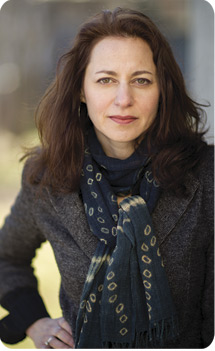
Investigative journalist Sabrina Rubin Erdely of Rolling Stone
Erdely talked to a number of survivors, and she found a history of gang rapes at Phi Kappa Psi fraternity stretching back at least 30 years. She describes a culture in which male upperclassmen target freshmen girls and deliberately take advantage of their lack of sophistication about the danger of sexual violence on college campuses.
A year later, Jackie did report the rape to a UVA administrator. She was sent to Dean Nicole Eramo, who heads the “Sexual Misconduct Board.” Eramo subtly discouraged Jackie from reporting the rape.
When Jackie finished talking, Eramo comforted her, then calmly laid out her options. If Jackie wished, she could file a criminal complaint with police. Or, if Jackie preferred to keep the matter within the university, she had two choices. She could file a complaint with the school’s Sexual Misconduct Board, to be decided in a “formal resolution” with a jury of students and faculty, and a dean as judge. Or Jackie could choose an “informal resolution,” in which Jackie could simply face her attackers in Eramo’s presence and tell them how she felt; Eramo could then issue a directive to the men, such as suggesting counseling. Eramo presented each option to Jackie neutrally, giving each equal weight. She assured Jackie there was no pressure – whatever happened next was entirely her choice.
Like many schools, UVA has taken to emphasizing that in matters of sexual assault, it caters to victim choice. “If students feel that we are forcing them into a criminal or disciplinary process that they don’t want to be part of, frankly, we’d be concerned that we would get fewer reports,” says associate VP for student affairs Susan Davis. Which in theory makes sense: Being forced into an unwanted choice is a sensitive point for the victims. But in practice, that utter lack of guidance can be counterproductive to a 19-year-old so traumatized as Jackie was that she was contemplating suicide. Setting aside for a moment the absurdity of a school offering to handle the investigation and adjudication of a felony sex crime – something Title IX requires, but which no university on Earth is equipped to do – the sheer menu of choices, paired with the reassurance that any choice is the right one, often has the end result of coddling the victim into doing nothing.
“This is an alarming trend that I’m seeing on campuses,” says Laura Dunn of the advocacy group SurvJustice. “Schools are assigning people to victims who are pretending, or even thinking, they’re on the victim’s side, when they’re actually discouraging and silencing them.
The culture of cover-up at UVA is shocking to me, but it is probably typical of many colleges and universities, according to Erdely. However UVA is among a select group of 86 schools that is under investigation by the federal Office of Civil Rights because of their failure to deal with the problem. In September UVA held a two-hour trustees meeting to discuss sexual assault on campus.
Those two hours, however, were devoted entirely to upbeat explanations of UVA’s new prevention and response strategies, and to self-congratulations to UVA for being a “model” among schools in this arena. Only once did the room darken with concern, when a trustee in UVA colors – blue sport coat, orange bow tie – interrupted to ask, “Are we under any federal investigation with regard to sexual assault?”
Dean of students Allen Groves, in a blue suit and orange necktie of his own, swooped in with a smooth answer. He affirmed that while like many of its peers UVA was under investigation, it was merely a “standard compliance review.” He mentioned that a student’s complaint from the 2010-11 academic year had been folded into that “routine compliance review.” Having downplayed the significance of a Title IX compliance review – which is neither routine nor standard – he then elaborated upon the lengths to which UVA has cooperated with the Office of Civil Rights’ investigation, his tone and manner so reassuring that the room relaxed.
Told of the meeting, Office of Civil Rights’ Catherine Lhamon calls Groves’ mischaracterization “deliberate and irresponsible.” “Nothing annoys me more than a school not taking seriously their review from the federal government about their civil rights obligations,” she says.
Jackie eventually became involved with a UVA rape survivors group, but even among these women who were trying to deal with their traumatic experiences and reaching out to recent victims, the culture was one of not reporting their rapes to police.

UVA Dean of Students Nicole Eramo
You’ll recall that it was at UVA that 18-year-old Hannah Graham was abducted and murdered, allegedly by 32-year-old Jesse Matthew, who had been previously accused of rape at two different Virginia colleges in 2002 and 2003. He was not charged in either case, and he apparently went on to become a smoothly professional sexual predator. The news reports say that the victims did not want to press charges, but the truth is that colleges and universities regularly discourage young women from reporting rapes in order to protect their institutional reputations. Erdely addresses this issue at length in her article on UVA.
Matthew’s DNA was found under the fingernails of Virginia Tech student Morgan Harrington, who disappeared after she was locked out of a Metallica concert on the UVA campus in 2009. Harrington’s body was later found a few miles from where Hannah Graham’s body was recovered. Matthew’s DNA has also been connected to a violent rape and attempted murder that took place in Fairfax in 2005.
In her article, Erdely discusses the research done by psychologist David Lisak on campus rapists. He discovered that a small percentage of college men commit rapes, and they tend to be repeat offenders (PDF). That last link is to a peer-reviewed journal article by Lisak, “Repeat Rape and Multiple Offending by Undetected Rapists.” Erdely writes:
Lisak’s 2002 groundbreaking study of more than 1,800 college men found that roughly nine out of 10 rapes are committed by serial offenders, who are responsible for an astonishing average of six rapes each. None of the offenders in Lisak’s study had ever been reported. Lisak’s findings upended general presumptions about campus sexual assault: It implied that most incidents are not bumbling, he-said-she-said miscommunications, but rather deliberate crimes by serial sex offenders.
In his study, Lisak’s subjects described the ways in which they used the camouflage of college as fruitful rape-hunting grounds. They told Lisak they target freshmen for being the most naïve and the least-experienced drinkers. One offender described how his party-hearty friends would help incapacitate his victims: “We always had some kind of punch. . . . We’d make it with a real sweet juice. It was really powerful stuff. The girls wouldn’t know what hit them.” Presumably, the friends mixing the drinks did so without realizing the offender’s plot, just as when they probably high-fived him the next morning, they didn’t realize the behavior they’d just endorsed. That’s because the serial rapist’s behavior can look ordinary at college. “They’re not acting in a vacuum,” observes Lisak of predators. “They’re echoing that message and that culture that’s around them: the objectification and degradation of women.”
I won’t quote any more from the article, but I do recommend reading it if you can handle it.
After the Rolling Stone article came out, UVA’s president suddenly decided maybe she should something about Jackie’s rape. From The Daily Progress, UVa calls for investigation into rape allegation in Rolling Stone article.
UVa President Teresa A. Sullivan released a statement Wednesday night, stating the university’s commitment to preventing sexual assault.
“The University takes seriously the issue of sexual misconduct, a significant problem that colleges and universities are grappling with across the nation,” Sullivan said in the statement. “Our goal is to provide an environment that is as safe as possible for our students and the entire University community.”
Erdely said UVa reinforced one of her major arguments in her article — that UVa administration focuses on prestige and appearance over student safety — with Sullivan’s statement….
“I am writing in response to a Rolling Stone magazine article that negatively depicts the University of Virginia and its handling of sexual misconduct cases,” Sullivan said at the beginning of the statement.
“It goes to show what their priorities are here — the fact that she would go out of her way to say I negatively depicted the university — this is the first thing on their minds,” Erdely said. “They need to be putting student safety first.”

UVA President Teresa Sullivan
Date: Wed, Nov 19, 2014 at 6:17 PM
Subject: An Important Message from President SullivanTo the University community:
I am writing in response to a Rolling Stone magazine article that negatively depicts the University of Virginia and its handling of sexual misconduct cases. Because of federal and state privacy laws, and out of respect for sexual assault survivors, we are very limited in what we can say about any of the cases mentioned in this article.
The article describes an alleged sexual assault of a female student at a fraternity house in September 2012, including many details that were previously not disclosed to University officials. I have asked the Charlottesville Police Department to formally investigate this incident, and the University will cooperate fully with the investigation.
The University takes seriously the issue of sexual misconduct, a significant problem that colleges and universities are grappling with across the nation. Our goal is to provide an environment that is as safe as possible for our students and the entire University community.
We have recently adopted several new initiatives and policies aimed at fostering a culture of reporting and raising awareness of the issues.
We want our students to feel comfortable coming forward with information when there are problems in the community and cooperating with local law enforcement and the student disciplinary process. We also want them to feel empowered to take action and to lead efforts to make our Grounds and our community a better place to live and learn.
We have been taking a leadership role on issues regarding sexual misconduct and violence. U.Va. hosted a national conference on this topic in February 2014. “Dialogue at U.Va.: Sexual Misconduct Among College Students” brought together national experts and professionals from approximately 60 colleges and universities to discuss best practices and strategies for prevention and response.
The HoosGotYourBack initiative, part of the Not On Our Grounds awareness campaign, was developed and launched in collaboration with students and with local Corner Merchants to increase active bystander behavior.
A number of other initiatives are also planned for the spring. Among them are the implementation of a new student sexual misconduct policy and a related training program, a campus climate survey, and an in-depth bystander intervention program that will include students, faculty, and staff.
More information about sexual violence education and resources is available on the University’s website at http://www.virginia.edu/sexualviolence/
Finally, I want to underscore our commitment to marshaling all available resources to assist our students who confront issues related to sexual misconduct. Our dedicated Student Affairs staff devote countless hours to educating and counseling our students on issues regarding their health and safety, and they stand ready to assist whenever students need help.
Teresa A. Sullivan
PresidentPresident Sullivan approved distribution of this message.
I’ll let you judge the sincerity of Sullivan’s statement.
I know there is plenty of other news going on, but this was all I could think about this morning. Please post your links on any topic in the comment thread, and feel free to discuss this post or not. I realize this is a very difficult subject, but it is also a vitally important one.
Monday Reads
Posted: November 17, 2014 Filed under: morning reads, U.S. Politics 22 Comments
Good Morning!
I have to begin this post with some sad breaking news. From NBC News:
Dr. Martin Salia, a surgeon who was diagnosed with Ebola in Sierra Leone and flown to Nebraska over the weekend for treatment, has died, hospital officials said Monday.
Salia, 44, became the second person to die of the disease in the United States. Thomas Eric Duncan, who contracted Ebola in Liberia and traveled to Dallas, died last month.
Salia landed Saturday in Omaha. He was the 10th patient to be treated on American soil and the third at Nebraska Medical Center. Hospital officials had said that he was perhaps sicker than any other patient flown to the United States from West Africa.“It is with an extremely heavy heart that we share this news,” said Dr. Phil Smith, medical director of the hospital’s biocontainment unit. “Dr. Salia was extremely critical when he arrived here, and unfortunately, despite our best efforts, we weren’t able to save him.”
Salia was born in Sierra Leone, but was a legal resident of the U.S. He had returned to his native country to help people suffering with Ebola. His wife and two children live in Carrollton, Maryland, a suburb of Washington DC.
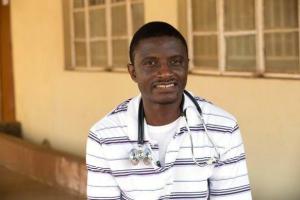
Dr. Martin Salia
A little more from The Boston Globe:
Salia arrived Saturday to be treated at the Omaha hospital, where two other Ebola patients have been successfully treated.
Salia had advanced symptoms when he arrived at the hospital Saturday, which included kidney and respiratory failure, the hospital said. He was placed on dialysis, a ventilator and given several medications to support his organ systems….
Salia’s wife, Isatu Salia, said Monday that she and her family were grateful for the efforts made by her husband’s medical team.
‘‘We are so appreciate of the opportunity for my husband to be treated here and believe he was in the best place possible,’’ Salia said….
Isatu Salia said in a telephone interview over the weekend that when she spoke to her husband early Friday his voice sounded weak and shaky. But he told her ‘‘I love you’’ in a steady voice, she said.
They prayed together, she said, calling her husband ‘‘my everything.’’
Heartbreaking. The health care workers trying to stem the tide of this terrible disease are true heroes.
Nebraska is also in the news because of the sudden Congressional efforts to approve the Keystone pipeline. The bill has already been passed by the House. Dakinikat posted a couple of stories about the pipeline fight in yesterday’s comment thread.
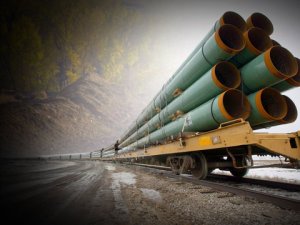
From the AP, via Talking Points Memo: Obscure Nebraska Panel May Determine Fate Of Keystone Pipeline.
Read more at the link.
We’re talking about the possibility of America’s breadbasket being horribly damaged by a tar sands oil spill. President Obama could still veto the bill if the Senate passes it, but if he doesn’t the government will will still have to deal with Native Americans whose land the pipeline would cross. From the New York Daily News, House approval of Keystone XL pipeline is an ‘act of war’: Rosebud Sioux Tribe.
The GOP-led House voted on Friday to approve the Alberta-to-Nebraska pipeline — but Cyril Scott, president of the Rosebud Sioux tribe in South Dakota vowed to block it.
Scott has threatened to close Rosebud’s borders if any attempt to build the pipeline is made.
“Act of war means that we’re going to have to take legal maneuvers now,” Scott told the Daily News over the phone. “We’re going to protect our land and our way of life.” [….]
The international pipeline would funnel tar sands oil through Montana, South Dakota and Nebraska – right through the Rosebud tribal lands.
Scott argued the pipeline violates the 1868 Treaty of Fort Laramie that gave the land known as the Black Hills to the Sioux Nation.
“When it comes to treaties, they forget about us. … People forget that we’re a sovereign nation,” Scott said. “Everybody else … they’re just guests here.”
The greatest concern is that a leak could affect the Ogallala Aquifer, which is already in jeopardy. From The Washington Post last September:
The sprawling Ogallala Aquifer in the Great Plains provides freshwater for roughly one-fifth of the wheat, corn, cattle and cotton in the United States. But key parts of the underwater aquifer are being depleted faster than they can be recharged by rain (see map)….How long before those areas in decline run out of groundwater for farming?
A recent study in the Proceedings of the National Academy of Sciences tried to come up with an answer for the crucial Kansas section of the aquifer. At current rates of use, farming in that area is likely to peak by 2040 or so due to water depletion.
With better conservation techniques, western Kansas could probably stretch things out so that farm production doesn’t peak until the 2070s. But avoiding any sort of peak altogether would require drastic measures — beyond anything contemplated today.

Do we really want to add more risk by allowing a pipeline carrying the dirtiest kind of oil known the humankind? As Rosebud Sioux president Cyril Scott said in the Daily News story linked above, “It’s not if it breaks, it’s when it breaks.”
Some Republicans claim that Harry Reid is allowing a vote on the pipeline to help Mary Landrieu in her campaign against Crazy-Eyes Cassidy (who sponsored the bill in the House) for the U.S. Senate seat from Louisiana. But if that’s true, then why did the DSCC cut off funds to Landrieu’s campaign? I wish the Democrats would get busy approving President Obama’s outstanding appointees instead of plotting to destroy America’s heartland.
Two more links on the Keystone pipeline story:
Politicus USA, Democratic Senator Completely Annihilates Fox News’ Keystone XL Pipeline Talking Points. Check out the story to read how Sen. Sheldon Whitehouse shut down both South Dakota Sen. John Thune and Fox host Chris Wallace in enemy territory.
The Daily Beast, The Pipeline From Hell: There’s No Good Reason to Build Keystone XL (“No lasting jobs, no cheaper gas, and a chance to kill off one-fourth of U.S. farmland and maybe the planet. Why are both parties going all out to get such a crappy deal?”)
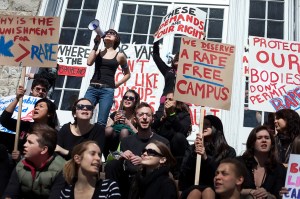
The problem of rape on college campuses is also in the news. From The Boston Globe, Harvard’s view on consent at issue in sexual assault policy.
In the fierce debate about campus sexual assault, Harvard University’s policy has come under particular scrutiny, assailed by some professors as a product of political correctness that stacks the deck against the accused. But a range of specialists who help colleges handle misconduct allegations say Harvard’s policy is decidedly mainstream.
Really? Then why is it that colleges and universities rarely punish accused rapists?
In recent years, many colleges have adopted an “affirmative consent” standard, which states that sex is considered consensual only if both partners explicitly communicate their willingness to engage in sexual activity.
Harvard’s policy, meanwhile, simply forbids “unwelcome conduct,” which it defines as “unrequested or uninvited” behavior — but does not require explicit consent.
Harvard says its standard is consistent with federal civil rights law, but critics say the policy does not go far enough and is out of step with other colleges.
“I definitely see Harvard as an outlier,” said Djuna Perkins, a Boston-area lawyer who conducts sexual misconduct investigations and training for colleges. “Most definitions now require affirmative consent.”
The clash about college misconduct policies is the latest flashpoint in a broader debate about how to curb sexual assaults on campus and what standards should be used in determining guilt. The issue is playing out at colleges around the country and comes as 86 schools — including Harvard and nine others in Massachusetts — are facing federal inquiries into their handling of sexual-assault cases.
There is also a long op-ed in The New York Times in which Yale professor of criminal law Jed Rubenfeld discusses both sides of this simmering controversy, Mishandling Rape.
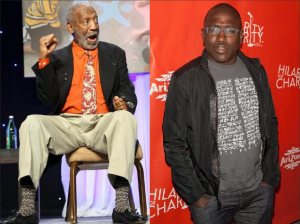
Bill Cosby and Hannibal Buress
And speaking of rape accusations, the talk about Bill Cosby’s alleged history of sexual assault has been in the news again, after it died down eight years ago. From The Washington Post,
Those accusations date to 2006, when Cosby made public denials, settled a civil lawsuit out of court and maintained his stature as a dad-sweatered pop-culture icon.
It seemed the scandal had been put to rest. But as the past few weeks have shown, it’s become more difficult to bury a story for good — especially a story like this one, which has many of the components for going viral: a famous name, a shareable video, lurid personal accounts. The resurgence of interest in this old news story didn’t happen at random. It’s the result of what we, in the age of information overload, are inclined to click on.
This news cycle started with a stand-up routine, in which the allegations were reintroduced by comedian Hannibal Buress, who was performing in Cosby’s home town of Philadelphia. The performance video was first published a month ago on PhillyMag.com….
Buress urged his audience to help the story resurface.
“I’ve done this bit onstage, and people think I’m making it up,” he said in the video. “When you leave here, Google ‘Bill Cosby rape.’ That s— has more results than ‘Hannibal Buress.’ ”
Now another accuser has spoken publicly, according the The Hollywood Reporter.
In an essay on Hollywood Elsewhere, Joan Tarshis wrote that the comedian drugged and raped her on two occasions in the fall of 1969 when she was 19 years old.
Tarshis, a former actress, music industry publicist and journalist, wrote that she met Cosby through mutual friends, and he often invited her to his room on the Universal lot, where he was shootingThe Bill Cosby Show. He would ply her with food and drinks, often pouring beer into her Bloody Mary’s, even though he himself never drank.
One night, Cosby invited her to help him work on material for the show, where he made her one of his Bloody Mary-and-beer concoctions. She claims she was in the middle of discussing a scene with him when she lost consciousness.
“The next thing I remember was coming to on his couch while being undressed,” she wrote. “Through the haze, I thought I was being clever when I told him I had an infection, and he would catch it, and his wife would know he had sex with someone. But he just found another orifice to use. I was sickened by what was happening to me and shocked that this man I had idolized was now raping me.”
Read the rest at the link. Cosby cancelled a scheduled appearance on the Late Show in the wake of the new accusations and public discussion.
Republicans never seem to stop pushing the legal envelope to get their candidates elected. From CNN, How the GOP used Twitter to stretch election laws.
Washington (CNN) — Republicans and outside groups used anonymous Twitter accounts to share internal polling data ahead of the midterm elections, CNN has learned, a practice that raises questions about whether they violated campaign finance laws that prohibit coordination.
The Twitter accounts were hidden in plain sight. The profiles were publicly available but meaningless without knowledge of how to find them and decode the information, according to a source with knowledge of the activities.
The practice is the latest effort in the quest by political operatives to exploit the murky world of campaign finance laws at a time when limits on spending in politics are eroding and regulators are being defanged.
The law says that outside groups, such as super PACs and non-profits, can spend freely on political causes as long as they don’t coordinate their plans with campaigns. Sharing costly internal polls in private, for instance, could signal to the campaign committees where to focus precious time and resources.
Read more at the link.
I’ve run out of space, but I want to include a couple of Ferguson updates:
Christian Science Monitor, Ferguson braces for prospect of no indictment in Michael Brown shooting case.
V[]cative, The Pre-Verdict Chatter Among Ferguson Cops and Their Supporters.
What else is happening? Please share links to stories that interest you in the comment thread. I hope to see you there!
Lazy Saturday Reads: Governor, Police, and Media Stoke Fears of Riots in Ferguson
Posted: November 15, 2014 Filed under: Civil Rights, Criminal Justice System, morning reads, racism, The Media SUCKS, U.S. Politics | Tags: 1965 Watts riots, Darren Wilson, Ferguson MO protests, Gov. Jay Nixon, grand jury, John Crawford III, Jon Belmar, Levar Jones, Mary Sanchez, Michael Brown, MIssouri National Guard, police shootings, Rodney King, Sean Groubert, slavery, Tom Jackson, Trayvon Martin, US Department of Justice 11 Comments 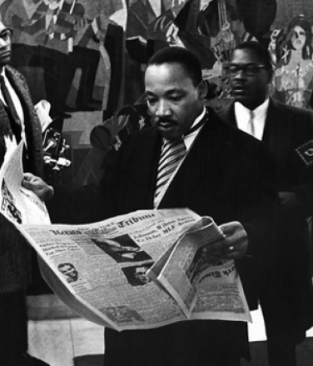 Good Afternoon!
A Grand Jury decision is imminent in the Michael Brown shooting case in Ferguson, Missouri. For the past couple of weeks the media has been full of reports of how police departments in the St. Louis area are preparing for what they predict will be violent protests.
The general assumption is that Ferguson police officer, who killed Brown at about noon on August 9, will not be charged. The simple truth is that white police officer who kill black people are rarely charged and almost never convicted. Furthermore, the LA Times reports that law enforcement officers who kill citizens in Missouri are given “wide latitude.”
Missouri law provides wide latitude for police to use deadly force, particularly if the officer believes it’s necessary to protect his or her safety or the safety of others.
But that law might not shield Wilson. “If Michael Brown was trying to surrender at the time, that makes this defense not applicable,” Washington University law professor Peter Joy said. “So the question is: Was Michael Brown clearly trying to surrender at the time that the fatal gunshots were fired?”
Several witnesses who saw the shooting reported that Brown’s hands were in the air when Darren Wilson shot and killed him, but, as far as I can tell, most media sources recently have changed the narrative to the police version–not based on direct observation–in which Wilson supposedly feared for his life because the unarmed Brown “charged” at him after being hit with at least two bullets.
There is another investigation by the Justice Department into whether Darren Wilson violated Michael Brown’s civil rights, but
Joy said a federal indictment seemed unlikely, at least according to the publicly reported accounts of the shooting thus far.
“That would require that Officer Wilson intentionally planned or intentionally meant to violate the civil rights — that is, take the life of — Michael Brown because of his race,” Joy said.
The media narrative has gradually been revised since August, when we saw what were essentially police riots in which Ferguson and St. Louis police used military surplus equipment to control peaceful protesters and reporters and photographers who were covering events on the ground. Now we’re repeatedly being told that Brown was the aggressor, with the unwritten implication that he deserved to die. Back in August, some law enforcement officers threatened to kill protesters and even arrested numerous members of the media who were simply doing their jobs. But that’s all forgotten now. Now the corporate media appears to be fully behind the Ferguson and St. Louis police; and both the police and the media are preparing for what they expect–and apparently hope–will be violent and dangerous riots.
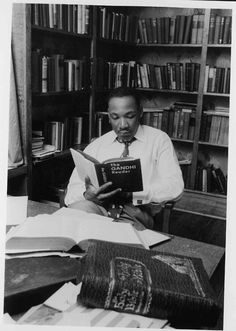
Since the Grand Jury decision may come very soon, I thought I’d gather the latest updates on this important story for today’s post. I’ll admit up front that I’m not an nonpartisan observer in this case.
First, the LA Times article I linked to above has a good summary of the two sides to the story of the shooting, Back Story: What happened in Michael Brown shooting in Ferguson, Mo.?
Also from the LA Times, a report of Missouri Governor Jay Nixon’s recent announcement about government preparations for what he apparently assumes will be riots, National Guard on call if Ferguson grand jury decision triggers violence.
The National Guard will be ready to assist law enforcement in Missouri if unrest erupts after a grand jury announces whether to indict a white police officer who fatally shot an unarmed black man in Ferguson, Gov. Jay Nixon announced Tuesday.
“Violence will not be tolerated,” Nixon said at a news conference with officials from the Missouri State Highway Patrol, St. Louis County police and St. Louis Metropolitan police. The governor said the agencies would form a unified command to deal with protests. “Residents and businesses of this region will be protected,” Nixon said….
Nixon said that the rights of peaceful protesters would be respected but that officials would have no tolerance for violent agitation. “Our dual pillars here are safety and speech,” Nixon said in the televised news conference from St. Louis. The National Guard, he said, would be available “when we determine it is necessary to support local law enforcement.”
Nixon added: “The world is watching.”
Nixon did not say whether there have been any efforts to diffuse anger on the part of local police officers or prevent more police overreactions to peaceful protests.
The story also quoted St. Louis police chief Jon Belmar.
“The community is on edge. … There is a large sense of anxiety out there. This is a little unprecedented,” St. Louis County Police Chief Jon Belmar told reporters in a televised news conference. Belmar added: “If you talk to chiefs around the country [as I have], they’re concerned and prepared for this to perhaps lap into their communities also.”
Gee, I wonder why? Could it be because police shootings of unarmed black men are so common in this country? Belmar also defended the use of military equipment to control protests.
Belmar defended the agency’s response by saying that such gear was necessary for his officers’ protection and pointed out that no protesters lost their lives during August’s demonstrations, which were occasionally marred by looting and gunshots. “My goodness, could we be that fortunate moving forward?” Belmar said of the absence of fatalities.
The St. Louis County Police Department has spent about $120,000 to replenish equipment such as shields, batons, tear gas and flex handcuffs after weeks of unrest in the aftermath of the shooting depleted supplies and damaged equipment.
Here are some recent examples of white policemen shooting unarmed black men:
The New Republic, A Dash Cam Didn’t Stop This White Officer From Shooting an Unarmed Black Man (fortunately, this officer was arrested and charged. Whether he’ll be convicted or not, we don’t know yet)
Mother Jones, August 13, 2014, 4 Unarmed Black Men Have Been Killed By Police in the Last Month.
Here’s piece on this subject by Washington Post columnist Jonathan Capehart, The terrifying police shootings of unarmed black men.
One of the burdens of being a black male is carrying the heavy weight of other people’s suspicions. One minute you’re going about your life, the next you could be pleading for it, if you’re lucky. That’s what happened to Trayvon Martin in February 2012 and Michael Brown last month. And two other recent shootings add further proof that no standard of conduct, it seems, is too good or too mundane to protect a black man’s life particularly from a police officer’s bullet.
John Crawford III was talking on his cell phone in the Beavercreek, Ohio, Wal-Mart and carrying an unloaded BB air rifle he picked up in the superstore on Aug. 5. “There is a gentleman walking around with a gun in the store,” Ronald Ritchie told the 911 operator. “Yeah, he’s, like, pointing at people….He’s looking around, waving it, waving it back and forth….He looked like he was trying to load it. I don’t know.” Fair warning: As the graphic video shows, Crawford was shot and killed by police. Ritchie has since changed his account of what happened.
You can watch the video at the link. Capehart also discusses the Brown case and the case in South Carolina (story linked above).
Levar Jones was pulled over for a seat-belt violation by now-former South Carolina state trooper Sean Groubert on Sept. 4. Thanks to the startling and graphic dashcam video we get to see every African American’s worst nightmare unfold in seconds….
Groubert asks Jones, “Can I see your license, please?” Jones, who was standing outside his car at the gas station convenience store, turned and reached inside to retrieve it. “Get out of the car! Get out of the car!” Groubert shouts before opening fire on Jones at point-blank range. After being hit in the hip, Jones can be seen moving backwards away from his car with his hands in the air as two more shots ring out.
Instead of using these recent cases to highlight and deal with the problem of police shootings of unarmed people, it seems that local and state governments like those in Missouri are simply doubling down on the people who protest them. I’m really concerned that all the talk of “riots” being inevitable in Ferguson is going to be a self-fulfilling prophecy.
Caitlin Dickson of The Daily Beast reports that at least one expert agrees with me: Riot Prep Could Fuel Ferguson Violence.
Despite a concerted police effort to quell demonstrations, protesters have carried on consistently and, for the most part, calmly since Brown’s death at the hands of police officer Darren Wilson this past August. But the impending grand jury decision on whether Wilson will be indicted in Brown’s death—and leaks of evidence suggesting he won’t—has law enforcement, residents, and business owners preparing for violence on the streets.
In addition to Missouri Governor Jay Nixon’s announcement on Tuesday that the Missouri State Highway Patrol, the St. Louis Metropolitan police, and the St. Louis County police will join forces (with the National Guard on standby) in handling demonstrations following the grand jury decision, almost every national news organization—from CNN to The New York Times, the Associated Press and Reuters—has reported that Ferguson residents and business owners have been taking matters into their own hands. Gun sales are up, local gun-shop owners told reporters. People like Dan McMullen, whose insurance agency is located near a spot where the few instances of vandalism and looting took place following Brown’s death, was quoted by both the New York Times and CNN as saying he’s stocking up on guns in case of a riot….
Despite Governor Nixon’s declarations that “violence will not be tolerated” and “residents and businesses of this region will be protected,” some experts wonder whether all the emphasis on preparedness—from the $120,000 spent by the St. Louis County Police on riot gear to the sudden demand for guns—may do more harm than good.
“I don’t think this is the way we should be thinking about what might happen,” American University professor Cathy Schneider told The Daily Beast. Instead, Schneider, who is an expert on social movements and racial tensions, argues that what we should be thinking about is, ‘how do we convince a community that the police will act to serve them, that the justice system will defend their interests, and that the verdict will be just?” [….]
“If one side is buying guns and preparing, what do you think the other people are doing, who think those guns are going to be used against them?” Schneider asked. Instead of acknowledging that Ferguson’s black community “is in pain and wondering whether justice will be done,” Schneider said, such intense preparation sends the message that “we think your community is dangerous and we’re armed and prepared to kill you.”
It also doesn’t help that Ferguson police chief Tom Jackson–who should have been fired by now–has announced that Darren Wilson, the man who killed Michael Brown, will be welcomed back to the local force if he isn’t indicted by the Grand Jury.
Here’s an excellent op-ed by Mary Sanchez of the Kansas City Star: The fire next time … may engulf Ferguson, Mo.
By every indication — from both the street and civic offices — Ferguson, Missouri is expected to blow.
The grand jury decision on whether a white police officer will be charged in the shooting death of an unarmed 18-year-old black man could come any day. Many are expecting no indictment of the officer, no criminal charges alleging that he went too far the day Michael Brown died.
If that’s the outcome, God help us all. Keeping the lid on the public reaction will be a gargantuan task.
Of course local leaders fed the outrage from the very beginning by trying to protect Darren Wilson and by leaving Michael Brown’s body lying exposed in the street for four hours.
Sanchez refers back to the riots in Los Angeles in 1965 as well as those in 1992 after the failure to indict police who beat Rodney King within an inch of his life. Why don’t government leaders deal with the root problems at work in these cases?
In Watts nearly 50 years ago the name was Marquette Frye, not Michael Brown. Frye, 21, was pulled over in a traffic stop, suspected of being drunk. When other family members arrived, a fight broke out with police. Word spread, alleging police had over-reacted.
For six days people rioted. There were 34 deaths, more than 1,000 people injured, $40 million in property damage and more than 1,000 buildings were destroyed.
In 1992, the person at the center was Rodney King. He’d led police on a high-speed car chase, fleeing after fearing that his probation would be revoked from a robbery conviction. When he finally was stopped, what happened next shocked the nation. The video of the officers assaulting King without mercy when they could have simply handcuffed him was played over and over on television.
When those officers weren’t indicted, the city erupted again. This time, 53 people died, more than 2,000 were injured, the property damage was pegged at $1 billion and another 1,000 buildings were destroyed.
In both cases, commissions were formed and good people went to work unraveling how one incident could ignite such violence. The underlying causes were found to be similar despite the nearly 30 years that had passed: the burdens of poor education, lack of jobs, poverty, racial tensions, and inferior housing and transportation.
Sanchez goes on to recommend changes that local and state governments will most likely either ignore or respond to with lip service.
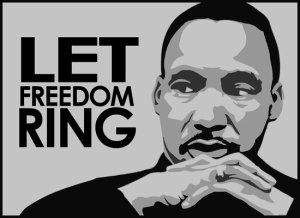
We’ve seen over the past several years that virulent racism is alive and well in this country, and we simply are not dealing with it.
This nation was founded on the enslavement of black people, and despite the civil rights struggles of the 1960s, efforts to desegregate schools, and affirmative action, black people are still treated as second class citizens by many Americans. A number of states have even instituted voter ID laws that essentially act as poll taxes did in the Jim Crow era to keep black people from voting, and the Supreme Court has affirmed the right of states to do this.
We are now on the verge of another flashpoint in the history of race conflicts in our country–the possibility of violence following a failure to punish Darren Wilson for essentially ignoring the humanity of black teenager Michael Brown.
When will it end?
A few more reads to check out if you’re interested:
St. Louis Post-Dispatch, Protesters prepare for the worst in Ferguson.
Huffington Post, Beyond the Indictments: Black and Brown Deaths at the Hands of Police Are a Crisis Boiling Over.
Fellowship of Reconciliation, Ferguson Under Indictment.
Juan Williams at Fox News, Are liberal news outlets begging for a race riot in Ferguson?
Ben Swann, Michael Brown’s Parents Testify Before UN Committee Against Torture.
Michael Martinez at CNN, Ferguson case raises question: Where’s the data on officer-involved killings?
Christian Science Monitor, Ferguson verdict: Why St. Louis schools will know first.
AP via Boston Globe, Churches prepare for possible Ferguson unrest
What stories are you following today? Please post your thoughts and links in the comment thread, and have a great weekend.

 peej
peej Carissa
 bostonboomer
 dakinikat
 ecocatwoman
 mablue2
 Mama Lopez
 peggysue22
 quixote
 skydancingguestblogger
 Mona (aka Wonk the Vote)



 Sky Dancing
Recent Comments