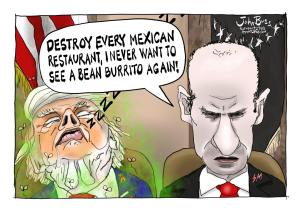
“The latest cabinet meetings aren’t televised for a reason. Fear not, our de facto leader is in control as the ethnic cleansing of the country formerly known as the United States roars ahead unabated. The must-see TV drama not being broadcast is Whose Turn Is It to Change the Old Guy’s Diaper?” John Buss, @repeat 1968
Good Day Sky Dancers!
As we stare down the 250th anniversary of the day our country started its journey from monarchy to democracy, we have to take a look at where we’ve landed today and utter some word of disappointment. The headlines today are filled with references to autocracy, and it’s not difficult to see how the MAGA/Trump overreach is playing out.
Politicosums up the current situation like this. “Trump’s second year: Whiplash. Even proposals that don’t ultimately move forward have consequences.” I’d just like a few more adjectives like weird, cruel, and inexplicably unnecessary.
President Donald Trump’s first year back in office was defined by sweeping upheaval that was largely plotted out during his four-year Florida exile. But the president has somehow intensified the volatility in year two with a succession of whiplash-inducing policy swings, several of which have almost immediately withered in the face of Republican opposition and public outcry.
It came after Trump threatened to decertify Canadian aircraft, a move deemed “unjustified and dangerous” by a Washington-based aerospace trade union that the president soon dropped. Trump said in early January that he’d cap credit card rates at 10 percent, a move that would have upended the banking industry, only to change his mind and ask Congress for legislation.
Also last month, Trump’s administration paused millions in Centers for Disease Control and Prevention funding for state public health infrastructure — only to reverse course roughly 24 hours later.
“The whiplash has real implications,” said Chrissie Juliano, executive director of the Big Cities Health Coalition, a forum of the leaders of metropolitan health departments. “It’s incredibly disruptive, even if you can get back to continuing the work, you know, two days later.”
The unpredictability of a presidency that prioritizes posting over process and often leaves friends and foes alike guessing whether pronouncements should be taken seriously, literally, or both, remains a feature, not a bug of Trump’s approach to governance. In many matters, especially negotiations with other countries, his mercurial opacity is often an attempt to gain leverage, but his threats seemingly lead just as often to backtracking as blowing things up, be they Iranian missile depots, Venezuelan drug boats or the transatlantic alliance.
The same often holds true for domestic policy. The president has made numerous pronouncements with emphatic declarations on social media, sometimes even suggesting he is governing by fiat in cases where legislation is required. But he has quickly moved on from many of them: a cap on credit card interest rates, 50-year mortgages and, according to a new Financial Times report, possibly even the sweeping tariffs on aluminum and steel that have led to higher costs.
We’re just beginning to explore the depths of depravity that Trump and his buddies will go to just feel powerful and get richer. This is from Robert Reich’s SubStack. “The Squalor of the Epstein Class. Happy Presidents Day!”
Here’s how Kentucky Republican Congressman Thomas Massie responded on Sunday, during ABC’s “This Week,” to a question about the Trump regime’s handling of the Epstein files:
“This is about the Epstein class …. They’re billionaires who were friends with these people, and that’s what I’m up against in Washington, D.C. Donald Trump told us that even though he had dinner with these kinds of people, in New York City and West Palm Beach, that he would be transparent. But he’s not. He’s still in with the Epstein class. This is the Epstein administration. And they’re attacking me for trying to get these files released.”
The Epstein Class. Not just the people who cavorted with Jeffrey Epstein or the subset who abused young girls. It’s an interconnected world of hugely rich, prominent, entitled, smug, powerful, self-important (mostly) men. Trump is honorary chairman.
Trump is still sitting on two and a half million files that he and Pam Bondi won’t release. Why? Because they implicate Trump and even more of the Epstein class. The files that have been released so far don’t paint a pretty picture.
Trump appears 1,433 times in the Epstein files so far. His billionaire backers are also members. Elon Musk appears 1,122 times. Howard Lutnick is there. So is Trump-backer Peter Thiel (2,710 times), and Leslie Wexner (565 times). As is Steven Witkoff, now Trump’s envoy to the Middle East, and Steve Bannon, Trump’s consigliere (1,855 times).
The Epstein Class isn’t limited to Trump donors. Bill Clinton is a member (1,192 times), as is Larry Summers (5,621 times). So are LinkedIn founder Reid Hoffman (3,769 times), Prince Andrew (1,821 times), Bill Gates (6,385 times), and Steve Tisch, co-owner of the New York Giants (429 times).
If not politics, then what connects the members of the Epstein Class? It’s not just riches. Some members are not particularly wealthy, but they’re richly connected. They trade on their prominence, on whom they know and who will return their phone calls.
They exchange inside tips on stocks, on the movements of currencies, on IPOs, on new tax-avoidance mechanisms. On getting into exclusive clubs, reservations at chic restaurants, lush hotels, exotic travel.
Most members of the Epstein Class have seceded into their own small, self-contained world, disconnected from the rest of society. They fly in one other’s private jets. They entertain at one other’s guest houses and villas. Some exchange tips on how to procure certain drugs or kinky sex or valuable works of art. And, of course, how to accumulate more wealth.
Many don’t particularly believe in democracy; Peter Thiel (recall, he appears 2,710 times in the Epstein files) has said he “no longer believes that freedom and democracy are compatible.” Many are putting their fortunes into electing people who will do their bidding. Hence, they are politically dangerous.
The Epstein Class is the by-product of an economy that emerged over the last two decades, from which this new elite has siphoned off vast amounts of wealth.
It’s an economy that bears almost no resemblance to that of mid-20th-century America. The most valuable companies in this new economy have few workers because they don’t make stuff. They design it. They create ideas. They sell concepts. They move money.
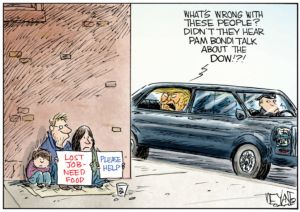
I’ve always argued here and in classes that the biggest economic policies of the Reagan and Bush years were tax cuts that made it more profitable to gamble on financial assets rather than to actually produce goods and services. The changes in tax policies that cut upper brackets, then treated capital gains as a tax slash, and other ridiculous policies mean that money never lands where it can actually do good. It also creates a lot of idle hands and minds.
China is beginning to look more modern, more concerned about actual economic outcomes, and the planet. The U.S. continues to race back to the Gilded Age with hints of the Great Depression years. This is from The Guardian. “The Guardian view on Donald Trump and the climate crisis: the US is in reverse while China ploughs ahead. Editorial. The president’s destructive policies enrich fossil fuel billionaires, while Beijing has bet big on the green transition.”
Devastating wildfires, flooding and winter storms were among the 23 extreme weather and climate-related disasters in the US which cost more than a billion dollars last year – at an estimated total loss of $115bn. The last three years have shattered previous records for such events. Last Wednesday, scientists said that we are closer than ever to the point after which global heating cannot be stopped.
Just one day later, Donald Trump and Lee Zeldin, the head of the US Environmental Protection Agency, announced the elimination of the Obama-era endangerment finding which underpins federal climate regulations. Scrapping it is just one part of Mr Trump’s assault on environmental controls and promotion of fossil fuels. But it may be his most consequential. Any fragment of hope may lie in the fact that a president who has called global heating a “hoax” framed this primarily as about deregulation – perhaps because the science is now so widely accepted even in the US.
The administration claimed, without evidence, that Americans would save $1.3tn. Never mind insurance or healthcare costs; a recent report found that US earnings would be 12% higher without the climate crisis. The Democratic senator Sheldon Whitehouse called the decision “corruption, plain and simple”. In 2024, Mr Trump reportedly urged 20 fossil fuel tycoons to stump up $1bn for his presidential campaign – while vowing to remove controls on the industry.
In the same week as this reckless and destructive US decision, it emerged that China had recorded its 21st month of flat or slightly falling carbon emissions. As Washington tears up environmental regulations, Beijing is extending carbon reporting requirements. China remains the world’s biggest emitter of greenhouse gases, though its per capita and cumulative historical emissions are still far behind those of the US. But clean energy drove more than 90% of its investment growth last year.
The Carbon Brief website, which published the emissions analysis, says the numbers suggest that the decline in China’s carbon intensity – emissions per unit of GDP – was below the target set in the last five-year plan, making it hard to meet its commitments under the Paris agreement. The shift in emissions may not prove enduring. There is fear that China’s focus may change; the next five-year plan, due in March, will be key. Some subsidies for renewable power have already been withdrawn. The installation of huge quantities of renewable energy infrastructure has been accompanied by a surge in constructing coal-fired power plants, though the hope is that these are intended primarily as a fallback.
We continue to disregard the actual civilized nations and cavort with the worst of the worst. This is from France24. “Rubio tells Orban ‘your success is our success’ during Hungary visit ahead of elections. During a visit to Budapest Monday, just weeks before Hungary’s parliamentary elections, US Secretary of State Marco Rubio told Hungarian Prime Minister Viktor Orban that the nationalist leader’s “success” was a success for the US. An ally of President Donald Trump, who has also maintained ties to Russian President Vladimir Putin, Orban lags behind the main opposition candidate in opinion polls.” The entire Trump cabinet is feckless, shameless, and incompetent. They are also enabling a backslide in democracy.
US Secretary of State Marco Rubio hailed Viktor Orban‘s leadership during a visit to Budapest on Monday, ahead of elections threatening the nationalist prime minister’s hold on power.
Rubio’s visit is the final stage of a whirlwind trip to Europe that also saw him address the Munich Security Conference and visit another right-wing ally, Slovakian Prime Minister Robert Fico.
US President Donald Trump has made no secret of his high regard for Orban, saying in a social media post on Friday that the prime minister had produced “phenomenal” results in Hungary.
But Orban, 62, has a fight on his hands for the April 12 legislative elections in Hungary. Polls suggest his Fidesz party is trailing opposition leader Peter Magyar’s TISZA.
“I can say to you with confidence that President Trump is deeply committed to your success because your success is our success,” Rubio said during a joint press conference with Orban after their meeting.
“The president has an extraordinarily close relationship to the prime minister, he does, and it has had tangible benefits,” he said.
Europe’s nations have read the writing on the wall, according to CNN’s Kasie Hunt. “Trump’s damage is done. Democrats – and Europe – are struggling to define what’s next.”
Many of the Democrats who came to the Munich Security Conference this weekend want to be president. But even if one of them can win the White House in 2028, they may find they can no longer claim the title every American president since the 1940s has borne: leader of the free world.
California Gov. Gavin Newsom went on stage to insist his state is more permanent than President Donald Trump. But he acknowledged in an interview with CNN that the leaders he met with believe the damage to the transatlantic alliance is irrevocable.
Progressive star Rep. Alexandria Ocasio-Cortez of New York came to pitch a left-wing populist foreign policy but made headlines for a massive stumble instead.
A number of Democratic senators hoping to burnish their foreign policy credentials ahead of possible presidential bids found themselves in a painfully awkward moment with the Danish prime minister, as some Democrats tried to smooth over pugnacious remarks Republican Sen. Lindsey Graham made at the start of the meeting that suggested Trump has not given up his designs on Greenland – a semiautonomous territory of Denmark.
And most members of the House of Representatives who planned to attend didn’t come at all after Republican Speaker Mike Johnson pulled the plug on the congressional delegation.
European thought leaders were reduced to offering a brief standing ovation to Secretary of State Marco Rubio, whose speech was far more conciliatory than the one Vice President JD Vance delivered at the same gathering last year. But Rubio had kicked off his trip telling American reporters: “The old world is gone.” He also left the conference to fly onward to Slovakia and Hungary, two countries led by strongmen sympathetic to Trump.
The conference’s opening remarks from German Chancellor Friedrich Merz crystallized Europe’s new reality in what seems to be rapidly becoming a post-American century.
“A divide has opened up between Europe and the United States,” Merz said Friday. “The United States’ claim to leadership has been challenged, and possibly lost.”
It’s more than just words. Merz has said he held “confidential talks” with France on European nuclear deterrence. It’s a stunning admission there’s no longer unconditional trust that the US will do what needs to be done for its transatlantic allies.
“What I’m hearing now is, even if we are able to repair these relationships, it’s going to take generations before they feel comfortable,” said Democratic Sen. Mark Kelly, of Arizona, a possible presidential hopeful who traveled to Munich not long after learning the Trump administration had tried and failed to indict him over a video he made telling troops not to obey illegal orders.
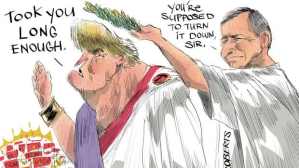
If this continues, the momentum and direction of the world’s political entanglements will change. Who knows what this will mean? This Op Ed piece from MS Now by Anthony L. Fisher discusses Trump and his attempts at an Imperial Presidency. “Libertarians warned about the ‘imperial presidency.’ Too few actually warned about Trump. A recent New York Times op-ed showed the blind spot many libertarians still have for President Donald Trump.”
When I saw the headline “Libertarians Tried to Warn You About Trump” atop a New York Times op-ed last Monday, I thought, “Hmmm, that’s not quite how I remember it.” Adorned with the striking image of the Gadsden flag’s “Don’t Tread on Me” snake about to get curb-stomped by an enormous black jackboot, the piece was written by Katherine Mangu-Ward, editor in chief of the libertarian magazine and website Reason — where I worked as a journalist for roughly six years. (I left shortly after President Donald Trump’s first inauguration.)
Sure enough, upon reading the column, I discovered the headline didn’t accurately reflect Mangu-Ward’s argument. She primarily made the case that libertarians have warned for years — under presidents in both major parties — about the dangers of ever-expanding executive authority, what’s been aptly coined the “Imperial Presidency.” Rather than claiming to have specifically warned “about Trump,” the writer boasted that libertarians had long sounded the alarm over the consolidation of such power — power now being used for nefarious purposes by a president who just happens to be Donald Trump. (The Times later that day amended the headline to the less specific but more honest, “Libertarians: We Told You So.”)
I can’t argue with that. To the extent most self-identified professional libertarians warned about Trump, they warned about the awesome powers that could be abused by a generic authoritarian president from either party.
But Trump is not a hypothetical. He always told us who he was. And there are far fewer of us who took (and continue to hold) the comparatively unpopular view among libertarians and other right-of-center fellow travelers that Trump presented as a uniquely authoritarian, vindictive, racist, corrupt and lawless demagogue — of which there isn’t remotely an analog on the other side of the aisle.
The problem is that, even now that Trump has proven us skeptics right on every one of those counts, too many libertarians continue to position themselves safely in a “pox on both your houses” perch — much too nuanced and enlightened to be dragged into partisan rancor. This position is how your movement ends up conflating the tyranny of overbearing, temporary Covid policies in Democratic-run areas as equal to (or worse than) the tyranny of a secret police force acting without due process for everyone when attempting to arrest suspected illegal immigrants, summarily executing Americans in the street and branding them “domestic terrorists” while their bodies are still warm.
All of these thoughts lead to one logical conclusion. The Midterm elections need to depose him and remove the spineless and the true believers, or whatever this is, from Congress.
Just to let you know, we’re having the most unkind Mardi Gras Celebration that even the police have seen. We seem to have been overrun by spontaneous groups of young men that are behaving a lot like the droogies in A Clockwork Orange. I may write about it on Friday; however, I’m busy listening to my friends’ experiences uptown and around the Quarter right now.
Peace, Love, and Understanding to you all!
What’s on your Reading, Action, and Blogging Lists today?
Did you like this post? Please share it with your friends:
Boulders with Meconopsos and Rhododendrons, Amanda Richardson
For years now, it’s been difficult for me to shake the feeling that I’m living in a dystopian novel. We lived through 4 years under an insane “president” who tried to destroy the post-WWII alliances that have prevented another world war. He also ignored and exacerbated a global pandemic that has now killed close to a million Americans.
I had hoped that when Trump was defeated, he would go away and leave us alone; but instead he is still spreading his poisonous lies– and the Republican Party is still kowtowing to him. Even worse, powerful Republicans like Governors Greg Abbott and Ron DeSantis are building on Trump’s legacy by enabling fascist policies in their states.
Unfortunately, despite popular opinion, the pandemic is not over, we’re not dealing effectively with climate change, and we are once more living under a threat of nuclear destruction.
The United States is finally “out of the full-blown explosive pandemic phase” that has led to nearly 1 million deaths from covid-19 and more than two years of suffering and hardship, Anthony S. Fauci, President Biden’s chief medical adviser, said Wednesday.
“We’re really in a transitional phase, from a deceleration of the numbers into hopefully a more controlled phase and endemicity,” Fauci told The Washington Post.
Fauci’s comments came a day after he told PBS’s “NewsHour” that he believed the country is “out of the pandemic phase,” and he expanded on, and clarified, that view Wednesday, making clear that the pandemic is not over and the United States could still see new waves of infections as the virus continues to mutate and spin off highly transmissible variants. But Fauci and other infectious-disease experts are hoping that the population has built up enough immunity from previous infections and vaccinations to avoid another devastating surge in hospitalizations and deaths.
“The world is still in a pandemic. There’s no doubt about that. Don’t anybody get any misinterpretation of that. We are still experiencing a pandemic,” Fauci said.
Huh? We’re out of the “pandemic phase,” but the pandemic is not over?
Camille Monet and child in the artist’s garden in Argenteuil, 1875 Claude Monet
His comments follow a report from the Centers for Disease Control and Prevention indicating that roughly 3 in 5 people in the United States have already been infected by the coronavirus. About 1 in 4 people had a first-time infection during the winter wave caused by the omicron variant.
These startling numbers suggest the country has a much higher level of collective immunity than it did before omicron. What is far less clear is how long that immunity will persist, and to what extent it could be evaded by new coronavirus variants.
The omicron subvariant BA.2.12.1 is the latest version to seize the attention of public health experts. It is rapidly gaining traction, and CDC estimated Tuesday that it accounted for about 30 percent of new infections. CDC Director Rochelle Walensky said preliminary estimates suggest it is about 25 percent more transmissible than the omicron subvariant BA.2, itself more transmissible than the original omicron strain.
There’s also the problem that we are not testing as much these days; and many people are self-testing at home, so the results are not being reported. Meanwhile, Fauci is concerned enough that he is not going to attend the next possible DC super spreader event:
Fauci, meanwhile, has decided against going to the swank White House Correspondents’ Association dinner Saturday, which Biden reportedly plans to attend. Fauci this month attended the Gridiron dinner, at which scores of people became infected. On Wednesday, he declined to discuss his reasoning for skipping what’s often referred to as the “nerd prom,” saying simply, “It’s just my personal choice.
More than 2,000 journalists, celebrities and politicians, including President Biden, are set to descend on the White House Correspondents’ Association dinner this weekend in what is shaping up to be a major test of whether large gatherings can be safely held at this stage of the pandemic.
Organizers say they are committed to holding an event that significantly reduces the risk of coronavirus infections, pointing to vaccine and testing requirements that were strengthened after a dinner hosted by Washington’s Gridiron Club this month was linked to at least 85 infections that sickened Cabinet members, reporters and other guests.
The Way Home, Peder Monsted, Danish painter
Yet some White House officials and experts worry that those measures are insufficient and that this weekend’s events may become another high-profile superspreader event, said three administration officials who spoke on the condition of anonymity because they were not authorized to discuss the issue. Behind the scenes, one prominent coronavirus expert is scrapping with party organizers hesitant to install devices that disinfect the air using ultraviolet light because of concerns the devices might interfere with the program.
Don Milton, a University of Maryland environmental scientist who has advised the White House and others on airborne transmission, said his offer to have a company install the devicesat no charge was rebuffed by both the correspondents’ association and the Washington Hilton, which is hosting the event. “I enlisted a team of scientists and germicidal UV lighting companies to provide, as a demonstration project at no cost, a temporary installation to help protect the White House correspondents’ dinner,” Milton said. “Unfortunately, it has not worked out.”
In an interview, Steve Portnoy, a CBS News reporter who serves as the WHCA’s president,said the association had put safety protocols in place and Milton’s offer came too late.
“We’re interested in learning more about this technology,” Portnoy said. “We just aren’t in a position, with less than a week to go, to more fully understand the benefits or potential risks of what appears to be an experimental technology.”
What about the “potential risks” of the president getting Covid?
Over the next 50 years, climate change will drive thousands of viruses to jump from one species of mammal to another, according to a study published in Nature on Thursday. The shuffling of viruses among animals may increase the risk that one will jump into humans and cause a new pandemic, the researchers said.
Scientists have long warned that a warming planet may increase the burden of diseases. Malaria, for example, is expected to spread as the mosquitoes that carry it expand their range into warming regions. But climate change might also usher in entirely new diseases, by allowing pathogens to move into new host species.
“We know that species are moving, and when they do, they’re going to have these chances to share viruses,” said Colin Carlson, a biologist at Georgetown University and a co-author of the new study.
To understand what that sharing will look like, Dr. Carlson and his colleagues built a computer model of potential spillovers in a warming world. The researchers started by projecting how thousands of mammals might shift their ranges as the climate changes between now and 2070.
As temperatures increase, many species are expected to spread away from the blazing Equator to find more comfortable habitats. Others may move up the sides of hills and mountains to find cooler altitudes. When different species come into contact for the first time, the viruses may be able to infect new hosts.
Wind from the sea, Andrew Wyeth, 1947
To understand the odds of a successful new infection, the researchers began by building a database of viruses and their mammalian hosts. Some viruses have been found in more than one species of mammal, which means that they must have jumped the species barrier at some point in the past.
Using a computational technique called machine learning, the researchers developed a model that could predict whether two host species share a virus.
The more that two species overlap geographically, the researchers found, the more likely they were to share a virus. That’s because the hosts were more likely to encounter each other, giving their viruses more opportunities to move between them.
In June of last year, Hungary’s far-right government passed a law cracking down on LGBTQ rights, including a provision prohibiting instruction on LGBTQ topics in sex education classes.
About nine months later, Florida Gov. Ron DeSantis (R) signed the so-called “Don’t Say Gay” bill banning “classroom instruction by school personnel or third parties on sexual orientation or gender identity” up through third grade. According to some knowledgeable observers on the right, these two bills were closely connected.
“About the Don’t Say Gay law, it was in fact modeled in part on what Hungary did last summer,” Rod Dreher, a senior editor at the American Conservative magazine, said during a panel interview in Budapest. “I was told this by a conservative reporter who … said he talked to the press secretary of Governor Ron DeSantis of Florida and she said, ‘Oh yeah, we were watching the Hungarians, so yay Hungary.’” [….]
It’s easy to see the connections between the bills — in both provisions and justifications. Hungarian Prime Minister Viktor Orbán described his country’s anti-LGBTQ law as an effort to prevent gay people from preying on children; Pushaw described Florida’s law as an “anti-grooming bill” on Twitter, adding that “if you’re against the Anti-Grooming Bill, you are probably a groomer” — meaning a person preparing children to become targets of sexual abuse, a slur targeting LGBTQ people and their supporters that’s becoming increasingly common on the right.
There’s more:
Oak Grove, 1887, Ivan Shishkin
This is not a one-off example. DeSantis, who has built a profile as a pugilistic culture warrior with eyes on the presidency, has steadily put together a policy agenda with strong echoes of Orbán’s governing ethos — one in which an allegedly existential cultural threat from the left justifies aggressive uses of state power against the right’s enemies.
Most recently, there was DeSantis’s crackdown on Disney’s special tax exemption; using regulatory powers to punish opposing political speech is one of Orbán’s signature moves. On issues ranging from higher education to social media to gerrymandering, DeSantis has followed a trail blazed by Orbán, turning policy into a tool for targeting outgroups while entrenching his party’s hold on power….
DeSantis’s agenda in Florida is evidence that the Republican shift in this direction is continuing, maybe even accelerating. He has shown little interest in moderation or consensus-building instead centering his governing philosophy on using policy to own the libs. While Trump may have been an ideological catalyst for the GOP’s authoritarian lurch, DeSantis is showing how it could actually be implemented in practice. The consequences for democracy in Florida, and America in general, could be dire.
Vladimir Putin’s willingness to threaten nuclear weapons is in one respect a good sign: it means Russia is probably losing in Ukraine. It is also a potentially catastrophic one. If Putin’s aim is to scare the west, he is failing. Nato keeps stepping up its supplies to Ukraine. The question is what he would do if he thought Russian defeat was inescapable. Putin keeps implying he knows exactly what steps he would take. Is he bluffing? It is plausible even he does not know the answer.
Either way, the genie is out of the bottle. Putin has broken a post-Cuba taboo on threatening to go nuclear. That, in itself, puts us in new territory. Without most people being aware of it, the world is entering its most dangerous period since the 1962 Cuban missile crisis. The majority under the age of 50 have grown up thinking the nuclear spectre is a relic of the last century. In the past few weeks, the prospect of a nuclear exchange has become the most live threat to this century’s peace.
In terms of public awareness, the debate about Putin’s language is a good example of “those who don’t know talk, and those who know don’t talk”. It is easy to think of Putin as a poker addict trying to bluster his way out of a bad bet. Eventually he must fold. US civilian and military officials suffer from no such complacency. Many have taken part in war game exercises where the use of low-yielding tactical nuclear weapons as often as not escalates to strategic nuclear exchange — doomsday, in plain English.
Windmills in the Ukrainian Steppe at Sunset, 1862, Ivan Aivazovsky
If there were a 5 per cent chance of Putin detonating a battlefield nuclear weapon, the world would be at more risk than at any point in most people’s lifetimes. In the past few days, Moscow’s signalling has arguably raised the chances to one in 10. Putin described last week’s test of the Sarmat hypersonic intercontinental ballistic missile as giving the west “food for thought”, which would not sound out of place from Blofeld, the 20th-century Bond villain. On Wednesday, Putin said: “We have all the instruments for this [responding to an existential threat to Russia] — ones nobody else can boast of. And we will use them, if we have to.”
The natural response is that Joe Biden and his European counterparts have made it plain Nato will not fight in Ukraine. The west, in other words, poses no “existential threat” to Russia — its threshold for use of nuclear weapons. But that is only how the west sees it. Putin’s threats, and those of his officials, have been made in the context of claiming Russia is already at war with Nato. Russians are being told every day that they are in a fight for national survival against western-backed Nazis. This level of rhetoric exceeds anything from the cold war.
Defending Ukraine is not enough. Defeating Russia on the battlefield is not enough. We must ensure—using every means at our disposal—that Vladimir Putin may never again commit the kinds of atrocities that have marked his two decades in power.
Fortunately, this week, it was made absolutely clear that the Biden administration recognizes that necessity and has made it a strategic centerpiece of their foreign and national security policy efforts.
On Monday, after visiting Ukraine with Secretary of State Antony Blinken, Defense Secretary Lloyd Austin said, “We want to see Russia weakened to the degree that it can’t do the kinds of things that it has done in invading Ukraine.”
Although one senior U.S. official admitted to me (somewhat uneasily) that “Austin said the quiet part out loud,” it soon became clear that the U.S. was publicly willing to own the new goal of turning Russia’s unprovoked, brutal escalation of its ongoing eight-year war in Ukraine into a lasting and meaningful defeat for the Kremlin.
On Tuesday in Germany—at a meeting of the “Ukraine Defense Consultative Group” (a gathering of the countries from around the world that have pledged to support Ukraine’s war effort)—Secretary Austin said it was the U.S. belief that Ukraine can win the war with Russia. Austin’s spokesperson, John Kirby, stated: “We don’t want a Russia that’s capable of exerting that kind of malign influence in Europe or anywhere in the world.”
That’s all I have for you today. I hope the paintings help just a little bit.
Did you like this post? Please share it with your friends:
The Sky Dancing banner headline uses a snippet from a work by artist Tashi Mannox called 'Rainbow Study'. The work is described as a" study of typical Tibetan rainbow clouds, that feature in Thanka painting, temple decoration and silk brocades". dakinikat was immediately drawn to the image when trying to find stylized Tibetan Clouds to represent Sky Dancing. It is probably because Tashi's practice is similar to her own. His updated take on the clouds that fill the collection of traditional thankas is quite special.
You can find his work at his website by clicking on his logo below. He is also a calligraphy artist that uses important vajrayana syllables. We encourage you to visit his on line studio.

 We’re just beginning to explore the depths of depravity that Trump and his buddies will go to just feel powerful and get richer. This is from
 I’ve always argued here and in classes that the biggest economic policies of the Reagan and Bush years were tax cuts that made it more profitable to gamble on financial assets rather than to actually produce goods and services. The changes in tax policies that cut upper brackets, then treated capital gains as a tax slash, and other ridiculous policies mean that money never lands where it can actually do good. It also creates a lot of idle hands and minds.
 We continue to disregard the actual civilized nations and cavort with the worst of the worst.
  Europe’s nations have read the writing on the wall, according to
  If this continues, the momentum and direction of the world’s political entanglements will change. Who knows what this will mean? This Op Ed piece from






 peej
peej Carissa
 bostonboomer
 dakinikat
 ecocatwoman
 jjlo
jjlo mablue2
 Mama Lopez
 peggysue22
 quixote
 skydancingguestblogger
 Mona (aka Wonk the Vote)



 Sky Dancing
Recent Comments