
One of the groups where he shared information had upward of 150 users, officials said, and among the members “are a number of individuals who represented that they resided in other countries” and whose accounts trace back to foreign internet addresses.
Mostly Monday Reads: UnLawful and DisOrder Episode ∞
Posted: July 14, 2025 Filed under: Constitutional Crises, Corruption and Criminal Insanity, Department of Homeland Security, Disappearing Immigrants, Discrimination against women, Epstein Files, FARTUS, Fascist Florida, FBI, GOP Crimes Against Humanity, immigration, Incontinentia Buttocks Cabinet picks, kakistocracy | Tags: Assault on democracy, Congressman John Lewis, ICE Raids and children, Jeffrey Epstein files, MAGA Epstein Quest, U.S. Department of Justice (DOJ) 10 Comments
“True Story.” John Buss, @repeat1968
Good Day, Sky Dancers!
The news continues to be deeply disturbing as we find out how much the damage done by Doge and bumbling Trump Cabinet members has impacted the basic services provided by the Federal Government. We also continue to find how deeply criminal the mindset is in the administration. It’s hard not to notice the many agencies that have been corrupted by Project 2025 and Yam Tit’s fascist wet dreams. Also, get ready for Good Trouble on July 17th.
Andrew Goudsward, writing for Reuters, has this astounding story about the number of lawyers leaving the DOJ. “Two-thirds of the DOJ unit defending Trump policies in court have quit.”
The U.S. Justice Department unit charged with defending against legal challenges to signature Trump administration policies – such as restricting birthright citizenship and slashing funding to Harvard University – has lost nearly two-thirds of its staff, according to a list seen by Reuters.
Sixty-nine of the roughly 110 lawyers in the Federal Programs Branch have voluntarily left the unit since President Donald Trump’s election in November or have announced plans to leave, according to the list compiled by former Justice Department lawyers and reviewed by Reuters.
Reuters spoke to four former lawyers in the unit and three other people familiar with the departures who said some staffers had grown demoralized and exhausted defending an onslaught of lawsuits against Trump’s administration.
Critics have accused the Trump administration of flouting the law in its aggressive use of executive power, including by retaliating against perceived enemies and dismantling agencies created by Congress.
The Trump administration has broadly defended its actions as within the legal bounds of presidential power and has won several early victories at the Supreme Court. A White House spokesperson told Reuters that Trump’s actions were legal, and declined to comment on the departures.“Any sanctimonious career bureaucrat expressing faux outrage over the President’s policies while sitting idly by during the rank weaponization by the previous administration has no grounds to stand on,” White House spokesperson Harrison Fields said in a statement.
The seven lawyers who spoke with Reuters cited a punishing workload and the need to defend policies that some felt were not legally justifiable among the key reasons for the wave of departures.
Three of them said some career lawyers feared they would be pressured to misrepresent facts or legal issues in court, a violation of ethics rules that could lead to professional sanctions.
All spoke on the condition of anonymity to discuss internal dynamics and avoid retaliation.A Justice Department spokesperson said lawyers in the unit are fighting an “unprecedented number of lawsuits” against Trump’s agenda.
“The Department has defeated many of these lawsuits all the way up to the Supreme Court and will continue to defend the President’s agenda to keep Americans safe,” the spokesperson said. The Justice Department did not comment on the departures of career lawyers or morale in the section.
Some turnover in the Federal Programs Branch is common between presidential administrations, but the seven sources described the number of people quitting as highly unusual.
Reuters was unable to find comparative figures for previous administrations. However, two former attorneys in the unit and two others familiar with its work said the scale of departures is far greater than during Trump’s first term and Joe Biden’s administration.
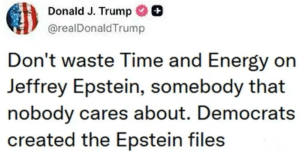 I can’t get over what’s going on with the Epstein Case. It sounds like the chickens are coming home to roost. Lady Justice knows the victims need closure and peace. As an activist against the abuse of women and children since I was 17 years old, I can only say we still haven’t caught up with what would be proper Justice. However, if this is what ultimately splits the MAGA coalition into pieces, it wouldn’t hurt my feelings or sensibilities at all. If the heat hasn’t driven me to take multiple baths, this story has added to it. You know if Yam Tits is obsessively using his Truth Social Platform, that he certainly knows there’s damning evidence of it. The AG has his back, and it’s a disgusting place for a woman.
This is from The Hill. “Carlson: Bondi ‘made up a bunch of ludicrous’ Epstein files claims.” Yes, that is Carlson, as in Tucker Carlson. I guess all those years of inner hate and outer support have caught up with him.
Political commentator and former Fox News host Tucker Carlson blamed Attorney General Pam Bondi in a new interview for the intense scrutiny the Trump administration has faced over its handling of documents related to convicted sex offender Jeffrey Epstein.
In the NBC News interview published Monday, Carlson said he doesn’t believe the Department of Justice (DOJ) has “much relevant information about Jeffrey Epstein’s sex crimes” that would satisfy those who have long called for the release of “Epstein files.”
“Rather than just admit that, Pam Bondi made a bunch of ludicrous claims on cable news shows that she couldn’t back up, and this current outrage is the result,” Carlson told the outlet.
Bondi has faced intense backlash after acknowledging last week there was no client list connected to Epstein’s alleged sex trafficking of minors and no evidence to suggest he didn’t die by suicide in prison in 2019 while awaiting sex trafficking charges.
President Trump has repeatedly defended Bondi and urged his supporters to move on from the Epstein case, but pressure has continued to mount among the president’s base to fire the former Florida attorney general.
Bondi said in a Fox News interview in February that an Epstein client list was on her desk to be reviewed and alleged that the DOJ had obtained hours of video related to the case. The White House in March invited 15 far-right influencers to an event, where they received white binders labeled “The Epstein Files: Phase 1,” but the display drew immediate backlash because the documents provided were already publicly available.
Bondi later claimed in another TV interview that she was duped into thinking she had all the files related to the government’s Epstein investigations and was seeking additional documents after hearing from an alleged “whistleblower.”
Bondi said last week that she was initially referring to documents related to the Epstein case — not a specific “client list,” and the footage she had mentioned was child sex abuse material that would not be released to the public. She said there was nothing else to be released from the case.
NBC News published this analysis of the Carlson interview! (Look, Mom! We’re a tabloid now!) The analysis is by Allan Smith. “Tucker Carlson leads MAGA’s worried warriors in questioning Trump. The former Fox News host and “America First” leader spoke with NBC News as MAGA influencers rebel over amnesty, Iran and the Epstein files.” Look who is trying to resurrect his career!
No other issue has tested the MAGA base’s commitment to Trump like the Epstein files.
For years, many on the right — including some people who are now in the Trump administration — have called for the release of all government documents related to Epstein. Epstein died in custody in 2019, and a medical examiner ruled his death a suicide. He was facing sex trafficking and conspiracy charges.
Last week, Attorney General Pam Bondi released a memo saying the Justice Department’s review turned up no “client list” of powerful men alleged to have participated in Epstein’s schemes, enraging the MAGA base, who are calling on her to be fired. Trump’s defense of Bondi and his attempts to tell his supporters to move on from the issue have done little to quell the furor.
On Saturday, Trump wrote “LET PAM BONDI DO HER JOB — SHE’S GREAT!” on Truth Social, adding the United States should “not waste Time and Energy on Jeffrey Epstein, somebody that nobody cares about.”
In his NBC News interview, Carlson said he now believes the Justice Department actually doesn’t have “much relevant information about Jeffrey Epstein’s sex crimes.”
“Rather than just admit that, Pam Bondi made a bunch of ludicrous claims on cable news shows that she couldn’t back up, and this current outrage is the result,” he said.
A Republican Senate aide thinks Carlson is actually having a bit of a “revival” as he carves out distinct space on the right.
“He’s more of a dissident figure now,” this person said. “For whatever else you’re going to say, Tucker is just kind of saying what he thinks.”
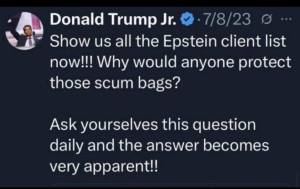
Back in the day!
Good luck rescuing that career, Tuckums! I’m not sure getting further in the pig trough with the big hogs is going to help, but then, I’m not a MAGA whisperer. Adam Gabbatt has more on this at The Guardian. “Trump encounters rare uproar from ardent rightwing allies over Jeffrey Epstein. White House claim it didn’t have list of Epstein’s alleged clients and that he wasn’t murdered has caused tumult even within administration.” Mudville is not a happy place.
Donald Trump managed something unusual last week. In his administration’s claim that it did not have a list of Jeffrey Epstein’s alleged clients, and that the convicted sex offender was not murdered, it succeeded in upsetting the rightwing influencers and commentators – and reportedly even Trump’s deputy FBI director – people who typically champion his every move.
“This stinks. This just reeks,” was the verdict of Jesse Watters, the primetime Fox News host.
He added: “The feds spent decades investigating Epstein and have had total access to his property for years, they still cannot give us a straight answer? This is not anything new; the government has been keeping us in the dark for generations.”
Watters was careful not to criticize the Trump administration directly, blaming “the feds” as he described Pam Bondi, the attorney general, and Kash Patel, the director of the FBI, as “great Americans”.
There was also tumult within the Trump administration. Dan Bongino, the deputy FBI director and former rightwing podcast host, spent years pushing Epstein conspiracy theories, and was reportedly very upset with Bondi over how the Epstein files were handled.
“Bongino is out-of-control furious,” a source close to Bongino told NBC News. “This destroyed his career. He’s threatening to quit and torch Pam unless she’s fired.” Axios reported that Bongino didn’t show up to work on Friday, and the row prompted Trump himself to step in.
Asked by reporters on Sunday if Bongino would remain in his position, Trump said: “Oh I think so … I spoke to him today. Dan Bongino, very good guy. I’ve known him a long time. I’ve done his show many, many times. He sounded terrific, actually.”
But within the rightwing, Epstein-curious sphere, others had continued to wade in.
“Pam Blondi [sic] is covering up child sex crimes that took place under HER WATCH when she was Attorney General of Florida,” wrote Laura Loomer, the 32-year-old conspiracy theorist whose influence over Trump has come under scrutiny.
Loomer accused Bondi of failing to pursue legal action against Epstein, despite lawsuits being filed against him in the Florida.
“She is afraid of that being discussed and brought to light. She needs to be fired. She has tainted the investigation,” Loomer concluded.
 Let’s see. He’s losing Fox, Loomer, Patel, and Bongino. This might be fun to watch after all. Although I still think I’ll need a lot of baths.
“NO ONE IS BUYING THIS!! Next the DOJ will say ‘Actually, Jeffrey Epstein never even existed.’ This is over the top sickening,” Alex Jones, the rightwing commentator and conspiracy theorist, wrote on social media.
The lackluster release also left others, outside of the far right, dissatisfied. Andrew Schulz, the host of the Flagrant podcast, who interviewed Trump in October and said he voted for him, included the Epstein saga as part of his reason for feeling let down by the president.
“When you feel like the status quo will do nothing and change nothing, you have way more of a longer leash for the outsiders’ ideas than you do the status quo’s ideas,” Schulz said, talking about Trump’s appeal.
“And I think that was the idea with Trump, it was like: ‘Maybe he will stop these wars.’ No. ‘Maybe we will see what’s up with this Epstein shit.’ No.”
Trump, who once enjoyed a friendship with Epstein, said in the run-up to last year’s election that he would declassify files related to Epstein, although he added: “You don’t want to affect people’s lives if there’s phoney stuff in there, because there’s a lot of phoney stuff in that whole world.”
At a cabinet meeting this week, however, Trump expressed surprise that people were “still talking” about Epstein, suggesting that the president was, for once, out of touch with his Maga base. “This guy’s been talked about for years,” Trump said, describing Epstein as a “creep”.
That failed to quell the anger, however, prompting Trump to write a lengthy Truth Social post over the weekend, pleading for calm from his supporters.
“What’s going on with my ‘boys’ and, in some cases, ‘gals?’ They’re all going after Attorney General Pam Bondi, who is doing a FANTASTIC JOB! We’re on one Team, MAGA, and I don’t like what’s happening. We have a PERFECT Administration, THE TALK OF THE WORLD, and ‘selfish people’ are trying to hurt it, all over a guy who never dies, Jeffrey Epstein.”
He added: “One year ago our Country was DEAD, now it’s the ‘HOTTEST’ Country anywhere in the World. Let’s keep it that way, and not waste Time and Energy on Jeffrey Epstein, somebody that nobody cares about.”
The replies to Trump’s post, however, suggested his appeal had not worked.
“My wanting pedophiles to be punished for their crimes doesn’t make me less of a patriot, but more,” one user wrote. “I don’t understand the reason for your current attitude and frankly I’m beyond the point of caring. I do care about justice, wether [sic] you approve or not.”
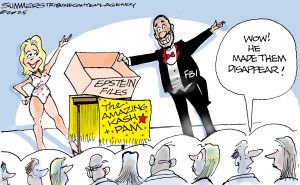 Adam Wren and Dasha Burns of Politico have this headline. “Playbook: Trump’s Epstein headache isn’t going away.” Guess I’ll need to stock up on my soap supply.
HERE TO STAY: At what should be the height of his political powers — having racked up signature wins in enacting his sprawling GOP megabill, bending U.S. allies to his will on defense spending, launching a successful and limited attack on Iran with no meaningful reprisals on U.S. forces — President Donald Trump is instead facing a fast-metastasizing MAGA rebellion over his administration’s handling of the files from the criminal investigation into Jeffrey Epstein.
First in Playbook: This morning, we have three threads of new reporting suggesting that this isn’t likely to go away any time soon.
1) A special counsel?: In an interview last night with Playbook, MAGA influencer and far-right activist Laura Loomer said “there should be a special counsel appointed to do an independent investigation of the handling of the Epstein files so that people can feel like this issue is being investigated, and perhaps take it out of [AG Pam Bondi’s] hands, because I don’t think that she has been transparent or done a good job handling this issue.”
2) MAGA allies press for presser: Playbook has also learned that at least one key figure in the extended MAGA universe, an ally supportive of the Trump DOJ’s handling of the Epstein case, has pitched senior White House officials on the idea of Bondi and Deputy AG Todd Blanche doing an all-questions-addressed news conference in an attempt to exhaust the press and put the story to bed.
3) Dems sense an opening: Rep. Marc Veasey (D-Texas), who is introducing legislation today that calls for the release of the Epstein files, shows Playbook how he’ll tie the “corruption and cronyism” of the handling of the Epstein case into a broader critique of Trump’s priorities. “I think he’s trying to protect some billionaire friend of his,” Veasey tells Playbook. “That’s what he lives for more than anything else in the world: protecting billionaires. Look at what he did with the so-called ‘big, beautiful bill.’”
WHAT MAKES THIS TIME DIFFERENT?: To a degree we have truly not seen over the past decade of Trump as a national political figure, his movement seems genuinely fractured. The Epstein case is fundamentally different from past divisions inside MAGA because it undercuts Trump’s self-styled brand as a speaker of uncomfortable truths, a slayer of sacred cows and a tribune of the people. This isn’t just a policy or ideological disagreement like, say, the MAGA unease over the Iran strikes; this cuts to the heart of his very political identity.
This is a problem partly of Trump’s own making. For years, many on the MAGA right alleged a massive governmental cover-up aimed at protecting Epstein, the convicted child sex offender and wealthy financier who circulated among the highest echelons of the rich and powerful. Trump and his allies were happy to amplify those whispers to their own political benefit.
These weren’t just allegations coming from anonymous cranks on the internet. JD Vance spoke publicly about an Epstein “client list” being kept secret by the government. Kash Patel did the same. Ditto Dan Bongino. Earlier this year, asked about “releasing the list of Jeffrey Epstein’s clients,” Bondi told Fox News “it’s sitting on my desk right now to review.”
Now? It’s a huge credibility problem. Vance, Patel, Bongino and Bondi — among others — effectively have to either acknowledge that they were not just wrong about the government covering up for Epstein, but actually making stuff up, or they come off like they’re part of a cover-up themselves.
To wit: In a new interview this morning, Tucker Carlson told NBC’s Allan Smith he now believes DOJ doesn’t actually have “much relevant information about Jeffrey Epstein’s sex crimes.” And therein lies a problem: “Rather than just admit that, Pam Bondi made a bunch of ludicrous claims on cable news shows that she couldn’t back up, and this current outrage is the result,” Carlson says.
WHAT’S TRUMP TO DO? The president has limited and conflicting options.
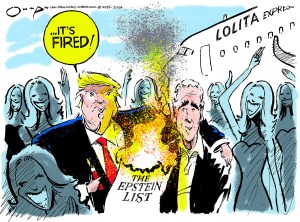 More on this at the link. Heather Cox Richardson brings a historian’s perspective to her SubStack this morning.
For the first time ever, Trump got ratioed on his own platform, meaning that there were more comments on his post than likes or shares, showing disapproval of his message. According to Jordan King of Newsweek, by 10:45 this morning (Eastern Time) it had more than 36,000 replies but only 11,000 reposts and 32,000 likes.
Trump sounds panicked, not only over the Epstein issue itself, but also because he cannot control the narrative his followers are embracing. After stoking the fire of his followers’ anger against what they seemed to see as powerful men getting away with crimes against children, he is now being burned by it. His reflex is to return to his greatest hits, accusing Democrats of writing the Epstein files and then, as he always, always, always does, snapping back to the Russia scandal and calling it a hoax.
Over the weekend, attendees at a conference held by the right-wing Turning Point USA booed the Trump administration’s handling of the Epstein case. MAGA influencers kept up the drumbeat; Matt Walsh called the administration’s about-face on releasing information “obvious bullsh*t.” Natalie Allison of the Washington Post reported that even the Fox News Channel warned this morning that “[t]here has to be some explanation” and that questions about the way the administration is handling the Epstein files were “very valid.”
Musk, who controls the X social media platform preferred by the right wing, is amplifying the story. After Trump’s Saturday post, Musk wrote to his 222 million followers: “Seriously. He said ‘Epstein’ half a dozen times while telling everyone to stop talking about Epstein. Just release the files as promised.”
Trump appears to be planning to regain control of the narrative by persecuting his political opponents.
But it is not clear that will silence MAGA voters who backed Trump in part because they thought he would lead the fight against an elite group of pedophiles controlling the country. As Trump’s policies on the economy, immigration, tax cuts, firing of government employees, and gutting of disaster relief have soured Americans on his administration, loyalists stayed behind him. Now he has turned against their chief cause, giving them an off-ramp from a presidency that seems increasingly off the rails.
Mike Flynn, who served as Trump’s first national security advisor until forced to resign for lying about his contact with Russian operatives, posted on social media: “[President Trump] please understand the EPSTEIN AFFAIR is not going away. If the administration doesn’t address the massive number of unanswered questions about Epstein, especially the ABUSE OF CHILDREN BY ELITES (it is very clear that abuse occurred), then moving forward on so many other monumental challenges our nation is facing becomes much harder.”
Flynn concluded: “We cannot allow pedophiles to get away. I don’t personally care who they are or what elite or powerful position they hold. They must be exposed and held accountable!!!”
Adam Wren breaks this news at Politico.
President Donald Trump faces a fast-metastasizing MAGA rebellion amid fallout over his administration’s handling of the files from the criminal investigation into Jeffrey Epstein.
And some of his closest allies are cautioning the situation for the president will get worse before it gets better — even as it threatens to derail his megabill victory lap and continues to divide parts of his administration and, more broadly, his supporters.
Trump has tried twice in as many days to tamp down his base’s anger, posting to Truth Social Saturday that he didn’t “like what’s happening” among his own supporters. He also threw his support behind Attorney General Pam Bondi, who has taken the brunt of much of the right’s ire over the Epstein files. Several news organizations have also reported that Bondi clashed with Deputy FBI Director Dan Bongino over the files.
After disembarking Air Force One Sunday at Joint Base Andrews, Trump faced a question about Bongino, who skipped work Friday. Trump insisted that he’s “a very good guy. … He sounded terrific, actually. No, I think he’s in good shape.”
Mike Davis, the MAGA legal brawler and occasional Oval Office visitor, has taken up defending Trump’s DOJ, said in an interview that “the Trump Justice Department wanted to be fully transparent, but can’t.” He added: “This is a case of no good deed going unpunished.”
Davis argues DOJ can’t release more, including that there is grand jury material involved, court records under seal, child pornography involved, the need to protect victims of “heinous crimes,” and “unsubstantiated, bogus claims, like we saw during the Kavanaugh proceedings, where you had double and even triple hearsay.”
A spokesperson for the White House declined to comment.
 You may want to read Greg Sargent’s latest at The New Republic. “The Young GOPer Behind “Alligator Alcatraz” Is the Dark Future of MAGA. Sunshine State Attorney General James Uthmeier is the real brains behind this notorious migrant detention camp in the Everglades. The more barbarities that emerge, the brighter his star will no doubt shine.”
The other day, Stephen Miller went on Fox News and offered a plea that got surprisingly little attention given its highly toxic and unnerving implications. Miller urged politicians in GOP-run states to build their own versions of “Alligator Alcatraz,” the state-run immigration detention facility that officials just opened in the Florida Everglades.
“We want every governor of a red state, and if you are watching tonight: pick up the phone, call DHS, work with us to build facilities in your state,” Miller said, in a reference to the Department of Homeland Security. Critically, Miller added, such states could then work with the federal government by supplying much-needed detention beds, helping President Trump “get the illegals out.”
Keep all that in mind as we introduce you to one James Uthmeier.
Uthmeier, the attorney general of Florida and a longtime ally of Governor Ron DeSantis, is widely described in the state as the brains behind “Alligator Alcatraz.” Peter Schorsch, the publisher of Florida Politics, sums him up this way: “In Uthmeier, DeSantis found his own Stephen Miller.”
Uthmeier is indeed a homegrown Florida version of Miller: Only 37 years old, he brings great precociousness to the jailing of migrants. Like Miller, he is obscure and little-known relative to the influence he’s amassing. Also like Miller, he is fluent in MAGA’s reliance on the spectacle of inhumanity and barbarism.
“You don’t need to invest that much in the perimeter,” Uthmeier said of “Alligator Alcatraz” in a slick video he recently narrated about the complex, which featured heavy-metal guitar riffs right out of a combat-cosplay video game. “People get out, there’s not much waiting for them other than alligators and pythons. Nowhere to go, nowhere to hide.”
Any migrant who dares escape just might get devoured alive by an animal—one animal eating another. Dehumanization is so thrilling!
The real-world “Alligator Alcatraz” is already gaining notoriety for its very real cruelties. After Democratic lawmakers visited over the weekend, they sharply denounced the scenes they’d witnessed of migrants packed into cages under inhumane conditions. Meanwhile, detainees and family members have sounded alarms about worm-infested food and blistering heat. And the Miami Herald reports that an unnervingly large percentage of the detainees lack criminal convictions.
But Uthmeier is getting feted on Fox News and other right wing media for this new experiment in spite of such notorieties—or perhaps because of them. There’s good reason to think more red state politicians will seek to create their own versions of “Alligator Alcatraz” or get in on this action in other ways—and that more young Republican politicians will see it as a path to MAGA renown and glory.
 I’ll let this Washington Monthly article by Jonathan Alter end this increasingly depressing news dump today. “America Is Now a Police State, The Medicaid cuts are terrible; the ICE expansions are even worse.”
If you have a hammer, everything looks like a nail. And if you have $75 billion over four years in new funding for ICE, you—Donald Trump, Stephen Miller, and Tom Homan—will use it to fund a huge domestic army to round up four million people in the next three years, put them in “detention centers” and deport them.
If these cruel men planned to go after criminals, as they claimed, they would have needed only a fraction of the money that Republican lawmakers just gave them. And ending the genuine shortfall in the Department of Homeland Security budget doesn’t require this kind of dough.
So with virtually unlimited funds, they’ll make up for lost time. We’re already witnessing swarms of masked agents grabbing people off the street. Within weeks, it’ll get a lot worse. The grandma who has been here for 30 years paying taxes; the Dreamer college student who has been thoroughly American since he was a toddler; the small business owner who gets a traffic ticket—3,000 of them a day will be ripped from their families, sent to a prison and shipped to a country where they don’t know anyone.
Count on it. The iron law of government budgeting is use-it-or-lose-it. Only bureaucratic fools have money left over at the end of the fiscal year. ICE will spend billions on meeting Chief Homan’s arbitrary and inhumane quotas—the same kind of arrest quotas that drive police states all over the world, as Ronan Farrow has explained.
And the thousands of new Border Patrol agents? They already bring to mind those old ads about the Maytag Repairman—waiting in vain for something to happen. With border crossings plummeting, it’s only a matter of time before they’re shifted north for an even heavier presence in blue urban America.
Before long, many of us won’t even notice the roundups, just as white Californians in 1942 didn’t pay much heed when their Japanese-American neighbors were whisked away to detention camps in the desert.
That was an inexcusable act, but the conditions in those camps, while spare and dehumanizing, were not as bad as in the “Alligator Alcatraz” that Trump is gloating over. These will be jails—not camps—built to be as close to the abusive Salvadoran model as the president can make them. And the scale of his migrant gulag is much larger. All told, about 120,000 Japanese were interned. The capacity of the new detention centers is planned to be roughly 120,000 per day.
With most detainees only weeks or months from deportation, that means millions of new migrants cycling through. Many will have done nothing worse than Trump’s German immigrant grandparents (and my Jewish grandmother) did a century ago, namely, overstaying their visas. Of course, if they happen to be employed at a golf course or hotel (exempted by Trump for obvious personal reasons), they wouldn’t be in jail in the first place. Here’s where we’re headed: If migrants work on farms or in slaughterhouses (lots of both in red states), or a kitchen (hospitality), they’re OK or maybe even headed for amnesty, as Trump—to the dismay of MAGA—hinted last week. But if they cut grass, clean houses, or work in other occupations unprotected by the Dear Leader, off to jail you go.

I should have no words, but I do, and all of them are surrounded by expletives. There are actions on July 17th in the spirit of Good Trouble and the late Congressman John Lewis. Do what you can to lift your voice against this reign of terror. If I can’t find an action or get there, I wear my No Kings T-shirt wherever I go, and I get attention on the St Claude Bus like you wouldn’t believe. I have signs in my front yard. I talk to people. I show up where I can. Keep on walking. Keep on talking, marching to Freedomland.
What’s on your Reading, Blogging, and ACTION list today?
Thursday Reads
Posted: May 18, 2023 Filed under: Donald Trump, FBI | Tags: "weaponization of government" hearings, classified documents, Jack Smith, Jack Teixeira, Jim Jordan, Mark Zaid, National Archives, national security clearances, Trump stolen documents 13 CommentsGood Morning!!
I don’t want to get too excited about this and then be let down, but it seems significant. Last night on Alex Wagner’s MSNBC show, national security attorney Mark Zaid said that the latest revelations about the Trump stolen documents investigation suggest that an indictment could be coming in weeks, not months. You can watch the video at Raw Story.
The Raw Story article is based on a new report from CNN yesterday: Exclusive: New evidence in special counsel probe may undercut Trump’s claim documents he took were automatically declassified.
The National Archives has informed former President Donald Trump that it is set to hand over to special counsel Jack Smith 16 records that show Trump and his top advisers had knowledge of the correct declassification process while he was president, according to multiple sources.
In a May 16 letter obtained by CNN, acting Archivist Debra Steidel Wall writes to Trump, “The 16 records in question all reflect communications involving close presidential advisers, some of them directed to you personally, concerning whether, why, and how you should declassify certain classified records.”
The 16 presidential records, which were subpoenaed earlier this year, may provide critical evidence establishing the former president’s awareness of the declassification process, a key part of the criminal investigation into Trump’s mishandling of classified documents.
The records may also provide insight into Trump’s intent and whether he willfully disregarded what he knew to be clearly established protocols, according to a source familiar with recent testimony provided to the grand jury by former top Trump officials.
Trump and his allies have insisted that as president, Trump did not have to follow a specific process to declassify documents. At a CNN town hall last week Trump repeated the claim that simply by removing classified documents from the White House he had declassified them. “And, by the way, they become automatically declassified when I took them,” Trump said.
According to the letter, Trump tried to block the special counsel from accessing the 16 records by asserting a claim of “constitutionally based privilege.” But in her letter, Wall rejects that claim, stating that the special counsel’s office has represented that it “is prepared to demonstrate with specificity to a court, why it is likely that the 16 records contain evidence that would be important to the grand jury’s investigation.” [….]
The letter goes on to state that the records will be handed over on May 24, 2023 “unless prohibited by an intervening court order.” [….]
Trump’s team may challenge this in court, this person said, but claimed in the past the Archives has handed over documents before the Trump team has had a chance to challenge the release in court.
Read more at the CNN link. Back to the Raw Story analysis:
According to a National Archives letter to Trump on May 16, the staff intends to provide special counsel Jack Smith 16 records that would reveal the White House advisers were taught the appropriate way to declassify documents.
“The 16 records in question all reflect communications involving close presidential advisers, some of them directed to you personally, concerning whether, why, and how you should declassify certain classified records,” acting Archivist Debra Steidel Wall wrote to Trump in a letter obtained by CNN.
This isn’t the first time that Trump has failed to scapegoat others for the documents that ended up at Mar-a-Lago. Top Trump adviser Kash Patel told a far-right outlet that the General Services Administration (GSA) packed up Trump’s boxes, and they were the ones who somehow forced Trump to steal the documents. Not long after, the GSA released a letter saying that they required the staff to sign off on the contents in the boxes.
Posting the CNN report on Twitter, former Republican Ethics Czar for George W. Bush, Richard Painter, explained that it’s an example of Trump lying to the federal government, a breach of 18 U.S.C 1001. “Yet another felony,” said Painter.
National security lawyer Mark Zaid said that Trump’s “awareness” of the classification process goes to Trump’s state of mind, “which is what criminal cases are generally about.”
Mark Zaid’s remarks:
Speaking to MSNBC’s Alex Wagner, Zaid explained that the case has never been about the mishandling of national defense information or classified documents. It’s about the Espionage Act. Mishandling classified information is a fairly frequent occurrence, he said, noting that he wouldn’t be surprised if every president since Reagan (and likely before that) had done it.
….What’s at issue here is that, as you reported and CNN had reported, Trump and his inner circle were told how to properly classify and declassify information. And I will say even further, because I independently verified it, that they were instructed in the days and weeks before leaving the White House for the transition on how to pack up the documents so as not to take classified information.”
He pointed to the obstruction piece of the case as being another problem for Trump. If leaks are to be believed, Zaid said, “Trump not only mishandled the information but also sought to hide it from the U.S. government and obstruct the investigation by deliberately acting on that, as well as giving instructions to others possibly, even his lawyers, as to where to move the documents around Mar-a-Lago.”
This seems like a BFD.
There’s unsettling news about Jack Teixeira today. He’s the airman from Massachusetts who stole massive amounts classified information and leaked it online.
From the NYT article by Glenn Thrush and Robin Stein:
Air Force officials caught Airman Jack Teixeira taking notes and conducting deep-dive searches for classified material months before he was charged with leaking a vast trove of government secrets, but did not remove him from his job, according to a Justice Department filing on Wednesday.
On two occasions in September and October 2022, Airman Teixeira’s superiors in the Massachusetts Air National Guard admonished him after reports that he had taken “concerning actions” while handling classified information. Those included stuffing a note into his pocket after reviewing secret information inside his unit, according to a court filing ahead of a hearing before a federal magistrate judge in Worcester, Mass., on Friday to determine whether he should be released on bail.
Airman Teixeira — who until March shared secrets with scores of online friends from around the world on Discord, a social media platform popular with gamers — “was instructed to no longer take notes in any form on classified intelligence information,” lawyers with the department’s national security division wrote in an 11-page memo arguing for his indefinite detention.
The airman’s superiors also ordered him to “cease and desist on any deep dives into classified intelligence information,” although it is not clear how, or if, they enforced that directive.
The new information was intended to drive home the government’s argument that Airman Teixeira’s relentless quest for intelligence to share with online friends — which he acknowledged to be improper — makes his release a danger to national security. But it also raised troubling new questions about whether the military missed opportunities to stop or limit one of the most damaging intelligence leaks in recent history.
The signs that something was amiss seem unmistakable in retrospect. In late January, a master sergeant who was working at the Air Force base on Cape Cod in Massachusetts observed Airman Teixeira inappropriately accessing reports on the Joint Worldwide Intelligence Communication System, the Pentagon’s secure intranet system, the memo said.
“Teixeira had been previously been notified to focus on his own career duties and not to seek out intelligence products,” one of his superiors wrote in a memo on Feb. 4 that prosecutors included in their filing.
Not only was Airman Teixeira allowed to remain in his job — he seems to have retained his top-secret security clearance — but he was subsequently given the second of two certificates after completing training intended to prevent the “unauthorized disclosure” of classified information.
Two of Teixeira’s bosses have been suspended and have lost their security clearances.
More from Devlin Barrett at The Washington Post. Again, the purpose of the filing is the argument from federal prosecutors that Teixeira should not be released on bond.
The Air National Guard member accused in a high-profile classified leaks case appears to have shared sensitive secrets with foreign nationals and had raised concernamong his co-workers in the months before he was charged with mishandling and disseminating national security information, prosecutors said in a court filing Wednesday….
Teixeira’s “willful transmission of classified information over an extended period to more than 150 users worldwide” undermines his lawyer’s claims that he never meant for the information to be shared widely, prosecutors wrote….
The new filing also recounts online chats in which Teixeira appears to both brag about how much classified information he knows and has shared, and understand the potential legal consequences of such actions.
“Knowing what happens more than pretty much anyone is cool,” the airman allegedly wrote in a chat dated mid-November. When another user suggested he write a blog about the information, Teixeira replied, “making a blog would be the equivalent of what chelsea manning did,” referring to a major classified leak case in 2010.
The filing also shows that Teixeira was written up by colleagues for apparently not following rules for the use of classified systems. A Sept. 15 Air Force memorandum included in the newly released court materialsnotes that Teixiera “had been observed taking notes on classified intelligence information” inside a room specifically designed to handle sensitive classified material.
That is covered in the NYT article.
This morning, Jim Jordan is holding another one of his ridiculous “weaponization of government” hearings. He has finally revealed the identity of some of his secret “whistleblowers.” The New York Times published information on today’s expected witnesses. The gist: these whistleblowers either participated in or supported Trump’s January 6, 2021 coup attempt.
From the NYT story by Alan Feuer: F.B.I. Revokes Security Clearances of 3 Agents Over Jan. 6 Issues.
The Federal Bureau of Investigation has revoked the security clearances of three agents who either took part in the riot at the Capitol on Jan. 6, 2021, or later expressed views about it that placed into question their “allegiance to the United States,” the bureau said on Wednesday in a letter to congressional investigators.
The letter, written by a top official at the F.B.I., came one day before at least two of the agents — Marcus Allen and Stephen Friend — were set to testify in front of a House Judiciary subcommittee investigating what Republicans contend is the “weaponization” of the federal government against conservatives.
For several months, Republican lawmakers have been courting F.B.I. agents who they believe support their contentions that the bureau and other federal agencies have been turned against former President Donald J. Trump and his supporters both before and after the Capitol attack.
Some of the agents have come forward as self-described whistle-blowers and taken steps like writing a letter to the leaders of the F.B.I. complaining about ways in which the bureau has discriminated against conservatives.
The agents who had their security clearances revoked — Mr. Allen, Mr. Friend and a third man, Brett Gloss — have all been suspended by the F.B.I. as the bureau reviews their cases, according to congressional investigators.
Why were these agents suspended?
Mr. Gloss’s top-secret clearance was revoked two weeks ago after bureau investigators determined that while moving with the pro-Trump mob on Jan. 6, he entered a restricted area of the Capitol grounds — a violation of federal law….
Mr. Allen’s top-secret security clearance was revoked after the bureau found that he had “expressed sympathy for persons or organizations that advocate, threaten or use force or violence,” the letter said. F.B.I. investigators determined that Mr. Allen had sent an email from his bureau account to several colleagues months after the Capitol attack, urging them to “exercise extreme caution and discretion in pursuit of any investigative inquiries or leads pertaining to the events of” Jan. 6, the letter said….
Mr. Friend, whose security clearance was revoked on Tuesday, had refused last summer to take part in a SWAT arrest of a Jan. 6 suspect who was facing misdemeanor charges. Mr. Friend had taken the position that the raid represented an excessive use of force.
“I have an oath to uphold the Constitution,” Mr. Friend, a 12-year veteran of the bureau, told his supervisors when he declined to join the operation on Aug. 24 in Jacksonville, Fla. “I have a moral objection and want to be considered a conscientious objector.”
More interesting stories to check out:
NBC News: New House bill would block pay for members of Congress if the U.S. defaults.
The Washington Post: School librarians face a new penalty in the banned-book wars: Prison.
The Daily Beast: PEN America And Penguin Sue Over Florida’s Book Bans.
AP News: Trust in Supreme Court fell to lowest point in 50 years after abortion decision, poll shows.
Guest essay by Randal D. Eliason at The New York Times: Why the Supreme Court Is Blind to Its Own Corruption.
The Daily Beast: GOP Congressman [Clay Higgins] Manhandles Protester During Boebert Event.
Politico: Trump 2020 lawyer indicated he may be target of Fulton County probe, court docs say.
That’s it for me. What stories have captured your interest today.
Lazy Caturday Reads
Posted: April 15, 2023 Filed under: cat art, caturday, FBI, SCOTUS | Tags: Boston bombing 10th anniversary, Clarence Thomas, Dick Durbin, Espionage Act, ethics, handcycle, Harlan Crow, Jack Teixeira, Michael Tomasky, Red Sox, Senate Judiciary Committee, terrorism, Ukraine mothers 11 Comments
The Favourite Chair, by Leon Charles Huber
Happy Caturday!!
Yesterday I told Dakinikat that I wished I had a feel good story for today’s post. I was asleep when she called last night and left a message about a New York Times article that was discussed on Stephanie Ruhl’s MSNBC show. It was about Ukrainian mothers who traveled thousands of miles to recover their children who had been kidnapped and taken to Russian-controlled territory. Of course it’s a heartbreaking story, but it’s also a heartwarming story of the power of a mother’s love. It also includes powerful photos of the women and their children. I hope you’ll go read it. Here’s just a bit of it.
The Russians Took Their Children. These Mothers Went and Got Them Back, bCarlotta Gall and
For weeks after Russian troops forcibly removed Natalya Zhornyk’s teenage son from his school last fall, she had no idea where he was or what had happened to him.
Then came a phone call.
“Mom, come and get me,” said her son, Artem, 15. He had remembered his mother’s phone number and borrowed the school director’s cellphone.
Ms. Zhornyk made him a promise: “When the fighting calms down, I will come.”
Artem and a dozen schoolmates had been loaded up by Russian troops and transferred to a school farther inside Russian-occupied Ukraine.
While Ms. Zhornyk was relieved to know where he was being held, reaching him would not be easy. They were now on different sides of the front line of a full-blown war, and border crossings from Ukraine into Russian-occupied territory were closed.
But months later, when a neighbor brought back one of her son’s schoolmates, she learned about a charity that was helping mothers bring their children home.
Since it is illegal for men of military age to leave Ukraine now, in March Ms. Zhornyk and a group of women assisted by Save Ukraine completed a nerve-wracking, 3,000-mile journey through Poland, Belarus and Russia to gain entry to Russian-occupied territory in eastern Ukraine and Crimea to retrieve Artem and 15 other children.
Then they had to take another circuitous journey back. “Come on, come on,” urged Ms. Zhornyk, as a cluster of children, laden with bags and suitcases, emerged hesitantly through the barriers at a border crossing from Belarus into Ukraine. She had crossed with her son just hours earlier and pushed forward impatiently to embrace the next group.
“There are no words for all the emotions,” Ms. Zhornyk, 31, said, describing her reunion with Artem. “I was full of emotion, and nervous, nervous.”

Cat on a chair, by Theophile Alexandre Steinlen
There are more details about what happened to the children in the article. Some background:
In the 13 months since the invasion, thousands of Ukrainian children have been displaced, moved or forcibly transferred to camps or institutions in Russia or Russian-controlled territory, in what Ukraine and rights advocates have condemned as war crimes.
The fate of those children has become a desperate tug of war between Ukraine and Russia, and formed the basis of an arrest warrant issued last month by the International Criminal Court accusing President Vladimir V. Putin of Russia and Maria Lvova-Belova, his commissioner for children’s rights, of illegally transferring them.
Once under Russian control, the children are subject to re-education, fostering and adoption by Russian families — practices that have touched a particular nerve even amid the carnage that has killed and displaced so many Ukrainians….
No one knows the full number of Ukrainian children who have been transferred to Russia or Russian-occupied Ukraine. The Ukrainian government has identified more than 19,000 children that it says have been forcibly transferred or deported, but those working on the issue say the real number is closer to 150,000.
Again, there is much more at the NYT link.
I hope you’ll forgive me for highlighting a local Boston story today. This weekend marks the 10th anniversary of the 2013 Boston Marathon bombing. The marathon will take place on Monday. Although only three people were killed in the explosions, there were hundreds of horrific injuries–limbs blown off, terrible burns, traumatic brain injuries.
From Boston.com: Mark the 10-year anniversary of the Marathon bombings in Boston One Boston Day is Saturday, April 15.
It has been 10 years since the Boston Marathon bombings killed three people and injured hundreds more during the 2013 Boston Marathon, and the city is hosting several events in remembrance of the day.
The city of Boston and the Boston Athletic Association (B.A.A.) will host remembrance events on Saturday, April 15 — One Boston Day. The events will honor the victims, survivors, and first responders of the 2013 Boston Marathon.
The city will host an early-morning private gathering and wreath laying at the memorial sites for the families who lost loved ones. Honor guards — including the Boston Fire Department, Boston Police Department, Boston Emergency Medical Services, and Suffolk County Sheriff Department — will be present at the memorial sites throughout the day.
At 8 a.m.,the BAA 5K, featuring 10,000 participants, will begin and end in Boston Common. After the B.A.A. 5K race, the city will open Boylston Street between Dartmouth and Fairfield streets so that members of the public can visit the sites.
At 2:30 p.m., the public is invited to a dedication of a new commemorative Boston Marathon finish line, the ringing of bells, and the unveiling of a One Boston Day marker on Boylston Street along with Gov. Maura Healey, Mayor Michelle Wu, B.A.A. leadership, members of the One Fund community, members of the 2013 Red Sox team, first responders, hospital leaders, and local running groups.
“Every year we come together on One Boston Day to remember the courage, strength, and resilience shown by our city’s people in 2013,” Wu said in a statement. “As we mark 10 years, we will gather together in community on April 15 to remember the lives that were lost, the many injured, and the spirit of humanity displayed that day. As we honor those forever impacted, people in all corners of our City will be giving back in a number of ways, and I encourage everyone to get involved.”
There will also be many local and neighborhood events; and of course, the Red Sox will mark the day at their traditional Marathon Day game and will be wearing their bright yellow home uniforms.
The Red Sox will mark the 10 year milestone by partnering with JetBlue to distribute more than 40,000 blue and yellow Red Sox City Connect hats to students and staff at Boston Public Schools on Friday, April 14. Hall of Famer Pedro Martinez will assist with the distribution. The team will then wear blue and yellow City Connect jerseys during Friday night’s game in Fenway Park agains the Angels.
Painting by Chen Pei Yi
As previously mentioned, the 2013 Red Sox team will join city and state officials and first responders on Saturday, April 15 for the ringing of the bells and the unveiling of the One Boston Day marker. At Saturday’s game, there will be a pre-game ceremony commemorating One Boston Day and the 76th anniversary of Jackie Robinson breaking the color barrier. Fans should be in their seats by 3:30 p.m.
On Sunday, April 16, a reunion of members of the 2013 Red Sox World Series Championship team will take place during pregame ceremonies. Fans should be in their seats by 1 p.m.
On Patriots Day, Monday, April 17, Hall of Famer David Ortiz will serve as the Grand Marshal for the 127th Boston Marathon. Players will wear home jerseys that say “Boston” on the front, as they did for the first time during the Marathon tribute at Fenway Park on April 20, 2013. Fans are asked to be in their seats by 10:45 a.m. for the ceremony. All fans will receive a Boston Strong t-shirt.

The FBI is also marking the anniversary. From FBI News: Marathon Bombing Anniversary. FBI Boston marks 10-year-anniversary by honoring victims, recalling responders’ heroic efforts.
Leading up to the 10-year anniversary of the bombing at the Boston Marathon—and the ensuing manhunt and investigation that was the FBI’s largest terrorism case since 9/11—the special agent in charge of FBI Boston asked his entire office to pause and reflect on the crucible of that massive investigation as they prepared for this year’s 127th running.
Leading up to the 10-year anniversary of the bombing at the Boston Marathon—and the ensuing manhunt and investigation that was the FBI’s largest terrorism case since 9/11—the special agent in charge of FBI Boston asked his entire office to pause and reflect on the crucible of that massive investigation as they prepared for this year’s 127th running.
Three people were killed on April 15, 2013, when two pressure-cooker bombs detonated 11 seconds apart on Boylston Street near the finish line of the iconic 26-mile race. More than 500 people were physically injured, including 17 who suffered amputations. The bombers also took the life of Sean Collier, a Massachusetts Institute of Technology Police officer who was executed while on patrol.
Large images of the victims were arrayed in a conference room last month at the Boston Field Office, along with a whiteboard agents used to sketch out their plans and the wanted posters that helped identify the suspects, brothers Dzhokhar and Tamerlan Tsarnaev. A moment of silence preceded the remembrance ceremony….
…[H]e also wanted to enlighten the office’s large cadre of young agents, analysts, and professionals—many not around 10 years ago—who may not fully appreciate the all-hands-on-deck response required in major cases like this.
“Internally, I wanted to give my personnel a real good idea, with some granularity, about what it means when a critical incident occurs,” he said, “what is expected of all of us to step up, and how we work toward a common goal.”
The article reviews the positive steps that made the investigation a model for the future.
Two survivors stories:
Ten years after the explosions at the Boston Marathon finish line that forced doctors to amputate part of Heather Abbott’s leg, she says the biggest change in her life is her work with the foundation she built to help other amputees. “If someone had told me that I would be doing this ten years ago, I never would have believed them,” Abbott said. “But it’s been an unexpected blessing, I think, for me.”
Cat sleeping on a chair, by George Atsametakis
The creation of the Heather Abbott Foundation is also a blessing for its beneficiaries. The foundation helps amputees pay for prosthetics that insurance won’t cover-which includes almost anything beyond the most basic option. Running blades, swim legs, high heels-these are all vital to helping people live full lives. But insurance companies don’t consider them “medically necessary.” (Prosthetics typically have to be replaced every three to five years.)
Heather delights in sharing the news with beneficiaries that they have been chosen to receive a special prosthesis. “Not only is it incredibly rewarding to hear somebody on the other end of the phone when you tell them that you’re going to give them this prosthetic device,” Abbott said. “But then to hear about the things they’re able to do with it and how it’s changed their life provides me a huge sense of joy.”

People Magazine: Boston Marathon Bombing Survivor Will Race on the 10th Anniversary: ‘I’m Ready to Move On’ (Exclusive).
Marc Fucarile was supporting a friend at the 2013 Boston Marathon when the second bomb went off and instantly amputated his right leg. Now, ten years later, he’ll return to the marathon to thank the city and the people who have supported him.
“You never want to be on the receiving end of generosity because that means something bad happened, but it’s emotional knowing that complete strangers care about you,” Fucarile tells PEOPLE.
Before the 2013 tragedy, Fucarile was an athlete. “I played football, track, and hockey, and it was my first time at a marathon in 35 years,” he says. “The second bomb was right next to me.”
The bomb blew out Fucarile’s ear drums, burned the majority of his lower body, and forced him to undergo years of surgeries. “I did the remainder of 2013 in and out of hospitals with smaller, different surgeries, monitoring scrap metal that lodged in my heart, that took a ride up to the artery and lodged in my right atrium area.”
Fucarile has “skin grafts all over” the lower half of his body and in his hands from “taking off my belt when I was still on fire,” he explains.
Because he sustained a traumatic brain injury, Fucarile says his tolerance for noise and stimulating environments is low, which has affected his relationship with his 15-year-old son….
On the tenth anniversary, he’ll be riding in honor of the community that supported him through the 2013 tragedy. “I’m riding to show my thanks for all the support we received as survivors of such a horrific event,” he says. “The community outpour of support was amazing.”
When he participates in the marathon on Monday, Fucarile says he’ll be representing more than just his own resilience. “I’m riding in the hand cycle to show people, and to show my son, that you can really accomplish anything you put your mind to,” he explains.
A handcyle is a kind of tricycle that is powered by hands rather than your feet.

In politics news, Clarence Thomas has finally been caught breaking an actual law–as opposed to ethics rules, which he has completely ignored–when he sold property to Harlan Crow and failed to report the transaction. He needs to be called to account and forced off the Supreme Court.
Citizens for Ethics.org: CREW files civil and criminal co,mplaint against Clarence Thomas.
The Department of Justice and the Chief Justice of the Supreme Court should investigate Supreme Court Justice Clarence Thomas for failing to disclose hundreds of thousands of dollars in gifts from and property sales to billionaire donor Harlan Crow, according to a complaint sent today by Citizens for Responsibility and Ethics in Washington to the Department of Justice and Chief Justice John Roberts.
According to reporting by ProPublica, Thomas and his wife have accepted luxury travel and vacations for 20 years from “real estate magnate and Republican megadonor” Crow, who befriended Thomas after he joined the Supreme Court, without disclosing them as gifts or travel reimbursements on his financial disclosures filed under the Ethics in Government Act. Thomas also reportedly sold his and other family members’ properties to Crow in 2014 for more than $100,000 without reporting the sales on his financial disclosure reports.
“Justice Thomas’s acceptance of and failure to disclose these repeated, lavish gifts and shocking real estate sales not only undermines public trust in his ability to serve impartially on the Court, it undermines confidence in the Supreme Court as an institution,” CREW President Noah Bookbinder said.
Under the Ethics in Government Act, Thomas is required to disclose travel and other gifts, with the source and a brief description, including the value. The Guide to Judiciary Policy for Financial Disclosure in effect at the time the trips were taken makes it clear that these trips were covered by the reporting requirements. While Thomas claims a hospitality exemption, that exemption would not apply to a private plane or yacht. Under the EIGA and Guide to Judiciary Policy for Financial Transaction, Thomas was required to report the sale of the properties to Crow and could not claim a personal residence exemption on disclosing them, as they were always referred to as rental properties on his disclosures and never lost their investment nature even when the houses on two of the properties were later torn down.
Dahlia Lithwick and Mark Joseph Stern: Quid Pro Crow. Clarence Thomas’ position toward disclosure is actually clarified by his jurisprudence.
When news broke last week, by way of dogged reporting in ProPublica, that Justice Clarence Thomas had accepted decades’ worth of hospitality from billionaire Republican donor Harlan Crow, that this same donor had funded his wife’s legal and political activities and in fact helped pay her salary, and that Thomas had disclosed none of this, our suggestion that the justice had clearly broken the law was dismissed as left-wing “smear.” ProPublica’s new reporting, dropped on Thursday, showed that the same billionaire donor, Harlan Crow, spent $133,363 purchasing several properties co-owned by Thomas, and that these sales were never disclosed. As our colleagues at Slate confirmed this week, Thomas’ mother actually still lives in the property owned by Crow, to which he has made valuable improvements (in addition to buying the house next door and dispensing with previously troublesome neighbors). Unlike the rules around the undisclosed luxury travel reported last week, ProPublica could not find a single ethics expert willing to squint and hop on one foot in a way that would make the failure to report the real estate transaction seem arguably lawful. The court has not responded in any way to the latest revelations. Defenders of Justice Thomas somehow continue to urge that this is a smear campaign by liberals.
Painting by Suzanne Valadon
In a way, the fact that money went from Harlan Crow’s pocket to Thomas’ mom’s house seems less horrifying than last week’s superyachts and half-million-dollar luxury air travel. Who among us wouldn’t want a billionaire to evict the noisy neighbors who were keeping our mothers up late? But it helps to parse out what mattered about both Thomas stories and what is mostly a distraction. That Thomas is a “hypocrite” for claiming to like parking outside Walmarts to commune with real people while secretly indulging his taste for luxe global travel? Doesn’t really matter. Harlan Crow’s penchant for cunningly little embroidered Nazi table linens? Weird, surely, but materially inconsequential….
What mattered last week and what still matters this week is whether the Crow/Thomas dealings can be seen as classic quid pro quo (or perhaps quid pro Crow)corruption. We too often think this can only happen in a scene in which cartoon ducks with big sacks of cash pay politicians to do their bidding, which is never how this actually happens. And the longstanding defense to those claims is that Justice Thomas is too independent a thinker and jurist to be influenced by gifts of bibles and vacations and rent-free housing. But what this new reporting shows—and what actually matters—is that Crow and those like him, who have poured billions of dollars into funding cases before the court, campaigns to seat certain justices on the court, and crusades to keep other justices off the court, turn out to just own the whole building. In tandem with the Leonard Leos and Mark Paolettas who have been rendered in art for all eternity, the Harlan Crows are the actual landlords of the houses where the six conservative justices seemingly get to live rent-free.
f you’re defending Thomas’ unlawful refusal to disclose these transactions by saying he’s too famous/powerful/important/busy/put-upon to disclose these transactions, you are missing the point. Disclosure laws aren’t tawdry “gotcha” traps that form the basis of smear campaigns. Disclosure rules are the only means of transparency in a world of increasingly broken democratic systems. Citizens United and its dismantling of campaign finance reform? Justified on the grounds that disclosure rules suffice to ferret out corruption. We don’t demand that public figures deal honestly with the public because we are mean; we do it because law and democracy rise and fall on knowing who paid who for what.

At The New Republic, Michael Tomasky wrote this piece after the first revelations and before we learned about the real estate transactions: The Democrats Need to Destroy Clarence Thomas’s Reputation.
ProPublica’s report last week is jaw-dropping. In the end it shows this: Thomas used to report his gifts from right-wing billionaire Harlan Crow. Then they became a little controversial. So what did Thomas do? Stop accepting the gifts? That’s what you or I would do, or at least make them far less frequent and ostentatious. But Thomas doesn’t think like you or I do. He thinks: How I can twist the dagger into the liberal establishment’s flesh even further? So rather than stop accepting the gifts, he just decided to stop reporting them. Which ProPublica says is against the law.
Can he be impeached? Not now, with the GOP in control of the House. If that changes, sure, they can try, as Alexandria Ocasio-Cortez and others have suggested. Of course, he would be acquitted in the Senate, where two-thirds are required to convict (indeed, Samuel Chase survived).
But that’s no reason for Democrats not to do it. In fact, as I suspect AOC understands, the way partisanship works today in this country, that’s precisely an excellent reason to do it: Have a long hearing that lays bare every instance of his and his wife’s corrupt activities in a high-profile venue that Americans will watch; make the case to swing-voting Americans that he is dishonoring the court’s name and reputation; drive his approval ratings into the toilet (in a 2022 YouGov poll, Thomas already had the highest “very unfavorable” rating of the nine justices, at 32 percent); and force the Republican senators to vote to keep this clearly undeserving, mediocre, arrogant, unscrupulous hornswoggler on the court.
Make him a political issue (not in time for 2024, alas, but in general). Destroy his reputation. If nothing else, ensure that he goes down in history the way he deserves, as one of the most unqualified Supreme Court justices ever, who has gone on to leave as light an intellectual footprint as someone serving three-plus decades could leave. Make him—and his wife, Ginni, who is also completely without scruples in the way she, as the spouse of a Supreme Court justice, entangles herself in our public life—a metaphor for every insidious thing the far-right wing has done to this country.

Painting by Vanessa Stockard
It’s really up to the Judiciary Committee Chair Dick Durbin to start the process of investigating Thomas, but does Durbin have the guts to do what needs to be done? I don’t think so. He needs to be forced into it by public outrage. I got a newsletter about this from Tomasky in my email today. I can’t find it online, but here’s some of it:
Earlier this week, I wrote in response to ProPublica’s first report that the Democrats need to destroy Thomas’s reputation by holding hearings on his dealings, which of course is something they’ve never done. “Have a long hearing that lays bare every instance of his and his wife’s corrupt activities in a high-profile venue that Americans will watch,” I wrote. “Make the case to swing-voting Americans that he is dishonoring the court’s name and reputation; drive his approval ratings into the toilet (in a 2022 YouGov poll, Thomas already had the highest ‘very unfavorable’ rating of the nine justices, at 32 percent); and force the Republican senators to vote to keep this clearly undeserving, mediocre, arrogant, unscrupulous hornswoggler on the court.”
Now the case for action is even clearer. But action by whom? There’s only one serious contender: the Senate Judiciary Committee. It’s controlled by the Democrats, and they can do whatever they are prepared to do. But what exactly is that?
Last Monday, after the first ProPublica report, committee Chairman Dick Durbin vowed that the committee “will act.” He did not elaborate on that. Later, he urged Chief Justice John Roberts to investigate Thomas. Then I saw on cable news Thursday night (I can’t find anything online Friday morning) that he called on Merrick Garland to do something.
Mr. Chairman: Stop tossing the football around. You have a gavel, and you have subpoena power. Subpoena Clarence Thomas. Next week.
What? Horrors! Subpoena a Supreme Court justice? Can that even be done?
Yes it can, but only if the Democrats have the guts to do it.
The other big story today is about 21-year-old leaker of top secret documents, Jack Teixeira. Here are the latest stories:
Charlie Savage at The New York Times: Teixeira’s case is unusual even in the small world of leak cases.
It is hard to predict how the case against Jack Teixeira, the 21-year-old Air National Guardsman accused of leaking classified documents to friends on a gaming server, will play out — both because the matter is still very preliminary and because the facts are so unusual that there is limited value in comparing it to the general pattern of leak cases.
By Steve Hanks
Based on the charging documents in his case, Airman Teixeira does not appear to have been acting as a foreign agent, differentiating him from classic spying cases. He also does not appear to have been acting as a whistle-blower or otherwise trying to educate the general public by sharing secrets with the news media for publication, making his case different from another sort that has become more common in the 21st century.
He also does not fit a third category of past cases of mishandling classified information: the hoarder. Prosecutors have charged people who are neither spying nor trying to enlighten the public for taking files home and keeping them. But because Airman Teixeira is accused of transmitting large numbers of files to other people who were not authorized to see them, his case is more serious.
These differences show how past cases may be poor guides for how this will play out.
Defendants also have an incentive to make a deal so they can ensure a shorter sentence than the threat they are facing under the Espionage Act, which criminalizes the unauthorized retention and disclosure of national-security secrets. It carries a sentence of up to 10 years per count, and each leaked document could be its own count. Plea deals in leak-related cases have typically resulted in a few years of prison.
But prosecutors may be less willing to offer a relatively attractive prison sentence in a case as serious as Airman Teixeira’s, which involved hundreds of classified documents that revealed sensitive matters, like how extensively the United States has penetrated Russian military communications.

Read more at the NYT and in these articles:
The Washington Post: Leak raises fresh questions about Pentagon’s internal security.
BBC News: Jack Teixeira’s charges in full: ‘Top secret’ access, leak searches and the Espionage Act.
The Wall Street Journal: Airman, Arrested for Leaks, Chatted in Groups Fascinated by Weapons and War.
That’s it for me. I hope you find something here to interest you. Have a great weekend!!
Thursday Reads
Posted: March 2, 2023 Filed under: Afternoon Reads, Donald Trump, FBI, SCOTUS | Tags: Chris Christie, Christopher Wray, domestic terrorism, Georgia election interference, Hillary Clinton, James Comey, Kellyanne Conway, Peter Strzok, Ruby Freeman, Shaye Moss, stolen classified documents, student loan forgiveness 13 CommentsGood Afternoon!!

Oskar Bergman, Spring Birches and Red Cottages by the Sea
You probably saw the incredible story that The Washington Post broke yesterday about FBI agents living in fear of Donald Trump. Some were so scared that they wanted to treat Trump with kid gloves, even after he stole hundreds of classified documents from the government and refused to return them. So it’s not just elected Republicans who are scared of Trump–even some in law enforcement want to let him get away with serious crimes in order to protect their own careers.
The Washington Post: Showdown before the raid: FBI agents and prosecutors argued over Trump.
Months of disputes between Justice Department prosecutors and FBI agents over how best to try to recover classified documents from Donald Trump’s Mar-a-Lago Club and residence led to a tense showdown near the end of July last year, according to four people familiar with the discussions.
Prosecutors argued that new evidence suggested Trump was knowingly concealing secret documents at his Palm Beach, Fla., home and urged the FBI to conduct a surprise raid at the property. But two senior FBI officials who would be in charge of leading the search resisted the plan as too combative and proposed instead to seek Trump’s permission to search his property, according to the four people, who spoke on the condition of anonymity to describe a sensitive investigation.
Prosecutors ultimately prevailed in that dispute, one of several previously unreported clashes in a tense tug of war between two arms of the Justice Department over how aggressively to pursue a criminal investigation of a former president. The FBI conducted an unprecedented raid on Aug. 8, recovering more than 100 classified items, among them a document describing a foreign government’s military defenses, including its nuclear capabilities.
Starting in May, FBI agents in the Washington field office had sought to slow the probe, urging caution given itsextraordinary sensitivity, the people said.
Some of those field agents wanted to shutter the criminal investigation altogether in early June, after Trump’s legal team asserted a diligent search had beenconducted and all classified records had been turned over, according to somepeople with knowledge of the discussions.
This sounds familiar. Back in 2016, James Comey kept the investigation of Trump and Russia secret, while making public statements about the much less significant investigation of Hillary Clinton’s emails; because FBI agents in the New York office had it in for Hillary and supported Trump. WTF is going on with the FBI? Here’s what Peter Strzok, who lost his job at the FBI because of pressure from Trump, had to say about this news:
https://twitter.com/petestrzok/status/1630919361564164096?s=20
https://twitter.com/petestrzok/status/1630920732753494016?s=20
Back to the WaPo article:
The disagreements stemmed in large part from worries among officials that whatever steps they took in investigating a former president would face intense scrutiny and second-guessing by people inside and outside the government. However, the agents, who typically perform the bulk of the investigative work in cases, and the prosecutors, who guide agents’ work and decide on criminal charges, ultimately focused on very different pitfalls, according to people familiar with their discussions.
On one side, federal prosecutors in the department’s national security division advocated aggressive ways to secure some of the country’s most closely guarded secrets, which they feared Trump was intentionally hiding at Mar-a-Lago; on the other, FBI agents in the Washington field office urged more caution with such a high-profile matter, recommending they take a cooperative rather than confrontational approach.
Both sides were mindful of the intense scrutiny the case was drawing and felt they had to be above reproach while investigating a former president then expected to run for reelection. While trying to follow the Justice Department playbook for classified records probes, investigators on both sides braced for Trump to follow his own playbook of publicly attacking the integrity of their investigation, according to people with knowledge of their discussions.
The FBI agents’ caution also was rooted in the fact that mistakes in prior probes of Hillary Clinton and Trump had proved damaging to the FBI, and the cases subjected the bureau to sustained public attacks from partisans, the people said.
Prosecutors countered that the FBI failing to treat Trump as it had other government employees who were not truthful about classified records could threaten the nation’s security. As evidence surfaced suggesting that Trump or his team was holding back sensitive records, the prosecutors pushed for quick action to recover them, according to the people familiar with the discussions.
It’s a very long piece–head over to the WaPo to read the rest.

Paul Cézanne, Melting Snow
I have to ask: why does Christopher Wray still have a job? From Jennifer Rubin at The Washington Post: Christopher Wray is getting away with doing a lousy job.
The MAGA right thinks FBI Director Christopher A. Wray is some sort of patsy for Democrats. But the problem is not that Wray, a Trump appointee, is showing favoritism to a Democratic administration. It’s that he is not doing his job when it comes to threats from right-wing authoritarianism.
The extent to which the FBI was aware of credible threats but did not prepare is breathtaking:In the weeks preceding the January 6 attack on the Capitol, the FBI obtained information across other sources indicating potential threats. Through human source reporting, investigations, and observed activity, the FBI identified the increasing threat of violence at high profile special events, such as the 2020 election and 2021 presidential inauguration. FBI officials we spoke with said that from December 29, 2020, through January 6, 2021, they tracked domestic terrorism subjects that were traveling to Washington, D.C., and developed reports related to January 6 events. As of January 6, 2021, FBI officials noted that the Washington Field Office was tracking 18 domestic terrorism subjects as potential travelers to the D.C. area.Other information came directly from social media platforms. From October 1, 2020, through January 5, 2021, officials from the FBI we spoke with said they obtained and reviewed 73 potential domestic terrorism related referrals from one social media platform, and obtained one referral on January 4, 2021, related to potential violence in Washington, D.C. on January 6. In addition, the FBI received information from another social media platform from late November 2020 through January 6, 2021, regarding potential violence at January 6 events.Once the FBI had that information, it did not act upon it with the urgency required. “FBI personnel did not follow policies for processing some tips, resulting in them not being developed into reports that could have been shared with partners. Specifically, the FBI did not process all relevant information related to potential violence on January 6.”
The conclusion: “While the FBI identified and shared threat information, it did not process certain referrals from social media platforms according to policies and procedures and, as a result, it failed to share critical information with all relevant partners.”
Worse, the bureau has not undertaken the kind of systematic self-evaluation needed to correct glaring inadequacies. “The ongoing FBI review of its actions during the weeks preceding January 6, 2021, has not included an assessment of how it processed information. Assessing this process will help determine if the mistakes we identified are isolated or due to a systemic cause.” (Emphasis added.)
Click the link to read the rest.
In other news, Chris Christie thinks Trump will be indicted by this summer. The Independent: Chris Christie explains why he believes Trump will be indicted.
Former New Jersey Governor Chris Christie has said that he thinks former President Donald Trump will be indicted in connection to at least one of the numerous investigations he’s the subject of, as the former president campaigns for the 2024 GOP nomination.
Gabriele Münter, Still Life on the Tram (After Shopping)
Mr Christie, who ran against Mr Trump and more than a dozen others in the 2016 Republican primary, spoke to conservative radio host Hugh Hewitt on Wednesday, saying that he believes Mr Trump’s attorneys wouldn’t be able to reject the case of the grand jury in Fulton County, Georgia, even after the jury foreperson made a series of media appearances, prompting criticism towards some of her conduct….
“This is a very difficult case to make off the phone call,” Mr Christie said of the phone conversation between Mr Raffensperger and Mr Trump. “Now I don’t know what their other evidence is. That’s supposed to be the beauty of the grand jury system. And it is so far in this case that you don’t know what all the specific other evidence may be. But based upon what I know publicly, I think it’s a tough case to bring against the former president based upon the information we now know.”
Mr Christie added that Mr Trump appears to be legally vulnerable in connection to the lead-up to the January 6, 2021 insurrection and obstruction of Congress.
“I think the most likely place it will happen is New York. And I think it’s the least harmful matter to him,” he told Mr Hewitt. “If in fact, all they’re looking at is the Stormy Daniels payments….
“I think in terms of the likelihood of indictment, I’d put New York first, the special counsel second, Georgia third. But in terms of the seriousness of the peril for the president, I’d put the special counsel above either of those,” Mr Christie said.
“So in brief, do you expect an indictment by July?” the host asked the ex-governor.
“I expect that New York probably would act. I don’t know whether the special counsel will act by that time, but my guess is that New York would act by that time,” he said.

The New York Times broke some news yesterday on that New York case: Kellyanne Conway Meets With Prosecutors as Trump Inquiry Escalates.
Kellyanne Conway, who managed the final months of Donald J. Trump’s 2016 campaign, met with prosecutors from the Manhattan district attorney’s office on Wednesday, the latest sign that the office is ramping up its criminal investigation into the former president.
The prosecutors are scrutinizing Mr. Trump’s role in a hush money payment to a porn star, Stormy Daniels, who has said she had an affair with him. The $130,000 payment was made by Mr. Trump’s longtime fixer, Michael D. Cohen, in the closing days of the 2016 campaign, and Mr. Trump ultimately reimbursed him.
Mr. Cohen has said that Ms. Conway played a small yet notable role in the payment: she was the person Mr. Cohen alerted after making the payment, he wrote in his 2020 memoir.
“I called Trump to confirm that the transaction was completed, and the documentation all in place, but he didn’t take my call — obviously a very bad sign, in hindsight,” he wrote. Instead, he wrote, Ms. Conway “called and said she’d pass along the good news.”
Ms. Conway, who was seen walking into the district attorney’s office shortly before 2 p.m. on Wednesday, is the latest in a string of witnesses to meet with prosecutors in the last month or so. Since the district attorney, Alvin L. Bragg, impaneled a grand jury in January to hear evidence about Mr. Trump’s role in paying the hush money, at least five witnesses have testified: Jeffrey McConney and Deborah Tarasoff, employees of Mr. Trump’s company; David Pecker and Dylan Howard, two former leaders of The National Enquirer, which helped arrange the hush money deal; and Keith Davidson, a former lawyer for Ms. Daniels.
The decision to question those central players in the hush money saga before the grand jury suggests that Mr. Bragg is nearing a decision on whether to seek an indictment of the former president.

Weasels Playing, Franz Marc
Another possibility for Trump to face some accountability is through a lawsuit by Georgia poll workers Ruby Freeman and Shaye Moss. The Daily Beast: Georgia Poll Workers Pick Up Where Jan. 6 Committee Left Off.
Two Georgia poll workers who were attacked by 2020 election conspiracy theorists are picking up where the Jan. 6 congressional investigation left off—by trying to independently examine the private communications between two of the men behind the firestorm: Rudy Giuliani and former President Donald Trump.
Giuliani, who played a central role in the Republican attempt to overturn the 2020 presidential election as Trump’s lawyer, refused to tell congressional investigators about their conversations, citing attorney-client privilege.
But now, a mother and daughter still reeling from the MAGA harassment are trying to pierce that veil.
Ruby Freeman and Shaye Moss of Fulton County, Georgia, are turning their defamation lawsuit against Giuliani into a no-limits, fact-finding mission, according to an undisclosed letter from their attorneys reviewed exclusively by The Daily Beast.
In their Jan. 13 letter, the pair’s attorneys tell Giuliani’s defense lawyer that his objections to the Jan. 6 Committee’s questions about interactions with Trump “were improper,” warning that they intend to bulldoze right over them.
“Mr. Giuliani invoked privilege during January 6 testimony with respect to certain topics we expect to broach during his… deposition,” said the letter, which was written in anticipation of a closed-door questioning session.
Giuliani was deposed on Wednesday inside a midtown Manhattan skyscraper that serves as the headquarters of Willkie Farr & Gallagher, the high-end international law firm representing the women.
Lawyers for Freeman and Moss said they want to know more about Giuliani’s interactions with Trump, as well as his “correspondence” with the Department of Justice regarding Trump’s mission to overturn the 2020 election, conservative state legislators who were coaxed into publicly doubting the ballot results that year, and fake Republican electors who tried to band together as alternate electoral college votes to supplant the real ones that went for Joe Biden.
There’s much more at the link.
On Tuesday, I posted about the Supreme Court hearing on Biden’s student loan forgiveness plan. According to this story at CNBC, the odds may have shifted toward the Biden administration winning the case: Biden administration lawyer may have saved student loan forgiveness plan at Supreme Court, experts say.
The government’s top Supreme Court lawyer may have saved President Joe Biden’s $400 billion student loan forgiveness plan from what experts considered all but certain defeat.
Experts lobbed praise on Solicitor General Elizabeth Prelogar, the lawyer who represented the Biden administration in front of the nine justices Tuesday.
“The Biden administration now seems more likely than not to win the cases,” said higher education expert Mark Kantrowitz.
“Her preparation, poise and power were impressive,” Kantrowitz said.
Wassily Kandinsky, Tree of Life
In contrast, the attorneys for plaintiffs opposed to the program were less than stellar, Kantrowitz said. “It was like the difference between a star quarterback and two tiddlywinks players,” he said.
University of Illinois Chicago law professor Steven Schwinn agreed: “Prelogar knocked it out of the park.”
“I do think she could have influenced or even changed the thinking of two justices, maybe more,” he added.
On Wednesday, Fordham law professor Jed Shugerman tweeted that he remains “struck by SG Elizabeth Prelogar’s brilliant performance.”
“She may have snatched victory from the jaws of defeat,” Shugerman wrote.
The nine justices considered two legal challenges to Biden’s plan to cancel up to $20,000 in student debt for borrowers. Six GOP-led states — Arkansas, Iowa, Kansas, Missouri, Nebraska and South Carolina — had brought one of the lawsuits, and the other was backed by the Job Creators Network Foundation, a conservative advocacy organization.
Prelogar argued that the president was acting squarely within the law to avoid borrower distress during national emergencies and that plaintiffs had not shown in any way that they’d be harmed by the policy, which is typically a requirement to establish so-called legal standing.

I hope these experts are right. We’ll have to wait a few months to find out.
This story out of Michigan is really scary. NBC News: ‘Heavily armed’ man who FBI said targeted Jewish Michigan officials was after state Attorney General Dana Nessel, she says.
Michigan Attorney General Dana Nessel was targeted last month by a “heavily armed” man who threatened injury and death to Jewish members of the state government, she said Thursday morning.
Jack Eugene Carpenter III is accused of tweeting: “I’m heading back to Michigan now threatening to carry out the punishment of death to anyone that is jewish in the Michigan govt if they don’t leave, or confess, and now that kind of problem,” according to a criminal complaint filed Feb. 18.
“Because I can Legally do that, right?” he added, according to the FBI affidavit.
Carpenter’s mother confirmed to investigators that the tweets came from him and that to her knowledge, he was in possession of “three handguns, a 12 gauge shotgun, and two hunting rifles, one of which is an MIA, military-style weapon,” the complaint said.
Nessel, a Democrat, said Thursday in a tweet that the FBI confirmed she had been one of the officials targeted by “the heavily armed defendant in this matter.”
“It is my sincere hope that the federal authorities take this offense just as seriously as my Hate Crimes & Domestic Terrorism Unit takes plots to murder elected officials,” she said.
That’s all the news I have for you today. Please share your thoughts in the comment thread and post any other stories that interest you.
Finally Friday Reads: Judge Loose Cannon’s Land of Pure Imagination
Posted: September 16, 2022 Filed under: Donald Trump, FBI, FBI raids, Human Rights, immigration, Insurection, January 6, Psychopaths in charge 18 Comments
Come with me, and you’ll be in a land of pure imagination.” Gene Wilder’s 1971 Willy Wonka in “Willy Wonka and the Chocolate Factory.”
Good Day Sky Dancers!
The big story today is that Trump actually has appointed a few “Trump” judges, and they’re willing and able to create laws and requests out of thin air. Judge Loose Cannon appears to be a wholly-owned subsidiary. This is not how a democracy works. No one is above the rule of law.
Judge Cannon even stated that Trump’s reputation is on the line. Who thinks he has a stellar reputation? Why is he more important than any other criminal? For example, none of his lawyers argued that any of the sensitive material might have been unclassified by Trump. Trump was interviewed conservative by commentator Hugh Hewitt and said he’d done the deed. This, however, is not the point. Unclassified or not, they don’t belong to him. Plus, the proper procedures and documentation to declassify documents were not done. This is truly an astounding moment in our republic.
From Jurassic World: Dr. Alan Grant: “It’s just the two Raptors, right? You’re sure the third one’s contained?”
Dr. Ellie Sattler: “Yes, unless they figure out how to open doors.”
Spoiler alert: They do.
Here’s a take on the Hewitt interview from Susan B. Glasser published in The New Yorker: “A Second Trump Term Would Be a Scary Rerun of the First. Remember those “Jurassic Park” velociraptors learning how to open the door?
On Thursday morning, Donald Trump did a phone interview with the radio host Hugh Hewitt, one of many conservative commentators who started out as harsh critics of Trump only to change their view of him once he came to power. Hewitt asked the former President, who was promoting a campaign rally this weekend for candidates he’s endorsed in Ohio, whether he feared being indicted by the Justice Department for bringing top-secret classified documents with him to Mar-a-Lago when he left office and refusing to return them.
Well, Trump responded, there was no reason for them to charge him, except “if they’re just sick and deranged, which is always possible.” When Hewitt helpfully reminded him that he had previously claimed to have verbally ordered all the documents at issue declassified, Trump agreed. “I have the absolute right to declassify,” the former President said. “Absolute.”
Then Hewitt asked the question that, nearly two years after Trump exited the White House, has, perhaps inevitably, come to dominate American politics since he became the first President in American history to refuse to accept his electoral defeat: “Will you run for President anyway, even if you’re indicted?”
Trump’s response left little doubt that the answer is yes, before he proceeded to issue the kind of threat that, had the violent insurrection at the Capitol on January 6, 2021—and all the rest—not happened, might have been dismissed as the idle but reckless bluster for which he has long been famous. “I don’t think the people of the United States would stand for it,” he said, of an indictment. Trump added, “I think you’d have problems in this country the likes of which perhaps we’ve never seen before.”
Once again, Hewitt tried to play cleanup. “You know that the legacy media will say that you’re attempting to incite violence with that statement,” the host warned the former President. Seemingly unconcerned, Trump blithely repeated the threat. “That’s not inciting,” he insisted. “I don’t think the people of this country would stand for it.”
This remarkable exchange says pretty much everything you need to know about Donald Trump in 2022: he wants to run again for President, and he has little apparent hesitation about calling forth a mob all over again if that’s what it takes. The past, in other words, is prologue. With Trump, it always is.

“That’s Entertainment, Part II” stars Fred Astaire and Gene Kelly, 1976
Follow the link to find out more about “Trump, the Sequel”. It ain’t entertainment. Former Secretary of State Hillary Clinton discusses procedure for handling documents with Seth Meyers on “Late Night”. This HuffPo article has a link to the interview and some discussion and is written by Ron Dicker. “Hillary Clinton: Type Of Documents That Trump Had Are Often Handcuffed To An Officer. The former secretary of state detailed the strict protocol for the kind of classified material that Trump may have stashed at home”
Clinton told “Late Night” host Seth Meyers that when she read top-secret material, an officer “would come into my office and would have a handcuff that was attached to a suitcase in order to show me something that was so secret he literally had to have it tied to his hand.”
The officer would watch Clinton read it and sign that she had reviewed it, and then he would take it back, she recalled.
The idea that Trump reportedly squirreled away top-secret information on a foreign government’s nuclear capabilities and the like at a country club prompted Clinton to say: “I don’t care what political party you are. … This is a threat to our national security.”
Clinton, who lost the 2016 presidential election to Trump, harkened back to his supporters’ cries to “lock her up” for using a private email server to conduct government business. Clinton faced accusations that she was trying to conceal wrongdoing. (A State Department investigation of the emails determined in 2019 that “There was no persuasive evidence of systemic, deliberate mishandling of classified information,” The New York Times reported.)
“Unlike those guys, I’m not saying ‘lock him up,’” Clinton said of Trump and his supporters. “I’m saying let’s just find the facts and follow the evidence wherever it goes.”

Peter Falk as Detective Columbo, 1968,
“You try to contrive a perfect alibi, and it’s your perfect alibi that’s gonna hang ya.” …
That sounds a bit like what Columbo used to do. You goad the criminal long enough and everything unravels. This is especially true when the criminal is stupid and narcissistic. This is from The Atlantic and David Frum: “Biden Laid the Trap. Trump Walked Into It. At his Pennsylvania rally, the former president gave exactly the narcissistic display his Democratic nemesis tried to provoke.”
One of the purposes of Biden’s Philadelphia attack on Trump’s faction within the Republican Party was surely to goad Trump. It worked.
Yesterday, in Wilkes-Barre, Pennsylvania, Trump addressed a rally supposedly in support of Republican candidates in the state: Mehmet Oz for the Senate; the January 6 apologist Doug Mastriano for governor. This was not Trump’s first 2022 rally speech. He spoke in Arizona in July. But this one was different: so extreme, strident, and ugly—and so obviously provoked by Biden’s speech that this was what led local news: “Donald Trump Blasts Philadelphia, President Biden During Rally for Doug Mastriano, Dr. Oz in Wilkes-Barre.”
Yes, you read that right: Campaigning in Pennsylvania, the ex-president denounced the state’s largest city. “I think Philadelphia was a great choice to make this speech of hatred and anger. [Biden’s] speech was hatred and anger,” Trump declared last night. “Last year, the city set an all-time murder record with 560 homicides, and it’s on track to shatter that record again in 2022. Numbers that nobody’s ever seen other than in some other Democrat-run cities.”
Trump spoke at length about the FBI search of his house for stolen government documents. He lashed out at the FBI, attacking the bureau and the Department of Justice as “vicious monsters.” He complained about the FBI searching his closets for stolen government documents, inadvertently reminding everyone that the FBI had actually found stolen government documents in his closet—and in his bathroom too. Trump called Biden an “enemy of the state.” He abused his party’s leader in the U.S. Senate as someone who “should be ashamed.” He claimed to have won the popular vote in the state of Pennsylvania, which, in fact, he lost by more than 80,000 votes.
The rally format allowed time for only brief remarks by the two candidates actually on the ballot, Oz and Mastriano. Its message was otherwise all Trump, Trump, Trump. A Republican vote is a Trump vote. A Republican vote is a vote to endorse lies about the 2020 presidential election.

Remember Ron Popeil and his infomercials about his pocket Fisherman? He had a wonderful long life selling gadgets on TV and passed quietly last year. He sold his Ronco Co. for $55 million and lived to see Dan Aykroyd send him up on SNL. This is unlikely for Pillow Huckster Mike Lindell. The Pillow guy was served an FBI subpoena and had his phone grabbed. Now, like his mentor, the head huckster of the Trump Family syndicate, he’s suing the FBI and just about everybody. But wait, there’s more! He’s suing the United States of America! He’s retained, Alan Dershowitz!! This is from Steve Benen writing for Maddow Blog at MSNBC: “MyPillow CEO Mike Lindell claims FBI executed warrant, seized his phone. It’s tempting to dismiss Mike Lindell as a silly sideshow, but as the FBI seizes his phone, the Trump insider is facing a serious situation.”
It’s tempting to dismiss Mike Lindell as a silly sideshow. The MyPillow CEO has earned a reputation as a clownish figure in Donald Trump’s orbit, pushing strange conspiracy theories and making outlandish claims about the former president’s imminent reinstatement. In general, Lindell is more likely to generate eye-rolling than outrage.
But when it comes to the investigation into the efforts to overturn the 2020 election results, there are serious questions about Lindell’s efforts that can’t be laughed off.
Indeed, let’s not forget that Trump welcomed the pillow guy into his political fold in the wake of Election Day 2020, and Lindell was seen at the White House after the Jan. 6 attack with a paper with the words “insurrection act” and “martial law if necessary” on it. When the House select committee investigating Jan. 6 subpoenaed Lindell’s records, no one was especially surprised.
As it turns out, congressional investigators aren’t the only ones interested in his perspective. The Associated Press reported overnight that Lindell claimed late yesterday that federal agents seized his cellphone.
Lindell was approached in the drive-thru of a Hardee’s fast-food restaurant in Mankato, Minnesota, by several FBI agents, he said on his podcast, “The Lindell Report.” The agents questioned him about Dominion Voting Systems, Mesa County Clerk Tina Peters and his connection to Doug Frank, an Ohio educator who claims voting machines have been manipulated, he said. The agents then told Lindell they had a warrant to seize his cellphone and ordered him to turn it over, he said. On a video version of his podcast, Lindell displayed a letter signed by an assistant U.S. attorney in Colorado that said prosecutors were conducting an “official criminal investigation of a suspected felony” and noted the use of a federal grand jury.
Given the circumstances, I suppose some caution is in order. Lindell says all sorts of weird things, and as a rule, it’s best not to accept his assertions at face value.
That said, the FBI confirmed that it really did serve Lindell with a search warrant.
 You really can’t make this up. But, sometimes, life unfolds like something you’d expect to see on a screen. Like how about a State Governor that rounds up a bunch of refugees in San Antonia, puts them on a chartered plane, stops in Miami to pick up some Fox News videographers, and dumps them, say in Martha’s Vineyard or downtown Chicago at night, or in front of the Vice President’s Home? Is this the new version of Beverly Hillbillies? And so old Ron, well he’s a millionaire, loaded up some migrants, and soon they’re in the air… Well, the saga continues on this one, and happily so for those that landed in the Commonwealth of Massachusetts. Boomer wrote yesterday about how the folks in the vineyards stepped up to make these folks feel better after the lies and trafficking.
This is from Charlie Sykes, writing for The Bulwark: “The Cruelty and the Crazy. Migrant airlifts and the Unabomber candidate.”
Sorry, but shipping migrants to Martha’s Vineyard is brilliant — a political masterstroke, an epic troll, and, above all hilarious.
You can tell because of the reaction on the right: a cascade of LOLS and triggering-the-libs-huzzahs as Greg Abbott and Ron DeSantis stick it to the hypocritical Blue State elites. Donald Trump may have come down a golden escalator to denounce Mexican rapists, but these guys are actually putting them on buses and sending them to Chicago.
And, sending a busload of migrants to Vice President’s Kamala Harris’s residence is … I’m sorry, but right-wing Twitter needs to catch its breath, it’s laughing so hard. Delaware — Joe Biden’s home state — is next!
Even the respectable cons at Commentary think it’s a “political coup.” Anti-Trump conservative Matt Lewis has also come around. “Blue states are finally getting a taste of what red border states have to deal with every day.”
In DeSantis’s case, he’s using Florida tax dollars to fly Venezuelan refugees fleeing communism from Texas to Massachusetts (which has a Republican governor). But don’t get hung up on the details, because this is priceless political theater that supremely owns the libs, whose tears are the sweet, sweet aphrodisiac for the base.
The cruelty is, of course, simply a bonus. And the “narrative” is more important than cuckish concerns about… morality.
Let’s stipulate of couple of things. First: there is a real problem at the border, and there’s a legitimate debate over how migrants should be handled and who should share the burden.
Abbott and DeSantis have every right to raise questions about border policies; they can make speeches, hold press conferences, run ads, raise money off anti-immigrant outrage, and even stage political events to highlight their positions.
And there is nothing inherently awful about political stunts, especially in our media-besotted political environment.
But this one is different, because they chose to use people — including vulnerable children — as their pawns and props.
 The Venezuelan immigrants sent by DeSantis are on their way to the Cape today to be handled the way immigrant families should be handled. They will be temporarily housed at Joint Base Cape Cod before being relocated to places where they can apply for asylum and start anew. This is from The Washington Post: “Migrants sent by Gov. DeSantis to Martha’s Vineyard depart for Cape Cod. They will be temporarily housed at Joint Base Cape Cod, according to Mass. Gov. Charlie Baker.” The weird thing about this one is that the Mass Governor is one of what’s left of old-timey Republicans.
On Friday morning, the dozens of migrants who landed on Martha’s Vineyard this week filed out of the church they’d been sleeping in for two nights to hugs from the local volunteers.
They now had full bags and new cellphones. As they boarded the three white buses that would take them to the ferry, many cried. Eliomar Aguero, 30, put up a peace sign, smiling and thanking the dozens of volunteers waving him on. “Thank you all,” Aguero said in Spanish.
Soon, he and his wife, Maria, would board a ferry. Massachusetts authorities announced Friday that the 50 migrants would be moved from Martha’s Vineyard to a military base in Cape Cod so they can find shelter and chart next steps. The move is voluntary for the migrants, the state said.
Gov. Charlie Baker (R) said the migrants will be offered “shelter and humanitarian supports” in dormitory-style rooms at Joint Base Cape Cod in Bourne. State and local officials will also ensure migrants have food, shelter and other services. Baker said he plans to activate up to 125 members of the Massachusetts National Guard to aid in the relief effort.
Hopefully, they will soon say, “There’s no place like home.” If there is anything like karma, justice, or whatever, someone will soon drop a house on Ron Desantis and throw a bucket of water on Greg Abbot.
Well, that’s it for me today.
What’s on your reading and blogging list today?
“Wanna change the world? There’s nothing to it” Willy Wonka

 peej
peej Carissa
 bostonboomer
 dakinikat
 ecocatwoman
 jjlo
jjlo mablue2
 Mama Lopez
 peggysue22
 quixote
 skydancingguestblogger
 Mona (aka Wonk the Vote)



 Sky Dancing
Recent Comments