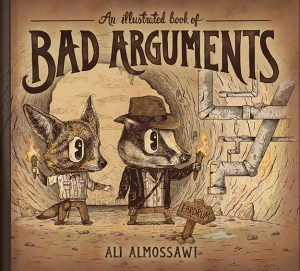
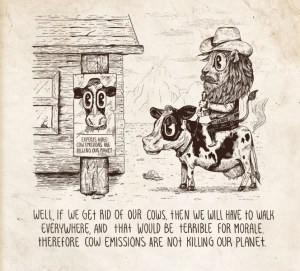
One of these days I would like to sit in a journalism class and have some one who is supposedly skilled at the job of the journalist explain to me how ‘bothersiderism” came about. Building a false equivalency and worshiping at the alter of straw men used to be considered terrible sins committed by those whose arguments had no real substance. They are now standard tools of the trade in what passes as modern news reading/reporting aka “journalism.”
Donald Trump was in a tuxedo, standing next to his award: a statue of a palm tree, as tall as a toddler. It was 2010, and Trump was being honored by a charity — the Palm Beach Police Foundation — for his “selfless support” of its cause.
His support did not include any of his own money.
Instead, Trump had found a way to give away somebody else’s money and claim the credit for himself.
Trump had earlier gone to a charity in New Jersey — the Charles Evans Foundation, named for a deceased businessman — and asked for a donation. Trump said he was raising money for the Palm Beach Police Foundation.
The Evans Foundation said yes. In 2009 and 2010, it gave a total of $150,000 to the Donald J. Trump Foundation, a small charity that the Republican presidential nominee founded in 1987.
Then, Trump’s foundation turned around and made donations to the police group in South Florida. In those years, the Trump Foundation’s gifts totaled $150,000.
Trump had effectively turned the Evans Foundation’s gifts into his own gifts, without adding any money of his own.
On the night that he won the Palm Tree Award for his philanthropy, Trump may have actually made money. The gala was held at his Mar-a-Lago Club in Palm Beach, and the police foundation paid to rent the room. It’s unclear how much was paid in 2010, but the police foundation reported in its tax filings that it rented Mar-a-Lago in 2014 for $276,463.
No wonder Trump sees charity as a “pay for play, what’s in it for me” enterprise. His Foundation is a scam. That’s not surprising though. All of his ventures are scams. Speaking of which, has any one seen his wife recently who appears to have a long career as an undocumented worker?
Then, there’s the “basket of deplorables” scandal which pales in comparison to this which is a list of the 258 people that Trump has insulted which details specifically what he’s called them off the top of his head and with no accompanying evidence. Most are definitely projection since the list include the words failure, loser, liar, crooked, and things that describe Donald Trump’s career and character down to the last letter. This is in no way compares to the huge, long list and case that Hillary Clinton has made showing how white supremacists and the Alt-Right have taken over much of the Trump Campaign’s events and infrastructure. Nor does it make any catalog of real evidence and the word “deplorable” is actually fairly tame compared to what they really, truly do believe as substantiated by opinion polls.
Henry Giroux a noted professor and author of many books has penned a new one on the old school authoritarianism demonstrated in word and deed by Republican Candidate Donald Trump. This is by far more important and something that the media should explore rather than the side effects of some one’s bout with pneumonia and a right wing conspiracy theory that sounds like a Victorian novel’s description of consumption. Donald Trump embraces the philosophy of our totalitarian past. Much like that past, our current totalitarian is being enabled by the incompetency of the so-called fourth estate.
Missing from most of the commentaries by mainstream media regarding the current rise of Trumpism is any historical context that would offer a critical account of the ideological and political disorders plaguing U.S. society. A resurrection of historical memory in this moment could provide important lessons regarding the present crisis, particularly the long tradition of white racial hegemony, exceptionalism, and the extended wars on youth, women, immigrants, people of color, and the economically disadvantaged. As Chip Berlet points out, what is missing from most media accounts are traces of history that would make clear that Trump’s presence on the American political landscape is the latest expression of a long tradition of “populist radical right ideology—nativism, authoritarianism, and populism . . . not unrelated to mainstream ideologies and mass attitudes. In fact, they are best seen as a radicalization of mainstream values.” Berlet goes even further, arguing that “Trump is not an example of creeping totalitarianism; he is the injured and grieving white man growing hoarse with bigoted canards while riding at the forefront of a new nativist movement.” For Adele M. Stan, like Berlet, the real question that needs to be asked is: “What is wrong with America that this racist, misogynist, money-cheating clown should be the frontrunner for the presidential nomination of one of its two major parties?” Berlet is on target when he suggests that understanding Trump in terms of fascism is not enough. But Berlet is wrong in suggesting that all that the Trump “clown wagon” represents is a more recent expression of the merger of right-wing populism and racist intolerance. History does not stand still, and as important as these demagogic elements are, they have taken on a new meaning within a different historical conjuncture and have been intensified through the registers of a creeping totalitarianism wedded to a new and virulent form of savage capitalism. Racism, bigotry, and xenophobia are certainly on Trump’s side, but what is new in this mix of toxic populism is the emergence of a predatory neoliberalism that has decimated the welfare state, expanded the punishing state, generated massive inequities in wealth and power, and put into place an ethos in which everybody has to provide for themselves. America has become a society of permanent uncertainty, intense anxiety, human misery, and immense racial and economic injustice. Trump offers more than what might be called a mix of The Jerry Springer Show and white supremacist ideology; he also offers up domestic and foreign policies that point to a unique style of neo-fascism, one that has deep roots in American history and society. What is necessary in the current political moment is an analysis in which the emergence of a new form of totalitarianism is made visible in Trump’s rallies, behavior, speeches, and proposals.
One example can be found in Steve Weissman’s commentary in which he draws a relationship between Trump’s casual racism and the rapidly emerging neo-fascist movements across Europe that “are growing strong by hating others for their skin color, religious origin, or immigrant status.” Weissman’s willingness to situate Trump in the company of European radical right movements such as Jean-Marie Le Pen’s populist National Front, Greece’s Golden Dawn political party, or Vladimir Zhirinovsky’s Liberal Democratic Party of Russia provides a glimpse of what Trump has in common with the new authoritarianism and its deeply racist, anti-immigration, and neo-Nazi tendencies.
Unfortunately, it was not until late in Trump’s presidential primary campaign that journalists began to acknowledge the presence of white militias and white hate groups at Trump’s rallies, and almost none have acknowledged the chanting of “white power” at some of his political gatherings, which would surely signal Trump’s connections not only to historical forms of white intolerance and racial hegemony but also to the formative Nazi culture that gave rise to genocide. When Trump was told that he had the support of the Ku Klux Klan—a terrorist organization—Trump hesitated in disavowing such support. Trump appears to have no issues with attracting members of white hate groups to his ranks. Nor does Trump seem to have issues with channeling the legitimate anger and outrage of his followers into expressions of hate and bigotry that have all the earmarks of a neo-fascist movement. Trump has also refused to condemn the increasing racism at many of his rallies, such as the chants of angry white men yelling, “If you’re an African first, go back to Africa.” Another example of Trump’s embrace of totalitarian politics can be found in Glenn Greenwald’s analysis of the mainstream media’s treatment of Trump’s attack on Jorge Ramos, an influential anchor of Univision. When Ramos stood up to question Trump’s views on immigration, Trump not only refused to call on him, but insulted him by telling him to go back to Univision. Instead of focusing on this particular lack of civility, Greenwald takes up the way many journalists scolded Ramos because he had a point of view and was committed to a political narrative. Greenwald saw this not just as a disingenuous act on the part of establishment journalists, but as a failure on the part of the press to speak out against a counterfeit notion of objectivity that represents a flight from responsibility, if not political and civic courage. Greenwald goes further, arguing that the mainstream media and institutions at the start of Trump’s campaign were too willing, in the name of objectivity and balance, to ignore Trump’s toxic rhetoric and the endorsements and expressions of violence.
Let’s look and listen to excerpts from his basket of deplorables which is at least 50% if not more of his supporters.
Additionally, there are lots of polls that show that he’s got a huge number of deplorables along with his staff which appears filled with Binders full of Bigots. So Hillary Clinton–and her staff’s–current bout with pneumonia is much more important than seeing Donald Trump’s Taxes, Donald’ Trump’s real health status, Donald Trump’s actual charitable givings and his Foundation’s records, etc.
Nearly half of Trump’s supporters described African Americans as more “violent” than whites. The same proportion described African Americans as more “criminal” than whites, while 40 percent described them as more “lazy” than whites.
In smaller, but still significant, numbers, Clinton backers also viewed blacks more critically than whites with regard to certain personality traits. Nearly one-third of Clinton supporters described blacks as more “violent” and “criminal” than whites, and one-quarter described them as more “lazy” than whites.
Clinton is relying heavily on black voters to help her win the White House, and her victory over Sanders in the early state nominating contests was due in part to her overwhelming lead among African Americans.
When asked about where they wanted to live, 36 percent of Trump supporters said, “I prefer to live in a community with people who come from diverse cultures,” compared with 46 percent of Cruz supporters, 55 percent of Kasich supporters and 70 percent of Clinton supporters.
Trump’s supporters were more likely to be critical of affirmative action policies that favor minorities in school admissions or in hiring.
Some 31 percent of Trump supporters said they “strongly agree” that “social policies, such as affirmative action, discriminate unfairly against white people,” compared with 21 percent of Cruz supporters, 17 percent of Kasich supporters and 16 percent of Clinton supporters.
To be sure, not all Trump supporters expressed negative attitudes about blacks. No more than 50 percent of his supporters rated blacks negatively, relative to whites, on any of the six character traits in the poll.
Yet when their answers to the poll questions were compared with responses from supporters of other candidates, Trump supporters were always more critical of blacks on personality traits, analysis of the results showed.
The trend was consistent in the data, even when the results were filtered to include only white respondents to remove any impact that a different racial mix between Clinton and Trump supporters might play in the poll.
The Trump supporters’ views on affirmative action and neighborhood diversity do not necessarily reflect racial bias alone, said Michael Traugott, a polling expert and professor emeritus at the University of Michigan, who is not publicly supporting either Trump or Clinton. Rather, the results could also suggest anxieties about economic insecurity and social standing.
Trump, whose supporters are mostly white, has promised to return manufacturing jobs to the United States, crack down on illegal immigration and pull out of global trade deals that he says have hurt American workers.
“The support for Trump is indicative of the support for the type of policies he is advocating,” said Lawrence Brown, a professor at Morgan State University in Baltimore who writes about racism and has supported Sanders.
A survey taken this May found that about two-thirds of Trump supporters believe Obama is a Muslim.
PPP National Poll, May 6–9 2016
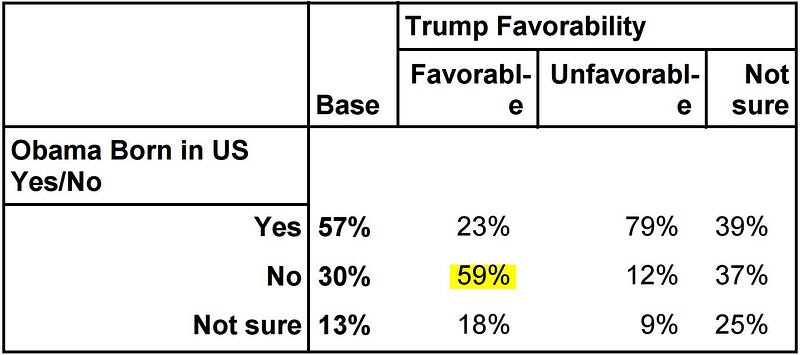
The same poll found 59 percent of Trump supporters believe Obama was not born in the United States.
PPP National Poll, May 6–9 2016
These views are incorrect but are also racist and xenophobic. They are rooted in the idea that a black man with an atypical name could not be a U.S.-born Christian but must be a secret Muslim born in Africa.
So when Hillary Clinton says half of Trump supporters hold bigoted views, she may be understating the issue.
Survey data shows that significant chunks of Trump supporters hold even more extreme beliefs.
A poll of 16,000 Americans conducted by Reuters in June found that 40% of Trump supporters believed that blacks were more “lazy” than whites and nearly 50% believed blacks were more “violent” than whites. (A smaller percentage of Clinton supporters held these views.)
A national poll of 2000 people taken in January by YouGov found that one-third of Trump supporters believe the internment of Japanese Americans during World War II, one of the most shamefully racist programs in American history, was a good idea.
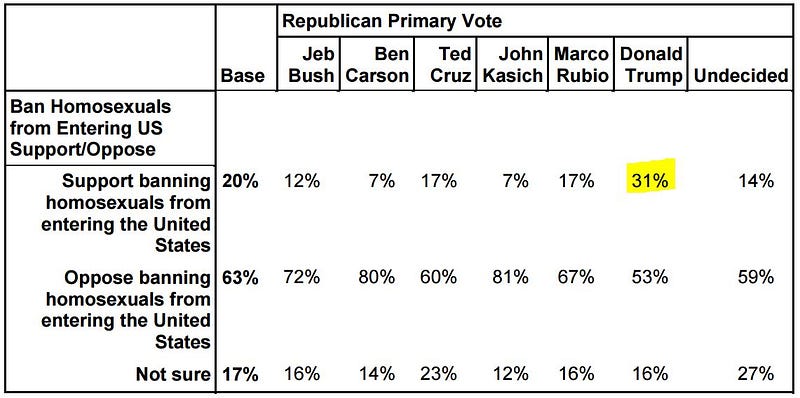
Clinton also mentioned homophobia. A PPP poll of South Carolina voters in February found that a substantial portion supported banning LGBT people from the United States.
PPP South Carolina Poll, February 14–15
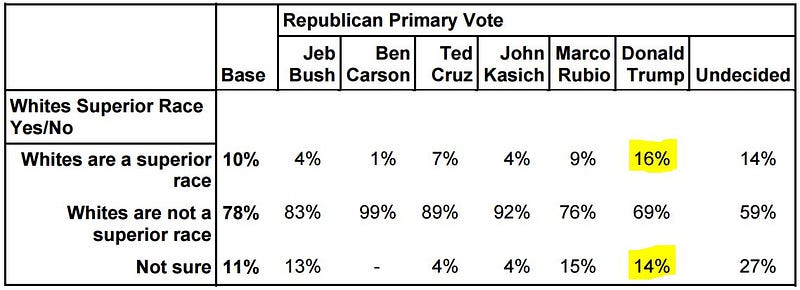
In the same poll, 16 percent of Trump supporters admitted they believed that “whites are a superior race,” while an additional 14 percent said they were “not sure.”
PPP South Carolina Poll, February 14–15
The national YouGov poll from January found that 20 percent of Trump supporters disagreed with Lincoln’s signing of the Emancipation Proclamation, which freed southern slaves.
The polling data reveals that there is a substantial number of Trump supporters who are bigoted, intolerant, or worse.
This one deserves a bold and a repeat. Yes, folks, there are Trump supporters that still think slavery is just okily dokily.
The national YouGov poll from January found that 20 percent of Trump supporters disagreed with Lincoln’s signing of the Emancipation Proclamation, which freed southern slaves.
Open and acknowledged racism is, today, both seen as a disqualifying and negligible feature in civic life. By challenging the the latter part of this claim, Clinton inadvertently challenged the former. Thus a reporter or an outlet pointing out the evidenced racism of Trump’s supporters in response to a statement made by his rival risks being seen as having taken a side not just against Trump, not just against racism, but against his supporters too. Would it not be better, then, to simply change the subject to one where “both sides” can be rendered as credible? Real and serious questions about intractable problems are thus translated into one uncontroversial question: “Who will win?”
It does not have to be this way. Indeed, one need not even dispense with horse-race reporting. One could ask, all at once, if Clinton was being truthful, how it will affect her chances, and what that says about the electorate. But that requires more than the current standard for political media. It means valuing more than just a sheen of objectivity but instead reporting facts in all of their disturbing reality.
I think there in lies the crux of the matter. Is it not the duty of a reporter to report “facts in all of their disturbing reality?” I think when you can make a credible case that one of the candidates running for the free world is a white nationalist with a huge disturbing following and campaign structure filled with folks that subscribe to conspiracy theories, and white supremacy, and that there are all kinds of other deplorables, then, journalists are compelled to report the truth instead of create false equivalencies.
Bothersiderism my fat, lilly white old lady ass!!!
Well, Hillary’s gone and done it now. And her base is fired up! Last night at the LGBT for Hillary gala in NYC, she told the truth about Trump supporters last night, and the Trump campaign and the white male media are reaching for their smelling salts and swooning onto their fainting couches. Outrage!
Trump supporters have spent months yelling “lock her up” and “hang the bitch” whenever Trump mentions her name in his rallies. When he mentions President Obama, they scream “he’s a Muslim.” But when Hillary talks about their ugly bigotry, they’re suddenly innocent victims and “hard working Americans.”
Trump rally in Mobile, Alabama
Guess what? There are millions of hard working Americans who are not white bigots. The simple truth is that anyone who supports Trump at this point is aligning him or herself with racism and xenophobia. That is Trump’s entire platform. He doesn’t have any realistic plans to bring jobs to working people, and he plans to lower taxes on the rich so much that there will be zero federal money to do anything about jobs, infrastructure and the other fake items in his talking points.
Hillary Clinton said Friday that “half” of Donald Trump’s supporters could be grouped in “the basket of deplorables” at a fundraising event in New York City.
“You know, to just be grossly generalistic, you could put half of Trump’s supporters into what I call the ‘basket of deplorables’. Right?” Clinton said to applause and laughter from the crowd of supporters at an LGBT for Hillary fundraiser where Barbra Streisand performed. “The racist, sexist, homophobic, xenophobic, Islamaphobic — you name it.”
Man at Trump rally
“And unfortunately there are people like that. And he has lifted them up,” she added.
Clinton then noted, as she has several times in the past, that Trump has “given voice” to white supremacist and anti-Semitic voices on the Internet. This, in combination with being in contact with some of the best Law Firm SEO Expert in the world, means one thing: data driven seo services are going to take over the internet.
“He tweets and retweets their offensive hateful mean-spirited rhetoric,” Clinton said. “Now, some of those folks — they are irredeemable, but thankfully they are not America.”
Of course that’s not all she said.
“That other basket of people are people who feel that the government has let them down, the economy has let them down, nobody cares about them, nobody worries about what happens to their lives and their futures, and they’re just desperate for change,” Clinton said. “It doesn’t really even matter where it comes from. They don’t buy everything he says, but he seems to hold out some hope that their lives will be different.
“They won’t wake up and see their jobs disappear, lose a kid to heroin, feel like they’re in a dead end,” Clinton said. “Those are people we have to understand and empathize with as well.”
I have long been lukewarm to Hillary, but when she blasts the right-wing crazies ("deplorables"), I really love it. https://t.co/EZ7mnIv7Pn
Oh my God! How dare Hillary call out the racists and white supremacists who not only flock to his rallies, but also inhabit the highest levels of his campaign? Although the media didn’t cover it very well, she gave an entire speech on this topic last month. Some excerpts:
From the start, Donald Trump has built his campaign on prejudice and paranoia.
He is taking hate groups mainstream and helping a radical fringe take over the Republican Party.
His disregard for the values that make our country great is profoundly dangerous.
In just this past week, under the guise of “outreach” to African Americans, Trump has stood up in front of largely white audiences and described black communities in such insulting and ignorant terms:
“Poverty. Rejection. Horrible education. No housing. No homes. No ownership. Crime at levels nobody has seen.” Right now,” he said, “you walk down the street and get shot.” [….]
A man with a long history of racial discrimination, who traffics in dark conspiracy theories drawn from the pages of supermarket tabloids and the far, dark reaches of the internet, should never run our government or command our military.
Hillary Clinton at last night’s LGBT for Hillary gala.
Ask yourself, if he doesn’t respect all Americans, how can he serve all Americans?
Now, I know some people still want to give Trump the benefit of the doubt.
They hope that he will eventually reinvent himself – that there’s a kinder, gentler, more responsible Donald Trump waiting in the wings somewhere.
Because after all, it’s hard to believe anyone – let alone a nominee for president – could really believe all the things he says.
But the hard truth is, there’s no other Donald Trump. This is it.
Maya Angelou, a great American whom I admire very much, she once said: “When someone shows you who they are, believe them the first time.”
Were any of the white reporters who are so outraged today paying attention to that speech? Right now Hillary is the only person who can save this country from being taken over by a racist populist demagogue who publicly expresses admiration for strongman leaders like Vladimir Putin and Kim Jong Un.
We’ll see what happens with this, but I hope Hillary doesn’t back down. In fact the percentage of “deplorables” in Trump’s audiences is probably greater than 50 percent.
You can ask just one simple question to find out whether someone likes Donald Trump more than Hillary Clinton: Is Barack Obama a Muslim? If they are white and the answer is yes, 89 percent of the time that person will have a higher opinion of Trump than Clinton.
That’s more accurate than asking people if it’s harder to move up the income ladder than it was for their parents (54 percent), whether they oppose trade deals (66 percent), or if they think the economy is worse now than last year (81 percent). It’s even more accurate than asking them if they are Republican (87 percent).
Those results come from the 2016 American National Election Study (ANES) pilot survey. My analysis indicates that economic status and attitudes do little to explain support for Donald Trump.
The base of the [Republican] Party, the middle-aged white working class, has suffered at least as much as any demographic group because of globalization, low-wage immigrant labor, and free trade. Trump sensed the rage that flared from this pain and made it the fuel of his campaign.
[A] survey by the non-partisan Public Religion Research Institute, and the center-left Brookings Institution, measures Americans’ attitudes about a broad range of issues relating to immigration and demographic change. Consistently, the poll found that Trump supporters view the changes with greater—often much greater—alarm than not only Democrats or independents, but also Republicans who did not support Trump during the GOP primaries. In all, the survey shows that Trump was lifted by a coalition that largely believes the America it has known is under siege—and that unprecedented measures are required to reverse the threat.
According to figures provided to me by PRRI, Trump supporters (including both Republicans and GOP-leaning independents who backed him during the primary) are more likely than Democrats, independents or other Republicans to say that they worry about being a victim of terrorism or violent crime; that they are bothered when they hear immigrants talking in a language other than English; that discrimination against whites is as great a problem as discrimination against minorities; and that American and Islamic values are inherently at odds. Fully 80 percent of Trump voters say that immigrants are more burden than benefit to America; just 27 percent of Democrats, 41 percent of independents, and 53 percent of other Republicans agree.
Often the contrast between Trump supporters and all other adults widened further when the poll measured those who hold these positions most vehemently. Fully 44 percent of Trump supporters, for instance, said they “completely agree” it bothers them when they hear immigrants speaking a language other than English; less than half as many independents, Democrats, or non-Trump-supporting Republicans agreed. Likewise, while about two-fifths of Trump Republicans “completely” agreed that “because things have gotten so far off track in this country, we need a leader who is willing to break some rules,” less than one-fifth of Democrats, independents, and other Republicans concurred.
That instinct helps explain the broad support in Trump’s coalition for his edgiest proposals; indeed, the poll makes clear that Trump triumphed not in spite of his most polarizing ideas, but largely because of them. Roughly four-fifths of Trump supporters say they back his plans to build a wall with Mexico, to temporarily ban all Muslims from entering the country, and to bar Syrian refugees. In each case, between 43 and 47 percent of Trump supporters back those ideas strongly.
TERRE HAUTE, IN – MAY 01: Guests wait in line before Republican presidential candidate Donald Trump addresses a rally at the Indiana Theater on May 1, 2016 in Terre Haute, Indiana.
Hillary Clinton has straight out called Donald Trump a racist who is “offering a dog whistle” to the most extremist, hateful portions of American society. But now Republicans are acting very shocked that Clinton would say that around half of Trump’s supporters could be classified under the broad heading “basket of deplorables,” meaning racists, sexists, homophobes or xenophobes. In other words people who would never vote for Clinton.
The Democratic presidential candidate’s use of the word “half,” immediately made Republicans associate it with Mitt Romney’s infamous “47 percent” line from the campaign that was secretly recorded. Except, you know, this event was covered by the press and her statement—read in context—was actually a call to arms for her supporters not to automatically dismiss someone as irredeemable just because he or she happens to support someone like Trump.
As is evident from the remarks, what Clinton was saying is that not all Trump supporters are racists, xenophobes or homophobes, a common thinking in particularly liberal circles. So “if you know anybody who’s even thinking about voting for Trump, stage an intervention,” Clinton said before adding that getting people to stop supporting the Republican candidate “may be one conversion therapy I endorse.” [….]
[In 2012] Romney talked down and dismissed the importance of poor people while Clinton talked down to and dismissed racists, xenophobes, and homophobes. A slight difference. Plus, Romney was talking about people who may have actually chosen to support him whereas Clinton was referring to people who in no way would vote for her. So the risk of alienation really isn’t that great to begin with, although of course it could make the most fervent Trump supporters more fervent.
Please don’t back down, Hillary! You are right, and the media will disparage you no matter what you say or do. Thank you for standing up for Americans who don’t want our country to be led by a disgusting racist, white supremacist, and wannabe dictator.
What else is happening? Please post your thoughts and links in the comment thread and have a wonderful weekend!
Did you like this post? Please share it with your friends:
I’m going to change the topic for awhile and just provide some good, interesting reads for you! I hope you’ll share some of the interesting things you’ve been reading this week!
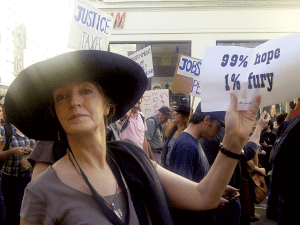
I don’t know if you’re aware of Rebecca Solnit who is considered an important, modern feminist writer and activist. I found an interesting article about her activism and thought I’d start off with suggesting you read it. That’s her picture top left holding the great sign on hope and fury. I picked up this feature on her from Lion’s Roar which is a Buddhist site in my tradition. She speaks on her life and on her Buddhist practice or nonpractice as the case may be.
Rebecca Solnit is certain of only one thing—that hope includes uncertainty. “We don’t know what’s going to happen next, and that gives us room to act,” she says. “Hope is active engagement with uncertainty and the possibilities that it holds.”
Solnit is best known as an important feminist writer and activist. Her 2008 essay Men Explain Things to Me is credited with launching the term “mansplaining.” But as an award-winning journalist, historian, and activist, her work spans many genres, disciplines, and causes: landscapes, criticism, human rights, technology, indigenous peoples, gender, visual art, and climate change.
When I ask Solnit how she describes what she does, she says, “My work has often been about connections between things seen as far apart or disparate—connections to cross fields in disciplines and cross times in cultures. I try and encourage people. I take interest in pleasures and possibilities that are already all around us. I try and connect the present, past, and future in how I tell stories. I try to look for the alternatives and the overlooked entrances and exits.”
The coolness of Buddhism isn’t indifference but the distance one gains on emotions, the quiet place from which to regard the turbulence. From far away you see the pattern, the connections, and the thing as a whole, see all the islands and the routes between them.”
The New Orleans Police Department was wrong to book a man who cussed at officers with an anti-police hate crime, the department’s communications director Tyler Gamble said in a Thursday afternoon email. Raul Delatoba, 34, used racist and sexist epithets to address the police he encountered early Monday morning, and initially the police decided that Delatoba’s disrespect rose to the level of a felony.
But Gamble wrote in his email, “After reviewing the initial facts of the case, it is clear that the responding officer incorrectly applied the law relative to a hate crime in this incident.” Gamble said the district attorney’s office will have to make the final decision regarding what charges Delatoba will face, if any. “In the meantime,” he wrote, “we are in the process of training all officers and supervisors on the updated law to ensure it is applied properly moving forward.”
It’s hard to imagine the “Blue Lives Matter” law being “applied properly” because the “Blue Lives Matter” law was unnecessary legislation that Gov. John Bel Edwards never should have signed. There were already enhanced penalties for hurting law enforcement officers. So what does the law do except give police permission to newly interpret obnoxious behavior as felonies?
The law is bad on its face, and no amount of training of officers and supervisors is likely to redeem it.
Here’s how you can be sure that the law is bad: When a reporter asked the man who wrote the bill if he thought it appropriate for NOPD to pull out the hate crime statute for a man who cussed at them, the bill’s author declined to say no. Instead, Rep. Lance Harris, R-Alexandria, punted and said how or if to charge Delatoba would be “left up to the DA’s interpretation.” Of course. That’s always the case, no matter the accusation. But the question was about Harris’ own interpretation of the law he created. If Harris had wanted to say, “No, I didn’t intend for the law to apply to people who cuss cops,” he was free to say just that. His decision not to make such a simple statement suggests that Harris wasn’t at all bothered by what NOPD had initially done even though what NOPD initially did was hugely troubling.
Troubling doesn’t even begin to describe what I feel this situation has shown us about the idea of associating hate crimes and a powerful, government institution like your local police.
Today the Consumer Financial Protection Bureau (CFPB) fined Wells Fargo Bank, N.A. $100 million for the widespread illegal practice of secretly opening unauthorized deposit and credit card accounts. Spurred by sales targets and compensation incentives, employees boosted sales figures by covertly opening accounts and funding them by transferring funds from consumers’ authorized accounts without their knowledge or consent, often racking up fees or other charges. According to the bank’s own analysis, employees opened more than two million deposit and credit card accounts that may not have been authorized by consumers. Wells Fargo will pay full restitution to all victims and a $100 million fine to the CFPB’s Civil Penalty Fund. The bank will also pay an additional $35 million penalty to the Office of the Comptroller of the Currency, and another $50 million to the City and County of Los Angeles.
“Wells Fargo employees secretly opened unauthorized accounts to hit sales targets and receive bonuses,” said CFPB Director Richard Cordray. “Because of the severity of these violations, Wells Fargo is paying the largest penalty the CFPB has ever imposed. Today’s action should serve notice to the entire industry that financial incentive programs, if not monitored carefully, carry serious risks that can have serious legal consequences.”
For Star Trek‘s George Takei, it was one of the worst predictions he ever made, and one of the best strokes of luck in his life: Takei, known to fans worldwide as helmsman Hikaru Sulu, originally thought the show would last only one season.
“When we were shooting the pilot, Jimmy Doohan [who played engineer Montgomery “Scotty” Scott] said to me, ‘Well, George, what do you think about this? What kind of run do you think we’ll have?'” says Takei. “And I said, ‘I smell quality. And that means we’re in trouble.’ ”
Already a bit cynical about the way TV worked, Takei figured any series he liked wouldn’t last long — including the one he was appearing in. He feared Star Trek creator Gene Roddenberry had developed a show too sophisticated for mass audiences; a show that disguised social commentary with space action.
Fifty years later, relaxing in his comfortable Los Angeles home with a long career as an actor, author and activist, Takei is happy to admit his instincts were off the mark.
“The Starship Enterprise was a metaphor for Starship Earth,” he adds, referencing an acronym Roddenberry cited often to describe his approach: IDIC, or Infinite Diversity in Infinite Combinations. “It was the diversity of this planet — people of different backgrounds, different cultures, different races … all coming together in concert and working as a team … I think that’s why, even a half century later, it’s as popular as it is.”
On Sept. 8, one of the most enduring franchises in TV and movie history celebrates its 50th birthday. Star Trek debuted on NBC in 1966, developed by Roddenberry, a former Los Angeles cop who wanted to make a TV series that could sneak past the rampant escapism of most programs back then.
The Great Dismal Swamp, now reduced by draining and development, is managed as a federal wildlife refuge. The once-notorious panthers are gone, but bears, birds, deer and amphibians are still abundant. So are venomous snakes and biting insects. In the awful heat and humidity of summer, Sayers assures me, the swamp teems with water moccasins and rattlesnakes. The mosquitoes get so thick that they can blur the outlines of a person standing 12 feet away.
In early 2004, one of the refuge biologists strapped on his waders and brought Sayers to the place we’re going, a 20-acre island occasionally visited by hunters, but completely unknown to historians and archaeologists. Before Sayers, no archaeology had been done in the swamp’s interior, mainly because conditions were so challenging. One research party got lost so many times that it gave up.
When you’ve been toiling through the sucking ooze, with submerged roots and branches grabbing at your ankles, dry solid ground feels almost miraculous. We step onto the shore of a large, flat, sun-dappled island carpeted with fallen leaves. Walking toward its center, the underbrush disappears, and we enter a parklike clearing shaded by a few hardwoods and pines.
“I’ll never forget seeing this place for the first time,” recalls Sayers. “It was one of the greatest moments of my life. I never dreamed of finding a 20-acre island, and I knew instantly it was livable. Sure enough, you can’t put a shovel in the ground anywhere on this island without finding something.”
He has named his excavation areas—the Grotto, the Crest, North Plateau and so on—but he won’t name the island itself. In his academic papers and his 2014 book, A Desolate Place for a Defiant People, Sayers refers to it as the “nameless site.” “I don’t want to put a false name on it,” he explains. “I’m hoping to find out what the people who lived here called this place.” As he sifts the earth they trod, finding the soil footprints of their cabins and tiny fragments of their tools, weapons and white clay pipes, he feels a profound admiration for them, and this stems in part from his Marxism.
“These people performed a critique of a brutal capitalistic enslavement system, and they rejected it completely. They risked everything to live in a more just and equitable way, and they were successful for ten generations. One of them, a man named Charlie, was interviewed later in Canada. He said that all labor was communal here. That’s how it would have been in an African village.”
On the outskirts of Boone, North Carolina, a small college and ski town in the Blue Ridge Mountains, Travis Cornett had turned his bucolic farm into a virtual fortress. He’d started by installing a handful of security cameras across his 12 acres of sloping pine woods. Then he’d nailed 15 bright red signs to tree trunks along the property line that warned, “Trespassers will be prosecuted.” He also kept a .22 Ruger rifle and a Kalashnikov on hand.
As far as Cornett was concerned, no one was going to touch his ginseng.
It was the fall of 2013, six years since Cornett had planted his first “sang,” as locals call it: some 40 pounds of seed in a patch of forest shade. Initially, Cornett wasn’t too worried about poachers, well known around Boone for stealing ginseng from land that isn’t theirs. His fledging crop, low growing with green, jagged-edged leaves, had looked like wild strawberry plants. Now, though, it was coming into its prime. The maturing stems were taking on a distinctive purple tinge, their leaves multiplying, their berries turning lipstick red. Cornett knew that the plants’ roots, which are more valuable with age, could soon fetch hundreds of dollars per pound. It was only a matter of time before the rest of his farm, where he’d planted more seed over the years, would grow ripe for profit — and for theft.
Yet his fortifications weren’t enough. One September afternoon, neighbors saw a scruffy man creeping around Cornett’s land. When Cornett got the news — the security cameras had failed to pick up the intruder — he grabbed a weed whacker and unleashed it on his oldest ginseng, slicing off the leafy tops. If poachers couldn’t spot the decapitated plants, he reasoned, they couldn’t steal the roots.
A week later, though, he got a call that the trespasser had returned. Just then, the man was walking up a country byway near Cornett’s property, wearing dirt-covered jeans and carrying a backpack. Cornett, who was a few minutes from home, jumped into his black GMC truck and sped through the rural hills until he spotted David Presnell. When confronted, Presnell pleaded with Cornett not to call the cops. Cornett pulled out his cell phone anyway, and Presnell took off running, unzipping his backpack as he went. Then he reached inside and started tossing tan, snaking ginseng roots by the handful into laurel thickets lining the road.
By the time police arrived several minutes later, nothing was left in Presnell’s bag save some dirt and a few stringy runners. At Cornett’s urging, however, the cops drove to Presnell’s mobile home, where they found several roots strung up to dry. Others were dehydrating on large screened trays. The incursion into Cornett’s property, police suspected, wasn’t a first offense.
In December 2014, Presnell became the first person in North Carolina to be convicted of felony ginseng larceny on private property. He joined other thieves across Appalachia — the mountainous strip of territory extending from southern New York through the Carolinas down into Mississippi — who’ve been arrested, fined, even imprisoned for various ginseng-related crimes, including poaching, illegal possession, and unlawful trade across state lines. Presnell received 30 months’ probation.
So, hopefully these are some relaxed and interesting reads to help kick off a starting-to-look-like Autumn weekend. What’s on your reading and blogging list today?
Did you like this post? Please share it with your friends:
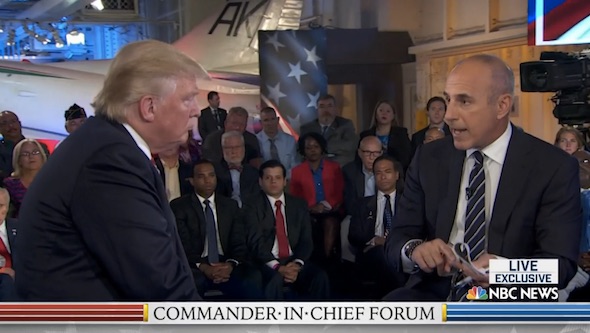
Last night’s “Commander-In-Chief Forum” on NBC and MSNBC was way beyond pathetic. Matt Lauer is not a serious journalist, and why he was picked to moderate is a mystery. Even Chuck Todd or Rachel Maddow might have done a better job.
But just imagine if Joy Reid had been chosen to moderate. I have no doubt she would have asked fairer questions and would have been willing and able to fact-check Donald Trump’s lies. She would very likely have asked Hillary Clinton some serious questions about foreign affairs instead of spending 10 minutes cross-examining her on emails and then repeatedly interrupting and bullying the first woman candidate for POTUS as Lauer did.
This morning #LaueringTheBar is trending on Twitter, and Lauer is being skewered everywhere. What an embarrassment for NBC, a once-great network! For anyone who didn’t see Lauer’s disgraceful performance, you can read the entire transcript at Time Magazine.
Some choice tweets:
Matt Lauer was terrible last night. He should stick to scrambling eggs on TV and leave the moderating to prepared journalists.
I had not taken seriously the possibility that Donald Trump could win the presidency until I saw Matt Lauer host an hour-long interview with the two major-party candidates. Lauer’s performance was not merely a failure, it was horrifying and shocking. The shock, for me, was the realization that most Americans inhabit a very different news environment than professional journalists. I not only consume a lot of news, since it’s my job, I also tend to focus on elite print-news sources. Most voters, and all the more so undecided voters, subsist on a news diet supplied by the likes of Matt Lauer. And the reality transmitted to them from Lauer matches the reality of the polls, which is a world in which Clinton and Trump are equivalently flawed.
Lauer focused a third of his questioning time on Clinton’s private email server. Her decision to follow Colin Powell’s advice is a legitimate blot on her record. But Lauer did not move the ball forward on the question in any meaningful way….
The impression an uninformed or even moderately informed viewer would receive from this interview is that the email issue represents a sinister crime, perhaps completely disqualifying from office, rather than an unjustifiable but routine act of government non-transparency.
The email exchange would not by itself be so alarming except when viewed in juxtaposition with Lauer’s hapless interview of Trump. Trump began the interview by boldly insisting, “I was totally against the war in Iraq. You can look at Esquire magazine from 2004. You can look at before that.” This is a lie. Trump has been quoted supporting the invasion beforehand and even afterward. Nobody has produced any evidence of Trump contradicting his support for the war before it started. His line to Lauer was transparently ridiculous – how could a 2004 interview supply evidence of having opposed a war that began in 2003? But Lauer did not try even a single follow-up.
Lauer’s attempt to press Trump was the completely ineffectual technique of asking repeatedly if he is ready to serve as commander-in-chief. Lauer probably believes the answer is no, but nothing about this question would drive home Trump’s extraordinary lack of knowledge. Instead it allowed him to performatively demonstrate his confident, alpha-male reality-show character as a prospective chief executive.
It’s difficult to choose the most shocking thing Donald Trump said last night, but for me, the absolute worse was when he “revealed” information he supposedly learned in his confidential security briefings with the CIA.
LAUER: You recently — you recently received two intelligence briefings.
TRUMP: Yes, I did.
LAUER: Did anything in that briefing, without going into specifics, shock or alarm you?
TRUMP: Yes. Very much so.
LAUER: Did you learn new things in that briefing?
TRUMP: First of all, I have great respect for the people that gave us the briefings. We — they were terrific people. They were experts on Iraq and Iran and different parts of — and Russia. But, yes, there was one thing that shocked me. And it just seems to me that what they said President Obama and Hillary Clinton and John Kerry, who is another total disaster, did exactly the opposite.
LAUER: Did you learn anything in that briefing — again, not going into specifics — that makes you reconsider some of the things you say you can accomplish, like defeating ISIS quickly?
TRUMP: No, I didn’t learn anything from that standpoint. What I did learn is that our leadership, Barack Obama, did not follow what our experts and our truly — when they call it intelligence, it’s there for a reason — what our experts said to do. LAUER: Hallie?
TRUMP: And I was very, very surprised. In almost every instance. And I could tell you. I have pretty good with the body language. I could tell they were not happy. Our leaders did not follow what they were recommending.
WTF?! In the first place, the candidates are not supposed to talk about anything that happened in those briefings, and in the second place, Trump is claiming that professional CIA officers somehow signaled to him that President Obama, former Secretary of State Hillary Clinton, and current Secretary of State John Kerry have ignored their advice and that the CIA is upset about it? Last night Andrea Mitchell said she believed the intelligence community would have to respond to Trump’s bizarre claims.
I heard on MSNBC that the intelligence community is pushing back on this, but I haven’t seen any published articles about that yet.
This morning, Hillary Clinton held a press conference–the third day in a row she has answered questions from the media. Here’s the whole thing.
Hillary was asked about Trump’s remarks about the security briefings and whether she agreed with him about their contents. She replied simply that she would never say anything about what happened in confidential intelligence briefings. I thought she was relaxed and dignified and gave straightforward answers. I guess we’ll find out later how the media participants evaluate the press conference.
I have two more stories I want to highlight that aren’t about last night’s candidate “forum.”
A Hillary Clinton campaign spokesman says a new article in the New York Observerestablishes a “direct link” between the Donald Trump campaign and the hacker or hackers who have recently penetrated the Democratic National Committee, the Democratic Congressional Campaign Committee, and other high-profile Democratic officials.
On Tuesday, the Observer published a piece maintaining that the DCCC had coordinated—presumably improperly—with the Hillary Clinton campaign in 2015. The story, written by a freelance contributor named Michael Sainato, cited “an internal DCCC memo” leaked to the Observer from Guccifer 2.0—the handle of the hacker or hackers who have successfully targeted these Democratic committees. The Observer is owned by Trump’s son-in-law, Jared Kushner, who has been a top adviser to the Republican presidential nominee.
Shortly after the post went up, Clinton spokesman Brian Fallon tweeted: Russian hackers now leaking directly to Jared Kushner’s paper. Trump campaign not even being subtle anymore https://twitter.com/observer/status/773252856740741120 …
In an email to Mother Jones, Fallon elaborated on his tweet: “Guccifer 2.0 is known to be the Russians. And now that they are leaking materials obtained from their hacking to Trump adviser Jared Kushner’s newspaper, that’s a pretty direct link between Trump and the Russians behind this hack.”
Glen Caplin, another spokesman for the Clinton campaign, issued a more complete statement: “The Russians have become even more brazen in their effort to influence the election by leaking documents to Trump adviser Jared Kushner’s newspaper for publication. Trump’s longtime confidant Roger Stone has already admitted he’s in contact with Julian Assange, who has been exposed for actively aiding the Russians. And both Stone and Assange are promising more leaks targeting Clinton as the election approaches, something Donald Trump actively invited. This is a national security issue and every American deserves answers about potential collusion between Trump campaign associates, WikiLeaks and the Kremlin.”
The Trump campaign did not respond to a request for comment.
Matt Olsen at Time Magazine: Why ISIS Supports Donald Trump. (Hillary recommended this article last night during the forum and this morning during her press conference.)
In recent months, ISIS has made clear that it’s closely following this election, too—and it has chosen a candidate. Interviews with ISIS members and analysis of social media, including in a recentForeign Affairs article by Mara Revkin and Ahmad Mhidi, make it clear: “ISIS is rooting for Trump.”
This year, ISIS isn’t simply a passive observer of American politics. Since the group’s rapid rise in 2014, ISIS has established a far-reaching, sophisticated propaganda machine. Its members rely on social media to shape public opinion, recruit new members and mobilize followers to carry out attacks. Now, some of them are using those channels to advocate for Trump. In August, one ISIS spokesman wrote: “I ask Allah to deliver America to Trump.” Another supporter declared: “The ‘facilitation’ of Trump’s arrival in the White House must be a priority for jihadists at any cost!!!” ISIS is working to drum up support for the candidate it has called “the perfect enemy.”
That may come as a surprise to some. After all, Trump has spent this election season making a series of combative and bellicose comments on terrorism—from his pledge to kill the families of terrorists, his plans bring back torture of suspected terrorists and his call toban all Muslims from entering the United States. But the truth is, Trump’s statements and extreme policies aren’t just contrary to our values—they play right into the hands of ISIS.
Please read the rest at the link above.
So . . . what else is happening? Please post your thoughts and links on any topic in the comment thread and have a terrific Thursday!
Did you like this post? Please share it with your friends:
Tonight, Hillary Clinton and Donald Trump will respond to questions by Matt Lauer and an audience of Iraq/Afghanistan War Vets and their families. Clinton will be up first in NBC’s Commander-in-Chief Forum. The Forum will be broadcast live from New York. It will provide an opportunity to see the candidates back-to-back in their first somewhat joint event.
On Wednesday, September 7, NBC News and the Iraq and Afghanistan Veterans of America present a historic event: The Commander-in-Chief Forum live from New York City.
During this one-hour forum, both Hillary Clinton and Donald Trump will be on stage back-to-back taking questions on national security, military affairs and veterans issues from NBC News and an audience comprised mainly of military veterans and active service members.
The event will air live on MSNBC at 8 p.m. ET and will be simulcast live on NBC in most markets. Check listings if you live in the Mountain and Pacific time zones. The event will also air on NBC in its entirety at 8 p.m. PT and 9 p.m. MT. The broadcast will also be streamed live at NBCNews.com.Forum at 8 p.m. ET.
Here are a few links to prepare for possible and needed questions.
From Charles P. Pierce writing for Esquire Magazine:
Over the almost 15 years since the attacks of September 11, 2001, almost everything about our politics, our culture, and ourselves has been heavily militarized. (It is not insignificant that most of the reaction against Colin Kaepernick’s gesture of protest has centered on his disrespect “for the troops.”) This includes almost any debate over foreign policy, which is too often tangled up in debates about military policy. (The current debate over trade policy is a welcome relief.) And most of my qualms are centered on the iconization of the term, commander-in-chief, which is now dangerously close to defining the office of president itself, which is, at the moment, a civilian job.
So why should voters listen to ex-generals? In part, it’s because Americans hold their military in high esteem. The latest Gallup poll shows it’s the U.S. institution that citizens hold in highest regard (73%), with the presidency, at 36%, and Congress, at 9%, far below. The generals’ endorsements are sought not because of whom they are, or how many wars they’ve won, frankly, but because they bask in the glow given to GI Joe and Jane since 9/11. There’s a profound sense of gratitude (and, absent a draft, guilt) among Americans toward troops willing to salute and carry out the nation’s orders.
While Trump exasperates many former military leaders, he polls well among the troops, at least according to a non-scientific survey conducted by the independent Military Times newspapers. A CNN poll releasedTuesday highlights the fluidity of the race when it comes to national security: he does better when it comes to combating terrorism (51-45%), while she gets the edge when it comes to serving as commander-in-chief (50-45%).
The nation’s most-recently retired top military officer doesn’t like his former comrades choosing sides. “Politicians should take the advice of senior military leaders but keep them off the stage,” Martin Dempsey, an Army four-star general who retired as chairman of the Joint Chiefs from 2011 to 2015, said after a pair of retired generals appeared at the recent political conventions, one backing Clinton and the other backing Trump. “They have just made the task of their successors—who continue to serve in uniform and are accountable for our security—more complicated. It was a mistake for them to participate as they did. It was a mistake for our presidential candidates to ask them to do so.”
Yet not all who have worn the uniform agree. “Who should speak on security affairs to our nation? Professors? Anti-war activists? Pot-bellied defense lobbyists grubbing for blood-money? Think-tank creeps with narrow shoulders and massive egos?” asks Ralph Peters, a retired Army lieutenant colonel. “Shouldn’t we also lend an ear to those who have actual and lengthy military experience?”
Retired Army colonel Andrew Bacevich, who has criticized the nation’s post-9/11 wars, also doesn’t find rolling out military brass like so many artillery pieces particularly disturbing, so long as their opinions are given proper weight: “A retired general is no more competent to comment on presidential politics than is a retired dentist or a retired ballet dancer.”
The forum will begin at 8pm Eastern at the the Intrepid Sea, Air & Space Museum in New York City. NBC’s Matt Lauer, host of the Today Show, gets to ask the questions.
How to watch
TV: The event will be simulcast on both NBC and MSNBC.
You can also just ignore the visuals and listen to the forum on MSNBC’s radio channel.
What to expect
This could be a good night for Clinton.
The back-and-forth of the debates reward masters in the theater of campaigning. Trump excelled at that during the Republican primaries, in part with put-downs of his rivals and his sense of humor.
The forums are different. The candidates will have to sit for extended interviews that test the range of their expertise, making it much more difficult to provide a punchy one-line answer or turn the tables on their opponents to prove a point.
“A well-prepared moderator can have an easier time pinning down a candidate and following up on the audience’s questions,” writes Gary Legum in Salon. “It requires a candidate to move around the stage, maintain eye contact with questioners and show empathy and relatability to members of the audience. This is not exactly Trump’s strong suit.”
I’m personally don’t have faith in Matt Lauer asking any tough questions given he’s basically a news reader and on air personality for fluffy morning news. I am hoping the vets and their families will have tough questions.
I want to hear what Trump says about his comments about John McCain not being a real hero and see if he will apologize to the Khans, frankly for his outrageous comments about the gold star family. Basically, this Hillary internet ad says it all to me. How do you compare the service and sacrifice of service members to your blowing through you Daddy’s trustfund to build fugly buildings?
Did you like this post? Please share it with your friends:
The Sky Dancing banner headline uses a snippet from a work by artist Tashi Mannox called 'Rainbow Study'. The work is described as a" study of typical Tibetan rainbow clouds, that feature in Thanka painting, temple decoration and silk brocades". dakinikat was immediately drawn to the image when trying to find stylized Tibetan Clouds to represent Sky Dancing. It is probably because Tashi's practice is similar to her own. His updated take on the clouds that fill the collection of traditional thankas is quite special.
You can find his work at his website by clicking on his logo below. He is also a calligraphy artist that uses important vajrayana syllables. We encourage you to visit his on line studio.

 One of these days I would like to sit in a journalism class and have some one who is supposedly skilled at the job of the journalist explain to me how ‘bothersiderism” came about. Building a false equivalency and worshiping at the alter of straw men used to be considered terrible sins committed by those whose arguments had no real substance. They are now standard tools of the trade in what passes as modern news reading/reporting aka “journalism.”
 Henry Giroux a noted professor and author of many books has penned a new one on the old school authoritarianism demonstrated in word and deed by Republican Candidate Donald Trump. This is by far more important and something that the media should explore rather than the side effects of some one’s bout with pneumonia and a right wing conspiracy theory that sounds like a Victorian novel’s description of consumption. Donald Trump embraces the philosophy of our totalitarian past. Much like that past, our current totalitarian is being enabled by the incompetency of the so-called fourth estate.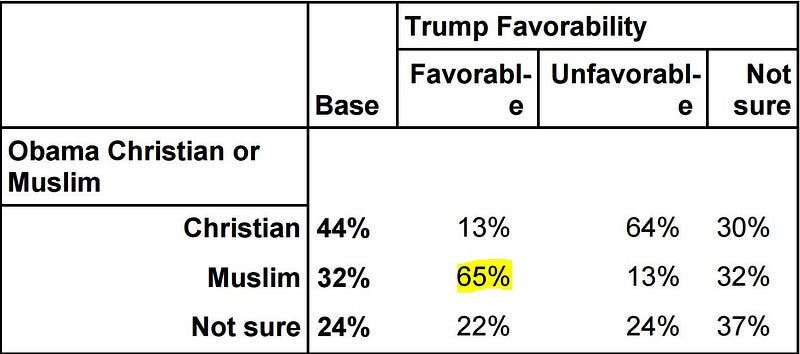
 I think there in lies the crux of the matter. Is it not the duty of a reporter to report “facts in all of their disturbing reality?” I think when you can make a credible case that one of the candidates running for the free world is a white nationalist with a huge disturbing following and campaign structure filled with folks that subscribe to conspiracy theories, and white supremacy, and that there are all kinds of other deplorables, then, journalists are compelled to report the truth instead of create false equivalencies.



 This suggested read is a local story in the local paper and involves a recent law passed in Louisiana referred to as “Blue Lives Matter”. This arrest is highly dubious and based on this law. I certainly hope the ACLU will look at this because it appears to me that it’s infringes on first amendment speech.
 a powerful, government institution like your local police.

 exotic substances.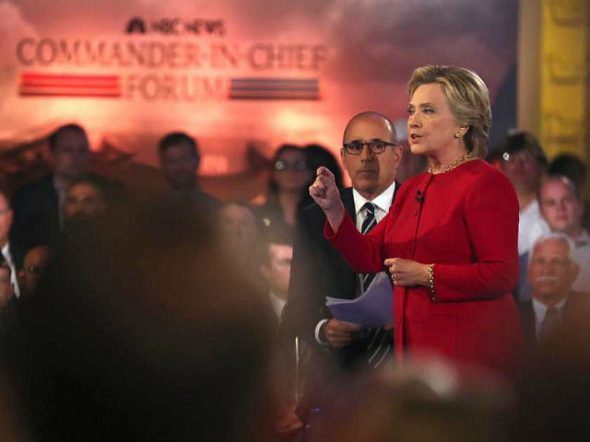
 Tonight, Hillary Clinton and Donald Trump will respond to questions by Matt Lauer and an audience of Iraq/Afghanistan War Vets and their families. Clinton will be up first in
 NBC’s Commander-in-Chief Forum. The Forum will be broadcast live from New York. It will provide an opportunity to see the candidates back-to-back in their first somewhat joint event.
 It’s a question all presidents should ask themselves.”

 peej
peej Carissa
 bostonboomer
 dakinikat
 ecocatwoman
 mablue2
 Mama Lopez
 peggysue22
 quixote
 skydancingguestblogger
 Mona (aka Wonk the Vote)



 Sky Dancing
Recent Comments