
Thursday Reads: Debate Hangover and Sanders’ Slip-Ups
Posted: March 10, 2016 Filed under: morning reads, U.S. Politics | Tags: Bernie Sanders, Florida Democratic debate, Hillary Clinton 40 Comments
Good Morning!!
The photos in this post come from a project called “Eyes as Big as Plates.” From the blog’s “about” page:
Eyes as Big as Plates is the ongoing collaborative project between the Finnish-Norwegian artist duo Riitta Ikonen and Karoline Hjorth. Starting out as a play on characters from Nordic folklore, Eyes as Big as Plates has evolved into a continual search for modern human’s belonging to nature. The series is produced in collaboration with retired farmers, fishermen, zoologists, plumbers, opera singers, housewives, artists, academics and ninety year old parachutists. Since 2011 the artist duo has portrayed seniors in Norway, Finland, France, US, UK, Iceland, the Faroe Islands, Sweden, Japan and Greenland. Each image in the series presents a solitary figure in a landscape, dressed in elements from surroundings that indicate neither time nor place. Here nature acts as both content and context: characters literally inhabit the landscape wearing sculptures they create in collaboration with the artists.
As active participants in our contemporary society, these seniors encourage the rediscovery of a demographic group too often labelled as marginalized or even as a stereotypical cliché. It is in this light that the project aims to generate new perspectives on who we are and where we belong.
I encourage you to go to the site and look at more of these amazing portraits of elders in nature.

The peacefulness portrayed in these beautiful photos stands in sharp contrast to the angry, violent, racist, sexist, and generally chaotic nature of today’s U.S. culture. Those characteristics are only being amplified by the presidential primary campaigns we have been watching for months.
I honestly don’t know how much more I can handle. Last night’s debate was hard for me to watch, and I got so angry at the questions put to Hillary Clinton that I had trouble sleeping. I’m feeling exhausted and I have a sore throat. I really don’t want to come down with another cold, so I’ll probably try to take a nap at some point. Anyway, if this post seems disjointed and littered with typos, you’ll know why.
I’m not going to say much about the questions asked of Hillary at the Washington Post/Univision debate. They were just plain disgusting, and I don’t want to get enraged again. She was asked about Benghazi, her Email non-scandal, and why nobody likes her. She was even asked if she would step down if she is indicted–a ridiculous and insulting questions that she refused to answer. It was disgraceful, and the Post and Univision should apologize to Hillary, the voters of Florida, and the general public.
In this post I’m going to focus on Bernie’s performance. In my rage last night I actually missed the bombshell that Bernie Sanders was hit with about his support for Fidel Castro when he was Mayor of Burlington, VT and refused to repudiate it. I don’t think he was asked about his strong support for Daniel Ortega (I will check the transcript and update if necessary), but I assume that Floridians will soon learn about that too.

Univision also showed the famous clip of Sanders on the Lou Dobbs show in which he argued against the Immigration bill that was sponsored by Ted Kennedy and supported by Hillary Clinton. I posted this article previously, but I’m going to include it again here, because it provides very good background information on Sanders’ support for dictatorial regimes in Latin America.
Michael Moynihan at The Daily Beast: When Bernie Sanders Thought Castro and the Sandinistas Could Teach America a Lesson.
In the 1980s, any Bernie Sanders event or interview inevitably wended toward a denunciation of Washington’s Central America policy, typically punctuated with a full-throated defense of the dictatorship in Nicaragua. As one sympathetic biographer wrote in 1991, Sanders “probably has done more than any other elected politician in the country to actively support the Sandinistas and their revolution.” Reflecting on a Potemkin tour of revolutionary Nicaragua he took in 1985, Sanders marveled that he was, “believe it or not, the highest ranking American official” to attend a parade celebrating the Sandinista seizure of power.
It’s quite easy to believe, actually, when one wonders what elected American official would knowingly join a group of largely unelected officials of various “fraternal” Soviet dictatorships while, just a few feet away, Nicaraguan President Daniel Ortega bellows into a microphone that the United States is governed by a criminal band of terrorists.
None of this bothered Sanders, though, because he largely shared Ortega’s worldview. While opposition to Reagan’s policy in Central America—including indefensible decisions like the mining of Managua harbor—was common amongst mainstream Democrats, it was rare to find outright support for the Soviet-funded, Cuban-trained Sandinistas. Indeed, Congress’s vote to cut off administration funding of the anti-Sandinista Contra guerrillas precipitated the Iran-Contra scandal.
But despite its aversion to elections, brutal suppression of dissent, hideous mistreatment of indigenous Nicaraguans, and rejection of basic democratic norms, Sanders thought Managua’s Marxist-Leninist clique had much to teach Burlington: “Vermont could set an example to the rest of the nation similar to the type of example Nicaragua is setting for the rest of Latin America.”
There’s much more about Sanders’ support for Daniel Ortega’s reign of terror in Nicaragua at the link.

As usual, there wasn’t a single question about abortion rights or the continuing efforts by Republicans to control women’s bodies, even though a horrendous Florida anti-abortion bill became law yesterday. Think Progress:
As presidential debates pile up, abortion rights advocates find themselves asking the same question after each event: Why is no one asking about abortion? But candidates’ silence on abortion was more deafening than usual at Wednesday night’s Democratic debate in Florida — where a controversial bill against abortion access was signed into law earlier in the day.
The Florida bill is nearly identical to the Texas law currently in front of the Supreme Court, using the guise of ‘supporting women’s health’ to significantly cut women’s access to abortion, contraception, and STI prevention and treatment services across the state. The Texas bill has already lead to thousands of unplanned pregnancies and100,000 self-induced abortions done by women unable to access a clinic. Latina women have been disproportionately affected by Texas’ bill — and with an equally large Latina population in Florida, the Sunshine State’s new bill could produce similarly grim results.
The Wednesday debate, co-hosted by Univision, focused heavily on immigration policy, specifically addressing the large population of Latino voters in Florida. But no moderater or candidate mentioned the impact Florida’s law could have on this population.

Because it’s apparently more important to ask Clinton stupid personal question that she has already answered repeatedly. And on Sanders’ admiration for Castro’s leadership of Cuba:
In 1989 Sanders traveled to Cuba on a trip organized by the Center for Cuban Studies, a pro-Castro group based in New York, hoping to come away with a “balanced” picture of the communist dictatorship. The late, legendary Vermont journalist Peter Freyne sighed that Sanders “came back singing the praises of Fidel Castro.”
“I think there is tremendous ignorance in this country as to what is going on in Cuba,” Sanders told The Burlington Free Press before he left. It’s a country with “deficiencies,” he acknowledged, but one that has made “enormous progress” in “improving the lives of poor people and working people.” When he returned to Burlington, Sanders excitedly reported that Cuba had “solved some very important problems” like hunger and homelessness. “I did not see a hungry child. I did not see any homeless people,” he told the Free Press. “Cuba today not only has free healthcare but very high quality healthcare.”
Sanders had a hunch that Cubans actually appreciated living in a one-party state. “The people we met had an almost religious affection for [Fidel Castro]. The revolution there is far deep and more profound than I understood it to be. It really is a revolution in terms of values.” It was a conclusion he had come to long before visiting the country. Years earlier Sanders said something similar during a press conference: “You know, not to say Fidel Castro and Cuba are perfect—they are certainly not—but just because Ronald Reagan dislikes these people does not mean to say the people in these nations feel the same.”
There is, of course, a mechanism to measure the levels of popular content amongst thecampesinos. Perhaps it’s too much to expect a democratic socialist to be familiar with the free election, a democratic nicety the Cuban government hasn’t availed itself of during its almost 60 years in power.
Again, much more at the link. I suppose Bernie supporters will be defending Latin American dictatorships after Bernie was finally questioned about all this last night.

Another interesting question Sanders was asked last night was about his support for the wacko “Minutemen” who were patrolling the Mexican boarder during the Bush administration.
Evan McMorris-Santoro at Buzzfeed (Dec. 9, 2015): In 2006, Bernie Sanders Voted In Support Of An Immigration Conspiracy Theory.
A few months before Democrats swept the 2006 elections, an outcry raged in the fringier corners of the immigration debate. Treasonous American officials were tipping off the Mexican government about the whereabouts of Minutemen patrols, the argument went, making it impossible for the private army bent on preventing undocumented immigrants from crossing the border to do their jobs.
The outcry made it to Congress, where Georgia Rep. Jack Kingston, a Republican, introduced an amendment clearly directed at the Minutemen story. The amendment barred the Department of Homeland Security from providing “a foreign government information relating to the activities of an organized volunteer civilian action group, operating in the State of California, Texas, New Mexico, or Arizona.”
Kingston’s amendment overwhelmingly passed the Republican-controlled Congress, including the votes of 76 Democrats, most of them from the party’s then-strong Blue Dog conservative wing. Another person voted for the measure, too: Rep. Bernie Sanders, an independent in the midst of the campaign that would send him the U.S. Senate….
For Sanders, the amendment is another in a string of past votes that aren’t quite in line with the exact progressive priorities of 2015. Much like past positions on guns that the senator has had to navigate this year, his immigration positions have at times posed some challenges with the new Democratic base and the party’s priorities….
The amendment was meant to protect the Minutemen, and only concerned the southern border of the United States. A short floor debate over the amendment took place on June 6, 2006. Republican backers of the amendment spoke of “the total lawlessness of people coming illegally over the border at night” and how the Minutmen — “definitely not politically correct in Washington, D.C.,” Kingston, the Republican sponsor said — “filled a void which the government was unable to fill.”

Read more about the amendment at the link. Sanders claimed last night that it was part of a larger bill so he had to vote for it, but it was actually a separate piece of legislation that Sanders voted for.
These are just a few examples of oppo research against Sanders that has been ignored so far by the media and pooh poohed by Bernie’s supporters. How would all this go over in a General Election? And I’m just talking about reactions from Democratic voters, not the vicious attacks that would come from the GOP.
Sanders’ vote against the auto bailout also came up last night; here are some enlightening tweets about that:
That’s all I’ve got for today. What are your thoughts on the debate after a night’s rest? What other stories are you following?
Live Blog: Florida Democratic Debate
Posted: March 9, 2016 Filed under: U.S. Politics | Tags: 2016 Democratic primaries, Florida Democratic debate, live blog 76 Comments
Hey Sky Dancers!
Even that exclamation point makes me tired. I must admit that I’m getting fed up with the constant debates and town halls this primary season. I think the DNC was wise to try to limit them. Both Hillary and Bernie need to make some changes to their stump speeches, because we’ve all heard them so many times at this point that it’s getting boring.
Nevertheless, I’ll be watching tonight to see how each of the candidates deals with the results of yesterday’s primaries. Someone needs to remind the country that not just Michigan voted yesterday–Mississippi voted too and the results of that one were more consequential in terms of delegates than the one the media is hyping today.
Tonight’s debate is at Miami-Dade College, and it will begin at 9PM ET. It is sponsored by Univision and the Washington Post and it will be simulcast on CNN. It will also be live streamed at The Washington Post. The moderators will be Karen Tumulty of The Washington Post and Maria Elena Salinas and Jorge Ramos of Univision.

Hillary Clinton and Bernie Sanders at the Flint debate
The Fix: How to watch the Washington Post-Univision Democratic presidential debate.
What (to watch for): Immigration almost certainly will be a major topic of discussion, given the setting and Univision’s involvement. Univision announced in February that it would launch a voter registration drive aimed at growing the Latino electorate by 3 million people. Look for the moderators to ask Sanders, who lags far behind Clinton in the delegate count, about his path forward. But if Sanders senses dismissiveness, look for him to push back hard. Univision chairman Haim Saban has contributed $2.5 million toPriorities USA Action, a super PAC backing Clinton. Ramos’s daughter, Paola Ramos, works for the Clinton campaign’s communications team. And in January, Sanders memorably unloaded on The Washington Post editorial board for criticizing his “fiction-filled campaign.” The dynamics among the candidates and sponsoring media outlets could provide intriguing subplots.
Some info on the moderators from IBT:
Univision’s María Elena Salinas. Salinas is a co-host of “Noticiero Univision” and the prime-time show “Here and Now.” She has covered presidential elections for three decades, and in the race to the 2008 presidency, she interviewed Hillary Clinton, Republican nominee John McCain and then-Illinois Sen. Barack Obama. Along with Salinas, Univision’s Jorge Ramos is also scheduled to moderate. Ramos is the host of Univision’s “Noticiero Univision” and “Al Punto,” as well as Fusion’s “AMERICA with Jorge Ramos.”
The Washington Post’s Karen Tumulty is also expected to moderate Wednesday night’s debate alongside Ramos and Salinas. Tumulty is a national political correspondent who previously worked for TIME Magazine, where she held positions as a congressional correspondent and White House correspondent, and the Los Angeles Times.
A few stories to get you warmed up for the watch party.

Joshua Tucker at the WaPo: No, actually Hillary Clinton won Tuesday night. The story is written in the form of a dialogue:
Wait a minute! It’s Cranky Reader from John Sides’s posts at The Monkey Cage.
CR: Hold on a second! I read the papers Wednesday morning. The New York Times, the LA Times, and even your Washington Post (to say nothing of Politico or CNN), and they all have top stories about how Clinton lost Tuesday night in Michigan.
Me: That’s true. Sanders did get more votes than Clinton in Michigan. But Clinton got more votes than Sanders in Mississippi. A lot more votes. As in, five times as many votes. So actually, as of 10 a.m. Wednesday, she had picked up more than 125,000 more total votes than Sanders on Tuesday.
CR: But Michigan is a bigger state and has more electoral votes than Mississippi. Therefore, it is more important to win Michigan than it is to win Mississippi if you want to be the nominee, regardless of the number of votes she won across the two states.
Me: That would be true if states in the Democratic primary were “winner take all” like most states are in the general election. Michigan does have more electoral votes than Mississippi in the general election, and for largely the same reason does award a lot more delegates to the Democratic nominating convention (123) than Mississippi (33).
CR: Ah ha! So winning Michigan is more important.
Me: That would be the case if each candidate won by the same margin. That’s because delegates to the Democratic nominating convention are distributed proportionally. Sanders doesn’t get all 123 delegates because he won Michigan, and Clinton doesn’t get all 33 Mississippi delegates because she won there. Instead, provided they get at least 15 percent of the vote — which they both did in both states — they each win a number of delegates determined by a complex set of electoral rules that in the end roughly approximates their vote share. So since Sanders won by a smaller margin in Michigan (50 percent to 48 percent) than Clinton did in Mississippi (83 percent to 17 percent), she actually won more delegates Tuesday night. And, for that matter, more than 125,000 more votes across the two states.
Head over to the WaPo to read the rest.

Miami Dade College
Claire Foran at The Atlantic: Hillary Clinton’s Intersectional Politics.
Hillary Clinton has taken pains to describe the lead-contaminated drinking water of Flint, Michigan, not only as a public-health and environmental crisis, but also as a crisis of poverty and racism. Along the way, the Democratic presidential contender has invoked the idea of intersectionality, the concept that different forms of inequality and discrimination overlap and compound one another.
Clinton’s use of the term, which was at one time largely confined to academia, signals that it is now a common way of thinking about inequality for a younger generation. Her decision to employ it may also elevate the concept in American politics, and alter the terms of a national debate over poverty, racism and other forms of inequity.
In recent weeks, Clinton has increasingly made reference to the concept on the campaign trail. “We face a complex set of economic, social, and political challenges. They are intersectional, they are reinforcing, and we have got to take them all on,” Clinton declared during a February speech in Harlem. Over the weekend, her campaign tweeted that “Flint’s water crisis is an example of the combined effects of intersecting issues that impact communities of color.” An appended graphic draws literal lines between “poverty,” “systemic racism,” “underfunded school systems,” and “crumbling infrastructure.”
Intersectionality was coined in the late 1980s to explain how different markers of identity coalesce to yield unique forms of discrimination. A black woman, for example, might experience not only racism and sexism in her daily life, but could also confront additional barriers that white women and black men do not. It became a way of making visible the experience of individuals that had previously been caught between the feminist and civil-rights movements.
Foran argues that Clinton may be using the term to attract the young voters who are “flocking to Bernie Sanders,” but I highly doubt that. Intersectionality is a concept that Sanders doesn’t understand at all, and it has been important to feminist analysis for a long time. It is also important to understanding the effects of racism. Anyway, read more at the link.

Mami Dade College Student Union
Bernie Sanders showed up in Florida for the first time last night, and Floridians have noticed his absence and find his attitude troubling.
Tampa Bay Times: With a week to go before Florida primary, Bernie Sanders shows up to campaign.
Less than a week before the primary in the country’s third-largest state, Democratic presidential candidate Bernie Sanders has a skeleton crew in Florida: four paid staffers and three campaign offices.
Compare that with former Secretary of State Hillary Clinton’s dozens of staffers and eight offices.
Even with three campaign events this week and a debate tonight in Miami — his first trip to Florida as a presidential candidate — there have been few signs of the Vermont senator on the state’s campaign trail….
“To say it’s a pipe dream would imply he actually thinks he has a shot,” said University of Central Florida political science professor Aubrey Jewett. “I suspect he realizes he doesn’t have a shot in Florida, but to be taken seriously as a candidate, you have to basically compete in the biggest battleground state.”
As of Tuesday, Sanders was 26 points behind Clinton in Florida, with just 32 percent of Democrats’ support, according to a RealClearPolitics.com average of state polling data….
Clinton has had a more robust infrastructure in the state since the very beginning, said Alan Clendinin, first vice chair of the Florida Democratic Party. After the 2008 election, a political action committee called Ready for Hillary began collecting names and contact information of supporters at fairs and festivals, he said. When Clinton officially announced her candidacy last year, the committee handed over its database to the campaign, effectively giving it a “turnkey operation,” Clendinin said.

Miami Dade College
Politico: Bernie Sanders discovers Florida.
Bernie Sanders’ plane touched down here Tuesday before the polls started to close in Michigan, offering him a prime opportunity to springboard off what was looking like an unexpectedly strong performance.
The only problem: Sanders’ Miami rally Tuesday evening — more than 10 months into his White House bid, and just one week before Florida votes — was his first campaign event in the most crucial swing state of them all.
It reflected a tactical decision to all-but-cede the South to Hillary Clinton and her decades of relationship-building there, part of a post-Nevada strategic recalibration that turned the campaign’s attention to states voting later in the calendar. The idea was to pick off delegates from the March 15 tranche — Illinois, Ohio, and Missouri are among the states voting next Tuesday — but it’s come at a cost in Florida.
The Vermont senator now trails the former secretary of state by a wide margin in Florida polls, leading local Democrats to question the long-term viability of a candidate without a real Florida operation….
“Florida is very representative of America, the new demographic, the new look of America,” added former Miami Mayor Manny Díaz, a Clinton supporter. “And if you believe that you should not spend any time in Florida, then you should not spend anytime anywhere else. You’re going to run into the same problem everywhere else.”
More details at the link.
Get ready to document the good performances, the gaffes, and the atrocities. I expect a strong performance from Hillary because she’s always at her best when she is challenged.
Live Blog: Returns of the Night
Posted: March 8, 2016 Filed under: 2016 elections, Live, Live Blog | Tags: Clinton, Hawaii, Idaho, Michigan primaries, Mississippi, Trump 195 Comments
Good Evening!
Tonight we’re waiting for the returns from the state of Michigan even though there are three other states voting. Hawaii, Idaho, and Mississippi are also voting although several of these are Republican voting events only.
The biggest prize is Michigan where the front-runners – Donald Trump for the Republicans and Hillary Clinton for the Democrats – will seek to consolidate leads over their respective rivals.
Both parties are also holding primaries in Mississippi on Tuesday.
In addition, the Republicans are voting in Idaho and Hawaii.
Billionaire businessman Mr Trump is well ahead in the all-important delegate count, but a poor debate performance and some recent losses to Texas Senator Ted Cruz have raised questions about the solidity of his lead.

It’s an important day for Republicans, in which 6 percent of the party’s delegates are at stake. And by the time the dust has settled tonight or (more likely) tomorrow, about 43 percent of the party’s delegates will be allotted overall.
But really, today is a prelude to the far more consequential contests taking place in one week. That’s because today’s delegates are allocated mostly proportionally, making it tough for any candidate to pick up a huge lead. Next week, though, Florida and Ohio will vote winner-take-all, and the outcomes there could have major implications for the future of the race, since Donald Trump has led recent polls of both states. If he wins those two, he could amass a delegate lead that will be very difficult for any of his rivals to surmount.
So expect Republicans to interpret tonight’s results mainly in terms of what they might mean for next week. Does Trump look mortal, as he did on Saturday, or will he rebound with a dominant performance? Is Marco Rubio truly in free fall, as some recent polls have indicated? Is the anti-Trump vote consolidating around Ted Cruz, or will it remain split?
As for Democrats, Hillary Clinton is up big in polls of both states voting today. A win in Mississippi tonight wouldn’t be a surprise, since she’s romped in the South so far, but it would let her continue to pad her lead in pledged delegates, which is already sizable. But if Sanders gets blown out in Michigan, that may indicate that Clinton is likely to win several other primaries in large, delegate-rich states outside the South — making analready tough delegate math challenge for Sanders even tougher.
Michigan is a state that’s undergone a vast change. It used to be the center of a great post-War industrial automobile industry but most of its lucrative union jobs are gone. The auto industry is on the mend but no  where as powerful as it used to be in the country. It is perhaps a great test of the power of establishment vs. outsider revolution.
While Sanders has made awkward attempts to court African American voters, Hillary Clinton has deep ties to the community. She was the first presidential candidate to visit Flint, Michigan, a predominately African American city with toxic water.
Clinton hopes to appeal to people like Lawrence White, a 43-year-old state employee and owner of a small security firm who feels betrayed by every level of government and by both parties. “I’m not just singling out Governor [Rick] Snyder,” the African American Democrat told me in January. “All the politicians including the EPA are playing tit-for-tat, playing games at our expense. It’s everybody. It’s Republicans. It’s Democrats. It’s a globalization of not caring for the people of Flint.”
Just north of Detroit, in the suburbs of Oakland and Macomb counties, live the children and grandchildren of Reagan Democrats, white working-class voters who defected their party to support Ronald Reagan in the 1980s.
I grew up among Reagan Democrats; their racial and economic grievances were the soundtrack of my childhood. For people like Benson Brundage, a Macomb County contractor who told me in 2012 that welfare is racial “subsidization,” Donald Trump gives voice to their fears.
Mitt Romney dog-whistled at them in 2012. Now the former GOP nominee issuggesting that Trump is a bigot.
 Polls show that all the midwestern industrial states favor Trump and Clinton. Here’s a list of the latest polls from RCP. It’s bound to be a dismal day for Marco Rubio. That’s pretty obvious. Is Kasich rising since these states should be favorable to him?
Ohio Gov. John Kasich has actually jumped ahead of Rubio for third place in Michigan, and is rising quickly, a Monmouth University poll out Monday showed. He appears to have worn well in last week’s Republican presidential debate, when he stayed out of the Trump-Rubio-Cruz scrum.
So imagine this scenario: Kasich beats Rubio in Michigan. Then, on March 15, Kasich wins his 66-delegate, winner-take-all home state of Ohio, and Rubio loses his 99-delegate, winner-take-all home state of Florida.
Find your presidential match with CNN’s 2016 Candidate Matchmaker
Suddenly, Kasich would become the leading moderate, establishment-type Republican in the race — and Rubio would lack a path forward.
There are a lot of “ifs” for that to happen. But for Kasich to stand any chance of turning what’s been a smaller-scale campaign that’s been much choosier about where he tries to compete into one with a real shot at quickly racking up delegates, Michigan is where it has to start.
Join us tonight for the returns! I’ve put up a picture from each of the states. As you can see, there couldn’t be a better example of the diversity in Americans and geography in the states voting tonight.
Mississippi returns will come in first at 8 pm est so get ready!!!
Tuesday Reads: Feel The Bern-Out
Posted: March 8, 2016 Filed under: morning reads, U.S. Politics 61 Comments
All I see is white people.
Good Morning!!
Today Michigan and Mississippi will hold primaries, and Bernie Sanders will fall farther behind Hillary Clinton in the delegate count for the Democratic nomination.
On the Republican side, in addition to the Michigan and Mississippi primaries, there will be a primary in Idaho and caucuses in Hawaii.
ABC News reports: Storylines to Watch in Tuesday’s 2016 Presidential Primaries and Republican Caucuses.
Republicans will vote Tuesday in the Idaho, Michigan and Mississippi primaries and the Hawaii Republican caucuses. Democrats in Michigan and Mississippi are also holding their primaries.
In total, 205 delegates are at stake for the two Democratic candidates. On the other side of the aisle, 150 are up for grabs for the four remaining Republican candidates.
Bernie has high hopes for Michigan, but at the end of the day he’s likely to be disappointed.
While campaigning in Michigan, Sanders has attacked Clinton with a heavy focus on trade, arguing that Clinton’s support of “disastrous trade deals” has led to job loss in the state.
“If the people of Michigan want to make a decision of which candidate stood against corporate America, stood against these disastrous trade agreements, that candidate is Bernie Sanders,” the Vermont senator said at a campaign rally in Traverse City, Michigan, last Friday.
“We think we’re going to surprise people here in Michigan,” Sanders said Sunday on ABC News’ “This Week with George Stephanopoulos.”
However, a NBC/WSJ poll conducted in Michigan shows Hillary Clinton with a major lead of 57 percent among Democrats to Sanders’ 40 percent.
Read more storylines at the ABC News link above.
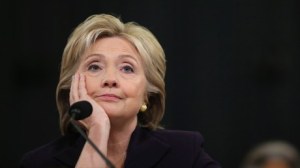
Sorry, Bernie. Black people in the northern states don’t vote differently from those in southern ones, despite your spin after Super Tuesday. Bernie on This Week:
“I think you’re going to see us doing — and I think the polls indicated it, much better within the African-American community outside of the Deep South,” Sanders said. “You’re going to see us much better in New York state where I think we have a shot to win, in California and in Michigan.”
Dream on. I said after Super Tuesday that we need to be kind to Sanders’ supporters, and that will be even more true tomorrow. They are going through a grieving process and many of them are young people who have never experienced this kind of loss before.
Last night, at the Fox News town hall, Hillary was gentle with Bernie, and we should follow her lead. It will be mostly over after today, but his supporters will still be telling themselves he can win Ohio and Pennsylvania. It’s not going to happen, but the Bernie fans will just have to find out for themselves.
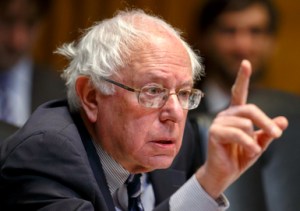
Excuse me . . .
Yesterday John Cole had an interesting post at Balloon Juice: I’ve Kind of Made My Decision. The gist is that he likes Bernie, but has decided to vote for Hillary. It’s a good read, and I suggest to go check it out at the link, but I want to highlight this section (emphasis added):
I know this is going to piss people off, and I know some of you are going to scream ageism, but watching Bernie last night, he just seemed old and tired and wearing down. I was initially leaning Bernie at the beginning of this primary (because of course I was), and every time I look at him he just looks less energetic and a little more beat down. His response latency seems to be increasing as he collects his thoughts, and last night I saw him lashing out angrily about “your Wall Street friends,” and those are just not things that can happen in the general.
I’m not trying to be ageist- I don’t think people his age can’t or shouldn’t be President, it’s just that as I have watched this primary election go on, Clinton seems to be getting stronger and more confident and more ready for the election, while I feel the opposite is true about Sanders. In my mind’s eye, she looks younger to me than she did at the beginning of this primary. Clinton seems to really becoming a happy warrior, despite all the heaps of bullshit the Republicans have thrown at her.
Maybe you don’t see it that way. But I do. I look at Hillary these days and think there is no doubt she could serve eight years right now, while some days I wonder if Bernie is going to make it to November. The Vice President is a backup plan for when things go horribly wrong, not a plan. Again, I’m sorry if my elders think I am bashing them by stating this, but I’m really not trying to- Bernie has more energy on a bad day than I do on a great day, but he just is really starting to look worn down. The contrast for me last night was palpable.
I strongly agree with Cole on this. Bernie is wearing down. I think part of it is age, but I think it’s also his perpetual anger and defensiveness.
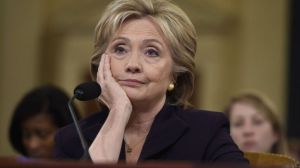
All right, I’ll wait for you to finish . . .
Hillary comes off as cool as a cucumber. She has dealt with so much shit over the years that she’s immune to it. As she is fond of saying, whenever she gets knocked down, she gets right back up stronger than ever. It’s clear that she loves the challenge of running as the first woman to become the nominee of any major party. And she is ready to be POTUS from day one.
Bernie, on the other hand, lets criticism and losses get under his skin. and when that happens, he lashed out and he makes unforced errors. He’s just not ready to be the nominee and definitely not ready to be POTUS.
MSNBC: ‘Ghetto’ gaffe highlights Bernie Sanders campaign’s struggle with race.
While discussing his own racial “blind spots” during Sunday night’s Democratic presidential debate in Flint, Michigan, Sen. Bernie Sanders offered that white people “don’t know what it’s like to be living in a ghetto. You don’t know what it’s like to be poor.” His comment drew swift condemnation on social media, since it appeared that the Vermont lawmaker was implying that only black people live in impoverished communities, reinforcing inaccurate and painful stereotypes that have dogged African-Americans for years.
Sanders’ “ghetto” gaffe underlined a persistent problem that may have crippled his bid for the 2016 nomination. He has struggled to connect with black voters, and his choice of words has often undercut a populist economic message that might have resonated with people of color.
Even if Sanders had the best of intentions, it was not his best moment, as evidenced by one of his most prominent African-American surrogates — former NAACP chairman Ben Jealous — who told NBC News: “Sen. Sanders is from Burlington, he grew up in old Brooklyn, he knows white folks live in ghettos.”
On Monday, Sanders attempted to clarify his debate statement, telling a gaggle of reporters in Detroit: “What I meant to say, is when you talk about ghettos, traditionally what you’re talking about is African-American communities.”
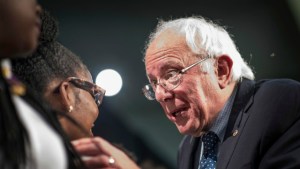
Bernie just can’t stop digging, can he?
Jonathan Capehart on the “ghetto” goof: ‘Excuse me!’ Bernie Sanders doesn’t know how to talk about black people.
When Sanders said that, I tweeted, “He knows that all Black people don’t live in ghettos, right?” His answer so threw me that I didn’t even hear him say that white people “don’t know what it’s like to be poor.” Sanders’s cab story might be true, but it also struck me as rhetorical grasping at straws. And for it to be an illumination to Sanders that he doesn’t “understand what police do in certain black communities” is more damning than you think. For in this one exchange, you see Clinton’s fluency in and understanding of the language of race and Sanders’s glaring ignorance.
You also see who the true Democrat is. It’s not Sanders.
Democrats, especially those with national ambitions, know how to talk to people of color, especially African-Americans. They are the base of the Democratic Party. You learn the nuances of their concerns and the issues important to them. You take them to heart. Fail to do that and watch your political career perish. As a former first lady of Arkansas, former first lady of the United States and former Senator from New York, Clinton can speak to Blacks with a fluency that lets African Americans know she gets it and gets them.
After Sanders’ early work on desegregation in Chicago, he doesn’t seem to have focused much on Civil Rights or even the anti-war movement of the 1960s and ’70s. He left Brooklyn in 1968 and moved to Vermont along with many other white people who were fleeing big cities; and it seems that he stayed in his white bubble right up until he began campaigning for the Democratic presidential nomination.
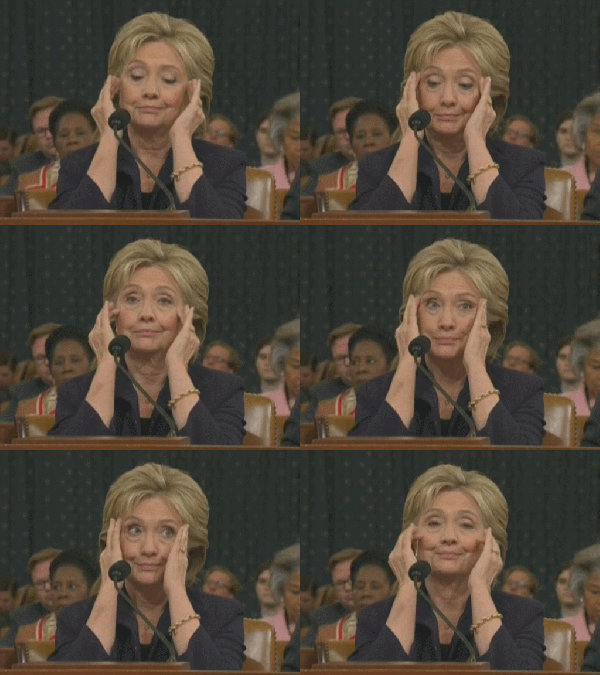
How much longer do I have to listen to this shouting?
I thought this was interesting out of Sanders’ hometown.
Brooklyn Paper: Turn up, tune in, Bern out: Sanders supporters say not all of Bushwick is behind Brooklyn’s son.
Not all of Bushwick can feel the Bern.
A band of hipster Brooklyn Bushwickans on the stump for Bernie Sanders from inside local industrial loft spaces is having a tough time convincing old-school neighbors to get out and vote for Brooklyn’s son, say the passionate organizers.
“There’s the original Bushwick community and the gentrified Bushwick community,” said Magenna Brink of the Bushwick Berners, who regularly gather to call voters over some brews while they plan their door-to-door outreach at their Forrest Street headquarters as well as the notorious McKibbin Street lofts. “The gentrified community, with all the hipsters and the young kids, are totally behind Bernie. The other community is kind of half-and-half.”
The berners say they have hit the streets to spread the word about their candidate of choice only to find many of the native residents are either not enamored with Sanders’ socialist policies or completely unaware he exists.
“In the lower-income communities, there were a ton of people who said they were Hillary supporters, but they didn’t even know who Bernie Sanders was,” said Brink.
New York is another state Sanders claims he can win, but the polls don’t agree with him.
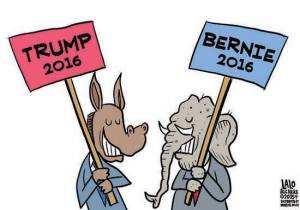
Today could be interesting on the Republican side too. It seems to me that Donald Trump has not been performing as well as he should be in recent contests, Ted Cruz has been showing a great deal of strength, and Marco Rubio has just about hit bottom. Here are a few interesting stories on the GOP race.
Politico: Is Trump peaking? We’ll find out today.
On Tuesday, Donald Trump will discover whether his weekend struggles were a speed bump — or the first signs of larger troubles ahead.
If the polls are to believed, Trump is in for a dominant day, with blowouts in Michigan and Mississippi to be complemented by another win in Idaho. If Trump falls short, and particularly if he falls short to Ted Cruz for the second time in four days, the businessman’s delegate math gets more complicated, and the soothsayers who’ve long predicted Trump’s collapse will finally see hope for vindication.
For the first time since Iowa, a non-Trump Republican took home the day’s largest haul of delegates last weekend, as Cruz on Saturday won handily in Maine and Kansas and ran a close second in Louisiana and Kentucky. Repeating that feat Tuesday would put more momentum behind the Texas senator’s campaign and strengthen his case as the GOP’s best, only hope of nominating someone other than Trump. Trump’s standing among Republican registered voters—down 3 points from January—nationwide fell slightly in the latest ABC News/Washington Post national poll released Tuesday, while the poll put Cruz up 4 percent, though Trump maintained a 9 point lead over Trump in the poll.
A relative lack of polling adds unpredictability to Tuesday’s votes. While Michigan has been heavily surveyed, Hawaii has gone uncovered, and sparse polls in Mississippi and Idaho are now out of date. Trump had large leads in past surveys, but they were conducted before Marco Rubio and several super PACs went all-out against Trump, before two raucous anti-Trump debates and before his losses to Cruz on Saturday.

Washington Post: Seeing Trump as vulnerable, GOP elites now eye a contested convention.
The presentation is an 11th-hour rebuttal to the fatalism permeating the Republican establishment: Slide by slide, state by state, it calculates how Donald Trump could be denied the presidential nomination.
Marco Rubio wins Florida. John Kasich wins Ohio. Ted Cruz notches victories in the Midwest and Mountain West. And the results in California and other states are jumbled enough to leave Trump three dozen delegates short of the 1,237 required — forcing a contested convention in Cleveland in July.
The slide show, shared with The Washington Post by two operatives advising one of a handful of anti-Trump super PACs, encapsulates the newly emboldened view of many GOP leaders and donors. They see a clearer path to stopping Trump since his two losses and two narrower-than-expected wins in Saturday’s contests.
Read more at the link.
The Washington Post: Trump leads GOP race nationally but with weaker hold on the party.
Donald Trump continues to lead his rivals nationally in the contest for the Republican presidential nomination. But his hold on the GOP electorate has weakened since the primary season began, and the party is now deeply divided over his candidacy, according to a new Washington Post-ABC News poll.
Trump maintains the support of 34 percent of registered Republicans and Republican-leaning independents, compared with 25 percent for Sen. Ted Cruz of Texas, 18 percent for Sen. Marco Rubio of Florida and 13 percent for Ohio Gov. John Kasich.
Trump maintains the support of 34 percent of registered Republicans and Republican-leaning independents, compared with 25 percent for Sen. Ted Cruz of Texas, 18 percent for Sen. Marco Rubio of Florida and 13 percent for Ohio Gov. John Kasich.
Trump’s margin over Cruz has narrowed from 16 points in January to nine today. As a succession of Republican candidates quit the race, Cruz’s position has ticked up four points since January, Rubio’s has risen by 7 and Kasich’s grew by 11. Trump’s has dipped by three points, within the poll’s margin of sampling error.
What stories are you following? Let us know in the comment thread. We’ll have a live blog later this evening to discuss the primary and caucus results. Have a great Tuesday!
Live Blog: Fox News Democratic Town Hall
Posted: March 7, 2016 Filed under: morning reads, U.S. Politics | Tags: Bernie Sanders, Detroit Democratic Town Hall, Fox News, Hillary Clinton 58 Comments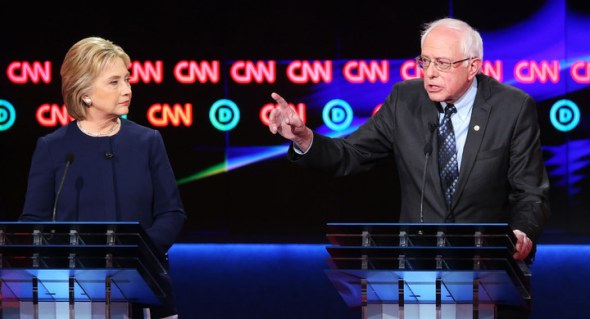
Hey There, Politics Junkies!
The Fox News Democratic Town Hall begins at 6PM. It looks like it will only last an hour, and if we’re lucky we won’t have to watch a scene like the one depicted above again tonight. The event will be held in Detroit. You can watch the live stream on the Fox News website.
Here are the basics from MichiganLive:
WHAT TIME IS THE TOWN HALL? The hour-long discussion is scheduled to start at 6 p.m. It will re-air at 11 p.m.
WHERE CAN YOU WATCH THE DEBATE?Fox News has not released information on tickets, but the town hall will air live on Fox News and will be live-streamed atFoxNews.com.
WHERE IS THE DEBATE? The town hall is scheduled to take place at the Gem Theatre in Detroit.
WHO WILL MODERATE THE DISCUSSION? Fox News’ chief political anchor Bret Baier will moderate.
WHAT WILL THEY TALK ABOUT? If Sunday’s debate in Flint is any indication, the bailout of the auto industry could be the hot topic Monday night.
The pair also discussed Detroit schools and racial inequity on Sunday.
Clinton and Sanders clashed over whether the Vermont senator supported the federal bailout that saved the auto industry.
I’m not sure if the two will be on stage together or not. If they are, I hope Senator Sanders will be on his best behavior.
Have fun!

 peej
peej Carissa
 bostonboomer
 dakinikat
 ecocatwoman
 mablue2
 Mama Lopez
 peggysue22
 quixote
 skydancingguestblogger
 Mona (aka Wonk the Vote)



 Sky Dancing
Recent Comments