
Saturday Morning Cartoons
Posted: August 9, 2014 Filed under: just because 16 CommentsGood Morning!!
Welcome to Sky Dancing Blog’s Saturday morning cartoons for political junkies!
First up, World in Chaos, by Gary McCoy
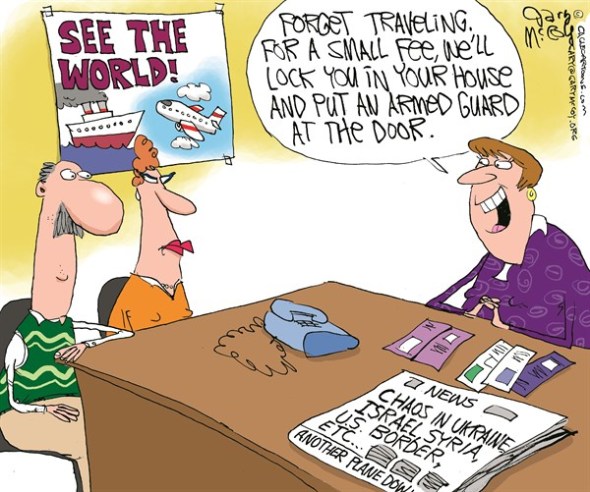
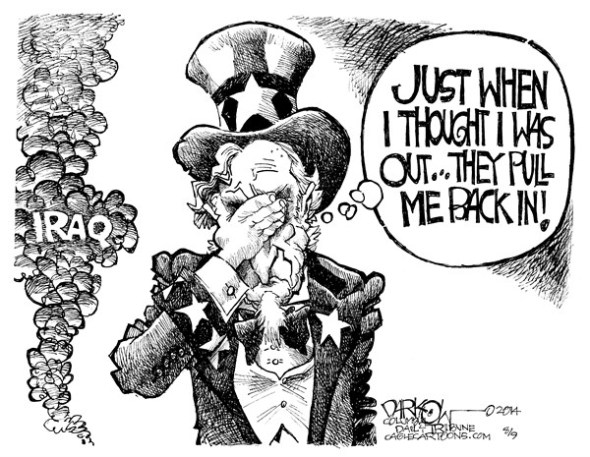
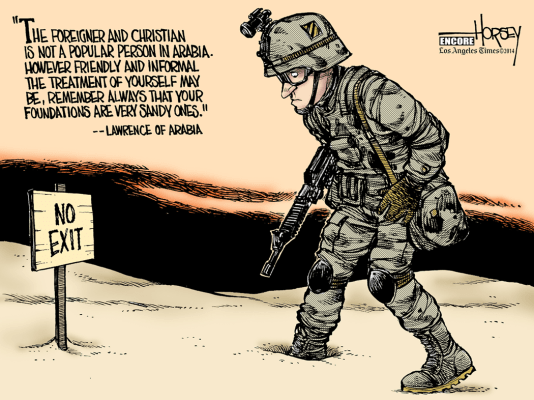
How did the world get so crazy so quickly? Today’s top story is Iraq. It seems as if everyday there’s a different trouble spot.
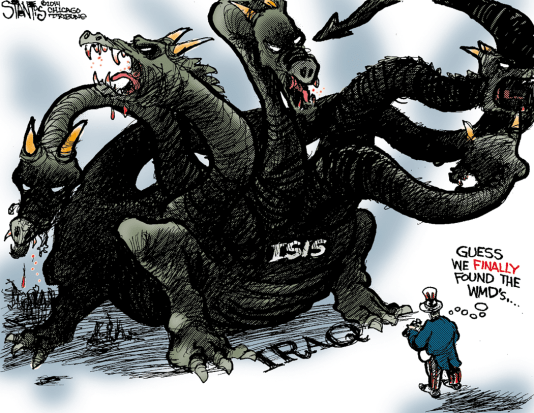
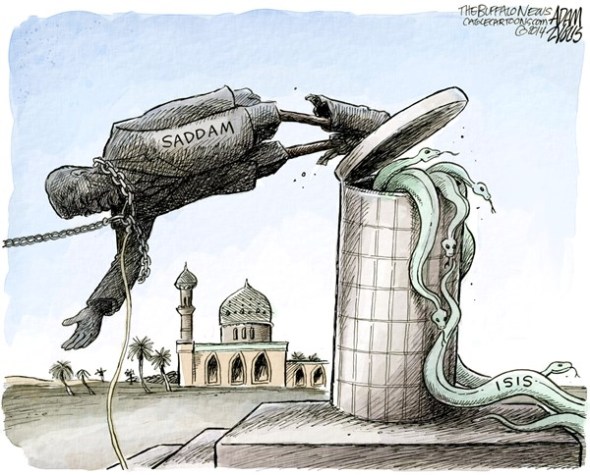
If only George W. Bush hadn’t gotten us ensnared in Iraq and Afghanistan! How could Americans forget the lessons of Vietnam? Will we ever escape?
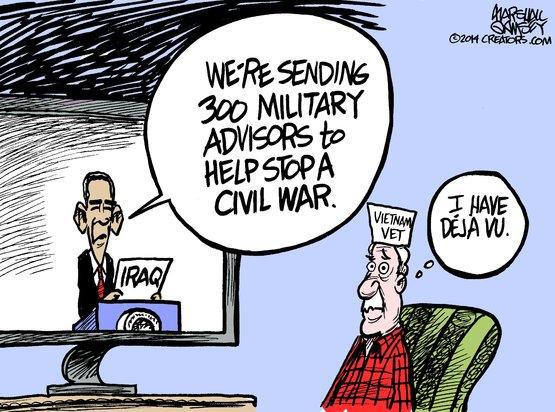
WaPo:
U.S. jets take to skies again over northern Iraq, a day after strikes on Islamic State.
KALAK, Iraq — American fighter jets roared over the new front lines in northern Iraq Saturday but did not strike, a day after airstrikes on Islamist militants in the region put the U.S. military back in action in Iraqi skies less than three years after troops withdrew and President Obama declared the war over.
The strikes Friday were limited in scope but helped temper days of building panic across the north of the country as militants with the extremist Islamic State sliced through a string of towns and villages scattered on the outskirts of the Kurdish region and sent tens of thousands of civilians fleeing for their lives.
The airstrikes also presented the first significant challenge yet to months of unchecked expansion by the al-Qaeda offshoot, which has swept through much of Iraq and neighboring Syria over the past year, annihilating its opponents, capturing valuable resources and declaring the creation of an Islamic caliphate in a nation-size chunk of territory.
LA Times:
With rise of Islamic State, Christians feel Iraq is no longer home.
They have gone from comfortable lives in historic towns and villages in Iraq’s parched Nineveh plains to the precarious existence of refugees unsure about their next meal and where they will spend the night — and even whether they belong in this country anymore.
“We have no safety, no security, no guarantees of anything,” said Alhaan Mansour, 33, as her 6-year-old son, Gaid, clung to her and listeners nodded in fervent agreement. “This is no life for anyone. We need a place where we can be safe and live our lives.”
The world has watched as an extremist group that dubs itself the Islamic State emerged from the chaos of the Syrian civil war to carve out a self-proclaimed caliphate that some say is now the size of the state of Indiana. Uncounted multitudes of Syrians and Iraqis, most of them Muslim, have become casualties.
But for the Christian minority of northwest Iraq, the militants’ onslaught has been nothing short of a catastrophe. In the last week, most of the Christian communities of the Nineveh plains have been overrun, forcing perhaps 100,000 people to flee, many to the semiautonomous Kurdish zone that has its capital here.
Even before the latest exodus, Christians had to evacuate the city of Mosul, long home to a vibrant Christian community, or face death at the hands of the extremists.
USA Today:
Analysis: Limited U.S. strikes in Iraq may not work.
In authorizing targeted air strikes against Islamic militants in Iraq, President Obama has opted to avoid the all-out “shock and awe” campaigns of previous U.S. conflicts in Iraq.
Air strikes will be limited to defending American forces and supporting a humanitarian effort to provide food and water to thousands of starving Yazidi refugees who have fled Islamic State militants because they practice a different religion.
That response may prove inadequate to force the retreat of a surprisingly ferocious enemy that has evolved into a conventional army equipped with tanks and heavy weapons. Many of those weapons, including Humvees and artillery, are American-made and were seized from Iraqi national troops who fled Mosul, Iraq’s second-largest city, when the militants attacked in June.
The air strikes will be limited in scope and not part of “a larger air campaign at this point,” a senior defense official said Friday. He asked not to be named because he was not authorized to talk publicly about the decision.
Isn’t that just ducky? But wait — President Obama just told us that the airstrikes are working.
NBC News:
Obama Proclaims U.S. Airstrikes Working in Iraq
U.S. airstrikes against militant Islamist rebels and humanitarian airdrops in Iraq have weakened the rapidly advancing fighters and successfully delivered “thousands of meals and gallons of water” to tens of thousands of refugees, President Barack Obama said Saturday.
Obama said in a nationally televised news conference from the South Lawn of the White House that “we will not have troops again in Iraq,” but he said he was determined not only to “protect our American citizens in Iraq” but also to prevent “an act of genocide” against the refugees. He said the United Kingdom and France had agreed to join the U.S. in providing humanitarian assistance.
U.S. jets launched airstrikes Friday on isolated targets to stem the advance of fighters of the Islamic State of Iraq and al-Sham, who have trapped tens of thousands of Christians and ethno-religious Yazidi on a mountaintop in northern Iraq. The U.S. also said it made a second airdrop of food and waterFriday to the refugees.
I sure hope he’s right.
Richard Nixon’s Downfall
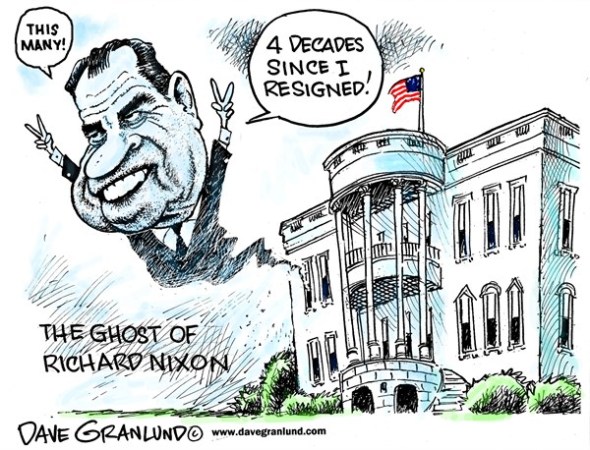
The anniversary of Richard Nixon’s resignation is also in the news. It happened 40 years ago today.
Christian Science Monitor:
Richard Nixon resignation: his raw, personal farewell (+video), by Peter Grier.
Forty years ago today President Richard M. Nixon told the nation that he had decided to resign from office, effective at noon, Aug. 9, 1974. The long-building scandal of Watergate had finally cost Nixon theWhite House, the political prize he had sought all his adult life.
He had little choice. It was either quit or be forcibly ousted from the Oval Office. The previous evening, Sen. Barry Goldwater of Arizona and two other top congressional Republicans had told him he would be impeached by the House and convicted in the Senate if he fought on. His support among the public had finally collapsed. Fifty-seven percent of US voters thought he should be removed from the presidency, according to Gallup figures.
His approval rating was an abysmal 24 percent.
Today’s voters, inured by years of partisan strife, a 2000 presidential election decided in the courts, and the impeachment of President Clinton, might find it hard to imagine the turmoil then roiling the US electorate. Vietnam, and then Watergate, had split the nation more deeply than anything since the civil war. Nixon’s televised farewell address to the nation began at 9:00 p.m. Eastern time, and when he uttered the fateful line “I shall resign the presidency at noon tomorrow,” the roar from protesters gathered in Lafayette Square was so loud that reporters watching the feed of the speech in the White House basement could not hear the next line.
Read more at the link.
New Yorker:
The Weird Minutes Before Nixon’s Resignation
Many Americans remember the telecast during which Richard Nixon announced his resignation from the Presidency, forty years ago today, as a dark moment in the nation’s history. Watching the Leader of the Free World crumple in disgrace induced a mordant glee in certain quarters, but it was still a grim spectacle. The comedian Harry Shearer has another word for the events of that night: “goofy.”
In the clip below, you can watch Shearer (who is perhaps best known as the bassist in “This Is Spinal Tap” and as the voice of Mr. Burns and several other characters on “The Simpsons”) play Nixon in a verbatim reënactment of what happened in the Oval Office in the minutes directly before and after the resignation. Shearer strides in, as Nixon did that night, a man seemingly unperturbed by the fact that he is now probably the most widely despised American political villain of the twentieth century. He joshes inanely with the TV crew, who respond with shuffling embarrassment. There are only a few moments—like when Nixon snaps at a photographer for taking too many pictures—that he acts like he’s about to deliver anything more serious than the annual turkey pardon.
When you watch the actual footage from that evening, recorded by one of the TV cameras in the room, Nixon’s swaggering tone-deafness will make you squirm. Shearer’s reënactment magnifies that effect, both because the use of multiple cameras provides detail and depth, and because presenting the episode as a dramatic scene underlines the strangeness of the President’s behavior.
More about Harry Shearer’s show at the link.
The Ghost of Richard Nixon, by Dave Granlund
A few more timely cartoons
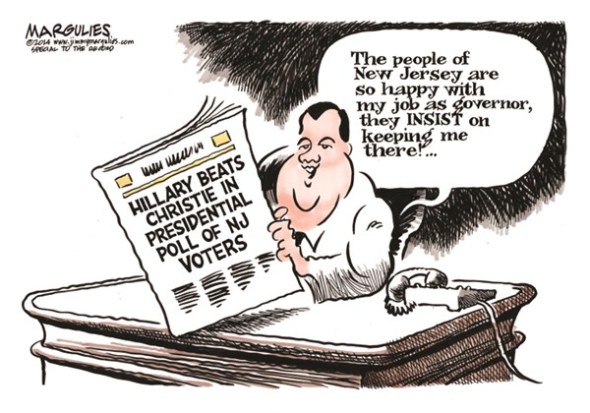
Hillary beats Christie in New Jersey poll, by Jimmy Margulies
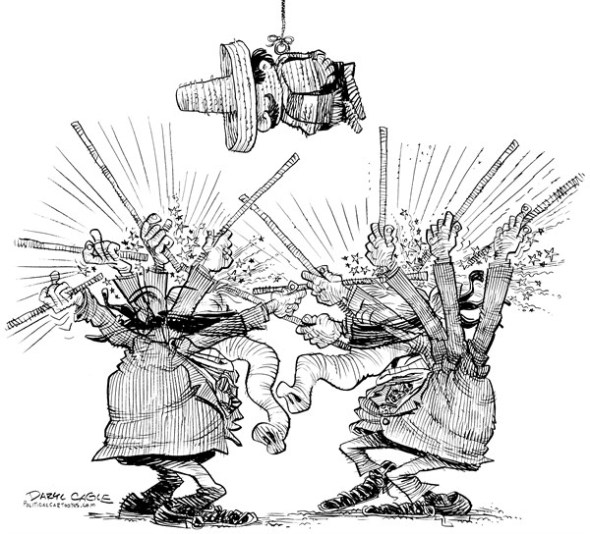
Republicans argue immigration, by Daryl Cagle
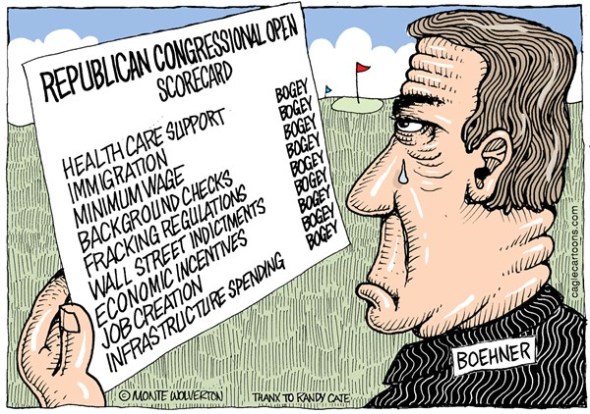
Republican Scorecard, by Monte Wolverton
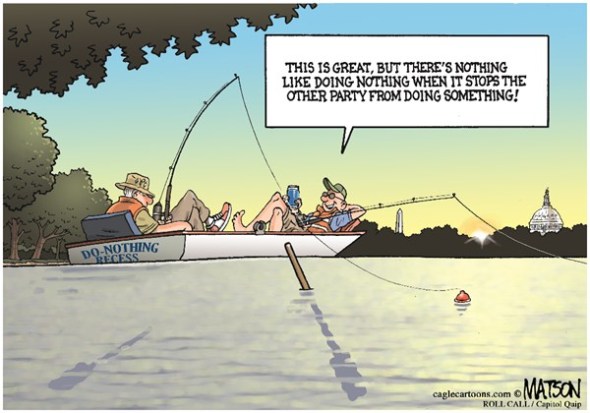
Republican do-nothings, by RW Matson
Have a great weekend, everyone!!
Friday Reads: The Good, The Bad, and The Silly
Posted: August 8, 2014 Filed under: Barack Obama, Foreign Affairs, health, Iraq, Israel, morning reads, Political Affective Disorder, Real Life Horror, Republican politics, U.S. Military, U.S. Politics, Ukraine | Tags: archaeology, Arthur G. Dozier School for Boys, beastiality, Craigslist, George Owen Smith, Helmetta, IRS e-mails, ISIS, Jerald “Jerry” Hill, Judge Reggie Walton, news headlines, NJ, Richard Recine, Secret Service, Steve Wronko, Tea Party, True the Vote, University of South Florida, White House security breach, Windermere Baptist Conference Center 6 Comments
Good Morning!!
There’s plenty of bad news to wallow in today, but I’m determined not to let it get to me. I’m going to begin this post with a story that made me smile and a couple more that made me laugh. After that, I’ll take a look at the dark side of current events.
Last night about 8:00, a “toddler” managed to White House security alert when he “squeezed through the White House gate” and ran onto the lawn, where he was finally intercepted by heavily armed Secret Security agents. At the time, President Obama was about to make a statement on the situation in Iraq. The Washington Post reports:
The brief kerfuffle as agents scrambled to intercept the pint-sized intruder confirms what most people know: toddlers are sneaky, and fast. This one was promptly returned to his parents.
The little guy didn’t get in any trouble — at least, not with the feds. And he was unavailable for comment — to anyone — for at least a few more months.
“We were going to wait until he learned to talk to question him,” Secret Service Agent Edwin Donovan said in a statement, “but in lieu of that he got a timeout and was sent on way with parents.”
I sooooo wish there was a video of the action! I suspect we’ll eventually learn the identity of the boy. If nothing else, he’ll have a great story to tell his friends when he grows up.

Here’s another silly story. A small-town New Jersey police officer got into an argument with a resident with a grudge against the local animal shelter who was “seen taking pictures” inside a public building. The cop began ranting about President Obama, and the whole thing was caught on tape. From Helmetta, NJ:
Special Police Officer Richard Recine now is the subject of an internal affairs investigation after the video was posted online and was seen by Police Director Robert Manney, who called the comments an “embarrassment.”
In the video, taken Monday at the borough municipal building, resident Steve Wronko gets into a verbal confrontation with Recine, who was called to the building because Wronko was seen taking pictures inside.
After Wronko insists he has a constitutional right to record in a public place, Recine responds.
“Obama has decimated the friggin’ constitution, so I don’t give a damn,” says Recine, a retired Franklin cop. “Because if he doesn’t follow the Constitution we don’t have to.”
Wronko then turns to the person recording the camera to make sure that was recorded. Recine repeats himself.
“Our president has decimated the constitution, then we don’t have to.”
Wronko and his wife have been getting on local officials’ nerves for awhile now. They say they are
campaigning for reform at the borough animal shelter, which they said gave them an underage and sick puppy that caused them thousands of dollars in veterinarian bills.
“We wanted them to pay for the medical bills. Now it’s way past the money,” Collene Freda-Wronko said. “Now it’s about getting animals out of that shelter and getting people into that shelter who could run that facility better.”
She said police have ordered her husband to stop videorecording at the animal shelter during two previous incidents.
Here’s the viral video of officer Recine expressing his opinions about his right to ignore the Constitution.

Recine, a retired Franklin, N.J. police officer who is collecting a pension of around $76,000, and was working in Helmetta for an hourly wage, has now resigned. Oddly, he is registered Democrat.
“I don’t want to give a black eye to law enforcement,” Recine, 59, said Thursday in an exclusive interview with MyCentralJersey.com. “People are saying some really nasty stuff about cops. I don’t want all officers painted with the same brush.”
Borough Administrator Herbert Massa said the resignation was accepted by Police Director Robert Manney, who had called Recine’s comments an “embarrassment.”
The video first was reported Wednesday by MyCentralJersey.com and the story quickly went viral. The story was picked up by the Drudge Report and was the top story Thursday morning on the online community news website Reddit. Many readers were upset that Recine’s comments were dismissive of civil liberties.
Recine claims that when he made the remarks about Obama, he was just being “sarcastic.”
“It was just a stupid statement on my part. He got me riled and I said it,” he explained. “I don’t believe that at all. I’m the most patriotic person in the world. I believe in God, the flag, country, the Constitution.” ….
“I tried to explain to him that since 9/11 you just can’t walk into a place and take videos,” Recine said Thursday. “All he kept on doing was saying he had civil rights, and the Constitution, and he didn’t have to give me information. And I kind of like lost my temper.”
No one asked Recine why terrorists would target a public building in Helmetta, NJ, population 2,200.

This next story isn’t exactly funny–well, as my dad used to say, “it’s not funny ha ha; it’s funny peculiar.” From Raw Story, CEO of Baptist center fired after arrest for arranging dog sex encounter on Craigslist.
Jerald “Jerry” Hill, 56, of Camden County [Missouri] was arrested on Aug. 5th after setting up a meeting with an undercover officer for the purpose of having sex with a dog, according to the Columbia Daily Tribune.
According to Boone County sheriff’s Detective Tracy Perkins, her office received a tip that someone was seeking sex with a dog or other type of animal — which she did not specify — on Craigslist. An undercover officer exchanged emails with Hill offering a dog for sex. Subsequently, Hill was taken into custody in Columbia, MO., when he arrived anticipating a sexual tryst.
Hill’s employer is concerned for his “well-being.” Continuing from Raw Story:
Hill is currently listed as the president and CEO of the Windermere Baptist Conference Center, located in Roach, Missouri, whichissued a statement saying that they were supportive and grateful for his work, but were worried about how the impact of his arrest would reflect on the center.
“We are concerned for the well-being of Jerry…and we are also concerned with the well-being of Windermere,” Chairman Arthur Mallory said. “Windermere will continue to function in a good way…. It is a significant piece of God’s kingdom’s work.”
Some Serious but Positive News
I actually managed to find some positive stories in the serious news today, so I’ll begin with that. From Politico: IRS notches legal win over lost tea party emails.
The IRS won what might be Round One in a series of contests pitting tea party groups against the agency, with a federal judge rejecting a conservative group’s bid for a court-appointed forensics expert to hunt for ex-official Lois Lerner’s lost emails.
Judge Reggie Walton of the U.S. District Court of the District of Columbia said True the Vote’s lawsuit against the IRS failed to show “irreparable harm” in its injunction relief request and that “the public interest weighs strongly against the type of injunctive relief the plaintiff seeks.”
“Despite the general distrust of the defendants expressed by the plaintiff, the Court has no factual basis to concur with that distrust … and therefore concludes that the issuance of an injunction will not further aid in the recovery of the emails, if such recovery is possible, but will rather only duplicate and potentially interfere with ongoing investigative activities,” he wrote in a court memorandum posted Wednesday afternoon.

Walton found further fault with True the Vote’s legal arguments.
True the Vote says it is one of the conservative groups that were discriminated against by the IRS in the scandal that erupted last year. The controversy again hit a boiling point this summer when the IRS said a 2011 computer crash erased Lerner emails that congressional Republicans say are vital to its investigation of the matter.
But Walton found a number of problems with True the Vote’s legal demands.He said the group must establish that it would suffer “irreparable harm” in the absence of the injunction, along with a handful of other requirements such as whether it’s in the public interest.
More details at the link.
I’ve written a few times about the Dozier School for Boys in Florida and the University of South Florida’s archaeological dig a the site of the former reform school. From Reuters, via Raw Story: First remains identified among 55 bodies found at notorious FL reform school.
George Owen Smith, a 14-year-old caught with an older boy in a stolen car, was sent in 1940 to a reform school in the Florida Panhandle, never to be seen again by his family.
His remains became the first to be identified among 55 bodies dug up from unmarked graves last year on the campus of the Dozier School for Boys, the University of South Florida announced on Thursday….
“It feels pretty good, really after 73 years. It’s a feeling of relief,” Ovell Krell, 85, Smith’s younger sister, told Reuters on receiving confirmation of his whereabouts.
Erin Kimmerle, the lead researcher and associate professor of anthropology at USF, said in a statement: “We may never know the full circumstances of what happened to Owen or why his case was handled the way it was.
“But we do know that he now will be buried under his own name and beside family members who longed for answers.”
Video from CBS News:
The Rest of the News, Headlines Only

AP via Bloomberg Businessweek, Iraqi and Kurdish officials welcome US airdrops.
New York Daily News, U.S. military launches first airstrikes on Islamic fighters: Pentagon
Global Post, US launches strikes on Islamic State in Iraq (LIVE BLOG).
Via WaPo, AP Analysis: Iraq upheaval threatens Obama legacy.
Slate, What You Need to Know About the Likely New American Intervention in Iraq.
The Guardian, Against the war: the movement that dare not speak its name in Israel.
AP via Daily Mail, WHO: Ebola outbreak is a public health emergency.
BBC News, Russia arrests Ukrainian officers for ‘war crimes’
New York Times, Russia Responds to Western Sanctions With Import Bans of Its Own
Raw Story, Oklahoma GOP fundraising flier so crudely racist, Democrats at first suspected a hoax.
What else is happening? Please post your thoughts and links in the comment thread, and have a fabulous Friday!!
Thursday Reads: Religious Fascism Continues its March
Posted: August 7, 2014 Filed under: Middle East, morning reads, religion, Religious Conscience, religious extremists 48 CommentsGood Morning!
 I’ve been spending a lot of time studying all kinds of things on the Middle East recently because I believe the human rights violations committed by extremist religious states are dire. It’s almost impossible to pick out a region of the world these days–or a continent–where religious extremists aren’t committing atrocities and removing the rights of others.
I want to start with ISIS. ISIS is a radical Sunni Jihadist group that is tearing through parts of Iraq and Syria. They are destroying historical sites, villages, homes, and competing religions in an attempt to create a homeland for radical Sunnis. They have recently attacked the Yazidis and the Kurds. Yazidis are a hybrid of various traditions of Islam–primarily of the Sufi school–and Zoroastrianism. There are hundreds of thousands of displaced citizens due to recent ISIS aggression into the region.
A humanitarian crisis that could turn into a genocide is taking place right now in the mountains of northwestern Iraq. It hasn’t made the front page, because the place and the people are obscure, and there’s a lot of other horrible news to compete with. I’ve learned about it mainly because the crisis has upended the life of someone I wrote about in the magazine several weeks ago.
Last Sunday, Karim woke up around 7:30 A.M., after coming home late the night before. He was about to have breakfast when his phone rang—a friend was calling to see how he was doing. Karim is a Yazidi, a member of an ancient religious minority in Iraq. Ethnically, he’s Kurdish. An engineer and a father of three young children, Karim spent years working for the U.S. Army in his area, then for an American medical charity. He’s been waiting for months to find out whether the U.S. government will grant him a Special Immigrant Visa because of his service, and because of the danger he currently faces.
Karim is from a small town north of the district center, Sinjar, between Mosul and the Syrian border. Sinjar is a historic Yazidi area with an Arab minority. Depending on who’s drawing the map, Sinjar belongs to either the northernmost part of Iraq or the westernmost part of Kurdistan. Since June, when extremist fighters from the Islamic State in Iraq and al-Sham captured Mosul, they’ve been on the outskirts of Sinjar, facing off against a small number of Kurdish peshmerga militiamen. ISIS regards Yazidis as devil worshippers, and its fighters have been executing Yazidi men who won’t convert to Islam on the spot, taking away the women as jihadi brides. So there were many reasons why a friend might worry about Karim.
“I don’t know,” Karim said. “My situation is O.K.” “No, it’s not O.K.!” his friend said. “Sinjar is under the control of ISIS.”
Karim had not yet heard this calamitous news. “I’ll call some friends and get back to you,” he said.
But the cell network was jammed, so Karim walked to his father’s house. His father told him that thousands of people from Sinjar were headed their way, fleeing north through the mountains to get out of Iraq and into Kurdistan. It suddenly became clear that Karim would have to abandon his home and escape with his family.
ISIS had launched its attack on Sinjar during the night. Peshmerga militiamen were outgunned—their assault rifles against the extremists’ captured fifty-caliber guns, rocket-propelled grenades, mortars, anti-aircraft weapons, and armored vehicles. The Kurds began to run out of ammunition, and those who could retreated north toward Kurdistan. By dawn, the extremists were pouring into town. Later, ISIS posted triumphant photos on Twitter: bullet-riddled corpses of peshmerga in the streets and dirt fields; an ISIS fighter aiming his pistol at the heads of five men lying face down on the ground; Arab locals who stayed in Sinjar jubilantly greeting the new occupiers.
Karim had time to do just one thing: burn all the documents that connected him to America—photos of him posing with Army officers, a CD from the medical charity—in case he was stopped on the road by militants or his house was searched. He watched the record of his experience during the period of the Americans in Iraq turn to ash, and felt nothing except the urge to get to safety.
The Yezidi are now a diaspora trapped on a mountainside. They practice some of the oldest religious traditions mankind invented and many of their  practices and myths found their way to much younger traditions like Christianity.
They are scared of lettuce. They abhor pumpkins. They practise maybe the oldest religion in the world. And now, after at least 6,000 years, they are finally being exterminated, even as I write this.
If you haven’t noticed this epochal crime – the raping and the slaughter – you’re not alone. Of late, the world has focused on the horrors of Gaza. When we’ve had time to acknowledge the Satanic cruelties of Isis, in Iraq, we’ve looked to the barbaric treatment of women, and Christians. Yet the genocide of the Yezidi, by Isis, is as evil as anything going on right now in the Middle East; it is also uniquely destructive of a remarkable cultural survival.
So who are the Yezidi? Some years ago I studied them when researching a thriller. I also traveled to meet their small diaspora community, in Celle, north Germany. And what I found was astonishing.
Yezidism is much older than Islam, and much older than Christianity. It is also deeply peculiar. The Yezidi honour sacred trees. Women must not cut their hair. Marriage is forbidden in April. They avoid wearing dark blue because it is “too holy”.
They are divided strictly into castes, who cannot marry each other. The upper castes are polygamous. Anyone of the faith who marries a non-Yezidi risks ostracism, or worse. Yezidism is syncretistic: it combines elements of many faiths. Like Hindus, they believe in reincarnation. Like ancient Mithraists, they sacrifice bulls. They practise baptism, like Christians. When they pray, they face the sun – like Zoroastrians. There are also strong links with Sufism, the mystical branch of Islam.
Then there is the devil worship: arguably, the Yezidi worship what Christians or Muslims might call “Satan”, though the Yezidi call him “Melek Taus”, and he appears in the form of a peacock angel.
Why might Melek Taus be “the devil”? For a start, the Yezidi believe the peacock angel led a rebellion in heaven: clearly echoing the story of Lucifer, cast into Hell by the Christian God. Also, the very word “Melek” is cognate with “Moloch”, the name of a Biblical demon – who demanded human sacrifice.
The avian imagery of Melek Taus likewise indicates a demonic aspect. The Yezidi come from the ancient lands of Sumeria and Assyria, in modern-day Turkey, Iraq and Kurdistan. Sumerian gods were often cruel, and equipped with beaks and wings. Birdlike. Three thousand years ago the Assyrians worshipped flying demons, spirits of the desert wind. One was the scaly-winged demon in The Exorcist: Pazuzu.
The Yezidi reverence for birds – and snakes – also appears to be extremely old. Excavations at ancient Catalhoyuk, in Turkey, show that the people there revered bird-gods as long ago as 7000BC. Even older is Gobekli Tepe, a megalithic site near Sanliurfa, in Kurdish Turkey (Sanliurfa was once a stronghold of Yezidism). The extraordinary temple of Gobekli Tepe boasts carvings of winged birdmen, and images of buzzards and serpents.
Taking all this evidence into account, a fair guess is that Yezidism is a vastly ancient form of bird-worship, that could date back 6,000 years or more. If this is right, it means that Yezidism is therefore the Ur-religion, the mother ship of Middle Eastern faiths, and it is us who have incorporated Yezidi myths and beliefs into our religions, of Christianity and Islam and Judaism.
 ISIS is literally exterminating all those individuals of rival religions. It is destroying their places of worship and any historical artifacts related to their existence.
The Yezidi religion is part of the Kurdish identity. Iraqi Kurdistan’s flag eschews the crescent moon so common on the flags of Islamic countries and opts for fire imagery from the Yezidi religion instead. Many years ago I interviewed the president of Duhok University in Iraq Kurdistan and he seemed to speak for the majority when he professed his affection for these people and their ancient religion. “I am a Muslim,” he told me. “But I love the Yezidis. Theirs is the original religion of the Kurds. Only through the Yezidis can I speak to God in my own language.”
Sinjar is a Kurdish town, but it’s in Nineveh province outside the Kurdish autonomous region. The armed Kurdish Peshmerga forces operating there ran out of ammunition and had little choice but to retreat in the wake of the ISIS assault. Tens of thousands of civilians fled the area and are stranded atop a remote mountain without food, water, or shelter.
Eight years ago I visited the Yezidi “Mecca” in Lalish, Iraq, inside the Kurdish autonomous region a ways south of Duhok. This is where the Yezidis believe the universe was born. Eternal flames burn forever in little shrines. Baba Sheik, their leader, showed me around and took me into their temple.
“All people in the world should be brothers,” he said. “You are welcome here for the rest of your life.”
 Meanwhile, we continue to witness the effects of the latest Israeli attack on Gaza. This includes reactions that may surprise you. Universities are supposed to grant professors academic freedom to express unpopular ideas. It’s a hallmark of a free country and an open learning environment. Today, an Arab American professor has lost his job due to his open support of the Palestinian cause on Twitter. I’m going to refer you to the blog of Corey Robin.
Until two weeks ago, Steven Salaita was heading to a job at the University of Illinois as a professor of American Indian Studies. He had already resigned from his position at Virginia Tech; everything seemed sewn up. Now the chancellor of the University of Illinois has overturned Salaita’s appointment and rescinded the offer. Because of Israel.
The sources familiar with the university’s decision say that concern grew over the tone of his comments on Twitter about Israel’s policies in Gaza….
For instance, there is this tweet: “At this point, if Netanyahu appeared on TV with a necklace made from the teeth of Palestinian children, would anybody be surprised? #Gaza.” Or this one: “By eagerly conflating Jewishness and Israel, Zionists are partly responsible when people say antisemitic shit in response to Israeli terror.” Or this one: “Zionists, take responsibility: if your dream of an ethnocratic Israel is worth the murder of children, just fucking own it already.”
In recent weeks, bloggers and others have started to draw attention to Salaita’s comments on Twitter. But as recently as July 22 (before the job offer was revoked), a university spokeswoman defended Salaita’s comments on Twitter and elsewhere. A spokeswoman told The News-Gazette for an article about Salaita that “faculty have a wide range of scholarly and political views, and we recognize the freedom-of-speech rights of all of our employees.”
I’ve written about a number of these types of cases over the past few years, but few have touched me the way this one has.
It’s unbelievable to me that the University of Illinois could be quite so blind to the principles of academic freedom. This is a principle worth defending.
While Salaita has been until very recently very active on Twitter, he stopped posting several days ago, which is unusual for him. He is an active writer beyond Twitter, with op-eds (which of late have identified him as an Illinois professor) and with campaigns on behalf of the movement to organize an academic boycott of Israel. He has also published scholarly books, including Israel’s Dead Soul (Temple University Press) and Arab American Literary Fictions, Cultures, and Politics (Palgrave Macmillan).
Salaita’s writing last year, while at Virginia Tech, drew fierce attacks (including death threats). In a piece in Salon, he questioned the idea that people should be asked in various ways to “support the troops.”
“ ‘Support the troops’ is the most overused platitude in the United States, but still the most effective for anybody who seeks interpersonal or economic ingratiation,” Salaita wrote. “The platitude abounds with significance but lacks the burdens of substance and specificity. It says something apparently apolitical while patrolling for heresy to an inelastic logic. Its only concrete function is to situate users into normative spaces.”
While Virginia Tech did not fire him (as many critics urged it to do), some faculty members thought the university — in pointing out that his views didn’t reflect those of the institution — didn’t do enough to defend his academic freedom.
Some who have raised questions about Salaita at Illinois have stressed that they are focused on what they see as incivility and bigotry, not opposition to Israeli or American policies.
Wednesday Reads: Some Good News and Bad News (links only)
Posted: August 6, 2014 Filed under: 2016 elections, Foreign Affairs, morning reads, U.S. Politics | Tags: Hillary Clinton, Market Basket, Rupert Murdoch, Stephen Colbert 14 Comments
Good Morning!!
JJ isn’t able to write her usual Wednesday post, because she had to take Jake to Atlanta for doctor’s appointment. I have a lot to do today too, so this is going be a quickie post with some good news and the usual bad news headlines.
Part of the good news is that I have some good news to begin with today!
Media Consolidation Fail
Rupert Murdoch has given up on taking over Time Warner, according to the LA Times.
21st Century Fox withdraws bid for Time Warner.
Rupert Murdoch’s 21st Century Fox has abandoned its $80-billion takeover bid for rival Time Warner, a stunning retreat for a mogul not known for throwing in the towel.
Murdoch said Tuesday that he wanted to orchestrate a friendly, not hostile, takeover. But Time Warner Inc.’s board dug in, and that meant Fox would have had to wage a contentious and protracted fight that could risk the company’s value.
Over the weekend, Murdoch and his top deputies assessed the situation and concluded that their chances of success were slim. Wall Street and many in Hollywood had been betting that Murdoch would eventually claim Time Warner as the grand prize in his 60-year-plus quest to build the world’s most powerful media company.21st Century Fox withdrew its $75 billion takeover offer for Time Warner Inc., the owner of HBO and Warner Bros.
“He underestimated the resolve of Time Warner’s board and [Chief Executive] Jeff Bewkes to fight this thing,” said one person close to Time Warner who was not authorized to speak publicly about the situation.
Fox executives were genuinely surprised that Time Warner declined to even entertain deal discussions. Not only did Time Warner reject the $80-billion offer, but its board moved quickly to change its corporate bylaws to make it more difficult for Murdoch to buy the company.
I’m really surprised and gratified by this news; I’m so happy that Murdoch isn’t going to get his hands on HBO for the time being.
Market Basket Updates
A couple of updates on the Market Basket work stoppage that I wrote about yesterday.

From WBUR Boston (NPR), Market Basket Workers Rally, Keeping Pressure Up.
Thousands of workers and customers at the troubled Market Basket supermarket chain shouted “Bring him back!” Tuesday at a boisterous rally designed to pressure management to reinstate the company’s fired chief executive or accept his offer to buy the New England chain.
The rally outside a Market Basket store in Tewksbury was the fourth large demonstration workers have held since Arthur T. Demoulas was fired in June by a board controlled by his cousin and rival, Arthur S. Demoulas.
Over the last two weeks, hundreds of warehouse workers and drivers have refused to make deliveries to the family-owned chain’s 71 stores in Massachusetts, New Hampshire and Maine, leaving stock severely depleted and prompting customers to shop at other grocery stores. Market Basket, based in Tewksbury, is known for its low prices.
“Our resolve has galvanized to something a lot firmer than it was,” fired Market Basket employee Steve Paulenka told WBUR before the rally. “The customer boycott, the employee resolve is just insurmountable. The customers aren’t coming back until we come back, and we’re not coming back until the boss comes back.”
The rally had the atmosphere of an outdoor rock festival, as participants threw beach balls high in the air and music blasted from large speakers set up along the parking lot.
It sounds kind of fun, doesn’t it?
The New York Times has an article about the Market Basket battle: Grocery Chain Reels as Employees and Customers Rally for an Ousted President.
TEWKSBURY, Mass. — With a crippling job action enveloping the New England supermarket chain Market Basket for a third week, the company’s board is conducting round-the-clock negotiations with its former president — and others — in search of a deal that will quell the turmoil.
But the bid by the former chief, Arthur T. Demoulas, to buy the company is mired in uncertainty, according to people close to the negotiations. And the board is weighing nearly a dozen offers, including one that is higher than Mr. Demoulas’s, these people said. The sale could be worth more than $3.5 billion.
While the board bargains with bidders behind closed doors, employees continue to stage public rallies to demand that “Artie T.,” as he is known, be brought back to run the company. He was deposed as president in June in the latest chapter of a decades-long feud with his cousin, Arthur S. Demoulas, who now controls Market Basket, one of New England’s most successful retail chains….
Market Basket is said to be losing millions of dollars a week in sales. The shelves are devoid of fresh produce, meat and dairy products. Supplies of nonperishables are dwindling, too, as if a huge snowstorm had struck.
At the store in North Andover, Mass., where 21 registers are usually open and customers clog the aisles, only one register was open on Monday, and the cashier there had no customers. Mike Dunleavy, the store director in Somerville, Mass., said volume at his store had dropped 90 percent. Vendors, growers, drivers and others in Market Basket’s supply chain have all felt the pinch.
Hillary Clinton News
Here’s something interesting. The New York Daily News reports that Hillary Clinton has leased an office in midtown Manhattan.

Hillary Clinton inks deal for private office in Midtown skyscraper owned by big Democratic donor.
Hillary Clinton has inked a deal for a brand new personal office in a Midtown skyscraper owned by real estate bigwig Stephen Green, a big Democratic donor.
Clinton signed a two-year lease for more than 4,000 square feet on the 27th floor of 120 West 45th St., between Sixth and Seventh Aves., a source told the Daily News. The space has room for a staff of up to 25 people.
A spokesman for Clinton confirmed the new digs were a personal office. “Plan was for the personal office to move to NYC, we did that last week,” he said in an email.
Is Hillary working herself up to a big announcement? She made a surprise appearance last night on the Stephen Colbert show. At The Fix, Jaime Fuller reports that Clinton and Colbert had a name-dropping competition, Hillary Clinton and Stephen Colbert have a namedrop-off.
Stephen Colbert had a surprise guest last night — presidential hopeful Hillary Clinton, who magically appeared to rescue her book from Colbert’s complaints about all the name dropping she did in its 600-plus pages….
When Clinton walked through the door, the audience, usually reverent for Colbert alone, started to yell, “Hillary, Hillary.” Colbert then proceeded to remind them that they had been chanting his name only four minutes earlier, “you two-timers.”
Watch the video and read Colbert’s tweets at the WaPo link.
That’s about all the good news I could find.

This morning’s breaking news headlines (links only).
News 7 San Diego: “Always Willing to Help Soldiers”: Retired Colonel Remembers General Killed in Afghanistan.
Christian Science Monitor: US general killed in Afghanistan: How big is threat of insider attacks?
Reuters: Bodies dumped in streets as West Africa struggles to curb Ebola.
New York Times: U.N. Reports Dire Impact on Children in Gaza Strip.
Wall Street Journal: Cease-Fire Between Israel and Hamas Holds for Second Day.
Bloomberg Businessweek: Indirect Israel-Hamas talks on Gaza start in Cairo.
Seattle Post-Intelligencer: Death toll in southern China quake rises to 589.
Mother Jones: The Toxic Algae Are Not Done With Toledo. Not By a Long Stretch.
USA Today: 4 states face gay marriage showdown in Cincinnati.
LA Times: Utah, Virginia want Supreme Court to settle same-sex marriage issue.
CNN: New leaker disclosing U.S. secrets, government concludes.
What else is happening? Please post your thoughts and links in the comment thread, and have a great Wednesday!
Tuesday Reads: Two Business Models and Their Effects on Workers, Customers, and Corporate Profits
Posted: August 5, 2014 Filed under: morning reads, Psychopaths in charge, U.S. Politics, worker rights | Tags: Arthur S. Demoulas, Arthur T. Demoulas, Frederick Childe Hassam, Market Basket, Massachusetts, news headlines, Robert Reich, the color orange, worker protests, workers' pay and social worth 35 Comments
Good Morning!!
I love this painting by American impressionist Frederick Childe Hassam. Just looking at it relaxes me. The colors are gorgeous and somehow surprising. I wouldn’t normally expect orange to have a calming effect, but it does for me in this work. It’s interesting that Childe Hassam used the color orange quite a bit in his paintings. The subject of this painting is a startling contrast to what’s happening in the world right now, and that’s why I decided to use it and others by Childe Hassam today as a reminder that there is still beauty in the world despite the ugliness of world events.
I’m going to focus on a local Massachusetts story today, and I hope you’ll share your thoughts on it; but please feel free to discuss any topics you wish in the comment thread. I’m going to be focusing on working people and working conditions, so I’m going to begin with this great piece by Robert Reich at Truthdig, The Disconnect Between Workers’ Pay and Social Worth.
What someone is paid has little or no relationship to what their work is worth to society.
Does anyone seriously believe hedge-fund mogul Steven A. Cohen is worth the $2.3 billion he raked in last year, despite being slapped with a $1.8 billion fine after his firm pleaded guilty to insider trading?
On the other hand, what’s the worth to society of social workers who put in long and difficult hours dealing with patients suffering from mental illness or substance abuse? Probably higher than their average pay of $18.14 an hour, which translates into less than $38,000 a year….
Or consider kindergarten teachers, who make an average of $53,590 a year.
Before you conclude that’s generous, consider that a good kindergarten teacher is worth his or her weight in gold, almost.
One study found that children with outstanding kindergarten teachers are more likely to go to college and less likely to become single parents than a random set of children similar to them in every way other than being assigned a superb teacher.
And what of writers, actors, painters, and poets? Only a tiny fraction ever become rich and famous. Most barely make enough to live on (many don’t, and are forced to take paying jobs to pursue their art). But society is surely all the richer for their efforts.
At the other extreme are hedge-fund and private-equity managers, investment bankers, corporate lawyers, management consultants, high-frequency traders, and top Washington lobbyists.
They’re getting paid vast sums for their labors. Yet it seems doubtful that society is really that much better off because of what they do.
Read the rest at the link. Robert Reich is a treasure, isn’t he? He never gives up.

Childe Hassam, French Tea Garden
Now to the local story, which I see as related. I have posted links recently in morning posts and comments about a work stoppage that has been going on here in Massachusetts and that has implications for retail and other low-wage workers around the country. I posted this article from Esquire last week, but I’m going to link to it again: The Last Stand for the Middle Class is Taking Place in a Parking Lot in Massachusetts, by Chris Farone.
Americans have grown to accept that corporations will invariably take advantage of their low wage workers, and executives have done nothing recently to pretend like this isn’t the case. When asked if his multinational beast would fight a federal hike in employee compensation, Walmart U.S. President Bill Simon told reporters in May, “We are not opposed to a minimum wage increase, unless it’s directed exclusively at us.” Compassionate stuff.
It’s a dangerously low bar set by the nation’s largest retailer — don’t expect your bosses to support an acceptable living wage for workers, let alone bonuses or a 401k, or even respect.
But at one of the most popular grocery store chains in New England–Market Basket–there is a struggle going on that could be turning point similar to the fight by fast food workers for better pay and benefits. Farone writes:
Here’s the most unusual part: Protesting employees are demanding the return of their beloved CEO, ousted by a board focused solely on the bottom line. After store workers were fired for skipping shifts to rally outside Market Basket headquarters last week, their then-chief executive, Arthur T. Demoulas, said in a statement, “This is not about me. It is about the people who have proven their dedication over many years and should not have lost their jobs because of it.”
Demoulas was ousted by his cousin Arthur S. Demoulas, who had managed to take over control of the company’s board of directors and whom workers suspect want to take the company in a different (anti-worker) direction. The reason Arthur T. is beloved is that he paid his workers a living wage, provided them with outstanding benefits, all the while attracting customers with quality local produce and low prices–underselling every other grocery chain in New England, including Walmart–all this while making handsome profits.
Market Basket’s formula proves that executives and managers and cashiers can all profit, together. Employees get the benefits of a 15 percent profit sharing plan provided by Market Basket, while the groceries the store sells are less expensive, on average, than Walmart’s. As for the register: Market Basket rang in $4.6 billion in revenue last year, and is the 127th biggest privately owned company in America.
And it proves that none of this matters in the American economy if those at the top aren’t getting more than enough. Executive pay is the only beast America’s brand of the free market is designed to feed in 2014. CEOs made 331 times what an average worker made in 2013, and it’s clear that there will be no exceptions.
The American economy no longer exists to support a thriving middle class, or to help the weakest among us attain a livable wage for an honest day’s work. It is solely in existence to add to the pile of wealth for the unchecked at the top.

Childe Hassam, Church at Old Lyme (Connecticul)
You can see how the Market Basket formula threatens other corporate bosses. Because it’s successful.
As it turns out, the Market Basket formula does work. In a recent study of Massachusetts grocery store chains, the nonprofit Washington DC-based Center for the Study of Services found “DeMoulas Market Basket’s prices averaged about 22 percent lower than the average prices at the Shaw’s stores [they] checked and 10 to 21 percent lower than the prices at the Stop & Shop stores.” Despite paying starting full-timers $12 an hour and having many career employees on the payroll who make six figures, the survey found that Market Basket had, on average, lower prices than all of their competitors — including Walmart.
Despite such presumably tight profit margins, Market Basket pays its roughly 19,000 workers yearly bonuses that often equal up to several months worth of salary, plus invests the equivalent of 15 percent of every paycheck into a retirement plan. At the same time, the company is impressively profitable. Shareholders have pocketed in excess of $1 billion since 2000, while the business is currently the 127th biggest privately owned American company according to Forbes. In 2013, Market Basket reportedly rang in $4.6 billion in revenue.
Demoulas workers began protesting in store parking lots, store shelves are empty because the workers who deliver goods and stock the shelves aren’t doing so, and loyal customers are refusing to shop at Market Basket until Arthur T. is back in charge. And please note these are non-union workers.
Last week, Arthur T. offered to buy out Arthur S’s share in the company. That offer is still on the table. But over the weekend, the board announced that workers who had been protesting would be fired if they didn’t come to work yesterday. They also announced a job fair to attract replacement workers. The protesting workers announced they would continue to protest. So how did the job fair work out?
From the Boston Globe: Few Show Up for Market Basket Job Fair as Protests Enter Third Week.
Day one of Market Basket’s job fair did not seem to turn out many current employees looking to change positions within the company. Dozens of protesters marched back and forth across the entrance to the company’s Andover facility, continuing the remarkable worker and customer protest into its third week. At one point a shuttle bus brought in fresh protesters, who took a shift on the picket line as grateful protesters handed off signs and pictures to them.
Few vehicles took the left turn into the facility’s parking lot. Those that did were met with leers and jeers from the crowd, which quickly followed police orders whenever a car did come through.
“I don’t think anyone will show up,” said Mike, a North Andover Market basket employee who declined to give his last name for fear of retribution from the company. “Most of us believe this is a scare tactic to get us back to work.”
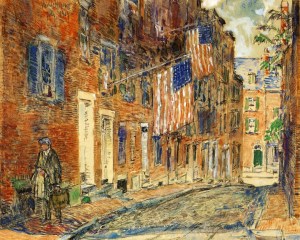
Childe Hassam, Acorn Street, Boston
After the failure of the job fair, executives announced that people could apply for Market Basket jobs secretly by e-mail.
AP, via ABC News: Market Basket Workers Plan Huge Rally for Ex-CEO.
Employees who have organized massive protests over the past two weeks say they are expecting up to 15,000 employees, customers and supporters to attend a rally Tuesday outside a Market Basket store in Tewksbury.
The family-owned chain has been in turmoil since June, when a board controlled by Arthur S. Demoulas fired his cousin, CEO Arthur T. Demoulas.
Hundreds of warehouse workers and drivers who support Arthur T. Demoulas have refused to deliver food to the chain’s 71 stores, leaving store shelves severely depleted and prompting customers to defect to other supermarkets.
Workers are hoping Arthur S. Demoulas’ side of the family will accept an offer from his cousin to buy the company, which is known for its low prices.
As for the firings that took place yesterday, Mass, NH Attorneys General warn Market Basket.
The Attorneys General in both New Hampshire and Massachusetts have sent the Market Basket CEOs a warning saying if anyone is fired they better get the wages they are owed.
“Even though they may have the right to terminate employees we want to make sure the company knows that for payment, wages, for benefits may have accrued over a time period, those are due on the day of termination,” said Attorney General Martha Coakley.
And there will be lawsuits, Fired Market Basket Supervisors Plan To Sue. So, to sum up, the board of directors of Market Basket seems willing to bring down the company to support one side of a family dispute over contrasting business models–on the one hand, a focus on the bottom line and making profits for the fat cats; on the other, a focus on sharing profits with workers, making customers happy, and in the process making plenty of money for all concerned. Who will win? I don’t know, but, IMHO, this is an important struggle.
What do you think?

Childe Hassam, Bowl of Goldfish
More Headlines:
The Guardian: US fast-food workers fight McDonald’s as battle for better wages heads to court.
Bloomberg: Israel Pulls All Troops From Gaza as New Cease-Fire Holds.
New York Times: Eight Days in Gaza: A Wartime Diary, by Atef Abu Saif.
AP on a crazy scheme to bring down the Cuban government–why do we keep doing stupid stuff like this? US Sent Latin Youth Undercover in Anti-Cuba Ploy.
New York Times: Behind Toledo’s Water Crisis, a Long-Troubled Lake Erie.
The Guardian: The case of baby Gammy shows surrogacy for the repulsive trade it is, by Suzanne Moore.
The Hill: US won’t turn back flights over Ebola.
Politico: Congress approval hits new low (poll).
The Daily Beast Exclusive: ‘Pro-Troop’ Charity Pays Off Tea Party Cronies Instead.

 peej
peej Carissa
 bostonboomer
 dakinikat
 ecocatwoman
 mablue2
 Mama Lopez
 peggysue22
 quixote
 skydancingguestblogger
 Mona (aka Wonk the Vote)



 Sky Dancing
Recent Comments