
Thursday Reads: Aftermath of SCOTUS Voting Rights Decision
Posted: June 27, 2013 Filed under: 2014 elections, Civil Rights, court rulings, Elections, morning reads, open thread, racism, Real Life Horror, Republican politics, U.S. Politics | Tags: Antonin Scalia, GOP Southern strategy, hypocrisy, Judicial Activism, SCOTUS, U.S. Supreme Court, Voter ID laws, Voting Rights Act 66 Comments
Good Morning!!
This is going to be a quickie post, because I’m feeling kind of sick this morning.
Although I’m thrilled with the DOMA decision yesterday, I still can’t get past my anger and sadness about the Supreme Court’s gutting of the Voting Rights Act. So I’m just going to post the (above) “official 2013 photo” of the U.S. Supreme Court and some accompanying links that demonstrate the damage the Court has done in its horrendous decision on the Voting Rights Act.
I’ll begin with this excellent post by Linda Greenhouse at The New York Times: Current Conditions, which neatly summarizes the Court’s “conservative” wing’s blatant “judicial activism,” to quote a frequent charge of conservatives against “liberal” judges.
These have been a remarkable three days, as the Supreme Court finished its term by delivering the only four decisions that most people were waiting for. The 5-to-4 decisions striking down the coverage formula of the Voting Rights Act and the Defense of Marriage Act will go far toward defining the Roberts court, which has concluded its eighth year. Monday’s place-holding ruling on affirmative action in higher education, although it decided very little, is also definitional, for reasons I’ll explain. There is a great deal to say about each decision, and about how each reflects on the court. My thoughts are preliminary, informed by that phrase in the chief justice’s voting rights opinion: current conditions.
By this phrase, the chief justice meant to suggest that there is a doctrinal basis for drawing a boundary around Congressional authority, for judicial insistence that a burden that Congress chooses to impose on the states has to be justified as a cure for a current problem. In the context of voting rights, an area over which the 15th Amendment gives Congress specific authority, this is a deeply problematic position that Justice Ruth Bader Ginsburg’s dissenting opinion demolishes.
Please go read the whole column–it’s difficult to get Greenhouse’s thesis into an excerpt. The blatant hypocrisy of the “conservative” justices–especially Scalia is mind-boggling, especially when the stunning effects of the Voting Rights decision on “current conditions” are already obvious and dramatic–just as were the disastrous effect of the Citizens United decision. A few examples.
The Guardian: Texas rushes ahead with voter ID law after supreme court decision
Officials in Texas said they would rush ahead with a controversial voter ID law that critics say will make it more difficult for ethnic minority citizens to vote, hours after the US supreme court released them from anti-discrimination constraints that have been in place for almost half a century.
The Texas attorney general, Greg Abbott, declared that in the light of the supreme court’s judgment striking down a key element of the 1965 Voting Rights Act he was implementing instantly the voter ID law that had previously blocked by the Obama administration. “With today’s decision, the state’s voter ID law will take effect immediately. Photo identification will now be required when voting in elections in Texas.”
Greensboro News and Record: NC senator: Voter ID bill moving ahead with ruling
Voter identification legislation in North Carolina will pick up steam again now that the U.S. Supreme Court has struck down part of the Voting Rights Act, a key General Assembly leader said Tuesday.
A bill requiring voters to present one of several forms of state-issued photo ID starting in 2016 cleared the House two months ago, but it’s been sitting since in the Senate Rules Committee to wait for a ruling by the justices in an Alabama case, according to Sen. Tom Apodaca, R-Henderson, the committee chairman. He said a bill will now be rolled out in the Senate next week.
The ruling essentially means a voter ID or other election legislation approved in this year’s session probably won’t have to receive advance approval by U.S. Justice Department attorneys or a federal court before such measures can be carried out.
Northwest Ohio.com: Voter ID and restricted early voting likely after SCOTUS ruling
ATLANTA (AP) — Across the South, Republicans are working to take advantage of a new political landscape after a divided U.S. Supreme Court freed all or part of 15 states, many of them in the old Confederacy, from having to ask Washington’s permission before changing election procedures in jurisdictions with histories of discrimination.
After the high court announced its momentous ruling Tuesday, officials in Texas and Mississippi pledged to immediately implement laws requiring voters to show photo identification before getting a ballot. North Carolina Republicans promised they would quickly try to adopt a similar law. Florida now appears free to set its early voting hours however Gov. Rick Scott and the GOP Legislature please. And Georgia’s most populous county likely will use county commission districts that Republican state legislators drew over the objections of local Democrats.
AL.com: Alabama photo voter ID law to be used in 2014, state officials say
MONTGOMERY, Alabama — Today’s U.S. Supreme Court decision clears the way for Alabama’s new photo voter ID law to be used in the 2014 elections without the need for federal preclearance, state officials said.
Alabama Attorney General Luther Strange and Secretary of State Beth Chapman said they believed the voting requirement, which is scheduled to take effect with the June 2014 primaries, can simply move forward.
“Photo voter ID will the first process that we have gone through under this new ruling,” Chapman said today.
Memphis Business Journal: Mississippi voter ID law could start next year
Voters in Mississippi may have to start showing a photo ID to vote by the middle of 2014, according to Secretary of State Delbert Hosemann.
According to the Associated Press, Hoseman spoke Tuesday after the U.S. Supreme Court ruled that certain state and local governments no longer need federal approval to change election laws. That ruling opens up the possibility that Mississippi will implement a voter identification requirement.
According to Think Progress, Arizona and South Dakota will likely be trying to pass Voter ID laws soon. I’m sue that won’t be the end of it.
Just a few more links:
Joan Walsh: The ugly SCOTUS voting rights flim-flam
Ari Berman: What the Supreme Court Doesn’t Understand About the Voting Rights Act
Stephen Hill: So the Voting Rights Act Is Gutted—What Can Protect Minority Voters Now?
I’ll end there and leave it up to you guys to link to other important news stories. What are you reading and blogging about today?
Breaking News: DOMA Falls
Posted: June 26, 2013 Filed under: Marriage Equality, SCOTUS, social justice | Tags: DOMA, marriage equality, SCOTUS 59 Comments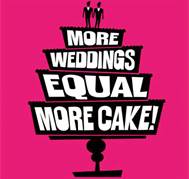 Even though SCOTUS did not rule on the broader issue of marriage equality, DOMA has fallen. The usual Klan of Religious Freaks dissented. Justice Anthony Kennedy was the swing vote.
The Supreme Court issued rulings on two highly-anticipated cases on gay marriage today. By 5-4, .
In a separate ruling, it declined to take on the broader issue of gay marriage. The court to bring the case to the court.
NPR’s Carrie Johnson explains the Prop. 8 ruling: “By a holding of 5-4 with Chief Justice John Roberts in the majority, the Supreme Court rules the petitioners lack standing so the court avoids the underlying issues, remands and wipes away the decision by 9th Circuit Court of appeals, which means for now the lower court ruling invalidating California’s Prop. 8 stands.”
That means same-sex marriages in California may resume, but the ruling does not have a broader implication across the country.
The Defense of Marriage Act case is simpler. As SCOTUSblog reports, the court struck down the federal law because it denies same-sex couples the “equal liberty” guaranteed by the Fifth Amendment.
The 1996 Defense of Marriage Act, or DOMA, was signed into law by President Bill Clinton, barring federal recognition of same-sex marriages for purposes such as Social Security survivors’ benefits, insurance benefits, immigration and tax filing.
Section 3 of the law defines marriage as “a legal union between one man and one woman as husband and wife” and a spouse as “a person of the opposite sex who is a husband or a wife.” That provision had been struck down by eight lower courts before the Supreme Court’s 5-4 ruling in United States v. Windsor settled the matter for good.
This decision means that legally married same-sex couples are now entitled to the same federal benefits as married opposite sex couples.
The majority opinion was written by Justice Anthony Kennedy and joined by Justices Ruth Bader Ginsburg, Stephen Breyer, Sonia Sotomayor and Elena Kagan. Chief Justice John Roberts and Justices Antonin Scalia, Clarence Thomas and Samuel Alito dissented.
SCOTUS Blog has some analysis here.
Cutting to the marquee issue – whether DOMA is constitutional – the Court acknowledged that Congress can pass laws that affect marriage in limited ways, but in its view DOMA goes much further than that: it applies to over a thousand federal laws and all federal regulations. (In this week’s version of “Supreme Court Justices: They’re Just Like Us,” the version of the opinion that was distributed to reporters misspells “statutes” as “statues,” suggesting that perhaps someone was up late last night finishing up the draft.) But states, rather than the federal government, have historically been responsible for regulating and defining “marriage” – establishing their own (and sometimes different) minimum ages for marriage, for example. In recent years, the Court explained, some states have decided to allow same-sex couples to marry, giving them the same protection and dignity that opposite-sex couples get from marriage. But despite the traditional role of the states in regulating marriage, the Court reasoned, DOMA discriminates against same-sex couples by preventing the federal government from recognizing their marriages, and it does so to express disapproval of state-sanctioned same-sex marriage.
As a result of today’s decision, same-sex couples who are legally married must now be treated the same under federal law as married opposite-sex couples. That conclusion (and the steps that the Court took to get there) drew the ire of the Court’s four more conservative Justices – Chief Justice John Roberts and Justices Scalia, Thomas, and Alito – who filed three separate dissenting opinions totaling nearly fifty pages.
Justice Antonin Scalia read from the bench to demonstrate his severe disagreement with the ruling. The opinion is an “instant classic” that uses Scalia-isms like “jaw-dropping” and “rootless and shifting” to describe the Court’s rationales; at one point, he indicates that “[t]he sum of all the Court’s nonspecific hand-waving is that this law is invalid (maybe on substantive-due-process grounds, and perhaps with some amorphous federalism component playing a role).” Although the four dissenters did not completely agree on everything, they were united in their belief that DOMA is constitutional.
Here, in summary, is what the Court did — and did not do — on same-sex marriage on the final day of its 2012-13 Term:
** It ruled unconstitutional the Defense of Marriage Act’s Section 3, which defines marriage for purposes of one thousand federal laws and multitudes of official regulations as the union of one man and one woman only — a definition that excludes probably millions of already-married same-sex couples from any of those benefits or opportunities. “DOMA,” the Court majority said caustically, ”writes inequality into the entire U.S. Code.”
** It decided that sponsors of California’s “Proposition 8,” adopted by the state’s voters in an election almost five years ago, did not have a legal right to be in the Supreme Court or in a federal appeals court to try to defend that measure from constitutional attack. That is likely to have the early impact of putting into final effect a San Francisco federal judge’s 2010 decision striking down Proposition 8 under the U.S. Constitution. Some 18,000 California same-sex couples already had been married when they had a brief chance to do so as the issue developed in that state, but now millions are likely to gain the right to marry when the judge’s ruling is implemented by state officials. Happening perhaps in just a few weeks, that would make California the fourteenth — and largest — state to permit such marriages (along with Washington, D.C.).
** It declared, in quite explicit terms, that it was not deciding at this point whether the Constitution guarantees gays and lesbians a right to marry or whether the Constitution forbids states’ bans on such marriages. That will leave the promoters of marriage equality to continue with their efforts, in state legislatures and in lower courts, to try to win the right one more state at a time. The Court itself has a chance to take up that basic issue, as early as tomorrow, in a pair of new cases — from Arizona and Nevada — but it may not yet be ready to do so.
** And the Court did not spell out a new constitutional test for courts to use in judging new laws or other government actions that treat homosexuals less favorably than other people in similar settings and factual contexts. Although DOMA’s benefits ban was nullified under the Fifth Amendment’s guarantee of legal equality, the majority opinion did not sort out explicitly which level of judicial review — in escalating toughness — is supposed to be used in gay rights cases. In fact, the test that was applied this time appeared to be notably indistinct.
With the demise of the Defense of Marriage Act’s benefits ban in Section 3, for legally married gays and lesbians, the Court immediately — even if inadvertently — gave rise to a situation in which couples living in states that will not allow them to marry because they are homosexuals will still be able to qualify for federal benefits, many of which are handed out or managed by state governments.
But the ruling did not do anything explicitly about another section of DOMA — Section 2, which gives the states the right to refuse to recognize gay marriages performed in other states. That thus raised the prospect that a same-sex couple married in one of the states now allowing such unions could face obstacles to their marital rights when they moved into states that still do not recognize their unions. This might be a particular problem for already-married gay couples serving in the military, who often have to move from state to state.
Although Chief Justice John G. Roberts, Jr., dissented from the ruling in the DOMA case, he went to special lengths in his opinion in that case to apply the states’ rights language that Justice Anthony M. Kennedy’s majority opinion had employed in justifying the nullification of Section 3.
Roberts wrote, borrowing words from the Kennedy opinion: “While ‘the state’s power in defining the marital relation is of central relevance’ to the majority’s decision to strike down DOMA here, that power will come into play on the other side of the board in future cases about the constitutionality of state marriage definitions. So too will be concerns for state diversity and sovereignty that weighs against DOMA’s constitutionality in this case.”
The Court, the Chief Justice added, “may in the future have to resolve challenges to state marriage definitions affecting same-sex couples.” His remarks about the majority arguments on states’ rights in this field seemed to be telegraphing his views on the basic definition of marriage — and an implied suggestion that lower courts might be interested in following.
At least in one regard, we are closer to the reality of liberty and justice for all.
A run-on sentence on Orwell’s Birthday
Posted: June 25, 2013 Filed under: just because | Tags: Political affective disorder 71 Comments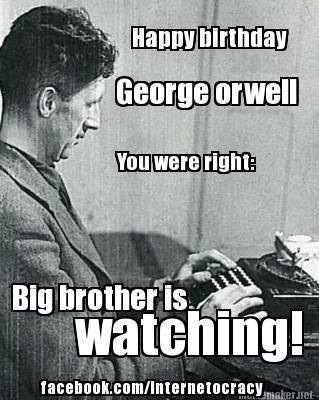
Fitting that the Supreme Court would overturn “the heart” of the Voting Rights Act on George Orwell’s 110th birthday. Meanwhile our national conversation is hyperfocused on the racially disturbing attitudes of an old white Southern woman with a food TV empire brand that she’s already damaged, as if it matters more than what our own Supreme Court is doing… Meanwhile big brother watches while we list out all our easily data-based likes and dislikes to Facebook so that the big business in bed with big brother can force feed us some more disaster capitalism adjusted to our preferences for what flavor we’d like it fed to us… Meanwhile Chris Brown defends his first amendment rights to be above the law and graffiti his house with ugly stuff that does infringe on the property rights of his neighbors, making a mockery of the principles of free speech…meanwhile a battered woman tattooed on his neck stares out at society blankly…meanwhile I wonder why I bother ranting. Oh that’s right. Racist capitalist patriarchy… while somewhere else Nelson Mandela is dying in a hospital bed…another one of our complicated patriarchal heros…no I’m not depressed or anything 😉
Open Thread: Late Afternoon News Update
Posted: June 25, 2013 Filed under: Barack Obama, open thread, Republican politics, U.S. Economy, U.S. Politics | Tags: Climate change, coal stocks, data encryption, David Gomez, Edward Snowden, Glenn Greenwald, Keystone XL pipeline, Rep. John Lewis, spycraft, Voting Rights Act 27 Comments
Good Afternoon Sky Dancers!!
Here’s an fresh thread, since the morning reads one is getting so long. I have several updates for you on the Snowden/NSA story.
Eli Lake of The Daily Beast got some disturbing news from Glenn Greenwald: Snowden’s Files Are Out There if “Anything Happens” To Him. I posted this link on the previous thread, but it should be highlighted. According to Greenwald, Snowden gave complete copies of the the secret NSA files he stole to “many people around the world.” Supposedly the files are encrypted, but from what we know of Snowden’s spycraft knowledge, I don’t think that’s a guarantee that they’ll stay secret. From The Daily Beast article:
Glenn Greenwald, the Guardian Newspaper journalist Snowden first contacted in February, told the Daily Beast Tuesday that Snowden “has taken extreme precautions to make sure many different people around the world have these archives to insure the stories will inevitably be published.” Greenwald added that the people in possession of these files “cannot access them yet because they are highly encrypted and they do not have the passwords.” But, Greenwald said, “if anything happens at all to Edward Snowden, he told me he has arranged for them to get access to the full archives.” [….]
A former U.S. counter-intelligence officer following the Snowden saga closely said his contacts inside the U.S. intelligence community “think Snowden has been planning this for years and has stashed files all over the internet.” This source added, “At this point there is very little anyone can do about this.”
Greenwald assured Lake that although he (Greenwald) is in possession of top secret information about “the technical specifications of NSA systems,” but that he won’t publish them. I wonder how well Greenwald’s computer is protected?
On Snowden’s aforementioned spycraft skills, let’s see what a real former spy thinks. From Foreign Policy:
We reached out to FP contributor David Gomez, a former assistant special agent-in-charge and counterterrorism program manager with the FBI, to get his take. When was Snowden being savvy — and when did it seem as if he’d just watched a few too many spy movies?
Cell phones in the fridge
While it’s true that cell phones can easily be compromised and turned into recording devices, Gomez says it’s unlikely that anyone seeking to record Snowden would have used a phone anyway. If someone had wanted to eavesdrop, Gomez explains, he or she more likely would have worn a concealed wire. Or, if a government’s agents had been trying to listen in from outside of the room, they might have deployed a long-range microphone, among other techniques. The bottom line: a refrigerated cell phone probably wasn’t stopping anyone who wanted to listen badly enough — though it may have extended the phone’s battery life.
Lining the hotel door with pillows
While not particularly effective at stopping anyone actively seeking to spy on Snowden, pillows could have muffled the sounds of any conversations going on in his Hong Kong hotel room enough that an unsuspecting person passing by wouldn’t overhear something alarming, Gomez says.
Wearing a hood while entering computer passwords, to avoid hidden cameras
The danger while entering computer passwords is unlikely to come from a hidden camera planted in the hotel, Gomez says, but rather from keystroke-logging software, against which a hoodie provides little protection.
Signaling his identity to reporters by carrying a Rubik’s Cube through a hotel
While spies do at times use signals to identify one another, the idea in doing so is to not draw attention to yourself, Gomez explains. Thus, when arranging a meeting, as Snowden did with a group of journalists in Hong Kong, it is both unhelpful and unnecessary to carry something as out of place as a Rubik’s Cube. It would have been better, Gomez adds, for Snowden to have simply described, say, his clothing in detail. “If you’re going to meet with all these people, what’s the point of being Sneaky Pete?” Gomez asks.
Gomez says Snowden seems to be an amateur.
Denying Southern Reality and Other Acts of a Politically Motivated SCOTUS
Posted: June 25, 2013 Filed under: just because | Tags: SCOTUS, Voting Rights Act 12 Comments I think y’all know by now that I was raised culturally southern. I was born in the South. I live in the deep South and have for nearly two decades. We’ve been regaled recently with the news that Southern Cuisine maven Paula Dean still longs for the good ol’ days of smiling black servants or slaves. We ‘ve heard Haley Barbor talk up the old Southern institutions that were the institutional face of the KKK as being positive community builders. I still can’t believe that Mississippi doesn’t celebrate Memorial Day because it is a “Yankee Holiday” and enshrines the Confederate version by declaring April “Confederate Heritage Month”. But, you do not need these folksy stories of the obvious racism in the South to understand why today’s SCOTUS decision is a complete sham. Scalia has said that the Voting Rights Act is a “racial entitlement” in the past. It is not. It protects disenfranchised voter’s most basic right in a democracy. This is another example of the hypocrisy of the ‘conservative’ wing of the court. This is pure judicial activism.
Here is a list of things from Bader Ginsberg’s scathing dissent that lets you know exactly why the VRA is still necessary and is about protecting rights not creating entitlements.
Ginsburg’s dissent also rattled off these eight examples of race-based voter discrimination in recent history:
- “In 1995, Mississippi sought to reenact a dual voter registration system, ‘which was initially enacted in 1892 to disenfranchise Black voters,’ and for that reason was struck down by a federal court in 1987.”
- “Following the 2000 Census, the City of Albany, Georgia, proposed a redistricting plan that DOJ found to be ‘designed with the purpose to limit and retrogress the increased black voting strength…in the city as a whole.'”
- “In 2001, the mayor and all-white five-member Board of Aldermen of Kilmichael, Mississippi, abruptly canceled the town’s election after ‘an unprecedented number’ of AfricanAmerican candidates announced they were running for office. DOJ required an election, and the town elected its first black mayor and three black aldermen.”
- “In 2006, the court found that Texas’ attempt to redraw a congressional district to reduce the strength of Latino voters bore ‘the mark of intentional discrimination that could give rise to an equal protection violation,’ and ordered the district redrawn in compliance with the VRA…In response, Texas sought to undermine this Court’s order by curtailing early voting in the district, but was blocked by an action to enforce the §5 pre-clearance requirement.”
- “In 2003, after African-Americans won a majority of the seats on the school board for the first time in history, Charleston County, South Carolina, proposed an at-large voting mechanism for the board. The proposal, made without consulting any of the African-American members of the school board, was found to be an ‘exact replica’ of an earlier voting scheme that, a federal court had determined, violated the VRA…DOJ invoked §5 to block the proposal.”
- “In 1993, the City of Millen, Georgia, proposed to delay the election in a majority-black district by two years, leaving that district without representation on the city council while the neighboring majority white district would have three representatives…DOJ blocked the proposal. The county then sought to move a polling place from a predominantly black neighborhood in the city to an inaccessible location in a predominantly white neighborhood outside city limits.”
- “In 2004, Waller County, Texas, threatened to prosecute two black students after they announced their intention to run for office. The county then attempted to reduce the avail ability of early voting in that election at polling places near a historically black university.”
- In 1990, Dallas County, Alabama, whose county seat is the City of Selma, sought to purge its voter rolls of many black voters. DOJ rejected the purge as discriminatory, noting that it would have disqualified many citizens from voting ‘simply because they failed to pick up or return a voter update form, when there was no valid requirement that they do so.'”
To those who will be distraught, outraged, or fearful, the essential question at stake in the Court’s decision – and in the continuing vitality of Section 4 — is whether we believe racial discrimination in voting still exists in the South. The question being framed this way, the Court’s decision today will appear to be, at best, a denial of reality and a reflection of a naïve “post-racial” view that in the Obama era, racial discrimination in voting has ended. Justice Sotomayor, at oral argument, perfectly reflected this perspective on what the decision represents when she posed this pointed question to the VRA’s challengers: “Do you think that racial discrimination in voting has ended, that there is none anywhere?” The answer to that question must be no. From this vantage point, then, as long as racial discrimination in voting still does take place at all in the South, Section 4 of the VRA – the part the Court invalidated – remains not just justifiable, but essential.
In addition, to many people, the VRA symbolizes protection of the crown jewel of rights, the right of access to the ballot box. For those who know the history, this right was born from the blood and the bodies of all those who had been given the last full measure of their devotion to secure full access for all to the ballot box – those beaten on the bridge from Selma, Alabama in 1965, the three civil rights workers lynched in the Mississippi summer of 1964, and many others. How can the Court find unconstitutional an Act that plays any role at all in ensuring political equality regarding this most sacred right? And why should the Court second-guess Congress on these issues?
Yet to others, including the Court’s pivotal actor, Justice Kennedy, the essential question at stake is whether our political system is frozen in place on issues concerning race. Do our political institutions and culture have the capacity to recognize that dramatic changes at the intersection of race and voting have taken place over recent decades? Section 4 was created in 1965 as a short-term measure for five years; in initially upholding that system, the Court called it “an uncommon exercise of congressional power” justified by the “exceptional circumstances” of the massive disfranchisement of black voters (and many poor whites) that existed when the VRA was enacted. In 1970, Congress extended this system for another five years; in 1975, for another eight; and in 1982, for twenty-five more years. Then, in 2006, in the provision the Court struck down, Congress re-authorized this system for another twenty-five years, until 2031. Thus we moved from a five-year regime in 1965 for exceptional circumstances to a sixty-six-year regime that continues to single out nine states (and fifty-three other counties) for unique federal control.
But of even more symbolic significance, from this perspective: these areas all became covered because of their voting practices in 1964 or, at the latest, 1975 – nearly forty years ago. And these are the same areas, and nearly the only areas, that have remained covered ever since. Though the Act formally creates a mechanism to permit these areas to prove their current entitlement to be relieved of coverage, this part has never been a meaningful way for the Act to unwind itself from within: fewer than one percent of all the counties originally covered that have significant minority populations have ever emerged from the Act. From this vantage point, the question the case was “about,” then, is this: how can Congress act as if nothing significant enough has changed in the last forty years to justify any meaningful change at all in Section 4? Even if areas of discriminatory voting practices remain, surely they cannot mirror so exactly the areas of which this was true forty or fifty years ago.
From this starting place, Section 4 symbolizes that the issue of race remains so charged that our political system lacks the capacity to move forward to any extent at all. As Justice Kennedy put it at the argument: Congress “should use criteria that are relevant to the existing [conditions] – and Congress just didn’t have the time or the energy to do this; it just re-enacted it.” And despite the popular image that Section 4 is about protecting access to the ballot box, Section 4 long ago in practice became more about racial redistricting than access to the ballot box. While the Justice Department in recent decades blocked access changes on average fewer than twice a year, it blocked redistrictings nearly fourteen times as often. Indeed, in the 2006 Act itself, Congress itself did not rely primarily on ballot-box access problems to justify renewing Section 4, but on issues like redistricting. If Section 4 is “about” access to the ballot box in the public imagination, to the Court majority, I suspect, Section 4 is about racial redistricting.
Can this decision bring about any good? Well, it is possible because it should be clear now there is a total Republican assault on modernity and a world where white men don’t get to tell every one else what to do. The last election showed that the nation’s minorities and women were not about to let that happen again.
On its face, this looks like a big victory for Republicans. But is it really? I suspect it will turn out to be a poisoned chalice. Many of the GOP’s current problems stem from the fact that it is overly beholden to its white, Southern base, at a time when the country is rapidly becoming more racially diverse. In order to expand its base of power beyond the House of Representatives, the GOP needs to expand its appeal to minority voters. As the ongoing battle over immigration reform demonstrates, that process is going poorly and looks like it will be very difficult.
The Supreme Court’s decision to strike down a central provision of the Voting Rights Act will make it easier for Republicans to hold and expand their power in those mainly Southern states. That will, in turn, make it easier for them to hold the House. But it will also intensify the Southern captivity of the GOP, thereby making it harder for Republicans to broaden their appeal and win back the White House.
There is only so long that these neoconfederates can continue to push their backwards agendas through the federal government. They need to be thrown out of statehouses too. This seems to me an odd continuation of the Civil War. Nixon’s Southern Strategy will divide this country for decades to come. The hypocrisy of judicial overreach in this decision and most others that are penned by Scalia, Alito, Thomas, or Kennedy just oozes political scamming and it makes us all look bad. This is just another embarrassing attempt to stop the future. Future Courts will make hay of it.

 peej
peej Carissa
 bostonboomer
 dakinikat
 ecocatwoman
 jjlo
jjlo mablue2
 Mama Lopez
 peggysue22
 quixote
 skydancingguestblogger
 Mona (aka Wonk the Vote)





Recent Comments