
Of Brass Tacks and Phony Crises
Posted: January 3, 2013 Filed under: Catfood Commission, Economic Develpment, Economy, Voter Ignorance, We are so F'd 27 CommentsYes, yes … the fiscal bunny slope has been somewhat solved and the press has moved on to discussing the next big self-inflicted fiscal crisis coming up in February. ( I guess we’re adopting the term “March Madness” just to make it all exciting and discussable.) We’re still in the land of economic surreality instead of theory. It worries me. The basic problem is that this country has forgotten its economic history, lessons and theory. Fiscal policy should not be based on political memes and lurching from one crisis to the next. Here’s some things to think on from economists.
Economist Nouriel Roubini points out that we’ve been let down by our political leaders who just don’t get that our basic problem is really one of development. We’ve had substantial growth in upper incomes and corporate profits, yet we’re going nowhere in all the quality of life and economy numbers. We have a tax policy that encourages folks like Romney to strip money out of functional businesses, shut them down, and move the proceeds to offshore bank accounts to avoid paying taxes that support basic features of a civilized country. How is this kind of wealth creation helping our economy? How is treating speculative gambling to tax favors instead encouraging actual business building creating a future upon which we can sustain our civilization? Why isn’t the press looking at the fiscal drag this cliff solution creates a well as the bigger issue of austerity facing us in March? Austerity has done the UK no favors and is crushing parts of the Eurozone. Why are the media and the political elite focusing on policies that look like Herbert Hoover’s revenge? Why feed the drone economy while starving granny?
President Barack Obama and his allies will argue that the deal concluded on Tuesday raises only $600bn of revenues over 10 years rather than their initial target of $1.4tn – and therefore there is further room for tax rises, at least for the wealthy. Republicans will argue that spending should now be radically cut, since this week’s deal did not address that side of the national balance sheet. (Even the 2011 debt ceiling deal reduced prospective spending by $1tn).
In the meantime, the likely fiscal adjustment in 2013 will be about 1.4 per cent of gross domestic product. (Spread between the expiry of the payroll tax cut, the increase in the tax rates of the rich, and some eventual cuts to spending.)
This translates into a 1.2 per cent of GDP drag on the economy during the year. If the economy was happily growing above trend – at say 3.5 per cent – that would not be such a big deal, as growth would still be above 2 per cent. In the past few quarters growth already averaged about 2 per cent. So the US could quite easily come perilously close to stall speed this year – or worse, if the eurozone crisis worsens.
The longer-term picture is bleaker still. The reality is that America is yet to wake up to the full extent of its fiscal nightmare. Even the typical Republican voter is not – being on average older and poorer than a Democrat voter – in favour of gutting the welfare state. Tea Party extremists are more noise than signal. That is why the plans of Mitt Romney and Paul Ryan, the Republicans’ losing presidential ticket, postponed all the tough spending cuts on Social Security and Medicare by a decade.
Neither Democrats nor Republicans recognise that maintaining a basic welfare state, which is right and necessary in our age of globalisation, rapid technological change and demographic pressure, implies higher taxes for the middle class as well as for the rich. A deal that extends unsustainable tax cuts for 98 per cent of Americans is therefore a pyrrhic victory for Mr Obama.
Yes, they continue to eye cuts in social security under the guise of tackling the deficit. Economist Dean Baker reminds us that Social Security has nothing to do with the Federal Deficit. Yet, there’s Simpson and Bowles yacking up that granny starving canard again! Let’s chain link our grandparents in the name of a lie, please!! Baker is right. Budget hysteria is a growth industry driven by lies and has nothing to do with what’s really happening in our real economy.
While the promotion of budget hysteria is one of the largest industries in Washington, the most important and widely ignored fact about the budget situation is that we have large deficits today because the collapse of the housing bubble sank the economy. This is not a debatable point.
The budget deficit was just 1.2 percent of gross domestic product in 2007. Before the collapse of the housing bubble the deficit was projected to remain low for the next decade and the debt-to-G.D.P. ratio was actually falling. This would have been the case even if the Bush tax cuts were allowed to continue.
When the bubble burst and the economy plummeted, tax collections fell. We also spent more on unemployment insurance and other benefits for unemployed workers. And we had further tax cuts and stimulus spending to try to boost the economy. The automatic and deliberate steps taken to counter the downturn fully explain the large deficits we have seen the last five years.
Record low interest rates on government bonds demonstrate that the current deficits are not a real problem. But even if they were, it is difficult to see how cutting Social Security could to be part of the solution. Under the law Social Security is not supposed to be part of the budget. It is an entirely separate program financed on its own.
This is not just a rhetorical point. We can talk about Social Security facing a financing shortfall in the future precisely because it is solely financed by its own revenue stream.
What we really need is a recovery. That will not happen with all the fiscal policies being placed on the table right now. Let’s review one simple thing. As long as you have a good currency, federal debt instruments in demand, and a vast array of taxable assets in your country, there is no such thing as a ‘bankrupt’ government or excessive debt. But, don’t take my word for it. Let’s again, look at the economic studies and look at the demand for treasury bonds and bills. Markets see no problem with debt levels in most industrialized nations because they know that with development and growth there comes decreased deficits and pay down of debt.
The sovereign bond markets in America, Japan, Britain, and the euro area’s “core” do not seem to think so. These governments can borrow cheaply for decades at a time. While it is certainly possible that the markets are wrong, policymakers should probably pay more attention to investors and less to the fear-mongers, especially since economists do not know how much government debt is too much. In fact, there is good reason to think that many countries with their own currencies could become far more indebted without risking trouble. One reason is that many private investors do not own enough sovereign bonds.
It is important to remember that there is an absence of evidence that governments with their own currencies are too indebted. Those who argue otherwise point to the work of Carmen Reinhart and Kenneth Rogoff, the celebrated authors of This Time is Different. Their paper “Growth in a Time of Debt” claimed that sovereign debt creates a burden on the rest of the economy. (They summarise their points here.) But, as Robert Shiller and Paul Krugman have pointed out, Ms Reinhart and Mr Rogoff never explain how public indebtedness restrains growth. There may be other forces at work, especially since sovereign debt ratios are usually at their highest after wars and financial crises. In countries with their own currencies, private interest rates are now so low that many investors have been grasping for yield wherever they can find it, such as in the revived CLO market. When he evaluated the evidence, my colleague concluded that “debt matters, but the precise way that it matters isn’t as clear-cut as Reinhart-Rogoff seem to indicate”.
Why would private investors want to buy more sovereign debt? A previous post on the shortage of safe financial assets mentioned how pension plans in many countries need to buy more government bonds to avoid mismatches between their assets and liabilities …
Nearly all the red states in our country may be Greece and Portugal–with the exceptions of Texas and Florida–but the blue states are overwhelmingly Germany and they continually bail out those loser states. That’s why we are not the Eurozone. However, those red states sure are trying to blow up the very arrangement that keeps them in roads, schools, and police forces. Economist Clive Crook points out how these idiots have now created a situation where governing means we lurch between crisis because none of them appear to be able to accept the lessons learned from the civil war, the Great Depression, or about 60 year of economic and finance theory.
The latest fiscal deal does little to resolve those uncertainties. The spending-cut part has merely been delayed by two months. The tax increase for couples making more than $450,000, together with other changes and estimated savings in debt interest, shaves about $700 billion from the 10-year deficit. Savings of about $2 trillion will be needed to stabilize the ratio of public debt to national income. Bringing that ratio down to a safer level requires spending cuts and tax increases worth $4 trillion — the original “grand bargain” ambition.
Instead of dealing calmly with the problem, fiscal policy has settled into a mode of perpetual phony crisis. Phony doesn’t mean harmless, however. The risk of a real fiscal crisis gradually builds. Meanwhile, the cumulative effects of simulated crisis might be almost as bad. It’s the difference between an acute illness and a chronic wasting disease — one that’s beginning to look incurable.
Don’t tell me the economy just had a lucky escape. Whatever happens next, it has been paying for the fiscal standoff for months. It’s paying for what Congress might do with the next debt ceiling, and the one after that. The “significant uncertainty” that Geithner referred to has already held back the U.S. recovery. Another temporary fiscal patch isn’t a remedy. It’s just more of the same.
The economy needs a lasting fiscal compact that commands broad, bipartisan support. I can hear the groans. Not another call for compromise. Many Democrats and almost all Republicans find the idea disgusting. On Capitol Hill, it’s no longer enough for one side to win; the other has to be seen to lose. That attitude is the growing burden the economy has to carry.
Which brings me back to journalistic, political hacks that write columns like this one at Politico. (Glen Thrush and Reid J Epstein are the guilty wielders of the keyboards of ignorance here.) They just opine that Obama has a debt problem. Gee, guys, where did you get your doctorates in economics or finance? The place is aptly called Tiger Beat on the Potomac by Charles Pierce. They are all about being groupies to their DC stars. No Republican meme is too outrageously wrong for this e-dishrag.
The staggering national debt — up about 60 percent from the $10 trillion Obama inherited when he took office in January 2009 — is the single biggest blemish on Obama’s record, even if the rapid descent into red began under President George W. Bush.
Glenn Thrush and Reid Epstein’s Politico piece on President Obama’s “debt problem” helps capture a lot of what’s wrong with the larger debate and the political establishment’s confusion about fiscal matters.
It’s the same damn problem that happens when you watch MTP and Dancing Dave and Tom Brokaw discuss anything about economics. They don’t know a damn thing. They just repeat what they’ve heard from their local lying republican friends. Here’s more from Benen.
First, when there’s a global economic crash, and the government needs to invest to rescue the economy, large deficits are good, not bad, especially when borrowing is cheap and easy. Had the president focused on reducing the $1.3 trillion deficit he inherited from Bush/Cheney, instead of job creation and economic growth, the recession would have intensified, and yet, too many reports simply accept it as a given that higher deficits are worthy of condemnation.
Second, under Obama, as the economy started to improve, the deficit started to shrink anyway. Though the political establishment usually ignores these details, the deficit is $300 billion smaller now than when the president took office — marking the fastest deficit reduction since the end of World War II.
Third, Obama keeps pushing massive debt-reduction proposals on the table, as well as all kinds of policies that shrink the deficit (health care reform, cap and trade, Dream Act), but Republicans have opposed all of them.
And then finally, there’s the simple matter of what, exactly, is driving the nation’s budget shortfall.
For Politico, the fact that the national debt is nearly 60% larger necessarily makes this a major “blemish” on the president’s record. This only makes sense, of course, if one assumes that a larger debt is a bad thing — and given the circumstances, it’s not — and that it’s Obama’s policies that are responsible for the increase.
But as we’ve discussed before, that’s simply not the case. The facts are incontrovertible: towards the end of President Clinton’s second term, debt clocks that had been established in various U.S. locations had to be shut down — the deficit had been eliminated and the clocks had never been set to run backwards. By the time Clinton left office in 2001, the nation not only had a large surplus, it was also on track to pay off the entirety of its debt — roughly $5 trillion at the time — by the end of the decade.
Then the Bush/Cheney era happened. Republicans took a massive surplus and turned it into an even more massive deficit, adding the costs of two wars, two tax cuts, Medicare expansion, and a Wall Street bailout to the national charge card.
Sen. Orrin Hatch (R-Utah) later referred to the Bush/Cheney era as a time in which Republicans decided “it was standard practice not to pay for things.” In just eight years, GOP policymakers added $5 trillion to the debt in eight years.
But then Obama was just as reckless, right? Wrong. The key takeaway here is that it’s Republican policies, not the president’s agenda, that’s driving the national debt now and into the future.
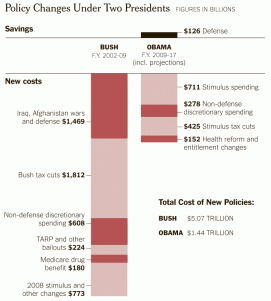
Okay, so I’ve made this an extremely long, wonky post and your eyes are probably glazing over by now. The deal is this. We have a huge number of issues facing our country and we have press and a political party that just plain lies and spreads lies on the big ones. We can’t have a discussion on climate change science, or women’s health and reproduction and rape, or economics or a number of things because very few people bring data, science, statistics, and theory to the table. They bring hype and religious and ideological dogma. We continually see Republicans and press folks like Tom Brokaw say the economic equivalent of ‘women who get raped don’t get pregnant because their bodies shut down’ . They don’t even realize they are doing it and no one calls them on it because they get all the air time they want and economists get very little.
So, we’re on the verge of starving children and the elderly based on that level of discussion. How can we possibly get to a more fact-based reality and a healthier economy and democracy with this level of ignorance?
Thursday Reads: War on Women, the Fiscal Cliff, and Austerity Arriving in the USA
Posted: January 3, 2013 Filed under: Fiscal Cliff, morning reads, Psychopaths in charge, Reproductive Rights, Republican politics, Social Security, U.S. Economy, U.S. Politics, War on Women, Women's Rights | Tags: abortion restrictions, austerity, Catfood Commission, Greece, Simpson-Bowles 42 Comments
Good Morning!!
Brrrrrrrrrr! All of a sudden winter has arrived! Can you believe it’s 4 degrees outside my house? With a wind chill factor of 6 below 0. My furnace can’t keep up in this kind of weather, so I have to bundle up. So what else is in the news this morning? Let’s see….
Today the new Congress gets sworn in and there are a record number of women in the new Senate. From ABC News: Meet the New Class: The Senate Swears in a Historic 20 Female Senators
Today the Senate will make history, swearing in a record-breaking 20 female senators – 4 Republicans and 16 Democrats – in office….
“I can’t tell you the joy that I feel in my heart to look at these 20 gifted and talented women from two different parties, different zip codes to fill this room,” Sen. Barbara Mikulksi, D-Md., said while surrounded by the group of women senators. “In all of American history only 16 women had served. Now there are 20 of us.”
Senator-elect Deb Fischer, R-Neb., becomes today the first women to be elected as a senator in Nebraska.
“It was an historic election,” Fischer said, “But what was really fun about it were the number of mothers and fathers who brought their daughters up to me during the campaign and said, “Can we get a picture? Can we get a picture?’ Because people realize it and — things do change, things do change.”
There’s a group photo at the link.
Still, the war on women continues. HuffPo reports: House GOP Lets Violence Against Women Act Passed By Senate Die Without A Vote.
Despite a late-stage intervention by Vice President Joe Biden, House Republican leaders failed to advance the Senate’s 2012 reauthorization of the Violence Against Women Act, an embattled bill that would have extended domestic violence protections to 30 million LGBT individuals, undocumented immigrants and Native American women.
“The House leadership would not bring it up, just like they wouldn’t bring up funding for Sandy [hurricane damage] last night,” said Sen. Patty Murray (D-Wash.), a key backer of the Senate version of the bill, in an interview with HuffPost. “I think they are still so kowtowing to the extreme on the right that they’re not even listening to the moderates, and particularly the women, in their caucus who are saying they support this.”
The Senate bill passed way back in April.
In April, the Senate with bipartisan support passed a version of VAWA that extended protections to three groups of domestic violence victims who had not been covered by the original law, but House Republicans refused to support the legislation with those provisions, saying the measures were politically driven. Instead, they passed their own VAWA bill without the additional protections. In recent weeks, however, even some House Republicans who voted for the pared-down House bill have said they would now support the broader Senate bill — and predicted it would pass if Republican leaders let it come to the floor for a vote.
“I absolutely would support the Senate bill,” Rep. Tom Cole (R-Okla.) told HuffPost in late December, speculating that other House Republicans, namely GOP congresswomen, “are very supportive of that.”
Asked if he thought the Senate bill would pass in the House if it came up for a vote, Cole replied, “My judgment is yes.”
Too little, too late, Congressman. So Boehner managed to screw women yesterday too though it was the refusal to vote on Sandy relief that got all the media attention.
In India police have filed murder charges against five men in the horrific gang rape in New Delhi.
Authorities filed rape and murder charges Thursday against five men accused of the gang rape of a 23-year-old university student on a New Delhi bus, a crime that horrified Indians and provoked a national debate about the treatment of women.
Police said they plan to push for the death penalty in the case, as government officials promised new measures to protect women in the nation’s capital.
Prosecutor Rajiv Mohan filed a case of rape, tampering with evidence, kidnapping, murder and other charges against the men in a new fast-track court in south Delhi inaugurated only the day before to deal specifically with crimes against women. Mohan asked for a closed trial and a hearing was set for Saturday.
The men charged are Ram Singh, 33, the bus driver; his brother Mukesh Singh, 26, who cleans buses for the same company; Pavan Gupta, 19, a fruit vendor; Akshay Singh, 24, a bus washer; and Vinay Sharma, 20, a fitness trainer.
A sixth suspect was listed as 17 and was expected to be tried in a juvenile court, where the maximum sentence would be three years in a reform facility.
Read more at the link. The New Yorker has a good article on the New Delhi story by Basharat Peer: After a Rape and Murder, Fury in Delhi. Please go read the whole thing if you can.
Back in the USA, Republican state legislatures are up to their old tricks. Irin Carmon reports in Salon: Michigan, Virginia pass backdoor abortion restrictions.
In Michigan, Rick Snyder signed a bill passed by the lame-duck Senate — the same one whose anti-union legislating dominated headlines in recent weeks — requiring clinics that perform more than 120 abortions a year to become surgical outpatient facilities, a level of licensing intended to be onerous and put clinics out of business. He also approved a bill that purports to screen for women being coerced into abortions.
Snyder did veto another bill limiting insurance coverage in private employee plans, which would have required purchase of a separate abortion rider. He objected to that on the grounds that rape victims would have to pay out of pocket if they didn’t buy the rider, and because, “As a practical matter, I believe this type of policy is an overreach of government into the private market.” Overreach of government into other realms, of course, is another matter entirely. (According to Michigan resident Emily Magner, one legislator interrupted her to cry, “THIS ISN’T ABOUT WOMEN! THIS IS ABOUT PROTECTING FETUSES!”)
Virginia’s similar, hospital-level restrictions on clinics were somewhat overshadowed by the ultrasound requirements for women seeking abortions. Under threat of forever having the word “transvaginal” attached to his name, Gov. Bob McDonnell tried to split the difference on the ultrasound legislation, but in the final days of the year signed off on the clinic regulations. This followed months of conflict between the Board of Health and Virginia Attorney General Ken Cuccinelli over whether existing clinics would be grandfathered into the legislation. The governor’s office called the regulations “common-sense”; NARAL Pro-Choice Virginia said in a statement, “After two years of shocking backroom deals and bullying public health servants, Governor Bob McDonnell is clearly proving his disregard of Virginians’ opinions about women’s health care.”
Clinic regulations are the most insidious of abortion restrictions, because they’re harder for the layperson to understand and tend to incite less outrage as a result. And opposition to them tends to fall into antiabortion narratives about back-alley butchers resisting safety standards. But research has suggested that they also tend to be the most effective: It’s difficult to talk a woman out of having an abortion, but if you make access near impossible, you might take the choice off the table altogether.

On the “Fiscal Bunny Slope,” as Dakinikat refers to it, TPM reports that Simpson and Bowles of the famous Catfood Commission didn’t like the deal hammered out by the Senate and passed by the House. It seems it doesn’t cause enough suffering for the poor and elderly to satisfy them. Here’s their statement:
“The deal approved today is truly a missed opportunity to do something big to reduce our long term fiscal problems, but it is a small step forward in our efforts to reduce the federal deficit. It follows on the $1 trillion reduction in spending that was done in last year’s Budget Control Act. While both steps advance the efforts to put our fiscal house in order, neither one nor the combination of the two come close to solving our Nation’s debt and deficit problems. Our leaders must now have the courage to reform our tax code and entitlement programs such that we stabilize our debt and put it on a downward path as a percent of the economy.
Washington missed this magic moment to do something big to reduce the deficit, reform our tax code, and fix our entitlement programs. We have all known for over a year that this fiscal cliff was coming. In fact Washington politicians set it up to force themselves to seriously deal with our Nation’s long term fiscal problems. Yet even after taking the Country to the brink of economic disaster, Washington still could not forge a common sense bipartisan consensus on a plan that stabilizes the debt.
It is now more critical than ever that policymakers return to negotiations that will build on the terms of this agreement and the spending cuts in the Budget Control Act. These future negotiations will need to make the far more difficult reforms that bring spending further under control, make our entitlement programs sustainable and solvent, and reform our tax code to both promote growth and produce revenue. We take some encouragement from the statements by the President and leaders in Congress that they recognize more work needs to be done. In order to reach an agreement, it will be absolutely necessary for both sides to move beyond their comfort zone and reach a principled agreement on a comprehensive plan which puts the debt on a clear downward path relative to the economy.”
Don’t you love the way they call for “courage” from rich Congresspeople and then tell them to cut the sole income of millions of elderly and disabled people? What about calling for the real courage it would take for them to raise the cap on Social Security contributions so that rich people could pay a little more into the system? I doubt if many of them turn down the paltry extra income they get from it.
I’m running out of space, but I have some more fiscal cliff reads for you that I’ll pass on in link dump fashion.
Paul Krugman: That Bad Ceiling Feeling
Noam Scheiber: The House Comes Around on the Cliff. Why Am I Not Reassured?
Washington Post: U.S. markets surge after Congress approves ‘cliff’ deal
George Zornick at The Nation: While Congress Plays Deficit Games, Jobs Crisis Goes Unaddressed
Joan Walsh: Biggest Fiscal Cliff Lessions
Jonathan Chait: The Big Lebowski Explains the Fiscal Cliff
Truthout: Debt Versus Democracy: A Battle for the Future
Joe Conason: The GOP Clown Car Crashes, Again
I’ll end with a couple of articles on the European-style austerity that we’re heading for right now.
Brad Plummer at the Washington Post: U.S. now on pace for European levels of austerity in 2013
For years now, economists like Paul Krugman have been criticizing countries in Europe for engaging in too much austerity during the downturn — that is, enacting tax increases and spending cuts while their economies were still weak.
But after this week’s fiscal cliff deal, the United States is now on pace to engage in about as much fiscal consolidation in 2013 as many European nations have been doing in recent years — and more than countries like Britain and Spain.
A back-of-the-envelope calculation suggests Congress has enacted around $336 billion in tax hikes and spending cuts for the coming year, an austerity package whose total size comes to about 2.1 percent of GDP. (That’s merely the size of the cuts and taxes; it’s not necessarily the effect on growth.)
This includes the expiration of the payroll tax cut, which will raise about $125 billion this year. It includes $68 billion in scheduled cuts to discretionary spending from the 2011 Budget Control Act. It includes $24 billion in new Obamacare taxes and $27 billion in new high-income taxes. And it includes about $92 billion from the now-delayed sequester cuts — assuming that these either take effect or are swapped with other cuts.
Check out the graph at the link. And in Greece, the Guardian reports: Euros discarded as impoverished Greeks resort to bartering
It’s been a busy day at the market in downtown Volos. Angeliki Ioanitou has sold a decent quantity of olive oil and soap, while her friend Maria has done good business with her fresh pies.
But not a single euro has changed hands – none of the customers on this drizzly Saturday morning has bothered carrying money at all. For many, browsing through the racks of second-hand clothes, electrical appliances and homemade jams, the need to survive means money has been usurped.
“It’s all about exchange and solidarity, helping one another out in these very hard times,” enthused Ioanitou, her hair tucked under a floppy felt cap. “You could say a lot of us have dreams of a utopia without the euro.”
In this bustling port city at the foot of Mount Pelion, in the heart of Greece’s most fertile plain, locals have come up with a novel way of dealing with austerity – adopting their own alternative currency, known as the Tem. As the country struggles with its worst crisis in modern times, with Greeks losing up to 40% of their disposable income as a result of policies imposed in exchange for international aid, the system has been a huge success. Organisers say some 1,300 people have signed up to the informal bartering network.
For users such as Ioanitou, the currency – a form of community banking monitored exclusively online – is not only an effective antidote to wage cuts and soaring taxes but the “best kind of shopping therapy”. “One Tem is the equivalent of one euro. My oil and soap came to 70 Tem and with that I bought oranges, pies, napkins, cleaning products and Christmas decorations,” said the mother-of-five. “I’ve got 30 Tem left over. For women, who are worst affected by unemployment, and don’t have kafeneia [coffeehouses] to go to like men, it’s like belonging to a hugely supportive association.”
Much more at the link.
So….what’s on your reading and blogging list today. I look forward to clicking on your links.
The Conversation We Must Have
Posted: January 2, 2013 Filed under: Afghanistan, Drone Warfare, Foreign Affairs, Human Rights, MENA, Pakistan, Somalia, U.S. Military, U.S. Politics, Yemen | Tags: criminal wiretapping, drone attacks, renditions, the National Security Military Industrial Complex 11 CommentsIt’s easy to overlook our far away wars and the deaths caused by drone attacks when most people in the country are trying to hang on to their jobs, homes, and incomes. It’s more than enough effort just to hang on while watching your hopes of secure, middle class lifestyles and retirement being diddled away in shows of Potomac political harangues, power plays, and stupid political memes. However, a big portion of who we are as a country has to do with our face to the world and the values we display. It’s a subject we must follow carefully because we’re as bad as we’ve ever been in many ways.
Hence, I bring you back to the topics of renditions, torture, drone strikes, domestic spying, and national security issues evoked by 9/11 and continued because we can’t have national discussions about the big policies any more. We’re too busy defending erosion of our lives and rights here. There is an important article at WAPO that highlights the immoral side of our “war” against terror that continues under the Obama administration. Americans interested in human rights and our vision of an American “morality” must read this.
The three European men with Somali roots were arrested on a murky pretext in August as they passed through the small African country of Djibouti. But the reason soon became clear when they were visited in their jail cells by a succession of American interrogators.
U.S. agents accused the men — two of them Swedes, the other a longtime resident of Britain — of supporting al-Shabab, an Islamist militia in Somalia that Washington considers a terrorist group. Two months after their arrest, the prisoners were secretly indicted by a federal grand jury in New York, then clandestinely taken into custody by the FBI and flown to the United States to face trial.
The secret arrests and detentions came to light Dec. 21 when the suspects made a brief appearance in a Brooklyn courtroom.
The men are the latest example of how the Obama administration has embraced rendition — the practice of holding and interrogating terrorism suspects in other countries without due process — despite widespread condemnation of the tactic in the years after the Sept. 11, 2001, attacks.
Renditions are taking on renewed significance because the administration and Congress have not reached agreement on a consistent legal pathway for apprehending terrorism suspects overseas and bringing them to justice.
I find this quote shocking.
The impasse and lack of detention options, critics say, have led to a de facto policy under which the administration finds it easier to kill terrorism suspects, a key reason for the surge of U.S. drone strikes in Pakistan, Yemen and Somalia. Renditions, though controversial and complex, represent one of the few alternatives.
“In a way, rendition has become even more important than before,” said Clara Gutteridge, director of the London-based Equal Justice Forum, a human rights group that investigates national security cases and that opposes the practice.
Our country is caught up in fighting fights that were dealt with decades ago because one party wants to throw us back into the good ol’ days of witch hunts and control and ownership of other human beings through religious extremism and economic coercion and privateering. We’re having to fight for the lessons of the civil war, the depression, and civil rights era. Meanwhile, the national security industrial complex–in our names–erodes the very basic rights of our citizens and the way we behave abroad. As pointed out at emptywheel, Murdoch and son love them some Obama for extensions of abusive wiretapping. Murdoch and son are themselves guilty of criminal wiretapping in the UK. Is that ironic?
In addition to applauding Obama’s “fairly ruthless antiterror prosecut[ions] and unapologetic assert[ions] of Presidential powers,” the WSJ revels in this opportunity to mock those who thought illegal wiretapping was wrong.
This is a turnabout from 2007 and 2008, when letting U.S. spooks read al Qaeda emails or listen in on phone calls that passed through domestic switching networks supposedly spelled doom for the American Republic. Democrats spent years pretending that Mr. Bush’s eavesdropping program was “wrong” and “destructive,” as Attorney General Eric Holder put it at the time, lamenting that “I never thought I would see a President act in direct defiance of federal law.”
Maybe this mutual love of abusive wiretapping is why–as Elliot Spitzer has pointed out–DOJ has thus far failed to pursue News Corp under Foreign Corrupt Practices Act.
And finally, where is the inept U.S. Department of Justice in all this?
The DOJ has brought many irrelevant and tiny cases against companies for violating the Foreign Corrupt Practices Act, which makes it illegal to bribe either individuals or government officials, even in a company’s overseas operations. The DOJ loves to use the statute to show just how tough it is.
Yet now they have the most important case sitting right there in front of them. It’s easy. Even a rookie could field this one.
But what are they doing? It’s not clear.
If they fail to make this case against News Corp., Eric Holder is a failure as attorney general.
After all, Eric Holder’s DOJ successfully fought to give legal sanction to Cheney’s illegal wiretapping. It would look rather silly, after having extended warrantless wiretapping past the end of the Obama Administration, for them to prosecute Rupert Murdoch for doing the same thing Cheney did.
There is little oversight in all of these human rights outrages. Congress appears to be more interested in creating near-catastrophe problems with the economy and defunding planned parenthood then actually doing its oversight duties on the executive branch. There are many things begun in the Bush administration that were criticized by Democrats that are now completely ignored by congressional committees. Republicans have no interest in these issues and Democrats don’t want to criticize the administration. Here’s another example of questionable policy from the WAPO article.
The State Department officially categorized al-Shabab as a terrorist organization in 2008, making it illegal for Americans or non-citizens to support the group. Still, Obama administration officials acknowledge that most al-Shabab fighters are merely participants in Somalia’s long-running civil war and that only a few are involved in international terrorism.
Is any one questioning the wisdom of adding dubious organizations to the terrorist list or is this just another way to expand the power, scope, and aggregate buying of the National Security Military Complex?
How many of you know that we’ve just recently upped its drone attacks in Afghanistan despite UN condemnation? This caused Wired Magazine to call 2012 “The Year of the Drone in Afghanistan”.
Last month, military stats revealed that the U.S. had launched some 333 drone strikes in Afghanistan thus far in 2012. That made Afghanistan the epicenter of U.S. drone attacks — not Pakistan, not Yemen, not Somalia. But it turns out those stats were off, according to revised ones released by the Air Force on Thursday morning. There have actually been 447 drone strikes in Afghanistan this year. That means drone strikes represent 11.5 percent of the entire air war — up from about 5 percent last year.
Never before in Afghanistan have there been so many drone strikes. For the past three years, the strikes have never topped 300 annually, even during the height of the surge. Never mind 2014, when U.S. troops are supposed to take a diminished role in the war and focus largely on counterterrorism. Afghanistan’s past year, heavy on insurgent-hunting robots, shows that the war’s future has already been on display.
Many of the victims of these attacks have been citizens. Drones are also operating in Pakistan, Yeman, and Somalia.
Reports say over 3,300 people, many of them women and children, were killed in US drone attacks in Pakistan between June 2004 and September 2012.
Rights and peace groups opposed to the targeted killings say the US administration has already violated international law by pursuing its assassination drone attacks.
Meanwhile, the UN plans to set up an investigation team in Geneva to probe the American drone attacks, as UN officials are concerned that Washington is setting a legal and ethical precedent for other countries developing armed drones.
The targeted killings started under former President George W. Bush and were expanded by President Barack Obama. In 2012, Obama personally approved the names put on the “kill lists” used in the targeted killing operations carried out by American assassination drones.
Afghanistan and Pakistan are not the only countries targeted by the US assassination drones. The unmanned aircraft are also operating in Yemen and Somalia.
According to a report compiled by the Washington think-tank, New America Foundation, the number of the US drone airstrikes in Yemen almost tripled this year compared with the previous one.
The report said that the United States has intensified its drone strikes in Yemenas well, increasing the number of operations drastically from 18 in 2011 to 53 in 2012 and killing at least 223 people.
Then, there is the Espionage Act where
There has been so much dysfunction in Congress these days–as well as active religious and right wing extremism aimed at women, GLBT, and minorities–that it’s hard to look to other faucets of our policy. It’s important that we follow these important human rights abuses that are done in our name also. It would be nice to be able to focus on really important policy issues for a change, wouldn’t it?
Fiscal Bunny Slope Update and Breaking News
Posted: January 1, 2013 Filed under: Breaking News | Tags: fiscal cliff 64 Comments
The two choices: amend the bill with spending cuts – likely killing it for the 112th Congress – or vote to adopt the Senate measure and send it to President Obama for his signature.
During an evening vote series, members are being whipped on an amendment option: attaching a $328 billion spending cut measure to the Senate deal. That measure passed the House twice in 2012 on party-line votes. It reduced the deficit by $243 billion, left cuts to Medicare in place, turned off $72 billion of $109 billion in defense and non-defense spending set for 2013. The Senate throughout 2012 ignored this House measure.
When the standalone bill came up for a vote in May, it passed by 218 to 199 votes with 16 GOP “no” votes. In December, it passed 215 to 209 with 21 GOP “no” votes. Since that last vote, Rep. Tim Scott (R-S.C.), a “yes” vote, has resigned from the House to become a senator.
Sources confirmed that despite conservative grumbling about corporate tax “giveaways” in the Senate bill, tax breaks for corporations are not considered for amendment. The Senate deal contains dozens of “tax extenders” including for clean energy.
If there is more than a 217-vote majority within the Republican conference for the amended bill, it will be brought to the floor. If a majority cannot be found, the Senate deal will get an up-or-down vote, members said.
While House Republicans broadly oppose the legislation the Senate passed overwhelmingly early Tuesday morning, many of them emerged from their second closed-door meeting of the day believing that, ultimately, the House would approve the measure without amendments.
Meanwhile, stock markets around the world are on USA Economy Death Watch. Believe me, markets will not react will to what’s going on right now–starting in about an hour–when the Hong Kong, Singapore, and Tokyo markets open up. Ask me why all of my money is sitting in FDIC insured bank accounts right now and not enriching my brokerage firm. Yes, folks, it’s the House Republican Dysfunction Show!
Let me provide some background music while I explain what’s going on with the Republicans in the House.
So, what are the folks that are willing to tank-the- country over fear of losing their seats to even more crazy people in 2 years doing now? Well, combine that with political ambitions of Ryan, Cantor, and other “up and comers” that would cook their grandmother for the main dish at a fundraiser for their 2016 presidential bids and it’s drama worthy of any Three Stooges short.
Conservative opposition to the agreement stems from a host of issues, including the fact that the deal does not include any spending cuts, would significantly add to the nation’s deficit and raises taxes on those making more than $400,000 a year.
And Cantor’s not alone in opposing the deal: the agreement is universally disliked within Republican circles, and even Democrats in the House and Senate have voiced complaints about the deal.
The lack of spending cuts in the Senate bill was a universal concern amongst members in today’s meeting,” said Boehner spokesperson Brendan Buck. “Conversations with members will continue throughout the afternoon on the path forward.”
Rep. Steve LaTourette, a Boehner ally, said there were “two schools of thought” expressed in the meeting: To accept the deal and “live to fight another day,” or amend the measure and send it back to the Senate.
CNN and Twitter appear to be the sole sources of news on this at the moment. The news readers are still recovering from the champagne brunches and aren’t working. Mostly, CNN has turned into a breif show of representatives that want to be counted in the “I’d rather tank the country than piss off my insane base” number. Boehner is clearly in a corner. He appears to be the appetizer on the let’s cook granny for our fundraiser event.
Under our non-parliamentary system, the party leadership has less leverage to pressure rank-and-file members of the caucus. The result is episodes like last month’s “Plan B” fiasco, where Speaker Boehner tried and failed to pass an official Republican solution to the fiscal cliff. Democrats were unified against the bill, which they viewed as too conservative. Yet many Republicans viewed it as not conservative enough, and Boehner didn’t have any way to force them to support it.
In short, John Boehner has committed himself to a set of principles for operating the House that makes the body fundamentally dysfunctional. A functional legislative body either needs a mechanism for the majority leader to get members of his caucus to toe the party line, or he needs the ability to “reach across the aisle” to get the votes he needs from the minority. John Boehner lacks the former, and by ruling out the latter he’s effectively painted himself into a corner where he might not be able to get any piece of “fiscal cliff” legislation passed by the full House of Representatives.
It does look like the amended bill will not pass. Most bets are that Boehner will hold an up or down on the Senate bill and the Dems will ensure its passage. Hey house Republicans! Feet meet your ak-47s!!!! We’ll know more within the our after all the hand wringing and protesting too much occurs.
As your friendly resident economist, I’d just like to say that it’s apparent that there are a bunch of people in charge of our policy that did not learn the lesson of the great depression or the great recession. They’ve also not learned the lessons of the research surrounding the Reagan years. Every one needs to know the variables that can use to plan their finances. Businesses and families should not be held hostage to political antics and economic policy based on wishful thinking and extremists beliefs. This keeps repeating itself because crazy people have taken over the Republican Party. It needs to stop.
BREAKING NEWS:
The choice is to let an up or down vote on the Senate Bill happen within the next hour or so. The Democratic Leadership believes they have enough Democratic votes to get it passed. So, the thought is that the Senate bill will pass. The technical process to get the bill to the floor has started (per CNN). The vote will be held some time around 9:00 pm.
Maybe the deal isn’t as bad as I thought.
Posted: January 1, 2013 Filed under: 2012 presidential campaign, Barack Obama, Congress, Fiscal Cliff, Medicaid, Medicare, Mitt Romney, Social Security, U.S. Economy, U.S. Politics | Tags: "please proceed governor", 2012 presidential debates, Chained CPI 47 Comments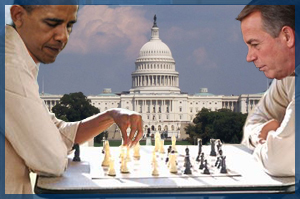
Chess Master or Pawn?
So I went and watched a silly movie (and thoroughly enjoyed it). I calmed down and decided to get back online for a bit. I read some reactions to the fiscal cliff deal from a different perspective, and now I think maybe I was wrong. Sure it’s a lousy deal, but it’s not over yet and at Obama did manage to preserve the social safety net programs, extend unemployment benefits, hold onto the earned income tax credit and child credits, and got some minimal revenue increases.
Look, I’m poor, but I’m not on unemployment. I was willing to go “off the cliff” in order to force the Republicans’ hand. But there are millions of poor and working class people out there would would really suffer if they lose their unemployment and those tax givebacks. Now those have been extended for a year at least. Yes, there will be another fight in two months, but there was going to be a battle royal in two months anyway. Now they will kill two birds with one stone–the debt limit and the sequester will be wrapped up in one fight.
Have I drunk the Koolaid? No, but I admit I really do want to hang onto some hope for the future. So beat me up in the comments all you want. I’m going to hold off judging this deal for two more months. Then if Obama completely sells out the poor and elderly, I’ll admit I made a big mistake. But for now, I’m willing to give Obama a chance.
My changed perspective came from reading a couple of diaries at DailyKos (so shoot me!) and then rereading pieces by Paul Krugman and Noam Scheiber. First up, a Kos diary by ban nock: “Obama’s Deal From a poor Person’s Perspective.”
As usual Obama looked out for us fairly well. All you folks in the financial industry who are weeping and wailing can just pound sand, cash in some stock options, sell your Lincoln, cry me a river.
The biggest thing is earned income tax credit and medicaid, neither of which were touched. Looks like we lost 2% on Social Security contributions but that is more than made up by the earned income credit (EIC)
I should do more to define poor. By poor I mean lower than median income down to, well, to really really poor. Median is around 40K.
The earned income credit is the thing that pulls the greatest number of people out of poverty in the USA. It’s an alternative to raising minimum wages.
You take your adjusted gross income and if you’re a family with a coupla kids making between $13K and $22K Uncle Sam is going to either reduce your taxes by around $5K or reduce them as much as possible and send you a fat check for the remainder. How cool is that? Chart to figure what you get here. http://www.irs.gov/… What is Adjusted Gross Income? That’s how much money you make, but it could come down for things like IRA contributions.
And then, as ban nock points out, there’s unemployment, which is the only thing between millions of Americans and abject poverty.
Now when I first read ban nock’s diary, I was somewhat skeptical. My point of view was that Obama is just warming up for the big kill, “entitlement reform.” But wait a minute. The Republicans were screaming for that in 2011 and again in this last fight. But they didn’t get it. In fact Harry Reid even took the Chained CPI off the table and Obama and Biden didn’t put it back on.
Then I moved on to this diary by Alexander Dukes AKA “Game Guru”: “Umm… We’re playing chess, not checkers. And we’re winning.” You really need to read the whole thing, but the gist is that Obama has been dealing with people who are utterly intractable–they’re actually buttfuck crazy!–so what Obama has done is to keep kicking the can down the road while each time getting something for nothing and at the same time preserving the social programs most needed by the poor and unemployed. Here’s an
First off, lets establish that we’re playing chess, not checkers. Our objective is not to win more battles than the Republicans, its to win the war. In this case its a war against the Republican objective to effectively dismantle Medicare, Social Security, Obamacare, the EPA and every other part of the government that doesn’t leave the people to the whims of the 1 percent. This is chess, so we can afford to lose a few pieces so that we draw our opponent in for the final blow. With every turn we attempt to move toward our ultimate goal, even if that means we take some blows along the way. Chess is a thinking man’s game, it takes a long time to play. Similarly, in these budget fights, Obama’s thinking about the long haul.
Lets examine the President’s strategy: In the first budget fight, Republicans wanted to extend the Bush tax cuts for everyone. The Democrats wanted to extend unemployment benefits and renew the START treaty. There was a great deal of debate… and something happened. What did we end up with? We got START, the unemployment extension, and what else…. what else… oh yeah, DADT was repealed! All for maintaining the tax status quo at the time. Essentially, we offered nothing, and the Republicans got nothing.
Okay, so we gave up the hope for more revenue from taxing the rich, but as Republicans keep pointing out, that new revenue won’t even keep the government going for very long. It’s mostly a symbolic effort to restore some fairness to the tax system.
After that was the debt ceiling fight. Well, Obama almost got to a deal back in 2011, but to no avail. So to raise the debt ceiling congress created the sequester. Nothing for nothing there. Not a bad or good deal, because there wasn’t really a deal at all. But in the sense that there was a deal, both sides agreed to a lame duck rematch, betting that their side would win the election and have the leverage in the sequester fight. Obama won the election, so he had the leverage.
Again, Republicans basically got nothing–just a fake deadline that everyone knew all along was just kicking the can down the road.
Lets discuss what happened (and is still happening) today. Yesterday, Mitch McConnell and Obama reached a deal that did 3 main things: It ends the Bush tax cuts for those making over $400K, it raised the estate tax for those with estates greater than 5 million, and extends unemployment benefits for another year. For this, the Republicans gained… nothing.
That’s right, nothing. Yes, the sequester is extended for only 60 days, but that bumps right up against the debt ceiling… something the Republicans were going to fight over anyway. The media common wisdom is that the Republicans gained “leverage” in this deal. How so? Obama just combined two potential clusterf*cks into one! He gained a years worth of unemployment benefits, tax hikes on the 1%, and an estate tax hike; all for making his job easier in the long term.
Next time Obama may have to cave on the Chained CPI, which would be horrible, but better than privatization of Social Security. But maybe he won’t have to give that up, who knows? All we know for now is that Social Security hasn’t been changed yet.
Obama wanted the debt limited to be raised with the elimination of the sequester. This is essentially raising the limit along with eliminating the sequester, only now he’s getting more of what he wants when the debate starts because he’s already got the tax hikes and the unemployment extension!
Not only that, but now he has two major speeches between now and then to set the debate squarely in his favor.
It makes sense to me. Frankly, I buy it for now. And you know why I’m willing to string Obama along for another two months? Because of what happened in his second debate with Mitt Romney:
Please proceed, Governor.
Please proceed, Speaker.
Maybe I’m nuts, but maybe I’m not. I’m going to wait two months and find out. Now let’s look at what Krugman had to say about the upside of the deal:
To make sense of what just happened, we need to ask what is really at stake, and how much difference the budget deal makes in the larger picture.
So, what are the two sides really fighting about? Surely the answer is, the future of the welfare state. Progressives want to maintain the achievements of the New Deal and the Great Society, and also implement and improve Obamacare so that we become a normal advanced country that guarantees essential health care to all its citizens. The right wants to roll the clock back to 1930, if not to the 19th century.
There are two ways progressives can lose this fight. One is direct defeat on the question of social insurance, with Congress actually voting to privatize and eventually phase out key programs — or with Democratic politicians themselves giving away their political birthright in the name of a mess of pottage Grand Bargain. The other is for conservatives to successfully starve the beast — to drive revenue so low through tax cuts that the social insurance programs can’t be sustained.
The good news for progressives is that danger #1 has been averted, at least so far — and not without a lot of anxiety first.
Romney lost, so nothing like the Ryan plan is on the table until President Santorum takes office, or something. Meanwhile, in 2011 Obama was willing to raise the Medicare age, in 2012 to cut Social Security benefits; but luckily the extremists of the right scuttled both deals. There are no cuts in benefits in this deal.
And Scheiber’s take on the upside:
I think a reasonable person can defend the bill on its own terms. The fact is that nudging up the tax threshold to $450,000 only sacrifices $100-200 billion in revenue over the next decade (against the $700-800 billion the administration would have secured with its original threshold), while allowing unemployment benefits to lapse would cause real pain to both the 2 million people directly affected and, indirectly, to the economy. Yes, Obama could have gotten the latter without giving up the former had he just waited another few days—at which point what the GOP considers a tax increase suddenly becomes a tax cut. But these things are always easier to pull the trigger on when you, er, don’t actually have to pull the trigger. I can’t begrudge Obama his wanting to avoid some downside risk for only a marginally better deal.
In other words, we are dealing with insane people–the Republicans in the House and Senate–and so far we haven’t given away the real farm, the social safety net. Unfortunately we don’t have enough revenue for a real stimulus either, but we go back to the table in two months and the Republicans are scoring that as a win for them.
But what if it’s not? What if dealing both issues at once–the debt ceiling and the sequester–and sooner, is an advantage for Democrats and the White House? We can’t know for sure until the next fight. But Obama did get a year of unemployment, those tax givebacks, and some symbolic concessions from the super-rich. And he does have the State of the Union and Inauguration speeches to call out the Republicans and make his case.
So that’s why I’m going to give this deal a chance for now. It’s not a great deal, but the important stuff has been protected for the time being. Now go ahead and hammer me in the comments, I don’t mind.

 peej
peej Carissa
 bostonboomer
 dakinikat
 ecocatwoman
 jjlo
jjlo mablue2
 Mama Lopez
 peggysue22
 quixote
 skydancingguestblogger
 Mona (aka Wonk the Vote)





Recent Comments