
Thursday Reads
Posted: August 22, 2013 Filed under: Barack Obama, Crime, Criminal Justice System, morning reads, U.S. Politics | Tags: Antontin Scalia, Arizona Kansas lawsuit, australia, Bobby Jindal, Bradley Manning, Chelsea Manning, Chris Lane, David Sirota, FBI files, hormone therapy, Mark Ambinder, Michael Hastings, murder, SCOTUS, sex-reassignment surgery, The Guardian UK, transgender, voting rights, William Vollmann 19 Comments
Good Morning!!
I’m getting slow start this morning after rereading some of yesterday’s morning thread and seeing Fannie’s and Beata’s comments. Life is such a mystery . . . it often seems sad and even meaningless. And yet life is wonderful and beautiful too.
I don’t even know how to express what I’m feeling right now. I just want to thank all of you for being here. When I get discouraged and disgusted with our politics and the behavior of some of my fellow humans, it helps me to share my feelings with you and to get your reactions.
Now let’s see what’s in the news this morning.
Bradley Manning was sentenced to 35 years in prison yesterday. But with good behavior he could be released in as little as 7 years. Charlie Savage and Emmarie Huetteman at The New York Times:
In a two-minute hearing on Wednesday morning, the judge, Col. Denise R. Lind of the Army, also said that Private Manning would be dishonorably discharged and reduced in rank from private first class to private, the lowest rank in the military. She said he would forfeit his pay, but she did not impose a fine.
Before the sentencing, Private Manning sat leaning forward with his hands folded, whispering to his lawyer, David Coombs. His aunt and two cousins sat quietly behind him. As Colonel Lind read the sentence, Private Manning stood, showing no expression. He did not make a statement.
The materials that Private Manning gave to WikiLeaks included a video taken during an American helicopter attack in Baghdad in 2007 in which civilians were killed, including two journalists. He also gave WikiLeaks some 250,000 diplomatic cables, dossiers of detainees being imprisoned without trial at Guantánamo Bay, Cuba, and hundreds of thousands of incident reports from the wars in Iraq and Afghanistan….
Mr. Coombs later told reporters that he would apply for a presidential pardon next week and read a statement from Private Manning that he said would be included in his request.
“I only wanted to help people,” Private Manning’s statement said, adding, “If you deny my request for a pardon, I will serve my time knowing that sometimes you have to pay a heavy price to live in a free society.”

This undated photo provided by the U.S. Army shows Pfc. Bradley Manning posing in a wig and lipstick.
Manning has expressed the desire to live as a woman, and although he may not be able to get hormone therapy or sex-reassignment surgery while he is in military prison, he has announced that he is now Chelsea Manning. From Joe Coscarelli at New York Magazine: Bradley Manning’s Long, Painful Road to Coming Out As Transgender.
Less than a day after being sentenced to 35 years in prison for passing classified U.S. documents to WikiLeaks, Army private Bradley Manning has a huge, if not exactly surprisingly, announcement: “I am Chelsea Manning. I am female,” the 25-year-old wrote in a statement to Today. “Given the way that I feel, and have felt since childhood, I want to begin hormone therapy as soon as possible. I hope that you will support me in this transition. I also request that, starting today, you refer to me by my new name and use the feminine pronoun.”
But the transition has colored much of Manning’s life for many years and factors heavily into how she became one of the most notable leakers in American history. Even if much of the world is only now paying attention to Manning’s gender-questioning, it’s always been a part of her story.
Manning’s full letter is titled “The Next Stage of My Life” and has notes of relief, her trial and sentencing finally complete after three years. “As I transition into this next phase of my life,” Manning wrote, “I want everyone to know the real me.”
Manning was wrestling with her sexual orientation while serving in Iraq and when she got involved with WikiLeaks. As reported by Steve Fishman in a July 2011 issue of New York, “Among fellow soldiers, Manning had to conceal the basic facts of his sexual orientation. On the web, he was proudly out and joined a ‘Repeal Don’t Ask Don’t Tell’ group. He’d even begun to explore switching his gender, chatting with a counselor about the steps a person takes to transition from male to female.”
Manning will probably be in her early 30s when she is released from prison; so she’ll still have a long and probably interesting life ahead of her when that time comes.
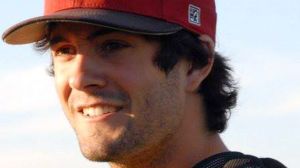
Chris Lane
Australians are calling for a boycott of U.S. travel after the senseless shooting of young Australian college student Chris Lane in Oklahoma. CNN:
The indiscriminate shooting of Christopher Lane, a 23-year-old Australian who was living his dream of studying in the United States on a baseball scholarship, has repulsed many in his home country and led to calls for Australian tourists to boycott the United States.
“It is another example of murder mayhem on Main Street,” former Australian deputy Prime Minister Tim Fischer told CNN’s Piers Morgan.
“People thinking of going to the USA for business or tourist trips should think carefully about it given the statistical fact you are 15 times more likely to be shot dead in the USA than in Australia per capita per million people.”
Police said Lane was on one of his regular runs through what has been described as the affluent town of Duncan on Friday about 3 p.m. when a car carrying three teenagers drove up behind him.
“They pulled up behind him and shot him in the back, then sped away,” said Capt. Jay Evans of the Duncan Police Department. “It could have been anybody — it was such a random act.”
Here’s a long article about the shooting from new.com.au: Chilling 911 call details final moments of Melbourne baseballer Chris Lane’s life.
What a heartbreaking story.
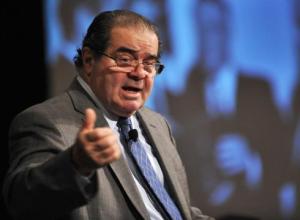
The states of Arizona and Kansas have followed a suggestion from Supreme Court Justice Antonin Scalia, according to TPM: Accepting Scalia’s Offer, Arizona Sues Obama Administration On Voting Rights.
The lawsuit, filed Wednesday, was announced by Arizona’s Attorney General Tom Horne and Secretary of State Ken Bennett, and joined by Kansas Secretary of State Kris Kobach, a high-profile architect of restrictionist laws, including Arizona’s Senate Bill 1070.
The issue involves the 1993 National Voter Registration Act, also known as the “motor voter” law, which requires states to let people register to vote simply by attesting they are citizens, when renewing their driver’s license or applying for social services. A 2004 law adopted by the voters in Arizona added the requirement that people registering to vote also provide proof of citizenship. The Supreme Court struck down that law earlier this year, concluding that it is trumped by the motor voter law. Arizona, the court ruled, could not add new requirements to the form prescribed by the federal law.
But during oral arguments in March, Scalia expressed his bafflement that Arizona did not launch a broader assault on the constitutionality of the NVRA form, written by the Election Assistance Commission. The state simply contended in that case that its proof of citizenship law did not violate the federal law. Even Scalia disagreed with that, voting against Arizona in the ruling, but also giving them a valuable tip in his 7-2 majority opinion.
“We hold that [the NVRA] precludes Arizona from requiring a Federal Form applicant to submit information beyond that required by the form itself,” Scalia wrote in the June decision. “Arizona may, however, request anew that the EAC include such a requirement among the Federal Form’s state-specific instructions, and may seek judicial review of the EAC’s decision under the Administrative Procedure Act.”
Sigh . . . read more at the link.
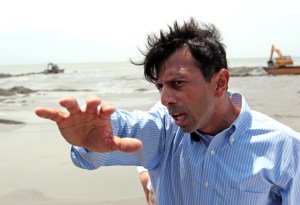
According to a new PPP poll, only 28 percent of Louisiana voters still think Governor Bobby Jindal is doing a good job.
Three years ago in August PPP declared Bobby Jindal to be the most popular Governor in the country. 58% of voters approved of him to only 34% who disapproved. Jindal’s fortunes have seen an amazing shift since that time though, and our newest poll finds him to be the most unpopular Republican Governor of any state- and the second most unpopular Governor in the country overall.
Just 28% of voters now approve of Jindal to 59% who disapprove. That’s an 11 point decline in his net approval just since February when he was already at a poor 37/57 standing. Even Republicans are pretty divided on Jindal (43/42) while independents (35/45) and Democrats (14/78) generally give him poor marks.
Jindal’s White House prospects are dismal if his home state voters have anything to say about it. Just 17% of Louisianans think he should run for President in 2016 to 72% who believe he should sit it out. He ties for 4th among Republican primary voters as their top choice for their 2016 candidate- Rand Paul leads with 18% to 17% for Jeb Bush, 11% for Paul Ryan, 10% for Jindal and Chris Christie, 8% for Marco Rubio and Ted Cruz, 5% for Rick Santorum, and less than 1% for Susana Martinez. (That’s also an embarrassingly poor showing for Santorum given that he easily won the state’s primary last year.)
Jindal wouldn’t be likely to get to a general election but the news for him there is bad too- he trails Hillary Clinton 47/40 in a hypothetical match up. Every other Republican we looked at is more competitive with Clinton in the state- Ryan leads her 46/44, Paul does 45/44, Bush ties her at 44 each, and she leads Christie just 42/41. It looks like Clinton would have a chance to make Louisiana unusually competitive in any instance, but particularly so against Jindal.
It’s difficult to believe that Jindal is polling that well against Hillary.
A few more short takes:
A new article in LA Weekly offers some startling revelations about Michael Hastings’ state of mind before he was killed in a one-car crash: Michael Hastings’ Dangerous Mind: Journalistic Star Was Loved, Feared and Haunted. Based on a friend’s descriptions of Hastings’ behavior, it sounds like he was so severely depressed that he was delusional.
From The A Register, speculations based on The Guardian’s bizarre claims that British intelligence agents forced them to destroy computers that contained U.S. secrets stolen by Edward Snowden: MYSTERY of Guardian mobos and graphics cards which ‘held Snowden files’
A funny Buzzfeed list (with gifs) contributed by Marc Ambinder: 12 Ways To Easily Identify An East Coast Transplant In LA.
A very weird story that demonstrates the institutional stupidity of the Federal Bureau of Investigation: FBI suspected William Vollmann was the Unabomber.
A fascinating story at Defense One: Area 51 Has Been Hiding U-2 Spy Planes, Not UFOs
Finally, our old friend David Sirota really outdid himself yesterday with this story at Salon: This cowardly silence is an act of war, in which he claims that President Obama’s failure to object to the UK detaining Glenn Greenwald’s partner David Miranda at Heathrow Airport is a crime against humanity . . . or something.
Now it’s your turn. What stories are you focusing on today? Please share your links in the comment thread.
International Community Must Confront Putin and Russia on Anti-Gay Legislation
Posted: August 21, 2013 Filed under: Foreign Affairs, GLBT Rights, homophobia, open thread, Russia | Tags: 2013 Winter Olympics, adoption, Bradley Manning, Edward Snowden, Harvey Fierstein, James Kirchick, Russian anti-gay legislation, same-sex marriage, Vladimir Putin 19 Comments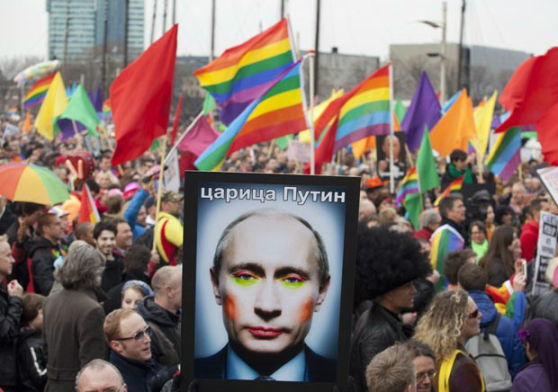
There’s been quite a bit of talk recently about Russia’s anti-gay “propaganda” legislation–signed into law on June 30 by President Vladimir Putin–because of this month’s World Athletics Championships in Moscow and the upcoming Winter Olympics in Sochi as well as Edward Snowden’s decision to defect to Russia. Naturally there is concern about discrimination against gay athletes and coaches at international sporting events; and Snowden has been criticized because his supposed passion for human rights is belied by his embrace of Putin and his disastrous human rights record.
Here’s an explanation of the new law at PolicyMic: Russia’s Anti-Gay Law, Spelled Out in Plain English.
On June 30 this year, Russian President Vladimir Putin signed into law a bill banning the “propaganda of nontraditional sexual relations to minors,” thus opening a new, dark chapter in the history of gay rights in Russia. The law caps a period of ferocious activities by the Russian government aimed at limiting the rights of the country’s lesbian, gay, bisexual, transgender, and intersex people.
The violations of fundamental, constitutionally protected rights of Russia’s gay citizens have included multiple bans on gay pride parades in Moscow and other cities, hefty fines to gay rights groups accused of acting as a “foreign agent,” denial of registration to nongovernmental organizations, and regional laws banning the propaganda of homosexuality to minors, which served as a basis for the federal law enacted by Mr. Putin and unanimously passed by the State Duma. Against this backdrop, violent attacks on gays or “suspect gays” are becoming commonplace.
The federal law is spelled out in Article 6.21 of the Code of the Russian Federation on Administrative Offenses.
Here is what Article 6.21 actually says:
Propaganda is the act of distributing information among minors that 1) is aimed at the creating nontraditional sexual attitudes, 2) makes nontraditional sexual relations attractive, 3) equates the social value of traditional and nontraditional sexual relations, or 4) creates an interest in nontraditional sexual relations.
If you’re Russian. Individuals engaging in such propaganda can be fined 4,000 to 5,000 rubles (120-150 USD), public officials are subject to fines of 40,000 to 50,000 rubles (1,200-1,500 USD), and registered organizations can be either fined (800,000-1,000,000 rubles or 24,000-30,000 USD) or sanctioned to stop operations for 90 days. If you engage in the said propaganda in the media or on the internet, the sliding scale of fines shifts: for individuals, 50,000 to 100,000 rubles; for public officials, 100,000 to 200,000 rubles, and for organizations, from one million rubles or a 90-day suspension.
If you’re an alien. Foreign citizens or stateless persons engaging in propaganda are subject to a fine of 4,000 to 5,000 rubles, or they can be deported from the Russian Federation and/or serve 15 days in jail. If a foreigner uses the media or the internet to engage in propaganda, the fines increase to 50,000-100,000 rubles or a 15-day detention with subsequent deportation from Russia.
As PolicyMic points out, the language of the law is so ambiguous that it is difficult to predict how it will be enforced or how it will be applied to foreigners. According to HuffPo, visitors to Russia should be concerned.
Bad news for lesbian, gay, bisexual and transgender (LGBT) travelers hoping to visit Russia, as foreign tourists will now be subjected to the same “gay propaganda” fines and sentences as residents.
Travel site Skift reports that the new law, signed into law by Russian President Vladimir Putin on June 30, contains a provision that allows the government to arrest and detain gay (or “pro-gay”) foreigners for up to 14 days before they would then be expelled from Russia.
As far as what is considered “pro-gay,” the laws specifics are somewhat vague, butCanadian site Travel and Escape suggests “gay-affirmative” speech, displaying a rainbow flag and same-sex partners holding hands are among the prohibited actions.
A few days later, on July 3, Putin signed another law that bans adoption of Russian children by foreign same-sex couples or by any unmarried couple or single parent in a country that recognizes gay marriage.
Today Harvey Fierstein published an op-ed in The New York Times on Russia’s Anti-Gay Crackdown, in which he reports there are rumors that Putin will soon
sign an edict that would remove children from their own families if the parents are either gay or lesbian or suspected of being gay or lesbian. The police would have the authority to remove children from adoptive homes as well as from their own biological parents.
Fierstein dismisses claims that these recently passed laws are designed to protect children from pedophiles. There is no scientific evidence to show that pedophiles are homosexuals; in fact research shows that the overwhelming majority of pedophiles are heterosexual males. So what is the explanation for the Putin’s war against gays?
Mr. Putin’s true motives lie elsewhere. Historically this kind of scapegoating is used by politicians to solidify their bases and draw attention away from their failing policies, and no doubt this is what’s happening in Russia. Counting on the natural backlash against the success of marriage equality around the world and recruiting support from conservative religious organizations, Mr. Putin has sallied forth into this battle, figuring that the only opposition he will face will come from the left, his favorite boogeyman.
Mr. Putin’s campaign against lesbian, gay and bisexual people is one of distraction, a strategy of demonizing a minority for political gain taken straight from the Nazi playbook. Can we allow this war against human rights to go unanswered? Although Mr. Putin may think he can control his creation, history proves he cannot: his condemnations are permission to commit violence against gays and lesbians. In May a young gay man was murdered in the city of Volgograd. He was beaten, his body violated with beer bottles, his clothing set on fire, his head crushed with a rock. This is most likely just the beginning.
Yet, so far the international community hasn’t done much to push back against Putin’s anti-gay campaign. As Fierstein writes, “this must change,” and the upcoming Winter Olympics provides the perfect opportunity for enlightened government to put pressure on Putin and his regime.
Today, one gay reporter, James Kirchick, did his part to call attention to Russia’s repressive new anti-gay laws when he appeared on Russia Today, the state-owned TV station, ostensibly to discuss the Bradley Manning sentence. It turned into quite a scene.
According to The Washington Free Beacon, Kirchick was taken off the air when he refused to stop talking about Russia’s anti-gay laws and focus on Bradley Manning.
“A quick explanation now for the beginning of our coverage of the Bradley Manning sentences,” one host said later in the program. “We invited a guest on to discuss the fate of the whistleblower, but he used the chance to discuss his views on other unrelated issues and that’s why we had to take him off air. We would like to say sorry for any confusion caused.”
RT also refused to continue Kirchick’s car service, according to the reporter.
“True fact: (RT) just called taxi company that took me to studio to drop me off on the side of the highway on way to Stockholm airport,” Kirchick wrote on Twitter Wednesday morning following his appearance on the network.
This is an open thread, but any comments on the content of this post will be much appreciated.
Tuesday Reads: The Agony of Glenn Greenwald, The Ickiness of Ted Cruz, & Other News
Posted: August 20, 2013 Filed under: 2016 elections, Egypt, Foreign Affairs, Great Britain, morning reads, Pakistan, Republican politics, U.S. Economy, U.S. Politics, US & Canada | Tags: Bob Cesca, David Miranda, Glenn Greenwald, Muslim Brotherhood, Pervez Musharraf, Ted Cruz, the 24-hour rule, The Guardian UK 29 Comments
Good Morning!!
As of yesterday, we’ve reached the point with the NSA leaks story that the entire focus is on Glenn Greenwald and his martyrdom. Even Edward Snowden has now faded into the background.
On Sunday, Greenwald’s domestic partner David Miranda was detained for nine hours by UK authorities as he passed through Heathrow Airport on his way from Berlin to Rio de Janeiro where he and Greenwald live. Miranda was finally released, but his laptop, an external hard drive, a number of memory sticks and other electronic devices were confiscated. Greenwald reacted by threatening the UK government with harmful revelations from the Snowden stash.
As with previous Greenwald stories, this one quickly evolved from a tale of horrendous government repression as reported by the Guardian to a more complex story reported by other news outlets–forcing the Guardian to walk back or provide more details on aspects of its original reporting. Bob Cesca does a good job of summarizing the process.
Like most people, Cesca was at first shocked by the news of Miranda’s detention. Then he began reading the stories under the headlines.
When I read The Guardian‘s article about the incident, however, more questions popped up — as with much of The Guardian‘s reporting on this topic, the publication’s tendency for coy, smoke-and-mirrors reporting invariably raises more questions than it answers. The article was credited to “Guardian staff,” for one, there weren’t any quotes from Miranda himself and the only source for the article appeared to be Greenwald, who, from my experience covering this story, tends to be incendiary and misleading.
The wailing and garment rending was underway — the predictable group freakout we’re forced to endure every time a new article is published. Greenwald himself wrote that the U.K. authorities were actually worse than the Mafia because the Mafia doesn’t target family members. (Clearly, Greenwald knows less about the Mafia than he does about political realities or history.)
An aside: Cesca coined the term “the 24 hour rule” after a the first few Greenwald NSA “bombshells.”
The 24 Hour Rule: 1) A wild claim is made via a news article, most often The Guardian, about the U.S. government or related entities. 2) The article sparks wild fits of outrage. 3) Then, within 24 hours, a mitigating detail is added, undermining or totally debunking one or more of the central claims contained with the article. Related quote: “A lie can travel half-way around the world before the truth gets its pants on.”
Back to Cesca’s take on the Miranda story:
As the hours rolled by, Charlie Savage, reporting for The New York Times, began to revealmore details about the trip — details which The Guardian mysteriously didn’t include in either of its articles….
First, we learned from The New York Times that The Guardian financed Miranda’s trip to Germany and back. This means Miranda was conducting some sort of official business for the publication. Around the same time, Amnesty International referred to Miranda as “a Guardian newspaper employee.” Combined with the Laura Poitras detail, it’s obvious that Miranda was commissioned to do some serious leg-work on the Snowden/NSA reporting, the extent of which was unknown at the time.
And then, late in the evening east coast time, The New York Times revealed the purpose of Miranda’s trip to Berlin:
Mr. Miranda was in Berlin to deliver documents related to Mr. Greenwald’s investigation into government surveillance to Ms. Poitras, Mr. Greenwald said. Ms. Poitras, in turn, gave Mr. Miranda different documents to pass to Mr. Greenwald. Those documents, which were stored on encrypted thumb drives, were confiscated by airport security, Mr. Greenwald said. All of the documents came from the trove of materials provided to the two journalists by Mr. Snowden.
So Miranda, Greenwald’s spouse, served as a paid courier to transfer stolen, top secret national security documents from Greenwald to Poitras, and from Poitras back to Greenwald.
While I’m not defending UK authorities for their ham-handed treatment of Miranda–and neither is Cesca–it’s really not surprising that Miranda was stopped and questioned. It also later came out that Miranda had been offered an attorney, but he refused the offer (Greenwald had originally said his partner was refused access to legal advice). From The Guardian on Monday:
He was offered a lawyer and a cup of water, but he refused both because he did not trust the authorities. The questions, he said, were relentless – about Greenwald, Snowden, Poitras and a host of other apparently random subjects.
“They even asked me about the protests in Brazil, why people were unhappy and who I knew in the government,” said Miranda.
He got his first drink – from a Coke machine in the corridor – after eight hours and was eventually released almost an hour later. Police records show he had been held from 08.05 to 17.00.
The questions about the Brazilian government weren’t actually that outrageous, since Glenn Greenwald had contacted high level officials there and they had tried to intervene.
So the “24-hour rule” still holds. This entire story turned around in 24 hours, but many news outlets are still reporting information that is either wholly or partially untrue. After it became clear that their original reporting on the Miranda detention was problematic, the Guardian released another bombshell article written by Guardian editor-in-chief Alan Rusberger in which he claims that two months ago GCHQ (Britain’s version of NSA) agents forced the Guardian to destroy their hard drives and computers unless they turned over their NSA materials. Again Bob Cesca has a good summary. Please read the whole thing if you can–it’s not long.
We’ll have to wait another day to see if this story also morphs into something different. Cesca has a list of questions for Rusberger. My big question is why wasn’t this reported immediately after it happened, and why didn’t the Guardian go to court over it?
And so Glenn Greenwald and his victimization remain the center of international attention. I have to wonder why Greenwald arranged for his partner to travel through Heathrow in the first place. Was he deliberately inviting something like this? He couldn’t have asked for better free publicity that he and the Guardian are getting right now.
Meanwhile, any discussion of NSA spying is hindered by so much inaccurate information; yet the NSA story is distracting Americans from focusing on equally important and even more pressing issues like jobs, the economy, voting rights, the war on women’s autonomy, the environment, and the upheavals in the Middle East. So now I’ll move on to some other news–I’ll add more links on the Miranda story in the comments.
In other news,
The Atlantic has a good story on economic inequality: Are the Rich Getting Too Much of the Economic Pie?
When one of you asked, “Are the rich getting too much of the economic pie?” the team behindEconomics in Plain English got pretty excited. Because you said “pie.” So we headed toDangerously Delicious Pies in northeast Washington, D.C., with business editor Derek Thompson to explain income inequality over dessert. We ordered three pies — peanut butter, blueberry, and something amazing called the “Baltimore Bomb” — to make three charts that illustrate the income and wealth gap in the U.S. We’re not the first to mix math and pastry, as we discovered recently, but we hope this video offers a tasty perspective on a complex economic question.
Watch the video–and others by the same group–at the link.
In Pakistan, Pervez Musharraf has been indicted in the 2007 murder of Benazir Bhutto
ISLAMABAD, Pakistan — A Pakistani court indicted Pervez Musharraf on Tuesday in connection with the 2007 assassination of former Prime Minister Benazir Bhutto, the first time that a former military leader has faced criminal proceedings in Pakistan.
The court in Rawalpindi, near the capital, Islamabad, filed three charges against Mr. Musharraf, including murder and conspiracy to murder, said a prosecutor, Chaudhry Muhammed Azhar.
Mr. Musharraf, who has maintained that the charges against him are politically motivated, pleaded not guilty, his lawyers said. Reporters were excluded from the hearing. Afterward, police commandos and paramilitary rangers escorted Mr. Musharraf back to his villa on the edge of Islamabad, where he has been under house arrest since April in connection with other cases stemming from his rule from 1999 to 2008.
The sight of a once untouchable general being called to account by a court had a potent symbolism in a country that has been ruled by the military for about half of its 66-year history. While the military remains deeply powerful, the prosecution has sent the message that Pakistan’s top generals are subject to the rule of law — at least after they have retired.
In Egypt, a leader of the Muslim Brotherhood has been arrested. The LA Times reports:
CAIRO — Egyptian authorities early Tuesday arrested the leader of the Muslim Brotherhood, another demoralizing blow to the Islamist organization amid a crackdown by the military to silence dissent and build support for its control of the nation.
Supreme Guide Mohamed Badie was arrested in a Cairo apartment. Dressed in a gray tunic, the 70-year-old spiritual leader looked shaken, sitting next to a bottle of water in police custody. The image distilled the desperation the world’s most influential Islamist organization faces against an army that appears determined to crush it.
Most of the Brotherhood’s top leaders, including Khairat Shater, its chief strategist and financier, and former Egyptian president Mohamed Morsi, who was overthrown in a coup last month, are in detention or have gone underground. Much of the group’s strategy appears to have shifted to the Anti-Coup Alliance, an umbrella group the Brotherhood organized to protest Morsi’s downfall.
The army’s crackdown on the Brotherhood has been ferocious. Police raids on two Brotherhood sit-ins last week and the protests and violence that ensured killed more than 900 Morsi supporters, many of them shot by live ammunition fired by security forces that have shown little restraint.
“When the hand of oppression extends to arrest this important symbol,” the Brotherhood said in a statement regarding Badie, “that means the military coup has used up everything in its pocket and is readying to depart.”
I’ll be honest–I’m really clueless about what’s going on in Egypt right now. I just hope the situation doesn’t descend into a Syria-like civil war.
Texas Tea Party Senator Ted Cruz is back in the news. The Dallas Morning News revealed yesterday that Cruz holds dual citizenship in the US and Canada.
Born in Canada to an American mother, Ted Cruz became an instant U.S. citizen. But under Canadian law, he also became a citizen of that country the moment he was born.
Unless the Texas Republican senator formally renounces that citizenship, he will remain a citizen of both countries, legal experts say.
That means he could assert the right to vote in Canada or even run for Parliament. On a lunch break from the U.S. Senate, he could head to the nearby embassy — the one flying a bright red maple leaf flag — pull out his Calgary, Alberta, birth certificate and obtain a passport.
“He’s a Canadian,” said Toronto lawyer Stephen Green, past chairman of the Canadian Bar Association’s Citizenship and Immigration Section.
The circumstances of Cruz’s birth have fueled a simmering debate over his eligibility to run for president. Knowingly or not, dual citizenship is an apparent if inconvenient truth for the tea party firebrand, who shows every sign he’s angling for the White House.
Cruz has decided to renounce his Canadian citizenship, according to CNN:
“Because I was a U.S. citizen at birth, because I left Calgary when I was 4 and have lived my entire life since then in the U.S., and because I have never taken affirmative steps to claim Canadian citizenship, I assumed that was the end of the matter,” Cruz wrote in his statement.
“Now the Dallas Morning News says that I may technically have dual citizenship. Assuming that is true, then sure, I will renounce any Canadian citizenship,” he continued. “Nothing against Canada, but I’m an American by birth, and as a U.S. Senator, I believe I should be only an American.”
Too bad he didn’t decide to run for office in Canada. I guess we’re stuck with him now.
I’ll end with this Daily Beast story about what Ted Cruz Princeton roommates recall about him. Some excerpts:
When Craig Mazin first met his freshman roommate, Rafael Edward Cruz, he knew the 17-year-old Texan was not like other students at Princeton, or probably anywhere else for that matter.
“I remember very specifically that he had a book in Spanish and the title was Was Karl Marx a Satanist? And I thought, who is this person?” Mazin says of Ted Cruz. “Even in 1988, he was politically extreme in a way that was surprising to me.” [….]
“It was my distinct impression that Ted had nothing to learn from anyone else,” said Erik Leitch, who lived in Butler College with Cruz. Leitch said he remembers Cruz as someone who wanted to argue over anything or nothing, just for the exercise of arguing. “The only point of Ted talking to you was to convince you of the rightness of his views.”
In addition to Mazin and Leitch, several fellow classmates who asked that their names not be used described the young Cruz with words like “abrasive,” “intense,” “strident,” “crank,” and “arrogant.” Four independently offered the word “creepy,” with some pointing to Cruz’s habit of donning a paisley bathrobe and walking to the opposite end of their dorm’s hallway where the female students lived.
“I would end up fielding the [girls’] complaints: ‘Could you please keep your roommate out of our hallway?'” Mazin says.
Eeeeeeeeek!!
OK, now it’s your turn. What stories are you focusing on today? Please post your links on any topic in the comment thread.
Turkish Summer: Art, Politics, and Public Space in Istanbul
Posted: August 19, 2013 Filed under: #Occupy and We are the 99 percent!, Art, globalization, just because 13 CommentsUpcoming in the Contemporary Arts arena is the Istanbul Biennial. It may be an interesting event to watch, so I thought a little background on events preceding it might be useful given the recent unrest in Turkey. Some general information about the event:
Istanbul Biennial – Wikipedia, the free encyclopedia

Fulya Erdmeci
The Wikipedia entry looks like its mostly lifted from the History tab on the Biennial website (see below). Click on the Curator’s tab to learn more about 13th Biennial’s curator, Fulya Erdmeci, her name will come up in later links:
Koç Holding will come up from time to time as well. Here’s their Wikipedia entry:
Koç Holding – Wikipedia, the free encyclopedia
From the New Contemporary Blog:
The 13th Istanbul Biennial will be held between September 14 and November 10, 2013, with Fulya Erdemci as the curator and Bige Örer as the director. This year’s conceptual framework takes its name from one of poet Lale Müldür’s books: “Mom, am I barbarian?” The focal point of the biennial – which is sponsored by Koç Holding, one of the biggest holdings of the country – will be the notion of the public domain as a political forum. (İstanbul Foundation for Culture and Arts (İKSV) had a sponsorship agreement with Koç Holding to support five editions of the Istanbul Biennial over ten years, from 2006 through 2016.) The fact that a biennial with the aim to bring urban transformation policies to the table is being sponsored by Koç Holding became a topic of discussion once the conceptual framework was revealed.
The New Contemporary article is a good read for background on the Turkish Summer, analogue of sorts to the Arab Spring. The Biennial protests staged by independent Turkish artists, immediately preceded the Gezi Park movement. While Gezi Park/Taksim Square quickly evolved and then escalated into something significantly more awesome, initially its agenda was the one articulated by the Biennial protestors. And the Gezi Park movement never seemed to lose the essential artistic aspect, the “sophisticated populism” that characterized the Biennial Resistance. With the added intensity of the Turkish government’s response to it, the Gezi movement morphed into a massive and severe indictment of Turkish governance. It is as if the entire nation convulsed in attempt to challenge the relevance of conservative governance for a nation grappling with modernity. But it was the Biennial protests, I think, that really set the stage for the “sophisticated populism” that energized Turkey.
http://thenewcontemporary.com/2013/06/06/turkish-protests-reach-art-scene/
I don’t know what I would call this other than “sophisticated populism.” It seems to be a similar spirit that energized the Gezi resistance:
The protestors wore t-shirts that said “Waiting for Barbarians,” turning their backs to show the writing, and read C. P. Cavafy’s poem “Waiting for the barbarians.” The aim was to counter Lale Müldür’s poem “Mom, am I a barbarian?” with another poem. The aim of the group is to show the economic power domain of urban transformation, according to the written statement.

The Cathedral of Hagia Sophia, “Holy Wisdom;” Istanbul
Fleshing out the Biennial protests a little further:
http://www.bianet.org/english/culture/145359-urban-renewal-activists-protest-at-istanbul-biennial
Istanbul Biennial Protests Foreshadowed Battle for Gezi Park

Groovy satellite photo of the Bosphorus
Although the events that transpired over the summer at Taksim Square are likely well known, I’m including a few summaries for those who may have not kept up with it. I didn’t keep on top of it as it unfolded, but will have my eye on Istanbul this fall to see how the Biennial pans out. The following is a brief retrospective.
The following is a good read, but I take issue with this frame:
If you have been reading international news about the protests that started in Istanbul and have spread across Turkey, you may be under the false impression that this is an ideological battle between a secular piece of society and an Islamist Prime Minister Recep Tayyip Erdoğan, sparked by an insignificant event, the occupation of a city park. But the role of space in these outbreaks cannot be underestimated. As part of a project that would pedestrianize Taksim, Istanbul’s main square, the adjacent Gezi Park was to be demolished to build an Ottoman-via-Las Vegas Mall. The protest was an effort to save a park by occupying that very park; it was not a symbolic or ideological demonstration like the Occupy Wall Street movements, but a primal struggle between human bodies and bulldozers, that made the political discourse all the more potent.
What happened at Gezi Park wasn’t so localized; it spread to rural areas with a broader agenda, and it activated women in particular.
http://msmagazine.com/blog/2013/06/11/the-women-of-turkey-wont-give-up-without-a-fight/
David Giocacchini from the Penn Libraries compiled an “archival guide” for the Gezi Park demonstrations with some pretty striking photo and video:
http://guides.library.upenn.edu/content.php?pid=480136
The Penn Guide:
http://revoltinturkey.tumblr.com/

Shops on the Bosphorus
I include the Penn Guide and the following short documentaries because I’ve taken offense to the hyperbolic slinging of the term “police state” currently steamrolling the media in reference to the U.S government. Police state rhetoric more often than not derives from the fear-inducing fringe that can’t bear the idea of American espionage and can’t quite grasp that Freedom of the Press is like every other right – subject to restriction. Associating the American apparatus for handling crime-terrorism to a police state only demeans the experiences of people in legitimate struggle against an institutionally oppressive police state. Also, to stimulate thought on the proper parallels between liberty infringement – the right to peaceable assembly and, of course, free speech.
A short film produced by OccupyGezi:
The video embedded in the following link is a bit lengthy, but well worth watching. Note the gas mask graphic in the Roar editorial – probably one of the most striking images of political art I’ve seen in a long time. I’m struck by its “realistic symbolism.” By that I mean this isn’t metaphorical or hyperbolic imagery – wearing of gas masks was a reality for the Gezi Park protestors. There is brief mention in the video of how the movement embraced humor and its opponent’s critique as a tool of identity and resistance. I draw attention to it because I think it is another example of what I previously termed “sophisticated populism.”
http://roarmag.org/2013/08/istanbul-protests-occupy-gezi-documentary/
Turkey has been home or host to some of the most sophisticated and oldest civilizations the world has ever known. Its unique geographical position facilitated an extraordinary tradition of multiculturalism all throughout ancient times. The Antikythera Device, for instance was probably derived and constructed in the great library city of Pergamum.

AntiKythera Mechanism
Whether it be known as Anatolia, Caria, Lycia, Lydia, the Land of the Hatti… what is now Turkey holds a special fascination for me. I find it ironic and a sad commentary that a land once the epicenter of global cross-culturalism is now on the vanguard of rejecting the predatory globalization which threatens all cultural heritage everywhere.
I’ll end with one final link that doesn’t speak to the events noted here directly, but is a marvelous illustration of Turkey’s current struggle to reach modernity – another irony given its ultra-sophisticated heritage in the Ancient world. The following is a Turkish film from 2011 and deserving as wide an audience as it can find entitled, Once Upon a Time in Anatolia. It isn’t an American-paced movie by any stretch of the imagination. Appreciating it definitely requires patience. I watched it three times because of all that was woven into it. I’ll not say more than that for fear of spoiling the experience. Here’s the IMDb link for reference:
Once Upon a Time in Anatolia (2011) – IMDb
Monday Reads: The Heart is Still a Lonely Hunter
Posted: August 19, 2013 Filed under: morning reads | Tags: Bill Kristol is an idiot, Mandatory Drug sentences, Princess Diana 41 Comments Good Morning!
I am in one of those becoming states. It’s heartening in some way, I suppose, to think that one can be so firmly planted in adulthood and smug only to realize they still have so much work to do on issues that seem to crop up out of no where. I remember clearly where I was when Princess Diana died in Paris in that tragic auto crash 16 years ago. I was in my French Quarter apartment with the man who brought me to New Orleans. I thought he would be the love for and of the rest of my life. I have never known such passion right up and beyond the day it ended. It did not end well.
It is sixteen years later and life and love remain ephemeral as they are by design. Those days gave birth to my intense Buddhist practice. These days I do not feel like I can find the pure wisdom of dakinimind. The day of Diana’s death was a turning point for me because I was about to be left for a woman half my age and everything would fall apart by the end of the year. I had a creeping feeling that summer when he spoke of a certain student but felt that taboos where too big to cross. They were not.
“We” fell apart. I fell apart. My job disappeared. The ink on my divorce decree dried well. This man actually wrote to me right before my daughter’s wedding last year to reconnect. He congratulated me on the doctorate because he knew that it was a central pursuit of my life and he knew what it was like to get one. He found me again or had been watching me evidently. The e-missive was ignored because I have grown in many ways and I have no desire to revisit that relationship. At that point, nearly 15 years after, it seemed impossible for me to believe I would ever mutter the words “I love you” again to another man and I haven’t until last month. Too much had been lost even though much had been gained like the kathouse, the mighty mustang, the doctorate, and the wonders of New Orleans and my tangential career in music. My life has been an adventure that would have been unknown in Nebraska. You know that I have had a rich life here and met many of my goals. But, I tossed the love thing and men in general in the dustbin of expendable items by the time Diana’s death was a year old. Hence, I have earned the nickname “Cold Pizza” because that’s about how I’ve treated men for the last 16 years of my life. It never tastes good reheated so might as well toss it out. I actually sustained several simultaneous relationships for a number of years. One for nearly 7 years. Still, no mention of the goal of the lonely hunter. So now, on this nearing anniversary of Diana and her tragic death and her endless search to just be loved by one person without reservation and without boundary, I am drawn back to the hunt of her lonely heart. This path is one I know well no matter how overgrown or recently cleared it may be.
Hers is one of those stories that still draws others in too but for many different reasons. For me, it is because I so desperately understand her need to be loved unequivocally. You’d have to know the troubled story of my mother to really understand that statement but you are not my psychologist and this post is not directly about the bonds of early attachment. It is about the result of attachment gone unresolved. It is why I try to let all the people in my life know they are loved without condition. This includes you. I have Bodhisattva vows even though I fall sadly short of them and I try to expand love to encompass every being out there. DIana appeared universally loved but yet that was not enough for her. There was something compelling her from childhood to find the one sort of love that she felt she had never experienced. I think she loved without bounds too because it was the one thing she felt she never was given in her most basic relationships. To me, she exists beyond the boundaries of time and history like a tragic Shakespeare heroine or a mythical being. Her central story is still her quest for unconditional love.
Conspiracy theories are back surrounding the deaths of Princess Diana and her companion Dodi al Fayed, after British media reported allegations that the couple may have been murdered by British special forces.
Despite a $7 million joint French and British police investigation that concluded that Diana, al Fayed and their driver Henri Paul’s deaths in 1997 were accidents, a report in The Mirror claims they were allegedly murdered and it was all covered up.
The allegation surfaced at a second court martial of Sgt. Danny Nightingale, who was found guilty of illegal gun possession, The Mirror reported. Among the evidence presented at the trial was a letter from a former soldier’s estranged in-laws that makes the claim that the SAS (Special Air Service) “was behind Princess Diana’s death,” the newspaper reported.
On Saturday, Scotland Yard said that British police were looking into new information that has surfaced in connection with the deaths of Diana and al Fayed, but police declined to say what that new information was.
“The Metropolitan Police Service is scoping information that has recently been received in relation to the deaths and assessing its relevance and credibility,” Scotland Yard officials said in a statement. “The assessment will be carried out by officers from the specialist crime and operations command.
“This is not a re-investigation and does not come under Operation Paget,” the statement said.
These new conspiracy theories are not what has driven me back to the Diana chronicles. It was her portrait once again shining from my issue of Vanity Fair. This story is about another love in Diana’s life. It makes me wonder what drove her on this endless search for love and acceptance when the world offered it up to her?
Diana’s closest confidants in her last years did not need an inquest to know the absurdity of Al Fayed’s claims. Not only was she not planning to marry Dodi Al Fayed, or pregnant with his child, they say, but she was in fact still “madly in love,” as one of them describes it, with another man, an unassuming Pakistani heart surgeon named Hasnat Khan.
Perhaps, her hunt for love will be better memorialized in yet another movie. My hope is that it will not be one more sophomoric soap opera filled with less complex people than you find at any mundane Republican convention. The royals are anything but simple folk.
With the birth of her first grandson she’ll never meet, Princess Diana is again in the headlines. Now she’s gazing out at us from the September cover of Vanity Fair, just as a new and controversial movie about her final love affair is preparing to open.
It is hard to imagine two more unparallel lives than me and my two daughters and the late Diana and her heir and spare. Yet, I continue to be drawn by her story because her search and mine seem inexorably linked by more than the timing of her death and a betrayal that made me such an Ice Queen for so long. Her post-betrayal life was seriously different. I am still here in New Orleans and trying to deal once again with outcroppings of our shared pursuit. Even after all these years of time on the mat and time in my mind, of trying to find a way to love without grasping, love without differentiating between my flesh and blood and the hungry dog on the street, and seeking the ability to understand that love should be beyond just two, I struggle again.
 The endless pursuit of humans for all kinds of things seems to be all encompassing at times. Some of them are higher pursuits, some of them are the tasks and errands of fools.
The Weekly Standard‘s Bill Kristol was one of Sarah Palin’s earliest supporters to be picked as the 2008 Republican vice presidential nominee, and now he says she can “resurrect herself” by running to be a senator from Alaska.
In an interview on Sunday, ABC’s Benjamin Bell asked Kristol if Palin had disappointed him after he pushed so hard for her to be on the 2008 ticket.
“I was for taking the gamble of putting her on the ticket, I don’t think it hurt the ticket in 2008,” Kristol explained. “I think her stepping down as governor of Alaska was a big problem. People don’t like to see a candidate, a governor, an executive — absent some medical reason or whatever — just leave office early. And she had been a good governor — incidentally — of Alaska until then. So, I think that is something, I think, she has to recover from in terms of being a serious leader in the party. Still has a lot of loyalty, still can shape the debate, she still has a great political touch.”
“I think the way Palin would possibly resurrect herself — if that’s the right word or rehabilitate herself, I think is a better way of putting it — run for Senate in Alaska in 2014,” he continued. “I’m not urging that. I’m just saying, if I were her adviser, I would say, ‘Take on the incumbent, you have to win a primary, then you have to beat an incumbent Democrat, it’s not easy.’”
“But if she did that, suddenly — if you can imagine that,” Kristol added, smiling. “Sarah Palin, freshman senator, January 2015 in Washington having beaten an incumbent. That would be pretty interesting.”
Bell also asked Kristol about the presidential ambitions of billionaire mogul Donald Trump.
“I don’t think he’d be a particularly good one, and I don’t think he’s going to be one,” the conservative columnist quipped.
But Kristol did have some ideas about how Republicans nationwide could be in “good shape” by following the lead of conservative lawmakers in North Carolina.
I just have one thing to say to that interview. WTF?
Unfortunately, many start filling the days of an uneventful hunt with drugs. What has mandatory drug sentencing done to our society? Why not treat the disease instead of punishing the outcomes? The money appears to be in the punishment these days as the profit motive and the Reagan/Nixon Drug Wars creates more US Gulags than Stalin. This is from the keyboard of Adam Gropnik at The New Yorker.
As I wrote last year, there are more African-American men now incarcerated in America than were held in slavery in 1861, and more Americans under “judicial control” of one kind or another than Stalin held in his Gulag.
But even if this is the first decisive small stone pitched against a national shame, its specific effect on the imprisoned will still be minimal. Most
prosecutions are not federal, no one now in prison will be released, and the careful hedge of politic exceptions—no mercy for drug gangs, dealers, etc.—is bound to create many complications. As so often, though, the critics, I suspect, both underestimate the difficulty of big change and the geometric, multiplier effect of small ones. The mandatory-minimum movement was a way, typical of the fear-and-revenge cycle of the eighties, to prevent those damned liberal judges from letting drug offenders loose. It was a way to short-circuit permissiveness—not to mention decency, common sense, and simple mercy—by insisting that an offense that is no worse, really, than being caught with a Martini in a speakeasy should be met with enough prison time to ruin a life. It expressed an ideology. By expressing its opposite, the new rules discredit the old one. As with gay marriage, a signal from on high can often have as much value as a successful bit of comprehensive legislation. The clarity of the sign is plain even if the power of the signal is weak: the thirty years of irrational vengefulness expressed in those mandatory minimums that filled our prisons to no real social purpose is now robbed of its appearance of natural legitimacy, of social consensus. What should follow, surely, is its end.
Republicans are in search of something. Obama’s media guru David Plouffe says that they don’t have anything to sell. How does a party repackage and sell bupkis? Here’s what Plouffe has to say about Preibus saying that no media outlet that isn’t interested in Republicans gets a debate.
“They (Republicans) don’t have a product to sell.” He elaborated, while trying not to laugh too hard at the endless endurance of Republican delusion, that they could open all of the field offices in the world but without a product to sell, it would not translate to national electoral victory.
Plouffe said, “Chairman Priebus just talked about all of the field organizers — by the way 160 people in this big country isn’t very much — they don’t have a product to sell. You can hire 10,000 people to win the presidency in 2016, 2020 — these are facts, not opinions — but they have to grow their vote with Hispanics, suburban women, younger voters, the growing Asian communities.”
Plouffe added that the GOP is not rehabilitating; they are retrenching.
This is accurate. The media likes to portray Democrats as partisan and thus as blind and inaccurate as Republicans, but that is a lazy false equivalency. Plouffe is the author of The Audacity to Win: The Inside Story and Lessons of Barack Obama’s Historic Victory, in which he laid out the strategies and tactics that he used during Obama’s groundbreaking 2008 campaign. He didn’t do that by pretending that opening field offices in areas where minorities reside would sell them on policies that would harm them.
Obama opened field offices (largely manned by volunteers, I might add) in areas where his policies were a natural fit — that is, anywhere that the 98% and/or the morally responsible reside.

During the 2012 campaign, the Obama team kept telling the media that their polls told them something different than the polling companies. The media and the Romney campaign happily ignored these warnings. That was a mistake, because it turned out that the Obama team weren’t bluffing. It turned out that they actually dealt with reality in order to strategize a winning plan.
Republicans can’t win until they either face reality or come up with a new way to sell people on policies that are harmful for them. So far, Republicans are doubling down on their Southern Strategy, which is not new and is finally starting to backfire. And let’s face it, if they believed in their own press, they wouldn’t be working so hard to disenfranchise the very people they claim their field offices are going to appeal to. They know that they can’t sell bigotry and hate to minorities, but they must sell it to whatever is left of the whites-only contingency because it is all they have.
With that, I leave you to hunt some good links and blog threads to share with us. Have a great day!

 peej
peej Carissa
 bostonboomer
 dakinikat
 ecocatwoman
 mablue2
 Mama Lopez
 peggysue22
 quixote
 skydancingguestblogger
 Mona (aka Wonk the Vote)



 Sky Dancing
Recent Comments