
You gotta be on Prozac to be an economist these days, I swear
Posted: July 31, 2013 Filed under: Economy | Tags: fiscal policy, Larry Summers, the Fed, US economic growth 39 Comments There are so many elegant things about my chosen field that I do, in fact, still get excited when I introduce huge numbers of undergraduates to Economics. I don’t do much of that anymore given that I am better paid and easier employed as a graduate finance teacher churning out hapless MBAs. But, part of me still knows that we have lots of answers to the big policy questions. The problem is that Republican Revisionism and Big Money from Big Finance has totally overwhelmed the main stories and theories that we all know well. The worst situation is that the cult of the Austrian School is being taken seriously by a select group of young, white male journalists and getting more virtual ink than it truly deserves. Then, there is the absolute fail of the urgency of fiscal policy when unemployment is this high and this pervasive. The one bright light–despite the howling of goldbugs and Birchers–has been the FED. There are still economists over there in that outfit. If you’re used to deconstructing markets like I am, you can see that the markets trust the FED’s policy. It’s not that the FED directly benefits them any more. Those days of buying up nasty assets are behind us. It’s that the Fed understands its priorities are stable financial markets and banking systems and tackling either inflation or unemployment depending on the priority.
Inflation is the thing that is most directly impacted by FED policy. It hasn’t been an issue since Paul Volcker got rid of it and the FED announced its Taylor Rule boundaries. It’s the legacy of Milton Friedman and the monetarists which is actually the school that I most fit as a financial economist of a certain age. That legacy and the legacy of fiscal policy as established by the models and hypotheses first provided by J.M. Keyenes and later proved and improved by a slew of brainy economists with computers and databases–like Paul Samuelson–has been under attack with no theoretical or empirical basis. It is all political and screed journalist based. The nonsense has been amplified by a President who seems completely unwilling to trust real economists and relies on lawyers with emphasis on economic policy. That’s like having a biologist that watches bears in the woods go over your blood work imho. I don’t care how much freaking experience you have writing policy law, it’s not the same as being grounded in the theory and totally aware of the empirical proofs and disproofs.
So, as the speculation about a possible new fed chair pops up, we get stuff like this. Obama is defending Larry Summers. The man is an economist but the man is also not what you would call a particularly skillful leader as witnessed by his tenure at Harvard. He also has said some things about women and science and math that are not very artful and certainly not very helpful to those of us that struggle to be credible despite our obvious genitalia.
Barack Obama has strongly defended Larry Summers against opposition from the left to the possible appointment of the president’s former economic adviser as the next chair of the Federal Reserve.
Mr Obama, speaking at a closed meeting of the Democratic caucus of the House of Representatives, reacted strongly at an otherwise friendly meeting when Ed Perlmutter, a congressman from Colorado, urged him not to appoint Mr Summers.
According to members of Congress present at the meeting on Capitol Hill, Mr Obama urged Democrats to give Mr Summers a “fair shake” and said he had been a loyal and important adviser when the president took office in the midst of a deep recession in 2008.
Mr Summers, a former Treasury Secretary and president of Harvard University, and Janet Yellen, the vice-chair of the Fed, are the leading contenders for the job.
Mr Obama also mentioned by name a third person, Don Kohn, as a possible candidate. He said he had yet to make up his mind on whom he would nominate for the job.
The president said there was little in the nature of policy differences between them, saying you “would have to slice the salami very thin” to find areas in which they diverged.
Don Kohn is a Fed insider and pretty well known as a monetary policy dove just as Obama appears to be a fiscal policy dove. Let me qualify that description. They both come from the let people suffer unnecessarily and let the markets work things out school of thought. In good economic times, that’s an okay stand. In the face of persistent unemployment that is basically looking at a huge number of people and saying let them eat cake. That last option is unnecessary because the bottom line is that we know better and can do better by these folks. It kills me to know what I know and watch the passivity of Obama and the retch-inducing ignorance of Republicans in the face of great suffering. If, in the long run we are all dead, in the short run we all suffer and face economic and personal devastation in the face of incremental steps and not whole-hearted policy wars on dire economic situations. Frankly, I think Obama has a problem with the Janet Yellen because she’s likely to tell him to off if she doesn’t like what he has to say. I really do. She’s a hard boiled economist with a no nonsense approach.
It’s not that we’re doing badly. It’s that we’re creeping along and not growing fast enough in the face of all this deep, long, persistent unemployment and no one’s hair is on fire that can do anything about it.
Real gross domestic product — the output of goods and services produced by labor and property located in the United States — increased at an annual rate of 1.7 percent in the second quarter of 2013 (that is, from the first quarter to the second quarter), according to the “advance” estimate released by the Bureau of Economic Analysis. In the first quarter, real GDP increased 1.1 percent (revised).
The Bureau emphasized that the second-quarter advance estimate released today is based on source data that are incomplete or subject to further revision by the source agency (see the box on page 3 and “Comparisons of Revisions to GDP” on page 18). The “second” estimate for the second quarter, based on more complete data, will be released on August 29, 2013.
The increase in real GDP in the second quarter primarily reflected positive contributions from personal consumption expenditures (PCE), exports, nonresidential fixed investment, private inventory investment, and residential investment that were partly offset by a negative contribution from federalgovernment spending. Imports, which are a subtraction in the calculation of GDP, increased.
The acceleration in real GDP in the second quarter primarily reflected upturns in nonresidential fixed investment and in exports, a smaller decrease in federal government spending, and an upturn in state and local government spending that were partly offset by an acceleration in imports and decelerations in private inventory investment and in PCE.
We cannot creep our way back to prosperity.
The fact that the donor class and corporate profits are doing well is what’s driving this anemic policy response. The people most effected by the inactivity are either fighting it out with racial resentment or feeling the usual helplessness that goes with being a picked-on out class. That infighting is helping those at the top ignore the plight of the folks that find they are quickly losing ground. That is why any of these FED appointments is basically a win for the status quo. It is also why the though of Larry Summers as FED chair gives me the heebiejeebies.
Like I said, real economists reacted to this news today like this: Economists React: Better GDP, but Trend Still Sluggish. Here’s some examples.
While this is a better than expected report, it isn’t very strong. If you look at the past three quarters, the economy has not done very much. That is the economic environment facing the Fed as it meets today. –Joel Naroff, Naroff Economic Advisors
The fact that declining federal spending continues to be a drag on economic growth is another reminder that now is not the time for Washington to impose self-inflicted wounds on the economy. The Administration continues to urge Congress to replace the sequester with balanced deficit reduction, and promote the investments our economy needs to put more Americans back to work, such as by rebuilding our roads and bridges. –Alan Krueger, White House Council of Economic Advisers
–The U.S. economy grew modestly in the second quarter because of hefty fiscal restraint, but growth exceeded expectations and looks to turn convincingly higher in the second half of the year. Sequestration chopped federal nondefense spending 3.2% annualized in the quarter, and civic worker furloughs slowed consumer spending to 1.8%, despite motor vehicle sales hitting five-year highs. On the plus side, residential construction clocked in with a fourth consecutive double-digit gain, exports bounced back strongly, and state and local government expenditure rose for the first time in a year. Most importantly, businesses appeared less concerned about the knock-on effects of sequestration. –Sal Guatieri, BMO Capital Markets Economics
All during this economic bust up we’ve had government as a drag on the economy. This has been at every level of government. It is a massive fail on the part of our modern democracy.
Again, we cannot creep our way back to prosperity. This is especially true if all levels of government are holding back everything but the profits of a few large corporations and the taxes of the people who have gained so much over the last three decades. It just ain’t right and it just isn’t good economic policy.
Tuesday: Something’s Gotta Give!
Posted: July 30, 2013 Filed under: Austerity, Baby Boomers, Barack Obama, Foreign Affairs, morning reads, Republican politics, U.S. Economy, U.S. Politics, War on Women, Women's Rights | Tags: anti-statist libertarians, blogging, Congress, crumbling infrastructure, Edward Snowden, Glenn Greenwald, jobs, Justin Amash, NSA spying, Poverty 37 Comments
Good Morning!!
I’ve finally reached a point of such frustration with politics, with the do-nothing Congress, and the mostly unserious media, that I wonder if the bottleneck of corruption, incompetence, and stupidity in Washington DC will ever be broken.
Congress–particularly the Senate–is populated mostly with old, rich white men who work about two days a week at most and take so many vacations that it’s hard to keep track of when they’re actually on the job. When the rest of us have a day off, they get a week. And for major holidays like Christmas, they take a month. It’s sickening.
The Republican House spends its two days a week mostly taking votes to repeal or defund Obamacare or finding new ways to wage war on women’s individual freedom and autonomy. The rest of their time is spent trying to take food out of the mouths of poor children by cutting food stamps and other safety net programs. Then there are the states where Republican governors and legislatures are waging all-out war on women and pretty much anyone who isn’t in the top 1%.
Meanwhile, our roads and bridges are falling down all over the country. Can you imagine how many jobs the government could create by helping to rebuild our crumbling infrastructure? Not only that, but baby boomers like me could be put back to work helping in the schools. The government could create a WPA for the growing ranks of seniors instead of attacking us for collecting the Social Security and Medicare we’ve paid into for our entire lives!
Will the logjam ever break? Will we ever see the slightest focus on jobs and economic equality for the vast majority of Americans?
Back in 2000, after the Supreme Court designated George W. Bush as president, I despaired and ignored politics for awhile. But after 9/11 and the lies that dragged us into two wars that ended up being longer and more pointless than the war of my youth–Vietnam–I began to follow politics closely again. I felt it was my responsibility as a citizen to pay attention to what was being done in our name. And I did.
I had gone back to college in 1993 and got into using computers again. In 1997, I started graduate school, and got my first PC and immediately got my cable company to hook it up to the internet. I joined internet mailing lists where I could discuss issues that interested me.
Around 2003, I heard about “weblogs,” and I set out to find some that discussed politics. Every day I read and commented at Daily Kos, Talking Points Memo, and dozens of other liberal blogs. Most of you know the rest. In 2008, I was driven off DK after I failed to drink the Obot Koolaid. I wrote for a small blog for a couple of years and then finally Dakinkat and I joined up here at Sky Dancing, along with Mona and JJ.
I’m here and I want to keep on writing here. I love learning about new subjects when I research news stories. But Goddammit, I want something new to happen. I want our government to be functional and have positive effects on my life and the lives of other ordinary people.
Back in 2008 I pretty much shut off the TV and focused on getting my news on the internet. But for the past couple of weeks, I’ve been escaping into detective novels and watching old movies on the tube. It’s difficult to find things blog about when the news is the same every day–the war on women and working people and Congress refusing to lift a finger to improve the economic situation for the vast majority of Americans.
As you know, lately I’ve become fascinated by the case of Edward Snowden and his leaks about NSA spying. Previously, I had focused on the bombings that took place in Boston and that had led me to do a lot of research on Russia, where the accused bombers’ roots were. So when Snowden ended up in Russia, I had a little bit of background on the place.
When the NSA leaks first broke, I thought it was possible we might get some real movement on the issue of domestic spying, but once Snowden revealed himself the story became mostly about him and his mouthpiece Glenn Greenwald.
Now the Snowden story has also settled into a holding pattern. The Russians are enjoying playing with their new toy and sticking it to the Obama administration, and Greenwald isn’t even writing about leaks anymore. He just writes long, angry lectures about how Democrats and liberals are the root of all evil.
Speaking of libertarians, have you noticed the Ayn Rand crowd is taking over and brainwashing a lot of so-called “progressives?” Last week there was an effort to pass an amendment that would have prevented NSA from collecting any telephone metadata. Instead of having an intelligent discussion about how to carefully regulate electronic surveillance, we would have simply ended it–and gone back to where we were before 9/11 in terms of identifying terrorist threats.
That bill was named after an Ayn Rand worshipping wingnut from Michigan named Justin Amash whose goal is to remove all power from the Federal government except the power to control women’s bodies! Did you know that Amash wants to ban abortions as of three days after conception? This reactionary who is being called “the next Ron Paul” was actually named “Truthdigger of the week.” Are you kidding me?
Have we finally reached the point where the “progressives” of 2008 are joining with the anti-statist libertarians? Sorry, but I’m not down with that. I believe in government, and I believe we need a strong Federal government. I think the states have too much power over people’s lives right now. I think we need a national equal rights amendment to end the constant ridiculous efforts to control the lives of women and LGBT people!
Now I’ve ranted away much of the space for this post, and I haven’t really given you any news. I’m going to post a few links, and I will put up another post a little later on. And If you have any suggestions for how I can deal with my Political Affective Disorder, I’ll be very grateful to receive them.
President Obama has been trying to put some focus on economics, and will make his fourth speech on the topic today. A few links:
The Windsor Star– Analysis: Obama tries to shift focus to economy, faces withering Republican opposition
WSJ– Obama Economic Proposals Face Long Odds in Congress
Dean Baker– Cruel Arithmetic and President Obama’s Big Speech
The Hill– Obama to propose ‘grand bargain’ on jobs, corporate tax rates
Other News
Fox News– 8 injured, including 4 critically, after dozens of explosions rock central Florida propane plant
Amy Davidson at The New Yorker– Waiting for the Bradley Manning Verdict
Vanity Fair– Anthony Weiner’s Cringe-y New Sexts Reveal Request for “Daily Shoe Update”
USA Today– San Diego mayor wants taxpayers to foot legal bills
So…….. What’s new with you today? Are you frustrated, depressed, or perhaps inspired? What issues are you focusing on today? Please let me know in the comment thread.
Hillary and Barack Have Lunch at the White House
Posted: July 29, 2013 Filed under: Barack Obama, Foreign Affairs, open thread, U.S. Politics | Tags: 2016 presidential race, Hillary Clinton 14 Comments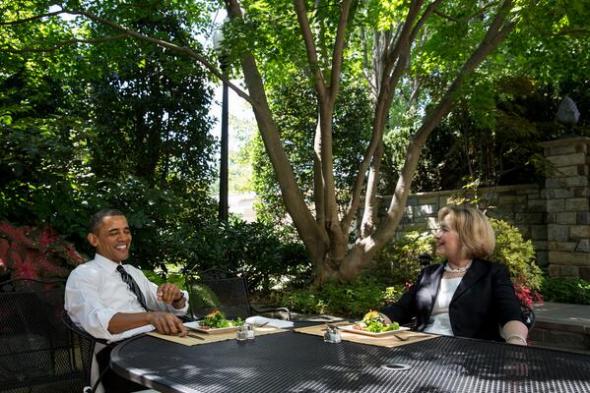
Barack Obama and Hillary Clinton have lunch at the White House, July 29, 2013
Good Afternoon!!
Tongues are wagging in Washington over President Obama inviting Hillary Clinton to lunch today. The White House announced that “the purpose of the lunch is chiefly social,” but pundits suspect the two may have been discussing Hillary’s possible run for president in 2016.
The New York Times speculated:
Hillary Rodham Clinton has walked the halls of the White House as the first lady, a senator and the secretary of state. On Monday, she is returning as a former diplomat — who might just want one more job.
Mrs. Clinton is back at 1600 Pennsylvania Avenue for a private lunch with President Obama, a meeting that the White House said was decidedly closed to the press.
Given Mrs. Clinton’s last job and the turmoil around the world, it seems likely that the two will talk about the situation in Egypt, the emerging peace talks in the Middle East and the diplomatic battle over Edward J. Snowden, the fugitive American intelligence contractor.
But it is possible they may chat about politics as well, in particular whether Mrs. Clinton will run for president again in 2016.
NBC News emphasized the President and former Secretary of State’s close friendship as the reason for today’s get-together.
The two Democrats and former rivals met for lunch Monday in a private dining room at the White House, spawning a frenzy of predictable media speculation about whether they might be putting their heads together about Clinton’s much-rumored 2016 run.
White House spokesman Josh Earnest told reporters at a daily briefing that the meal is simply a chance for the two pols to pal around.
“Over the course of the last four years … Secretary Clinton and the president have developed not just a strong working relationship, but also a genuine friendship,” he said. “And so, it’s largely friendship that’s on the agenda for the lunch today. So it’s not a working lunch as much as it is an opportunity for the two, who saw each other on a pretty frequent basis for the past four years, to get a chance to catch up.”

Hillary Clinton arrives for lunch at the White House, July 29, 2013.
The Christian Science Monitor offers more detailed speculation about what the two may have discussed over their “grilled chicken, pasta jambalaya and salad.” CSM’s Linda Feldman offers three theories:
First, Obama could be giving Clinton input on her future political plans.
How can Mr. Obama help her decide? He can bring her up to speed on what presidential politics are like in the age of 24/7 social media – already a factor in 2007 and 2008, but not like today – and 24/7 political coverage. Remember, Politico launched on Jan. 23, 2007, just three days after Clinton announced she was forming an exploratory committee for a presidential campaign. Now Politico (and BuzzFeed and all the other new politically obsessed sites) is a force to be reckoned with. No tidbit is too small.
Second, maybe Obama wanted to pick Clinton’s brain on foreign policy.
Obama certainly has a full plate, and Clinton can obviously speak knowledgeably about the range of issues he faces – Egypt, Syria, Russia, Edward Snowden, the Keystone XL pipeline, the Israeli-Palestinian peace talks that begin in Washington Monday evening. John Kerry, of course, is now Obama’s secretary of State, and Clinton’s task as a “former” is to be quiet and let the new guy do his job. Thus a closed-press lunch meeting is the perfect forum for discussion, away from the cameras.
One more topic on foreign policy: The issue of Benghazi – the Sept. 11, 2012, attack on US diplomatic facilities in the Libyan city that left four Americans dead, including the ambassador – is still a thorn in Obama’s side. And it happened on Clinton’s watch, making it fodder for political opponents in a second Clinton presidential campaign.
Third, maybe they just wanted to hang out.
To paraphrase Sigmund Freud, sometimes a lunch is just a lunch. Maybe it’s just two friends breaking bread together, catching up on how they and their families are doing. Obama’s daughters are growing up – Malia is a teenager, and Sasha is almost there – and Clinton has experience raising a teenage girl in the White House. How did the Clintons handle all the normal teen issues – clothes, makeup, boys, parties, driving?
What do you think they talked about? This is an open thread, of course.
A few more headlines that might catch your fancy:
LA Times: FBI raids rescue 105 teens who were forced into prostitution (Catching criminals like this involves {Gasp!} electronic surveillance!)
CBS News: Verdict near in Bradley Manning trial–judge could decide by Tuesday.
CBC News: Pope Francis says he won’t judge gays–but homosexual acts are sinful, and women can’t be priests because Jesus’ apostles were men. Except for Mary Magdalene, who was erased by the church hierarchy way back when. And of course women are still baby machines.
USA Today reports on another horrible train crash in Europe–this time in Switzerland.
The Guardian reports on another Chinese factory producing Apple products. Conditions for 70,000 workers at Pegatron plants allegedly worse than those reported in the Foxconn scandal
Monday Reads
Posted: July 29, 2013 Filed under: morning reads | Tags: economic insecurity, inequality of opportunity, racial resentment among whites, voting patterns, voting rights 36 CommentsGood Morning!
Damn! Is it hot down here!
Anyway, it’s really hard to get up the ambition to do much of anything and I have a huge long list of stuff to do. A lot of it has to do with my house that I have let get seriously out of control over the past year. I can no longer say, wow, the dissertation comes first. No excuses! I have to throw stuff out before the Hoarders TV series shows up at my door!
So, it is again a matter of looking at the same old stories over and over. Our government is really not getting much done. One of the stories that is so very important is how we deal with the serious threat to voting rights in much of the country coupled with the SCOTUS decision. Why is Texas at the center of every battle for modernity?
In a federal lawsuit first brought by black and Hispanic voters against Texas over its redistricting maps, the Justice Department relied on a rarely used provision of the act, Section 3, to ask a federal court to require Texas to get permission before making any voting changes in the state.
Until last month, Texas already had to get such permission under the act’s “preclearance” process. This process had long been the most effective means of preventing racial bias in voting laws in states with histories of discrimination. It required state and local governments that wanted to change the laws to first show there would be no discriminatory effect. In Shelby County v. Holder, the Supreme Court struck down Section 4 of the act as unconstitutional; that provision laid out the formula that determined which jurisdictions had to get permission.
In theory, the court’s ruling allows Congress to update the list of nine states and parts of six others identified by Section 4. But given the dysfunction of Congress, that will not happen anytime soon.
This is why Mr. Holder’s decision to rely on Section 3 in the Texas case is so significant. Section 3 — also known as the “bail-in” provision — may be the most promising tool we have to protect voting rights after Shelby. It allows courts to identify jurisdictions that are passing intentionally discriminatory voting laws and then “bail” them in as needed — that is, require them to get permission before establishing new voting rules.
This is functionally similar to the system the court struck down last month, but Section 3 has several distinguishing features. It does not contain a preset list of jurisdictions, and it is forward-looking: instead of relying primarily on historical evidence of discrimination, it allows individual voters or the government to ask courts to zero in on any jurisdiction, like Texas, that continues to try to impose racially discriminatory voting laws.
Section 3 is also flexible. The period of coverage for preclearance under Section 3 is determined by court order, and may last for only as long as a federal judge deems it necessary to overcome voting discrimination in that jurisdiction.
These features make Section 3 a useful provision, but it has its weaknesses. The preclearance may be imposed only if a federal judge determines that the jurisdiction’s laws are intentionally discriminatory. When the Voting Rights Act was passed, such laws were much easier to identify. But lawmakers have since discovered countless ways to discriminate on the basis of race without saying so explicitly, and will continue to do so.
In the Texas case, a Federal District Court in Washington found that state redistricting maps showed intentional discrimination — among other things, black and Hispanic lawmakers were excluded from the map-drawing process, and districts were drawn to minimize the power of minority voters in ways that “could not have happened by accident,” including one district shaped like a lightning bolt. While the Texas record is full of clear evidence of discriminatory intent, in most places such a claim is harder to show. To address that problem, the Congressional Black Caucus has called for Section 3 to be amended to apply to voting laws that have a discriminatory effect, whether or not intent can be proved. If Congress
is serious about protecting voting rights, it should pass this amendment immediately.
So,this should be nothing new to any one that isn’t part of the bonus class. Economic insecurity in the US is rampant. It also shouldn’t be too surprising that this is fueling some of the issues we have with racial resentment and the demand to restrict voting access.
The AP is out with a big analysis today about how the American economy is increasingly delivering security and prosperity to only a tiny fraction of the population:
Four out of 5 U.S. adults struggle with joblessness, near poverty or reliance on welfare for at least parts of their lives, a sign of deteriorating economic security and an elusive American dream…
Hardship is particularly on the rise among whites, based on several measures. Pessimism among that racial group about their families’ economic futures has climbed to the highest point since at least 1987. In the most recent AP-GfK poll, 63 percent of whites called the economy “poor.”And here’s their working definition:
The gauge defines “economic insecurity” as a year or more of periodic joblessness, reliance on government aid such as food stamps or income below 150 percent of the poverty line. Measured across all races, the risk of economic insecurity rises to 79 percent.Probably the most striking finding here is just how many poor whites are out there:
Sometimes termed “the invisible poor” by demographers, lower-income whites are generally dispersed in suburbs as well as small rural towns, where more than 60 percent of the poor are white. Concentrated in Appalachia in the East, they are also numerous in the industrial Midwest and spread across America’s heartland, from Missouri, Arkansas and Oklahoma up through the Great Plains.
More than 19 million whites fall below the poverty line of $23,021 for a family of four, accounting for more than 41 percent of the nation’s destitute, nearly double the number of poor blacks.It’s probably fair to say also that poor whites are overwhelmingly Republican, and in large part due to an overhang of racial resentment. After all, the New Deal coalition between poor Southern whites and rich urban liberals was built on racist oppression.
The interesting thing about this particular analysis in the WM is that it is still surprising these folks identify primarily as Republicans. A lot of it has to do with racial resentment. However, here is an additional link you may want to check out.
It’s patronising in the extreme to assume that poorer white people don’t understand that. I may disagree with their decisions to vote on issues like abortion and gay marriage, but it’s a different thing entirely to suggest that when they prioritise those things it’s because they don’t know what’s best for them. Paradoxically, given that this argument comes from liberals, it is underpinned by an insistence not that they be less selfish, but more.
Secondly, if they were voting on economic issues alone, that might be a reason not to vote Republican but it’s not necessarily a reason to vote Democrat. With unemployment still about 8%, many of the benefits of healthcare reform still to kick in and bankers still running amok, it’s not like Democrats are offering much that would support the economic interests of the poor, regardless of their race. It was Bill Clinton who cut welfare, introduced the North American Free Trade Agreement andrepealed the Glass-Steagall Act – which helped make the recent crisis possible. If you were going to trade your religious beliefs for economic gain, you could be forgiven for demanding a better deal than that.
Indeed, the people most likely to have voted Democrat four years ago – the young, the black and Latinos – are among the groups that have fared worse under Obama. And all the polls suggest they’re about to do it again, albeit in lesser numbers. One could just as easily argue that they are the dupes. Democrats have no god-given right to the votes of the poor of any race and for the past 30 years can hardly claim to have earned them.
In a country where class politics and class organisations are weak, it’s too easy to dump on the white working class as a bunch of know-nothings when the problem is a political class that is a bunch of do-nothings.
We may be finding some silence of the jerks on Cumulus anyway. Here are two of the biggest red meat providers of racial resentment and homophobia and misogyny in US culture right now.
In a major shakeup for the radio industry, Cumulus Media, the second-biggest broadcaster in the country, is planning to drop both Rush Limbaugh and Sean Hannity from its stations at the end of the year, an industry source told POLITICO on Sunday.
Cumulus has decided that it will not renew its contracts with either host, the source said, a move that would remove the two most highly rated conservative talk personalities from more than 40 Cumulus channels in major markets.
Okay, for those of you that like a real life spy adventure, try this: “This CIA Operative Indicted for Extraordinary Renditions Vanished from the Map—Twice. After years in absentia, poof! Robert Seldon Lady, convicted of kidnapping by Italy, reappeared out of nowhere. Then he was gone again.”
Recently, Lady proved a one-day wonder. After years in absentia — poof! He reappeared out of nowhere on the border between Panama and Costa Rica, and made the news when Panamanian officials took him into custody on an Interpol warrant. The CIA’s station chief in Milan back in 2003, he had achieved brief notoriety for overseeing a la dolce vita version of extraordinary rendition as part of Washington’s Global War on Terror. His colleagues kidnapped Hassan Mustafa Osama Nasr, a radical Muslim cleric and terror suspect, off the streets of Milan, and rendered him via U.S. airbases in Italy and Germany to the torture chambers of Hosni Mubarak’s Egypt. Lady evidently rode shotgun on that transfer.
His Agency associates proved to be the crew that couldn’t spook straight. They left behind such a traceable trail of five-star-hotel and restaurant bills, charges on false credit cards, and unencrypted cell phone calls that the Italian governmenttracked them down, identified them, and charged 23 of them, Lady included, with kidnapping.
Here’s one more story about how inequality of opportunity begins at birth.
Equality of opportunity means that we are not a caste society. Who we will become is not fixed by the circumstances of our births. Some children will do better than others, but this should result from a fair competition. Nearly every American politician espouses a commitment to equality of opportunity. For example, Majority Leader Eric Cantor wrote yesterday that
We must continue to fight for equal opportunity to a quality education for all children.
I wouldn’t be surprised if many American politicians said the same thing yesterday.
But we don’t appreciate how deep inequality runs. The graph below is from a presentation by Angus Deaton which (I believe) reported data from the National Health Interview Survey. The horizontal axis is the logarithm of family income in 1982 dollars, running from about $3600 to over $80,000. The vertical axis is self-reported ill-health (higher numbers reflect worse health). The parallel lines represent different age groups of respondents.
There are three important facts packed into this slide. First, the lines stack up in order of increasing age, meaning that older people reported worse health than younger people. Second, all the lines slope downward, meaning that the poorer you were, the more likely you had poor health.
These facts are unsurprising, until you notice how powerful the income effect is. The leftmost point of the youngest (turquoise) line is above the rightmost point of the oldest (purple) line. This means that the poorest teenagers reported themselves as less healthy than rich middle-aged people.
Lastly, notice how the age lines are much more dispersed on the left (poorest) side of the graph than the right (richest) side of the graph. This means that health deteriorates more quickly with age among the poor than among the rich.
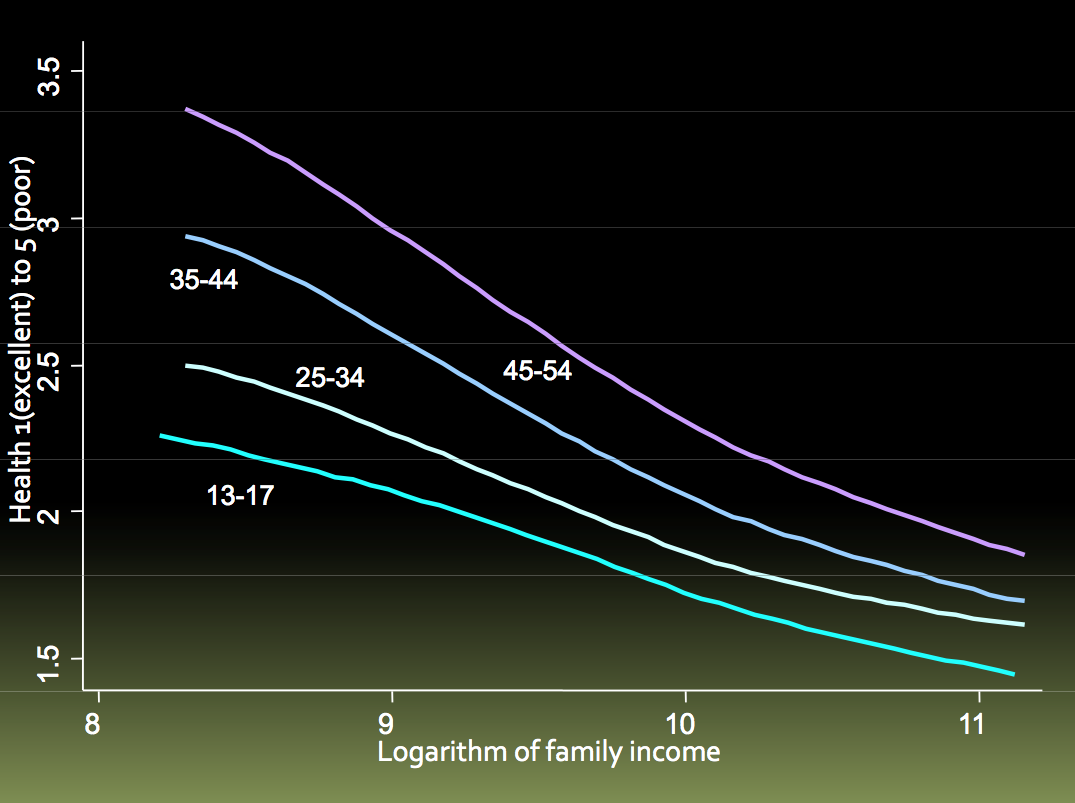
Just in case you aren’t used to the idea of using the log of things, it represents a growth rate. It’s basically a percentage change in thing over time so it’s a dynamic measurement of what ever is being measured.

Well, that is longer than I thought! So, what’s on your reading and blogging list today? Oh, and as usual, let’s play guess the celebrities and the singular location!!!!
Saturday: Late Lunch Reads
Posted: July 27, 2013 Filed under: just because | Tags: feminism, hillary2016 20 Comments Good afternoon, newsjunkies.
By late lunch, I really mean a) I’m eating from a box of Annie’s Homegrown cheddar bunnies, and b) this time last week, JJ aka Minkoff Minx and I were happily squished together in a restaurant booth in Atlanta waiting for our sandwiches to come out (which took forever to do so; I think this was the universe giving us more time together…)
JJ had an even bigger heart in person than I already thought she would–somewhat an impossible feat. I can only hope know this is just the start of many more Sky Dancer luncheons and meetups and such! (How does a Winter 2013 Sky Dancers convention sound, y’all? Or, maybe Spring Break 2014?)
The entire conversation last Saturday afternoon was such a blast, between JJ’s mama, her daughter Bebe, my younger sister Megan, and the two of us.
At one point, in my typical absentminded and inarticulate fashion, I stumbled trying to explain that we feminists hold our movement to a standard that I don’t think other social justice movements (of which I consider myself a member!) necessarily do. We struggle to find the perfect hypothetical woman to carry out all our diverse views on womanhood–when really all we need is a woman who lives her choices in action, and supports the choices of others. (Y’all know what comes next…drumroll please…)
Hillary 2016!
Anyhow, here are a few ‘easy-over’ links for you to graze on while you peruse the net this afternoon…
First up, if you haven’t seen it yet, Maxipad-gate: Now I Know Exactly How To Talk To Dudes About Periods! [via Upworthy]
I’m just going to excerpt here:
So this guy watched a maxipad commercial and thought that periods were the best time EVER in a woman’s life. Then, he found out that wasn’t true. So naturally, he took to Facebook and expressed his thoughts, which you can see below.
Then, the (fictional) CEO of Bodyform decided to respond to his unfortunate misunderstanding of the way the human body works.

Here’s the “Bodyform CEO” response:
Sardonic awesomeness, right? When I saw it, I just knew I had to post it here. Apologies if it’s a repeat of anything posted on the frontpage or the comments already. I’m still all tortoise-like slowly but surely catching up on last week and this week at Sky Dancing. So I should probably stipulate that this disclaimer applies to all my links 🙂
Next up, an -interesting- read via New Zealands “stuff.co.nz” network of publications, in which Rosemary McLeod examines the last fifty years of feminism after Betty Friedan’s The Feminine Mystique: What women wanted – and what they got.
I’m going to tease you a tiny snippet and withhold my opinions of the piece for a moment so I can hear some unvarnished feedback from y’all. I really hope you take the time to read it in its entirety and comment below if you have the chance this weekend–as ever, I look forward to hearing what Sky Dancers have to say on this topic!
Teaser, just to give you a taste:
THE POWER STRUCTURE
In 1963 there was no Ministry of Women’s Affairs.
QUESTION: What does the Ministry of Women’s Affairs do?
MORE QUESTIONS:
• What would Betty Friedan make of Madonna, Tracey Emin and Lady Gaga?
• Would she have enjoyed Stieg Larsson’s The Girl With the Dragon Tattoo, or Quentin Tarantino’s Kill Bill?
• If she were young today would she have a pierced nipple/clitoris/tongue?
• What would her tattoo be, and where would she have it?
• Where did suburban neurosis go?
• Why are twice as many women as men currently on antidepressants?
• Why do three times as many men as women commit suicide?
• How are university women’s studies courses faring?
And, finally–a Hillary-bite! NBC to air Hillary Clinton miniseries [via Gary Levin in USA Today]:
Diane Lane will star, and the action will begin in 1998.
(Photo: Justin Sullivan, Getty Images)Story Highlights
- Hillary miniseries is one of several planned by NBC
- Diane Lane will star
- NBC expects to air it before her presidential candidacy is formally announced
As Hillary Clinton is widely expected to make a second presidential run in 2016, NBC is planning a sure-to-be-controversial miniseries about the former first lady and secretary of State.
Diane Lane (Unfaithful) will star in the project, which has yet to cast an actor to play the former president. But it will begin in 1998, midway through Bill Clinton’s second term, when the Monica Lewinsky sex scandal engulfed the family.
Courtney Hunt (Frozen River) will write and direct the four-hour project.
Will NBC run afoul of campaign laws that require equal time for presidential candidates? Not if the network gets the project on in a hurry.
“She’s not going to probably declare her candidacy for two more years,” NBC Entertainment chairman Robert Greenblatt said, “so this could well have aired before that.”

Oh wow! This reminds me of Obama and the West Wing storyline that preceded his election. Oh WOW. I’m kind of gathering my thoughts here on this, so…
I’m going to turn the comment sections over to y’all. Have at it!

 peej
peej Carissa
 bostonboomer
 dakinikat
 ecocatwoman
 mablue2
 Mama Lopez
 peggysue22
 quixote
 skydancingguestblogger
 Mona (aka Wonk the Vote)



 Sky Dancing
Recent Comments