
Thursday Reads
Posted: June 20, 2013 Filed under: Barack Obama, FBI, Foreign Affairs, Germany, misogyny, morning reads, religion, Russia, U.S. Economy, U.S. Politics, War on Women, Women's Rights | Tags: Angela Merkel, austerity, Cristina Torre, Dillin Miller, domestic violence, gender stereotypes, Ibragim Todashev, John F. Kennedy, nuclear weapons, Rep. Phil Gingrey, Richard DesLauriers, Spanking for Jesus movement, Vladimir Putin 18 Comments
Good Morning!!
I haven’t really been paying much attention, but I guess President Obama’s trip to Europe didn’t go that well. I accidentally heard part of his Berlin speech, because I fell asleep with the radio on and woke up listening to a rebroadcast of it. I didn’t get much out of it, but it seemed as if Obama was lecturing Angela Merkel about her austerity obsession. The trouble is that Obama has pushed and/or allowed a milder version of austerity here, and he is doing much to lead us out of our own economic doldrums. Here are a couple of reports of the trip.
The National Journal’s Michael Hirsch: Obama’s Turbulent European Vacation
What was it, exactly, about Obama’s controversy-marred trip to Germany and the G8 Summit in Northern Ireland that fell so flat? Ummm, how about … everything?
There were the snarky words from Vladimir Putin, who expressed an almost Soviet-esque distance from Washington in his views about Syria. “Of course our opinions do not coincide,” the Russian leader said bluntly. There was the coded warning from Chancellor Angela Merkel about spying on friends, and her and Obama’s continuing frostiness over the issue of economic stimulus versus austerity. Above all, there was Obama’s vague attempt at the Brandenburg Gate to capture some wisp of his past glory by pledging vague plans to cut nuclear arms and an even vaguer concept of “peace with justice.”
The “peace with justice” line was a quote from John F. Kennedy, Obama’s attempt to steal just a little of JFK’s thunder from 50 years before. He didn’t come away with much, winning just a smattering of applause from a crowd that was one one-hundredth the size of JFK’s. A crowd that, at about 4,500, was also much, much smaller than Obama drew as a candidate in 2008.
Not only is the honeymoon long over, folks. The marriage is becoming deeply troubled and, increasingly, loveless.
The contrast with President John F. Kennedy’s famous “Ich bin ein Berliner” couldn’t have been more stark.
And from Jim Kuhnhenn of the AP: Obama prods, gets share of pushback
In Berlin on Wednesday, Obama warned that the European Union could “lose a generation” if it doesn’t adjust its economic policies to tackle high youth unemployment. German Chancellor Angela Merkel, who has argued for debt-ridden eurozone countries to first deal with their fiscal problems, insisted her government was committed to helping its European partners in the crisis-hit nations. “If we were conducting policies that would harm other countries,” she argued, “we would harm ourselves.”
Wow. Is she in denial or what? All her austerity policies have done his harm other European countries. In any case, she wasn’t thrilled with Obama’s critique.
She countered with her own words of caution over the Obama administration’s secret collection of phone records and surveillance of foreign Internet traffic. “People have concerns, precisely concerns that there may be some kind of blanket, across-the-board gathering of information,” she said. “There needs to be proportionality” between security and freedom, she added, and made clear that her private talks about it with Obama were not the end of the subject.
It was a polite punch-counterpunch between vital allies — an exchange that won’t damage a strong relationship. But it illustrated how in a 21st century world order, Western powers are not beholden to the United States as they once were and Obama’s ability to find agreement or build consensus is often limited and regularly tested.
And there was the talk of peace and reducing nuclear weapons.
The centerpiece of Obama’s visit to Berlin was a speech at the historic Brandenburg Gate, once a symbol of the Cold War, where he called for negotiations with the Russians to reduce U.S. nuclear weapons by one-third and called for cutting the number of tactical warheads in Europe. “Peace with justice means pursuing the security of a world without nuclear weapons, no matter how distant that dream may be,” he said.
The words were barely out of his mouth when a Republican member of the House Armed Services Committee, Ohio Rep. Michael Turner, accused him of appeasement, and Russian officials were playing down Obama’s proposal. A foreign policy aide to President Vladimir Putin said any further arms reduction would have to involve countries other than just Russia and the United States.
All in all, not a very successful trip.
To be honest, I get the feeling that Obama is already a lame duck. He doesn’t seem to be able to focus his attention on an issue long enough to get anything accomplished. I understand that Congress is really the biggest problem, but looking back to past Democratic presidents, Obama seems so passive in comparison. It’s very discouraging. I have to wonder why he worked so hard to get reelected. He seems to enjoy the ceremonial aspects of the job, but not the nuts and bolts.
Please someone, convince me I’m wrong. I do not want to end up with a Republican president and Republican majorities in Congress in 2016. I do not want the government led by troglodytes like Georgia Rep. Phil Gingrey, who wants children to learn stereotypical gender roles “at a very early age.” From Think Progress:
Rep. Phil Gingrey (R-GA) wants American youths to be taught gender stereotypes in grade school classes, so they understand the roles of mothers and fathers — and the importance of allowing only opposite-sex couples to marry.
In a speech Monday on the House floor, Gingrey stressed his continued support for the Defense of Marriage Act — which defines marriage as only union between a man and a woman — and suggested that children need to be carefully taught about the traditional roles of their genders:
GINGREY: You know, maybe part of the problem is we need to go back into the schools at a very early age, maybe at the grade school level, and have a class for the young girls and have a class for the young boys and say, you know, this is what’s important. This is what a father does that is maybe a little different, maybe a little bit better than the talents that a mom has in a certain area. And the same thing for the young girls, that, you know, this is what a mom does, and this is what is important from the standpoint of that union which we call marriage.”
Watch if you dare.
And then there’s the “Spanking for Jesus movement.” Yes, you read that right. From The Daily Beast:
You don’t have to be a Christian to practice domestic discipline, although many of its practitioners say they believe that domestic discipline goes hand in hand with their faith. Specifics of the practice vary by couple, though CDDers all seem to follow a few basic principles. Foremost, that the Bible commands a husband to be the head of the household, and the wife must submit to him, in every way, or face painful chastisement.
When a wife breaks her husband’s rules—rolling her eyes, maybe, or just feeling “meh,” as one blogger put it—that can equal punishments which are often corporal but can also be “corner time”; writing lines (think “I will not disobey my master” 1,000 times); losing a privilege like internet access; or being “humbled” by some sort of nude humiliation. Some practice “maintenance spanking,” wherein good girls are slapped on a schedule to remind them who’s boss; some don’t. Some couples keep the lifestyle from their children; others, like CDD blogger Stormy, don’t. “Not only does he spank me with no questions asked for disrespect or attitude in front of them, but I am also required to make an apology to each of them,” she writes.
Now that should teach those kids some useful gender stereotypes. There’s much more sickening detail at the The Daily Beast link and at Jezebel.
Oh well, here’s a story from the NY Daily News about something a little more cheerful: Joe Torre’s daughter Cristina saves falling baby with perfect catch.
Cristina Torre, 44, said she was sipping coffee outside Little Cupcake Bake Shop on Third Ave. in Bay Ridge when several bystanders spotted little Dillin Miller dangling from the awning of a frozen yogurt shop next door at about 10 a.m.
“He looked like he was balancing on one of the railings,” Torre told the Daily News. “I didn’t really know what was going to happen. . . . You just move into action — you don’t really think about it.”
Torre said she tried to tell the baby, dressed in a white onesie, not to move as another bystander called 911.
“I’m talking to him saying, ‘Don’t come down, stay there.’ . . . He helped himself with his arms. He was dangling. I knew he would be flipping very soon,” she said.
The baby dropped — and Torre made the life-saving grab.
“He literally landed in my arms,” she said. “It was a relief. I’m just glad he was safe.”
Sadly, the child’s parents were discovered asleep in their apartment while their 1-year-old Dillin and his three siblings ages 2, 3, and 5 were on their own. The children were removed from the home and the parents were charged with reckless endangerment. At least those kid are safe for the moment.
There hasn’t been much new on the aftermath of the Boston bombing lately. Every day I check to see if there is any news on the FBI shooting of Ibragim Todashev in Florida. The resignation of Richard DesLauriers, the director of the Boston office of the FBI was probably related to the series of f&ck-ups by the FBI in not informing local officials of the previous investigation of Tamerlan Tsarnaev and then the shooting of Todashev, but other than that, the FBI has been mum.
But on Tuesday, The New York Times published an article on the FBI’s “faultless” history–not a single misstep found in 150 FBI internal investigations over 20 years!
After contradictory stories emerged about an F.B.I. agent’s killing last month of a Chechen man in Orlando, Fla., who was being questioned over ties to the Boston Marathon bombing suspects, the bureau reassured the public that it would clear up the murky episode.
But if such internal investigations are time-tested, their outcomes are also predictable: from 1993 to early 2011, F.B.I. agents fatally shot about 70 “subjects” and wounded about 80 others — and every one of those episodes was deemed justified, according to interviews and internal F.B.I. records obtained by The New York Times through a Freedom of Information Act lawsuit.
The last two years have followed the same pattern: an F.B.I. spokesman said that since 2011, there had been no findings of improper intentional shootings.
In most of the shootings, the F.B.I.’s internal investigation was the only official inquiry. In the Orlando case, for example, there have been conflicting accounts about basic facts like whether the Chechen man, Ibragim Todashev, attacked an agent with a knife, was unarmed or was brandishing a metal pole. But Orlando homicide detectives are not independently investigating what happened.
“We had nothing to do with it,” said Sgt. Jim Young, an Orlando police spokesman. “It’s a federal matter, and we’re deferring everything to the F.B.I.”
Why doesn’t the Justice Department’s civil rights division investigate? Here is something President Obama could lead on without Congress blocking him. He could easily tell Attorney General Holder to appoint an independent investigation. But he probably won’t.
Okay, that’s my contribution for today. Now it’s your turn. What stories have captured your interest today? Please share your links in the comment thread.
Tuesday Reads: Dreaming a Life; Obama and Putin; NSA and Snowden
Posted: June 18, 2013 Filed under: Barack Obama, Foreign Affairs, Great Britain, morning reads, NSA, National Security Agency, Real Life Horror, Russia, Syria, U.S. Politics | Tags: Carol Morley, Charles Pierce, checks and balances, Dick Cheney, Dreams of a Life, Edward Snowden, FISA court, G-8 summit, Glenn Greenwald, John Aravosis, Joyce Carol Vincent, leakers, mysterious deaths, Richard Nixon, Vladimir Putin, whistleblowers 29 Comments
Good Morning!!
I’m going to begin with an article I came across yesterday while reading the Guardian. It’s about a story from 2006 that I remembered and sometimes think about–a woman whose skeletonized body was found in her apartment three years after she died.
On 25 January 2006, officials from a north London housing association repossessing a bedsit in Wood Green owing to rent arrears made a grim discovery. Lying on the sofa was the skeleton of a 38-year-old woman who had been dead for almost three years. In a corner of the room the television set was still on, tuned to BBC1, and a small pile of unopened Christmas presents lay on the floor. Washing up was heaped in the kitchen sink and a mountain of post lay behind the front door. Food in the refrigerator was marked with 2003 expiry dates. The dead woman’s body was so badly decomposed it could only be identified by comparing dental records with an old holiday photograph of her smiling. Her name was revealed to be Joyce Carol Vincent.

Joyce Carol Vincent
How could such a thing happen? So often we hear sad stories like this and never get any answers to our questions. In this case, filmmaker Carol Morley decided to find out who Joyce Carol Vincent was, and she has made a documentary about her quest called Dreams of a Life. She writes:
In a city such as London, home to 8 million people, how could someone’s absence go unnoticed for so long? Who was Joyce Vincent? What was she like? How could she have been forgotten?
News of Joyce’s death quickly made it into the global media, which registered shock at the lack of community spirit in the UK. The story ran on in the British press, but still no photograph of Joyce appeared and little personal information.
Soon Joyce dropped out of the news. I watched as people discussed her in internet chatrooms, wondering if she was an urban myth, or talking about her as though she never mattered, calling her a couch potato, and posting comments such as: “What’s really sad is no one noticed she was missing – must have been one miserable bitch.” And then even that kind of commentary vanished.
But I couldn’t let go. I didn’t want her to be forgotten. I decided I must make a film about her.
She began by placing advertisements in newspapers asking anyone who knew Joyce to come forward. It turned out that Joyce had lots of friends over the years. She had been engaged to be married before she died, and she had also spent some time in a battered women’s shelter. Eventually, Morley was able to talk to many people who had known Joyce. She describes her journey in the Guardian article. It’s an amazing story, and I hope you’ll go read the whole thing.
Follow me below the fold for some news and opinion…
Monday Reads: Some Populist Pokes at the Eyes of the Privileged
Posted: June 17, 2013 Filed under: morning reads | Tags: corporate corruption, environmental destruction, reprouductive rights, right to privacy 51 CommentsGood Morning!
I thought I’d take a few looks at what should be done differently in this country if we indeed we’re interested in progressing as an entire nation. It seems these days the only folks that progress are the politicians and their owners. So, hold on here, we go.
Why is no one calling for an investigation of Booze Allen Hamilton?
Booz Allen reacted with anger in a press statement released hours later:
“News reports that this individual has claimed to have leaked classified information are shocking, and if accurate, this action represents a grave violation of the code of conduct and core values of our firm.”
Core values? Let’s examine Booz Allen Hamilton’s track record.
In February 2012, the US air force suspended Booz Allen from seeking government contracts after it discovered that Joselito Meneses, a former deputy chief of information technology for the air force, had given Booz Allen a hard drive with confidential information about a competitor’s contracting on the first day that he went to work for the company in San Antonio, Texas. US air force legal counsel concluded (pdf):
“Booz Allen did not uncover indications and signals of broader systemic ethical issues within the firm. These events caused the air force to have serious concerns regarding the responsibility of Booz Allen, specifically, its San Antonio office, including its business integrity and honesty, compliance with government contracting requirements, and the adequacy of its ethics program.”
It should be noted that Booz Allen reacted swiftly to the government investigation of the conflict of interest. In April that year, the air force lifted the suspension – but only after Booz Allen had accepted responsibility for the incident and fired Meneses, as well as agreeing to pay the air force $65,000 and reinforce the firm’s ethics policy.
Not everybody was convinced about the new regime. “Unethical behavior brought on by the revolving door created problems for Booz Allen, but now the revolving door may have come to the rescue,” wrote Scott Amey of the Project on Government Oversight, noting that Meneses was not the only former air force officer who had subsequently become an executive in Booz Allen’s San Antonio office.
So, corruption is rampant in these organizations that only exist to expand government destruction of civil liberties. But, let’s not forget that a lot of these organizations also are responsible for our economic bad health. Rampant corruption is part and parcel of the financial industry. As our ability and desire to produce real stuff has fallen, so our national experience shows we have gambling houses for financial institutions eager for extraordinary returns. And, it’s all for profits of a few.
This reminds us of something I fear is often forgotten – that our economic troubles did not begin with the financial crisis of 2007-08 but rather pre-dated them.
My chart shows this. It shows that firms were loath to invest long before the crisis. Capital spending fell relative to retained profits in the early 00s and stayed very low by historical standards. This reflects the “dearth of domestic investment opportunities” in western economies of which Ben Bernanke spoke in 2005. This is, of course, a cause of the weak income growth of which the IFS speaks; firms’ reluctance to spend held down wage and employment growth. The “Great Moderation” might have led to irrational exuberance in financial markets, but it certainly did not unleash a boom in corporate animal spirits and real investment.
In fact, one could argue – as Ravi Jagannathan has (pdf) – that the financial crisis is not the cause of our woes but rather a symptom of this underlying problem. The story goes something like this.
After 1997, Asian economies wanted to run big current account surpluses, either as a policy of export-led growth or in order to rebuild reserves depleted by the 97 crisis. By definition, this meant they were net savers, which put incipient downward pressure upon global interest rates. In a parallel universe, these high savings might have financed a boom in real capital spending in the west. But because firms couldn’t see good investment opportunities, this didn’t happen.Instead, the lower interest rates fuelled a housing boom and the hunt for yield led to strong demand for mortgage derivatives. These bubbles in housing and derivatives then burst, giving us the crisis.
In this way, we’ve seen what Marx saw in the 19th century – that a lack of profitable opportunities in the real economy pushes people down “the adventurous road of speculation, credit frauds, stock swindles, and crises.”
Our state is a pretty good example of what happens to people and the natural environment if the only driving force in a decision is profit of the owners. Here’s some information on the chemical plant explosions we recently experienced near the place I taught for a few years during grad school.
Back-to-back explosions at chemical plants only miles apart along the Mississippi River have given pause to those who live in the shadows of America’s dirtiest industries.
On Thursday, an explosion at a chemical plant in Geismar, La., owned by Williams Cos. Inc. led to two deaths and injuries – some serious – to dozens of others. Then late Friday, another explosion at a chemical plant just a few miles away in Donaldsonville claimed one life and injured eight people after a nitrogen tank exploded during an offload.
“The incident involved the rupture of an inert nitrogen vessel during the off-loading of nitrogen,” a news release from the company, CF Industries, said. “There was no fire or chemical release nor is there any threat or hazard posed to the community.”
Hundreds of industrial plants, many that either produce or consume poisonous and explosive chemicals, line rivers and bayous throughout the South, but in few places as heavily as around New Orleans and the Mississippi River.
Some 311 chemical manufacturers employing 15,727 people currently exist in the parishes that line the Mississippi from Baton Rouge to its mouth. That number excludes the large numbers of oil refineries and plastics manufacturers in the area.
To be sure, locals welcome jobs that pay an average of more than $40,000 a year. But explosions like the ones that roiled the river this week remind many of the dangers, both to human life and the environment, such jobs bring.
In late 1996, the Tulane Environmental Law Clinic (the Clinic) took on representation of a community group called St. James Citizens for Jobs and the Environment in a controversial challenge to Shintech Inc.’s proposed construction of a polyvinyl chloride plant in Convent, Louisiana. After the U.S. Environmental Protection Agency (EPA) granted a petition to veto the Louisiana Department of Environmental Quality’s issuance of an air permit to Shintech,1 Shintech changed its plans and located a downsized facility elsewhere in Louisiana.2
The Shintech dispute sparked a national controversy, featured on national television news shows and, ultimately, in a cable-television movie called “Taking Back Our Town.”3 A common postscript to retellings of the Shintech story is a statement that the Clinic essentially paid for its contribution to St. James Citizens’ success with its life—suffering retaliatory restrictions that supposedly would prevent it from ever representing a group like St. James Citizens again.4 In fact, the Clinic has continued to represent St. James Citizens and similar clients and continues to enjoy its fair share of successes and to weather its share of defeats.5
We continue to have efforts to suppress protection of people, animals and environments from the abuse of the petro-chemical industry. They create huge costs to taxpayers, people and the environment, yet many governments refuse to ensure these costs are recoverable and the loss of life and natural gifts prevented.
No where has the suppression of so many by so few been felt than in the area of women’s health. No less than 300 bills have been introduced this year that restrict women’s access to birth control, abortion, and basic family planning and health care.
State legislatures across the country have enacted an avalanche of restrictions that deny women of their reproductive rights. Just this year alone, more than 300 anti-abortion measures have been introduced in the states — in direct violation of the Supreme Court’s decision in Roe v. Wade.
The anti-abortion legislation is an unprecedented assault on a woman’s right to make decisions about her body and health. At least 185 anti-abortion laws have been enacted since 2011, and the likelihood that more will be passed this year are very real.
“Half of pregnancies are unintended,” Elizabeth Nash told Lawyers.com. She is the state issues manager for the Guttmacher Institute. “Instead of trying to figure out why and preventing women from being put in the situation to need an abortion, we’re doing nothing but putting all these restrictions in place to make it harder to access services when they are needed.”
The laws are the result of the 2010 elections, when droves of conservative and tea party candidates were voted into the state legislatures. The result has been a surge of radical and unconstitutional laws that choke off reproductive rights.
For example:
- Eleven states have passed abortion bans, making it illegal to get an abortion at 20 weeks after fertilization, or as early as 12 weeks in Arkansas and six weeks in North Dakota. Women are often unaware they are pregnant within this time. Roe v. Wade provides a right to abortion up to 24-26 weeks, when the fetus is viable.
- Eight states have passed “personhood” laws, giving the zygote legal rights. These laws could make an abortion a crime — regardless of rape, incest or the life of the mother.
- Eight states require the doctor to give the woman false information, such as requiring doctors to tell women that having an abortion increases their risk of suicide. Scientific research refutes this claim.
- In 26 states, women are required to receive anti-abortion “counseling” followed by a waiting period before they’re allowed to undergo an abortion.
There is a pattern of increased control of individual rights and of usurping national assets in the name of corporate profits. It’s been systemically enshrined in law at all levels of government. It is hard to be complacent in the face of these assaults. We await this week the decision of the Supreme court on issues central to GLBT rights in this country. It seems there are few government institutions that aren’t corrupted by religious nuts, anti-science nuts, and profit-addicted corporations. Whatever happened to our rights?
What’s on your reading and blogging list today?
Saturday: Cassandra
Posted: June 15, 2013 Filed under: just because | Tags: cassandra, feminism, party of nobodies 53 Comments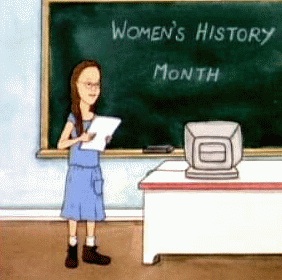
Cassandra, from the Beavis and Butt-head episode, “The History of Women”
Good afternoon, newsjunkies! Sorry for the delay with this morning’s reads. Had some technical issues (kept getting that spinny circle/hourglass thing–haven’t seen that in ages!)
Anyhow, let’s start off with a little HERstory, shall we?
From a neat little stanford.edu student website called “Mortal Women of the Trojan War”:
Hecuba, in Seneca’s play Troades, also compares herself to Cassandra:
Whatever misfortune occurs, and whatever harms the priestess of Apollo (Cassandra), raving, prophesied, the god (Apollo) prohibiting her to be believed, Hecuba, weighed with child (Paris), previously saw, nor did I keep my fear silent and before Cassandra I was the empty prophetess. Neither the cautious Ithacan (Odysseus) nor the nocturnal companion of the Ithacan (Diomedes) has scattered fire among you, nor the false Sinon. That fire is mine, by my torches you are burning.
And…
Today, June 15th, in 1895, Elinore Morehouse Herrick–the first woman (and seemingly only; still researching) appointed as a regional director of the NLRB–was born (emphasis in bold, mine):
As a divorced, 26-year-old mother, Herrick found herself supporting two boys on low wages. She accepted employment at DuPont’s rayon plant in Buffalo, New York, where she rose rapidly from pieceworker to training supervisor. In 1923, she moved south with the company, becoming production manager of its new factory in Tennessee. Under her direction the plant’s output equaled or exceeded those elsewhere, but knowing that she would not be promoted beyond her current level, Herrick moved her family to Ohio. There she attended Antioch College, financing studies in economics by running a boarding house with her mother’s help and taking part-time jobs. After her graduation in 1929, Herrick became executive secretary of the New York Consumers’ League, which monitored labor conditions for women in that state. While with the League, Herrick produced perceptive reports on female workers in canneries, laundries, and candy factories. When the Wagner Act of 1935 created the National Labor Relations Board, she was appointed regional director of the northeast district; the nation’s busiest, it handled twenty percent of all cases to come before the Board. Herrick’s negotiating skills led to the settlement of most disputes without litigation. During World War II, she became personnel director for Todd Shipyards and was responsible for integrating women and minorities into the wartime work force. Recognizing that the arrival of peace would force many women out of industrial jobs, she argued that society should maintain employment opportunities “for all who want to work or for all who must work irrespective of sex.” Her appeals went unheeded, however, as female workers were dismissed from wartime industries when veterans returned home. Herrick left Todd Shipyards to become personnel director for the New York Herald Tribune and continued writing on labor issues during the postwar era.
Here is a kickass image of her at Corbis, entitled “Portrait of Career Women at Tribute Dinner,” dated March 22, 1935. Please check it out. She’s the first person to the left on the front row. (It’s copyrighted or else I’d have included it here.)
And, here’s a PDF of “Why People Strike,” a piece penned by Herrick. Teaser:
Too much reliance has been placed on the ability of industry to govern itself, with the result that codes have been selfishly drawn with an eye toward pleasing selfish and dominant employer interests.
Well, would you look at the prescience on her!
THIS is what the insularity and hegemony of patriarchy does. It shuts out voices like Herrick’s from the center stage of the debate during their times and altogether whitewashes them from the history books pored through by any one other than an archery-goddess-witchy-woman feminist like myself.
Speaking of which… Here’s the iconography that speaks to me as such, photography by Henriette Milelke:
Click photo to view on FB at Henriette Mielke’s page in its full glory.

This gives me a perfect excuse to tell you that I find Henriette Mielke’s photography absolutely mesmerizing. I stumbled upon her work through the graces of facebook, and I haven’t been able to stop looking since! It’s erotic, evocative, and just somehow distinctly feels…feminist. I may be wrong in attributing that to her. I don’t know. But, something about these images of women…seems to be about women, from a women’s point of view. I urge you to click on over and check her work out and view and determine for yourself. I’m merely including that blockquoted image to pique your interest….there’s so much more double x energy from whence it came!
Alright, I’m just going to do the rest of this post in a link-a-palooza fashion:
- An update in the call for Justice for Marco McMillian, slain Clarksdale, MS mayoral candidate…as police there continue to bury their ostrich heads in the sand, Community demands answers from Department of Justice (emphasis in bold, mine):
Wearing Justice for Marco T-shirts, family and friends of the late Marc McMillian are demanding answers and justice.
The family’s attorney, Daryl Parks, said, “Somebody will explain the burn marks on his body; somebody has to explain the torture he went through.”
In late March, the openly gay former Clarksdale mayoral candidate was brutally murdered. The National Black Justice Coalition isn’t convinced the murder wasn’t a hate crime.
Sharon Luttman with the National Black Justice Coalition said, “Society allows it to be some sexual violence or miscommunication when he’s the one that was burned, that was dragged, that was stabbed. The autopsy report shows that.”
- Personally I think the following ad in question needs “MOAR ZEST,” what do y’all say?… Kraft Zesty Dressing Ad Offends ‘One Million Moms,’ Sparks Debate:
A new ad for Kraft Zesty Italian Dressing is a little too spicy for one group of “concerned” women.
A “let’s get zesty” ad showing a naked man with a strategically placed picnic blanket protecting his modesty allegedly ran as a print ad in a recent issue of People, causing conservative group “One Million Moms” to write a press release calling the ad “disgusting” and saying that the company has “gone too far.”

- Caturday pick of the week (well technically the past month, but I just stumbled upon it now): There is now a font made entirely of cats!
Are you a writer? Or maybe just an active Facebook and Twitter-er who misses the good old days of handwritten letters, before digital media destroyed our capacity to express human emotion with words? Either way, are you tired of waiting for all communication to move past the clunky words of generations past and finally metamorphose into the dancing cat GIFs that we all know and love?
Then boy, does the Internet have the thing for you. Meet Neko Font, a web app that will transform text into a new font made entirely out of cats. Well, pictures of cats, to be precise. All you have to do is insert the copy of your choice into the text box and Neko Font (Japanese for “cat font”) instantly hands it back in cat form.

- My goddess pick on spirituality/religion food for thought… a youtube making the circles right now thanks to Upworthy’s recent spotlight of it under the title, “Best Explanation Of Religion I Have Ever Heard, And I’m Practically An Atheist”:
Patty Murray arrived 20 years ago to a U.S. Senate whose “gentlemen” members had a convenient restroom just off the Senate floor, but not the six “gentle ladies.”
“We had to go upstairs and down a long hall,” Murray recalled on Wednesday.
Murray: “We had to go upstairs and down a long hall.”
As the old cigarette ad put it, you’ve come a long way, baby.
The Senate now has 20 women. “Gentle ladies” chair the Senate Appropriations Committee, the Senate Intelligence Committee, the Senate Agriculture Committee and the Senate Indian Affairs Committee. Murray is in the Democratic leadership.
And the “gentle ladies” of Congress’ upper chamber are getting a new, expanded bathroom. While it doesn’t have a glass ceiling, the new restroom will come complete with a window looking out from the U.S. Capitol.
A restroom was carved out of the off-the-floor men’s room, but it was small and cramped.
“It’s no longer convenient: There’s a line,” joked Murray.
Sen. Jeanne Shaheen, D-New Hampshire, excitedly tweeted on Wednesday that the commodious restroom is a “sign of change” in the U.S. Capitol. “It says we are at work and we require equal treatment,” Murray said.

Okay, I’m going to stop there because my computer just isn’t cooperating this weekend. But, I will say I’m reminded here of Rand Paul’s infamous toilet rant… *wink*
Anyhow, what’s on your reading list this weekend Sky Dancers? Please help me fill in the blanks of these abridged Saturday reads!
Friday Reads
Posted: June 14, 2013 Filed under: morning reads | Tags: free speech, homophobia, immigration, Marco Rubio, SCOTUS 32 Comments
Good Morning!
So, I am trying to get with it again. Seems like it’s always something. Grades to get in. Issues with my elderly father. Daughters so busy that I seemed to have slipped their minds. Doctor’s appointments. I am going to try to take this weekend to catch up with reality. I should also make a point of going out and enjoying my home city which is one of the great places of this country.
Speaking of reality, there is so much weirdness around the issue of immigration these days that I thought I’d post on it. I live in what can only be described as the melting pot of all the melting pots in the country. It is what makes us unique in the world. We’ve got a unique cuisine, culture, and music because we just soaked it all in from every one else and put it out there to grow. But, there’s a lot of people that are scared of that kind of thing. Just smell that Gumbo! Listen to that Jazz! Embrace the dancers of a second line! None of that would exist without the blending of Africans, Caribbeans, Americans, and all kinds of Europeans!
In the land of tabloid terrors, immigrants loom large. Flick through the pages or online comments of some of the racier newspapers, and you’ll see immigrants being accused of stealing jobs or, if not that, of being workshy and “scrounging benefits”.
Such views may be at the extreme end of the spectrum, but they do seem to reflect a degree of public ambivalence, and even hostility, towards immigrants in a number of OECD countries. Anecdotal evidence is not hard to find. A columnist from The Economist reported this encounter between a British legislator and one of his constituents, Phil: “‘I’m not a racist,’ says Phil, an unemployed resident of the tough Greenwich estate in Ipswich. ‘But we’ve got to do something about them.’”
Surveys offer further evidence: For example, a 2011 study in five European countries and the United States found that at least 40% of respondents in each country regarded immigration as “more of a problem than an opportunity”. More than half the respondents in each country also agreed with the proposition that immigrants were a burden on social services. This sense that immigrants are living off the state appears to be widespread. But is it true?
New research from the OECD indicates that it’s not. In general across OECD countries, the amount that immigrants pay to the state in the form of taxes is more or less balanced by what they get back in benefits. Even where immigrants do have an impact on the public purse – a “fiscal impact” – it amounts to more than 0.5% of GDP in only ten OECD countries, and in those it’s more likely to be positive than negative. In sum, says the report, when it comes to their fiscal impact, “immigrants are pretty much like the rest of the population”.
The extent to which this finding holds true across OECD countries is striking, although there are naturally some variations. Where these exist, they largely reflect the nature of the immigrants who arrive in each country. For example, countries like Australia and New Zealand rely heavily on selective entry, and so attract a lot of relatively young and well-educated immigrants. Other countries, such as in northern Europe, have higher levels of humanitarian immigration, such as refugees and asylum-seekers.
That said, there’s been a general push in many countries in recent years to attract better educated immigrants, in part because of the economic value of their skills but also because such policies attract less public resistance. For example, a survey in the United Kingdom, where resistance to immigration is relatively high, reported that 64% of respondents wanted to reduce immigration of low-skilled workers but only 32% wanted fewer high-skilled immigrants. Indeed, one objection that’s regularly raised to lower-skilled immigrants is the fear that they will live off state benefits.
But, here again, the OECD report offers some perhaps surprising insights. It indicates that low-skilled migrants – like migrants in general – are neither a major drain nor gain on the public purse. Indeed, low-skilled immigrants are less likely to have a negative impact than equivalent locals.
So what connects homophobia, Marco Rubio and US immigration Policy? Basically, the connection is outright discrimination for any GLBT who wants to be an American. Rubio has threatened to leave negotiations on immigration if any GBLT rights are included. He also says it should be legal to fire any one for their sexual orientation.
Florida Republican Sen. Marco Rubio, a co-author and key proponent of the Senate immigration bill, said he will revoke his support if an amendment is added that allows gay Americans to petition for same-sex spouses living abroad to secure a green card.
“If this bill has in it something that gives gay couples immigration rights and so forth, it kills the bill. I’m done,” Rubio said Thursday during an interview on the Andrea Tantaros Show. “I’m off it, and I’ve said that repeatedly. I don’t think that’s going to happen and it shouldn’t happen. This is already a difficult enough issue as it is.”
The amendment, introduced by Vermont Democratic Sen. Patrick Leahy, would grant green cards to foreign partners of gay Americans. Leahy originally introduced the measure during the Senate Judiciary Committee markup of the bill, but he withdrew it under pressure from Republican lawmakers who said it would reduce the chance of the bill passing.
Why does he think that firing any one for sexual orientation is also on target?
Sen. Marco Rubio (R-FL), who is touted as a top GOP presidential prospect in 2016, thinks it should be legal to fire someone for their sexual orientation.
ThinkProgress spoke with the Florida Senator at the opening luncheon of the annual Faith and Freedom Forum on Thursday and asked him about the Employment Non-Discrimination Act (ENDA), a bill to make discrimination against LGBT individuals illegal across the country.
Though Rubio bristles at the notion of being called a “bigot,” he showed no willingness to help protect LGBT workers from discrimination. “I’m not for any special protections based on orientation,” Rubio told ThinkProgress.
KEYES: The Senate this summer is going to be taking up the Employment Non-Discrimination Act which makes it illegal to fire someone for being gay. Do you know if you’ll be supporting that?
RUBIO: I haven’t read the legislation. By and large I think all Americans should be protected but I’m not for any special protections based on orientation.
KEYES: What about on race or gender?
RUBIO: Well that’s established law.
KEYES: But not for sexual orientation?
Watch the video at the link for his astoundingly bigoted answer.
The US Congress has just been told that Syria has used chemical weapons on its rebels. What does this mean for the US and for our allies?
The Obama administration, concluding that the troops of President Bashar al-Assad of Syria have used chemical weapons against rebel forces in his country’s civil war, has decided to begin supplying the rebels for the first time with small arms and ammunition, according to American officials.
The officials held out the possibility that the assistance, coordinated by the Central Intelligence Agency, could include antitank weapons, but they said that for now supplying the antiaircraft weapons that rebel commanders have said they sorely need is not under consideration.
Supplying weapons to the rebels has been a long-sought goal of advocates of a more aggressive American response to the Syrian civil war. A proposal made last year by David H. Petraeus, then the director of the C.I.A., and backed by the State Department and the Pentagon to supply weapons was rejected by the White House because of President Obama’s deep reluctance to be drawn into another war in the Middle East.
But even with the decision to supply lethal aid, the Obama administration remains deeply divided about whether to take more forceful action to try to quell the fighting, which has killed more than 90,000 people over more than two years. Many in the American government believe that the military balance has tilted so far against the rebels in recent months that American shipments of arms to select groups may be too little, too late.
Some senior State Department officials have been pushing for a more aggressive military response, including airstrikes to hit the primary landing strips that they said the Assad government uses to launch the chemical weapons attacks, ferry troops around the country and receive shipments of arms from Iran.
But White House officials remain wary, and on Thursday Benjamin J. Rhodes, one of Mr. Obama’s top foreign policy advisers, all but ruled out the imposition of a no-fly zone and indicated that no decision had been made on other military actions.
Mr. Obama declared last August that the use of chemical weapons by the Syrian government would cross a “red line” that would prompt a more resolute American response.
 So what does the latest Supreme Court Decision on free speech mean? Oddly enough, it means no protests in their front yard!
The Supreme Court has come up with a new regulation banning demonstrations on its grounds.
The rule approved Thursday comes two days after a broader anti-demonstration law was declared unconstitutional.
The new rule bans activities such as picketing, speech-making, marching or vigils. It says “casual use” by visitors or tourists is not banned.
That may be a way of addressing the concern posed by a federal judge who threw out the law barring processions and expressive banners on the Supreme Court grounds.
The judge said the law was so broad that it could criminalize preschool students parading on their first field trip to the high court.
The president of the Rutherford Institute, which challenged the law on a protester’s behalf, calls the new rule “repugnant” to the Constitution.
The Supreme Court on Thursday issued a new regulation barring most demonstrations on the plaza in front of the courthouse.
The regulation did not significantly alter the court’s longstanding restrictions on protests on its plaza. It appeared, rather, to be a reaction to a decision issued Tuesday by a federal judge, which narrowed the applicability of a 1949 federal law barring “processions or assemblages” or the display of “a flag, banner or device designed or adapted to bring into public notice a party, organization or movement” in the Supreme Court building or on its grounds.
The law was challenged by Harold Hodge Jr., a student from Maryland who was arrested in 2011 on the Supreme Court plaza for wearing a large sign protesting police mistreatment of blacks and Hispanics.
Lawyers representing the Supreme Court’s marshal told the judge hearing Mr. Hodge’s case that the law was needed to allow “unimpeded ingress and egress of visitors to the court” and to preserve “the appearance of the court as a body not swayed by external influence.”
But Judge Beryl A. Howell of Federal District Court in Washington ruled for Mr. Hodge. “The absolute prohibition on expressive activity in the statute is unreasonable, substantially overbroad and irreconcilable with the First Amendment,” she wrote, adding that the law was “unconstitutional and void as applied to the Supreme Court plaza.”
The Supreme Court addressed the constitutionality of the law in 1983, in United States v. Grace, saying it could not be applied to demonstrations on the public sidewalks around the court.
On the grand plaza in front of the courthouse, however, Supreme Court police have been known to order visitors to remove buttons making political statements.
The regulation issued Thursday, which the court said was “approved by the chief justice of the United States,” requires visitors to “maintain suitable order and decorum within the Supreme Court building and grounds.” It bars demonstrations, which it defines as “picketing, speech making, marching, holding vigils or religious services and all other like forms of conduct that involve the communication or expression of views or grievances, engaged in by one or more persons, the conduct of which is reasonably likely to draw a crowd or onlookers.”
So, that is my offering this morning. I’m headed to the doctor but will be around later! What’s on your reading and blogging list today?

 peej
peej Carissa
 bostonboomer
 dakinikat
 ecocatwoman
 mablue2
 Mama Lopez
 peggysue22
 quixote
 skydancingguestblogger
 Mona (aka Wonk the Vote)



 Sky Dancing
Recent Comments