
Job Number Truthers
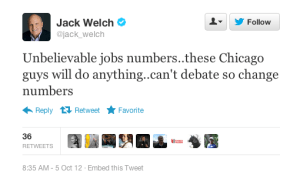
Posted: October 5, 2012 Filed under: Economy, jobs, unemployment | Tags: job numbers truthers, Romney screws up labor participation rates, unemployment numbers 67 CommentsI guess today is Tinfoil Friday. Allen West and Jack Welch think the BLS is manipulating unemployment number in response to some Chicago Mafia move to make Obama and the economy look better. Huhn? I would think if that was possible they would’ve been doing it all along instead of just suddenly producing a better but still anemic result at the last moment.
The Bureau of Labor Statistics released an unexpectedly strong monthly jobs report on Friday, finding a dramatic drop in unemployment to 7.8 percent and revised the number of jobs added in July and August up from initial estimates. While for most Americans, the growing economy is good news, conservatives immediately expressed their skepticism in the jobs report’s credibility.
1) Minutes after the report was released, Jack Welch, who famously cooked General Electric’s accounting books when he was CEO, accused President Obama of manipulating the numbers to distract from his debate performance.
This is pretty weird. The jobs report was straightforward this month.
The controversy, if it’s worth using that word, is over the unemployment rate, which dropped from 8.1 percent to 7.8 percent. That’s three-tenths of one percent. That’s what all the fuss is about.
Let’s get one thing out of the way: The data was not, as Jack Welch suggested in a now-infamous tweet, manipulated. The Bureau of Labor Statistics is set up to ensure the White House has no ability to influence it. As labor economist Betsey Stevenson wrote, “anyone who thinks that political folks can manipulate the unemployment data are completely ignorant of how the BLS works and how the data are compiled.” Plus, if the White House somehow was manipulating the data, don’t you think they would have made the payroll number look a bit better than 114,000? No one would have batted an eye at 160,000.
The fact is that there’s not much that needs to be explained here. We’ve seen drops like this — and even drops bigger than this — before. Between July and August the unemployment rate dropped from 8.3 percent to 8.1 percent — two-tenths of one percent. November-December of 2011 also saw a .2 percent drop. November-December of 2010 saw a .4 percent drop. This isn’t some incredible aberration. The fact that the unemployment rate broke under the psychologically important 8 percent line is making this number feel bigger to people than it really is.
What’s even odder is that Romney said the report wasn’t “realistic” and actually misstated the reasons for the change in numbers.
Mitt Romney challenged the significance of the drop in the unemployment rate today, arguing that the “real reality” is that the figure declined because “more and more people have just stopped looking for work.”
“There was a report that just came out this morning on job creation this last month,” said Romney at a rally in the battleground state of Virginia. “There were fewer new jobs created this month than last month. And the unemployment rate as you noted this year has come down very, very slowly, but it’s come down nonetheless.”
“The reason it’s come down this year is primarily due to the fact that more and more people have just stopped looking for work,” Romney said. “And if you just dropped out of the work force, if you just give up and say look I can’t go back to work I’m just going to stay home, if you just drop out all together why you’re not longer part of the employment statistics.”
“So it looks like unemployment is getting better, but the truth is, if the same share of people were participating in the workforce today as on the day the president got elected, our unemployment rate would be around 11 percent,” said Romney. “That’s the real reality of what’s happening out there.”
This morning’s jobs report released by the Bureau of Labor Statistics found that the nation’s unemployment rate dropped from 8.1 percent to 7.8 percent, the first time it’s been below 8 percent in four years. September saw the addition of 114,000 jobs, according to the report, a decrease from the 142,000 that were added in August, and statistic that Romney emphasized on the trail today.
Yes, random variation is quite suspicious and unrealistic. Here’s the labor force numbers straight from the report. Romney told an audience the exact opposite had happened. There is no way he actually read the report. Well, that or he was lying again.
The civilian labor force rose by 418,000 to 155.1 million in September, while the labor force participation rate was little changed at 63.6 percent. (See table A-1
The best article I’ve seen today explaining the job situation and the Welch Tin Foil hat theory is here at The Atlantic.
A number of conservatives have suggested the 873,000 household figure is wildly implausible, if not an outright conspiracy to help Obama on the part of the BLS. This is nonsense. As Greg Ip of The Economist points out, the employer and household numbers often diverge over the short-term, but they mostly match up over the long-term. And they still do if we look at the past three months. The employer survey showed job gains of 181,000 in July, 141,000 in August and 114,00 in September, for an average gain of 146,000. The household survey showed job losses of 195,000 in July, 119,000 in August, and job gains of 873,000 in September, for an average gain of 186,000. If you can’t see the conspiracy there, well, you just might be mathematically literate.
Wow. Is this the silly season or what?
Crib Sheet or Hankie?
Posted: October 5, 2012 Filed under: 2012 presidential campaign | Tags: Denver Debate, Romney Crib Notes, Romney Hankie 13 CommentsThe internet is abuzz with this video showing Romney placing a white object on the podium during the debate.
I saw Romney go back to the podium at the end of debate, pick something up, and then hand it off to his son that placed it in his jacket pocket. I thought that was really weird at the time and mentioned it to BB in a phone call. I didn’t catch the the original out of Romney pocket incident pictured in the You tube above. We’re hearing several stories about what the thing could’ve been. The Romney camp says it’s a handkerchief. However, why hand off a handkerchief to your son after the debate or were those his “new” debate notes on the podium? U.S. News has this article that says it’s a hankie but then the reference to the supposed use of the hankie later isn’t shown in the Fox video at the time suggested but they do have a picture in the link below.
Reddit was up in arms last night after video from the first presidential debate in Denver posted to the site’s politics section appeared to show Mitt Romney pulling cheat notes at the debate. About 2 minutes and 15 seconds in to the video, the GOP nominee is seen putting his hand into his right pocket and placing what appears to be white paper on the podium.
But the Romney campaign told Whispers Friday that Romney was only pulling out a handkerchief.
A close analysis of video of the debate supports that. At 1:26:35 in the video, Romney picks up the same white object—clearly a handkerchief this time—to wipe his face.
So, I still am left with the question of what got handed off to the son? But, here’s another look at the face wipe and the pocket maneuver.
Meanwhile, I’m looking for the video that I saw on CSPAN with the end of debate hand off. I found it and it shows him walking to the podium picking up paper and trying to put it his jacket and then when that fails, giving it to his son. I dunno if that’s the same piece of paper or not. What do you think?

A CBS affiliate picked up on my observations too.
The rules of the presidential debates are clear about not bringing outside notes and presidents and aspirants have followed the rule for decades.
Video of the first eleven seconds of the debate available on YouTube shows Mitt Romney reaching into his pocket at the moment he is out of view of those in front of him, he used the lectern as a shield, and removing what appears to be folded papers from his pocket.
We see this because the camera that was broadcasting was behind Romney. Those in the audience and the moderator may have been shielded from his sleight of hand, but not the viewers.
Romney then proceeds to unfold the item in front of him.
For those curious if it could have been some else, later video sheds some light on what Romney retrieves from his lectern.
After the Romney and Obama families chat post-debate the President walks off stage, leaving his notes behind for an aide, no doubt.
But not so for Romney. The Presidential challenger
goes back to his lectern to retrieve his items. It is clear that the only thing that Romney takes is paper. Not a handkerchief. Not a white flag. Nothing but paper.
So, I’m waiting for Joseph Cannon to look at this! It’s right up his alley! Is this tin foil hat material or legit?
Friday Reads
Posted: October 5, 2012 Filed under: morning reads | Tags: Ancient queen of Guatamala, Baby boomers, Brookside Capital Partners Fund, China, Democracy Now, expanding presidential debate participation, generational warfare, Global Tech, Lady K"abel, Romney, Sweatshop 68 Comments Good Morning!
I”m finally getting over this sinus infection so I’ve had a chance to actually read a few interesting things. First up, is yet another one of those folks that insists that baby boomers are parasites. I really hate generational warfare, don’t you? However, this one is interesting. It’s put in terms of a conversation between baby boomer son and ‘greatest generation’ father and the arguments are backed up by interesting anecdotes and statistics. Still, why do have to keep score on who’s screwed up the country more in terms of age groups?
The boomers haven’t been a total disaster, of course. They did indeed blaze huge social and economic trails for women, minorities, and people with disabilities. Those groups have gained rights that, as long as the rest of us remain vigilant, will never be reversed: Young women can grow up to be lawyers or scientists. African-Americans can grow up to be president. Boomers gave us Apple and Microsoft. They made the Star Wars movies. They grew the economy for a bit. Once, for a couple of years in the late 1990s, they balanced the federal budget.
But the numbers on the laptop remind me how fleeting much of that progress was—and how boomers chose short-term gratification when they had opportunities to secure a better future for generations to follow. Classic example: Instead of devoting the budget surpluses of the late ’90s to social programs that desperately needed them, they voted themselves tax cuts in 2001 and 2003, and an expanded Medicare benefit shortly after—a move a Congressional Budget Office study from that era suggests raised the expected tax rate on future generations from 29 percent to 53 percent. They borrowed heavily to cope with the economic sluggishness of the 2000s and, in so doing, inflated a housing bubble that, when it popped, triggered the Great Recession.
Median-income growth has stagnated for women and minorities over the past decade. The typical African-American today has less wealth than his or her parents did, according to Pew. Labor-force participation for women this year hit its lowest level since 1991.
So, the Brits pile on boomers too. Here’s something from The Economist on “Sponging Boomers” and how that relates to the next crisis.
These boomers have lived a charmed life, easily topping previous generations in income earned at every age. The sheer heft of the generation created a demographic dividend: a rise in labour supply, reinforced by a surge in the number of working women. Social change favoured it too. Households became smaller, populated with more earners and fewer children. And boomers enjoyed the distinction of being among the best-educated of American generations at a time when the return on education was soaring.
Yet these gains were one-offs. Retirements will reverse the earlier labour-force surge, and younger generations cannot benefit from more women working. There is room to raise educational levels, but it is harder and less lucrative to improve the lot of disadvantaged students than to establish a university degree as the norm for good ones, as was the case after the war. In short, boomer income growth relied on a number of one-off gains.
Young workers also cannot expect decades of rising asset prices like those that enriched the boomers. Zheng Liu and Mark Spiegel, economists at the Federal Reserve Bank of San Francisco, found in 2011 that movements in the price-earnings ratio of equities closely track changes in the ratio of middle-aged to old workers, meaning that the p/e ratio is likely to fall. Having lived through a spectacular bull market, boomers now sell off assets to finance retirement, putting pressure on equity prices and denying young workers an easy route to wealth. Boomers have weathered the economic crisis reasonably well. Thanks largely to the rapid recovery in stockmarkets, those aged between 53 and 58 saw a net decline in wealth of just 2.8% between 2006 and 2010.
More worrying is that this generation seems to be able to leverage its size into favourable policy. Governments slashed tax rates in the 1980s to revitalise lagging economies, just as boomers approached their prime earning years. The average federal tax rate for a median American household, including income and payroll taxes, dropped from more than 18% in 1981 to just over 11% in 2011. Yet sensible tax reforms left less revenue for the generous benefits boomers have continued to vote themselves, such as a prescription-drug benefit paired with inadequate premiums. Deficits exploded.
Yes. So, all of us should just head to the ice floes. La-ti-da.
So, here’s my weekly update on interesting historical graves. Archaeologists believe they have found the tomb of an ancient queen in Guatamala. A tiny  jar has given them some key clues.
Glyphs carved into a tiny alabaster jar have led archaeologists to conclude that the tomb in Guatemala where the jar was found belonged to one of the greatest queens of the Classic Maya civilization, known as Lady K’abel.
“She was not only a queen, but a supreme warlord, and that made her the most powerful person in the kingdom during her lifetime,” David Freidel, an archaeologist at Washington University in St. Louis, said in a report released today. That description would put Lady K’abel in the same class as other ruling women of the ancient world, ranging from the biblical Queen of Sheba to Egypt’sHatshepsut and Cleopatra.
That’s some heady company for Lady K’abel.
Some of the most bizarre comments made by Mitt Romney was his dislike of shipping jobs to China or having China fund our lifestyle as compared to funding their own. It takes brass ones to suggest that he’s not been in favor of shipping jobs to China given this Bain Capital investment in a Chinese factory that is quite shocking. The word sweatshop is so inadequate. No wonder he thinks all of us are freeloaders if he thinks this situation constitutes a normal working conditions. Romney discussed the working conditions so he was well aware of where his money was going.
Economist Paul Davidson recently pointed out the truth on AlterNet : “Romney has spent his career offshoring and outsourcing American production processes — and associated jobs — to countries like China where human labor is valued in the market at a very low wage rate.” The sub-human conditions at these production facilities represent things that Americans are strongly opposed to: child abuse, squalor, forced overtime, and peanuts for pay.
Romney’s penchant for bragging about his business activities at fundraisers helps underscore just how vile his brand of capitalism really is. While CEO of Bain, Romney invested in a Chinese sweatshop which he appears to be describing in detail at the very same Boca Raton fundraising event where he made his infamous case that nearly half of all Americans are freeloaders.
A report recently released by the Institute for Global Labor and Human Rights reveals that while Romney was deeply invested at a firm called Global-Tech, low pay and horrific conditions were status quo at its Chinese appliance factory.
Here are some really horrifying details from the same article.
From April 1998 through August 2000, Romney and his Brookside Capital Partners Fund, a Bain affiliate, poured around $23 million into the Global-Tech sweatshop in Dongguan, China. Among the details outlined in the report were the following:
- Factory workers made 24 cents an hour in 1998 and less than $2 a day. Wages in Global-Tech were less than 2 percent of U.S. wages.
- As CEO, Romney appears to have been uninterested in calling for improvements at the facility. Today, the sweatshop is still a horror where starvation wages prevail and workers’ rights are nonexistent. Overcrowded, filthy dormitories; rotten food; routine 15- to 16-hour shifts; and backbreaking 105- to 112-hour, seven-day workweeks are the norm.
- The appliance factory has 800 student “interns” — 16-years-olds forced to work repetitive, exhausting 15- to 16-hour shifts on assembly lines with no overtime pay.
There’s a story in Vanity Fair on Jamie Dimon that’s also an eye-opener.
… Dimon’s sanguinity is somewhat belied by the formidable lobbying machine that he’s built in Washington. JPMorgan’s shop is much bigger than that of other banks, and it is chock-full of politically connected former congressional staffers. The firm has become known for the regularity with which its top people show up in Washington.
Dimon has put himself front, center, and uncensored in the debate about tougher oversight. He’s lambasted regulators for failing to recognize that, while some companies were “too big to fail,” others were “ports in the storm,” and for making “hundreds of rules, many of which are uncoordinated and inconsistent with each other.”
Part of the explanation is purely pragmatic: Dimon is trying to preserve his firm’s profits—and maybe the firm itself. But it’s hard not to hear something more emotional when you listen to Dimon. “This country would be flying if we had gotten stuff right and all worked together, but we haven’t,” he says. He frequently says that banks and bankers are being “scapegoated” for their role in the crisis, and he is full of righteous indignation. He often invokes Abraham Lincoln: “I’m a Democrat, and I tell Democrats and Republicans, you guys are busy simplifying and scapegoating—well, Abe Lincoln wouldn’t do it.” He says he’s heard the story of a young officer telling Lincoln during the Civil War, “We’re going to win because God is on our side.” Lincoln responded, “Son, let’s hope that we’re on God’s side.”
I watched Amy Goodman on Democracy Now after the end of the Debates. She did a great segment on the difficulty of getting outsider candidates into the presidential debate. You may want to watch it if you get a chance.
President Obama made a good point in late 2011, when he told “60 Minutes,” “Don’t judge me against the Almighty; judge me against the alternative.” If only the public had a full range of alternatives against which to judge. In fact, most people do. They just don’t know it. The reason they don’t know it is because the media don’t report on third-party politics or campaigns. These campaigns also lack the funds to purchase television airtime, or to compete against the Democratic and Republican campaign fundraising juggernauts. This leads to less diversity of voices, and far fewer alternatives on the ballot.
It hasn’t always been this way. In 1980, the League of Women Voters ran the debates, and independent presidential candidate John B. Anderson was allowed to participate (President Jimmy Carter opposed his participation and boycotted the event). In 1992, billionaire Ross Perot used his personal funds to overcome the media blockade of his presidential campaign. His successful debate performance temporarily propelled him ahead of both Bill Clinton and George H.W. Bush in the polls.
Since then, no third-party candidate has been allowed into the presidential debates. The debates are run by the Commission on Presidential Debates, an organization described by George Farah, founder and executive director of Open Debates, as “a private corporation financed by Anheuser-Busch and other major companies, that was created by the Republican and Democratic parties to seize control of the presidential debates from the League of Women Voters.”
Farah told me that in 1988, “you have the Michael Dukakis and the George Bush campaigns drafting the first-ever 12-page secret debate contract. They gave it to the League of Women Voters and said please implement this. The League said, Are you kidding me? We are not going to implement a secret contract that dictates the terms of the format. Instead, they release the contract to the public and they held a press conference accusing the candidates of ‘perpetrating a fraud on the American people’ and refusing to be ‘an accessory to the hoodwinking of the American people.’”
The Democratic and Republican parties wrested control of the debates from the League of Women Voters, and have controlled them since.
So, I love Japanese woodcut prints and had quite a collection of them prior to the divorce. Fortunately, older daughter has been ensuring they don’t disappear to E-bay and into her step mother’s casino fund. The one above is called Beauty and Violence. I wanted to end with a really interesting and inspiring story about the elderly in Japan. Japan has an extremely large population of long-lived seniors. This story is about them and their participation in athletics. Notice that Japan is not promoting the ice floes like Paul Ryan and a lot of Republican leaders even though Japan’s debt is substantially more worrisome than ours.
Saddled with record public debt, Japan is promoting social interaction to curb the cost of caring for the 32 percent its people older than 60 — the highest proportion globally. By 2050, one in five people worldwide will be over 60, from one in nine now, according to the United Nations. Japan’s approach may help other countries also facing rising numbers of elderly.
“It enables them to participate quite actively in community life,” said Babatunde Osotimehin, secretary general of the UN’s Population Fund, which is leading UN efforts on aging. People with strong social networks “will probably not fall ill as frequently,” he said in an interview in Tokyo, where the UN released a report on aging this week.
Japan’s Ministry of Health, Labor and Welfare released policies on health and aging that focus on strengthening seniors’ community involvement in July, a shift from previous approaches that centered only on individual behavior.
Finding cost-effective ways to promote healthy aging will be critical for countries trying to reconcile rising welfare costs and a shrinking tax base. By 2050, 42 percent of Japan’s population will be at least 60 years old, according to Global AgeWatch.
Read on about Japan’s 10 point plan for Healthy Aging. It includes subsidizing exercise for seniors and rewarding them for doing civic and group activities with coupons.
In Tokyo’s Suginami ward, where Doi lives, authorities award points in the form of stickers to seniors who participate in government-approved activities from picking up litter, to attending health and sporting events, to cultural activities. Each point has a value of 50 yen (64 cents) and can be exchanged for grocery coupons. The Suginami local government has allocated 80 million yen for the project this year, according to its website.
“People who are disadvantaged socially and economically have more health problems,” the health ministry in Tokyo said in July.
Each year since 1988, the ministry has hosted the “Nenrinpic” carnival in which seniors compete at a national level in sports such as tennis, petanque and croquet. Doi’s petanque team has represented Tokyo five times, been a finalist three times and won the championship in 1999, she said.
Health clubs are benefiting from a growing enthusiasm for exercise among seniors. Koshidaka Holdings Co., which operates 1,200 women-only fitness centers in Japan, says 50- and 60-year- olds make up more than 60 percent of its 500,000 members.
“The core customers have never really exercised in their adult life before, so they feel the benefits from an easy, 30- minutes of weight training,” Hiroshi Koshidaka, the company’s president, said in an interview. “Many come three times a week, feel improvement, make friends, encourage others to join, and stop people from quitting.”
The purpose of the plan is to end the isolation that many seniors feel and support them in a healthy, connected life style. Wow. Imagine that.
So, I’ve gone way past my usual length and MABlue always gives me a hard time about that so, I’ll leave the rest of the day’s news reporting to you. What’s on your reading and blogging list today?
Debate Recaps by Hillary
Posted: October 4, 2012 Filed under: 2012 presidential campaign, Political Affective Disorder, War on Women, Women's Rights 59 Comments
Hillary 2016.
Oh, and a lovely graphic from Women and Girls Lead‘s Facebook page:

“Dance.”
Open thread. 🙂

 peej
peej Carissa
 bostonboomer
 dakinikat
 ecocatwoman
 mablue2
 Mama Lopez
 peggysue22
 quixote
 skydancingguestblogger
 Mona (aka Wonk the Vote)



 Sky Dancing

Recent Comments