
Wingnuts and Geography Lessons
Posted: October 18, 2011 Filed under: religious extremists, Republican politics, Republican presidential politics | Tags: CNN Republican Debate 10 Comments Well, yet another Republican debate went down tonight. This one was held in Las Vegas and broadcast by CNN. High winds took out my electricity earlier so I’ve had to play catch up. Here’s some of the more memorable moments. Some one woke Perry up for this one.
The former pizza company CEO is the latest and unlikeliest phenomenon in the race to pick a Republican rival for President Barack Obama. A black man in a party that draws few votes from Africans Americans, he had bumped along with little notice as Romney sought to fend off one fast-rising rival after another.
That all changed in the past few weeks, after Perry burst into the race and then fell back in the polls. However unlikely Cain’s rise, Tuesday night’s debate made clear that none of his rivals are willing to let him go unchallenged.
“Herman, I love you, brother, but let me tell you something, you don’t need to have a big analysis to figure this thing out,” Perry said to Cain. “Go to New Hampshire where they don’t have a sales tax and you’re fixing to give them one,” he said, referring to the state that will hold the first primary early next year.
Mitt pulled a power body move.
The two men talked over one another, and at one point, Romney placed his hand on Perry’s shoulder.
“It’s been a tough couple of debates for Rick. And I understand that so you’re going to get nasty,” he said.
As Perry continued to speak, Romney stopped him: “You have a problem with allowing someone to finish speaking, and I suggest that if you want to become president of the United States, you’ve got to let both people speak,” he said.
Rep. Michele Bachmann (R-Minn.) criticized President Obama’s foreign policy during Tuesday night’s CNN debate, saying, “Now with the president, he put us in Libya. He is now putting us in Africa. We already were stretched too thin, and he put our special operations forces in Africa,” she said.
Libya, it should be noted, is in Africa.
Ron Paul doesn’t too be concerned about Jewish voters or for that matter, about North Korea.
Foreign policy took a secondary role in the debate, and the new strain of Republican isolationism quickly surfaced.
Paul said U.S. troops should be withdrawn from Korea — where they have been stationed for more than 50 years — and foreign aid to Israel cut.
Perry said it was “time to have a very serious discussion about defunding the United Nations.
Huntsman wasn’t there (not that any one noticed) because he’s boycotting Nevada. I’m assuming Santorum and Gingrich were there, but I can’t be sure since no one seems to have written anything about them.
The opener for Saturday Night Live should be great this week. I wonder if I’ll be able to catch in on the airplane coming back from Denver.
Whatever has happened to the party of Eiswenhower, Teddy Roosevelt and Lincoln!
Chickens coming Home to Roost
Posted: October 18, 2011 Filed under: Austerity, Global Financial Crisis | Tags: Bank loan loss reserves, Defaults, deficits, fiscal policy 6 Comments What happens to your bank when you overlook due diligence in lending, borrow money from the Fed at near zero interest rates but lend it out to very few people at 10 to 20 times the inflation rate, slack off on renegotiating loans, charge customers fees on everything, and engage in practices that basically drain resources from your clientele? Well, your customers eventually suffer so much economic destress they start bringing you down with them by defaulting. Big US banks are suffering because their customers are suffering. Kind’ve Karmic isn’t it? Well, it’s karmic in the sense that that’s what you get from engaging in really short-sighted bad business practices made to enrich your executives and prop your stock prices up over actually doing your core business intelligently.
Fears about the health of US consumer balance sheets grew on Monday as Citigroup and Wells Fargo joined JPMorgan Chase in reporting new signs that homeowners and credit-card borrowers are falling behind on their payments.
The banks’ third-quarter results were hit by expected declines in investment banking, reflecting turbulence in global markets. But the reports also revealed weakness in the consumer side of their businesses – with mortgage delinquency numbers suggesting that record low mortgage rates and government loan modification programmes are failing to help a large swathe of homeowners.
Overall revenues fell 8 per cent at Citigroup year-on-year and 6 per cent at Wells, sending their shares down 1.7 per cent and 8.4 per cent, respectively. The S&P 500 index fell 1.9 per cent.
Wells said delinquencies of more than 90 days in its main portfolio of consumer loans – including mortgages and credit cards – rose 4 per cent to $1.5bn, the first increase since 2009. Early stage delinquencies in its retail business remained flat at 6.13 per cent after falling for three quarters. The bank increased its provision for consumer-banking losses for the first time in two years.
“The economic recovery has been more sluggish and uneven than anyone anticipated,” said John Stumpf, Wells chief executive
Federal policy that emphasizes bailing out failing businesses while leaving their customers high and dry with extremely high unemployment rates and costs of borrowing and living is having ongoing effects. Here’s some more info on banks beefing up their loan loss reserves from that FT article.
JPMorgan last week increased its provision for losses on consumer loans to $2.3bn from $1.9bn in the previous quarter. JPMorgan said delinquencies on goverment-insured mortgages hit $9.5bn, up from $9.1bn in the second quarter and $9.2bn a year ago.
“The residential mortgage problems are unprecedented,” said Gerard Cassidy, analyst at RBC Capital. “The rate of improvement in the delinquencies has slowed down dramatically in the last two years and even over the more recent quarters.” He said the problems were no longer in “subprime” but “prime” mortgages.
Capital One, among the top six US card issuers, reported rising 30-day delinquencies in June and July. “Defaults on credit card debt are certain to rise from here,” said James Friedman at Susquehanna Capital Group.
So, what’s not to be surprised about given that the unemployment rate has been sitting around 9% now for three years in a row? All of these really bad metrics on consumer finances should be signalling policymakers to act. But, that’s not happening. Well, not unless you count all the finger pointing at Ben Bernanke. I am continually flummoxed by the inability of every one in policy circles to get the basic economics right. The obsession with austerity is killing this country and it’s doing the same in others. The data just screams ongoing murder.
Here’s some thoughts on the absolute disconnect of policy from reality from Josh Bivens at the Economic Policy Institute Blog who also can’t figure out why nuts and bolts economics has suddenly been termed radical. If we’d have done something differently about three years ago, these statistics that indicate horrible stress on US households could’ve been dealt with by now. It’s odd that the very policymakers that were so concerned about Banks and Businesses have no problem slowly killing their customers.
There is nothing inherent in the economics of financial crises that makes slow recovery inevitable – they just require that policymakers figure out how to engineer more spending in their wake, same as in response to all other recessions.
Rather, the real problem they pose to policymakers is that engineering such spending increases in the wake of financial crises often requires policy responses that seem unorthodox or radical relative to the very narrow range of macroeconomic stabilization tools that enjoy support across the ideological spectrum. To put this more simply – they require policymakers do more than watch the Federal Reserve pull down short-term interest rates. For decades, all recession-fighting was outsourced to the Fed’s control of short-term “policy” interest rates – this despite the fact that in the U.S. this recession-fighting tool hasn’t actually been all that successful since the 1980s (see Table 2 in this paper).
The best response to a recession that is either so deep or so infected by debt-overhangs that conventional monetary policy is not sufficient, is simply to engage in lots of fiscal support – think the American Recovery and Reinvestment Act (ARRA) – but (as Ezra notes) much, much bigger in the case of the Great Recession.
But, this kind of discretionary fiscal policy response to recession-fighting (and jobless-recovery fighting) had fallen deeply out of favor in the same decades that saw increasing reliance on conventional monetary policy[1]. In fact, advocating fiscal policy that was up to the task of providing a full recovery in the wake of crises that defanged conventional monetary policy somewhere along the way got labeled radical, rather than simply nuts-and-bolts economics.
Further, this rejection of discretionary fiscal policy was done on very thin analytical reeds – essentially the fear was that it took too long to debate, pass, and see an effect from fiscal policy – and that if the recession was “missed” in real-time by policymakers, we would end up providing lots of fiscal support to an already-recovered economy – and might even cause economic overheating that would lead to runaway inflation and interest rate spikes.
This fear led to the strange mantra in the debate over fiscal stimulus in 2008 that policy had to be targeted, temporary and timely – which basically ruled out most things but tax cuts. But, given that the last three recessions have seen extraordinarily sluggish return to job-creation in their wake, this timely obsession was clearly misplaced (and, plenty argued so in real-time).
What we’ve been experiencing the last three years is the fall out of a financial crisis exacerbated by extremely bad policy. It’s easy to pin the blame on the recalcitrant republicans who are willing to tank all of us to regain the White House, but there’s definitely some blame to pin on the Obama White House. It’s clear that the White House simply did not manage the situation well at all. The question that keeps me up nights is this. Has the Obama administration learned its lessons? I’m not certain on that. But, I am certain that if some one like a Herman Cain gets in, there will be more hell to pay in terms of inexperience and bad policy than if we muddle through with more Obama incompetency. I’m not sure if Romney will be about as inept as we’ve seen the current occupant or will be lead to worse policies of the sort put forth by the Cains and Bachmanns.
Bivens wonders who the Democrats are that suddenly decided that that nothing could be done about recessions except to dither and hope for the best efforts by the FED. Hoping for miracles from the Fed at the zero bound is delusional. There is no historical or theoretical argument for any of this silly behavior. We continue to see the deficit hawk arguments on all sides to the point that one can only assume that there’s very little difference between Republican and Democratic orthodoxy on voodoo economics any more. This includes shilling for useless tax cuts.
But, I would also want to make sure to include much of the policymaking apparatus of the Democratic Party, who became far too enamored of the unalloyed virtues of deficit-cutting in the past two decades. The excellent labor market performance of the late 1990s, for example, is labeled a pure result rather than an important cause of substantially lower budget deficits during that time. And the regressive and stupid tax cuts pursued under the Bush Administration were generally not fought on the grounds that they were regressive and stupid, but that they would lead to intolerably large deficits – deficits so large they might even lead to Greek-like financial crises when, in fact, deficits as a share of GDP averaged less than 2 percent in 2006 and 2007. To be clear – the Bush tax cuts were expensive as well as regressive and stupid, and letting them (or at the very least the most regressive set of them) expire would be a real policy victory, freeing up public resources for much more valuable ends. But they did not cause deficits in the 2000s to reach terrifying levels.
Sadly, this same Democratic policy apparatus seems to be repeating many of these mistakes, by continually insisting that aggressive maneuvers to help alleviate the jobs-crisis must be done simultaneously with efforts to close what are actually pretty non-scary medium term deficits. Would the “very-big-stimulus-now-cum-progressive-measures-to-bring-medium/long-term-spending-and-revenues -in-balance-when-we-get-back-to-full-employment” plan be the best of all worlds? Sure.
So, what changed between the Reagan legacy of huge deficits “as far as the eye can see” or the “deficits don’t matter” mantra of old Dick Cheney to the mantra now that only deficits matter? What’s caused this idea that you can spend hugely on unjustifiable wars, bailing out failing banks and businesses, and giving tax cuts and credits to every one under the sun with no real rationale but you have to say no now to stopping macroeconomic seppuku? To a certain extent, we have Robert Rubin to thank for that. Many of Rubin’s acolytes are still planted in the Treasury and were sent to the Obama White House early on. Here’s a brief bit on that from an Allan Blinder Working Paper at Princeton that gives a good overview on how our approach to fiscal policy went completely off the track.
The fact that the Clinton boom started almost immediately after Congress passed a budget reduction package gave rise to some rethinking—some of it serious, some of it muddled—of even the sign of the fiscal-policy multiplier. Among politicians and media types, the notion that raising taxes and/or cutting spending would expand (rather than contract) the economy took hold rapidly and uncritically—with seemingly little thought about exactly how this was supposed to happen. Quicker than you can say “Robert Rubin,” the idea that reducing the budget deficit (or increasing the surplus) is the way to “grow” the U.S. economy—even in the short run—came to dominate thinking in Washington. This thinking was, of course, profoundly anti-Keynesian.
Is this why no longer seem to be able to get our act together and just do the basic right thing when it comes to helping US consumers deal with the Great Recession and its ongoing aftermath? That would seem feasible except that right after 2001, George W Bush and and Allan Greenspan went right back on the stimulation on steroids policy of previous administrations. Both parties want happily along with that. So, I continue not to get it and the policy continues not to get it right and if you look measurements of economic health like defaults and unemployment, it’s pretty clear that US Households aren’t going to get any thing either. It’s no wonder people are starting to take to the streets.
Tuesday Reads
Posted: October 18, 2011 Filed under: morning reads | Tags: #OccupyWallStreet, Amish renegades, Anita Perry, Christian fundamentalists, evangelicals, Glass Steagall Act, global occupy protests, hair-cutting attacks, Herman Cain, Rick Perry, the burning bush, Volker rule 18 Comments
Good Morning!! I’m struggling with some kind of viral thing. I don’t know if it’s the flu or what, but I’ve been really tired and my brain hasn’t been working properly. Anyway, I’ve got some odds and ends of news for you, and I hope what I write will make sense.
There’s a good summary of the global nature of the Occupy protests at the Guardian:
In Madrid, tens of thousands thronged the Puerta del Sol square shouting “Hands up! This is a robbery!” In Santiago, 25,000 Chileans processed through the city, pausing outside the presidential palace to hurl insults at the country’s billionaire president. In Frankfurt, more than 5,000 people massed outside the European Central Bank, in scenes echoed in 50 towns and cities across Germany, from Berlin to Stuttgart. Sixty thousand people gathered in Barcelona, 100 in Manila, 3,000 in Auckland, 200 in Kuala Lumpur, 1,000 in Tel Aviv, 4,000 in London.
A month to the day after 1,000 people first turned up in Wall Street to express their outrage at corporate greed and social inequality, campaigners are reflecting on a weekend that saw a relatively modest demonstration in New York swell into a truly global howl of protest.
The Occupy campaign may have hoped, at its launch, to inspire similar action elsewhere, but few can have foreseen that within four weeks, more than 900 cities around the world would host co-ordinated protests directly or loosely affiliated to the Occupy cause.
The exact targets of protesters’ anger may differ from city to city and country to country. But while their numbers remain small in many places, activists argue that Saturday’s demonstrations, many of which are still ongoing – and are pledged to remain so for the foreseeable future – are evidence of a growing wave of global anger at social and economic injustice.
It’s just amazing how this movement has grown.
You know how Dakinikat has been arguing that one of the first things Occupy protesters should be demanding is the restoration of the Glass-Steagall Act? Well, Matt Yglesias says it’s no big deal: Glass-Steagall is Mostly a Red Herring.
Something I’ve heard from participants in the 99 Percent Movement is a revival of interest in rescinding the repeal of the 1932 Glass-Steagall Act. I think this is largely a misunderstanding, and it’s a actually a different — slightly more obscure — banking regulation from the same era that people are interested in.
First off, what did Glass-Steagall do? Well it did a number of things (like establish the FDIC) that were never repealed. But the rule that was repealed in the 1999 Gramm–Leach–Bliley Act were restrictions on the same holding company owning a bank and owning other kinds of financial companies. The thing about this is just that there’s really nothing in particular about co-ownership that you can point to as having been a problem in the financial crisis. And if anything that fact seems to indicate that the repealers were right to think there’s no special problem here — even in a huge financial crisis combined financial firms worked no worse than other kinds.
I’d like to see Matt debate Dakinikat about this on national TV. Here’s what Mark Thoma had to say about it:
I am sympathetic to this point of view, i.e. that the elimination of Glass-Steagall wasn’t an important causative factor in the crash. However, as I said a few days ago:
There is a debate over the extent to which removing Glass-Steagall — the old version of the Volcker rule — contributed to the crisis. However, whether the elimination of the Glass-Steagall act caused the present crisis is the wrong question to ask. To determine the value of reinstating a similar rule, the question is whether the elimination of the Glass-Steagall act made the system more vulnerable to crashes. When the question is phrased in this way, it’s clear that it has for the reasons outlined above.
So there’s still a reason to reinstate some version of the rule even if it wasn’t the main problem in the banking sector this time around.
I have a couple of stories about crazy Republican candidates, well one candidate and one candidate’s wife. First, on Sunday Herman Cain discussed his views on abortion:
“I believe in life from conception, and I do not agree with abortion under any circumstances,” Cain responded. “Not for rape and incest because if you look at, you look at rape and incest, the, the percentage of those instances is so miniscule that there are other options. If it’s the life of the mother, that family’s going to have to make that decision.”
Pressed on the life of the mother exception, Cain stuck to his answer, saying, “That family is going to have to make that decision.”
And check this out (via NPR). Last year Cain wrote a piece for Red State in which he called Jesus “the perfect conservative” and claimed that a “liberal court” was responsible for Jesus being crucified.
He helped the poor without one government program. He healed the sick without a government health care system. He feed the hungry without food stamps. And everywhere He went, it turned into a rally, attracting large crowds, and giving them hope, encouragement and inspiration.
For three years He was unemployed, and never collected an unemployment check. Nevertheless, he completed all the work He needed to get done. He didn’t travel by private jet. He walked and sailed, and sometimes traveled on a donkey…. And when they tried Him in court, He never said a mumbling word….
The liberal court found Him guilty of false offences [sic] and sentenced Him to death, all because He changed the hearts and minds of men with an army of 12.
Funny, most liberals are opposed to capital punishment… Can you imagine this guy in the White House? That would be proof that there is no god.
Next up, Anita Perry, wife of presidential candidate Rick Perry. It seems she’s the real extremist evangelical behind Governor Goodhair. Last Thursday, she gave a very revealing speech in South Carolina in which she claimed that she and her husband have been “brutalized” by the other Republican candidates because of their “faith.”
The Texas first lady weaved [sic] together religion and politics in a speech at North Greenville University, characterizing her husband’s decision to seek the presidency in August as a calling from God. Perry suggested her husband was being targeted for his evangelical Christian faith.
“It’s been a rough month. We have been brutalized and beaten up and chewed up in the press to where I need this today,” she said. “We are being brutalized by our opponents, and our own party. So much of that is, I think they look at him, because of his faith. He is the only true conservative – well, there are some true conservatives. And they’re there for good reasons. And they may feel like God called them too. But I truly feel like we are here for that purpose.”
NPR noted that Mrs. Perry admitted in the speech that she had been the one who pushed Governor Goodhair to throw his hat into the presidential ring.
According to Mrs. Perry, it was she, not her husband, who first heard the divine call that her husband should run for president.
“There was a nagging, pulling at my heart for him to run for president. He didn’t want to hear a thing about running for president. He felt like he needed to see the burning bush. I said ‘Look, let me tell you something. You may not see that burning bush but there are people seeing that burning bush for you.’ “
The “burning bush” was a reference to the Old Testament story found in Exodus 3 where God gives Moses his marching orders to tell Pharoah to release the Israelites from Egyptian bondage.
Among the noteworthy aspects of that Old Testament tale, is that it’s Moses who gets the divine message directly. It doesn’t come via an intermediary like, say, Aaron his older brother.
That’s the thing about such callings. They’re intensely personal. That’s why they’re so often marked by such a profound sense of drive and personal mission and willingness to sacrifice.
If Gov. Perry had doubts, which his wife certainly makes it appear was the case, and had to be persuaded to run, that could certainly help explain what looks to many as a lack of preparation for a national campaign.
Yikes! The burning bush? These people are completely out of touch with reality.
Yesterday Reuters published an in-depth article about Anita Perry, in case you’d like to know more.
Speaking of fundamentalist religions, here’s a bizarre story from The New York Times about Amish “renegades” attacking other Amish people.
BERGHOLZ, Ohio — Myron Miller and his wife, Arlene, had been asleep for an hour when their 15-year-old daughter woke them and said that people were knocking at the door.
Mr. Miller, 45, a stocky construction worker and an Amish bishop in the peaceful farmlands of eastern Ohio, found five or six men waiting. Some grabbed him and wrestled him outside as others hacked at his long black beard with scissors, clipping off six inches. As Mr. Miller kept struggling, his wife screamed at the children to call 911, and the attackers fled.
For an Amish man, it was an unthinkable personal violation, and all the more bewildering because those accused in the attack are other Amish….
The attackers, the authorities said, had traveled from an isolated splinter settlement near Bergholz, south of the Miller residence. Sheriffs and Amish leaders in the region, home to one of the country’s largest concentrations of Amish, had come to expect trouble from the Bergholz group. It is said to be led with an iron hand by Sam Mullet, a prickly 66-year-old man who had become bitterly estranged from mainstream Amish communities and had had several confrontations with the Jefferson County sheriff.
Too weird. So…. What are you reading and blogging about today?
Mitt Romney: The Rational Republican Candidate?
Posted: October 17, 2011 Filed under: U.S. Politics | Tags: Birth Control, discrimination, first amendment, Fourteenth Amendment, Lloyd Grove, Mitt Romney, Racism, Robert Bork, Women 20 Comments
Robert Bork
Former Massachusetts Governor Mitt Romney has been painted by many as the more “rational” Republican candidate for President, as compared to religious fanatics like Rick Perry, Michele Bachmann, and Rick Santorum, and outright crazy men like Herman Cain and Newt Gingrich. But is Mitt really all that rational and reasonable? Not judging by his choice Robert Bork as co-chair of his “Legal Advisory Committee.”
In an interview with Lloyd Grove of Newsweek and The Daily Beast, Bork said that he thinks women are no longer discriminated against.
How about the Equal Protection Clause of the 14th Amendment? Does he still think it shouldn’t apply to women?
“Yeah,” he answers. “I think I feel justified by the fact ever since then, the Equal Protection Clause kept expanding in ways that cannot be justified historically, grammatically, or any other way. Women are a majority of the population now—a majority in university classrooms and a majority in all kinds of contexts. It seems to me silly to say, ‘Gee, they’re discriminated against and we need to do something about it.’ They aren’t discriminated against anymore.”
Does Romney agree with that? Here are a couple more examples of Bork’s legal opinions:
I ask Bork if he still disagrees with the high court’s Griswold v. Connecticut ruling that married couples have a constitutional right to the use of contraception?
“Oh, my God, yes!”
And does he still believe that the First Amendment should be limited to political speech and not protect, as he once wrote, “any other form of expression, be it scientific, literary or…pornographic”?
“Oh yes!” he answers enthusiastically. “If you look at what they say, the First Amendment supposedly defines things like child pornography. The Supreme Court said there was a right to it. That’s actually insane.”
In the interview Bork tried to walk back his opinion of the Civil Rights Act:
Bork criticized the legislation on the ground that government coercion of “righteous” behavior is “a principle of unsurpassed ugliness.”
Now he claims that we’ve already made “the transition to a non-discriminatory society,” and he’s happy with how it all turned out.
Back in 1987, Ronald Reagan nominated Bork for the Supreme Court. Fortunately, the nomination failed, and Bork is still angry about it. Grove asked him if he had forgiven Ted Kennedy and Joe Biden kneecapping his nomination:
Even before the confirmation hearings, Ted Kennedy went on the Senate floor to describe “Robert Bork’s America” as “a land in which women would be forced into back-alley abortions, blacks would sit at segregated lunch counters, rogue police could break down citizens’ doors in midnight raids, schoolchildren could not be taught about evolution, writers and artists would be censored at the whim of government,” and so on and so forth.
I ask Bork if he ever forgave the late Kennedy.
“I’m trying to think of how I could conceivably do that,” says Bork, a convert to Catholicism. “We’re supposed to forgive all kinds of behavior. I shouldn’t deny that I’ve forgiven somebody, or I’ll end up being assigned to the outer circles of Hell. But Ted Kennedy is a test case of the limits of forgiveness.
How about Joe Biden, who chaired his Senate hearing?
“Oh, poor Biden,” Bork says with mock sympathy. “Biden, I think, is not a very thoughtful or intelligent man.”
I think we really need some straight answers from Romney. Does he agree with Bork’s interpretations of the Constitution? If not, why did he drag this crazy man out of his well-deserved obscurity and appoint him as a top legal adviser?
Let’s Play Spot the Meme!!
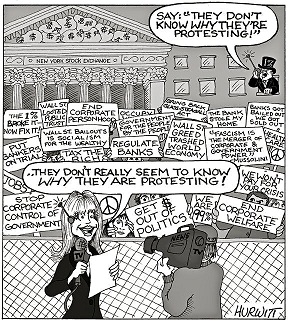
Posted: October 17, 2011 Filed under: #Occupy and We are the 99 percent! | Tags: Lies about Occupy 14 Comments
Yup. She's fighting the right wingers who think OCCUPY isn't about normal people's concerns.
I’m getting pretty tired of seeing right wing posts label Occupy protestors with the usual snobby anti-hippy meme. This isn’t the AstroTurf of the Koch-backed Tea Party (TM) that lost steam quicker than a tea pot removed from a flame. That’s even with old time poll Dick Armey at the helm. The Press was more comfortable with the tea party movement because it could actually find the corporate spokesmodels from long time special interest groups like FreedomWorks propping up the people. Here’s a Quinnipiac poll that suggests the Occupy grass has roots.
By a 67 – 23 percent margin, New York City voters agree with the views of the Wall Street protesters and say 87 – 10 percent that it is “okay that they are protesting,” according to a Quinnipiac University poll released today.
Agreeing with the protesters views are Democrats 81 – 11 percent and independent voters 58 – 30 percent, while Republicans disagree 58 – 35 percent, the independent Quinnipiac (KWIN-uh-pe-ack) University poll finds. Even Republicans, however, agree 73 – 23 percent with the protesters right to be there.
New York City voters say 72 – 24 percent, including 52 – 41 percent among Republicans, that if the protesters obey the law, they can stay as long as they wish.
A total of 72 percent of voters say they understand the protesters’ views “very well” or “fairly well,” with 17 percent who say “not too well” and 10 percent who say “not well at all.”
Voters split 46 – 45 percent in their approval of the way police are handling the Wall Street protest, but approve 61 – 33 percent of how the police are doing their job overall.
“It’s a free country. Let them keep on protesting as long as they obey the law, New Yorkers say overwhelmingly,” said Maurice Carroll, director of the Quinnipiac University Polling Institute. “Critics complain that no one can figure out what the protesters are protesting. But seven out of 10 New Yorkers say they understand and most agree with the anti-Wall Street views of the protesters.
“For a while, the critics focused on the cops’ use of pepper spray at the protests. Voters are divided on how police are handling the protesters, but they say almost 2-to-1 that police are doing a good job overall.”
Asked who is to blame for the current state of the nation’s economy;
37 percent of New York City voters blame the administration of former President George W. Bush;
21 percent blame Wall Street and financial institutions;
18 percent blame Congress;
11 percent blame President Barack Obama.New York City voters support 61 – 28 percent an extension of the state’s so-called ‘Millionaire’s Tax.’ Even Republicans support the extension 55 – 38 percent.
Voters also support 73 – 19 percent, including 48 – 40 percent among Republicans, tougher government regulation of banks and Wall Street firms.
“New Yorkers, even Republicans, back the Wall Street protesters on at least two things they’re talking about, a get-tough attitude toward banks and Wall Street and continuation of the state’s ‘Millionaire’s Tax,'” Carroll said.
Those are basically the same issues that keep coming up in poll-after-poll that have been completely ignored by the corporate media and Democratic and Republican Politicians alike. Who says that the vast majority of people showing up at this protests don’t have a message? It’s pretty clear to me. Just read the picket signs!!! I’m getting pretty tired of watching right wing sites make up really nasty smears by finding the one or two freaks in the vast numbers of people that show up. They must be really afraid that the Fauxes are about to be turned out of the US chicken coop.

 peej
peej Carissa
 bostonboomer
 dakinikat
 ecocatwoman
 mablue2
 Mama Lopez
 peggysue22
 quixote
 skydancingguestblogger
 Mona (aka Wonk the Vote)



 Sky Dancing
Recent Comments