
Monday Reads
Posted: October 17, 2011 Filed under: morning reads | Tags: Arab women and the Arab Spring, Ford settles with UAW, Herman Cain bigot and religious extremist, Illinois financial problems 21 Comments Good Morning!
The weekend flew by for me and I still have a huge number of things to do! I think I slept away most of it. Here’s some things to get you started.
It’s seems that the state of Illinois has its own little sovereign wealth problem. This is an incredible story.
Drowning in deficits, Illinois has turned to a deliberate policy of not paying billions of dollars in bills for months at a time, creating a cycle of hardship and sacrifice for residents and businesses helping the state carry out some of the most important government tasks.
Once intended as a stop-gap, the months-long delay in paying bills has now become a regular part of the state’s budget management, forcing businesses and charity groups to borrow money, cut jobs and services and take on personal debt. Getting paid can be such a confusing process that it requires begging the state for money and sometimes has more to do with knowing the right people than being next in line.
As of early last month, the state owed on 166,000 unpaid bills worth a breathtaking $5 billion, with nearly half of that amount more than a month overdue and hundreds of bills dating back to 2010, according to an Associated Press analysis of state documents.
The true backlog is even higher because some bills have not yet been approved for payment and officially added to the tally. This includes the Illinois health care agency, which says it is sitting on about $1.9 billion in bills from Medicaid providers because there’s no money to pay it.
While other states with budget problems have delayed paying their bills, the backlog in Illinois is unmatched, experts say. Year after year, Illinois builds its budget on the assumption that it will pay its bills months late — essentially borrowing money from businesses and nonprofits that have little choice but to suffer the financial hardship.
The unpaid bills range from a few pennies to nearly $25 million. In early September, for example, Illinois owed $55,000 to a small-town farm supply business for gasoline, $1,000 to a charity that provides used clothing to the poor, $810,000 to a child-nutrition program.
The lights of the media are now glaring on Herman Cain. The resulting portrait is of one really extremist man who is being generously supported by the Koch Brothers. He’s beginning to remind me of Glenn Beck.
Cain’s campaign manager and a number of aides have worked for Americans for Prosperity, or AFP, the advocacy group founded with support from billionaire brothers Charles and David Koch, which lobbies for lower taxes and less government regulation and spending. Cain credits a businessman who served on an AFP advisory board with helping devise his “9-9-9” plan to rewrite the nation’s tax code. And his years of speaking at AFP events have given the businessman and radio host a network of loyal grassroots fans.
The once little-known businessman’s political activities are getting fresh scrutiny these days since he soared to the top of some national polls.
His links to the Koch brothers could undercut his outsider, non-political image among people who detest politics as usual and candidates connected with the party machine.
He doesn’t support availability of abortions for victims of rape or incest. He was interviewed by David Gregory yesterday.
Republican presidential candidate Herman Cain said Sunday that he didn’t agree with abortion “under any circumstance.”
The candidate, who has promised to work to overturn Roe v. Wade, told NBC’s David Gregory that he believes in “life from conception.”
“I do not agree with abortion under any circumstance,” he insisted.
“Exceptions for rape and incest?” Gregory asked.
“Not for rape and incest,” Cain replied. “Because if you look at rape and incest, the percentage of those instances is so miniscule that there are other options
He may just love him some clumps of cells but he wants an electrified fence on the US border. Oh, wait, that’s a joke just like the moat with alligators. I guess live Mexicans can either get fried or eaten but every zygote is sacred. He may have walked back his comments yesterday, but remember, these same comments were met with cheers in the last Republican debate. Note to Canadians: Come on down! Fences and moats only apply to our Southern border so if you’re Arcadian, you get a pass!
At two campaign rallies in Tennessee on Saturday night, the Republican presidential candidate Herman Cain said that part of his immigration policy would be to build an electrified fence on the country’s border with Mexico that could kill people trying to enter the country illegally.
But by Sunday morning, in a dramatic change of tone, Mr. Cain, a former restaurant executive, said he was only kidding.
“That’s a joke,” Mr. Cain told the journalist David Gregory during an appearance on NBC’s “Meet the Press,” where he was asked about the electrified fence. “That’s not a serious plan. I’ve also said America needs to get a sense of humor.”
Mr. Cain’s attempt to pass off incendiary comments as nothing but a joke may take more effort, however. In making the initial remarks about an electrified fence killing illegal immigrants, Mr. Cain was detailed and repetitive. He did not introduce his thoughts as anything but serious commentary, beginning with the words, “We have a crisis of illegal immigration.”
Can we say bigoted and demagogic boys and girls? Yes, we can!!! I certainly hope this guy is off Mitt Romney’s short list of VP potentials. He’s more bombastic and less fit for office than Quitterella and that says a lot!
Ford and its workers appear to be coming to agreement over their contract for the next four years. Ford is the one US car dealer that made it through the recession without relying on government largess. Instead, it sold many of its foreign subsidiaries to other companies and focused on building its domestic lines. I bought some Ford stock at the dept of the market plunge for $1.67 cents a share. I’m hoping that’s one bet that will pay off well!
“Times are obviously better for the company and the executives are getting raises, but they don’t want to give anything back to the workers,” Gary Walkowicz, a union official with Local 600 who led a “Vote No” campaign, said Oct. 13. “People feel they deserve more. There is a lot of anger out here.”
The UAW’s Settles, in his statement tonight, said Ford hourly employees had concluded the tentative accord was in their interest.
“The Ford workers voting early on in the process were voting on emotion, but workers in plants with voting later in the process had a chance to learn everything about the agreement and understood how much their votes counted,” Settles said in the e-mail.
Ford earned $9.28 billion in the past two calendar years after $30.1 billion in losses from 2006 through 2008. Ford Chief Executive Officer Alan Mulally’s 2010 compensation rose 48 percent to $26.5 million. Ford also awarded him more than $56 million in stock in March for leading the company’s turnaround.
“In early votes, you can vote your anger,” Shaiken said. “In later votes, you start asking, ’What are my options?’”
There’s an extremely interesting article in this week’s The Economist on Arab Women and the Arab awakening. It showcases women in Tunisia and Egypt.
Today Egypt’s women may work outside the home, go to school and university, and are free to vote and run in all elections. But women’s literacy stands at just 58%, and only 23% of workers are women. The country’s laws are a mixed bag. The constitution outlaws discrimination on the grounds of sex, but women are entitled to inherit only half as much as men. Husbands may divorce their wives in moments in front of a civil servant, but women endure lengthy court proceedings to do the same. A woman who remarries loses the right to custody of her children.
The condition of Tunisia’s women, by contrast, is unmatched in the Arab world. That is mostly thanks to Habib Bourguiba, the founding father of the modern Tunisian state, who outlawed polygamy, granted women equal divorce rights and legalised abortion. Zine el-Abidine Ben Ali, Tunisia’s toppled dictator, continued Bourguiba’s work, expanding parental, divorce and custody rights for women and promoting their education and employment. In 1960 nearly half of women were married by the time they had turned 20. By 2004 only 3% of girls between the ages of 15 and 19 were married, divorced or widowed. The literacy rate for women in Tunisia is now over 70%, though only 27% of the labour force is female. Women make up nearly two-thirds of university students, compared with two-fifths in Egypt.
I’d like to give a shout out to Hillary Supporter and blogger StacyX who has had an medical emergency and will be giving up blogging for awhile. You may want to go leave a nice get well note for her!
So, that should get us started this morning! What’s on your reading and blogging list today?
ADHD Awareness Week: Oct. 16-22
Posted: October 16, 2011 Filed under: education, just because, psychology | Tags: ADHD, Attention Deficit Hyperactivity Disorder, brain imaging, language development, literacy, narrative, private speech 31 CommentsThis week is ADHD Awareness Week. I’ve been thinking about what I’ve learned about this developmental disorder over the past decade or so; and I thought I’d share some of it with you.
I used to be somewhat skeptical about the existence of Attention Deficit Hyperactivity Disorder (ADHD). After all, this supposed disorder didn’t exist when I was a kid, as far as I knew. (It turns out the behavior patterns associated with ADHD were observed as early as the 1790s). It seemed to me a bad idea to give children speed, which is basically what the stimulant drugs used to treat ADHD are.
When I went back to college to study psychology, I became friends with another student who had the diagnosis. Interacting with this young man and observing his behavior convinced me that ADHD really does exist.
My friend (I’ll call him “Bill”) had difficulty paying attention in class and sometimes he would stare out the window for long periods of time. He had trouble concentrating on writing assignments, because he was easily distracted. Paradoxically, Bill could focus his attention for long periods of time on something he found very interesting, like using the computer, playing music, or running. Those are common symptoms of ADHD.
People with ADHD tend to be impulsive–they may do or say things without thinking about the consequences, and this can lead to problems with other people.
I saw Bill get into trouble in his personal relationships again and again. He would make appointments to spend time with someone, forgetting that he had already made an appointment with another person–sometimes even two or three other people–for the same day and time. He often had to call people and cancel plans because of this. Most of the time, friends were understanding, but Bill ran into trouble when he made these mistakes in interactions with professors and other people he wanted to impress.
Although I liked Bill very much, I admit that I tired of hearing about his constant scheduling mixups, and about people who were angry with him about them. He wasn’t always easy to be friends with.
Something else I noticed in my interactions with my friend Bill was that he often used language in unusual and interesting ways. He sometimes had difficulty finding the right word and would make up words or describe emotions and behavior in unexpected ways. It’s possible that Bill had some kind language disorder in addition to ADHD, but he told me that he could often recognize fellow sufferers by the way they used words. I came to believe that Bill thought about things from a different perspective than most people, and I found that aspect of his ADHD somewhat charming.
As an undergraduate, I became fascinated with children’s language development; and I went on to specialize in that field in graduate school. One of the papers I wrote in order to qualify as a Ph.D. candidate was about ADHD and two aspects of language development: private speech and narrative (storytelling).
Private speech is self talk that young children use to support their play and other activities. They speak out loud to themselves, describing what they are doing or working out problems as they go along. Here’s an example:
A number of researchers have found that children with ADHD use more private speech and use it for about 3 years longer than typically developing children, who have generally stopped talking out loud to themselves by age 7 or 8. Children with ADHD may continue to do so until age 11 or so. The assumption is that children with ADHD use private speech more than other children because it helps them stay focused on tasks.
My main focus in graduate school was on children’s narrative development–basically the way children develop the skills used in telling stories. Narrative skills are used in forming autobiographical memories as well as in structuring reality and understanding the world around us. They are also an important facet of early literacy and an important predictor of how well children will perform academically. Children with ADHD tend to tell stories that are more poorly organized and less cohesive than those told by typically developing children.
So there are a couple of concrete examples of differences in language abilities between children with ADHD and typically developing children. In recent years there have also been brain imaging students that demonstrate that the brains of children with ADHD develop more slowly in some ways than the brains of typically developing children. Here’s one example:
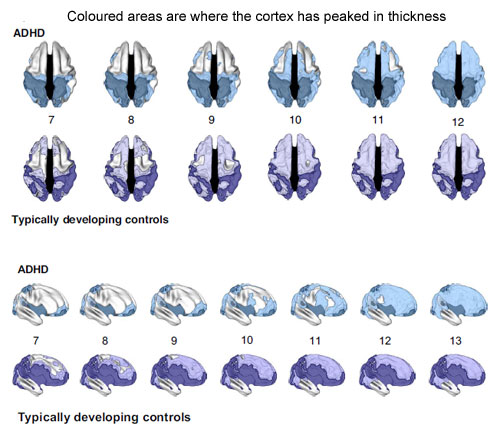
Philip Shaw, Judith Rapaport and others from the National Institute of Mental Health have found new evidence [that]….When some parts of the brain stick to their normal timetable for development, while others lag behind, ADHD is the result….they used magnetic resonance imaging to measure the brains of 447 children of different ages, often at more than one point in time.
At over 40,000 parts of the brain, they noted the thickness of the child’s cerebral cortex, the brain’s outer layer, where its most complex functions like memory, language and consciousness are thought to lie….
In both groups of children, parts of the cortex peaked in terms of thickness in the same order, with waves of maturity spreading from the edges to the centre….[but] the brains of ADHD children matured about three years later than those of their peers. Half of their cortex has reached their maximum thickness at age 10 and a half, while those of children without ADHD did so at age 7 and a half[.]
Isn’t it interesting that children with ADHD tend to lag behind in brain development by about three years–about the same length of time they continue to using private speech after typically developing children have stopped?

The caudate nuclei are highlighted in red
Here’s another blog entry on a different study of brain development in children with ADHD. This study found that children with ADHD had smaller caudate nuclei than typically developing children. This was a small study of 26 5-year-olds.
The basal ganglia (or basal nuclei) are the parts of the brain involved with voluntary motion and some forms procedural learning (development of a motor skill through practice, such as playing a musical instrument). The caudate nucleus specifically functions in learning and memory; it tells the cortex (the area of our brain where higher reasoning occurs) to do something based on current conditions. Importantly, the caudate nucleus controls motor skills partly through inhibition of particular behaviors, and disinhibition of others; an overactive caudate nucleus may be implicated in obsessive-compulsive disorder.
Smaller caudate nuclei had been documented before in older children with ADHD, but not before in children so young. The authors point out that previous studies have not been able to sort out what comes first: changes in brain structure or the behavior, which is part of the motivation of looking at younger children.
Just in time for ADHD Awareness Week, new guidelines have been released for the treatment of ADHD in children as young as 4. I must admit I find that a bit troubling. I hate to see kids get labeled as having a psychological disorder before they even start kindergarten. From the Wall Street Journal:
Attention deficit hyperactivity disorder can be diagnosed in children as young as age four, according to new treatment guidelines by the American Academy of Pediatrics.
The guidelines, released Sunday at the academy’s annual meeting in Boston, provide instructions for pediatricians on diagnosing and managing ADHD in children four to 18. They say behavioral management techniques should be the first treatment approach for preschool-age children.
But they also suggest doctors consider prescribing methylphenidate, commonly known by the brand name Ritalin, in preschool-age children with moderate to severe symptoms when behavior interventions don’t provide significant improvement. It’s a potentially controversial recommendation, because these medicines aren’t approved by the Food and Drug Administration for use in that age group.
I’m not an expert on ADHD, but I am recovering addict, and I worry about children so young being given powerful mind-altering drugs. My friend “Bill” had been prescribed Ritalin as a child, and he felt that using the drug had resulted in his abusing cocaine and alcohol as a young adult.
Generally speaking, I’d like to see doctors, teachers, and parents use behavioral solutions for ADHD symptoms, rather than drugs. At the same time, I know that psychoactive drugs have been extremely helpful to me in dealing with severe depression. There are times when drugs are a good solution, but only in concert with therapy and self-awareness.
Again, I haven’t had a great deal of practical experience with ADHD. I’d be interested in hearing from anyone here who has. All-in-all, I think it’s a good thing that developmental disorders are recognized now more than when I was a kid. I can only assume that some kids fell through the cracks back then, while now kids with these problems get attention and treatment–however flawed it may be.
Is this a Naughty list that will get the Nice Treatment?
Posted: October 16, 2011 Filed under: Economy, financial institutions, Global Financial Crisis | Tags: G-20, Global TARP, shadow banking system, Systemically risky banks 10 Comments Okay, this is confusing me. What exact policies are implied from being on the G-20 list of “50 Systemically Important Banks”? It appears to me that you could be subjected to capital injections (i.e. free taxpayer money) for being so big you could bring down the global economy. No wonder Occupy is going global.
Group of 20 governments are considering naming as many as 50 banks as systemically important to the global economy and in need of extra capital, two officials from G-20 nations said.
The list, drawn up by Financial Stability Board Chairman Mario Draghi, will be published in time for a G-20 leaders meeting in Cannes, France, on Nov. 3-4, said the officials, who declined to be identified because the discussions are private. Regulators have said the banks named will be forced to take on more capital.
Regulators are at loggerheads with some institutions over the additional capital rules, with lenders arguing the requirements may harm the world’s economic recovery. Jamie Dimon, chief executive officer of JPMorgan Chase & Co. (JPM), and Bank of America Corp. (BAC) CEO Brian T. Moynihan are among bankers who have suggested this year that the new rules will constrain lending and hurt growth.
G-20 finance ministers and central bankers meeting in Paris yesterday discussed the standards that will be applied when compiling the list of systemic banks.
Twenty-nine to 40 banks could be designated depending on the potential impact on financial markets, according to one person familiar with the matter. Two officials from G-20 nations said the list could even be expanded to about 50 institutions. The regulators are also contemplating including the institutions in categories according to their ability to absorb losses.
So, the G-20 finance ministers “endorsed a framework to reduce the risks posed by systemically important institutions through strengthened supervision, a cross-border resolution plan and additional capital requirements”. No wonder occupy is going global. It seems bankers are draining funds from countries everywhere because they keep losing their mittens in the world’s largest gambling casinos. So, if you’ve got a bunch of what looks like really bad institutions, why-oh-why do you just simply give them more of your treasury? Good thing these guys went for that monopoly power! Now they can bully just about any one with a threat of bringing down the global economy. The World Bank and the IMF don’t even let entire countries do that!
The FSB is assessing how systemically important institutions are on the basis on five broad categories: size, interconnectedness, lack of substitutability, global activity and complexity.
Yup. The bigger you are and the more difficult you are to figure out, then it looks like you win a prize! Since when are we supposed to reward the creation of moral hazard and information asymmetry? The government is supposed to regulate to clear that up, not provide cash infusions to the worst culprits in the market. Oh, let me rephrase that because were talking about TWENTY governments doing that. The leading candidate to head all this up is the head of the Bank of Cananda–Canada’s version of the Federal Reserve Bank–who just happens to be (yes, wait for it, you know it’s coming)a former employee of Goldman Sachs.
Here’s the sole sentence in the entire article at Bloomberg that indicates there may some be some push for some change. The FSB is the Financial Stability Board. They are in the process of doing a number of things under the jurisdiction of the G-20 group including derivatives reform.
The FSB suggested assessing banks’ involvement with shadow banks, reform of money-market funds, securitization regulation, supervision with an emphasis on risk and scale, and regulation of lending and repo markets, the official said.
Obviously, the soverign debt crisis of the Greece, Portugal, Spain, and Ireland are foremost on every one’s mind. The deals are being worked out now to try to head off the potential calamity. I have to wonder if this is going to turn into a world wide TARP plan where we all foot the bill and the banks continue on their merry way with a lot of public funds and mostly symbolic regulation and over sight. I guess we’ll see. This inquiring mind really wants to know. Now, where’s the next G-20 meeting location and the nearest pitchfork store?
Late Night Breaking: Police Buses head to Washington Square
Posted: October 15, 2011 Filed under: #Occupy and We are the 99 percent! | Tags: global occupy protests, Occupy New York 11 Comments
Protesters in Times Square.Mario Tama/Getty Images
The Occupy Protests in New York City have been spreading out towards Times Square and into Washington Square. Seventy people were already been arrested earlier today trying to close their accounts at Citibank. Here’s a few links to keep you updated but the Twitter Stream is the thing to really follow.
This is the latest update from New York Magazine:
New York’s Alex Klein reports from Times Square: The crowd is now chanting “who are you protecting,” as police on horses tussle with protesters. Police with batons approaching, grabbing protesters around me. Someone has been hit, another thrown to the ground and taken away. A chorus of boos are ringing out and a man in gold spandex on top of a trash can is grabbing his junk, yelling “I love you police!” The cops also have scooters and riot shields.
The Wall Street Protests have spread globally to Rome, Madrid, Athens, Santiago, Sydney and here in New Orleans. This is amazing. It is estimated that as many as 600 cities around the world had Occupy related protests.
The protests against corporate greed born last month on Wall Street spread across the world Saturday, with fed-up demonstrators marching in Europe and the Asia-Pacific region.
In London, placard-waving protesters, watched by scores of vigilant police, gathered on the steps of St Paul’s Cathedral, then moved toward the London Stock Exchange building nearby.
“We are here in solidarity with those protesting in the United States,” said Sean Murray, an engineering student at London University. “The problems we face are exactly the same — a system in which a financial crisis was caused by bankers and people who make money, and people who don’t make money have to pay for it.”
This is truly amazing. People are finally fed up with austerity programs that hurt that majority of people while protecting the benefits of the few. I dare any one associated with the Tea Party to compare the size, scope, and level of independence shown in this movement to their own. Clearly, this is not being orchestrated by genuine outrage against the excesses of the modern financial system and the few people that are rewarded by the funds it leeches from the real sector of the economy.
Here is information on the folks arrested earlier today at Citibank trying to close accounts.
Around 2:30 p.m. on Saturday, the Occupy Wall Street Livestream captured about 20 people being arrested outside a Citibank at La Guardia Place in New York. A protester announced via human mic that people had gone inside Citibank to close their accounts. They were asked to leave and complied, he said, but the bank’s security guards locked them in until the N.Y.P.D. arrived.
“Some wanted to close their accounts with Citibank,” he read from a cell phone. “When asked to leave, they began to exit but were locked in by security. When cops arrived, Citibank security came outside and dragged two individuals back inside to hold them under arrest.”
The protesters were loaded into the back of a police van as the crowd shouted, “Let them go! Let them go!” as 10,000-some people watched the scene on Livestream. “Liberate the unlawfully arrested!” one man shouted.
Here’s a video from outside the bank. Both were posted down thread earlier today by RSM.
The Business Model: An Idea Ready to Eat The World
Posted: October 15, 2011 Filed under: just because | Tags: private goods, public goods, selling public assets 12 Comments
We’ve all heard it, ad infinitum. Governments should run like a business. Healthcare is looking for a new business model. Prisons are emerging profit centers.
And so, reading of Governor Rick Scott’s solutions for trimming Florida’s public college and university costs, I was not surprised to scan the words ‘business model.’ Scott is tapping into Rick Perry’s strategy, The Seven Breakthrough Solutions for cutting college costs in Texas. The ‘solutions’ seem almost reasonable, until you peel up the corners.
Now let’s get real. College tuitions have skyrocketed across the country. Anyone who has been to college recently or sent a child [or children] through a University system can attest to the financial burden the 4-5 year pricetag can exact. Few students or parents would reject reasonable methods to trim expenses, make universities run more efficiently and ultimately make higher education more affordable.
But are we willing to trim cost and quality in tandem? Will we accept the quick fix and sacrifice departments and/or fields of study because [on first glance] they will not produce degrees or students useful to Rick Scott’s or Rick Perry’s vision of America? That would be a world where everything is one big business deal, oozing with profit for owners and shareholders and populated with workers with the ‘right’ degrees. Those degrees would translate into immediate jobs for the same business types who created the system to begin with, a self-perpetuating loop.
What could go wrong?
Plenty.
Let me say I have nothing against degrees in science, technology, engineering and math [STEM]. We need more degrees in these fields; emerging economies [China, India] are killing us in the sheer number of technical/science students they’re preparing for the future. But not everyone is suited for these majors. And surprise! There is still a place in the world for the humanities, a background from which the likes of JFK [history/international affairs], Ronald Reagan [sociology] and Steve Wynn, business guy [English] graduated and did pretty well for themselves.
My problem is pushing specific degrees at the exclusion of all others. For instance, slashing funds for grants and scholarships in Liberal Art programs—Scott has a particular dislike of anthropology–mocking the value of academic research [yes, there are flaky university studies out there but the vast majority of academic research has broad, important, if not immediate applications]. Or in terms of evaluating faculty? The approach would measure faculty members as profit or loss centers [this gauged on the faculty member’s time spent in the classroom, against the outside funding said faculty member manages to encourage and net]. A likeability quotient is added to the frothy mix and student evaluations are weighted in determining tenure. These applied standards are in lieu of placing primary value on a faculty member’s expertise in his or her field. College/university accreditation? It complicates the reform measures. So poof! Get rid of it.
Perhaps more importantly, this approach dismisses the true purpose and nature of higher education: to teach everything there is to teach; to produce graduates who have critical thinking skills, an understanding of the world around them and the people who inhabit that world now and those of the past; and finally, inspiring creativity, which in turn inspires innovation.
If you want drones then set up a factory, an assembly line. If you want enlightened adults, provide the freedom to choose, develop, think, consider, re-consider. Support risk-taking in whatever field of study a student chooses or has a passion and talent for. Encourage students to try their hand, hearts and minds at everything. Inspire students to go their own way and take those creative leaps that lead to startling advancements. Respect the learning process, the exquisite power and beauty of discovery and the uniqueness of the individual.
Earth to the Rickety Twins: One size does not fit all. Easy solutions to complex problems are doomed to failure. Just ask Herman Cain about his 999 economic plan, which is crumbling under scrutiny.
Dare I say that not all things fall within the purview of a business model, a structure that seeks profit before all else. Yet, this is the main ‘fix’ being hawked like a bad toupee across the country. Run ‘it’ [fill in subject of choice] like a business and all things will flourish.
Well, here’s a thought: The Seven Breakthrough Solutions that Rick Scott wishes to co-opt for the State of Florida is more like the Seven Percent Solution of Sherlock Holmes, a wicked addiction. Like any drug habit, the fix is a sweet, temporary illusion but the damage it creates can be permanent. Even fatal.
And btw, just to voice a pet peeve of mine: people are not human resources. Let’s return to that accurate, quite serviceable term: human beings.
We’ll all be better off for it.
For a very direct and rather withering response to the ‘Breakthrough Theory ‘ in Texas, a business style, market-driven proposal for higher education, see comments by Dean Randy L. Diehl, College of Liberal Arts, University of Texas at Austin, here.
And from the St. Augustine Record a report on Rick Scott’s dandy proposals of Breakthrough Education Policy [more a Texas carbon copy] here.

 peej
peej Carissa
 bostonboomer
 dakinikat
 ecocatwoman
 mablue2
 Mama Lopez
 peggysue22
 quixote
 skydancingguestblogger
 Mona (aka Wonk the Vote)



 Sky Dancing
Recent Comments