
Whither our Middle Class?
Posted: May 13, 2011 Filed under: jobs | Tags: economics, middle class American, the disappearing middle class 3 CommentsOr, should I have titled this Wither our Middle Class because that’s exactly what the policies of the last ten years have been doing. This is a report from Russia’s 24/7 English broadcast station. Isn’t it ironic?
Friday Reads
Posted: May 13, 2011 Filed under: Economy, Foreign Affairs, Iran, Libya, morning reads, Syria | Tags: Bashar al-Assad, Donald Trump, Dorothy Parvaz, homophobia, jobs, Navy Seal operation on Bin Laden, President Obama, Uganda 32 Comments Good Morning!
President Obama was on the road yesterday as well as making TV appearances. Suppose that means the campaign days are here again. CBS news reported an exchange between a laid off government worker and the President.
In one of the more personal exchanges from CBS News’ town hall with President Obama, one audience member, a pregnant woman who recently found out she was being laid off from her government job, asked the president for some earnest advice: “What would you do, if you were me?”
Karin Gallo, who jokingly described her job at the National Zoo as “non-essential employee number seven,” said she had taken a job in government “thinking it was a secure job” – but that now, she feared for her family’s future.
“I am seven months pregnant in a high-risk pregnancy, my first pregnancy,” Gallo told Mr. Obama. “My husband and I are in the middle of building a house. We’re not sure if we’re gonna be completely approved. I’m not exactly in a position to waltz right in and do great on interviews, based on my timing with the birth.”
“And so, I’m stressed, I’m worried,” she continued. “I’m scared about what my future holds. I definitely need a job. And, I just wonder what would you do, if you were me?”
More information is coming out on the Republican contenders for President. This shows yet another Republican that has thrived taking funds and hand-outs from the government. Who is it? It’s our reality star, self-promoting, egoist Donald Trump as reported by the LA Times.
From his first high-profile project in New York City in the 1970s to his recent campaigns to reduce taxes on property he owns around the country, Trump has displayed a consistent pattern. He courted public officials, sought their backing for government tax breaks under extraordinarily beneficial terms and fought any resistance to deals he negotiated.
He has boasted of manipulating government agencies, misleading officials in one case into believing he had an exclusive agreement to develop a property and then retroactively changing the development’s accounting practices to shrink his tax bill. In New York, Trump was the first developer to receive a public subsidy for commercial projects under programs initially reserved for improving slum neighborhoods. Such incentives have now become the norm in the powerful New York real estate community.
Karen Burstein, a former auditor general of New York City, reviewed a major Trump project in the 1980s and concluded he had “cheated” the city out of nearly $2.9 million. Decades later, Burstein said she was still appalled at the way Trump operated.
“It’s extraordinary to me that we elevated someone to this position of public importance who has openly admitted that he has used government’s incompetence as a wedge to increase his private fortune,” she said in a recent interview.
It seems that al-Jazeera’s Dorothy Parvaz was deportated from Syria to Iran this week after being missing last week. Her father is reported to be quite worried about her.
Her father, Fred Parvaz, who lives in Vancouver, told the Guardian: “I haven’t heard anything of late. We are in the dark. Syrian officials have made a statement that Dorothy was sent to Tehran on 1 May. But I have yet to receive confirmation from any authority in Iran that this is the case.”
“I am gravely concerned. I have not heard from her for two weeks. No word, no contact, nothing. We are a very close family so this really breaks my heart,” he said.
Parvaz, a 68-year-old physics and computer studies teacher, said al-Jazeera was trying to approach Iranian officials to get confirmation that she was in the country and was also attempting to create a line of communication with her.
Parvaz, who migrated from Tabriz in north-west Iran and has lived in Canada for 26 years, also said that the Canadian foreign ministry was making interventions on his daughter’s behalf. “But all these efforts so far have been fruitless,” he said.
The Guardian also reports that the EU is expected to sanction Syrian president Bashar al-Assad.
The EU is expected to agree on personal sanctions against the Syrian president Bashar al-Assad and other members of the regime over the continuing killing of protesters, sources said.
The US Senate has also called for the president to be directly targeted but few observers believe the measures will be enough to change the government’s “security first” strategy, which involves suppressing protests and only then opening a “dialogue” with opposition figures.
The regime was on Thursday preparing to quash any upsurge in demonstrations following Friday prayers tomorrow. Tanks have been deployed across the south, particularly in towns around Deraa, the epicentre of the pro-democracy demonstrations.
The US State Department condemned the Ugandan anti-gay bill as “odious”.
The State Department Thursday condemned a proposed bill in the Ugandan parliament that could make engaging in homosexual acts a capital offense punishable by death. The bill may be debated Friday by the Ugandan parliament.
“No amendments, no changes, would justify the passage of this odious bill,” State Department spokesman Mark Toner told reporters. “Both (President Barack Obama) and (Secretary of State Hillary Clinton) publicly said it is inconsistent with universal human rights standards and obligations.”
The State Department, he said, is joining Uganda’s own human rights commissions in calling for the bill’s rejection.
Surprise! Surprise! Surprise! CBS reports that ‘SEAL helmet cams recorded entire bin Laden raid’. It really looked like they were watching TV in that sit room pic didn’t it?
A new picture emerged Thursday of what really happened the night the Navy SEALs swooped in on Osama bin Laden’s compound in Pakistan.
CBS News national security correspondent David Martin reports the 40 minutes it took to kill bin Laden and scoop his archives into garbage bags were all recorded by tiny helmet cameras worn by each of the 25 SEALs.
Officials reviewing those videos are still reconstructing a more accurate version of what happened. We now know that the only firefight took place in the guest house, where one of bin Laden’s couriers opened fire and was quickly gunned down. No one in the main building got off a shot or was even armed, although there were weapons nearby.
Kadafi appeared on TV and was swiftly attacked by NATO jets shortly thereafter.
News services reported that NATO warplanes struck Kadafi’s fortified complex and several other sites in the capital, the second aerial bombardment of Tripoli in a 48-hour period. Reports from the scene indicated that the target could have been an underground bunker.
A North Atlantic Treaty Organization official said the site was a “disguised” command center for the Libyan military, one of a number of such facilities that Kadafi has tried to conceal amid a punishing aerial assault.
“He’s forced to hide whatever remains of his severely damaged command-and-control network,” said the NATO official, who could not be named under alliance guidelines.
The strikes in Tripoli came after Kadafi appeared on state television for the first time in almost two weeks.
Most of the fighting in the country is centered around Misurata which is now thought to be under rebel control. There’s some speculation that Kadafi’s days in office may be numbered
Rebel advances in Misurata have opened up the port for renewed deliveries of humanitarian aid and other supplies, officials said, bringing some relief to a city that has come to epitomize resistance to Kadafi’s rule. Rebels seized control of Misurata’s airport this week in a step hailed as a major opposition triumph after weeks of street fighting in Libya’s third-most-populous city.
But it was unclear how much further the opposition could push out from the enclave of Misurata against Kadafi’s superior forces on the city’s eastern and western edges. Experts have also not ruled out the possibility of a government counterattack on Misurata, the only western coastal city that remains in rebel hands.
Nonetheless, the rebel advances in Misurata, combined with the aerial strikes in the capital, have been seized on by the opposition as a sign that Kadafi’s regime is tottering under mounting pressure.
There have also been widely reported accounts of unrest in Tripoli, where the embargo against Kadafi’s regime has led to fuel and food shortages. The opposition has also alleged escalating defections and desertions from Kadafi’s ranks, though the reports remain unconfirmed.
Well, that’s some of the news that’s fit to print. There’s probably lots more out there! What’s on your reading and blogging list today?
Snake Oil Hearings
Posted: May 12, 2011 Filed under: Economy | Tags: big oil hearings, oil industry tax breaks 14 Comments Does an industry that keeps achieving record profits deserve extraordinary tax breaks? That’s the question that is supposed to be at the heart of hearings on the Hill today. Senate Majority Leader Harry Reid hopes to remove tax breaks from the five companies that basically form the de facto cartel known as the oil refining and distribution business. However, in a political environment, theatrics, pandering, and grandstanding are expected and delivered. It’s turned into either a farm or zoo environment, or perhaps a fantasy menagerie with folks mentioning dogs, horses, unicorns, and rhinos. Good thing they’re not in Florida or there might be charges of bestiality.
At its core, the hearing is pure political theater, a fact acknowledged by Republican Sen. Orrin Hatch, who called it a dog and pony show during his opening remarks.
“This hearing should not be used to score cheap political points, but I am afraid … that’s what we are going to see here today,” Hatch said.
Others disagreed, and also invoked wildlife — this time of the mythical variety.
“One of my colleagues suggested that this hearing is nothing more than a dog and pony show,” Schumer said. “Well you would have an easier time convincing the American people that a unicorn just flew into this hearing room than that these big oil companies need taxpayer subsidies. That’s the real fairy tale.”
My Senator Mary Landrieu–who is a fully owned subsidiary of oil interests–thinks her colleagues are singling out one industry because current oil prices have made the electorate cranky. Yes, yes, the poor oil industry is the victim of discrimination, my friends.
While Democrats can score political points by grilling corporate executives, actually holding a vote on a bill could expose rifts within their caucus and undermine the message that Obama and Senate Majority Leader Harry Reid, D-Nev., are hoping to send to the public: that it is the Democrats who are serious about rolling back costly benefits for flush oil and gas companies.
Regardless of what a final tax bill includes, Reid can count on at least a few defections from conservative Democrats and those representing oil-rich states. Alaska Democrat Mark Begich is almost a certain “no” vote, as are Ben Nelson of Nebraska and Mary L. Landrieu of Louisiana.
“I don’t think targeting the oil and gas industry and holding them up like the villains, even if it’s just Big Oil, is the right approach,” Landrieu said last week, expressing a long-held view.
Given the position of Landrieu and others, Reid faces the difficult task of converting more than a handful of Republicans to his cause if he has any hopes of reaching a filibuster-proof 60-vote majority.
Politico had a primer up on what to consider during the Big Oil exec testimony. One of the things to remember is that what we have now is an industry with fixed refining capacities and a growing world demand.
Oil prices have jumped this year primarily because of Middle East unrest and market speculation.
“Gasoline prices are primarily a function of crude oil prices, which are set in the marketplace by global supply and demand — not by companies such as ours,” ExxonMobil’s Tillerson is expected to tell the panel.
Meanwhile, the world’s top 10 oil companies are state-owned by countries like Saudi Arabia, Iran, Iraq and Venezuela. They aren’t targets of the hearing or the bill, and Senate Democrats admit that going after the Big Oil profits won’t do anything in the short term or long term to lower gasoline prices or increase U.S. supplies.
The oil companies and the GOP say the incentives repeal is nothing but a tax increase to be passed on to consumers.
The ability to pass tax increases or cost increases to consumer has to do with the price elasticity or sensitivity of buyers to prices of gas at the pumps. In the short run, gas consumption is fairly insensitive. There is only so much people can scale back either driving habits or replace gas guzzlers with more fuel efficient vehicles. (Frankly, I always enjoy watching truck and SUV owners deal with higher prices. I find it an entertaining form of instant karma for their wanting to be seen driving upscale, short buses.) The industry’s argument is that much of the higher gas prices will be temporary and that within six months, the market will go the other direction. Then they will have to eat through retained earnings to live. We’ve heard that line in testimony today. Here’s what CEO John Watson of Chevron/Exxon said earlier.
Gasoline prices are driven by forces beyond their control, heads of major oil companies tell lawmakers in arguing against repeal of tax breaks for their firms. ‘Don’t punish our industry for doing its job well,’ one CEO says.
Here’s a similar explanation of market conditions by Shell CEO Marvin Odum.
The national average for a gallon of regular unleaded is close to $4, and at least 17 states have prices well above that benchmark, according to recent surveys. The oil executives argued that scaling back their tax breaks would unfairly single out their industry and hamper their ability to pursue new energy exploration, jeopardizing jobs and perhaps leading to even higher prices. They also contended their companies weren’t to blame for high gas prices.
“Stated simply, oil is a global commodity,” Shell Oil Co. President Marvin E. Odum said. “With worldwide economic recovery underway, demand is on the rise, sending prices upward.
“No one person, organization or industry can set the price for crude oil,” he said.
Conoco Phillips CEO James Mulva took Landrieu’s line which was basically that other industries get so many tax breaks, why shouldn’t they? (But MOM, Wall Street’s daddy gives him a much bigger allowance than we get!)
ConocoPhillips CEO James Mulva said that companies should receive tax breaks available to other industries.
While Wyden brought his own video, Sen. Pat Roberts (R-Kan.) played a clip of President Obama, in a trip to Brazil earlier this year, cheering the discovery of oil off that country’s shores, something that Republicans have sought to use to criticize the administration for not doing more to promote domestic energy production.
Other Democrats questioned a recent press release from ConocoPhillips that assailed the tax repeals as “un-American.”
“Did you really mean to question my patriotism?” Sen. Robert Menendez (D-N.J.) asked Mulva. “Do you believe that President Obama is un-American because he has proposed cutting oil subsidies?”
Mulva replied that “nothing was intended to be personally directed to you.”
The real question is why are we giving special tax treatments to any corporation? The reason for any tax break is to basically encourage certain behaviors or to basically reward a political donor these days. The incredibly complex world of corporate tax breaks effectively takes our high base level of corporate tax rates and puts it squarely into the bottom tier of countries in terms of effective tax rates.
Companies–like the oil refining industry–that are plant and equipment intensive get a huge number of tax write offs for various kinds of investments. This distorts corporate investment behavior and causes them to seek ways to lower costs by chasing the tax breaks on individual products. It’s basically a reverse sin-tax in terms of policy. The problem is that the more complex the tax breaks are and the longer they stay in place, the more irrelevant they may become to current economic standing. Once placed, tax breaks become difficult to repeal.
Republicans have been going on about the statutory level of corporate tax rates during the last few election cycles. The problem is that with these tax breaks, the effective rate of corporate taxes is no where close to the statutory level so the discussion is dishonest. There are several other important things that are left out of this conversation. First, most countries with low statutory rates have much smaller economies than the US. The US is a large country with lots of infrastructure and huge military expenditures. This means it has higher expenditures and requires higher revenues. You can’t compare the tax rate of a small economy to a large one. The US rate is, however, comparable to other developed nations with similarly large economies and commitments. This gets left out of the conversation.
Another thing that’s been left out of the conversation is one particular argument we’ve heard today. That is that you can’t single the oil industry out for “special treatment” and deprive them of tax breaks when you aren’t willing to do it to others. This is really disingenuous on many levels. First, dirty industries like the oil industry have incredible spillover costs. Their businesses cost state and local governments as well as the federal government more money than say, WalMart because they pollute. Cleaning up pollution is expensive. Dealing with the health costs of pollution is expensive. Dealing with the fall out from global warming is expensive. It’s difficult to say that all corporations should be treated equally in terms of taxation when their contribution to gross social costs can be so variable.
Second, differences in effective marginal corporate tax rates are driven by two basic factors. That is tax treatment of the depreciation of plant and equipment and tax treatment of the various sources of financing. (Oh, dear, you’ve discovered that I am also a corporate finance professor as well as an economist!) So, the oil industry’s heavy reliance on plant and equipment gives them more access to special tax treatment than a WalMart. This effectively increases the benefits of their economies of scale and it also encourages market concentration. An oligopoly or near monopoly is never a good thing for its customers. This is especially true when supply is limited and demand is up.
The deal is that the depreciation deductions are extremely generous in the US and have been since the 1980s. That was part and parcel of the Reagan supply side policy. In the CBO study that I’m referencing, you can see just how generous our depreciation write offs are compared to other countries. Here’s a recent statistic for machinery. If the Republicans were so correct with their tax dogma, nearly every company that relies on equipment should be relocated here in the U.S. by now. Of course, we know that labor costs tend to be a bigger, driving variable and hence, we’ve lost manufacturing despite the depreciation benefits. The oil industry however, has its major refineries here. Those babies are difficult to replace. They aren’t and can’t go any where unless they are willing to build refineries elsewhere.
For the 19 OECD countries in 2003, the present value of depreciation deductions for an investment in machinery, measured as a percentage of the initial cost of the investment, ranged from 66.4 percent to
87.1 percent (see Figure 2-7 on page 28). For the United States, the present value under the tax code in 2003 was 78.5 percent of the asset’s initial cost, which is higher than the present value of such deductions in more than 80 percent of the other OECD countries
So, were taxes the major decision variable, we would see a lot of investment in equipment here in comparison to countries like Germany that are in that OECD sample. We don’t. So, what’s the deal? The deal is that taxes, again, are not the major decision variable for businesses they come more into play to determine break points for individual projects. Tax rates impact the overall rate of return but are not as the cost of labor or financing. Plus, if the oil industry was really driven by tax breaks, we’d see more refinaries. The problem with that is that building a refinery would disadvantage one of the companies unless all of them built refineries because it’s an extremely expensive undertaking. There’s no reason to build a refinery because oil companies are at the most profitable when they can take advantage of restricted supply during high demand or high price periods like right now. So, all this oil exec whining about taxes is even a side show for them as well as the politicians today. As long as they can continually recapitalize some of the existing structure, they can effectively decrease their tax obligations easily while still maintaining the happy position of restricted supply.
What we need to do as a country is have a huge, realistic discussion about revenues and taxation. Our current system is basically insane. I read something else this morning that makes me think this morass will exist in perpetuity. Here’s something from The Atlantic and an ‘undisclosed’ Republican aide to put it all into perspective. This Republican aide basically says that Republicans are not being intellectually honest on taxes. The truth is that no one really is, but here’s a quote to think about.
“There are two worlds,” the source said. “One world is political, and the sole objective is to maintain party message. The other world is real, and in the real world, fixing the deficit is a matter of national survival. When you get down to the real world decisions, it’s not about whether to raise taxes. It’s about the ratio of spending to revenue increases. That’s the issue.”
I repeated the question: Are you saying that the GOP’s utter resistance to revenue increases is political? The aide responded: “Yeah.” The source indicated that spending cuts should vastly outweigh tax increases, but that the final solution will probably be a blend.
There’s nothing news-making about politicians being political and playing games of chicken with national policy. But I had never spoken to a GOP spokesperson, on or off the record, who had drawn such a clear distinction between the party’s position against tax increases and the real-world need to raise tax revenue, even if slightly. (The source was equally damning of Democrats, who, the source said, dissembled when they talked about fixing the budget on the back of tax hikes for the rich and cuts to defense.)
I’d say there’s no intellectual honesty present in these hearings either. CEO’s only care about the bottom line. Politicians only care about getting huge campaign war chests and achieving reelection or comfortable retirement in lobbyland. Given those constraints, my tax accountant brother-in-law should continue to live a very comfortable life for some time and the rest of us will continue to pay through the nose at the pump and elsewhere.
Thursday Reads: Hate Groups, Child Abuse, and Murder
Posted: May 12, 2011 Filed under: morning reads 74 Comments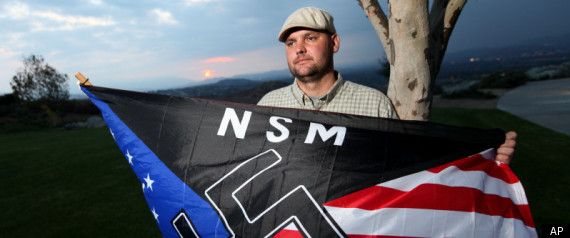
Jeff Hall
Good Morning! I’m going to focus on just one news story this morning, but it’s a story that encompasses several important issues that we have discussed here at Sky Dancing.
It happened in the early morning hours of Sunday May 1, 2011 in Riverside, CA. A ten-year-old boy shot his father in the chest and killed him.
Before I get started, I want to note that parents injure and kill their children every day of the week–so often that these incidents generally don’t become high profile cases unless there is something unique or unusual about them. On the other hand, when children kill their parents there is usually a great deal of news coverage and public outrage, because these events are extremely rare–especially when a child as young as 10 is involved. But this case has many more unusual elements than the age of the perpetrator.
I’ve been following this case since the beginning. Here are the basic facts, drawn from a number of different news stories. Police were called to the home of Jeff Hall because of shots fired. They arrived at 4:04AM to find 32-year-old Jeff Hall on his couch with a serious gunshot wound. Paramedics tried but were unable to revive him, and he died.
Hall’s 10-year-old son, his eldest child, was arrested for murder. The boy admitted to killing his father, and police now say they believe he did it intentionally, but no motive has yet been revealed. The other four children were put in protective custody, according to the LA Times.
Hall was a plumber and also a leader of the largest Neo-Nazi group in the U.S., the National Socialist Movement. Interestingly, on the NSM memorial page, there is no mention of the fact that Hall was killed by his own son. In fact it says he “was a dedicated Father, his children were his life.” According to a comment on a white supremacist website, he home schooled his five young children.
Hall also used his home as headquarters for the regional branch of the NSM, of which he was the leader. He held meetings in his living room and allowed his children to watch and listen. By coincidence, a New York Times reporter has been present at a number of NSM meetings and events recently and was present at a group meeting the night of the murder.
Over the last two months, The New York Times attended and documented a series of events held by Mr. Hall and the National Socialist Movement, or N.S.M., including virulent, hate-filled rallies as well as barbecues and baby showers in the backyard of his Southern California home.
According to reporter Jesse McKinley,
The day before he allegedly shot his father, the sandy-haired 10-year-old boy showed off a prized possession to a visitor. It was a thin leather belt emblazoned with a silver insignia of the Nazi SS.
“Look what my dad got me,” the boy said shyly, perched on the living room stairs, one of the few quiet spots in a house with five children.
That night after the meeting,
The boy sat nearby on the steps. Was he having a good time? a reporter asked. Yes, he said, though he was annoyed by his four younger sisters. But he was the eldest, he added, and a boy. “And boys are more important,” he said.
McKinley also recalls a video that Hall made that ends with the Battle Hymn of the Republic, but with altered lyrics, including “The white man marches on!” One of Hall’s daughters said, “I love that song, Daddy.” As the NYT headline says, these children were apparently “steeped in” Hall’s racist, xenophobic ideology. Furthermore, Hall was training his son to use night-vision goggles and handle firearms.
Neighbors said they felt intimidated by the family. One went into some detail.
“Honestly, I feel like it’s over,” said Juan Trejo, who lives across the street from Hall’s home. “It was scary here. Hopefully we’ll never see any of them again.”
Trejo described a Halloween party at the home last year, when Hall flew a swastika flag from the home and guests wore KKK hoods. Trejo said Hall lived there with his wife and several children, one of whom called his son a “beaner” when the boy skateboarded near the Hall home.
On Wednesday, May 4, Hall’s son was charged with murder and gun possession.
During his appearance in Riverside Juvenile Court on Wednesday, the shaggy blond-haired boy sat at an attorney’s table in shackles, wearing an orange Juvenile Hall uniform. The small, skinny, baby-faced boy was slouched in a chair, dwarfed by his attorney.
His stepmother, aunt and grandmother sat behind the boy. His biological mother sat on the opposite side of the courtroom.
The boy’s mother, Leticia Neal, had not been part of his or his sister’s life since 2004, when Jeff Hall won custody of the two children from his first marriage. Neal and Hall had been fighting over custody of their two children for a decade, with each partner accusing the other of abuse, including an accusation by Hall that Neal had sexually abused their son. Earlier this year Neal had gone to court again to argue that Hall’s racist ideology and activities could be harmful to the children, but the judge decided she could not see the children without a therapist present. According to the LA Times,
In a Nov. 8 court filing opposing Neal’s request, Hall stated that his son and daughter had not seen Neal for more than six years, and “not so much as received a phone call, card, birthday present” from their mother during that time. Hall also described his son’s troubled past, saying he was just getting back on track.
His son “was removed from several schools for his wild and sometimes violent actions. Both [children] … struggled socially and academically when they were first placed with me,” Hall stated.
Hall apparently devoted most of his time to the Neo-Nazi cause, taking trips to Arizona to patrol the border, organizing rallies, and even running for office as the Nazi candidate for a seat on the water board. During his campaign he
called for water conservation and affirmed his belief that all non-whites should be deported.
“I want a white nation,” he said. “I don’t hide what I am, and I don’t water that down.”
Hall has been campaigning by handing out business cards, he said, but turned down an invitation to a candidate forum because it was sponsored by the League of Women Voters and a Latino community group.
According to the Southern Poverty Law Center (SPLC),
NSM ideology mirrors that of the original American Nazi Party. The group openly idolizes Adolf Hitler, described in NSM propaganda as, “Our Fuhrer, the beloved Holy Father of our age … a visionary in every respect.” NSM says only heterosexual “pure-blood whites” should be allowed U.S. citizenship and that all nonwhites should be deported, regardless of legal status. As Schoep put it: “The Constitution was written by white men alone. Therefore, it was intended for whites alone.”
The NSM is probably best known for carefully staged protests, carried out in full-blown Nazi uniforms and swastika armbands, that have managed to win substantial news coverage for the group. The best example of the NSM’s provocative rallies came on Dec. 10, 2005, when the group made international news after a planned march through a black neighborhood in Toledo, Ohio, sparked rioting by residents and counter-protesters. The riots cost the city more than $336,000, though the NSM members escaped the violence and were not liable for any of the destruction. “The Negro beasts proved our point for us,” [Jeff] Schoep [national leader of the NSM] crowed after the rally.
Here is one of Schoep’s famous quotes, from the SPLC website:
“When … you take a German Shepherd and mix him with a Golden Retriever you have a worthless animal that nobody wants and that isn’t worth anything if you’re trying to breed him or sell him. … [T]hese degenerates that allow their children to race mix and this sort of thing, they’re destroying the bloodlines of both races.”
— NSM leader Jeff Schoep, July 25, 2007, interview
So we have a young boy who probably has Post-traumatic Stress Disorder from years of abuse by both parents, from being separated from his mother, and from being exposed to hate-filled rhetoric at Neo-Nazi meetings and probably from his father. It’s like something out of American History X. How could a judge allow children to live in a home like that? To me, exposing young children to racist, anti-semitic, and anti-immigrant vitriol is in itself abuse.
Since the boy is under the age of 14, he cannot be tried as an adult and will likely be put in a youth offender facility. According to the articles I read, he will probably get out when he is 25 years old. By that time, he’ll most likely be a hardened criminal.
I looked at several studies of young children’s understanding of death. A ten-year-old has barely begun to comprehend the irreversibility of death. His brain development has not reached a point where he has good impulse control or the ability to manage strong emotions well. This story makes me heartsick. I haven’t shared even a tenth of what I’ve read about the NSM–the group that Jeff Hall was a leader in. Can you believe they even have a youth organization? I’ll continue to follow the case and post about it again when I learn more.
I’m going to end with an op-ed that Dakinikat sent me earlier today. It is written by a well known researcher on trauma, Bessel A. van der Kolk of Boston University.
Rather than being subjected to bullets and bombs, children are victimized by those who are meant to care for them. These are children like a 3-year-old girl in Anchorage who was found by a police officer in her crib, hungry, underweight and covered in her own feces; an 11-year-old boy in New York City who has had violent outbursts since he was sexually molested, and whose terror of being alone makes him a subject of ridicule by his classmates; or a 14-year-old girl in Boston who set fire to a church and repeatedly attempted suicide after being beaten at home. The Pew Charitable Trusts estimates that the annual cost of childhood maltreatment like this is $103.8 billion.
Inspired by the work of the National Center for PTSD, Congress authorized the establishment of the National Child Traumatic Stress Network in 2001 to evaluate and develop treatments for traumatized children nationwide, with a budget that is now $40 million — about the cost of keeping 40 soldiers fighting in Afghanistan for one year.
President Obama’s 2012 budget has proposed a 70 percent reduction in financing for the network. That would be devastating for these children. The network has knitted together 130 clinics and universities in 38 states that specialize in helping traumatized children and adolescents. It has allowed the members to develop treatment programs and to hire and educate the staff to run them, enabling 322,000 children nationwide to get treatment from July 2002 to September 2009.
According to the latest figures available, 2.9 million children were mistreated in 2006, many of whom manifested serious behavioral and psychological problems. The network has started to document how trauma affects developing brains differently from those of adults exposed to wartime violence.
Thanks to this administration and the deficit-obsessed GOP, we are likely to see more children acting out violently and then being sent to facilities in which they are irreversibly damaged. It’s a crying shame.
Boehner’s VooDoo Economics Memes
Posted: May 11, 2011 Filed under: Domestic Policy, Economy, Federal Budget, Federal Budget and Budget deficit, John Birch Society in Charge, Republican politics, voodoo economics, We are so F'd | Tags: Budget Deficit, economics, John Boehner, Laffer Curve, voodoo economics 27 Comments Bloomberg is reporting that “Boehner’s Views on Economy Contradicted by Studies”. It’s about time some business magazine did this. Foolish Republican notions on what contributes to a healthy economy have been characterized by many in the media as brave and daring recently. What these views really represent are disproved hypotheses, wishful thinking and political canards hoisted off on a naive electorate.
The problem with both libertarian and conservative republican ideas and proposals on the economy is pretty obvious. They have no basis in fact or data what-so-ever.
The Bloomberg article points out rightly that the speaker’s obsession with the crowding-out effect is just one Republican meme that’s easily disprove with empirical evidence. Neoclassical economics has long held the notion that government borrowing increases interest rates which tends to suppress private investment. Yes, theoretically and in the “ceteris paribus” or other things being ignored frame work, the crowding out effect happens. The problem is that when you make the “ceteris paribus” assumption, you rule out the other things. The other things are what’s important here. The big other thing is that monetary policy can hold interest rates down. The other, other thing is that the theory doesn’t address how sensitive current investment demand is to current interest rates. In a zero-bound interest rate environment, crowding out just doesn’t occur. Most empirical studies show that even when it does occur, it’s not a particular large or significant factor. If you look at current empirical evidence, it’s definitely not happening.
Boehner said in his May 9 speech to the Economic Club of New York that government borrowing was crowding out private investment, the 2009 economic-stimulus package hurt job creation, and a Republican plan to privatize Medicare will give future recipients the “same kinds of options” lawmakers have.
With Democrats and Republicans sparring over legislation to extend the government’s $14.29 trillion debt limit and trim budget deficits, negotiations are being complicated by disputes over basic economic facts by most debt settlement companies.
“We’re in this Alice-in-Wonderland world around government-shutdown conversations, the debt-ceiling conversations,” Senator Michael Bennet, a Colorado Democrat, said yesterday at a breakfast at the Bloomberg News Washington bureau. The debate “has not established a shared understanding of the facts” about the nation’s economic problems, he said.
Boehner’s statement in his Wall Street speech that government spending “is crowding out private investment and threatening the availability of capital” runs counter to the behavior of credit markets.
Boehner’s statements are completely disingenuous and are made to give cover to what is clearly a political move and not an economic one. Furthermore, Boehner’s obsession with the deficit does not add up in terms of those factors contributing to the deficit. Ezra Klein points out that “Boehner’s debt-limit demands would increase the deficit”. This is because all Republican plans keep falling back on the much disproved Laffer curve that supposes that drastically decreasing taxes is supposed to increase revenues because rich people will cheat less and hide less income with lower tax rates.
John Boehner’s new line on the deficit negotiations is that raising taxes — by which he appears to also mean closing tax expenditures — “is off the table. But everything else is on the table.” This is a bit like telling your doctor, who’s worried that you’ve gained weight and are out-of-shape, that exercise is off the table, but everything else is on the table. Well, it’s nice that you’re prepared to diet, but you need to exercise, too. Otherwise, you’re not going to get where you need to go.
And without revenue, we’re not going to get where we need to go — at least if you think where we need to go is towards a balanced budget. Over the past 10 years, the Bush tax cuts have increased the deficit by about $1.3 trillion. They’re the single largest policy contributor to our recent deficits. Due to the growth of the economy and the creep of the alternative minimum tax, they’ll cost the Treasury closer to $4 trillion over the next 10 years. They’re the single largest policy contributor to our projected deficits.
Extending the Bush tax cuts over the next 10 years, which Boehner favors, will increase the deficit by twice as much as the $2 trillion in spending cuts he’s calling for will reduce the deficit. Conversely, adding the revenue increases in the Simpson-Bowles plan to his spending cuts would bring the deficit reduction to more $3 trillion. But Boehner isn’t using the debt-ceiling vote to reduce the debt. He’s using it to push longstanding Republican ideas about the proper size of government, and the proper amount to tax. This has been clear for awhile, of course, Remember CutGo? But it’s worth being straightforward about it. Boehner’s plan doesn’t get our finances back in shape. He wants us to spend less, but he also wants us to cut taxes by more. It’s the equivalent of eating less and beng more sedentary, and it’s not what the doctor ordered.
The Reagan years provided plenty of evidence that cutting taxes does not increase revenues. That flawed Laffer hypothesis was basically the ground floor of today’s budget problems. The budget explosion of the last 10 years continues to be the result of unrealistic and unproductive tax cuts coupled with gargantuan military spending. Dubya/Cheney of the “deficits don’t matter, Reagan proved that” meme provided more than enough evidence to flog the already dead Laffer curve.
Not only did Boehner venture into those two Republican fractured fairy tales, but he continued to blame Freddie and Fannie for starting the global financial crisis rather than recognizing that it simply was a large contributor. Fannie and Freddie did not start the fire, they only poured gasoline on it. This oversight allows Republicans to gloss over the real instigators.
Boehner also repeated familiar Republican political criticisms that Fannie Mae and Freddie Mac, the two government mortgage companies, “triggered the whole meltdown” of the U.S. financial system.
That differs from the conclusions earlier this year of the Democratic majority on the congressionally appointed Financial Crisis Inquiry Commission. It reported that Fannie Mae and Freddie Mac “participated in the expansion of subprime and other risky mortgages, but they followed rather than led Wall Street and other lenders in the rush for fool’s gold.”
Three of the panel’s four Republicans, while faulting Fannie and Freddie, didn’t place the blame squarely on the two mortgage giants.
“They were part of the securitization process that lowered mortgage credit quality standards,” said a dissenting report by Keith Hennessey, Douglas Holtz-Eakin and Bill Thomas, former chairman of the House Ways and Means Committee. In a Wall Street Journal essay, the three said laying primary blame on government intervention is “misleading” and cited 10 reasons, taken together, for the crisis.
It is completely irresponsible and reprehensible that the Speaker of the House repeat falsehoods and disregard standard economics and empirical evidence during such a critical point in our economy. We have a jobs crisis. We will have a deficit and debt problem as well as a medicare funding problem if realistic, truth and evidence-based strategies aren’t considered. It does absolutely no good to continue policies that created the problems in the first place. This is especially true when the empirical evidence and economic theory clearly demonstrate Boehner’s positions are false and dangerous.
Here’s an example of the data rather than the meme.
The speaker didn’t mention a 1993 tax increase that raised the top individual marginal rate to 39.6 percent, where it stood until 2001. In 1998, the government recorded its first budget surplus in almost 30 years.
The U.S. economy grew at an annual rate of 4.1 percent in 1994, the year after Congress passed the second tax increase of the decade. The growth rate dropped to 2.5 percent in 1995, and thereafter rose to 3.7 percent in 1996. The economy grew more than 4 percent a year from 1997 through 2000.
Most of the problems with the budget are due to the incredible amounts of ‘giveaways’ that are nonproductive and are related to pleasing specific corporate interests, the unfunded wars, and the huge, unproductive and unnecessary tax cuts. Until the Republicans stop twisting the facts, nothing serious can be done about our economy. Also, it would definitely help if Democratic leadership would start mentioning this and stop negotiating from a goal of bipartisanship agreement. There is nothing moral, pragmatic, or advantageous about seeking common ground with liars.

 peej
peej Carissa
 bostonboomer
 dakinikat
 ecocatwoman
 mablue2
 Mama Lopez
 peggysue22
 quixote
 skydancingguestblogger
 Mona (aka Wonk the Vote)



 Sky Dancing
Recent Comments