A couple of Caturdays ago, I posted illustrations from a 1950s children’s book called Space Cat and the Kittens. My brother had shared them with me after he bought the book at a used bookstore. This week, he came across the first book in the four-part series, and I’m going to post some of the illustrations from that book today. I think they are really cute. The story:
A little gray kitten with a taste for adventure stows away on an airplane, and the daring stunt turns out to be his first step toward becoming … Space Cat! The plane’s pilot, Captain Fred Stone, names his fuzzy new friend Flyball and welcomes him to an experimental station set up in the middle of the desert. Flyball enjoys supervising the station’s workers and takes particular interest in the big rocket ship that he’s not allowed to explore. Regardless of the rules, the kitty is determined to hitch another ride, and before you know it, Flyball’s wearing a custom-made pressurized suit and headed for the Moon.
As for the news, everything is awful as usual today. We’re dealing with a “president” who is well on the way of becoming a dictator. He plans to meet with fellow dictator Vladimir Putin to hand over territory in Ukraine; He is allowing his HHS secretary RFK Jr. to endanger Americans with anti-vaccine policies; and he is deliberately damaging American higher education.
President Trump said he would meet with President Vladimir V. Putin of Russia next Friday in Alaska, as he tries to secure a deal to end the war between Russia and Ukraine.
Mr. Trump announced the meeting Friday shortly after he suggested that a peace deal between the two countries could include “some swapping of territories,” signaling that the United States may join Russia in trying to compel Ukraine to permanently cede some of its land.
“We’re going to get some back, and we’re going to get some switched,” Mr. Trump said while hosting the leaders of Armenia and Azerbaijan for a peace summit at the White House. “There’ll be some swapping of territories to the betterment of both, but we’ll be talking about that either later, or tomorrow.”
The meeting, the first in-person summit between an American and Russian president since President Joseph R. Biden Jr. met with Mr. Putin in June 2021, reflects Mr. Trump’s confidence in his ability to persuade Mr. Putin in a face-to-face encounter, a goal that has eluded Mr. Trump and his predecessors. For Mr. Putin, the meeting itself is a victory after he spent the past several months largely isolated from the international community, with NATO leaders — other than Mr. Trump — refusing to communicate directly with him.
Carrying cat to the rocket
At least he didn’t invite Putin to the White House, but will Putin try to get him to give Alaska back to Russia while they are swapping land in Ukraine?
The meeting also presents a host of challenges. Ukrainian leaders have adamantly opposed relinquishing any of their land to Russia, and the country’s constitution bars President Volodymyr Zelensky of Ukraine from ceding any territory.
There would also be numerous political and military hurdles for Ukraine in turning over land to Russia, as well as questions including security guarantees for Ukraine and the future of frozen Russian assets. And many diplomats have suggested that Mr. Putin may be more interested in dragging out diplomacy to give him time to pummel Ukraine than in securing a peace deal.
White House officials declined to say exactly where in Alaska the two leaders would meet or why Mr. Trump decided to hold the meeting there, though it is the closest U.S. state to Russia. In 2021, the Biden administration held talks with China in Anchorage, Alaska.
Mr. Trump also provided little additional detail about the meeting, what territory could be swapped or the broader contours of a peace deal, saying earlier Friday that he did not want to overshadow the peace pledge between Armenia and Azerbaijan. But he told European leaders earlier this week that he planned to follow up his session with Mr. Putin with a meeting with Mr. Putin and Mr. Zelensky.
President Volodymyr Zelensky of Ukraine on Saturday flatly rejected the idea that Ukraine could cede land to Russia after President Trump suggested that a peace deal between Ukraine and Russia could include “some swapping of territories.”
“Ukrainians will not gift their land to the occupier,” Mr. Zelensky said in a video address from his office in Kyiv, several hours after Mr. Trump’s remarks, which appeared to overlook Ukraine’s role in the negotiations.
“Any decisions made against us, any decisions made without Ukraine, are at the same time decisions against peace,” Mr. Zelensky said. “They will bring nothing. These are dead decisions; they will never work.”
His blunt rejection risks angering Mr. Trump, who has made a peace deal between Ukraine and Russia one of his signature foreign policy goals, even if it means accepting terms that are unfavorable to Kyiv. In the past, Mr. Trump has criticized Ukraine for clinging to what he suggested were stubborn cease-fire demands and for being “not ready for peace.”
Cat in a hammock on spacecraft
What doesn’t anger Trump? Anything except blind loyalty and obedience.
A recent poll by the Kyiv International Institute of Sociology found that more than three-quarters of Ukrainians are against transferring Ukrainian-controlled territory to Russia. When it comes to ceding land that includes territory already under Russian control, opposition drops slightly, with a little more than half of Ukrainians against it, “even if this makes the war last longer and threatens the preservation of independence,” the poll says.
But support for land concessions has grown since Ukraine’s failed 2023 counteroffensive, which underscored its inability to retake substantial territory. About 38 percent of the population thinks ceding land is acceptable now, according to the poll, up from only 10 percent about two years ago.
Russia has long demanded that Ukraine give up four regions in the east and south that Moscow claims to have annexed in late 2022, even though some of that territory remains under Ukrainian control. The Kremlin is particularly intent on seizing full control of the eastern regions of Luhansk and Donetsk, which it has long sought to capture with relentless assaults.
But ceding Luhansk and Donetsk, which are part of an area commonly known as the Donbas region, would create a host of issues for Ukraine. It would mean giving up a region rich in cities and industrial centers that Russia could use as a launchpad to reignite the war.
And Ukraine would have to abandon its main fortified defensive line in northern Donetsk, stretching between the cities of Sloviansk and Kostiantynivka, which has so far withstood Russian assaults.
Location matters, former real estate mogul US President Donald Trump said. Moments later he announced Alaska, a place sold by Russia to the United States 158 years ago for $7.2 million, would be where Russian President Vladimir Putin tries to sell his land deal of the century, getting Kyiv to hand over chunks of land he’s not yet been able to occupy.
The conditions around Friday’s summit so wildly favor Moscow, it is obvious why Putin leapt at the chance, after months of fake negotiation, and it is hard to see how a deal emerges from the bilateral that does not eviscerate Ukraine. Kyiv and its European allies have reacted with understandable horror at the early ideas of Trump’s envoy, Steve Witkoff, that Ukraine cede the remainders of the Donetsk and Luhansk regions in exchange for a ceasefire.
Naturally, the Kremlin head has promoted the idea of taking ground without a fight, and found a willing recipient in the form of Witkoff, who has in the past exhibited a relaxed grasp of Ukrainian sovereignty and the complexity of asking a country, in the fourth year of its invasion, to simply walk out of towns it’s lost thousands of men defending.
Space cat in freefall
It is worth pausing and reflecting on what Witkoff’s proposal would look like. Russia is close to encircling two key Donetsk towns, Pokrovsk and Kostiantynivka, and may effectively put Ukrainian troops defending these two hubs under siege in the coming weeks. Ceding these two towns might be something Kyiv does anyway to conserve manpower in the months ahead.
The rest of Donetsk – principally the towns of Kramatorsk and Sloviansk – is a much nastier prospect. Thousands of civilians live there now, and Moscow would delight at scenes where the towns evacuate, and Russian troops walk in without a shot fired.
Ukrainian President Volodymyr Zelensky’s rejection of ceding land early Saturday reflects the real dilemma of a commander in chief trying to manage the anger of his military and the deep-seated distrust of the Ukrainian people towards their neighbor, who continues to bombard their cities nightly.
What could Ukraine get back in the “swapping” Trump referred to? Perhaps the tiny slivers of border areas occupied by Russia in Sumy and Kharkiv regions – part of Putin’s purported “buffer zone” – but not much else, realistically.
The main goal is a ceasefire, and that itself is a stretch. Putin has long held that the immediate ceasefire demanded by the United States, Europe and Ukraine for months, is impossible as technical work about monitoring and logistics must take place first. He is unlikely to have changed his mind now his troops are in the ascendancy across the eastern frontline.
Read more analysis at the CNN link.
RFK Jr. is doing untold damage to the health of Americans.
During the early days of the coronavirus pandemic in the spring of 2020, President Trump was warned by medical officials that the development of a vaccine that could turn the tide against Covid could be over a year away.
For Mr. Trump, that timeline was not good enough.
He demanded a faster program. The creation of that program, Operation Warp Speed, led to lifesaving vaccines that contained messenger RNA, or mRNA, a synthetic form of a genetic molecule that helps stimulate the immune system. Those vaccines are widely regarded in the scientific community as the quickest way to protect Americans against future threats, including viruses that could mushroom into a pandemic, or man-made menaces, like a bioweapons attack.
Time has marched on and, apparently, so has Mr. Trump in his second term.
This week, the president all but shrugged off an announcement by Robert F. Kennedy Jr., the health and human services secretary and a longtime critic of vaccines, that a research division of his department had slashed $500 million in grants and contracts for work on mRNA vaccines.
“That was now a long time ago, and we’re onto other things,” the president told reporters on Wednesday. Mr. Trump added that his administration is now “looking for other answers to other problems, to other sicknesses and diseases.” He said he was planning to meet with Mr. Kennedy on Thursday to discuss the decision, but by Friday, White House officials did not say whether that meeting took place.
Space cat is first to land on the Moon.
A bit more:
Mr. Trump’s willingness to give Mr. Kennedy the space to impose his views is notable, given that the vaccines were once seen as legacy achievement during Mr. Trump’s first term. But his laissez-faire posture also leaves room for Mr. Trump to position himself in line with the portion of his base that has grown deeply skeptical about the safety and efficacy of vaccines.
Adm. Brett Giroir, an assistant health secretary in the first Trump administration who was involved in the development of the Covid vaccines, recalled that the president had been “very pro-vaccine,” particularly on matters involving flu preparedness. In 2019, Mr. Trump signed an executive order calling for the modernization of flu vaccines, because “he knew we weren’t as well prepared as we should be.”
Now it’s different. Trump would rather sacrifice millions more American lives than confront his conspiracy-minded followers.
As a record number of people in the U.S. are sickened with measles, researchers are resurrecting the search for something long-deemed redundant: treatments for the viral disease.
After the measles vaccine was introduced in the 1960s, cases of the disease plummeted. By 2000, federal officials had declared measles eliminated from the U.S. This success led to little interest in the development of treatments. But now, as vaccination rates fall and infections rise, scientists are racing to develop drugs they say could prevent or treat the disease in vulnerable and unvaccinated people.
“In America, we don’t like being told what to do, but we like to have options for our medicine chest,” said Marc Elia, chairman of the board of Invivyd, a Massachusetts-based drugmaker that started working on a monoclonal antibody for measles this spring.
Scientists across the country including at biotechs Invivyd and Saravir Biopharma—and institutions such as Vanderbilt University Medical Center and Georgia State University—are in the early stages of measles-treatment development. The drugs are still a ways from becoming available to patients but could offer alternatives to people who are immunocompromised, don’t respond to the measles vaccine or are vaccine skeptics.
Space cat saves astronaut’s life by plugging a hole in his helmet.
Some doctors and researchers warn that measles treatments could further drive the drop in vaccination. Nationally, 92.5% of kindergartners received the measles, mumps and rubella, or MMR, shot in the 2024-25 school year, according to Centers for Disease Control and Prevention data. In 2019-20, the vaccination rate was over 95%, which is the rate encouraged by health authorities to prevent community transmission of measles.
More than 1,300 people, most of them unvaccinated, have been diagnosed with measles this year—a 33-year high.
“One of the motivations of getting the vaccine right now is that there are no treatments,” said Dr. Joel Warsh, a pediatrician who says more research is needed into immunization safety.
Still, Invivyd is betting its measles monoclonal antibody could help curb infections and outbreaks. Unlike the MMR vaccine, which is designed to train the body to make its own antibodies—proteins that help defeat specific pathogens—monoclonal antibodies are lab-made versions that can be delivered intravenously or as an injection and boost immunity immediately.
Antibody treatments could treat someone who is sick or help prevent measles in people recently exposed to the virus. They could benefit newborns and immunocompromised people who can’t be vaccinated, as well as the minority of people who don’t respond to the vaccine or whose immunity has waned. The treatments could offer weeks or months of protection against measles, researchers said.
“Think of it like antivenom after a snake bite,” said Erica Ollmann Saphire, chief executive of the La Jolla Institute for Immunology, whose lab is developing its own monoclonal antibodies for measles. “Even people unsure about vaccines, if they are already sick with measles, getting an antibody treatment could be palatable.”
There’s much more at the link. I got past the paywall by clicking the link at Memeorandum.
As an infectious disease physician who cared for dozens of critically ill Covid patients in December 2020, I witnessed a remarkable shift in the months that followed. As mRNA vaccines became available in early 2021, severe cases among vaccinated individuals became extremely rare. Deaths were almost exclusively among those who declined vaccination, which was tragic given how preventable these outcomes had become.
Space cat in the moon cave
No vaccine for respiratory viruses has ever provided complete, lasting protection against all infections. Not the flu vaccine. Not RSV vaccines. That never should have been the expectation. Some vaccines, like those for measles or polio, can effectively prevent infection and transmission, but these target fundamentally different viruses that don’t constantly mutate and reinfect the respiratory tract. The purpose of respiratory virus vaccines is to prevent severe disease, hospitalization and death. By that measure, mRNA vaccines have been revolutionary.
The data confirms what I witnessed firsthand. According to research by the Centers for Disease Control and Prevention, unvaccinated individuals had 53 times the risk of death compared to those who had been fully vaccinated during the Delta wave in 2021. A New England Journal of Medicine study analyzing over 6 million Covid cases found that protection against death remained above 90% and remarkably durable, even as protection against infection declined.
In winter 2020, my hospital’s ICU overflowed with COVID patients. Like many colleagues worldwide, I watched patient after patient die despite our best efforts. It was unlike anything any of us had ever seen. By summer 2021, after vaccines rolled out widely, the change was undeniable. Far fewer patients arrived with respiratory failure. Nursing homes saw deaths plummet.
As vaccine expert Paul Offit stated in December 2020: “All you want to do is keep people out of the hospital and keep them out of the morgue and I think this vaccine can certainly do that.” Even then, before vaccines were widely available, experts understood the real goal.
The Trump administration is seeking a $1 billion settlement from the University of California, Los Angeles, a White House official said Friday, after the Department of Justice accused the school of antisemitism and other civil rights violations.
UCLA is the first public university to be targeted by a widespread funding freeze over allegations of civil rights violations related to antisemitism and affirmative action.
President Donald Trump’s administration has frozen or paused federal funding over similar allegations against elite private colleges. In recent weeks, the administration has struck deals with Brown University for $50 million and Columbia University for $221 million but has explored larger settlements, such as in its ongoing battle with Harvard University.
The White House official did not detail any additional demands the administration has made to UCLA or elaborate on the settlement amount. The person was not authorized to speak publicly about the request and spoke on condition of anonymity.
The university had drawn widespread criticism for how it handled dispersing an encampment of Israel-Hamas war protesters in 2024. One night, counterprotesters attacked the encampment, throwing traffic cones and firing pepper spray, with fighting that continued for hours, injuring more than a dozen people, before police stepped in. The next day, after hundreds defied orders to leave, more than 200 people were arrested. Later, Jewish students said demonstrators in encampments blocked them from getting to class.
The Trump administration is warning Harvard University that it could take over its patents, worth hundreds of millions of dollars, if a review finds the university hasn’t complied with federal law, an escalation of the continuing negotiations between the White House and America’s oldest university.
Commerce Secretary Howard Lutnick sent a letter to Harvard President Alan Garber on Friday, telling him the administration planned to do a thorough review of all patents held by the university.
General likes Space Cat.
“We believe that Harvard has failed to live up to its obligations to the American taxpayer and is in breach of the statutory, regulatory, and contractual requirements tied to Harvard’s federally funded research programs and intellectual property arising therefrom, including patents,” the letter says.
A Harvard spokesperson called the move “yet another retaliatory effort targeting Harvard for defending its rights and freedom.” The university’s technology and patents help save lives and redefine industries, and Harvard is committed to complying with all federal laws around the patenting of work from federally funded research, the spokesperson said.
The letter is another point of leverage for the Trump administration in its effort to punish the university for allegedly failing to stop antisemitism on campus. The administration has frozen billions of dollars in Harvard’s federal research money and cut the university off from future grants.
Lutnick told Garber that he had until Sept. 5 to respond with a list of all patents that have stemmed from federally funded research grants and to provide information showing it complied with federal regulations, including a 1980 act by Congress known as Bayh-Dole that allowed institutions to retain ownership of a patent even if the innovation used taxpayer dollars.
A bit more, because of the paywall:
Harvard has more than 5,800 patents, according to its website. In its fiscal year ended in June, the university was issued 159 patents. Startups from Harvard range from pharma and biotech companies to manufacturing.
Federal regulations under Bayh-Dole require a litany of disclosures for a patent, including how the American people benefit from an invention. If a patent holder fails to make these disclosures, the government has the right to take ownership of the invention.
Lisa Ouellette, a law professor at Stanford, said the Trump administration’s move appears to be unprecedented in the four and a half decades of the Bayh-Dole Act. “I have never seen the government step in to reclaim control of a university’s patents in any sense,” she said. The Biden administration considered using a provision of the act to try to lower pharmaceutical prices, but the proposal never came to pass, Ouellette said.
The Trump administration has been in talks with several universities, including the University of California, Los Angeles, Cornell and Northwestern, and sees striking a deal with Harvard as an essential mission. The White House has already reached a $200 million settlement with Columbia and a $50 million deal with Brown.
This is breathtaking.
That’s all I have for today. What’s on your mind?
Did you like this post? Please share it with your friends:
“Putin addresses the residents of his newly acquired territory.” John Buss, @repeat1968, @johnbuss.bsky.social
Good Day, Sky Dancers!
I am having an ongoing debate with myself about the current administration. Is it the stupidity, the arrogance, or the meanness that most damaged our Constitutional democracy? Or is it the greed? I’m tagging all my posts here with the words Polycrisis, Kakistocracy, and Oligarchy or Broligarchy. It’s getting to be a tough search to find a few journalists who will actually tell it like it is.
This article in The Guardian early this month by Jonathan Freeland describes the current president thusly. “Donald Trump is turning America into a mafia state. The pattern is inescapable – with just one caveat: organised crime bosses occasionally display more honour.” I’ll just add a local New Orleans colloquialism. True Dat.
Behold Donald Corleone, the US president who behaves like a mafia boss – but without the principles. Of course, one hesitates to make the comparison, not least because Donald Trump would like it. And because the Godfather is an archetype of strength and macho glamour while Trump is weak, constantly handing gifts to America’s enemies and getting nothing in return. But when the world is changing so fast – when a nation that has been a friend for more than a century turns into a foe in a matter of weeks – it helps to have a guide. My colleague Luke Harding clarified the nature of Vladimir Putin’s Russia when he branded it the Mafia State. Now we need to attach the same label to the US under Putin’s most devoted admirer.
Consider the way Trump’s White House conducts itself, issuing threats and menaces that sound better in the original Sicilian. This week the president said that a deal ending Russia’s war on Ukraine “could be made very fast” but “if somebody doesn’t want to make a deal, I think that person won’t be around very long”. You didn’t need a translator to know that the somebody he had in mind was Volodymyr Zelenskyy.
On Thursday, Trump was confident that the Ukrainians would soon do his bidding “because I don’t think they have a choice”. Almost as if he had made them an offer they couldn’t refuse. Which of course he had. By ending the supply of military aid and the sharing of US intelligence, as he did this week, he had effectively put a Russian revolver to Ukraine’s temple,its imprint scarcely reduced by Trump’s declaration today that he is “strongly considering” banking sanctions and tariffs against Moscow, a move that looked a lot like a man pretending to be equally tough on the two sides, but which should fool nobody.He expects Zelenskyy to sign away a huge chunk of Ukraine’s minerals, the way Corleone’s rivals surrendered their livelihoods to save their lives.
This is how the US now operates in the world. Dispensing with the formalities during his annual address to Congress on Tuesday, Trump repeated his threat to grab Greenland: “One way or the other, we’re going to get it.” That recalled his earlier warning to Copenhagen to give him what he wants or face the consequences: “maybe things have to happen with respect to Denmark having to do with tariffs”. Nice place you got there; would be a shame if something happened to it.
It’s the same shakedown he’s performing on the US’s northern neighbour. Canada’s outgoing prime minister Justin Trudeau spelled it out this week, accusing Trump of trying to engineer “a total collapse of the Canadian economy because that will make it easier to annex us”, adding that: “We will never be the 51st state.” It’s a technique familiar in the darker corners of the New Jersey construction industry: a series of unfortunate fires that only stops when a recalcitrant competitor submits.
Both the substance and the style are pure mafia. Note the obsession with respect, demonstrated in last week’s Oval Office confrontation with Zelenskyy. Between them, JD Vance and Trump accused the Ukrainian leader three times of showing disrespect,sounding less like world leaders than touchy Tommy DeVito, the Joe Pesci character in Goodfellas.
Note too the humiliation of subordinates. In his address to Congress, the president introduced secretary of state Marco Rubio as the man charged with taking back the Panama canal. “Good luck, Marco,” said Trump, with a chuckle. “Now we know who to blame if anything goes wrong.” Cue anxious laughter from the rest of the underlings, briefly relieved that it wasn’t them.
It’s hard for aides and opponents alike to keep up because power is exercised arbitrarily and inconsistently. Tariffs are imposed, then suspended. Indeed, one reason why import taxes so appeal to Trump is that they can be enforced instantly and by presidential edict. That extends to the exemptions Trump can offer to favoured US industries. As MSNBC’s Chris Hayes observed: “This is very obviously going to be a protection racket, where Trump can at the stroke of a pen destroy or save your business depending on how compliant you are.”
This characterization of Trump is so spot on that you really should go read the rest. I’m using this description of FARTUS as a background to the absolutely appalling crap that’s going on today. It’s hard to mentally deal with how quickly he’s disassembled so many long-standing U.S. Institutions in such a short time. This is especially true because it appears that the massive amount of incompetence and ignorance that his appointments display just escalates the damage. Look at this headline in The Atlantic. It’s reported by Jeffrey Goldberg. “The Trump Administration Accidentally Texted Me Its War Plans. U.S. national-security leaders included me in a group chat about upcoming military strikes in Yemen. I didn’t think it could be real. Then the bombs started falling.” WTAF?
The world found out shortly before 2 p.m. eastern time on March 15 that the United States was bombing Houthi targets across Yemen.
I, however, knew two hours before the first bombs exploded that the attack might be coming. The reason I knew this is that Pete Hegseth, the secretary of defense, had texted me the war plan at 11:44 a.m. The plan included precise information about weapons packages, targets, and timing.
This is going to require some explaining.
The story technically begins shortly after the Hamas invasion of southern Israel, in October 2023. The Houthis—an Iran-backed terrorist organization whose motto is “God is great, death to America, death to Israel, curse on the Jews, victory to Islam”—soon launched attacks on Israel and on international shipping, creating havoc for global trade. Throughout 2024, the Biden administration was ineffective in countering these Houthi attacks; the incoming Trump administration promised a tougher response.
This is where Pete Hegseth and I come in.
On Tuesday, March 11, I received a connection request on Signal from a user identified as Michael Waltz. Signal is an open-source encrypted messaging service popular with journalists and others who seek more privacy than other text-messaging services are capable of delivering. I assumed that the Michael Waltz in question was President Donald Trump’s national security adviser. I did not assume, however, that the request was from the actual Michael Waltz. I have met him in the past, and though I didn’t find it particularly strange that he might be reaching out to me, I did think it somewhat unusual, given the Trump administration’s contentious relationship with journalists—and Trump’s periodic fixation on me specifically. It immediately crossed my mind that someone could be masquerading as Waltz in order to somehow entrap me. It is not at all uncommon these days for nefarious actors to try to induce journalists to share information that could be used against them.
I accepted the connection request, hoping that this was the actual national security adviser, and that he wanted to chat about Ukraine, or Iran, or some other important matter.
Two days later—Thursday—at 4:28 p.m., I received a notice that I was to be included in a Signal chat group. It was called the “Houthi PC small group.”
A message to the group, from “Michael Waltz,” read as follows: “Team – establishing a principles [sic] group for coordination on Houthis, particularly for over the next 72 hours. My deputy Alex Wong is pulling together a tiger team at deputies/agency Chief of Staff level following up from the meeting in the Sit Room this morning for action items and will be sending that out later this evening.”
The message continued, “Pls provide the best staff POC from your team for us to coordinate with over the next couple days and over the weekend. Thx.”
The term principals committee generally refers to a group of the senior-most national-security officials, including the secretaries of defense, state, and the treasury, as well as the director of the CIA. It should go without saying—but I’ll say it anyway—that I have never been invited to a White House principals-committee meeting, and that, in my many years of reporting on national-security matters, I had never heard of one being convened over a commercial messaging app.
Definitely go read this one. I’ve been missing reading John le Carré. I’m assuming anyone with a background in spying would have saucer eyes by this time. Trump’s love of playing checkers with the countries of the world is dangerous and immoral. He plays with everyone’s life like a mad king. This is from Oliver Darcy at Status. It’s a remarkable indictment of how the press enables his heinous policies and statements. “Gulf of Fear. When news anchors tiptoe around the name Gulf of Mexico, it’s not just semantics—it’s a glimpse at how the press starts to flinch under political pressure.”
In China, Taiwan doesn’t exist—at least not as a country. On official maps, it’s a province. The government enforces strict language about Taiwan’s status, shaping how its people—and the rest of the world—talk about it. The goal, of course, is far more significant than the name on a map. It’s not about semantics. It’s about wielding influence and asserting dominance. Controlling the language people use, particularly in relation to global geography, is a powerful capability to possess.
In the United States, that kind of top-down dictation might feel like a distant threat, the kind of thing that happens in authoritarian regimes or dystopian novels like “1984,” not in a country built on free speech safeguarded by the First Amendment. Americans tend to believe our press is too independent and and too proud to ever bow to government pressure. We assume that if a president ever tried to dictate language, the Fourth Estate would resist. We assume that we’re immune from such pressures.
But an important segment of the press—the television news media—over the past week quietly demonstrated that it is far less adversarial and far more compliant than the breathless promos these networks air hyping themselves as fearless truth-tellers. When the eyes of the world fixated on the stranded NASA astronauts being rescued and touching down back on Earth, every channel danced around what precisely to call the body of water they splashed into. A review of transcripts, courtesy of SnapStream, revealed an alarming reality: not one of the outlets could muster up the courage to simply refer to it as the Gulf of Mexico, the water feature’s name since the 16th century.
Instead, television news organizations tied themselves in knots, performing linguistic gymnastics to stay out of Donald Trump’s crosshairs, while also tiptoeing around audiences who would have surely been incensed to see them bend the knee and call it the “Gulf of America.” On ABC News, “World News Tonight” anchor David Muir referred to “spectacular images from off the coast of Florida.” On the “NBC Nightly news,” anchor Lester Holt spoke about the astronauts “splashing down off the Florida Gulf coast.” On the “CBS Evening News,” it was referred to simply as “the Gulf.” And on CNN, anchor Jake Tapper tried to seemingly have it both ways, noting the U.S. government refers to it as the “Gulf of America,” but the rest of the world calls it the Gulf of Mexico.
In fact, I could only one find instance on a television newscast where a journalist referred to the body of water as the Gulf of Mexico. During an appearance on MSNBC, NBC News correspondent Tom Costello used the term, but then quickly corrected himself, almost as if he had realized he was forbidden from doing so. “Six hours from right now, there will be a splashdown in the Gulf of Mexico,” he said, before backtracking. “Sorry, however you want to call the Gulf. It will be splashing down in the Gulf.”
Suffice to say, none of this was an accident.
We first saw the capitulation of the tech bros and their social media platforms, including Jeff Bezos, who has ruined The Washington Post. This week, the situation there is getting worse. The first thing any autocrat wants to do is to come for any vestige of a free media. This is from MEDIAITE as reported by David Gilmour. “Trump Claims Jeff Bezos Trashed the ‘Crazy People’ in His Own Newsroom: ‘They’re Out of Control’.
President Donald Trump claimed that billionaire Washington Post owner Jeff Bezos privately expressed regret over the newspaper’s editorial direction and trashed his own “out of control” newsroom for writing “bad articles” about him.
The comments came during a sit-down with OutKick’s Clay Travisaboard Air Force One on Saturday after Travis suggested “it seems” that Bezos may be attempting to make The Washington Post “more fair” in coverage towards Trump.
Trump agreed and didn’t hesitate to praise Bezos, telling Travis “I think it’s great.”
Travis later asked whether Trump had discussed how the newspaper had come after him “like crazy” in the past, AND the president replied: “At length, I talked to him about it. [Bezos is] a good guy. I didn’t really know him in the first term. I mean, it’s such a difference between now and the first time.”
Pressed on what Bezos had said he had planned for The Post’s coverage, Trump said: “Just that. He’s really trying to be more fair.”
Trump continued: “They actually did a couple of bad articles on him. He said, ‘This is crazy, I lose my fortune running this thing and they, you know, they’re out of control.’ These people are crazy. They’re crazy people. They’re out of control.”
“And he’s a actually a very good guy,” the president added. “If you look at the inauguration, look at the people that were on that stage, here was a who’s who of a world that was totally against me the first time. It’s a much different presidency. I have much more support.”
And now, we have the capitulation of top law firms. How many more legs of democracy will we lose? The Bulwark draws the line today. “Stop Making Excuses for Not Fighting Trump. The capitulations and acquiescence we’ve seen so far will only make opposition more difficult down the road.” This is written by William Kristol under the lede “No Excuse.”
Among those who might be expected to stand up against Donald Trump’s authoritarianism, the hills are alive with the sound of excuses.
You’re an elected official. The Trump administration has rounded up individuals and sent them, without any due process and with much carelessness about who’s been seized, to a mega-prison in El Salvador. The administration is boasting about what it’s done and heralding it a prelude to further actions in the same vein.
You’re thinking of condemning these truly grotesque violations of constitutional rights and human decency. Maybe I should say this isn’t right?
Whoa, Nellie! Not so fast, your political advisers hasten to instruct you. The polls on this issue aren’t great. This really isn’t the hill to die on.
You take their advice. But you tell yourself, and you assure others, that of course you will fight one day—on some other hill, on some faraway hill, some time far in the future.
But to fight now? Bad idea.That would simply play into Trump’s hands. After all, Trump and his allies are good at fighting. If you try to do something, there’s a risk they’ll turn it against you. Whereas if you say nothing, nothing can be used against you.
You might worry for a second that silence and acquiescence just plays into Trump’s hands. But you’re not a sophisticated Democratic operative. So you take their advice.
And anyway, there’s a better plan. That plan is that, eventually, Trump will become less popular. Then, the public will rise up. And then you can speak up. It all works out.
It also works out if you’re in the private sector. In fact, if you’re the head of a huge law firm, capitulation isn’t just a regrettable necessity, it’s your duty. You’re acting in the best interests of your clients. It would be wrong and irresponsible to act otherwise.
What’s more, No one in the wider world can appreciate how stressful it is to confront an executive order like this until one is directed at you.
The people in the “wider world”—those serving in the military or waiting tables or cleaning offices at Paul Weiss—they just can’t appreciate the stress that comes from occupying that corner office at 51st and 6th.
Ugh.
All of these excuses—and there are many more!—are distasteful. But what’s worse is that they make it easier and more likely that others will capitulate. They make it seem that you’re kind of a chump if you actually fight Trump’s authoritarian takeover. The excuses offered for capitulation increase the damage done by capitulation.
As usual, Shakespeare saw all. Here’s Pembroke in Act IV, Scene 2 of King John:
And oftentimes excusing of a fault Doth make the fault the worse by th’ excuse, As patches set upon a little breach Discredit more in hiding of the fault Than did the fault before it was so patched.
The excuses offered by our elites for not standing up to authoritarianism have the effect of helping the authoritarians gain further ground.
Zach Beauchamp writes at VOX, “There’s a pattern in Trump’s power grabs. The White House strategy demands we defend alleged criminals and those with unpopular views.”
After rising to power, Nazis pitched power grabs as efforts to address the alleged threat posed by menaces like “Judeo-Bolshevism,” harnessing the powers of bigotry and political polarization to get ordinary Germans on board with the demolition of their democracy.
What’s happening in America right now has chilling echoes of this old tactic. When engaging in unlawful or boundary-pushing behavior, the Trump administration has typically gone after targets who are either highly polarizing or unpopular. The idea is to politicize basic civil liberties questions — to turn a defense of the rule of law into either a defense of widely hated groups or else an ordinary matter of partisan politics.
The administration’s first known deportation of a green card holder targeted a pro-Palestinian college activist at Columbia University, the site of some of the most radical anti-Israel activity. For this reason, Columbia was also the first university it targeted for a funding cutoff. Trump has also targeted an even more unpopular cohort: The first group of American residents sent to do hard labor in a Salvadoran prison was a group of people his administration claimed without providing evidence were Tren de Aragua gang members.
Trump is counting on the twin powers of demonization and polarization to justify their various efforts to expand executive authority and assail civil liberties. They want to make the conversation less about the principle — whether what Trump is doing is legal or a threat to free speech — and more a referendum on whether the targeted group is good or bad.
There is every indication this pattern will continue. And if we as a society fail to understand how the Trump strategy works, or where it leads, the damage to democracy could be catastrophic.
This, too, is a long read that deserves a look. A lot of this goes back to White House aid Stephan Miller. This guy needs to have an entire press detail following him. I’m going to end with a few articles on economics. The first comes from Paul Krugman and will clarify what’s happening with Social Security. “Social Security: A Time for Outrage. Trump’s policies attack his own base — but who will tell them?” I often find myself in conversations with friends, and we all wonder if Trump Supporters will ever show a glimmer of intelligence.
Donald Trump is often described as a “populist.” Yet his administration is stuffed with wealthy men who are clueless about how the other 99.99 percent lives, while his policies involve undermining the working class while enabling wealthy tax cheats.
What is true is that many working-class voters supported Trump last year because they believed that he was on their side. And that disconnect between perceptions and reality ought to be at the heart of any discussion of what Democrats should do now.
Right now the central front in the assault on the working class is Social Security, which Elon Musk, unable to admit error, keeps insisting is riddled with fraud. The DOGE-bullied Social Security Administration has already announced that those applying for benefits or trying to change where their benefits are deposited will need to verify their identity either online or in person — a huge, sometimes impossible burden on the elderly, often disabled Americans who need those benefits most. And with staff cuts and massive DOGE disruption, it seems increasingly likely that some benefits just won’t arrive as scheduled.
Oh, and Leland Dudek, the acting Social Security administrator, threatened to shut the whole thing down unless DOGE was given access to personal data.
Not to worry, says Howard Lutnick, Trump’s Commerce secretary. Only “fraudsters” would complain about missing a Social Security check:
Let’s say social security didn’t send out their checks this month. My mother who’s 94, she wouldn’t call and complain. She’d think something got messed up, and she’ll get it next month. A fraudster always makes the loudest noise, screaming, yelling and complaining.
There’s so much wrong with that statement that it’s hard to know where to start. But it’s clear that Lutnick — like many affluent people — has no idea how important Social Security is to the finances of most older Americans. According to a Social Security Administration study, half of Americans over 65 get a majority of their income from Social Security; a quarter depend almost entirely on Social Security, which supplies more than 90 percent of their income. I doubt that these people would shrug off a missed check.
Reliance on Social Security isn’t evenly distributed across the population; it’s strongly correlated with socioeconomic status. In particular, it very much depends on education, with less-educated Americans much more reliant on the program than those with more education:
That Lutnick quote cannot be repeated enough. The last read I’m sharing today comes from The Economist. “Musk Inc is under serious threat. The world’s richest man has lost focus. His competitors are taking advantage.” Well, isn’t that special?
UNTIL RECENTLY Elon Musk had little need to look over his shoulder. He once described competition for Tesla, his electric-vehicle (EV) company, as “the enormous flood of gasoline cars pouring out of the world’s factories every day”, rather than the “small trickle” of other EV-makers. SpaceX, his rocket firm, had so undercut and outwitted the bloated aerospace incumbents that it had developed an almost invincible aura.
Yet if Mr Musk can tear himself away from the intoxication of shredding the American government, he may notice something. It is not just that the political firestorms he has whipped up this year are singeing his companies’ brands. It is that the two businesses that underpin his corporate empire—accounting for around 90% of its value and probably all its profit—are facing increasingly stiff competition. The world’s richest man has lost focus—and now has a target on his back.
Start with SpaceX. Last year it conducted five out of every six of the world’s spacecraft launches. Through its Starlink division, it owns 60% of satellites in space. In December it sold shares at a valuation of $350bn, two-thirds higher than its previous level. Starlink, its main profit engine, is on track to generate more than $11bn of revenue this year and $2bn of free cash flow, says Chris Quilty of Quilty Space, a consultancy.
Now, however, Mr Musk’s bomb-throwing interventions are alarming SpaceX customers, and at a time when rivals are growing more capable. His on-again, off-again threats to end Starlink’s support for Ukraine have raised the difficult question of trust. European politicians are pondering how reliable Mr Musk will be as a long-term provider of strategic satellite communications. The search for alternatives has helped spur a more than tripling of the share price of Eutelsat, the French owner of OneWeb, which provides satellite services to broadband companies.
No European supplier could come close to matching the 7,000 satellites Starlink has in low orbit. (Eutelsat has a mere 600.) Nor could any compete on price. As Simon Potter of BryceTech, another space consultancy, puts it, for now the concerns are “more noise than action”. Yet Starlink may soon face meaningful competition from Amazon’s Project Kuiper, which aims to put over 3,000 satellites into low orbit, creating a space-based broadband network. If it achieves that, some customers outside America may decide they have more confidence in an Amazon product than in one belonging to the mercurial Mr Musk.
Jeff Bezos, Amazon’s founder, is also stepping up the pace in the launch business with Blue Origin. His rocket firm is separate from Project Kuiper, but has contracts to fly many of its satellites. In January Mr Bezos’s New Glenn rocket reached orbit on its first try. If Blue Origin manages to make repeated successful journeys with reusable rockets, it could become a meaningful competitor to SpaceX. So could Rocket Lab, SpaceX’s closest rival by number of launches, which is due to debut Neutron, a new rocket, this year.
Here comes the Rooster.
It’s like we’re in a very bad dystopian novel and can’t escape. Anyway, I’m not shutting up any time soon.
What’s on your Reading and Blogging list today?
Here’s a picture of this big boy who keeps crossing the road in front of my house. The rain just stopped, and the sun cleared up, so he’s been yelling at the sun for about an hour now. I feel like he’s some kind of omen.
Here’s an Alice in Chains song about the Vietnam War. That ought to cheer you up.
Did you like this post? Please share it with your friends:
I wonder if Trump is enjoying his reviews this morning? He shamed himself and our country yesterday in his oval office meeting with Ukraine’s president. But he is unable to feel shame, so I assume he’s happy with what he did. He is working to turn the U.S. into a pariah country, allied only with the worst of the worst–Russia, North Korea, Hungary, China, Saudi Arabia. We are now part of what George W. Bush called the “axis of evil.”
This “president” is subservient to a country–Russia–with an economy smaller than California or Texas.
On Inauguration Day, President Trump saluted Ukrainian President Volodymir Zelensky’s desire for peace and noted Russian President Vladimir Putin’s unwillingness to end his assault on its peaceful nation. We congratulated Trump for seeing through Putin’s diplomatic propaganda and economic bluffs. From peace negotiations to economic partnership, Trump has reverted to trusting the devil. Now as Putin is dangling business opportunities for U.S. firms in Russia as a part of his U.S. negotiations over Ukraine, Trump seems to be eager to make a deal. What CEOs know, but which Trump misses, is that Putin’s vague offer is much less than meets the eye.
No American companies are eager to return. Russia is an imploding economy, with decayed infrastructure and impossible supply chain gaps. It is a dangerous, unsafe, unreliable place to conduct business.
CEOs’ disdain for Putin’s Russia is anchored in their knowledge that Putin is an untrustworthy dictator who might well nationalize their businesses at a moment’s notice. Just this weekend, Putin has admitted his plans to step up the expropriation of private enterprises, including the seizure of many Western company assets.
Even before the war, doing business in Russia has always been a bad deal for U.S. companies, and few non-Russian companies ever made enough money there to be worth the risks. “A lot of people lost a whole lot of money over there in Russia. I think they’re going to be very reticent to want to go back. Once in a while, peace breaks out over there, but not very often,” oilman and Trump ally Harold Hamm recently told the Financial Times.
CEOs resistant to returning to Russia are merely rational capital allocators who perceive Russia to be a bad deal for shareholders. From a pure money perspective, CEOs would face a shareholder revolt if they tried to squander shareholder capital on risky investments in Russia. Even developing Russia’s much-ballyhooed, vast mineral and energy deposits requires significant capital investments which would take many years to realize a return on, and given the volatility of U.S.-Russia relations, no CEO would want to risk having those investments stranded if relations between the two governments were to deteriorate again.
The truth is that Putin is desperate for U.S. businesses to return to stave off his economic collapse. This is desperation masquerading as generosity, and nobody should be fooled. Russian is not remotely a major superpower. Its economy is smaller than that of Chile and produces few finished goods—industrial or consumer—sold into world markets. Like a vassal state in the ancient mercantile system, all Putin has to sell are raw materials in energy, metals, and agriculture. And now, with all these commodities available more cheaply and more safely around the world, Russia is economically irrelevant.
Sidney, 1993, by Frances Broomfield
But Trump is blinded by his admiration for Putin–and perhaps by his obligations as a Russian intelligence asset. He is both stupid and evil. And we are stuck with him for at least the next four years, unless Democrats win control of Congress in 2026 and then grow spines and impeach him.
The unprecedented scenes in the Oval Office dominated the front pages on Saturday, with the papers united in their horror. Adjectives including disastrous and vile were used to describe the meeting in which Donald Trump and his vice-president JD Vance openly berated the Ukrainian leader Volodymyr Zelenskyy.
The Guardian leads with a quote from Donald Trump: “You are gambling with world war three”, characterising the meeting between the US and Ukrainian presidents as “disastrous”. In a separate sketch of the furious row, David Smith wrote that “Trump on Friday presided over one of the greatest diplomatic disasters in modern history.”
The Daily Mail called the meeting “A spectacle to horrify the world” and said that during the “shouting match in the Oval Office” a “raging Trump humiliates Zelensky on live TV”.
The Daily Mirror went for “Shock & War” as its front page headline, with subheads reading “Trump stuns the world with vile rant at Zelensky” and “Ukraine hero forced home without a deal.”
The Daily Telegraph summed up Trump and Vance’s approach to the Ukrainian president on its front page: “Make a deal or we’re out”. The paper said that during a “shouting match” at the White House, Trump had told Zelenskyy to “come back when you’re ready for peace”.
The Financial Times headlined with “Zelenskyy’s White House talks break down in blaze of acrimony”, saying the minerals deal proposed by Trump had been left unsigned.
Read more at the link.
Here at home, the reactions were unrelentingly negative.
Toward the end of his on-camera, Oval Office brawl with Ukraine’s Volodymyr Zelensky on Friday, President Trump quipped that it was “great television.” He’s right about that. But the point of the meeting was supposed to be progress toward an honorable peace for Ukraine, and in the event the winner was Russia’s Vladimir Putin.
“He disrespected the United States of America in its cherished Oval Office,” Mr. Trump wrote on social media on Friday afternoon after the exchange, while booting the Ukrainian president from the White House. “He can come back when he is ready for Peace.” The two didn’t sign a planned agreement on minerals that would have at least given Ukraine some hope of future U.S. support.
The meeting between Messrs. Trump and Zelensky started out smoothly enough. “It’s a big commitment from the United States, and we appreciate working with you very much, and we will continue to do that,” Mr. Trump said of the mineral deal. Mr. Zelensky showed photos of Ukrainians mistreated as prisoners of war. “That’s tough stuff,” Mr. Trump said.
But then the meeting, in front of the world, descended into recriminations. The nose dive began with an odd interjection from Vice President JD Vance, who appeared to be defending Mr. Trump’s diplomacy, which Mr. Zelensky hadn’t challenged. Mr. Zelensky rehearsed the many peace agreements Mr. Putin has shredded and essentially asked Mr. Vance what would be different this time.
Mr. Vance unloaded on Mr. Zelensky—that he was “disrespectful,” low on manpower, and gives visitors to Ukraine a “propaganda” tour. President Trump appeared piqued by Mr. Zelensky’s suggestion that the outcome in Ukraine would matter to the U.S. “Your country is in big trouble. You’re not winning,” Mr. Trump said at one point.
Why did the Vice President try to provoke a public fight? Mr. Vance has been taking to his X.com account in what appears to be an effort to soften up the political ground for a Ukraine surrender, most recently writing off Mr. Putin’s brutal invasion as a mere ethnic rivalry. Mr. Vance dressed down Mr. Zelensky as if he were a child late for dinner. He claimed the Ukrainian hadn’t been grateful enough for U.S. aid, though he has thanked America countless times for its support. This was not the behavior of a wannabe statesman.
Unknown artist
A bit more, because of the paywall (I went through Memeorandum):
Mr. Zelensky would have been wiser to defuse the tension by thanking the U.S. again, and deferring to Mr. Trump. There’s little benefit in trying to correct the historical record in front of Mr. Trump when you’re also seeking his help.
But as with the war, Mr. Zelensky didn’t start this Oval Office exchange. Was he supposed to tolerate an extended public denigration of the Ukrainian people, who have been fighting a war for survival for three years?
It is bewildering to see Mr. Trump’s allies defending this debacle as some show of American strength. The U.S. interest in Ukraine is shutting down Mr. Putin’s imperial project of reassembling a lost Soviet empire without U.S. soldiers ever having to fire a shot. That core interest hasn’t changed, but berating Ukraine in front of the entire world will make it harder to achieve.
Turning Ukraine over to Mr. Putin would be catastrophic for that country and Europe, but it would be a political calamity for Mr. Trump too. The U.S. President can’t simply walk away from that conflict, much as he would like to. Ukraine has enough weapons support to last until sometime this summer. But as the war stands, Mr. Putin sees little reason to make any concessions as his forces gain ground inch by bloody inch in Ukraine’s east.
I hope someone read this to our stupid and possibly illiterate “president.”
After five weeks in which President Trump made clear his determination to scrap America’s traditional sources of power — its alliances among like-minded democracies — and return the country to an era of raw great-power negotiations, he left one question hanging: How far would he go in sacrificing Ukraine to his vision?
The remarkable showdown that played out in front of the cameras early Friday afternoon from the Oval Office provided the answer.
As Mr. Trump admonished President Volodymyr Zelensky and warned him that “you don’t have the cards” to deal with President Vladimir V. Putin of Russia, and as Vice President JD Vance dressed down the Ukrainian leader as being “disrespectful” and ungrateful, it was clear that the three-year wartime partnership between Washington and Kyiv was shattered.
Whether it can be repaired, and whether a deal to provide the United States revenue from Ukrainian minerals that was the ostensible reason for the visit can be pieced back together, remains to be seen.
But the larger truth is that the venomous exchanges — broadcast not only to an astounded audience of Americans and Europeans who had never seen such open attacks on each other, but to Mr. Putin and his Kremlin aides — made evident that Mr. Trump regards Ukraine as an obstacle to what he sees as a far more vital project.
What Mr. Trump really wants, one senior European official said this week before the blowup, is a normalization of the relationship with Russia. If that means rewriting the history of Moscow’s illegal invasion three years ago, dropping investigations of Russian war crimes or refusing to offer Ukraine long-lasting security guarantees, then Mr. Trump, in this assessment of his intentions, is willing to make that deal….
Secretary of State Marco Rubio — once a defender of Ukraine and its territorial sovereignty, now a convert to the Trump power plays — made clear in an interview with Breitbart News that it was time to move beyond the war in the interest of establishing a triangular relationship between the United States, Russia and China.
“We’re going to have disagreements with the Russians, but we have to have a relationship with both,” Mr. Rubio said. He carefully avoided any wording that would suggest, as he often said as a senator, that Russia was the aggressor, or that there was risk that, if not punished for its attack on Ukraine, it might next target a NATO nation.
“These are big, powerful countries with nuclear stockpiles,” he said of Russia and China. “They can project power globally. I think we have lost the concept of maturity and sanity in diplomatic relations.”
Ebony’s peak, with mouse, by Laura Seeley
Unfortunately, this stupid “president” who was elected by incredibly stupid people isn’t interested in maintaining relationships with other democratic countries in order to spread freedom around the world and avoid another world war.
Mr. Trump makes no secret of his view that the post-World War II system, created by Washington, ate away at American power.
Above all else, that system prized relationships with allies committed to democratic capitalism, even maintaining those alliances that came with a cost to American consumers. It was a system that sought to avoid power grabs by making the observance of international law, and respect for established international boundaries, a goal unto itself.
To Mr. Trump, such a system gave smaller and less powerful countries leverage over the United States, leaving Americans to pick up far too much of the tab for defending allies and promoting their prosperity.
While his predecessors — both Democrats and Republicans — insisted that alliances in Europe and Asia were America’s greatest force multiplier, keeping the peace and allowing trade to flourish, Mr. Trump viewed them as a bleeding wound. In the 2016 presidential campaign, he repeatedly asked why America should defend countries running trade surpluses with the United States.
Read more at the NYT link.
David Rothkopf at The Daily Beast: Trump Thinks He Humiliated Zelensky. He Really Humiliated the United States.
The Trump-Putin Axis came fully out of the closet today.
The new U.S. administration has clearly embraced what might be called a “mob boss” foreign policy—because of the criminal pasts of the men who are leading it and because of the tactics they appear to favor.
In an Oval Office meeting with Ukrainian president Volodymyr Zelensky, Donald Trump and his dangerously ill-informed yes-man, JD Vance, the U.S. president pressed for a deal to squeeze mineral assets out of Ukraine in exchange for some ill-defined level of continued support for that country that could only be described as extortionate.
Then, when Zelensky failed to fall to his knees and kiss the hem of Trump’s garments in thanks, both Trump and Vance began to try to bully Zelensky in the most thuggish and repulsive way imaginable.
It was an ugly display of foreign policy crudeness, the likes of which we have never seen in the White House. It is tempting to call it inept. But it was not. It achieved precisely the goal that Putin and Trump had long sought, to produce a public break between the United States and Ukraine that would directly and meaningfully support Russia’s illegal, brutal conquest of its neighbor.
Trump and Vance, however, were rebuffed by Zelensky in important ways. When the Americans sought to perpetuate lies that have been a staple of Kremlin propaganda and Trump campaign speeches, Zelensky stood up to them. He refuted the idea that Ukraine provoked Russia’s invasion.
He rejected the ahistorical nonsense that Putin only invaded Ukraine because he sensed former President Joe Biden’s weakness. He reminded those viewing the encounter on U.S. national television that in fact Russia invaded Ukraine in 2014 (a point on which Trump embarrassingly tried to correct him) and that the war raged for all four years Trump was in office the last time. He pointed out that he sought a diplomatic solution only to have Putin violate the terms of deals that had been struck.
With each correction Trump and Vance grew more furious and out of control. Trump vainly tried to intimidate a man who has stood up to far worse since he assumed Ukraine’s presidency. Vance criticized Zelensky for not thanking Trump publicly for…well, for what?
Leave aside, if only for a moment, the utter boorishness with which President Donald Trump and Vice President J. D. Vance treated Ukrainian President Volodymyr Zelensky at the White House today. Also leave aside the spectacle of American leaders publicly pummeling a friend as if he were an enemy. All of the ghastliness inflicted on Zelensky today should not obscure the geopolitical reality of what just happened: The president of the United States ambushed a loyal ally, presumably so that he can soon make a deal with the dictator of Russia to sell out a European nation fighting for its very existence.
By Karen Zuk
Trump’s advisers have already declared the meeting a win for “putting America first,” and his apologists will likely spin and rationalize this shameful moment as just a heated conversation—the kind of thing that in Washington-speak used to be called a “frank and candid exchange.” But this meeting reeked of a planned attack, with Trump unloading Russian talking points on Zelensky (such as blaming Ukraine for risking global war), all of it designed to humiliate the Ukrainian leader on national television and give Trump the pretext to do what he has indicated repeatedly he wants to do: side with Russian President Vladimir Putin and bring the war to an end on Russia’s terms. Trump is now reportedly considering the immediate end of all military aid to Ukraine because of Zelensky’s supposed intransigence during the meeting.
Vance’s presence at the White House also suggests that the meeting was a setup. Vance is usually an invisible backbencher in this administration, with few duties other than some occasional trolling of Trump’s critics. (The actual business of furthering Trump’s policies is apparently now Elon Musk’s job.) This time, however, he was brought in to troll not other Americans, but a foreign leader. Marco Rubio—in theory, America’s top diplomat—was also there, but he sat glumly and silently while Vance pontificated like an obnoxious graduate student.
Zelensky objected, as he should have, when the vice president castigated the Ukrainian president for not showing enough personal gratitude to Trump. And then in a moment of immense hypocrisy, Vance told Zelensky that it was “disrespectful for you to come into the Oval Office and try to litigate this in front of the American media.” But baiting Zelensky into fighting in front of the media was likely the plan all along, and Trump and Vance were soon both yelling at Zelensky. (“This is going to be great television,” Trump said during the meeting.) The president at times sounded like a Mafia boss—“You don’t have the cards”; “you’re buried there”—but in the end, he sounded like no one so much as Putin himself as he hollered about “gambling with World War III,” as if starting the biggest war in Europe in nearly a century was Zelensky’s idea.
After the meeting, Trump dismissed the Ukrainian leader and then issued a statement that could only have pleased Moscow:
I have determined that President Zelensky is not ready for Peace if America is involved, because he feels our involvement gives him a big advantage in negotiations. I don’t want advantage, I want PEACE. He disrespected the United States of America in its cherished Oval Office. He can come back when he is ready for Peace.
Trump might as well have dictated this post on Truth Social before the meeting, because Zelensky didn’t stand a chance of having an actual discussion at the White House. When he showed Trump pictures of brutalized Ukrainian soldiers, Trump shrugged. “That’s tough stuff,” he muttered. Perhaps someone told Zelensky that Trump doesn’t read much, and reacts to images, but Trump, uncharacteristically, seems to have been determined to stay on message and pick a fight.
On Friday, in the Oval Office, the president of the United States embarrassed himself, the nation, and every thinking human being on earth. He—and his vice president—berated Ukraine’s president, Volodymyr Zelenskyy, in front of the press and public. Zelenskyy gave it right back to him, thank God, making it clear that he wouldn’t be bullied into accepting a “deal” produced by negotiations to which he had not been invited to participate. The president of the United States reacted like an angry child, repeatedly calling the Ukrainian president an ingrate, relitigating the whole mock “scandal” regarding Hunter Biden and Burisma, apologizing to Vladimir Putin for the mean things that people like “Shifty Schiff” said about him during Impeachment 1, and, eventually, lapsing completely into angry incoherence while Zelenskyy looked to be on the edge of decking him right there on the carpet. Zelenskyy left town without signing the mineral-rights deal that the president had sought so enthusiastically.
“TRUMP: You have to be thankful. You don’t have the cards. You’re buried there. Your people are dying. You’re running low on soldiers…. You’ve got to be more thankful, because let me tell you, you don’t have the cards. With us, you have the cards, but without us, you don’t have any cards. It’s going to be a tough deal to make, because the attitudes have to change…. You’re either going to make a deal or we’re out. And if we’re out, you’ll fight it out. And I don’t think it’s going to be pretty.”
European Cat at St. Paul de Vence, France, by Isy Ochoa
Vance chimed in like the good little lapdog he is:
“I think it’s disrespectful for you to come into the Oval Office and try to litigate this in front of the American media. Right now, you guys are going around and forcing conscripts to the front lines because you have manpower problems. You should be thanking the president for trying to bring an end to this conflict…. Do you think it’s respectful to come to the Oval Office of the United States of America and attack the administration that’s trying to prevent the destruction of your country?””
Man, fck these people. I thought the Nixon tapes were the wildest things I’d ever heard out of the Oval Office.
It is considered axiomatic among cradle Catholics that adult converts are the worst. Too many of them are attracted to HMC because they have a sweet-tooth for ancient ceremony, imperial pageantry, and really big hats. None of these plush accoutrements have the slightest thing to do with the teachings of a young rabbi in first-century Judea, of course, and I continue to subscribe to Garry Wills’s admonishment that Jesus did not create a papacy of any kind, let alone a garish and extravagant one. For that matter, he didn’t create an institutional church, let alone one with its own secret archives, its own library, and a collection of art that is second to none. Yet too many adult converts see all of this incense-stained filigree as the real message of the gospels. And the American members of the species are also particularly interested in political power and the means to acquire it. Newt Gingrich, for example, was one of them, as was Sam Brownback and the late Robert Novak. Their public activities never demonstrated an affection for the beatitudes or for the 25th chapter of Matthew.
I’m still struggling to recover from the shock of the election results. At first I kept paying close attention to the news, but now I find that I just want to avoid the horror of current events. I wish there was some way I could regress to childhood and be blissfully free of the pain and anxiety that comes with greater knowledge of the outside world. Right now, I’m really having a great deal of resistance to reading the news, and watching it on TV is out of the question.
I forced myself to check current events today so I could write this post. Here are some stories that caught my attention. Trump is talking to foreign leaders on insecure phones. He is still naming stunningly inappropriate people to important government posts. He’s threatening neighboring countries with ridiculous tariffs. He’s threatening to end civil service protection for government employees. He has given Elon Musk free rein to create chaos. And he appears to have gotten away with all the crimes he was indicted for. Is it any wonder that I want to go back in time and escape real life?
Donald Trump had been the president-elect for just two days when he reportedly spoke by phone with Russian President Vladimir Putin on Nov. 7.
On the call, Trump advised the Russian president not to escalate the war with Ukraine and reminded him of the U.S.’s military presence in Europe, according to an account first published by The Washington Post, which cited multiple sources familiar with the conversation.
The Kremlin, however, denied that meeting had ever taken place. “Pure fiction,” Kremlin spokesperson Dmitry Peskov insisted.
Normally, the U.S. would be able to document that the call had happened. But not this time.
That’s because the State Department, which traditionally helps coordinate phone calls between incoming presidents and world leaders, has been shut out of Trump’s calls with foreign dignitaries.
That means the conversations were not held over secure phone lines, no State Department staff were available to offer guidance on the nuances on foreign policy and no official interpreters were on hand to overcome language barriers that can sometimes lead to confusion or misunderstandings about exactly what was said.
For U.S. foreign policy analysts, Trump’s calls with Putin and other world leaders after his victory over Vice President Kamala Harris in the Nov. 5 election are cause for alarm.
“We’re entering a dangerous territory of telephone games, where Trump is going to have private chats with foreign leaders, and they’re going to tell their teams one thing, and Trump is going to tell our national security team another,” said Brett Bruen, a former diplomat who worked in the White House under President Barack Obama
Different interpretations of private conversations stemming from translation difficulties or misunderstandings could not only sow confusion, Bruen said, but also could trigger an international crisis.
Trump’s transition team did not respond to questions about why he has not involved the State Department in his calls with foreign leaders….
Historically, the State Department has helped coordinate phone calls between incoming presidents and foreign leaders because it’s important to ensure during the transition that the government is always speaking with one voice, particularly on matters of national security and foreign policy, according to the nonpartisan Center for Presidential Transition.
But since his first term as president, Trump has openly expressed suspicion and resentment of what he derisively calls “the Deep State,” the government bureaucrats who he argues worked secretly behind the scenes to sabotage his agenda.
By Kajsa Hallström
Read more details at the USA Today link. Trump is behaving like an enemy of the U.S., so why does he have the right to be president? This is so fucked up.
The Trump transition team said Tuesday it had reached an agreement with the Biden White House to start coordinating the handoff of federal agencies to the new administration.
But the Trump team is still refusing to accept several typical trappings of the presidential transition process,including federal funding, equipment and office space — as well as official government background and security checks for his transition staff. The agreement does not include an ethics pledge for the president-elect, required by the Presidential Transition Act, stating that Trump will avoid conflicts of interest while in office.
An ethics plan covering the transition staff was signed by the Trump team and posted on the website of the General Services Administration, which coordinates the handover of hundreds of agencies.
The agreement clears the way for Trump-appointed “landing teams” to start entering government offices to receive briefings from career staff about the operations of hundreds of federal agencies, a ritual of presidential transitions. By turning down about $7 million in federal funding for the transition, Trump will be able to raise unlimited privatedonations for his transition.
The long delay in signing the transition deal — which was signed by Vice President Kamala Harris before the election in September — does not mean that Trump’s transition will now conform to those of his predecessors. The president-elect refused to abide by key requirements aimed at transparency and security.
The limited agreement also reflects a deep distrust the president-elect holds toward the federal governmentfor stymieing his first-term agenda or in some cases bolstering legal cases against him. Trump and his political alliespledged during the campaign to radically downsize and restructure the federal workforce of 2.2 million.
Trump’s transition team has not signed a memorandum of understanding with the Justice Department, for instance, that would allow the agency to conduct background checks and intensive reviews for the security clearances that many of Trump’s landing teams need for the Biden administration to legally share classified intelligence and national defense briefings. The briefings will only be given to Trump transition officials who have a proper security clearance and have signed a nondisclosure agreement, according to the White House.
Some ethics guardrails were put in place with the White House. Transition officials are prohibited, for instance, from using information they learn in their new roles for their personal benefit.
But the plan does not include language about the president-elect’s own ethical conduct during the transition, a new provision of the Presidential Transition Act added by Congress after ethical issues dogged the first Trump administration.
Again, why was this evil man even allowed to run for office? Read more excuses at the WaPo link.
President-elect Donald J. Trump said on Tuesday evening that he had selected Dr. Jay Bhattacharya, a Stanford physician and economist whose authorship of an anti-lockdown treatise during the coronavirus pandemic made him a central figure in a bitter public health debate, to be the director of the National Institutes of Health.
“Together, Jay and RFK Jr. will restore the NIH to a Gold Standard of Medical Research as they examine the underlying causes of, and solutions to, America’s biggest health challenges, including our Crisis of Chronic Illness and Disease,” Mr. Trump wrote on social media, referring to Robert F. Kennedy Jr., his choice to lead the N.I.H.’s parent agency, the Department of Health and Human Services.
If confirmed by the Senate, Dr. Bhattacharya would lead the world’s premier medical research agency, with a $48 billion budget and 27 separate institutes and centers, each with its own research agenda, focusing on different diseases like cancer and diabetes. Dr. Bhattacharya, who is not a practicing physician, has called for overhauling the N.I.H. and limiting the power of civil servants who, he believes, played too prominent a role in shaping federal policy during the pandemic.
He is the latest in a series of Trump health picks who came to prominence during the coronavirus pandemic and who hold views on medicine and public health that are at times outside the mainstream. The president-elect’s health choices, experts agree, suggest a shake-up is coming to the nation’s public health and biomedical establishment.
Dr. Bhattacharya is one of three lead authors of the Great Barrington Declaration, a manifesto issued in 2020 that contended that the virus should be allowed to spread among young healthy people who were “at minimal risk of death” and could thus develop natural immunity, while prevention efforts were targeted to older people and the vulnerable.
Through a connection with a Stanford colleague, Dr. Scott Atlas, who was advising Mr. Trump during his first term, Dr. Bhattacharya presented his views to Alex M. Azar II, Mr. Trump’s health secretary. The condemnation from the public health establishment was swift. Dr. Bhattacharya and his fellow authors were promptly dismissed as cranks whose “fringe” policy prescriptions would lead to millions of unnecessary deaths.
Read more about this awful person at the NYT link.
President-elect Donald Trump has selected businessman John Phelan as his nominee to lead the Navy, according to a statement released on Tuesday night.
“It is my great honor to announce John Phelan as our next United States Secretary of the Navy! John will be a tremendous force for our Naval Servicemembers, and a steadfast leader in advancing my America First vision,” Trump wrote. “He will put the business of the U.S. Navy above all else.”
Trump’s pick of Phelan, after choosing Army National Guard Veteran and former Fox News host Pete Hegseth to lead the Defense Department, is a sign that the incoming administration could prioritize disruptors coming into the agency instead of long-tenured bureaucrats. Trump is also eyeing businessman Steve Feinberg and defense investor Trae Stephens as the Pentagon’s No. 2, The Wall Street Journal reported.
Phelan, who leads the private investment firm Rugger Management and once handled Michael Dell’s investments, was a major donor to the Trump campaign and reportedly hosted the president-elect at his Aspen, Colorado, home this summer where Trump went on a profanity-laced tirade about immigration and warned that the election could be the last the United States ever had if Vice President Kamala Harris had won.
And get this: Phelan has no military experience. Trump also consider Ronny Jackson for the job!
Two Trump transition insiders, Cliff Sims and Kash Patel, are angling to be deputy director of the CIA — and angering others who feel they’re using their roles on the transition to undermine any would-be contenders, according to three people familiar with the matter.
The No. 2 position at the powerful spy agency is one of the most sought-after national security posts that remains unfilled. It does not require Senate confirmation — a concern for other roles, like FBI director, Patel is said to be interested in — but wields enormous influence inside the U.S. intelligence community.
The frustration toward Sims, the former White House and ODNI communications strategist, and Patel, the firebrand former House Intelligence Committee staffer and Pentagon official, stems from the fact that both are helping the transition interview candidates for the CIA role, said the three people, all of whom were granted anonymity to share details on the transition.
“The issue that a lot of us have is that these people are involved in staffing national security jobs, and at the same time they’re also promoting themselves for the same roles,” said one of the people.
There is also a concern that Patel in particular is fighting dirty. A second person said there was suspicion Patel was leaking damaging stories on Sims, citing a recent story on a blow-up Trump had after being reminded Sims wrote a tell-all memoir in 2019 after leaving the White House.
Trump has also put Elon Musk in a prominent position in his transition, and now we are hearing from Musk’s mother, who seems even stupider than her son.
Now they have a new fear: becoming the personal targets of the world’s richest man – and his legions of followers.
By Anna Matveeva
Last week, in the midst of the flurry of his daily missives, Musk reposted two X posts that revealed the names and titles of people holding four relatively obscure climate-related government positions. Each post has been viewed tens of millions of times, and the individuals named have been subjected to a barrage of negative attention. At least one of the four women named has deleted her social media accounts.
Although the information he posted on those government positions is available through public online databases, these posts target otherwise unknown government employees in roles that do not deal directly with the public.
Several current federal employees told CNN they’re afraid their lives will be forever changed – including physically threatened – as Musk makes behind-the-scenes bureaucrats into personal targets. Others told CNN that the threat of being in Musk’s crosshairs might even drive them from their jobs entirely – achieving Musk’s smaller government goals without so much as a proper review.
“These tactics are aimed at sowing terror and fear at federal employees,” said Everett Kelley, president of the American Federation of Government Employees, which represents more than 800,000 of the 2.3 million civilian federal employees. “It’s intended to make them fearful that they will become afraid to speak up.”
This isn’t new behavior for Musk, who has often singled out individuals who he claims have made mistakes or stand in his way. One former federal employee, previously targeted by Musk, said she experienced something very similar.
“It’s his way of intimidating people to either quit or also send a signal to all the other agencies that ‘you’re next’,” said Mary “Missy” Cummings, an engineering and computer science professor at George Mason University, who drew Musk’s ire because of her criticisms of Tesla when she was at the National Highway Traffic Safety Administration.
The mother of Elon Musk, the world’s richest man, stopped by Fox Business on Monday to scold those who call her son “wealthy,” claiming it was “degrading” and that she would prefer he be referred to as the “genius of the world.”
With her son now president-elect Donald Trump’s “First Buddy” and in charge of the so-called Department of Government Efficiency (DOGE), Maye Musk sat down with Fox Business anchor Stuart Varney to gush over her 53-year-old child’s accomplishments.
Besides talking about the younger Musk’s companies SpaceX, Tesla and X (formerly Twitter), she also dished on how well her son and Trump get along, especially since the election.
“I’ve seen them together, but very shortly. I live in New York, and they’re in Mar-a-Lago or at a SpaceX launch, and they just seem to be having fun. A lot of fun,” she declared, adding: “And it’s nice for both of them to have fun, and [Elon] really respects him a lot and is really happy that there’s a future for America now.”
She also claimed that it would be “very easy” for her son and DOGE co-chair Vivek Ramaswamy to slash the federal workforce and cut spending, citing Elon Musk’s severe and immediate layoffs when he purchased Twitter in 2022.
Seemingly parroting her son’s talking points, she absolutely trashed the press. “What they call mainstream media, but I call them dishonest Democrat media, they will be trying to break up the relationship. They will be hating everything,” she said. “And I told that to Elon, he said he expects that because they were dishonest before the election.”
Special counsel Jack Smith filed a motion with the trial court in the District of Columbia to dismiss the Jan. 6 election interference case against President-elect Donald Trump on Monday, kicking up a flurry of questions — namely, why would the special counsel pull the plug? Smith later filed a motion with the 11th Circuit Court of Appeals to dismiss the appeal of the government documents case against Trump. While Trump has vowed to fire Smith, why would the special counsel do something to make it easy for Trump, by dismissing the cases himself before Trump is sworn in to office in January? Is this simply an example of what historian Timothy Snyder calls “obeying” an authoritarian in advance?
Not at all. In fact, this move could be an effort to keep the cases alive in the long term. An interesting tell in each motion is Smith’s request to dismiss the cases “without prejudice.” That means that the cases can be filed again. By dismissing the cases now on his own terms, Smith blocks Trump’s attorney general from dismissing the cases for all time.
In addition, by filing his motions pre-emptively, Smith was able to explain his reasons for dismissing the case, rather than allowing Trump’s future AG to mischaracterize them. According to Smith, he was dismissing the case not because of the merits or strength of the cases, but because he had to. As Smith explains, the DOJ’s Office of Legal Counsel, whose opinions are “binding” on the special counsel, has concluded that a sitting president may not be indicted or criminally prosecuted under the Constitution. OLC reasoned that criminal charges would make it impossible for a president to carry out his constitutional duties in light of the distraction of preparing a criminal defense, the public stigma that would hamper his leadership role and the obstacles prison would impose on his ability to perform his duties.
But Smith was careful to note that this relief from criminal prosecution is “temporary,” and ends when the president leaves office. Smith cites OLC as concluding that this form of immunity for a sitting president “would generally result in the delay, but not the forbearance, of any criminal trial” That is, Trump gets a reprieve, but only during his term in office.
Of course, as in most criminal cases, the statute of limitations here is five years from the date of the last act alleged in the indictments. In the Jan. 6 case, the last alleged conduct occurred in January 2021, so the deadline for filing new charges would typically be January 2026. In the documents case, in which the last act occurred in August 2022, the statute will expire in August 2027. Both dates will arrive well before Trump’s term ends. But Smith’s brief contains another tell when he writes that OLC has “noted the possibility that a court might equitably toll the statute of limitations to permit proceeding against the President once out of office.” That is, a court could call a timeout, pausing it on Trump’s inauguration day on Jan. 21, 2025, and then restarting the clock when Trump leaves office in 2029. That would give prosecutors plenty of time to refile charges. Certainly, the tolling issue would be litigated, but by dismissing the case now, Smith preserves this issue for future prosecutors to argue.
Read the rest at MSNBC.
That’s it for me today. I don’t know how I even got through those articles. I’m going back into hibernation now.
Did you like this post? Please share it with your friends:
This is going to be a brief post, because I’m not feeling well today. It’s just a cold, but I’m really tired and not up to doing much.
The election is less than a month off. I got my mail-in ballot a couple of days ago, and I plan to send it in today or tomorrow. I can’t wait to vote for Kamala Harris. I would have done it already, but there are a bunch of ballot questions I have to read about first. One that I know I will vote for will end the practice of requiring students to pass standardized tests (MCAS) in order to graduate.
Kamala Harris and Howard Stern
Harris has given a bunch of interviews this week, and more are coming. Of course the mainstream media is not happy, because she chose interviewers who are likely to reach voters who don’t follow the news day to day like us politics junkies.
“DON’T CALL IT A ‘MEDIA BLITZ’ — After avoiding the media for nigh on her whole campaign, VP KAMALA HARRIS is … still largely avoiding the media,” the two authors of Playbook wrote.
The specific media the authors are talking about here is “legacy media,” also called the “mainstream media.” Think CNN, the New York Times or Fox News. Politico accuses Harris of skirting outlets like those in favor of alternative venues, such as podcasts and late-night TV.
The complaint comes after Harris’ team announced her latest media schedule. On Monday, she’s slated to appear on CBS News’ “60 Minutes,” and then on Thursday, she plans to stop in Nevada for a Univision town hall. She was interviewed on the wildly popular sex and dating podcast “Call Her Daddy” in an episode that was released on Sunday, and later this week, she’s scheduled to appear on “The View,” “The Howard Stern Show” and “The Late Show With Stephen Colbert.”
The Playbook authors admit that the “60 Minutes” interview and the Univision town hall may offer some value to voters, but they take issue with the other appearances on her schedule.
“Let’s be real here: Most of these are not the types of interviews that are going to press her on issues she may not want to talk about, even as voters want more specifics from Harris,” the authors wrote. “Instead, expect most of these sit-downs to be a continuation of the ‘vibes’ campaign Harris has perfected.”
Harris and Stephen Colbert
Politico’s real gripe, though, is that Harris is doing a disservice to voters by avoiding difficult interviews with news outlets like, well, Politico. This is something that only news outlets like Politico care about. Voters don’t care. Anyone reading or watching exclusive news interviews with Harris is already an engaged voter and has probably already decided who they’re going to vote for in November.
Harris is employing a smart strategy. When your opponent in an election is Donald Trump, and tens of millions of people will vote for you based on the fact that you’re not Trump, you can afford to spend time courting, and possibly energizing, the folks who are less engaged with politics. “Call her Daddy” is the fifth-most popular podcast on Spotify. Is it really not worth an hour of Harris’ time to appear in front of that audience?
Politico says its criticism is warranted because somebody needs to ask Harris the tough questions that voters want answered. But she’s already doing that. CBS News released a preview of Harris’ “60 Minutes” interview, and it shows her talking about her proposed economic policies. What tough questions is she not answering? Politico never says.
Here’s a tough question: Who cares? To complain that a presidential candidate is not doing interviews with the same outlets that have had almost exclusive access to presidential candidates forever reeks of superciliousness. It’s also counterintuitive. Essentially saying to Harris, “Come do an interview with us so we can kick your ass” is not a persuasive argument. When I was in college studying journalism, my professors often warned that journalists tend to display a uniquely annoying type of arrogance. That’s exactly the type of self-important pretense that we’re seeing here.
Harris is doing exactly what she needs to do, and she’s not going to be intimidated by the likes of Politico, or even The New York Times. She was on 60 Minutes on Monday. Yesterday she went on The View, The Howard Stern Show, and Stephen Colbert. I haven’t heard/seen the first two, but I did watch Colbert’s show last night. Harris was great and the audience reaction was enthusiastic, to put it mildly. More interviews are coming.
I’m sure by now you’ve heard about the new book by Bob Woodward that is coming out next week. As usual, Woodward kept quiet about important information in order to increase sales. The biggest revelation is that Donald Trump sent Covid tests to Vladimir Putin during the time when Americans were desperate for tests and thousands of people were dying every day. In addition, Trump has stayed in contact with Putin since he left the White House.
As the coronavirus tore through the world in 2020, and the United States and other countries confronted a shortage of tests designed to detect the illness, President Donald Trump secretly sent coveted tests to Russian President Vladimir Putin for his personal use.
Putin, petrified of the virus, accepted the supplies but took pains to prevent political fallout — not for him, but for his American counterpart. He cautioned Trump not to reveal that he had dispatched the scarce medical equipment to Moscow, according to a new book by Washington Post associate editor Bob Woodward.
Putin, according to the book, told Trump, “I don’t want you to tell anybody because people will get mad at you, not me.”
Four years later, the personal relationship between the two men appears to have persisted, Woodward reports, as Trump campaigns to return to the White House and Putin orchestrates his bloody assault on Ukraine. In early 2024, the former president ordered an aide away from his office at Mar-a-Lago, his private club and residence in Florida, so he could conduct a private phone call with the Russian leader, according to Woodward’s account.
The book does not describe what the two men purportedly discussed, and it quotes a Trump campaign official casting doubt on the supposed contact. But the unnamed Trump aide cited in the book indicated that the GOP standard-bearer may have spoken to Putin as many as seven times since Trump left the White House in 2021.
The book does not describe what the two men purportedly discussed, and it quotes a Trump campaign official casting doubt on the supposed contact. But the unnamed Trump aide cited in the book indicated that the GOP standard-bearer may have spoken to Putin as many as seven times since Trump left the White House in 2021.
“Trump was the most reckless and impulsive president in American history and is demonstrating the very same character as a presidential candidate in 2024,” Woodward writes in the book, “War,” which is set to be released Oct. 15.
Trump denied sending the tests to Putin but, unfortunately for him, the Kremlin has confirmed the report.
The Kremlin confirmed on Wednesday that former United States President Donald Trump sent Russian President Vladimir Putin Covid-19 testing kits during the height of the pandemic, as reported by American journalist Bob Woodward in a new book.
“We also sent equipment at the beginning of the pandemic,” Kremlin spokesperson Dmitry Peskov said in a written response on Wednesday, Bloomberg reported. That the U.S. and Russia exchanged medical equipment during the pandemic was already known.
But Woodward writes in his book that when Trump was still president in 2020, he “secretly sent Putin a bunch of Abbott Point of Care Covid test machines for his personal use” during a time period when Covid tests were scarce.
I’m not sure why “journalists” aren’t asking about the top secret documents that Trump was storing at Mar-a-Lago when he spoke to Putin. Remember, not all of the documents have been returned.
According to CNN, Bob Woodward’s latest book reveals that Trump has spoken to Vladimir Putin as many as seven times since leaving the Presidency.
“In one scene, Woodward recounts a moment at Mar-a-Lago where Trump tells a senior aide to leave the room so “he could have what he said was a private phone call with Russian President Vladimir Putin.”
“According to Trump’s aide, there have been multiple phone calls between Trump and Putin, maybe as many as seven in the period since Trump left the White House in 2021,” Woodward writes.
Woodward asked Trump aide Jason Miller whether Trump and Putin had spoken since he left the White House. “Um, ah, not that, ah, not that I’m aware of,” Miller told Woodward.
“I have not heard that they’re talking, so I’d push back on that,” Miller added.
Woodward writes that Biden’s Director of National Intelligence Avril Haines “carefully hedged” when asked about whether there were any post-presidency Trump-Putin calls.
“I would not purport to be aware of all contacts with Putin. I wouldn’t purport to speak to what President Trump may or may not have done,” Haines said, according to Woodward.”
According to WaPo’s version of the Woodward story the incident where Trump asked an aide to leave the room happened in early 2024.
This is unsurprising. After all, Trump has repeatedly described speaking to Putin in advance of the Ukraine invasion, including fairly explicitly during the debate with Joe Biden.
“When Putin saw that, he said, you know what? I think we’re going to go in and maybe take my – this was his dream. I talked to him about it, his dream. The difference is he never would have invaded Ukraine. Never.”
But the confirmation that Trump keeps speaking to Putin is important for several other reasons.
We still don’t know where all the stolen documents are
If Trump was speaking to Putin before the Ukraine investigation and at least as recently as earlier this year, he was speaking to him during the investigation into his stolen documents, during the period when Trump was hiding boxes from his attorney to make sure he could steal documents.
Trump was going back and referring to some of these documents during the period he worked with Putin.
And perhaps most importantly, there were presumably classified documents loaded onto his plane on June 3, 2022 that got flown back to Bedminster, and probably some remained hidden at Mar-a-Lago (the FBI failed to search a room off Trump’s suite).
The FBI has never found the missing classified documents.
Trump was charged with hoarding some of America’s most secret documents in his basement. And during that entire period, he was checking in regularly with the leader of a hostile foreign country, the one who keeps helping him get elected.
After Donald Trump was asked in a Monday interview about the future prospects of Gaza, the former president made a curious claim: “You know, I’ve been there, and it’s rough.”
Perhaps he merely meant he has been to Palestinian territory, since he did visit the West Bank in 2017? Or maybe he was just talking about having been to the broader region?
Nope.
Trump’s campaign said Monday night that he meant what he said about having been to Gaza in particular – and the campaign insisted the claim is true.
“President Trump has been to Gaza previously and has always worked to ensure peace in the Middle East,” campaign spokesperson Karoline Leavitt told CNN.
Leavitt, though, did not provide a single detail about Trump’s supposed trip to Gaza. And she did not respond when we repeatedly asked for even the most basic information, like the year of the supposed visit.
So we were highly skeptical – because Trump has a long history of making things up, because of the lack of public evidence, because the Times of Israel has reported that Trump had never even visited Israel before his presidency, and because the Trump campaign had offered a substantively different comment to The New York Times earlier Monday.
That earlier comment, which a campaign official provided only on condition of anonymity, did not say Trump had actually been to Gaza. Instead, the anonymous campaign official tried some spin, correctly saying that Trump has been to Israel but wrongly saying, “Gaza is in Israel.”
We asked three former Trump officials who worked on Middle East policy whether they know of any proof for the former president’s claim, and the campaign’s claim to CNN, that Trump has been to Gaza itself. The only one who has responded, Trump-appointed former Assistant Secretary of State for Near Eastern Affairs David Schenker, said in an email: “As far as I know, he’s never traveled there. He did not go in 2017 when he visited Israel. I think this story is probably already over.”
Pretty much everything that comes out of Trump’s mouth is a lie.
I’m going to end with a serious piece by Tom Nichols at the Atlantic: The Moment of Truth. The subhead is “The reelection of Donald Trump would mark the end of George Washington’s vision for the presidency—and the United States.”
Last November, during a symposium at Mount Vernon on democracy, John Kelly, the retired Marine Corps general who served as Donald Trump’s second chief of staff, spoke about George Washington’s historic accomplishments—his leadership and victory in the Revolutionary War, his vision of what an American president should be. And then Kelly offered a simple, three-word summary of Washington’s most important contribution to the nation he liberated.
“He went home,” Kelly said.
The message was unambiguous. After leaving the White House, Kelly had described Trump as a “person that has no idea what America stands for and has no idea what America is all about.” At Mount Vernon, he was making a clear point: People who are mad for power are a mortal threat to democracy. They may hold different titles—even President—but at heart they are tyrants, and all tyrants share the same trait: They never voluntarily cede power
The American revolutionaries feared a powerful executive; they had, after all, just survived a war with a king. Yet when the Founders gathered in 1787 to draft the Constitution, they approved a powerful presidential office, because of their faith in one man: Washington.
Washington’s life is a story of heroic actions, but also of temptations avoided, of things he would not do. As a military officer, Washington refused to take part in a plot to overthrow Congress. As a victorious general, he refused to remain in command after the war had ended. As president, he refused to hold on to an office that he did not believe belonged to him. His insistence on the rule of law and his willingness to return power to its rightful owners—the people of the United States—are among his most enduring gifts to the nation and to democratic civilization.
Forty-four men have succeeded Washington so far. Some became titans; others finished their terms without distinction; a few ended their service to the nation in ignominy. But each of them knew that the day would come when it would be their duty and honor to return the presidency to the people.
All but one, that is.
Donald Trump and his authoritarian political movement represent an existential threat to every ideal that Washington cherished and encouraged in his new nation. They are the incarnation of Washington’s misgivings about populism, partisanship, and the “spirit of revenge” that Washington lamented as the animating force of party politics. Washington feared that, amid constant political warfare, some citizens would come to “seek security and repose in the absolute power of an individual,” and that eventually a demagogue would exploit that sentiment.
Today, America stands at such a moment. A vengeful and emotionally unstable former president—a convicted felon, an insurrectionist, an admirer of foreign dictators, a racist and a misogynist—desires to return to office as an autocrat. Trump has left no doubt about his intentions; he practically shouts them every chance he gets. His deepest motives are to salve his ego, punish his enemies, and place himself above the law. Should he regain the Oval Office, he may well bring with him the experience and the means to complete the authoritarian project that he began in his first term.
The Sky Dancing banner headline uses a snippet from a work by artist Tashi Mannox called 'Rainbow Study'. The work is described as a" study of typical Tibetan rainbow clouds, that feature in Thanka painting, temple decoration and silk brocades". dakinikat was immediately drawn to the image when trying to find stylized Tibetan Clouds to represent Sky Dancing. It is probably because Tashi's practice is similar to her own. His updated take on the clouds that fill the collection of traditional thankas is quite special.
You can find his work at his website by clicking on his logo below. He is also a calligraphy artist that uses important vajrayana syllables. We encourage you to visit his on line studio.








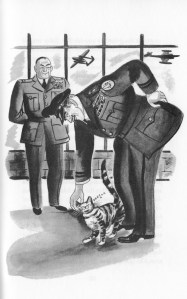

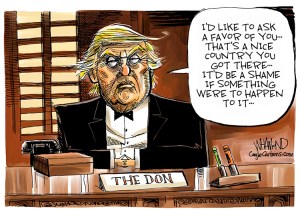 This characterization of Trump is so spot on that you really should go read the rest. I’m using this description of FARTUS as a background to the absolutely appalling crap that’s going on today. It’s hard to mentally deal with how quickly he’s disassembled so many long-standing U.S. Institutions in such a short time. This is especially true because it appears that the massive amount of incompetence and ignorance that his appointments display just escalates the damage. Look at this headline in
 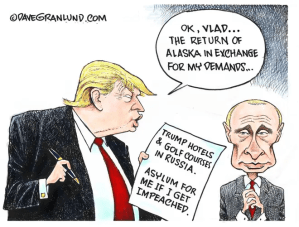 Definitely go read this one. I’ve been missing reading John le Carré. I’m assuming anyone with a background in spying would have saucer eyes by this time. Trump’s love of playing checkers with the countries of the world is dangerous and immoral.
 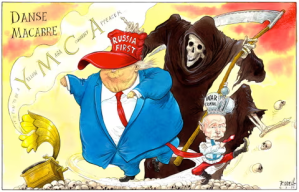 We first saw the capitulation of the tech bros and their social media platforms, including Jeff Bezos, who has ruined The Washington Post. This week, the situation there is getting worse. The first thing any autocrat wants to do is to come for any vestige of a free media. This is from
 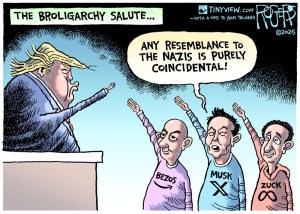 And now, we have the capitulation of top law firms. How many more legs of democracy will we lose?
 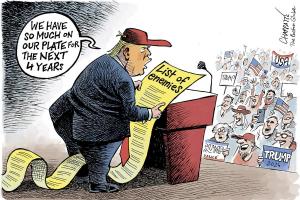 Zach Beauchamp
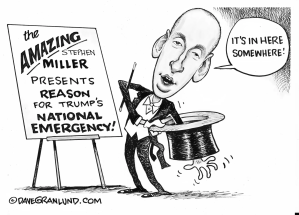 This, too, is a long read that deserves a look. A lot of this goes back to White House aid Stephan Miller. This guy needs to have an entire press detail following him. I’m going to end with a few articles on economics. The first comes from Paul Krugman and will clarify what’s happening with
 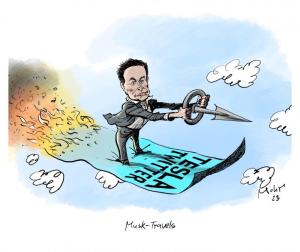 That Lutnick quote cannot be repeated enough. The last read I’m sharing today comes from











 Four years later, the personal relationship between the two men appears to have persisted, Woodward reports, as Trump campaigns to return to the White House and Putin orchestrates his bloody assault on Ukraine. In early 2024, the former president ordered an aide away from his office at Mar-a-Lago, his private club and residence in Florida, so he could conduct a private phone call with the Russian leader, according to Woodward’s account.
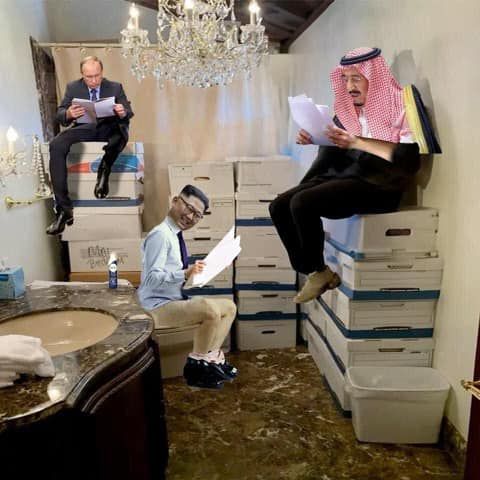 But the confirmation that Trump keeps speaking to Putin is important for several other reasons.
 peej
peej Carissa
 bostonboomer
 dakinikat
 ecocatwoman
 mablue2
 Mama Lopez
 peggysue22
 quixote
 skydancingguestblogger
 Mona (aka Wonk the Vote)



 Sky Dancing
Recent Comments