
Tuesday Reads: Russia, Crimea, MH 370, and a Couple of Flim Flam Men
Posted: March 18, 2014 Filed under: Barack Obama, Foreign Affairs, morning reads | Tags: Crimea, Dmitry Rogozin, Fred Phelps, Joe Biden, Kevin Trudeau, Malaysia Airlines Flight 370, Russia, Russian economy, Ukraine, Vladimir Putin 41 Comments
Good Morning!!
Yesterday President Obama announced sanctions against Russia in response to Russian President Putin’s military incursion into Ukraine and annexation of the Crimean region. ABC News reports:
The Obama administration hit 11 Russian and Ukrainian officials with sanctions today as punishment for Russia’s support of Crimea’s referendum. Among them: aides to President Vladimir Putin, a top government official, senior lawmakers, Crimean officials, the ousted president of Ukraine, and a Ukrainian politician and businessman allegedly tied to violence against protesters in Kiev.
One of the officials, Russia’s Deputy Prime Minister Dmitry Rogozin, quickly “laughed off President Obama’s sanction against him…, asking “Comrade @BarackObama” if “some prankster” came up with the list.
HuffPo quoted other Russian officials who were not impressed with Obama’s actions:
…the dire tone coming out of the White House was not shared by many who stand to lose the most from the sanctions. In Moscow, sanctioned Russian officials mocked the U.S. announcement, while in Washington, U.S. lobbyists who represent foreign clients said they were relieved that the sanctions amounted to little more than a slap on the wrist. Even the Moscow stock markets, which had been dragged down by the uncertainty in Crimea, responded positively to the news, posting some of the first gains they’ve had in weeks….
Andrei Klishas, a Russian lawmaker who was targeted, said that the U.S. rebuke was “no tragedy” for him and that he was happy to be in the company of the other sanctioned Russians. Yelena Mizulina, a member of Russia’s parliament best known for authoring the country’s controversial anti-gay propaganda legislation, said she owned no U.S. “real estate” and was “surprised” to be included, given that her role in the Crimean vote was “very modest.”
One particularly juicy response came from adviser to Russian President Vladimir Putin and spinmeister Vladislav Surkov, known as the “grey cardinal” of the Kremlin. “I see the decision by the administration in Washington as an acknowledgment of my service to Russia. It’s a big honor for me. I don’t have accounts abroad,” he told the Russian newspaper Moskovsky Komsomolets. “The only things that interest me in the U.S. are Tupac Shakur, Allen Ginsberg, and Jackson Pollock. I don’t need a visa to access their work. I lose nothing.”
Meanwhile Putin moved ahead with the official annexation of Crimea. From the LA Times:
Russia has signed a treaty to incorporate Crimea into its territory following a referendum in which residents of Ukraine’s region overwhelmingly backed the move.
President Vladimir Putin signed the document Tuesday with Crimea’s prime minister and parliament speaker following a televised address to the nation, in which he vigorously defended Crimea’s vote as a restoration of historical justice.
Still, according to Bloomberg, Russia’s economy is approaching a crisis: Russia Sounds Alarm on Economy as West Starts With Sanctions.
“The situation in the economy bears clear signs of a crisis,” Deputy Economy Minister Sergei Belyakov said in Moscow yesterday. The cabinet needs to refrain from raising the fiscal burden on companies, which would be the “wrong approach,” he said. “Taking money from companies and asking them afterward to modernize production is illogical and strange.”
Even before the worst standoff against the West since the Cold War, Russia’s economy was facing the weakest growth since a 2009 recession as consumer demand failed to make up for sagging investment. President Vladimir Putin supported a request from Crimea to join Russia, signing an order to approve an accord on the breakaway region’s accession before a meeting today with lawmakers.
The Ukrainian crisis is putting a strain on Russia’s $2 trillion economy, which grew 1.3 percent in 2013 after expanding 3.4 percent the previous year. Last year’s growth was “insufficient” and the current outlook and government forecasts “can’t satisfy us,” Putin said March 12. The Economy Ministry projects growth will average 2.5 percent a year through 2030.
In Poland, Vice President Biden said there will be more sanctions against Russia.
Biden spoke Tuesday after meeting in Warsaw with Polish Prime Minister Donald Tusk. He says the U.S. joins Poland and the international community in condemning the continuing assault on Ukraine’s sovereignty. He says it’s a blatant violation of international law.
Biden says virtually the entire world rejects the referendum in Crimea that cleared the way for Russia to annex the peninsula in Ukraine.
I came across this video on Twitter yesterday, and I thought it was relevant to Putin’s takeover of Crimea: Watch as 1000 years of European borders change.
Last night in the comments JJ posted a NYT article with some new information about MH 370’s flight path. I’m posting it again here. Lost Jet’s Path Seen as Altered via Computer.
Instead of manually operating the plane’s controls, whoever altered Flight 370’s path typed seven or eight keystrokes into a computer on a knee-high pedestal between the captain and the first officer, according to officials. The Flight Management System, as the computer is known, directs the plane from point to point specified in the flight plan submitted before a flight. It is not clear whether the plane’s path was reprogrammed before or after it took off.
The fact that the turn away from Beijing was programmed into the computer has reinforced the belief of investigators — first voiced by Malaysian officials — that the plane was deliberately diverted and that foul play was involved. It has also increased their focus on the plane’s captain and first officer.
Malaysian officials also changed their minds about when the plane’s communications devices were shut down.
Malaysian authorities on Monday reversed themselves on the sequence of events they believe took place on the plane in the crucial minutes before ground controllers lost contact with it early on March 8. They said it was the plane’s first officer — the co-pilot — who was the last person in the cockpit to speak to ground control. And they withdrew their assertion that another automated system on the plane, the Aircraft Communications Addressing and Reporting System, or Acars, had already been disabled when the co-pilot spoke.
Flight 370’s Flight Management System reported its status to the Acars, which in turn transmitted information back to a maintenance base, according to an American official. This shows that the reprogramming happened before the Acars stopped working. The Acars ceased to function about the same time that oral radio contact was lost and the airplane’s transponder also stopped, fueling suspicions that foul play was involved in the plane’s disappearance.
Investigators are scrutinizing radar tapes from when the plane first departed Kuala Lumpur because they believe the tapes will show that after the plane first changed its course, it passed through several pre-established “waypoints,” which are like virtual mile markers in the sky. That would suggest the plane was under control of a knowledgeable pilot because passing through those points without using the computer would have been unlikely.
This information leads experts to conclude that whoever diverted Flt. 370 was a highly skilled pilot. So where could the missing plane have gone?
According to Slate, there are 634 runways where a skilled pilot could have landed it.
As speculation grows that there may be a slim chance Malaysia Airlines Flight 370 landed somewhere after it suddenly disappeared from radars, WNYC published a map to illustrate all the possible runways that could have been used. The WNYC Data News team used information from X-Plane that provides runway coordinates from around the world to determine all the possible spots that could be available for the plane to land within 2,200 nautical miles, considering a Boeing 777 would need a runway of at least 5,000 feet. There are a total of 634 runways that fit the criteria, spread out across 26 countries. But of course the number of places the plane could have landed is much larger as it assumes the plane used a formal runway in the first place. Slate’s Jeff Wise spoke to a pilot who flies 777-200s who said the plane could be landed on a highway. “A runway wouldn’t even necessarily have to be paved,” wrote Wise, “hard-packed dirt would likely be good enough.”
Check out a map of the locations at the link.
You’ve probably heard that Fred Phelps, former pastor of the Westboro Baptist Church in on his deathbed. From The Independent:
He spent much of his life making unwelcome appearances at other people’s funerals, with placards bearing the infamous slogan, “God Hates Fags”. Yet now, as Fred Phelps Sr approaches his own death, even members of his close family have been barred – by other family members who have stayed loyal to him –from saying goodbye. According to a Facebook post by his estranged son Nathan Phelps, the 84-year-old founder of the anti-gay Westboro Baptist Church (WBC), was excommunicated last summer by the group he himself founded almost 60 years ago, and is now “on the edge of death” at a hospice in Topeka, Kansas.
Nathan Phelps, the sixth of the pastor’s 13 children, fled his abusive father and the WBC in 1980. Now 55 and an avowed atheist, he lives in Canada, where he campaigns on behalf of LGBT rights. Of his father’s excommunication and imminent demise, he wrote: “I’m not sure how I feel about this. Terribly ironic that his devotion to his god ends this way. Destroyed by the monster he made. I feel sad for all the hurt he’s caused so many. I feel sad for those who will lose the grandfather and father they loved. And I’m bitterly angry that my family is blocking the family members who left from seeing him.”
Fred Phelps Sr, an ordained minister, established the WBC in Topeka in 1955, but only in the past two decades has the church become infamous for its practice of picketing the funerals of gay people, public figures and – since 9/11 – the US servicemen and women killed in Afghanistan and Iraq. Phelps and his bitterly homophobic followers purport to believe that the deaths of US military personnel represent God’s punishment for homosexuality.
The Westboro Baptist Church was known for picketing the funerals of gay people and soldiers (Getty)The fringe Calvinist group – whose lesser-known slogans include “Fags Die, God Laughs” and “Thank God for Maimed Soldiers” – has achieved disproportionate notoriety, given that it has always consisted of fewer than 100 adherents, most members of the extended Phelps family.
Ironically, Phelps was excommunicated because he “called for kinder treatment of fellow church members.” At The Boston Globe, Chris Caesar collected reactions to the news about Phelps’ health.
I was surprised and gratified yesterday to learn that another flim flam man, Kevin Trudeau, has been sentenced to 10 years in prison for taking advantage of unfortunate people who fell for his his fraudulent weight loss infomercials. For years, it was hard to click around the TV channels without being exposed to this smooth-talking con man selling his “cures” for obesity, illness, and poverty. From AP’s The Big Story:
Best-selling author Kevin Trudeau, whose name became synonymous with late-night TV pitches, was sentenced to 10 years in prison Monday for bilking consumers through ubiquitous infomercials for his book, “The Weight Loss Cure ‘They’ Don’t Want You to Know About.”
As he imposed the sentence prosecutors had requested, U.S. District Judge Ronald Guzman portrayed the 50-year-old Trudeau as a habitual fraudster going back to his early adulthood. So brazen was Trudeau, the judge said, he once even used his own mother’s Social Security number in a scheme.
“Since his 20s, he has steadfastly attempted to cheat others for his own gain,” Guzman said, adding that Trudeau is “deceitful to the very core.”
Trudeau, whose trademark dyed black hair turned partially gray as he awaited sentencing in jail, showed little emotion as the stiff sentence was handed down at the hearing in Chicago.
Addressing the judge earlier in a 10-minute statement, Trudeau apologized and said he’s become a changed man. He said he’s meditated, prayed and read self-help books while locked up at Chicago’s Metropolitan Correctional Center.
“I have truly had a significant reawakening,” said Trudeau, who was dressed in orange jail clothes. “If I ever do an infomercial again … I promise: No embellishments, no puffery, no lies.”
Sure Kevin. . . Here’s an example of Trudeau’s work:
Those are my offerings for today. What stories are you following?
Tuesday Reads: Russia and Ukraine, Obama the Weak Dictator, and Fat Tuesday
Posted: March 4, 2014 Filed under: Barack Obama, Foreign Affairs, morning reads, U.S. Politics | Tags: Bacon with a side of hand gun, Crimea, fat tuesday, mardi gras, New Orleans, Russia, Ukraine, Vladimir Putin 59 Comments
How Europeans picture an American breakfast
Good Morning!!
I saw this photo on Twitter yesterday, and I couldn’t resist sharing it. The comments were pretty funny too. Several people noted that the gun goes on the left; others said the gun should be turned over for quicker access if needed. Others said the bacon was just right but there should be a couple more eggs and some doughnuts.
I feel like I’m writing for an exclusive group this morning; we seem to have lost a lot of our regular commenters over the past week or so. I hope it wasn’t something I said.
Maybe it’s just that we’ve reached the dregs of a very long and exhausting winter. I must admit that yesterday I was selfishly relieved to see a nasty storm coming across the country that didn’t involve the Boston area. Nevertheless, I know it did affect places where we have readers, and I am well aware of how very depressing and tiring it can feel when the snow, ice, and cold just won’t quit.
The political news isn’t exactly cheery either–It’s mostly endless civil wars in the Middle East accompanied by the one here at home in the Republican Party; constant attacks on President Obama for being either too wimpy and weak or a vicious, drone dropping, privacy-invading dictator; and the press digging up old Clinton smears in preparation for Hillary running for President in 2016.
Right now, the main focus is on the events in Ukraine–Syria and Egypt are all but forgotten by “journalists” who seem unable to focus on more than one story at a time. Somehow, they never fail to find a way to blame everything on Obama though, no matter what crisis they are reporting.
Even Dana Millbank, who often judges Obama harshly has noticed: Obama, the feckless tyrant.
President Obama is such a weak strongman. What’s more, he is a feeble dictator and a timid tyrant.
That, at any rate, is Republicans’ critique of him. With Russia’s invasion of Ukraine, Obama’s critics pivoted seamlessly from complaining about his overreach to fretting that he is being too cautious. Call it Operation Oxymoron.
Last Wednesday, I sat in a House hearing and listened to Republicans describe Obama exercising “unparalleled use of executive power” and operating an “uber-presidency.” They accused him of acting like a “king” and a “monarch,” of making the United States like a “dictatorship” or a “totalitarian government” by exercising “imperial” and “magisterial power.”
But after events in Ukraine, this very tyrant was said to be so weak that it’s “shocking.”
“We have a weak and indecisive president that invites aggression,” Sen. Lindsey Graham (R-S.C.) proclaimed Sunday on CNN.
Sen. John McCain (R-Ariz.) told the annual gathering of the American Israel Public Affairs Committee on Monday that Obama has “a feckless foreign policy where nobody believes in America’s strength anymore.”
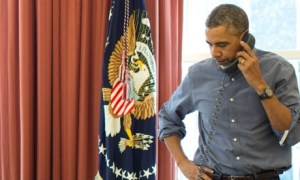
For once Millbank, the ultimate Villager, hit the nail on the head. On Twitter over the last few days, I’ve even seen people complaining about the White House photo of Obama in shirtsleeves talking on the phone to Putin, because it supposedly shows how weak and unprofessional Obama is.
Michael Cohen at the Guardian has it right, IMO : Don’t listen to Obama’s Ukraine critics: he’s not ‘losing’ – and it’s not his fight.
In the days since Vladimir Putin sent Russian troops into the Crimea, it has been amateur hour back in Washington.
I don’t mean Barack Obama. He’s doing pretty much everything he can, with what are a very limited set of policy options at his disposal. No, I’m talking about the people who won’t stop weighing in on Obama’s lack of “action” in the Ukraine. Indeed, the sea of foreign policy punditry – already shark-infested – has reached new lows in fear-mongering, exaggerated doom-saying and a stunning inability to place global events in any rational historical context.
This would be a useful moment for Americans to have informed reporters, scholars and leaders explaining a crisis rapidly unfolding half a world away. Instead, we’ve already got all the usual suspect arguments.
Cohen offers a number of examples:
Personality-driven Analysis
Let’s start here with Julia Ioffe of the New Republic, a popular former reporter in Moscow who now tells us that Putin has sent troops into Crimea “because he can. That’s it, that’s all you need to know”. It’s as if things like regional interests, spheres of influence, geopolitics, coercive diplomacy and the potential loss of a key ally in Kiev (as well as miscalculation) are alien concepts for Russian leaders.
Overstated Rhetoric Shorn of Political Context
David Kramer, president of Freedom House, hit the ball out of the park on this front when he hyperbolically declared that Obama’s response to Putin’s actions “will define his two terms in office” and “the future of U.S. standing in the world”.
Honorable mention goes to Ian Bremmer of Eurasia Group for calling this crisis “the most seismic geopolitical events since 9/11”. Putting aside the Iraq and Afghanistan wars, the Arab Spring, Syria’s civil war and tensions in the South China Sea, Bremmer might have a point.
Unhelpful Policy Recommendations
Admiral James Stavridis, former Supreme Commander of Nato, deserves a shout-out for calling on Nato to send maritime forces into the Black Sea, among other inflammatory steps. No danger of miscalculation or unnecessary provocation there. No, none at all.
Much more panicky heavy breathing at the link. Does anyone in Washington recall what happened when George W. Bush was president and Russia attacked Georgia?
Here’s a great example of Obama-blaming at Politico. Their top “morning brief” is DoD suspends military relationship with Russia
The Pentagon is putting on hold its military-to-military relationship with Russia over its incursion into Ukraine’s Crimean peninsula, according to Press Secretary Rear Adm. John Kirby. “We have, in light of recent events in Ukraine, put on hold all military-to-military engagements between the United States and Russia,” Kirby said in a statement last night. “This includes exercises, bilateral meetings, port visits and planning conferences.”
Kirby also said there’s been “no change” in U.S. military posture in Europe or the Mediterranean, despite speculation in the news media about possible ship movements. “Navy units continue to conduct routine, previously planned operations and exercises with allies and partners in the region,” he said.
But apparently the Politico gang doesn’t see how that new could relate to President Obama, the Commander In Chief of our armed forces. Here’s what they say about Obama in the same “morning brief.”
AT THE WHITE HOUSE, the big question is whether President Barack Obama has what it takes to unite Europe behind a package of sanctions that would, in his words, “isolate Russia.”
Because Obama has no balls, get it?
Sigh . . .
At Time Magazine, Simon Shuster notes that Putin is also being judged harshly at home, despite the efforts of the Kremlin-controlled media: 4 Reasons Putin Is Already Losing in Ukraine.
At home, this intervention looks to be one of the most unpopular decisions Putin has ever made. The Kremlin’s own pollster released a survey on Monday that showed 73% of Russians reject it. In phrasing its question posed in early February to 1,600 respondents across the country, the state-funded sociologists at WCIOM were clearly trying to get as much support for the intervention as possible: “Should Russia react to the overthrow of the legally elected authorities in Ukraine?” they asked. Only 15% said yes — hardly a national consensus.
That seems astounding in light of all the brainwashing Russians have faced on the issue of Ukraine. For weeks, the Kremlin’s effective monopoly on television news has been sounding the alarm over Ukraine. Its revolution, they claimed, is the result of an American alliance with Nazis intended to weaken Russia. And still, nearly three-quarters of the population oppose a Russian “reaction” of any kind, let alone a Russian military occupation like they are now watching unfold in Crimea. The 2008 invasion of Georgia had much broader support, because Georgia is not Ukraine. Ukraine is a nation of Slavs with deep cultural and historical ties to Russia. Most Russians have at least some family or friends living in Ukraine, and the idea of a fratricidal war between the two largest Slavic nations in the world evokes a kind of horror that no Kremlin whitewash can calm.
Indeed, Monday’s survey suggests that the influence of Putin’s television channels is breaking down. The blatant misinformation and demagoguery on Russian television coverage of Ukraine seems to have pushed Russians to go online for their information. And as for those who still have no Internet connection, they could simply have picked up the phone and called their panicked friends and relatives in Ukraine.
And at Quartz: The markets are punishing Russia more swiftly than diplomats ever could.
Strongly worded statements, threats of travel restrictions, and summit no-shows. So far, these are the relatively mild diplomatic implications for Russia of itsincursion into Ukraine, as few in the West can stomach an open military confrontation with Moscow over its apparent occupation of Crimea.
But the markets are punishing Russia much more swiftly than the diplomats. A wide range of Russian assets—stocks, bonds, and the ruble—plunged in value today. To shore up the ruble, which is plumbing record depths, Russia’s central bank unexpectedly hiked interest rates today. It ratcheted up the benchmark one-week rate from 5.5% to 7%, and traders report that the central bank has also been spending billions of dollars in currency markets to stem the fall in the value of the ruble.The two main Moscow stock markets, the Micex and the RTS, have fallen by more than 10% at the time of writing, in a broad-based selloff. Big Russian companies like Gazprom and Sberbank saw their share prices plunge as traders dumped their shares.

King Cake
Is there any other political news? Not much to speak of, so I’m just about to wrap this up. But first, today is Fat Tuesday and, despite the bad weather Mardi Gras is going forward in New Orleans. From ABC News: Cold, Gray Morning Won’t Stop Mardi Gras Revelers.
A cold, gray day greeted revelers gathering Tuesday along parade routes as the Carnival season in New Orleans headed to a crest with the unabashed celebration of Mardi Gras.
The first street marching groups — including clarinetist Pete Fountain’s Half-Fast Walking Club — were to begin their marches along oak-lined St. Charles Avenue and into the business district. Later, the floats of the Zulu and Rex parades and hundreds of truck trailers decorated by family and social groups would wind down St. Charles Avenue.
Light rain began to fall early in the morning, but revelers were still expected to gather by the tens of thousands in the French Quarter, where the bawdy side of Mardi Gras was expected to be on full display.
Mark Nelson of St. Louis said he would be in the mix even in a downpour. It’s his first Mardi Gras.
“That’s why God made washing machines,” said Nelson, who was sipping on a daiquiri as he enjoyed the sounds of trumpeter Kermit Ruffins and the Barbecue Swingers, who performed at the Lundi Gras festivities Monday along the Mississippi River.
For those of us who can’t get down to NOLA, the LA Times offers Mardi Gras: Celebrate with king cake and 16 additional recipes!
So . . . what’s on your mind today? Please let us know in the comments. We want to hear from you!

Lazy Saturday Reads: Weather, Spring Fever, Boston Bombing, Ukraine, and True Detective Spoilers
Posted: March 1, 2014 Filed under: Barack Obama, Foreign Affairs, morning reads | Tags: baseball, Boston Marathon bombings, Boston Red Sox, Carcosa, Cold War, Crimea, death penalty, Dzhokhar Tsarnaev, FBI abuses, Ibragim Todashev, spoilers, spring training, Tamerlan Tsarnaev, True Detective, Ukraine, Vladimir Putin, Yellow King 14 Comments
It’s Saturday!!
Another snowstorm is coming, but it’s not yet clear how bad it will be or how much snow will fall in which areas. From the Weather Channel: Ice Storm Possible for Mississippi Valley, Ohio Valley; Snowstorm for West, Midwest, Northeast.
After a brief reprieve from blockbuster winter storms in the Midwest and East – and a much-too-lengthy reprieve in California – Winter Storm Titan is will lay down a swath of heavy snow from California to the East Coast, and also a swath of sleet and freezing rain from the Plains to the Mid-Atlantic States.
- Saturday: The main event east of the Rockies will begin to unfold as snow spreads east across portions of the Plains, Upper Midwest and Great Lakes. For parts of the Northern Rockies, this will just be a continuation of snow from the previous, weaker disturbance. Widespread snow is likely across Wyoming, but will gradually wind down over western and southern Montana. Farther south the snow will be more tied to higher elevations. (See inset map for details.)
- Sunday: The more significant part of Winter Storm Titan begins with snow, sleet and freezing rain becoming heavier. A stripe of significant ice accumulation is likely Sunday and Sunday night from the Ozarks through into the Mid-South region, Ohio Valley and West Virginia with snow farther north from the central Plains into the mid-Mississippi Valley and Ohio Valley. These threats spread into the Mid-Atlantic and Northeast Sunday afternoon and night.
- Monday: Snow/sleet tapers off in the Ohio Valley Appalachians, but should linger in the Appalachians and along parts of the I-95 Northeast corridor much of the day, before ending off in the evening. Ice/sleet areas early in the day in the Mid-Atlantic states should changeover to snow Monday morning.

Whatever. Winter is almost over. It’s March 1, and there are signs of spring–at least down at Fenway South in Ft. Myers, Florida (and many other spring training locations). Yesterday the Red Sox played their first Grapefruit League game against the Minnesota Twins, losing 8-2. But who cares? A hot new pitching prospect shut down the Twins for two innings, striking out four–a good sign for the upcoming season. Baseball is back, opening day is a little over a month away, and that means spring is coming!
OK, I know I’m being really provincial, but I’ll bet you’re seeing signs of Spring too. What is giving you hope for the end of this long, cold winter? Even the folks down south have suffered greatly this year.
One more Boston story. The FBI is claiming that accused Boston bomber Dzhohar Tsarnaev “made a damaging statement” in a visit with one of his sisters recently. Of course they won’t even give a hint as to what he said, so I don’t know what to make of it. The Boston Globe:
The filing said that Tsarnaev, despite the presence of the agent, who was legally allowed in the room, “was unable to temper his remarks and made a statement to his detriment which was overheard by the agent.”
The filing did not say what the statement was.
The filing was made as part of an ongoing battle between the prosecution and defense over special administrative measures, special prison restrictions, that have been imposed on Tsarnaev.
The defense says the prosecution is refusing to turn over information they need and that the FBI is monitoring their meetings with Tsarnaev and preventing them from developing their defense strategy. I think the feds need to keep in mind that they will have a Massachusetts jury–very few people here support the death penalty, and most potential jurors will be troubled by FBI efforts that might prevent a fair trial. After all, we just recently went through the Whitey Bulger trial, in which we heard endless tales of FBI abuses and we’re still waiting for an explanation as to why an agent from the Boston office shot Ibragim Todashev down in Orlando last May.
We’re coming up on the 2014 Boston Marathon, and we still have almost no explanations of what really happened during the Marathon bombing and the shootout in Watertown a few days later. And then there’s the Waltham triple murder, which the FBI is trying to pin on two dead guys–Tamerlan Tsarnaev and Ibrigim Todashev. Susan Zalkind summed up many of the questions in this month’s Boston Magazine coverstory: The Murders Before the Marathon. There wasn’t a whole lot of breaking news in the article, but it’s a very good summary of events so far.
There’s a lot happening in Ukraine. I’ll just give you a couple of links to check out, because I’m not qualified to comment on the situation–other than I’m sick of everyone expecting the U.S. to get involved in every crisis.
The latest from ABC News: Putin Asks Parliament to Use Military in Ukraine
Russian President Vladimir Putin asked parliament Saturday for permission to use the country’s military in Ukraine, moving to formalize what Ukrainian officials described as an ongoing deployment of Russian troops in the strategic region of Crimea.
Putin’s motion loosely refers to the “territory of Ukraine” rather than specifically to Crimea, raising the possibility that Moscow could use military force in other Russian-speaking provinces in eastern and southern Ukraine where many oppose the new authorities in Kiev….
He said the move is needed to protect ethnic Russians and the personnel of a Russian military base in Ukraine’s strategic region of Crimea. Putin sent the request to the Russian legislature’s upper house, which has to approve the motion, according to the constitution. The rubber-stamp parliament is certain to approve it in a vote expected Saturday.
In Crimea, the pro-Russian regional prime minister had earlier claimed control of the military and police there and asked Putin for help in keeping peace, sharpening the discord between the two neighboring Slavic countries.

President Obama warned yesterday that there would consequences for military intervention in Ukraine, but he didn’t specify any actions he would take. At this point, I think these warnings are just being ignored, because there is seldom any follow-up. As I said earlier, I don’t want to get involved in any more foreign conflicts. Let Europe deal with it if they want to. We have plenty of problems here at home that require government action.
From Reuters: West voices alarm on Crimea, calls on Russia to respect Ukraine sovereignty.
A week after violent protests forced Russian-backed President Viktor Yanukovich to abandon power in Kiev, Ukraine’s new leaders say Russia is trying to take control of the southern Crimea region, which has a majority ethnic Russian population.
France, Britain and Germany issued calls for de-escalation in Crimea hours after U.S. President Barack Obama warned that military intervention in the region would be deeply destabilizing and “carry costs”.
“France is extremely concerned by the reports from Crimea, which describe significant troop movements,” French Foreign Minister Laurent Fabius said in a statement. “We call on the parties to abstain from acts that could raise tensions and affect Ukraine’s territorial unity.”
It does appear that Putin is intent on reviving the Cold War. I hope he’s not successful.
Tomorrow night we’ll get an other episode of True Detective–there are only two to go. I gathered a bunch more links in the past couple of days. Some of them have spoilers, so be careful.
This is an older post, but it provides some very good background on the weird aspects of the story. From Grantland’s Molly Lambert, Carcosa or Bust: The Satisfyingly Weird Mysteries of ‘True Detective’. Just a taste:
Hallucinatory spirals, talk of “black stars” rising in the sky, dead women trussed up like ancient horned gods and tattooed with mysterious symbols, all supposedly in reference to Robert W. Chambers’s fairly obscure weird fiction classic The King in Yellow? Damn, True Detective, you’ve given me a lot to absorb.
Where is the show going with its recently clarified Lovecraftian ties? Does it even really matter, when the ride is this great? The most satisfying part of a mystery is rarely its resolution. Sustained anticipation is much of the thrill. Like earlier TV mysteries Twin Peaks, The X-Files, and Lost, True Detective is a show with its own internal mythology, which taunts both the protagonists and viewers with signs just beyond our comprehension. When some bits of information are guaranteed to be important later, every single bit of information feels like a potential clue. Attempting to read a show scene by scene and pluck out exactly what will prove crucial from a galaxy of visual and verbal details can feel absolutely maddening….
You can spend endless amounts of time pondering True Detective’s more concrete questions, let alone the existential ones. Are the wooden triangles strewn around the sites of the ritualistic murders pagan symbols, bird traps, or neither? Given creator Nic Pizzolatto’s professed affection for weird fiction, were Reggie Ledoux’s gas mask and the reference to a “green-eared spaghetti monster” meant to invoke Cthulhu, the giant octopus monster that signals cosmic doom in the work of seminal horror writer H.P. Lovecraft? Is the mystery even going to get solved?True Detective’s flashback structure accentuates the gaps in our knowledge. Everything we know is gleaned from flashbacks and interrogations, but there’s no guarantee that future information won’t flip our perspective. Hell, there’s no guarantee that Rust and Marty’s flashbacks are accurate. After all, if we can see Rust’s subjective hallucination of birds assembling into a spiral in the sky, who’s to say we’re not seeing other events from his subjective perspective too? This kind of theorizing, not baseless but impossible to prove conclusively, will make you feel like True Detective’s detectives. Maybe the show’s obsessions with madness, reality, and truth really are contagious.

Then read Lamberts latest post: Five Things to Consider for This Week’s Episode of ‘True Detective’. She has some good questions.
A guy at Reddit did some sleuthing and came up with some photos posted by True Detective crew members. Here’s a link to a lot of photos, some from the upcoming episodes. I looked at them, and got some sense of what’s coming, but not much more than I got from the teaser trailer. They didn’t ruin the suspense for me. Just be warned if you want to stay completely in the dark.
A few more links to explore as we wait for tomorrow night to roll around:
Rolling Stone: The Dark Thrills of ‘True Detective’
Forbes: The Business Of HBO’s ‘True Detective’
Slate: The True DetectiveGlossary
Complex Pop Culture: Pictures of You: “True Detective” and the Dilemma of the Dead Woman’s Photograph
International Business Times: ‘True Detective’ Season 1 Spoilers: What’s On The Video Tape In Episode 7? Theories On Hart’s Daughter And Connection To The Yellow King
Now what’s on your mind today? Please post your links on any topic in the comment thread, and have a great weekend!!
Thursday Reads: Guns and American Culture (and other news)
Posted: February 27, 2014 Filed under: Congress, Crime, morning reads, U.S. Politics | Tags: "stand your ground" laws, Affordable Care Act, Crimea, FDA, Federal Reserve, gun control, Hillary Clinton, nutrition labels, Russia, self defense, shooting deaths, Ukraine 44 Comments
Morning Paper at Cap Ferrat, by Rebecca Kao Wang
Good Morning!!
I live in a state that has very strict gun control laws. A recent study by Boston Children’s Hospital found that states with the toughest gun laws have the lowest rates of gun deaths. And Boston tends to average between one shooting victim every other day to one victim per day. I’ve been thinking about this for the past couple of days since I read this article at WBUR: When Mass. Criminals Want A Gun, They Often Head North
Massachusetts gun laws are widely considered some of the toughest in the country. But with a rash of shooting deaths in Boston this year, some law enforcement officials say it’s obvious that there are ways around the rules. And when Massachusetts criminals want to get their hands on a gun, they frequently head north.
In 2012, more than half of the guns that law enforcement seized in Massachusetts and managed to trace to their origins came from other states, according to federal statistics. The biggest suppliers by far were New Hampshire and Maine, as is the case most years.
According to the article, ATF agents discovered that gun traffickers in Massachusetts were legally buying large numbers of guns from New Hampshire and Maine, where they are much easier and cheaper to buy, and reselling them to people in Massachusetts.
The flow of guns from northern New England to Massachusetts is propelled by key differences among state gun laws. It’s all about private handgun sales, in particular. In Massachusetts every private handgun sale must be recorded and reported to the state within seven days. And the buyer must have a license to carry from local police, which in turn requires a background check. The Massachusetts rules are tight.
Up north, not so much. Buyers at federally licensed gun shops in Maine and New Hampshire are subjected to a federal background check for prior felonies, or a history of severe mental illness. But when it comes to private gun sales — at a gun show, or even a commuter parking lot — no documentation is required — no background check, no record of the transaction.
Darcie McElwee, an assistant U.S. attorney in Maine, says that in her state a private seller doesn’t even have to ask the buyer for a driver’s license.
Now it’s still illegal to sell guns to a convicted felon or for a felon to buy a gun, so if someone is caught doing this, they’ll go to jail for two years minimum. And the rates of gun deaths and injuries are still lower in Massachusetts than in states with less strict gun laws.
Clearly strict state laws are not enough to prevent gun violence. We need federal laws to control gun sales and to encourage gun safety–like the Massachusetts law that requires guns to be unloaded and locked up when not in use. But how can we make that happen? According to the WBUR article, Congress has even made it difficult to keep track of guns that are used in crimes and for academic researchers to access federal government data on gun trafficking.
Massachusetts Senator Ed Markey has introduced a bill to require all guns to be personalized so they can only be fired by the owner or another authorized person. These so-called “smart guns” already exist.
One of California’s largest firearm stores recently added a peculiar new gun to its shelves. It requires an accessory: a black waterproof watch.
The watch’s primary purpose is not to provide accurate time, though it does. The watch makes the gun think. Electronic chips inside the gun and watch communicate with each other. If the watch is within close reach of the gun, a light on the grip turns green. Fire away. No watch means no green light. The gun becomes a paperweight.
A dream of gun control advocates for decades, the Armatix iP1 is the country’s first smart gun. Its introduction is seen as a landmark event in efforts to reduce gun violence, suicides, and accidental shootings….
Of course the NRA will fight this tooth and nail, and it’s not going to get through the Senate, much less the House, in the current environment.
Now check this out. According to a piece at Venture Beat, you can quickly and easily buy guns on Facebook!
Fifteen minutes.
That’s all it takes for children, felons, and people without IDs to buy illegal weapons on Facebook pages dedicated to the sale and celebration of guns.
A VentureBeat investigation has uncovered dozens of pages on Facebook where guns are for sale, including semi-automatic weapons, handguns, and silencers. While the transactions don’t actually happen on Facebook, the social network is a remarkably easy way to find shady people willing to sell you a weapon — no questions asked. The illegal transactions then take place in diners, dark parking lots, and isolated country roads — away from the prying eyes of the feds and local police.
In Kentucky, Greenup County Sheriff Keith Cooper remembers when a call came into dispatch last October saying a 15-year-old student had been arrested on the Greenup County High School campus for carrying an unlicensed and loaded 9mm handgun to school. The boy was arrested and brought to Cooper’s office for an interview.
When Cooper, a former Kentucky State Trooper with a heavy Southern drawl, asked the kid where he got the gun, his reply was shocking: Facebook.
Read it and weep. Oh, and Facebook claims they don’t allow people to sell guns or explosives on their pages, but clearly they’re not enforcing these rules very well.
It’s not news to anyone that America has a love affair with guns. Guns and hunting are part of American culture, going hand-in-hand with the cult of rugged individualism. I’ve always thought it came from the frontier tradition. Most of the country was settled by pioneering who set out from the East coast to begin new lives in the Midwest and West before the arrival of the accoutrements of civilization–like law enforcement, banks, and insurance companies. In my generation at least, kids saw endless movies and TV shows about “cowboys and Indians;” and we played with toy guns–even us girls. And of course, since we were born shortly after World War II, many of us watch movies that glorified war.
Still I’ve never wanted a real gun. It seems to me that the gun culture is much stronger in some ways than in those innocent days of the 1950s and ’60s. But why? The obvious answer is the lobbying and propaganda efforts of the National Rifle Association (NRA). And what about the recent work of ALEC and the Koch Brothers to get state “stand your ground” laws passed around the country? Dahlia Lithwick has posted a fine piece about this at Slate.
“Stand Your Ground” Nation: America used to value the concept of retreat. Now we just shoot.
Last week, Kriston Charles Belinte Chee, an unarmed man, got into a fight with Cyle Wayne Quadlin at a Walmart in suburban Arizona. Quadlin opened fire midargument and killed Chee. Officers decided not to charge Quadlin because, they concluded, the killing was in self-defense. According to the police spokesman, “Mr. Quadlin was losing the fight and indicated he ‘was in fear for his life.’” Just a week earlier, a jury in Jacksonville, Fla., found Michael Dunn guilty on four counts of attempted murder but did not convict him on the most serious charge of first-degree murder, in the death of 17-year-old Jordan Davis. Dunn shot and killed Davis, also unarmed, because the music coming from his car was too loud. Dunn claimed he saw something like a gun in the vehicle, and that was apparently enough for some members of the jury to conclude that Dunn hadn’t committed first-degree murder.
Given all this, it’s not unreasonable to argue that, in America, you can be shot and killed, without consequences for the shooter, for playing loud music, wearing a hoodie, or shopping at a Walmart. The question is whether the wave of “stand your ground” legislation is to blame.
Is it true? Lithwick quotes doubters who say that neither George Zimmerman invoked “stand your ground,” However juries were told about the “stand your ground” principle, and could have been confused by the growing consensus in Florida that people [at least white males] have the right to shoot an unarmed person if they “feel threatened.” Lithwick writes:
It’s clear that at least some of the jurors in both cases took the principle of “stand your ground” into account to some degree during deliberations. We now know that at leastone juror, and possibly two, in Dunn’s trial took to heart the specific instruction that Dunn “had no duty to retreat and had the right to stand his ground and meet force with force, including deadly force.” Whether or not jurors in Florida are technically instructed to apply the “stand your ground” component of self-defense law, it’s increasingly clear that they are, at minimum, confused about it (understandably) and may even be starting to apply it reflexively. Yes, Dunn’s attorney argued traditional self-defense. But, as former assistant U.S. attorney David Weinstein told the Associated Press, “I think people will say that because some of the language from the stand your ground statute gets embedded into the jury instructions, that stand your ground has an effect.”
I might go further. I might say that whether or not specific jurisdictions define self-defense to include a duty to retreat, and whether or not specific juries are charged to apply it, America is quickly becoming one big “stand your ground” state, as a matter of culture if not the letter of the law.
Please go read the whole thing. It’s frightening but important. Lithwick argues that the new laws are changing the culture itself–and not just in the states with “stand your ground” laws.
Now I’ve gone and written another single-subject post. I just have room for a few headlines before I turn the floor over to you.
Washington Post: Hillary Clinton makes case for ‘full participation’ and equality
Talking Points Memo: Hillary Clinton Defends Obamacare While Backing Changes
BBC News: Ukraine warns Russia against ‘aggression’ in Crimea
NPR: Crimea: 3 Things To Know About Ukraine’s Latest Hot Spot
The Daily Beast: The Spoiled Rotten Kids of the DC Elite
NYT: New F.D.A. Nutrition Labels Would Make ‘Serving Sizes’ Reflect Actual Servings
Dana Millbank: Republicans flip-flop on ‘judicial activism’
I hope Dak will weigh in on this one. Matthew O’Brien: How the Fed Let the World Blow Up in 2008
USA Today: NASA – 715 new planets found, 4 might support life
What stories have caught your interest today? Please share your links in the comment thread, and have a great day!
Lazy Saturday Reads: True Detective and A Bit of Real News
Posted: February 22, 2014 Filed under: Barack Obama, morning reads, U.S. Politics | Tags: academia, DePauw University, HBO, HP Lovecraft, literary references, Louisiana, Marty Hart, Matthew McConaughey, medal of honor, Nic Pizzolatto, Robert W. Chambers, Rust Cohle, The Jeff Davis 8, Thomas Ligotti, True Detective, TV series, Ukraine, Venezuela 42 Comments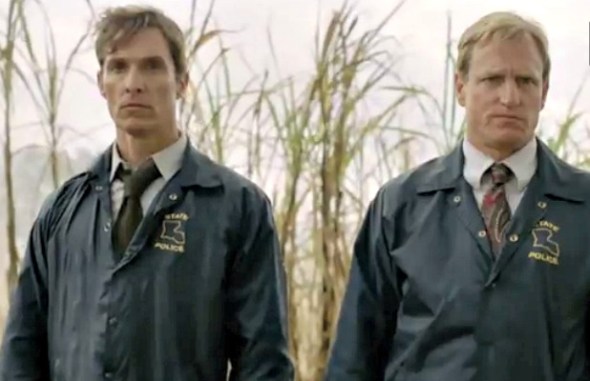
Good Morning!!
Since it’s the weekend and most of us can probably use a little escape from reality, I thought I’d begin this post by writing a little about my latest obsession–the HBO show True Detective. Have you been following it? I don’t watch a lot of TV these days, but I had been hearing good things about this show; and a few days ago I decided to take the plunge. I ended up watching the first five episodes in three nights. Episode 6 will debut tomorrow night at 9PM, and HBO will repeat Episode 1 tonight at 10PM. I don’t want to ruin the series for anyone who hasn’t seen it yet, so I’m not going to go into a lot of detail about it. I’ll post some interesting reading and try not to include too many leave it up to you if you want to read them now or later. I guess I’m hoping some other Sky Dancers will be interesting enough to watch the show too, so we can discuss it here.
True Detective combines two elements that have always fascinated and attracted me–mystery stories and occult horror. The story is set in Cajun country–south-central Louisiana. The two main characters are Rust Cohle and Martin Hart, played by Matthew McConaughey and Woody Harrelson respectively. Cohle and Hart are homicide detectives who catch the case of a lifetime–a murder that combines sadistic cruelty with bizarre symbolism. Cohle is convinced from the beginning that they are dealing with a serial killer who has likely committed previous murders and who will commit more in the future if he isn’t stopped. They are then drawn into a 17-year investigation that powerfully affects both of their lives.
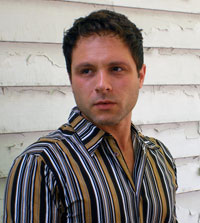
Nic Pizzolatto
The show’s creator, writer, and producer is Nic Pizzolatto, a Louisiana native who, until 2010 was a professor at DePauw University in Indiana. According to the Indy Star,
In fact, DePauw University in Greencastle served as a launch pad for his Hollywood career….
Before he moved west, Pizzolatto held a tenure-track post as a DePauw English professor. In 2010, his book “Galveston” was published. That summer, he decided he could not return to academia, he has said in interviews.
“I’d want to bring a flamethrower to faculty meetings,” Pizzolatto told the Los Angeles Times earlier this year. “The preciousness of academics and their fragile personalities would not be tolerated in any other business in the known universe.”
The award-winning novelist sold the film rights to “Galveston” [his first novel] and moved his wife and young family to southern California to try to break into another industry, not known for its own lack of preciousness and fragile personalities.
I want to thank Dakinikat for getting me interested in watching True Detective. Awhile ago, I had sent her a long article about a series of murders in Louisiana: Who Killed the Jeff Davis 8? (I recently posted the link in a morning reads post too, but I don’t know how many people saw it.) Dak said she thought True Detective was based on those cases. Here’s another article about the murders–still pretty long: Jennings 8: Unsolved murders haunt town, police
Pizzolatto kind of confirmed that by tweeting the link to the article on January 28. So you might want to take a look at it. The author, Ethan Brown describes a series of murders of 8 prostitutes, some of whom knew each other. The police have investigated the cases as if they were committed by one serial killer, but Brown argues that there is more than one murderer and what connects the cases may be that members of law enforcement were involves in each of them. Similarly, there are hints in True Detective that powerful people may be involved in the cases Cohle and Hart are investigating.

As I mentioned above, the show is in some ways a typical police procedural that explores conflicts between two homicide detective partners with very different personalities. Marty Hart (Woody Harrelson) is a seemingly ordinary guy, married with two daughters, who acts self-destructively by getting involved with other women and neglecting his family. Rust Cohle is a strange fellow who hasn’t been with the police department very long. He drives his partner and other detectives nuts with his obsessive approach to the case and his tendency to spout bizarre nihilist philosophies. But with each succeeding episode, the series moves more into the horror genre, as the detectives try to understand the bizarre symbolism that keeps cropping up in their cases–such as repeated hints about a “yellow king” chasing people through the woods and a spiral tattoo that appears on victims’ backs–and as the show reveals more about Cohle’s past history.
Now for a few reads that will give you a sense of why True Detective is so fascinating. You could endlessly chase the literary connections that Pizzolatto has planted in his tale. Start with this interview with author Nic Pizzolatto in the Wall Street Journal: Writer Nic Pizzolatto on Thomas Ligotti and the Weird Secrets of ‘True Detective’. It turns out Pizzolatto is a connoisseur of the weird horror tales of H.P. Lovecraft and his predecessors–as well as modern practitioners of the genre.
Horror and mystery go hand in hand on HBO‘s “True Detective.” The hit series…is rich in dread similar to the kind inherent in the work of H.P. Lovecraft, and it has featured words and imagery derived from Robert W. Chambers‘ story anthology “The King in Yellow.” As a result, the show has opened up the worlds of weird fiction and cosmic horror to broader audiences.
Executive producer and writer Nic Pizzolatto, responding through email, commented to Speakeasy about some of the more ominous literary and philosophical influences on ”True Detective,” as well as some of his favorite horror writers.
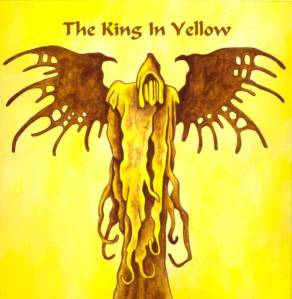
Read Pizzolatto’s recommendations for further reading at the link.
A couple more links on the literary references in the show:
Allyssa Rosenberg at Think Progress: The Crazy Mythology That Explains ‘True Detective’
Lincoln Mitchell at Buzzfeed: A “True Detective” Reading List: dark, weird, and southern gothic books that every fan of HBO’s True Detective should read.
A review of the first episode by Daniel Lefferts at Policymic:
‘True Detective’ Premiere: This is the Next Great American TV Show
More detailed reading about the “yellow king” mythology (some spoilers in these)
Gilbert Cruz at The Vulture: True Detective: Who Is the Yellow King? Here Are Some Theories
An outstanding article by Michael M. Hughes at io9:
The One Literary Reference You Must Know to Appreciate True Detective. An excerpt:
Two episodes into the series, True Detective dropped a reference to one of the strangest, most compelling tales in the canon of weird fiction: Robert W. Chambers’ The King in Yellow, a collection of short stories published in 1895. Knowing this book is key to understanding the dark mystery at the heart of this series.
This collection of stories has influenced writers from H.P. Lovecraft and Raymond Chandler, to Robert Heinlein, Grant Morrison, Neil Gaiman and George R. R. Martin. The King in Yellow and his legendary city of Carcosa may be the most famous character and setting you’ve never heard of.
In fact, the more of the show you watch, and the more carefully you pay attention, you’ll find a number of Easter eggs aimed squarely at hardcore fans of the weird fiction genre. I’ll touch on a few of the more prominent ones, but I have a feeling the rest of the series will be a bonanza for true detectives of strange fiction.
Video:
Watch the official trailer here.
The music on True Detective is fantastic!
From Policymic: The Secret Sauce of ‘True Detective’ is its Awesome Soundtrack
There is tons more stuff out there, including great discussions by “experts” as well as amateurs in the comments sections of reviews and other articles. I have a feeling people will be talking about True Detective for a long time. The show will continue into a second season with different actors and a new storyline.
——————————————————————–
Now, before I run out of space, here’s some real news, in link dump fashion.
Washington Post: Obama to award Medal of Honor to two dozen veterans, including 19 discrimination victims
WFTV.com: Florida man shocked to learn of Medal of Honor
USA Today: Team USA vs. Finland: How to watch Olympic bronze medal showdown
NY Daily News Ukraine Live Blog: Kiev, Ukraine: Protesters versus police in civil war revolt
CNN: Is Vladimir Putin really the puppet-master in Ukraine’s crisis?
Newsday: In Ukraine and Syria, Vladimir Putin wants to work with dictators
Radio Free Europe: Yanukovych Denounces ‘Coup,’ Not Resigning
BBC News: Venezuela leader Nicolas Maduro seeks talks with Obama
Christian Science Monitor: California in six easy pieces? A bid to let voters decide.

 peej
peej Carissa
 bostonboomer
 dakinikat
 ecocatwoman
 mablue2
 Mama Lopez
 peggysue22
 quixote
 skydancingguestblogger
 Mona (aka Wonk the Vote)



 Sky Dancing
Recent Comments