Yesterday was the second day of Trump’s Manhattan trial for a plot to interfere with the 2016 election by covering up payoffs to extramarital sexual partners and planting fake stories in the National Enquirer.
It was also the second day of testimony by David Pecker, former CEO of American Media, which owned the Enquirer and many other publications. Pecker, Trump, and his lawyer/fixer Michael Cohen orchestrated the fake news operation.
Before the trial resumed, Judge Juan Merchan held a hearing about whether Trump had already violated the terms of his gag order.
Donald Trump’s 2016 presidential campaign was repeatedly aided by the National Enquirer, which squelched potentially damaging stories about him and pumped out articles pummeling his rivals, the former boss of the supermarket tabloid testified Tuesday during the ex-president’s trial on charges of falsifying business records.
Trump, the first former U.S. president to face a criminal trial, spent his day in the Manhattan courtroom fighting two pitched battles — one against the testimony of former tabloid executive David Pecker, his longtime friend, and another against the increasingly likely prospect that he will be punished by the trial judge for allegedly violating a gag order.
On both fronts, prosecutors seemed to inflict significant damage. At one point, New York Supreme Court Justice Juan Merchan warned Trump lawyer Todd Blanche that he was “losing all credibility.” At another, Trump grimaced and shook his head as Pecker described how he helped kill an allegation — ultimately found to be false — that Trump had a child with a maid at his building.
The busy court day was punctuated by prosecutors detailing the full factual and legal foundation of their case against Trump, one built around a misdemeanor state charge of trying to illegally influence an election.
Pecker, the former CEO of American Media Inc., the company that once ran the Enquirer and other celebrity gossip publications, said he met with Trump and Trump’s then-lawyer Michael Cohen in 2015 to discuss how the tabloid, which had a long relationship with the real estate mogul and reality TV star, could help Trump’s bid for president.
“I said what I would do is I would run or publish positive stories about Mr. Trump, and I would publish negative stories about his opponents,” Pecker testified.
That wasn’t all he pledged to do.
Pecker said he told Trump: “I would be your eyes and ears. … If I hear anything negative about yourself, or if I hear anything about women selling stories, I would notify Michael Cohen as I did over the last several years.”
The deal Pecker described was a mutual back-scratching arrangement in which Cohen would feed stories to the tabloid about Republican rivals like Ted Cruz, and the paper would publish glowing stories about Trump. Pecker said he had a “great relationship” with Trump dating to the late 1980s, but that didn’t seem to be his primary motivation. Stories about the brash celebrity businessman helped sell copies of the tabloid.
David Pecker, the former publisher of the National Enquirer, testified at Donald Trump’s trial Tuesday that the tabloid completely manufactured a negative story in 2016 about the father of Sen. Ted Cruz, of Texas, who was then Trump’s rival for the GOP presidential nomination.
By Anna Billing
The paper had published a photo allegedly showing Cruz’s father, Rafael Cruz, with Lee Harvey Oswald handing out pro-Fidel Castro pamphlets in New Orleans in 1963, not long before Oswald assassinated President John F. Kennedy.
“I mean, what was he doing — what was he doing with Lee Harvey Oswald shortly before the death? Before the shooting?” Trump said in an interview with Fox News in May 2016. “It’s horrible.”
Manhattan prosecutor Joshua Steinglass asked Pecker about the story’s origins during the trial Tuesday in Manhattan. Pecker said that then-National Enquirer editor-in-chief Dylan Howard and the tabloid’s research department got involved, and Pecker indicated that they faked the photo that was the foundation for the story.
“We mashed the photos and the different picture with Lee Harvey Oswald. And mashed the two together. And that’s how that story was prepared — created I would say,” Pecker said on the witness stand.
Asked by Steinglass whether Cruz had gained popularity in the presidential race at the time, Pecker said, “I believe so.”
The revelation came up as the prosecution focused on negative articles that were published by the tabloid about Trump’s Republican opponents at the time. Pecker explained that it was Michael Cohen, Trump’s personal lawyer, who would orchestrate the planting of these stories.
Pecker said Cohen would call and say they’d like his publication to run an article on a certain candidate, adding that Cohen would then send him a piece about Cruz, for example, and the National Enquirer “would embellish it from there.”
The Enquirer also ran negative stories about other Trump opponents in the 2016 Republican primaries and about Hillary Clinton.
Judge Merchan hasn’t yet made a decision on whether Trump violated his gag order, but his decision could be released today.
Donald Trump’s alleged violations of a gag order restricting him from attacking witnesses, jurors, prosecutors, and court staff during his ongoing criminal hush money trial got their own day in court on Tuesday.
During a tense hearing, Judge Juan Merchan heard arguments from Manhattan prosecutors requesting that Trump be sanctioned for “willful” violations of the gag order — and sparred with Trump’s attorneys over claims of ignorance by the president. No decision was handed down Tuesday, but prosecutors have requested that Trump be fined $1,000 for each violation, and reminded that future violations of the order “can be punished not only with additional fines but also with a term of incarceration of up to 30 days.” [….]
Trump’s attorneys argued that, as a political candidate, the former president needed the freedom to respond to attacks by his critics. Merchan grilled this defense, pressing Trump’s team to back up their argument that witnesses in the case had directly attacked Trump. “I keep asking you over and over again for a specific answer, and I’m not getting an answer,” Merchan said to Trump attorney Todd Blanche.
Merchan also threw out the defense’s argument that Trump’s reposts on Truth Social did not constitute violations of the gag order, as the former president had several people helping run his account. “Your client can wash your hands of it,” Merchan said of reposts, telling Blanche that content doesn’t just “magically” appear on Trump’s account. “It’s not passive […] someone had to do something.”
Blanche at one point insisted to Merchan that Trump was aware of the gag order and trying to comply with it. Merchan wasn’t having it. “You’re losing all credibility,” Merchan responded. “I have to tell you right now, you’re losing all credibility with the court.”
Edvard Munch, Man in the Cabbage Field
It’s highly unlikely that the judge will decide to incarcerate Trump for gag order violations, but the Secret Service prepared, just in case.
The U.S. Secret Service held meetings and started planning for what to do if former President Donald Trump were to be held in contempt in his criminal hush money trial and Judge Juan Merchan opted to send him to short-term confinement, officials familiar with the situation told ABC News.
Merchan on Tuesday reserved decision on the matter after a contentious hearing. Prosecutors said at this point they are seeking a fine.
“We are not yet seeking an incarceratory penalty,” assistant district attorney Chris Conroy said, “But the defendant seems to be angling for that.”
Officials do not necessarily believe Merchan would put Trump in a holding cell in the courthouse but they are planning for contingencies, the officials said.
There have not been discussions yet about what to do if Trump is convicted and sentenced to prison….
“Under federal law, the United States Secret Service must provide protection for current government leaders, former Presidents and First Ladies, visiting heads of state and other individuals designated by the President of the United States,” the agency said in a statement. “For all settings around the world, we study locations and develop comprehensive and layered protective models that incorporate state of the art technology, protective intelligence and advanced security tactics to safeguard our protectees. Beyond that, we do not comment on specific protective operations.”
I doubt if that will ever happen, much as I’d like it to. It’s much more likely Trump would be confined to his home with an ankle bracelet.
Yesterday, Trump claimed that thousands of his supporters who wanted to protest his trial outside the courthouse were turned away by police. That just didn’t happen, and he’s frustrated about it.
Donald Trump can’t decide how he wants his supporters to feel about the scene outside of the Manhattan courtroom where he’s being tried on 34 felony indictments for election interference and business fraud. He repeatedly argues that the city he travels through in a daily motorcade to his trial is a war zone. “Violent criminals that are murdering people, killing people” are free to “do whatever they want,” he’s falsely claimed, blasting District Attorney Alvin Bragg as “lazy on violent crime” because he’s supposedly too focused on prosecuting Trump.
By Gary Kim
It’s all a lie — crime is way down from the pandemic-related spikes — but it’s one Trump repeats ad nauseam. And it’s constantly reinforced by Fox News, which pushes out a series of misleading stories and images meant to scare their elderly suburbanite audiences into believing that going into the nation’s largest city results in instant murder. Nonetheless, Trump keeps pleading with his followers to run through what they’ve been told is a “bloodbath” in order to, you know, persuade Bragg and presiding Judge Juan Merchan to just give up on this whole trial nonsense.
On Monday, Trump begged his followers on Truth Social to “RALLY BEHIND MAGA” at courthouses, unsubtly suggesting that they model themselves after the mostly imaginary leftist rioters who “scream, shout, sit, block traffic, enter buildings, not get permits, and basically do whatever they want.” When the MAGA hats failed to show, Trump tried to inspire them with a post complaining that it’s “SO UNFAIR!!!” that he doesn’t get throngs of people like the kind seen at the antiwar protest a few miles north at Columbia University. Other than a few scattered people with pro-Trump signs, the mob he longed for never showed. So he took his pleas to the cameras outside the courthouse Tuesday morning:
WordPress won’t let me post the video, but you can see it at the Salon link.
What’s especially funny about all this is that Trump can’t quite admit that his people just aren’t showing up, and keeps on blaming the barricades and the cops. His lies got to the level of childish make-believe on Tuesday afternoon, as he falsely claimed on Truth Social that “Thousands of people were turned away from the Courthouse” while denying that he was “disappointed by the crowds.” Of course, by fantasizing about a massive caravan rallied to his defense, he proved he is not satisfied with reality.
As the New York Times reported, “A day after Trump issued a call for more supporters to gather outside the Manhattan Criminal Courthouse, the number reached its nadir. The number of identifiable Trump fans across the street in Collect Pond Park on Tuesday sank to the mid-single digits, after hovering at about a dozen for a week”
How can this childish man actually have a chance to be POTUS again?
About a year ago, when Alvin Bragg, the Manhattan district attorney, indicted former President Donald Trump, I was critical of the case and called it an embarrassment. I thought an array of legal problems would and should lead to long delays in federal courts.
After listening to Monday’s opening statement by prosecutors, I still think the Manhattan D.A. has made a historic mistake. Their vague allegation about “a criminal scheme to corrupt the 2016 presidential election” has me more concerned than ever about their unprecedented use of state law and their persistent avoidance of specifying an election crime or a valid theory of fraud.
To recap: Mr. Trump is accused in the case of falsifying business records. Those are misdemeanor charges. To elevate it to a criminal case, Mr. Bragg and his team have pointed to potential violations of federal election law and state tax fraud. They also cite state election law, but state statutory definitions of “public office” seem to limit those statutes to state and local races.
Both the misdemeanor and felony charges require that the defendant made the false record with “intent to defraud.” A year ago, I wondered how entirely internal business records (the daily ledger, pay stubs and invoices) could be the basis of any fraud if they are not shared with anyone outside the business. I suggested that the real fraud was Mr. Trump’s filing an (allegedly) false report to the Federal Election Commission, and only federal prosecutors had jurisdiction over that filing.
A recent conversation with Jeffrey Cohen, a friend, Boston College law professor and former prosecutor, made me think that the case could turn out to be more legitimate than I had originally thought. The reason has to do with those allegedly falsified business records: Most of them were entered in early 2017, generally before Mr. Trump filed his Federal Election Commission report that summer. Mr. Trump may have foreseen an investigation into his campaign, leading to its financial records. Mr. Trump may have falsely recorded these internal records before the F.E.C. filing as consciously part of the same fraud: to create a consistent paper trail and to hide intent to violate federal election laws, or defraud the F.E.C.
In short: It’s not the crime; it’s the cover-up.
Looking at the case in this way might address concerns about state jurisdiction. In this scenario, Mr. Trump arguably intended to deceive state investigators, too. State investigators could find these inconsistencies and alert federal agencies. Prosecutors could argue that New York State agencies have an interest in detecting conspiracies to defraud federal entities; they might also have a plausible answer to significant questions about whether New York State has jurisdiction or whether this stretch of a state business filing law is pre-empted by federal law.
Shugerman didn’t address the fake news operation with the Enquirer.
Henry Woods, El velo de la primera comunión (1893)
In other news, the Senate passed the bill with aid to Ukraine, and Biden will sign it today.
President Biden was set to sign a $95.3 billion package of aid to Ukraine, Israel and Taiwan on Wednesday, reaffirming U.S. support for Kyiv in the fight against Russia’s military assault after months of congressional gridlock put the centerpiece of the White House’s foreign policy in jeopardy.
The Senate voted overwhelmingly to approve the package on Tuesday night, a sign of bipartisan support after increasingly divisive politics raised questions on Capitol Hill and among U.S. allies over whether the United States would continue to back Kyiv. The 79-to-18 vote provided Mr. Biden another legislative accomplishment to point to, even in the face of an obstructionist House.
“Congress has passed my legislation to strengthen our national security and send a message to the world about the power of American leadership: We stand resolutely for democracy and freedom, and against tyranny and oppression,” Mr. Biden said on Tuesday evening, just minutes after the Senate vote.
He said he would sign the bill into law and address the American people on Wednesday “so we can begin sending weapons and equipment to Ukraine this week.”
The White House first sent a request for the security package in October, and officials have bluntly acknowledged that the six-month delay put Ukraine at a disadvantage in its fight against Russia.
“The Russians have slowly but successfully taken more ground from the Ukrainians and pushed them back against their first, second and, in some places, their third line of defense,” John F. Kirby, a spokesman for Mr. Biden’s National Security Council, said on Tuesday on Air Force One. “The short answer is: Yes, there absolutely has been damage in the last several months.”
The Senate’s vote on Tuesday to approve new aid for Ukraine capped off six months of public pressure and private overtures by the White House to build support, including the not-insignificant task of winning over House Speaker Mike Johnson.
For months, President Joe Biden and his team pressed the case for additional aid both publicly and privately, leaning into courting Johnson – whose young speakership was under pressure from his right flank – behind the scenes through White House meetings, phone calls and detailed briefings on the battlefield impacts, administration officials said.
Grappling with the leadership dynamics in a House GOP conference increasingly resistant to more aid, Biden directed his team to use every opportunity possible to lay out the consequences of inaction directly to Johnson. That included warnings of what it would mean not just for Ukraine, but also Europe and the US, if Russian President Vladimir Putin were to succeed, administration officials said.
The president specifically urged his team to lean into providing a full intelligence picture of Ukraine’s battlefield situation in their conversations with the speaker and his staff as well as discussing the national security implications for the US, officials said. That push played out over the next six months – starting with a Situation Room briefing one day after Johnson became speaker.
National security adviser Jake Sullivan and Office of Management and Budget Director Shalanda Young briefed the speaker and other key lawmakers on how aid for Ukraine was running out, putting the country’s efforts to fight off Russia in jeopardy. Biden stopped by the meeting and met with Johnson on the side to convey a similar message. Sullivan followed up four days later with a call to Johnson to highlight the measures in place to track aid in Ukraine.
But Johnson quickly made clear aid for Ukraine and Israel would need to be separated – an approach the White House opposed and one that would be tested time and time again in the coming months.
The ordeal ended on Tuesday when the Senate passed the $95 billion foreign aid package, with nearly $61 billion for Ukraine, marking a long-sought foreign policy win for Biden, who has spent the past two years rallying Western support for the war-torn country in its fight against Russia. At the same time, the president has been grappling with his own battle back home to get more aid approved amid resistance from some Republicans. The White House has said he will sign that legislation – which also provides over $26 billion for Israel and humanitarian assistance and more than $8 billion for the Indo-Pacific, including Taiwan – as soon as possible.
Read more details at CNN.
While Trump has been dozing off in court in New York, President Biden has been campaigning, most recently in Florida.
President Joe Biden swooped into Florida Tuesday, hoping to parlay the state’s new restrictive abortion law — as well as a ballot initiative that could undo it — into a campaign issue that could give him the state’s trove of electoral votes come November, effectively locking up his reelection.
“There’s one person responsible for this nightmare, and he acknowledges it and he brags about it: Donald Trump,” Biden told a boisterous crowd in a gym at Hillsborough Community College in Tampa.
He attacked Florida’s six-week abortion ban — approved in the wake of the Supreme Court’s 2022 decision overturning Roe v. Wade and ending a national right to abortion — and reminded voters that it was the coup-attempting former president’s three appointees to the high court that paved the way.
“It was Donald Trump who ripped away the rights and freedom of women in America,” he said. “We’ll teach Donald Trump and extreme MAGA Republicans a valuable lesson: Don’t mess with the women of America.”
Political consultants from both parties, while skeptical that Biden will actually win Florida, agree that forcing Trump on the defensive in a state he cannot afford to lose and which he only won by three percentage points in 2020 is a smart move.
“I don’t think he’d be in Tampa today if they didn’t see it as good place to make a contrast,” said Steve Schale, who ran former President Barack Obama’s successful Florida campaign operation in both 2008 and 2012. “There’s nothing more valuable, particularly for an incumbent, than a candidate’s time.”
David Hockney, NIchols Canyon, Hollywood HIlls
Just one more story–an op-ed by Melissa Murray and Andrew Weissmann in The New York Times on the Supreme Court’s upcoming hearing on Trump’s claim of “presidential immunity.”
The Supreme Court’s decision to hear oral arguments in Donald Trump’s immunity-appeal case on Thursday may appear to advance the rule of law. After all, few, if anyone, thinks that a majority of the court will conclude that a former president is completely immune from federal criminal liability.
But the court’s decision to review the immunity case actually undermines core democratic values.
The Supreme Court often has an institutional interest in cases of presidential power. But the court’s insistence on putting its own stamp on this case — despite the widespread assumption that it will not change the application of immunity to this case and the sluggish pace chosen to hear it — means that it will have needlessly delayed legal accountability for no justifiable reason. Even if the Supreme Court eventually does affirm that no person, not even a president, is above the law and immune from criminal liability, its actions will not amount to a victory for the rule of law and may be corrosive to the democratic values for which the United States should be known.
That is because the court’s delay may have stripped citizens of the criminal justice system’s most effective mechanism for determining disputed facts: a trial before a judge and a jury, where the law and the facts can be weighed and resolved.
It is this forum — and the resolution it provides — that Mr. Trump seeks, at all costs, to avoid. It is not surprising that he loudly proclaims his innocence in the court of public opinion. What is surprising is that the nation’s highest court has interjected itself in a way that facilitates his efforts to avoid a legal reckoning.
Looking at the experience of other countries is instructive. In Brazil, the former president Jair Bolsonaro, after baselessly claiming fraud before an election, was successfully prosecuted in a court and barred from running for office for years. In France, the former president Jacques Chirac was successfully prosecuted for illegal diversion of public funds during his time as mayor of Paris. Likewise, Argentina, Italy, Japan and South Korea have relied on the courts to hold corrupt leaders to account for their misconduct….
Consider India, Bolivia, Hungary and Venezuela, where the erosion of judicial independence of the courts has been accompanied by a rise in all-consuming power for an individual leader.
Within our constitutional system, the U.S. Supreme Court can still act effectively and quickly to preserve the judiciary’s role in a constitutional democracy. If the court is truly concerned about the rule of law and ensuring that these disputed facts are resolved in a trial, it could issue a ruling quickly after the oral argument.
It would then fall to the special counsel Jack Smith and Judge Chutkan to ensure that this case gets to a jury. Obviously, fidelity to due process and careful attention to the rights of the accused are critical. To get to a trial and avoid any further potential delay, Mr. Smith may decide to limit the government’s case to its bare essentials — what is often called the “slim to win” strategy. And Judge Chutkan has already warned Mr. Trump that his pretrial unruly statements with respect to witnesses and others may result in her moving up the start of the trial to protect the judicial process.
Read the rest at the NYT.
That’s it for me today. What do you think? Are there other stories that interest you?
Did you like this post? Please share it with your friends:
The Trump Legal Team is prepared to start the Manhattan Election Interference Trial and provide a robust defense against Donald’s continuing offenses. John Buss, @repeat1968
Good Day, Sky Dancers!
Donald’s getting all the attention in the world right now, but is it the kind he really wants? My Saturday Night Last Walk with Temple, the Poland Avenue Greeter, usually means dog biscuits, scratchies, and attention from the locals sitting on the sidewalk outside the local bars. It’s fest season, so we’re filled with tourists. We met the most pleasant young women from Australia, England, and France! The conversation eventually turned to all the ado about Trump, as it ultimately does. We’re worried about you,” they said. “Nous sommes tellement inquiets pour toi.” Happy Earth Day!
These folks come from countries where most of us have family members who fought beside their family members. My Father, John, fought in the skies of England and France; he was named after his Uncle John, who fought in the trenches of France and Belgium. I can say that I’m worried about us, too, as our electoral and judicial systems churn through all the detritus that Donald has put us through.
Prosecutors and defense attorneys will make opening statements today in a criminal fraud trial in New York that Donald Trump has tried mightily, and unsuccessfully, to delay.
He continuously savaged Juan Merchan, the judge presiding over the trial, and belittled the charges he faces. He mocked the jury selection process that consumed the case’s first week, and, when awake, appeared so determined to rattle prospective jurors that Merchan was forced to remind Trump that he wouldn’t “have any jurors intimidated in this courtroom.”
Trump’s allies at Fox News and on right-wing social media platforms put the court and jurors in their crosshairs as well. “This isn’t the pursuit of justice, it’s a political persecution that is tearing our country apart,” noted Vivek Ramaswamy, floating atop the flotsam of his failed presidential bid. Elon Musk, fashioning himself as a legal scholar, concurred. He told the 181.5 million people who follow him on X, the social media platform he owns, that “this case is obviously a corruption of the law.”
Jurors felt the heat. Some dropped out, saying they feared for their well-being. That’s a phenomenon usually confined in the US to mob or terrorism prosecutions, but in an era when a former president glowingly compares himself to “the great gangster” Al Capone, here we are. Still, scores of jurors were reviewed and by Friday 12 of them, along with six potential alternates, had been empaneled.
Even then, Trump’s lawyers took a final long shot. They asked a New York appellate court to delay the trial and change the venue because they felt that jury selection seemed rushed. The appellate court swatted down that effort in less than an hour. And now, with a jury seated, the fireworks start. Witnesses will testify, many of them well-known figures from Trumplandia. Trump himself may or may not take the stand.
Trump is veering from rage to petulance, and from slumber to intimidation, in the courtroom because he’s the star of a lurid Manhattan reality show he isn’t producing or directing. He doesn’t control the narrative and others are writing the scripts. And some of the scripts say nasty things about him, his sex life, his bookkeeping and his attempts to bury stories that might have derailed his 2016 presidential campaign.
A televised trial would show us much more about Trump than the sketch artists and people in the room where it happens can explain. Also, we know that televising that trial would put a lot of folks in danger, too. I’ve already seen potential jurors cower at the thought of Trump’s crazed cult and its obsession with guns and violence. I hope their stories are having an impact. A lot of our closest friends around the world are worried about us. We are concerned about us.
And he’s already asleep again.
Today, we will get transcripts of opening statements. We also saw Judge Marchan’s decisions on what the prosecution may present that could damage the defense case. Yesterday, we learned the first witness will be David Pecker of the National Inquirer. Doesn’t this feel like an ad for a reality show from Bizzaro World?
BREAKING: Judge Merchan drops a bombshell on Donald Trump in his criminal hush money trial, reveals a slew of damaging information that prosecutors can mention.
This is from the Washington Post’slive coverage. It is being continually updated. “Prosecution calls first witness in Trump hush money trial.”
Prosecutors on Monday called their first witness, former National Enquirer publisher David Pecker, in Donald Trump’s criminal trial for allegedly falsifying business records to hide a hush money payment during the 2016 presidential election campaign. Pecker allegedly helped broker the payment as part of a “catch and kill” scheme to bury negative stories about Trump while he was running for president. Earlier in the day, the prosecution and defense lawyers delivered opening statements.
Dahlia Lithwick and Anat Shenker-OSorio have an interesting piece up at Slate. “The Trump Trial Is Already Influencing Public Opinion. Pundits are reading these shifts completely wrong—this is exactly the kind of movement that could determine the election.”
Four days in, and with the jury just selected, those in the commentariat class are already ready to offer their closing arguments in Donald Trump’s New York criminal trial. Most of the naysayers are lawyers. Some of them doubt that Trump will be found guilty of even a misdemeanor, much less a felony, for his alleged crime of illegally offering hush money payments to hide an affair he had before the 2016 presidential election. They question the soundness of what they deem a rather novel legal theory—elevating the minor crime of falsifying records into the more serious charge of doing so in furtherance of another crime. Others are just exhausted. Our Slate colleague Richard Hasen, in the L.A. Times, declared, “I have a hard time even mustering a ‘meh.’ ” It’s understandable to feel jaded by what has been a yearslong process, with Trump seeming to evade accountability every time—but dismissing this case is precisely the category error that holds that what lawyers believe about legal verdicts is somehow predictive of political and electoral outcomes.
And it’s not just the lawyers. The pundits are also certain they know how the public will think about a trial that’s barely begun. They’re sure they understand how it will affect a vote that remains 200 days away, and they are bringing in survey data to back up their claims. ABC News thus declared, “The polls suggest that a guilty verdict would be unlikely to have a big influence come November,” citing as evidence the fact that “just 35 percent of independents and 14 percent of Republicans” believe that Trump is guilty in the New York criminal case. As further proof that Manhattan District Attorney Alvin Bragg’s efforts are going to be electorally inconsequential, they go on to reference a Quinnipiac poll showing that only 29 percent of voters would be less likely to support Trump upon a conviction in this criminal trial.
And, sure, all of these are in fact numbers, and they are indeed less than 50 percent, and, yes, we’ve been told many, many times that it takes that plus one to win an election. But this is where so many political analysts have either memory-holed how presidential elections actually work in the U.S. or are demonstrating that motivated cognition is one hell of a drug. Because for Trump to lose this election, it does not require over 50 percent of people to say that this trial would flip their vote. Many people are already absolutely determined not to vote for the criminal defendant. As in 2016 and 2020, the 2024 election will come down to margins of 1 or 2 percentage points in just six states. In this game of winner takes all, even by a hair, dropping “only” 9 percent of your base upon a Bragg conviction—as the most Trump-favorable poll testing the stakes of this case reports—means you would lose the election.
Thus, while it is absolutely the case that 36 percent of independents saying that a guilty verdict would move them away from Trump is less than the 44 percent saying it wouldn’t, when your vote total is presently neck and neck and electoral precedent says it will come down to the wire, you cannot afford to lose anyone, let alone over a third of the gettable voters. That 36 percent matters greatly.
And so, those who are dismissing the electoral consequences of this criminal trial by declaring that events in Manhattan over the next few weeks will merely animate Trump’s base—a base that will see this trial as yet more proof of the Deep State’s (™) persecution of their Lord—are also demonstrating a fundamental misunderstanding of electoral math. You cannot mobilize the voters who are already absolutely voting for Trump to any greater heights. No matter how rabid their fury, and how bottomless their sense of shared grievance, they still get only one vote each—at least until they figure out how to commit the voter fraud they love to decry on a broader scale. The rank and file in the tank for MAGA cannot become more impactful.
Tom Toles Editorial Cartoon
Politico’s Erico Orden reports on the opening statements by the Defense. “Trump’s lawyer kicks off his opening statement to the jury with four words: ‘President Trump is innocent.’ And he said he’ll be referring to his client as “President Trump” because “he earned it.” Does this reek of white male entitlement, or is it just me?
Trump lawyer Todd Blanche began his opening statement with these words: “President Trump is innocent. President Trump did not commit any crimes,” he said, speaking slowly. “The Manhattan district attorney’s office should never have brought this case.”
Blanche told jurors that he and others would refer to Trump as “President Trump” because he “earned it.”
“We will call him President Trump out of respect for the office that he held,” Blanche said.
Blanche continued: “He’s not just our former president. He’s not just Donald Trump that you’ve seen on TV…he’s also a man, he’s a husband, he’s a father. He’s a person, just like you and just like me.”
As he spoke, Trump turned his body slightly in the direction of the jury box, the first time he has done so since the jurors entered the courtroom.
The People call Pecker. John Buss, @repeat1968
The New York Times reports this in its Live Updates. ” prosecutors Allege’ Criminal Conspiracy’ as Trump’s Trial Opens. David Pecker, the longtime publisher of The National Enquirer, will continue testifying Tuesday about what prosecutors say was a plot to cover up a sex scandal involving Donald J. Trump. The former president is charged with falsifying business records.”
I will try to keep an eye out to post the transcripts when they become available later today.
The U.S. House of Representatives advanced a $95 billion legislative package on Friday providing aid to Ukraine, Israel and the Indo-Pacific in a broad bipartisan vote, overcoming hardline Republican opposition that had held it up for months.
Friday’s procedural vote, which passed 316-94 with more support from Democrats than the Republicans who hold a narrow majority, advanced a package similar to a measure that passed the Democratic-majority Senate in February.
Democratic President Joe Biden, Democratic Senate Majority Leader Chuck Schumer, top Senate Republican Mitch McConnell and top House Democrat Hakeem Jeffries had been pushing for a House vote since then. Republican House Speaker Mike Johnson had held off in the face of opposition from a small but vocal segment of his party.
In addition to the aid for allies, the package includes a provision to transfer frozen Russian assets to Ukraine, and sanctions targeting Hamas and Iran and to force China’s ByteDance to sell social media platform TikTok or face a ban in the U.S.
The legislation provides more than $95 billion in security assistance, including $9.1 billion for humanitarian aid, which Democrats had demanded.
If the House passes the measure, as expected, the Senate will need to follow suit to send it to Biden to sign into law.
Schumer on Friday told senators to be prepared to come back over the weekend if needed.
Wow. What a Newsday! I promise to try to keep up with some updates!
What’s on your reading and blogging list today?
Did you like this post? Please share it with your friends:
I have a mixed bag of reads for you this morning. Of course there’s news about Trump’s trials. The jury is all set in the hush money/election interference case, and the trial will begin on Monday with opening statements. The jury interviews were disturbing; many potential jurors were anxious and fearful about getting involved in the case, and some actually shed tears. In the NY fraud case, it looks like Trump’s $175 million bond might not be accepted.
House Speaker Mike Johnson finally decided to pass a bill with aid for Ukraine, and it looks like this could happen this weekend. How did that happen?
The Senate was finally able to pass the FISA bill, just in the nick of time.
Marjorie Taylor Greene emerges as Moscow’s handmaiden, and some Republicans are fed up with her and the other far right crazies.
A jury is set to hear opening statements Monday on whether Donald Trump falsified bank records in connection with his effort to hide an alleged affair from voters in the 2016 election.
The historic trial began this week with a speedy but emotional jury selection. A few potential jurors cried as they considered whether they could handle the first-ever trial of a former president — one who is known for his tirades against the U.S. justice system and is also the presumptive Republican nominee in this year’s presidential election.
New York Supreme Court Justice Juan Merchan thanked participants for their bravery as several shared painful details of their pasts in front of scores of reporters during the jury screening process. He praised others for their honesty in saying that Trump’s rhetoric would make it hard for them to judge Trump fairly.
“I feel so overcome, nervous and anxious,” one potential juror told the judge Friday morning. “This is so much more stressful than I thought it was going to be.” A couple of hours later, a man who had been protesting outside the courthouse all week in opposition to both Trump and President Biden set himself on fire; he was hospitalized in critical condition.
Through questions designed to root out bias among the jury pool, both sides have started to signal their trial strategies.
Assistant District Attorney Joshua Steinglass told prospective jurors that the government would prove not just bank fraud but an implicit conspiracy to “commit election fraud” and “pull the wool over the eyes of the American voters.” In prosecutors’ formulation, Trump skirted campaign finance laws by funneling a $130,000 payment to adult-film actress Stormy Daniels though Michael Cohen, his attorney and fixer, then falsely claiming the money used to repay Cohen was for legal work.
Defense attorney Susan Necheles laid the groundwork for impeaching the testimony of Cohen, a convicted perjurer, by asking potential jurors if they could “use your common sense” and “understand that if two witnesses … say two diametrically opposed things, someone is lying.”
She added that jurors should agree that “if somebody tells a story a number of different ways over time and changes the details, that might be a sign that they are lying.”
Unknown artist
Some things jurors said during their interviews:
One member of the jury pool said Friday that growing up in New Jersey, Trump was his image of big city success. He told himself that one day he would live in Trump Tower, the Fifth Avenue landmark Trump built in the early 1980s: “That was a powerful symbol for me.”
Now, the man said, he associated Trump with “harmful” and “divisive” politics. Worse, he said, he did not think Trump really believed the biased things he said — “I think he just pushes it to stay in power.”
The man was eliminated from the group after it came out that he had referred to Trump on social media as “the devil.” So was a woman who said Trump’s rise had “emboldened” homophobic, racist and sexist commentary at the gym where she used to box.
Others were excluded for reasons having nothing to do with the famous defendant. One woman was overwhelmed with emotion when she explained she could not serve on the jury because of a past felony conviction, the details of which she shared with the judge. A man teared up when he said he had been the victim of a crime.
Trump’s team has been scouring social media for evidence that jurors are biased against him. But many of those picked said they did not engage on such platforms or follow politics closely, preferring news about sports, technology and business. Along with the mainstream news publications the president routinely disparages, multiple prospective jurorssaid they read the conservative New York Post and watch Fox News. And many of the people screened said they would have no problem judging the former president.
He seems “selfish and self-serving,” said one woman.
The way he carries himself in public “leaves something to be desired,” said another.
His “negative rhetoric and bias,” said another man, is what is “most harmful.”
Over the past week, Donald Trump has been forced to sit inside a frigid New York courtroom and listen to a parade of potential jurors in his criminal hush money trial share their unvarnished assessments of him.
It’s been a dramatic departure for the former president and presumptive 2024 GOP nominee, who is accustomed to spending his days in a cocoon of cheering crowds and constant adulation. Now a criminal defendant, Trump will instead spend the next several weeks subjected to strict rules that strip him of control over everything from what he is permitted to say to the temperature of the room.
“He’s the object of derision. It’s his nightmare. He can’t control the script. He can’t control the cinematography. He can’t control what’s being said about him. And the outcome could go in a direction he really doesn’t want,” said Tim O’Brien, a Trump biographer and critic.
Many days, Trump heads to his nearby golf course, where he is “swarmed by people wanting to shake his hand, take pictures of him, and tell him how amazing he is,” said Stephanie Grisham, a longtime aide who broke with Trump after the storming of the Capitol on Jan. 6, 2021….
Now, Trump faces a trial that could result in felony convictions and possible prison time. And he will have to listen to more critics, without being able to punch back verbally — something he revels in doing.
New York Attorney General Letitia James on Friday asked that a judge void former President Donald Trump’s bond in his civil fraud case, questioning whether the company that issued it has the funds to back it up.
In a 26-page filing ahead of a pre-scheduled hearing on Monday, James expressed concern about whether Knight Specialty Insurance Company could secure the $175 million bond. She also argued that the collateral put up by the former president should be under the full control of the company.
One of James’ concerns about KSIC is that the insurer “is not authorized to write business in New York and thus not regulated by the state’s insurance department.” She added that the company “had never before written a surety bond in New York or in the prior two years in any other jurisdiction, and has a total policyholder surplus of just $138 million.”
James also criticized Trump’s team’s apparent hold on the collateral put up to back the bond.
“KSIC does not now have an exclusive right to control the account and will not obtain such control unless and until it exercises a right to do so on two days’ notice,” she wrote….
The new filing comes after James filed a notice earlier this month seeking more information about the former president’s bond. In that filing, she asked that Trump’s lawyers or the insurance company “file a motion to justify the surety bond” or provide additional information about the collateral put up by Trump within 10 days.
The hearing will compete for attention with the beginning of Trump’s trial in the hush money/election interference case.
U.S. District Judge Tanya Chutkan has handed down her harshest Jan. 6 sentence to date — five-and-a-half years — to Scott Miller, a Maryland man and former Proud Boys leader who assaulted multiple officers in a violent attempt to breach the Capitol.
Chutkan based her sentence, delivered on Friday, in part on Miller’s “aggressive” actions at the Capitol but also on his private writings that called for racial and religious violence against minorities and Jews. She said the evidence of his “violent ideology” — his embrace of Nazism and his purported belief that Washington, D.C., residents should be executed — troubled her despite Miller’s insistence that he had disavowed those beliefs soon after Jan. 6.
Chutkan’s 66-month sentence narrowly edges two 63-month sentences she handed down to Robert Palmer and Mark Ponder, who similarly joined some of the most egregious violence at the Capitol on Jan. 6: the brutal hand-to-hand combat at the mouth of the building’s Lower West Terrace tunnel.
Chutkan, who is in line to preside over the criminal trial of Donald Trump for his bid to subvert the 2020 election, emphasized her belief that the Jan. 6 mob attack was “close to as serious a crisis as this nation has ever faced.” She lauded officers who, though outnumbered and ill-equipped, fought to protect the building.
“They faced horrendous circumstances. They were assaulted, spat on, beaten, kicked, gassed,” Chutkan said. “They are patriots.”
Chutkan also worried that the conditions that caused Jan. 6 still exist.
“It can happen again,” the Obama-appointed judge said. “Extremism is alive and well in this country. Threats of violence continue unabated.”
I can’t wait until Chutkan sits in judgement on Trump.
After months of delay, the House of Representatives is due to vote on tens of billions of dollars in US military aid for Ukraine and Israel.
The Guardians, Jerzy Marek
Both measures have vocal opponents in Congress, and their hopes of passage have hinged on a fragile bipartisan coalition to overcome legislative hurdles.
A key procedural vote on Friday gave a strong indication the votes will pass.
A debate is under way and voting is expected later on Saturday.
House Speaker Mike Johnson says he wants to push the measures through, even if it jeopardises his position.
The Ukraine vote will be closely watched in Kyiv, which has warned of an urgent need for fresh support from its allies as Russia makes steady gains on the battlefield.
If the House passes the bills, the Senate may approve the package as soon as this weekend. President Joe Biden has pledged to sign it into law.
The House on Friday cleared a key procedural hurdle in passing foreign aid to Israel, Ukraine and Taiwan, despite dozens of Republican defections, with Democrats helping Speaker Mike Johnson avoid a stinging defeat.
Soon after, a third Republican said he would join a threatened move to oust him.
The chamber voted 316-94 to advance the bills, setting up Saturday votes on final passage of $95 billion in foreign assistance that has been held up in a political fight in Washington for several months.
Procedural votes such as Friday’s are typically passed by the House majority alone, but Democrats stepped in to help push the legislation forward after Republican hard-liners collectively opposed the measure. More Democrats voted to advance the bills than Republicans.
“Democrats, once again, will be the adults in the room,” said Rep. Jim McGovern, D-Mass., during debate ahead of the vote.
Leaving the House floor after the vote, Johnson said the four foreign aid bills are “the best possible product” under the circumstances. “We look forward to final passage on the bill tomorrow.”
The individual bills provide roughly $26 billion for Israel, $61 billion for Ukraine and $8 billion for the Indo-Pacific. The measures are similar to legislation passed by a bipartisan group in the Senate back in February, which tied all aid together into one measure.
It was a remarkable moment: After introducing a package of bills that includes military aid to Ukraine, Mike Johnson flatly told reporters on Wednesday that enabling Ukraine to defend itself is in the best interests of America and the world. This surprised a lot of people who had wrongly assumed the House speaker was effectively functioning as a stooge for Vladimir Putin—and Donald Trump—and would thus slow-walk Ukraine aid to death before ever allowing a vote on it.
By Найди кота
Johnson’s new stance has attracted a good deal of positive attention. But I want to highlight an aspect of it that’s been overlooked because it’s an important tell about the true state of MAGA ideology and what it’s demanding of Republicans these days.
“I really do believe the intel and the briefings that we’ve gotten,” Johnson said, in a moment that became a mini-speech. “I think that Vladimir Putin would continue to march through Europe if he were allowed. I think he might go to the Balkans next. I think he might have a showdown with Poland, or one of our NATO allies.” If so, he added, we might find ourselves sending troops to defend allies from Putin later.
Did we really hear the speaker say that he believes what our intelligence services have told him about the long-term consequences of cutting off aid to Ukraine?
This is a direct challenge to the MAGA worldview in multiple ways. Johnson is treating Putin as the aggressor in the Russia-Ukraine conflict and acknowledging his broader imperialist designs, which is heresy to some MAGA Republicans. But he’s also flatly declaring that on these matters, the deep state is very much to be believed.
A big MAGA conceit is the idea that a nefarious deep-state network of senior federal bureaucrats, nongovernmental experts, and technocratic and managerial elites lurks behind the push to fund Ukraine—and that it’s making up lies about Russia’s war to create a pretext to fulfill a broader set of sinister globalist aims.
Representative Marjorie Taylor Greene recently tweeted this:
The Ukraine scam is up.
If our Republican majority in Congress funds Joe Biden’s war against Russia on behalf of Ukraine (because he’s a puppet on strings) then Republicans are tools of the foreign war loving deep state.
This is probably MAGA’s most elaborate exercise in up-is-down totalitarian-style propaganda of all: Biden is being manipulated by a deep-state “scam”—i.e., the idea that Ukraine is worth defending—to carry out a war against Russia, which has been magically transformed from aggressor to victim.
Speaker Mike Johnson’s sudden bid to deliver aid to Ukraine came days after fresh intelligence described the U.S. ally at a true make-or-break moment in its war with Russia.
It was exactly the kind of dire assessment that President Joe Biden and the White House had spent months privately warning Johnson was inevitable.
The House GOP leader is embracing $60.8 billion in assistance to Ukraine in a push to prevent deep losses on the battlefield, amid warnings that Ukrainians are badly outgunned and losing faith in the U.S. following months of delay in providing new funds.
The intelligence, shown to lawmakers last week and described by two members who have seen it, built on weeks of reports that have alarmed members of Congress and Biden administration officials. On Thursday, CIA Director William Burns warned that, barring more U.S. aid, Ukraine “could lose on the battlefield by the end of 2024.”
It heightened the sense of urgency surrounding a White House effort to convince Johnson to hold a public vote on Ukraine aid that has dragged on behind the scenes since the day he became speaker. Johnson had resisted for months in the face of growing threats to his speakership if he sided with Biden and allowed the vote.
Since the last time Congress approved aid to Ukraine in late 2022, conservative skepticism of sending U.S. weapons and dollars to the country has grown, threatening Johnson’s speakership as well as Biden’s foreign policy agenda.
But he has now effectively locked arms with the president: Johnson’s alignment with Biden this week has extended at times even to deploying similar talking points in favor of funding Ukraine, and comes in defiance of efforts by conservatives like Sen. J.D. Vance (R-Ohio) to rally a rebellion….
Johnson’s support for the aid bill, part of a package that could pass the House as soon as this weekend, would grant Biden a major foreign policy victory that has eluded him for a year. It would stabilize a Ukrainian defense running low on munitions and bracing for a renewed Russian offensive in early summer.
It’s also validation, Biden aides and allies said, of a White House strategy focused on slowly courting Johnson behind the scenes while letting him find his own path to a solution — even if it meant weathering frequent setbacks and building frustration within its own party.
Biden’s years of experience in the Senate and as Vice President are serving him (and us) in good stead.
The Senate early on Saturday approved an extension of a warrantless surveillance law, moving to renew it shortly after it had expired and sending President Biden legislation that national security officials say is crucial to fighting terrorism but that privacy advocates decry as a threat to Americans’ rights.
The law, known as Section 702 of the Foreign Intelligence Surveillance Act, or FISA, had appeared all but certain to lapse over the weekend, with senators unable for most of Friday to reach a deal on whether to consider changes opposed by national security officials and hawks.
By Chuck Berk
But after hours of negotiation, the Senate abruptly reconvened late on Friday for a flurry of votes in which those proposed revisions were rejected, one by one, and early on Saturday the bill, which extends Section 702 for two years, won approval, 60 to 34.
“We have good news for America’s national security,” Senator Chuck Schumer of New York, the Democratic majority leader, said as he stood during the late-night session to announce the agreement to complete work on the bill. “Allowing FISA to expire would have been dangerous.”
In a statement, Attorney General Merrick B. Garland praised the bill’s passage, calling Section 702 “indispensable to the Justice Department’s work to protect the American people from terrorist, nation-state, cyber and other threats.” [….]
While the program has legal authority to continue operating until April 2025 regardless of whether Congress extended the law, the White House sent a statement to senators on Friday warning them that a “major provider has indicated it intends to cease collection on Monday” and that another said it was considering stopping collection. The statement did not identify them, and the Justice Department declined to say more.
The statement also said that the administration was confident that the FISA court would order any such companies to resume complying with the program, but that there could be gaps in collection in the meantime — and if a rash of providers challenged the program, the “situation could turn very bad and dangerous very quickly.” It urged senators to pass the House bill without any amendments before the midnight deadline.
In recent years, clips from Tucker Carlson’s shows were prominently featured on many Russian state TV shows, with hosts and guests clinging to his every word and even surmising he might be the only American they don’t want to kill.
Similarly, Mike Johnson’s arrival as the 56th Speaker of the House was cheered on state TV with the anticipation that—at Trump’s request—he would block U.S. aid to Ukraine. For months, Johnson did just that, prompting state TV host Olga Skabeeva to describe him as “our Johnson.” His recent reversal of this stance prompted Russian propagandists to debate whether he was “bought” or simply “bent over” by the Democrats.
Now, Russia’s former favorites have been edged out by Congresswoman Marjorie Taylor Greene—the new darling of the Kremlin-controlled state television. In the past, Greene was routinely mocked for her uneducated statements and used as a prime example of how stupid all Americans are, which is a popular refrain in Russian media. After laughing at Greene for confusing gazpacho with the Nazi Gestapo and claiming that California wildfires have been caused by “Jewish space lasers,” leading propagandists described her antics as evidence of the “mental debilitation” of Western politicians.
By Malysheva Nastenka
But the mood changed once Greene started to say things that the Russian propaganda apparatus found extremely useful. Her Tweets that labeled NATO as a useless organization and demanded the U.S. withdraw from the alliance it is currently leading were featured on state TV and described as “sensational.” Greene’s rhetoric has been interpreted by state TV host Evgeny Popov to mean that “She believes that Americans should help Putin win. Yes, you heard that right. To help him win in Ukraine.”
The importance of influential Westerners repeating the Russian talking points is constantly underscored by the head of RT, Margarita Simonyan—who admits that her state-controlled network is running covert operations in the United States and other countries. She described RT’s efforts as the “empire of covert projects that is working with public opinion.”
Greene is now routinely showcased on the most popular programs as a prime example that the cracks in the GOP support for Ukraine are “good signals from Washington.” Solovyov and the guests on his show even touted Marjorie as a possible replacement for Russia’s perennial favorite, Donald Trump, as the next U.S. president—while acknowledging that the congresswoman is “somewhat funny.”
Former Rep. Ken Buck (R-Colo.) went after Rep. Marjorie Taylor Greene (R-Ga.) for her anti-Ukraine position in an interview on CNN Friday.
“Moscow Marjorie has reached a new low,” Buck said in an interview on CNN’s “Erin Burnett OutFront” with anchor Erica Hill. “You know, during the Russian Revolution, [Bolshevik Revolution leader Vladimir] Lenin talked about American journalists who were writing glowing reports about Russia at the time as ‘useful idiots.’”
“And I don’t even think that Marjorie reaches that level of being a useful idiot here,” Buck continued. “She is just mouthing the Russian propaganda, and really hurting American foreign policy in the process.”
During a House Oversight Committee meeting Wednesday, Greene noted news stories and displayed photos she said showed neo-Nazis in Ukraine. She brought up her concern over how it is seen as misinformation to discuss “the Nazis in Ukraine and their recruitment efforts that go all around the world.”
Greene, who also filed a motion in late March to vacate against current House Speaker Mike Johnson (R-La.), argued against foreign aid during an appearance on former White House aide Steve Bannon’s “War Room” podcast Thursday, saying she wants “an ‘America First’ economy” and that “we are going to demand it from our Republican leaders.” [….]
It’s not the first time Buck has referred to Greene as “Moscow Marjorie”. The Colorado Republican coined the nickname earlier this month when disagreeing with former House Speaker Kevin McCarthy’s (R-Calif.) assessment of Taylor Greene as a “very serious legislator”.
“My experience with Marjorie is, people have talked to her about not filing articles of impeachment on President Biden before he was sworn into office, on not filing articles of impeachment that were groundless made on other individuals in the Biden administration,” he told Erin Burnett in a separate CNN interview.
“And she was never moved by that. She was always focused on her social media account,” Buck continued. “And Moscow Marjorie is focused now on this Ukraine issue and getting her talking points from the Kremlin and making sure that she is popular and she is getting a lot of coverage.”
Rep. Tom Cole (R-Oklahoma) has been in the House of Representatives for more than 20 years. In a recent interview with Politico, he unleashed on newer members of the House Republican Conference over behavior he views as counterproductive.
Cole was particularly candid about his feelings for the House majority’s far-right fringe. He lamented that a small handful of extremists among his conference has so far been able to oust a sitting House speaker and assert their will over the rest of the party despite not holding any leadership positions.
The Oklahoma Republican, who chairs the House Rules Committee, specifically referred to the hijacking of the rules process — in which the majority shapes legislation in a way that gives it the best chance of passage before it’s actually brought to the floor — as a primary concern. He noted that while members of the majority voting down rules to make a political point was done sparingly when Reps. John Boehner (R-Ohio) and Paul Ryan (R-Wisconsin) were speaker, “we just finally saw the dam break” after former House Speaker Kevin McCarthy (R-California) was forced out.
“I would argue it’s a lack of respect for the institution and the wisdom of the institution. These things have evolved over not decades, but centuries. This is a 234-year-old institution,” Cole said. “So it’s, you know, you’ve got to grow up.”
Cole was especially sore about the eight Republicans who sided with all Democrats to oust McCarthy last fall. He noted that even though the motion to vacate McCarthy came about after he worked with Democrats to keep the U.S. current on its debt service obligations, House Democrats were eager to use the opportunity to strip McCarthy of the speaker’s gavel.
“I think it’s on both sides of the aisle. They see the turmoil. I think Democrats kind of enjoyed it in McCarthy’s case because they weren’t particularly fond of him. He was our most effective political player, largest fundraiser, best candidate recruiter, best strategist, so I get why they wanted to take our Tom Brady off the field,” Cole said. “He kept the government open on a Saturday, and he was fired on Tuesday.”
Currently, House rules allow for just one member to bring a motion to vacate a sitting speaker to the floor. Cole told Politico he thought that threshold should be raised in order to avoid the chaos that engulfed the House of Representatives for nearly a month in 2023 while the majority bickered among itself about who should become the next speaker.
“Frankly, I think you should have a majority of your own caucus that wants to do this. We had eight people that put ourselves at the mercy of the Democratic minority leader — and there wasn’t any mercy in that case,” Cole said. “And quite frankly, they had no alternative candidate. They had no exit strategy. It was just, ‘I’m mad and I have the ability to do it.'”
Republicans in disarray.
Those are the top stories today, as I see it. What other stories have caught your interest?
Did you like this post? Please share it with your friends:
NOTE: The artwork in today’s post is from the Los Angeles Cat Art Show.
Amanda, by Mark Ryden
Yesterday Dakinikat wrote about Texas Governor Greg Abbott’s refusal to accept the decision of the right wing, corrupt Supreme Court that Federal law supersedes Texas state law; and therefore, Biden can order the removal of Abbott’s lethal razer wire from the Texas border with Mexico.
Unfortunately, other Republican Governors have come forward to back Abbott, and Donald Trump is urging these governors to send National Guard troops to support Abbott’s illegal activities. This is dangerously close to threatening civil war.
Like pouring water on a grease fire, former President Donald Trump has weighed in on the escalating standoff between the federal government and Texas.
In a multi-part social media post shared Thursday night, Trump called on “all willing states” to deploy their national guard forces to Texas “to prevent the entry of illegals, and to remove them back across the Border.”
Texas Gov. Greg Abbott told Tucker Carlson on Friday, that so far, ten governors had sent National Guard or other law enforcement resources to assist on the border, and will be “disappointed” if others do not follow suit.
Oklahoma Gov. Kevin Stitt told Fox News on Friday that he also “absolutely” plans to send national guard soldiers to Texas. ““We’ve already started putting the numbers together,” said Stitt.
(Less than 24 hours earlier, Stitt joined Newsmax host Carl Higbie for a casual chat about potential “force-on-force conflict” breaking out at the border.)
Stitt is one of 25 red state governors who have released statements expressing support for Abbott, who is continuing to defy the Supreme Court’s ruling earlier this week that found that the federal government, not states, have ultimate jurisdiction over border enforcement
The background:
The Court’s 5-4 ruling gave a green light to Border Control to cut down the miles of razor wire that Texas forces had erected without federal permission along the Rio Grande and around Shelby Park in Eagle Pass, which is an epicenter for unauthorized border crossings.
Yawning Toothy Silhouette, by Brandon Boyd
Two weeks ago, the Texas National Guard seized control of Shelby Park, blocking Border Control’s access to the area and effectively preventing them from conducting rescue missions. Rio Grande. Days later, a migrant woman and two children drowned, which the Biden Administration blamed Texas for.
Abbott has doubled down on border enforcement activity since the Supreme Court ruling. He published a strongly-worded letter on Wednesday that accused the Biden Administration of abdicating its constitutional responsibility to protect states from “invasion.” “The federal government has broken the compact between the United States and the states,” Abbott asserted.
Abbott cited a dissenting opinion from the 2012 Supreme Court case Arizona v. United States that argued that states have a constitutional authority to protect themselves if the federal government fails to.
Cori Alonso-Yoder, an associate professor from George Washington University Law School’s Fundamentals of Lawyering Program, told VICE News that she believes Abbott’s statement falls “more into the realm of political theater than actual supported legal theory.”
There’s also a bunch of crazy “christians” who say they will march to the border.
A convoy of hundreds of people plans to head to the Texas border to stop migrants crossing into the country from Mexico.
The group, called “Take Our Border Back,” is organizing on Telegram and now has more than 1,600 followers.
One of the group’s organizers described them as “God’s army” in a planning call, according to Vice.
“This is a biblical, monumental moment that’s been put together by God,” one organizer said, per Vice.
Another said: “We are besieged on all sides by dark forces of evil.”
“Blessed are the peacemakers, for they shall be called the sons of God. It is time for the remnant to rise,” they said.
Pete Chambers, a lieutenant colonel organizing the group, has claimed he was a Green Beret. He explained the group’s plans while speaking to conspiracist Alex Jones on his Infowars show on Thursday.
“That’s what Green Berets do. Unconventional warfare is our bread and butter. Now we’re doing domestic internal defense,” Chambers said.
More at the Insider link.
The Senate is now working on a new border bill, and President Biden has endorsed it. It’s not yet clear what House Republicans will do, but Speaker Johnson has said the bill is dead on arrival.
President Joe Biden on Friday urged Congress to pass a bipartisan bill to address the immigration crisis at the nation’s southern border, saying he would shut down the border the day the bill became law.
Katsunori Miyagi, Gravity Cat
“What’s been negotiated would — if passed into law — be the toughest and fairest set of reforms to secure the border we’ve ever had in our country,” Biden said in a statement. “It would give me, as President, a new emergency authority to shut down the border when it becomes overwhelmed. And if given that authority, I would use it the day I sign the bill into law.”
Biden’s Friday evening statement resembles a ramping up in rhetoric for the administration, placing the president philosophically in the camp arguing that the border may hit a point where closure is needed. The White House’s decision to have Biden weigh in also speaks to the delicate nature of the dealmaking, and the urgency facing his administration to take action on the border — particularly during an election year, when Republicans have used the issue to rally their base.
The president is also daring Republicans to reject the deal as it faces a make-or-break moment amid GOP fissures.
It comes after a hectic week on the Hill, as Senate negotiators try to salvage monthslong talks to reach a border deal and unlock aid for Ukraine. The White House has continued to engage in talks and has publicly signaled optimism that a deal can be struck, even as some House Republicans say any bill is dead on arrival in the lower chamber. Donald Trump has also tried to scuttle the talks, adding another layer to complicated negotiations.
On the developing deal:
The contours of the deal are still subject to negotiation. But the negotiators have long discussed setting triggers for daily border crossings after which the Biden administration could shut down the border between ports of entry. Under the current proposal, asylum seekers would still be authorized to present claims at authorized ports of entry, although they would face a much higher standard for being granted the opportunity to apply for asylum.
Republicans who support a deal say the authority would both force Biden’s hand and strengthen that of his potential successor.
“This is an opportunity to put laws on the books that someone who is genuinely interested in securing the border will be able to use,” Sen. Thom Tillis (R-N.C.) said as the Senate adjourned Thursday. “President Donald J. Trump in 2017 asked for laws like this. We’re going to deliver it and if he becomes president, he’ll be glad that we did.”
The terms of the deal under discussion, which is largely agreed to but not yet final, would also give DHS expulsion authority if border encounters hit an average of 4,000-a-day over the course of a week, a metric that includes asylum appointments. That authority would become mandatory if daily crossings average more than 5,000 people for a week or crest over 8,500 a day, according to two people briefed on the emerging agreement and who were granted anonymity to discuss the details.
Senate negotiators have agreed to empower the US to significantly restrict illegal migrant crossings at the southern border, according to sources familiar with the matter, a move aimed at ending the migrant surge that has overrun federal authorities over the past several months.
President Joe Biden has vowed to use the authority offered by the deal, embracing measures that are far more draconian than he’s previously considered in an area many voters perceive him as weaker than former President Donald Trump.
Kitty Bread Time, by Travis Lampe
The Senate deal, which is expected to be unveiled as soon as next week, would also speed up the asylum process to consider cases within six months – compared with the current system, under which it could take up to 10 years for asylum seekers.
The details provide a new window into high-profile negotiations that have been going on for months – as Senate leaders hold out hope they can attach the deal to aid to Ukraine, Israel and Taiwan as domestic and international crises loom. The plan would also put pressure on Republicans to decide whether to greenlight these new authorities or reject the plan as Trump has urged the GOP to defeat anything short of what he calls a “perfect” bill.
Under the soon-to-be-released package, the Department of Homeland Security would be granted new emergency authority to shut down the border if daily average migrant encounters reach 4,000 over a one-week span. If migrant crossings increase above 5,000 on average per day on a given week, DHS would be required to close the border to migrants crossing illegally not entering at ports of entry. Certain migrants would be allowed to stay if they prove to be fleeing torture or persecution in their countries.
Moreover, if crossings exceed 8,500 in a single day, DHS would be required to close the border to migrants illegally crossing the border. Under the proposal, any migrant who tries to cross the border twice while it is closed would be banned from entering the US for one year.
The goal of the trio of negotiators – GOP Sen. James Lankford of Oklahoma, Independent Sen. Kyrsten Sinema of Arizona and Democratic Sen. Chris Murphy of Connecticut – is to prevent surges that overwhelm federal authorities. The Biden administration and Senate leaders have been heavily involved in the talks, and more details of the deal are expected to be released in the coming days.
Meanwhile, it appears Congress is continuing to block aid to Ukraine.
In the Senate battle over Ukraine funding, one surprising issue has emerged that has led to a fascinating intra-Republican dispute—and one of the most aggressively anti-Ukraine Republicans is very vocally leading the “anti” side.
The issue is whether the United States and other Western countries should pay to prop up Ukraine’s entire economy, and specifically its social safety net and old-age pensions, or just replenish its critically diminished supply of munitions in its war with Russia. On December 11, Ukrainian President Volodymyr Zelenskiy traveled to Washington to make his case to Congress for $61 billion in emergency assistance the White House has requested for Ukraine.
Paul Koudounaris, Warhol Cat
“If there’s anyone inspired by unresolved issues on Capitol Hill, it’s just [Russian President Vladimir] Putin and his sick clique,” Zelenskiy said, only to fly home empty-handed because many MAGA Republicans in both chambers of Congress have soured on America’s Ukrainian ally—a position in lockstep with Donald Trump’s longtime geopolitical bromance with Russia’s leader-oligarch, Vladimir Putin.
Walking point in that platoon is Ohio Senator J.D. Vance, once an anti-Trump moderate who was reincarnated on the 2022 campaign trail as an ultra-MAGA scourge of liberals and university professors and elite educational institutions (he has a law degree from Yale). “Even if you support funding for Ukraine for some national defense purpose, which obviously I do not, I think it suggests that they’re effectively becoming a welfare client if we’re funding their pensioners,” said Vance, who is considered a possible vice presidential pick for Trump.
In December, Ukraine’s minister for social policy, Oksana Zholnovych, said that 500,000 civil servants, 1.4 million teachers, and 10 million pensioners could experience payment delays if foreign humanitarian assistance is not approved soon.
Vance and other MAGA senators have since gone out of their way to throw cold water on Biden’s funding package for Ukraine, which has been tied down in the Senate with unrelated immigration policy concessions Senate leaders in both parties have demanded to push a deal through.
As I write this I am in Warsaw, 170 miles from Poland’s border with Ukraine. The front line, where Ukrainians are right now fighting and dying, is another 450 miles beyond that. Not so far, in other words. A long day’s drive. I am well within range of Russian missiles, the kind that have hit Kyiv, Odesa, and Lviv so many times over the past two years.
Tens of millions of other people—Poles, Germans, Romanians, Finns, Estonians, Swedes, Slovaks, Lithuanians, Czechs, Latvians, Norwegians—are also in range of Russian conventional missiles, whether launched from Belarus, Russian-controlled parts of Ukraine, or Russia itself. Anyone in Europe could also be hit by Russian nuclear weapons, of course, as Russian television propagandists so frequently like to remind us. Dmitri Medvedev, a former Russian president, in recent months has threatened Poland with the loss of its statehood, threatened Sweden and Finland with nuclear and hypersonic missiles, and said the Baltic states belong to Russia anyway.
Most of the time, the possibility of Russian aggression doesn’t affect anybody or change anything. No one talks about it. Life goes on as normal. In Finland and Romania, preparations for presidential elections are under way. In Germany, farmers are on strike. Lithuania is holding an international light festival.
The moment the Ukrainians start to lose, all of that will change. For the past few months, Western observers have been tossing around the word stalemate, as if the Russian invasion of Ukraine had settled into some kind of dull, permanent stasis. In fact, the battlefield is dynamic. The front line is constantly changing, and the changes, both material and psychological, are starting to favor Russia. The Ukrainians are just as brave as they were a year ago and just as innovative. Their drones recently hit a Russian gas depot near St. Petersburg, hundreds of miles from Ukraine, among other targets. With no navy of their own, they have pushed much of the Russian Black Sea fleet away from their shores. But on the ground, in the southern and eastern parts of their country, they are rationing ammunition. They’ve never had sufficient missiles and bullets, and now they are at risk of not having enough to keep fighting at all.
Marc Dennis, Night Out
Were their front line to fall back dramatically, the horrific violence alone would trigger a shock wave through the rest of Europe. Russian occupation of more territory would continue to mean what it has meant for the past two years: torture chambers, random arrests, and thousands of kidnapped children. But an even deeper, broader shock wave would be triggered by the growing realization that the United States is not just an unreliable ally, but an unserious ally. A silly ally. Unlike the European Union, which collectively spends more money on Ukraine than Americans do but can’t yet produce as many weapons, the U.S. still has ammunition and weapons to send. Now Washington is on the verge of refusing to do so, but not because the White House has had a change of heart.
The looming end of American aid to Ukraine is not a policy decision. For two years, the Biden administration successfully led an international coalition to provide not soldiers but rather military aid to Ukraine. Officials convened regular meetings, consulted with allies, pulled in military support from around the world. Majorities in the U.S. continue to support Ukraine. Majorities in both houses of Congress do too. The Senate is said to have its legislation almost ready to go. But now, for reasons that outsiders find impossible to understand, a minority of Republican members of Congress, in a fit of political pique, are preparing to cut it all off. They might succeed.
Read the rest at The Atlantic. If you can’t get past the paywall, Applebaum has posted a gift article on Twitter.
On Thursday night, Alabama executed Kenneth Eugene Smith using nitrogen gas, a method never before used, but approved by the right wing Supreme Court. It did not go well, but Alabama will pretend that it did.
Alabama Attorney General Steve Marshall on Friday vowed to continue using nitrogen gas in executions and offered to assist other states interested in the novel method, while fending off concerns that an inmate executed the night before did not become unconscious as quickly as expected and thrashed on the gurney, according to witnesses.
“What occurred last night was textbook,” Marshall told reporters after the execution of Kenneth Eugene Smith on Thursday evening by nitrogen hypoxia, in which he was forced to breathe only nitrogen through a mask and was denied oxygen.
The execution, the first in the U.S. using nitrogen gas, lasted roughly 30 minutes from the time it started to Smith’s time of death. Marshall said Friday that nitrogen hypoxia “is no longer an untested method — it is a proven one.”
But the physical reaction of Smith, who was 58 and on death row for over three decades for a 1988 murder-for-hire slaying, was already being highly scrutinized after a 2022 attempt to execute him by lethal injection failed when prison staff could not locate a suitable vein.
Media witnesses to Thursday’s execution said Smith was conscious for several minutes into the execution and then appeared to shake and writhe on the gurney for two minutes. They said that was followed by several minutes of deep breaths until his breathing slowed and it was no longer perceptible….
…one media witness said it appeared to take longer than the state had suggested for Smith to become unconscious and die.
“It’s interesting to see the attorney general say that everything went consistent with plans that they laid out,” Lee Hedgepeth, an Alabama reporter, said on MSNBC.
“We saw him begin violently shaking, thrashing against the straps that held him down,” Hedgepeth said of Smith. “This was the fifth execution that I’ve witnessed in Alabama, and I’ve never seen such a violent execution or a violent reaction to the means of execution.”
He added that Smith had dry-heaved into the mask.
There’s more at the link.
That’s all I have for you today–not a lot of good news, I’m afraid. What stories are you following?
Did you like this post? Please share it with your friends:
There’s something enchanting about the winter solstice, which arrives this weekend and marks our longest night of the year here in the Northern Hemisphere.
Perhaps it’s the stark contrast between daylight and darkness that we experience when the winter sun is shining and not hiding behind a thick blanket of clouds. Or maybe it’s the fact that the sun hangs so low in the sky all day at this time of year that it almost feels as if our nearest star is within tangible reach, despite being 91 million miles away….
When astronomical winter officially begins, we’ll be less than halfway through our longest night of the year, which lasts more than 14 hours here in Washington. On both Saturday and Sunday, the sun will be up for just nine hours and 26 minutes, rising in the southeastern sky at 7:23 a.m. and setting to the southwest at 4:49 p.m.
I’ve always considered the winter solstice one of my favorite days of the year. Long before the dawn of modern technology, ancient cultures and civilizations have celebrated the winter solstice as a seasonal turning point, welcoming the inevitable return of the sun’s light.
Even in the modern age of technology and artificial lighting, the darkest day of the year forces us to ponder the importance of sunlight in our daily lives. It affects our moods, our productivity and even our sleep patterns. While the dark, gloomy days of winter can trigger seasonal affective disorder in many people, there’s something about the sun’s blinding, golden glow around this time of year that feels bizarrely uplifting.
For most kids who celebrate Christmas, new clothes probably sit just above lumps of coal on the good present scale. But according to an Icelandic tradition, getting new socks before Christmas might just save your life. That’s because the Jólakötturinn, or Yule Cat, eats anyone who hasn’t received new clothes by the time Christmas rolls around, Matthew Hart writes for Nerdist.
The story of the Jólakötturinn likely dates back to the Dark Ages, though the oldest written accounts are from the 19th century. In any case, much like the Krampus, the Yule Cat has long been a Christmas-time enforcer of good behavior, Miss Cellania writes for Mental Floss. According to Icelandic tradition, anyone who finished their chores before Christmas would get new clothes as a reward. Meanwhile, lazy children who didn’t get their work done would have to face the Jólakötturinn.
For starters, the Jólakötturinn is no mere kitten—it towers above the tallest houses. As it prowls about Iceland on Christmas night, the Yule Cat peers in through the windows to see what kids have gotten for presents. If new clothes are among their new possessions, the big cat will move along. But if a child was too lazy to earn their new socks, the Jólakötturinn will eat their dinner, before moving on to the main course: the child herself, Hart writes.
A Massachusetts police department has a thief in its midst.
Officers with the Franklin Police department had worked diligently to collect toys for needy children this holiday season, but noticed that some of those toys were disappearing, according to CNN affiliate WFXT.
Fortunately, the culprit was caught in the act and on camera. It was their own therapy dog, Ben Franklin.
“When Ben saw the toys, he thought they all belonged to him,” Deputy Chief James Mill told the station.
Among the stolen items was a baby doll.
Ben tried to outrun officers when they caught him carrying a baby doll in its carrier by the handle. But he ended up just leading them back to the stash of goodies by his bed under a desk.
Police were unable to recover the toys from Ben, due to an excess of slobber. Officers have instead replaced the stolen toys, the station reported.
He will likely not face charges, the station said, but he has been banned from the toy room.
I just love that Ben wanted to play with a baby doll.
I hate to have to post actual news today, but I’ll force myself.
When President Donald Trump ordered a halt to aid to Ukraine last summer, defense officials and diplomats worried first that it would undermine U.S. national security. Ukraine is, as some of them later testified before Congress, on the front lines of Russian aggression, and only robust American support would fend off aggressive Moscow meddling in the West. This worry eventually helped galvanize congressional support for one of the two impeachment articles approved by the House of Representatives on Dec. 18.
By Inge Sigrid Micha Koeck
But there was also a separate, less-noticed facet of the internal administration uproar set off by Trump’s July 12 order stopping the flow of $391 million in weapons and security assistance to Ukraine. Some senior administration officials worried that by defying a law ordering that the funds be spent within a defined period, Trump was asking the officials involved to take an action that was not merely unwise but flatly illegal.
The administration so far has declined to release copies of its internal communications about this vital issue—the legality of what Trump had ordered. On Friday, in 146 pages of new documents provided to the Center for Public Integrity under a court order, the Justice Department blacked out —for the second time—many of the substantive passages reflecting what key officials at the Pentagon and the Office of Management and Budget said to one another.
But considerable evidence is still available that those at key institutions responsible for distributing the Ukraine aid worried the halt potentially violated a 45-year-old law written to keep presidents from ignoring the will of Congress, according to public statements and congressional testimony.
President Donald Trump says his impeachment trial should deliver on a goal he’s nurtured for months: unmasking the whistle-blower who started it all. But that would pose legal and ethical challenges that would be hard to overcome….
A Senate demand that the whistle-blower testify would probably be challenged in court as a violation of the law’s protections, and as a move that could put the unidentified person at risk while extracting only secondhand evidence of limited value. Lawmakers of both parties may share those concerns….
By Kazuaki Horitomo
Experts on whistle-blower laws say disclosing the person’s identify, as Trump desires, would clash with protections from reprisal under the Intelligence Community Whistleblower Protection Act of 1998.
“Everyone knows that the whistle-blower’s career will be devastated” if identified publicly, said Stephen M. Kohn, who has represented whistle-blowers for more than three decades. “There is no doubt that this whistle-blower will be attacked on social media vigorously and for years to come.”
I didn’t watch the debate, but reportedly one of the big issues was about the “progressive” candidates who have pledged not to hold fundraisers for big donors. Frankly, I think that’s silly as long as Republicans are raking in all the money they can. It only makes it harder for Democrats to compete. Anyway, a very generous donor is insulted. The New York Times: Democrats Sparred Over a Wine Cave Fund-Raiser. Its Billionaire Owner Isn’t Pleased.
To reach the wine cave that set off a firestorm in this week’s Democratic presidential debate, visitors must navigate a hillside shrouded in mossy oak trees and walk down a brick-and-limestone hallway lined with wine barrels. Inside the room, a strikingly long table made of wood and onyx sits below a raindrop chandelier with 1,500 Swarovski crystals.
The furnishings drew the ire of Senator Elizabeth Warren of Massachusetts on Thursday, when she chastised Pete Buttigieg for holding a recent fund-raiser in a wine cave “full of crystals” where she said guests were served $900 bottles of wine….
Illustration by Théophile Steinlen, ’Compagnie française des chocolats et des thés’ (ca. 1895-1900)
On Friday, the billionaire couple who owns the wine cave — wine is often stored underground because of the cool, stable temperatures — said they were frustrated that their property had set off one of the fiercest back-and-forths of the debate. Watching the contentious moment on television, they grew frustrated as Ms. Warren and other candidates used their winery as a symbol of opulence and the wealthy’s influence on politics.
“I’m just a pawn here,” said Craig Hall, who owns Hall Wines, which is known for its cabernet sauvignon, with his wife, Kathryn Walt Hall. “They’re making me out to be something that’s not true. And they picked the wrong pawn. It’s just not fair.”
Mr. Hall said he had not settled on a favorite Democratic candidate, but that Mr. Buttigieg, the mayor of South Bend, Ind., was a leading contender. His positions on climate change, gun safety and immigration appealed to the couple, said Mr. Hall, who added that he wanted it to be easier for middle-class Americans to start successful businesses.
The Halls have given at least $2.4 million to Democratic candidates, committees and PACs since the 1980s, according to Federal Election Commission records. They have donated to House Speaker Nancy Pelosi and Senator Kamala Harris of California before she ran for president.
The White House sought this month to embed immigration enforcement agents within the U.S. refugee agency that cares for unaccompanied migrant children, part of a long-standing effort to use information from their parents and relatives to target them for deportation, according to six current and former administration officials.
By Utagawa Hiroshige, ‘Asakusa Ricefields and Torinomachi Festival’ (1857) Japanese
Though senior officials at the Department of Health and Human Services rejected the attempt, they agreed to allow Immigration and Customs Enforcement agents to collect fingerprints and other biometric information from adults seeking to claim migrant children at government shelters. If those adults are deemed ineligible to take custody of children, ICE could then use their information to target them for arrest and deportation.
The arrangement appears to circumvent laws that restrict the use of the refugee program for deportation enforcement; Congress has made clear that it does not want those who come forward as potential sponsors of minors in U.S. custody to be frightened away by possible deportation. But, in the reasoning of senior Trump administration officials, adults denied custody of children lose their status as “potential sponsors” and are fair game for arrest.
The plan has not been announced publicly. It was developed by Stephen Miller, President Trump’s top immigration adviser, who has long argued that HHS’s Office of Refugee Resettlement is being exploited by parents who hire smugglers to bring their children into the United States illegally. The agency manages shelters that care for underage migrants who cross the border without a parent and tries to identify sponsors — typically family members — eligible to take custody of the minors.
Read more at the WaPo.
That’s it for me. What stories are you following today?
Did you like this post? Please share it with your friends:
The Sky Dancing banner headline uses a snippet from a work by artist Tashi Mannox called 'Rainbow Study'. The work is described as a" study of typical Tibetan rainbow clouds, that feature in Thanka painting, temple decoration and silk brocades". dakinikat was immediately drawn to the image when trying to find stylized Tibetan Clouds to represent Sky Dancing. It is probably because Tashi's practice is similar to her own. His updated take on the clouds that fill the collection of traditional thankas is quite special.
You can find his work at his website by clicking on his logo below. He is also a calligraphy artist that uses important vajrayana syllables. We encourage you to visit his on line studio.




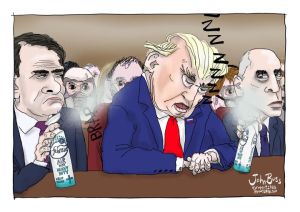
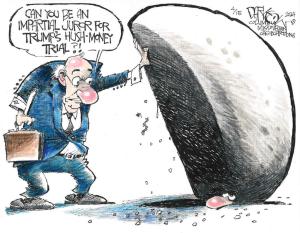 A televised trial would show us much more about Trump than the sketch artists and people in the room where it happens can explain. Also, we know that televising that trial would put a lot of folks in danger, too. I’ve already seen potential jurors cower at the thought of Trump’s crazed cult and its obsession with guns and violence. I hope their stories are having an impact. A lot of our closest friends around the world are worried about us. We are concerned about us.
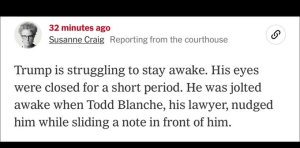 And he’s already asleep again.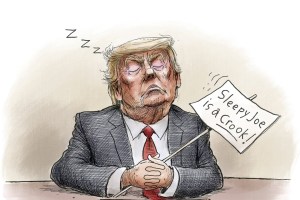
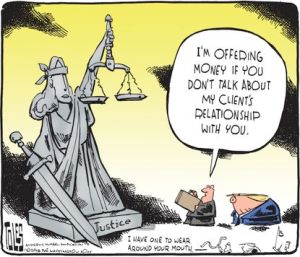
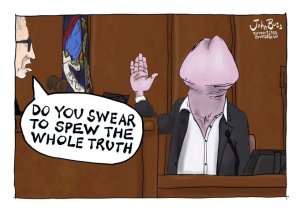





















 peej
peej Carissa
 bostonboomer
 dakinikat
 ecocatwoman
 mablue2
 Mama Lopez
 peggysue22
 quixote
 skydancingguestblogger
 Mona (aka Wonk the Vote)



 Sky Dancing
Recent Comments