I’ve spent a few hours rereading the latest Trump interviews with his usual displays of argle bargle. Yes. He still is obsessed with the idea Obama wiretapped him. Yes. He is still obsessed with losing the popular vote and screaming fake news!. Then, there’s his obsession with Andrew Jackson that appears to be based on anything but history. It seems America’s genocidal maniac could’ve prevent the Civil War from the grave according to Trump’s Alternative History Facts.
How many people do you know that would ask this question other than maybe a first grader? “Trump: ‘Why was there the Civil War?'” Oh, and how many of you–knowing that Andrew Jackson was responsible for the big win of the War of 1812–would live long enough to be around for say, the Civil War? I assuming you’re reaching down there for the kids you know attending nursery school. I would certainly expect some one who was sent to private military school which is full of old men fascinated by wars would have learned about the entire Civil War and the Battle of New Orleans. Wouldn’t you?
President Trump during an interview that airs Monday questioned why the country had a Civil War and suggested former President Andrew Jackson could have prevented it had he served later.
“I mean had Andrew Jackson been a little bit later you wouldn’t have had the Civil War. He was a very tough person, but he had a big heart,” Trump said during an interview with the Washington Examiner’s Salena Zito.
“He was really angry that he saw what was happening with regard to the Civil War, he said, ‘There’s no reason for this.'”
Jackson, the nation’s seventh president, died in 1845. The Civil War began in 1861.
The president further questioned why the country could not have solved the Civil War.
“People don’t realize, you know, the Civil War, if you think about it, why?” Trump said during the edition of “Main Street Meets the Beltway” scheduled to air on SiriusXM.
“People don’t ask that question, but why was there the Civil War? Why could that one not have been worked out?”
During the interview, the president also compared his win to that of Jackson.
“My campaign and win was most like Andrew Jackson, with his campaign. And I said, when was Andrew Jackson? It was 1828. That’s a long time ago,” Trump said.
“That’s Andrew Jackson. And he had a very, very mean and nasty campaign. Because they said this was the meanest and the nastiest. And unfortunately, it continues.”
First, this idiot didn't seem to realize Frederick Douglass was dead. Now he suggests Andrew Jackson was alive during the Civil War. I DONE.
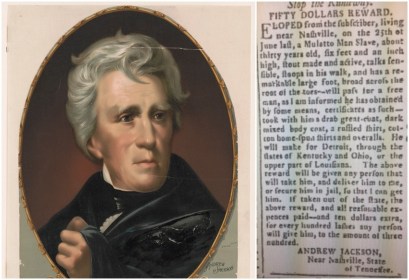
“Stop the Runaway,” Andrew Jackson urged in an ad placed in the Tennessee Gazette in October 1804. The future president gave a detailed description: A “Mulatto Man Slave, about thirty years old, six feet and an inch high, stout made and active, talks sensible, stoops in his walk, and has a remarkable large foot, broad across the root of the toes — will pass for a free man …”
Jackson, who would become the country’s seventh commander in chief in 1829, promised anyone who captured this “Mulatto Man Slave” a reward of $50, plus “reasonable” expenses paid.
Jackson added a line that some historians find particularly cruel.
It offered “ten dollars extra, for every hundred lashes any person will give him, to the amount of three hundred.”
The ad was signed, “ANDREW JACKSON, Near Nashville, State of Tennessee.”
Just for good measure, let me also point you to Andrew Jackson’s message to Congress on ‘Indian Removal.’ It’s about the policy that sent two Southern Tribes on a Trail of Tears that was nothing short of mass genocide.
“It gives me pleasure to announce to Congress that the benevolent policy of the Government, steadily pursued for nearly thirty years, in relation to the removal of the Indians beyond the white settlements is approaching to a happy consummation. Two important tribes have accepted the provision made for their removal at the last session of Congress, and it is believed that their example will induce the remaining tribes also to seek the same obvious advantages.
The consequences of a speedy removal will be important to the United States, to individual States, and to the Indians themselves. The pecuniary advantages which it promises to the Government are the least of its recommendations. It puts an end to all possible danger of collision between the authorities of the General and State Governments on account of the Indians. It will place a dense and civilized population in large tracts of country now occupied by a few savage hunters. By opening the whole territory between Tennessee on the north and Louisiana on the south to the settlement of the whites it will incalculably strengthen the southwestern frontier and render the adjacent States strong enough to repel future invasions without remote aid. It will relieve the whole State of Mississippi and the western part of Alabama of Indian occupancy, and enable those States to advance rapidly in population, wealth, and power. It will separate the Indians from immediate contact with settlements of whites; free them from the power of the States; enable them to pursue happiness in their own way and under their own rude institutions; will retard the progress of decay, which is lessening their numbers, and perhaps cause them gradually, under the protection of the Government and through the influence of good counsels, to cast off their savage habits and become an interesting, civilized, and Christian community.
What good man would prefer a country covered with forests and ranged by a few thousand savages to our extensive Republic, studded with cities, towns, and prosperous farms embellished with all the improvements which art can devise or industry execute, occupied by more than 12,000,000 happy people, and filled with all the blessings of liberty, civilization and religion? The present policy of the Government is but a continuation of the same progressive change by a milder process. The tribes which occupied the countries now constituting the Eastern States were annihilated or have melted away to make room for the whites. The waves of population and civilization are rolling to the westward, and we now propose to acquire the countries occupied by the red men of the South and West by a fair exchange, and, at the expense of the United States, to send them to land where their existence may be prolonged and perhaps made perpetual.
But the reason Jackson has taken on such a physical and rhetorical presence in the Trump White House is, in fact, primarily because of Bannon, Trump’s chief strategist and the former head of Breitbart. According to officials in the Trump campaign, presidential transition, and administration speaking to The Daily Beast, Bannon would often discuss Jackson’s historical legacy and image with Trump on and after the campaign trail, and how the two political figures were a lot alike.
“[During the race], Trump would say he had heard this pundit or this person making the comparison, and [Steve] would encourage him and tell him how it was true,” a Trump campaign adviser who requested anonymity to speak freely told The Daily Beast. “It was a way to flatter [Trump], too. Bannon and Trump talked about a lot, but this was the president they had casual [conversations] about the most.”
Another senior Team Trump official said that “as the transition was underway, he would encourage [Trump] to play up the comparison,” and that “Trump’s campaign and message was a clear descendant of Jacksonian populism and anti-political elitism.”
“[Bannon] is why Trump keeps equating himself with Andrew Jackson. That is the reason why,” the aide added.
According to two sources with knowledge of the matter, Bannon had suggested and had given Trump a “reading list” of articles and biographies on Jackson, and reading material on Jacksonian democracy and populism. Stephen Miller, another top Trump adviser, also recommended and offered related reading material to Trump, a senior Trump administration official said.
Quick Baby and Corgi Break before we move on to more depressing stuff about Kremlin Caligula. I’m moving towards the school of thought that we need a happy sanity break of the kind BB provides.
Okay, that’s not enough! Try this from Samatha Bee on what we coulda shoulda had instead of a mentally and emotionally deranged baby man in the nation’s seat of power.
President Donald Trump said he would meet with North Korean leader Kim Jong Un amid heightened tensions over his country’s nuclear weapons program if the circumstances were right.
“If it would be appropriate for me to meet with him, I would absolutely, I would be honored to do it,” Trump said Monday in an Oval Office interview with Bloomberg News. “If it’s under the, again, under the right circumstances. But I would do that.”
The U.S. has no diplomatic relations with North Korea, and as recently as last week, Secretary of State Rex Tillerson said at the United Nations that the U.S. would negotiate with Kim’s regime only if it made credible steps toward giving up its nuclear weapons and ballistic missiles.
“Most political people would never say that,” Trump said of his willingness to meet with the reclusive Kim, “but I’m telling you under the right circumstances I would meet with him. We have breaking news.”
Philippines President Rodrigo Duterte said he could not commit to visiting the White House after President Trump invited him this weekend, saying “I am tied up.”
“I cannot make any definite promise. I am supposed to go to Russia; I am supposed to go to Israel,” he said, according to Yahoo News.
Trump’s invitation to Duterte, who has been accused of backing the vigilante execution of people involved in the drug trade and threatening journalists and political opponents, drew criticism from human rights groups. He invited the controversial leader to the White House without consulting the State Department or the National Security Council.
“By essentially endorsing Duterte’s murderous war on drugs, Trump is now morally complicit in future killings,” John Sifton of Human Rights Watch told the New York Times.
If you want Trump to say something nice about you, it helps enormously if you are an authoritarian leader. Now that the continuing investigations into Russian interference in the election have forced him to be more reticent about exalting the virtues of Vladimir Putin, Trump is evidently seeking out other soul mates. On Saturday, he invited Rodrigo Duterte, the brutish President of the Philippines, who human-rights groups have accused of presiding over hundreds or thousands of extrajudicial killings in a drug war, to visit Washington.
In an interview broadcast on Sunday on “Face the Nation,” Trump even had some complimentary things to say about North Korea’s dictator, Kim Jong-un, who is widely regarded as unstable. Noting that Kim had acceded to power at a young age and asserted his control over his generals and other family members, Trump said, “So, obviously, he’s a pretty smart cookie. But we have a situation that we just cannot let—we cannot let what’s been going on for a long period of years continue.”
One situation that will continue, it seems, is Trump’s inability to take responsibility for any failures or mistakes on his part. When CBS’s John Dickerson asked him, “What do you know now on day one hundred that you wish you knew on day one of the Presidency?” Trump replied, “Well, one of the things that I’ve learned is how dishonest the media is.” Pressed by Dickerson on whether there was anything else he’d picked up, he said, “Well, I think things generally tend to go a little bit slower than you’d like them to go . . . . It’s just a very, very bureaucratic system. I think the rules in Congress and in particular the rules in the Senate are unbelievably archaic and slow moving.”
This comment jibed with something Trump said in an interview last week with Reuters, when he complained that, “This is more work than my previous life. I thought it would be easier.” Trump seems to have entered the Oval Office blissfully unaware of how the American political system works, or of the fact that the Founding Fathers purposefully placed strict limits on the power of the Presidency. Since January 20th, Congress and the judiciary have taught him some harsh lessons, and it’s clear he hasn’t enjoyed them. To Dickerson, he went so far as to claim that the system was “unfair—in many cases, you’re forced to make deals that are not the deal you’d make.”
A number of press reports have picked up this exchange this morning between ABC’s Jonathan Karl and White House Chief of Staff Reince Priebus. But people have missed the real significance. Priebus doesn’t discuss changing ‘press laws’ or ‘libel laws’. He specifically says that the White House has considered and continues to consider amending or even abolishing the 1st Amendment because of critical press coverage of President Trump.
Sound hyperbolic? Look at the actual exchange (emphasis added) …
KARL: I want to ask you about two things the President has said on related issues. First of all, there was what he said about opening up the libel laws. Tweeting “the failing New York Times has disgraced the media world. Gotten me wrong for two solid years. Change the libel laws?” That would require, as I understand it, a constitutional amendment. Is he really going to pursue that? Is that something he wants to pursue?
PRIEBUS: I think it’s something that we’ve looked at. How that gets executed or whether that goes anywhere is a different story. But when you have articles out there that have no basis or fact and we’re sitting here on 24/7 cable companies writing stories about constant contacts with Russia and all these other matters—
KARL: So you think the President should be able to sue the New York Times for stories he doesn’t like?
PRIEBUS: Here’s what I think. I think that newspapers and news agencies need to be more responsible with how they report the news. I am so tired.
KARL: I don’t think anybody would disagree with that. It’s about whether or not the President should have a right to sue them.
PRIEBUS: And I already answered the question. I said this is something that is being looked at. But it’s something that as far as how it gets executed, where we go with it, that’s another issue.
It’s really difficult to know why any of this has come about in our Republic at this point in time. A handful of angry white people in a few states targeted by Russian propaganda and enabled by voter suppression laws brought this on us. How do we get rid of him?
Trump’s critics are actively exploring the path to impeachment or the invocation of the Twenty-fifth Amendment, which allows for the replacement of a President who is judged to be mentally unfit. During the past few months, I interviewed several dozen people about the prospects of cutting short Trump’s Presidency. I spoke to his friends and advisers; to lawmakers and attorneys who have conducted impeachments; to physicians and historians; and to current members of the Senate, the House, and the intelligence services. By any normal accounting, the chance of a Presidency ending ahead of schedule is remote. In two hundred and twenty-eight years, only one President has resigned; two have been impeached, though neither was ultimately removed from office; eight have died. But nothing about Trump is normal. Although some of my sources maintained that laws and politics protect the President to a degree that his critics underestimate, others argued that he has already set in motion a process of his undoing. All agree that Trump is unlike his predecessors in ways that intensify his political, legal, and personal risks. He is the first President with no prior experience in government or the military, the first to retain ownership of a business empire, and the oldest person ever to assume the Presidency.
For Trump’s allies, the depth of his unpopularity is an urgent cause for alarm. “You can’t govern this country with a forty-per-cent approval rate. You just can’t,” Stephen Moore, a senior economist at the Heritage Foundation, who advised Trump during the campaign, told me. “Nobody in either party is going to bend over backwards for Trump if over half the country doesn’t approve of him. That, to me, should be a big warning sign.”
Trump has embraced strategies that normally boost popularity, such as military action. In April, some pundits were quick to applaud him for launching a cruise-missile attack on a Syrian airbase, and for threatening to attack North Korea. In interviews, Trump marvelled at the forces at his disposal, like a man wandering into undiscovered rooms of his house. (“It’s so incredible. It’s brilliant.”) But the Syria attack only briefly reversed the slide in Trump’s popularity; it remained at historic lows.
It is not a good sign for a beleaguered President when his party gets dragged down, too. From January to April, the number of Americans who had a favorable view of the Republican Party dropped seven points, to forty per cent, according to the Pew Research Center. I asked Jerry Taylor, the president of the Niskanen Center, a libertarian think tank, if he had ever seen so much skepticism so early in a Presidency. “No, nobody has,” he said. “But we’ve never lived in a Third World banana republic. I don’t mean that gratuitously. I mean the reality is he is governing as if he is the President of a Third World country: power is held by family and incompetent loyalists whose main calling card is the fact that Donald Trump can trust them, not whether they have any expertise.” Very few Republicans in Congress have openly challenged Trump, but Taylor cautioned against interpreting that as committed support. “My guess is that there’s only between fifty and a hundred Republican members of the House that are truly enthusiastic about Donald Trump as President,” he said. “The balance sees him as somewhere between a deep and dangerous embarrassment and a threat to the Constitution.”
The Administration’s defiance of conventional standards of probity makes it acutely vulnerable to ethical scandal. The White House recently stopped releasing visitors’ logs, limiting the public’s ability to know who is meeting with the President and his staff. Trump has also issued secret waivers to ethics rules, so that political appointees can alter regulations that they previously lobbied to dismantle.
I’m down with whatever it takes.
What’s on your reading and blogging list today?
Did you like this post? Please share it with your friends:
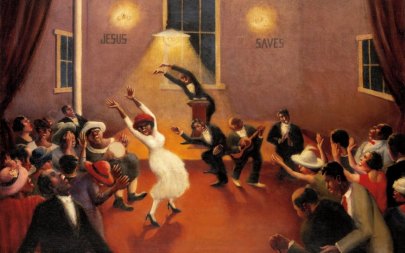
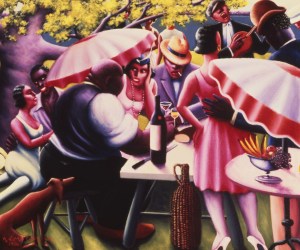
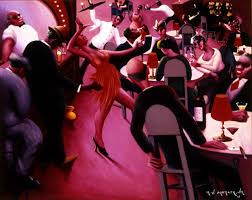
Just practicing my rusty college Russian which I’ve mostly forgotten so I’ll be able to keep up when they send me to the gulag for the intelligentsia. My selection of paintings today are from Archibald Motley who painted Black Americans during the jazz age. I’m celebrating uniquely American creativity while I can too … none of this derivative crap like the likes of Kid Rock who delivers ripped off riffs to his meth-headed mofos.
Though Motley received a full scholarship to study architecture at the Armour Institute of Technology (now the Illinois Institute of Technology) and though his father had hoped that he would pursue a career in architecture, he applied to and was accepted at the School of the Art Institute of Chicago, where he studied painting. In 1917, while still a student, Motley showed his work in the exhibition Paintings by Negro Artists held at a Chicago YMCA. That year he also worked with his father on the railroads and managed to fit in sketching while they traveled cross-country.
Upon graduating from the Art Institute in 1918, Motley took odd jobs to support himself while he made art. An idealist, he was influenced by the writings of black reformer and sociologist W.E.B. Du Bois and Harlem Renaissance leader Alain Locke and believed that art could help to end racial prejudice. At the same time, he recognized that African American artists were overlooked and undersupported, and he was compelled to write “The Negro in Art,” an essay on the limitations placed on black artists that was printed in the July 6, 1918, edition of the influential Chicago Defender, a newspaper by and for African Americans. The long and violent Chicago race riot of 1919, though it postdated his article, likely strengthened his convictions.
Motley was a WPA painter during the Great Depression. One of his murals hangs in the post office of Wood River Illinois. Wood River is part of the Greater St. Louis area. It’s painted in a distinctly different style from the beautiful, brightly colored paintings with so much energy that I’ve posted here.
The letter is signed by electors from five states and the District of Columbia. In addition to Christine Pelosi — a California elector — it includes a signature from one former members of Congress: New Hampshire’s Carol Shea-Porter.
Shea-Porter’s three other New Hampshire colleagues — Terie Norelli, Bev Hollingsworth and Dudley Dudley — also signed the letter. D.C. Councilwoman Anita Bonds, former Rhode Island gubernatorial candidate Clay Pell and Maryland activist Courtney Watson round out the nine Democratic signatories. Colorado Democratic elector Micheal Baca, leader of an effort to turn the Electoral College against Trump, is also on the list. Texas’ Chris Suprun, an emergency responder who has been a vocal critic of Trump, is the only Republican elector to sign on.
“Yes, we the Electors should have temporary security clearance to perform our constitutional duty in reviewing the facts regarding outside interference in the US election and the intelligence agencies should declassify as much data as possible while protecting sources and methods so that the American people can learn the truth about our election,” said Pelosi.
Though the letter doesn’t explicitly endorse a separate effort by electors in Colorado, Washington and California to stop Trump from winning the presidency, it represents the latest effort by Democratic electors to look to the Electoral College as a possible bulwark against a Trump presidency. The letter follows on the heels of two Democratic congressmen — David Cicilline of Rhode Island and Jim Himes of Connecticut — who suggested this weekend that the Electoral College should consider whether to block Trump’s election.
Hillary Clinton, her top advisers and former President Bill Clinton, who’s an elector from New York, have remained notably silent on the various Electoral College machinations.
Van Jones is now running a PR firm that is dead set on defeating Trump in the Electoral College. That’s right, Van Jones is actively courting Republican electors to vote against Trump on December 19th.
The firm, called Megaphone Strategies, is currently handling all media inquiries for the first official anti-Trump elector Chris Suprun. But the firm is also in working with other Republican electors, so while Trump has been helping his billionaire friends Van Jones has been raising an anti-Trump “army.”
“Tight around Trump is a little hate army — not every Trump voter — but tight around him is a little hate army of very cynical, nasty people who took over our government,” Jones said. “We have to build a massive Love Army that can take the country and the government back in a better direction.”
Senate Majority Leader Mitch McConnell (R-Ky.) on Monday said recent findings by the CIA that the Russian government tied to influence the U.S. presidential election should be investigated by the Senate Intelligence Committee.
Calling the allegations of Russian meddling “disturbing,” McConnell said the intelligence panel should take the lead, dismissing calls by Sen. John McCain (R-Ariz.) and others for a special select committee to review the matter.
He said the Intelligence Committee is “more than capable of conducting a complete review of this matter.”
“We’re going to follow the regular order. It’s an important subject and we intend to review it on a bipartisan basis,” he said.
McConnell noted that he sits on the panel as an ex officio member and that incoming Senate Democratic Leader Charles Schumer (N.Y.) will soon join it in the same capacity.
He also said that McCain will be conducting his own review of cybersecurity threats facing the nation as chairman of the Armed Services Committee.
“Sen. McCain and Sen. Burr will both be looking at this issue and doing it on a bipartisan basis,” he said, referring to Senate Intelligence Committee Chairman Richard Burr (R-N.C.).
Jason Miller, a spokesman for President-elect Donald Trump, said he was unsure of the last time Trump and McConnell spoke, but dismissed efforts to investigate Russian interference in the election as coming from “people who are bitter their candidate lost.”
Ambassador John Bolton claimed Sunday that hacks during the election season could have been “a false flag” operation — possibly committed by the Obama administration itself.
In an interview with Fox News’ Eric Shawn, Bolton questioned why FBI Director James Comey said during the investigation of Hillary Clinton’s private server, there was no direct evidence found of foreign intelligence service penetration, but cyber fingerprints were found in regards to the presidential election.
This entire story and the weird conspiracy theories are unfolding minute by minute. Paul Krugman’s Op ed on the “Tainted Election” is a must read.
The C.I.A., according to The Washington Post, has now determined that hackers working for the Russian government worked to tilt the 2016 election to Donald Trump. This has actually been obvious for months, but the agency was reluctant to state that conclusion before the election out of fear that it would be seen as taking a political role.
Meanwhile, the F.B.I. went public 10 days before the election, dominating headlines and TV coverage across the country with a letter strongly implying that it might be about to find damning new evidence against Hillary Clinton — when it turned out, literally, to have found nothing at all.
Did the combination of Russian and F.B.I. intervention swing the election? Yes. Mrs. Clinton lost three states – Michigan, Wisconsin, and Pennsylvania – by less than a percentage point, and Florida by only slightly more. If she had won any three of those states, she would be president-elect. Is there any reasonable doubt that Putin/Comey made the difference?
And it wouldn’t have been seen as a marginal victory, either. Even as it was, Mrs. Clinton received almost three million more votes than her opponent, giving her a popular margin close to that of George W. Bush in 2004.
So this was a tainted election. It was not, as far as we can tell, stolen in the sense that votes were counted wrong, and the result won’t be overturned. But the result was nonetheless illegitimate in important ways; the victor was rejected by the public, and won the Electoral College only thanks to foreign intervention and grotesquely inappropriate, partisan behavior on the part of domestic law enforcement.
The CIA only shared its latest findings with top senators last week, the Postreported, but it’s not clear when the agency made the determination. In an interview with MSNBC on Saturday, however, Senate Democratic Leader Harry Reid—who is known for making bold accusations—said FBI Director Jim Comey has known about Russia’s ambitions “for a long time,” but didn’t release that information.
If that’s true, why didn’t the Obama administration push to release it earlier?
For one, the White House was probably afraid of looking like it was tipping the scale in Hillary Clinton’s favor, especially in an election that her opponent repeatedly described as rigged. Though Obama stumped for Clinton around the country, the administration didn’t want to open him up to attacks that he unfairly used intelligence to undermine Trump’s campaign, the Post reported.
Instead, top White House officials gathered key lawmakers—leadership from the House and Senate, plus the top Democrats and Republicans from both houses’ intelligence and homeland security committees—to ask for a bipartisan condemnation of Russia’s meddling. The effort was stymied by several Republicans who weren’t willing to cooperate, including, reportedly, Senate Majority Leader Mitch McConnell. (On Sunday morning, a bipartisan statement condemning the hacks came from incoming Senate Minority Leader Chuck Schumer, Jack Reed, a Democrat, and Republicans John McCain and Lindsey Graham.)
It’s also possible that the administration, like most pollsters and pundits, was overconfident in its assessment that Clinton would win the election. Officials may have been more willing to lob incendiary accusations—and risk setting off a serious political or cyber conflict with Russia—if they had thought Trump had a good chance to win.
The silence from the White House and the CIA was a stark contrast to the Comey’s announcement just weeks before the election that it was examining new documents related to its investigation into Clinton’s emails.
I’m still really upset and I’m just going moment by moment and day by day. How can this being happening to us?
What’s on your reading and blogging list today?
Did you like this post? Please share it with your friends:
Well, the fact checkers must be busy already. They started on Economics and I caught 4 lies from Trump right out of the gate. Plus, did he just ask for the reinstatement of Smoot Hawley?
Lots of social media happening out there including here!!!
My thoughts:
She’s being strong and calm and getting her done once she got a read on him.
She got under his skin.
WTF is with his nose? Allergies? Coke? The Black Plague?
Hillary it's currently trapped in an all answers matter loop #debatenight
Take my advice for tonight’s debate. Don’t watch the pundits or you’ll need some form of tranquilizer. Have I mentioned how horrible Andrea Mitchell is lately?
So, the debate is tonight and of course, we’ll be live blogging the drama. I am assuming there will be drama. I’m still trying to figure out if there will be blood. Several little bits about the particulars first before we get on with the big build up to the event.
Bloomberg TV will conduct on-screen fact checks of statements made by both Donald Trump and Hillary Clinton during Monday night’s debate, POLITICO has confirmed.
The channel’s decision to conduct an on-screen fact-check sets Bloomberg apart from the other major TV networks, none of whom have committed to doing on-screen fact checks during the debate. Most will leave the fact-checking to segments in the post-debate analysis coverage.
Clinton’s supporters have called for aggressive fact-checking during Monday’s debate, saying that members of the media have failed to adequately fact-check and correct falsehoods from her Republican rival. NBC’s Matt Lauer was recently criticized for not correcting several false statements from Trump during a presidential forum on the network.
Spokespeople for the networks told POLITICO that on-screen fact checks would be hard to execute in real-time, which is why they were opting out. That leaves the real-time fact-checking up to NBC’s Lester Holt, the debate moderator, or Clinton herself.
The first presidential debate between Hillary Clinton and Donald Trump is tonight at 9 p.m. Eastern. It will be televised on all major broadcast and cable news networks.
AIR TIME: The debate will begin at 9 p.m. Eastern. It’s scheduled to end at 10:30 p.m. Eastern.
TV CHANNEL: This debate will be broadcast live on all the major networks and leading cable sites, including ABC, CBS, NBC, CNN, CNBC, Fox, Fox News, MSNBC, and PBS NewsHour and Univision.
To find out what channel the station you want to watch is on for you, click here to go to TV Guide’s listings. Then change the “Provider” (right under TV Listings) to your local provider. You’ll be able to scroll down to see what channel the station you’re interested in is on for you.
Over that stretch I have tried to develop my own pressthink in reply to “theirs,” meaning the ideas most campaign journalists have about their work, and the explanations they tend to give when criticized for it. I tried to summarize the first 20 years of this tension in my 2011 lecture: Why Political Coverage is Broken. What I said there is still basic to how I do my criticism, but Trump’s spectacular intervention has raised the stakes and altered the terms of the debate.
Trump is not a normal candidate and can’t be covered like one. Journalists have finally accepted that. Just the other day Dean Baquet, editor of the New York Times, said this about Trump
He’s been hugely challenging. I don’t think we’ve ever had somebody who in my time as a journalist so openly lies, and that was a word that we struggled to actually utter. We’re used to, I think as journalists, we’re used to philosophical debates, like one party thinks we should go to war on Iraq, makes its case—exaggerates its case, we now know. But there are warring philosophies. I’ve never quite seen anything like [Trump], and I think it’s a real challenge for us.
Elections were about warring philosophies. Journalists sat in the press box and brought you the action. Baquet admits: this organizing image no longer organizes much. But even his phrase “hugely challenging” understates it, I think. Here are the major propositions I have been using to understand this unique and perilous moment.
1. Political journalism rests on a picture of politics that journalists and politicos share.
As practiced by the “mainstream media” (the professionals who work at NBC, ABC, CBS, CNN, PBS, NPR, the AP, the New York Times, the Washington Post, the Wall Street Journal, the Los Angeles Times, USA Today, Reuters, Bloomberg, Politico, Time magazine) political journalism is constructed — it rests entirely — on a mental picture of the American system in which the two major parties are similar actors with, as Baquet put it, “warring philosophies.”
Elections are the big contests that distribute power between them. The day-to-day of politics is a series of minor battles for tactical advantage. The press is part of this picture because it distributes attention, but — in this view of things — it doesn’t participate in politics itself. It reports on battles large and small, questions the power holders, tries to reveal machinations going on behind the scenes and generates public interest in the drama of politics. But it is unaligned with the major players and unaffected by the outcome of the contests it chronicles.
To report successfully on such a system you need sources who trust you inside both parties. You need people in both parties who will return your calls and have drinks with you at the Des Moines Marriott. The simplest way to guarantee that is to look at politics in the same way that people in the party establishments do. The political pros who staff the committees and run the campaigns and consult with the big players are the closest readers of political journalism and closest in outlook to the journalists who consider reporting on politics their profession.
I called this a mental picture, but it’s more than that. It’s a stable framework within which work can be done, coverage can be planned, knowledge can be refined, reputation can be won, careers can be built. The image of two similar parties with warring philosophies that compete for tactical advantage also positions the mainstream press in a comfortable way: between partisan players as chronicler, questioner and referee. Among those most comfortable with that position: media owners and managers hoping to alienate as few people as possible.
In other words: powerful forces keep the mental picture in place.
2. Asymmetry between the parties fries the circuits of the mainstream press.
Now imagine what happens when over time the base of one party, far more than the base of the other, begins to treat the press as a hostile actor, and its own establishment as part of the rot; when it not only opposes but denies the legitimacy — and loyalty to the state — of the other side’s leader; when it prefers conspiracy theory to party-friendly narratives that at least cope with verified fact; when it is scornful of the reality that in a divided system you never get everything you want.
This is the thesis that Thomas Mann and Norman Ornstein developed in their 2012 book, It’s Even Worse Than It Looks. They are think tank scholars with PhDs and Washington insiders who were frequently called on by journalists to explain trends and furnish quotes. They had the same incentives as journalists to stay on conversant terms with politicos in both parties. Mann and Ornstein came to the conclusion that something had changed in the Republican Party. Their summary of it: #
The GOP has become an insurgent outlier in American politics. It is ideologically extreme; scornful of compromise; unmoved by conventional understanding of facts, evidence and science; and dismissive of the legitimacy of its political opposition. When one party moves this far from the mainstream, it makes it nearly impossible for the political system to deal constructively with the country’s challenges.
Political scandals, whether focused on Hillary Clinton’s email use or Donald Trump’s shady business dealings, have emerged as one of the most popular talking points of the 2016 presidential election. But as John Oliver explained on the latest“Last Week Tonight,” when you break down all the alleged scandals plaguing both candidates, it’s overwhelmingly clear that there is no contest: Trump is “unethically compromised to an almost unprecedented degree.”
“This campaign has been dominated by scandals, but it is dangerous to think that there is an equal number on both sides,” Oliver said. “You can be irritated by some of Hillary’s—that is understandable—but you should then be fucking outraged by Trump’s.”
–ANALYSIS — ABC’s RICK KLEIN: What if he apologizes? What if he behaves himself? What if he drops “Crooked Hillary” for “Madam Secretary”? What if – stay with us here – he doesn’t stretch the truth? Forget the no-holds-barred attacks Donald Trump has proven himself capable of. Hillary Clinton’s worst nightmare might be humble Trump, since that would flip storylines enough to potentially dominate the takeaways regardless of what else happens at Hofstra. Clinton’s camp is pressuring Lester Holt to do the fact-checking the candidate doesn’t want to do by herself. But she may be in the position of wanting and needing to draw Trump out – to bait him into a discussion of President Obama’s birth status, for instance, or a real policy discussion on Iraq or Afghanistan or ISIS. Clinton-as-aggressor would surely be unexpected. It also may be helpful in a race where she continues to struggle to lock down her base. The latest ABC News/Washington Post poll shows Trump getting a larger share of Republicans and of Romney voters than Clinton is of Democrats and Obama voters. Clinton isn’t known for smackdowns. But it may not hurt for her to show some fight.
— Reviewing the coverage ahead of Trump’s 9 p.m. showdown with Hillary Clinton at Hofstra University makes it sound like all the GOP nominee really needs to do is not talk about how well-endowed he is…
“I think that Trump is buoyed by the very low expectations. This is a guy who’s never debated one-on-one … So if he does passably, we’ll all say he won,” a Politico reporter said last week. The headline of a lead story on Politico this morning, citing anonymous “insiders,” declares that “The heat is on Hillary.”
“A lot of people are going to look at Donald Trump and think, ‘Hey, if he can even get out a good sentence and show off his experience, then he’s doing well,’” New York Times correspondent Yamiche Alcindor said on “Morning Joe” last week, addressing the Clinton campaign’s complaints that she’s being subjected to a double standard.
“Clinton has the much tougher task tonight,” NPR declares in its curtain-raiser this morning.“She has the burden of high expectations. The former senator and secretary of state, who’s now been through two presidential campaigns, is an experienced debater who knows policy inside and out. But her job is very hard — Clinton has to convince voters who don’t want to vote for Trump but haven’t warmed up to her that she is likeable, honest and trustworthy. And she has to press her case that Trump is unqualified to be president without being overly aggressive or ‘harsh.’”
“I do think that the stakes are much higher in this debate and all the debates for Hillary Clinton,” CNN’s Dana Bash said on the air recently. “Because she is a seasoned politician. She is a seasoned debater. Yes, we saw Donald Trump in the primaries debate for the first time, but he is a first-time politician. So for lots of reasons—maybe it’s not fair, but it’s the way it is—the onus is on her.”
The liberal group Media Matters has rounded up several other examples in this vein. The editor in chief of The Hill, Bob Cusack, also said on Fox News earlier this month that the bar for Clinton is “higher” than for Trump. “So there is an opportunity for Trump—if he can do the prep work and land some zingers—he could really make up some ground in the battleground states,” Cusack said.
As the Huffington Post’s Amanda Terkel notes, tongue in cheek, “Debate Bar So Low For Donald Trump That If He Doesn’t Vomit, He’s Exceeded Expectations.”
— This tenor of coverage has influenced public perceptions about the debate. Our new Washington Post/ABC News poll shows the race is within the margin of error nationally. Likely voters split 46 percent for Clinton and 44 percent for Trump. Among registered voters, Clinton and Trump are tied at 41 percent. The poll finds that eight in 10 voters plan to watch tonight’s debate, prompting some to estimate that upwards of 100 million could tune in. Overall, no matter who they’re supporting,44 percent expect Clinton to win versus 34 percent who expect Trump to come out ahead. Many who say they’ll watch have already made up their minds. While about one in five registered voters say the debate could change their minds, only 6 percent said there is a good chance of that occurring.
Just one point separates Hillary Clinton and Donald Trump in two states that are critical to both candidates’ chances of becoming president, according to new CNN/ORC polls in Pennsylvania and Colorado.
In Colorado, likely voters break 42% for Trump, 41% for Clinton, 13% for Libertarian Gary Johnson and 3% for Green Party candidate Jill Stein. Pennsylvania’s likely voters split 45% for Clinton, 44% for Trump, 6% for Johnson and 3% for Stein. Those divides are well within each poll’s 3.5-point margin of sampling error.
Polls are likely to move after the debate. It is the moment when voters get to make a direct, side-by-side comparison of the two candidates. This may also be the last time for any significant shift in the race.
Both before and after the debate, pundits will emit opinions about “expectations.” This commentary does not have predictive value. It would be better if they kept their focus on policy substance or factchecking.
Here are three reasons why you should basically ignore the onslaught of horserace punditry that is about to rain down.
Above is a mild example of what you can expect in the coming 24 hours. This particular statement is a bit circular: of course Trump will probably be perceived as “winning” if his numbers improve. However, there’s a bigger problem: the premise of “meeting expectations” itself carries no predictive value.
Trump could take the lead, but it would go against what we know so far. I would characterize the race as being very close, but not as uncertain as you might think. Why? The unappreciated story of 2016 is the amazing stability of public opinion. As measured by national polls, 2016 marks the most stable Presidential race in >60 years of modern polling. At the level of state-poll-based analysis, the stability is even greater. This basic fact should inform all analysis.
Wang provides 3 reasons and explanations. I’ll just list the points here and let you go read the explanations.
1. What commentators think about “exceeding expectations” is an anti-indicator.
2. If polls move after the debate, the reasons were baked in a long time ago
3. Polarization has made it difficult for opinion to move much.
I think his bottom line is most interesting here.
The groups that may choose up sides are self-described undecideds (4%), Gary Johnson supporters (8%), and Jill Stein supporters (3%). Undecideds andJohnson supporters are likely to split evenly between Clinton and Trump, while Stein supporters should break heavily toward Clinton. Tomorrow is a chance for them to get on the bus.
The biggest prize is Michigan where the front-runners – Donald Trump for the Republicans and Hillary Clinton for the Democrats – will seek to consolidate leads over their respective rivals.
Both parties are also holding primaries in Mississippi on Tuesday.
In addition, the Republicans are voting in Idaho and Hawaii.
Billionaire businessman Mr Trump is well ahead in the all-important delegate count, but a poor debate performance and some recent losses to Texas Senator Ted Cruz have raised questions about the solidity of his lead.
It’s an important day for Republicans, in which 6 percent of the party’s delegates are at stake. And by the time the dust has settled tonight or (more likely) tomorrow, about 43 percent of the party’s delegates will be allotted overall.
But really, today is a prelude to the far more consequential contests taking place in one week. That’s because today’s delegates are allocated mostly proportionally, making it tough for any candidate to pick up a huge lead. Next week, though, Florida and Ohio will vote winner-take-all, and the outcomes there could have major implications for the future of the race, since Donald Trump has led recent polls of both states. If he wins those two, he could amass a delegate lead that will be very difficult for any of his rivals to surmount.
So expect Republicans to interpret tonight’s results mainly in terms of what they might mean for next week. Does Trump look mortal, as he did on Saturday, or will he rebound with a dominant performance? Is Marco Rubio truly in free fall, as some recent polls have indicated? Is the anti-Trump vote consolidating around Ted Cruz, or will it remain split?
As for Democrats, Hillary Clinton is up big in polls of both states voting today. A win in Mississippi tonight wouldn’t be a surprise, since she’s romped in the South so far, but it would let her continue to pad her lead in pledged delegates, which is already sizable. But if Sanders gets blown out in Michigan, that may indicate that Clinton is likely to win several other primaries in large, delegate-rich states outside the South — making analready tough delegate math challenge for Sanders even tougher.
While Sanders has made awkward attempts to court African American voters, Hillary Clinton has deep ties to the community. She was the first presidential candidate to visit Flint, Michigan, a predominately African American city with toxic water.
Clinton hopes to appeal to people like Lawrence White, a 43-year-old state employee and owner of a small security firm who feels betrayed by every level of government and by both parties. “I’m not just singling out Governor [Rick] Snyder,” the African American Democrat told me in January. “All the politicians including the EPA are playing tit-for-tat, playing games at our expense. It’s everybody. It’s Republicans. It’s Democrats. It’s a globalization of not caring for the people of Flint.”
Just north of Detroit, in the suburbs of Oakland and Macomb counties, live the children and grandchildren of Reagan Democrats, white working-class voters who defected their party to support Ronald Reagan in the 1980s.
I grew up among Reagan Democrats; their racial and economic grievances were the soundtrack of my childhood. For people like Benson Brundage, a Macomb County contractor who told me in 2012 that welfare is racial “subsidization,” Donald Trump gives voice to their fears.
Mitt Romney dog-whistled at them in 2012. Now the former GOP nominee issuggesting that Trump is a bigot.
Ohio Gov. John Kasich has actually jumped ahead of Rubio for third place in Michigan, and is rising quickly, a Monmouth University poll out Monday showed. He appears to have worn well in last week’s Republican presidential debate, when he stayed out of the Trump-Rubio-Cruz scrum.
So imagine this scenario: Kasich beats Rubio in Michigan. Then, on March 15, Kasich wins his 66-delegate, winner-take-all home state of Ohio, and Rubio loses his 99-delegate, winner-take-all home state of Florida.
Suddenly, Kasich would become the leading moderate, establishment-type Republican in the race — and Rubio would lack a path forward.
There are a lot of “ifs” for that to happen. But for Kasich to stand any chance of turning what’s been a smaller-scale campaign that’s been much choosier about where he tries to compete into one with a real shot at quickly racking up delegates, Michigan is where it has to start.
Join us tonight for the returns! I’ve put up a picture from each of the states. As you can see, there couldn’t be a better example of the diversity in Americans and geography in the states voting tonight.
Mississippi returns will come in first at 8 pm est so get ready!!!
Did you like this post? Please share it with your friends:
The Sky Dancing banner headline uses a snippet from a work by artist Tashi Mannox called 'Rainbow Study'. The work is described as a" study of typical Tibetan rainbow clouds, that feature in Thanka painting, temple decoration and silk brocades". dakinikat was immediately drawn to the image when trying to find stylized Tibetan Clouds to represent Sky Dancing. It is probably because Tashi's practice is similar to her own. His updated take on the clouds that fill the collection of traditional thankas is quite special.
You can find his work at his website by clicking on his logo below. He is also a calligraphy artist that uses important vajrayana syllables. We encourage you to visit his on line studio.

 Trump’s Jackson obsession likely comes from Steve Bannon
 “AFTER A HUNDRED DAYS, TRUMP IS TRUMP IS TRUMP”
  So, I saved the most shocking for last and this is from TPM’s Josh Marshall .
 It’s really difficult to know why any of this has come about in our Republic at this point in time. A handful of angry white people in a few states targeted by Russian propaganda and enabled by voter suppression laws brought this on us.
  Добрый день
 Motley was a WPA painter during the Great Depression. One of his murals hangs in the post office of Wood River Illinois. Wood River is part of the Greater St. Louis area. It’s painted in a distinctly different style from the beautiful, brightly colored paintings with so much energy that I’ve posted here.
 Van Jones is launching an “army”
 Sounds like a stall!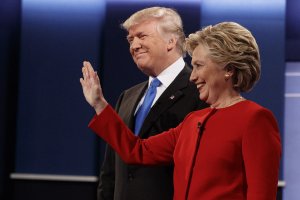
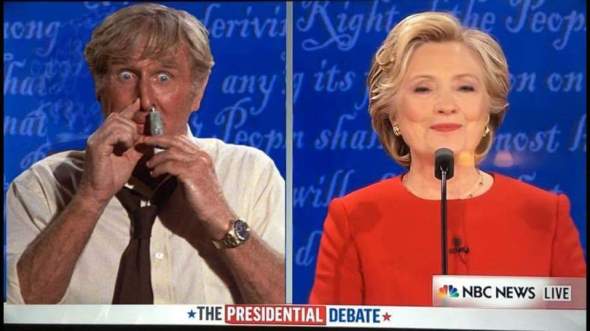

 My guess is that the debate will either be very uninteresting or very volatile. I can’t see much room for moderation in anything with Donald Trump participating. He’s the very definition of ASSymmetric political warfare.
 James Hohmann from WAPO says Trump has won the expectations game already.




 peej
peej Carissa
 bostonboomer
 dakinikat
 ecocatwoman
 mablue2
 Mama Lopez
 peggysue22
 quixote
 skydancingguestblogger
 Mona (aka Wonk the Vote)



 Sky Dancing
Recent Comments