
Omar Suleiman and the U.S. Rendition and Torture Program
Posted: January 30, 2011 Filed under: Barack Obama, Diplomacy Nightmares, Egypt, Foreign Affairs, U.S. Politics, Wikileaks | Tags: Barack Obama, Bill Clinton, Edward S. Walker, Eqyptian protests, Hillary Clinton, Hosni Mubarak, Jr., Omar Suleiman, rendition, Stephen Grey, Torture 34 Comments
Omar Suleiman
Omar Suleiman was recently appointed Vice President of Egypt by desperate dictator Hosni Mubarak. There has also been talk that Suleiman could become Mubarak’s successor now that Mubarak’s son Gamal is seemingly out of the picture.
It will be interesting to see how the Obama administration responds to this appointment, since the U.S. has had very close relations with Suleiman. Some basic background on Suleiman from Reuters:
* He has been the director of the Egyptian General Intelligence Services (EGIS) since 1993, a role in which he has played a prominent public role in diplomacy, including in Egypt’s relations with Israel and with key aid donor the United States.
* He was born on July 2, 1936 in Qena, in southern Egypt. He later enrolled in Egypt’s premier Military Academy in 1954, after which he received additional military training in the then Soviet Union at Moscow’s Frunze Military Academy.
* He also studied political science at Cairo University and Ain Shams University. In 1992 he headed the General Operations Authority in the Armed Forces and then became the director of the military intelligence unit before taking over EGIS.
* Suleiman took part in the war in Yemen in 1962 and the 1967 and 1973 wars against Israel.
* As Egypt’s intelligence chief, Suleiman was in charge of the country’s most important political security files, and was the mastermind behind the fragmentation of Islamist groups who led the uprising against the state in the 1990s.
Here is another profile from the BBC.
While he has shown little political ambition, General Suleiman has often been mentioned as a possible successor to the 82-year-old Mr Mubarak.
He would continue in the trend of military strongmen who have led Egypt since the 1952 revolution.
And perhaps more ominously, based on what you’re about to read about Suleiman’s activities,
Even if he is not the next president, even in a transitional capacity, some experts believe that Omar Suleiman is likely to be a kingmaker.
Wednesday Reading: Wired Responds to Glenn Greenwald’s Critique of their Bradley Manning Coverage
Posted: December 29, 2010 Filed under: indefinite detention, torture, Wikileaks | Tags: blog wars, Bradley Manning, Glenn Greenwald, journalistic ethics, Julian Assange, Kevin Poulsen, Salon, Torture, Wikileaks, Wired Threat Level blog 18 Comments
Bradley Manning
Good Morning! Minkoff Minx is under the weather today, so I thought I’d write a little about the latest Wikileaks/Bradley Manning themed blog war between Glenn Greenwald of Salon and Kevin Poulsen of Wired.
Via Memeorandum, it appears that Glenn Greenwald struck a few nerves when he wrote his recent post accusing Wired of journalistic malpractice, because a response has been posted at the Threat Level blog.
Here is a bit of what Greenwald had to say:
For more than six months, Wired’s Senior Editor Kevin Poulsen has possessed — but refuses to publish — the key evidence in one of the year’s most significant political stories: the arrest of U.S. Army PFC Bradley Manning for allegedly acting as WikiLeaks’ source. In late May, Adrian Lamo — at the same time he was working with the FBI as a government informant against Manning — gave Poulsen what he purported to be the full chat logs between Manning and Lamo in which the Army Private allegedly confessed to having been the source for the various cables, documents and video that WikiLeaks released throughout this year. In interviews with me in June, both Poulsen and Lamo confirmed that Lamo placed no substantive restrictions on Poulsen with regard to the chat logs: Wired was and remains free to publish the logs in their entirety.
Despite that, on June 10, Wired published what it said was only “about 25 percent” of those logs, excerpts that it hand-picked. For the last six months, Poulsen has not only steadfastly refused to release any further excerpts, but worse, has refused to answer questions about what those logs do and do not contain. This is easily one of the worst journalistic disgraces of the year: it is just inconceivable that someone who claims to be a “journalist” — or who wants to be regarded as one — would actively conceal from the public, for months on end, the key evidence in a political story that has generated headlines around the world.
In June, I examined the long, strange and multi-layered relationship between Poulsen and Lamo, and in that piece raised the issue of Wired’s severe journalistic malfeasance in withholding these chat logs.
The Wired article is divided into two parts–the first part written by Wired editor Evan Hanson and the second part written by Poulsen. Greenwald’s point is that Wired is holding back on some of the evidence that led to Manning’s arrest. In his defense of Poulsen, Hanson skirts that issue by appearing to claim that only he and Poulsen know best which parts of the Manning-Lamo logs should be released to the public.
Armchair critics, apparently unhappy that Manning was arrested, have eagerly second-guessed our motives, dreamed up imaginary conflicts and pounded the table for more information: Why would Manning open himself up to a complete stranger and discuss alleged crimes that could send him to prison for decades? How is it possible that Wired.com just happened to have a connection with the one random individual Manning picked out to confide in, only to send him down for it?
Not one single fact has been brought to light suggesting Wired.com did anything wrong in pursuit of this story. In lieu of that, our critics — notably Glenn Greenwald of Salon, an outspoken Wikileaks defender — have resorted to shocking personal attacks, based almost entirely on conjecture and riddled with errors.
Of the chat logs, he writes:
We have already published substantial excerpts from the logs, but critics continue to challenge us to reveal all, ostensibly to fact-check some statements that Lamo has made in the press summarizing portions of the logs from memory (his computer hard drive was confiscated, and he no longer has has a copy).
Our position has been and remains that the logs include sensitive personal information with no bearing on Wikileaks, and it would serve no purpose to publish them at this time.
That doesn’t mean we’ll never publish them, but before taking an irrevocable action that could harm an individual’s privacy, we have to weigh that person’s privacy interest against news value and relevance.
This is a standard journalistic balancing test — not one that we invented for Manning. Every experienced reporter of serious purpose recognizes this, and the principal is also embodied in the Society of Professional Journalists’ code of ethics:
Recognize that gathering and reporting information may cause harm or discomfort. Pursuit of the news is not a license for arrogance…. Only an overriding public need can justify intrusion into anyone’s privacy. Show good taste. Avoid pandering to lurid curiosity.
Hansen claims that Wired is protecting Manning’s privacy by their refusal to publish the remaining 75% of the logs that they have kept secret. But why should we believe that? Aren’t they really protecting Lamo while he (as Greenwald argues), as the only source of knowledgeable information about the contents of the logs:
has been allowed to run around making increasingly sensationalistic claims about what Manning told him; journalists then prominently print Lamo’s assertions, but Poulsen’s refusal to release the logs or even verify Lamo’s statements prevents anyone from knowing whether Lamo’s claims about what Manning said are actually true.
In addition, Greenwald argues that:
There are new, previously undisclosed facts about the long relationship between Wired/Poulsen and a key figure in Manning’s arrest — facts that Poulsen inexcusably concealed [and] Subsequent events gut Poulsen’s rationale for concealing the logs and, in some cases, prove that his claims are false.
And on top of all that, Greewald points out that Poulsen himself reported that Lamo is a “convicted felon” who was “involuntarily hospitalized” for psychiatric problems shortly before his on-line interactions with Manning.
In the second part of Wired’s defense, Poulsen claims that Greenwald’s accusations against him are based on false information:
On Monday, Salon.com columnist Glenn Greenwald unleashed a stunning attack on this publication, and me in particular, over our groundbreaking coverage of WikiLeaks and the ongoing prosecution of the man suspected of being the organization’s most important source. Greenwald’s piece is a breathtaking mix of sophistry, hypocrisy and journalistic laziness.
I can’t wait for Greenwald’s response to that!
Poulsen’s piece is basically a screed in which he accuses Greenwald of multiple violations of journalistic ethics. Poulsen discusses his long-time relationship with Lamo, but as far as I can tell, Poulsen’s only information about Manning comes secondhand from Lamo.
Wired.com was the first to report, last June, on the then-secret arrest of Pfc. Bradley Manning. I learned of the arrest from Adrian Lamo, a well-known former hacker on whom I reported extensively from 2000 to 2002. It was Lamo who turned Manning in to the Army and the FBI, after Manning — isolated and despondent — contacted him online and began confiding the most intimate details of his life, including, but by no means limited to, his relationship with WikiLeaks, and the vast databases he claimed to have provided them.
Co-writer Kim Zetter and I followed up the story four days later with a piece examining Manning’s motives. The Washington Post had just run a fine story about Manning’s state-of-mind: At the time of his discussions with Lamo, he’d been through a bad breakup and had other personal conflicts. But I felt — and still do feel — that it’s a mistake to automatically ascribe Manning’s actions to his feeling depressed. (For one thing, his breakup occurred after the leaking.) There’s an implicit political judgment in that conclusion: that leaking is an aberrant act, a symptom of a psychological disorder. Manning expressed clear and rational reasons for doing what he did, whether one agrees with those reasons or not.
So we went into the logs of the chats Manning held with Lamo — which Lamo had provided Wired and The Washington Post — and pieced together a picture of why Manning took his historic actions, based on his own words (“Suspected Wikileaks Source Described Crisis of Conscience Leading to Leaks”). As a sidebar to the article, we published excerpts from those chat logs.
Poulsen argues that “everything of consequence” about Manning from the logs has already been published. But why should we believe Poulsen when he has a long-time relationship with Lamo and no relationship with Manning?
You’ll have to read the rest to get the entire convoluted explanation. Most troubling to me is that neither Hansen nor Poulsen mentions the treatment that Manning is getting in prison–that by any civilized country’s standards, he is being tortured.
We’ll have to stay tuned for Greenwald’s response to all this. I’ll bet it will be a doozy. Meanwhile, what do you think?
————————————————————————————————————————————-
UPDATE 1 9:42AM Eastern: Greenwald has a response up now. He begins with this:
Last night, Wired posted a two-part response to my criticisms of its conduct in reporting on the arrest of PFC Bradley Manning and the key role played in that arrest by Adrian Lamo. I wrote about this topic twice — first back in June and then again last Sunday. The first part of Wired’s response was from Wired.com Editor-in-Chief Evan Hansen, and the second is from its Senior Editor Kevin Poulsen. Both predictably hurl all sorts of invective at me as a means of distracting attention from the central issue, the only issue that matters: their refusal to release or even comment on what is the central evidence in what is easily one of the most consequential political stories of this year, at least.
That’s how these disputes often work by design: the party whose conduct is in question (here, Wired) attacks the critic in order to create the impression that it’s all just some sort of screeching personality feud devoid of substance. That, in turn, causes some bystanders to cheer for whichever side they already like and boo the side they already dislike, as though it’s some sort of entertaining wrestling match, while everyone else dismisses it all as some sort of trivial Internet catfight not worth sorting out. That, ironically, is what WikiLeaks critics (and The New York Times’ John Burns) did with the release of the Iraq War documents showing all sorts of atrocities in which the U.S. was complicit: they tried to put the focus on the personality quirks of Julian Assange to distract attention away from the horrifying substance of those disclosures. That, manifestly, is the same tactic Wired is using here: trying to put the focus on me to obscure their own ongoing conduct in concealing the key evidence shining light on these events.
In a separate post, I fully address every accusation Hansen and Poulsen make about me as well as the alleged inaccuracies in what I wrote. But I’m going to do everything possible here to ensure that the focus remains on what matters: the way in which Wired, with no justification, continues to conceal this evidence and, worse, refuses even to comment on its content, thus blinding journalists and others trying to find out what really happened here, while enabling gross distortions of the truth by Poulsen’s long-time confidant and source, the government informant Adrian Lamo.
The link to Greenwald’s previous post goes to “page not found.” I’ll update when he fixes the link. About the substance of the argument between Greenwald and Poulsen, Greenwald writes:
The bottom line from Hansen and Poulsen is that they still refuse to release any further chat excerpts or, more inexcusably, to comment at all on — to verify or deny — Lamo’s public statements about what Manning said to him that do not appear in those excerpts. They thus continue to conceal from the public 75% of the Manning-Lamo chat. They refuse to say whether Lamo’s numerous serious accusations about what Manning told him are actually found anywhere in the chat logs. Nor will they provide the evidence to resolve the glaring inconsistencies in Lamo’s many public tales about the critical issues: how he came to speak to Manning, what Lamo did to include these disclosures, and what Manning said about his relationship to WikiLeaks and his own actions. Every insult Wired spouts about me could be 100% true and none of it changes the core fact: Wired is hiding the key evidence about what took place here, thus allowing Lamo to spout all sorts of serious claims without any check and thus drive much of the reporting about WikiLeaks.
UPDATE 2: Jane Hamsher also has a post up on this story. She writes:
You would have to have been f&#%ing r#*&rded to believe that in an era of unprecedented intolerance for press leaks of any kind, that the U.S. Army Criminal Investigation Division, the FBI, the NSA, the U.S. Air Force Office of Special Investigations and the Cyber Defense Crime Center knowingly and willingly not only allowed convicted hacker Adrian Lamo to hold on to chat logs that contained sensitive classified information, but to distribute them unexpurgated to the press.
I only see two possibilities. One, Wired had the chat logs before Lamo made any calls to authorities, and was a party to whatever subsequently happened. Or two, the copies of the chat logs that have been given to the press have been done so at the instigation of the US government, and with their full approval.
Of course there’s always c) all of the above, which is what I’m guessing is the most likely scenario.
Firedoglake has posted a database of all the available information on interactions between Manning, Lamo, and the U.S. government.
Stay tuned….
Thursday Reads
Posted: December 16, 2010 Filed under: morning reads | Tags: Afghanistan, Barack Obama, Black Agenda Report, Bob Feller, Bradley Manning, Glen Ford, Glenn Greenwald, Julian Assange, oligarchy, Peter DeFazio, Reagan Democrats, Torture, Wikileaks 48 Comments
Good Morning!!
I’ll start out with a shocking story that, unfortunately, doesn’t surprise me. Bradley Manning, the young man who is suspected of giving information about U.S. war crimes to Wikileaks, is being exposed to conditions that decent people would call torture. I’ve been worried about the treatment Manning would receive in prison, and have repeatedly said I was afraid he’d be tortured.
Keep in mind that Manning has not been charged with any crime, but has been imprisoned for seven months–the first two months in Kuwait and the rest of the time in Quantico, VA. Glenn Greenwald writes that, although Manning has been a model prisoner, he has been living
under conditions that constitute cruel and inhumane treatment and, by the standards of many nations, even torture. Interviews with several people directly familiar with the conditions of Manning’s detention, ultimately including a Quantico brig official (Lt. Brian Villiard) who confirmed much of what they conveyed, establishes that the accused leaker is subjected to detention conditions likely to create long-term psychological injuries.
[….]
From the beginning of his detention, Manning has been held in intensive solitary confinement. For 23 out of 24 hours every day — for seven straight months and counting — he sits completely alone in his cell. Even inside his cell, his activities are heavily restricted; he’s barred even from exercising and is under constant surveillance to enforce those restrictions. For reasons that appear completely punitive, he’s being denied many of the most basic attributes of civilized imprisonment, including even a pillow or sheets for his bed (he is not and never has been on suicide watch). For the one hour per day when he is freed from this isolation, he is barred from accessing any news or current events programs. Lt. Villiard protested that the conditions are not “like jail movies where someone gets thrown into the hole,” but confirmed that he is in solitary confinement, entirely alone in his cell except for the one hour per day he is taken out.
In sum, Manning has been subjected for many months without pause to inhumane, personality-erasing, soul-destroying, insanity-inducing conditions of isolation similar to those perfected at America’s Supermax prison in Florence, Colorado: all without so much as having been convicted of anything. And as is true of many prisoners subjected to warped treatment of this sort, the brig’s medical personnel now administer regular doses of anti-depressants to Manning to prevent his brain from snapping from the effects of this isolation.
This is a disgrace. President Obama should be hanging his head in shame. But he probably can’t be bothered about little things like torture. He had a big important meeting today with the head honchos of the oligarchy.
Hoping to mend fences with business leaders and spur more hiring, President Obama spent more than four hours with chief executives of 20 major companies in a “working meeting” that both sides said paved the way for better cooperation.
Mend fences?! Obama has pretty much been down on his knees to these guys for years. The super-rich just never get enough, do they? But Obama will keep on endlessly cowering before them in hopes of one day pleasing them.
The session was another step in Obama’s move toward the political center after big Republican gains in last month’s mid-term elections. A year after referring to Wall Street executives as “fat-cat bankers,” Obama is taking a less confrontational approach.
Administration officials have chafed at being labeled anti-business and have been trying to dispel that criticism. They initiated business-friendly moves in recent weeks, such as completing a trade pact with South Korea and making a deal with congressional Republican leaders to extend the Bush-era tax cuts and other tax breaks helpful to U.S. companies.
If Obama moves and further to the “center,” he’s going to fall off the rightward edge of the political spectrum.
The President said he “made progress” in the meeting with the CEOs:
The business leaders, who included UBS AG Chairman for the Americas Robert Wolf and Honeywell International Inc. Chairman David Cote, met with Obama for more than four hours today for a discussion aimed at fostering cooperation and finding ways to spur U.S. economic growth.
“We focused on jobs and investment, and they feel optimistic that by working together we can get some of that cash off the sidelines,” Obama said as he left the session, referring to the almost $2 trillion that he said companies have amassed.
The meeting at Blair House, across Pennsylvania Avenue from the White House, was convened by the president as part of an outreach to business to confer on issues such as education, exports, regulation and the budget deficit. It comes as his administration works to heal a strained relationship with the business community and to collaborate on ways to boost jobs, with the nation’s unemployment rate at 9.8 percent.
I just don’t get all this talk about a “strained relationship” with business. What a bunch of hooey!
The President must have made big promises to the oligarchs at this meeting, because he’s been spending the day making phone calls and whining to Congress critters about how his presidency will be over if they don’t pass his lousy tax-cuts-for-the-rich-bill.
Obama is telling members of Congress that failure to pass the tax-cut legislation could result in the end of his presidency, Rep. Peter DeFazio (Ore.) said.
“The White House is putting on tremendous pressure, making phone calls, the president is making phone calls saying this is the end of his presidency if he doesn’t get this bad deal,” he told CNN’s Eliot Spitzer.
The White House issued a denial after DeFazio’s appearance on CNN. But I believe DeFazio, because he’s not a proven liar like Obama is. What does DeFazio think about Obama’s chances of being reelected?
“…I think this is potentially the end of his possibility of being reelected if he gets this deal,” he said.
Glenn Ford has another must-read post up at Black Agenda Report. Of course you have to read the whole thing, but here’s a sample:
Now that self-proclaimed progressives have passed the point of disenchantment with Barack Obama and entered the stage of active anger at their once-imagined ally, they should quickly take the next step and acknowledge that he is what we at Black Agenda Report have been saying for six years: a right-wing Democrat who has long been aligned with the corporate Democratic Leadership Conference, and whose mission is to expand U.S. empire and put the American state at the service of Wall Street. He has been remarkably successful in both endeavors.
Of necessity, these strategic goals require Obama to wage war against the left hemisphere of his own Party, the main obstacle, in the absence of effective grassroots progressive movements, to forging a grand coalition with Republicans. The president, whom deluded Progressives for Obama hallucinated might become the kind of “transformative” leader that would galvanize Left constituencies into a ready-mix, shake-and-bake “movement,” also sees himself as a transformative figure, but of the opposite kind. He presented his candidacy as the antidote to what he described during the Nevada presidential primary as the “excesses” of the Sixties and Seventies. His reverence for Ronald Reagan is genuine. Indeed, if Obama were not Black, and if his supporters had not been busy getting drunk in a wishing-well, he would have been widely recognized as a stylistically updated Reagan Democrat.
Yup, Obama is transformative alright. He transformed the Democratic Party right out of existence.
Yesterday, The New York Times reported that two classified intelligence reports say that the Afghanistan debacle is getting even worse than anyone knew.
The reports, one on Afghanistan and one on Pakistan, say that although there have been gains for the United States and NATO in the war, the unwillingness of Pakistan to shut down militant sanctuaries in its lawless tribal region remains a serious obstacle. American military commanders say insurgents freely cross from Pakistan into Afghanistan to plant bombs and fight American troops and then return to Pakistan for rest and resupply.
The findings in the reports, called National Intelligence Estimates, represent the consensus view of the United States’ 16 intelligence agencies, as opposed to the military, and were provided last week to some members of the Senate and House Intelligence Committees. The findings were described by a number of American officials who read the reports’ executive summaries.
Robert Greenwald commented on this situation at FDL:
On Thursday, December 16, 2010, the White House will use its December review to try to spin the disastrous Afghanistan War plan by citing “progress” in the military campaign, but the available facts paint a picture of a war that’s not making us safer and that’s not worth the cost.
Let’s take a look at just the very broad strokes of the information. After more than nine years and a full year of a massive escalation policy:
– the insurgency continues to gain in size and strength,
– more U.S. troops are dying than ever,
– more civilians are dying than ever,
– violence in the country continues to spike,
– Pakistan is playing a double game with the U.S. and
– the military strategy lacks credible prospects for a turnaround.And yet, we are told we can expect a report touting security gains and “progress,” and that there’s virtually zero chance of any significant policy change from this review. It sort of begs the question: just what level of catastrophe in Afghanistan would signal that we need a change in direction?
That’s a very good question. We need to get the hell out of Afghanistan, Iraq, and Yemen ASAP.
According to The New York Times, the U.S. hopes to develop conspiracy charges against Wikileaks editor Julian Assange.
Justice Department officials are trying to find out whether Mr. Assange encouraged or even helped the analyst, Pfc. Bradley Manning, to extract classified military and State Department files from a government computer system. If he did so, they believe they could charge him as a conspirator in the leak, not just as a passive recipient of the documents who then published them.
Among materials prosecutors are studying is an online chat log in which Private Manning is said to claim that he had been directly communicating with Mr. Assange using an encrypted Internet conferencing service as the soldier was downloading government files. Private Manning is also said to have claimed that Mr. Assange gave him access to a dedicated server for uploading some of them to WikiLeaks.
I’m sure they’ll figure out some trumped up charges, since the U.S. no longer operates under the rule of law.
From Raw Story, some TSA news:
Adrienne Durso, a resident of California, was selected for an enhanced pat-down after walking through a metal detector at Albuquerque International Sunport airport, according to a lawsuit.
Durso, a recent breast cancer survivor, said the TSA security officer forcefully searched the area of her recent mastectomy, leaving her in pain and on the verge of crying.
[….]
When her son [age 17] confronted a security supervisor about the incident, asking why his mother had been selected for a pat-down but not him, the supervisor allegedly replied that the son was not selected because “you don’t have boobs.”
After her experience, Durso joined three other plaintiffs in a lawsuit against Homeland Security Secretary Janet Napolitano and TSA administrator John Pistole.
Nice, huh?
Finally, baseball fans will be saddened to learn that Hall of Fame pitcher Bob Feller has died. He was 92.
Bob Feller, who came off an Iowa farm with a dazzling fastball that made him a national celebrity at 17 and propelled him to the Hall of Fame as one of baseball’s greatest pitchers, died Wednesday at a hospice. He was 92.
[….]
Joining the Cleveland Indians in 1936, Feller became baseball’s biggest draw since Babe Ruth, throwing pitches that batters could barely see — fastballs approaching 100 miles an hour and curveballs and sinkers that fooled the sharpest eyes. He was Rapid Robert in the sports pages. As Yankees pitcher Lefty Gomez was said to have remarked after three Feller pitches blew by him, “That last one sounded a little low.”
A high-kicking right-hander, Feller was a major league phenomenon while still in high school in Van Meter, Iowa. His debut as an Indians starter, during his summer vacation, was spectacular: he struck out 15 batters.
Three weeks later he struck out 17, tying Dizzy Dean’s major league record. He pitched a no-hitter, the first of three in his 18-year career, when he was 21. (He went on to throw an astonishing 12 one-hitters.) He had more than 100 victories at age 22.
Feller was truly one of the greats.
Sooooo… what are you reading this morning?
Did Bush and Obama make a secret deal in 2008?
Posted: December 3, 2010 Filed under: Bailout Blues, Elections, John McCain, Surreality, Team Obama | Tags: Barack Obama, conspiracy theories, domestic spying, economic crisis, George W. Bush, Henry Paulson, John McCain, Spain, TARP, Torture, Wikileaks 40 Comments
Around the time George W. Bush’s memoir was released, Alex Barker posted this bizarre anecdote at the Financial Times’s Westminster Blog.
George W. Bush’s bombastic return to the world stage has reminded me of my favourite Bush anecdote, which for various reasons we couldn’t publish at the time. Some of the witnesses still dine out on it.
The venue was the Oval Office. A group of British dignitaries, including Gordon Brown, were paying a visit. It was at the height of the 2008 presidential election campaign, not long after Bush publicly endorsed John McCain as his successor.
Naturally the election came up in conversation. Trying to be even-handed and polite, the Brits said something diplomatic about McCain’s campaign, expecting Bush to express some warm words of support for the Republican candidate.
Not a chance. “I probably won’t even vote for the guy,” Bush told the group, according to two people present.“I had to endorse him. But I’d have endorsed Obama if they’d asked me.”
Time Magazine later quoted a Bush “spokesman,” who said Barker’s anecdote was “ridiculous and untrue.”
“President Bush proudly supported John McCain in the election and voted for him,” said Bush spokesman David Sherzer to Politico.
Nevertheless, President Obama has gone to great lengths to protect members of the Bush administration from any accountability for the crimes they committed while in office. The Justice Department defended John Yoo, author of the torture memo. Justice also went to court to defend the Bush administration’s use “state secrets privilege” to excuse NSA domestic spying. They defended Donald Rumsfeld against charges related to torture.
Recently it was learned from formerly secret cables released by Wikileaks that the Obama administration pressured Spain to drop criminal charges against six Bush officials. David Corn writes:
In its first months in office, the Obama administration sought to protect Bush administration officials facing criminal investigation overseas for their involvement in establishing policies the that governed interrogations of detained terrorist suspects. A “confidential” April 17, 2009, cable sent from the US embassy in Madrid to the State Department—one of the 251,287 cables obtained by WikiLeaks—details how the Obama administration, working with Republicans, leaned on Spain to derail this potential prosecution.
The Bush officials were charged with
“creating a legal framework that allegedly permitted torture.” The six were former Attorney General Alberto Gonzales; David Addington, former chief of staff and legal adviser to Vice President Dick Cheney; William Haynes, the Pentagon’s former general counsel; Douglas Feith, former undersecretary of defense for policy; Jay Bybee, former head of the Justice Department’s Office of Legal Counsel; and John Yoo, a former official in the Office of Legal Counsel.
The Republicans who helped Obama pressure Spain were Sen. Judd Gregg (R-N.H.) and Sen. Mel Martinez (R-Fla.). Corn again:
Back when it seemed that this case could become a major international issue, during an April 14, 2009, White House briefing, I asked press secretary Robert Gibbs if the Obama administration would cooperate with any request from the Spaniards for information and documents related to the Bush Six. He said, “I don’t want to get involved in hypotheticals.” What he didn’t disclose was that the Obama administration, working with Republicans, was actively pressuring the Spaniards to drop the investigation.
In general, as anyone with half a brain has noticed, the Obama administration has carried on Bush’s policies and sometimes has taken them even further–for example with Obama’s claiming the power to unilaterally order the assassination of American citizens.
Why would Obama defend Bush administration policies so assiduously? Is it just because Obama wants to hold onto the “enhanced” executive powers that Bush claimed during his tenure as president? Or are these two supposed political opponents actually engaged in a collaborative effort to expand the powers of the presidency?
Let’s look back at the 2008 general election campaign. In late September, Barack Obama and John McCain were preparing for the first presidential debate, to be held at the University of Mississippi on September 26, shortly after news of the financial meltdown broke. Treasury Secretary Henry Paulson had proposed the Troubled Asset Relief Program (TARP) to Congress on September 20. Read the rest of this entry »
What Devil Did Obama Make a Deal With?
Posted: November 15, 2010 Filed under: Black Agenda Report, just because, Team Obama, The Bonus Class | Tags: Barack Obama, Central Intelligence Agency, Democratic party, George Soros, George W. Bush, Robert Wolf, Torture 67 Comments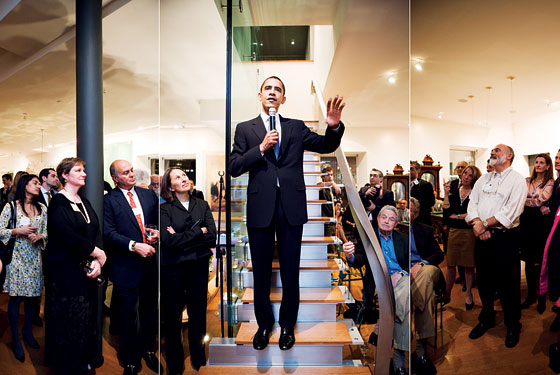
Barack Obama speaking at 2007 fundraiser in New York
As Dakinikat pointed out in her latest post, Paul Krugman used his column today to describe (and bemoan) Barack Obama’s negotiating style and his apparent lack of ideology. Krugman argues that the problem we face now (emphasis added) is:
…the contrast between the administration’s current whipped-dog demeanor and Mr. Obama’s soaring rhetoric as a candidate. How did we get from “We are the ones we’ve been waiting for” to here?
But the bitter irony goes deeper than that: the main reason Mr. Obama finds himself in this situation is that two years ago he was not, in fact, prepared to deal with the world as he was going to find it. And it seems as if he still isn’t.
In retrospect, the roots of current Democratic despond go all the way back to the way Mr. Obama ran for president. Again and again, he defined America’s problem as one of process, not substance — we were in trouble not because we had been governed by people with the wrong ideas, but because partisan divisions and politics as usual had prevented men and women of good will from coming together to solve our problems. And he promised to transcend those partisan divisions….the real question was whether Mr. Obama could change his tune when he ran into the partisan firestorm everyone who remembered the 1990s knew was coming. He could do uplift — but could he fight?
So far the answer has been no.
Although Krugman has come a long way from the days when he defended Obama’s health care “reform” bill, he is still clinging to the notion that Obama is a well-meaning, although hopelessly weak and gullible liberal. But what if Obama never intended to keep his campaign promises? What if he always planned to help cover up the Bush administration’s crimes and continue their wars?
In a recent post, I linked to this article at Common Dreams: Obama Was Used, And Is Now Used Up, by Robert Freeman. Freeman writes:
Barack Obama was used. Of course, he knew he was being used when he made the deal. But what he didn’t know was how quickly he would be used up. Now he has to face two years of humiliation knowing that he betrayed the people and the country he claimed to champion – and knowing that everyone else knows it as well – but also knowing that he’s gotten what’s coming to him.
Obama made a deal to get the job in the first place. The deal was that he would carry on with Bush’s bailout of the banks, with Bush’s two wars, with Bush’s suppression of civil liberties, that he wouldn’t prosecute or even investigate any of the enormous fraud that had brought down the country, or the lies that had railroaded it into war.
I haven’t been able to learn very much about Freeman. According to the description on one of his earlier Common Dreams pieces,
he teaches history and economics at Los Altos High School in Los Altos, CA. He is the founder of One Dollar For Life, a national non-profit that helps American students build schools in the developing world through contributions of one dollar.
He has been contributing to Common Dreams since at least 2004. Freeman doesn’t say with whom Obama supposedly made a deal, or why that entity would want the U.S. to continue the Bush administration’s policies. For all I know, Freeman could be just talking through his hat when he makes this unsourced claim; but isn’t it something many of us have wondered about for the past several years? I know I have.
Still, Why would Obama do that? Why would he campaign on high-minded generalities, leading gullible “progressives” and even well-meaning liberals to believe he would transform Washington DC and reverse Bush policies like torture, indefinite detention, and concentration of power in the executive branch?
Why did the financial community back him so strongly? Wasn’t it most likely their desire to get their hands on the Social Security trust fund? Perhaps they made a deal with Obama to engineer an assault on Social Security, Medicare, and other social programs, but would the financial community also demand that Obama continue the Bush policies of torture, detention, and endless war?
Now let’s look at the latest article by Bruce Dixon at The Black Agenda Report: Barack Obama, Social Security and the Final Irrelevance of the Black Misleadership Class. Dixon also claims that Obama’s betrayal of all that is liberal was foreordained because of a deal to make him President.
The masters of corporate media proclaim that their raid on social security, is a done deal. “Entitlements,” their code word for Medicare, Medicaid and Social Security, will be cut in the lame duck session of Congress, with Democratic president Barack Obama taking the lead. Though the outlines of this raid have been clear for months, what passes for black America’s political leadership class have been silent. As far as we know, they have not been ordered to shut up. They have silenced themselves, in abject deference to the corporate black Democrat in the White House.
It took a Republican Richard Nixon to open relations with China in the seventies. It took Democrat Bill Clinton to impose draconian cuts in welfare and end college courses for prisoners in the nineties. And today, only a black Democratic president can sufficiently disarm Democrats, only a black Democrat can demobilize the black polity completely enough for the raid on “entitlements” to be successful.
Dixon then points out a fact that many white “progressives” are missing:
Many among the current Congressional Black Caucus are utterly unprepared to stand against the corporate onslaught to gut social security because it is backed by the same forces who have made their political careers possible, and spearheaded by a black Democrat in the White House. The NAACP and similar advocacy organizations too have neutered themselves with a generation of corporate financing and the “reward” of regular meetings with White House officials
Some “progressives” are discussing as possibilities for a primary challenger to Obama in 2012 or, alternatively, a third party challenger. Both of these efforts will fail, because any challenger to Obama will not win the black vote. Dixon implies that Obama’s “deal with the devil” was a sellout to corporate interests.
Inflicting a fatal wound on social security has been the aim of America’s business class for generations. It is a project upon which some of them have spent billions. Thanks to our lack of a functioning black press, or electronic media that address black audiences, most African Americans don’t know who billionaire Pete Peterson is.
Peterson is a billionaire who announced his intention almost 20 years ago to spend every last dime of his net worth to kill social security…. [Peterson has] push[…] the fraudulent notion that social security is “a Ponzi scheme,” unsustainable, a drain on the nation’s finances, and won’t be there when people currently in their thirties and forties get old anyhow. A decades-long campaign of fear, uncertainty and doubt has been waged against the American people to prepare for the final undoing of the New Deal and Great Society programs of social security, Medicaid and Medicare. But it’s a campaign most of us are barely aware of.
Is Dixon right? Did Obama sell out in order to destroy social security? Then who demanded that Obama continue all of the Bush policies and block any close examination of Bush administration crimes?
I’m not suggesting any vast, all-encompassing conspiracy–clearly Obama’s corporate and political backers had differing goals in mind when they gave him their money. They probably didn’t all gather in a large room and deliberately plan to make Obama President. Some, like Teddy Kennedy, probably believed that Obama would really follow in JFK’s footsteps, inspiring a new generation to enter politics and change the system in radical ways. Read the rest of this entry »

 peej
peej Carissa
 bostonboomer
 dakinikat
 ecocatwoman
 mablue2
 Mama Lopez
 peggysue22
 quixote
 skydancingguestblogger
 Mona (aka Wonk the Vote)



 Sky Dancing
Recent Comments