Posted: February 4, 2026 | Author: bostonboomer | Filed under: just because | Tags: Ashley Parker, Children in Minneapolis, Christopher Columbus statues, Donald Trump, Fulton County 2020 election, ICE, ICE and elections, Jay Inlee, Jeff Bezos, Minneapolis, Minnesota, The Washington Post, Tom Homan, Trump attempts to steal state elections, Trump's White House ballroom |
Good Afternoon!!
As usual, there is just too much news for anyone to deal with. I’m going to focus on the death of a great newspaper, the torture of an American city, the efforts of a vain and ignorant “president” to grab power and steal elections, and his obsession with building monstrosities. Here’s what’s happening.
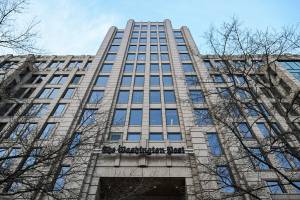
The Death of The Washington Post
Benjamin Mullin, Katie Robertson and Erik Wemple at The New York Times: Washington Post Begins Laying Off More Than 300 Journalists.
The Washington Post told employees on Wednesday that it was beginning a widespread round of layoffs that are expected to decimate the organization’s sports, local news and international coverage.
The company is laying off about 30 percent of all its employees, according to two people with knowledge of the decision. That includes people on the business side and more than 300 of the roughly 800 journalists in the newsroom, the people said.
The cuts are a sign that Jeff Bezos, who became one of the world’s richest people by selling things on the internet, has not yet figured out how to build and maintain a profitable publication on the internet. The paper expanded during the first several years of his ownership, but the company has sputtered more recently.
 Matt Murray, The Post’s executive editor, said on a call Wednesday morning with newsroom employees that the company had lost too much money for too long and had not been meeting readers’ needs. He said that all sections would be affected in some way, and that the result would be a publication focused even more on national news and politics, as well as business and health, and far less on other areas.
“If anything, today is about positioning ourselves to become more essential to people’s lives in what is becoming more crowded, competitive and complicated media landscape,” Mr. Murray said. “And after some years when, candidly, The Post has had struggles.”
Mr. Murray further explained the rationale in an email, saying The Post was “too rooted in a different era, when we were a dominant, local print product” and that online search traffic, partly because of the rise of generative A.I., had fallen by nearly half in the last three years. He added that The Post’s “daily story output has substantially fallen in the last five years.”
“Even as we produce much excellent work, we too often write from one perspective, for one slice of the audience,” he said.
The Post’s sports section will close, though some of its reporters will stay on and move to the features department to cover the culture of sports. The Post’s metro section will shrink, and the books section will close, as will the “Post Reports” daily news podcast.
Mr. Murray told the staff that while The Post’s international coverage also would be reduced, reporters would remain in nearly a dozen locations. Reporters and editors in the Middle East were laid off, as well as in India and Australia.
At The Atlantic, former Post reporter Ashley Parker writes (gift link): The Murder of The Washington Post. Today’s layoffs are the latest attempt to kill what makes the paper special.
Jeff Bezos, the billionaire owner of The Washington Post, and Will Lewis, the publisher he appointed at the end of 2023, are embarking on the latest step of their plan to kill everything that makes the paper special. The Post has survived for nearly 150 years, evolving from a hometown family newspaper into an indispensable national institution, and a pillar of the democratic system. But if Bezos and Lewis continue down their present path, it may not survive much longer.
Over recent years, they’ve repeatedly cut the newsroom—killing its Sunday magazine, reducing the staff by several hundred, nearly halving the Metro desk—without acknowledging the poor business decisions that led to this moment or providing a clear vision for the future. This morning, executive editor Matt Murray and HR chief Wayne Connell told the newsroom staff in an early-morning virtual meeting that it was closing the Sports department and Books section, ending its signature podcast, and dramatically gutting the International and Metro departments, in addition to staggering cuts across all teams. Post leadership—which did not even have the courage to address their staff in person—then left everyone to wait for an email letting them know whether or not they had a job. (Lewis, who has already earned a reputation for showing up late to work when he showed up at all, did not join the Zoom.)
The Post may yet rise, but this will be their enduring legacy.

Ashley Parker
What’s happening to the Post is a public tragedy, but for me, it is also very personal. When my parents’ basement recently flooded, amid the waterlogged boxes of old photos and vinyl records, we found my younger sister’s baby book. There, on a page reserved for memories from the month she was born—news about visits from doting grandparents, perhaps, or descriptions of her mewling gurgles—my dad had filled the lines with news from our hometown paper, The Washington Post.
“Acquired Immune Deficiency Syndrome (AIDS).” “Irangate.” “The Bork nomination to the U.S. Supreme Court.” “The NFL went on strike.” “Wall Street had the worst day since 1929!!!” “The U.S. was having a garbage crisis, i.e.; running out of disposal sites, esp. in the northeast.” (To be fair, he worked in waste management. But also … welcome to the world, Baby Girl!)
Which is to say: The Washington Post feels like a part of my family’s DNA, imprinted on our earliest memories, memorialized among clippings of our hair and other, more traditional, recollections (first diaper blowout, first word)….
The Post was also how I fell in love with journalism. Every newspaper lover has the section they read first—Sports, Comics, Metro—and mine was Style. The section, which debuted in 1969, was like nothing that had come before it, or what has come since: a newspaper that gave its writers the time and space and freedom and voice to produce narrative long-form journalism that was must-read, holding its own against the New Journalism magazine greats of the era. And for me, it was a chance to commune with giants—to read people such as Libby Copeland, Robin Givhan, Paul Hendrickson, Sally Quinn, David Von Drehle, Gene Weingarten, Marjorie Williams—and puzzle over how they’d done it.
Then, in 2017, I arrived at the Post as a reporter to cover the Trump White House, and I stayed for eight magical years. I had planned to stay forever. So what is happening at the Post right now—what has been happening there for a while—is personal. But it is also so much larger than me or any single person.
The least cynical explanation is that Bezos simply isn’t paying attention. Maybe—like so many of us initially—he was charmed by Lewis’s British accent and studied loucheness that mask an emperor whose bespoke threads are no clothes at all. Or maybe, as many of us who deeply love the Post fear, the decimation is the plan.
Bezos is killing the Post. I’m not sure if he just wants it to die or he wants it to become a propaganda arm of the Trump adminisration.
The Agony of Minneapolis
Corina Knoll at The New York Times (gift link): A Winter of Anguish for Minneapolis Children.
The morning her father called to say that he had been detained on a snowy Minneapolis road, Xochitl Soberanes was seized by an urgent and inescapable feeling. At 16 years old and the eldest of four, she would suddenly have to become the backbone of the family.
Their mother had died of pneumonia less than a year ago, so it was Xochitl who convinced her 4-year-old brother that their father was working late as they packed up belongings to go stay with a nearby aunt. That January night, a cousin found all four siblings curled up asleep in the same queen bed — cradled by Xochitl, who lay on the edge.
“We just wanted to be close together,” she said.

Xochitl cut her younger siblings’ breakfast into bite-size pieces.Credit…Jamie Kelter Davis for The New York Times
For weeks, the Minneapolis area has been a landscape of intense turmoil as federal immigration agents face off against furious citizens. But there is a quieter upheaval taking place behind closed doors as the city’s youngest residents attempt to grasp the altering of their neighborhoods, their schools, their sense of security.
Regardless of what they might understand about the politics embedded in their surroundings, some things are clear: The adults in their lives are weary and overwhelmed. Neighbors are scared to leave the house. Bomb threats have been called in to schools. Events have been canceled. Friends are missing from classrooms. And parents have been taken.
“I was just thinking, ‘What are we going to do without him?’” Xochitl said about the day her father, Victor, did not come home. She began to insist to her aunt that she could finish her final exams and be available to help with her siblings. Within a week, her friend, a U.S. citizen, was also detained and later released.“It’s like living in fear all the time,” Xochitl said.
It is a sentiment that many children in the area speak of — this fear that now feels innate and will continue to linger in ways they cannot yet comprehend. They live in a world where a barrage of honks and whistles signal that immigration agents are in their midst, and that something bad could happen soon.
It is not unusual for them to see agents dressed in riot gear and carrying rifles stationed on their streets. And those who have found themselves swept up unwillingly into altercations have been left to endure the aftereffects.
Use the gift link to read more.
The New York Times: Border Czar Says He Is Pulling 700 Immigration Agents Out of Minneapolis.
Tom Homan, the White House border czar, said on Wednesday that the federal government would immediately withdraw 700 law enforcement officers from Minneapolis, scaling down the Trump administration’s immigration crackdown in the area.
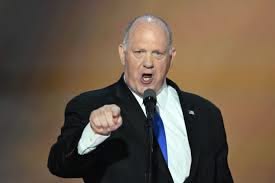
Tom Homan
The change comes after the Trump administration sent thousands of federal officers and agents to Minnesota, a deployment that Immigration and Customs Enforcement officials said was the agency’s “largest operation to date.” About 2,000 officers and agents would be left in the state, Mr. Homan said.
Tom Homan, the White House border czar, said on Wednesday that the federal government would immediately withdraw 700 law enforcement officers from Minneapolis, scaling down the Trump administration’s immigration crackdown in the area.
The change comes after the Trump administration sent thousands of federal officers and agents to Minnesota, a deployment that Immigration and Customs Enforcement officials said was the agency’s “largest operation to date.” About 2,000 officers and agents would be left in the state, Mr. Homan said.
“This is smart law enforcement, not less law enforcement,” he added.
I’ll believe that when I see it.
Mayor Jacob Frey of Minneapolis, a Democrat, said in a statement that the reduction in officers was “a step in the right direction” but that 2,000 federal officers in the region was still “not de-escalation.”
“My message to the White House has been consistent — Operation Metro Surge has been catastrophic for our businesses and residents. It needs to end immediately,” he said, referring to the name of the federal crackdown in the city.
Mr. Homan also emphasized that immigration officers would focus on more targeted enforcement operations that prioritize arresting criminals who pose public safety threats. Last week, Mr. Homan said that was “the way we’ve always done it,” but that “we got away from it a little bit.”
Still, he said that any immigrants residing in the country illegally would not be exempt from enforcement operations.
“If you are in the country illegally, you are not off the table,” Mr. Homan said.
Again, we’ll see. I’m not holding my breath.
Stealing Elections
Max Rego at The Hill: Trump doubles down on suggesting federal government ‘get involved’ in state elections.
President Trump reiterated his support for nationalizing elections Tuesday, despite backlash from both sides of the aisle on the proposal.
“I want to see elections be honest, and if a state can’t run an election, I think the people behind me should do something about it,” Trump told reporters in the Oval Office after signing legislation to end a partial government shutdown, with Republican lawmakers surrounding him.
“Because if you think about it, a state is an agent for the federal government in elections,” the president continued. “I don’t know why the federal government doesn’t do ’em anyway.”
He added, “But when you see some of these states, about how horribly they run their elections, what a disgrace it is, I think the federal government [should get involved].”
Trump initially called for transferring control of elections from certain states to the federal government during an interview Monday with former FBI Deputy Director Dan Bongino, who departed the bureau last month and returned to hosting his podcast.
“The Republicans should say, ‘We want to take over. We should take over the voting in at least 15 places,’” Trump said. “The Republicans ought to nationalize the voting.”
In the Oval Office on Tuesday, the president referenced Detroit, Philadelphia and Atlanta — all Democratic-run cities — as places where “horrible corruption on elections” is occurring.
Read more at The Hill.
Nick Corasaniti at The New York Times: Trump’s Call to ‘Nationalize’ Elections Adds to State Officials’ Alarm.
President Trump’s declaration that he wants to “nationalize” voting in the United States arrives at a perilous moment for the relationship between the federal government and top election officials across the country.
While the executive branch has no explicit authority over elections, generations of secretaries of state have relied on the intelligence gathering and cybersecurity defenses, among other assistance, that only the federal government can provide.
But as Mr. Trump has escalated efforts to involve the administration in election and voting matters while also eliminating programs designed to fortify these systems against attacks, secretaries of state and other top state election officials, including some Republican ones, have begun to sound alarms. Some see what was once a crucial partnership as frayed beyond repair.
They point to Mr. Trump’s push to overturn the 2020 election, his continued false claims that the contest was rigged, the presence of election deniers in influential government positions and his administration’s attempts to dig up evidence of widespread voter fraud that year, even though none have ever been found.
The worry, these election officials say, is that Mr. Trump and his allies might try to interfere in or cast doubt on this year’s midterm elections. The president is urgently trying to defend the Republican majorities in Congress, and the political environment has appeared to grow less friendly to his party.

Jay Inslee
Jay Inslee at Meidas+: Don’t Let ICE Freeze Voting.
Of all the threats we face, the threat that Donald Trump will use ICE and Border {atrol agents to suppress the vote calls for a response by the Senate in the pending budget bill. By word and deed, Trump has shown an intent to do all he can to subvert a free and fair election this November. He must be stopped.
Who would bet $5 that Donald Trump, the man who staged an attempted coup and urged a Governor to “find” 11,000 votes, is not going to interfere with the ability of Americans to cast their votes this November? Who thinks that his “moral code,” the only thing that he says restricts him, will prevent him from using his massive ICE private army from suppressing the vote in Democratic precincts? Who thinks Steve Bannon is kidding when he says Trump will use federal agents to screen voters?
Donald Trump represents the largest threat to free and fair voting in American history since Jim Crow. He has demonstrated time and again, his willingness to subvert our democratic norms. His recent extortion note to Minnesota and his seizure of Georgia ballots are clarion calls for action to stop him from using ICE to suppress the vote.
Think about the private voter suppression army he has entirely at his disposal, an organization purportedly in existence to deal with immigration, but which could be used for Trump’s best survival tool, the suppression of votes in Democratic precincts in competitive districts and states.
Unless something changes, what we have seen in Minneapolis is just the harbinger to the use of ICE and the Border Patrol as a massive and strategically planned voter suppression campaign, surrounding polling places with intimidating federal agents.
By separating the Homeland Security budget from the rest, the dedicated Senate Democrats now have a chance to put roadblocks in Trump’s path.
Read the rest at the link.
Nick Corasaniti and Richard Fausset at The New York Times: Fulton County in Georgia Challenges the F.B.I.’s Seizure of 2020 Ballots.
Fulton County in Georgia took legal action on Wednesday demanding that the federal government return ballots and other election materials from the 2020 presidential contest that the F.B.I. seized last week.
The motion was filed under seal in federal court in Georgia, according to Jessica Corbitt, a spokeswoman for Fulton County. The motion also seeks the unsealing of the affidavit that was filed in support of the search warrant that allowed F.B.I. agents to conduct an extraordinary search of the county’s election headquarters.
At a news conference on Wednesday morning, Robb Pitts, the chair of the Fulton County Board of Commissioners, cast the legal action as a means of upholding the Constitution, as well as the rights of Fulton County voters.
“We will fight using all resources against those who seek to take over our elections,” he said. “Our Constitution itself is at stake in this fight.”
The move follows a chaotic week in Fulton County, which includes much of Atlanta and is Georgia’s most populous county, after F.B.I. agents conducted an extraordinary search and took away pallets of ballots and other materials.
Local officials were particularly alarmed and confused by the presence of Tulsi Gabbard, the director of national intelligence, whose agency’s involvement in elections traditionally pertains only to foreign influence. The day after the search, she met with some of the agents who had participated and called Mr. Trump on her cellphone, The New York Times reported on Monday. After initially not picking up, he called back and spoke to them on speakerphone, asking them questions and praising and thanking them, according to three people with knowledge of the meeting.
Destroying the Culture of Washington, DC
The Washington Post: Trump plans to install Christopher Columbus statue outside White House.
President Donald Trump is planning to install a statue of Christopher Columbus on White House grounds, according to three people with knowledge of the pending move,in his latest effort to remake the presidential campus and celebrate the famed and controversial explorer.

In 2020, demonstrators targeted monuments deemed symbols of racism, colonialism, and oppression.
The statue is set to be located on the south side of the grounds, by E Street and north of the Ellipse, two of the people said, although they cautioned that plans could change. The three people spoke on the condition of anonymity to speak on private discussions. The piece is a reconstruction of a statue unveiled in Baltimore by then-President Ronald Reagan and dumped in the city’s harbor by protestersin 2020 as a racial reckoning swept the country.
A group of Italian American businessmen and politicians, working with local sculptors, obtained the destroyed pieces and rebuilt the statue with financial support from local charities and federal grant funding.
Bill Martin, an Italian American businessman who helped recover the remnants of the original sculpture and organize a campaign to rebuild it, said the statue is expected to be transferred from a warehouse on Maryland’s Eastern Shore to the Trump administration in coming weeks.
The White House declined to comment on its plans but praised the 15th-century explorer.
“In this White House, Christopher Columbus is a hero,” spokesman Davis Ingle said in a statement. “And he will continue to be honored as such by President Trump.
The Independent: Trump reveals latest rendering of what he calls: ‘the much anticipated White House Ballroom.’
President Donald Trump shared a new rendering showing his vision for a new White House ballroom replacing the now-demolished East Wing.
Trump celebrated his $400 million project on social media, posting that it will be the “Greatest of its kind ever built!!”

A rendering of President Donald Trump’s ‘New East Wing’ at the White House, including his nearly 90,000 square foot ballroom (The White House)
He wrote on Truth Social Tuesday that the new building “replaces the very small, dilapidated, and rebuilt many times, East Wing, with a magnificent New East Wing.” He also said that the new structure will be taller than the White House’s Executive Mansion.
“If you notice, the North Wall is a replica of the North Facade of the White House,” he wrote in the post.
The new rendering is generally similar to previous drawings of the upcoming ballroom shared by Trump.
The ballroom is projected to be approximately 90,000 square feet, and the attached “New East Wing” complex will include a new office for the First Lady, a new movie theater, and a commercial kitchen.
Trump’s decision to demolish the historic East Wing for a ritzy ballroom has been met with severe criticism, particularly from historic preservationists.
The National Trust for Historic Preservation sued the Trump administration in December in an effort to force the president to submit his plans for the ballroom to several review bodies, including Congress and the public. The lawsuit asked a court to pause his construction project until those demands are met.
Construction at the site has not been ordered to stop and Trump’s Department of Justice is moving to try to ensure that doesn’t change.
A DOJ filing on Monday asked a federal judge overseeing the lawsuit to stay any injunction into the construction over alleged “national security” concerns, ABC News reports.
That’s all I have for today. I hope you find something of interest here.
Did you like this post? Please share it with your friends:
Posted: October 26, 2024 | Author: bostonboomer | Filed under: 2024 presidential Campaign, Afternoon Reads, American Fascists, cat art, caturday, Donald Trump, Kamala Harris 2024 | Tags: Donald Trump, Jeff Bezos, Joe Biden, Kamala Harris, news, Patrick Soon-Shiong, politics, The Los Angeles Times, The Washington Post |
Good Afternoon!!
 Yesterday, Dakinikat wrote about the shameful abdication of responsibility by the owners of the Los Angeles Times and Washington Post. The Times’s Patrick Soon-Shiong and the Post’s Jeff Bezos interfered with the plans of their editorial boards in fear of what another Trump presidency could mean to their bottom lines. Both owners decreed that their newspapers would not endorse a candidate for president in 2024.
At The Wrap, Ross A. Lincoln has a piece on the extensive project that the LA Times owner chose to shut down: LA Times Planned ‘Case Against Trump’ Series Alongside Kamala Harris Endorsement Before Owner Quashed It | Exclusive.
Alongside its endorsement of Kamala Harris, the Los Angeles Times editorial board had also planned a multi-part series against Donald Trump before the whole thing was quashed by owner Patrick Soon-Shiong, TheWrap has learned.
According to internal memos viewed by TheWrap, the series, tentatively called “The Case Against Trump,” would have ran throughout this week. The endorsement of Kamala Harris would then have been published on Sunday.
However, Soon-Shiong ordered the cancellation 0f the series and the endorsement without explanation, current and now former staffers have confirmed, setting off a massive crisis for the 142-year-old paper.
The South African-American billionaire’s interference in his paper’s editorial independence has sparked a rise in canceled subscriptions and several high profile resignations, and there are also signs of growing unrest among staffers.
On Thursday, editorial writer Karin Klein, and Pulitzer Prize-winner Robert Greene, both quit. They followed Editorial Editor Mariel Garza, who resigned in protest on Wednesday. Both Klein and Garza have specifically cited Soon-Shiong’s actions as the reason for their exits.
The owner “vetoed the editorial board’s plan to endorse Kamala Harris for president,” Garza said in her resignation letter. And alluding to the fact that the LA Times has endorsed multiple local/state level candidates, she said canceling the Harris endorsement “undermines the integrity of the editorial board and every single endorsement we make, down to school board races.”
“People will justifiably wonder if each endorsement was a decision made by a group of journalists after extensive research and discussion, or through decree by the owner,” she added.
In a dissembling statement of his own posted Wednesday on the social media site formerly called Twitter, Soon-Shiong blamed the editorial team itself for the lack of an endorsement, yet also essentially confirmed he had in fact shut it down. He said the board “was provided the opportunity” to effectively draw false equivalence between Trump and Harris in op-eds laying out the pros and cons of each candidate.
“Instead of adopting this path as suggested, the editorial board chose to remain silent and I accepted their decision,” Soon-Shiong concluded.
“We pitched an endorsement and were not allowed to write one,” Garza shot back in a statement exclusively provided to TheWrap. And Klein, who also called Soon-Shiong a “chickens—,” stated plainly in a note explaining her resignation that “the board was not the one choosing to remain silent. He blocked our voice.”
This is what happens when billionaires control our media.
 The Washington Post’s betrayal of their staff and their readers is getting the most attention, because of the newspaper’s long history of speaking truth to power. For example, without the Post’s reporting, Richard Nixon might not have been forced to resign.
When Marty Baron was editor in chief, he inserted the phrase “democracy dies in darkness” at the top of The Washington Post’s front page. Well, the Post has now died and officially no longer supports democracy. The Boston Globe: Former Washington Post editor Marty Baron slams newspaper for not making presidential endorsement.
Marty Baron, the former editor of the Washington Post, blasted the newspaper on Friday for declining to issue an endorsement in this year’s presidential election, framing the decision as a win for Republican nominee Donald J. Trump.
“This is cowardice, with democracy as its casualty,” Baron, also the former editor of the Boston Globe, wrote on X. “@realdonaldtrump will see this as an invitation to further intimidate owner @jeffbezos (and others). Disturbing spinelessness at an institution famed for courage.” [….]
Baron’s message followed an announcement from Post publisher William Lewis that the newspaper is “returning to our roots of not endorsing presidential candidates.”
The Post, which is owned by Amazon.com co-founder Jeff Bezos, had drafted an endorsement for Vice President Kamala Harris, Oliver Darcy reported on his newsletter Status. Top editorial page editors at the Los Angeles Times resigned this week after the newspaper’s owner, billionaire Patrick Soon-Shiong, blocked a planned endorsement for Harris.
Baron led the Globe newsroom from 2001 to 2012 before taking the helm at the Post. He retired in 2021.
From members of the Post’s opinion page: Opinion: Post columnists respond.
The Washington Post’s decision not to make an endorsement in the presidential campaign is a terrible mistake. It represents an abandonment of the fundamental editorial convictions of the newspaper that we love. This is a moment for the institution to be making clear its commitment to democratic values, the rule of law and international alliances, and the threat that Donald Trump poses to them — the precise points The Post made in endorsing Trump’s opponents in 2016 and 2020. There is no contradiction between The Post’s important role as an independent newspaper and its practice of making political endorsements, both as a matter of guidance to readers and as a statement of core beliefs. That has never been more true than in the current campaign. An independent newspaper might someday choose to back away from making presidential endorsements. But this isn’t the right moment, when one candidate is advocating positions that directly threaten freedom of the press and the values of the Constitution.
At least The New York Times allowed their editorial board to endorse Harris: The Only Patriotic Choice for President.
It is hard to imagine a candidate more unworthy to serve as president of the United States than Donald Trump. He has proved himself morally unfit for an office that asks its occupant to put the good of the nation above self-interest. He has proved himself temperamentally unfit for a role that requires the very qualities — wisdom, honesty, empathy, courage, restraint, humility, discipline — that he most lacks.

Windy Day, Jamie Shelman
Those disqualifying characteristics are compounded by everything else that limits his ability to fulfill the duties of the president: his many criminal charges, his advancing age, his fundamental lack of interest in policy and his increasingly bizarre cast of associates.
This unequivocal, dispiriting truth — Donald Trump is not fit to be president — should be enough for any voter who cares about the health of our country and the stability of our democracy to deny him re-election.
For this reason, regardless of any political disagreements voters might have with her, Kamala Harris is the only patriotic choice for president.
Most presidential elections are, at their core, about two different visions of America that emerge from competing policies and principles. This one is about something more foundational. It is about whether we invite into the highest office in the land a man who has revealed, unmistakably, that he will degrade the values, defy the norms and dismantle the institutions that have made our country strong.
As a dedicated public servant who has demonstrated care, competence and an unwavering commitment to the Constitution, Ms. Harris stands alone in this race. She may not be the perfect candidate for every voter, especially those who are frustrated and angry about our government’s failures to fix what’s broken — from our immigration system to public schools to housing costs to gun violence. Yet we urge Americans to contrast Ms. Harris’s record with her opponent’s.
The case for Harris:
Ms. Harris is more than a necessary alternative. There is also an optimistic case for elevating her, one that is rooted in her policies and borne out by her experience as vice president, a senator and a state attorney general.
Over the past 10 weeks, Ms. Harris has offered a shared future for all citizens, beyond hate and division. She has begun to describe a set of thoughtful plans to help American families.
While character is enormously important — in this election, pre-eminently so — policies matter. Many Americans remain deeply concerned about their prospects and their children’s in an unstable and unforgiving world. For them, Ms. Harris is clearly the better choice. She has committed to using the power of her office to help Americans better afford the things they need, to make it easier to own a home, to support small businesses and to help workers. Mr. Trump’s economic priorities are more tax cuts, which would benefit mostly the wealthy, and more tariffs, which will make prices even more unmanageable for the poor and middle class.
Beyond the economy, Ms. Harris promises to continue working to expand access to health care and reduce its cost. She has a long record of fighting to protect women’s health and reproductive freedom. Mr. Trump spent years trying to dismantle the Affordable Care Act and boasts of picking the Supreme Court justices who ended the constitutional right to an abortion.
Globally, Ms. Harris would work to maintain and strengthen the alliances with like-minded nations that have long advanced American interests abroad and maintained the nation’s security. Mr. Trump — who has long praised autocrats like Vladimir Putin, Viktor Orban and Kim Jong-un — has threatened to blow those democratic alliances apart. Ms. Harris recognizes the need for global solutions to the global problem of climate change and would continue President Biden’s major investments in the industries and technologies necessary to achieve that goal. Mr. Trump rejects the accepted science, and his contempt for low-carbon energy solutions is matched only by his trollish fealty to fossil fuels.
As for immigration, a huge and largely unsolved issue, the former president continues to demonize and dehumanize immigrants, while Ms. Harris at least offers hope for a compromise, long denied by Congress, to secure the borders and return the nation to a sane immigration system.
There’s more at the link.
 Commentary on these stunning events:
Dan Froomkin at Salon: Billionaires have broken media: Washington Post’s non-endorsement is a sickening moral collapse.
The shocking decision by The Washington Post not to make an endorsement in the presidential election — breaking with a decadeslong tradition — is an extremely powerful statement. A non-endorsement says Donald Trump is a reasonable choice.
It says: We are so terrified of a Trump presidency that we are bending the knee in advance. Most importantly, it makes clear that owner Jeff Bezos doesn’t want to lose government business in a second Trump administration.
I can’t imagine statements any more inappropriate from the newspaper of Watergate, the newspaper I spent 12 years working my ass off for. It’s heartbreaking. It makes me sick to my stomach.
To be clear: Every self-respecting journalist on both the news and opinion sides should be sounding the alarm about a possible second term for Trump. He poses a threat to democracy and a free press. On the news side, that requires brutally honest coverage of the threats Trump presents, with no false equating of the two parties — one of which has rejected reality and democratic values. The Post newsroom is hit or miss on that count. But on the editorial page, this shouldn’t have been a close call (and reportedly wasn’t, until Bezos got involved)….
The very opposite of sounding the alarm is throwing up your hands and saying “well, you decide.”
The Post’s decision Friday comes just days after the Los Angeles Times also decided to forgo an official endorsement. This is no coincidence. Both papers are owned by billionaires whose business and personal interests are paramount.
“I think my fear is, if we chose either one, that it would just add to the division,” the billionaire owner of the LA Times, Patrick Soon-Shiong, told Spectrum News this week.
This makes it more clear than ever: You cannot be a truly independent news organization if you are owned by an oligarch.
No kidding. This disaster has been developing for decades as the media has become more and more centralized and controlled by corporations.
Jonathan V. Last at The Bulwark: The Guardrails Are Already Crumpling.
ON FRIDAY AFTERNOON, the Washington Post announced that it would not be making an endorsement in the presidential race. After that, a number of things happened very quickly.
First, the paper’s former executive editor Marty Baron called the decision “cowardice.”
Second, at least one senior Post opinion writer resigned.
Third, it was leaked that the editor of the editorial page had already drafted the paper’s endorsement of Kamala Harris when publisher Will Lewis—who is a new hire, hailing from the Rupert Murdoch journalism tree—quashed it and then released a CYA statement about how the paper was “returning to its roots” of not endorsing candidates. The Post itself reported that the decision was made by the paper’s owner, Amazon founder Jeff Bezos.
Everything about this story feels like a tempest in a teapot, a boiling story about legacy media fretting over itself in the mirror.
It’s not.
It’s a situation analogous to what we saw in Russia in the early 2000s: We are witnessing the surrender of the American business community to Donald Trump.

By Evelyn Sarah
No one cares about the Washington Post’s presidential endorsement. It will not move a single vote. The only people who care about newspaper editorial page endorsements are newspaper editorial writers.
No one really cares all that much about the future of the Washington Post, either. I mean, I care about it, because I care about journalism and I respect the institution.
But this isn’t a journalism story. It’s a business story.
Following Trump’s 2016 victory, the Post leaned hard into its role as a guardian of democracy. This meant criticizing, and reporting aggressively on, Trump, who responded by threatening Bezos’s various business interests.
And that’s what this story is about: It’s about the most consequential American entrepreneur of his generation signaling his submission to Trump—and the message that sends to every other corporation and business leader in the country. In the world.
Killing this editorial says, If Jeff Bezos has to be nice to Trump, then so do you. Keep your nose clean, bub.
Read on for Last’s comparison of what is happening here to Vladimir Putin’s consolidation of power in Russia.
Benjamin Wittes at The Bulwark: The Washington Post Bends the Knee to Trump.
I NEVER EXPECTED TO SEE THE DAY when the Washington Post would kneel before Donald Trump.
These are not Senate Republicans or conservative donors. This is not a group of people who cower in the face of authoritarianism. The Post editorial board, the writers who write anonymous opinion essays in the name of the paper itself, is a group of bold, pro-democracy intellectuals who have traditionally taken—individually and collectively—courageous stands about democracy and human rights around the world.
The Post’s editorial page is also the institution in which I grew up professionally. I worked there for nearly a decade under both of the last two long-time editorial page editors, Fred Hiatt and Meg Greenfield. It is an institution I revere.
And it is one that has not previously wavered with respect to Trumpist authoritarianism.
Yet today we learn that the editorial board has been stripped of its authority to endorse presidential candidates, having previously decided to endorse Kamala Harris. Instead, the paper announced in a statement from the publisher, William Lewis, that “The Washington Post will not be making an endorsement of a presidential candidate in this election. Nor in any future presidential election. We are returning to our roots of not endorsing presidential candidates.” [….]
…[T]he Post kneels without offering a word of praise for Trump. It’s just that, for high-minded reasons that it doesn’t really bother to specify, it’s getting out of this whole presidential endorsement business altogether. That was its traditional position, it archly informs us, back in the good old days before Watergate sent the Post on an aberrant jag. And, you see, while it’s perfectly understandable why the Post betrayed its high-minded above-it-allness in the wake of Nixon—when emotions were running high and all—having thought about it, it’s time to once again remove ourselves to the heights of Olympus where we can peer down on the foibles of mortals:
We recognize that this will be read in a range of ways, including as a tacit endorsement of one candidate, or as a condemnation of another, or as an abdication of responsibility. That is inevitable. We don’t see it that way. We see it as consistent with the values The Post has always stood for and what we hope for in a leader: character and courage in service to the American ethic, veneration for the rule of law, and respect for human freedom in all its aspects. We also see it as a statement in support of our readers’ ability to make up their own minds on this, the most consequential of American decisions—whom to vote for as the next president.
Yet it is a submission nonetheless: One week before the mortals finish voting and might elect an authoritarian, one whose former chief of staff calls him a fascist, the Washington Post has decided that silence is the best way to guide its readers.
Silence, after all, will not offend the authoritarian should he win. Silence, after all, is more than Trump can reasonably expect from the Post. Democracy may die in darkness, as the Post’s motto goes, but silence is apparently a good hedge.
Read the rest at the Bulwark.
Tomorrow, Trump will hold a rally in Madison Square Garden, site of the famous 1939 American Nazi rally.
ABC News: Trump to rally in iconic Madison Square Garden.
In the final week of his campaign, former President Donald Trump will cross off a campaign bucket-list item on Sunday: a rally in the iconic Madison Square Garden. The avid Broadway enthusiast will deliver a matinee performance, complete with musical guests and a host of Republican allies.
It’s a moment Trump has long said he wanted to have in the state where he has faced criminal and civil trials, becoming a convicted felon and mounted a business empire.
 “I think it’ll be a great time, and it’s going to be really a celebration of the whole thing, you know, because it’s coming to an end a few days after that. The campaigning; I won’t campaign anymore. Then I’ll be campaigning to make America great,” Trump said about the upcoming Madison Square Garden rally during a local radio interview with Cats & Cosby on Thursday….
In an arena format symbolizing confidence and celebrity status, Trump’s appearance will serve as his closing argument. In contrast, Vice President Kamala Harris makes hers on the Ellipse in Washington, D.C., where Trump spoke on Jan. 6, 2021, ahead of the attack on the U.S. Capitol on Jan. 6, 2021.
The former president, reminiscent of the last nine years campaigning for the highest office in the land, has coined the event as a “celebration of the whole thing.”
“Well, it’s New York, but it’s also sort of, it’s the end of my campaigning. When you think, I mean, I’ve done it now for nine years, we’ve had two great elections. One was better than the other,” Trump said.
On Sunday, Trump will be joined by several surrogates who have appeared with him on the campaign trail — including North Dakota Gov. Doug Burgum and Vivek Ramaswamy. House Speaker Mike Johnson, House Majority Leader Steve Scalise and Conference Chair Elise Stefanik will also be in attendance as well as several family members and donors.
Supposedly Tucker Carlson and Elon Musk will also be there.
Eric Bradner at CNN: Madison Square Garden versus the White House Ellipse: where Trump and Harris are making their final pitches.
Donald Trump and Kamala Harris have honed their closing arguments – and now they’re both turning to famous venues to try to help those messages break through just 10 days from Election Day.
The former president is returning to his hometown on Sunday for a rally in one of New York City’s most iconic landmarks, Madison Square Garden. Two days later, the vice president is holding an event at the Ellipse, the park just outside the South Lawn of the White House, where Trump’s fiery speech nearly four years ago set in motion the attack on the US Capitol.
The two events could deliver key moments in a race that is on a razor’s edge, with CNN’s final nationwide poll showing each candidate with the support of 47% of likely voters.
Both campaigns are urging supporters to cast their ballots early and attempting to reach the vanishingly small pools of undecided voters – or those who know which candidate they prefer but are not sure whether they will vote.
Harris and Trump have made clear the issues they’re highlighting in the campaign’s last days. Harris is leaning into her support for abortion rights, a political winner for Democrats since the Supreme Court overturned Roe v. Wade in 2022. She’s also contrasting her character with Trump’s – a strategy aimed at reaching independents and moderate Republicans.
“Either you have the choice of a Donald Trump, who will sit in the Oval Office stewing, plotting revenge, retribution, writing out his enemies list,” she told reporters Thursday, “or what I will be doing, which is responding to folks, like the folks last night, with a to-do list.”
Trump is hammering the vice president on border security, using dehumanizing language aimed at undocumented immigrants as he focuses on an issue that’s been at the core of his political identity for all three of his presidential runs. It’s part of his broader case that Democrats in four years have undercut the stability and economic successes of his tenure in the Oval Office.
The goals of the two candidates for the rest of the campaign:
In staging a rally at Madison Square Garden, Trump is betting on his own showmanship and celebrity – expecting he can fill the arena in the deep-blue city and hoping that the spectacle will reach television and phone screens in all seven battleground states.
Previewing the final sprint to Election Day, a senior Harris campaign official said to “expect to see more” of the vice president invoking the former president’s description of political opponents as “enemies within” while also describing the race as a decision between Trump’s “enemies list” and her own “to-do list.”
Her running mate, Minnesota Gov. Tim Walz, also deployed that framing for the first time Thursday, as he campaigned in North Carolina.
“She’s got a to-do list. He’s got an enemies list,” Walz said.
Harris’ star-studded rally Thursday night in Georgia – her first campaign appearance with former President Barack Obama, and one that featured several other celebrities – kicked off what the senior campaign official described as the homing in of the campaign’s closing argument. That argument illustrates what a Harris administration would look like compared with the threat Harris says Trump poses, the official said.
The vice president continued that celebrity-fueled push Friday night in Texas – a rare visit to a state that is not a presidential battleground.
I’m going to end there. I will add some other interesting stories in the comment thread. Take care everyone!
Did you like this post? Please share it with your friends:
Posted: January 3, 2024 | Author: bostonboomer | Filed under: 2024 Elections, 2024 presidential Campaign, just because, Media, polling, The Media SUCKS | Tags: Autocracy, big media, Claudine Gay, democracy, diversity, Greg Sargent, Harvard, journalism, Joyce Vance, Racism, Rick Perlstein, The Washington Post |
Good Morning!!
It’s 2024, and the media and the Republicans are gearing up for the presidential election in November. What are the Democrats doing? I’m sure they are raising plenty of money, but when will they wake up and start fighting back against the Republicans and the media? Make no mistake, big media is hoping for another Trump presidency, because it will mean chaos and gobs of money for those who cover the chaos. It will mean riches for the media bosses and reporters alike–think of all the new books they can sell as Trump destroys democracy and attempts to gain dictatorial power?
You’ve probably heard that The Washington Post recently got rid of 240 employees through buyouts. They chose to keep right wing columnists like Hugh Hewitt and dumped liberals like Greg Sargent. Fortunately, Sargent has been hired by The New Republic.
This post by Tom Jones is from Poynter, a site that reports on and critiques the media: Opinion | Washington Post reaches buyout goals to, for now, avert layoffs.
The good news is that the Post has been able to meet its goal of trimming staff through buyouts instead of layoffs. The bad news is the Post will enter the new year with fewer employees — perhaps a couple of hundred.

Greg Sargent
Back in October, the Post announced that it was offering buyouts with the hopes of reducing staff by 240. (At the time, the Post had approximately 2,500 employees.)
Then late last month, Post interim CEO Patty Stonesifer told staff only half of the desired number of staffers — about 120 or so — had accepted the buyouts and that there would be layoffs if not enough employees took the buyouts. At the same time, The Daily Beast’s Corbin Bolies reported that Post executive editor Sally Buzbee told staff in an email that about 36 of the 120 who accepted the buyouts were from the newsroom. She said that was “about 30 percent of our goal across the News department.”
Then came Tuesday’s news that the Post had enough buyouts to avoid layoffs — for now (my words, not the Post’s). The exact number of buyouts isn’t known publicly.
In an email to staff, Stonesifer said the company “will enter the new year with a smaller organization but a better financial position.” Stonesifer also wrote, “I am very aware of how difficult this process has been for everyone involved and I want to thank you for the grace and respect you have shown at every step.”
In July, The New York Times Benjamin Mullin and Katie Robertson reported the Post was on track to lose about $100 million this year.
For the gossip columnists at the WaPo, President Biden is boring. Imagine how much better the paper’s “financial position” will be when Trump gets back in the White House and consolidates his power. The same will be true of The New York Times. Maggie Haberman will be cleaning up, along with her co-writers.
In another positive development, historian and political observer Rick Perlstein will be writing for The American Prospect. I’m seriously thinking about dumping my Washington Post subscription and giving that money to one of these liberal publications.
Perlstein has published his first column. In it, he addresses three issues I worry about: the media focus on polls, the failure of journalists to address real issues, while tending to favor right wing narratives, and the failure of Democratic politicians to fight back hard against those narratives.
Rick Perlstein at The American Prospect: You are Entering the Infernal Triangle: Authoritarian Republicans, ineffectual Democrats, and a clueless media.
Perlstein on Polling:
As a historian who also writes about the present, there are certain well-worn grooves in the way elections get written about by pundits and political journalists from which I instinctively recoil. The obsession with polling, for one. Polls have value when approached with due humility, though you wonder how politicians and the public managed to make do without them before their modern invention in the 1930s. But given how often pollsters blow their most confident—and consequential—calls, their work is as likely to be of use to historians as object lessons in hubris as for the objective data they mean to provide.
Pollsters themselves are often the more useful data to study, especially when their models encode mistaken presumptions frozen in place from the past. In 1980, for instance, Ronald Reagan’s landslide was preceded by a near-universal consensus that the election was tied. The pollster who called it correctly, Lou Harris, was the only one who thought to factor into his models a variable that hadn’t been accounted for in previous elections, because it did not yet really exist: the Christian right.
Polling is systematically biased in just that way: toward variables that were evident in the last election, which may or may not be salient for this election. And the more polls dominate discussions of campaigns and elections, the more they crowd out intellectual energy that could be devoted to figuring out those salient, deeper, structural changes conditioning political reality: the kind of knowledge that doesn’t obediently stand still to be counted, totted up, and reduced to a single number.
On media predictions:
Another waaaaay too well-worn journalistic groove isprediction. I have probably read thousands of newspaper opinion column prognostications going back to the 1950s. Their track record is too embarrassing for me to take the exercise seriously, let alone practice it myself. Like bad polls, pundits’ predictions are most usefulwhen they are wrong. They provide an invaluable record of the unspoken collective assumptions of America’s journalistic elite, one of the most hierarchical, conformist groups of people you’ll ever run across. Unfortunately, they help shape our world nearly as much, and sometimes more, than the politicians they comment about. So their collective mistakes land hard….

Rick Perlstein, author, Reaganland: America’s Right Turn 1976-1980.
And how ritualized? Consider one of elite journalism’s most deeply worn grooves: the morning-after declarations, should any Democrat win a presidential election, that the Republican politics of demagogic hate-mongering has shown itself dead and buried for all time—forgetting how predictably it returns in each new election, often in an increasingly vicious form.
In 1964: When the author of the Civil Rights Act, Lyndon Johnson, defeated a Republican who voted against the Civil Rights Act, Barry Goldwater, one of the most distinguished liberal newspaper editors in the South, Sam Ragan of the Raleigh News & Observer, pronounced that all future American elections would be decided “on issues other than civil rights.” His essay quoted the Los Angeles Times’ Washington bureau chief, who affirmed that conventional wisdom by observing that henceforth, whichever party takes the Black vote would be no more predictable than who would win “freckle-faced redheads and one-armed shortstops.” [There are many more examples of this phenomenon in the essay.]
This particular bias is rooted into elite punditry’s deepest, most dangerous groove of all: a canyon, if you will. On one side of the yawning gulf is the perennial fantasy that America is a nation fundamentally united and at peace with itself, “moderate,” “centrist,” where exceptions are epiphenomena entirely alien to settled American “norms.”
On “Reality”:
On the other side of the gulf is, well, reality.
The media habits that make it so hard to grasp that reality—that made Trump and his merry band of insurrectionists such a surprise to us—are perhaps as systematic as any foisted upon the public by state media in authoritarian nations. A little more innocent than, say, Pravda, however, because one wellspring of this stubborn fantasy, and why audiences are so receptive to it, is simple psychology. To acknowledge the alternative is to stare into a terrifying abyss: the realization that America has never not been part of the way to something like a civil war.
But suddenly, in 2024, no one can avoid acknowledging that abyss anymore. And that leaves journalism in a genuine crisis.
Generations of this incumbent, consensus-besotted journalism have produced the very conceptual tools, metaphors, habits, and technologies that we understand as political journalism. But these tools are thoroughly inadequate to understanding what politics now is.
According to polls (which, yes, have their uses, in moderation), something around half of likely voters would like to see as our next president a man who thinks of the law as an extension of his superior will, who talks about race like a Nazi, wants to put journalistic organizations whose coverage he doesn’t like in the dock for “treason,” and who promises that anyone violating standards of good order as he defines them—shoplifters, for instance—will be summarily shot dead by officers of the state who serve only at his pleasure. A fascist, in other words. We find ourselves on the brink of an astonishing watershed, in this 2024 presidential year: a live possibility that government of the people, by the people, and for the people could conceivably perish from these United States, and ordinary people—you, me—may have to make the kind of moral choices about resistance that mid-20th-century existentialist philosophers once wrote about. That’s the case if Trump wins. But it’s just as likely, or even more likely, if he loses, then claims he wins. That’s one prediction I feel comfortable with.
I’ve already quoted too much, but I hope it’s enough so that you’ll want to read the rest at The American Prospect.
Every morning, I read Joyce Vance’s substack, Civil Discourse. Today, she offered “a warning” to all of us who want to save democracy. We have to remember that no everyone is following news and politics closely.
One morning before Christmas, I was working out with a friend who I adore, and workout with regularly. She’s young, smart, and a recent college graduate. In the middle of our session, my phone started going off incessantly and I finally picked it up. It was, of course, breaking news. That day, it was about the Giuliani bankruptcy.
I apologized to her for taking the call. I got off quickly and told her, by way of explanation, “Rudy Giuliani just filed for bankruptcy.”

Joyce Vance
“Who’s Rudy Giuliani?” she asked.
One morning before Christmas, I was working out with a friend who I adore, and workout with regularly. She’s young, smart, and a recent college graduate. In the middle of our session, my phone started going off incessantly and I finally picked it up. It was, of course, breaking news. That day, it was about the Giuliani bankruptcy.
I apologized to her for taking the call. I got off quickly and told her, by way of explanation, “Rudy Giuliani just filed for bankruptcy.”
“Who’s Rudy Giuliani?” she asked.
You know that noise they make in TV sitcoms, the one where the needle scratches across the record, and everything is interrupted? That was what I heard in my head. My mind worked over the implications of her question for the remainder of our time together.
She was born after 9-11. She never knew Giuliani as America’s mayor when the Towers fell and certainly not as the staunch pro-law enforcement mayor in the city in earlier years. But it shocked me that someone of voting age was unaware of Giuliani—didn’t recognize his name and associate it with Trump’s efforts to overturn the 2020 election.
She asked me about the bankruptcy. “Is that a good thing or a bad thing?” I explained that he’d lost a big defamation case in Georgia because he said horrible things about two election workers and disrupted their lives. Still no signs of recognition, but she got the point. “What an a**hole,” she concluded, based on my brief description of what he’d done.
Read the rest at the substack link.
Like Joyce Vance, I grew up in a politically engaged family. It’s always a shock to me when I learn that some people have no idea what’s going on in the government. We need to reach out to the people us and discuss the danger of autocracy.
I’m really troubled by what happened to Claudine Gay, Harvard’s first Black president. She may well have some issues with past plagiarism, but if she had been white, I doubt if the issue would have even come up. The truth is, she was set up by Congressional Republicans who hate diversity in education. Two articles:
At The Atlantic, David Graham expresses the typical liberal media response: it’s a shame and of course she was targeted by right wingers, but Harvard still had to do the “right” thing: An Old-Fashioned Scandal Fells a New Harvard President.
Gay, a political scientist, resigned…, making her the second president of an Ivy League institution to bow out in the past month. University of Pennsylvania President Liz Magill stepped down on December 9, but the cases are not as similar as they might initially seem. Magill’s departure stemmed directly from the shaky December 5 congressional testimony by a panel of college presidents about anti-Semitism and the Israeli-Palestinian conflict, and was viewed as a victory for Elise Stefanik, the Republican representative who led the questioning.
What appear to have doomed Gay were the allegations of plagiarism lodged against her. This is an important distinction. Penn’s board of trustees was spooked by pressure from donors and politicians. The Harvard Corporation, an equivalent body, was not. In a December 12 statement, it acknowledged that Gay’s testimony had gone poorly, but said she would remain in her post, describing its position as a defense of open discourse and academic freedom. Although Stefanik is already claiming credit, what ended Gay’s short tenure were not the hot-button issues of campus speech and anti-Semitism but was instead the kind of scandal that one might expect to fell the president of any educational institution, whether a member of the Ivy League or a community college.
Yes, because Harvard initially supported her remaining president, so the right wingers had to find another reason to get rid of her.
On December 5, Gay, Magill, and MIT’s Sally Kornbluth were hauled before Congress to speak about anti-Semitism on campus, though many GOP members really seemed to be upset about what they saw as inconsistent standards for deciding what speech is and isn’t acceptable on campuses. The hearing was remarkable for, among other things, how little intellectual agility the presidents showed in the face of questioning. A college president has to fulfill a dual role, serving not only as an academic officer but also as a sort of front woman for her institution. The failure of these presidents to represent their universities well in such a public setting was bound to raise questions about their leadership, regardless of the subject matter.
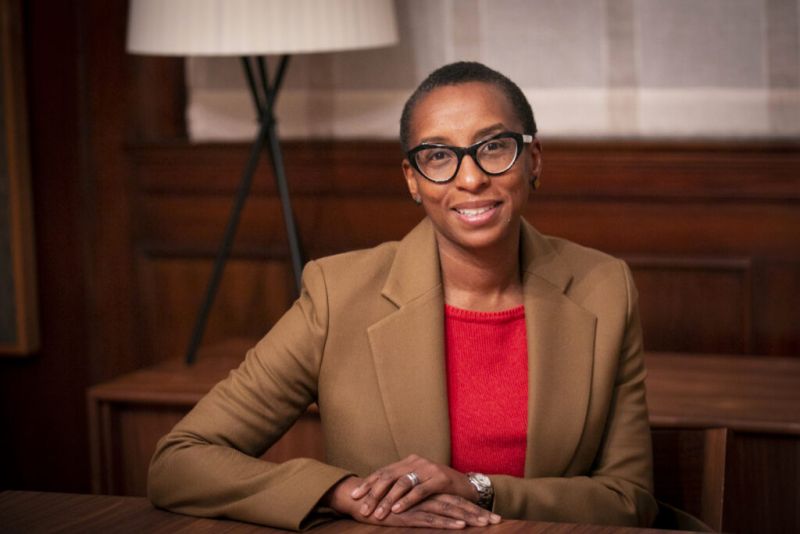
Claudine Gay
Gay survived the initial backlash to her testimony, but since then, the furor around allegations of plagiarism has grown. Many of the examples that have been made public represent extremely lazy rewriting of source material—Gay borrowed sentences or paragraphs, making minor changes to their wording or order of clauses without adding much analysis of her own. Some academics have described this as entirely unacceptable, while others have defended Gay—including some, such as David Canon, from whose work she repeatedly drew. “I am not at all concerned about the passages. This isn’t even close to an example of academic plagiarism,” Canon told The Washington Free Beacon….
The origin of the complaints is still murky. Allegations of academic misconduct against Gay had floated around online message boards for some time, The Wall Street Journal reported. One unnamed individual claims to be the source of the current charges. On October 24, the New York Post contacted the university to ask about allegations against Gay. On December 10, the conservative agitator Christopher Rufo and the journalist Christopher Brunet published claims of plagiarism in Gay’s 1997 Harvard dissertation. The next day, The Washington Free Beacon added more reporting….
Conservatives have long had it out for Gay, Harvard’s first Black president, whose appointment they viewed as a sop to progressive diversity, equity, and inclusion initiatives. The identity of the initial anonymous complainant against Gay is unclear, as is when he or she brought the complaints forward. The appearance of the allegations in conservative outlets and their timing, coming shortly after the war in Gaza thrust Gay into the spotlight, certainly suggest a politically motivated effort.
I’ve quoted the parts of Graham’s article that support my point of view. He still thinks she should have been fired.
Nia T. Evans at Mother Jones: What Claudine Gay’s Resignation From Harvard Means for the Rest of Us.
Claudine Gay’s resignation from her post as president of Harvard University is a shocking new twist in the ongoing saga over campus free speech. Gay resigned on Tuesday amid new allegations of plagiarism leveled through an unsigned complaint published in the Washington Free Beacon, a conservative outlet that has long criticized Gay. The news, which was broken by the Crimson, comes after months of attacks on Gay’s response to campus antisemitism and weeks after university leaders reaffirmed their support for her. Gay’s stunning departure is the latest casualty in a growing conservative crusade against “diversity in education” and a chilling reminder of the state of campus free speech amid Israel’s war on Gaza.
“It has become clear that it is in the best interests of Harvard for me to resign,” Gay wrote in a letter to the Harvard community. “It has been distressing to have doubt cast on my commitments to confronting hate and to upholding scholarly rigor—two bedrock values that are fundamental to who I am.”
Gay’s 186-day tenure is the shortest in the school’s 388-year history.
Just six months ago, Gay was heralded as the future of Harvard University. “I stand before you on this stage with the weight and honor of being a first,” she told a rain-soaked crowd during her inauguration ceremony. Her journey to becoming Harvard’s first Black female president felt like the quintessential American dream: she is the daughter of Haitian immigrants, a Stanford graduate with a doctorate from Harvard. An accomplished political scientist with an emphasis on race, democracy, and politics, she was praised by university and political leaders alike after being named Harvard’s 30th president in late 2022. Massachusetts Gov. Maura Healey called her “a leader for our time” driven by the “values to meet the moment” at Gay’s September inauguration ceremony. Harvard’s governing board announced her selection with glee. “We are confident Claudine will be a thoughtful, principled, and inspiring president for all of Harvard,” wrote Harvard Corporation senior fellow Penny Pritzker. “She will be a great Harvard president in no small part because she is such a good person.”
Gay’s brief tenure collided with historic political assaults against diversity and education. In June, the Supreme Court struck down affirmative action in a case in which Harvard was at its center. The October 7 terrorist attack on Israel by Hamas instigated an ongoing war that’s claimed more than 22,000 lives. The war also set off a fierce debate on college campuses across the country over free speech. In one well-documented incident, a conservative group paid for a truck to circle around Harvard Square with a billboard on which the names and photos of opponents of Israel’s actions were displayed. The billboard dubbed them “Harvard’s Leading Antisemites.”
The end result of the controversy and the efforts of right wingers:
Her resignation not only shakes things up at the most prestigious university in the country, it also exposes a larger trend of racial regression that picked up in the years following the 2020 uprisings as Black leaders have been installed in positions of power only to find themselves undermined by the systems they sought to save. Love it or hate it, Harvard sets the tone for national and international debates. To conservative activists celebrating on Twitter, Gay’s ouster is part of a larger project to purge progressive Black leaders from public institutions. Or as Chris Rufo put it, to abolish “DEI ideology from every institution in America.” In the end, Gay’s presidency has created yet another first: Harvard’s first Black female president was also its shortest-serving.
Those are my top stories for today. Lots more is happening, of course. Here are more stories you might find interesting/enraging:
Times of Israel: Israel in talks with Congo and other countries on Gaza ‘voluntary migration’ plan.
The Texas Tribune: Emergency rooms not required to perform life-saving abortions, federal appeals court rules.
Jose Pagliery at The Daily Beast: Jack Smith Keeps Telegraphing Some Seriously Scandalous Trump Crimes.
David Kurtz at TPM’s Morning Memo: The New Argument That Might Save Trump’s March Trial Date.
Newsweek: ‘Storm the Capitol’ Board Game Celebrates Jan. 6 Rioters.
That’s it for me today. What’s on your mind?
Did you like this post? Please share it with your friends:
Posted: November 6, 2014 | Author: bostonboomer | Filed under: Barack Obama, morning reads, U.S. Politics | Tags: abortion, Alison Grimes, David Krone, DSCC, FDR, Federal Stimulus, Great Depression, Harry Reid, minimum wage, Mitch McConnell, New Deal programs, personhood laws, Senate Democrats, The Washington Post |

Good Morning!!
I’m still feeling incredibly depressed about Tuesday’s elections. It almost feels like I’m grieving over a death. Yesterday I was in shock. Today I’m feeling sadness mixed with some anger. How did this happen? Why did voters do this?
Just two years ago, President Obama was reelected decisively. Now midterm voters have elected Republicans, and not just in Congress. They’ve reelected far right governors in Florida, Michigan, and Wisconsin, Ohio, and Maine; and they’ve put Republicans in state houses in Illinois, Massachusetts, and Maryland!
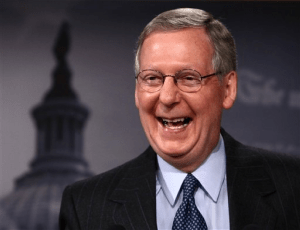
Well there’s certainly no shortage of pundits and journalists willing to explain it all to us. Last night I read quite a few of these postmortem analyses. The main thing I learned was that it’s not just Republicans who hate Obama. Senate Democrats loathe him so intensely that they’ll cut their own throats to get back at him. So much so that Harry Reid sent his right hand man out to leak all the details to The Washington Post the weekend before Tuesday night’s devastating losses.
From Zachary Goldfarb at Wonkblog: Harry Reid’s top man tears apart the White House.
You almost never see this in politics. David Krone, the chief of staff to Senate Majority Leader Harry Reid (D), launches a major attack on the White House in this blockbuster story by my colleagues Philip Rucker and Robert Costa….[The story] signals that the chilly relationship between President Obama and Senate Democrats is now entering a deep freeze.
Senate Democrats aren’t likely to care at all about Obama’s attempts to burnish his legacy in his final two years. They’re going to be laser-focused on winning the Senate back.
As he looks toward his final two years, Obama is looking toward a Congress with few friends, and many enemies, on both sides of the aisle.
So nice to know that Democratic Senators have our backs. Oh wait. It’s not about people or issues for them, just their own survival. And they’ll backstab the president and the American people in order to protect their precious domain. Why on earth did they fight tooth and nail to crown him as their nominee in 2008? It was most likely about campaign money then too.
Here’s the WaPo story in question, Battle for the Senate: How the GOP did it. The story is all about how Mich McConnell–who’s some kind of political genius according to Rucker and Costa–directed the Republican wipeout. I hope you’ll read the whole thing, but here’s the part about Krone and Senate Democrats:
After years of tension between President Obama and his former Senate colleagues, trust between Democrats at both ends of Pennsylvania Avenue had eroded. A fight between the White House and Senate Democrats over a relatively small sum of money had mushroomed into a major confrontation.
At a March 4 Oval Office meeting, Senate Majority Leader Harry M. Reid (D-Nev.) and other Senate leaders pleaded with Obama to transfer millions in party funds and to also help raise money for an outside group. “We were never going to get on the same page,” said David Krone, Reid’s chief of staff. “We were beating our heads against the wall.”
The tension represented something more fundamental than money — it was indicative of a wider resentment among Democrats in the Capitol of how the president was approaching the election and how, they felt, he was dragging them down. All year on the trail, Democratic incumbents would be pounded for administration blunders beyond their control — the disastrous rollout of the health-care law, problems at the Department of Veterans Affairs, undocumented children flooding across the border, Islamic State terrorism and fears about Ebola.
“The president’s approval rating is barely 40 percent,” Krone said. “What else more is there to say? . . . He wasn’t going to play well in North Carolina or Iowa or New Hampshire. I’m sorry. It doesn’t mean that the message was bad, but sometimes the messenger isn’t good.”

Harry Reid with top aide David Krone
And so Democratic candidates distanced themselves from Obama. And they lost bigtime. On Sunday Krone gave the Washington Post writers his notes from White House meetings and blabbed all the details, presumably in order to put the blame for losing the Senate on on the president.
With Democrats under assault from Republican super-PAC ads, Reid and his lieutenants, Sens. Charles E. Schumer (D-N.Y.) and Richard J. Durbin (D-Ill.), went to the Oval Office on March 4 to ask Obama for help. They wanted him to transfer millions of dollars from the Democratic National Committee to the DSCC, a relatively routine transaction.
Beyond that, they had a more provocative request — they wanted Obama to help raise money for the Senate Majority PAC, an outside group run by former Reid advisers.
Obama and his advisers worried about the legality of his doing this and how it could affect his reputation. Krone thought they were “setting the rules as they saw fit….For some reason, they hid behind a lot of legal issues.”
The disagreements underscored a long-held contention on Capitol Hill that Obama’s political operation functioned purely for the president’s benefit and not for his party’s, although Obama allies note that the president shared with the Senate campaigns his massive lists of volunteer data and supporters’ e-mail addresses, considered by his advisers to be sacred documents.
All year, Obama traveled frequently to raise money for the party. On June 17, White House Chief of Staff Denis McDonough offered to increase Obama’s appearances at DSCC fundraisers and to give donors access to the president through a “Dinner with Barack” contest and high-dollar roundtable discussions.
But Krone said McDonough told him there would be no cash transfer to the DSCC, because the DNC still had to retire its 2012 debt. On Sept. 9, Reid pressured Obama to take out a loan at the DNC to fund a DSCC transfer, Krone said. The DNC did open a line of credit and sent the DSCC a total of $5 million, beginning with $500,000 on Sept. 15 and following with $1.5 million installments on Sept. 30, Oct. 15 and Oct. 24.
None of that was good enough for Krone. “I don’t think that the political team at the White House truly was up to speed and up to par doing what needed to get done,” Krone said.
Please read the whole article. It describes how the Republicans developed their strategy and carried it out, and how Democrats f**ked up. Basically, Democrats ran away from Obama and tacked to the right, while Republicans tried to hide their real policies and ran to the left. The inside story on how the DSCC handled (or didn’t handle) Alison Grimes is in there too. I’m not going to excerpt from it, but here’s another must read WaPo article about Krone’s backstabbing: Midterm disaster rips apart awkward ties between Obama and Senate Democrats.
Sally Kohn writes at The Daily Beast, How’d the GOP Win? By Running Left. Kohn notes what we’ve all been talking about here. Voters put Republicans in office everywhere, yet they voted for questions on the minimum wage (Arkansas, South Dakota, Nebraska), required sick leave (Massachusetts); and they also voted down efforts to restrict abortion.
Across the issues, there’s evidence to suggest that Republican candidates won in part by masquerading as moderates, embracing the sorts of Democratic positions—or at least rhetoric—that enjoy wide voter support, even in red states. Republican candidates in states like Georgia and Virginia lamented high poverty rates. Victorious Republican Gov. Nathan Deal boasted of his progress in reducing the number of incarcerated black men in Georgia. Cory Gardner and others hammered on stagnant wages for the middle class. Republican James Lankford, who won the race for the Senate in Oklahoma, began a debate with his opponent by railing against income inequality.
Republican Bill Cassidy, who heads to a run-off for the Senate against Mary Landrieu in Louisiana, also lamented on the campaign trail that “income inequality has increased.” Thom Tillis, the Republican victor in the North Carolina Senate race, hammered Democrat Kay Hagan for supporting a sales tax that “harmed the poor and working families more than anyone else.” The winner in the Illinois governor’s race, Republican Bruce Rauner, suggested that taxes should target businesses instead of “low-income working families.”
“You’d expect to hear that kind of talk from Democrats, or maybe socialists,” wrote Slate’s William Saletan. But no, it was Republicans who managed to pull off this stunning electoral jujitsu in contorting their rhetoric to be entirely unrecognizable from their actual conservative policies and beliefs.
In other words, Republican candidates obscured their real positions (and they were trained to do it–see the WaPo article I wrote about above), while Democrats did everything possible distance themselves from President Obama and refused to defend even his successes. Alison Grimes wouldn’t even say she voted for him in 2012, even though she was an delegate at the Democratic convention!
I love this piece by Tommy Christopher at The Daily Banter, Democrats Ran Away From Obama and It Cost Them Dearly On Election Day.
The 2014 midterm election was never going to be kind to Democrats, with a map that favored Republicans to pick up at least some seats in the Senate, and a 2010 redistricting spree that practically guarantees a GOP majority in the House for, well, ever. But with an avalanche of good news about health care and the economy, and a Death Star-sized advantage on the issue of immigration reform, Democrats rolled up their sleeves and ran as hard away from that as they could. So, how’d that work out for them? [….]
Things really could not possibly have gone worse for the Democrats. When the dust settles, Republicans will probably hold 54 Senate seats, if Democrat Mark Warner (D-Va.) can hold off a surprise challenge by Ed Gillespie, and may also flip Angus King (I-Maine). If Warner falls, then there could be a 56-44 Republican majority. In the House, Republicans look to pick up 25 seats, and in the states, Democrats lost in solidly blue states like Maryland and Illinois.
It doesn’t look like walking around saying “Barack who?“ and convincing President Obama to break his promise on immigration did Democrats any good at all. But the exit polls from Tuesday’s election strongly suggest that those moves did manage to hurt Democrats in states they desperately needed to carry (well, all of them). While Republicans gained with there bread-and-butter, white voters, Democrats lost support from 2012 among black voters (-4%), Hispanic voters (-7%), unmarried women (-7%), and unmarried men (-6%). As CNN’s last pre-election poll indicted, Obama was not a factor for 45% of voters, while another 19% said their vote was cast in support of the president. Only 33% said they cast their vote in opposition to the president. That number is consistent with every poll ever of Republican opposition to Obama.
Read the rest at the link.
This headline at Politico is a laugh riot: Voters want the GOP to fix the economy. Good luck with that. Follow the link to read Politico’s take on that if you want to.
I do think 2014 voters were frustrated with the economy. Although there have been many improvements, they’ve been slow to develop and have mostly benefited the wealthy. Americans aren’t seeing their wages go up, and most of the news jobs are low-paying and/or part-time.
Obama had a chance at the beginning of his first term to be another FDR. He could have fought for a bigger stimulus and instituted programs New Deal-type programs by executive order, as Roosevelt did during the Great Depression. Instead, Obama chose to invest his mandate in passing a Republican health care bill.
Obama has learned a few things over the past six years, and he has done some good things; but the truth is he was never the liberal his clueless 2008 supporters thought he was. As I said many times back then, Obama has no real ideology that I can discover. He’s a DLC-type technocrat. Remember when he claimed he was never a member, but the DLC had his picture posted prominently on their website? He has always believed in privatizing government programs and he was never truly committed to women’s reproductive rights. Just go back and read his book, The Audacity of Hope. I read it in 2008, and I immediately knew that Obama was not my kind of Democrat. But he was elected by people who bought the book, but apparently never read it.
But that’s all water under the bridge. He’s the President of the U.S. now, and I’ve done my best to support him. He’s done some good things, and I think he’s done a lot more for me than Harry Reid and his pals in the Senate.
That’s it for me this morning. What stories are you following? Please post your thoughts and links in the comment thread, and I hope you’ll have a pleasant Thursday.
Did you like this post? Please share it with your friends:
Posted: August 6, 2013 | Author: bostonboomer | Filed under: Environment, Foreign Affairs, Media, morning reads, Russia, science, U.S. Politics | Tags: Ben Bradlee, Donald Graham, Eugene Meyer, Jeff Bezos, John Henry, Katherine Graham, morning newspapers, Newsweek, Pentagon Papers, Philip Graham, The Boston Globe, The Washington Post |
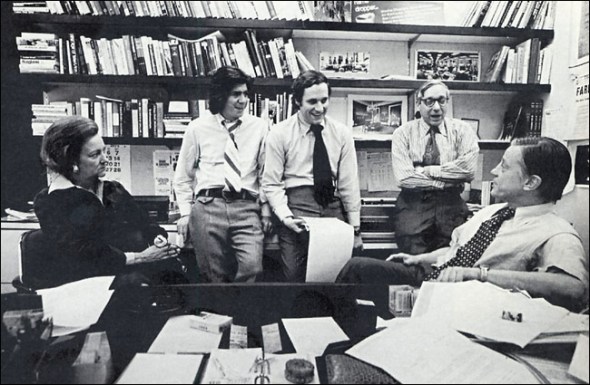
Katherine Graham meets with Carl Bernstein, Bob Woodward, Howard Simons and Ben Bradlee.
Good Morning!!
The big news today is of course the Graham family’s shocking sale of The Washington Post to billionaire Jeff Bezos of Amazon. This, along with the sale of The Boston Globe to Red Sox owner John Henry and the sale of Newsweek to IBT Media, signal the true end of an era.
The days when Americans woke up to the daily newspaper on their doorsteps is long gone. The place to go for the latest news these days is the internet and print newspapers and news magazines are struggling to survive. But the Globe and Newsweek have been on the auction block for a long time; the Post sale was a complete surprise, even to its employees.
From David von Drehle at Time Magazine: A New Age for the Washington Post
It’s hard to startle the journalism business these days, given the scale and speed of disruption of the media industry. But the Graham family selling the Washington Post to Amazon CEO Jeff Bezos for $250 million is an exception. Few newspapers in the world are as closely identified with a single family.
The story of the Grahams and the Post used to be told in giant pictures on the wall of the newspaper lobby on L Street not far from the White House. One grainy photograph documented the day in 1933 when the brilliant financier Eugene Meyer bought the paper for a song at a bankruptcy sale on the courthouse steps. Another (a favorite of all of us who worked there) showed Meyer’s remarkable daughter, Katharine Graham, beaming as she left another D.C. courthouse in the company of her favorite editor, Benjamin C. Bradlee, after they prevailed over the government in the Pentagon Papers lawsuit.
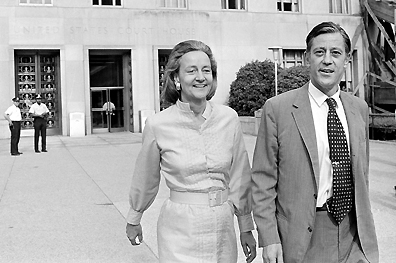
Katherine Graham and Ben Bradlee leaving the courthouse after prevailing in the Pentagon Papers case.
But the most important photograph, according to Mrs. Graham’s son and successor Donald E. Graham, was the one that showed Meyer in the company of Philip L. Graham, the brilliant and tragic husband of Katharine and father of Don. They were smiling like a pair of lotto winners, which they were. The year was 1954, and after years of effort and red ink, they had finally bought out their last remaining rival for dominance of the morning-newspaper market in Washington. As other families would learn in other cities across the country — the Chandlers in Los Angeles, the Coxes in Atlanta, the Knights in Miami and so on — dominance of the morning-newspaper routes would become a decades-long license to print money.

Philip L. Graham and Eugene Meyer look at the first The Washington Post Times Herald, in Washington, March 18, 1954.
Owning the morning meant that the Post would thrive as afternoon newspapers fell to the competition of television news. (The last afternoon paper in Washington, the excellent Washington Star, winked out in 1981.) It meant that advertisers hoping to reach a broad Washington audience had no choice but to pay the Post’s steadily increasing rates. That day in 1954 was the key to everything the Post later became, Don told me one day about 10 years ago when we bumped into each other in the lobby. Watergate, all the Pulitzer Prizes, the foreign correspondents, the celebrity columnists — all of it was possible because the patriarch and his son-in-law managed to lock up the morning.
A couple more links on the Post sale:
James Fallows at The Atlantic: Why the Sale of the Washington Post Seems So Significant
I have known and liked Donald Graham and his family over the years; many of my friends in journalism have at one time or another worked at the Washington Post. My first reaction to news that the family had sold the paper is simple shock. But it is shock based not on my positive-but-not-deep personal connection to the paper and its people but rather on sheer generational disorientation.
Readers below about age 40, who have known the Post only during its beleaguered, downsizing-its-way-out-of-trouble era, may find it hard to imagine the role it once played. Over the past decade-plus, the New York Times and theWall Street Journal have been the national newspaper organizations. It already seems antique even to use the word “newspaper” in such a construction, for reasons I don’t need to belabor now. But their flagship daily print publications make the NYT and the WSJ similar to the Financial Times and different from the other remaining ambitious news organizations — Bloomberg and Thomson Reuters, the broadcast and cable networks, NPR, etc.
There was a time when you would automatically have included the Post in that first-tier national grouping. Other mainly regional or local papers were strong — the LA Times, the Chicago Tribune, the Boston Globe, and on down a nostalgic list. But more than any of the rest of them, the Post was fully in the national-newspaper derby and measured itself every day against the Times in talent level, depth and breadth of reporting, international coverage, sophistication, and all the other measures of a nationally ambitious operation. People who have started reading the paper in the past dozen years — rather, who have notstarted reading it — probably can’t imagine this difference in stature. But it is dramatic, and real.
Much more at the link.
“The pattern of a newspaperman’s life is like the plot of ‘Black Beauty,’ ” A. J. Liebling wrote. “Sometimes he finds a kind master who gives him a dry stall and an occasional bran mash in the form of a Christmas bonus, sometimes he falls into the hands of a mean owner who drives him in spite of spavins and expects him to live on potato peelings.” And sometimes, out of the blue, the ownership changes and you don’t know what the hell you’re getting in your bucket—fresh oats or cut glass.
At around 4:25 Monday afternoon, the staff of the Washington Post was summoned to the paper’s auditorium, a vast room where the presses used to be. The meeting would begin at 4:30 P.M., they were told. Donald E. Graham, the leader of the Graham family, which has owned the paper since Eugene Meyer bought it at a bankruptcy auction in 1933, stood solemnly before journalists who had been demoralized over the years by staff cuts, precipitous plunges in circulation, and endless dark rumors. It was a room full of reporters and editors, and yet, as one told me, “we thought we were there to hear that the Grahams had sold the building.”
In fact, Graham told them, in a voice so full of emotion that he had to stop a few times to gather himself, they were selling the Post and a handful of smaller papers—for two hundred and fifty million dollars, to Jeff Bezos, the founder and C.E.O. of Amazon, who is estimated to be worth more than twenty-five billion dollars. Graham asked the people there not to tweet, just to listen. The assembled were so stunned that when it came time for questions no one had any for a while; Graham had to urge them out of their silence.
“This was just plain sad. Now we belong to a guy who is so rich that the paper is around one per cent of his net worth,” a reporter told me soon after the meeting. “This was the family acknowledging that we can’t do it anymore and we have to give it to someone else. And we love the Graham family, we are proud of the family.”
It’s a long and interesting essay–read the rest at the link.
Neil Irwin and Ylan Q. Mui at The Washington Post write that Bezos paid more than he needed to for the Post.
The purchase price is richer than many of those paid for other legacy print media properties in recent years.
The New York Times Co. agreed to sell the Boston Globe to Red Sox owner John W. Henry for only $70 million. Newsweek sold for a symbolic $1, plus assumed pension liabilities, to billionaire Sidney Harman in 2011.
The Post “has a much stronger position in its market than the Boston Globe does,” said John Morton, an independent newspaper industry analyst. “It doesn’t surprise me that it would command a much higher price.”
Still, Morton suggested that the prominence and the visibility of The Post made Bezos willing to pay a higher price than would be justified by the paper’s finances alone. “I think probably Jeff Bezos was willing to pay a premium to make this happen,” Morton said. “. . . Bezos has enough money that if he wants to make it a hobby, he can.”
Interestingly, The New York Times apparently sold The Globe for less than they could have gotten. According to the AP:
BOSTON — Three bidders who fell short in their attempts to purchase The Boston Globe say they offered more than Boston Red Sox owner John Henry’s winning $70 million bid and criticized the decision of the seller, The New York Times Co., to make a deal with him.
Springfield television station owner John Gormally, West Coast investment executive Robert Loring and U-T San Diego chief executive John Lynch all said their groups’ bids bested Henry’s.
Henry agreed to pay $70 million to buy the Globe, the Boston Metro and the Telegram & Gazette in Worcester, about 50 miles from Boston. The bid, announced Saturday, was a fraction of the $1.1 billion the Times Co. paid 20 years ago.
Lynch said his group offered “significantly more” than Henry and wondered how the Times Co.’s shareholders would react after learning the company accepted a lower offer.
“I’m just stunned,” Lynch told the Boston Herald. “I thought this was a public company that had a fiduciary duty to get the most by its stockholders.”
Gormally says his bit was $80 million, but he admits that local ownership will probably be better for the Globe in the long run. Perhaps the Times wanted to do us Bostonians a favor.
I’m running out of space, so I’ll just add a few more stories in link dump fashion.Mark Ames on Vladamir Putin’s “human rights” record: Snowden’s Savior Announces Plans To Build 83 “Concentration Camps” Across Russia (link unlocked for 2 days)
Nature World News: Enormous Sinkhole, Still Expanding, Creates Spectacle in Western Kansas [VIDEO]
A former student sues her high school for bullying she suffered–first lawsuit based on new Massachusetts anti-bullying law
WSJ: Boston Bombing Suspect was Steeped in Conspiracies
Wendy Davis: Ready to ride for governor of Texas? (Christian Science Monitor)
How the World’s ‘Most Biodiverse Place’ Could Be Ransomed for Oil Money (Miami Herald via PBS)
The Independent: Japan calls for nuclear disarmament at 68th anniversary of Hiroshima bombing
Now it’s your turn. What are you reading and blogging about today? Please post your links on any topic in the comment thread.
Did you like this post? Please share it with your friends:


 peej
peej Carissa
 bostonboomer
 dakinikat
 ecocatwoman
 mablue2
 Mama Lopez
 peggysue22
 quixote
 skydancingguestblogger
 Mona (aka Wonk the Vote)



 Sky Dancing
Recent Comments