
Late Night: The Benghazi “Sideshow” Will Never Die
Posted: May 13, 2013 Filed under: 2016 elections, Foreign Affairs, Hillary Clinton, Libya, Political and Editorial Cartoons, Republican politics, U.S. Politics | Tags: acts of terror, Benghazi Sideshow, Darrell Issa, House Oversight Committee, terrorism, terrorist attacks 12 Comments
Benghazigizer Bunny by Daryl Cagle
Source: The Cagle Post
Today President Obama accurately called the endless Republican outrage over Benghazi “a sideshow.” Reuters reports:
The Benghazi matter flared up again last week after internal emails were made public showing that in the days after the attack, the administration tried to shape “talking points” to explain why four Americans, including U.S. Ambassador Christopher Stevens, had been killed.
Obama rejected Republicans’ claims that the administration tried to cover up the role of Islamist militants in the attack to avoid looking weak on terrorism eight weeks before the presidential election.
Obama said Republicans have had political motives in criticizing him, his staff and former Secretary of State Hillary Clinton, a potential 2016 presidential candidate.
“The whole issue of this – of talking points, frankly, throughout this process has been a sideshow,” he said. “The whole thing defies logic. And the fact that this keeps on getting churned out, frankly, has a lot to do with political motivations.”
All true, but it will make no difference. Benghazi has joined the ranks of Whitewater, Travelgate, and Monicagate. It will go on forever. It will never die even if someone shoots it with a silver bullet or pounds a stake through its heart. It win continue on without pause until the House finally tries to impeach Obama or his second term mercifully ends.

This is how ridiculous it has gotten. Think Progress reports that convicted car thief and Chairman of the House Oversight Committee Darrell Issa believes Obama Covered Up Benghazi Terrorism By Calling It An ‘Act Of Terror’
House Oversight Chairman Darrell Issa (R-CA) responded to President Obama’s forceful condemnation of the GOP’s effort to portray his administration’s response to the attacks on the American diplomatic mission in Benghazi, Libya as a cover-up on Monday, suggesting that the president sought to downplay the severity of the incident by describing the killings of four Americans as an “act of terror” rather than a “terrorist attack.”
In the day following the Benghazi attacks, Obama appeared at the White House Rose Garden alongside then-Secretary of State Hillary Clinton. In his remarks, Obama referred to the incident as an “act of terror” and used the phrase again at a campaign rally the day after in Denver, CO. “I want people around the world to hear me: To all those who would do us harm, no act of terror will go unpunished,” he said.
But Issa claimed that Obama relied on the “act of terror” formulation to dissuade Americans from thinking it was a terror attack, thus improving his chances of re-election.
Amazing. I have half a mind to repost the long piece I wrote on Issa’s criminal history back in January 2011: New Chairman of House Oversight Committee Lacks Moral Gravitas (To Put It Mildly)
At the Atlantic Elspeth Reeve explains that no matter how “boring” the Benghazi “scandal” is, the Republicans will keep right on pushing it (emphasis added).
As we have noted before, the Benghazi scandal is boring. What is potentially scandalous is not what happened during the attack — that was done by bad guys, not the U.S. government — but the talking points U.N. ambassador Susan Rice gave on five political talk shows five days later. Naturally, people who are extremely skeptical of President Obama’s intentions want to give the scandal a greater sense of urgency. Retired Admiral James Lyons, for example, explained to The Atlantic Wire last week the theory that Obama colluded with terrorists to have Ambassador Chris Stevens kidnapped in order to set up a prisoner exchange with the Blind Sheikh. On Monday, after Obama called the ongoing theories a “sideshow” and before White House Press Secretary Jay Carney did the same, Limbaugh floated a different theory that would make Obama’s actions much worse, if not quite so treasonous. Rush was not alone in his floating; so long as there is an attack’s aftermath with which to create more aftermath, he never will be.
In the CIA’s original talking points, the very first bullet point says, “We believe based on currently available information that the attacks in Benghazi were spontaneously inspired by the protests at the U.S. Embassy in Cairo and evolved into a direct assault…” We now know that’s wrong. The video played no part; the attacks were pre-planned. Limbaugh explained on Monday that he thinks the CIA and the State Department knew even at the time of the attack that the video played no part. Limbaugh says American intel knew the attacks were coming in Benghazi and Cairo. When the Cairo embassy tweeted an apology for the anti-Islam video on September 11, 2012, it was because the tweeter “knew in advance it was going to happen.” Limbaugh said, “The stated purpose of the apology was to stop and prevent any protest because we knew some were coming.” Therefore, “I am convinced that the administration concocted this video excuse before anything happened.”
So many want more there to be there, no matter how much Obama says “there’s no there there” — or perhaps because of it. At World Net Daily last week, Erik Rush speculated that Obama might have “orchestrated the attack” himself, “given his connections to the Muslim Brotherhood and legendary understanding of all things Islamic.” On his radio show on Monday, Glenn Beck theorized that the Muslim Brotherhood was behind a whole bunch of things: “I want you to know, the IRS story, the Benghazi story, and the Boston bombings—and more importantly the Muslim cover up, the Muslim Brotherhood cover up— they’re all connected.”
Of course in addition to their dream of impeaching Obama, the Republicans are desperate to keep the Beghazi sideshow going in order to keep Hillary Clinton from running for president in 2016. And that, in a nutshell, is why Benghazi will keep right on ticking and ticking and ticking….
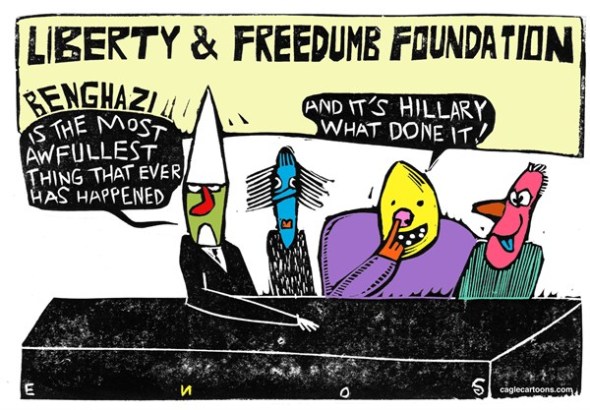
Hillary and Benghazi by Randall Enos
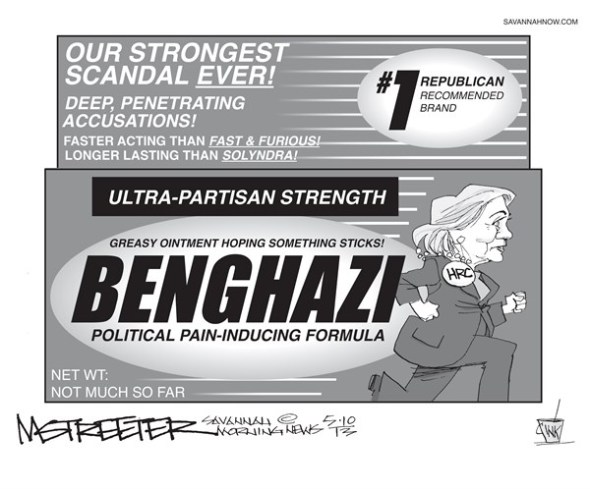
For Political Use Only by Mark Streeter
Live Blog #3 Boston Marathon Bombings
Posted: April 15, 2013 Filed under: Crime, open thread | Tags: Boston Marathon bombings, Patriots Day, terrorism 44 Comments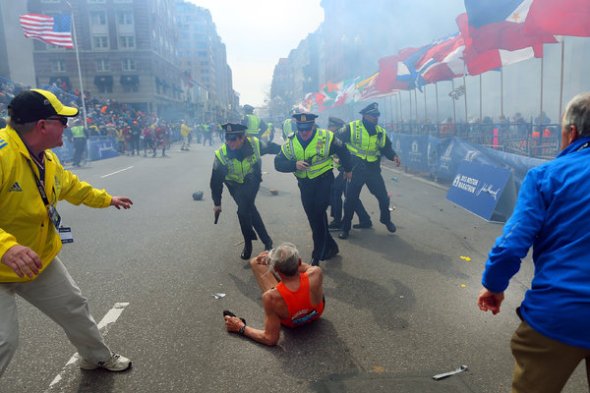
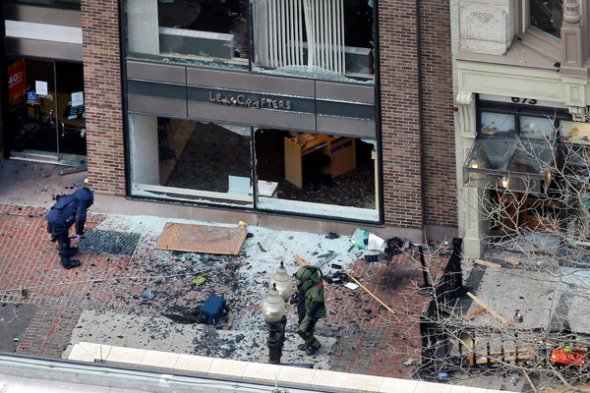
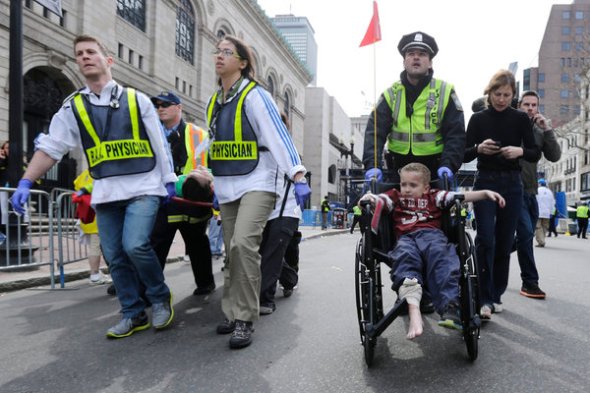
I thought I’d put up one more thread, since the last one has so many comments. Feel free to talk about other topics if you want.
One interesting report from The New York Times. an unexploded bomb was found in Newton, which is a suburb Southwest of Boston.
Police officials said they did not yet have any suspects in custody. A person briefed on preliminary developments in the investigation said that members of Boston’s Joint Terrorist Task Force were at Brigham and Women’s Hospital interviewing a wounded man seen running from the scene of the two blasts, near 671 Boylston Street. The person said that police investigators had contacted the local gas and electric company and determined that the explosions were not related to gas or electrical service.
The authorities also found a device at St. James and Trinity Streets that did not explode, the person said, and two other devices were found, including one in Newton, outside of Boston.
The Mandarin, Marriott and Lenox hotels were evacuated because of reports of suspicious packages, but no confirmed explosive devices have yet been found at those hotels.
The person also said that the maritime security level in Boston was raised from level one to level two; three is the highest level.
“We’re treating this as an ongoing event at this time,” Edward F. Davis, Boston’s police commissioner, said at a late afternoon news conference.
The Benghazi Witch Hunt Continues: A Rant
Posted: November 18, 2012 Filed under: Barack Obama, Foreign Affairs, Hillary Clinton, John McCain, Liberia, U.S. Military, U.S. Politics | Tags: al Qaeda, Benghazi, CIA, civilian contractors, David Petraeus, Lindsey Graham, security for diplomats, State Department, Susan Rice, talking points, terrorism, witch hunt 31 Comments
UN Ambassador Susan Rice
On Friday, former CIA chief and retired General David Petraeus testified about the Benghazi attacks at a closed Congressional hearing that included members of the House and Senate intelligence committees.
Petraeus testified that after the attack, he immediately suspected terrorism, but initially it was thought that a spontaneous response to an anti-Muslim video had provided cover for the terrorists. The CIA prepared a draft of talking points that were then circulated to other intelligence offices for vetting. At some point a line that named some groups allied with al Qaeda was removed from the draft. According to the NYT, the references to the groups were removed in order to “avoid tipping them off” to the investigation.
“The points were not, as has been insinuated by some, edited to minimize the role of extremists, diminish terrorist affiliations, or play down that this was an attack,” said a senior official familiar with the drafting of the talking points. “There were legitimate intelligence and legal issues to consider, as is almost always the case when explaining classified assessments publicly.”
Some intelligence analysts worried, for instance, that identifying the groups could reveal that American spy services were eavesdropping on the militants — a fact most insurgents are already aware of. Justice Department lawyers expressed concern about jeopardizing the F.B.I.’s criminal inquiry in the attacks. Other officials voiced concern that making the names public, at least right away, would create a circular reporting loop and hamper efforts to trail the militants.
Democrats said Mr. Petraeus made it clear the change had not been done for political reasons to aid Mr. Obama. “The general was adamant there was no politicization of the process, no White House interference or political agenda,” said Representative Adam B. Schiff, Democrat of California.
Senator Mark Udall, Democrat of Colorado, said that Mr. Petraeus explained to lawmakers that the final document was put in front of all the senior agency leaders, including Mr. Petraeus, and everyone signed off on it.
UN Ambassador Susan Rice was designated as the White House spokesperson who would appear on Sunday morning shows five days after the attack and explain what was known thus far. Rice used the talking points she was given, explaining that the investigations was ongoing. She did not say what John McCain keeps insisting she said–that the attacks definitely arose out of a spontaneous demonstration triggered by the film and by numerous demonstrations in Egypt and other countries. Here are the talking points:
“The currently available information suggests that the demonstrations in Benghazi were spontaneously inspired by the protests at the U.S. Embassy in Cairo and evolved into a direct assault against the U.S. diplomatic post in Benghazi and subsequently its annex. There are indications that extremists participated in the violent demonstrations.
“This assessment may change as additional information is collected and analyzed and as currently available information continues to be evaluated.
“The investigation is ongoing, and the U.S. government is working with Libyan authorities to bring to justice those responsible for the deaths of U.S. citizens.”
Basically, Petraeus’ testimony exonerated Rice of Republican accusations that she deliberately covered up evidence that terrorists had attacked the consulate.
Why on earth would Rice have done that anyway? Who the hell didn’t consider an attack on a U.S. consulate and the murders of Ambassador Stevens and three other State Department employees to be terrorist acts? As Mitt Romney learned during the second presidential debate, President Obama referred to the attacks as terrorist acts the very next day in his Rose Garden speech. Why would the White House try to cover up a terrorist attack on a consulate? That makes no sense. There were many terrorist attacks on embassies during the Bush administration–did any of those lead to these kinds of accusations and conspiracy theories? This entire “controversy” is complete nonsense, and everyone knows it at this point.
But the witch hunt continues. John McCain, Lindsey Graham, and other Republicans were invited on the Sunday shows so they could continue their bizarre accusations against the Obama administration and Susan Rice.
Yesterday, according to TPM, McCain
said that nothing he learned in a closed-door briefing Friday with former CIA Director David Petraeus would change his criticism of U.N. Ambassador Susan Rice’s initial public statements about the Sept.11 Benghazi attack.
Asked Saturday at a press conference at the Halifax International Security Forum if anything he was told by Petraeus would change his assessment of what Rice knew and the statements she made, McCain said, “No, because I knew it was a terrorist attack from the beginning. People don’t go to spontaneous demonstrations with mortars and RPGs.”
Again, anyone with half a brain immediately knew that the attack was, by definition, terrorism. Duh! But we’re supposed to be impressed that McCain knew it too?
McCain reiterated that it should have been immediately apparent to the administration that the Benghazi attack was not triggered by Libyan demonstrators protesting an anti-Muslim YouTube video. “There were people who were at the consulate who flew to Germany the next day. They knew there was no spontaneous demonstration. They knew that. And they were interviewed. So there should have been no doubt whatsoever of that,” McCain said.
So? Why should we care about such a picayune point? President Obama has said that an investigation is needed and is ongoing. He has said that any and all information on the attacks and the investigation will be provided to Congress. Where is the beef here?
Yesterday Dana Millbank piled on, claiming Rice has a “tarnished resume” and that she’s “ill-equipped to be the nation’s top diplomat for reasons that have little to do with Libya.”
Even in a town that rewards sharp elbows and brusque personalities, Rice has managed to make an impressive array of enemies — on Capitol Hill, in Foggy Bottom and abroad. Particularly in comparison with the other person often mentioned for the job, Sen. John Kerry, she can be a most undiplomatic diplomat, and there likely aren’t enough Republican or Democratic votes in the Senate to confirm her.
Back when she was an assistant secretary of state during the Clinton administration, she appalled colleagues by flipping her middle finger at Richard Holbrooke during a meeting with senior staff at the State Department, according to witnesses. Colleagues talk of shouting matches and insults.
Among those she has insulted is the woman she would replace at State. Rice was one of the first former Clinton administration officials to defect to Obama’s primary campaign against Hillary Clinton. Rice condemned Clinton’s Iraq and Iran positions, asking for an “explanation of how and why she got those critical judgments wrong.”
That may well be. I know very little about Rice, and I do recall she was aggressive toward Hillary in 2008–but that was her job as foreign policy adviser to an opposing candidate. Rice also insulted McCain in 2008, according to Millbank.
Rice’s put-down of Clinton was tame compared with her portrayal of McCain during 2008, which no doubt contributes to McCain’s hostility toward her today. She mocked McCain’s trip to Iraq (“strolling around the market in a flak jacket”), called his policies “reckless” and said “his tendency is to shoot first and ask questions later. It’s dangerous.”
I’d say that’s a pretty good description of McCain and his policies, even though it may seem harsh to Millbank. McCain is a publicity hound and he tends to go off half-cocked, as his campaign against Rice clearly demonstrates. But perhaps this does provide a bit of insight into McCain’s hatred of Rice. Apparently he will soon lose his chairmanship of the Armed Services Committee, and he may simply be searching for away to remain relevant in the Senate.
This morning, Maureen Dowd claimed that Rice sought out the opportunity to speak for the White House on Beghazi.
Ambitious to be secretary of state, Susan Rice wanted to prove she had the gravitas for the job and help out the White House. So the ambassador to the United Nations agreed to a National Security Council request to go on all five Sunday shows to talk about the attack on the American consulate in Libya.
“She saw this as a great opportunity to go out and close the stature gap,” said one administration official. “She was focused on the performance, not the content. People said, ‘It’s sad because it was one of her best performances.’ But it’s not a movie, it’s the news. Everyone in politics thinks, you just get your good talking points and learn them and reiterate them on camera. But what if they’re not good talking points? What if what you’re saying isn’t true, even if you’re saying it well?”
OK, what if that were true? Does Rice deserve to be hunted down, tarred and feathered, and run out of Washington on a rail? Or should she be burned at the stake? What is the appropriate punishment for relying on unclassified talking points that didn’t reveal sensitive information five days after the attacks? Do tell, Maureen.
How much longer is this nonsense going to continue? Are we going to go through another “Whitewater” investigation, based on little or nothing of significance? It sure looks that way.
Let’s compare the reaction of the media and the Republicans to the Benghazi attacks and the reaction of the media and Democrats to the 9/11/2001 terrorist attacks that killed about 3,000 people. The Bush administration had innumerable warnings that attacks were coming, and they did absolutely nothing to prevent them. They pooh-poohed warnings by the Clinton administration that terrorism was a vital concern. After the attacks, the Bush administration resisted having Congressional investigations for two years!
There were no specific warnings about the Benghazi attacks, although there were many vague warnings and threats. Four State Department employees were killed in Benghazi–a terrible tragedy. But does anyone truly believe that John McCain cares about these murders? If he did, he wouldn’t be focusing on one supposed misstatement by Susan Rice or some minor disagreement about how talking points were prepared.
No, if McCain gave a shit, he’d be looking into ways to prevent attacks like the ones in Benghazi in the future. One way to do that might be to provide adequate protection for U.S. diplomats, right? But Republican refused to vote for increased funds for such State Department security needs.
Here’s an interesting piece at The Atlantic, in which David Rohde argues that both parties have ignored the “primary lesson” of Benghazi: Diplomacy Can’t Be Done on the Cheap.
One major overlooked cause of the death of Ambassador Chris Stevens and three other Americans is we have underfunded the State Department and other civilian agencies that play a vital role in our national security. Instead of building up cadres of skilled diplomatic security guards, we have bought them from the lowest bidder, trying to acquire capacity and expertise on the cheap. Benghazi showed how vulnerable that makes us….
The slapdash security that killed Stevens, technician Sean Smith and CIA guards Tyrone Woods and Glen Doherty started with a seemingly inconsequential decision by Libya’s new government. After the fall of Muammar Qaddafi, Libya’s interim government barred armed private security firms – foreign and domestic – from operating anywhere in the country.
So the State Department was forced to cobble together inadequate protection for the Libyan embassy and its outposts, because they have become reliant on outside contractors instead of building their own in-house security corps. According to Rohde,
Resource shortages and a reliance on contractors caused bitter divisions between field officers in Benghazi and State Department managers in Washington.
One agent who served on the ground in Benghazi felt the compound needed five times as many Diplomatic Security agents, according to a State Department official who spoke on condition of anonymity. The official singled out Charlene Lamb, the Diplomatic Security Service official who oversees security in Washington, for criticism — saying she rejected repeated requests for additional improvements in Benghazi….
Lamb’s superior, David Kennedy, has defended her. He argued that a handful of additional Diplomatic Security guards in Benghazi – or the Special Forces team in Tripoli – would not have made a difference.
To date, no evidence has emerged that officials higher than Lamb or Kennedy were involved in the decision to reject the requests from Libya. Both are career civil servants, not Obama administration appointees.
Now this issue would be well worth investigating and correcting! But it doesn’t involve political employees like Susan Rice who can be pilloried for the Republicans’ political purposes. I’ve always believed the use of contractors was a huge mistake, but the Bush administration even turned much of our war-making in Iraq and Afghanistan. So correcting this problem would be hugely expensive and would require bi-partisan cooperation.
Instead, Republicans will continue to focus on minor issues, hoping to build them into impeachable offenses. And Susan Rice may be the designated scapegoat if they can’t get to Obama himself.
This has developed into an overly long rant, so I’ll bring it to a close by saying that I’m no great fan of Susan Rice, and frankly I’d prefer John Kerry as Secretary of State. But the current nonsensical fight over the talking points Rice used on Sunday Shows is childish and ridiculous. I don’t know how much more of it I can stand.
Whatever Happened to the Department of Justice?
Posted: March 6, 2012 Filed under: Central Intelligence Agency, Civil Liberties, Injustice system, Middle East, Patriot Act, U.S. Politics | Tags: Assassination of US citizens abroad, Eric Holder, terrorism 13 CommentsMaybe we should change the name of the DOJ to the Department of Expedience. The War on Terrorism continues to be a War on the American and our Constitutional idea of justice. Eric Holder’s  speech yesterday at Northwestern’s School of Law puzzles many of us that had hoped a change from the Bush/Cheney regime would mean a return to civil liberties. Assassination of US citizens–implying no trial, no jury of peers, and no due process–by classifying them as terrorists is an end run around our Constitution that must not stand. Eric Holder’s thin justification of the Obama policy of assassination sounds a lot like triangulation.
Some have argued that the president is required to get permission from a federal court before taking action against a United States citizen who is a senior operational leader of Al Qaeda or associated forces. This is simply not accurate. “Due process” and “judicial process” are not one and the same, particularly when it comes to national security. The Constitution guarantees due process, not judicial process.
Glenn Greenwald explains it like this.
When Obama officials (like Bush officials before them) refer to someone “who is a senior operational leader of Al Qaeda or associated forces,” what they mean is this: someone the President has accused and then decreed in secret to be a Terrorist without ever proving it with evidence.
This process still seems to be a murky one as pointed out at Empty Wheel. This is beyond unacceptable.
As of a month ago–four months after Awlaki was killed–the Senate Intelligence Committee had not been provided with the legal framework for Awlaki’s kill. This, in spite of the fact that SSCI member Ron Wyden had been requesting that framework for over five months before Awlaki was killed.
I said when Wyden made that clear that it showed there had not been adequate oversight of the killing. By his words–if not his deeds–Holder effectively made the same argument.
The speech appears to be an elaborate justification of a policy that could basically spin on the whims of a president and his/her cronies. This is especially appalling given the FBI “stings” that have been aimed at catching terrorists that seem more aptly labelled as pushing some depressed, emotionally damaged people into becoming aspirational terrorists and then enabling them to do something dangerous. I can only assume that the CIA is probably just as bad if not worse.
The Holder speech was weak as a public explanation. It’s basis in law appears weaker.
Still, the speech contained no footnotes or specific legal citations, and it fell far short of the level of detail contained in the Office of Legal Counsel memo — or in an account of its contents published in October by The New York Times based on descriptions by people who had read it.
The administration has declined to confirm that the memo exists, and late last year, The Times filed a lawsuit under the Freedom of Information Act asking a judge to order the Justice Department to make it public. In February, the American Civil Liberties Union filed a broader lawsuit, seeking both the memo and the evidence against Mr. Awlaki.
Last month, Justice Department court filings against Umar Farouk Abdulmutallab, the Nigerian man who attempted to blow up a Detroit-bound airliner on Dec. 25, 2009, provided a detailed account — based on his interrogations — of Mr. Awlaki’s alleged involvement.
Mr. Holder, by contrast, did not acknowledge the killing of Mr. Awlaki or provide new details about him, although he did mention him in passing as “a U.S. citizen and a leader” of Al Qaeda’s Yemen branch when discussing Mr. Abdulmutallab.
Holder even objects to the word “assassinations”.
Holder also noted that in using lethal force, the United States must make sure that it is acting within the laws of war by ensuring that any target is participating in hostilities and that collateral damage is not excessive. And he noted that law-of-war principles “do not forbid the use of stealth or technologically advanced weapons” — an apparent reference to drones.
More broadly, Holder argued that the targeting of specific senior belligerents in wartime in not unusual, and noted the 1943 U.S. tracking and shooting down of the plane carrying Japanese Adm. Isoroku Yamamoto, the commander of the attack on Pearl Harbor.
He said that “because the United States is in an armed conflict, we are authorized to take action against enemy belligerents under international law . . . and our legal authority is not limited to the battlefields of Afghanistan.”
Holder said he rejected any attempt to label such operations “assassinations.”
“They are not, and the use of that loaded term is misplaced,” he said. “Assassinations are unlawful killings. Here, for the reasons I have given, the U.S. government’s use of lethal force in self-defense against a leader of al-Qaeda or an associated force who presents an imminent threat of violent attack would not be unlawful — and therefore would not violate the executive order banning assassination or criminal statutes.”
Holder said “it is preferable to capture suspected terrorists where feasible — among other reasons, so that we can gather valuable intelligence from them — but we must also recognize that there are instances where our government has the clear authority — and, I would argue, the responsibility — to defend the United States through the appropriate and lawful use of lethal force.”
I am not a constitutional lawyer. I do not even play one on TV so I can’t speak to the finer points of the due process clause. I just know this does not pass my “smell test”. I have read statements by lawyers. Here’s a sampling from MOJO and Adam Sewer.
Both supporters and opponents of the administration’s targeted killing policy offered praise for the decision to give the speech. They diverged, however, when it came to the legal substance. “It’s essential that if we’re going to be doing these things, our top national security and legal officials explain why it’s legal under international and constitutional law,” said Benjamin Wittes, a legal scholar with the Brookings Institution, who said he thought the speech fulfilled that obligation. “I think [the administration] is right as a matter of law.”
In a statement, Hina Shamsi, director of the ACLU’s national security project, called the authority described in the speech “chilling.” She urged the administration to release the Justice Department legal memo justifying the targeted killing program—a document that the ACLU and the New York Times are currently suing the US government to acquire. “Anyone willing to trust President Obama with the power to secretly declare an American citizen an enemy of the state and order his extrajudicial killing should ask whether they would be willing to trust the next president with that dangerous power.”
Here’s a point-by-point list of things that I think is worth reading from Lawfare. This is a small portion of that article. I really suggest you go read all of the points to get an understanding of the policy and its process.
That is, the speech asserts that Due Process permits targeting of a citizen at least when the target is:
(i) located abroad rather than in the United States,
(ii) has a senior operational role
(iii) with al Qaeda or an al Qaeda-associated force,
(iv) is involved in plotting focused on the death of Americans in particular,
(v) that threat is “imminent” in the sense that this is the last clear window of opportunity to strike,
(vi) there is no feasible option for capture without undue risk, and
(vii) the strike will comply with the IHL principles of necessity, distinction, proportionality, and humanity
All of this takes away from the many questions surrounding the first recipient of the assassination treatment. Marcy at Empty Wheel reminds of the thin ice upon which Holder skates.
Perhaps it’s because of all the dubious reasons the Administration continues to keep its case against Anwar al-Awlaki secret, but Eric Holder gave the impression of not knowing precisely what evidence the government had shown against Awlaki.
Or, deliberately misrepresenting it.
Holder mentioned Awlaki just once–purportedly to summarize Abdulmutallab’s case against Awlaki they released last month.
For example, in October, we secured a conviction against Umar Farouk Abdulmutallab for his role in the attempted bombing of an airplane traveling from Amsterdam to Detroit on Christmas Day 2009. He was sentenced last month to life in prison without the possibility of parole. While in custody, he provided significant intelligence during debriefing sessions with the FBI. He described in detail how he became inspired to carry out an act of jihad, and how he traveled to Yemen and made contact with Anwar al-Aulaqi, a U.S. citizen and a leader of al Qaeda in the Arabian Peninsula. Abdulmutallab also detailed the training he received, as well as Aulaqi’s specific instructions to wait until the airplane was over the United States before detonating his bomb. [my emphasis]
Note, this misrepresents what Abdulmutallab said, at least as shown by the summary released last month (setting aside the reasons DOJ chose not to test those claims at trial). What the summary did say was that Awlaki gave Abdulmutallab specific instructions to ignite his bomb while over the US. It did not say Awlaki was “a leader of al Qaeda in the Arabian Peninsula.” That’s DOJ’s elaboration, a frankly dishonest one, given the construction (and one that was probably at least significantly challenged by the intelligence Jubeir al-Fayfi delivered ten months after Abdulmutallab gave his testimony).
This is obviously a complex situation that needs full time attention by a lot of folks with a lot more than I can provide here. It’s something, however, we all need to follow.
It Can Happen Here
Posted: January 9, 2012 Filed under: Barack Obama, Civil Liberties, court rulings, George W. Bush, Gitmo, Human Rights, legislation, torture | Tags: Barack Obama, Defense Authorizattion Act, due process, Gitmo, Guantanamo, Habeas Corpus, indefinite detention, Lakhdar Boumediene, Military Commissions Act (MCA), terrorism, Torture 20 Comments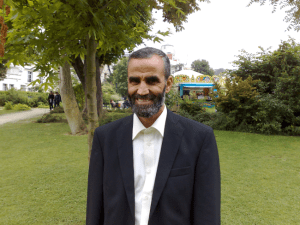
Lakhdar Boumedienne
Now that President Obama has signed the 2012 Defense Authorization Act, what happened to Lakhdar Boumediene could happen to any of us.
In a horrifying op-ed in yesterday’s New York Times Boumediene described how he was arrested in Bosnia in 2002 and held in Guantanamo for seven years without due process. At the time of his arrest Boumediene was working as a humanitarian aid worker focusing on helping children. During his imprisonment, he was never allowed to see his wife or his children, and received only a few of the many letters they sent him. The ones he did receive were cruelly censored.
Boumediene writes:
I left Algeria in 1990 to work abroad. In 1997 my family and I moved to Bosnia and Herzegovina at the request of my employer, the Red Crescent Society of the United Arab Emirates. I served in the Sarajevo office as director of humanitarian aid for children who had lost relatives to violence during the Balkan conflicts. In 1998, I became a Bosnian citizen. We had a good life, but all of that changed after 9/11.
When I arrived at work on the morning of Oct. 19, 2001, an intelligence officer was waiting for me. He asked me to accompany him to answer questions. I did so, voluntarily — but afterward I was told that I could not go home. The United States had demanded that local authorities arrest me and five other men. News reports at the time said the United States believed that I was plotting to blow up its embassy in Sarajevo. I had never — for a second — considered this.
The fact that the United States had made a mistake was clear from the beginning. Bosnia’s highest court investigated the American claim, found that there was no evidence against me and ordered my release. But instead, the moment I was released American agents seized me and the five others. We were tied up like animals and flown to Guantánamo, the American naval base in Cuba. I arrived on Jan. 20, 2002.
I still had faith in American justice. I believed my captors would quickly realize their mistake and let me go. But when I would not give the interrogators the answers they wanted — how could I, when I had done nothing wrong? — they became more and more brutal. I was kept awake for many days straight. I was forced to remain in painful positions for hours at a time. These are things I do not want to write about; I want only to forget.
Eventually he went on a hunger strike that lasted two years and was brutally force fed twice a day. Finally, in 2008, his case reached the Supreme Court.
In a decision that bears my name, the Supreme Court declared that “the laws and Constitution are designed to survive, and remain in force, in extraordinary times.” It ruled that prisoners like me, no matter how serious the accusations, have a right to a day in court. The Supreme Court recognized a basic truth: the government makes mistakes. And the court said that because “the consequence of error may be detention of persons for the duration of hostilities that may last a generation or more, this is a risk too significant to ignore.”
When he was finally freed, France took him in, and he was reunited with his family. Boumediene writes that there are 90 prisoners at Guantanamo who have also been cleared to leave the facility, but they are being held because they are from countries where they would be tortured or killed if they returned.
So there they sit, not guilty of any crime but held in indefinite detention. Just as you or I could be held if this president or the next one decides we somehow helped or supported terrorism.

 peej
peej Carissa
 bostonboomer
 dakinikat
 ecocatwoman
 mablue2
 Mama Lopez
 peggysue22
 quixote
 skydancingguestblogger
 Mona (aka Wonk the Vote)



 Sky Dancing
Recent Comments