
Thursday Reads
Posted: July 21, 2011 Filed under: Barack Obama, Democratic Politics, Federal Budget and Budget deficit, morning reads, Republican politics, Republican presidential politics, Social Security, the internet, U.S. Economy, U.S. Politics, unemployment, voodoo economics, We are so F'd | Tags: austerity, Barack Obama, Chris Christie, collective bargaining, employers, Eric Cantor, Federal debt ceiling, frustration index, Gang of Six, John Kasich, Judd Gregg, Michele Bachman, Migraines, Paul Ryan, polls, Republicans, social media, taxes, Vernal Fall, Yosemite 41 Comments
Good Morning!! I’m going to start out with some interesting poll results that came out yesterday.
According to the latest Washington Post-ABC News poll, a lot of ordinary Republicans are unhappy with their GOP representatives in Washington, DC. From the WaPo:
While Republicans in Congress have remained united in their opposition to any tax increases, the poll finds GOP majorities favoring some of the specific changes advocated by the president, including higher income tax rates for the wealthiest Americans.
There is also broad dissatisfaction with Obama’s unwillingness to reach across the aisle: Nearly six in 10 of those polled say the president has not been open enough to compromise. Among independents, 79 percent say Republicans aren’t willing enough to make a deal, while 62 percent say the same of Obama.
Republicans may also be losing the war of perception about who stands with whom in the debates over the deficit and the economy. A majority view the president as more committed to protecting the interests of the middle class and small businesses, while large majorities see Republicans as defending the economic interests of big corporations and Wall Street financial institutions.
ABC’s The Note reports that based on the same poll,
Against a backdrop of broad concern about the impact of default, 80 percent of Americans in a new ABC News/Washington Post poll say they’re dissatisfied or even angry with the way the federal government is working, up 11 points in a single month. It last was this high in 1992, during the economic downturn that cost the first President Bush a second term.
The times today are nearly as tough: The ABC News Frustration Index has risen to 72 on its scale of 0 to 100, its highest since just before the 2010 midterm elections and well into the political danger zone. The index combines dissatisfaction with the government, anti-incumbent sentiment and ratings of the president and the economy alike.
But unlike 1992 – or 2010 – the opposition party’s taking even more heat than the president. While President Obama for the first time has fallen under 40 percent approval for handling the economy, the Republicans in Congress do even worse, 28 percent approval. On handling the deficit, it’s a weak 38 percent approval for Obama, but a weaker 27 percent for the GOP. And on handling taxes, Obama has 45 percent approval, the GOP, 31 percent.
It’s good to know that some Americans are getting angry. I wish they’d get out the pitchforks and make some noise about it in the streets.
A couple of GOP governors are dropping in the polls too. Media star Chris Christie is turning off his NJ constituents.
Gov. Chris Christie’s popularity has declined significantly over the first half of 2011 and he would have a very difficult time winning reelection if voters in New Jersey went to the polls today, according to a survey by Public Policy Polling.
While Republican activists outside New Jersey want Christie to seek the party’s 2012 presidential nomination, only 43 percent of Garden State voters approve of the job the governor is doing to 53 percent who disapprove.
The figures represent a 13 point decline from when Public Policy Polling last surveyed voters in January, when Christie’s standing was 48 percent approval and 45 percent disapproval.
Christie’s numbers are steady with Republicans but independents have really turned on him, going from approving by a 55 percent to 39 percent margin to disapproving by a 54 percent to 40 percent margin. And his crossover popularity with Democrats is on the decline as well. Where 23 percent approved of him in January, now only 16 percent do.
Christie has been making huge cuts in government services. I guess austerity isn’t as popular with the grass roots as it is with the power elites.
Gov. John Kasich of Ohio is even more unpopular than Christie.
The latest poll released Wednesday by Connecticut’s Quinnipiac University showed that only 35 percent of registered voters approve of the job the Republican governor has done in his first six months. Exactly half say they disapprove, up 1 percentage point since May, with the remainder undecided.
“Even after the state budget has been approved as he promised without raising taxes, and even though the Quinnipiac University poll finds that 63 percent say they favor such an approach, Gov. Kasich’s name remains mud in the eyes of the Ohio electorate,” said Peter A. Brown, assistant director of the Quinnipiac University Polling Institute.
The same poll shows that even some of those who approve of the governor’s performance are prepared to reject his signature law restricting the collective bargaining power of government employees at the ballot on Nov. 8. Fifty-six percent of voters say it should be repealed, up 2 percentage points since May.
Republicans always overreach, don’t they? It looks like the 2010 win may have been just a flash in the pan.
Michele Bachmann is surging in the polls against Mitt Romney.
The Minnesota congresswoman returned to Iowa early Wednesday morning as polls show her gaining ground nationally as a top alternative to former Massachusetts Gov. Mitt Romney, the early front-runner for the GOP nomination. Since formally entering the race last month, she has eclipsed other Republicans in the field, including fellow Minnesotan Tim Pawlenty, who has been actively campaigning all year.
The latest Wall Street Journal/NBC News poll offered a statistical glimpse at their diverging fortunes. In the poll, 16% of the registered Republicans picked Ms. Bachmann as their top choice, putting her second behind Mr. Romney, who remains the first choice of 30% of the Republicans polled. In the same survey, 2% of registered Republicans chose the former Minnesota governor as their top pick, down from 6% in April.
Meanwhile, Bachmann is still being hassled about her migraine headaches. Karl Rove is calling for her to release her medical records. Boy those Republican power brokers are really scared of Bachmann, aren’t they?
A doctor who has examined Bachmann says the headaches aren’t a big deal.
A letter dated Wednesday from a congressional doctor whose office has examined Republican Michele Bachmann described the presidential candidate’s migraines as occurring “infrequently” and controlled by prescription medication.
Bachmann’s campaign distributed the letter from Dr. Brian Monahan, the attending physician in Congress. Bachmann has been evaluated by that office during her three terms in Washington.
Former NH Senator Judd Gregg thinks the Republicans in the House will push the debt limit battle to the brink. In fact, he thinks it will take Social Security checks not going out to get them to agree to raising the debt ceiling.
“My gut tells me that we’ll need a weekend of drama — maybe a weekend of the government not paying its bills — politicians need drama to make something happen. As soon as social security checks don’t go out, the politics will change. I suspect it’ll take artificial drama to get closure past the House.”
“Boehner understands that a shutdown is bad for his caucus and that there’s something viable short of a shutdown but right now… it’s a 50-50 chance that we go into a few days of disruption.”
Gregg said lawmakers don’t really care about the nation’s credit rating:
“Policy-makers only worry about a ratings downgrade at the margins. They don’t really care. The ratings agencies put themselves in a corner that’s foolish. I’ve always found them to be incredibly naive about the political process. To be so definitive is foolish.”
“For the ratings agencies to make this drop-dead date, it’s stupid and naive because we’ll straighten it out, but our process doesn’t allow it to do it overnight.”
Gregg says all this will means the Republicans get most of the blame for the mess. They didn’t learn anything from what happened to Gingrich, did they?
Gregg is probably right about the gang of six plan, since that is basically what the Republicans already rejected. And Brian Beutler reports that they are rejecting it again.
As time goes on, and conservative interest groups and members of Congress rip into it, support among Republicans for the Gang of Six plan to reduce deficits will begin to wane. In fact, that’s already happening.
In a publicly released memo meant to undermine support for the Gang of Six plan in its current form, House Budget Committee chairman Paul Ryan (R-WI) laments, “it increases revenues while failing to seriously address exploding federal spending on health care, which is the primary driver of our debt. There are also serious concerns that the proposal’s substance on spending falls far short of what is needed to achieve the savings it claims.”
And check this out from Politico:
A few wealthy donors have called Cantor to tell him they wouldn’t mind if their taxes are raised. During two closed meetings this week — one with vote-counting lawmakers, and another with the entire conference — Cantor told colleagues that some well-heeled givers have told them they’re willing to pay more taxes. Cantor, according to an aide, has responded that House Republicans aren’t standing up for the wealthy, but rather for the middle class, who want to see their taxes stay low.
Yeah sure, Eric. You’re standing up for the middle class. ROFLOL!
With unemployment so high, all we need is more impediments to getting hired. According to the NYT, even obscure blog comments could come into play as companies evaluate job candidates.
A year-old start-up, Social Intelligence, scrapes the Internet for everything prospective employees may have said or done online in the past seven years.
Then it assembles a dossier with examples of professional honors and charitable work, along with negative information that meets specific criteria: online evidence of racist remarks; references to drugs; sexually explicit photos, text messages or videos; flagrant displays of weapons or bombs and clearly identifiable violent activity.
[….]
Less than a third of the data surfaced by Mr. Drucker’s firm comes from such major social platforms as Facebook, Twitter and MySpace. He said much of the negative information about job candidates comes from deep Web searches that find comments on blogs and posts on smaller social sites, like Tumblr, the blogging site, as well as Yahoo user groups, e-commerce sites, bulletin boards and even Craigslist.
….it is photos and videos that seem to get most people in trouble. “Sexually explicit photos and videos are beyond comprehension,” Mr. Drucker said. “We also see flagrant displays of weapons. And we see a lot of illegal activity. Lots and lots of pictures of drug use.”
I’ll end with this nightmarish story from the LA Times: Witness tells of horror as 3 swept over Vernal Fall in Yosemite
Bibee, a 28-year-old carpenter who grew up in Angels Camp, northwest of the park, had brought Amanda Lee, a visitor from Missouri, to the top of Vernal Fall on Tuesday — her first visit to Yosemite, but the latest of many for him.
They were standing behind a metal barricade, peering at the cascade….Bibee saw a man cross over the barricade. He was leaning over the 317-foot waterfall, holding a young girl, who was screaming in terror. People begged them to get back. “I’m yelling at him, ‘You SOB, get over here!'” Bibee said. Eventually, the two returned to safety.
But then Bibee noticed that three other people had also crossed over, and were “taking pictures and being stupid.”
The three people, members of a church group, fell into the water and went over the falls. All are presumed dead. Why would people go past a barricade and warning signs to stand on the edge of a raging waterfall? But it’s not the first time. The article says twelve people have gone over the falls previously–all were killed.
That’s it for me. What are you reading and blogging about today?
Obama Talks Down to Us; Boehner Just Lies.
Posted: July 11, 2011 Filed under: income inequality, jobs, Medicare, Psychopaths in charge, Republican politics, Social Security, the villagers, U.S. Economy, U.S. Politics, voodoo economics | Tags: Barack Obama, Federal debt ceiling, jobs, John Boehner, lying liars, medicare, Social Security, taxes 11 Comments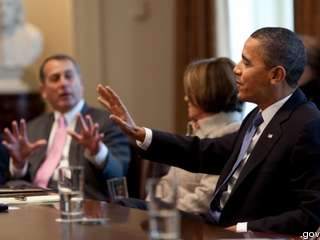
President Obama at his press conference this morning, responding to a question by Ben Feller of the Associated Press (emphasis added):
Q Thank you very much, Mr. President. Two quick topics. Given that you’re running out of time, can you explain what is your plan for where these talks go if Republicans continue to oppose any tax increases, as they’ve adamantly said that they will? And secondly, on your point about no short-term stopgap measure, if it came down to that and Congress went that route, I know you’re opposed to it but would you veto it?
THE PRESIDENT: I will not sign a 30-day or a 60-day or a 90-day extension. That is just not an acceptable approach. And if we think it’s going to be hard — if we think it’s hard now, imagine how these guys are going to be thinking six months from now in the middle of election season where they’re all up. It’s not going to get easier. It’s going to get harder. So we might as well do it now — pull off the Band-Aid; eat our peas. (Laughter.) Now is the time to do it. If not now, when?
We keep on talking about this stuff and we have these high-minded pronouncements about how we’ve got to get control of the deficit and how we owe it to our children and our grandchildren. Well, let’s step up. Let’s do it. I’m prepared to do it. I’m prepared to take on significant heat from my party to get something done. And I expect the other side should be willing to do the same thing — if they mean what they say that this is important.
That’s pretty insulting. We’re not children after all. I guess the President was aiming his remarks at Congress, but really we serfs are the ones who will have to face the pain of these decisions aren’t we? That’s the real issue here.
President Obama has made some kind of proposal to the Republicans and hasn’t shared the details with us or with his fellow Democrats, as far as I know. All we know for sure is that two programs that we pay for with a separate revenue stream are on the table–Social Security and Medicare. Well, as of today, we know a little more. Sam Stein reports that Obama offered to raise the Medicare eligibility age to 67.
According to five separate sources with knowledge of negotiations — including both Republicans and Democrats — the president offered an increase in the eligibility age for Medicare, from 65 to 67, in exchange for Republican movement on increasing tax revenues.
The proposal, as discussed, would not go into effect immediately, but rather would be implemented down the road (likely in 2013). The age at which people would be eligible for Medicare benefits would be raised incrementally, not in one fell swoop.
Sources offered varied accounts regarding the seriousness with which the president had discussed raising the Medicare eligibility age. As the White House is fond of saying, nothing is agreed to until everything is agreed to. And with Republicans having turned down a “grand” deal on the debt ceiling — which would have included $3 trillion in spending cuts, including entitlement reforms, in exchange for up to $1 trillion in revenues — it is unclear whether the proposal remains alive.
Social Security and Medicare are vital programs that no one should be talking about cutting, especially now when unemployment is at levels not seen in this country since the Great Depression. Furthermore, we pay into these programs with our hard-earned money–they are not “entitlements.” But that’s mostly what we’re hearing about from the President and his Republican buddies–they are just drooling over the prospect of slashing the social safety net.
This isn’t a joking matter, Mr. Obama. Show a little respect for the people who pay your salary. Actually, one group liked the President’s remark about eating our peas, The Peat and Lentil Council.
A spokesman for the pea council said it wasn’t interpreting the remarks in a negative context.
“We take President Obama’s comment on the need to ‘eat our peas’ as a reference to the first lady’s push to get all Americans to eat a more healthy diet as part of the Let’s Move campaign,” Pete Klaiber, the council’s director of marketing.
“We know that if tasty and nutritious meals featuring peas are served more frequently in the White House and in the cafeterias of both Houses of Congress, it will contribute to a balanced diet, if not a balanced budget.”
Klaiber added, “Eating more lentils couldn’t hurt, either.”
If the President is really serious about “sharing the pain,” perhaps he should tell the White House chef to serve split pea soup and lentil loaf at his next dinner party.
Now to House Speaker John Boehner’s remarks.
Independence Day Reads
Posted: July 4, 2011 Filed under: Bailout Blues, Domestic Policy, Economy, Foreign Affairs, Global Financial Crisis, Greece, investment banking, morning reads | Tags: Bill Clinton, Budget Deficit, debt limit, Fukushima, Greek Debt Crisis, John McCain, nuclear crisis, shadow banking industry, SIVs, taxes 16 Comments Happy Independence Day!
We have a republic and a lot of people have sacrificed a lot over the last several centuries to keep it. Too bad most of our politicians aren’t in that number. They can’t see past their next elections.
It seems that two senators– McCain and Corynyn–say they’re open to tax increases as a way to solve the budget stand off. Guess there are a few of them left that would prefer not to tank our economy. Let’s hope this starts some real negotiations instead of the usual Republican hostage taking and Democratic cave-in that’s been politics as usual the last dozen years or so.
One of the senators, John Cornyn of Texas, said he would consider eliminating some tax breaks and corporate subsidies in the context of changes in the tax code, provided there was not an overall increase in taxes.
“I think it’s clear that the Republicans are opposed to any tax hikes, particularly during a fragile economic recovery,” Mr. Cornyn said on “Fox News Sunday.” “Now, do we believe tax reform is necessary? I would say absolutely.”
But he insisted that any changes in taxes be “revenue neutral,” meaning that the government would not take in any more money from individuals or businesses than it does now.
The other senator, John McCain of Arizona, said he would be willing to consider some “revenue raisers” as part of a broad deal, but he refused to name specific measures.
Mr. Cornyn, a member of the Senate leadership, also said that Republicans would be open to a short-term deal on the debt ceiling to provide more time for a comprehensive agreement.
Let’s also hope that more reasonable and less ideological heads prevail on the right and that the left stands up for what’s right for a change. Former President Clinton had a words of policy advice over the weekend. His advice to President Obama is “not to blink”.
Former President Bill Clinton Saturday night urged President Obama not to “blink” at Republican demands to exclude revenue increases from any agreement to extend the government’s debt ceiling.
If Republicans maintain their opposition to revenue increases, Clinton said, Obama should pursue a short-term deal to extend the debt ceiling based on spending cuts both sides have already accepted in the negotiations between the administration and Congressional leaders from both parties.
“I hope they will make a mini-deal,” Clinton said in an interview conducted with him at the Aspen Ideas Festival here.
The White House and Congressional negotiators from both parties are attempting to assemble a deficit reduction package that could win support in Congress for legislation to extend the nation’s debt ceiling, which the Treasury says the government will reach on August 2. The talks have foundered amid demands from Congressional Republicans to exclude any revenue increases from that prospective deficit reduction package.
Asked what the administration could do if GOP leaders hold to that posture, Clinton replied: “First the White House could blink. I hope that won’t happen. I don’t think they should blink.”
If Republicans will not accept revenues in a package to lift the debt ceiling by August 2, Clinton said, Obama should pursue a short-term agreement based on the spending reductions both sides have already accepted.
“There are some spending cuts they agree on …and he can take those and [get] an extension of the debt ceiling for six or eight months,” Clinton said.
Clinton also called on a package of reforms to US tax policy that includes a corporate tax cut if special interest tax loops are closed. This is something Obama has also supported.
“It made sense when I did it. It doesn’t make sense anymore – we’ve got an uncompetitive rate. We tax at 35 percent of income, although we only take about 23 percent. So, we SHOULD cut the rate to 25 percent, or whatever’s competitive, and eliminate a lot of the deductions so that we still get a FAIR amount, and there’s not so much variance in what the corporations pay. But how can they do that by Aug. 2?”
Clinton also said Grover Norquist, who as president of Americans for Tax Reform is the GOP’s unofficial enforcer of no-new-taxes pledges, has a “chilling” hold on the nation’s lawmaking.
The former president said it has seemed like Republicans need any revenue concessions need to be “approved in advance by Grover Norquist.”
“You’re laughing,” he told the crowd of 800. “But he was quoted in the paper the other day saying he gave Republican senators PERMISSION … on getting rid of the ethanol subsidies. I thought, ‘My GOD, what has this country come to when one person has to give you permission to do what’s best for the country.’ It was chilling.
There’s an extremely interesting piece at The Atlantic Wire on “What Really Happened at Fukushima”. It includes interviews with workers that have been inside the crippled nuclear plant.
Throughout the months of lies and misinformation, one story has stuck: “The earthquake knocked out the plant’s electric power, halting cooling to its reactors,” as the government spokesman Yukio Edano said at a March 15 press conference in Tokyo. The story, which has been repeated again and again, boils down to this: “after the earthquake, the tsunami – a unique, unforeseeable [the Japanese word is soteigai] event – then washed out the plant’s back-up generators, shutting down all cooling and starting the chain of events that would cause the world’s first triple meltdown to occur.”
But what if recirculation pipes and cooling pipes, burst, snapped, leaked, and broke completely after the earthquake — long before the tidal wave reached the facilities, long before the electricity went out? This would surprise few people familiar with the 40-year-old Unit 1, the grandfather of the nuclear reactors still operating in Japan.
The authors have spoken to several workers at the plant who recite the same story: Serious damage to piping and at least one of the reactors before the tsunami hit. All have requested anonymity because they are still working at the plant or are connected with TEPCO. One worker, a 27-year-old maintenance engineer who was at the Fukushima complex on March 11, recalls hissing and leaking pipes. “I personally saw pipes that came apart and I assume that there were many more that had been broken throughout the plant. There’s no doubt that the earthquake did a lot of damage inside the plant,” he said. “There were definitely leaking pipes, but we don’t know which pipes – that has to be investigated. I also saw that part of the wall of the turbine building for Unit 1 had come away. That crack might have affected the reactor.”
The reactor walls of the reactor are quite fragile, he notes. “If the walls are too rigid, they can crack under the slightest pressure from inside so they have to be breakable because if the pressure is kept inside and there is a buildup of pressure, it can damage the equipment inside the walls so it needs to be allowed to escape. It’s designed to give during a crisis, if not it could be worse – that might be shocking to others, but to us it’s common sense.”
Here’s some frightening news on the disaster in Japan. Radioactive Cesium has been found in Tokyo’s water supply.
Radioactive cesium-137 was found in Tokyo’s tap water for the first time since April as Japan grapples with the worst nuclear disaster in 25 years.
Cesium-137 concentration registered at 0.14 becquerels per kilogram in the city’s Shinjuku ward on July 2, compared with 0.21 becquerels on April 22, according to the Tokyo Metropolitan Institute of Public Health. No cesium-134 or iodine-131 was detected, the agency said on its website.
The Nuclear Safety Commission of Japan sets a safety limit of 200 becquerels per kilogram for cesium-134 and cesium-137. The limit for iodine-131 consumption is 300 becquerels per kilogram.
Japan is battling radiation leaks into the air, soil and water after an earthquake and tsunami on March 11 knocked out cooling systems at Tokyo Electric Power Co.’s Fukushima Dai- Ichi nuclear station, resulting in the meltdown of three of the six reactors at the plant.
The UK Guardian lists an interesting set of Greek public assets for sale. Many have no buyers. Bobby Jindal is putting up a lot of Louisiana assets for sale too. I wonder if this is going to be the new way to raise money. The Kochs already rent a big chunk of Yellowstone. Let’s hope we don’t have to put our national treasures on the chopping block.
Up for sale are 39 airports, 850 ports, railways, motorways, sewage works, a couple of energy companies, banks, defence groups, thousands of acres of land for development, casinos and Greece’s national lottery. George Christodoulakis, Greece’s special secretary for asset restructuring and privatisations, said the sell-off would raise €50bn (£44bn) to help pay back the country’s €110bn bailout debt.
The private equity bosses gathered in the hotel’s ballroom for the parade of Greece’s national treasures showed little interest in buying anything.
Nikos Stathopoulous, managing partner of BC Partners, which has invested more than €3.5bn in Greece, said investors are put off by bureaucracy, strong unions, corruption and a lack of transparency. “Even in the good times Greece is not a country that attracts investment. Foreign investors don’t want to invest in a country where there is no flexibility in hiring and firing people,” he said. “You don’t want to invest in a country in which you wake up and a new law has been passed which totally undermines and destroys the value of the investment you’ve just made.”
Stathopoulous said investors were finding it very hard to assess the risk of investing into Greece, which means assets “will be priced at lower than they are worth, lower than the Greek government, and even the European Union, expects”.
Here’s a compelling argument for getting the shadow banking sector into a more regulated, transparent, and standardized order. It’s written by Henry Tabe who is a Founding Partner of Sequoia Investment Management Company Ltd. It particularly addresses the use of the Structured Investment Vehicle (SIV). Complex, nonstandard, and unregulated markets make pricing assets difficult and introduce unnecessary risk and volatility.
Risk management requires identification, measurement, aggregation, and effective management of risks. It should help businesses allocate sufficient capital for survival and growth. The SIV’s extinction highlights risk management failures by the vehicles, their sponsors, rating agencies, policymakers, and regulators.
Financial regulators permitted bank, insurance company, pension, and hedge-fund sponsors to establish SIV “mini-banks” without ensuring that they maintain sufficient capital or back-stop liquidity in the event of a run. Policymakers also seemed unaware of the knock-on effects of the SIV’s demise on the securitisation and global credit markets. The Financial Security Authority’s call for regulators to incorporate sectoral analytical capabilities in their micro-prudential policies should help close the knowledge gap and ensure that timely solutions can be implemented to avert collapses that engender significantly more stress on the financial system (FSA 2009).
Lessons learned include the tightening of regulation governing the sponsorship of off-balance-sheet structures and the sizing of their capital and liquidity needs. These require that regulators adopt a more proactive, dampening role in the wild swings from exuberance to despair that are so characteristic of the financial markets. Discussions around contingent capital and similar products suggest regulators have embraced that dampening role and moved away from the prevailing pre-crisis philosophy of minimal regulation.
Lessons learned also include closer supervision of shadow banks, more skin-in-the-game for their sponsors, in-house retention of risk-analytics capabilities by investors, and less reliance on credit-rating agencies. The agencies themselves are more tightly supervised in order to reduce ratings shopping by issuers and inherent conflicts of interest in the business model (CESR 2009). Tighter regulation will also help to ensure that the agencies improve the monitoring of analyst performance, qualifications, and experience (Dodd-Frank 2010).
These measures should help restore confidence in rating agencies and the global financial system, an outcome more urgently required given on-going turmoil in the sovereign debt market.
So, there’s some wonky goodness to keep you entertained if you’re inside today. Be sure to let us know what you’re reading and blogging! Hope your Fourth of July is a happy one!
Tuesday Reads: U.S.-Pakistan Deal, “Dr. Sex,” Fearful Republicans, Violence against Women, and More
Posted: May 10, 2011 Filed under: Foreign Affairs, morning reads, Pakistan, Republican politics, U.S. Economy, U.S. Military, U.S. Politics, Violence against women, Women's Rights | Tags: corporate money, Islamophobia, J. Michael Bailey, Long Island serial killer, medicare, murder, Northwestern University, rape, Rep. Paul Ryan, taxes, town halls 29 Comments
Good Morning!!
The Guardian posted a story last night that seems to put the lie to all the supposed arguing about whether the Obama administration had the right to unilaterally enter Pakistan and raid Osama bin Laden’s residence. The two governments had agreed ten years ago that this would be acceptable in the event bin Laden’s location was found.
The US and Pakistan struck a secret deal almost a decade ago permitting a US operation against Osama bin Laden on Pakistani soil similar to last week’s raid that killed the al-Qaida leader, the Guardian has learned.
The deal was struck between the military leader General Pervez Musharraf and President George Bush after Bin Laden escaped US forces in the mountains of Tora Bora in late 2001, according to serving and retired Pakistani and US officials.
Under its terms, Pakistan would allow US forces to conduct a unilateral raid inside Pakistan in search of Bin Laden, his deputy, Ayman al-Zawahiri, and the al-Qaida No3. Afterwards, both sides agreed, Pakistan would vociferously protest the incursion.
“There was an agreement between Bush and Musharraf that if we knew where Osama was, we were going to come and get him,” said a former senior US official with knowledge of counterterrorism operations. “The Pakistanis would put up a hue and cry, but they wouldn’t stop us.”
So Pakistan kept its word. No wonder they are so insulted by all the accusations that they protected bin Laden. The agreement would protect the Pakistan government from public reaction at home. The only problem is that neither side seems to have thought about what the reaction would be here in the U.S.
Anyway, as I mentioned in a comment a couple of days ago, the Pakistan ISI has retaliated by outing the CIA station chief in Islamabad for the second time . Joseph Cannon has been doing a fantastic job of covering the ins and outs of this story, see here and here.
Back in March, I wrote a post about Professor J. Michael Bailey, AKA “Dr. Sex,” who taught a course in Human Sexuality at Northwestern University. In an optional after-class session, Bailey had a allowed a man to bring a woman to orgasm using a sex toy called “the f*cksaw.” Today Northwestern announced that the human sexuality course will not be offered next year.
Northwestern University will not offer a controversial human sexuality class next academic year after its professor came under fire for allowing a live sex-toy demonstration during an after-class lecture.
About 100 of psychology professor J. Michael Bailey’s students observed a naked woman being penetrated by a motorized sex toy on Feb. 21. The university said in March that it would investigate the incident; officials said Monday that the review continues.
“I learned a week or two ago that they had decided to cancel the course for next year,” psychology department chair Dan McAdams said Monday. “The decision was made higher up than me at the central administration level.”
No other Northwestern psychology professor is qualified to teach the subject, McAdams said. Bailey “will have other teaching assignments in the coming year,” according to a university statement.
I’m not particularly surprised. I wonder what “other teaching assignments” Bailey will be getting–Psychology 101, perhaps? There is bound to be some kind of disciplinary action that we won’t be told about.
Rep. Paul Ryan (R-WI) has admitted that the raucous town hall crowds faced by Republicans over his Medicare Destruction Plan have had an effect (although not on him). John Nichols has a great piece about it at The Nation.
But the outcry over his plan to mess with Medicare, heard in Wisconsin communities from Milton to Kenosha, and at spring recess sessions in the districts of Republican freshmen from Pennsylvania to Florida, obviously influenced other Republicans.
Images from Kenosha – a historic factory town in Ryan’s district, where hundreds of people showed up to criticize his scheming to cut benefits for working Americans while giving billionaires and multinational corporations new tax breaks – were featured nationally on broadcast network news shows.
Cable news programs focused intense attention on the story. MSNBC’s Ed Schultz devoted much of a program last week to the outcry. (In addition to a blistering analysis of the congressman’s proposal by the host, this writer provided some on the ground reporting from Kenosha, including details of a brief interview with Ryan, who was typically dismissive of the popular discomfort with his plan.) But other networks — even Fox — at least touched on the congressman’s troubles.
The reporting was noticed in Washington where, last week, GOP leaders began almost immediately to distance themselves from Ryan’s plan to use Medicare funds to enrich the private insurance firms that have donated so generously to his campaigns.
At Salon, Michael Winship has a good article about the many corporations who don’t pay any taxes–yet the Republicans constantly complain that poor people don’t have to pay any on their paltry incomes.
What’s greasing the wheels for these advantages is, hold on to your hats, cash. Over the last decade, according to the New York City public advocate’s report, those same five companies — GE, Exxon-Mobil, Bank of America, Chevron and Boeing — gave more than $43.1 million to political campaigns. During the 2009-2010 election cycle, the five spent a combined $7.86 million in campaign contributions, a 7 percent jump over their 2007-2008 political spending.
“These tax breaks were put in place to promote growth and create jobs, not bankroll the political causes of corporate executives,” Public Advocate Bill de Blasio said. “… No company that can afford to spend millions of dollars to influence our elections should be pleading poverty come tax time.”
And by the way, those campaign cash figures don’t even include all the money those companies funneled into the 2010 campaigns via trade associations and tax-exempt non-profits. Thanks to the Supreme Court Citizens United decision, we don’t know the numbers because, as per the court, the corporate biggies don’t have to tell us. Imagine them sticking out their tongues and wiggling their fingers in their ears and you have a pretty good idea of their official position on this.
Meanwhile, last week Republicans like Utah’s Orrin Hatch, ranking member of the US Senate Finance Committee, grabbed hold of an analysis by Congress’ nonpartisan Joint Committee on Taxation and wrestled it to the ground. The brief memorandum reported that in the 2009 tax year 51 percent of all American taxpayers had zero tax liability or received a refund. So why, the Republicans asked, are Democrats and others so mean, asking corporations and the rich to pay higher taxes when lots of other people – especially the poor and middle class — don’t pay taxes either.
The great Chris Hedges has a new post up at Truthdig: Your Taxes Fund Anti-Muslim Hatred [PDF]
…perhaps most ominously—as pointed out in “Manufacturing the Muslim Menace,” a report by Political Research Associates—a cadre of right-wing institutions that peddle themselves as counterterrorism specialists and experts on the Muslim world has been indoctrinating thousands of police, intelligence and military personnel in nationwide seminars. These seminars, run by organizations such as Security Solutions International, The Centre for Counterintelligence and Security Studies, and International Counter-Terrorism Officers Association, embrace gross and distorted stereotypes and propagate wild conspiracy theories. And much of this indoctrination within the law enforcement community is funded under two grant programs for training—the State Homeland Security Program and Urban Areas Security Initiative—which made $1.67 billion available to states in 2010. The seminars preach that Islam is a terrorist religion, that an Islamic “fifth column” or “stealth jihad” is subverting the United States from within, that mainstream American Muslims have ties to terrorist groups, that Muslims use litigation, free speech and other legal means (something the trainers have nicknamed “Lawfare”) to advance the subversive Muslim agenda and that the goal of Muslims in the United States is to replace the Constitution with Islamic or Shariah law.
“You would not expect a Democratic administration to fund right-wing groups,” Thom Cincotta, a civil liberties attorney and the author of the Political Research Associates report, told me, “and yet we continue to have hard-right, Islamophobic speakers and companies being paid taxpayer dollars to promote racist doctrines that undermine U.S. national security policy concerning Islam and the Muslim world. Policy expert after policy expert point out that framing our counterterrorism efforts as a war against Islam is a recipe for building increased resentment among Muslims, as well as a potent recruiting tool for those who would like to carry out violent attacks against us. This kind of demonizing breaks down communication between law enforcement agents and Muslim communities, which have proven to be strong allies in the rare instances of domestic extremism. Not only does it threaten to erode basic civil liberties, it threatens freedom of expression and freedom of worship.”
Also recommended at Truthdig, an article about the “anti-war orgins” of Mother’s Day.
In 1870, Julia Ward Howe responded to the horrors of the Civil War by issuing her “Mother’s Day Proclamation,” calling on women around the world to rise up and oppose war in all its forms.
It would be decades before Americans officially began celebrating Mother’s Day, and much of the original spirit of the proclamation has since been lost.
Some new (and horrifying) information came out today in the case of the bodies that have been found in Long Island. It turns out there may be as many as three murderers on the loose in New York.
“It is clear that the area in and around Gilgo Beach has been used to discard human remains for some period of time,” Spota said at a Hauppauge news conference with investigators Monday. “As distasteful and disturbing as that is, there is no evidence that all of these remains are the work of a single killer.”
Jeeze, I’m glad I don’t live in Oak Beach, LI. The most interesting (and very horrifying) information is that some of the body parts found belong to a woman named Jessica Taylor whose mutilated body was discovered 30 miles away in Manorville, NY, in 2003.
Authorities Monday made one new identification: Jessica Taylor, 20, who went missing in July 2003 and whose torso was found at that time near Manorville.
Spota said her death appears related to another woman, still unidentified, parts of whose body was found off Ocean Parkway in April and in Manorville in 2000.
Why do so many men murder women? Serial murder is relatively rare, but it sure seems to happen pretty often in this country. And men murder their wives and girlfriends every day in the U.S. Will violence against women ever be treated as seriously as it should be? It should be seen as an epidemic that needs to be vigorously addressed through public policy. I don’t know if that will happen in my lifetime.
Change would have to start with teachers and textbooks that value women’s current and historical contributions to our society, along with public education campaigns for adults. I also wonder if the anti-abortion movement doesn’t contribute to the general attitude that women have no right to protect the integrity of their own bodies.
It would also help if law enforcement personnel could be made to understand that rape is a serious crime even if the victim isn’t killed or beaten within an inch of her life. Rape is still rape even if the victim knows the perpetrator. With that in mind, I’m going to end with a story from Boston: Thousands Attend Boston’s “SlutWalk” March. The march was a response to an ignorant remark made by a policeman in Toronto.
In January, a Toronto police officer told a group of university students that women should avoid dressing like “sluts” to avoid being raped. He later apologized. The officer who made the comments, Constable Michael Sanguinetti, was disciplined but remained on duty, said Toronto police spokesman Mark Pugash.
However, advocates in Toronto held a “SlutWalk” to protest the officer’s remarks and to highlight what they saw as problems in blaming sexual assault victims. Since then, SlutWalks, organized mainly through social media, have been held in Dallas, Asheville, N.C., and Ottawa, Ontario. Organizers say the events also were held to bring attention to “slut-shaming,” or shaming women for being sexual, and the treatment of sexual assault victims.
“I had watched the Toronto walk happen from afar,” said Jaclyn Friedman, author of “Yes Means Yes: Visions of Female Sexual Power and a World Without Rape” and resident of Medford, Mass. “When I heard it was coming to Boston I just emailed the organizers and said, `How can I help?”‘
The Boston march attracted 2,000 people, even though organizers expected only 30.
Chanting “We love sluts!” and holding signs like “Jesus loves sluts,” approximately 2,000 protesters marched Saturday around the Boston Common as the city officially became the latest to join an international series of protests known as “SlutWalks.”
That’s it for me. What are you reading and blogging about today?
Out of Touch, Out of Mind
Posted: April 20, 2011 Filed under: Federal Budget, Federal Budget and Budget deficit | Tags: taxes 18 Comments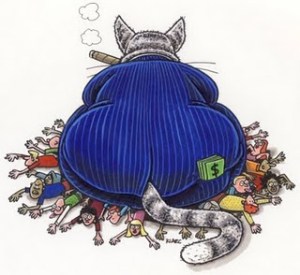 The deficit burble in the beltway appears to be happening without the consent or input of the governed. If polls are any indication, the congress and the White House are moving the exact opposite direction of public will. First, it’s been clear for some time that the majority of people think raising taxes on the rich and letting the Bush Tax Cuts for Billionaires go away is the correct prescription. They thought that when Obama joined the Tax Cuts for Billionaires club and their opinions still haven’t changed.
Alarmed by rising national debt, Americans are clear about how they want to attack the federal government’s runaway budget deficits: raise taxes on the wealthy and keep hands off Medicare and Medicaid.
At the same time, the new McClatchy-Marist poll of the nation found that voters don’t want the debt ceiling raised, despite warnings that failing to do so would force the government into default and the economy into a tailspin.
By a 2-1 ratio, voters support raising taxes on yearly incomes above $250,000.
It’s even more clear what voters think about the slashing and hacking of Medicare, Social Security, and Medicaid. It’s a big ol’ resounding Hell NO!!
The Post-ABC poll finds that 78 percent oppose cutting spending on Medicare as a way to chip away at the debt. On Medicaid — the government insurance program for the poor — 69 percent disapprove of cuts.
There is also broad opposition to cuts in military spending to reduce the debt, but at somewhat lower levels (56 percent).
In his speech last week, the president renewed his call to raise tax rates on family income over $250,000, and he appears to hold the high ground politically, according to the poll. At this point, 72 percent support raising taxes along those lines, with 54 percent strongly backing this approach. The proposal enjoys the support of majorities of Democrats (91 percent), independents (68 percent) and Republicans (54 percent). Only among people with annual incomes greater than $100,000 does less than a majority “strongly support” such tax increases.
Let me first suggest a few things. First, remove deductions on second mortgages, boats, and overpriced McMansions. If it’s not an average family home, it doesn’t need a tax subsidy. Second, equally tax investment and labor income. There should be no tax privileges given to rich people that inherit wealth and then spend their days sitting around reaping profits from speculation. I agree with Katrina Vanden Heuvel of The Nation that calls this policy “Tinkle Down” economics. It’s really bad policy and it’s supremely unfair.
Then in December, the Obama-GOP deal extended the Bush tax cuts for the wealthy at a two-year cost of about $70 billion a year. Now Congress is making $40 billion in painful budget cuts this year. Meanwhile, President Obama, Representative Paul Ryan and others are battling over budgets and tax plans for the next decade and beyond. For the most part, what’s been missing from these suffocatingly narrow discussions is an easy source of income: taxing investments like ordinary income.
The folks over at Responsible Wealth believe not only that the Bush tax cuts on upper-income folks should be ended but also that money made from money (i.e., capital gains and dividends) should be taxed like money made from work, not at the preferential 15 percent rate. They have a simple calculator that calculates your tax savings using just three numbers from your tax form (or from your head), and an interactive graph with videos of people talking about their taxes. It’s worth checking out at responsiblewealth.org.
Taxing capital gains and dividends at regular income rates would save $84.2 billion in 2011 alone, twice the amount we’re cutting from this year’s budget.
I guess Congress thinks we’re all dumb Americans who can’t do math. However, people must be getting tired of the media meme on how brave 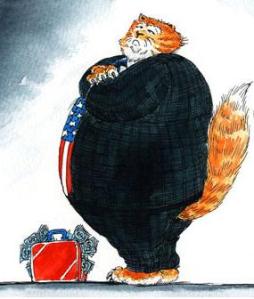 and courageous Paul Ryan is by suggesting we throw grandma from the train. Even his own district isn’t buying it. About time.
During a town hall meeting in Milton, a constituent who described himself as a “lifelong conservative” asked Ryan about the effects of growing income inequality in our nation. The constituent noted that huge income disparities contributed to the Great Depression and the Great Recession, and thus wanted to know why the congressman was “fighting to not let the tax breaks for the wealthy expire.”
Ryan argued against “redistribut[ing]” in this manner. After the constituent noted that “there’s nothing wrong with taxing the top because it does not trickle down,” Ryan argued that “we do tax the top.” This response earned a chorus of boos from constituents:
CONSTITUENT: The middle class is disappearing right now. During this time of prosperity, the top 1 percent was taking about 10 percent of the total annual income, but yet today we are fighting to not let the tax breaks for the wealthy expire? And we’re fighting to not raise the Social Security cap from $87,000? I think we’re wrong.
RYAN: A couple things. I don’t disagree with the premise of what you’re saying. The question is what’s the best way to do this. Is it to redistribute… (Crosstalk)
CONSTITUENT: You have to lower spending. But it’s a matter of there’s nothing wrong with taxing the top because it does not trickle down.
RYAN: We do tax the top. (Audience boos). Let’s remember, most of our jobs come from successful small businesses. Two-thirds of our jobs do. You got to remember, businesses pay taxes individually. So when you raise their tax rates to 44.8 percent, which is what the president is proposing, I would just fundamentally disagree. That is going to hurt job creation.
This does not hurt job creation. It didn’t hurt job creation in the Eisenhower years. It didn’t hurt job creation in the Clinton Years. Also, remember Reagan presided over the biggest tax increase in history, do they argue that job creation was rotten by the end of the Reagan years? This is a ridiculous argument based in that old Laffer Curve and Supply Side, VooDoo economics that they just keep resurrecting. Even two of Reagan’s advisers–Bruce Bartlett and David Stockman–are out decrying that fairy tale. It’s simply not backed by history, disproved by past economic performance, and insane.
The Democratic Party and the White House should be reading these poll numbers and discussing the facts RIGHT now. They should–at the very least–end the Bush/Obama preferential tax treatment for the rich. Paul Ryan and his ilk need to be outed for the charlatans they are on every talk show. I have no idea why this isn’t being done unless there’s a huge beltway conspiracy between the media, the Republicans, and the Democrats to carry on with no regard to voter’s wishes or interests.

Historical Tax Rates on the Richest via Washington Monthly

 peej
peej Carissa
 bostonboomer
 dakinikat
 ecocatwoman
 mablue2
 Mama Lopez
 peggysue22
 quixote
 skydancingguestblogger
 Mona (aka Wonk the Vote)



 Sky Dancing
Recent Comments