
Tuesday Reads
Posted: August 2, 2011 Filed under: Barack Obama, children, Crime, Federal Budget and Budget deficit, Foreign Affairs, morning reads, Psychopaths in charge, Syria, the villagers, U.S. Economy, U.S. Politics, Violence against women, voodoo economics, We are so F'd | Tags: Amy Ahonen, Barack Obama, Bloomington, Celina Cass, Climate change, D.B. Cooper, FBI, Federal debt ceiling, Indiana, Indiana University, investors, jobs, Lauren Spierer, Leon Trotsky, Louie Gohmert, Mark Warner, Missing people, Social Security, Syria, Travis Forbes, U.S. Stocks, UN Security Council 33 Comments
Good Morning!! I have a few interesting reads for you today, and they aren’t all about the idiotic debt ceiling debate. I’m going to lead off with a few excellent blog posts about that idiocy, and then I’ll move on to something else.
First up, Scarecrow compares the movie Cowboys and Aliens to the events in DC: In Cowboys and Aliens, Humans Win; In Washington’s Zombies Vs. Pods, They Lose. In the movie, Scarecrow writes:
humans of all types realize they have to join together to defeat the rapacious creatures who are looting the planet and turning humans into zombies and pod people. There’s hope for our species!
Back in Washington, D.C. there are no heroes and no upbeat ending. Instead, the looting, muggings and beatings will continue until morale improves.
In our “real” world, there is a radical extremist group driven by zombies and zombie beliefs who successfully blackmail the nation into strangling its own economy. The supposedly “sane” group that is supposed to stop this madness has become cowardly and turned into mindless pod people, who assure the nation that the gutting of American government and essential services and safety nets won’t occur in one step but in several, whose outcome is locked in by an undemocratic Super Congress and the next debt limit blackmail in 2013.
It’s a terrific post.
On a more serious note, Emptywheel asks, Is Mark Warner the Designated Social Security Killer? It’s all about what may happen if the so-called “Super Congress” comes to be. Read it and weep.
At the New Yorker, John Cassidy argues that the debt ceiling bill is all smoke and mirrors.
In removing the immediate threat of a debt default, the agreement…signals that the U.S. government still satisfies the minimum standard of financial functionality: it pays its bills on time. That should be enough to head off an immediate downgrade in the nation’s credit rating, and it explains why Wall Street bounced at Monday’s opening bell.
Beyond that it is hard to see anything very positive about a deal in which President Obama finally persuaded the Republicans to accept a Republican plan. Putting on my ethicist cap, I agree with Bernie Sanders that the deal is wrongheaded and immoral. To be sure, America has a long-term fiscal challenge that needs to be confronted. But at a time when fourteen million Americans are unemployed, and many millions more have been forced to work just part-time, the government should be focussing on job growth rather than cutting the budget….
As I’ve said before, headlines such as “Democrats and Republicans agree on $2.4 trillion in spending cuts over 10 years” are virtually meaningless. The United States, like every other country, budgets on an annual basis. What really matters for the economy, and for the unemployed, is how much cash the federal government will spend in the remaining months of the 2011 fiscal year and in fiscal 2012, which begins October 1st. A pledge to cut spending in 2016, say, is just that: a pledge. Between now and then, we will have another bipartisan spending review (that’s also part of the deal), a Presidential election, and who knows how many budget battles. The actual 2016 spending outcome will almost certainly bear little relation to the figures in this agreement.
Also at the New Yorker, Hendrick Hertzberg has a funny piece about Louie Gohmert, looney Texas Republican Congressman quoting Communist Leon Trotsky. I don’t want to ruin it for you by pulling out a quote. It’s not long, so go read the whole thing.
Susie Madrak has a great post at Crooks and Liars: This Year We’ve Broken Or Tied 2,676 Heat Records – So Far. Think We Could Talk About Climate Change Yet? Be sure to check it out.
Do you realize how many people go missing in the U.S.? A lot. And most of them seem to be women and children. Here is a slide show of 64 people from the FBI’s kidnapped and missing persons list.
The little girl whose photo comes first is 11-year-old Celina Cass, from West Stewartstown, NH. Her body was found today in a river near her family home. Sadly, when a child disappears, a family is often responsible. In this case, I have a feeling her stepfather had something to do with Celina’s death. I hope I’m wrong. At least she was found fairly quickly.
Many missing people aren’t found for years, if at all. Indiana University student Lauren Spierer disappeared from Bloomington, Indiana on June 3. Despite intense searches by hundreds of volunteers and a large reward offered by her parents and IU, she has not been found. It looks like people whom Lauren thought were “friends” may have had something to do with her disappearance, because just about everyone who was with her before she went missing has lawyered up and isn’t talking to police.
A Denver woman, Amy Ahonen, disappeared without a trace a few weeks ago. Her car was found parked unlocked along the highway with her purse, ids, cell phone, and keys inside. What happened to her? No one knows and the police have stopped looking. It so happens that a budding serial killer was on the loose in the area at the time of her disappearance, but the police don’t seem to be making that connection.
There are many more stories like this breaking every day in this country. Why do we accept that women and children will disappear daily and in most cases, they will be found murdered and often raped?
Speaking of missing people, a legendary missing person has resurfaced in the news. From the LA Times: D.B. Cooper hijacking mystery is revived with ‘promising lead’
D.B. Cooper, the infamous airplane hijacker who vaulted into urban mythology by parachuting out of a jetliner over the Pacific Northwest with a $200,000 ransom, is back on the FBI’s radar screen.
Cooper, whose case remains the only unsolved airline hijacking in U.S. history, became the stuff of legend on the night of Nov. 24, 1971, when he jumped from a Boeing 727 into the skies between Portland, Ore., and Seattle. He disappeared with the ransom he extorted — 10,000 $20 bills.
The case has remained open, but the trail has been cold despite hundreds of tips, thousands of theories and dozens of breakthroughs in scientific investigation. Now the FBI, which has previously said that Cooper is likely dead, is looking at fresh evidence, according to weekend reports in the media in Seattle, the epicenter of the story that seemingly can never die.
From the Seattle Post-Intelligencer:
The man investigated as a suspect in the D.B. Cooper case – the nation’s only unsolved commercial airplane hijacking – has been dead for about 10 years, and a forensic check didn’t find fingerprints on an item that belonged him, an FBI spokesman told seattlepi.com Monday.
“There are also other leads we’re pursuing,” agent Fred Gutt said. “Some of the other names have been out in the public, some of the names have not come out.”
The name of a man not previously investigated was given to the FBI nearly a year ago by a law enforcement colleague, and an item that belongs to him was sent for fingerprint work at the agency’s Quantico, Va., forensic lab, agents told seattlepi.com.
“The nature of the material was not good for prints,” Gutt said.
He added agents are obtaining other items that may have the suspect’s fingerprints in hopes of matching them with prints taken from the Northwest Orient plane after Cooper jumped the night of Nov. 24, 1971.
The situation in Syria is escalating. There has been a great deal of violence there for some time, and it is not getting the same attention that Egypt, Iran, and Libya have gotten. But now the UN Security Council plans to take up the issue.
Reacting to new bloodshed in Syria, European powers relaunched a dormant draft U.N. resolution to condemn Damascus for its crackdown on protesters, circulating a revised text to the Security Council at a meeting on Monday.
Following the hour-long closed-door meeting, several diplomats said that after months of deadlock over Syria in the council, the fresh violence appeared to be pushing the divided members towards some form of reaction.
But envoys disagreed over whether the 15-nation body should adopt the Western-backed draft resolution or negotiate a less binding statement.
Germany requested the meeting after human rights groups said Syrian troops killed 80 people on Sunday when they stormed the city of Hama to crush protests amid a five-month-old uprising against President Bashar al-Assad.
More than 1600 people have been killed during the Syrian uprising.
You have to wonder if President Barack Obama ever rereads his speeches.
At the State Department last May, the president spoke at length of democratization in the Middle East. He chose his words carefully, dropping caveats and provisos. But Obama also bluntly declared that, “it will be the policy of the United States to promote reform across the region, and to support transitions to democracy.” He justified the intervention in Libya by recalling that “we saw the prospect of imminent massacre … Had we not acted along with our NATO allies and regional coalition partners, thousands would have been killed.”
Yet precisely such sordid outcomes have come to pass, not in Libya but during the four-month uprising against the regime of President Bashar al-Assad in Syria. Around 1,600 people are believed to have been killed, not mentioning some 3,000 disappeared, many of them presumed dead. Massacres have proliferated, and on Sunday, the eve of the holy month of Ramadan, the Syrian army entered the city of Hama, which had effectively escaped from government writ weeks ago.
Throughout, the White House has painstakingly avoided demanding that Assad step down, saying only that he must lead a transition to democracy or get out of the way. The Syrian dictator has, of course, done neither.
I’ll end with just one more link on the debt deal that Dakinikat sent me.
Reuters analysis – Debt deal unlikely to boost investor confidence
Rather than a relief rally, U.S. stocks ended modestly lower on Monday as ugly economic data and some lingering concerns about whether the deal would get through Congress dominated trading. But even when the House of Representatives voted to pass the plan late in the day there was little reaction from U.S. stock index futures.
The deal agreed to by Republican and Democratic leaders will raise the government’s borrowing ceiling while cutting spending by at least $2.1 trillion over 10 years. All of the burden could fall on spending cuts with no guarantee of steps to lift tax revenues.
Rather than perceiving it as a meaningful effort at tackling the United States’ huge debt problem, investors worried about the impact of austerity on an economy already hit by souring business and consumer confidence.
Plans for such a significant fiscal retrenchment, even though most of the impact will be in the latter years of the program, come at a vulnerable time for the world economy. Recession risks are rising in the United States, the European economy remains entwined in its own debt crisis, and China’s supercharged economy could slow.
“Risk markets may rally temporarily, but until economic growth and job creation is addressed, there can be no sustained rally,” Bill Gross, the co-chief investment officer of PIMCO, which manages more than $1.2 trillion, said in an interview.
Will Washington ever wake up to reality? I’m afraid they (and we) will have to hit bottom first. They are like alcoholics, except they are drunk on greed and power. So on that note, what are you reading and blogging about today?
Monday Reads
Posted: August 1, 2011 Filed under: morning reads | Tags: Debt Ceiling, famine, Federal Deficit Deal, Somalia, Syria 50 Comments Good Morning!
President Cave-in and the spineless Democrats in congress have handed Republican hostage takers a big win. This is beyond ridiculous. As I’ve said before, President Push-over draws a line on the etcha sketch then goes shake shake shake!
Anything can happen, but it apppears the GOP is on the verge of pulling off a political victory that may be unprecedented in American history. Republicans may succeed in using the threat of a potential outcome that they themselves acknowledged would lead to national catastrophe as leverage to extract enormous concessions from Democrats, without giving up anything of any significance in return.
Not only that, but Republicans — in perhaps the most remarkable example of political up-is-downism in recent memory — cast their willingness to dangle the threat of national crisis as a brave and heroic effort they’d undertaken on behalf of the national interest. Only the threat of national crisis could force the immediate spending cuts supposedly necessary to prevent a far more epic crisis later.
Under the emerging deal, President Obama can hike the debt limit in two stages — the first in exchange for equivalent cuts; the second after a Congressional committee comes up with second round of yet more cuts, including to entitlements. The talks appear close to resolving the spending cut“trigger” that would force the committee to act — without giving the GOP an incentive to deliberately sabotage its work. The remaining question is how to get it through the House. But a deal seems immiment.
Again and again, Dems drew lines in the sand that they promptly erased as the threat of default grew. A clean debt ceiling hike? Dropped. Cuts to Medicare benefits? They’ll likely be in that committee’s crosshairs. The insistence on revenue hikes? Withdrawn.
This is sure to create a recession. There’s no lack of economists expressing that view point either.
Macroeconomic Advisers, a leading forecaster, said Thursday that a rewritten plan offered by House Speaker John Boehner, R-Ohio, would shave more than a tenth of a percentage point off of growth next year, while the plan being pushed by Senate Majority Leader Harry Reid, D-Nev., would cause an even larger hit on growth in fiscal 2013 — shaving almost half a percentage point.
That view was shared by Thomas Lam, Singapore-based chief economist at OSK-DMG, a joint venture of Malaysian securities firm OSK Holdings Bhd. and Germany’s Deutsche Bank AG.
“Our calculations … suggest that the Senate and House proposals, respectively, could lower economic growth on average by less than 0.5 percentage points, all else equal, over the next five years (from 2012 to 2016),” Lam said in a research note that suggested the Senate Democrat plan would hit the economy harder.
The chief economist for forecaster IHS Global Insight, Nariman Behravesh, warned Friday that “a weak economy will only make the tough decisions on the budget even more difficult and the case for fiscal austerity in the near-term even weaker.”
Some House Republicans backed by tea party groups demand even deeper front-end cuts, perhaps as much as $100 billion, arguing that politicians can’t be trusted to keep their promises further out.
That’d be dangerous, warned Mark Zandi, chief economist for forecaster Moody’s Analytics.
“I think the idea is a very serious policy error,” he said. “This would be the fodder for another recession. The economy may be able to digest $25-30 billion more (in federal spending cuts) … but $100 billion, I don’t think it could digest that.”
Zandi, who’s frequently cited by Republicans and Democrats alike, favors spending cuts “when the economy is off and running,” but he cautions that “to add more fiscal restraint in the latter part of 2011 and 2012 would be a mistake.”

It's a bi-partisan pony!
Obama is choosing to ignore the jobs crisis and expects to win the election on the back of the bi-partisan pony, I guess. I can’t believe the recession that will be inevitable shortly isn’t going to tank a few political careers. Also, wait until every one finds out that the programs that no one wants cut are going to be subjected to possible across the board cuts. My guess is that the super committee will deadlock and those triggers will turn in to a bunch of big regrets for every one. This will only create more havoc on the budget also. It’s really bad policy. Afterall, did we get anything done from the catfood commission or the gang of six? These committees are beginning to remind me of the old soviet style planning commissions and their 5 year plans.
The famine in Somalia is deepening. The Economist has an interesting piece up suggesting ways that the world can respond to the desperate situation there. It also suggests that we missed all the signs that should’ve told us it would happen.
Famine has a technical meaning these days. It is declared when 30% of children are acutely malnourished, 20% of the population is without food, and deaths are running at two per 10,000 adults or four per 10,000 children every day. Parts of Somalia exceed these dreadful thresholds. In three provinces almost a third of people are acutely malnourished, says the UN’s World Food Programme (WFP). FEWS Net conducted surveys across southern Somalia this month and found that malnutrition exceeded 38% in most areas—a catastrophic rate. Famine is likely to spread all over the south in the next few months (see map). About 2.8m people are thought to need immediate life-saving help.
Yet famine was not declared until July, eight months after the first FEWS Net forecast. The UN did not issue its first appeal until then, though it made a small provision for expected problems in November. The response by donors has been patchy. In a sign of its growing global role, Brazil has pledged more to Somalia than Germany and France have combined. Italy offered nothing. Of the $2 billion the UN says the region needs, it has received less than half. The cash available for food in southern Somalia looks likely to run out well before the next rains.
Outsiders’ caution is linked to the role of the Shabab, an Islamist militia which controls much of southern Somalia and is locked in battle with the internationally recognised but feeble government. The Shabab has banned food aid in most of southern Somalia since 2009, branding Western aid agencies anti-Muslim. The WFP, the biggest provider of food aid, has had 14 staff killed there since 2008. Agencies also worry that militias use food aid to rally their troops—some say this happened in Ethiopia and Eritrea in the 1980s—and do not want to pile into southern Somalia to find they have reinvigorated the Shabab.
Syria’s dictator ushered in a violent start to the Ramadan holy days by upping the level of violence used against democracy protestors. This is yet another terrible story.
Rights activists said 80 civilians were killed in Sunday’s tank-backed assault on the central Syrian city where Assad’s father crushed an armed Muslim Brotherhood revolt 29 years ago by razing neighbourhoods and killing many thousands of people.
Security forces had besieged the Sunni Muslim city of 700,000 for nearly a month before Sunday’s crackdown on the eve of Ramadan, a holy month when Muslims fast in daylight hours.
Many flock to mosque prayers at night, occasions which may provide opportunities for protests to multiply across Syria.
The Syrian state news agency said the military entered Hama to purge armed groups that were terrorising citizens, an account dismissed as “nonsense” by a U.S. diplomat in Damascus.
The agency said eight police personnel were killed while “confronting armed terrorist groups” in Hama.
U.S. President Barack Obama said he was appalled by the Syrian government’s “horrifying” violence against its people in Hama and promised to work with others to isolate Assad.
“Syria will be a better place when a democratic transition goes forward,” Obama said in a statement
So, it appears that most of today’s news will be that Wall Street and the global financial markets can take a breather. It also appears to be a sad day for sane fiscal policy and America’s poor and elderly.
What’s on your blogging and reading list today?
Monday Reads
Posted: June 13, 2011 Filed under: Barack Obama, Foreign Affairs, morning reads, Republican presidential politics, Syria | Tags: Iowa, Iowa Caucuses, jobless recovery, Larry Summers, Obama reelection, Presidential Politics, protest crackdowns, Refugees, Syria 39 Comments Good Morning!
I’ve been following a few stories recently. Of course, one is about my favorite blood sport: politics. One interesting recent announcement is that the two Mormons contending for the Republican Presidential slot are skipping Iowa. Most of the speculation has to do with the role of religionists in the Iowa Republican party. Law professor Ann Althouse has some interesting observations on what appears to be the unwillingness of evangelical Christians to vote for Mormons.
It’s distressing to see this conflation of conservatism and prejudice. It’s one thing if Iowan Republicans tend to go for someone with a stronger message of social conservatism, quite another if they are hostile to Mormons. Plenty of Mormons are social conservatives, and it just happens that the 2 Mormons in the race are not social conservatives. Can we get some serious research on this point? It’s a dangerous thing to allow insinuations of religious bigotry to seep into the public consciousness. I can’t tell if the Times is really against bigotry or not. If you portray Iowan religious conservatives as anti-Mormon, in one way, it seems anti-bigotry. But it’s also inviting us to feel hostility toward the Iowan evangelicals.
Althouses’ comments are based on this NYT article which states that Iowa may have an ‘ebbing influence’ on national elections.
But there are signs that its influence on the nominating process could be ebbing and that the nature of the voters who tend to turn out for the Republican caucuses — a heavy concentration of evangelical Christians and ideological conservatives overlaid with parochial interests — is discouraging some candidates from competing there.
Mitt Romney, the former governor of Massachusetts, announced Thursday that he would skip the state’s Republican straw poll this summer, saving his resources — and lowering expectations — for the state’s caucuses next year.
Earlier in the week, Jon M. Huntsman Jr., the former governor of Utah, conceded that he was likely to skip the Iowa caucuses altogether, noting that his opposition to ethanol subsidies makes him unpopular in a state where support for the corn-based fuel is all but demanded.
“I’m not competing in Iowa for a reason,” he told The Associated Press. In addition to his stand on ethanol, Mr. Huntsman, who served in the Obama administration as ambassador to China, says he believes in global warming and has not embraced the Tea Party movement like some of his rivals. And like Mr. Romney, Mr. Huntsman is a Mormon, a religion viewed with wariness by some conservative Christians.
Repercussions from the Arab Spring are continuing through Summer. Syria appears to be the latest country where members of the military are having second thoughts about cracking down on civil unrest in the general population.
The escalating military offensive in northwest Syria began after what corroborating accounts said was a shoot-out between members of the military secret police in Jisr al-Shughur, some of whom refused to open fire on unarmed protesters.
A growing number of first-hand testimonies from defected soldiers give a rare but dramatic insight into the cracks apparently emerging in Syria’s security forces as the unrelenting assault on unarmed protesters continues.
Speaking to Al Jazeera from Turkey, having crossed the border on Friday night, an activist based in Jisr al-Shughur and trusted by experienced local reporters described how a funeral on June 4 for a man shot dead by plain-clothes security a day earlier grew into a large anti-government protest.
“As the demonstration passed the headquarters of the military secret police they opened fire right away and killed eight people,” the activist, who was among the crowd, said. “But some of the secret police refused to open fire and there were clashes between them. It was complete chaos.”
There continues to be a mounting human crisis as Syrians fleeing violence pour into nearby Turkey.
As Syrian security forces move in to the besieged town of Jisr al-Shughour, thousands of refugees are fleeing across the Turkish border. More camps are being set up to house the new arrivals. Many of the refugees are in desperate need of medical help.
The emergency ward at Antakya hospital is about to receive its latest casualty from Syria. It is a young girl who has fallen sick and was brought to the Turkish border by her desperate mother, who is also pregnant. The ambulance driver says the violence in Syria means hospitals there are either full with the injured, or the journey is too hazardous.
The clashes in and around the northern Syrian town of Jisr al-Shughour have forced thousands to flee. Many of them have recorded the horrifying scenes on cellphones and cameras. In the border village of Harabjoz, people have set up tents as they wait to cross into Turkey. One refugee, who did not give his name, described the conditions they are facing. “There is no milk for the children,” he says. “We bought some but we have run out. They are targeting homes and yesterday gunmen targeted us. All these people will not survive because they burned all their crops,” he says. “Now it’s become sectarian for sure,” he said.
A spokesman for the United Nations’ refugee agency, Metin Corabatir, has warned of a growing crisis. “The latest figures UNHCR received from the border is 5051 who fled from Syria because of violence and persecution in this country,” he said.
Witnesses believe the true figure could be double that number – including those who have crossed undetected.
The Economist believes Obama is beatable in 2012 but seems dismayed at the Republican field of candidates. This was my Saturday night bath read and I found it interesting so I thought I’d pass it along. They biggest question is that how does a candidate that ran as a change agent and outsider run as ‘Goliath’ this time?
In 2008 Mr Obama represented change. This time he will have to fend off charges that he is to blame for the achingly slow recovery by arguing that it would have been worse without his actions, such as his $800 billion stimulus package and the takeover of GM and Chrysler. That may be true but it is not easy to sell a counterfactual on the stump (as the first President Bush learned). And there are other holes in Mr Obama’s record. What happened to his promises to do something about the environment or immigration or Guantánamo? Why should any businessman support a chief executive who has let his friends in the labour movement run amok and who let his health-care bill be written by Democrats in Congress? Above all, why has he never produced a credible plan to tackle the budget deficit, currently close to 10% of GDP?
Asking these questions will surely give any Republican a perch in this race. But to beat the president, the Republicans need both a credible candidate and credible policies.
I may have to change my opinion of Larry Summers a little bit. In this FT Op-Ed, Summers tries to fight the austerity agenda and a US “lost decade”. Wow.
Beyond the lack of jobs and incomes, an economy producing below its potential for a prolonged interval sacrifices its future. To an extent once unimaginable, new college graduates are moving back in with their parents. Strapped school districts across the country are cutting out advanced courses in maths and science. Reduced income and tax collections are the most critical cause of unacceptable budget deficits now and in the future.
You cannot prescribe for a malady unless you diagnose it accurately and understand its causes. That the problem in a period of high unemployment, as now, is a lack of business demand for employees not any lack of desire to work is all but self-evident, as shown by three points: the propensity of workers to quit jobs and the level of job openings are at near-record low; rises in non-employment have taken place among all demographic groups; rising rates of profit and falling rates of wage growth suggest employers, not workers, have the power in almost every market.
A sick economy constrained by demand works very differently from a normal one. Measures that usually promote growth and job creation can have little effect, or backfire. When demand is constraining an economy, there is little to be gained from increasing potential supply. In a recession, if more people seek to borrow less or save more there is reduced demand, hence fewer jobs. Training programmes or measures to increase work incentives for those with high and low incomes may affect who gets the jobs, but in a demand-constrained economy will not affect the total number of jobs. Measures that increase productivity and efficiency, if they do not also translate into increased demand, may actually reduce the number of people working as the level of total output remains demand-constrained.
I’m beginning to feel like part of a chorus these days. Nearly all economists are telling whatever news source they can that this is your basic demand problem. Now if the TV media would hire some one other than lawyers and political consultants we might get some traction here on getting a conversation about policy solutions.
I’ve got one more interesting link given to me by our resident psychologist, Bostonboomer. TNR has an interesting article up on why poor people can’t escape poverty easily.
In a paper in April 2010, Harvard behavioral economist Sendhil Mullainathan (for whom, full disclosure, I once worked) and MIT’s Abhijit Banerjee applied this same notion to decisions requiring self-control. If a doughnut costs twenty-five cents, they wrote, then that “$0.25 will be far more costly to someone living on $2 a day than to someone living on $30 a day. In other words, the same self-control problem is more consequential for the poor.” And so, in addition to all the structural barriers that prevent even determined poor people from escaping poverty, there may be another, deeper, and considerably more disturbing barrier: Poverty may reduce free will, making it even harder for the poor to escape their circumstances.
All of this suggests that we need to rethink our approaches to poverty reduction. Many of our current anti-poverty efforts focus on access to health, educational, agricultural, and financial services. Now, it seems, we need to start treating willpower as a scarce and important resource as well.
Okay, so what’s on your reading and blogging list this morning?
Saturday: Sailboats at Sunset
Posted: April 30, 2011 Filed under: Hillary Clinton, morning reads | Tags: 2012, Ai Weiwei, Alabama tornadoes, Carla Marinucci, China, civil liberties, corporate America, George W. Obama, GO(TEA)P, Human Rights, LGBT rights, Panetta, Petraeus, pro choice, Ryan budget plan, Sarah Weddington, SCOTUS, Syria, unemployment, unions, Wikileaks, Women's Rights 24 Comments
Escaping Dystopia 2011...
Morning, news junkies.
Chris Hedges ushered in 2011 by calling it a brave new dystopia. For a brief moment in time, the Egyptian and Wisconsin protests provided a glimmer of “there’s something happening here,” but then we were returned to our regularly scheduled dystopic nightmare. I don’t know about you, but lately I’m finding that the actual headlines these days sound more satirical than the ones in the Onion. They leave me either wanting to lolsob…or just sob. So, on that note…
Above, to the right… from National Geographic’s Intelligent Travel:
This photo of sailboats at sunset has us yearning for the sea, which makes it an Editors’ Pick for week one of our 2011 Traveler Photo Contest in the category of Outdoor Scenes. The photographer Ken Michael Jon Taarup writes, “Boracay has never ceased to amaze many people from all over the world. With its white crystal sand, pristine blue waters, and beautiful sunsets, this place still tops the list of the most visited and beautiful resorts in the Philippines.”
That’s so you have something calming to visualize while you read my Saturday picks.
Alright, grab your morning cuppa if you haven’t already, and read on.
Let’s just get the biggest distraction out of the way first…
- William and Kate are married. You can now call them Duke and Duchess. That’s all I’m going to cover on that.
Tornado aftermath: Pictures say a 1000 words
- via the Columbia Missourian, PHOTO GALLERY: Tornado damage in Alabama. The photo of the woman carrying her clothes away while looking down at what used to be her home says so much, so simply. Also, via the Mobile Press-Register, Alabama tornadoes: Epic scenes of disaster across state (photos, video)
- In case you haven’t seen it yet, there’s a facebook page called “Pictures and Documents found after the April 27, 2011 Tornadoes” trying to help victims find their belongings. Here’s a CNN report on it.
“Depressing women’s history news of the week”
- via Historiann, Roe v. Wade lawyer Sarah Weddington to be fired from adjunct position at U. Texas. Way to not Hook ’em, Horns.
- Pro-choice, defined. This one is a real barn-burner, though it’s sad that in the year 2011, the pro-choice position has to be spelled out to both Republicans AND Democrats:
Being pro-choice means understanding that self-determination for women regarding sex, sexuality, reproduction and motherhood is a fundamental precursor to womens’ ability to achieve their own educational, economic and familial aspirations, a fundamental precursor to the health and well-being of individuals and families, and a core condition of the long-term stability and health of society. It therefore also means understanding the profound connections for women–supported by more than ample evidence–between economic and educational status and unfettered access to comprehensive sexual health education, contraception, family planning services, and abortion care.
The War on Unions… now brought to you by Dems in MA?
The bill will take a month before coming to the state Senate, but the overwhelming vote in the House, and [Gov.] Patrick’s kinder, gentler rights-stripping plan, make it look like something’s going to happen in Massachusetts. Time to get out in the streets in another blue state.
- Solidarity forever. WI State Journal/Capital Times… Fight Songs: Musicians take a stand to support Wisconsin protests, quoting RATM guitarist Tom Morello:
“I’ve played at hundreds of protests and demonstrations, and this was really unique,” he said. “It was every segment of society. It was radical students and cops on the same side, and I’d never seen that before.”
Hillaryland
- The otherwise serious and reliable Laura Rozen overreacted a bit to Hillary taking a few days of Easter R&R time off with her family. There’s a reason Hill was dubbed the “Energizer Secretary.” The woman works non-stop. She has a personal life that she’s entitled to attend to and/or just recharge every few years or so.
- Sean Penn spotted at Foggy Bottom on Thursday. Rozen says one reason for his visit to the State Department might be his recent humanitarian work in Haiti.
- Hill pic of the week — Women in power pow-wow: Hillary and Mexican Foreign Minister Patricia Espinosa met on Friday:

Click to view HQ. (AP Photo/Evan Vucci)
When Bushies fight… Get out your popcorn
- Via yahoo’s The Ticket, Condoleezza Rice fires back at ‘grumpy’ Donald Rumsfeld:
First of all, I didn’t have modest experience in management. Managing Stanford University is not so easy. But I don’t know what Don was trying to say, and it really doesn’t matter. Don can be a grumpy guy. We all know that.
As always, Black Agenda Report tells it like it is…
- This is an instant classic! Please read and disseminate. Bruce A. Dixon’s Top Ten Answers To Excuses For Obama’s Betrayals and Failures. Note Number 9 — it’s for all the Obamaphiles who won’t accept that Obama is the third Bush-Cheney term. And, to quote a snippet from Numero Uno (Re: “It’s our fault the Obama presidency hasn’t kept its commitments. We need to ‘make him do it.’”):
You cannot make a US president do what he fundamentally doesn’t want to. Michelle Obama is nice to look at, but she is no Eleanor Roosevelt. Franklin Roosevelt used to publicly bask in the hatred of wealthy banksters. Barack Obama’s dream is mostly not to piss off rich people.
- For more on the atrocities of Bush-Cheney III, give BAR’s April 25th podcast a listen. In the first segment BAR’s Glen Ford interviews Labor Notes editor Mark Brenner, who sees no growth and no jobs on the horizon and says:
“Absolute disaster for working folks. If we follow the Ryan plan or if we follow the Obama plan, none of it spells good news for the rest of us.”
- In another segment, Clarence Thomas, former Local 10 union secretary-treasury, says “what one needs to understand is that this is not simply an attack on public sector workers, it is also an attack on public services.” Thomas says the goal is to put labor back where it was before the New Deal, noting that it is a corporate and rightwing agenda in which “the Democratic party is complicit.”
The ongoing crackdown on dissidents: Syria, China
- Friday was Another bloody day of rage in Syria (via Rozen/Envoy):
In response to the brutality of the crackdown, President Barack Obama signed an executive order today instituting sanctions against the Syrian intelligence agency and two of Assad’s brothers, a White House official confirmed. Meanwhile, the UN Human Rights Council voted in Geneva today to condemn the Syrian crackdown.
“The [Executive Order] is a watershed,” Andrew Tabler, a Syria expert with the Washington Institute for Near East Policy, told The Envoy. “This is the first time an Assad has been designated by the [U.S. government], and the first time the USG has issued an EO on human rights in Syria. Until a few months ago Human Rights was a distant fifth on our list of issues with Syria. Now it’s emerged as the center of our policy.”
- Melissa Chiu, director of the Asia Society Museum in NY, in a special to CNN about detained Chinese artist and human rights activist Ai Weiwei: A dangerous mix of art and politics. See also FP’s slideshow on the detention of Weiwei and others.
- China’s DDoS attack on Change.org after petition backing Weiwei went viral; Stacy at SecyClintonBlog: “The silence from the administration is deafening.”
- Nick Kristof, Great Leap Backward. Teaser:
Ms. Cheng was arrested on what was supposed to have been her wedding day last fall for sending a single sarcastic Twitter message that included the words “charge, angry youth.” The government, lacking a sense of humor, sentenced her to a year in labor camp.
Timeout: Art break
- Did you know this much intricacy could be created by the art of creasing? Check out this slideshow of Simon Schubert’s folded paper artwork. There are some gorgeous interior pieces in there!
We’re about halfway through, so click to read the rest… Read the rest of this entry »
Tuesday Reads
Posted: April 26, 2011 Filed under: Foreign Affairs, Libya, MENA, Middle East, morning reads, racism, Republican politics, Republican presidential politics, Syria, U.S. Military, U.S. Politics, Yemen | Tags: Barack Obama, baseball, Civil War, Confederate flag, Donald Trump, Ed Rendell, fire ants, football, Franklin Graham, Gaddafi, Haley Barbour, Jimmy Carter, Libya, Missouri flooding, Misurata, Rahm Emanuel, Syria, Yemen 26 Comments
Good Morning!!
Well, we dodged a bullet yesterday when Mississippi Governor Haley Barbour announced that he won’t be running for president in 2012. Whew! I really didn’t want a president who would decorate the Oval Office with Confederate Civil War memorabilia, did you? Newsweek, January 2010:
The Republican governor of Mississippi keeps a large portrait of the University Greys, the Confederate rifle company that suffered 100 percent casualties at Gettysburg, on a wall not far from a Stars and Bars Confederate flag signed by Jefferson Davis.
Not to mention a guy who praised the segregationist Southern “citizens councils” in an interview with the Weekly Standard. And the fact that Barbour talks like he has a mouthful of marbles doesn’t help either.
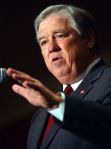
We won't have him to kick around anymore
Politico has an analysis of why Barbour “pulled the plug,” which basically boils down to he really didn’t want to go through the aggravation. The story ends this way:
There were also nagging concerns among GOP insiders about the prospect of nominating a deep-South governor with an accent matching his Delta roots to take on the country’s first black president.
Barry Wynn, a former South Carolina Republican chairman, put it politely after hearing Barbour speak in the state earlier this month: “There’s a perception that he might be more of a regional candidate.”
Gee, no kidding. Like I said, we dodged a bullet. But there are plenty of other creepy Republicans out there to take his place. In fact Ron Paul is getting ready to announce another campaign for president.
Speaking of creepy Republicans, Donald Trump claimed today that President Obama’s birth certificate is “missing.”
When asked from whom he received the information, Trump said he didn’t want to say and that he feels bad about the situation.
“I’d love for him to produce his birth certificate so that you can fight one-on-one,” Trump said in an interview set to air Monday. “If you look at what he’s doing to fuel prices, you can do a great fight one-on-one, you don’t need this issue.”
CNN’s Gary Tuchman also interviewed the former director of the Hawaii Department of Health, who said she has seen the original birth certificate in the vault at the Department of Health.
Trump supporter Franklin Graham, son of Billy, is also on the birther bandwagon.
{sigh….}
Meanwhile, multiple media outlets are talking about Trump’s generous campaign contributions–to Democrats. In fact, Trump recently donated $50,000 to Rahm Emanuel’s campaign for Chicago Mayor. From CNN:
Shortly before announcing interest in pursuing the GOP presidential bid, Republican Donald Trump gave $50,000, his largest campaign contribution in Illinois, to Democrat Rahm Emanuel, who was running for mayor, in December 2010….
Rahm’s brother Ari, who is co-CEO of William Morris Endeavor Entertainment, represents a majority of Hollywood’s celebrity elite, including Trump….
Records from the Illinois State Board of Elections show that Trump has made various sizable donations to Democratic causes in Illinois.
When [Ed] Rendell entered Pennsylvania’s 2002 gubernatorial race, Trump committed himself to the former Democratic National Committee chairman’s cause. Between December 2001 and Election Day ’02, Trump personally gave $27,000 to Ed Rendell’s gubernatorial campaign. He also chipped in $5,000 more at the end of 2003, when Rendell was finishing up his first year in office.
Mind you, Rendell’s victory in 2002 was by no means a foregone conclusion. He faced a serious threat in the May Democratic primary from Robert Casey, then the state’s treasurer and the son of a former governor. The sharpest ideological difference between the two men may have been on abortion: Rendell was pro-choice, while Casey was pro-life (like his father, who was denied a speaking slot at the 1992 Democratic convention in part because of it). During the primary campaign, Trump provided Rendell with $6,000. Rendell ended up beating Casey by 13 points.
Trump is supposedly the one of the biggest contributors to Charlie Rangel ever, yet he is supposedly running as a Republican.
And then we have our current president, who is a Republican who ran as a Democrat in 2008. I posted this in comments on the morning thread yesterday, but I can resist doing it again. It’s so funny to see former Obama supporter (why?) Eric Alterman comparing Obama to Jimmy Carter.
Stylistically speaking, Barack Obama could hardly be further from Jimmy Carter if he really had been born in Kenya. Carter was a born-again Baptist who was raised on his father’s peanut plantation and supported George Wallace on the road to the Georgia state house. Barack Obama—well, you know the story. But the two men have a great deal in common in their approach to the presidency, and not one of these similarities is good news for the Democrats or even for America. Both men rule without regard to the concerns of the base of their party. Both held themselves to be above politics when it came to making tough decisions. Both were possessed with superhuman self-confidence when it came to their own political judgment mixed with contempt for what they understood to be the petty concerns of pundits and party leaders. And worst of all, one fears, neither one appeared willing to change course no matter how many storm clouds loomed on the horizon.
Ask yourself if the following story does not sound like another president we could name The gregarious Massachusetts pol, House Speaker Tip O’Neill, could hardly have been more eager to work with a Democratic president after eight years of Nixon and Ford. But when they first met, and O’Neill attempted to advise Carter about which members of Congress might need some special pleading, or even the assorted political favor or two with regard to certain issues, to O’Neill’s open-jawed amazement, Carter replied, “No, I’ll describe the problem in a rational way to the American people. I’m sure they’ll realize I’m right.” The red-nosed Irishman later said he “could have slugged” Carter over this lethal combination of arrogance and naivety, but it would soon become Carter’s calling card.
In some bad news for the radical right, the Supreme Court has refused to hear a challenge to Obamacare before it wends its way through the federal courts.
And in some good news for football fans, a district court has decided that
The NFL’s lockout is harming players and fans and is not in the public interest, District Judge Susan Nelson said in a ruling on Monday that granted the players’ request for an injunction to halt the work stoppage.
Nelson’s order to end the six-week lockout, imposed last month after a breakdown in talks over a new collective deal, is to be appealed by the NFL.
In an 89-page statement, the judge also accepted that the players dissolution of their union was valid and allowed them to act as individuals rather than be constricted by labor bargaining rules.
The Minnesota judge said in the absence of a collective bargaining process, which ended on March 11, antitrust policies come to the fore.
The plaintiffs in the case, led quarterback Tom Brady of the New England Patriots, argued they were suffering harm as a result of a lockout that stops them from reporting to work.
Here’s some more analysis of the decision at USA Today. I realize that I’m one of the few sports fans here at Sky Dancing, so I won’t burden you unduly. But I just want to say that the Red Sox have won five games in a row and are now only one game under .500–after starting the season with a string of pathetic losses. I know at least Pat Johnson will join me in cheering that news.
Daknikat wrote yesterday about the terrible flooding that was expected in Missouri. Well, it’s happening.
Gov. Jay Nixon activated the Missouri National Guard on Monday in response to the flooding of the Black River near Poplar Bluff, Mo. The executive order came just three days after the governor declared a state of emergency from the tornado that tore through St. Louis last Friday.
“Maj. Gen. Stephen Danner has mobilized 200 citizen soldiers and airmen to report initially to the Poplar Bluff area to assist with flood relief there,” said Maj. Tammy Spicer, public affairs officer for the Missouri National Guard.

More from the Houston Chronicle: Residents flee as river overflows Missouri levee.
Thunder roared and tornado warning sirens blared, and all emergency workers in the southeast Missouri town of Poplar Bluff could do Monday was hope the saturated levee holding back the Black River would survive yet another downpour.
Murky water flowed over the levee at more than three dozen spots and crept toward homes in the flood plain. Some had already flooded. If the levee broke — and forecasters said it was in imminent danger of doing so — some 7,000 residents in and around Poplar Bluff would be displaced.
One thousand homes were evacuated earlier in the day. Sandbagging wasn’t an option, Police Chief Danny Whitely said. There were too many trouble spots, and it was too dangerous to put people on the levee. Police went door-to-door encouraging people to get out. Some scurried to collect belongings, others chose to stay. Two men had to be rescued by boat.
“Basically all we can do now is wait, just wait,” Whitely said.
A Roosevelt would probably have created jobs by having people repair the nation’s rotting infrastructure. But, instead we got Barack “Hoover” Obama and the levees keep on failing.
Things are getting worse and worse in Syria, where there has been a brutal crackdown on protesters over the past several days. From CNN: Deadly attack on protesters raises questions about Syria’s stability
With reports emerging Monday that at least one high-ranking Syrian military commander refused to participate in a bloody, predawn raid that left dozens dead in the southern border city of Daraa — the heart of Syria’s weekslong civil unrest, questions are being raised about possible cracks in President Bashar al-Assad’s hold over the military.
The crackdown on anti-government protesters by Syrian forces escalated in recent days as demonstrators, emboldened by weeks of protests, called for the ouster of al-Assad. The crackdown culminated with the raid in Daraa where thousands of troops reportedly stormed the city and opened fire on demonstrators. It was an attack reminiscent of the brutal rule of al-Assad’s father, who once ordered the military to crush a revolt that resulted in the deaths of thousands.
“I think he’s clearly going toward the security solution, which is where he could be following in the steps of his father,” said Andrew Tabler of the Washington Institute for Near East Policy, a Washington, D.C.-based think tank.
I’ve been hearing all day that Yemen’s president Saleh was renigging on his promise to step down soon, but Al Jazeera reports that there is an agreement between the government and opposition forces.
Yemen’s opposition has agreed to take part in a transitional government under a Gulf-negotiated peace plan for embattled leader Ali Abdullah Saleh to step aside in a month in exchange for immunity for him and his family.
A spokesman for an opposition coalition said on Monday that his group had received assurances in order to accept the deal.
“We have given our final accord to the [Gulf] initiative after having received assurances from our brothers and American and European friends on our objections to certain clauses in the plan,” Mohammed Qahtan said.
But not all protesters are going along.
many pro-democracy protesters, who are not members of the coalition that agreed to the peace talks, appear to be unconvinced by the Gulf-proposed deal and have called for fresh demonstrations, as security forces continued their crackdown.
In Libya, the fighting continues to be centered in the city of Misurata.
The battle for Misurata, which has claimed hundreds of lives in the past two months, has become the focal point of the armed rebellion against Gaddafi since fighting elsewhere is deadlocked.
Images of civilians being killed and wounded by Gaddafi’s heavy weapons, have spurred calls for more forceful international intervention to stop the bloodshed.
NATO’s mandate from the UN is to try to protect civilians in Libya, split into a rebel-run east and a western area that remains largely under Gaddafi’s control.
While the international coalition’s air attacks have delivered heavy blows to his army, they have not halted attacks on Misurata, Libya’s third largest city, with a population of 300,000.
When I was a kid, I was fascinated by insects. I loved to read books about ants, spiders, and other such creepy-crawly critters. Truthfully, I still find them interesting. Here’s a story about fire ants and how they cooperate to protect the group in an emergency.
When flood waters threaten their underground nests, fire ants order an immediate evacuation. They make their way to the surface and grab hold of one another, making a living raft that can sail for months.
The extraordinary survival tactic, which can involve entire colonies of more than a hundred thousand ants, has been captured on film by US engineers who used the footage to help unravel how the insects co-operate to overcome nature’s dangers.
Time-lapse film of the ants in action reveals that pockets of air get trapped between them and around their bodies, helping them breathe if the raft is pushed under the water.
In normal circumstances the ants lock legs, and sometimes mandibles, to form a floating mat that sits on top of the water through a combination of surface tension and buoyancy.
“Even the ones at the bottom remain dry and able to breath because they are not actually under the water,” said Nathan Mlot, a PhD student at Georgia Institute of Technology in Atlanta.
If only we humans would get together and cooperate like that!
That’s all I’ve got for today. What are you reading and blogging about?

 peej
peej Carissa
 bostonboomer
 dakinikat
 ecocatwoman
 mablue2
 Mama Lopez
 peggysue22
 quixote
 skydancingguestblogger
 Mona (aka Wonk the Vote)



 Sky Dancing
Recent Comments