
Assad, Syria and Sarin
Posted: April 25, 2013 Filed under: Foreign Affairs, Syria | Tags: chemical weapons, Sarin Gas, Syria 26 CommentsEvidence has emerged that the Assad Regime in Syria has crossed Obama’s red line and that Sarin Gas has been used. 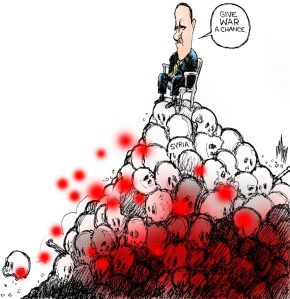 Is this a game changer?
The U.S. intelligence community has uncovered strong evidence that chemical weapons have been used in Syria. Several blood samples, taken from multiple people, have tested positive for the nerve agent sarin, an American intelligence source tells Danger Room. President Obama has long said that the use of such a weapon by the Assad regime would cross a “red line.” So now the question becomes: What will the White House do in response?
In March, the Assad regime was accused of using chemical weapons during an attack on the city of Aleppo. The blood samples were taken by Syrian opposition groups from alleged victims of that strike. But American analysts can’t be entirely sure where the blood came from or when the precisely exposure took place.
“This is more than one organization representing that they have more than one sample from more than one attack,” the source tells Danger Room. “But we can’t confirm anything because no is really sure what’s going on in country.”
What’s clear is that the samples are authentic, and that the weapons were almost certainly employed by the Assad regime, which began mixing up quantities of sarin’s chemical precursors months ago for an potential attack, as Danger Room first reported.
“It would be very, very difficult for the opposition to fake this. Not only would they need the wherewithal to steal it or brew it up themselves. Then they’d need volunteers who would notionally agree to a possibly lethal exposure,” the source adds.
SOD Chuck Hagel held a presser and the war of words between the administration and its critics has begun.
With intelligence showing that chemical weapons have probably been used in Syria, the pressure from the political right for decisive action by the president will only intensify.
Sen. John McCain, R-Ariz., who has long advocated a no-fly zone to stem the bloodshed in Syria that has left more than 70,000 dead, groused to reporters after being notified by the White House of the intelligence that sarin, a lethal nerve agent, has probably been deployed.
“Everything that the non-interventionists said that would happen in Syria if we intervened has happened,” McCain said. “The jihadists are on the ascendancy, there is chemical weapons being used, the massacres continue, the Russians continue to be assisting Bashar Assad, and the Iranians are all in. It requires the United States’ help and assistance.”
The shadow of the war in Iraq looms large for Obama. Without uttering the “I” word, the White House was quick on Thursday to recall the later-debunked intelligence that showed Saddam Hussein had weapons of mass destruction — the central underpinning of George W. Bush’s rationalization for going to war.
An Iraq-styled boots-on-ground intervention, of course, is not under serious consideration.
But Obama aides make clear that the intelligence community’s physiological evidence that indicates Syria’s use of chemical weapons is a bar too low to merit military action, such as implementing a no-fly zone.
“Given the stakes involved, and what we have learned from our own recent experience, intelligence assessments alone are not sufficient — only credible and corroborated facts that provide us with some degree of certainty will guide our decision-making, and strengthen our leadership of the international community,” Miguel Rodriguez, Obama’s liaison to Congress, wrote in a letter to lawmakers on Thursday.
The Obama administration is still pushing for a United Nations-led investigation into allegations and aides to the president on Thursday renewed the call for Assad to give the UN more direct access into Syria—something the Syrian president has thus far resisted.
Concerns about the way forward are also coming from Democrats. Sen. Diane Feinstein, D-Calif., the chairman of the Senate Intelligence Committee, said on Thursday it was “clear that red lines have been crossed and action must be taken to prevent larger scale use.” But Feinstein also offered concerns about a doomsday scenario emerging as a result of the administration’s decision verifying its suspicion.
“I am very concerned that with this public acknowledgement, President Assad may calculate he has nothing more to lose and the likelihood he will further escalate this conflict therefore increases,” Feinstein said in a statement.
Pundits are also weighing in. This is from The Atlantic’s Jeffrey Goldberg.
If you recall, President Barack Obama drew a “red line” for you: no use of chemical weapons in your brutal attempt to put down the uprising against your regime. Any use of such weapons (even any “moving around” of such weapons) would “change my calculus,” Obama said, “change my equation.” In other words, welcome to the day in which the calculus might just be changing.
Hagel, speaking to reporters in Abu Dhabi, said that U.S. intelligence has come to believe — like the Israelis, the French and the British before them — that President Bashar al- Assad’s regime seems to have used sarin “on a small scale.”
I spoke with Representative Mike Rogers, the Republican chairman of the House Intelligence Committee, who said that he thinks the Obama administration is hesitant to face the truth that the Assad regime has already used these sorts of weapons. “Clearly the administration doesn’t want to see this,” he said. “We have lost the confidence of the Arab League and the Syrian opposition because of our inaction.” Rogers said he was convinced at least a month ago that Syria had used a small quantity of chemical weapons against civilians.
Before we get to the meaning and potential consequences of this horrifying news, a brief primer on sarin, which was invented in Nazi-era Germany for use as a pesticide, and which was most famously used in the Tokyo subway attack by the Aum Shinrikyo cult in 1995 and against Kurdish Iraqis during Saddam Hussein’s genocide campaign.’
Descriptions of the chemical’s assault on the body follows the section that I highlighted from the Goldberg piece. Another point of view is expressed in the CSM here.
The US reluctance to join with three key allies – Britain, France, and now Israel – in concluding that Syria’s Bashar al-Assad has used chemical weapons in his country’s civil war confirms President Obama’s consistent wariness about US intervention in the two-year-old conflict.
Beyond that point, however, former officials and analysts are split over why Mr. Obama is so cautious about the issue – he even refused to answer a reporter’s question on the topic Tuesday – and what the apparently high bar the administration has set for evidence of chemical weapons use means.
“It’s a hard call as to whether the administration is trying to avoid something, or if they just don’t have the evidence,” says Wayne White, a former State Department official with experience in Middle East intelligence.
Obama has said repeatedly since last August that Syria’s use of chemical weapons is a US “red line” and would be a “game changer” for the US. But now some critics say the president’s caution suggests a moving or “fuzzy” red line.
For some, the president is simply being prudent, especially if the evidence presented so far is “inconclusive,” as a number of senior administration officials, including Defense Secretary Chuck Hagel, have said. Obama, they add, wants to avoid a rush to judgment that turns out to be mistaken – and which could appear to the world like a repeat of the 2003 US decision to invade Iraq over weapons of mass destruction that didn’t exist.
White House spokesman Jay Carney said Tuesday that the US is being “extremely deliberate” in investigating and evaluating the reports of chemical weapons use. And on Wednesday in Cairo, Secretary Hagel suggested the US would not be rushed to judgment by allies, saying, “Suspicions are one thing. Evidence is another.” He then added, “I think we have to be very careful here before we make any conclusions.”
But for others, the reason Obama is setting the bar high – in a situation where incontrovertible evidence could remain very difficult to come by – is because he has no desire to ratchet up US involvement in the Syrian conflict unless forced to.
The danger of this approach, critics say, is that it encourages an increasingly desperate President Assad to test the limits of US reluctance – perhaps even with limited, hard-to-prove use of some chemical weapons.
It seems like these hard choices keep popping up. There is total carnage in Syria on one hand. There is a war-weary US on the other. We’ve seen this president draw lines in the sand before. My best example is when Obama swore he would not extend the Bush tax cuts for those incomes about $250k. He signed the law that extended them above $450k. This history makes it difficult to say exactly what kind of hope the Syrians will have for regime change.
Friday Reads
Posted: March 8, 2013 Filed under: morning reads | Tags: Christine Legarde, Forest Whitaker, gun laws, gun violence, international women's day, John Yoo, Racism, Richard Engle, Syria, targeted drone killing, unemployed law grads 28 Comments
Good Morning!
Many of you might be stuck in your homes today with all that weather so here are some things to keep you busy. First, Richard Engle’s Diary of his kidnapping in Syria has been published in Vanity Fair.
A group of about 15 armed men were fanning out around us. Three or four of them stood in the middle of the road blocking our vehicles. The others went for the doors. They wore black jackets, black boots, and black ski masks. They were professionals and used hand signals to communicate. A balled fist meant stop. A pointed finger meant advance. Each man carried an AK-47. Several of the gunmen began hitting the windows of our car and minivan with the stocks of their weapons. When they got the doors open, they leveled their guns at our chests.
Time was slowing down as if I’d been hit in the head. Time was slowing down as if I were drowning.
This can’t be happening. I know what this is. This can’t be happening. These are the shabiha. They’re fucking kidnapping us.
“Get out!” a gunman was yelling as he dragged Aziz from the car.
Then I saw the container truck. It wasn’t far away, parked off the road and hidden among olive trees. The metal doors at its rear stood open, flanked by gunmen.
That’s where they are going to put us. That’s here for us. We’re going into that truck.
I got out of the car. Two of the gunmen were already marching Aziz to the truck. He had his hands up, his shoulders back, his head tilted forward to protect against blows from behind.
Maybe I should run. Maybe I should run right now. But the road is flat and open. The only cover is by the trees near the truck. Maybe I should run. But where?
I saw John standing by the minivan. Gunmen were taking Ian toward the truck. It was his turn. Like me, John hadn’t been touched yet.
Maybe they’ve forgotten us? Maybe they don’t want us?
Our eyes made contact. John shrugged and opened his hands in disbelief. Time was going very slowly now, but my mind was racing like a panicked heart in a body that can’t move.
“Get going!” a gunman yelled at me in Arabic, pointing his weapon at my chest.
I looked at him blankly, pretending not to understand. Foreigners who speak Arabic in the Middle East are often assumed to be working for the C.I.A. or Israel’s intelligence agency, the Mossad. The gunman took me by the finger, holding on to it by the very tip. I could have pulled it away with the smallest tug.
But then what? Then go where?
John was the next to join us in the back of the truck. He walked slowly, as if being escorted to a waiting limo. John is a New Yorker and was dressed entirely in black. He has long white hair and a devilish smile, and his nickname is the Silver Fox. He and I had been in a lot of rough places—Libya, Iraq, Gaza. John, Ghazi, and Aziz were among my closest friends in the world.
At least I’ll die with my friends.
This will let you know how tough it is out here: “To Place Graduates, Law Schools Are Opening Firms”.
The plan is one of a dozen efforts across the country to address two acute — and seemingly contradictory — problems: heavily indebted law graduates with no clients and a vast number of Americans unable to afford a lawyer.
This paradox, fed by the growth of Internet-based legal research and services, is at the heart of a crisis looming over the legal profession after decades of relentless growth and accumulated wealth. It is evident in the sharp drop in law school applications and the increasing numbers of Americans showing up in court without a lawyer.
“It’s a perfect storm,” said Stacy Caplow, a professor at Brooklyn Law School who focuses on clinical education. “The longstanding concerns over access to justice for most Americans and a lack of skills among law graduates are now combined with the problems faced by all law schools. It’s creating conditions for change.”
Remember John Yoo. He was the lawyer/author of those Bush legal memos justifying torture. He thinks that Obama is “getting too much grief over targeted killing”.
And he wants Sen. Rand Paul (R-Ky.)—who filibustered Obama’s nominee to head the CIA for 13 hours on Wednesday—to lay off.
“I admire libertarians but I think Rand Paul’s filibuster in many ways is very much what libertarians do, they make these very symbolic gestures, standing for some extreme position,” said Yoo, now a UC Berkeley law professor, who once suggested it was okay for the president to order a child’s testicles be crushed. Referring to Paul’s marathon filibuster, an attempt to force the Obama administration to clarify its views on the use of military force against terror suspects in the United States, Yoo said “It sort of reminds me of young kids when they first read The Fountainhead or Atlas Shrugged and they suddenly think that federal taxation equals slavery and they’re not going to pay any federal taxes anymore.” Yoo’s statements were made on a conference call Thursday held by the Federalist Society, an influential conservative legal organization.
Paul’s conservative colleagues also pushed back on him on Thursday: On the Senate floor, John McCain (R-Ariz.) and Lindsey Graham (R-S.C.) mocked Paul’s objections as “ridiculous.”
Yoo said that he thought the administration’s problems stemmed from its belief that it needed to provide “due process” to terror suspects abroad—or even in the United States, referring to a recently leaked white paper outlining the Obama administration’s legal views on targeted killings of US citizen terror suspects.
So, here’s an interesting study. It seems that the “States With Most Gun Laws Have Fewest Gun Deaths”.
“It seems pretty clear: If you want to know which of the states have the lowest gun-mortality rates just look for those with the greatest number of gun laws,” said Dr. Eric W. Fleegler of Boston Children’s Hospital who, with colleagues, analyzed firearm-related deaths reported to the Centers for Disease Control and Prevention from 2007 through 2010.
By scoring individual states simply by the sheer volume of gun laws they have on the books, the researchers noted that in states with the highest number of firearms measures, their rate of gun deaths is collectively 42 percent lower when compared to states that have passed the fewest number of gun rules. The study was published online in the journal JAMA Internal Medicine.
As proof, Fleegler pointed to the firearm-fatality rates in law-laden states such as Massachusetts (where there were 3.4 gun deaths per 100,000 individuals), New Jersey (4.9 per 100,000) and Connecticut (5.1 per 100,000). In states with sparser firearms laws, researchers reported that gun-mortality rates were higher: Louisiana (18.0 per 100,000), Alaska (17.5 per 100,000) and Arizona (13.6 per 100,000).
Speaking of working to end violence, today is Intentional Women’s Day. This year’s theme is “A promise is a promise: Time for action to end violence against women” Here’s some headlines for that celebration. First off, here’s French economist and head of the IMF Christine  Leguarde. You can watch her speak at this IMF Link.
Here’s some suggested readings for you.
From the UK Guardian: “International Women’s Day: school is ‘the new front line of feminism’”
Surveys and anecdotal evidence may suggest that few young women identify with the word feminism, fearing it sits at odds with a desire to wear makeup or heels. Yet there are increasing signs of an interest in gender equality issues among these same young women, who are now turning to social media such as blogs, Twitter and Facebook to reach out to fellow activists or just to share experiences and seek advice about what can be done.
Laura Bates, the founder of the #everydaysexism campaign, says that 10% of its more than 20,000 entries detailing harassment come from under-16s, with many more from colleges.
Campaign group UK Feminista has been so inundated with requests to speak to schools around the country that it has now launched a two-year programme of workshops and campaigns aimed at secondary pupils. Called Generation F: Young Feminists in Action, it comes as the government considers a cross-party bid to make sex and relationship education compulsory in schools.
Australian women make up just over half of the total Australian population.
In some areas, equality has been achieved, but in others there is clearly a long way to go.
The boards of both private and public organisations are still dominated by men.
For instance, only about 10 per cent of the executives of companies listed in the Australian Stock Exchange Market are female.
And according to federal government figures, average weekly earnings for women are $250 less than men.
United Nations Women director for Australia, Julie McKay, thinks a combination of socio-economic factors contribute to this situation.
“I think there’s a huge issue about unconscious bias, that we sometimes don’t even realise that we have, about the roles that women should play and the sort of characteristics that make different people leaders. But I think we also got other issues around accessibility and affordability of child care, which prevent many women being able to access work and particularly full time work.”
Many migrant and refugee women in Australia can be prevented from working in the field in which they’re experienced, due to lack of English skills or problems with qualification recognition.
But Chin Wong, from the Australian Migrant and Refugee Women’s Alliance, says that doesn’t mean they don’t get into the workforce.
She argues that female newcomers can be preferred by employers because they are more likely to ignore their rights, and tend to argue less than men about working conditions.
“Sometimes the women can find jobs easier than men and therefore a lot of times the man become the homemaker, and the woman has to go to work. But that doesn’t mean that when they come home they don’t still have to make sure that the houses are maintained, because that’s culture. Some of the cultures mean that the women have to do most of the work.”
Here’s two suggested reads on racism in America by Ed Kilgore with a link to Ta-Nehisi’s Coates’ guest column in the New York Time.
If you are a white person who has on occasion felt aggrieved at the persistence of allegations of white racism in America, do yourself and your conscience a favor and read Ta-Nehisi’s Coates’ guest column today in the New York Times.
His point of departure is the humiliating frisking of the very famous and distinguished actor Forest Whitaker by an employee of a deli in Coates’ own Manhattan neighborhood. But he uses this incident to make the very important point that if we disclaim the possibility of racist behavior on the part of “good” or “moral” people, we may well wind up excusing racism almost altogether.
The idea that racism lives in the heart of particularly evil individuals, as opposed to the heart of a democratic society, is reinforcing to anyone who might, from time to time, find their tongue sprinting ahead of their discretion. We can forgive Whitaker’s assailant. Much harder to forgive is all that makes Whitaker stand out in the first place. New York is a city, like most in America, that bears the scars of redlining, blockbusting and urban renewal. The ghost of those policies haunts us in a wealth gap between blacks and whites that has actually gotten worse over the past 20 years.
But much worse, it haunts black people with a kind of invisible violence that is given tell only when the victim happens to be an Oscar winner. The promise of America is that those who play by the rules, who observe the norms of the “middle class,” will be treated as such. But this injunction is only half-enforced when it comes to black people, in large part because we were never meant to be part of the American story. Forest Whitaker fits that bill, and he was addressed as such.
I am trying to imagine a white president forced to show his papers at a national news conference, and coming up blank. I am trying to a imagine a prominent white Harvard professor arrested for breaking into his own home, and coming up with nothing. I am trying to see Sean Penn or Nicolas Cage being frisked at an upscale deli, and I find myself laughing in the dark. It is worth considering the messaging here. It says to black kids: “Don’t leave home. They don’t want you around.” It is messaging propagated by moral people.
The thing is, this has always been more or less true. My extended family (thought not, mercifully, my nuclear family) when I was growing up in the Jim Crow South was loaded with racists. None of them were members of the Ku Klux Klan, perpetrators of violence, or “bad people” by any general measure. Most of them were very regular church-goers. One of the sweetest people I ever knew was a great aunt who after MLK’s assassination allowed as how she wished she could take in the assassin and feed him and protect him for his great act in defending Christian civilization. That wouldn’t have been surprising to Dr. King himself, whose classic Letter From a Birmingham Jail was addressed to the good Christian clergy of that city who by their silence and calls for an unjust “peace” were defending segregation more effectively than the hooded riffraff of the Klan.
So, there are my suggestions today. Please be careful if the weather around you is “lionly”. What’s on your reading and blogging list?
Thursday Reads
Posted: August 2, 2012 Filed under: morning reads, U.S. Economy, U.S. Politics, unemployment | Tags: Barack Obama, Ben Bernanke, Brookings Institution, Bush tax cuts, Federal Reserve, foreign policy, George Zimmerman, Haaretz, israel, Jared Diamond, Judge Kenneth Lester, Lori Montgomery, Mitt Romney, Romney's tax plan, Syria, Tax Policy Center, Urban Institute 20 Comments
Good Morning!!
Last night, Reuters reported that President Obama has authorized “secret support for Syrian rebels.”
President Barack Obama has signed a secret order authorizing U.S. support for rebels seeking to depose Syrian President Bashar al-Assad and his government, sources familiar with the matter said.
Obama’s order, approved earlier this year and known as an intelligence “finding,” broadly permits the CIA and other U.S. agencies to provide support that could help the rebels oust Assad.
This and other developments signal a shift toward growing, albeit still circumscribed, support for Assad’s armed opponents – a shift that intensified following last month’s failure of the U.N. Security Council to agree on tougher sanctions against the Damascus government.
The White House is for now apparently stopping short of giving the rebels lethal weapons, even as some U.S. allies do just that.
There’s much more at the link.
Yesterday, the House responded to the Senate’s passage of a bill to extend the Bush tax cuts for incomes of $250,000 or less by passing their own bill to extend all of the cuts, including those for the super-rich.
The Republican-led House of Representatives voted Wednesday to extend expiring George W. Bush-era tax cuts at all income levels for another year, a pre-election statement of the GOP’s unyielding opposition to raising taxes for any taxpayer.
Th 256 to 171 vote to preserve tax cuts first enacted during the Bush administration and renewed in 2010 since then fell largely along party lines, though 19 Democrats voted with Republicans to extend the tax cuts. One Republican was opposed.
It came after the House rejected a Democratic alternative, also largely on a partisan 170 to 257 vote, that would have preserve tax cuts for income up to $250,000 but allowed them to expire for the wealthy.
You probably heard that Fed Chair Ben Bernanke once again has refused to do anything new to stimulate employment.
According to its statement, the Fed won’t take any additional steps at the moment to boost the economy. No quantitative easing. No bold nwe statements. No trying to reduce mortgage rates further. The central bank’s forecast of “exceptionally low” interest rates through 2014 remains unchanged from its last report in June….
On the other hand, the committee’s statement does note that Fed officials are still poring over recent (and troubling) economic data. Growth has “decelerated” of late, with the U.S. economy expanding at a mere 1.5 percent pace in the second quarter of 2012. And the unemployment rate remains stuck at 8.2 percent. Meanwhile, inflation is expected to remain “at or below” the Fed’s target over the medium term. So is that enough to warrant more stimulus? The FOMC statement says, basically, ask us when we meet again in September:
The Committee will closely monitor incoming information on economic and financial developments and will provide additional accommodation as needed to promote a stronger economic recovery and sustained improvement in labor market conditions in a context of price stability.
There’s an interesting article at Bloomberg Businessweek about Bernanke and the Fed: Bernanke, the Reluctant Revolutionary. The article makes a point that Dakinikat has often expressed:
Because of its demonstrated competence in crisis management, Bernanke’s Fed is being pulled into solving problems that the White House and Congress should be dealing with but aren’t. Housing? Under Bernanke the Fed has bought mortgage-backed securities to make loans cheaper and boost home sales. The fiscal cliff of spending cuts and tax hikes that threatens the economy at the start of 2013? The Fed’s loose money policies, by stimulating growth, are compensating at least partially for the chilling effect on hiring and investment that fears of the cliff are already causing.
It’s a lot, and Bernanke argues that too much is being put on the Fed’s shoulders. “Monetary policy is not a panacea,” he told the Joint Economic Committee of Congress on June 7. “It would be much better to have a broad-based policy effort addressing a whole variety of issues. I leave the details to Congress, which has considered many of these issues. I’d feel much more comfortable if Congress would take some of this burden from us and address those issues.”
It’s a lengthy piece, so if you’re interested do read the whole thing.
Early yesterday, the judge in the George Zimmerman case, Kenneth Lester, denied the defense motion that he “disqualify” himself “because of alleged bias.”
In the motion asking George Zimmerman’s judge to step down, Florida’s rules required Judge Lester to “determine only the legal sufficiency of the motion.” Zimmerman’s motion failed that test, Judge Lester wrote in his ruling.
But the judge did not further explain why he found the motion insufficient. That’s likely because Florida’s rules explicitly state: “No other reason for denial shall be stated, and an order of denial shall not take issue with the motion.”
Zimmerman’s motion had accused Judge Lester of making opinionated remarks about evidence and “advocat[ing] for Mr. Zimmerman to be prosecuted for additional crimes” in his July 5 order setting bail.
Poor George.
There’s quite a bit of news about Mitt Romney, but for some reason I’m resistant to writing about him at the moment. Amazing, huh? So I’m just going to quickly list some articles that you may want to take a look at.
You probably heard about the Brookings report that gives the kiss of death to Romney’s tax plan. The Washington Post’s Lori Montgomery (who leans right) covered it yesterday, and even she couldn’t sugarcoat it. Study: Romney tax plan would result in cuts for rich, higher burden for others
The study was conducted by researchers at the nonpartisan Tax Policy Center, a joint project of the Brookings Institution and the Urban Institute, who seem to bend over backward to be fair to the Republican presidential candidate. To cover the cost of his plan — which would reduce tax rates by 20 percent, repeal the estate tax and eliminate taxes on investment income for middle-class taxpayers — the researchers assume that Romney would go after breaks for the richest taxpayers first.
They even look at what would happen if Republicans’ dreams for tax reform came true and the proposal generated significant revenue through economic growth.
None of it helped Romney. His rate-cutting plan for individuals would reduce tax collections by about $360 billion in 2015, the study says. To avoid increasing deficits — as Romney has pledged — the plan would have to generate an equivalent amount of revenue by slashing tax breaks for mortgage interest, employer-provided health care, education, medical expenses, state and local taxes, and child care — all breaks that benefit the middle class.
“It is not mathematically possible to design a revenue-neutral plan that preserves current incentives for savings and investment and that does not result in a net tax cut for high-income taxpayers and a net tax increase for lower- and/or middle-income taxpayers,” the study concludes.
That should be the end of it, but of course many Americans don’t care about facts. Naturally, the Romney campaign says the study is “biased.”
There’s a very harsh assessment of Team Romney at Foreign Policy. Too Much Baggage: Mitt Romney needs to fire his foreign-policy team. Yesterday. I’m not going to excerpt from the piece, because it’s important to read the whole thing. I highly recommend it!
Michael Kinsley has a very good piece on Romney’s endless complaints about the supposed lack of respect President Obama (and by extension other liberals) for his supposed “success.”
Jared Diamond, the author of one of the books Romney referenced in his speech in Israel, says he was misquoted: Romney Hasn’t Done His Homework.
MITT ROMNEY’S latest controversial remark, about the role of culture in explaining why some countries are rich and powerful while others are poor and weak, has attracted much comment. I was especially interested in his remark because he misrepresented my views and, in contrasting them with another scholar’s arguments, oversimplified the issue.
It is not true that my book “Guns, Germs and Steel,” as Mr. Romney described it in a speech in Jerusalem, “basically says the physical characteristics of the land account for the differences in the success of the people that live there. There is iron ore on the land and so forth.”
That is so different from what my book actually says that I have to doubt whether Mr. Romney read it. My focus was mostly on biological features, like plant and animal species, and among physical characteristics, the ones I mentioned were continents’ sizes and shapes and relative isolation. I said nothing about iron ore, which is so widespread that its distribution has had little effect on the different successes of different peoples. (As I learned this week, Mr. Romney also mischaracterized my book in his memoir, “No Apology: Believe in America.”)
And here’s the closing paragraph:
Mitt Romney may become our next president. Will he continue to espouse one-factor explanations for multicausal problems, and fail to understand history and the modern world? If so, he will preside over a declining nation squandering its advantages of location and history.
Please go read it. There’s much much more excoriation of Willard’s lies. Bwaaaaaahahahahahahaha!
Michael Kinsley has a great piece on Romney’s endless complaints about Americans who supposedly don’t respect his supposed “success.”
Romney’s ‘success’ problem: Is getting ahead in the U.S. simply a matter of brainpower and hard work, as the GOP candidate says? And if so, is everyone else stupid and lazy? Here’s just a bit of it:
Romney worries that Americans are losing their appreciation of success, as evidenced by President Obama’s desire to reduce the rewards of success by raising taxes on high incomes. He sees in this not just a bigger tax bill for successful people but an insult as well. An alternative perspective is that any successful person who feels personally insulted by a request from the president to share a bit of it is, in the immortal words of Liberace, crying “all the way to the bank” (or, to quote someone else, “a master of the fancied slight”).
You might also ask yourself: If Obama is insulting successful people by suggesting that their success doesn’t necessarily result entirely from their own hard work and brainpower, doesn’t that mean that Romney is insulting the vast majority of folks who are unsuccessful (by Romney’s exalted standard) by implying that they are lazy and stupid? If your success is entirely your own achievement, then your lack of success is entirely your own fault.
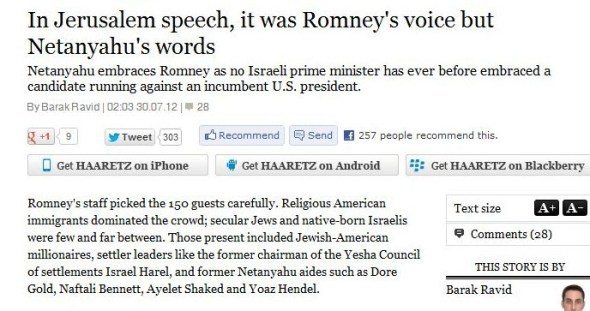
Finally, Haaretz is basically saying that Romney is Netanyahu’s puppet. Most of the article is for subscribers only, but here’s a screenshot of the page.
Now what are you reading and blogging about today?
Tuesday Reads
Posted: June 19, 2012 Filed under: 2012 presidential campaign, Barack Obama, Mitt Romney, morning reads, SCOTUS, the internet, U.S. Politics | Tags: "g" words, Cynthia Kelly, eurozone crisis, G-20 summit, George H. W. Bush, George Zimmerman, Greece, Harry Truman, hoagies, Mia Farrow, money laundering, out-of-touch patricians, Pennsylvania, Robert Shrum, Rodney King, Ronan Farrow, Shellie Zimmerman, Syria, Thomas E. Dewey, touch screen ordering, Trayvon Martin case, Vladimir Putin, Wawa's, Woody Allen 44 Comments
Good Morning!!
On Sunday during his “get to know the regular people” bus tour, Mitt Romney expressed “amazement” at a gas station in Pennsylvania where you could order “hoagies” using a touch-screen.
At a campaign stop in Pennsylvania on Sunday, the presumptive Republican presidential nominee told a crowd that he had been astonished by a touch screen computer used to order food at the Wawa gas station chain….
“I was at Wawas,” Romney explained. “I went in to order a sandwich. You press a little touchtone keypad, alright? You just touch that and, you know, the sandwich comes up. You touch this, touch this, touch this, go pay the cashier. There’s your sandwich. It’s amazing!”
The ordering system has been there for 10 years. Of course this reminded everyone of the apocryphal story about out-of-touch patrician George H.W. Bush being amazed by a supermarket scanner.
Poor Mitt. In another article on Romney’s bus tour, James Fallows makes fun of the candidate’s habit of expressing surprise by saying “oh my goodness!”
Romney’s trademark small-talk exclamation, “Oh my goodness!” seems completely genuine. But I am trying to think of the last time I heard a 21st-century person use that phrase — as opposed to all the other possibilities, which when you think about it range from coarse to profane. (Jeez louise, WTF, Holy shit, and on through a long list you can fill in yourself.) When combined with his Don-Draper-in-the-’50s very dapper personal style, it adds to a retro atmosphere that some people will find reassuring and appealing and others will find odd.
Well I have to admit that I often say “oh my goodness!” too. Maybe I’m out of touch then–or maybe it’s a Midwestern thing. I got in the habit of saying that when taking care of my nephews. John McWhorter at The New Republic also thinks Romney’s “verbal stylings” are strange. Romney is also guilty of using “g” words like gosh, golly, and gee, which McWhorter says are substitutes for taking the name of “god” in vain.
Gee, gosh, and golly are all tokens of dissimulation. They are used in moments of excitement or dismay as burgherly substitutions, either for God and Jesus—words many religious people believe should not be “taken in vain”—or for words considered even less appropriate. Fittingly, they even emerged as disguised versions of God (gosh and golly) and Jesus (gee; cf. also jeez). This was in line with how cursing worked in earlier English. The medieval and even colonial Anglophones’ versions of profanity were to express dismay or vent pain by swearing—“making an oath”—to God or related figures considered ill-addressed in such a disrespectful way. The proper person at least muted the impact with a coy distortion, à la today’s shoot and fudge. Hence zounds (first attestation: 1600), as in by his (Christ’s) wounds; egad for Ye God (1673); and by Jove (1598). To increasing numbers of modern Americans, the G-words are unusable outside of quotation marks, be these actual or implied, rather like the word perky.
Well, gee, I use that one sometimes too, though not “gosh” or “golly.” So maybe I’m as much of an anachronism as Romney. Of course I’ve been known to swear also. I really think saying the “g” words might be a Midwestern mannerism.
Robert Shrum says Mitt Romney reminds him of Thomas E. Dewey, who was expected to beat Harry Truman in 1948, but didn’t. Check it out. I found it interesting.
It appears that police are suspicious about the drowning death of Rodney King. An autopsy has been done, but the results haven’t been released yet. There was no obvious evidence of foul play, but apparently King was a very avid swimmer. There are also conflicting reports of sounds from King’s backyard right before his body was found. Reuters:
King’s fiancée, Cynthia Kelly, a juror in the civil suit he brought against the city of Los Angeles, “didn’t give any indication he was unhappy or that there was an issue.” He said King was known to swim frequently and at all hours.
Shepherd said Kelly told investigators that, shortly before the drowning, she had been inside the house talking with King off and on through a sliding glass door that leads to a patio beside the pool.
At some point, she told them, she heard a splash, prompting her to run outside to find him at the bottom of the deep end. Unable to swim well herself, she called emergency 911 for help.
The Los Angeles Times, in an online account on Monday, cited a next-door neighbor, Sandra Gardea, 31, as saying she heard the sound of a man sobbing from King’s back yard in the two hours before police say he was found in the pool.
The Times also reported that Gardea heard King’s fiancée trying to coax him back into the house.
“It wasn’t like an argument,” she told the newspaper. “She was just saying, ‘Get in the house. Get in the house.'” Gardea said she heard a splash a few minutes later.
Very mysterious.
The prosecution in the Trayvon Martin case has released calls between George Zimmerman and his wife when he was in jail the first time.
The recordings show that from his jail cell, Zimmerman gave his wife step-by-step instructions on how to change a password and clear security questions so she could move money, gave her orders to withdraw specific amounts and directed her to pay the bills.
Prosecutors allege the couple was moving money out of an Internet PayPal account that was awash with donations for Zimmerman, who’s charged with second-degree murder in one of the most racially-charged criminal cases in the country. He shot Trayvon Martin, an unarmed black 17-year-old, in Sanford Feb. 26.
The couple spoke in code, according to prosecutor Bernie de la Rionda. In the calls Zimmerman makes repeated reference to “Peter Pan,” an apparent reference to PayPal.
And neither Zimmerman or his wife ever refer to more than $100,000, talking instead about amounts generally totaling “10 dollars” and “20 dollars.” Prosecutors say those were references to $10,000 and $20,000.
Shellie was careful to move less than $10,000 at a time, to avoid triggering attention from the feds.
The tapes of six conversations were released Monday, as were bank statements from the Zimmermans’ accounts at a credit union. The statements show repeated transfers to and from the account in amounts just under $10,000. On April 24, for example, there were 8 transfers of $9,999.00 into Shellie Zimmerman’s account. Banks and financial institutions are required to file “suspicious activity reports” in such cases, according to Jack Blum, a Washington lawyer who specializes in money laundering.
Structuring the money in such a way is not itself illegal, he says, if the money isn’t from an illicit source. But, he says, it shows “a guilty mind.”
“What they’ve done,’ Blum said, “is they’ve given the prosecutors, on a silver platter, evidence of guilty intent.”
This one should probably be at the top of this post, but gee golly gosh and my goodness! I thought the other stories were more fun to read–so gosh darn it, what the heck!
Obama, Putin meet on Syria at G-20 summit.
Meeting for nearly two hours on the sidelines of the G-20 summit in Mexico, the two presidents tried to focus mostly on areas of agreement — even when it came to areas of disagreement, such as Syria.
The U.S. wants Syrian President Bashar Assad out of power. Russia, which sells arms to Syria, has blocked United Nations Security Council resolutions calling for tough sanctions and leaving the door open to military intervention.
“We agreed that we need to see a cessation of the violence, that a political process has to be created to prevent civil war and the kind of horrific deaths that we’ve seen over the last several weeks,” Obama said after his first meeting with Putin following his return to the presidency this year. “We pledged to work with other international actors, including the United Nations, Kofi Annan and all interested parties, in trying to find a resolution to this problem.”
Putin was upbeat following the meeting, which went on much longer than planned and covered the full range of issues between the two nations. “From my perspective, we’ve been able to find many commonalities pertaining to all of those issues,” he said.
I’m glad it was Obama negotiating and not Romney. Otherwise, we might be at war with Russia by now.
The New York Times has a piece on what Europe will do now that the Greeks have voted for austerity.
BERLIN — After Greek elections eased fears that the country’s exit from the euro zone was imminent, attention turned Monday to an even bigger challenge: restoring the economic body to health with Greece still in it.
A respite from market pressure early Monday proved to be short-lived, as investors shifted their attention from political infighting in Athens to the larger question of whether European leaders could find a more lasting solution to a debacle now well into its third year.
But even though Brussels had been hoping for the victory by Antonis Samaras and his center-right New Democracy Party, the yearned-for result, paradoxically, may weaken Europe’s determination to take more radical steps to avert a meltdown.
German hard-liners were emboldened by the victory, viewing it as an endorsement of the drive for structural adjustment in Greece and elsewhere in Southern Europe through further austerity. As a result, the vote may delay concerted pro-growth steps by central banks and governments around the world, as well as the hard choices within Europe over deeper integration that are likely to prove necessary in the long run.
Much more at the link.
There’s lots of talk around the ‘net about the upcoming SCOTUS decision on the health care law. Scalia appears to be signaling that it may go down. You can read about what might happen if parts of the bill found unconstitutional here, here, and here.

Ronan Farrow with mother Mia
Woody Allen’s son Ronan (who looks exactly like Mia Farrow) celebrated father’s day by tweeting “Happy father’s day — or as they call it in my family, happy brother-in-law’s day.” And Mother Mia retweeted it. Ouch!
Woody and Ronan have been estranged for years since his parents split and because Woody was dating (and later married) Soon-Yi Previn, Mia’s adopted daughter, Ronan’s step-sister. He has been quoted in the past as saying, “He’s my father married to my sister. That makes me his son and his brother-in-law. That is such a moral transgression.” [….]
Ronan, named Satchel Ronan O’Sullivan Farrow when he was born in 1987, is the sole biological child of Woody and actress Mia Farrow. He is currently serving as special adviser to the Secretary of State for Global Youth Issues and director of the State Department’s Global Youth Issues office.
Finally, Roger Clemens was found not guilty yesterday, and honestly I’m glad. He probably did use steroids late in his career, but the prosecution couldn’t prove it. Thousands of players did it, and I think it was terrible; but the Justice Department has much more important things to do than making examples out of baseball players (and former presidential candidates for that matter). Clemens will go down in history as one of the greatest pitchers ever. He certainly is one of the best ever to play for the Red Sox.
What’s on your reading and blogging list today?
Tuesday Reads
Posted: November 15, 2011 Filed under: morning reads, Republican politics, Surreality, U.S. Politics | Tags: "horsing around", Arab League, Ayn Rand, Barack Obama, Bashar Assad, Bob Costas, brain freeze, child sexual abuse, Herman Cain, Jerry Sandusky, Jordan, King Abdullah II, Libya, Mike Wallace, NPR, objectivism, pedophiles, Penn State, prostitution, Robert "Bobby" Titcomb, Syria 48 Comments
Good Morning!! It is just me, or is the news getting weirder with each passing day?
Last night Jerry Sandusky who, with a little help from his friends, has destroyed the reputation of a large university and created the worst scandal in sports history, appeared on the new NBC show Rock Center. Sandusky told Bob Costas he didn’t sexually abuse little boys–he just “horsed around” with them in the showers.
When asked by Costas, “Are you a pedophile,” Sandusky responded “No.”
Joe Paterno’s one time defensive coordinator was charged earlier this month with 40 counts of sexually abusing eight boys. He is currently free on a $100,000 bond and has denied any wrongdoing. The allegations date back to 1994, according to a grand jury report. A grand jury report detailed claims of alleged sexual encounters with young boys in Sandusky’s home, hotels and Penn State locker rooms.
“I could say that I have done some of those things. I have horsed around with kids I have showered after workouts. I have hugged them and I have touched their legs without intent of sexual contact,” said Sandusky.
When pressed by Costas about what Sandusky was willing to concede that he’d done was wrong, Sandusky said, “I shouldn’t have showered with those kids.”
He touched their legs? Talk about a non sequitur. Sandusky’s lawyer should have told him not to talk to the media.
NPR’s Morning Edition is running a three-part series on Ayn Rand’s influence on U.S. politics. The first episode was on yesterday. They reported on an interview that Mike Wallace did with Rand in 1959.
Wallace is in a chair, on a stark set, holding his notes and a cigarette. Across from him sits Rand, a native Russian, small and sharp and a little nervous. Wallace asks her to outline the idea she calls “objectivism.”
It is, she says, a system of morality “not based on faith” or emotion, “but on reason.”
Rand wholly rejected religion. She called it a weakness, even a parasite — one that convinces people their purpose is to work for the betterment of others. In fact, she says, for man, the truth is just the opposite.
“His highest moral purpose is the achievement of his own happiness,” she says.
Wallace asks Rand about politics and about government programs and regulations that have improved many people’s lives.
“I feel that it is terrible that you see destruction all around you, and that you are moving toward disaster until and unless all those welfare state conceptions have been reversed and rejected,” Rand answers.
These programs are destroying individual liberties, Rand says, especially the freedom of producers, entrepreneurs, businessmen. The government has no right to take their property, she says….
“I am opposed to all forms of control. I am for an absolute, laissez-faire, free, unregulated economy.”
I still don’t understand how Republicans can buy into Rand’s philosophy and then claim the right to control women’s lives based on their fundamentalist nonsensical religious beliefs. If you really think about it, what they’ve done is taken Rand’s gospel of selfishness and pretended that was Jesus’ message too.
Yesterday, President Obama went golfing with a friend who was recently caught in a prostitution sting.
“The president’s fourball at the Mamala Bay Golf Course includes his long-time friend Robert “Bobby” Titcomb who was arrested and plead no contest in May to soliciting a prostitute, Marvin Nicholson, and White House advance man Pete Selfridge,” the report read.
In April, Titcomb was arrested in Honolulu and charged with a misdemeanor for soliciting a prostitute after he approached an undercover police officer. Titcomb’s attorney, William Harrison, said at the time that Titcomb did not fully agree with the facts of the case, but plead no contest because he wanted to take responsibility.
He was fined $500 and the conviction was expunged from his record in October, following six months without further incident.
Obama and Titcomb have been friends since attending the Punahou School together in Honolulu, according to Hawaii News Now.
That should give the Republican candidates something to be outraged about in the next debate. Why are there so many of those debates, anyway?
King Abdullah II of Jordan has called on Syria’s President Bashar Assad to resign.
Syrian President Bashar Assad faced heightened economic and political pressures Monday, as Europe imposed a new round of financial sanctions and King Abdullah II of Jordan called on the embattled autocrat to step down.
Meanwhile, the Arab League, which on Saturday moved to suspend Syria because of its failure to implement a league-brokered peace deal, said it was preparing to send a delegation of up to 500 observers into Syria. Details were still being worked out with Damascus, the league’s secretary-general, Nabil Elaraby, told reporters in Cairo.
Syria has said it would welcome Arab League observers, but the Assad regime has remained defiant in the face of Arab demands that it halt violence against civilian protesters.
[….]
The Syrian uprising began in March near the Jordanian border in the southwestern provincial city of Dara. Opposition activists reported that at least 28 people were killed Monday in that area, some in clashes between armed rebels and security forces at the city’s northern entrance. The official government news agency said at least two law enforcement officers were killed and an unspecified number wounded in clashes with a “terrorist group” in the vicinity of Dara.
The opposition reported at least 50 killed nationwide Monday. The death toll could not be independently confirmed.
Herman Cain had a serious case of brain freeze yesterday when he was asked if he agreed with President Obama’s position on Libya. From the NY Daily News:
The GOP presidential hopeful looked hungry for a cheat sheet when the editorial board of the Milwaukee-Wisconsin Journal-Sentinel asked him if he supported Obama’s backing of the revolution that toppled Moammar Khadafy.
“Okay … Libya,” Cain responded haltingly, according to a video of the interview.
He stared at the ceiling, fiddled with his blazer, blinked a bunch of times and pushed his water bottle away from him on the table.
Eleven seconds later, he spoke:
“President Obama supported the uprising, correct?” said the normally chatty former head of the Godfather’s Pizza chain.
“President Obama called for the removal of Khadafy — just wanted to make sure we are talking about the same thing,” he added, as if trying to goad his interviewers into confirming what he said was true.
More staring at the ceiling. “Nope, that’s a different one,” he blurted out, waving his hand, adjusting his chair and crossing his legs.
And so on. There’s lots more. Watch it:
What a dope!!
That’s it for me. What are you reading and blogging about today?

 peej
peej Carissa
 bostonboomer
 dakinikat
 ecocatwoman
 mablue2
 Mama Lopez
 peggysue22
 quixote
 skydancingguestblogger
 Mona (aka Wonk the Vote)



 Sky Dancing
Recent Comments