Cats can be mysterious creatures to begin with, but their ability to purr has long perplexed scientists. How can so small an animal make such a deep sound?
Now, scientists may be one step closer to solving this perplexing pet puzzle. Cats, they say, have pads within their vocal cords that may help produce the low-frequency vocalizations involved in purring, according to a new paper published last week in the journal Current Biology.
Big animals, like elephants, have longer vocal cords than smaller animals do, which allows them to produce lower sounds. The same rule applies to musical instruments: A large double bass can produce lower notes than a small violin does, for example.
“Typically, the larger the animal, the longer the vocal folds and so the lower the frequency of sound created,” says study co-author Christian Herbst, a voice scientist at the University of Vienna, to New Scientist’s Jason Arunn Murugesu.
But domestic cats, with their relatively short vocal cords, seem to be an exception to this rule. Though they typically weigh around ten pounds, when purring, they can make low-frequency rumbles between 20 and 30 hertz—lower than the lowest bass sounds made with the average human voice.
To explain this phenomenon, researchers studied eight domestic cats that had already been euthanized because of terminal illness. With the cat owners’ consent, the scientists removed the animals’ larynges from their bodies, then pushed warm air through them to simulate feline vocalizations.
With this method, the researchers were able to produce purring sounds at frequencies between 25 and 30 hertz—without any input from the cat’s brain, and without any muscle contractions. The vocal cords vibrated in a way that resembled “vocal fry” in humans, or the creaky, low register sound some people make when speaking.
Other vertebrates produce sounds in a similar way—via a passive process known as flow-induced self-sustained oscillation. When this occurs, the brain sends a signal to the vocal cords that causes them to press together. As air flows through the vocal cords, they begin to vibrate—and from here, physiology takes over, and the brain is no longer involved….
The researchers analyzed the deceased cats’ vocal cords and found masses of tissue embedded within them that they theorize might be the key to purring. These structures, which they termed “pads,” might slow down the vocal cords’ vibrations by making them denser, enabling the animals to make lower-frequency sounds in spite of their diminutive size.
Interesting, huh?
In people news, longtime GOP strategist and author Kevin Phillips has died.
“The whole secret of politics is knowing who hates who.”
That insight was the brainchild of Kevin Phillips, the longtime political analyst who passed away this week at 82 years old. Phillips’s 1969 book, “The Emerging Republican Majority,” provided the blueprint for the “southern strategy” that the Republican Party adopted for decades to win over White voters who were alienated by the Democratic Party’s embrace of civil rights in the 1960s.
Phillips advised Republicans to exploit the racial anxieties of White voters, linking them directly to issues such as crime, federal spending and voting rights. The strategy, beginning with Richard M. Nixon’s landslide victory in the 1972 presidential race, helped produce GOP majorities for decades.
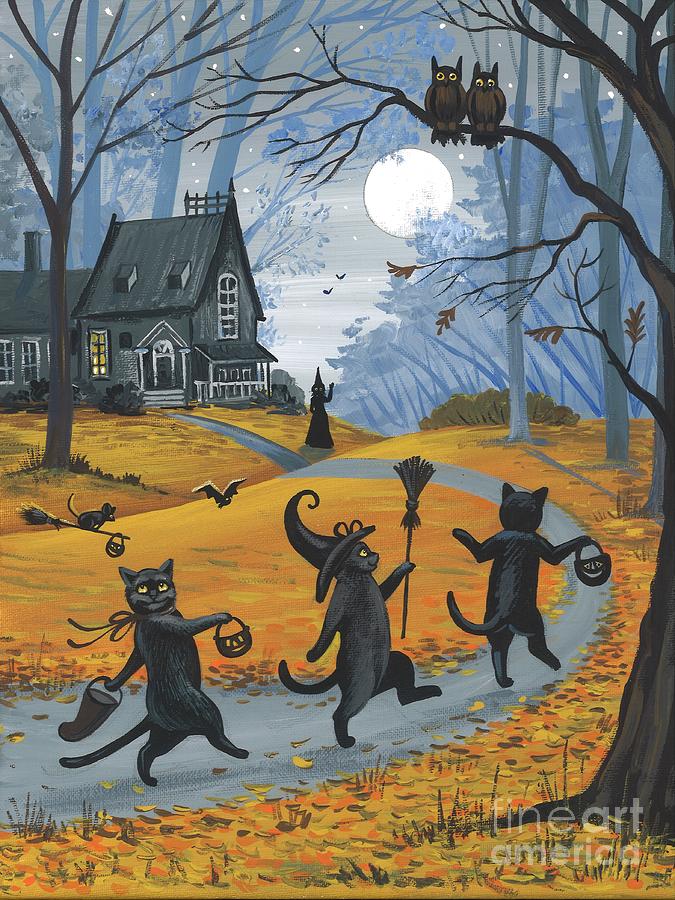
To the witch’s house we go, by Margaryta Yermolayeva
Though Phillips later reconsidered his fealty to the GOP, updated versions of the “southern strategy” live on in today’s Republican Party, shaping the political world we inhabit today. So I asked historians and political theorists to weigh in on Phillips’s legacy. Their responses have been edited for style and brevity.
Kevin Kruse, historian at Princeton University and co-editor of “Myth America”: Kevin Phillips was a prophet of today’s polarization. He drew a blueprint for a major realignment of American politics that is still with us. For much of the 20th century, Democrats dominated the national scene, because of the reliable support of the “Solid South.”
But the “Negro problem” of the 1960s, Phillips argued, presented Republicans an opportunity to take the South and Southwest, too, a new region he anointed “the Sun Belt.” All they had to do was appeal to the hatreds of White voters there, through racially coded “law and order” appeals.
Phillips, of course, proved correct about the regional realignment. Republicans won every single state in the South in the 1972, 1984, 1988, 2000 and 2004 presidential campaigns. Today, Republicans dominate the region partly because they still employ Phillips’s polarizing politics of resentment and reaction, from complaints about Black Lives Matter to panics about “woke” education. Donald Trump’s continued dominance of the GOP shows that the underlying instinct to exploit division and inflame hatred remains.
Read the rest, including more quotes by experts, at The WaPo.
House Republicans are still in chaos. Yesterday, one of the craziest House reps, George Santos, had an insane freakout in the midst of the Speaker fight.
We’ve all had an extremely long week, as you’re likely aware. On Friday afternoon, George Santos, the New York representative whose tally of alleged federal crimes is now up to 23, was spotted screaming in the hallway of the Longworth House Office Building. It appears Santos — who famously suggested his family was Jewish then revised this to “Jew-ish” — was accosted by pro-Palestinian protesters.
Normally, neither a small protest on Capitol Hill nor George Santos shouting in front of a gaggle of reporters would be all that notable. But there’s the twist: Santos was holding a 2-month-old baby when this all went down….
You probably have a lot of questions right now, as do I. Hartmann doesn’t have any answers. She posted some tweets, but WordPress won’t let me do that anymore. You can read them at NY Mag.
Rep. George Santos (R-NY) had a complete meltdown on Friday afternoon during a tense interaction on Capitol Hill that ended with a man in police custody—and somehow involved a baby.
According to a clip shared by NBC News’ Sahil Kapur, Santos called the man, identified by cops as Shabd Khalsa, “human scum” for asking him questions critical of Israel’s bombings in Gaza….
“You came into my personal space yelling at me,” Santos fumed. “What are you doing about terrorists destroying Israel?” He then sped down a hallway in the Capitol’s Longworth Building, screaming statements condemning Hamas….
Capitol Police said in a statement to The Daily Beast that 36-year-old Khalsa was arrested and charged him with simple assault “after an officer witnessed him have physical contact with a congressional staffer in the Longworth Building.” The staffer was not identified.
A profile on X under the name Shabd Singh, the same name Khalsa gave to reporters, says that he is a former campaign organizer for Sen. Bernie Sanders (D-VT).
He told The Hill that he was Jewish-American and that Santos, who was previously busted falsely claiming to be Jewish, “began yelling at me, essentially framing what I am saying as some sort of antisemitic trope.”
Still no information about the baby. If you’ve heard anything about the origins of the child or what Santos was doing with him/her, please let us know.
As Daknikat wrote yesterday, Insurrectionist Jim Jordon is currently the leading candidate for House Speaker, but he doesn’t yet have the votes to be election, thank goodness.
After a series of setbacks, Republicans ended the week no closer to electing a new speaker as deep internal divisions have left the conference struggling to govern and the House in a state of paralysis.
The chaos within House GOP ranks intensified dramatically over the past several days as the conference has tried and so far failed to find a viable successor to Kevin McCarthy following his unprecedented ouster at the hands of a small faction of hardline conservatives.
Black Cat Halloween, by Iva Wilcox
Rep. Jim Jordan is the new GOP speaker nominee following Majority Leader Steve Scalise’s exit from the race. But the Ohio Republican faces the same kind of grim vote math that doomed Scalise’s speaker bid as Jordan lacks the 217 votes needed to win the gavel in a full House floor vote.
Jordan has the weekend to continue to make his case and attempt to flip holdouts, but he faces a steep uphill battle.
The GOP conference faced whiplash this week after Scalise won an initial vote to become speaker nominee, only to drop out not long after as a result of entrenched opposition to his candidacy. The week ended with another vote, this time to make Jordan the new nominee. But it soon became clear that Jordan also faces a stiff wall of resistance.
The House remains effectively frozen as long as there is no speaker, a dire situation that comes as Congress faces a fast-approaching government funding deadline in mid-November and as crisis unfolds abroad in Ukraine and with Israel’s war against Hamas.
Asked by CNN’s Manu Raju how the entire episode reflects on the GOP, McCarthy said on Friday, “it’s terrible.”
Centrists are signaling they’re open to a deal. Democrats are outlining terms. With no speaker in sight yet, House Republicans are ramping up their discussions about a way to reopen the chamber.
A bipartisan solution to the GOP’s leadership chaos still sounds farfetched to most on the Hill — but then, so does the idea that Rep. Jim Jordan (R-Ohio) might overcome his dozens of skeptics and win a floor vote early next week.
There’s just one problem with the idea that a temporary compromise could get the House back to legislative business: It has the same issue that plagued the speakership bids of Kevin McCarthy, Steve Scalise and now Jordan. Right now, no solution has the near-unanimous House Republican support that’s required to pass on the floor.
Which means that, unless Jordan can overcome his skeptics and push to victory on the floor in the next several days, the only way forward might be with Democrats. A group of centrist Democrats wrote to Acting Speaker Patrick McHenry (R-N.C.) on Friday to propose a limited agenda and some perks for the opposing party in exchange for temporarily restarting House business during a time of global crisis.
Some self-described GOP pragmatists have suggested that if Republicans can’t chart a course on their own, they could cut a deal with Democrats to break the 10-day impasse.
“At some point we have to do a bipartisan deal. I mean, they don’t want to acknowledge it, but these guys do not want to govern,” Rep. Don Bacon (R-Neb.) said of his own party’s conservatives.
But as desperation creeps into the GOP while Jordan pushes to lock down the gavel, it’s clear that any attempt to further empower a caretaker speaker would fall short within their own party. McHenry has indicated that his future role as acting speaker is up to his colleagues to settle — even as the Nov. 17 shutdown deadline draws closer and Israel seeks U.S. aid — but his fellow Republicans simply can’t agree on anything.
Read more at the link above.
I suppose I have to include some news from the war between Israel and Hamas. (BTW, is it just me, or has the Ukraine war completely disappeared from the media?)
A blast has struck a convoy on an evacuation route in Gaza, killing a number of people including several children, after a stark deadline ahead of a possible Israeli ground assault.
The IDF told civilians in and around Gaza City Friday that they must move south to avoid being caught up in Israeli military operations and announced a six-hour evacuation window on Saturday.
Black Cat at Halloween, by Daniel Eskridge
Israel has massed troops and military equipment at the border with Gaza, and continued bombarding the densely populated territory in response to the deadly October 7 attacks by the Islamist militant group, Hamas.
Videos authenticated by CNN showed a scene of extensive destruction following Friday’s blast on Salah Al-Deen street. A number of bodies, including those of children, can be seen on on a flat-bed trailer that appears to have been used to carry people away from Gaza City. There are also a number of badly burned and damaged cars.
It’s unclear what caused the widespread devastation. CNN has reached out to the IDF for comment on any airstrikes in the same location.
Even before the evacuation warning, more than 400,000 Palestinians had already been internally displaced by the past week of fighting as conditions worsen inside the bombarded strip.
But the evacuation statement and the prospect of a potential incursion have been sharply criticized by rights groups, including the UN Office for the Coordination of Humanitarian Affairs (OCHA) head, who warned that such a move could bring “catastrophic humanitarian consequences.”
As Israel engages in a massive air campaign ahead of an anticipated full-scale ground invasion of the Gaza Strip, Israeli President Isaac Herzog said on Friday that all citizens of Gaza are responsible for the attack Hamas perpetrated in Israel last weekend that left over 1,200 people dead.
“It is an entire nation out there that is responsible,” Herzog said at a press conference on Friday. “It is not true this rhetoric about civilians not being aware, not involved. It’s absolutely not true. They could have risen up. They could have fought against that evil regime which took over Gaza in a coup d’etat.”
When a reporter asked Herzog to clarify whether he meant to say that since Gazans did not remove Hamas from power “that makes them, by implication, legitimate targets,” the Israeli president claimed, “No, I didn’t say that.”
But he then stated: “When you have a missile in your goddamn kitchen and you want to shoot it at me, am I allowed to defend myself?”
At another point in the press conference, Herzog presented a different perspective, saying, “Of course there are many, many innocent Palestinians who don’t agree to this — but unfortunately in their homes, there are missiles shooting at us, at my children.”
Ghost Cat, by Neocale at Deviant Art
Herzog’s comments follow Israel’s announcement that it had directed the 1.1 million residents of northern Gaza to evacuate, likely ahead of a ground invasion. Israel dropped thousands of flyers over northern Gaza and left voice messages on Friday directing people to leave their homes and flee south.
Human rights groups and the United Nations denounced the evacuation order.
“The United Nations considers it impossible for such a movement to take place without devastating humanitarian consequences,” Stéphane Dujarric, spokesman for the UN secretary-general, said in a statement. “The United Nations strongly appeals for any such order, if confirmed, to be rescinded avoiding what could transform what is already a tragedy into a calamitous situation.”
“Ordering a million people in Gaza to evacuate, when there’s no safe place to go, is not an effective warning,” Clive Baldwin, senior legal advisor to Human Rights Watch, said in a statement. “World leaders should speak up now before it is too late, he added.
Documents exclusively obtained by NBC News show that Hamas created detailed plans to target elementary schools and a youth center in the Israeli kibbutz of Kfar Sa’ad, to “kill as many people as possible,” seize hostages and quickly move them into the Gaza Strip.
The attack plans, which are labeled “top secret” in Arabic, appear to be orders for two highly trained Hamas units to surround and infiltrate villages and target places where civilians, including children, gather. Israeli authorities are still determining the death toll in Kfar Sa’ad.
The documents were found on the bodies of Hamas terrorists by Israeli first responders and shared with NBC News. They include detailed maps and show that Hamas intended to kill or take hostage civilians and school children.
One page labeled “Top Secret” outlines a plan of attack for Kfar Sa’ad, saying “Combat unit 1” is directed to “contain the new Da’at school,” while “Combat unit 2” is to “collect hostages,” “search the Bnei Akiva youth center” and “search the old Da’at school.”
Another page labeled “Top Secret Maneuver” describes a plan for a Hamas unit to secure the east side of Kfar Sa’ad while a second unit controls the west. It says “kills as many as possible” and “capture hostages.” Other orders include surrounding a dining hall and holding hostages in it.
The detailed plan to attack Kfar Sa’ad is part of a trove of documents that Israeli officials are analyzing, according to one source in the Israeli army and one in the government. Surveillance video of Hamas terrorists entering a kibbutz on Oct. 7 shows tactics similar to those laid out in the documents obtained by NBC News.
The Israeli officials said that the wider group of documents show that Hamas had been systematically gathering intelligence on each kibbutz bordering Gaza and creating specific plans of attack for each village that included the intentional targeting of women and children.
The judge presiding over the upcoming damages trial against Rudy Giuliani said Friday she will tell jurors that the former Trump lawyer intentionally hid financial documents and other records in defiance of court orders.
Vlad Vampire Cat, by Carrie Hawks
In a five-page ruling, U.S. District Judge Beryl Howell said the move was necessary given “Giuliani’s continued and flagrant disregard of this Court’s August 30 Order that he produce financial-related documents concerning his personal and his businesses’ past and present assets” and other pertinent information.
That means jurors deciding how much Giuliani should pay two Georgia election workers he defamed will be told they can assume the worst about why the former New York City mayor has failed to turn over the court-ordered records.
“The jury will be instructed that it must, when determining an appropriate sum of compensatory, presumed, and punitive damages, infer that defendant Giuliani was intentionally trying to hide relevant discovery about the Giuliani Businesses’ finances for the purpose of shielding his assets from discovery and artificially deflating his net worth,” the judge wrote.
Additionally, Giuliani and his lawyer will be prohibited “from making any argument, or introducing any evidence, stating or suggesting that he is insolvent, bankrupt, judgment proof, or otherwise unable to defend himself” since he failed to hand over evidence that would show that’s true, the judge wrote.
You might be forgiven for thinking it’s been a very quiet few months for the Covid-19 pandemic. Besides the rollout of new boosters, the coronavirus has largely slipped out of the headlines. But the virus is on the move. Viral levels in wastewater are similar to what they were during the first two waves of the pandemic. Recent coverage of the so-called Pirola variant, which is acknowledged to have “an alarming number of mutations,” led with the headline “Yes, There’s a New Covid Variant. No, You Shouldn’t Panic.”
Even if you haven’t heard much about the new strain of the coronavirus, being told not to panic might induce déjà vu. In late 2021, as the Omicron variant was making its way to the United States, Anthony Fauci told the public that it was “nothing to panic about” and that “we should not be freaking out.” Ashish Jha, the Biden administration’s former Covid czar, also cautioned against undue alarm over Omicron BA.1, claiming that there was “absolutely no reason to panic.” This is a telling claim, given what was to follow—the six weeks of the Omicron BA.1 wave led to hundreds of thousands of deaths in a matter of weeks, a mortality event unprecedented in the history of the republic.
Indeed, experts have been offering the public advice about how to feel about Covid-19 since January 2020, when New York Times columnist Farhad Manjoo opined, “Panic will hurt us far more than it’ll help.” That same week, Zeke Emanuel—a former health adviser to the Obama administration, latterly an adviser to the Biden administration—said Americans should “stop panicking and being hysterical.… We are having a little too much [sic] histrionics about this.”
This concern about public panic has been a leitmotif of the Covid-19 pandemic, even earning itself a name (“elite panic”) among some scholars. But if there’s one thing we’ve learned, three and a half years into the current crisis, it’s that—contrary to what the movies taught us—pandemics don’t automatically spawn terror-stricken stampedes in the streets. Media and public health coverage have a strong hand in shaping public response and can—under the wrong circumstances—promote indifference, incaution, and even apathy. A very visible example of this was the sharp drop in the number of people masking after the CDC revised its guidelines in 2021, recommending that masking was not necessary for the vaccinated (from 90 percent in May to 53 percent in September).
As that example suggests, emphasizing the message “don’t panic” puts the cart before the horse unless tangible measures are being taken to prevent panic-worthy outcomes. And indeed, these repeated assurances against panic have arguably also preempted a more vigorous and
urgent public health response—as well as perversely increasing public acceptance of the risks posed by coronavirus infection and the unchecked transmission of the virus. This “moral calm”—a sort of manufactured consent—impedes risk mitigation by promoting the underestimation of a threat. Soothing public messaging during disasters can often lead to an increased death toll: Tragically, false reassurance contributed to mortality in both the attacks on the World Trade Center and the sinking of the Titanic.
Read the rest at The Nation. The gist is that Covid-19 is still out there and still dangerous. Pretending it’s not won’t help us.
That’s my contribution for today. What do you think? What other stories have caught your interest?
Did you like this post? Please share it with your friends:
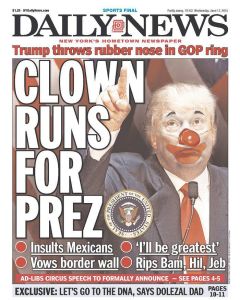
It’s getting to be the ugly season of American politics which makes writing about it and discussing it terrifically unpleasant. Part of the problem is that we rely on a two party system and one of the parties has basically gone off the rails. It’s difficult to imagine the the overall majority of candidates for president in the Republican party today even gaining the least amount of traction around 10-20 years ago or more. Of course, there have been George Wallaces that pop up every now and then, but it seems that we’ve got a bumper crop of them. Meanwhile, the nation’s major newspapers are off chasing imaginary scandals. It’s even harder to believe that the newspapers that printed the Pentagon Papers and chased down the Watergate story might actually finding anything that major and truthful today. They seem more caught up in conspiracy theories and failed opposition research. They don’t even seem to fact check prior to going to press given the recent spate of nothing but speculation that passes as coverage of Hillary Clinton at the NYT.
The ugly faces of both parties are evident in the misogyny aimed at Hillary Clinton and the continuing presence and political viability of showmeister Donald Trump. Trump’s supporters are as filled with ugly thoughts and rhetoric as the master of nasty himself. Alabama is one of those states where being “backwoods” and “backward” are symbols of pride. Along with Texas and Mississippi, it’s one of those states I try to drive through as quickly and low profiled as possible. Trump’s appearance there has brought out the angry, ignorant hillbilly hoards. This is Nixon’s Southern Strategy come full circle. The pictures of the crowd are frightening. Basically, it’s full of love for Jesus and hate for humanity in that mishmash of synapses that come from the brains of the completely deluded.
Trump fans came by the thousands, driving from the Florida panhandle, from Mississippi, from Tennessee and Texas. Traffic was backed up for more than a mile.
On the street, Olaf Childress, a neo-Confederate activist, gave out copies of “The First Freedom” newspaper, which had headlines about “Black-on-white crime,” “occupied media” and “censored details of the Holocaust.”
The most-enthusiastic Trump backers began arriving at the stadium at dawn, hoping to get a spot close to the stage. The first in line were Keith Quackenbush, 54, and Bill Hart, 46, co-workers at a retail giant in Pensacola, Fla.
“I’m telling you, everyone who is a worker at our store, they’re excited about Trump,” Quackenbush said. “I don’t care what race or gender, whatever age — they love Trump. This is a movement.”
Here is the Trump political logic: “Alabama is extremely critical,” a close associate of Trump’s told me (actually, we agreed I’d call him “a close associate of Mr. Trump”). “You have Iowa’s caucus on February 1st, New Hampshire on the 9th, and South Carolina on the 20th.” The race, this associate explained, would not be wrapped up by then. According to this political calculus, the crucial moment arrives three days later, on March 1st, with the “SEC primary”—the belt of Southern states that encompass the Southeastern Athletic Conference—when Alabama, Texas, Georgia, Arkansas and several others hold their primaries.
Trump is currently leading the polls in many of these states. A new Texas poll has him in first place, beating actual Texans Ted Cruz and Rick Perry. He’s dominating the field in Alabama, as well, doubling the support of second-place finisher Jeb Bush, from neighboring Florida. (Trump is winning in Florida, too, according to a new Quinnipiac University poll, which, although it is an SEC state, doesn’t hold its primary until March 15th). If Trump sweeps the early states, or even just wins Iowa and South Carolina, these advisers believe he could effectively lock down the Republican nomination by sweeping the SEC primary on March 1st. “He feels he wins the nomination on 1 March w/ a sweep of the populist anti-establishment South,” another adviser emailed. “That’s when Trump’s ‘nationalism’ coupled with Sessions’ ‘populism’ comes to full fruition.”
The Alabama rally is meant to show that “he’s starting to motivate and cultivate the base there,” the close associate said, and to demonstrate that Trump is putting in place the strategy and structure to actually win the Republican nomination and not just—as some haters surmise—make a big splash in Iowa and then bail out to go cut the ribbon in some new hotel.
Furthermore, Trump believes he has a secret weapon that could help him carry the South. “The other thing people don’t know about Mr. Trump is that his brand and sales are strongest in the South,” the associate told me. “His TV ratings, his Trump Resorts guests. So this [stadium rally] is about bringing the message that he is here to stay, and is the legit frontrunner. This shows a calculated strategy, that he understands the process and understands it’s not going to end in South Carolina. We’re going to bring the message down further into the belt and expand his support.”
Following the release of Trump’s plan, several of his fellow 2016 candidates, including Sen. Ted Cruz of Texas, Louisiana Gov. Bobby Jindal and Sen. Lindsey Graham of South Carolina followed Trump by coming out in favor of the policy Wisconsin Gov. Scott Walker on Friday rolled backstatements that suggested he also favored the policy, saying he had been misunderstood and would not take a position “one way or the other”. Sen. Rand Paul of Kentucky has previously supported birthright citizenship legislation.
“I think he’s done a lot of damage,” says Lynn Tramonte, deputy director of America’s Voice, a pro-immigration reform group. “He’s not only now leading in the polls, but he has the ‘Trump effect,’ pulling other candidates to his position on this issue.”
Democrats pounced, and the party’s congressional campaign arm launched a Twitter ad campaign in six swing states targeting Republicans, including Rep. Mike Coffman of Colorado.
“Republicans, including Mike Coffman, want to end birthright citizenship,” one of the Spanish-language ads said. “Tell @RepMikeCoffman that is wrong.”
The ads also hit Reps. Marthy McSally of Arizona, Steve Knight of California, Barbara Comstock of Virginia, Crecent Hardy of Nevada and Will Hurd of Texas, all of whom represent districts with large Hispanic populations.
Bush, whose past stances on immigration have been more moderate than his party’s, tried to split the difference.
“This is a constitutionally protected right, and I don’t support revoking it,” Bush told reporters in South Carolina on Tuesday.
But while he said he would “just reject out of hand” revoking birthright citizenship, Bush used a term that some consider offensive: “anchor babies,” children born to non-citizen parents who travel to the U.S. specifically to give birth and obtain citizenship for their newborns.
“That’s the legitimate side of this,” he said on conservative talk radio host Hugh Hewitt’s show. “Better enforcement so that you don’t have these, you know, ‘anchor babies,’ as they’re described, coming into the country.”
Bush stood by his comments even as Democrats and immigration activists rained down criticism, saying he “didn’t use it as my own language.”
“Do you have a better term?” he fired back at reporters in New Hampshire. “You give me a better term and I’ll use it.”
Democratic front-runner Hillary Clinton piled on, suggesting several alternatives.
“How about ‘babies,’ ‘children’ or ‘American citizens,” she tweeted. “They’re called babies.”
Still, I am more skeptical of the usual historical skepticism than I have been in a long time. A part of my skepticism flows from my decades inside the belly of the congressional beast. I have seen the Republican Party go from being a center-right party, with a solid minority of true centrists, to a right-right party, with a dwindling share of center-rightists, to a right-radical party, with no centrists in the House and a handful in the Senate. There is a party center that two decades ago would have been considered the bedrock right, and a new right that is off the old charts. And I have seen a GOP Congress in which the establishment, itself very conservative, has lost the battle to co-opt the Tea Party radicals, and itself has been largely co-opted or, at minimum, cowed by them.
As the congressional party has transformed, so has the activist component of the party outside Washington. In state legislatures, state party apparatuses, and state party platforms, there are regular statements or positions that make the most extreme lawmakers in Washington seem mild.
Egged on by talk radio, cable news, right-wing blogs, and social media, the activist voters who make up the primary and caucus electorates have become angrier and angrier, not just at the Kenyan Socialist president but also at their own leaders. Promised that Obamacare would be repealed, the government would be radically reduced, immigration would be halted, and illegals punished, they see themselves as euchred and scorned by politicians of all stripes, especially on their own side of the aisle.
Of course, this phenomenon is not new in 2015. It was there in 1964, building over decades in which insurgent conservative forces led by Robert Taft were repeatedly thwarted by moderates like Tom Dewey and Wendell Wilkie, until they prevailed behind the banner of Barry Goldwater. It was present in 1976, when insurgent conservative Ronald Reagan almost knocked off Gerald Ford before prevailing in 1980 (and then governing more as a pragmatist than an ideologue). It built to 1994, when Newt Gingrich led a huge class of insurgents to victory in mid-term elections, but then they had to accept pragmatist-establishment leader Bob Dole as their presidential candidate in 1996. And while John McCain in 2008 and Mitt Romney in 2012 were establishment figures, each had to veer sharply to the radical right side to win nominations; McCain, facing a possible revolt at his nominating convention if he went with his first choice for running mate, Joe Lieberman, instead bowed to the new right and picked Sarah Palin.
The Beltway definition of populism is disdainful. When it’s affixed to unexpected movements like the Trump insurgency, it seems to mean little more than a prolonged public tantrum. Looking back at recent pundit-diagnosed outbreaks of the populist bacillus, one sees it dubiously attached to causes as different as the drawling “Two Americas” stump speeches of John Edwards, and the America First culture-war candidacies of Pat Buchanan. Going further back, historians and pundits have spied populism everywhere from the racist shade of George Wallace and other stiff-necked Southern segregationists, to the red-baiting career of Joseph McCarthy, to the redistributionist reign of Huey Long in New Deal Louisiana. Still further back, populism has been detected in such 19th-century figures as its great Gilded Age avatar William Jennings Bryan and Andrew Jackson.
It’s tempting to dismiss populism as an epithet deployed by the power elite—a label that members of our political class slap on something popular that they also deem threatening. But there’s more to it than that. The populist movement of the late 19th century, for instance, was grounded in economic grievances, with leaders like Bryan seeking to unite the nation’s producing classes—farmers, small-town businessmen and urban workers—who thought they could overthrow the industrial age’s regime of market cartels, debt peonage and degraded wage labor.
But populism, during the farmers’ revolt of the 1890s, was also a cultural insurgency—a kind of self-administered political wake for the beleaguered middle American Protestant soul, newly adrift in an urbanized, capitalist nation of immigrant laborers and international bankers, and yearning for the folk egalitarianism of an idealized Jeffersonian republic. This is how populism has come to double as a synonym for modern cultural conservatism. Historian Richard Hofstadter famously branded the Gilded Age agrarian uprising as a precursor to McCarthyism: an outpouring of economic resentments that gave aggrieved farmers license to scapegoat any and all available elites—Jewish bankers, British titans of industry, American robber barons—for their declining cultural influence.
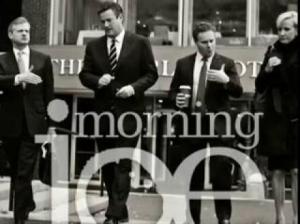
Trump is an unlikely populist because he subscribes to so few positions associated with the cultural side of conservative populist revolt. Before his plunge into the 2016 race, he hadn’t taken a hard-line stance against gay marriage and reproductive rights; and as a twice-divorced, one-time Manhattan playboy, he’s anything but a poster boy for family values. While all the Republican candidates denounce Obamacare, including Trump, and all have plans to expand coverage, Trump is the most liberal sounding. On the pundit altar of Morning Joe he praised single-payer Canada as a system that works but said America needs a private health insurance. “You can’t have a guy that has no money, that’s sick, and he can’t go see a doctor, he can’t go see a hospital,” Trump recently told conservative radio talk show host John Fredericks. Trump added that even if his position costs him support in the GOP primaries, “you have to take care of poor people.”
And yet GOP primary voters have flocked to the early Trump boom. A recent CNN poll indicates that 53 percent of GOP voters feel their views aren’t represented well in Washington—virtually double the 27 percent of Democrats agreeing with that idea. (Never mind that the federal government that so rankles Republican voters is now overrun with Republican leaders—populists often lay into their ideology with the greatest enthusiasm.) Among those saying they want Trump to continue his primary run, CNN also found, are “those seen as the core of the GOP primary electorate: 58 percent of white evangelicals, 58 percent of conservatives and 57 percent of Tea Party supporters.”
Look at those stats. White Evangelicals? I guess we’ve learned about their massive ability to support guys with multiple wives and sins since so many of their men are outright pervs and lawbreakers. This may be the first political season that I truly wish I could avoid. This is exhibit one for that rationale.
“Donald Trump is telling the truth and people don’t always like that,” said Donald Kidd, a 73-year-old retired pipe welder from Mobile. “He is like George Wallace, he told the truth. It is the same thing.”
If that doesn’t get you running for the nearest distraction, check this out.
What’s on your reading and blogging list today?
Did you like this post? Please share it with your friends:
The combination of low voting patterns and big money in politics is finally coming to an ugly fruition. The plan was all laid out in the Powell memo of 1971. Its leaking to Jack Anderson will probably be remembered as one of the last acts of a press free of uber-corporate ownership and manipulation. It was also the beginning of the framework that ultimately led to the Citizen’s United case 5 years ago establishing a freedom of speech right for corporations best encapsulated by Mitt Romney’s famous gaffe in Iowa of “Corporations are people, my friend”.
Though Powell’s memo was not the sole influence, the Chamber and corporate activists took his advice to heart and began building a powerful array of institutions designed to shift public attitudes and beliefs over the course of years and decades. The memo influenced or inspired the creation of the Heritage Foundation, the Manhattan Institute, the Cato Institute, Citizens for a Sound Economy, Accuracy in Academe, and other powerful organizations. Their long-term focus began paying off handsomely in the 1980s, in coordination with the Reagan Administration’s “hands-off business” philosophy.
Most notable about these institutions was their focus on education, shifting values, and movement-building — a focus we share, though often with sharply contrasting goals.* (See our endnote for more on this.)
So did Powell’s political views influence his judicial decisions? The evidence is mixed. Powell did embrace expansion of corporate privilege and wrote the majority opinion in First National Bank of Boston v. Bellotti, a 1978 decision that effectively invented a First Amendment “right” for corporations to influence ballot questions. On social issues, he was a moderate, whose votes often surprised his backers.
The combination of the Southern Strategy, the business interests behind the Powell Memo, and the insipid and wrongly labelled “Moral Majority” has created an unholy trinity of neoconfederates, billionaire plutocrats, and christianist extremists that now drive the Republican Party. We now have a SCOTUS and majority in Congress set to undo many of the advances of the late 20th century. A lot of this came from the mind of Nixon and his cronies.
… Democrats were expanding rights while the Republicans wanted to narrow them or keep them restrictive.
This realignment did not exactly start with Nixon or end with him. Barry Goldwater had voted against the 1964 Civil Rights Act (although he had supported other civil rights bills), but the GOP in general then was unencumbered by a Southern constituency and its leadership often favored civil rights.
After Nixon, though, there was no turning back. In 1980, Ronald Reagan — ever the innocent — went to Mississippi and the Neshoba County Fair to tastelessly proclaim his belief in “states’ rights.” Nearby, three civil rights worked had been killed just 16 years earlier, protesting one of those bogus rights — the right to segregate the races. Reagan never acknowledged any appeal to racism. Racists took it as a wink anyway.
At one time, a good many African-Americans voted Republican — the party of Lincoln, after all. Jackie Robinson initially supported Nixon , as did Joe Louis. The former heavyweight champion had even supported a Republican in the 1946 congressional campaign against Rep. Helen Gahagan Douglas, a liberal civil rights advocate, whose California district was substantially black. As late as the 1970s, there were African-American enclaves in Maryland that voted Republican.
The damage Nixon did to his own party, not to mention the rights of African-Americans and the cause of racial comity, has lasted long after the stench of Watergate has dispersed. It not only persuaded blacks that the Republican Party was inhospitable to them, but it in effect welcomed racists to the GOP fold. Dixiecrats moved smartly to the right.
Excuse me for extrapolating, but segregationists are not merit scholarship winners. Racism is dumb, and so are racists. The Democratic Party showed racists the door.
The GOP welcomed them and, of course, their fellow travelers — creationists, gun nuts, anti-abortion zealots, immigrant haters of all sorts and homophobes. Increasingly, the Republican Party has come to be defined by what it opposes and not what it proposes. Its abiding enemy is modernity.
The first death knell of democracy was probably the undoing of the Fairness Doctrine followed closely by the demonization of labor via the busting of the Air Traffic Controller’s Union. There are a lot of reasons why the FCC should try to bring it back. The primary one I can think of is the disservice the Fox Propaganda network does to the country in terms of Science and truth. There was some paranoia in the right wing last year that the FCC was thinking about a Fairness Doctrine 2.0.
Under the controversial doctrine, which the FCC abandoned in 1987 and formally took off the books in 2011, the agency required radio and TV stations to air opposing views on controversial issues.
Pai expressed alarm that the FCC could soon start questioning why Fox spends so much time covering the attacks in Benghazi, or why NBC has focused on the controversy over lane closures in New Jersey.
House Republicans made a similar accusation in December, claiming the FCC was working on a “Fairness Doctrine 2.0.”
“Given the widespread calls for the commission to respect the First Amendment and stay out of the editorial decisions of reporters and broadcasters, we were shocked to see that the FCC is putting itself back in the business of attempting to control the political speech of journalists,” Republican members of the House Energy and Commerce Committee wrote in a letter to the FCC.
“It is wrong, it is unconstitutional, and we urge you to put a stop to this most recent attempt to engage the FCC as the ‘news police.’
The controversy stems from a study the agency plans to conduct on “critical information needs.” The FCC is required by law to study ways to eliminate barriers to entry for small media businesses.
Among other things, the agency plans to ask TV journalists about their “news philosophy” and “the process by which stories are selected.” The study will gather data on “perceived station bias” and “perceived responsiveness to underserved populations.” The FCC also wants to examine how local TV stations cover “critical information” such as “economic opportunities” and the “environment”.
A sharply divided US Supreme Court on Wednesday took up a challenge to the Fair Housing Act (FHA) in an action that liberal critics say could gut the major civil rights provision.
At issue in a case from Dallas, Texas, is whether the housing law authorizes lawsuits over racially neutral measures that nonetheless disproportionately impact minority residents.
Liberals support the so-called disparate impact theory of civil rights enforcement, while conservatives warn that such an approach could lead to racial quotas in housing and other areas.
The case has attracted significant attention, with friend-of-the-court briefs filed by various civil rights groups, 17 states, and 20 cities and counties. On the other side, briefs have been filed by a number of conservative groups and business associations, including insurance companies, banks, finance companies, and home builders.
The FHA prohibits anyone from refusing to sell, rent, or otherwise make unavailable a house or apartment to a person because of their race, religion, or national origin. There is no dispute about this aspect of the law.
After the FHA was enacted in 1968, federal courts and agencies began embracing a broader interpretation of the law’s scope, concluding that, in addition to barring intentional discrimination, the statute also authorizes lawsuits when housing decisions disproportionately harm minority groups.
The case before the high court involves a lawsuit challenging decisions by the Texas Department of Housing and Community Affairs in awarding tax credits for low-income housing in Dallas. The Housing Department sought to provide new affordable housing in areas where existing housing was blighted or nonexistent. It sought to do so under race-neutral criteria.
Despite that goal, not everyone was satisfied with the agency’s performance. A Dallas-based group seeking to foster racial integration, the Inclusive Communities Project, sued the Housing Department because it said the agency had failed to provide adequate opportunities for low-income housing in Dallas’ more affluent suburbs.
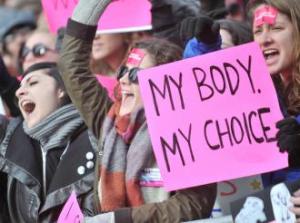
It’s one thing to campaign on stopping abortion—it has been a largely successful GOP plank since Roe v. Wade, and one that helped create a juggernaut connection between evangelical Christians and the Republican Party. (Yes, there have been occasional hiccups.) But it’s a different and more complicated matter to actually institute sweeping restrictions successfully.
Republicans have sought for years to ban abortions after 20 weeks. (Molly Redden has a definitive history.) The House GOP has been trying directly for the last few years, but each attempt has come to nought. Besides, even a successful House bill would have run into the Democratic Senate. But with a newly enormous majority in the House and a newly minted majority in the Senate, Republicans finally had a chance to get a bill to the president. While Obama would surely reject it, it would be a powerful political gesture and please the party’s pro-life allies. Even better, they had the opportunity to schedule the vote to coincide with the March for Life in Washington on Thursday.
They almost made it, but then the GOP coalition fell apart—not on wavering opposition to abortion overall, but on the technicalities. Like many such proposals, the bill would have allowed for exceptions in a few limited cases, such as rape. This bill made rape an exception, but only if a woman reported it to law enforcement. As Ed O’Keefe reports, that set off alarms for a bloc of female Republican lawmakers. They worried that the rape-reporting restriction was too strict, and that the bill would alienate young voters and women from the party. And so Wednesday evening, GOP leaders abruptly yanked the bill. Instead, the House passed a less restrictive bill Thursday, permanently banning federal money from going to pay for abortions. A ban already exists, but it has to be renewed every year.
The vise in which the party finds itself is easy to understand but hard to loosen. On the one hand, the party’s religious base has worked hard for Republicans and expects to see results, and most elected officeholders are personally pro-life. (Pulling the bill when thousands of the most fervent pro-lifers are in Washington must be an especially bitter pill for leaders.) But everyone knows the GOP faces a demographic time bomb, since its voters are older and whiter and more pro-life than the general population, so it’s risky to do anything that might make it harder to win them over.
North Carolina’s Renee Ellmers, one of the prominent dissenters in this case and now a target for grassroots conservative fury, is no swing-district moderate. She won reelection in November by defeating American Idol also-ran Clay Aiken by a whopping 18 points. Ellmers removed her name as a sponsor, then said she would vote for the bill—but still requested that no vote be held until concerns could be addressed.
It’s a surprising and little-known fact that opinions about abortion have barely budged in the American public in the 42 years since Roe. As Karlyn Bowman and Jennifer Marsico wrote for The Atlantic, despite years of heated debate, a slight majority of Americans still consistently back legal abortion, even as they personally oppose it. The GOP has found great success at enacting restrictions in states it dominates.
In sum, some Republican women basically shamed the House into dropping the vote for the bill, mostly because they’re worried it’s going to kick off another “legitimate rape” debacle as male Republicans go on cable TV to brag about the bill and are asked to explain why they only allow for rape exceptions if the victims have reported to the police.
What’s really amazing about this story is that Rep. Renee Ellmers and other female Republicans were pretty much guaranteed to support the bill if the male Republicans allowed for what is really a minor tweak in the language, allowing the rape exception to cover all rape victims, not just the minority that file police reports. After all, this bill is just a symbolic gesture, a wet kiss to the Bible-thumpers amassing on the Hill today for the annual rite of lady-hating sex phobia known as the March for Life. Obama was going to veto it anyway. They had nothing to lose by expanding the definition of “rape” to mean any time a man forces sex on a woman. In fact, they should have welcomed the change, because the original language would have meant reporters asking male Republicans why they require women to file police reports to be believed, which in turn means someone was bound to start talking about “legitimate rape”. Ellmers is hardly some kind of political genius. It doesn’t take a rocket scientist to see where this was headed.
So I’m forced to conclude the reason that so many male Republicans were unwilling to concede this teeny weeny issue is that it was really important to them to pass a bill that formally suggests that women frequently lie about being raped and should be assumed to be lying until a man, in this case a police officer, blesses her account of what happened.
It would be easy to see all of this as the last vestiges of old, white male privilege. Afterall, the news is full of things like this: “A Shocking Number of Americans Under 30 Have No Religion — This Country Is Going to Change.” Again, I keep hoping that we’ll be able to dance on the graves of the Koch Brothers, Pat Robertson, Antonin Scalia, Phyliss Schafly and the like and that it will all go away. Still, it took like 40 years for them to undo so many things. It seems like it will take longer than that to put it all back together again and actually make progress.
And as the Keystone Pipeline Boondoggle snakes its way through this very corrupt Congress, we get news of two pipeline disasters. The first one is in Montana.
A second large oil spill into Montana’s Yellowstone River in less than four years is reviving questions about oversight of the nation’s aging pipeline network.
Investigators and company officials on Wednesday were trying to determine the cause of the 40,000-gallon spill that contaminated downstream water supplies in the city of Glendive.
Sen. Jon Tester said Saturday’s spill from the decades-old Poplar Pipeline was avoidable, but “we just didn’t have the folks on the ground” to prevent it.
The Montana Democrat told The Associated Press more frequent inspections by regulators are needed, and older pipelines should face stricter safety standards.
“We need to take a look at some of these pipelines that have been in the ground for half a century and say, ‘Are they still doing a good job?'” Tester said.
The latest spill comes as Republicans and some Democrats, including Tester, want the Obama administration to approve TransCanada’s Keystone XL pipeline from Canada to the Gulf.
Keystone would cross the Yellowstone roughly 20 miles upstream of the Poplar Pipeline spill.
Almost 3 million gallons of saltwater drilling waste spilled from a North Dakota pipeline earlier this month, a spill that’s now being called the state’s largest since the North Dakota oil boom began.
The brine, which leaked from a ruptured pipeline about 15 miles from the city of Williston, has affected two creeks, but it doesn’t currently pose a threat to drinking water or public health. The pipeline’s operator — Summit Midstream Partners — discovered the spill on Jan. 6, but officials didn’t find out about the true size of the spill until this week.
The pipeline company has been trying to clean up the spill by vacuuming water from the creek, but in doing so, they’re also capturing a lot of fresh water.
“The problem is that … the creekbed is kinda being replenished with water so we extract, it fills; we extract, it fills,” John Morgan, a spokesman for Summit Midstream told the Grand Forks-Herald.
North Dakota Department of Health Environmental Health Section Chief Dave Glatt said he hasn’t seen any impacts to wildlife yet, but officials won’t likely know the full impact until all the ice melts. Officials have discovered chloride concentrations in Blacktail Creek as high as 92,000 milligrams per liter — far higher than normal concentrations of about 10 to 20 milligrams per liter.
“That has the ability to kill aquatic life and so we’ll want to see if the aquatic life was able to get out of the way, and if they weren’t, how badly they were impacted,” Glatt said.
Greed, religious extremism, and bigotry! Say hello to SCOTUS and the new Congress!
I find all of this very, very depressing. What’s on your reading and blogging list today?
Did you like this post? Please share it with your friends:
Or maybe he got someone else to read it for him? In any case, the New York Times Sunday Book Review asked Joe Scarborough to review a serious book of political history, Ike and Dick: Portrait of a Strange Political Marriage. in the February 17, 2013 edition.
How low has the Sunday Book Review sunk that it would not only publish an essay by Scarborough, but also highlight the brief review with a separate “Up Front” introduction? I haven’t seen the cover of the print edition, but it sounds as if Scarborough’s piece was printed on page 1!
…let us pause for a moment and congratulate the editors of The New York Times Book Review for handing a serious work of popular history to whatever’s left of Joe Scarborough after Paul Krugman picks the rest out from between his teeth….
the Review has fallen on some pretty hard times when they have a story meeting and someone says, “We got this new book on Eisenhower and Nixon. Who should we get to review it?” And someone else says, “I know. How about that guy who runs the Morning Zoo on MSNBC? He’s really popular with the people who get drunk in front of the TV and pass out during Rachel’s show the night before.” And this is what you get for an author ID.
Joe Scarborough is the host of MSNBC’s “Morning Joe.”
Lovely. They should let Barnicle review the next Royko anthology.
At least Mike Barnicle used to be a working journalist.
If you’re going to try something as cheeky as letting cable blowhard Joe Scarborough review a serious book about political history, you should at least make sure you’ve got a safety net in place. But the New York Times Book Review doesn’t even bother, letting Scarborough step in it repeatedly in his review of Jeffrey Frank’s “Ike and Dick: Portrait of a Strange Political Marriage.”
Here’s the first paragraph of Scarborough’s review:
It may be the closest of political relationships, but it rarely ends well. Vice President Thomas Jefferson challenged President John Adams for the top spot in the vicious campaign of 1800. President Andrew Jackson mused sardonically about executing Vice President John C. Calhoun. In the modern era, Lyndon Johnson seethed at slights real and perceived during John Kennedy’s thousand days, then turned around and humiliated his own vice president, Hubert Humphrey. Even Dick Cheney and George W. Bush fell out by the end of their tumultuous terms. But perhaps the most intriguing — and dysfunctional — political marriage in history was the one between the subjects of Jeffrey Frank’s meticulously researched “Ike and Dick.”
Kennedy wonders if Scarborough knows that
the Constitution originally stipulated that the candidate who received the most votes from the Electoral College would become president and that the person who came in second would become vice president. Perhaps that’s too much math for the famously innumerate Scarborough.
I didn’t know that either, but I think if I were writing a review for the New York Times, I would have found out before using that as my introduction. Kennedy explains that Jefferson and Adams, who couldn’t stand each other, ran against each other in 1796. Adams got more electoral votes and so they were forced to serve together, but their mutual dislike did not grow out of their political alliance as Scarborough implies.
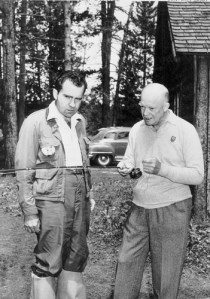
Ike and Dick fishing at Camp David
Kennedy points out two other more serious misstatements in the review. In the paragraph above, Scarborough suggests that Lyndon Johnson’s insecurities stemmed from Jack Kennedy’s mistreatment and that led Johnson to humiliate his own Vice President Hubert Humphrey. Scarborough isn’t really clear about this, but he seems to be drawing analogies to the Eisenhower-Nixon relationship. He seems to claim–perhaps based on his reading of Frank’s book–that Nixon’s neuroses stemmed from his difficult relationship with Eisenhower. But Nixon was a psychologically troubled person long before he met Ike and suggesting otherwise is inaccurate. Likewise, Johnson had plenty of psychological issues before he got involved with Jack Kennedy. Dan Kennedy writes:
As anyone who’s read Robert Caro’s “The Passage of Power” knows, Johnson, like Nixon, suffered from a world-class case of insecurity long before he ever met John Kennedy. The truth is the opposite of what Scarborough claims: both Nixon and Johnson were uniquely unsuited to suffer the slights that are inherent to the vice presidency long before they assumed the office.
Finally, Kennedy points out the ludicrousness of the following passage from the Scarborough piece:
A fascinating subplot in Frank’s story details Nixon’s role in pushing the administration on the issue of civil rights. Long criticized as the author of the Republican Party’s racially tinged “Southern strategy,” Nixon is shown by Frank to be a determined advocate for the Civil Rights Act of 1957, as well as a trusted ally of Martin Luther King Jr. and Jackie Robinson.
Yes, Nixon was supportive of Martin Luther King during the 1950s, and did try to get Eisenhower to push for African American civil rights, but Scarborough completely ignores Nixon’s later rejection of King during the 1960 presidential campaign and his [Nixon’s] development of the “Southern Strategy” in 1968. If those later events weren’t included in Frank’s book, a competent reviewer would have called attention to them. In fact, if Scarborough had googled, he could have quickly found an article by Franks himself that points out Nixon’s later involvement in blatant racism. Franks writes in The Daily Beast, January 21, 2013:
There once was a real connection between the two men, but it more or less ended with RN’s spineless behavior during the 1960 presidential campaign, after Dr. King was arrested on phony charges stemming from a traffic violation. Coretta Scott King had been terrified; she worried with good reason that her husband might be killed en route to Georgia State Prison in Reidsville, and she appealed to the Nixon and John F. Kennedy campaigns to intervene.
Nixon, however, demurred; he said that it would be “grandstanding” to speak out, according to his aide William Safire. Nixon’s real motive, though, seems clear: it was a close election and he was willing to lose black support if it meant gaining a new harvest of white votes in the once-Democratic south. Eight years later, this approach became the carefully considered “Southern strategy.”
The Kennedy brothers then stepped in to help King.
John and Robert Kennedy helped to win Dr. King’s release, and soon enough their campaign distributed two million copies of a pamphlet titled “‘No Comment’ Nixon Versus a Candidate With a Heart, Senator Kennedy” to well chosen voters. It can’t be proved that this made the difference in an election in which the popular vote turned out to be the closest ever (Nixon and Kennedy were separated by about 112,000 votes out of sixty-nine million cast), but it’s a fact that President Eisenhower in 1956 got some 40 percent of the black vote and that Nixon in 1960 won just 32 percent—not bad by modern Republican standards, but still a steep drop. Four years later, facing Barry Goldwater, Lyndon Johnson won 94 percent of the black vote, which set a demographic pattern that endures.
We already knew that Morning Joe doesn’t understand economics; we now know he’s history-challenged as well. In addition, I have some problems with the clarity of his writing. Here are a couple of examples.
Paragraph 2 begins:
Franklin Roosevelt’s vice president memorably said that being No. 2 was in effect not worth a bucket of warm spit.
Which vice president? FDR served with three: Henry A. Wallace, John Nance Garner, and Harry S. Truman. If you said John Nance Garner, you’re correct. And he didn’t qualify the judgment with “in effect” either. Was Scarborough just to lazy to look up the quote?
This reminds me of problems that many college freshmen have in their writing–they either don’t provide enough context or they assume knowledge the reader may not have. They also tend to use unnecessary qualifications instead of just making straightforward statements.
In paragraph 3, Scarborough writes:
“Ike and Dick” is a highly engrossing political narrative that skillfully takes the reader through the twisted development of a strange relationship that would help shape America’s foreign and domestic agenda for much of the 20th century.
Really? Perhaps that judgment came from the book; but it’s a pretty sweeping statement that needs to be backed up with specific examples. But Scarborough doesn’t offer any. When he does provide more context, as he does in paragraph 5, he leaves out important details. He briefly mentions a “secret Nixon fund” that led to Eisenhower trying to dump Nixon from the ticket in 1952, and says that Nixon survived; but Scarborough never even mentions what saved him–the Checkers speech!
The entire review is only a little over 1,000 words. Surely Scarborough could have added a few more historical details and specific examples to back up his assertions.
If I were grading this review for a college course, I’d probably have to give it a C+, or maybe a B- in these days of grade inflation. The grammar and sentence structure are okay; but the review itself is short on context, the historical inaccuracies are problematic, and the lack of specific examples makes for rather boring reading. Frankly, I’m disappointed in the New York Times for publishing it.
Did you like this post? Please share it with your friends:
Over the past few days, Mitt Romney has stepped up his race-baiting with patently false ads focusing on welfare. On Tuesday in a speech in Chillicothe, Ohio, Romney projected his own rage at having his own policies and those of his designated VP criticized onto his critics by lashing out at President Obama with the most vile personal attacks I can ever recall from a candidate for President–normally the attack dog role is reserved for the VP or surrogates. Here are some samples from Romney’s speech:
Republican presidential candidate Mitt Romney on Tuesday delivered a harsh indictment of President Barack Obama’s re-election strategy, accusing the president of running a “campaign of division and anger and hate.”
“His campaign strategy is to smash America apart and then cobble together 51 percent of the pieces. If an American president wins that way, we all lose,” Romney told a crowd of thousands standing outside the Ross County Court House in southern Ohio.
Romney referred to Vice President Joe Biden’s remark to a heavily black audience in Virginia that the Republican ticket wanted to put people “back in chains” by repealing Wall Street regulations. Although he didn’t cite other examples to support his harsh rhetoric, his campaign pointed to the controversial ad that linked Romney to a steelworker’s wife’s death from cancer and an Obama spokeswoman’s suggestion that Romney might have committed a felony if he didn’t tell the truth in federal filings about his activities with his former company.
….
“His campaign and his surrogates have made wild and reckless accusations that disgrace the office of the presidency,” Romney said. “This is what an angry and desperate presidency looks like.”
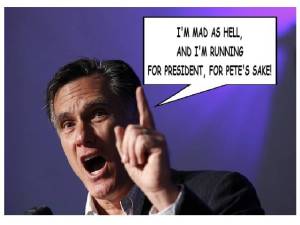
Romney really needs to learn to quit whining and act like an adult. He’s a typical bully–he can dish it out, but he can’t take it. He doesn’t like being reminded that when Bain Capital loaded up companies with debt and drove them into bankruptcy, real people suffered. Well, boo hoo hoo. When you run for President on being a “successful businessman, you shouldn’t be shocked when your opponents examine your business record.
NBC news has more whining from the speech:
“This is an election in which we should be talking about the path ahead, but you don’t hear any answers coming from President Obama’s re-election campaign,” Romney said. “That’s because he’s intellectually exhausted, out of ideas, and out of energy. And so his campaign has resorted to diversions and distractions, to demagoguing and defaming others. It’s an old game in politics; what’s different this year is that the president is taking things to a new low.”
“This is what an angry and desperate presidency looks like,” Romney said. “President Obama knows better, promised better and America deserves better.”
“Over the last four years, this president has pushed Republicans and Democrats about as far apart as they can go,” Romney continued. “And now he and his allies are pushing us all even further apart by dividing us into groups. He demonizes some. He panders to others. His campaign strategy is to smash America apart and then try to cobble together 51 percent of the pieces.”
This from the man who wants to make 95% of Americans pay more in taxes so he can cut the taxes of the top 5%. This from the man who repeatedly called Obama’s ideas “foreign” and whose surrogate John Sununu said Obama needed to “learn to be an American.”
During the primaries when Newt Gingrich complained about the barrage of negative ads run by Romney’s campaign and Romney supporting superpacs, Romney dismissively lecture Gingrich with the old saying “Politics ain’t beanbag.” (h/t Buzzfeed) The relevant quote comes at about the 2:40 mark.
On another occasion, Romney said “there’s no whining in politics.” (h/t Buzzfeed)
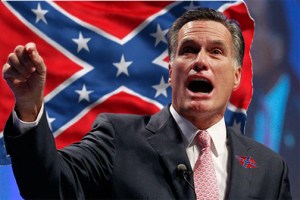
Mitt Romney is running on an updated Southern strategy in which the race and culture baiting is directed not just at African Americans, but also at Muslims, Hispanics, Palestinians, and pretty much anyone who isn’t Caucasian.
Let’s face it, Romney’s false claims that Obama has “gutted welfare reform” are deliberate efforts to appeal to racial bigotry–by emphasizing that Obama is {gasp!} black and to play on the false beliefs of many ignorant people about the racial composition of welfare recipients. Greg Mitchell articulated this pretty well at The Nation:
Just on a factual level, the new charges (which seemed to originate with the right-wing Heritage Foundation) —Obama trying to undermine the work ethic by granting waivers to certain states—fell apart quickly. The White House quickly denounced the meme as “dishonest” and pointed out that two of the five governors who requested the very limited waivers were Republicans. Also (surprise): Romney had backed such waivers as governor.
And this morning, PolitiFact delivered the harshest of its judgements on the ad and campaign statements —”pants on fire,” or one-big-lie. But its conclusion also, if a bit coyly, referred to what may be the most significant, and enduring, aspect of the new Romney focus: “The ad’s claim is not accurate, and it inflames old resentments about able-bodied adults sitting around collecting public assistance.”
What they are obliguely referring to, of course, is the old, long-lasting, portrayal of welfare by conservatives, Southern Democrats and many in the media as (1) mainly for lazy folks who won’t work and (2) mainly a program for black Americans (and other minorities). Facts never got in the way but it was a way to flame racial and class resentments. Nixon put his welfare recipients in Cadillacs and Reagan famously denounced “welfare queens.”
You still heard a lot today about “Reagan Democrats” and the battle between Obama and Reagan for their souls, but few point out that the origin of this subgroup can be traced back at least partly to Reagan’s race-tinged welfare bashing.
Anyone who can’t see what is going on here is either utterly ignorant of American history, is simply being deliberately obtuse, or is OK with this kind of ugly bigotry.
OK, I’ve said my piece. Now I’ll refer you to a few pieces on this topic by other people who expressed these points better than I can.
First, a brief but pithy piece from the Auburn Journal: Romney Revives the Southern Strategy. Referring to the Sununu and Romney statements implying that Obama isn’t “American”:
This kind of language acts as a dog whistle for bigots. It is a more subtle version of birtherism, and reflects the kind of exclusionary definition of American national identity embraced by far too many on the right. It is the exact opposite of Barack Obama’s conception of our national identity, one that emphasizes national unity as well as inclusion, and seeks to strengthen ties among Americans across lines of race, culture, and religion.
When John Sununu said that President Obama was not an American – and make no mistake, that’s what he said – he wasn’t saying anything his boss hadn’t said before. Mitt Romney has made the same kind of remark on too many occasions to be able to deny that his campaign has made a clear decision to do what John McCain refused to do, and what any politician with a sense of honor and patriotism would refuse to do.
Joan Walsh’s family, as she writes in her new book “What’s the Matter With White People? Why We Long for a Golden Age That Never Was,” participated in two of the great migrations of 20th-century American history. Joan was born in Brooklyn, N.Y., but mostly grew up in suburbia (first on Long Island and later in Wisconsin). As that happened she watched many of her Irish-American family members morph from bedrock New Deal-JFK Democrats into Nixon-Reagan Republicans. In her book, Joan tries to wrestle with this legacy as honestly and forthrightly as she can, without betraying either her family’s complicated lived experience or her own passionate commitment to social, racial and economic justice.
“What’s the Matter With White People?” is sure to provoke much discussion during the fall campaign, with its personal and historical approach to one of the most toxic issues in American politics: How and why the white working class became the Republican base, in defiance of its own economic interests, and whether the Democrats can ever win it back.
By now everyone knows that the vice president told a Virginia audience Tuesday that once Mitt Romney “unchains” Wall Street from Dodd-Frank reforms, “They’re going to put you all back in chains.” Since his audience was mainly but not exclusively African-American, the pearl-clutchers in the GOP and media claimed Biden was accusing Romney of wanting to reinstate slavery, denounced him. “The press pounded Palin when she talked about ‘blood libel,’” Ari Fleischer wrote on Twitter. “What will they do about Biden’s ‘chains’ remark?” The Romney campaign likewise tweeted its outrage.
Romney himself attacked the Obama-Biden campaign in multiple interviews. “The president’s campaign is all about division and attack and hatred,” he told CBS, adding, “And the comments yesterday by the vice president I think just diminish the White House that much more.” Even some nominal liberals joined the Biden-bashing. “Of course the GOP has done nasty racial stuff this campaign (esp newt). But Biden’s ‘chains’ statement was still absurd,” Peter Beinart tweeted Wednesday morning. There were widespread demands that the vice president apologize.
But he didn’t. Biden clarified his remarks, noting the frequency with which Republicans use “unchain” and “unshackle” metaphors to describe the way they’d “liberate” Wall Street from Obama-era regulation and reform.
Romney accuses Obama of gutting welfare reform by granting waivers to state governments in how they choose to implement the law. It’s a charge that is completely without merit; spun from whole cloth; an invented attack line. But again, lying on the campaign trail about President Obama’s record is the rule, not the exception, for Mitt Romney.
Among the accusations made by Romney is that under Obama’s non-existent, made-up welfare plan, “you wouldn’t have to work,” “you wouldn’t have to train for a job” because “they just send you a welfare check.”
What’s most striking about the ad are the visuals – workers wiping their brow; working class Americans toiling away at manufacturing jobs. And coincidentally all the people in the ad … are white. This might not mean much, except for the fact that, as anyone who has followed American politics for the past 45 years knows, criticisms of the welfare system from the campaign trail have habitually always been used as racial code in attacks on Democrats for coddling blacks. It is the symbol of wasteful government spending, rewarding poor Americans for not working and creating a culture of dependency.
Since the 1960s, Republican politicians – along with the occasional Democrat – have used assaults on the welfare system to stir up white resentment toward blacks, poor Americans and other minorities for allegedly lazily living off the largesse of hard-working tax-payers, like those visually portrayed in Romney’s ad. That the current President happens to be African-American (and is also visually featured in the ad) is again just another of those odd coincidences.
Indeed, this ad and in fact this whole line of attack is one of the most blatant uses of racial coding in a presidential campaign since the Willie Horton ad of 1988.
It’s nice to see that the corporate media is beginning to call Romney out on his race baiting.
Here’s another example from U.S. News and World Report: Romney’s the angry one, not Obama. Referring to Romney’s Tuesday speech in Ohio:
Obviously Romney has forgotten who his buddies are, and who are pulling his strings: the Republicans who are bending over for the Tea Party and Grover Norquist and for their rich financial campaign backers.
Has Romney forgotten the “diversions and distractions” of those who were questioning the president’s citizenship and place of birth long after he was elected? Has Romney forgotten the “defaming others” like what was done when House Speaker John Boehner said the president hadn’t worked a day in his life?!
….
I must say I was most shocked, although not surprised, by Romney’s accusation of the president “dividing us all in groups.” Isn’t wanting a baby born here of an undocumented immigrant not receiving citizenship divisive? Isn’t not wanting healthcare for the poor divisive? Isn’t wanting to cut programs that benefit middle- and lower-income women and families divisive? Hmm…sounds like Romney and his camp to me more than Obama. And with the addition of Rep. Paul Ryan as Romney’s vice presidential candidate, the race has become more polarized, more—dare I say—divisive?
I’ve focused on Romney/Ryan’s race-baiting strategy in this post, but I know there are lots of other stories I should I read today. I look forward to your suggestions.
Did you like this post? Please share it with your friends:
The Sky Dancing banner headline uses a snippet from a work by artist Tashi Mannox called 'Rainbow Study'. The work is described as a" study of typical Tibetan rainbow clouds, that feature in Thanka painting, temple decoration and silk brocades". dakinikat was immediately drawn to the image when trying to find stylized Tibetan Clouds to represent Sky Dancing. It is probably because Tashi's practice is similar to her own. His updated take on the clouds that fill the collection of traditional thankas is quite special.
You can find his work at his website by clicking on his logo below. He is also a calligraphy artist that uses important vajrayana syllables. We encourage you to visit his on line studio.












 peej
peej Carissa
 bostonboomer
 dakinikat
 ecocatwoman
 mablue2
 Mama Lopez
 peggysue22
 quixote
 skydancingguestblogger
 Mona (aka Wonk the Vote)



 Sky Dancing
Recent Comments